Sample Category Title
XAU/USD: Gold Extends Recovery Despite Sticky US Inflation
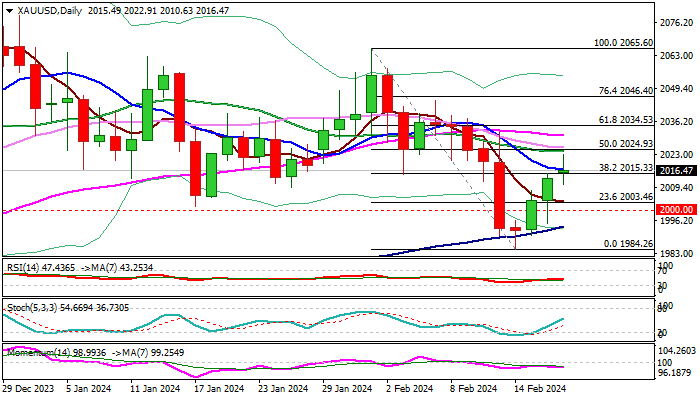
Recovery leg from $1984 (9-week low of Feb 14) extends into third straight day after short-lived probe below psychological $2000 level was contained by 100DMA and Morning Doji Star reversal pattern formed on daily chart.
Although the metal’s price gained pace and established above $2000, caution is still required as 14-d momentum is still in negative territory and a cluster of converged daily moving averages (20/30/55), just above the price (at $2024/30 zone), marks significant obstacle.
Gold price regained ground despite warning of sticky inflation (Friday’s higher than expected PPI numbers further worsened overall picture) and signals of prolonged period of unchanged interest rates, as investors remain optimistic and believe that this is a temporary phenomenon and inflation remains in a steady downward trajectory.
Recovery needs a sustained break above $2030 zone to confirm reversal signal and open way for $2050+ acceleration.
Today’s close above $2015 (cracked Fibo 38.2% of $2065/$1984 bear-leg) to further firm near-term structure, while bulls will be sidelined if the price returns below $2000 level.
Res: 2024; 2030; 2034; 2046.
Sup: 2010; 2000; 1992; 1984.
Sunset Market Commentary
Markets
A quiet weekend, uninspiring overnight Asian dealings, an all but empty economic calendar & US financial markets closed for Presidents’ Day. Those are the poor cards European market were dealt with at the start of the week. It doesn’t come as a surprise, then, to see German yields, the euro and European equities basically flatline. We’ve expanded the New & Views section for the occasion.
News & Views
Headline inflation in Sweden printed at -0.1% M/M and 5.4% Y/Y up from 4.4% (vs 5.0% expected). The preferred measure of the Riksbank, CPIF inflation (fixed interest rate) showed a similar picture (0.3% monthly decline but rebounding from 2.3% Y/Y to 3.3% Y/Y). However, the rise in the Y/Y measure was driven by unfavourable base effects due to a sharp decline in energy prices last year. The Riksbank probably will draw comfort from a further decline in core CPIF inflation excluding energy (-0.5% M/M and 4.4% from 5.3% in December). Monthly details showed a drop in prices for clothing (-8.3%), fuels (-10.8 %), international flights (-23.7%), package holidays (-12.7%) and accommodation services (-4.2%). This was partially counterbalanced by higher electricity prices (5.7% M/M), rents for housing (2.1 %) and interest rate expenses/owner occupied housing costs (1.5%). In its latest monetary policy report (Nov 2023), the RB forecasted CPIF inflation ex energy at 4.5% Y/Y, with the measure expected to return to the low 2% area H2 2024. In the statement after the February decision, the RB indicated that rates could be cut be sooner than initially expected, maybe already in H1. In this respect, the June meeting is/was on the radar. But for that option to materialize, the Fed (and the ECB) probably should be able to start their easing cycle in June (or early) as well. This is less evident after last week’s US data. The Swedish krone gains marginally (EUR/SEK 11.23) but is holding in a ST consolidation pattern between 11.20 and 11.43.
The recent rather sharp weakening of the koruna apparently is becoming a factor of growing importance at least for some members of Czech National Bank MPC. In an interview with Szenamzpravy.cz published on the CNB website, vice Governor Eva Zamrazilova indicated that if the exchange rate remains weaker than the levels expected by the CNB for the medium or longer term, it will have to cut rates at a slower pace. Czech January inflation last week expectedly printed at 1.5% M/M and 2.3% Y/Y (3.0% was expected by the CNB). This sharp slowdown in inflation further raised speculation that the CNB might step up the pace of rate cuts from 50 bps to 75 bps, especially as inflation might drop below the 2.0% target later this year. Last week, governor Michl already argued that while the CNB restored price stability, ongoing high core inflation, a high public deficit and a weaker-than-expected koruna are good arguments for the CNB to lower interest rates only cautiously. In this respect, the bar for 75 bps steps probably remains high. At EUR/CZK 25.45, the koruna is holding near the weakest levels since March 2022.
French Finance Minister Le Maire yesterday brought some bad news regarding the EU’s second-largest economy, lowering this year’s growth forecast to a meagre 1%. Germany’s Bundesbank today issued a similarly depressing message about Europe’s N° 1. Its monthly report projected another economic contraction in the first three months of the year. With the economy having shrunk 0.3% in 2023Q4 it would put Germany in a technical recession. The Bundesbank blamed several factors including uncertainty over fiscal policy since the constitutional court ruling banning the use of off-budget financing vehicles caused a budgetary shockwave reaching in the tens of billions. Economy Minister Habeck last week said this will cripple growth in the updated forecasts (due Wednesday) to just 0.2% this year. The BuBa also highlighted ongoing weak domestic and foreign demand, production hit by train and airport strikes, depleting order books in the industry and construction & dampened investments amid higher borrowing costs. However, the economy should gain traction later this year against the background of a stable labour market and (real) wages rising sharply. The dire message comes ahead of the February PMI’s later this week. These forward looking indicators are projected to still signal an economic contraction (<50) but to improve marginally, extending (manufacturing, from 45.5 to 46) or initiating (47.7 to 48) a bottoming out process, be it an extremely gradual one.
Subdued Trading and Anticipation for RBA Minutes
Activity in the global financial markets are rather muted today, with major European stock indexes reading water within a narrow range. US futures are also showing little change, reflecting the quietness of US market holiday. In the currency sphere, movements are similarly subdued, with Euro and Swiss Franc ranking as the day's weaker currencies followed by Dollar. Kiwi, Aussie, and Yen are having relative strength. Sterling and Swiss Franc find themselves positioned in the middle, presenting mixed performance.
The upcoming Asian trading session, however, promises an uptick in market volatility, with release of RBA minutes highly anticipated. At its February board meeting, RBA maintained official cash rate at 4.35%, aligning with market expectations. Notably, the central bank chose not to abandon its tightening bias. Governor Michele Bullock's stance, that another rate hike remains a possibility but is not definitively on the cards, has sparked keen interest. The forthcoming minutes are expected to shed light on whether an additional hike was seriously considered and the degree of contention surrounding this decision.
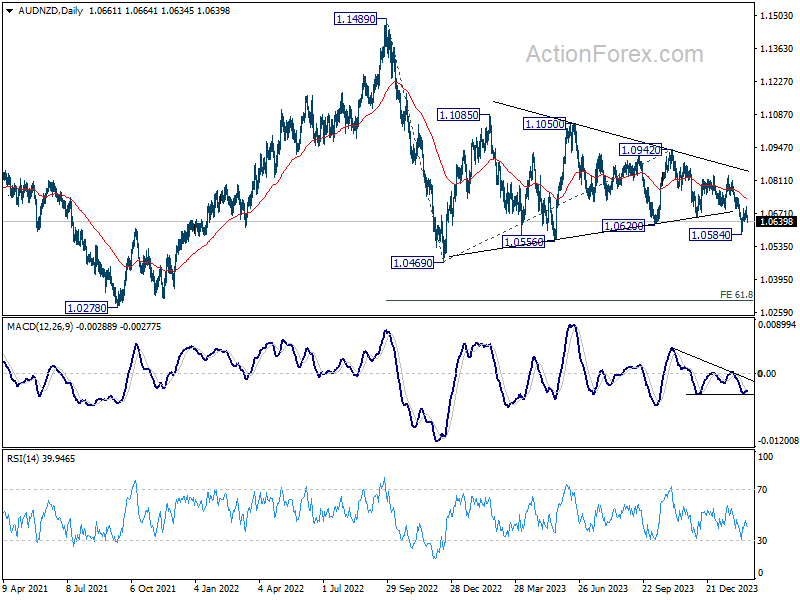
Technically, AUD/NZD recovered after dipping to 1.0584 earlier in the month. But there is no change in the bearish outlook with 55 D EMA (now at 1.0735) intact. Deeper decline is expected and break of 1.0584 will target 1.0469 (2022 low). Firm break there will resume whole down trend from 1.14879 (2022 high).
In Europe, at the time of writing, FTSE is up 0.15%. DAX is down -0.28%. CAC is down -0.19%. UK 10-year yield is down -0.0074 at 4.107. Germany 10-year yield is up 0.009 at 2.417. Earlier in Asia, Nikkei fell -0.04%. Hong Kong HSI fell -1.13%. China Shanghai SSE rose 1.56%. Singapore Strait Times rose 0.12%. Japan 10-year JGB yield fell -0.0004 to 0.730.
Bundesbank: Weak German economy but no significant, broad-based and long-lasting decline
In its latest monthly report, Bundesbank acknowledged that the "weak phase" in the German economy since Russian war of aggression against Ukraine would continue.
Despite this, it stops short of predicting a recession, defining it as a "significant, broad-based and long-lasting decline in economic output."
The report further elaborates, indicating "no signs of an impending noticeable deterioration" in the labor market stemming from the current economic slowdown.
On the inflation front, Bundesbank anticipates continued decline in inflation rates in the coming months, with price pressures on food and other goods expected to ease further. Nonetheless, the report signals slower pace of decline in service sector inflation, attributing this trend partly to "continued strong wage growth."
NZ BNZ services rises to 52.1, springs back to growth
New Zealand's BusinessNZ Performance of Services Index rose from 48.8 to 52.1 in January, marking its highest peak since May 2023. This rebound places the sector back into expansion, albeit slightly below long-term average of 53.4.
Components of the PSI showed notable improvements: activity/sales surged to 53.0 from 47.2, employment edged up to 48.1 from 47.2, new orders/business increased to 51.8 from 50.8, and stocks/inventories rose to 53.5 from 51.7. However, a decrease in supplier deliveries to 48.7 from 50.3 hints at logistical challenges.
Reflecting on the sector's performance, BusinessNZ's chief executive, Kirk Hope, remarked on the "seesaw" trend between expansion and contraction observed in recent months. He highlighted that the sector's sustained recovery hinges on "continued momentum" in business activity and new orders, coupled with alleviation in "cost of living" pressures.
BNZ Senior Economist Doug Steel provided an optimistic outlook, suggesting that the combined PMI and PSI activity indicator hints that "annual GDP growth will soon turn positive." Yet Steel cautioned that further progress is essential to mitigate growing spare capacity within the economy.
USD/JPY Mid-Day Outlook
Daily Pivots: (S1) 149.81; (P) 150.23; (R1) 150.63; More...
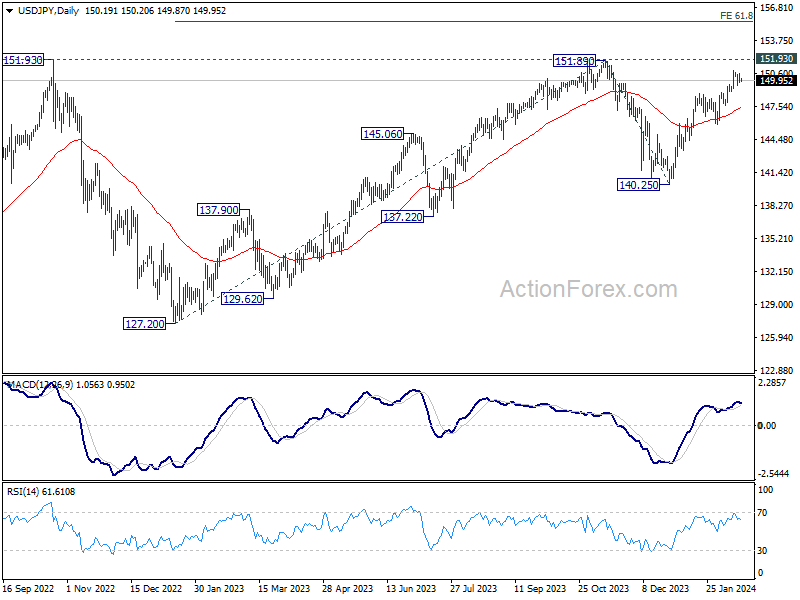
USD/JPY is extending the consolidation from 150.87 and intraday bias remains neutral. Downside of retreat should be contained by 148.79 resistance turned support to bring another rally. Above 150.87 will resume the rise from 140.25 to 151.89/93 key resistance zone. Decisive break there will confirm larger up trend resumption of 155.50 projection level next. However, firm break of 148.79 will turn bias to the downside for 145.88 support.
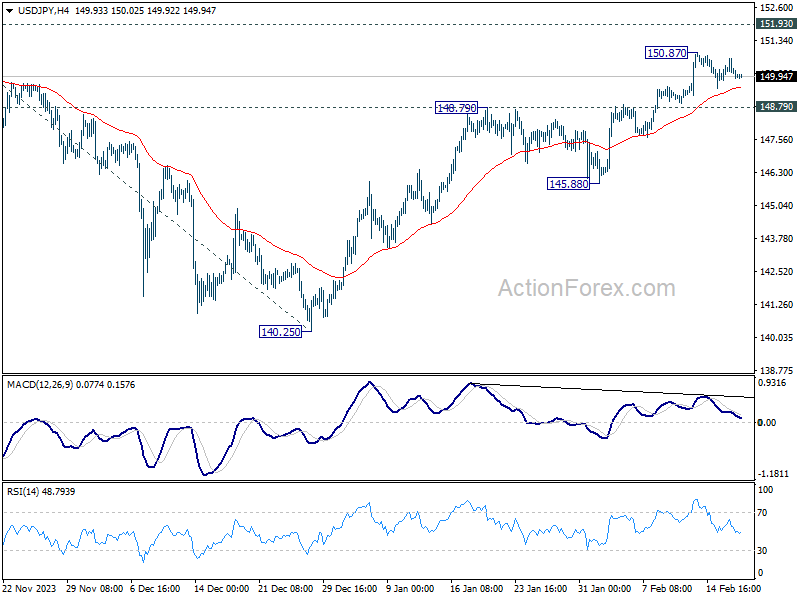
In the bigger picture, fall from 151.89 is seen as a correction to the rally from 127.20, which might have completed at 140.25 already. Firm break of 151.89/93 resistance zone will confirm up trend resumption, and next target will be 61.8% projection of 127.20 to 151.89 from 140.25 at 155.50. This will now remain the favored case as long as 140.25 support holds.
Economic Indicators Update
| GMT | Ccy | Events | Actual | Forecast | Previous | Revised |
|---|---|---|---|---|---|---|
| 21:30 | NZD | Business NZ PSI Jan | 52.1 | 48.8 | ||
| 23:50 | JPY | Machinery Orders M/M Dec | 2.70% | 2.50% | -4.90% | |
| 00:01 | GBP | Rightmove House Price Index M/M Feb | 0.90% | 1.30% | ||
| 11:00 | EUR | German Buba Monthly Report | ||||
| 13:30 | CAD | Industrial Product Price M/M Jan | -0.10% | 0.10% | -1.50% | |
| 13:30 | CAD | Raw Material Price Index Jan | 1.20% | 0.80% | -4.90% |
Yen Bears Have a Good Chance of Reaching Lows Not Seen Since 1990
The Japanese yen is hovering near 150 per dollar, retreating from last week’s four-month highs of 151. The 150-152 area is hazardous for short-term traders, as this is the level from which the Japanese Ministry of Finance intervened in October 2022 and November 2023 to stop the currency from depreciating.
However, it would be too naive to expect a reversal from 151.8, as it has happened several times before. A weaker yen makes Japanese exports more competitive and thus stimulates the economy. In addition, the currency’s weakness fuels imported inflation and puts downward pressure on prices.
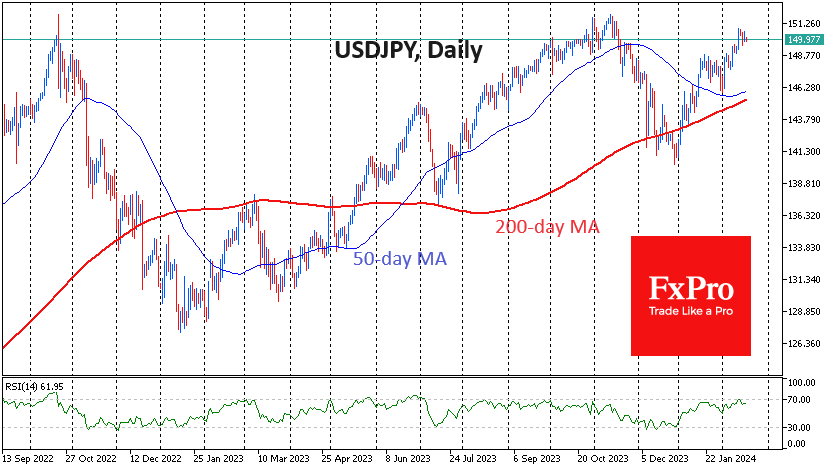
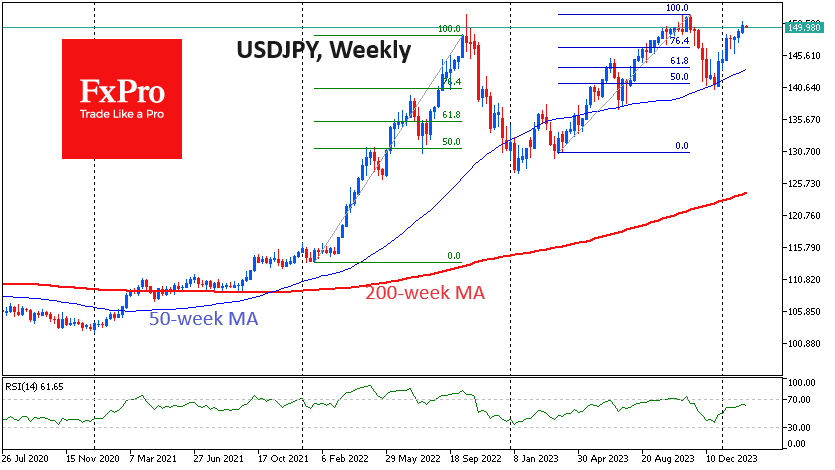
By using this tool moderately, the country’s finance ministry and central bank can address their long-term problem of a stagnant economy and deflation. The momentum of the yen’s depreciation in 2022 was excessive, exceeding 30 per cent in seven months. Interventions and the unwinding of long positions in the market have given the yen back about half of this decline.
The second wave of pressure started in March 2023 and lasted about seven months, taking USDJPY back to the peak of the previous cycle. This time, it is harder to say whether we saw intervention or whether the market switched to buying the yen as the outlook for the dollar changed sharply. As with the first wave, the pullback has lost strength, giving back about half of the initial move, or about 7.5%.
The current phase of USDJPY gains began in early January and is taking the yen to extremes before the beginning of March. At the same time, bets on further Yen weakness have risen to their highest levels in over two years. This extreme positioning creates a breeding ground for a downside move, as is the case with such counter-trend strategies.
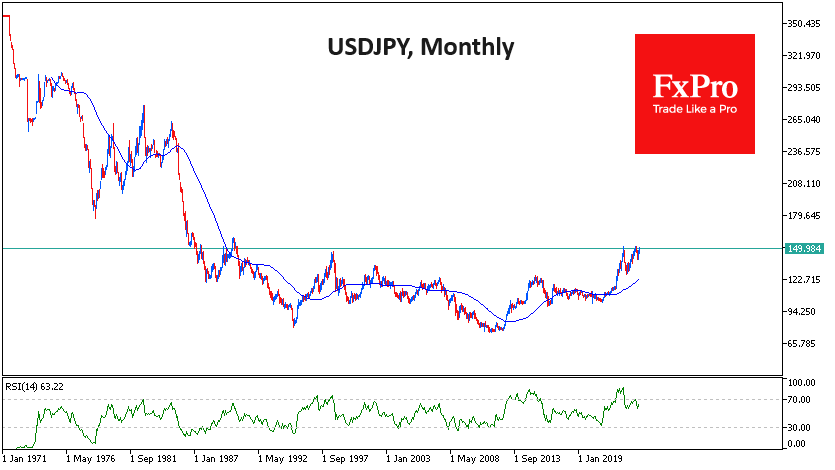
The yen’s growth impulses have allowed the economy to adjust, so there is no need to defend precisely the 152 level. USDJPY is now 14% higher than a year ago. This is not a critical drop. In our experience, officials start to get worried about exchange rate movements when they approach 20% year-on-year.
In the case of the yen, one should be prepared for neither the Bank of Japan nor the Ministry of Finance to refrain from active action and perhaps even verbal intervention until the 160 yen/$ level, which is the next round level coinciding with the 1990 peak.
Officials may allow the yen to weaken thanks to slower inflation and lower commodity. Japan’s economy has contracted for the past two quarters, suggesting a need for support. Meanwhile, the outperformance of the stock market suggests confidence that the economy is not overly burdened by exchange rate volatility and will soon benefit from more competitive prices for its goods.
EUR/USD Mid-Day Outlook
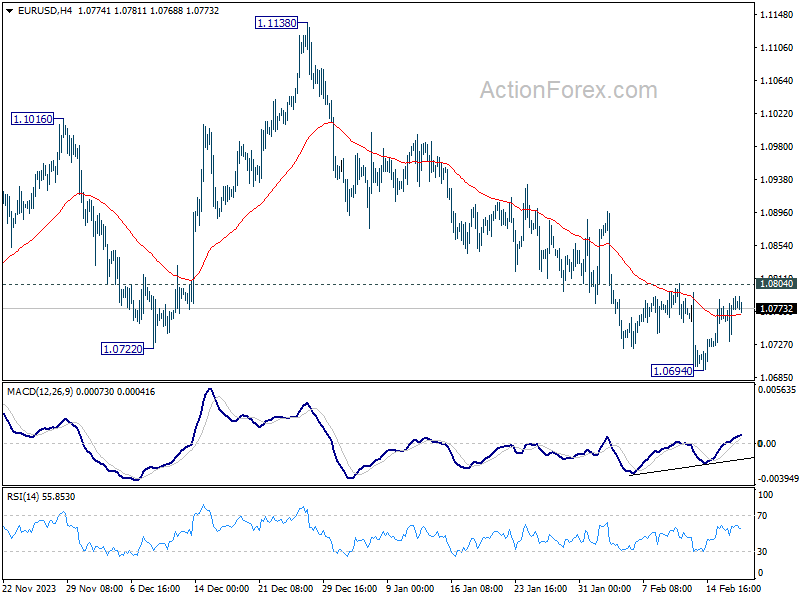
Daily Pivots: (S1) 1.0744; (P) 1.0766; (R1) 1.0800; More...
EUR/USD is extending the consolidation from 1.0694 and intraday bias stays neutral. . Further decline is in favor with 1.0804 resistance intact. On the downside, below 1.0694 will resume the fall from 1.1138 to retest 1.0447 support. Nevertheless, considering bullish convergence condition in 4H MACD, above 1.0804 will turn bias to the upside for stronger rebound.
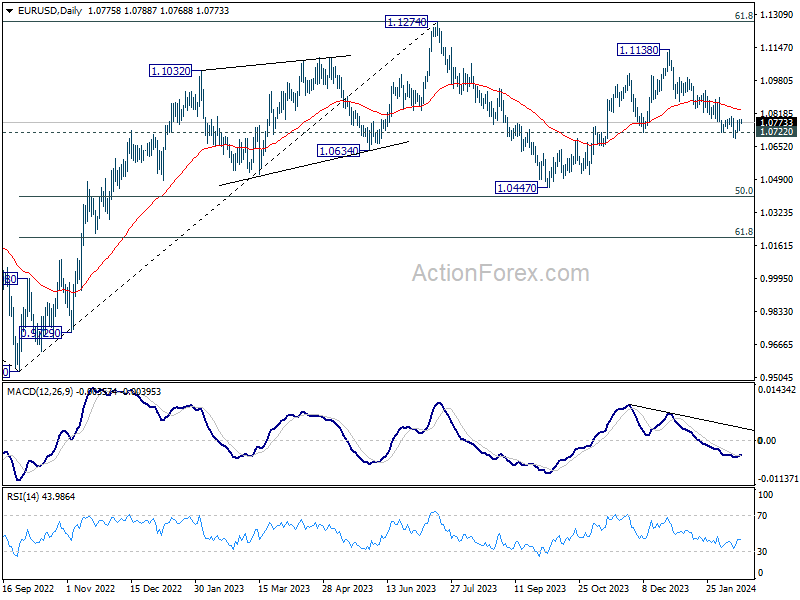
In the bigger picture, price actions from 1.1274 are viewed as a corrective pattern to rise from 0.9534 (2022 low). Rise from 1.0447 is seen as the second leg. While further rally could cannot be ruled out, upside should be limited by 1.1274 to bring the third leg of the pattern. Meanwhile, sustained break of 1.0722 support will argue that the third leg has already started for 1.0447 and possibly below.
GBP/USD Mid-Day Outlook
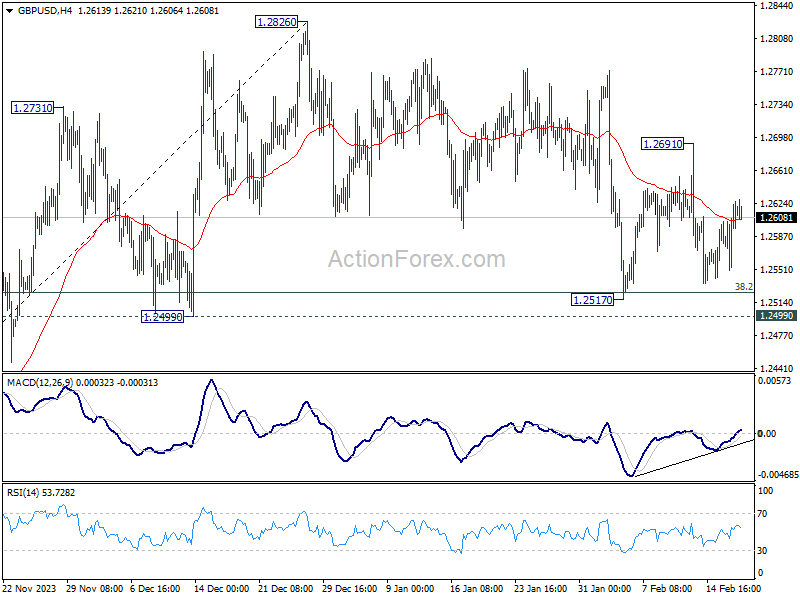
Daily Pivots: (S1) 1.2560; (P) 1.2592; (R1) 1.2634; More...
Range trading continues in GBP/USD and intraday bias stays neutral. On the upside, break of 1.2691 resistance will indicate that correction from 1.2826 has completed. Intraday bias will be back on the upside for retesting 1.2826. Nevertheless, decisive break of 1.2499 will argue that whole rise from 1.2036 has completed and turn near term outlook bearish.
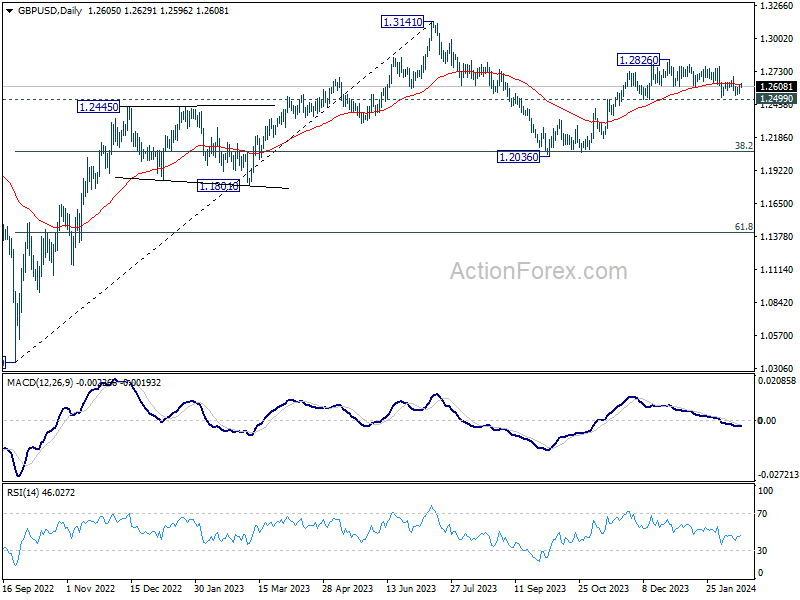
In the bigger picture, price actions from 1.3141 medium term top are seen as a corrective pattern to up trend from 1.0351 (2022 low). Rise from 1.2036 is seen as the second leg, which could be still in progress. But upside should be limited by 1.3141 to bring the third leg of the pattern. Meanwhile, break of 1.2499 support will argue that the third leg has already started for 38.2% retracement of 1.0351 (2022 low) to 1.3141 at 1.2075 again.
USD/CHF Mid-Day Outlook
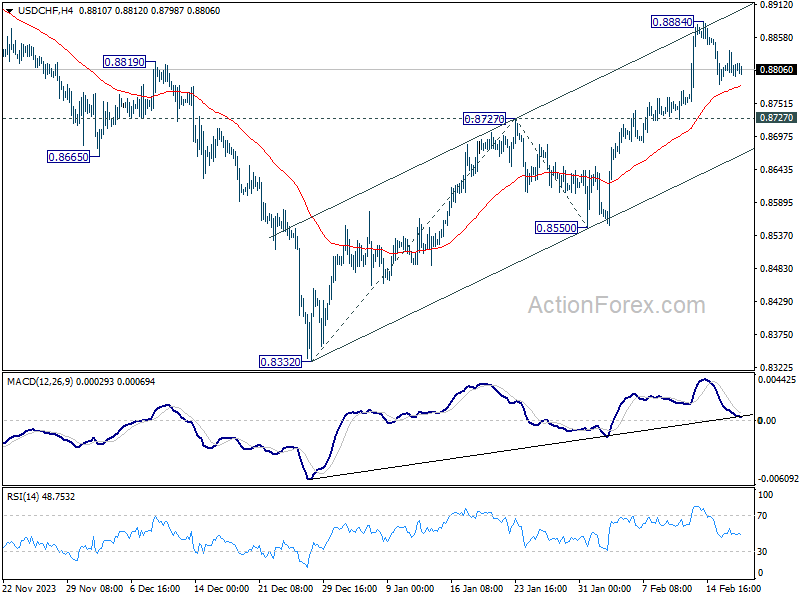
Daily Pivots: (S1) 0.8788; (P) 0.8813; (R1) 0.8835; More....
USD/CHF is extending the consolidation pattern from 0.8884 and intraday bias remains neutral. Further rally is expected as long as 0.8727 resistance turned support holds. On the upside, break of 0.8885 will resume the rise from 0.8332 and target and 100% projection of 0.8332 to 0.8727 from 0.8550 at 0.8954. However, sustained break of 0.8727 will dampen this bullish view, and turn bias back to the downside for 0.8550 support instead.
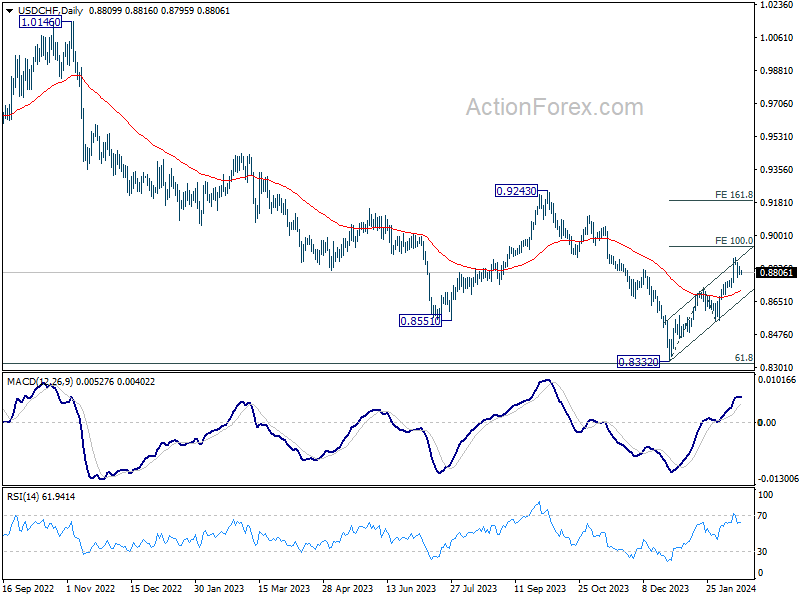
In the bigger picture, a medium term bottom should be formed at 0.8332, on bullish convergence condition in W MACD, just ahead of 0.8317 long term fibonacci support. It's still early to decide if the larger down trend from 1.0146 (2022 high) is reversing. But further rise should be seen to 0.9243 resistance even as a correction.
USD/JPY Mid-Day Outlook
Daily Pivots: (S1) 149.81; (P) 150.23; (R1) 150.63; More...
USD/JPY is extending the consolidation from 150.87 and intraday bias remains neutral. Downside of retreat should be contained by 148.79 resistance turned support to bring another rally. Above 150.87 will resume the rise from 140.25 to 151.89/93 key resistance zone. Decisive break there will confirm larger up trend resumption of 155.50 projection level next. However, firm break of 148.79 will turn bias to the downside for 145.88 support.
In the bigger picture, fall from 151.89 is seen as a correction to the rally from 127.20, which might have completed at 140.25 already. Firm break of 151.89/93 resistance zone will confirm up trend resumption, and next target will be 61.8% projection of 127.20 to 151.89 from 140.25 at 155.50. This will now remain the favored case as long as 140.25 support holds.
Bundesbank: Weak German economy but no significant, broad-based and long-lasting decline
In its latest monthly report, Bundesbank acknowledged that the "weak phase" in the German economy since Russian war of aggression against Ukraine would continue.
Despite this, it stops short of predicting a recession, defining it as a "significant, broad-based and long-lasting decline in economic output."
The report further elaborates, indicating "no signs of an impending noticeable deterioration" in the labor market stemming from the current economic slowdown.
On the inflation front, Bundesbank anticipates continued decline in inflation rates in the coming months, with price pressures on food and other goods expected to ease further. Nonetheless, the report signals slower pace of decline in service sector inflation, attributing this trend partly to "continued strong wage growth."
Australian Dollar Extends Gains, RBA Minutes Next
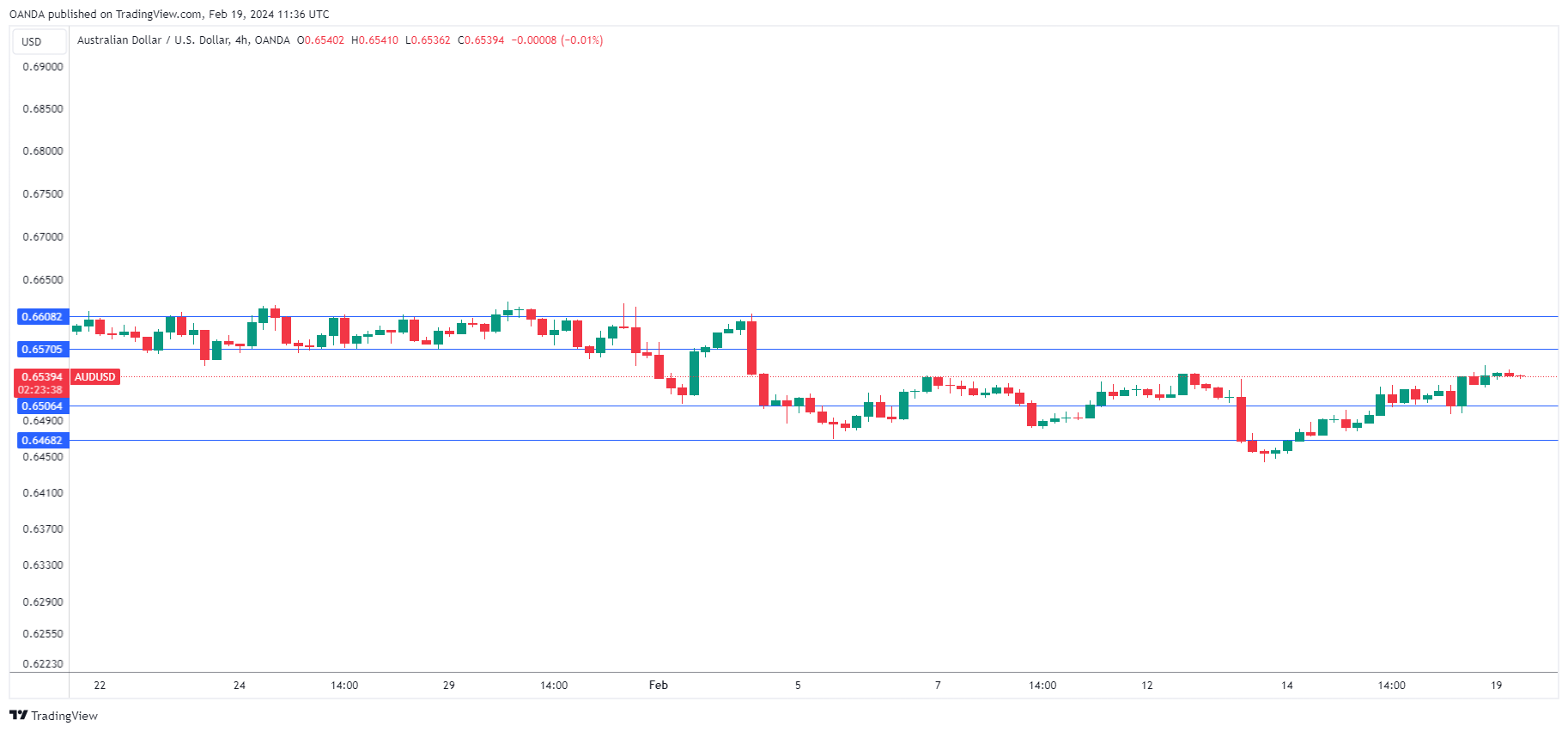
The Australian dollar extended its gains for a fourth straight day. In the European session, AUD/USD is trading at 0.6537, up 0.10%.
Last Tuesday, the Australian dollar suffered its worst one-day showing of the year, declining by 1.18%, after US inflation was higher than expected, which sent the US dollar surging higher. The Aussie has since recovered those losses and is trading at a two-week high against the US dollar.
Markets eye RBA minutes
The Reserve Bank of Australia will release the minutes of the February meeting on Tuesday. AAutrlt the meeting, there RBA maintained the cash rate at 4.35%, as expected. The RBA has raised rates only once since June, which has led to the markets pricing in rate cuts later this year. The RBA has pushed back against these expectations, as it is concerned that inflation remains sticky and won’t fall back to the 2%-3% target range until 2025.
At the February meeting, board members kept a rate hike on the table, with the policy statement noting that “a further increase in interest dates cannot be ruled out”. The minutes could provide some insights as to what factors would prompt the central bank to raise rates.
Last week’s employment report was softer than expected and the RBA will be keeping a close eye on Wednesday’s wage price index report. The RBA has reiterated that its rate path would be data dependent, and wage inflation is an important contributor to inflation. A soft release would reduce the likelihood of the RBA raising interest rates.
AUD/USD Technical
- 0.6506 and 0.6468 are providing support
- 0.6570 and 0.6608 are the next resistance lines