Sample Category Title
Fed Holds Rates, Signals More Rate Cuts in 2024
The Federal Reserve Open Market Committee (FOMC) maintained the federal funds rate in the 5.25% to 5.50% range and announced it would continue its balance sheet runoff.
The Fed adjusted its language to acknowledge the recent easing in economic data, stating "recent indicators suggest that growth of economic activity has slowed from its strong pace in the third quarter. Job gains have moderated since earlier in the year but remain strong, and the unemployment rate has remained low. Inflation has eased over the past year but remains elevated."
The Fed's Summary of Economic Projections was updated from September:
- The median projection for real GDP growth was upgraded overall to 2.6% in 2023, 1.4% in 2024, 1.8% in 2025, 1.9% in 2026, and 1.8% over the long run.
- The median unemployment rate forecast for 2023, 2024, 2025, 2026, and the longer run came in at 3.8%, 4.1%, 4.1%, 4.1%, and 4.1% (from 3.8%, 4.1%, 4.1%, 4.0%, and 4.0%), respectively.
- On inflation, the median estimate for core PCE was assumed to be 3.2% in 2023, 2.4% in 2024, 2.2% in 2025, and 2.0% in 2026.
- The median projection for the fed funds rate was 4.6% in 2024, 3.6% in 2025, and 2.9% in 2026. The long-run neutral rate was assumed to be 2.5%.
All of the members of the FOMC voted in favor of the decision.
Key Implications
Everyone was watching for how the Fed would adjust its economic and interest rate forecast in the wake of cooling economic data. Recent readings have started to weaken alongside a quicker than anticipated deceleration in inflation. The Fed's outlook for a perfect landing – a marginal increase in the unemployment rate and inflation coming down to target – has been sped up in its updated forecast today. Importantly, this means that the median Fed voter is anticipating that the policy rate will be 50 basis points lower by the end of 2024 than it was previously expecting (4.6% vs 5.1%).
While FOMC members are increasingly moving forward the start of rate cuts, markets are a few steps ahead. The Fed's forecast implies that rate cuts would start in the fall of 2024 (assuming 25 bps cuts in consecutive meetings), while market odds are pointing to cuts happening in the spring. We are in the middle of these two views. While we think that cuts should come earlier than the Fed foresees, it will take more time for the economy to cool enough to justify a cut in early May. Either way, markets are cheering the shift in the Fed view, with both equities and bonds rallying post-announcement.
Sunset Market Commentary
Markets
UK gilts and sterling catch the eye today. Yields in the country tank between 9.8 (30-y) and 13.3 bps (2-y). Sterling dropped with EUR/GBP, after testing the 0.86 yesterday, now moving past that level more convincingly (0.8612). Reason for the move s this morning’s batch of October eco data. Whether it was industrial production, construction manufacturing, a services activity gauge or a monthly GDP estimator; they all surprised to the downside. It only adds fuel to speculation that not only the Fed and ECB are close to a turning point, but the Bank of England as well. Bets for a first full rate cut in recent weeks moved from August to June. Yesterday chances were 50-50 of one happening in May already and today that balance tilted to 80-20. The sharp British moves come with some knock-on effects on core markets. US and German yields drop, with moves extending as American investors join the market. Current declines for the former range between 3.4-5.7 bps and -2.7-4.3 bps for the latter. The US dollar swapped earlier tentative strengthening for weakening, with EUR/USD surpassing 1.08 in the run-up to the Fed. DXY eases to 103.74 while USD/JPY hits 145.1.• As tonight’s Fed meeting comes closer, we end this report with a preview. The Fed is almost certain to keep the policy rate unchanged at 5.25%-5.50%. The final rate hike flagged by the Fed’s Summary of Economic Projections (SEP) back in September served its purpose as a signal the central bank remained open to tighten further if needed and become redundant in the meantime. The key question for today is how much easing the December SEP puts forward for 2024. We assume that sticking to 50 bps conveys a neutral message to markets. That’s equal the amount of the September SEP but with the sidenote that the cutting cycle would start off from a lower terminal rate. This compares to money market pricing of >100bps of cuts by end next year. Rate projections further out are also worth taking a look at with the lifting of the neutral rate (current median at 2.5%) only requiring three more governors to adjust their view upwards. It would be an important signal of the higher for longer era – something which markets currently (gladly) dismiss. Turning to the press conference. Just as the summer-through-October (real) yield rally called off the need for the final rate hike, the recent opposite move brings about a premature easing of financial conditions. Stressing the economic resilience today instead of the inflation cooldown would be a shift in tactics compared to November and could be a sign of unease among Powell and his colleagues. Doing so may create a bottom for US yields. Drawing conclusion from the Fed for EUR/USD is tricky since tomorrow’s ECB meeting is equally important for its short term fate.
News & Views
At the COP 28 meeting in Dubai, the representatives of the participating countries agreed on a text that includes to start a transition in energy consumption away from fossil fuels. It is the first time that this approach was retained in the final text. The text urges countries to quickly concert energy systems from fossil fuels in a ‘just and orderly and equitable manner’ to reach net zero by 2050. A big group of countries wanted a stronger language. However, this phrasing met strong opposition from Saudi-Arabia and other oil producing countries. Saudi Arabia still maintains the view that the focus should be on reducing of emissions regardless of the source. The text also includes an agreement to triple production capacity of renewable power and double the rate of efficacity gains. Aside from moving away from fossil fuels, the text also supports speeding up efforts to capture and storage carbon. The views on this topic remain divided as several participants see this as justification to further explore and use carbon fuels.
In its Winter economic forecast, the KOF Swiss economic institute sees economic growth in Switzerland (ex major sporting events) in 2023 at 1.2%. In the period until 2025 KOF expects that economic activity in the country will mainly be supported by domestic activity as it expects foreign trade to be curbed by a weak global economy. It expects GDP to increase by 1.3% in 2024 (was 1.5% previously) and the rising trend is seen continuing in 2025 (1.8%). KOF downwardly revised its inflation forecasts for the country to 1.7% next year (from 2.2%) and 1.0%. In 2025 (from 1.5% in the autumn forecast). KOF expects the Swiss National Bank to lower its key interest rate at the beginning of 2025. The Swiss franc recently held within reach of the strongest levels this year against the euro, currently changing hands at EUR/CHF 0.9455 (YTD strongest at 0.9403 earlier this month).
EUR/USD – Fireworks Expected from the Final Fed Meeting of the Year
- Fed expected to leave interest rates unchanged
- Forecasts and dot plot key as markets price in four rate cuts next year
- EURUSD hovers around 50 Fib
The final Fed meeting of the year could also be the most eventful, with the central bank likely to acknowledge it’s done with tightening and even signal rate cuts next year. The question is how many, with markets now pricing in four starting in May.
The interest rate decision itself will almost certainly be straightforward – on hold – but with new economic forecasts, the dot plot, a statement, and the press conference to follow, there could be fireworks.
Any acknowledgment of rate cuts next year could be well received, although only one may get a cool response as that would suggest policymakers view it as coming very late in the year.
Traders may well shake on two as that would point to a third-quarter rate cut which would still not be nearly as aggressively as markets are positioned but it’s unlikely the Fed will pivot to the extent that it aligns with the very optimistic expectation currently priced in. That isn’t to say they won’t get there over the next few months.
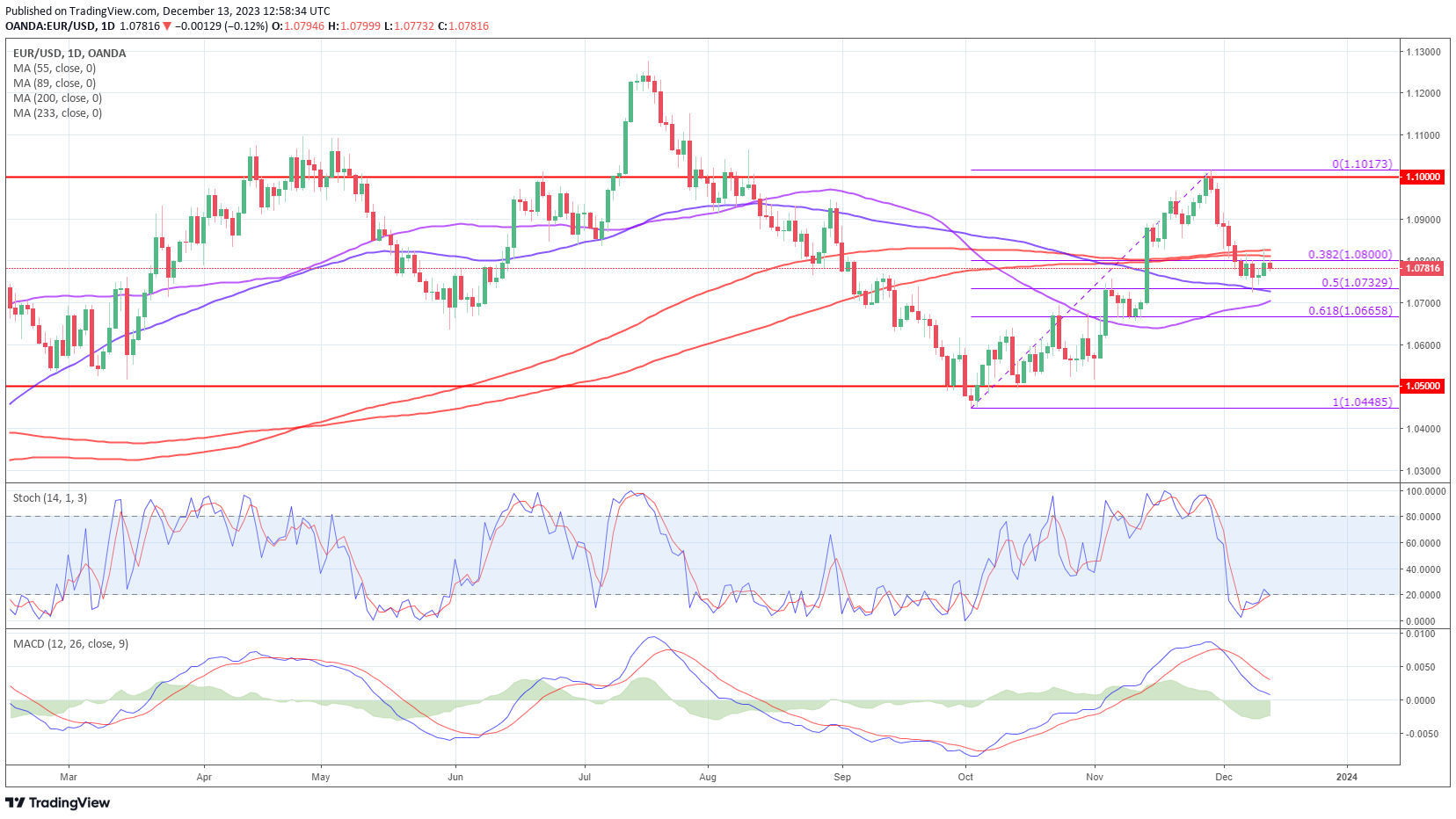
EURUSD steadies ahead of the announcement
We’ve seen a decent correction in EURUSD over the last couple of weeks, with the pair giving up around half of the gains it achieved since early October.
Source – OANDA
Resistance can be seen around 1.08 where the pair has recently run into trouble and the 200/233-day simple moving average band is providing a barrier to the upside. Below the 50% Fibonacci retracement level looks key, with the pair having rebounded strongly off there on Friday.
Crypto Continued Retreat
Market picture
The total capitalisation of cryptocurrencies has declined by almost 2% to $1.54 trillion in the past 24 hours. This is still a move in the opposite direction relative to the US and European indices, which are rising. Given that the current year is marked by impressive growth in cryptocurrencies, profit-taking looks like a logical end to it.
Bitcoin has gained more than 170% from the start of the year to its peak last week. The levels of $38K and $34K look like potential targets for a full-fledged correction. At the same time, locally, Bitcoin is being actively bought back at levels above $40.5K, clearly protecting a significant round level.
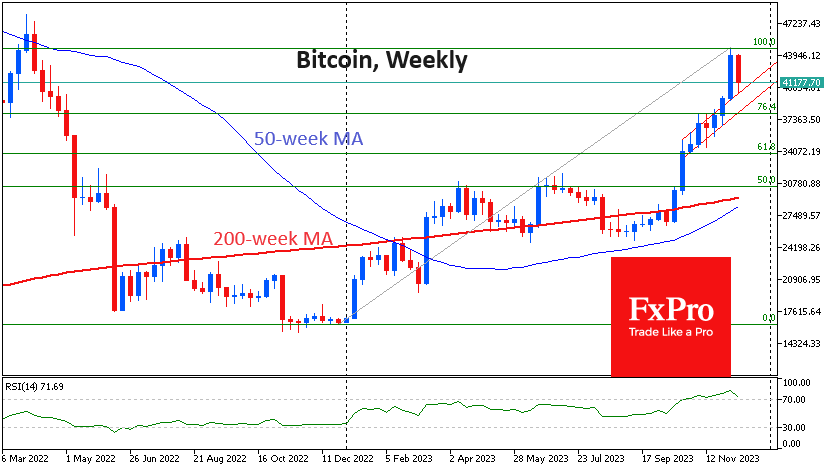
A failure under it is likely in case of a reversal of stock indices and a widespread thrust from risky assets, which has not been observed yet. The Fed has a chance to influence the situation later on Wednesday with its rate decision, which could determine demand for days and weeks to come.
News background
Avalanche (AVAX) has climbed into the top 10 cryptocurrencies with the highest market capitalisation, overtaking Dogecoin. The AVAX exchange rate has been up 57% in the last seven days; 30-day gains exceed 104%. Central banks, such as Bank of America, Citi, and JPMorgan, are looking at options to use the Avalanche blockchain to tokenise real-world assets. Bernstein predicts more robust demand for AVAX and further growth of the asset.
Cryptocurrency exchange KuCoin has reached a settlement agreement with the New York State Attorney’s Office to resolve claims it will pay more than $22 million. In March, the platform was accused of violating securities laws by unlicensed digital asset offerings.
El Salvador will launch Bitcoin-backed Volcano Bonds in the first quarter of 2024. They will be issued on Bitfinex Securities, a platform registered in El Salvador as a blockchain-based trading platform for stocks and bonds. According to CoinGecko, just 2 per cent of Salvadorans have become cryptocurrency investors after two years.
According to Circle, which issues the USDC stablecoin, there is now a boom in interest in blockchain and stablecoins. The global volume of stablecoin settlements exceeded $7 trillion last year. By comparison, Visa and Mastercard settlements totalled $14 trillion. Latin America is becoming the biggest consumer of digital currencies.
EUR/USD Mid-Day Outlook
Daily Pivots: (S1) 1.0760; (P) 1.0794; (R1) 1.0829; More...
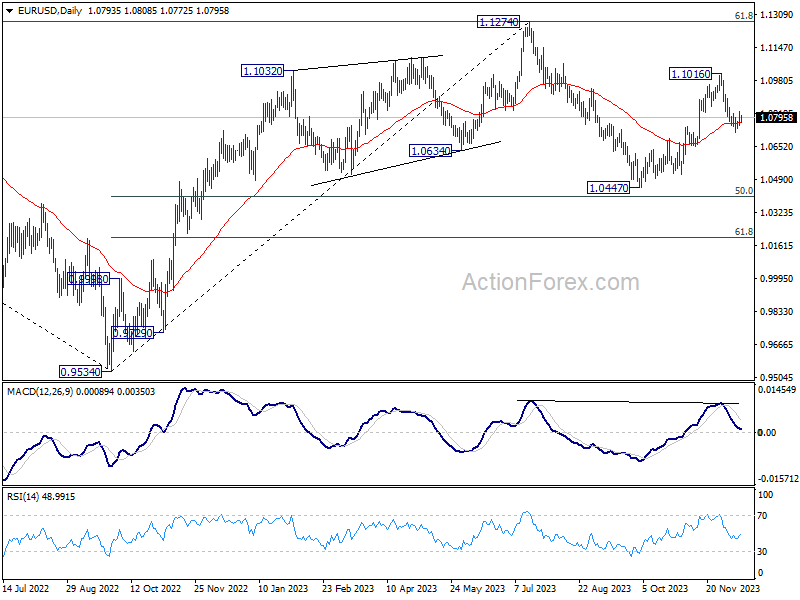
Intraday bias in EUR/USD remains neutral and further decline is mildly in favor as long as 1.0827 minor resistance holds. Break of 1.0722, and sustained trading below 55 D EMA (now at 1.0770) will extend the fall from 1.1016 short term top to retest 1.0447 support. However, on the upside, firm break of 1.0827 minor resistance will turn intraday bias back to the upside for stronger rebound.
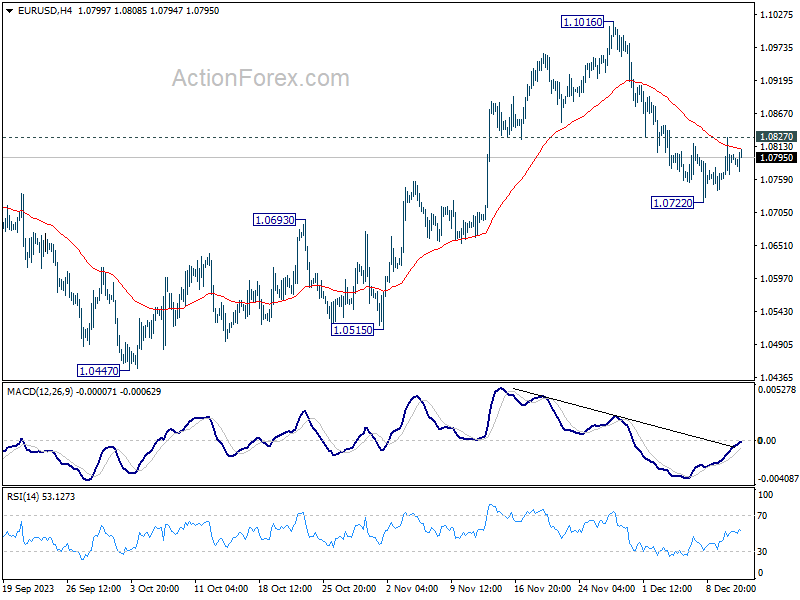
In the bigger picture, price actions from 1.1274 are viewed as a corrective pattern to rise from 0.9534 (2022 low). Rise from 1.0447 is seen as the second leg. While further rally could cannot be ruled out, upside should be limited by 1.1274 to bring the third leg of the pattern. Meanwhile, sustained break of 55 D EMA will argue that the third leg has already started for 1.0447 and below.
GBP/USD Mid-Day Outlook
Daily Pivots: (S1) 1.2512; (P) 1.2564; (R1) 1.2614; More...
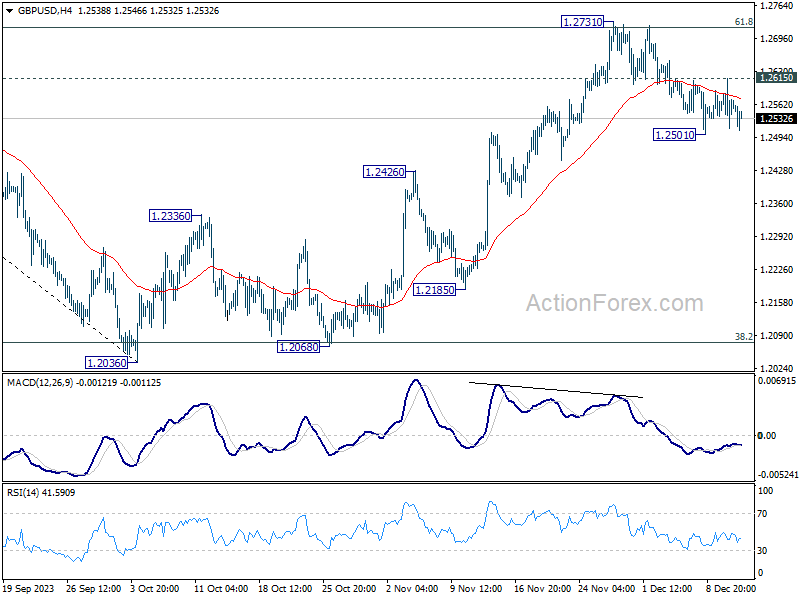
Intraday bias in GBP/USD remains neutral and further decline is mildly in favor with 1.2614 minor resistance intact. Break of 1.2501 will resume the fall from 1.2731 short term top to to 55 D EMA (now at 1.2452). Sustained break there will bring retest of 1.2036 low. However, firm break of 1.2615 will turn bias back to the upside for retesting 1.2731 resistance.
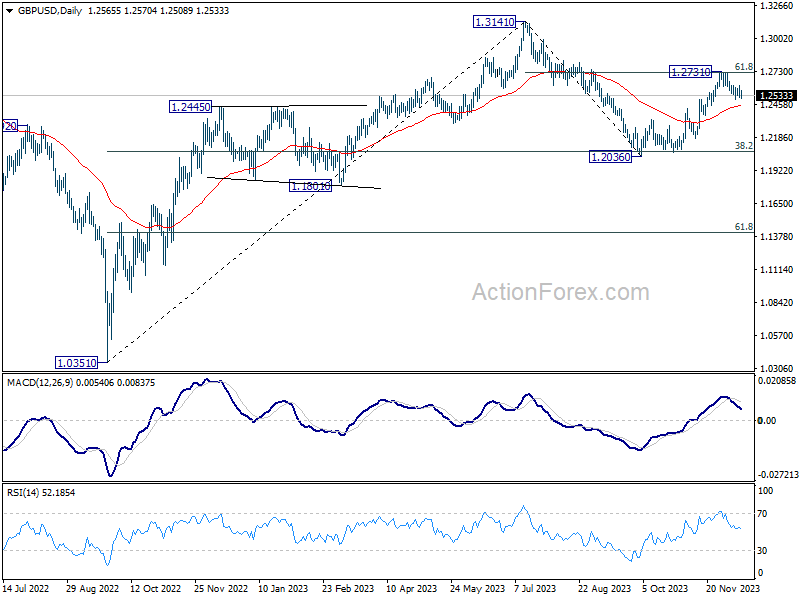
In the bigger picture, price actions from 1.3141 medium term top are seen as a corrective pattern to rise from 1.0351 (2022 low). Rise from 1.2036 is seen as the second leg, that could still extend through 1.2731. But upside should be limited by 1.3141 o bring the third leg of the pattern. Meanwhile, sustained trading below 55 EMA will argue that the third leg has already started for 38.2% retracement of 1.0351 (2022 low) to 1.3141 at 1.2075 again, and possibly below.
USD/CHF Mid-Day Outlook
Daily Pivots: (S1) 0.8720; (P) 0.8757; (R1) 0.8789; More....
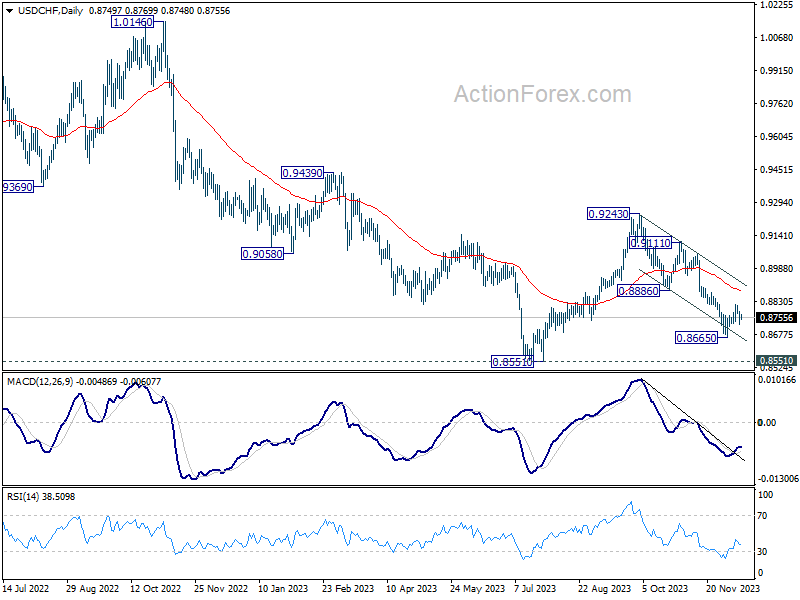
No change in USD/CHF's outlook as intraday bias remains neutral. Further rise remains in favor with 0.8722 minor support intact. Above 0.8819 will resume the rebound from 0.8665 short term bottom to 0.8886 support turned resistance first. However, firm break of 0.8722 will retain near term bearishness, and turn bias back to the downside to resume the fall from 0.9243 through 0.8665.
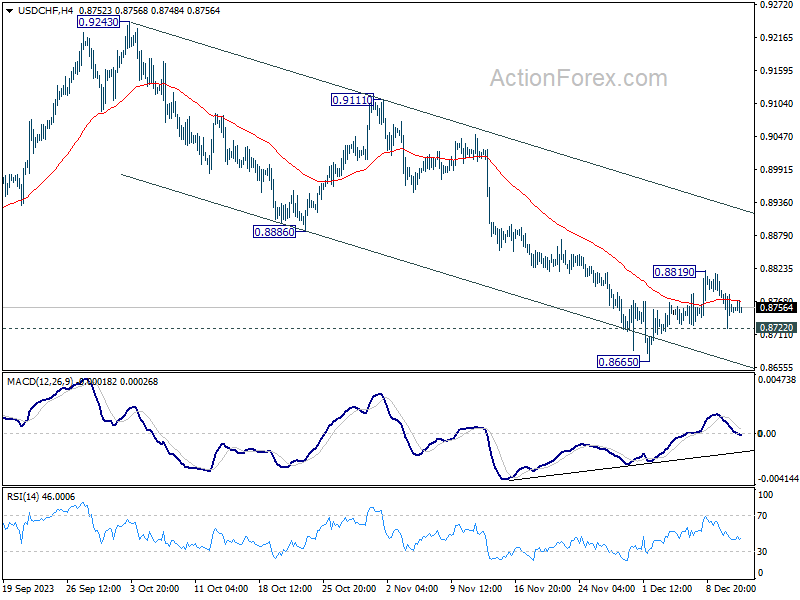
In the bigger picture, price actions from 0.8551 are currently seen as part of a corrective pattern to the decline from 1.0146 (2022 high). Fall from 0.9243 is seen as the second leg for now. Deeper decline could be seen to 0.8551 low but strong support should be seen there to bring rebound. Meanwhile, break of 0.9111 resistance will argue that the third leg has started already, and target 0.9243 and above.
USD/JPY Mid-Day Outlook
Daily Pivots: (S1) 144.74; (P) 145.47; (R1) 146.19; More...
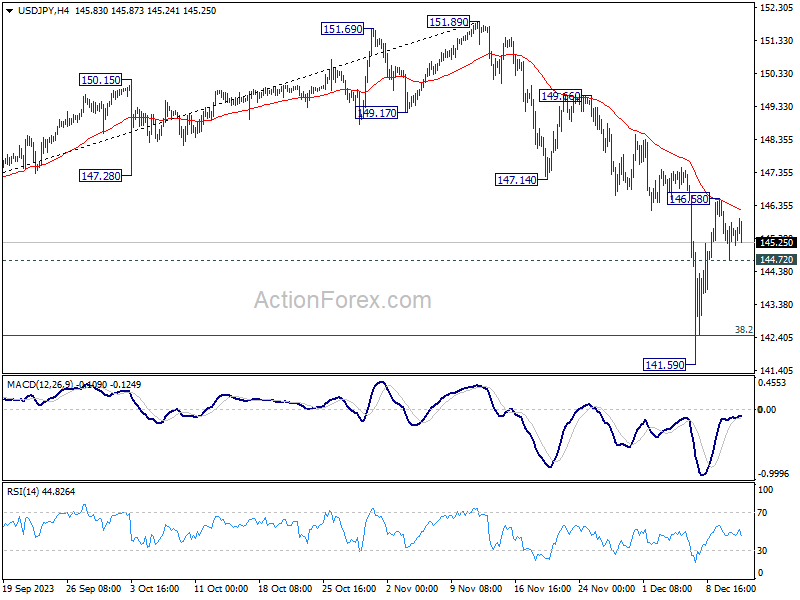
Intraday bias in USD/JPY remains neutral, and outlook stays bearish with 147.14 support turned resistance intact. On the downside, break of 144.72 minor support will suggest that rebound from 141.59 has completed at 146.58. Intraday bias will then be back on the downside for retesting 141.59 low. However, decisive break of 147.14 will dampen the bearish view, and bring stronger rally back towards 149.56/151.89 resistance zone.
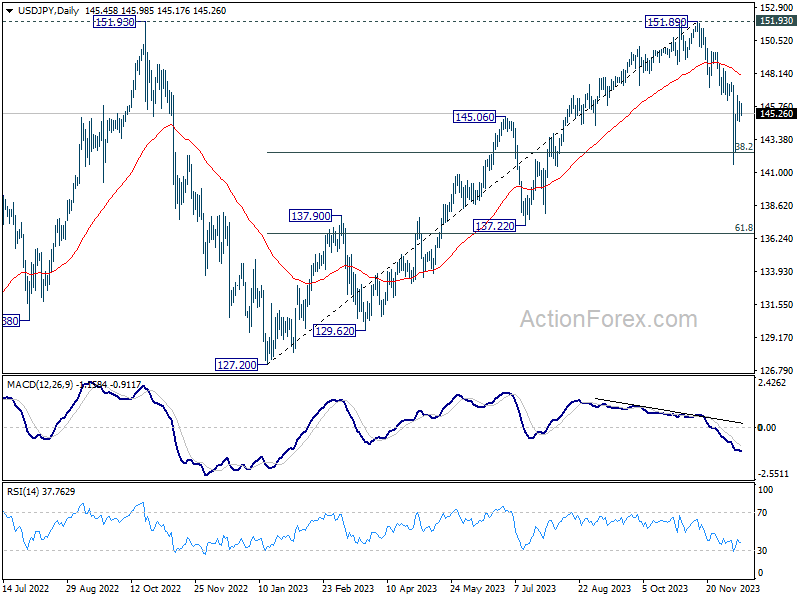
In the bigger picture, current fall from 151.89 is seen as the third leg of the corrective pattern from 151.93 (2022 high). Deeper decline would be seen through 38.2% retracement of 127.20 to 151.89 at 142.45 to 61.8% retracement at 136.63. This will now remain the favored as long as 147.14 support turned resistance holds.
Dollar Steady ahead of FOMC, Sterling Weakens on GDP Data
The currency markets are currently in a state of anticipation, with Dollar trading within familiar range as investors await FOMC rate decision. The critical question facing the markets is whether Fed will signal the pace of rate cuts in its updated dot plot. In September, the median projection indicated the federal funds rate would remain at 5.125% by the end of 2024, implying no rate cuts from the current level. While revisions to this projection are expected, the exact pace and extent of potential rate cuts remain uncertain.
Meanwhile, Sterling has weakened broadly following release of GDP data that showed deeper-than-anticipated contraction. This has raised concerns that the UK economy may already be in a recession. Additionally, the slowing wage growth combined with a less optimistic economic outlook could lead to a shift in stance among the more hawkish members of BoE's MPC. While BoE Governor Andrew Bailey is expected to push back against speculations on rate cut following tomorrow's decision, there are discussions suggesting BoE might cut rates sooner than previously anticipated due to subdued growth.
Regarding weekly performance, Swiss Franc leads as the strongest currency so far, followed by Euro and Canadian Dollar. Japanese Yen is at the bottom of the list, with New Zealand and Australian Dollars trailing close behind. Sterling and Dollar are exhibiting mixed performances.
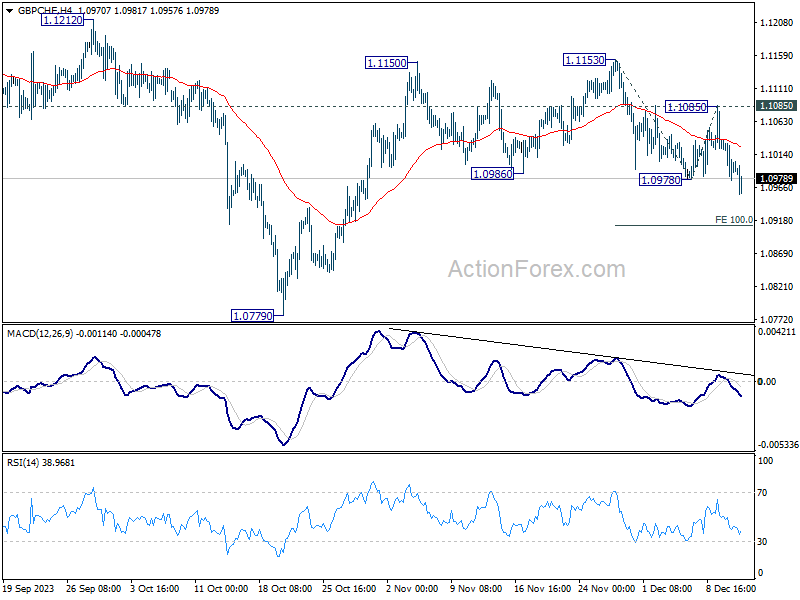
Technically, GBP/CHF's break of 1.0978 invalidated our original bullish view and indicates that fall from 1.1153 is in progress. Near term outlook is mixed for now, with focus on 100% projection of 1.1153 to 1.0978 from 1.1085 at 1.0910. Sustained break there could prompt downside acceleration to 1.0779 to resume larger down trend. Nevertheless, strong rebound from this projection level could revive near term bullishness for another rise through 1.1153 at a later stage.
In Europe, at the time of writing, FTSE is up 0.32%. DAX is up 0.07%. CAC is up 0.18%. Germany 10-year yield is down -0.031 at 2.197. UK 10-year yield is down -0.122 at 3.852. Earlier in Asia, Nikkei rose 0.25%. Hong Kong HSI fell -0.89%. China Shanghai SSE fell -1.15%. Singapore Strait Times rose 0.06%. Japan 10-year JGB yield fell -0.0484 to 0.690.
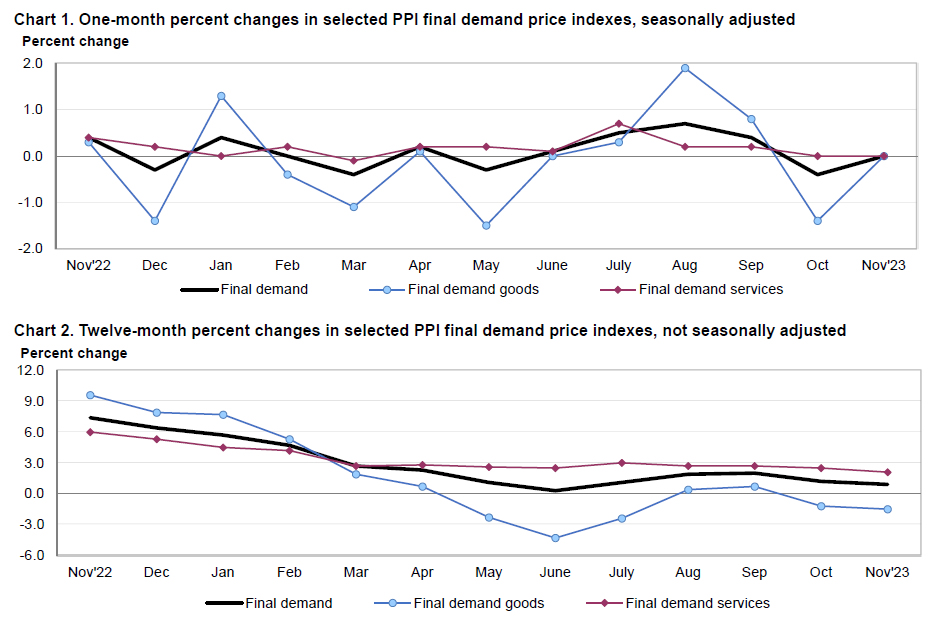
US PPI at 0.0% mom, 0.9% yoy in Nov
US PPI for final demand was unchanged at 0.0% mom in November, below expectation of 0.1% mom. Both indexes for final demand goods and services were unchanged. PPI less foods, energy, and trade services edged up by 0.1% mom.
For the 12 months period, PPI slowed from 1.2% yoy to 0.9% yoy, below expectation of 1.0% yoy. PPI less foods, energy and trade services slowed from 2.8% yoy to 2.5% yoy.
UK GDP shrinks -0.3% mom in Oct, all sectors contract
UK's GDP contracted by -0.3% mom in October, a figure that is notably worse than the expected -0.1% mom. The primary factor contributing to this downturn was the decline in services output, which fell by -0.2% mom. Additionally, production output experienced a sharper drop of -0.8% mom, and construction output also saw a contraction of -0.5% mom.
When examining the three-month period leading up to October, UK's real GDP showed no growth compared with the three months leading to July. During this quarter, while services output saw a marginal growth of 0.1%, both production and construction outputs declined, falling by -0.7% and -0.3%, respectively.
NIESR: BoE may cut rates earlier due to subdued growth
NIESR forecasts that UK's GDP will remain flat Q3. An early prediction for Q1 of 2024 indicates a modest GDP growth of 0.3%, primarily driven by the services sector. NIESR noted that these projections align with UK's long-term trend of low but stable economic growth.
Today's subdued GDP data, as suggested by NIESR, might be interpreted as a sign by BoE that "no further monetary tightening is needed". This could pave the way for BoE to "start cutting interest rates earlier than previously expected", depending on future inflation trends.
Eurozone industrial production falls -0.7% mom in Oct, EU down -0.5% mom
Eurozone industrial production fell -0.7% mom in October, worst than expectation of -0.3% mom. Production of capital goods fell by -1.4%, intermediate goods and non-durable consumer goods both by -0.6%, while production of durable consumer goods grew by 0.2% and energy by 1.1%.
EU industrial production declined -0.5% mom. Among Member States for which data are available, the largest monthly decreases were registered in Ireland (-7.0%), Malta (-2.5%) and the Netherlands (-2.1%). The highest increases were observed in Greece (+6.0%), Portugal (+3.8%) and Czechia (+2.9%).
SECO downgrades 2024 Swiss growth outlook
Swiss State Secretariat for Economic Affairs has revised down its 2024 economic growth forecast for Switzerland, now expecting a growth of 1.1% instead of previous 1.2%. This revision indicates an expectation of below-average growth for the Swiss economy for a second consecutive year. A key factor influencing this outlook is the expected slow growth in the eurozone in 2024, which is anticipated to impact Swiss exports.
Looking ahead to 2025, SECO forecasts an economic recovery with growth projected at 1.7%, driven by a gradual global economic rebound. On the inflation front, SECO anticipates deceleration from 2.1% in 2023 (revised down from 2.2%) to 1.9% in 2024, followed by a further reduction to 1.1% in 2025.
SECO's report also underscores several considerable risks to the economic outlook. Ongoing conflict in the Middle East poses geopolitical risks that could lead to surge in oil prices and, consequently, higher inflation. Additionally, the report warns of possibility of tighter international monetary policy in response to sustained core inflation.
Other highlighted risks include global debt, potential market corrections in real estate and finance, and balance sheet vulnerabilities at financial institutions. Further, economic developments in Germany and China are noted as potential risks for the international economy that could adversely affect Swiss foreign trade.
Energy security remains a concern for Switzerland. Significant energy shortage in Europe, leading to widespread production stoppages and a severe economic downturn, could push Switzerland into a recession coupled with high inflation.
Japan's Tankan manufacturing index rose to 12, highest in nearly 2 years
Japan's Tankan survey for Q4 show signs of strength in both manufacturing and non-manufacturing sectors. Yet, the cautious outlook among manufacturers suggests uncertainty about future economic conditions.
Large Manufacturing Index rose from 9 to 12, surpassing the expected figure of 10. This increase marks the third consecutive quarter of improvement and the highest level since Q1 2022. The Non-Manufacturing Index also showed positive development, rising from 27 to 30, exceeding the forecast of 27. This improvement represents the seventh consecutive quarter of growth, reaching its highest point since 1991.
However, the outlook for the next three months tells a different story. Large Manufacturing Outlook Index fell from 10 to 8, falling short of the expected 9, indicating less optimism among manufacturers for the near future. In contrast, Non-Manufacturing Outlook Index did improve from 21 to 24, yet it missed the anticipated mark of 25.
In terms of capital expenditure, big firms in Japan are projecting an increase of 13.5% for the current fiscal year ending in March 2024. This projection is more optimistic than the median market forecast, which anticipated a 12.4% increase.
ADB raises 2023 growth forecast, driven by stronger performance in China and India
Asian Development Bank upgrades growth forecasts Developing Asia for 2023, raising projection from 4.7% to 4.9%. This upgrade is primarily attributed to stronger than expected growth in two of the region's largest economies, China and India. On the other hand, growth forecast for 2024 remains unchanged at 4.8%.
Specifically, for China, ADB now projects growth to reach 5.2% in 2023, an increase from previous forecast of 4.9% made in September. Growth rate for China in 2024 is expected to slow to 4.5%, unchanged from prior predictions. In contrast, India's growth forecast for 2023 is raised from 6.3% to 6.7%, and the country is anticipated to maintain this robust growth rate of 6.7% in 2024.
In terms of inflation, ADB made slight adjustments to its forecasts for Developing Asia. Inflation expectation for 2023 is reduced from 3.6% to 3.5%, while forecast for 2024 sees a minor increase from 3.5% to 3.6%.
ADB, in its release, highlighted several downside risks to these forecasts. Key among these are the potential for "higher-for-longer interest rates in advanced economies," which could lead to financial instability. Additionally, potential supply disruptions from factors like El Niño and the ongoing Russian invasion of Ukraine pose risks of renewing energy and food security challenges, which could reignite inflationary pressures.
USD/JPY Mid-Day Outlook
Daily Pivots: (S1) 144.74; (P) 145.47; (R1) 146.19; More...
Intraday bias in USD/JPY remains neutral, and outlook stays bearish with 147.14 support turned resistance intact. On the downside, break of 144.72 minor support will suggest that rebound from 141.59 has completed at 146.58. Intraday bias will then be back on the downside for retesting 141.59 low. However, decisive break of 147.14 will dampen the bearish view, and bring stronger rally back towards 149.56/151.89 resistance zone.
In the bigger picture, current fall from 151.89 is seen as the third leg of the corrective pattern from 151.93 (2022 high). Deeper decline would be seen through 38.2% retracement of 127.20 to 151.89 at 142.45 to 61.8% retracement at 136.63. This will now remain the favored as long as 147.14 support turned resistance holds.
Economic Indicators Update
| GMT | Ccy | Events | Actual | Forecast | Previous | Revised |
|---|---|---|---|---|---|---|
| 23:50 | JPY | Tankan Large Manufacturing Index Q4 | 12 | 10 | 9 | |
| 23:50 | JPY | Tankan Large Manufacturing Outlook Q4 | 8 | 9 | 10 | |
| 23:50 | JPY | Tankan Non - Manufacturing Index Q4 | 30 | 27 | 27 | |
| 23:50 | JPY | Tankan Non - Manufacturing Outlook Q4 | 24 | 25 | 21 | |
| 23:50 | JPY | Tankan Large All Industry Capex Q4 | 13.50% | 12.40% | 13.60% | |
| 07:00 | GBP | GDP M/M Oct | -0.30% | -0.10% | 0.20% | |
| 07:00 | GBP | Industrial Production M/M Oct | -0.80% | -0.10% | 0.00% | |
| 07:00 | GBP | Industrial Production Y/Y Oct | 0.40% | 1.10% | 1.50% | |
| 07:00 | GBP | Manufacturing Production M/M Oct | -1.10% | 0.00% | 0.10% | |
| 07:00 | GBP | Manufacturing Production Y/Y Oct | 0.80% | 1.90% | 3.00% | |
| 07:00 | GBP | Goods Trade Balance (GBP) Oct | -17.0B | -14.1B | -14.3B | |
| 08:00 | CHF | SECO Economic Forecasts | ||||
| 10:00 | EUR | Eurozone Industrial Production M/M Oct | -0.70% | -0.30% | -1.10% | -1.00% |
| 13:30 | USD | PPI M/M Nov | 0.00% | 0.10% | -0.50% | -0.40% |
| 13:30 | USD | PPI Y/Y Nov | 0.90% | 1.00% | 1.30% | 1.20% |
| 13:30 | USD | PPI Core M/M Nov | 0.00% | 0.20% | 0.00% | |
| 13:30 | USD | PPI Core Y/Y Nov | 2.00% | 2.20% | 2.40% | |
| 15:30 | USD | Crude Oil Inventories | -1.9M | -4.6M | ||
| 19:00 | USD | Fed Interest Rate Decision | 5.50% | 5.50% | ||
| 19:30 | USD | FOMC Press Conference |
US PPI at 0.0% mom, 0.9% yoy in Nov
US PPI for final demand was unchanged at 0.0% mom in November, below expectation of 0.1% mom. Both indexes for final demand goods and services were unchanged. PPI less foods, energy, and trade services edged up by 0.1% mom.
For the 12 months period, PPI slowed from 1.2% yoy to 0.9% yoy, below expectation of 1.0% yoy. PPI less foods, energy and trade services slowed from 2.8% yoy to 2.5% yoy.