

Sample Category Title
EUR/USD Mid-Day Outlook
Daily Pivots: (S1) 1.1693; (P) 1.1746; (R1) 1.1801; More….
Outlook in EUR/USD is unchanged as range trading continues. Intraday bias remains neutral, and with 1.1642 support intact, rise from 1.1408 is expected to continue. On the upside, firm break of 1.1848 will target 1.2081 high next. However, firm break of 1.1662 support will indicate the the rebound from 1.1408 has completed, and bring deeper decline back towards this low instead.
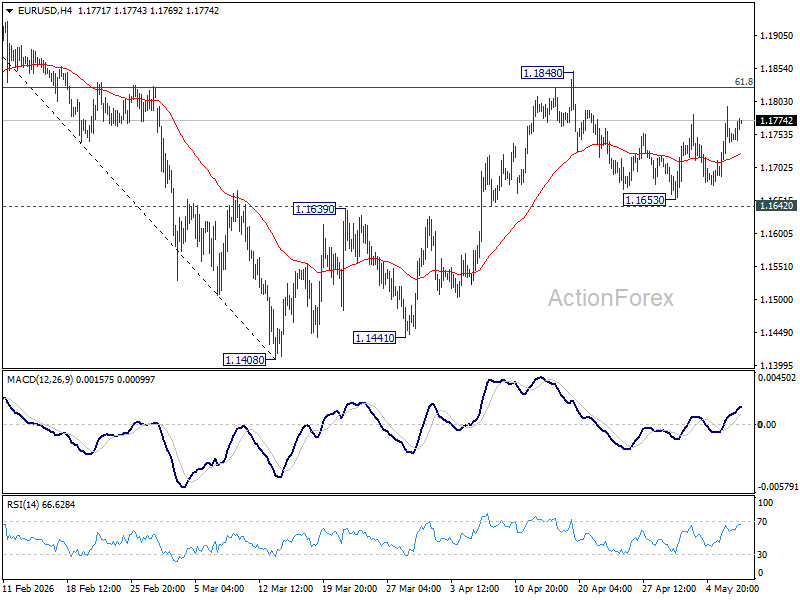
In the bigger picture, the strong support from 38.2% retracement of 1.0176 to 1.2081 at 1.1353 suggests that the pullback from 1.2081 is more likely a corrective move. Strong support was also found in 55 W EMA (now at 1.1537). Focus is back on 1.2 key cluster resistance level. Decisive break there will carry long term bullish implications. Nevertheless, break of 1.1408 support will revive the case of medium term bearish trend reversal.
From War Panic to Post-Conflict Positioning: Oil Falls, Silver Surges
Markets appear to be entering a new phase of post-conflict positioning, with oil prices falling again on hopes of a full reopening of the Strait of Hormuz while precious metals begin rebuilding bullish momentum. The sharp moves across commodities suggest investors are increasingly looking beyond the immediate US-Iran conflict and starting to reposition for a more normalized global macro environment.
The clearest signal is coming from oil markets. Brent crude extended its decline again today and broke below the $97 level, while WTI moved closer toward the key $90 handle. The price action suggests traders are becoming increasingly confident that the Strait of Hormuz could soon reopen fully to international shipping and energy flows if a peace agreement between Washington and Tehran materializes.
Oil traders now appear increasingly hopeful that commercial normalization could return to the region, allowing tankers to move freely again without disruption or informal “tolls” imposed by Iran’s Islamic Revolutionary Guard Corps on vessels passing through the Strait. That shift represents a major unwind of the geopolitical premium that had fueled the earlier oil surge.
Elsewhere, equities and currencies were notably calmer today after this week’s powerful risk-on rally. US stock futures traded largely steady following the record-breaking gains in S&P 500 and NASDAQ earlier in the week. Dollar also stabilized within recent ranges and appears to be awaiting a fresh directional catalyst from broader market sentiment.
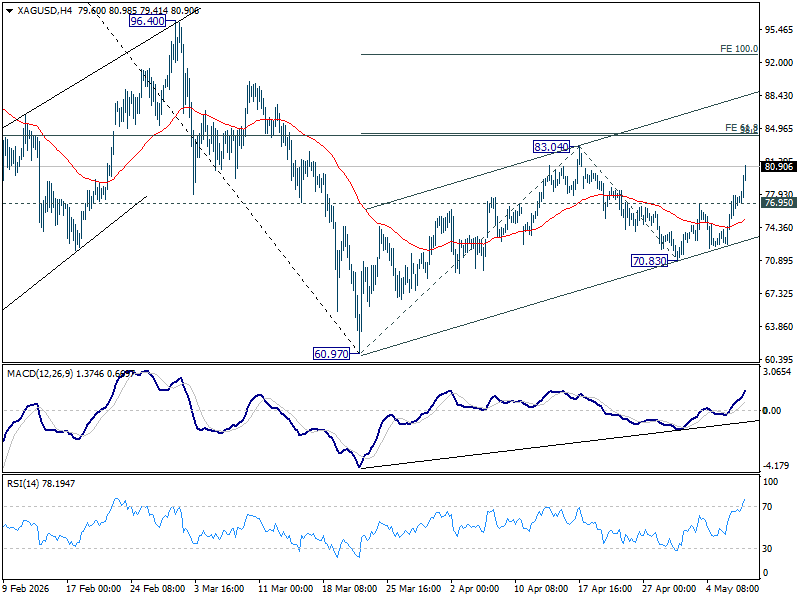
Meanwhile, the strongest momentum today has shifted toward precious metals, particularly Silver. Silver surged above the psychologically important $80 mark, significantly outperforming Gold and reinforcing the idea that investors are increasingly rotating back into higher-beta opportunities rather than pure defensive positioning.
Some investors are already beginning to argue that the record-breaking bull markets in Gold and Silver could resume later this year if a durable US-Iran peace settlement is achieved and the temporary pressure from higher interest rates fades. Both metals posted extraordinary gains during 2025, with Gold surging 66% and Silver soaring 135%, before experiencing sharp and volatile corrections this year.
Recent declines in precious metals had been driven by fears of higher interest rates, a stronger Dollar linked to rising oil prices, and heavy position liquidation during periods of market stress. But as oil retreats and the inflation shock potentially eases, investors are revisiting the longer-term structural bullish case for metals.
That longer-term story remains centered on central bank diversification away from US government debt, persistent physical Silver supply tightness, and expanding demand tied to green energy technologies and AI infrastructure. In many ways, the US-Iran conflict may have strengthened rather than weakened those structural themes by reinforcing the strategic importance of energy diversification and renewable technologies.
For now, markets appear to be transitioning away from “war panic” and toward “post-conflict positioning.” Oil is pricing normalization, equities are consolidating record highs, and Silver’s breakout suggests investors are once again willing to chase higher-beta opportunities tied to long-term structural growth themes.
In the currency markets, for the week so far, Kiwi is the best performer, followed by Aussie, and then Swiss Franc. Loonie is the worst, followed by Dollar, and then Sterling. Euro and Yen are positioning in the middle.
In Europe, at the time of writing, FTSE is down -0.53%. DAX is down -0.05%. CAC is up 0.09%. UK 10-year yield is down -0.035 at 4.913. Germany 10-year yield is down -0.026 at 2.980. Earlier in Asia, Nikkei surged 5.58%. Hong Kong HSI rose 1.57%. China Shanghai SSE rose 0.48%. Singapore Strait Times rose 0.30%. Japan 10-year JGB yield fell -0.023 to 2.483.
Silver Breaks 80 as Markets Rotate From Defense to Offense
Silver’s breakout above 80 may be signaling a major shift in market psychology. As Iran de-escalation hopes fuel a global risk-on rally, investors are rotating away from defensive Gold positioning and into higher-beta opportunities, with Silver emerging as one of the clearest beneficiaries. Read More.
US Jobless Claims Edge Higher to 200k, Labor Market Still Stable
US jobless claims rose slightly last week, but the broader labor market picture remains stable. Continuing claims declined and trend measures improved, reinforcing the view that layoffs remain contained despite slower economic momentum and geopolitical uncertainty. Read More.
Eurozone Retail Sales Slip -0.1% mom in March as Fuel Demand Weakens
Eurozone consumer spending remains fragile. Retail sales slipped again in March as falling fuel and food purchases offset resilient non-food demand, while Germany’s sharp decline highlighted persistent weakness in the region’s largest economy. Read More.
EUR/USD Mid-Day Outlook
Daily Pivots: (S1) 1.1693; (P) 1.1746; (R1) 1.1801; More….
Outlook in EUR/USD is unchanged as range trading continues. Intraday bias remains neutral, and with 1.1642 support intact, rise from 1.1408 is expected to continue. On the upside, firm break of 1.1848 will target 1.2081 high next. However, firm break of 1.1662 support will indicate the the rebound from 1.1408 has completed, and bring deeper decline back towards this low instead.
In the bigger picture, the strong support from 38.2% retracement of 1.0176 to 1.2081 at 1.1353 suggests that the pullback from 1.2081 is more likely a corrective move. Strong support was also found in 55 W EMA (now at 1.1537). Focus is back on 1.2 key cluster resistance level. Decisive break there will carry long term bullish implications. Nevertheless, break of 1.1408 support will revive the case of medium term bearish trend reversal.
US Jobless Claims Edge Higher to 200k, Labor Market Still Stable
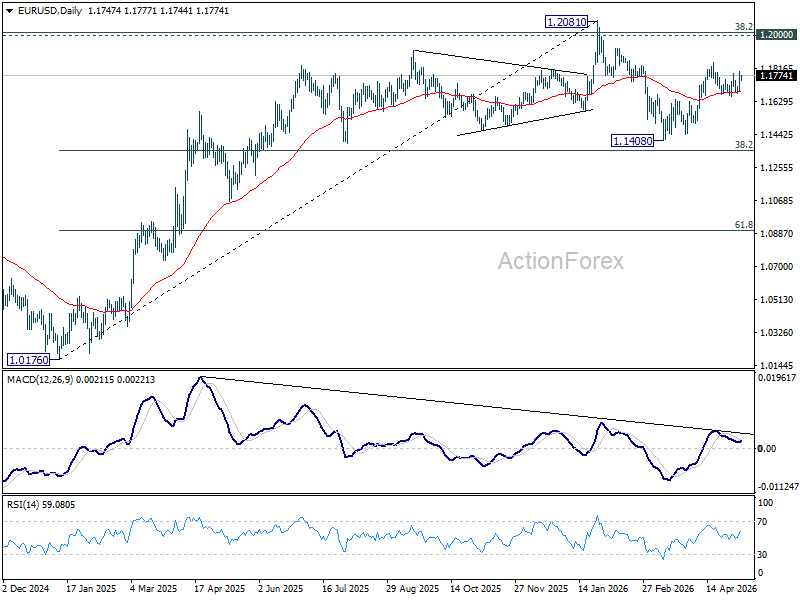
US initial jobless claims rose modestly by 10k to 200k in the week ending May 2, slightly above expectations of 199k. Despite the increase, claims levels remain historically low.
Underlying trends in the data were broadly stable. The four-week moving average of initial claims fell by -4,500 to 203,250, helping smooth out weekly volatility and reinforcing the view that layoffs remain relatively contained.
Continuing claims also improved modestly, falling by -10k to 1.766m in the week ending April 25.
| Indicator | Previous | Latest | Expectation |
|---|---|---|---|
| Initial Jobless Claims | 190k | 200k | 199k |
| Continuing Claims | 1.776m | 1.766m | — |
Oil: Brent Oil Continues to Trend Lower on Growing Optimism over Peace Talks
Brent oil remains firmly in red and extends weakness on Thursday after falling 10% on Wednesday and ending day with 5.5% loss.
Growing hopes for a US-Iran peace deal provided relief, keeping oil prices under increased pressure for the third straight day.
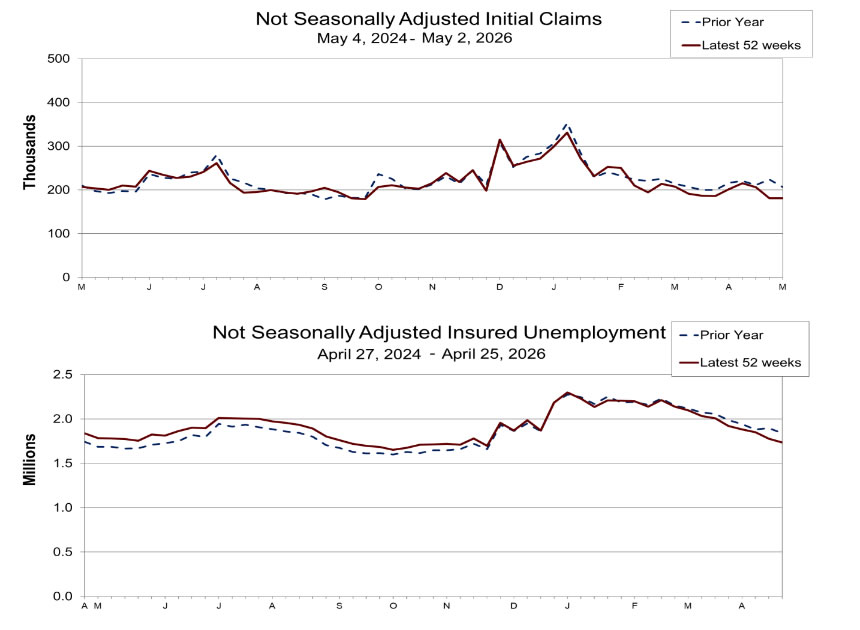
Bears probe again through important supports at $100.67 and $100.00 (50% retracement of $86.08/$115.26 upleg / psychological) which were broken on Wednesday’s spike to $96.76 but failed to register a daily close below these levels (market closed at $101.86).
Strong optimism about possible solution for the Middle East that would open way for stabilization of global oil market, which was strongly hit by closure of one of the world’s key oil / gas supply routes, continues to deflate oil prices.
Sustained break below $100 level to generate fresh bearish signal for attack at next strong support at $97 zone (Fibo 61.8% / Wednesday’s spike low), violation of which to confirm the signal and open way for further weakness (base of thick daily cloud lays at $91.36).
Broken pivots at $100.00/67 and $100.94 (cloud top) reverted to resistances, which should cap potential upticks to keep larger bears intact.
Res: 100.00; 100.97; 102.63; 103.43.
Sup: 97.25; 96.76; 93.93; 92.97.
Silver Breaks 80 as Markets Rotate From Defense to Offense
Silver’s sharp rally above the psychologically important 80 level is signaling more than just strength in precious metals—it reflects a broader shift in market psychology toward aggressive risk-taking. As geopolitical tensions surrounding Iran ease and global equities continue surging to record highs, investors are increasingly rotating away from defensive positioning and toward higher-beta assets with stronger upside potential.
The immediate catalyst for the move has been the sharp improvement in risk sentiment driven by growing optimism over a potential US-Iran agreement to end the conflict and reopen the Strait of Hormuz. The resulting “peace trade” has fueled record highs in S&P 500, NASDAQ, Nikkei, and KOSPI, while falling oil prices and broad Dollar weakness have further supported metals prices. Within precious metals, however, Silver is now clearly outperforming Gold.
That divergence is significant because the two metals often play different roles in investor positioning. Gold is traditionally viewed more as a defensive store of value and capital preservation asset during periods of uncertainty. Silver, by contrast, tends to behave more like a high-beta expression of optimism and growth expectations due to its stronger cyclical and speculative characteristics. Silver’s outperformance therefore suggests markets are increasingly shifting from defense into offense.
In many ways, the current move reflects a broader mentality change across global markets. Investors are no longer primarily focused on hedging geopolitical catastrophe. Instead, they are increasingly chasing opportunities tied to improving sentiment, easing war risks, and expanding risk appetite. Silver’s rally is becoming a visible reflection of that transition.
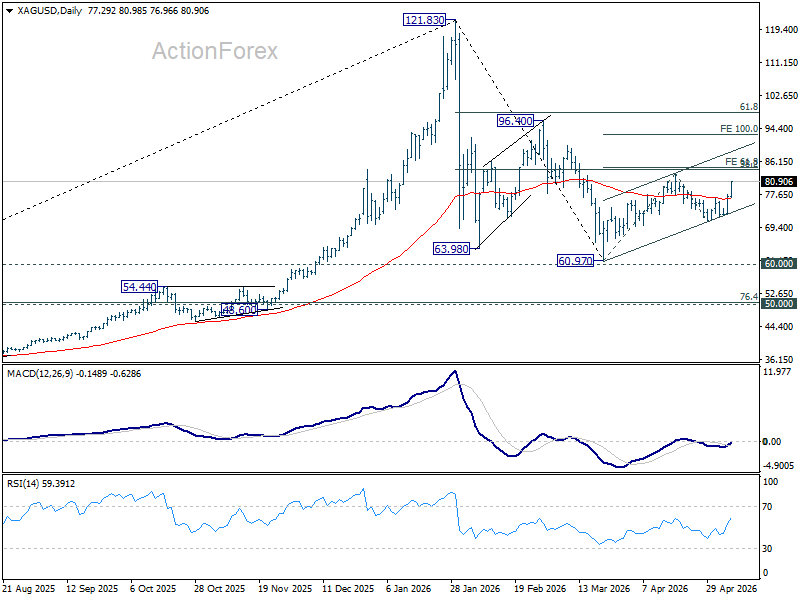
Technically, Silver’s rise from 70.83 is now viewed as the third leg of the broader rebound from the 60.97 low. Momentum remains firmly bullish following the break above 80, with bias staying to the upside as long as 76.95 minor support holds. Next target is 61.8% projection of 60.97 to 83.04 from 70.83 at 84.46. Firm break there could trigger another acceleration phase toward 100% projection at 92.90.
However, the outlook may become more challenging near the resistance zone between 96.40 and 61.8% retracement of 121.83 to 60.97 at 98.58, where strong technical barriers converge. It is a likely region for profit-taking and renewed selling pressure on the first attempt.
For now, though, the message from Silver is that markets are no longer hiding in defensive assets—they are increasingly chasing higher-octane opportunities as global risk appetite strengthens.
EUR/USD — At the Crossroads of Monetary Expectations
Fundamental Background
The fundamental backdrop for EUR/USD in early May is shaped by diverging monetary policy expectations on both sides of the Atlantic. At its 30 April meeting, the ECB left interest rates unchanged; however, Governing Council members Joachim Nagel and Peter Kazimir signalled the possibility of a rate hike as early as June amid persistent inflationary pressure. Meanwhile, the Federal Reserve has maintained rates within the 3.50–3.75% range without giving clear indications of imminent easing, while US inflation stood at 3.3% year-on-year in March.
Tensions in the Strait of Hormuz continue to keep oil prices near four-year highs, increasing inflation risks for the import-dependent eurozone. An additional pressure factor is the possibility of Washington raising tariffs on European cars to 25%.
Technical Picture
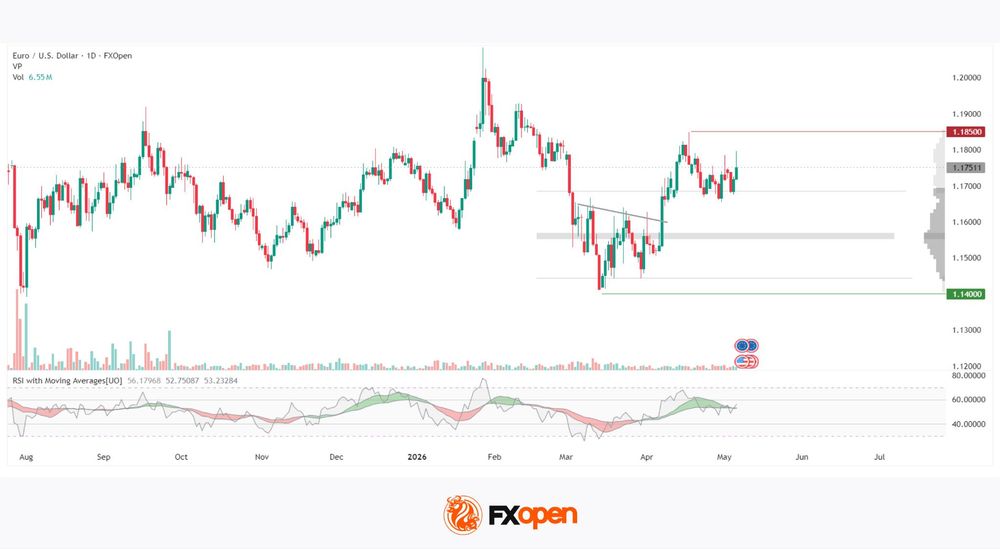
On the daily chart, EUR/USD formed and completed an inverted head-and-shoulders pattern in March. The neckline of the formation is located above the point of control (POC) of the horizontal volume profile, and the breakout above the neckline triggered a rally towards the 1.1850 area. The profile covers the 1.1440–1.1690 range, while the POC zone at 1.1550–1.1570 — representing the highest concentration of horizontal volume during the analysed period — acts as the main support area for the current market structure.
Following the pullback from 1.1850, the pair continues to trade above the upper boundary of the profile. The 1.1850 level remains the nearest significant resistance, while 1.1400 serves as the deeper support level for the entire profile zone. The RSI + MAs indicator shows readings of 56, 52 and 53: RSI remains above both moving averages, reflecting a moderate advantage for buyers without signs of strong momentum.
Key Takeaways
The fundamental backdrop remains mixed: expectations of tighter ECB policy continue to support the euro, while energy-related risks and weak eurozone growth are limiting bullish momentum. From a technical perspective, the key factor is whether price can hold above the POC zone and the 1.1690 level — a condition that could help sustain the bullish trend.
Trade over 50 forex markets 24 hours a day with FXOpen. Take advantage of low commissions, deep liquidity, and spreads from 0.0 pips (additional fees may apply). Open your FXOpen account now or learn more about trading forex with FXOpen.
This article represents the opinion of the Companies operating under the FXOpen brand only. It is not to be construed as an offer, solicitation, or recommendation with respect to products and services provided by the Companies operating under the FXOpen brand, nor is it to be considered financial advice.
Bitcoin Has Stalled Just Short of the 200-Day MA
Market Overview
The crypto market capitalisation has remained around $2.69 trillion, as the largest coins by market cap consolidate following their recent gains, while smaller altcoins have accelerated their growth. The top performers over the last 24 hours were Toncoin (+29%), NEAR (+10.7%) and Internet Computer (+9.6%). The worst performers were recent stars such as Zcash (-5%), Doge (-3.8%) and Bitcoin Cash (-2.9%).
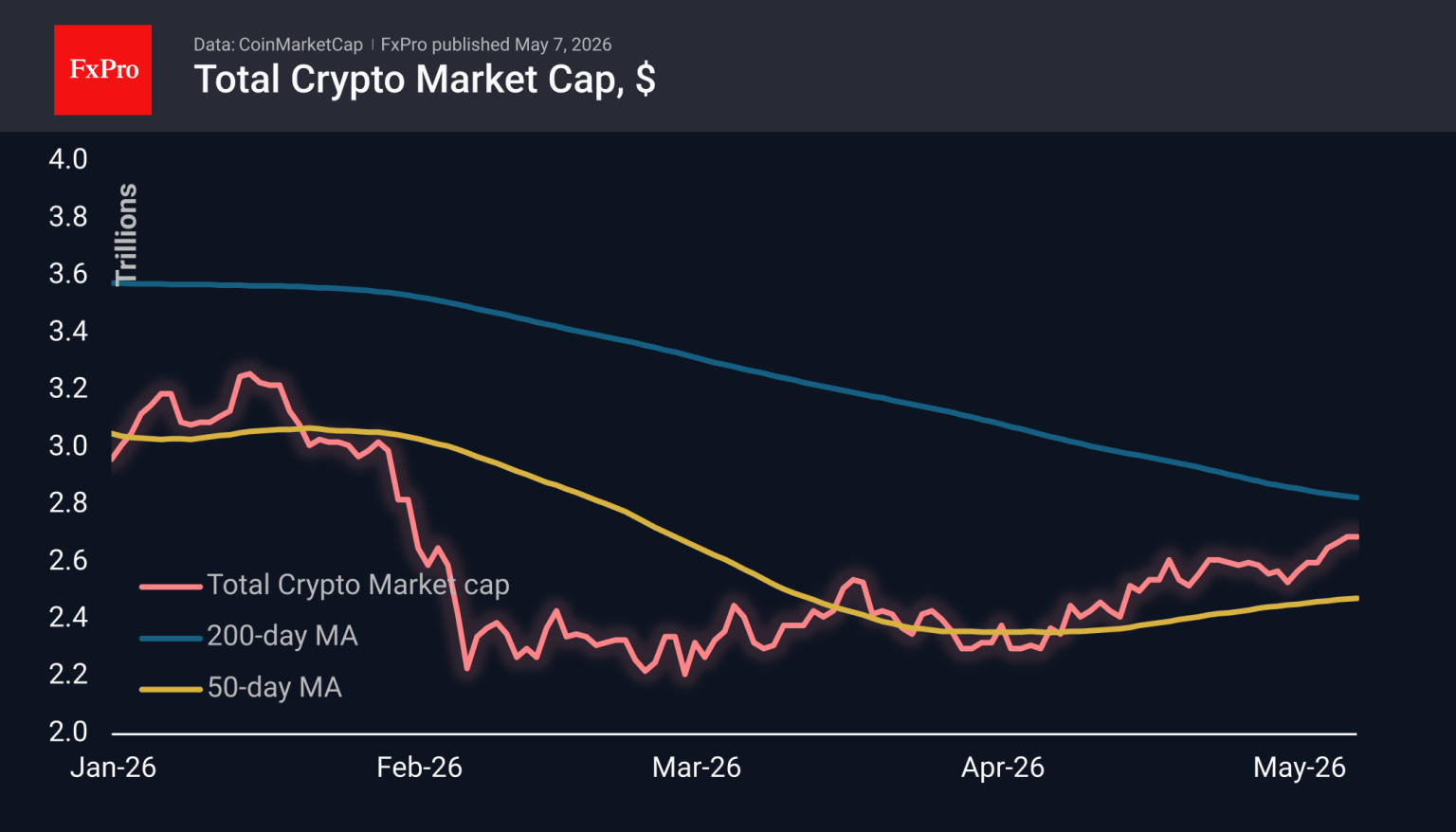
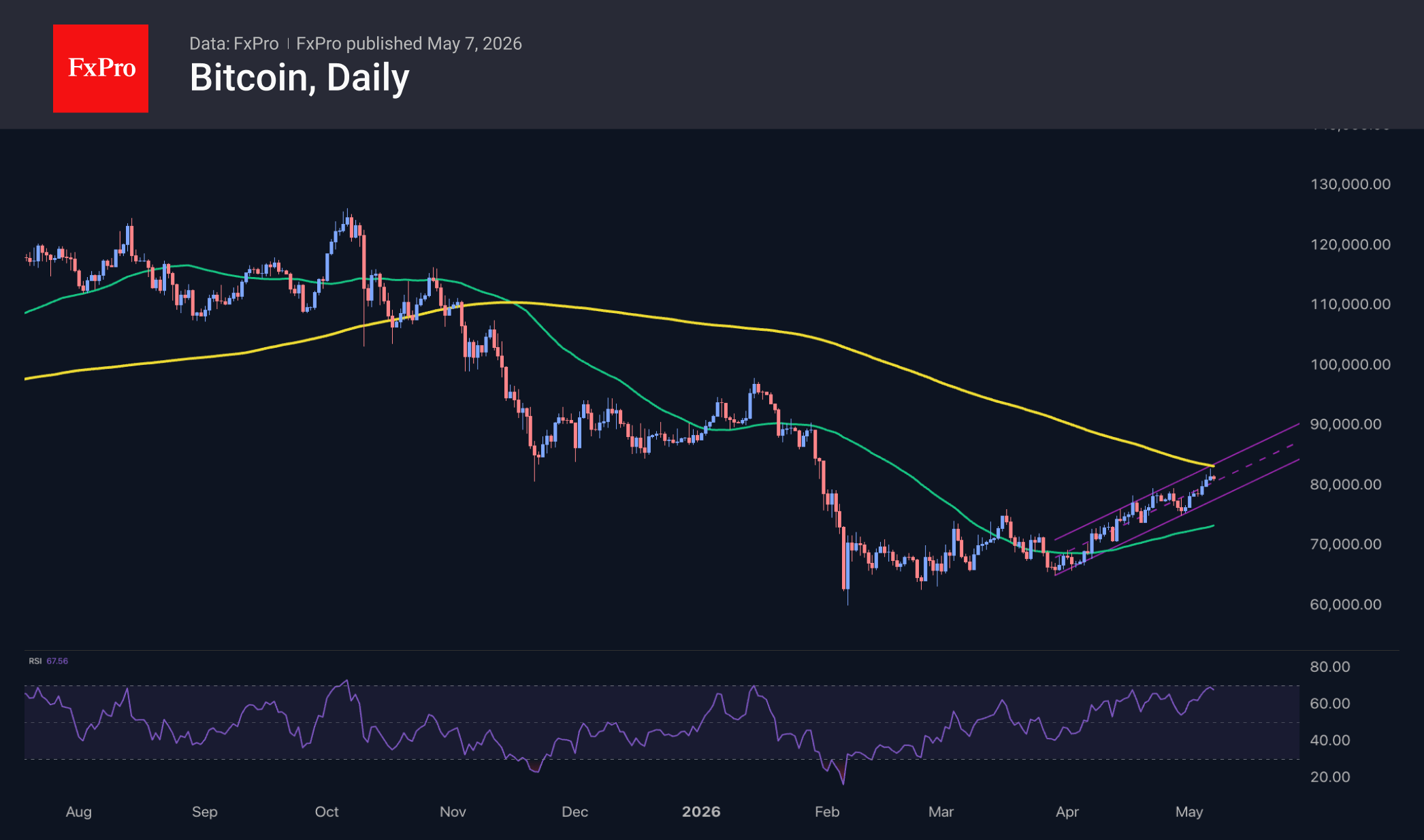
Bitcoin rose to $82.8K on Wednesday, approaching but not breaking through the 200-day moving average (currently at $83.2K). From its local highs, the leading cryptocurrency retreated to $81.3K at the time of writing, pausing its upward momentum. This pause also coincided with the RSI touching the overbought territory (>70) on daily timeframes. It is worrying that the previous three touches of these levels (in August, October and January) were followed by sharp selloffs. It is quite logical that market participants are taking a breather to assess the situation and gather strength. Thus, the current pause is not a sign of buyer exhaustion.
News Background
The Bitcoin futures market is experiencing its longest streak of negative funding rates in the last 10 years: it has remained in negative territory for 67 consecutive days, according to K33 Research. This situation heightens the risk of a short squeeze.
XWIN Japan identifies the $93K level as a key medium-term target for Bitcoin, driven by the closing of the price gap on the CME. However, the movement will not necessarily be straightforward, and the market may initially move lower.
The options market does not confirm a full-fledged breakout, QCP Capital points out. Monthly implied volatility remains around 41%, and demand for put options persists: market participants are buying Bitcoin but continue to hedge their risks.
Strategy reported a net loss of $12.5 billion for the first quarter of 2026. The main reason for this was ‘paper’ losses from the revaluation of the Bitcoin reserve against the backdrop of a fall in BTC. Strategy founder Michael Saylor admitted that the company may sell some of its Bitcoin to pay dividends, even though he had previously denied the possibility.
Pound Reaches Fresh Highs as the US Dollar Weakens
GBP/USD climbed to 1.3599 on Thursday, with sterling testing its highest levels since mid-February during the previous session. The pound continues to gain support from weakening demand for the US dollar as a safe-haven asset amid growing optimism surrounding a possible agreement between the US and Iran.
According to Axios, the White House is close to signing a framework memorandum with Iran that could pave the way for ending the conflict and launching nuclear negotiations. Tehran’s response is expected within the next 48 hours, although a final agreement has yet to be secured.
Investors are also closely monitoring local elections in the United Kingdom, where opinion polls suggest that Keir Starmer’s party could face notable losses.
On the monetary policy front, expectations for the Bank of England have shifted slightly. Markets are currently pricing in around 50 basis points of tightening by the end of the year, equivalent to two rate increases. Previously, investors had anticipated as many as three hikes.
Technical Analysis
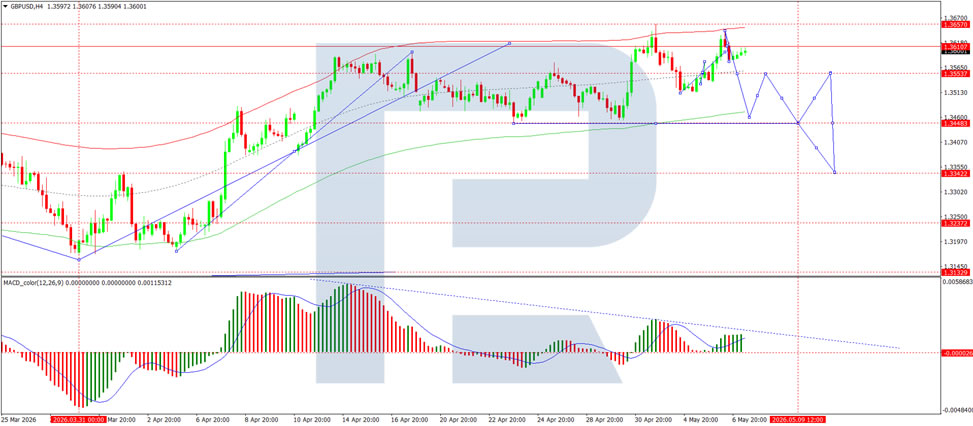
On the H4 chart, GBP/USD is trading within a broad consolidation range above 1.3515, currently extending towards 1.3650. A corrective move lower towards 1.3344 remains possible. After this correction, the pair may consolidate again. A breakout higher would reopen the path towards 1.3650, while a downside move could extend losses towards 1.3344. The MACD indicator supports this scenario, with the signal line above zero and pointing firmly lower, indicating fading bullish momentum.
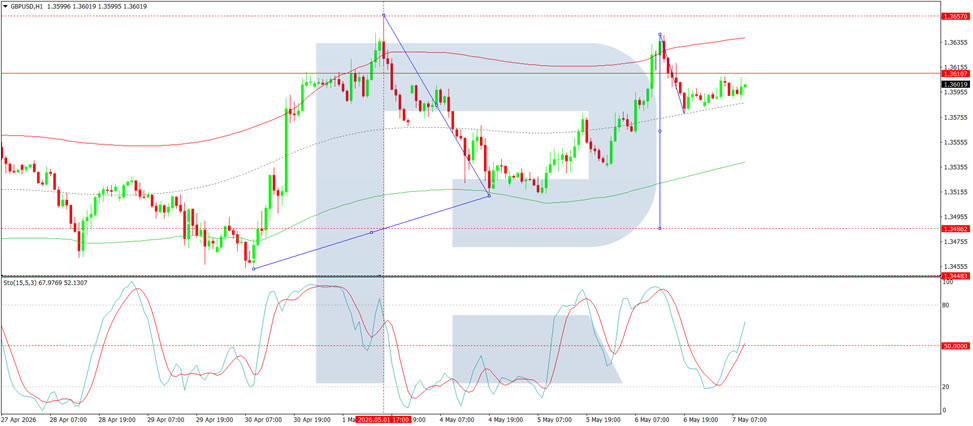
On the H1 chart, GBP/USD is trading within a compact consolidation range around 1.3615. The range has extended lower towards 1.3578, with the pair attempting to rebound towards 1.3615 as a retest from below. After that, another decline towards 1.3565 may follow. The Stochastic oscillator confirms this outlook, with the signal line below 50 and pointing downwards towards 20, signalling increasing short-term downside pressure.
Conclusion
Sterling remains supported by improving global risk sentiment and reduced demand for the US dollar as a defensive asset. However, political uncertainty in the UK and shifting expectations around Bank of England policy could limit further upside. In the near term, GBP/USD is likely to remain highly sensitive to geopolitical headlines and broader market sentiment.
Eurozone Retail Sales Slip -0.1% mom in March as Fuel Demand Weakens
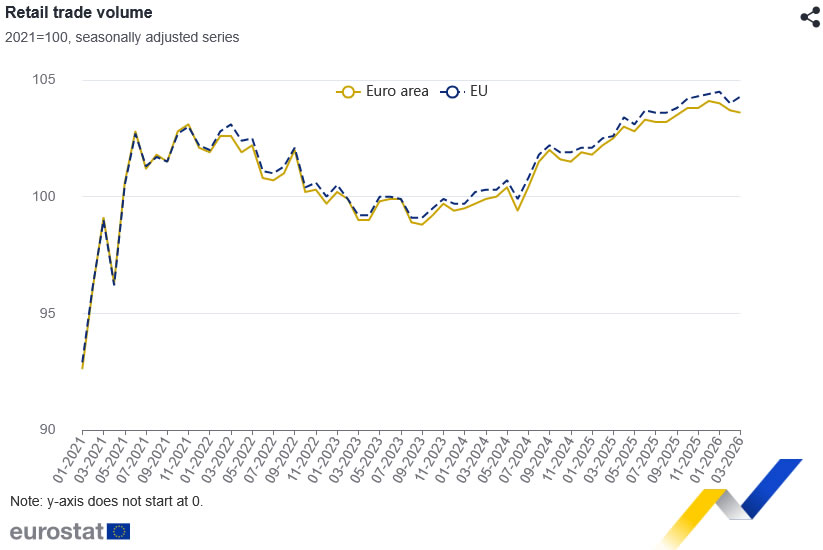
Eurozone retail sales edged lower in March, with the volume of retail trade falling -0.1% mom, outperforming expectations for a steeper -0.4% mom decline. The data suggest consumer spending remains soft, as higher energy costs and geopolitical uncertainty continue weighing on confidence across the region.
The monthly decline in Eurozone was driven primarily by weaker fuel spending, with sales of automotive fuel in specialized stores dropping -1.6% mom. Food, drinks, and tobacco sales also slipped -0.3% mom. However, non-food products excluding fuel showed resilience, rising 0.6% mom and partially offsetting broader weakness in household consumption.
Across the wider EU, retail sales fell -0.3% mom. Country-level performance was highly uneven, with Slovenia, Luxembourg, and Belgium recording the strongest monthly gains, while Germany posted a sharp -2.1% decline. The data reinforce the broader picture of a fragile European consumer sector, where spending remains constrained by elevated inflation pressures and slowing economic momentum.
| Indicator | Previous | Latest | Expectation |
|---|---|---|---|
| Eurozone Retail Sales (MoM) | — | -0.1% | -0.4% |
| EU Retail Sales (MoM) | — | -0.3% | — |
| Eurozone Category | Monthly Change |
|---|---|
| Food, Drinks & Tobacco | -0.3% |
| Non-Food Products (ex-fuel) | +0.6% |
| Automotive Fuel | -1.6% |
| EU Strongest Performers | Monthly Change |
|---|---|
| Slovenia | +4.3% |
| Luxembourg | +4.0% |
| Belgium | +3.6% |
| EU Weakest Performers | Monthly Change |
| Germany | -2.1% |
| Malta | -0.4% |
| Italy | -0.1% |
| Latvia | -0.1% |
AUD/USD and AUD/CAD Hit New Highs Amid RBA Tightening
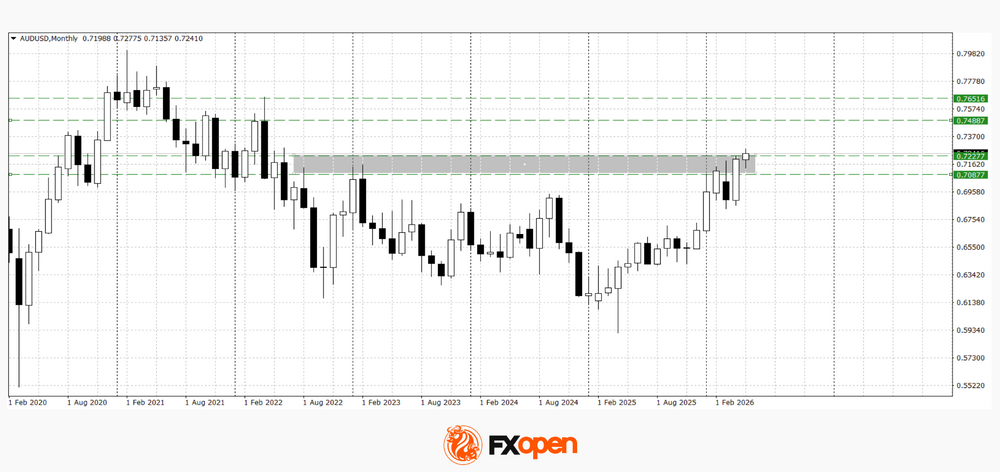
The Australian dollar continues to strengthen, pushing to fresh 2021–2022 highs, supported by a combination of the Reserve Bank of Australia’s tight monetary stance and a weaker US dollar. This week’s rate hike by the RBA has been a key driver, widening yield differentials and boosting demand for the Australian currency, which has reinforced the ongoing uptrend. Additional pressure on the US dollar came from weak labour data, including the ADP report, increasing expectations of a more accommodative Fed policy.
The current market structure suggests that both AUD/USD and AUD/CAD have broken out of recent consolidation ranges and are now advancing towards multi-year highs. Trading at these levels creates a decision zone where liquidity is being reallocated, with the market assessing whether prices can hold above extremes or fall back into prior ranges.
In the near term, the key event for markets will be the US Non-Farm Payrolls report, while other macro releases are likely to play a secondary role. The NFP reaction could significantly influence expectations for Fed policy and set the direction for the US dollar.
AUD/USD
AUD/USD is trading near yearly highs, maintaining bullish momentum after breaking out of its range. Dollar weakness combined with RBA policy support continues to favour further gains, with the current area acting as a key test for breakout confirmation.
From a technical perspective, continuation of the uptrend depends on the 0.7230 level holding as support. However, in the absence of fresh catalysts ahead of key data releases, a pullback towards 0.7130–0.7160 remains possible.
Key Events For AUD/USD:
- today at 15:30 (GMT+3): US initial jobless claims
- today at 17:00 (GMT+3): US construction spending
- today at 18:30 (GMT+3): Atlanta Fed GDPNow indicator
AUD/CAD
AUD/CAD reached a new yearly high yesterday at 0.9870 and still shows potential for a move towards 2021 extremes near 0.9990. If the upper boundary of the recent range turns into support, the bullish momentum could strengthen further.
At the same time, a slowdown at current levels could lead to a return back into the broken range, creating a false breakout scenario and opening the door for a corrective move.
Key Events For AUD/CAD:
- today at 13:00 (GMT+3): Canada leading economic indicators
- today at 23:30 (GMT+3): US Federal Reserve balance sheet
- tomorrow at 15:30 (GMT+3): Canada employment change
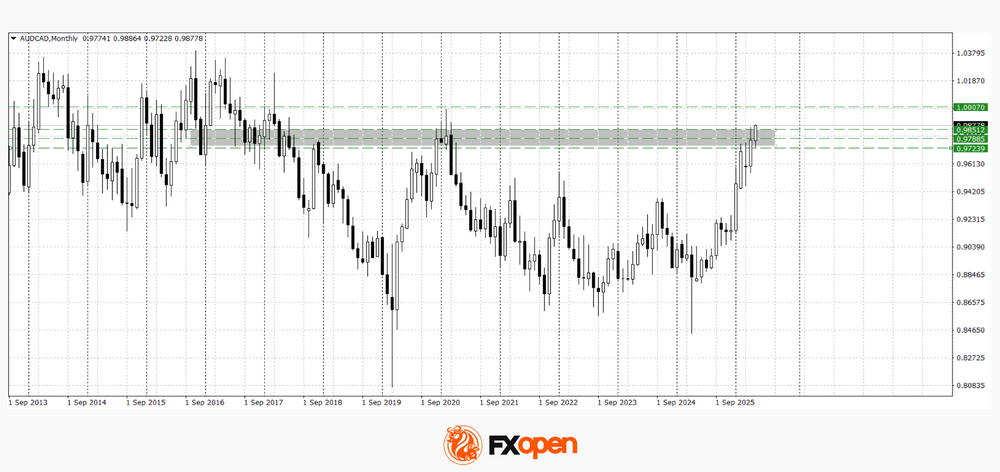
Overall, both currency pairs remain in a strong upward phase supported by fundamental drivers. The current resistance zone is a key decision area: a sustained breakout would open the way for further gains, while weak follow-through or stronger US data could trigger a return into prior ranges and a corrective pullback. Upcoming macroeconomic releases are likely to be the decisive catalyst for the next market move.
Trade over 50 forex markets 24 hours a day with FXOpen. Take advantage of low commissions, deep liquidity, and spreads from 0.0 pips (additional fees may apply). Open your FXOpen account now or learn more about trading forex with FXOpen.
This article represents the opinion of the Companies operating under the FXOpen brand only. It is not to be construed as an offer, solicitation, or recommendation with respect to products and services provided by the Companies operating under the FXOpen brand, nor is it to be considered financial advice.