

Sample Category Title
USD/JPY Daily Outlook
Daily Pivots: (S1) 154.95; (P) 156.46; (R1) 157.90; More...
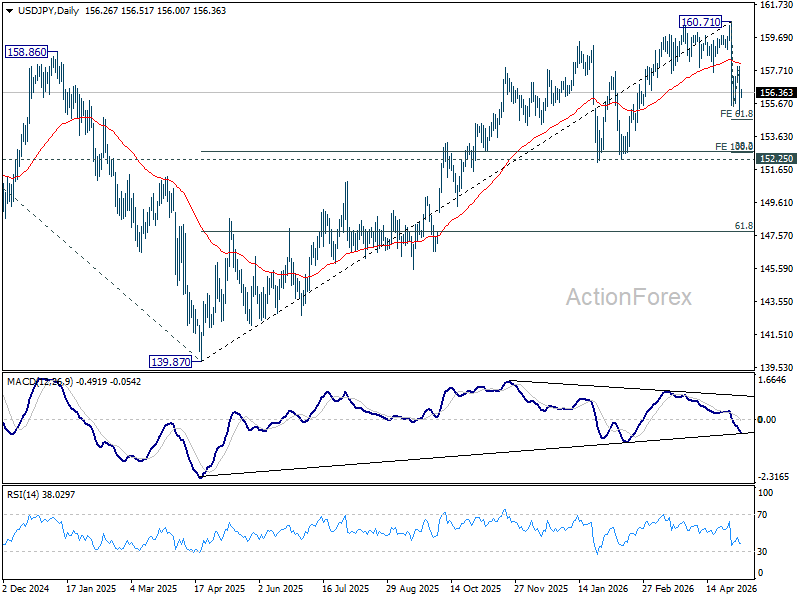
Intraday bias in USD/JPY stays mildly on the downside for 61.8% projection of 160.71 to 155.48 from 157.92 at 154.68. Firm break there will target 100% projection at 152.69. That would be close to key 152.25 cluster support (38.2% retracement of 139.87 to 160.71 at 152.74). For now, risk will stay on the downside as long as 157.92 resistance holds, in case of recovery.
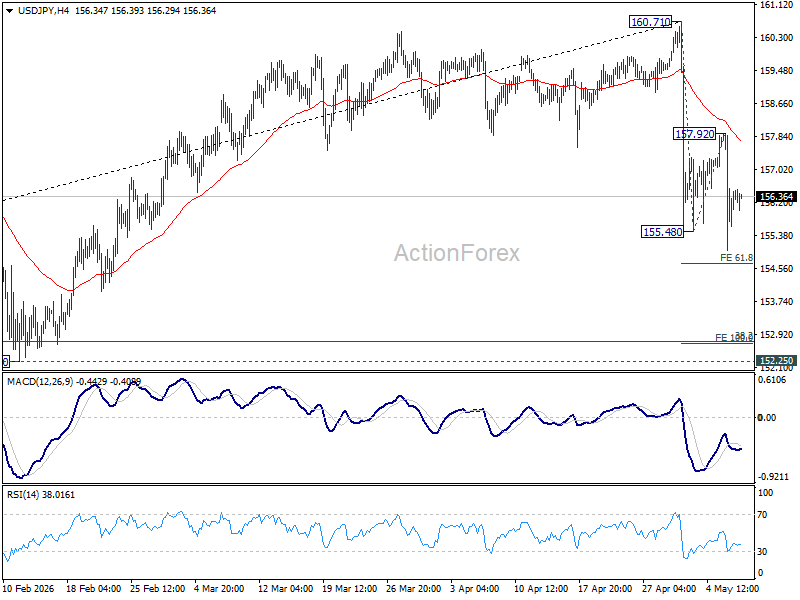
In the bigger picture, for now, corrective pattern from 161.94 (2024 high) is still seen as completed at 139.87. Rise from there is seen as resuming the long term up trend. So, break of 161.94 is expected at a later stage to resume the long term up trend. However, sustained break of 55 W EMA (now at 154.01) will dampen this view and bring deeper fall back towards 139.87 to extend the pattern from 161.94.
GBP/USD Daily Outlook
Daily Pivots: (S1) 1.3539; (P) 1.3591; (R1) 1.3646; More...
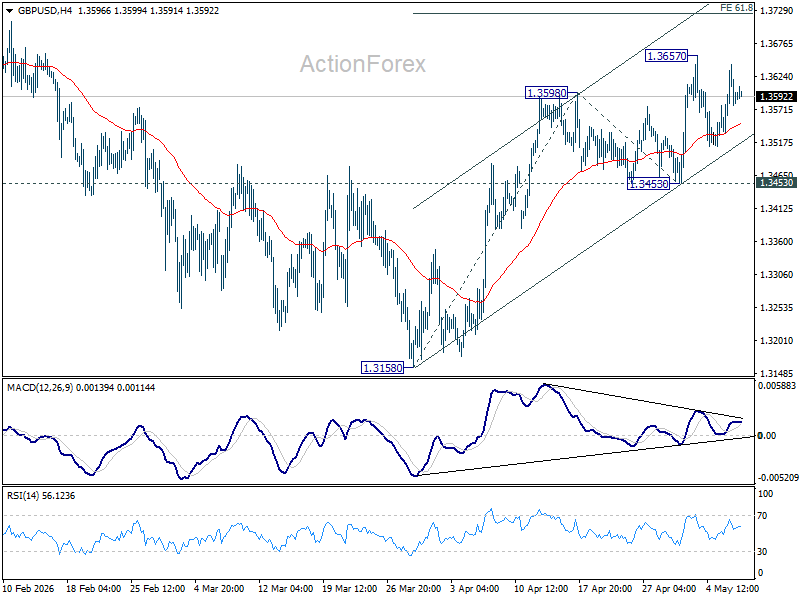
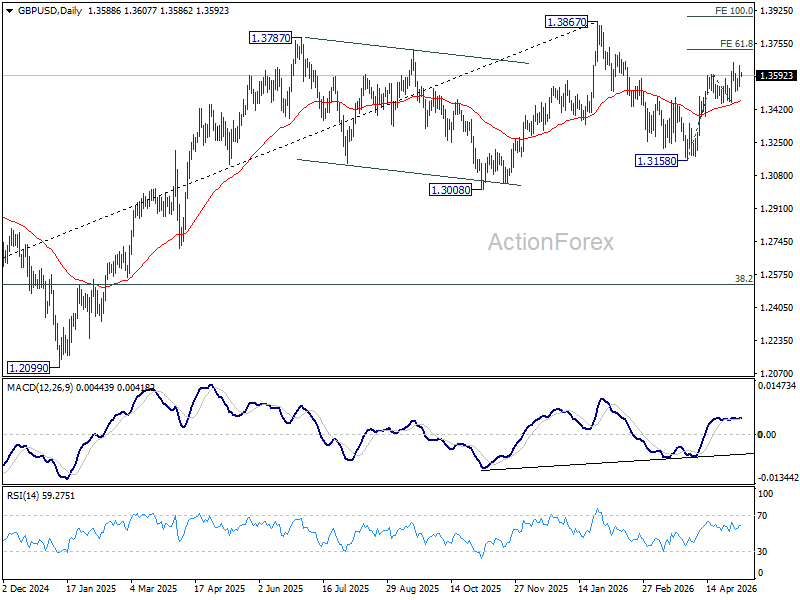
Intraday bias in GBP/USD remains neutral as range trading continues. With 1.3453 support intact, further rise is expected. On the upside, above 1.3657 will target 61.8% projection of 1.3158 to 1.3598 from 1.3453 at 1.3725 first. Firm break there will target a retest on 1.3867 high. However, break of 1.3453 will turn bias back to the downside for 1.3158 support instead.
In the bigger picture, current development suggests that price actions from 1.3867 are merely a corrective pattern within the broader up trend from 1.0351 (2022 low). With 1.3008 support intact, medium term bullishness is maintained and break of 1.3867 is in favor for a later stage, towards 1.4248 key resistance (2021 high).
USD/CHF Daily Outlook
Daily Pivots: (S1) 0.7759; (P) 0.7801; (R1) 0.7829; More….
Intraday bias in USD/CHF remains mildly on the downside at this point. Fall from 0.8041 is in progress. Firm break of 61.8% projection of 0.8041 to 0.7774 from 0.7923 at 0.7758 will target 100% projection at 0.7656. On the upside, above 0.7847 minor resistance will turn bias neutral again.
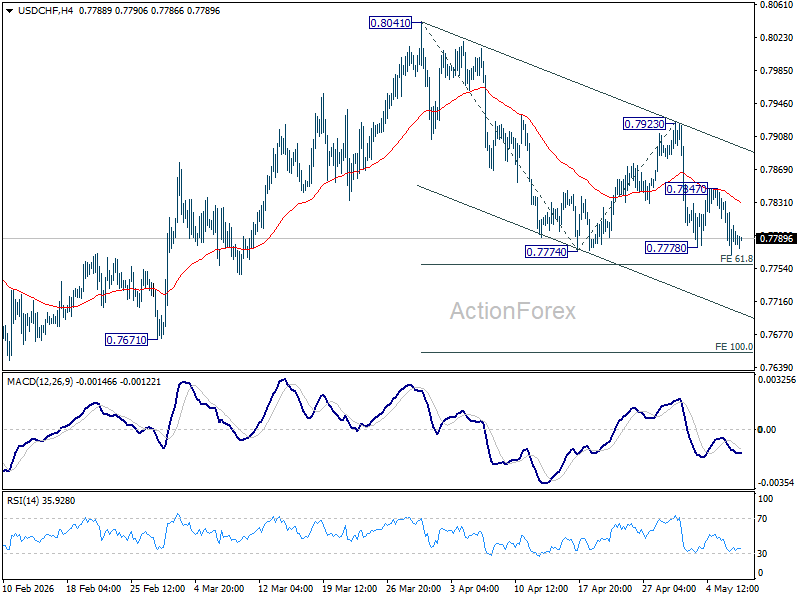
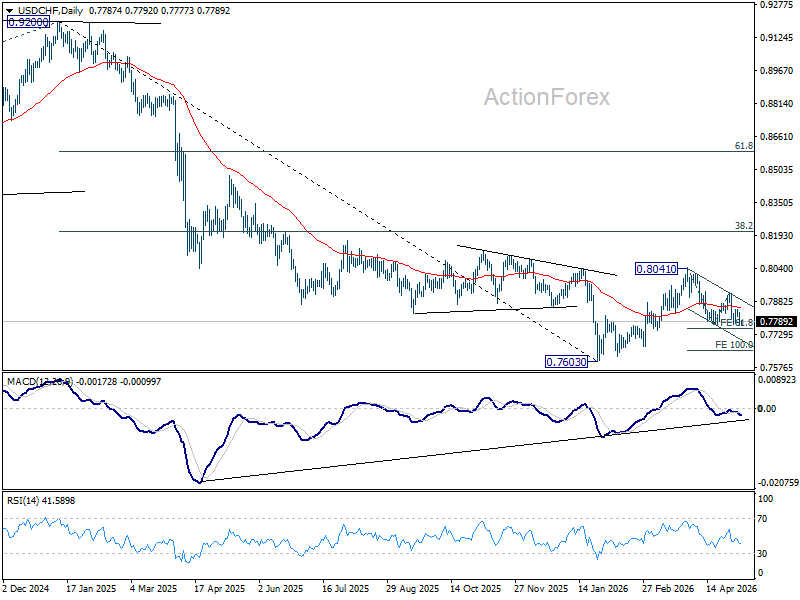
In the bigger picture, rebound from 0.7603 medium term bottom is seen as correcting the fall from 0.9200 only. Rejection by 55 W EMA (now at 0.8042) will affirm this bearish case, and setup down trend resumption to 100% projection of 1.0146 (2022 high) to 0.8332 from 0.9200 at 0.7382 at a later stage. Though, sustained break of 55 W EMA will suggest that it's probably correcting the larger scale down trend from 1.0146 (2022 high).
USD/CAD Daily Outlook
Daily Pivots: (S1) 1.3594; (P) 1.3619; (R1) 1.3658; More...
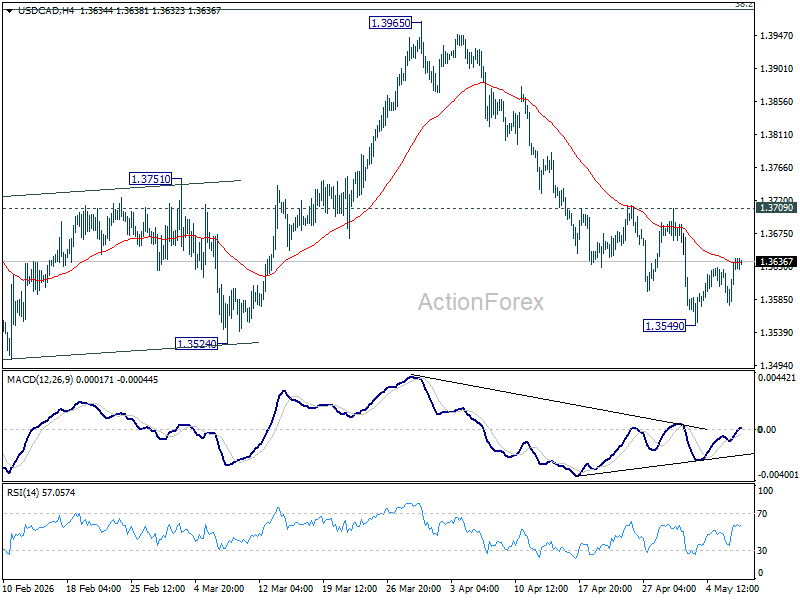
Intraday bias in USD/CAD remains neutral and more consolidations could be seen above 1.3549. Further decline is expected as long as 1.3709 resistance holds. Below 1.3549 will resume the fall from 1.3965 to retest 1.3480 low. Decisive break there will resume whole down trend from 1.4791. However, firm break of 1.3709 will turn bias back to the upside for stronger rebound.
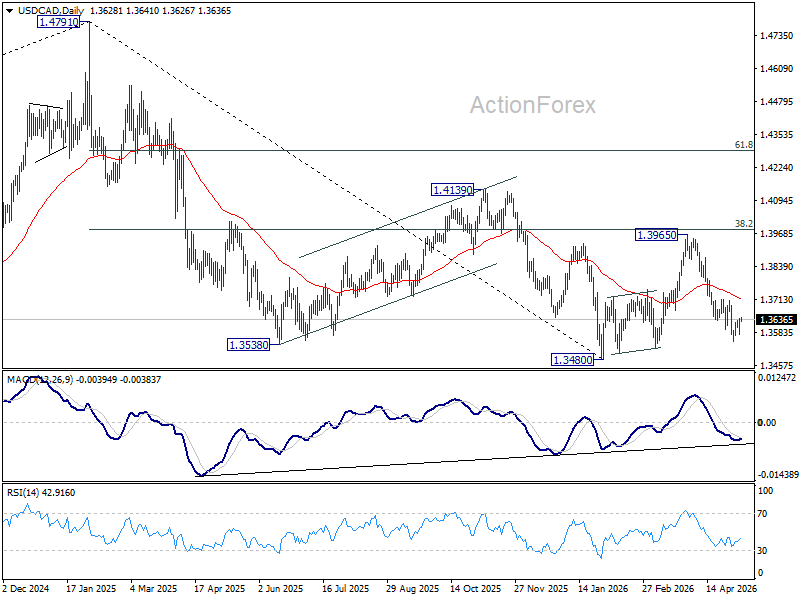
In the bigger picture, price actions from 1.4791 are seen as a corrective pattern to the whole up trend from 1.2005 (2021 low). Deeper fall could be seen, as the pattern extends, to 61.8% retracement of 1.2005 to 1.4791 at 1.3069. However, decisive break of 38.2% retracement of 1.4791 to 1.3480 at 1.3981 will argue that the correction has completed with three waves down to 1.3480 already.
AUD/USD Daily Report
Daily Pivots: (S1) 0.7185; (P) 0.7231; (R1) 0.7284; More...
Intraday bias in AUD/USD remains on the upside at this point. Current rally should target 61.8% projection of 0.6420 to 0.7187 from 0.6832 at 0.7306. On the downside, below 0.7223 minor support will turn intraday bias neutral again. But outlook will remain bullish as long as 0.7101 support holds, in case of retreat.
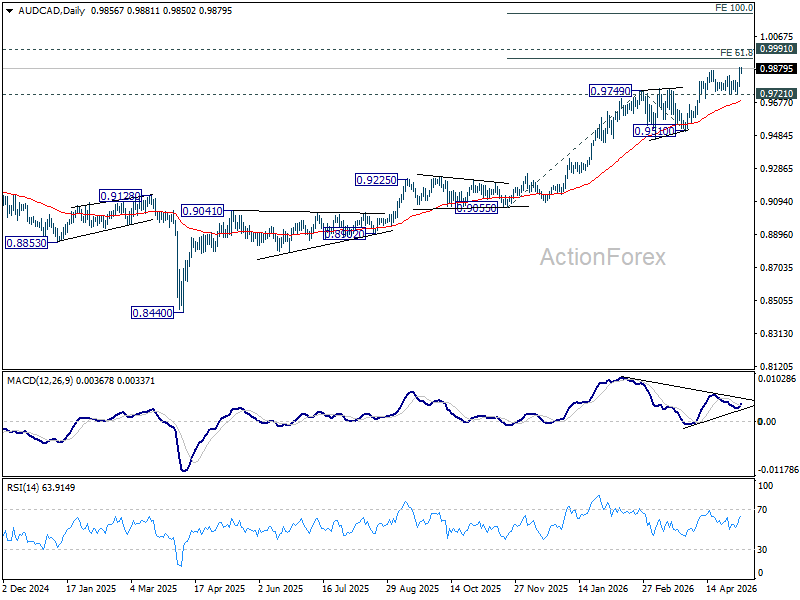
In the bigger picture, rise from 0.5913 (2024 low) is still in progress. Decisive break of 61.8% retracement of 0.8006 to 0.5913 at 0.7206 will solidify the case that it's already reversing the down trend from 0.8006 (2021 high). Further rally should then be seen to retest 0.8006. For now, outlook will remain bullish as long as 0.6832 support holds, in case of pullback.
Markets Party on Peace Hopes, but Oil and Beirut Strike Warn Risks Aren’t Gone
Global markets are throwing a full-scale “peace party.” Equities are surging relentlessly, risk appetite is exploding higher, and investors are increasingly behaving as though the Middle East crisis is already moving toward resolution. But beneath the rally, oil markets and renewed violence in Lebanon are flashing warnings that the geopolitical story may not be nearly as settled as stock investors want to believe.
Wall Street led the charge overnight as S&P 500 and NASDAQ blasted to fresh record highs. The momentum then rolled straight into Asia, where Nikkei climbed to another historic peak while KOSPI paused only briefly after reaching yet another intraday record. The market narrative has clearly shifted from war panic toward peace optimism.
The catalyst remains growing confidence that the US and Iran are moving closer to a framework agreement to end the conflict and reopen the Strait of Hormuz. Traders are increasingly betting that the proposed 14-point memorandum of understanding will either produce a formal peace deal or, at minimum, prevent further military escalation. For equity investors, that distinction is enough. Markets are increasingly treating “no new escalation” as effectively equivalent to peace.
The result has been a rapid unwind of the entire “war trade.” Dollar is under broad pressure this week, while risk-sensitive currencies and global equities continue to rally aggressively. Oil prices have also fallen sharply from their highs, with Brent briefly crashing below the critical $100 mark earlier this week.
But the fact that Brent is still hovering near $100 may actually be one of the most important signals in markets right now. Oil traders are not fully buying the optimism yet. If energy markets were genuinely convinced the crisis had been resolved, crude prices would likely be much lower already.
One reason is that the regional picture remains extremely fragile. Israel reportedly launched strikes on Beirut on Wednesday for the first time since agreeing to a ceasefire with Hezbollah last month. Israel said the operation targeted a commander from Hezbollah’s elite Radwan force in the southern suburbs of the Lebanese capital.
That strike carries broader significance because the Lebanon ceasefire is one of the pillars supporting the wider US-Iran truce. Tehran had viewed a halt to Israeli operations in Lebanon as one of the critical conditions for broader de-escalation. Renewed military action therefore raises questions about how durable the current diplomatic momentum really is.
In other words, equities may be pricing peace faster than geopolitics can realistically deliver it. Investors are clearly leaning toward a no-escalation outcome, but crude markets still reflect lingering anxiety that the regional situation could deteriorate again quickly if negotiations break down or regional actors lose control of events.
Meanwhile, another major market focus remains Yen after the extraordinary volatility of the past two weeks. Japanese Vice Finance Minister Atsushi Mimura escalated Tokyo’s anti-speculator rhetoric today by declaring Japan faces “no constraints” on how often it can intervene in currency markets. He also revealed that Japanese authorities remain in daily contact with Washington.
Perhaps most importantly, Mimura said the US “fully understand our thinking and our actions,” effectively signaling to markets that Tokyo believes it has a green light from Washington to continue defending Yen aggressively if necessary. That message was widely interpreted as a direct warning to speculators betting against the Japanese currency.
Markets are now looking ahead to US Treasury Secretary Scott Bessent’s trip to Japan next week, where discussions are expected to cover speculative Yen selling, economic security issues, energy procurement, and potentially the Iran conflict itself.
For now, risk appetite remains dominant. Kiwi and Aussie are leading gains this week, while Loonie and Dollar lag badly as falling oil and fading war fears unwind safe-haven positioning. But with oil still elevated and Lebanon tensions re-emerging, investors may soon discover that the path from ceasefire optimism to genuine regional stability is far more complicated than the current equity rally suggests.
In Asia, at the time of writing Nikkei is up 5.94%. Hong Kong HSI is up 1.43%. China Shanghai SSE is up 0.27%. Singapore Strait Times is up 0.29%. Japan 10-year JGB yield is down -0.027 at 2.479. Overnight, DOW rose 1.24%. S&P 500 rose 1.46%. NASDAQ rose 2.02%. 10-year yield fell -0.06 to 4.36.
AUD/CAD Targeting Parity as Peace Optimism, Falling Oil and RBA-BoC Divergence Align
AUD/CAD is rapidly moving toward parity as multiple macro forces align in favor of the Aussie. Improving geopolitical sentiment is boosting global equities and pushing oil prices lower, while widening divergence between the hawkish RBA and constrained BoC adds further upside momentum to the cross. Read More.
Fed’s Goolsbee: Iran War Is Inflationary, Not Yet Stagflationary
Fed’s Austan Goolsbee drew a crucial distinction for markets: the Iran war is currently inflationary, not stagflationary. With jobs and growth still holding up, he remains more focused on persistent inflation and supply-chain disruptions than on supporting economic activity. Read more.
Macklem Warns Energy Shock Could Force Consecutive BoC Hikes
BoC Governor Tiff Macklem delivered a clear warning to markets: if elevated oil prices begin feeding into broader inflation, the Bank of Canada may need “consecutive increases” in interest rates. While policymakers are still looking through the initial energy shock, concern about persistent inflation is rising rapidly. Read More.
AUD/USD Daily Report
Daily Pivots: (S1) 0.7185; (P) 0.7231; (R1) 0.7284; More...
Intraday bias in AUD/USD remains on the upside at this point. Current rally should target 61.8% projection of 0.6420 to 0.7187 from 0.6832 at 0.7306. On the downside, below 0.7223 minor support will turn intraday bias neutral again. But outlook will remain bullish as long as 0.7101 support holds, in case of retreat.
In the bigger picture, rise from 0.5913 (2024 low) is still in progress. Decisive break of 61.8% retracement of 0.8006 to 0.5913 at 0.7206 will solidify the case that it's already reversing the down trend from 0.8006 (2021 high). Further rally should then be seen to retest 0.8006. For now, outlook will remain bullish as long as 0.6832 support holds, in case of pullback.
AUD/CAD Targeting Parity as Peace Optimism, Falling Oil and RBA-BoC Divergence Align
AUD/CAD is rapidly moving toward parity as multiple macro forces suddenly align in favor of the Aussie at the same time. The shift from Middle East war fears toward peace optimism is simultaneously boosting risk appetite globally while pressuring oil prices lower—a rare combination that strongly favors AUD over CAD.
The market narrative changed dramatically this week after reports suggested the US and Iran are moving closer to a framework agreement to end the conflict. Investors responded aggressively by piling back into risk assets. S&P 500 and NASDAQ surged to fresh record highs, while the rally spread across Asia with KOSPI and Nikkei also reaching new highs. That powerful risk-on backdrop is naturally supportive for the Australian Dollar, which remains one of the market’s preferred pro-cyclical currencies.
At the same time, the “peace trade” is crushing oil prices. Brent crude has fallen back toward the $100 area as traders rapidly unwind part of the geopolitical premium built during weeks of conflict around Hormuz. That matters enormously for CAD because lower oil prices directly weaken one of the Canadian Dollar’s biggest structural supports. In other words, the same geopolitical shift is helping AUD and hurting CAD simultaneously.
The longer-term macro story is reinforcing the move even further. The RBA has already hiked three times this year, taking rates to 4.35%, and its latest projections suggest rates could eventually move as high as 4.7%. Markets see the RBA as one of the few major central banks still leaning clearly hawkish as energy inflation risks remain elevated.
The BoC, however, is trapped in a much more difficult position. Governor Tiff Macklem sounded cautious and even warned that persistent inflation could eventually require “consecutive increases” in rates. But he also made clear that the Canadian economy remains highly exposed to US tariffs, trade uncertainty, and the upcoming CUSMA review process. That means the BoC is not realistically in a position to tighten aggressively yet, despite rising inflation concerns.
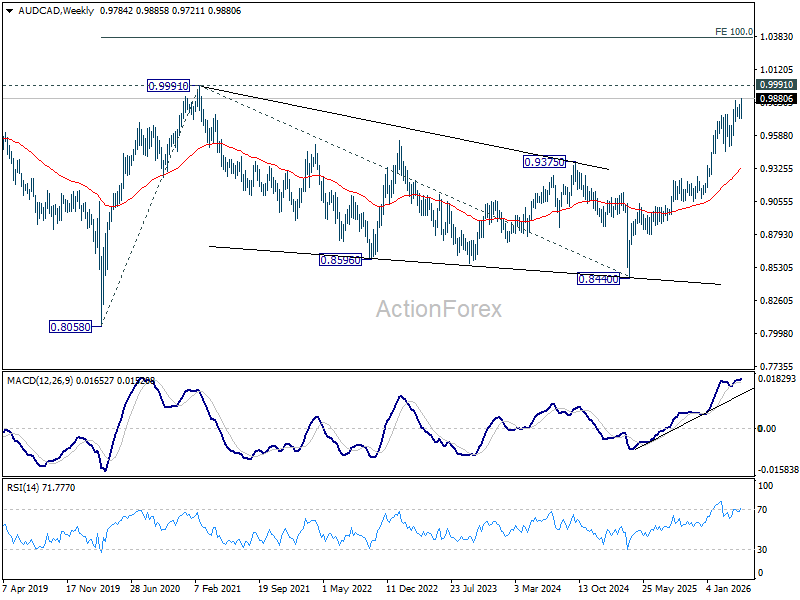
This divergence is visible in AUD/CAD price action. Technically, the medium-term uptrend from 0.8440 is resuming towards 0.9991 resistance (2021 high). Parity is not just a psychological talking point—it is a realistic technical objective. Decisive break above parity would confirm that the broader long-term uptrend from the 2020 low at 0.8058 has resumed.
In this bullish case, the next near term target is 100% projection of 0.9055 to 0.9749 from 0.9510 at 1.0204. Next medium term target is 0.8058 to 0.9991 from 0.8440 at 1.0373.
Stock Markets Rally on US-Iran Peace Hopes; Tech Drives S&P 500 to Record Highs
Key takeaways
- Global risk appetite surged on US–Iran peace hopes: Reports of a potential peace memorandum between the US and Iran drove a sharp rally in global equities and a steep decline in oil prices, easing inflation concerns and boosting sentiment across risk assets.
- Tech and semiconductors powered record equity highs: The S&P 500, Nasdaq 100, and several Asian indices hit fresh record highs, led by strong momentum in semiconductor stocks after upbeat earnings and AI-related partnership developments involving Intel and AMD.
- USD weakened while gold and JPY gained: The US dollar fell broadly as geopolitical risk premiums eased, triggering a 3%+ surge in gold above $4,700 and renewed strength in the Japanese yen amid suspected intervention and bearish technical signals on USD/JPY.
- Chart of the day: USD/JPY has further potential downside pressure below 157.30/157.55 key short-term resistance. Next intermediate supports at 154.65 and 154.05.
Top macro headlines
- US-Iran peace deal hopes: Oil prices slumped and global stocks surged following news that the U.S. and Iran are nearing a memorandum to end the conflict, with the US concluding offensive operations.
- US equities hit record highs: Bloomberg data highlights the S&P 500 closing at a record 7,259.22. The rally was heavily driven by the semiconductor sector, with Intel jumping 13% on Apple partnership reports and AMD soaring 16.5% after hours.
- Gold spikes past $4,700: Spot gold climbed over 3% to $4,703/oz, hitting a multi-week high as the prospect of peace dragged down the US Dollar and shifted safe-haven dynamics.
- Yen volatility persists: JPY rallied 1.8% to around 155.00 per USD on Wednesday, 8 May, Asian session on suspected “stealth intervention”.
- US ADP Employment beats expectations: Private payrolls increased by 109,000 in April, surpassing the forecast of 99,000, signaling continued labor market tightness that complicates the Fed's easing path.
Key macro themes
- Geopolitical de-escalation & energy Relief: The potential resolution of the Middle East conflict is rapidly pulling the extreme risk premium out of the energy markets. WTI crude falling back toward $100/bbl provides immediate relief to global inflation expectations.
- The AI semiconductor supercycle: The tech sector continues to decouple from broader macro anxieties. Exceptional earnings beats and strategic partnerships (like Intel/Apple) are reinforcing semiconductors as the primary growth engine for global equities.
- Dollar weakness and gold reallocation: The sudden drop in the US Dollar (spurred by peace hopes), has triggered an intraday massive capital rotation into gold, which surged around 3% as a preferred alternative asset.
Global markets impact (last 24 hours)
- Equities: The S&P 500 (+1.5% to 7,365), Nasdaq 100 (+2.1% to 28,599), and Russell 2000 (+1.5% to 2,886) closed at record highs.DJIA (+1.2% to 49,910) lagged. In Europe, the DAX surged 2.1% to 24,918.
- Fixed Income: The US 30-year Treasury yield fell back below 5% (to 4.98%) as investors locked in rates. The 10-year yield remains anchored at 4.4%.
- FX: The US Dollar weakened broadly on the US-Iran peace news. The AUD/USD climbed to 0.7238, closing in on a 4-year high on upbeat risk appetite.
- Commodities: WTI Crude slumped toward $90,50/bbl on the US-Iran developments. Spot Gold spiked 3.2% to $4,703/oz, its highest since late April.
Asia Pacific impact
- Stock markets: An overnight 4.5% jump in the US SOX semiconductor index sets up a positive feedback loop back into key Asian stock markets. Nikkei 225 (+5.4% to 62,720 to hit a fresh all-time high), KOSPI (+0.2% to propel towards a new record high of 7,400), Hang Seng Index (+1.3% to 26,564), China A50 (+0.2% to 15,850 to hit a 52-month high), and STI (+0.3% to 4,944) at this time of writing.
- Currencies: The Australian Dollar (AUD) outperformed all regional peers following the rally seen in global stock markets. The Japanese Yen (JPY) has managed to find a floor at around 157.30/157.55 per USD on fears of further intervention,
- Economic Outlook: The region is expected to benefit significantly from declining energy import costs. If the Middle East peace deal is implemented, it will provide a significant economic boost for major oil importers such as Japan and South Korea.
Top 2 events to watch today
- US Initial Jobless Claims - 8.30 pm SGT: (consensus: 205K, previous week: 189K) Impact: USD, US stock indices, Short-end US Treasuries
- Eurozone Retail Sales - 5.00 pm SGT: (consensus: -0.3% m/m, Feb: -0.2% m/m) Impact: EUR crosses, DAX
- Ongoing US-Iran Peace Memorandum Developments Impact: All asset classes
Chart of the day - USD/JPY further downside pressure below 157.30/157.55
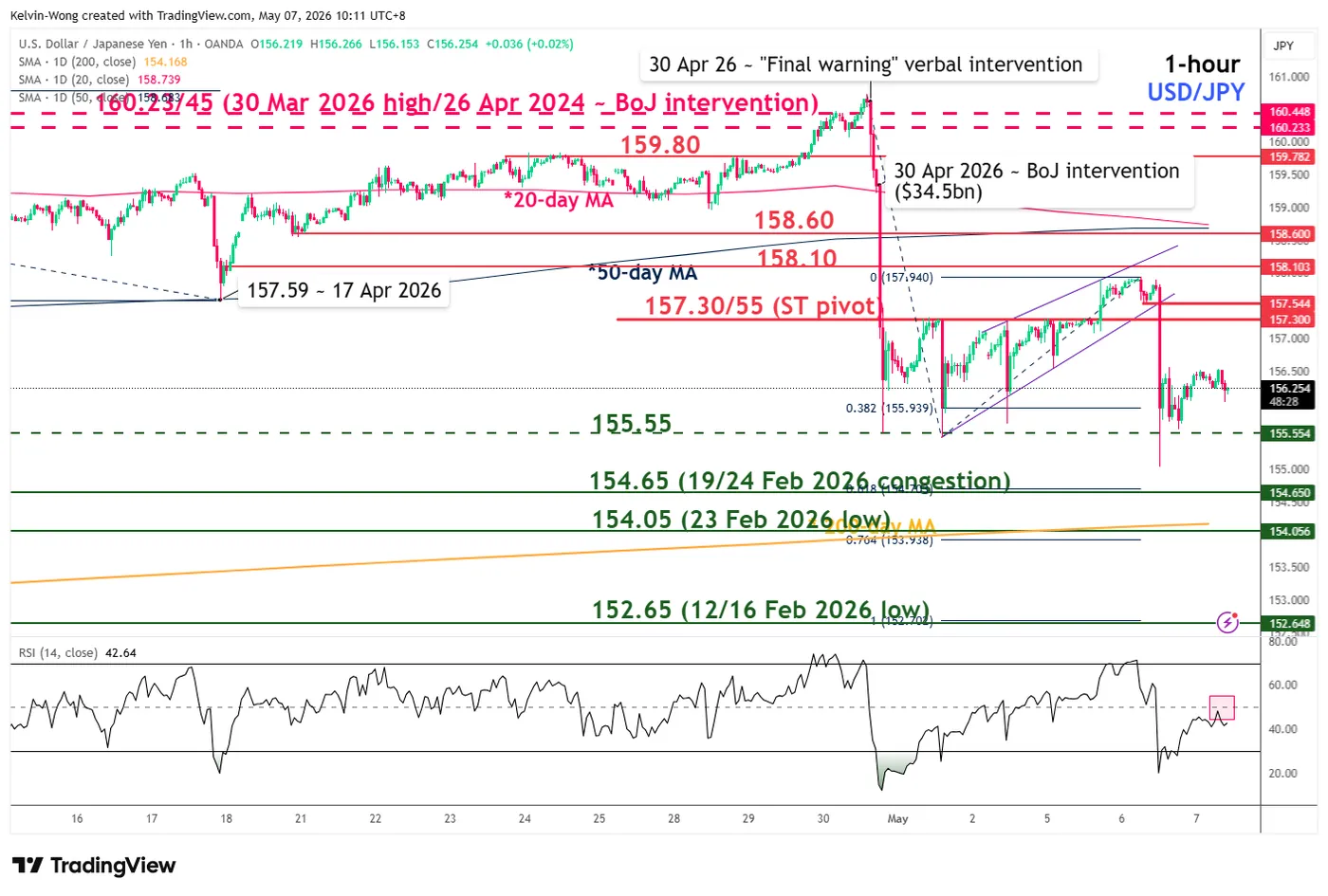
Fig. 1: USD/JPY minor trend as of 7 May 2026 (Source: TradingView)
The USD/JPY has staged a bearish breakdown below its minor “Ascending Wedge” configuration on Wednesday, 6 May 2026. In addition, in today’s opening Asian session (Thursday, 7 May 2026), its hourly RSI momentum indicator has flashed a bearish momentum condition below the 50 level.
These observations suggest the minor downtrend phase of the USD/JPY remains intact. Watch the 157.30/157.55 key short-term pivotal resistance for another potential down leg to expose the next intermediate supports at 154.65 and 154.05 (also the key 200-day moving average) (see Fig 1).
However, a clearance and an hourly close above 157.55 negates the bearish tone for a rebound towards the next intermediate resistances at 158.10 and 158.60 (the intersection of the 20-day and 50-day moving averages).
Bitcoin Gains More Ground, Upside Pressure Continues To Build
Key Highlights
- Bitcoin started a fresh increase above $78,000 and $80,000.
- A bullish trend line is forming with support at $80,200 on the 4-hour chart of BTC/USD.
- Ethereum remained in a range below $2,400.
- Gold is recovering losses and might revisit the $4,850 resistance.
Bitcoin Price Technical Analysis
Bitcoin price remained supported above $76,500 against the US Dollar. BTC formed a base and started a fresh increase above $78,500.
Looking at the 4-hour chart, the price settled above $78,800, the 100 simple moving average (red, 4-hour), and the 200 simple moving average (green, 4-hour). The bulls even pumped the price above $80,000.
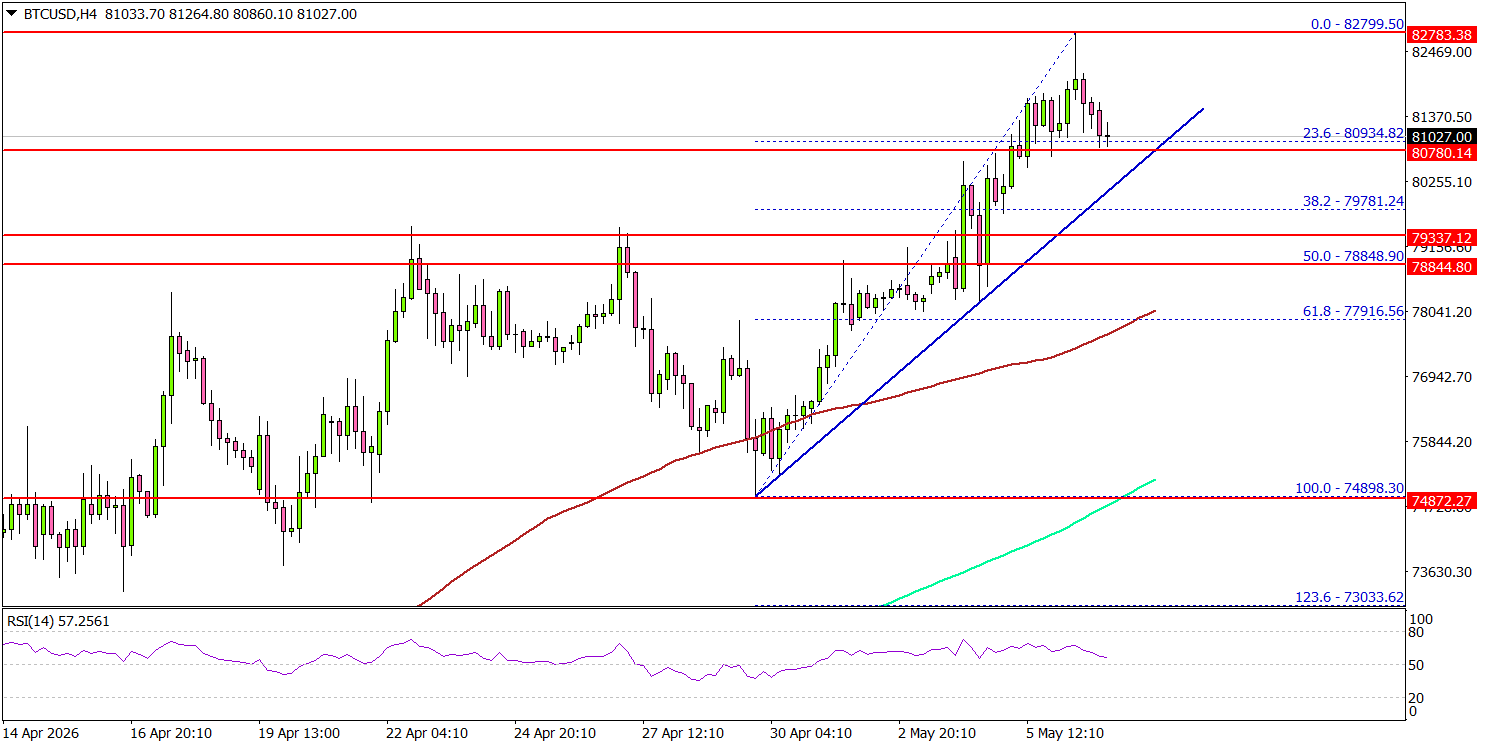
A high was formed at $82,799, and the price is now consolidating gains near the 23.6% Fib retracement level of the upward move from the $74,898 swing low to the $72,799 high.
On the upside, the price now faces resistance near $81,800. The first key hurdle is $82,800. A close above $82,800 could send the price toward $83,500. Any more gains might call for a test of $85,000.
Immediate support sits at $80,500. The first key support could be $80,000. There is also a bullish trend line forming with support at $80,200. The main breakdown support could be near $78,850 or the 50% Fib retracement level of the upward move from the $74,898 swing low to the $72,799 high.
A downside break below $78,850 might start another decline. The next major support is $75,000, below which BTC could decline toward $72,000.
Looking at Ethereum, the price also gained bullish momentum above $2,300, but the bears remained active near $2,400.
Today’s Key Economic Releases
- US Initial Jobless Claims - Forecast 205K, versus 189K previous.
- Fed's Kashkari speech.
- Fed's Hammack speech.
Macklem Warns Energy Shock Could Force Consecutive BoC Hikes
BoC Governor Tiff Macklem delivered a clear warning that the Bank of Canada is becoming increasingly uncomfortable with the inflation risks created by the Middle East conflict. While policymakers are still willing to “look through” the first-round jump in gasoline prices, Macklem stressed that the BoC “will not let” higher energy costs evolve into broader, persistent inflation across the economy.
The most market-sensitive part of his remarks was the explicit opening of the door to renewed rate hikes. Macklem said that if oil prices continue rising and remain elevated, “there may be a need for consecutive increases in the policy rate.” That marks one of the clearest acknowledgements yet from the BoC that the current energy shock could eventually force a renewed tightening cycle, even as the labor market remains soft and growth moderate.
At the same time, Macklem emphasized that policy flexibility remains critical because risks are moving in both directions. Additional US tariffs and weaker growth could still require further rate cuts, while persistent energy inflation could demand tighter policy instead. With uncertainty “unusually elevated,” the BoC’s core message was that monetary policy may need to be “nimble” as officials try to prevent the oil shock from becoming embedded in long-term inflation expectations.