

Sample Category Title
Yen Weakens as Demand for the US Dollar Returns
USD/JPY held near 157.22 on Tuesday following a volatile start to the week. Pressure on the Japanese yen has increased as demand for the US dollar has returned, with investors once again favouring the greenback as a defensive asset. The move comes amid renewed tensions in the Middle East, which threaten the fragile truce between the US and Iran.
The renewed escalation around the Strait of Hormuz has pushed energy prices higher and reignited inflation concerns. In turn, this has supported the US dollar by increasing expectations that the Federal Reserve may need to maintain a tighter monetary stance for longer.
At the same time, markets remain cautious following Japan’s suspected currency intervention last week, which triggered a sharp rebound in the yen. Market estimates suggest Tokyo may have spent as much as USD 35 billion, although the authorities have yet to confirm any direct action.
Investors continue to price in the risk of further intervention. Japan has historically preferred to act during periods of thinner liquidity and has often intervened in waves, helping to sustain elevated volatility across the foreign exchange market.
Technical Analysis
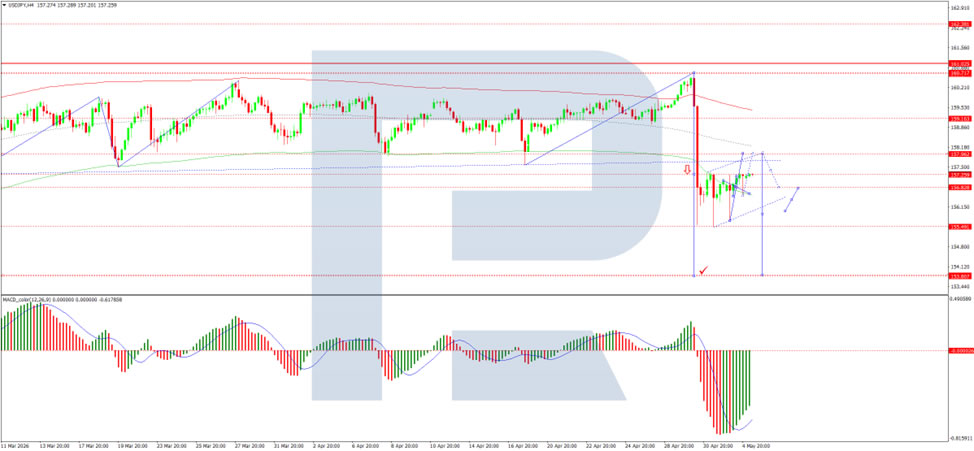
On the H4 chart, USD/JPY is trading within a consolidation range around 156.50 and is now moving towards 157.60. This level remains the immediate upside target. Once reached, a corrective move lower may begin, with scope for a decline towards 153.80 and potentially 153.00 thereafter. The MACD supports this scenario, with its signal line below zero but pointing firmly upwards, indicating that bullish momentum is still building in the short term before a broader correction may emerge.
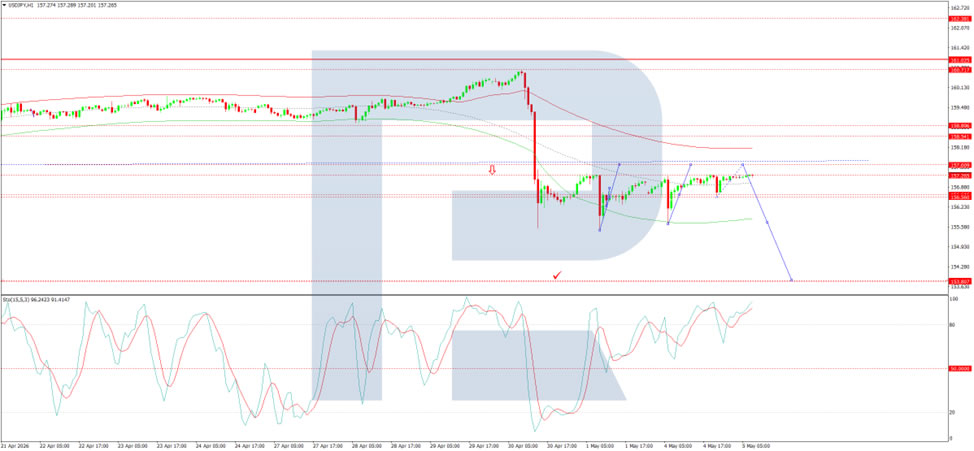
On the H1 chart, the market is attempting a breakout above 157.26. A further push higher towards 157.60 is likely in the near term. After that, a pullback towards 155.77 may follow, with the potential for the decline to extend to 153.80. The Stochastic oscillator supports this view, with its signal line above 80, indicating overbought conditions and suggesting that short-term downside pressure may begin to build once the current upward move fades.
Conclusion
USD/JPY remains supported by renewed demand for the US dollar amid heightened geopolitical tensions and inflation concerns, strengthening the greenback’s defensive appeal. However, the risk of renewed intervention from Japan continues to cap upside potential, leaving the pair vulnerable to sharp reversals despite the near-term bullish bias.
Swiss CPI Accelerates to 0.6% YoY as Energy Import Costs Rebound
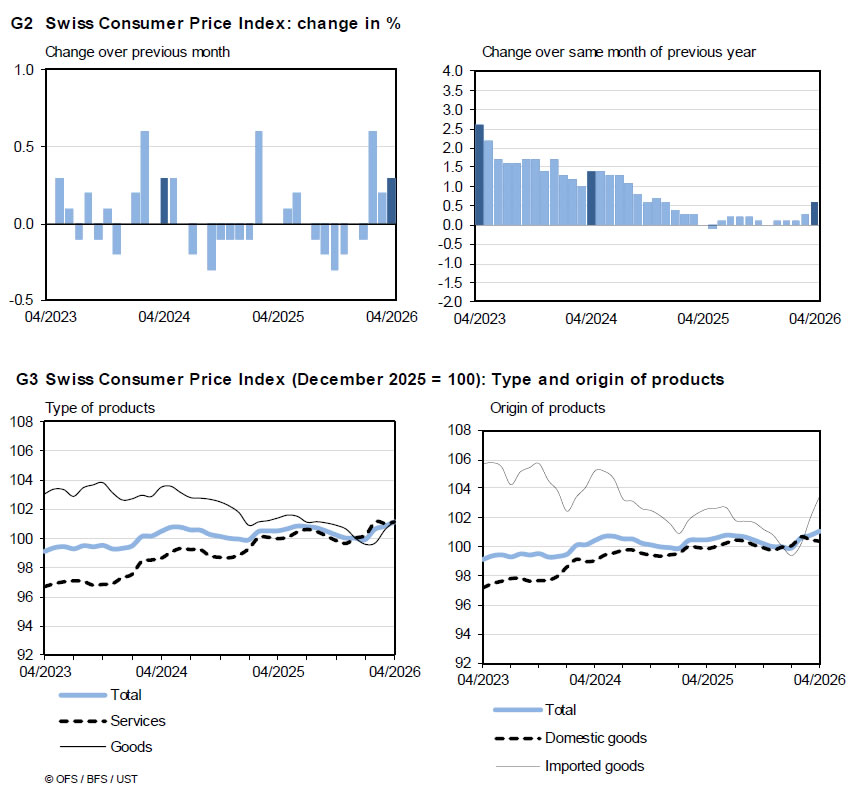
Swiss inflation picked up modestly in April, with headline CPI rising 0.3% month-on-month, driven largely by higher energy and travel-related costs. According to the Federal Statistical Office, increases in petrol, diesel and heating oil prices were key contributors, alongside higher airfares and international package holidays.
The underlying picture remains subdued. Core CPI was flat on the month, while domestic product prices slipped by -0.1% mom, pointing to limited internal price pressures. In contrast, imported product prices jumped 1.5% mom, highlighting that the recent pickup in inflation is being driven primarily by external cost factors rather than domestic demand.
On an annual basis, CPI rose from 0.3% yoy to 0.6% yoy, while core inflation edged lower from 0.4% yoy to 0.3% yoy. Domestic price growth remained unchanged at 0.5% yoy, but imported inflation rebounded sharply from -0.3% yoy to 0.9% yoy.
The data suggest that Switzerland’s inflation remains low overall, with the latest increase largely reflecting rising import costs linked to energy rather than broad-based price pressures.
| Indicator | Previous | Latest |
|---|---|---|
| CPI (YoY) | 0.3% | 0.6% |
| Core CPI (YoY) | 0.4% | 0.3% |
| Domestic Prices (YoY) | 0.5% | 0.5% |
| Imported Prices (YoY) | -0.3% | 0.9% |
Gold (XAUUSD) Chart Suggests 7-Swing Double Correction in Elliot Wave Structure
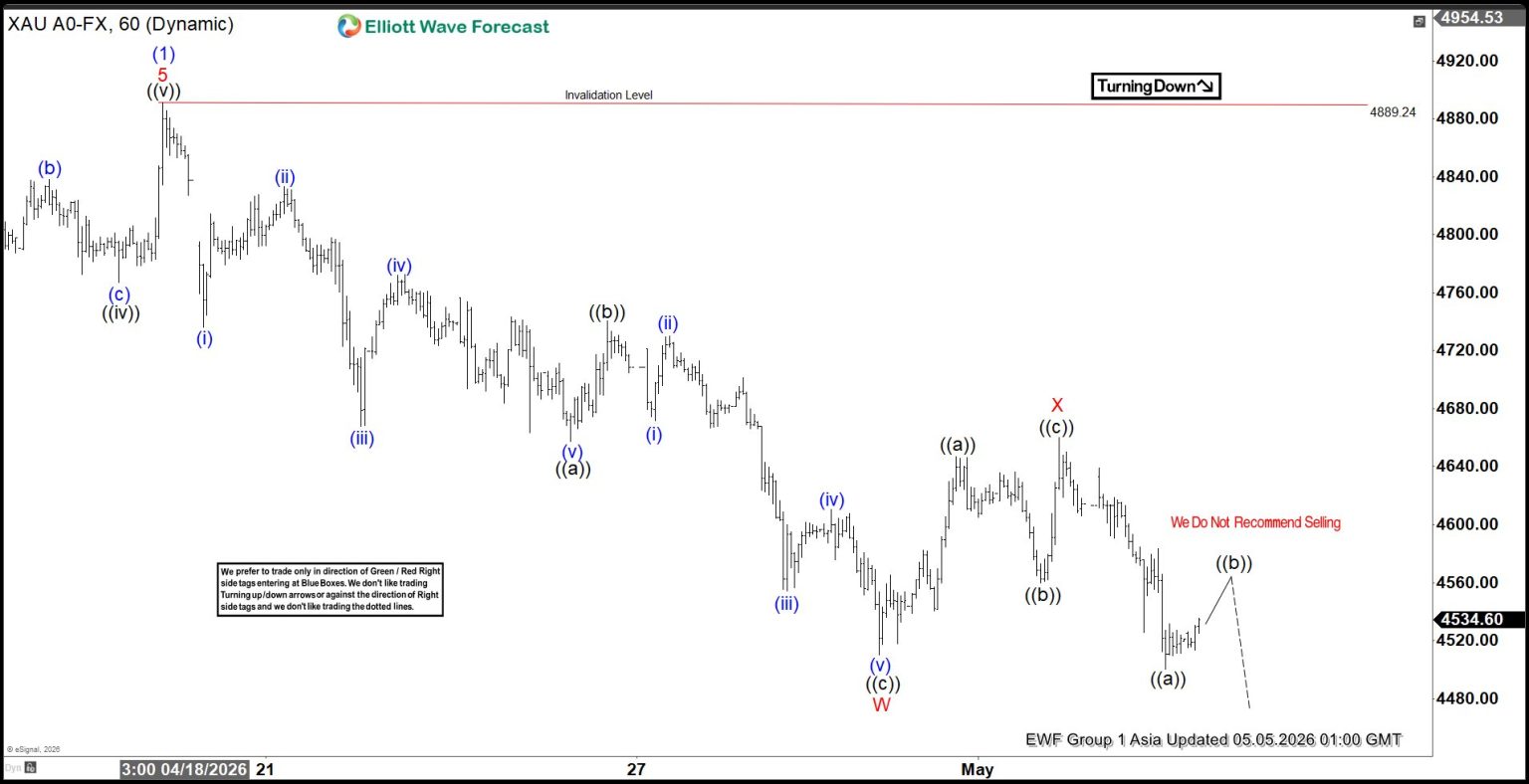
The short‑term Elliott Wave view in Gold (XAUUSD) shows that the rally from the March 23 low completed as wave (1) at 4889.24. After this peak, a corrective pullback in wave (2) began, retracing the cycle from the March 23 low. The internal subdivision of this pullback is unfolding as a double three Elliott Wave structure, a common corrective pattern. From wave (1), the decline in wave ((a)) ended at 4657.48, while the rally in wave ((b)) terminated at 4740.32. The metal then moved lower in wave ((c)), reaching 4509.88, which completed wave W at a higher degree.
The subsequent rally in wave X unfolded as a zigzag structure. Within this sequence, wave ((a)) ended at 4646.95, the pullback in wave ((b)) concluded at 4559.93, and the final leg in wave ((c)) advanced to 4660.28. This completed wave X in higher degree. At present, wave Y lower is progressing, continuing the correction against the cycle from the March 23 low. In the near term, while Gold remains below 4889.24, the expectation is for the metal to extend lower. A retest of the March 23 low at 4098.27 is anticipated before the broader bullish trend resumes. This corrective phase is important to balance the prior rally and prepare the market for the next upward cycle.
Gold 60-Minute Elliott Wave Chart
XAUUSD (Gold) Elliott Wave Video:
https://www.youtube.com/watch?v=htRwG6TgjlA
GBP/JPY Daily Outlook
Daily Pivots: (S1) 211.81; (P) 212.73; (R1) 213.68; More...
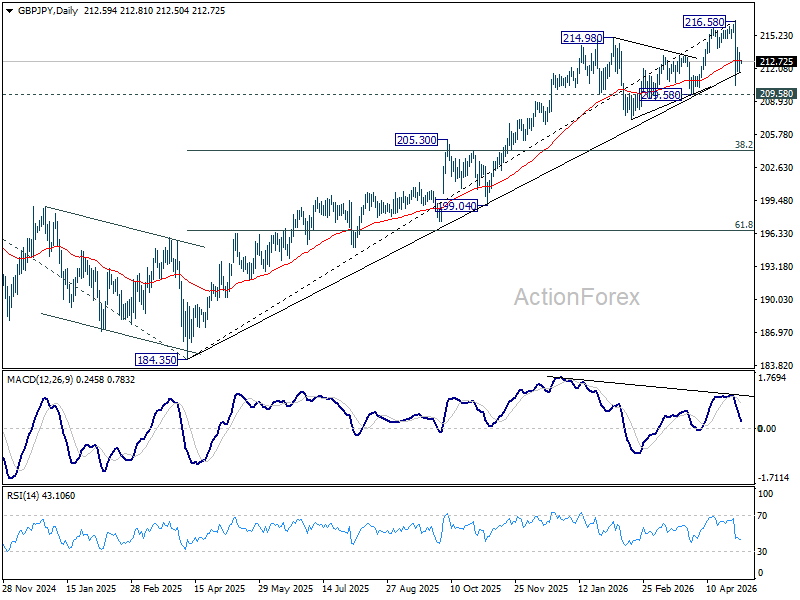
Intraday bias in GBP/JPY stays neutral for consolidations above 210.43. Risk will stay on the downside as long as 55 4H EMA (now at 214.28) holds. Below 210.43 will target 209.58 support first. Break will target 38.2% retracement of 184.35 to 216.58 at 204.28.
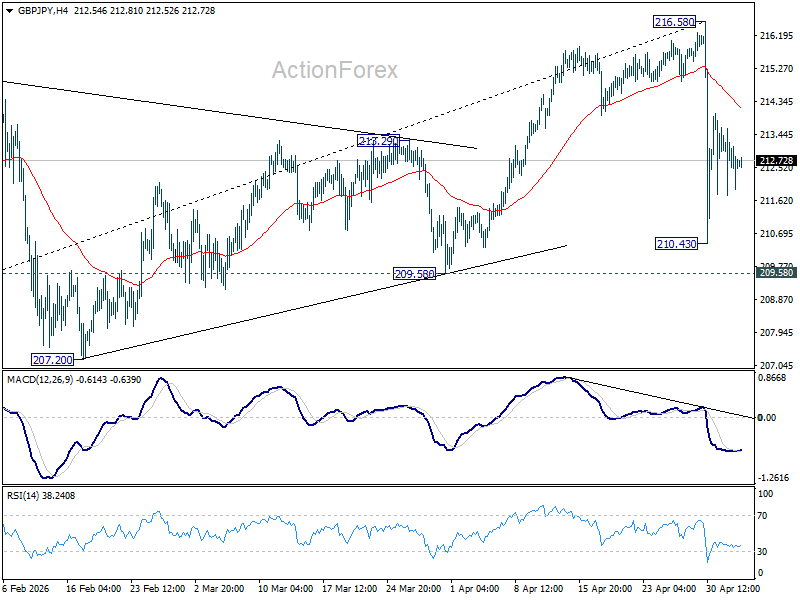
In the bigger picture, while the fall from 216.58 is steep, there is no clear sign of trend reversal yet. The long term up trend could still extend to 61.8% projection of 148.93 (2022 low) to 208.09 (2024 high) from 184.35 at 220.90 on resumption. However, sustained break of 55 W EMA (now at 205.45) will argue that it's already in medium term down trend for 184.35 support.
EUR/JPY Daily Outlook
Daily Pivots: (S1) 182.96; (P) 183.69; (R1) 184.57; More...
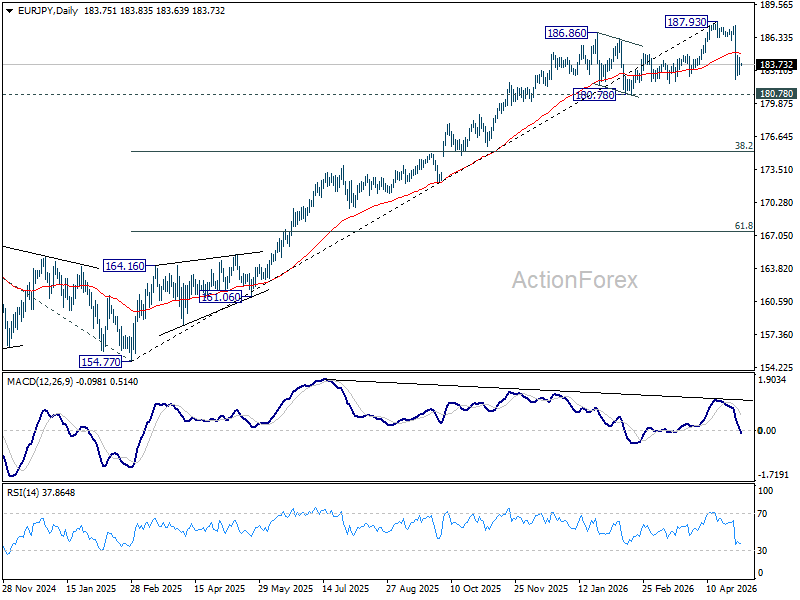
Intraday bias in EUR/JPY stays neutral and more consolidations could be seen above 182.28 temporary low. Risk will stay on the downside as long as 55 4H EMA (now at 185.45) holds. Below 182.28 will extend the fall from 187.93 to 180.78 support.
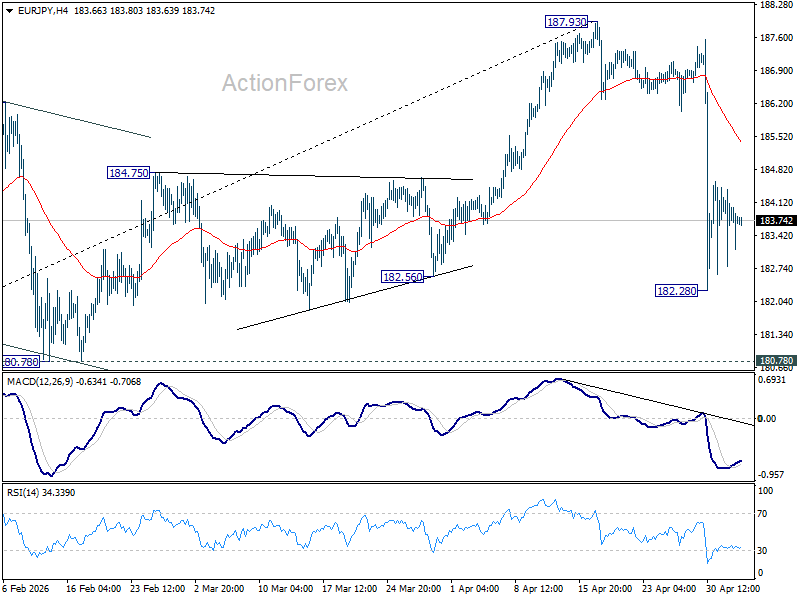
In the bigger picture, the pullback from 187.93 is steep, there is no sign of reversal yet. Uptrend from 114.42 is still expected to resume at a later stage to 78.6% projection of 124.37 (2022 low) to 175.41 (2025 high) from 154.77 at 194.88. However, sustained break of 55 W EMA (now at 177.76) will argue that it's already in a medium term down trend to 175.41 resistance turned support and below.
EUR/GBP Daily Outlook
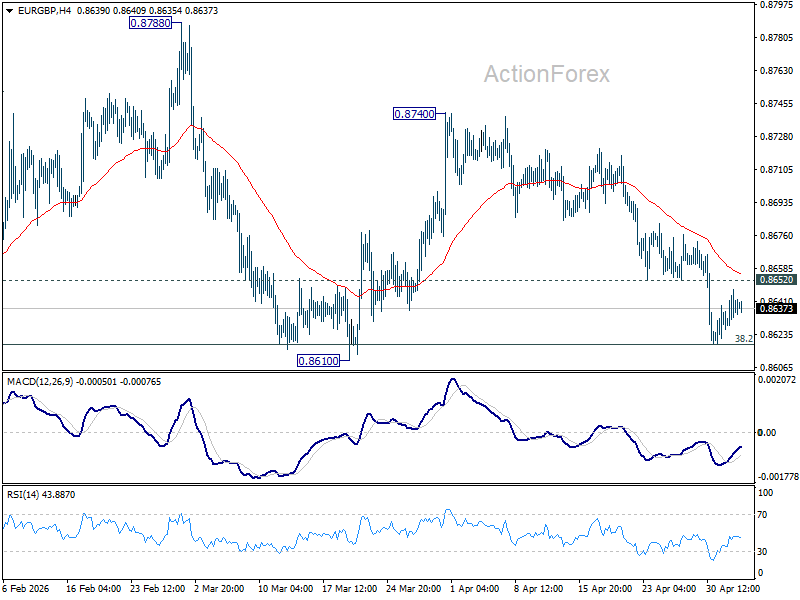
Daily Pivots: (S1) 0.8629; (P) 0.8640; (R1) 0.8651; More…
Intraday bias in EUR/GBP remains neutral for the moment, and some more sideway trading could be seen. On the downside, decisive break of 0.8610 key support carry larger bearish implications and pave the way to 0.8466 fibonacci level next. However, firm break of 0.8652 will turn bias back to the upside for stronger rebound to 55 D EMA (now at 0.8681) and above.
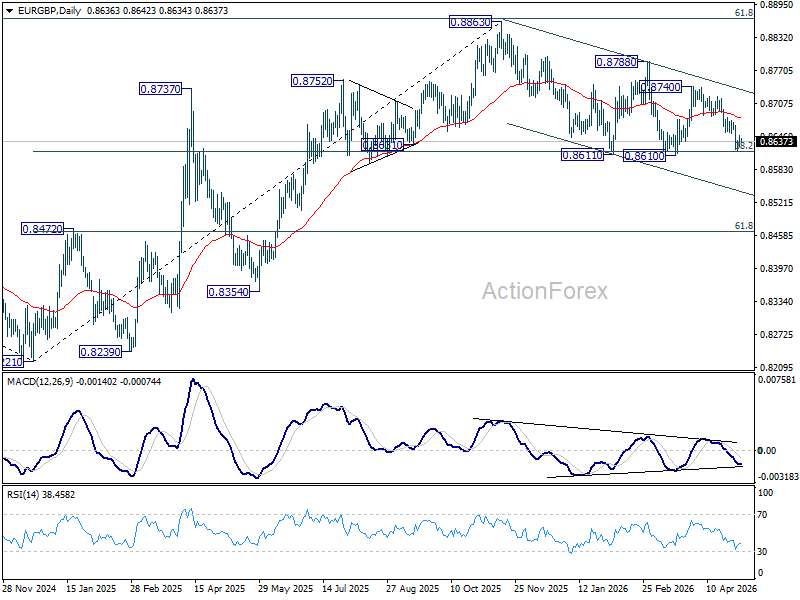
In the bigger picture, focus is back on 38.2% retracement of 0.8821 to 0.8863 at 0.8618. Sustained break there will confirm that whole rise from 0.8221 has completed at 0.8863. Deeper decline should then be seen to 61.8% retracement at 0.8466 at least. For now, risk will stay mildly on the downside as long as 55 D EMA (now at 0.8680) holds, in case of recovery.
EUR/AUD Daily Outlook
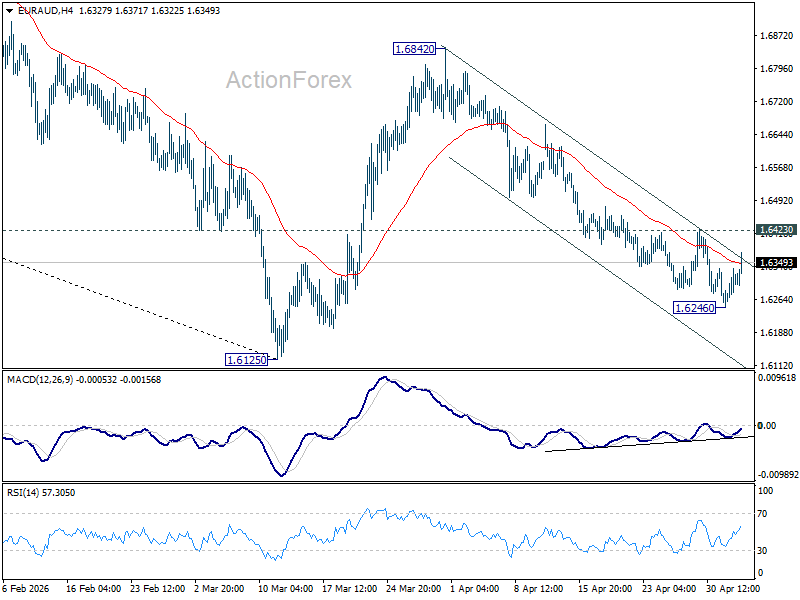
Daily Pivots: (S1) 1.6265; (P) 1.6301; (R1) 1.6348; More...
Intraday bias in EUR/AUD is turned neutral with current recovery. Further fall is expected as long as 1.6423 resistance holds. Below 1.6246 will bring retest of 1.6125 low. Decisive break there will resume whole fall from 1.8554. However, considering bullish convergence condition in 4H MACD, firm break of 1.6423 will indicate short term bottoming, and turn bias back to the upside for 55 D EMA (now at 1.6560).
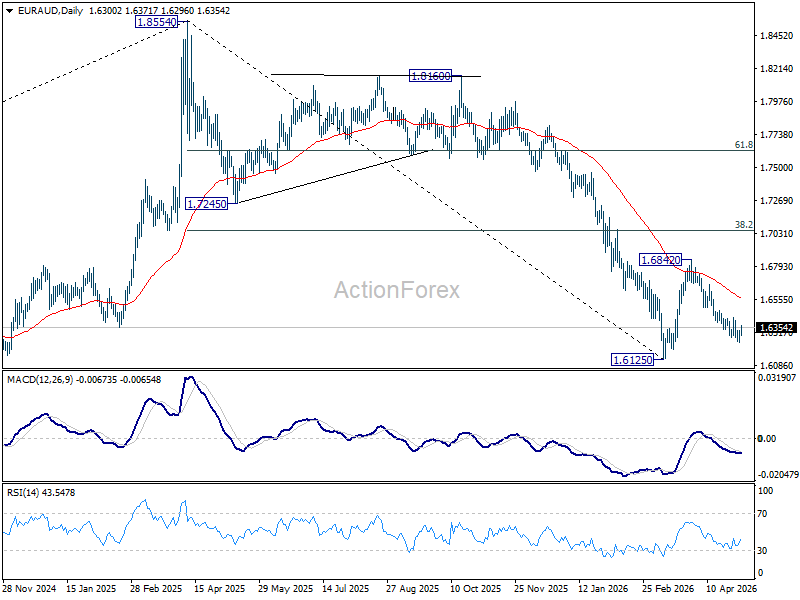
In the bigger picture, fall from 1.8554 (2025 high) is in progress and deeper decline should be seen to 61.8% retracement of 1.4281 to 1.8554 at 1.5913, which is slightly below 1.5963 structural support. Decisive break there will pave the way back to 1.4281 (2022 low). For now, risk will stay on the downside as long as 55 W EMA (now at 1.7069) holds, even in case of strong rebound.
EUR/CHF Daily Outlook
Daily Pivots: (S1) 0.9153; (P) 0.9167; (R1) 0.9178; More....
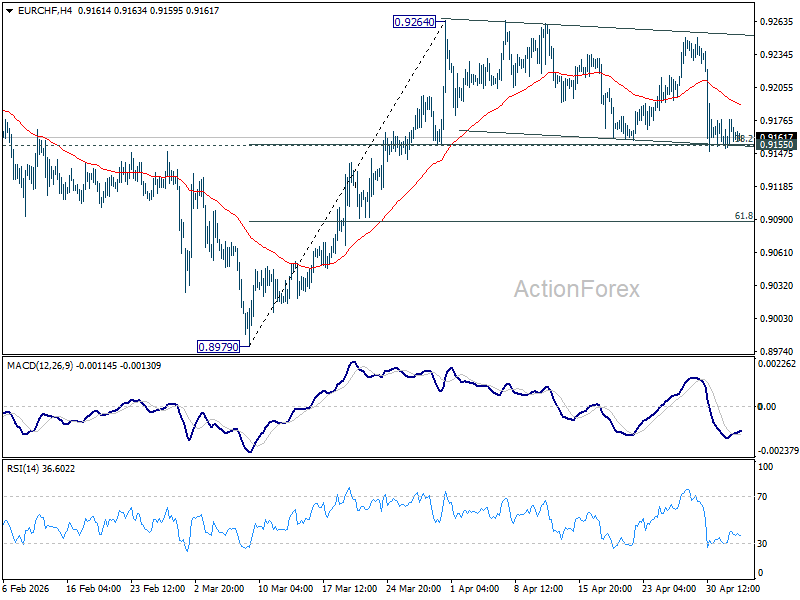
Range trading continues in EUR/CHF and intraday bias remains neutral. Rise from 0.8979 is expected to continue as long as 0.9155 cluster support (38.2% retracement of 0.8979 to 0.9264 at 0.9155) holds. On the upside, firm break of 0.9264 will target 0.9394 resistance next. However, break of 0.9155 will turn bias back to the downside for deeper pullback to 61.8% retracement at 0.9088 and possibly below.
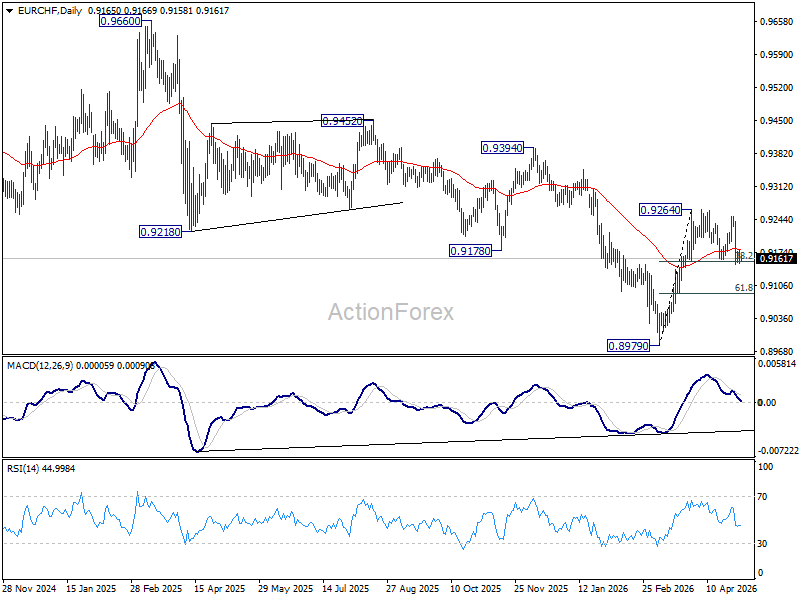
In the bigger picture, considering bullish convergence condition in W MACD, a medium term bottom should be in place at 0.8979. Sustained trading above 55 W EMA (now at 0.9268) will add more credence to this case. Further break of 0.9394 resistance will pave the way to 0.9660 resistance next. However rejection by the 55 W EMA will set up another fall through 0.8979 low at a later stage.
Sunrise Market Commentary
Markets
Iran Foreign Minister Araghchi likened the US’s “Project Freedom” in the Persian Gulf to “Project Deadlock”. Since US President Trump announced plans to help commercial vessels through Hormuz, the number of reported military incidents went up reaching amongst the largest levels since the start of the cease-fire about a month ago. Brent crude went from opening levels near $106.5/b to currently $113. When asked about how long the situation would still last, President Trump returned to his answer of choice since the very beginning of the war: “two weeks, maybe three”. Yesterday’s events clearly raised the probability that the fragile cease-fire might snap. Defense Secretary Hegseth and Joint Chiefs of Staff Chairman Caine will hold a news conference later today.
Yesterday’s trading was skinned by public holidays in Japan, China and the UK. Markets nevertheless marched to the drums of the higher oil price. Risk sentiment took a hit with key European indices losing up to 2% for the EuroStoxx50. Main US benchmarks lost between -0.2% (Nasdaq) and -1.15% (Dow). Core bond yield curves extended the bear flattening process. EU swap rates added between 8.8 bps (2-yr) and 3.6 bps (30-yr). The EU 2y swap rate managed its highest closing level (2.94%) since July 2024 as money markets add to ECB tightening bets this year. With a 25 bps June rate hike almost fully discounted, that means adding to cumulative tightening bets for this year. Currently markets are swinging back a total of 3-4 moves. An avalanche of ECB speakers hit the wire with Governing Council member Kazimir bluntly saying that policy tightening in June is “all but inevitable”. ECB vice president de Guindos suggested that the war shock affected inflation more than growth with Bundesbank Nagel adding that a rate hike would come without marked improvement in price outlook. Recall that ECB President Lagarde suggested last week that “we’re certainly moving away” from the base scenario. ECB Simkus said it’s clear we’re talking about a possible hike in June. Other ECB members were less committed for now. US Treasuries yesterday followed the bear flattening with yields ending the day 7.5 bps (2-yr) to 5.6 bps (30-yr) higher. The former extends the trend that started after last week’s hawkish hold by the Fed. US money markets are back to erring on the side of a rate hike instead of a rate cut on a 12-month horizon. The US 30-yr yield closed at 5.02%, the highest the summer of 2025 as US risk premia start building again. Fitch over the weekend warned for US deficits just shy of 8% of GDP for this year and next. On FX markets, the dollar profited from the set-up with EUR/USD returning below 1.17. Today’s eco calendar contains US services ISM and JOLTS job openings but we don’t expect them to break the market reaction function to developments in the Middle East (higher oil, bear flattening, stronger USD, weak risk sentiment).
News & Views
The Reserve Bank of Australia this morning raised the policy rate by 25 bps to 4.35%. It was the third consecutive hike and was supported by a 8-1 majority (one vote for unchanged). The decision comes as inflation had already picked up materially in H2 2025 with information since the start of the year still reflecting capacity pressures. Higher fuel and commodity prices from the conflict in the Middle East now add to inflationary pressures as many firms are experiencing cost pressures and are looking to increase prices of goods and services. Even in a baseline scenario assuming that the conflict is resolved soon and fuel prices decline, the RBA sees inflation peaking higher than expected in February (4.8% end H1). Trimmed mean inflation is expected to peak at 3.8% with both measures expected to return to 2.5% by June 2028. The RBA still sees risks to inflation tilted to the upside. After three consecutive hikes, it is now well placed to respond to developments and the Board is focused on its mandate to deliver price stability and full employment. Money markets now discount one additional rate hike by end summer/autumn. The reaction to the decision is mild. The 3-y government bond yield eases 2.3 bps (to 4.64%). After filling offers north of AUD/USD 0.72 over the previous days, the Aussie dollar this morning eases slightly (0.715).
The US Treasury raised its estimate for borrowing in the current April-June quarter to $189bn. The amount is $79bn higher than in the estimate of February. The upward revision was mainly due to lower projected net cashflows, but this was partially mitigated by a higher cash balance at the start of the quarter. For the July–September 2026 quarter, Treasury expects to borrow $671bn in privately-held net marketable debt, assuming an end-of-September cash balance of $950bn. During the January–March 2026 quarter, Treasury borrowed $577bnin privately-held marketable debt and ended the quarter with a cash balance of $893bn compared with estimates of $574bn borrowing and an assumed an end-of-March cash balance of $850bn in the February projection. Additional details on the refinancing will be released tomorrow.
Narrative Flips from AI to Middle East
Yesterday, the US announced it would escort ships through the Strait of Hormuz — calling it a humanitarian operation (!) Iran warned it would retaliate, and reports suggest the US went ahead regardless. Iran then struck ships and key oil infrastructure in Fujairah, UAE — notably a terminal that allows exports bypassing the Strait. Unsurprisingly, oil prices spiked, with US crude nearing $110pb and Brent $115pb. This morning, uncertainty remains high, though prices have eased slightly.
The pattern is familiar: the $115–120pb range is acting as strong resistance — above this level, the market shifts from pricing supply constraints to pricing demand destruction. That brings rising inflation expectations, more hawkish central bank expectations and higher yields — all of which were triggered yesterday.
The US 2-year yield jumped near 4%, while the 30-year yield breached 5%. European 10-year benchmark yields also moved higher.
As a result, the dominant market narrative flipped from AI optimism to Middle East tensions. The US dollar index rebounded past its 200-DMA, while gold eased toward $4’500, pressured by the stronger dollar and rising yields, which increase the opportunity cost of holding non-yielding assets. I believe gold’s muted reaction also reflects the speculative positioning built up ahead of the crisis. That said, gold remains well supported in the current geopolitical backdrop, with central banks reportedly continuing to accumulate on dips.
Elsewhere, the Reserve Bank of Australia (RBA) delivered its third straight rate hike — in line with expectations — to rein in inflation. The AUDUSD nevertheless eased, pressured by a broadly stronger US dollar driven by geopolitical tensions and higher oil prices. The EURUSD is testing its 200-DMA to the downside, while USDJPY is consolidating just below its 100-DMA.
FX moves will likely remain driven by the US dollar in the near term. The higher the tensions, the higher oil prices, and the stronger the dollar. A stronger dollar raises imported inflation globally, reinforcing expectations for tighter monetary policy. That, in turn, weighs on risk appetite.
As such, major US and European indices retreated. The Stoxx 600 was also hit by a notable selloff in European carmakers on reports that Trump would impose a 25% tariff, arguing Europeans are not complying with trade agreements. Europeans deny. The situation remains legally and politically unclear, anyway.
But forget about the tariffs for a second. The broader issue is structural: European carmakers will struggle to replace US demand, as the US continues to restrict Chinese EV penetration. Outside these regions, markets are increasingly open to Chinese EVs, which are cheaper and often more advanced. Meanwhile, higher fuel prices accelerate the global EV transition.
To me, European carmakers will remain under pressure with or without US market access — without it, the unravelling would simply be faster.
On oil, renewed tensions and damage to infrastructure should keep upward pressure in place. A spike above $120pb is possible, but unlikely to be sustained — at those levels, demand destruction typically kicks in and caps further gains.
Voilà, that’s it for the big picture.
The recent spike in oil prices is weighing on European futures this morning, while Nasdaq futures are in positive territory.
After the bell yesterday, Palantir Technologies reported an 85% jump in Q1 sales year-on-year, driven by strong US military demand. Alas, solid results and guidance were not enough — the stock fell in after-hours trading.
Today, AMD heads into earnings with expectations for ~30%+ year-on-year growth, driven by AI and data centre demand. But the bar is high: after a rally of more than 85% since late March, the key question is whether AMD can deliver a convincing beat, particularly against Nvidia’s dominance and ongoing supply constraints.
Nvidia, for its part, is starting to face growing competition — from AMD, as well as custom chips developed by hyperscalers like Amazon and Google.
So far, none have matched Nvidia’s full-stack ecosystem — especially its CUDA software moat — which keeps it firmly in the driver’s seat. But a shift is underway between training and inference. Training large models remains compute-heavy and tightly tied to Nvidia’s ecosystem. Inference, however, is about cost, efficiency and scale — and that’s where competition intensifies, with solutions like Google’s TPUs and Amazon’s Inferentia chips.
Anyway, let’s see how AMD’s earnings resonate — and whether they can help offset the geopolitical noise.