Sample Category Title
Canada’s Trade Books Flip to a Surplus in March
Canada's trade balance moved into a $1.8 billion surplus in March, from a $5.1 billion deficit the prior month.
Exports in March surged by 8.5% month-on-month (m/m) following February's sturdy gain. Rapidly rising energy prices pushed crude oil exports up 18.9% m/m, while exports of unwrought gold, silver, and platinum rose by a sizeable 37.7% m/m. Meanwhile, exports of motor vehicles and parts (+4.5% m/m) rose again in March as they continued their recovery from January's depressed level. In total, 7 of 11 product categories registered a gain.
Goods imports decreased by 1.6% m/m in March, paring some of the prior month's robust 9.4% monthly gain, with 8 of 11 subsectors booking a loss. Consumer goods imports (-3.9% m/m) and imports of aircraft and other transportation equipment (-12.8% m/m) contributed most to the monthly decline.
In volume terms, exports edged lower by 0.3% m/m while imports fell by a larger 2.0% m/m.
Canada's merchandise trade surplus with the United States widened from $2.9 billion in February to $7.1 billion in March. Exports to non-U.S. destinations rose by a healthy 9.1% m/m, setting a new all-time high.
Key Implications
March's trade data showed some firming in headline activity, though all of the positive print in exports came from price impacts of higher oil prices. With data up until March in the books, net trade still appears poised to subtract from Q1 2026 real GDP growth, reflecting a broadly stronger quarter for imports. Looking ahead, higher oil prices should meaningfully lift nominal export values into Q2, helping to further improve the trade balance.
The upcoming USMCA renegotiation remains a key near-term risk for Canada. With the July 1st review approaching, renewed engagement between Canadian and U.S. officials is a positive first step, but concrete outcomes remain limited. Our base case continues to assume the agreement stays intact, though elevated uncertainty is likely to restrain business confidence and investment decisions.
Politics is Weighing on the Pound
- Labour risks losing the local elections, which could pressure GBPUSD.
- Japan may be able to afford further currency intervention.
The US dollar capitalised on the pullback in stock indices from record highs and the surge in Brent futures. Buyers of the USD index stepped up their pressure, driven by rising demand for safe-haven assets and a worsening economic outlook in the eurozone amid higher energy prices.
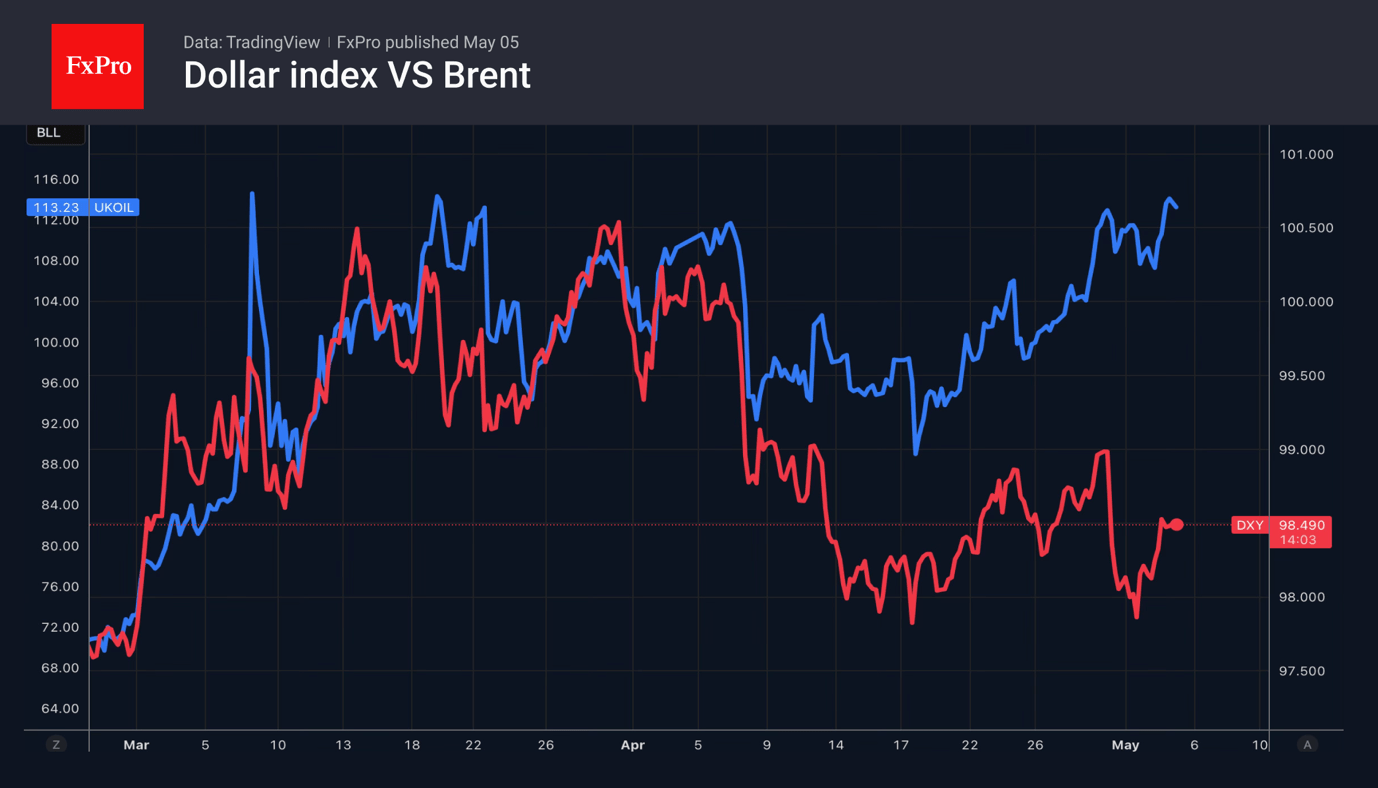
The escalation of the conflict in the Middle East has reignited investor interest in the US dollar as a safe-haven asset. At the same time, oil prices have risen, as have the risks of a surge in US inflation. To combat this, the Fed may raise interest rates this year, with the likelihood of such a move rising from 11% to 32%.
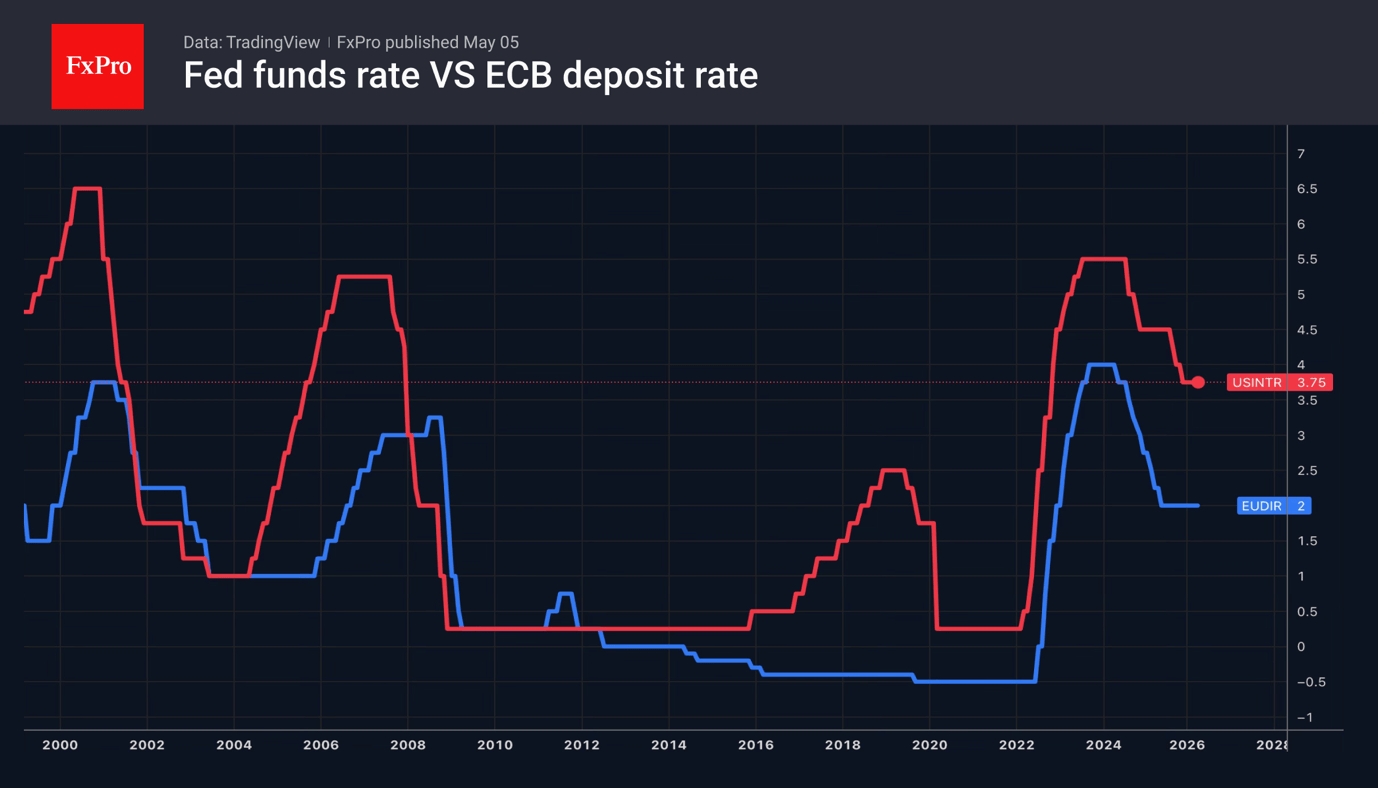
The Bundesbank is prepared to follow the ECB’s path of monetary tightening. According to Bundesbank President Joachim Nagel, the objective is clear: to bring inflation back to 2% in the medium term. If this does not happen, interest rates will have to be raised. Nevertheless, investors view such rhetoric as a ‘hawkish’ bluff. EU Economic Affairs Commissioner Valdis Dombrovskis argues that Europe is facing a stagflationary shock, as high energy prices are pushing the region towards higher inflation and slower GDP growth.
The yen’s appreciation over three consecutive days following currency intervention has prompted the Ministry of Finance to comment on the rules. The IMF regards this entire period as a single episode. Unless there are up to three such episodes within six months, the exchange rate regime will not be changed from a managed float to a free float. This means that Japan may resume selling USDJPY until 5 May.
The escalation in the Middle East and the approaching local elections in Britain are putting pressure on GBPUSD. Labour risks losing the vote due to Keir Starmer’s weakened approval ratings. Rising political uncertainty is driving volatility in the pound and a decline in its exchange rate.
EUR/USD Mid-Day Outlook
Daily Pivots: (S1) 1.1664; (P) 1.1707; (R1) 1.1732; More….
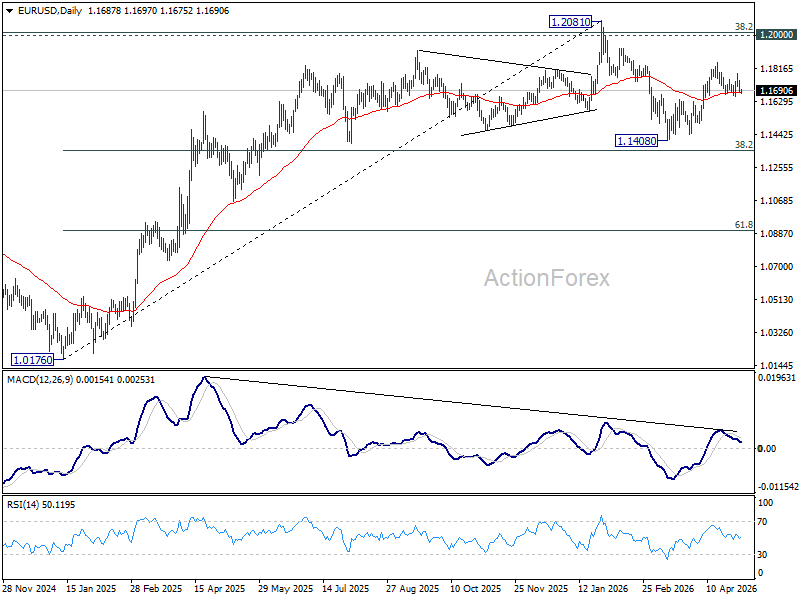
Range trading continues in EUR/USD and intraday bias stays neutral. Rise from 1.1408 is expected to continue as long as 1.1642 support holds. Firm break of 1.1848 will target 1.2081 high next. However, firm break of 1.1662 support will indicate the the rebound from 1.1408 has completed, and bring deeper decline back towards this low instead.
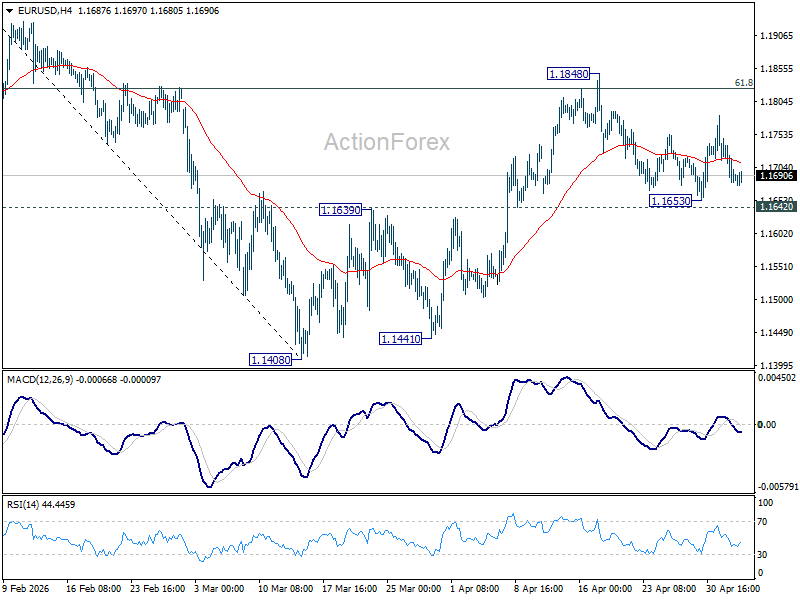
In the bigger picture, the strong support from 38.2% retracement of 1.0176 to 1.2081 at 1.1353 suggests that the pullback from 1.2081 is more likely a corrective move. Strong support was also found in 55 W EMA (now at 1.1537). Focus is back on 1.2 key cluster resistance level. Decisive break there will carry long term bullish implications. Nevertheless, break of 1.1408 support will revive the case of medium term bearish trend reversal.
GBP/USD Mid-Day Outlook
Daily Pivots: (S1) 1.3542; (P) 1.3601; (R1) 1.3634; More...
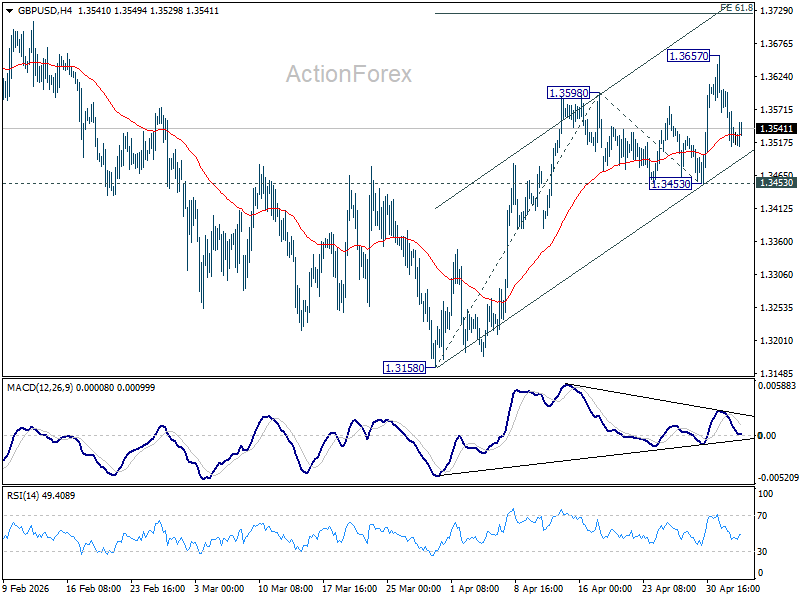
Intraday bias in GBP/USD stays neutral as consolidations continue. Further rise is still expected as long as 1.3453 holds. Above 1.3657 will target 61.8% projection of 1.3158 to 1.3598 from 1.3453 at 1.3725 first. Firm break there will target a retest on 1.3867 high. However, break of 1.3453 will turn bias back to the downside for 1.3158 support instead.
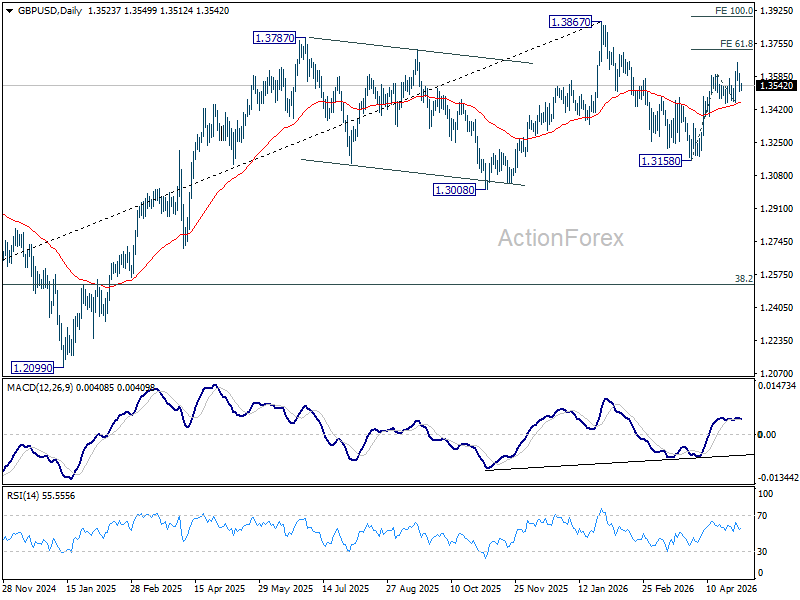
In the bigger picture, current development suggests that price actions from 1.3867 are merely a corrective pattern within the broader up trend from 1.0351 (2022 low). With 1.3008 support intact, medium term bullishness is maintained and break of 1.3867 is in favor for a later stage, towards 1.4248 key resistance (2021 high).
USD/CHF Mid-Day Outlook
Daily Pivots: (S1) 0.7808; (P) 0.7829; (R1) 0.7861; More….
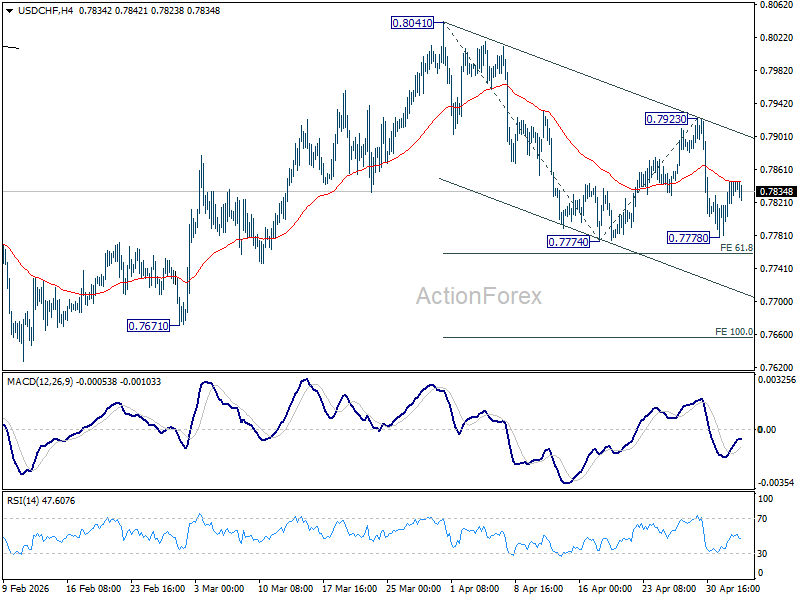
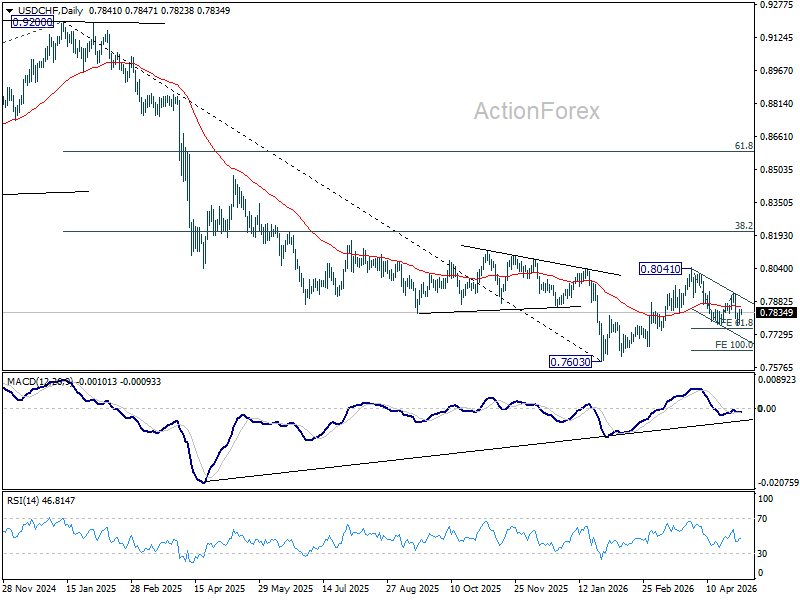
USD/CHF is staying in consolidations above 0.7778 and intraday bias remains neutral. Risk will remain on the downside as long as 0.7923 resistance holds. Firm break of 61.8% projection of 0.8041 to 0.7774 from 0.7923 at 0.7758 will extend the fall from 0.8041 to 100% projection at 0.7656. However, firm break of 0.7923 will turn bias back to the upside for stronger rebound.
In the bigger picture, rebound from 0.7603 medium term bottom is seen as correcting the fall from 0.9200 only. Rejection by 55 W EMA (now at 0.8042) will affirm this bearish case, and setup down trend resumption to 100% projection of 1.0146 (2022 high) to 0.8332 from 0.9200 at 0.7382 at a later stage. Though, sustained break of 55 W EMA will suggest that it's probably correcting the larger scale down trend from 1.0146 (2022 high).
Is USD/JPY Heading Back to 160? Not Yet—Unless Yields Break 4.5% and Oil Hits $120
Is USD/JPY heading back to 160? For now, the answer is no—but the risk is clearly building as global yield dynamics shift and geopolitical tensions intensify. The Yen is back under pressure today, driven primarily by widening rate differentials as US and European yields continue to climb.
The US 10-year Treasury yield has surged above 4.45% and is now approaching the key 4.5% mark, a level that has previously acted as a psychological ceiling. The move is being fueled by a combination of factors: renewed geopolitical tensions in the Middle East, rising inflation concerns linked to higher energy prices, and a shift in Federal Reserve expectations away from rate cuts.
Energy markets remain on high alert as the fragile ceasefire between the US and Iran shows signs of breaking down. Elevated oil prices are reinforcing inflation risks, which in turn are pushing bond yields higher. Markets are increasingly concerned that sustained energy-driven price pressures could delay disinflation and force the Fed to tighten policy again.
This repricing is already visible in interest rate markets. Fed funds futures are now assigning nearly a 30% probability of a rate hike by year-end, while expectations for rate cuts have largely been priced out. The shift marks a significant turnaround in policy expectations and is providing strong support for US yields.
The global yield move is not limited to the US. Germany’s 10-year Bund yield has risen above 3.05%, while the UK 10-year gilt yield has climbed to 5.04%. These moves reflect both the global nature of the inflation shock and the possibility that the ECB and BoE would also need to maintain or even tighten policy at the next meeting.
For the Yen, widening yield differentials are once again driving weakness. USD/JPY has rebounded following last week’s sharp decline, though the current move still appears to be driven more by short covering than fresh directional positioning.
That said, the outlook could change quickly if key thresholds are breached. A sustained move in US 10-year yields above 4.5% would likely trigger a stronger wave of algorithmic selling in the Yen, amplifying upward pressure on USD/JPY. At the same time, a further rise in oil prices toward the $120 level would reinforce inflation fears and strengthen the case for higher global yields.
Intervention risk remains a complicating factor. Japanese authorities are reported to have deployed more than USD 30 billion in last week's operations that helped push USD/JPY back toward the 155 area. Officials have also signaled a willingness to act again, even during the Golden Week holiday period.
However, intervention may prove less effective if underlying market forces intensify. Acting against a backdrop of rising yields and surging oil prices would present a much more difficult challenge. In such a scenario, attempts to stabilize the Yen could slow the move, but are unlikely to reverse the broader trend.
For now, USD/JPY remains contained within last week’s range, suggesting that markets are not yet fully committed to a renewed push higher. But with yields and oil prices approaching key trigger levels, the risk of a move back toward 160 is no longer hypothetical—it is conditional.
For the day so far, Yen is currently the worst performer, followed by Dollar, and then Euro. Kiw is the strongest, followed by Aussie and then Loonie. Sterling and Swiss Franc are positioning in the middle.
Swiss CPI Accelerates to 0.6% YoY as Energy Import Costs Rebound
A rise in Swiss CPI masks weak underlying inflation. Energy-driven import costs are lifting headline prices, but core inflation is flat and domestic pressures are subdued. The trend suggests limited internal inflation momentum. Read More.
RBA Hikes to 4.35%, Signals It’s Not Done Yet
RBA raise interest rate as expected, and signaled a clear shift to higher-for-longer policy. Inflation is now expected to peak higher and fall more slowly, while growth forecasts are being downgraded. With rates projected near 4.7% through 2028, the central bank is preparing for a prolonged fight against persistent price pressures. Read more.
Gold Slides on Hormuz Attacks, 4,400 Breakdown in Focus, 4,000 Next
Gold is under renewed pressure as Hormuz tensions escalate and oil prices surge. Iran’s attacks on ships and a UAE oil port have intensified supply fears, lifting the Dollar and shifting focus back to inflation risks. With 4,400 support now under threat, a breakdown could accelerate the slide toward the 4,000 level. Read More.
USD/JPY Mid-Day Outlook
Daily Pivots: (S1) 156.22; (P) 156.76; (R1) 157.79; More...
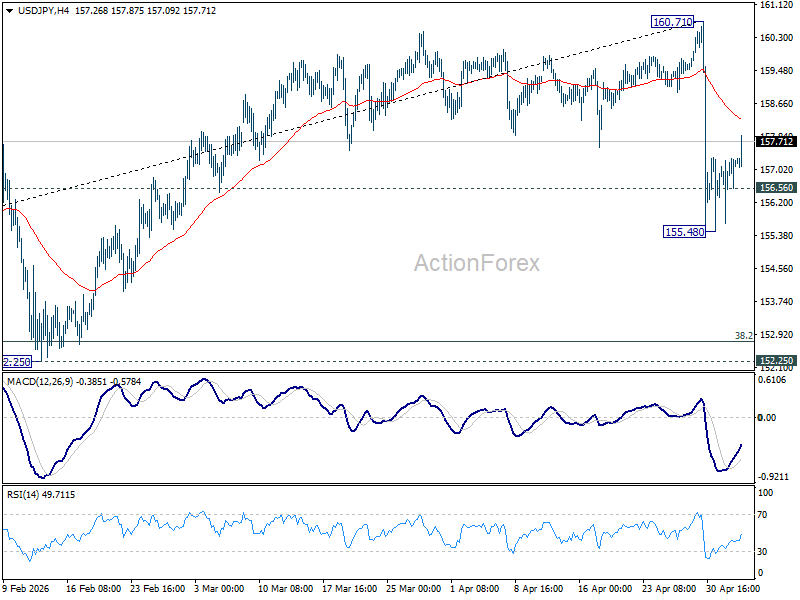
USD/JPY's recovery from 155.48 accelerates higher today, but it stays below 55 4H EMA (now at 158.27). Intraday bias remains neutral and further decline is still in favor. Below 156.55 minor support will bring retest of 155.48. Break there will extend the fall from 160.71 and target 152.25 cluster support (38.2% retracement of 139.87 to 160.71 at 152.74). However, sustained break of the 55 4H EMA will bring stronger rebound back to retest 160.71 high.
In the bigger picture, for now, corrective pattern from 161.94 (2024 high) is still seen as completed at 139.87. Rise from there is seen as resuming the long term up trend. So, break of 161.94 is expected at a later stage to resume the long term up trend. However, sustained break of 55 W EMA (now at 154.03) will dampen this view and bring deeper fall back towards 139.87 to extend the pattern from 161.94.
USD/JPY Mid-Day Outlook
Daily Pivots: (S1) 156.22; (P) 156.76; (R1) 157.79; More...
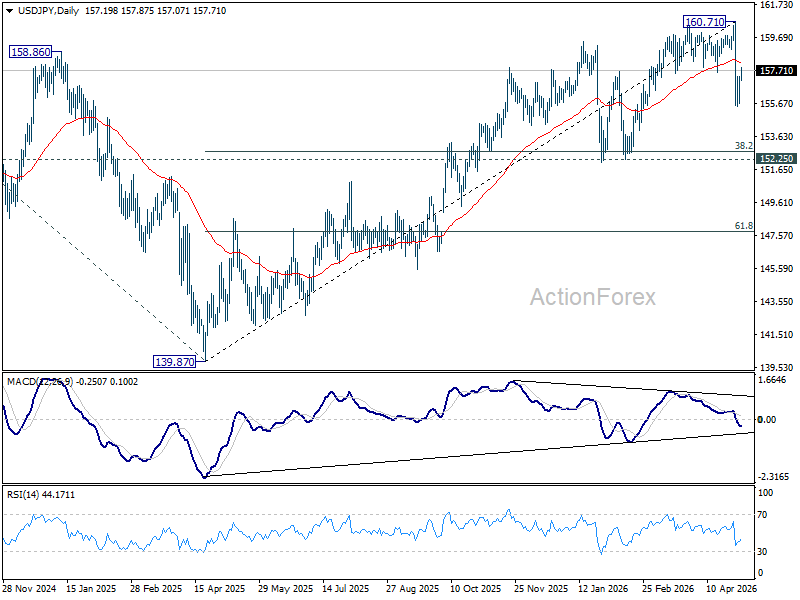
USD/JPY's recovery from 155.48 accelerates higher today, but it stays below 55 4H EMA (now at 158.27). Intraday bias remains neutral and further decline is still in favor. Below 156.55 minor support will bring retest of 155.48. Break there will extend the fall from 160.71 and target 152.25 cluster support (38.2% retracement of 139.87 to 160.71 at 152.74). However, sustained break of the 55 4H EMA will bring stronger rebound back to retest 160.71 high.
In the bigger picture, for now, corrective pattern from 161.94 (2024 high) is still seen as completed at 139.87. Rise from there is seen as resuming the long term up trend. So, break of 161.94 is expected at a later stage to resume the long term up trend. However, sustained break of 55 W EMA (now at 154.03) will dampen this view and bring deeper fall back towards 139.87 to extend the pattern from 161.94.
ETH/USD: Corporate Demand For the Coin Is Rising
According to Santiment, in early May large holders acquired more than 140,000 ETH within 96 hours. This demand is forming against a backdrop of growing corporate interest in Ethereum as a reserve asset: Bitmine Immersion Technologies holds over 5 million ETH. At the same time, an opposing trend is emerging: total assets under management in ETH-focused ETPs and ETFs amount to around $16 billion; however, at the beginning of 2026 the ETF segment experienced a period of subdued activity, with interest only starting to recover by April (source: CoinLaw).
Technical Picture
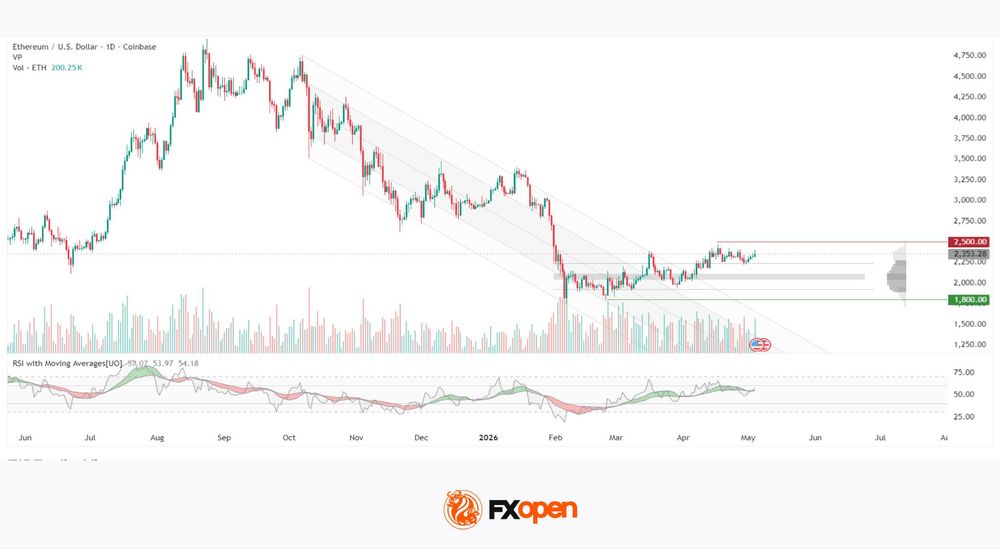
On the daily chart, an extended downward structure is evident: since early October 2025, the price has been declining within a descending channel, reaching a culmination in early February 2026 near the $1,750 level. Vertical volume during this period showed peak values, signalling the exhaustion of selling pressure. This was followed by a rebound: the price broke above the upper boundary of the channel and, during subsequent trading, formed a horizontal volume zone in the $1,920–$2,240 range, where the bulk of transactions over the period was concentrated. The point of control (POC) of this volume zone lies around $2,050–$2,100.
The price is currently trading above this zone, indicating a shift in favour of buyers. Support at $1,800 coincides with the February low from which the reversal began. Above current levels lies a resistance area near $2,500 — a zone the price approached in April but failed to consolidate above the round level. The RSI + MAs indicator shows readings of 57, 54 and 54: the oscillator is positioned above neutral, while the moving averages remain broadly neutral.
Key Takeaways
The technical profile reflects a transition from a prolonged downtrend to a consolidation phase above the volume zone. Further movement will depend on whether corporate demand for ETH can provide a sufficient basis to sustain a move towards the resistance area.
FXOpen offers the world's most popular cryptocurrency CFDs*, including Bitcoin and Ethereum. Floating spreads, 1:2 leverage — at your service (additional fees may apply). Open your trading account now or learn more about crypto CFD trading with FXOpen.
*Important: At FXOpen UK, Cryptocurrency trading via CFDs is only available to our Professional clients. They are not available for trading by Retail clients. To find out more information about how this may affect you, please get in touch with our team.
This article represents the opinion of the Companies operating under the FXOpen brand only. It is not to be construed as an offer, solicitation, or recommendation with respect to products and services provided by the Companies operating under the FXOpen brand, nor is it to be considered financial advice.
Bitcoin Has Begun Hunting Down Short Sellers
Market Overview
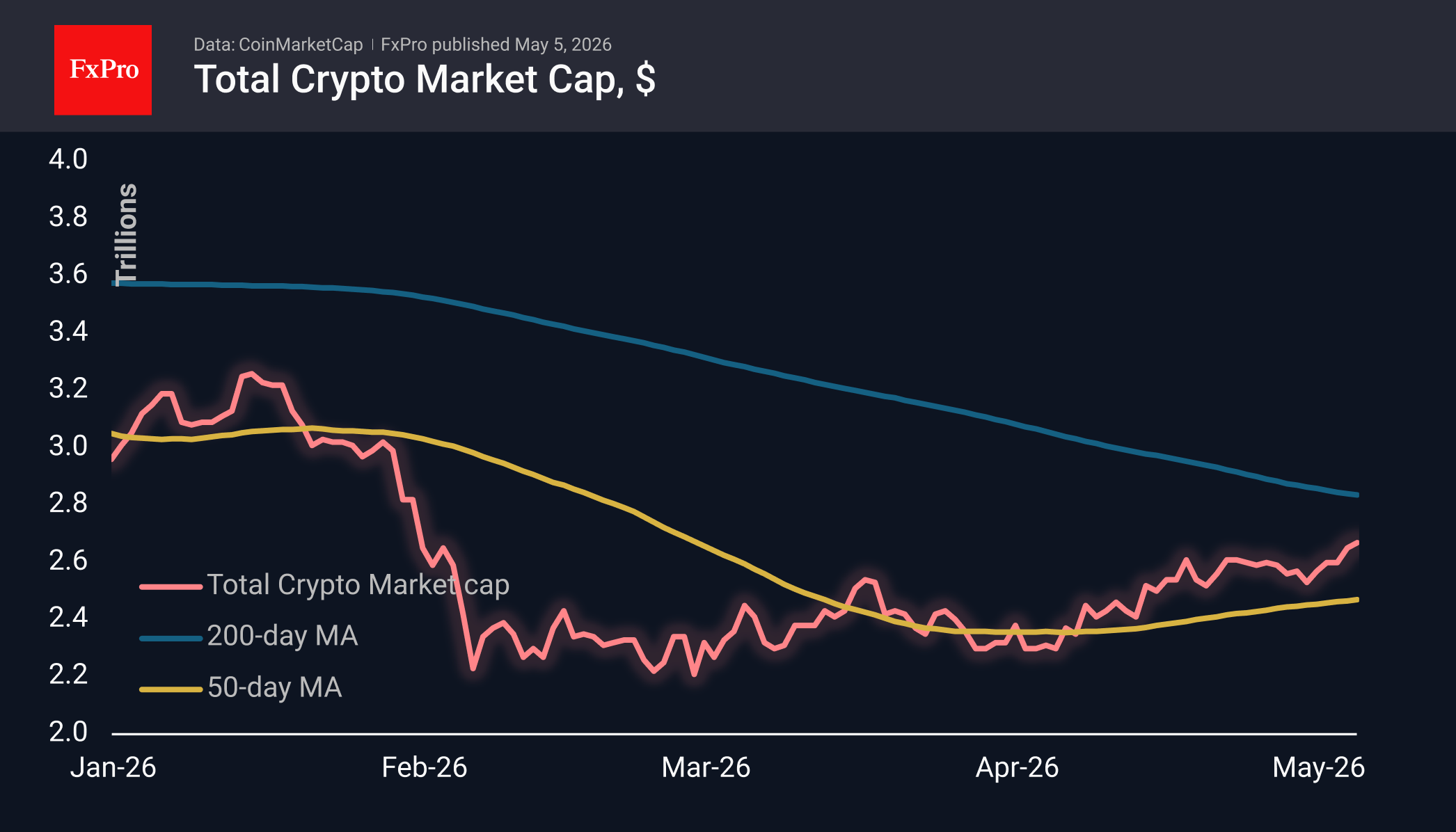
The crypto market capitalisation has continued to hit new highs since early February, reaching $2.67 trillion. This time, the movement was not uniform, consisting of individual surges led by Toncoin (+29%), followed by Algorand (+4.5%) and Basic Attention (+4%). The underperformers include Dash (-5.5%), Aptos (-2.1%) and VeChain (-1.6%).
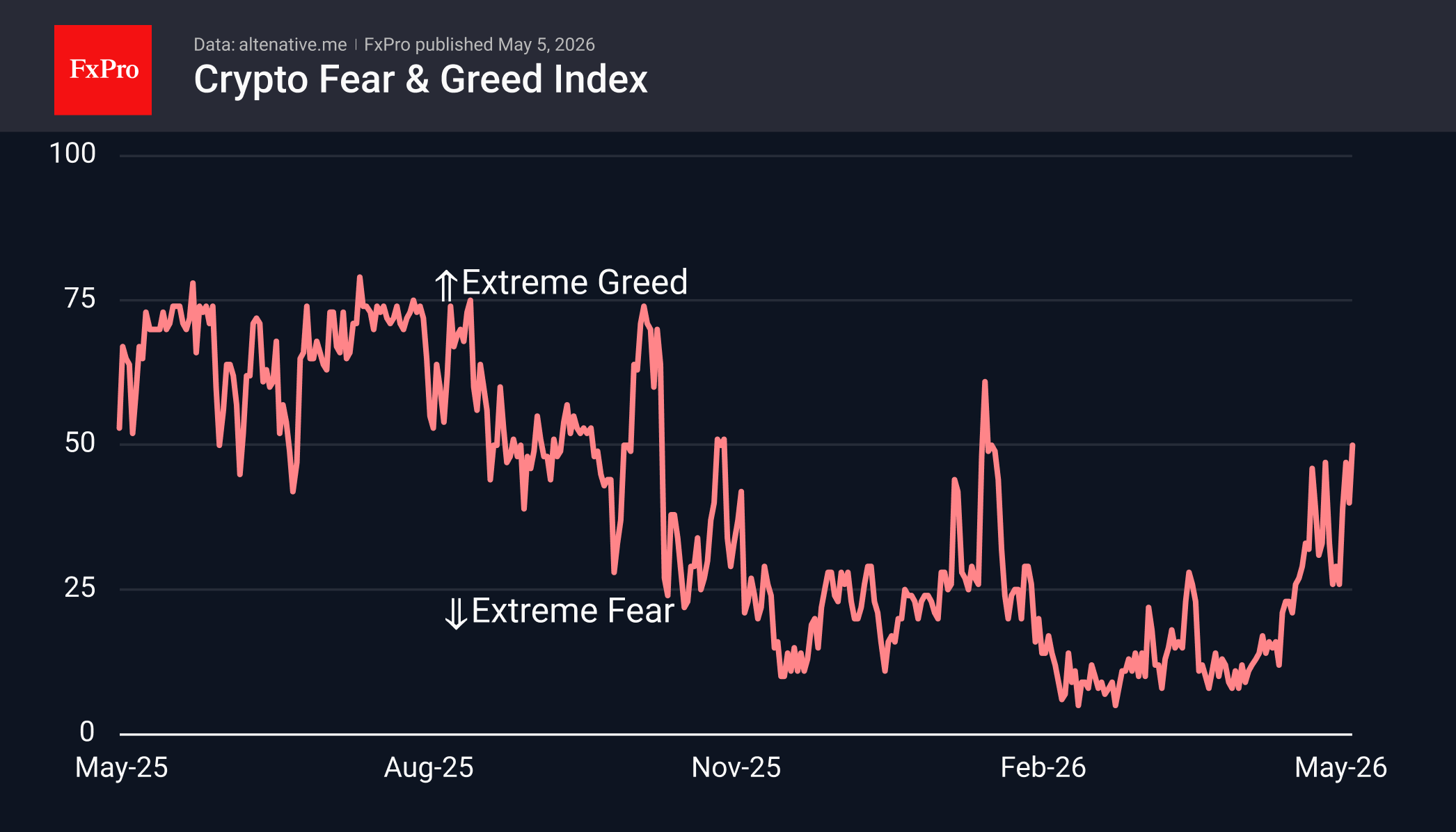
The sentiment index has reached 50, the midpoint of the indicator’s range, where it last stood on 17 January. The market is approaching a significant turning point. Since last October, there have been only brief surges in sentiment to higher levels, but these have provided excellent opportunities for bears to sell at higher prices.
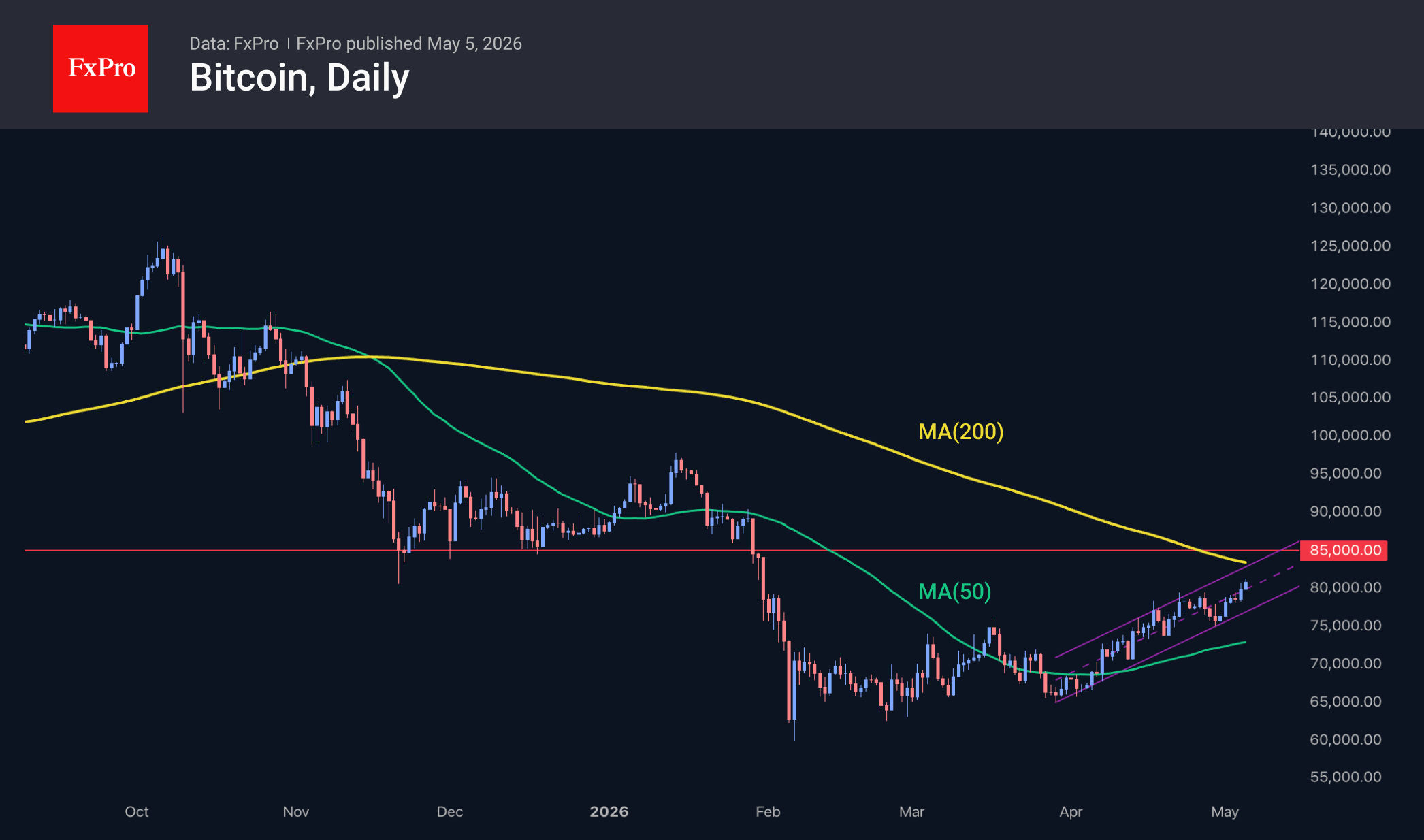
Although Bitcoin faced some pressure midday on Monday, it overcame it on Tuesday, reaching $81K and gaining 1.3% for the day, though, by and large, it covered this ground in just the last 4 hours. We attribute this rally to short squeezes, as the rise occurred during the period of the most aggressive movements ahead of the start of active trading in Asia, when liquidity is at its lowest. Meanwhile, on the stock markets, there was only a slight pullback following the downward momentum. In any case, on the daily charts, Bitcoin is recording its sixth bullish candle, and the entire April uptrend now fits within a new upward channel, with the upper boundary currently at the 200-day moving average.
News Background
The Capriole investment fund has noted a sharp rise in demand for Bitcoin from major players. Institutional investors are buying up more than 500% of the daily mining output of the leading cryptocurrency every day. Historically, such a supply shortage has led to a 24% rise in BTC over the following month.
Bitcoin appears poised for an upward surge. A break above $80K opens up the possibility of reaching $86K0–$88K in the coming period, notes MN Trading founder Michael van de Poppe.
Following the latest adjustment, Bitcoin’s mining difficulty has fallen by 2.3% to 132.47 T. According to Glassnode, the network’s average hash rate, smoothed by a 7-day moving average, stands at around 955 EH/s.
Senators Tom Tillis and Angela Olsbrooks have reached a compromise regarding stablecoin yields in the CLARITY Act. This bill regulating the US crypto market may be considered by the Senate Banking Committee in the week following 11 May.
AUD/USD Slips to 20-SMA After RBA Rate Hike
- AUD/USD loses ground as RBA meets rate hike expectations.
- Short-term risk is tilted to the downside.
- A close below 20-SMA could extend decline.
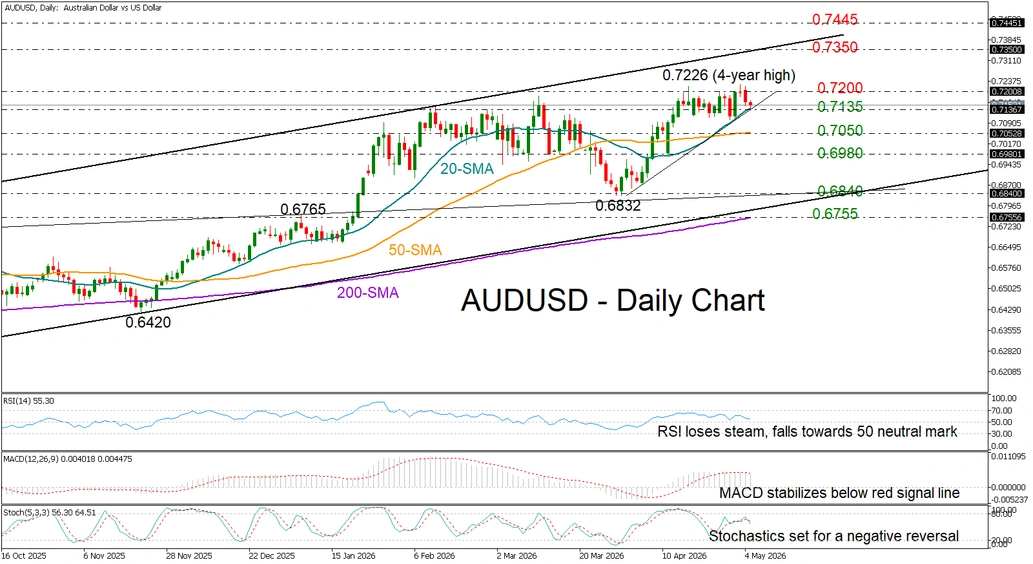
AUD/USD retreated to 0.7134, extending Monday’s losses after the Reserve Bank of Australia (RBA) delivered its third consecutive rate increase, as expected, to quell inflation while signaling a data-dependent approach for future policy actions. A relatively firmer dollar, amid escalating tensions in the Middle East, added extra pressure on the pair.
Technically, the pullback emerged after the 0.7200 bar stood firm once again near four-year highs, bringing the 20-day simple moving average (SMA) at 0.7135 back into view. A break lower would put April’s upleg into question, shifting the spotlight toward the 50-day SMA at 0.7050. Should the sell-off extend beyond 0.6980, the next pivot point could come at the March low of 0.6840.
Given the negative trajectory in the RSI and the MACD, there is limited optimism for short-term acceleration. Nevertheless, if the bulls reclaim the 0.7200 level and revive the 2025 uptrend, the door could open toward the ascending trendline connecting the 2025 and 2026 highs, currently seen near 0.7350. The 0.7445 resistance taken from April 2025, could be the next destination.
In summary, AUD/USD appears to be losing bullish momentum in the short-term picture as it tests a key support area around 0.7135. Failure to hold this level could trigger another wave of selling.