Sample Category Title
USD/JPY Daily Outlook
Daily Pivots: (S1) 149.58; (P) 149.73; (R1) 150.02; More...
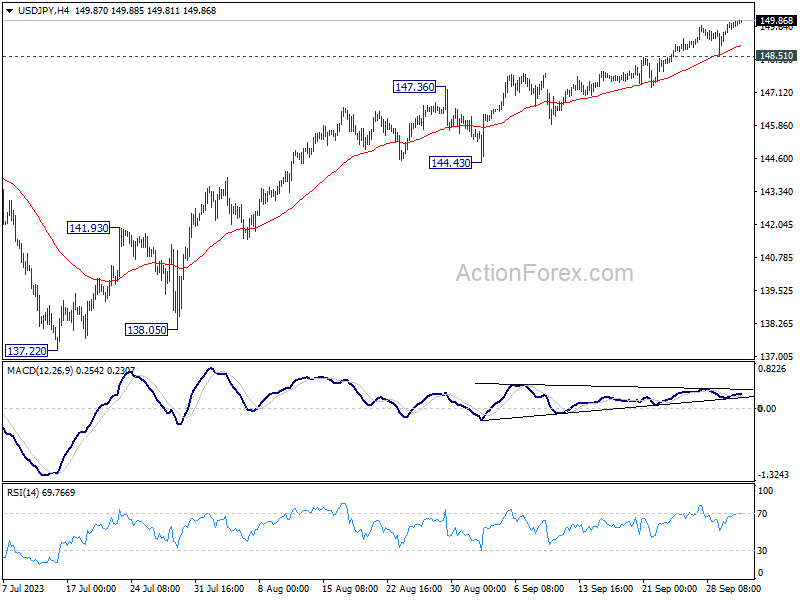
USD/JPY's rally is in progress and intraday bias stays on the upside. Current rise from 127.20 should target a retest on 151.93 high next. On the downside, break of 148.51 support is needed to indicate short term topping. Otherwise, outlook will stay bullish in case of retreat.
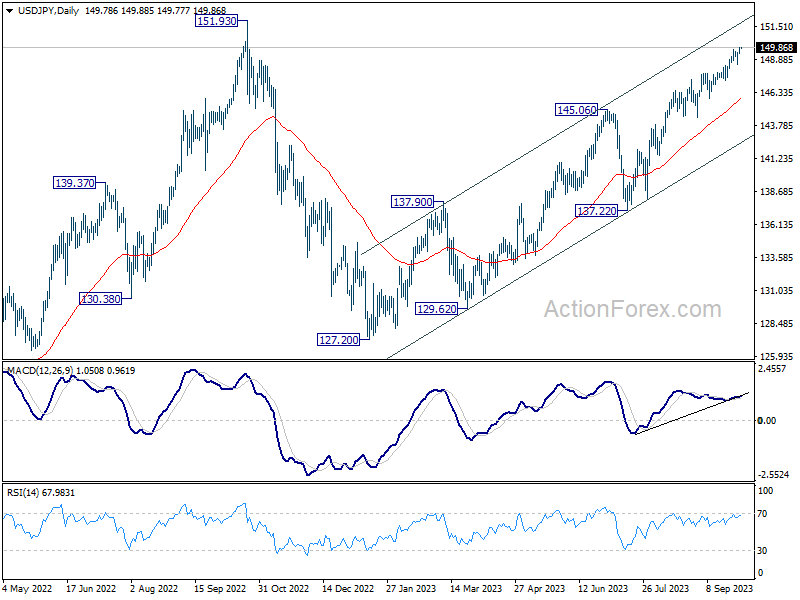
In the bigger picture, while rise from 127.20 is strong, it could still be seen as the second leg of the corrective pattern from 151.93 (2022 high). Rejection by 151.93, followed by break of 145.06 resistance turned support will be the first sign that the third leg of the pattern has started. However, sustained break of 151.93 will confirm resumption of long term up trend.
USD/CHF Daily Outlook
Daily Pivots: (S1) 0.9130; (P) 0.9163; (R1) 0.9215; More....
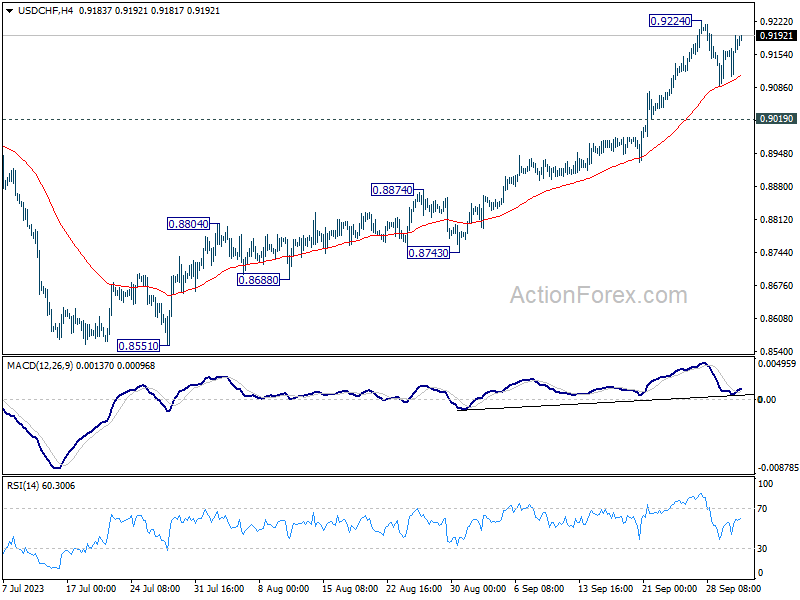
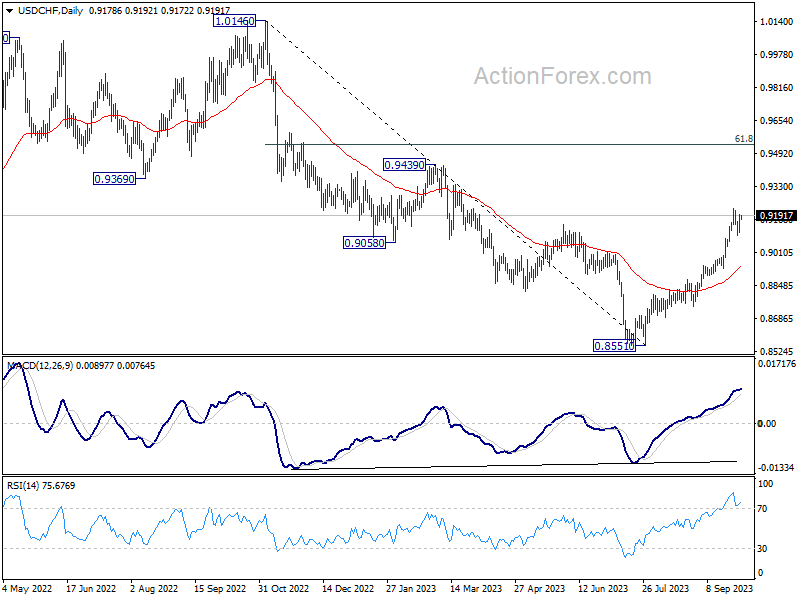
Intraday bias in USD/CHF remains neutral for the moment as consolidation from 0.9224 is extending. Deeper retreat cannot be ruled out. But near term outlook will stay bullish as long as 0.9019 support holds. On the upside, break of 0.9224 will resume the rally from 0.8551 to 0.9439 resistance next.
In the bigger picture, current development indicates that rise from 0.8551 is reversing whole down trend from 1.0146. Further rally would then be seen to 61.8% retracement at 0.9537 and above. For now, this will be the favored case as long as 55 D EMA (now at 0.8942) holds, even in case of deep pullback.
USD/CAD Daily Outlook
Daily Pivots: (S1) 1.3598; (P) 1.3639; (R1) 1.3717; More....
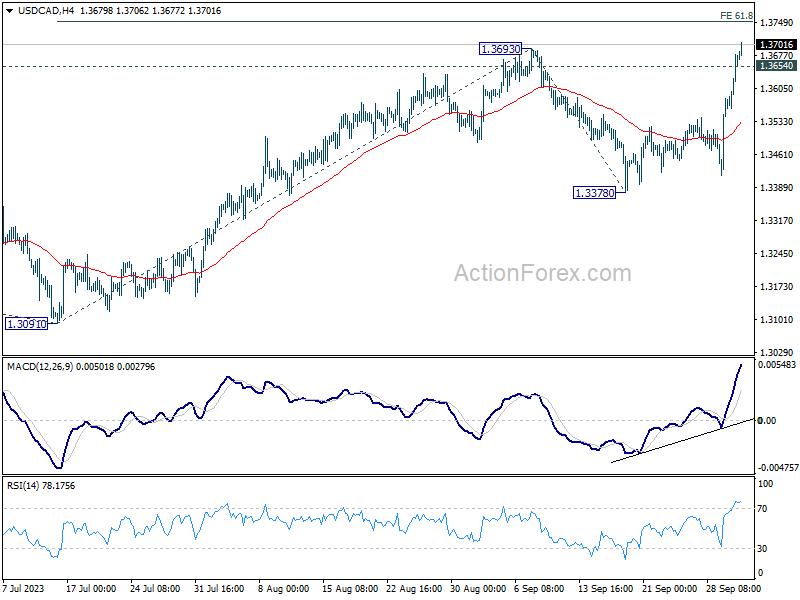
USD/CAD's break of 1.3693 minor resistance indicates resumption of whole rally from 1.3091. Intraday bias stays on upside for 61.8% projection of 1.3091 to 1.3693 from 1.3378 at 1.3750. Firm break there will target 100% projection at 1.3980. On the downside, below 1.3654 minor support will turn intraday bias neutral first.
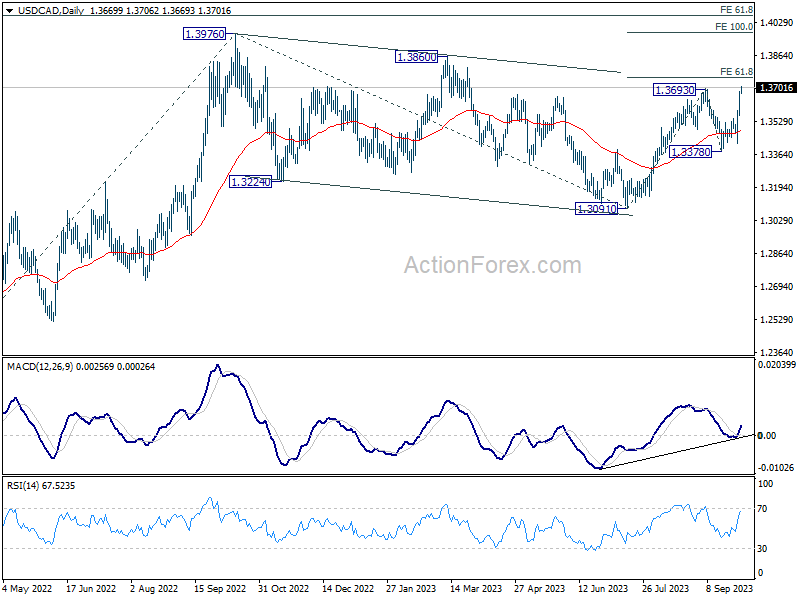
In the bigger picture, current development revives the case that corrective pattern from 1.3976 (2022 high) has completed with three waves down to 1.3091. Decisive break of 1.3976 high will confirm resumption of up trend from 1.2005 (2021 low). Next target will be 61.8% projection of 1.2401 to 1.3976 from 1.3091 at 1.4064. This will now remain the favored case as long as 1.3378 support holds.
Gold (XAUUSD) Bearish Sequence Favors More Downside
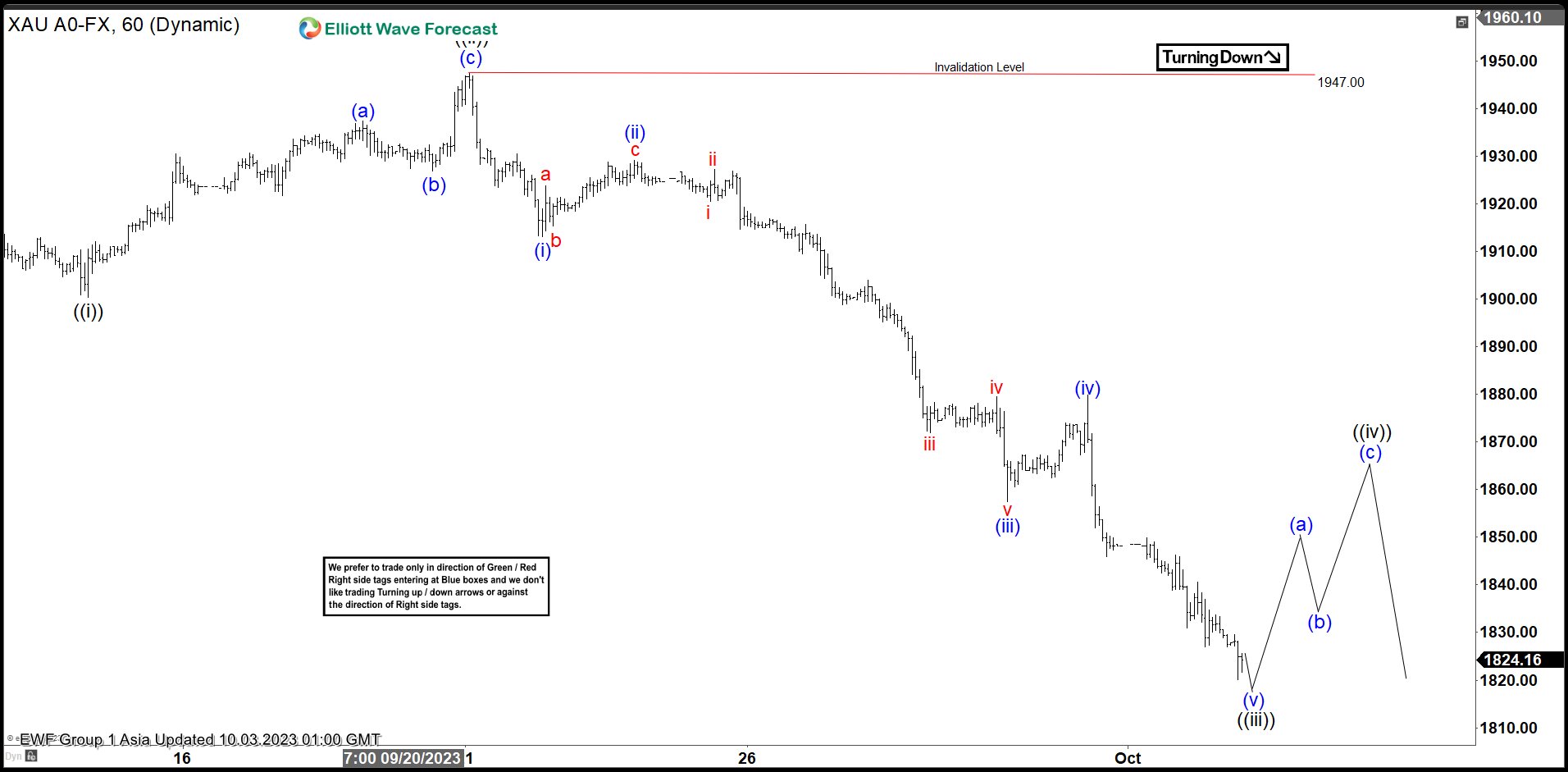
Gold shows incomplete bearish sequence from 5.4.2023 high favoring further downside. Down from 5.4.2023 high, wave (W) ended at 1898.12 and wave (X) rally ended at 1987.42. Gold then resumed lower in wave (Y) with internal subdivision as a zigzag Elliott Wave structure. Down from wave (X), wave A ended at 1884.89 low and wave B ended at 1952.95 high on September 1. Wave C lower is in progress as a 5 waves impulse structure. Down from wave B, wave ((i)) ended at 1901.11 and wave ((ii)) rally ended at 1947.39.
Wave ((iii)) lower is in progress as a 5 waves impulse in lesser degree. Down from wave ((ii)), wave (i) ended at 1913 and rally in wave (ii) ended at 1929.12. Wave (iii) lower ended at 1857.40 and rally in wave (iv) ended at 1879.81. Expect wave (v) to end soon which should complete wave ((iii)). Afterwards, expect rally in wave ((iv)) to correct cycle from 9.21.2023 high in 3, 7, or 11 swing before the decline resumes. Near term, as far as pivot at 1947 high stays intact, expect rally to fail in 3, 7, or 11 swing for further downside.
Gold 60 Minutes Elliott Wave Chart
XAUUSD Elliott Wave Video
https://www.youtube.com/watch?v=zeOwrsLztEA
AUD/USD Daily Report
Daily Pivots: (S1) 0.6336; (P) 0.6390; (R1) 0.6419; More...
AUD/USD's breach of 0.6330 support indicates resumption of recent down trend. Intraday bias is back on the downside. Current fall from 0.7156 should target 100% projection of 0.7156 to 0.6457 from 0.6894 at 0.6195. On the upside, break of 0.6500 resistance is needed to indicate short term bottoming. Otherwise, outlook will stay bearish in case of recovery.
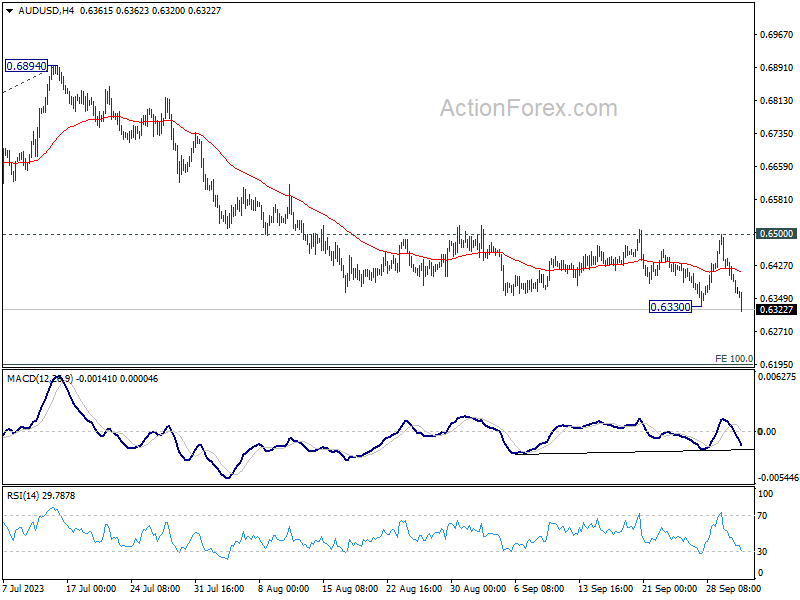
In the bigger picture, down trend from 0.8006 (2021 high) is possibly still in progress. Decisive break of 0.6169 will target 61.8% projection of 0.8006 to 0.6169 to 0.7156 at 0.6021. This will now remain the favored case as long as 0.6894, in case of strong rebound.
Aussie Faces Headwinds Post-RBA Hold Amid Asian Market Jitters and Dollar Power
Australian Dollar is facing heavy downward pressure, emerging as the most underperforming currency this week so far. The weak under tone is maintained following RBA's decision to hold interest rates steady. Both Aussie and Kiwi have relinquished the gains made the previous week, a reversal exacerbated by an evident risk aversion in Asia.
Significant decline is seen in Hong Kong stocks post-long weekend. Despite a dramatic over 40% surge in China Evergrande as trading of its shares resumed from last week's halt, the overall market sentiment remained uninspired. The embattled property developer's spike did little to alleviate the prevailing bearish outlook.
Contrarily, Dollar has emerged robust, spearheading the near-term rally against Euro and Sterling. The buoyancy can be attributed to a "relatively" upbeat ISM manufacturing data that has incrementally heightened the prospects of another Fed hike, now hovering around 45% likelihood in December. This positive data concurrently propelled 10-year yield and the greenback upwards. However, impending ISM services and non-farm payroll data are anticipated to be crucial determinants in Dollar's continued ascendancy.
Elsewhere in the currency markets, Yen is tailing Dollar as the second strongest, keeping market participants and analysts vigilant due to potential interventions by Japan close to the 150 handle against Dollar. Among European majors, Sterling is the laggard.
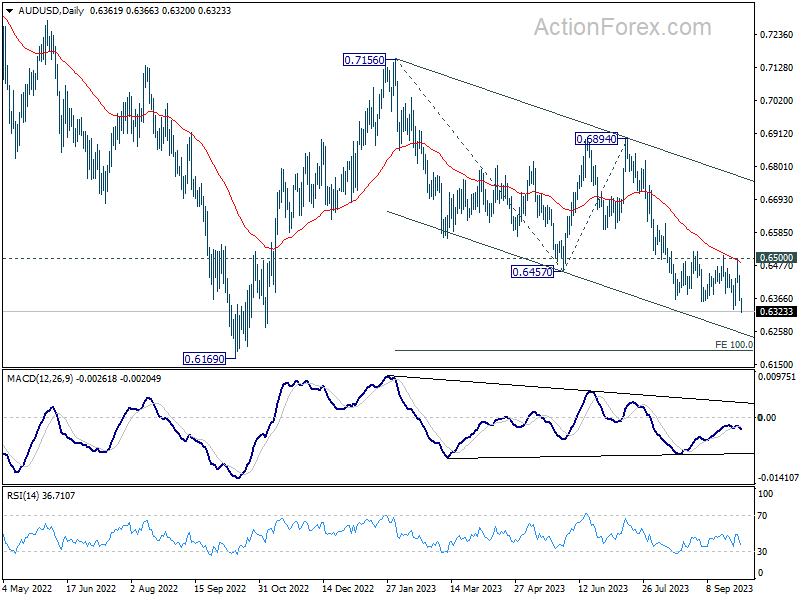
On the technical front, GBP/USD is now pressing an important fibonacci level at 38.2% retracement of 1.0351 to 1.3141 at 1.2075 Sustained break there will align the outlook will EUR/USD. That is, fall from 1.3141 in GBP/USD, whether it's a correction or reversing whole trend form 1.0351, would target 61.8% retracement at 1.1417.
In Asia, at the time of writing, Nikkei is down -1.43%. Hong Kong HSI is down -3.03%. Singapore Strait Times is down -0.81%. Japan 10-year JGB yield is down -0.0123 at 0.764. China is on holiday. Overnight, DOW dropped -0.22%. S&P 500 rose 0.01%. NASDAQ rose 0.67%. 10-year yield rose 0.110 to 4.683, after hitting as high as 4.703.
RBA holds rates steady, maintains hawkish bias
In what was Michelle Bullock's inaugural meeting as Governor, RBA opted to maintain its cash rate target at 4.10%, aligning with broad market expectations. The central bank's statement carried a hawkish tone, noting that "some further tightening of monetary policy may be required. The exact course of such adjustments, however, would be determined by "the data and the evolving assessment of risks."
While RBA acknowledged that inflation had passed its pinnacle, the levels remain uncomfortably elevated. It observed a decline in goods price inflation but pointed out the brisk rise in service prices, as well as notable increases in fuel and rent prices.
The central bank projects a gradual return of CPI inflation to its 2-3% target range by the end of 2025. This aligns with their prediction of sustained below-trend growth for the economy, expecting this trend to persist. Consequently, they anticipate the unemployment rate to inch up, reaching approximately 4.5% towards the end of the following year.
Outlook is shrouded in "significant uncertainties." These encompass variables like service price inflation, delays in monetary policy transmission monetary policy, and businesses' reactions in terms of pricing and wages. Consumer behavior, particularly household consumption patterns, also remains an unpredictable factor.
On a global scale, RBA expressed concerns over China's economy, especially given the prevalent disturbances in its property market.
NZ NZIER survey shows mild recovery in business sentiment
NZIER Quarterly Survey of Business Opinion reveals a modest improvement in business confidence for the September quarter, climbing to -52.7 from its previous position at -60.3. However, it's evident that overall sentiment within the business community remains pessimistic. Trading activity for the next three months improved from -16.6 to -14.2.
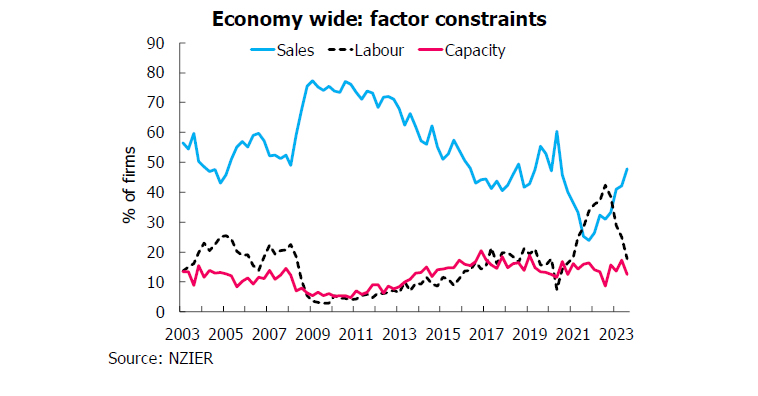
One major positive shift observed was the pronounced decrease in reported labour shortages. Fewer businesses now list the challenge of finding labour as their principal operational bottleneck, shifting their concerns instead to a softer demand environment. This transition in concerns implies that the recent hikes in interest rates may be suppressing economic demand in the country.
On the flip side, the easing of capacity pressures hasn't provided much respite to businesses in terms of costs. A significant 68.2% of respondents noted a rise in their operating costs over the past three months, only a minor reduction from the prior quarter's 67.1%. Moreover, the inclination to transfer these cost pressures to consumers has subsided, with 57.3% of businesses raising output prices in the recent quarter, down from a previous 68.8%.
Fed's Barr eyes restrictive policy duration over rate height
Fed Vice Chair Michael Barr advocated for a cautious approach to monetary policy adjustments during his speech yesterday. While discussions surrounding interest rate hikes are paramount, Barr's concern is primarily anchored on the duration for which these elevated rates should be maintained.
Speaking on the current tightening cycle, Barr highlighted the progress made and expressed that it's a juncture where meticulous decision-making is essential. He stated, "Given how far we have come, we are now at a point where we can proceed carefully as we determine the extent of monetary policy restriction that is needed."
Perhaps most notably, he reframed the ongoing debate on rate adjustments by remarking, "The most important question at this point is not whether an additional rate increase is needed this year or not, but rather how long we will need to hold rates at a sufficiently restrictive level." This perspective places a clear emphasis on policy duration, suggesting a prolonged period of elevated rates may be more impactful than further substantial hikes in the near term.
On the economy, Barr's baseline is for real GDP growth to "moderate to somewhat below its potential rate over the next year" as restrictive monetary policy and tighter financial conditions restrain economic activity." He anticipates this deceleration in growth to be concomitant with "some further softening in the labor market".
Fed's Bowman flags energy as potential setback to disinflation progress; advocates more hike
Fed Michelle Bowman has made her hawkish stance clear on the pressing issue of inflation that continues to grip the US economy. In a speech yesterday, Bowman emphasized the persistence of inflationary pressures, signaling the need for a more restrictive monetary policy to anchor inflation back to the Fed's 2% target.
"Inflation continues to be too high, and I expect it will likely be appropriate for the Committee to raise rates further and hold them at a restrictive level for some time to return inflation to our 2 percent goal in a timely way," Bowman stated.
Bowman pointed to the latest inflation reading based on the PCE index, noting a rise in overall inflation driven, in part, by escalating oil prices. "I see a continued risk that high energy prices could reverse some of the progress we have seen on inflation in recent months," she warned.
Also, Bowman cited the Summary of Economic Projections released during the September FOMC meeting, where "the median participant expects inflation to stay above 2 percent at least until the end of 2025." This expectation of prolonged inflationary pressures aligns with Bowman's perspective that "further policy tightening" will be instrumental in steering inflation back towards target.
Fed's Mester suggests another rate hike needed
Cleveland Fed President Loretta Mester acknowledged in a speech yesterday the robust state of the economy with a cautious stance on inflation and interest rates. She signaled the possibility of another rate hike this year.
"I suspect we may well need to raise the fed funds rate once more this year and then hold it there for some time," she said.
However, Mester also underscored the contingent nature of future monetary policy decisions, stating, "whether the fed funds rate needs to go higher than its current level and for how long policy needs to remain restrictive will depend on how the economy evolves relative to the outlook."
Inflation, according to Mester, continues to pose a significant challenge. She plainly remarked that inflation remains "too high". Though she expects some easing of price pressures, she cautioned that "the risks to the inflation forecast remain tilted to the upside."
On a positive note, Mester expressed optimism about the broader economic picture. "The economy is on a good path," she observed. Delving into labor market dynamics, she pointed out that while conditions remain robust, the disparity between labor demand and supply is shrinking, indicating that "firms are finding it easier to find the workers they need."
Looking ahead
The economic calendar is ultra-light today with only Swiss CPI featured.
AUD/USD Daily Report
Daily Pivots: (S1) 0.6336; (P) 0.6390; (R1) 0.6419; More...
AUD/USD's breach of 0.6330 support indicates resumption of recent down trend. Intraday bias is back on the downside. Current fall from 0.7156 should target 100% projection of 0.7156 to 0.6457 from 0.6894 at 0.6195. On the upside, break of 0.6500 resistance is needed to indicate short term bottoming. Otherwise, outlook will stay bearish in case of recovery.
In the bigger picture, down trend from 0.8006 (2021 high) is possibly still in progress. Decisive break of 0.6169 will target 61.8% projection of 0.8006 to 0.6169 to 0.7156 at 0.6021. This will now remain the favored case as long as 0.6894, in case of strong rebound.
Economic Indicators Update
| GMT | Ccy | Events | Actual | Forecast | Previous | Revised |
|---|---|---|---|---|---|---|
| 21:00 | NZD | NZIER Business Confidence Q3 | -52 | -63 | ||
| 23:01 | GBP | BRC Shop Price Index Y/Y Aug | 6.20% | 6.90% | ||
| 00:30 | AUD | Building Permits M/M Aug | 7.00% | 3.30% | -8.10% | |
| 03:30 | AUD | RBA Interest Rate Decision | 4.10% | 4.10% | 4.10% | |
| 06:30 | CHF | CPI M/M Sep | 0.00% | 0.20% | ||
| 06:30 | CHF | CPI Y/Y Sep | 1.80% | 1.60% |
GBP/USD Nosedives, Bears Seem To Aim 1.2000
Key Highlights
- GBP/USD is accelerating lower below the 1.2120 level.
- A major bearish trend line is forming with resistance near 1.2170 on the 4-hour chart.
- EUR/USD is also moving lower below the 1.0500 level.
- The Swiss CPI could increase from 1.6% to 1.8% in Sep 2023 (YoY).
GBP/USD Technical Analysis
The British Pound remained in a bearish zone below 1.2200 against the US Dollar. GBP/USD dived below the 1.2150 zone to enter further into a bearish zone.
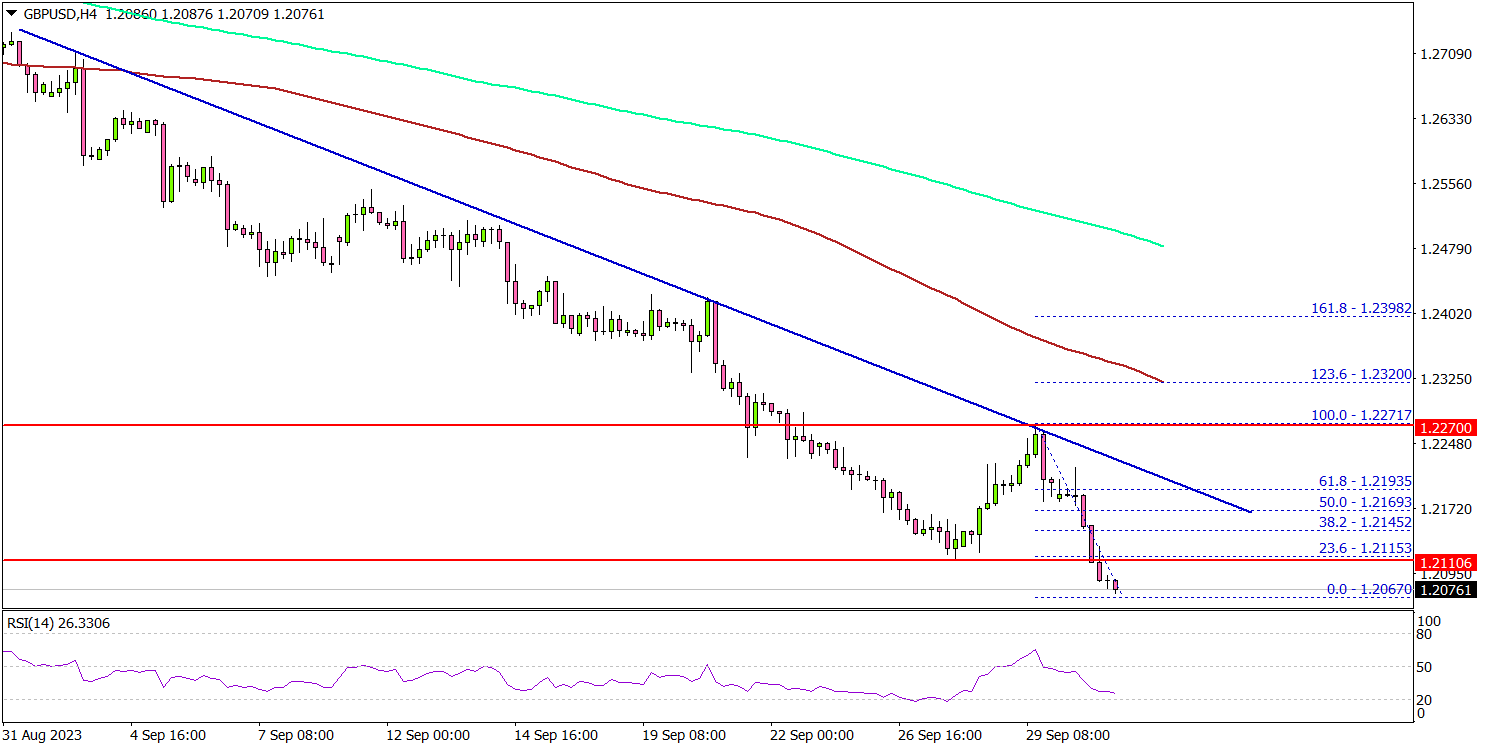
Looking at the 4-hour chart, the pair settled below the 1.2140 level, the 100 simple moving average (red, 4 hours), and the 200 simple moving average (green, 4 hours).
The decline gained pace below the 1.2120 level. A low is formed near 1.2067 and the pair is still showing signs of more downsides. Immediate support is near the 1.2050 level. The next key support is seen near the 1.2020 level, below which it could test 1.2000.
Any more losses might send the pair toward the 1.1880 level. If there is a recovery wave, the pair could face resistance near the 1.2120 level.
The first major resistance is near 1.2150. There is also a major bearish trend line forming with resistance near 1.2170 on the same chart. The trend line is near the 50% Fib retracement level of the downward move from the 1.2271 swing high to the 1.2067 low.
A close above 1.2170 could start a steady increase. In the stated case, GBP/USD might rise and recover toward the 1.2250 resistance zone.
Looking at EUR/USD, the pair extended its decline toward the 1.0450 level and is currently at risk of more downsides.
Economic Releases
- Swiss CPI for Sep 2023 (YoY) – Forecast +1.8%, versus +1.6% previous.
RBA holds rates steady, maintains hawkish bias
In what was Michelle Bullock's inaugural meeting as Governor, RBA opted to maintain its cash rate target at 4.10%, aligning with broad market expectations. The central bank's statement carried a hawkish tone, noting that "some further tightening of monetary policy may be required. The exact course of such adjustments, however, would be determined by "the data and the evolving assessment of risks."
While RBA acknowledged that inflation had passed its pinnacle, the levels remain uncomfortably elevated. It observed a decline in goods price inflation but pointed out the brisk rise in service prices, as well as notable increases in fuel and rent prices.
The central bank projects a gradual return of CPI inflation to its 2-3% target range by the end of 2025. This aligns with their prediction of sustained below-trend growth for the economy, expecting this trend to persist. Consequently, they anticipate the unemployment rate to inch up, reaching approximately 4.5% towards the end of the following year.
Outlook is shrouded in "significant uncertainties." These encompass variables like service price inflation, delays in monetary policy transmission monetary policy, and businesses' reactions in terms of pricing and wages. Consumer behavior, particularly household consumption patterns, also remains an unpredictable factor.
On a global scale, RBA expressed concerns over China's economy, especially given the prevalent disturbances in its property market.
(RBA) Statement by Michele Bullock, Governor: Monetary Policy Decision
At its meeting today, the Board decided to leave the cash rate target unchanged at 4.10 per cent and the interest rate paid on Exchange Settlement balances unchanged at 4.00 per cent.
Interest rates have been increased by 4 percentage points since May last year. The higher interest rates are working to establish a more sustainable balance between supply and demand in the economy and will continue to do so. In light of this and the uncertainty surrounding the economic outlook, the Board again decided to hold interest rates steady this month. This will provide further time to assess the impact of the increase in interest rates to date and the economic outlook.
Inflation in Australia has passed its peak but is still too high and will remain so for some time yet. Timely indicators on inflation suggest that goods price inflation has eased further, but the prices of many services are continuing to rise briskly and fuel prices have risen noticeably of late. Rent inflation also remains elevated. The central forecast is for CPI inflation to continue to decline and to be back within the 2–3 per cent target range in late 2025.
Growth in the Australian economy was a little stronger than expected over the first half of the year. But the economy is still experiencing a period of below-trend growth and this is expected to continue for a while. High inflation is weighing on people's real incomes and household consumption growth is weak, as is dwelling investment. Notwithstanding this, conditions in the labour market remain tight, although they have eased a little. Given that the economy and employment are forecast to grow below trend, the unemployment rate is expected to rise gradually to around 4½ per cent late next year. Wages growth has picked up over the past year but is still consistent with the inflation target, provided that productivity growth picks up.
Returning inflation to target within a reasonable timeframe remains the Board's priority. High inflation makes life difficult for everyone and damages the functioning of the economy. It erodes the value of savings, hurts household budgets, makes it harder for businesses to plan and invest, and worsens income inequality. And if high inflation were to become entrenched in people's expectations, it would be very costly to reduce later, involving even higher interest rates and a larger rise in unemployment. To date, medium-term inflation expectations have been consistent with the inflation target and it is important that this remains the case.
The recent data are consistent with inflation returning to the 2–3 per cent target range over the forecast period and with output and employment continuing to grow. Inflation is coming down, the labour market remains strong and the economy is operating at a high level of capacity utilisation, although growth has slowed.
There are significant uncertainties around the outlook. Services price inflation has been surprisingly persistent overseas and the same could occur in Australia. There are also uncertainties regarding the lags in the effect of monetary policy and how firms' pricing decisions and wages respond to the slower growth in the economy at a time when the labour market remains tight. The outlook for household consumption also remains uncertain, with many households experiencing a painful squeeze on their finances, while some are benefiting from rising housing prices, substantial savings buffers and higher interest income. And globally, there remains a high level of uncertainty around the outlook for the Chinese economy due to ongoing stresses in the property market.
Some further tightening of monetary policy may be required to ensure that inflation returns to target in a reasonable timeframe, but that will continue to depend upon the data and the evolving assessment of risks. In making its decisions, the Board will continue to pay close attention to developments in the global economy, trends in household spending, and the outlook for inflation and the labour market. The Board remains resolute in its determination to return inflation to target and will do what is necessary to achieve that outcome.
NZ NZIER survey shows mild recovery in business sentiment
NZIER Quarterly Survey of Business Opinion reveals a modest improvement in business confidence for the September quarter, climbing to -52.7 from its previous position at -60.3. However, it's evident that overall sentiment within the business community remains pessimistic. Trading activity for the next three months improved from -16.6 to -14.2.
One major positive shift observed was the pronounced decrease in reported labour shortages. Fewer businesses now list the challenge of finding labour as their principal operational bottleneck, shifting their concerns instead to a softer demand environment. This transition in concerns implies that the recent hikes in interest rates may be suppressing economic demand in the country.
On the flip side, the easing of capacity pressures hasn't provided much respite to businesses in terms of costs. A significant 68.2% of respondents noted a rise in their operating costs over the past three months, only a minor reduction from the prior quarter's 67.1%. Moreover, the inclination to transfer these cost pressures to consumers has subsided, with 57.3% of businesses raising output prices in the recent quarter, down from a previous 68.8%.