Sample Category Title
ECB’s Villeroy: Patience is more important now
ECB Governing Council member Francois Villeroy de Galhau spoke about the current monetary policy outlook in an interview with France Inter radio on Saturday. Emphasizing the need for a patient approach, Villeroy stated, "From today's perspective, patience is more important than raising rates further."
He highlighted the current deposit rate, which stands at a record 4%. According to Villeroy, this level should be held steady as it plays a crucial role in controlling inflation within Eurozone.
Amid concerns over the potential inflationary impact of rising oil prices on the global economy, Villeroy remained steadfast in the ECB's commitment to its objectives.
"The recent increase in oil prices won't derail the European Central Bank's fight to tame inflation," he asserted. Elaborating further on this, he said, "We're very attentive, but [this] doesn't put into doubt the underlying disinflation."
Villeroy reiterated ECB's target: "Our outlook and engagement is to bring inflation to around 2% in 2025."
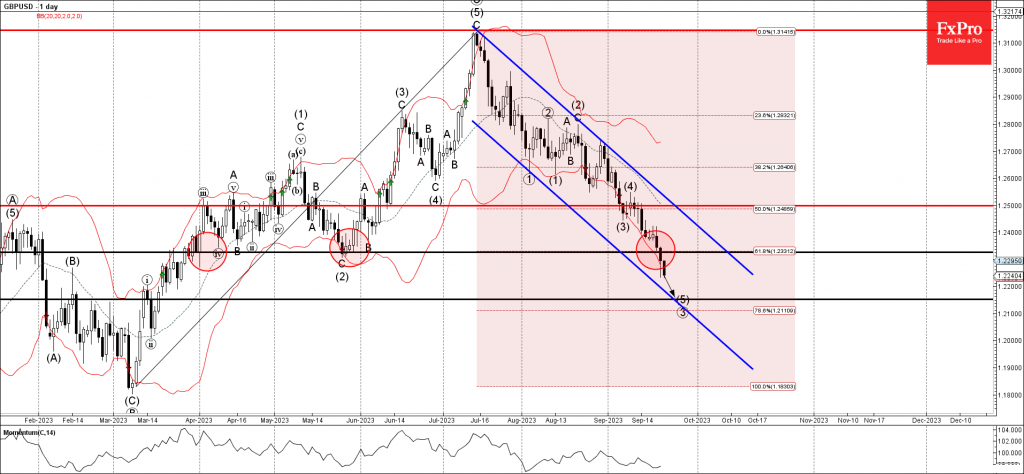
GBPUSD Wave Analysis
- GBPUSD broke support level 1.2325
- Likely to fall to support level 1.2150
GBPUSD recently broke the strong support level 1.2325 (which has been reversing the price from April) intersecting with the 61.8% Fibonacci correction of the uptrend from March.
The breakout of the support level 1.2325 accelerated the active impulse wave (5), which belongs to the higher impulse wave 3 from July.
GBPUSD can be expected to fall further toward the next support level 1.2150 (target for the completion of the active impulse wave (5)).
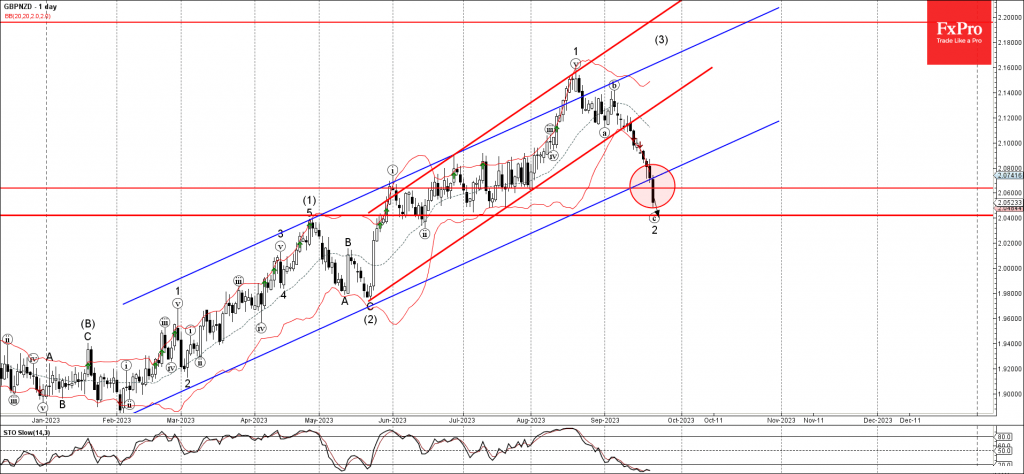
GBPNZD Wave Analysis
- GBPNZD broke support level 2.0640
- Likely to fall to support level 2.0400
GBPNZD recently broke the support level 2.0640 (which reversed the pair multiple times in July) intersecting with the support trendline of the weekly up channel from February.
The breakout of the up channel from February follows the earlier breakout of the sharp up channel from May, accelerating the active impulse wave c.
GBPNZD can be expected to fall further toward the next support level 2.0400 (target for the completion of the active ABC correction 2).
Forex and Cryptocurrency Forecasts
EUR/USD: Verbal Interventions by the Federal Reserve Support the Dollar
In previous reviews, we extensively discussed the verbal interventions made by Japanese officials who aim to bolster the yen through their public statements. This time, similar actions have been taken by FOMC (Federal Open Market Committee) officials, led by the Chairman of the Federal Reserve, Jerome Powell. At their meeting on September 20th, the FOMC decided to maintain the interest rate at 5.50%. This was largely expected, as futures markets had indicated a 99% probability of such an outcome. However, in the subsequent press conference, Mr. Powell indicated that the battle against inflation is far from over, and that the 2.0% target may not be achieved until 2026. Therefore, another rate hike of 25 basis points is very much in the cards. According to the Fed Chairman, there is no recession on the horizon, and the U.S. economy is sufficiently robust to sustain such high borrowing costs for an extended period. Furthermore, it was revealed that 12 out of 19 FOMC members anticipate a rate hike to 5.75% within this year. According to the Committee's economic forecast, this rate level is expected to persist for quite some time. Specifically, the updated forecast suggests that the rate could only be lowered to 5.1% a year from now (as opposed to the previously stated 4.6%), and a decrease to 3.9% is expected in a two-year outlook (revised from 3.4%).
Market participants have mixed beliefs about these prospects, but the fact remains that the hawkish assertions from officials have bolstered the dollar, despite the absence of tangible actions. It's possible that the Federal Reserve has learned from the mistakes of their European Central Bank (ECB) counterparts, who have led market players to believe that the monetary tightening cycle in the Eurozone has concluded. As a reminder, ECB President Christine Lagarde made it clear that she considers the current interest rate level to be acceptable, while the Governor of the Bank of Greece, Yannis Stournaras, stated that, in his opinion, interest rates have peaked, and the next move will likely be a reduction. A similar sentiment: that the September act of monetary tightening was the last, was also expressed by Stournaras's colleague, Boris Vujčić, the Governor of the National Bank of Croatia.
As a result of the Federal Reserve's verbal intervention, the Dollar Index (DXY) soared from 104.35 to 105.37 within just a few hours, while EUR/USD declined to a level of 1.0616. Economists at Oversea-Chinese Banking Corporation (OCBC) believe that, given the Fed's decision to retain flexibility concerning another rate hike, it is not advisable to anticipate a dovish turn in the foreseeable future.
Danske Bank strategists opine that "the Fed was as hawkish as it could be without actually raising rates." However, they contend that "despite the ongoing strengthening of the dollar, there may be some upside potential for EUR/USD in the near term." Danske Bank further states, "We believe that peak rates, improvements in the manufacturing sector compared to the service sector, and/or a reduction in pessimism towards China could support EUR/USD over the next month. However, in the longer term, we maintain our strategic position favouring a decline in EUR/USD, expecting a breakthrough below 1.0300 within the next 12 months."
Data on U.S. business activity released on Friday, September 22, presented a mixed picture. The Manufacturing PMI index rose to 48.9, while the Services PMI declined to 50.2. Consequently, the Composite PMI remained above the 50.0 threshold but showed a slight dip, moving from 50.2 to 50.1.
Following the PMI release, EUR/USD concluded the week at 1.0645. Seventy percent of experts favoured further strengthening of the dollar, while 30% voted for an uptrend in the currency pair. In terms of technical analysis, not much has changed over the nearly completed week. All trend indicators and oscillators on the D1 timeframe are still unanimously supporting the American currency and are coloured red. However, 15% of them are signalling the pair's oversold condition. The nearest support levels for the pair lie in the 1.0620-1.0630 range, followed by 1.0490-1.0525, 1.0370, and 1.0255. Resistance levels will be encountered in the 1.0670-1.0700 zone, then at 1.0745-1.0770, 1.0800, 1.0865, 1.0895-1.0925, 1.0985, and 1.1045.
As for the upcoming week's events, Tuesday, September 26 will see the release of U.S. real estate market data, followed by durable goods orders in the U.S. on Wednesday. Thursday, September 28 promises to be a busy day. Preliminary inflation (CPI) data from Germany as well as U.S. GDP figures for Q2 will be disclosed. Additionally, the customary U.S. labour market statistics will be released, and the day will conclude with remarks from Federal Reserve Chairman Jerome Powell. On Friday, we can also expect a slew of significant macroeconomic data, including the Eurozone's preliminary Consumer Price Index (CPI) and information regarding personal consumption in the United States.
GBP/USD: BoE Withdraws Support for the Pound
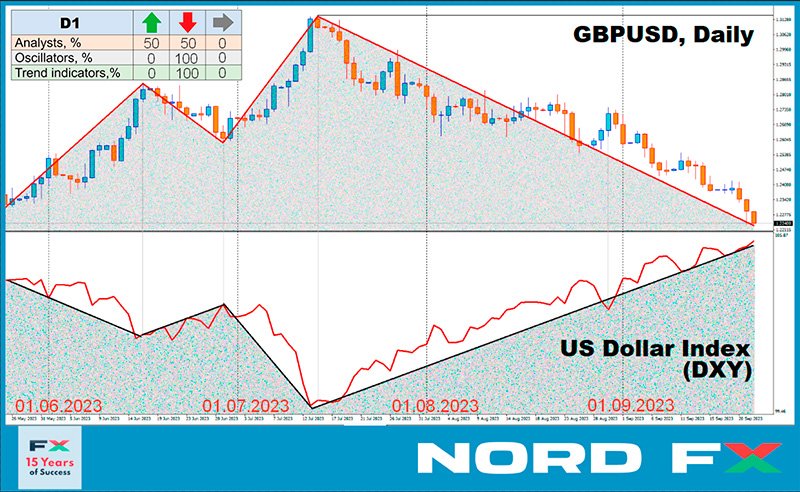
The financial world doesn't revolve around the Federal Reserve's decisions alone. Last week, the Bank of England (BoE) also made its voice heard. On Thursday, September 21, the BoE's Monetary Policy Committee left the interest rate for the pound unchanged at 5.25%. While a similar decision by the Federal Reserve was expected, the BoE's move came as a surprise to market participants. They had anticipated a 25 basis point increase, which did not materialize. As a result, the strengthening dollar and weakening pound drove GBP/USD down to 1.2230.
The BoE's decision was likely influenced by encouraging inflation data for the United Kingdom published the day before. The annual Consumer Price Index (CPI) actually declined to 6.7%, compared to the previous 6.8% and a forecast of 7.1%. The core CPI also fell from 6.9% to 6.2%, against a forecast of 6.8%. Given such data, the decision to pause and not burden an already struggling economy appears reasonable. This rationale is further supported by the United Kingdom's preliminary Services Purchasing Managers' Index (PMI) for September, which hit a 32-month low at 47.2, compared to 49.5 in August and a forecast of 49.2. The Manufacturing PMI was also reported at 44.2, significantly below the critical level of 50.0.
According to economists at S&P Global Market Intelligence, these "disheartening PMI results suggest that a recession in the United Kingdom is becoming increasingly likely. [...] The sharp decline in production volumes indicated by the PMI data corresponds to a GDP contraction of more than 0.4% on a quarterly basis, and the broad-based downturn is gaining momentum with no immediate prospects for improvement.".
Analysts at one of the largest banks in the United States, Wells Fargo, believe that the BoE's decision signals a loss of rate-based support for the British pound. According to their forecast, the current rate of 5.25% will mark the peak of the cycle, followed by a gradual decline to 3.25% by the end of 2024. Consequently, they argue that "in this context, a movement of the pound to 1.2000 or lower is not out of the question."
Their counterparts at Scotiabank share a similar sentiment. New lows and strong bearish signals on the oscillator for short-term, medium-term, and long-term trends indicate an elevated risk of the pound dropping to 1.2100-1.2200.
Economists at Germany's Commerzbank do not rule out the possibility of a slight recovery for the pound if inflation outlooks significantly improve. They believe that the Bank of England has left the door open for another rate hike. The vote for maintaining the current rate was surprisingly close at 5:4, meaning four members of the Monetary Policy Committee voted in favour of a 25 basis point increase. This underscores the high level of uncertainty. Nevertheless, due to the weakness in the UK economy, the outlook for the pound remains bearish.
GBP/USD closed the past week at 1.2237. Analyst opinions on the pair's immediate future are evenly split: 50% expect further downward movement, while the other 50% anticipate a correction to the upside. All trend indicators and oscillators on the D1 chart are coloured in red; moreover, 40% of these oscillators are in the oversold zone, which is a strong signal for a potential trend reversal.
If the pair continues its downward trajectory, it will encounter support levels and zones at 1.2190-1.2210, 1.2085, 1.1960, and 1.1800. On the other hand, if the pair rises, it will face resistance at 1.2325, 1.2440-1.2450, 1.2510, 1.2550-1.2575, 1.2600-1.2615, 1.2690-1.2710, 1.2760, and 1.2800-1.2815.
In terms of economic events impacting the United Kingdom for the upcoming week, the highlight will be the release of the country's GDP data for Q2, scheduled for Friday, September 29.
USD/JPY: Lacklustre Meeting at the Bank of Japan
Following their counterparts at the Federal Reserve and the Bank of England, the Bank of Japan (BoJ) held its meeting on Friday, September 22. "It was a lacklustre meeting," commented economists at TD Securities. "All members unanimously voted to keep policy unchanged. The statement was largely similar to the one issued in July, and no changes were made to the forward guidance." The key interest rate remained at the negative level of -0.1%.
The subsequent press conference led by BoJ Governor Kazuo Ueda also disappointed yen bulls. Ueda did not speak against the weakening of the national currency; instead, he reiterated that the exchange rate should reflect fundamental indicators and remain stable. The central bank's head also noted that the regulator "could consider the possibility of ending yield curve control and altering the negative interest rate policy when we are confident that achieving the 2% inflation target is near."
Japan's Finance Minister Shunichi Suzuki's speech was also a typical form of verbal intervention for him. "We are closely monitoring currency exchange rates with a high sense of urgency and immediacy," the minister declared, "and we do not rule out any options for responding to excessive volatility." He added that last year's currency intervention had its intended effect but did not indicate whether similar steps could be expected in the near future.
Ten-year U.S. Treasury bonds and the USD/JPY currency pair are traditionally directly correlated. When the yield on the bonds rises, so does the dollar against the yen. This week, following hawkish statements from the Federal Reserve, rates on 10-year Treasuries soared to their highest peak since 2007. This propelled USD/JPY to a new high of 148.45. According to economists at TD Securities, considering the rise in U.S. yields, the pair could break above 150.00. Meanwhile, at the French bank Societe Generale, target levels of 149.20 and 150.30 are being cited.
The last note of the five-day trading session sounded at the 148.36 mark. A majority of surveyed experts (70%) agreed with the views of their colleagues at TD Securities and Societe Generale regarding the further rise of USD/JPY. A correction to the downside, and possibly a sharp drop due to currency interventions, is expected by 20% of analysts. The remaining 10% took a neutral stance. All 100% of trend indicators and oscillators on the D1 timeframe are coloured green, although 10% of the latter are signalling overbought conditions. The nearest support level is in the 146.85-147.00 zone, followed by 145.90-146.10, 145.30, 144.50, 143.75-144.05, 142.20, 140.60-140.75, 138.95-139.05, and 137.25-137.50. The nearest resistance is at 148.45, followed by 148.45, 148.85-149.20, 150.00, and finally, the October 2022 high of 151.90.
No significant economic data related to the state of the Japanese economy is scheduled for release in the upcoming week. However, traders may want to mark Friday, September 29 on their calendars, as consumer inflation data for the Tokyo region will be published on that day.
CRYPTOCURRENCIES: Battle for $27,000
On Monday, September 18, the price of the leading cryptocurrency began to soar, pulling the entire digital asset market upward. Interestingly, the reason behind this surge was not directly related to bitcoin, but rather to the U.S. dollar. Specifically, it was tied to the Federal Reserve's decisions regarding interest rates. High dollar rates limit the flow of investments into riskier assets, including cryptocurrencies, as large investors prefer stable returns. In this case, ahead of the upcoming Federal Reserve meeting, market participants were confident that the regulator would not only refrain from raising rates but would also keep them unchanged until year-end. Riding on these expectations, BTC/USD surged, reaching a peak of $27,467 on August 19, adding more than 10% since September 11.
However, although the rate did indeed remain unchanged, it became clear following the meeting that the fight against inflation would continue. Therefore, any hopes of a shift away from the Fed's hawkish stance should be set aside for now. As a result, the price of bitcoin reversed course. After breaking through the support zone at $27,000, it returned to its starting positions.
Despite the recent pullback, many in the crypto community remain confident that the digital gold will continue to rise. For instance, an analyst going by the alias Yoddha believes that bitcoin has a chance to refresh its local high in the short term and reach $50,000 by year-end. After which, he suggests, a correction to $30,000 may occur in early 2024, ahead of the halving event. Blogger Crypto Rover also anticipates that troubles in the U.S. economy will fuel BTC's growth. If the pair manages to firmly establish itself above $27,000, he expects the price to move towards $32,000.
Analyst DonAlt is of the opinion that bitcoin stands a chance to stage a new impressive rally and update its 2023 high. "If we rise and overcome the resistance we are currently battling," he writes, "the target, I believe, could be $36,000. [...] I won't rule out missing a good entry at $30,000 because if the price takes off, it may rise too quickly. [But] we have enough compelling reasons to also move downward. In the worst case, I'll take a minor hit if it plunges into the $19,000 to $20,000 range.".
Trader and analyst Jason Pizzino believes that bitcoin's bullish market cycle began forming around January, and this process is still not complete despite the recent price consolidation. According to the expert, bitcoin will confirm its bullish sentiment if it crosses a key level at $28,500. "This market has seldom seen sub-$25,000 levels. I'm not saying it can't go down, but for six months now, the weekly closings have been above these levels. So far, so good, but we're not in bull territory yet. Bulls need to see closings above $26,550 at least occasionally," states Pizzino. "Bulls still have much to do. I'll start talking about them once we cross the white line at the $28,500 level again. This is one of the key levels for bitcoin to start moving upwards and then try to break $32,000.".
John Bollinger, the creator of the Bollinger Bands volatility indicator, does not rule out the possibility that the leading crypto asset is preparing for a breakout. The indicator uses the standard deviation from the simple moving average to determine volatility and potential price ranges for an asset. Currently, BTC/USD is forming daily candles that touch the upper band. This could indicate a reversal back to the central band or, conversely, an increase in volatility and upward movement. Narrow Bollinger Bands on the charts suggest that the latter scenario is more likely. However, Bollinger himself comments cautiously, believing that it is still too early to draw definitive conclusions.
PlanB, the well-known creator of the S2FX model, has reaffirmed his forecast made earlier this year. He noted that the November 2022 low was the bottom for bitcoin, and its ascent will begin closer to the halving event. PlanB believes that the 2024 halving will drive the leading cryptocurrency up to $66,000, and the subsequent bull market in 2025 could push its price above the $100,000 mark.
Investor and best-selling author of "Rich Dad Poor Dad," Robert Kiyosaki, has high hopes for the halving event as well. According to the expert, the U.S. economy is on the verge of a serious crisis, and cryptocurrencies, particularly bitcoin, offer investors a safe haven during these turbulent times. Kiyosaki predicts that the price of bitcoin could soar to $120,000 next year, and the 2024 halving will serve as a key catalyst for the rally.
In conclusion, to balance out the optimistic forecasts mentioned earlier, let's introduce some pessimism. According to popular analyst and host of the DataDash channel, Nicholas Merten, the crypto market could experience another downturn. He cites the declining liquidity of stablecoins as an indicator. "It's a good metric for identifying trends in the cryptocurrency market. For instance, from April 2019 to July 2019, bitcoin rose from $3,500 to $12,000. During the same period, the liquidity of stablecoins increased by 119%. Then we see a period of consolidation where liquidity also remained at a constant level. When bitcoin rose from $3,900 to $65,000 in 2021, the liquidity of stablecoins surged by 2,183%," the expert shares his observations.
"Liquidity and price growth are interconnected. If liquidity is declining or consolidating, the market is likely not going to grow. This is true for both cryptocurrencies and financial markets. For market capitalization to grow, you need liquidity, but what we are seeing is a constant decline in liquidity, which makes a price drop for cryptocurrencies more probable," Nicholas Merten states.
As of the time of writing this review, Friday evening, September 22, BTC/USD is trading around $26,525. The overall market capitalization of the crypto market has remained virtually unchanged, standing at $1.053 trillion (compared to $1.052 trillion a week ago). The Bitcoin Crypto Fear & Greed Index has dropped by 2 points, moving from 45 to 43, and remains in the 'Fear' zone.
Dollar’s Conundrum: Bullish Factors Met with Lackluster Gains
Despite a confluence of favorable conditions that are typically Dollar bullish — a decidedly hawkish Federal Reserve, plummeting stocks, and soaring yields — the greenback's response was unexpectedly tepid last week. While it managed to gain ground against European majors and Yen, it faltered when squared against the robust commodity currencies. Dollar Index, a measure of the currency against a basket of other major currencies, also recorded only a modest uptick. With the quarter's end on the horizon, it's plausible that a sense of caution may have restrained Dollar's potential surge. Alternatively, traders might possibly be awaiting further developments to validate a one-sided bullish shift.
The week was notably tough for Sterling and Swiss Franc. Both currencies took a hit after their respective central banks, BoE and SNB, caught market participants off-guard with decisions to maintain their interest rates unchanged. There's mounting speculation that both these institutions might have hit the ceiling of their tightening cycles. Euro, despite facing its own challenges, found some reprieve from the buying against these two European rivals, which in turn, acted as a buffer against surging Dollar.
Meanwhile, Japanese Yen emerged as the week's third most lackluster performer, following Pound and Franc. BoJ's decision to remain tight-lipped about potential policy adjustments did the currency no favors. However, fears surrounding potential intervention are lending some support to Yen, anchoring it securely above 150 mark against Dollar.
In a surprising twist, commodity currencies stood out as the week's top performers. Their rise can be dissected into several catalysts. Market bets are tilting towards BoC potentially breaking its pause for a second time, particularly in light of Canada's robust inflation figures. The narrative surrounding RBA remains more ambivalent, with market consensus yet to crystallize on the possibility of another rate hike within the fourth quarter, potentially in November. However, the primary tailwind for commodity currencies appears to be the revitalized Chinese stock markets, endowing them with substantial impetus.
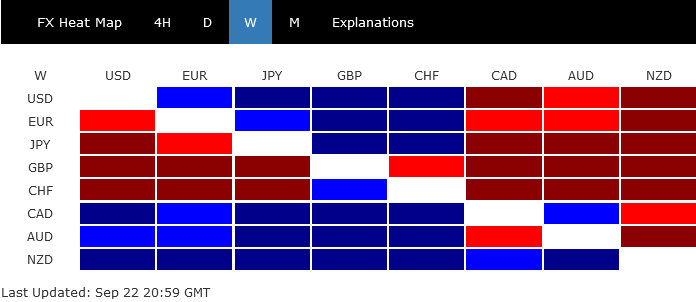
Dollar bulls remain wary despite hawkish Fed, surging yields, and falling stocks
The US markets faced a turbulent last week after Fed's hawkish hold at 5.25-5.00%. While Fed's messages were clear that interest rates are going to stay "higher for longer", overall developments argue that investors are much less convinced on the "higher" part than the "longer".
S&P 500 and NASDAQ experiencing notable drops of -2.9% and -3.6% respectively, marking both indexes' most dismal weekly performance since March and their third consecutive week in the red. 10-year Treasury yield reached its highest point since 2007, while 2-year rate recorded its apex since 2006. Despite the risk aversion sentiment and elevated yields, Dollar index only nudged up by a mere 0.002%. Dollar would probably need to be convinced about the "higher" part before having another substantial break on the upside.
To recap, Fed's messages were unequivocal – another rate hike this year is in the offing. Out of 19 policymakers, 12 have projected another 25bps rate hike to 5.50-5.75% by the year's end. Interest rates will remain elevated for a protracted period. By the conclusion of 2024, rate is anticipated to drop backs slightly to 5.10%.
However, market sentiment doesn't seem wholly aligned with Fed's projections. Current indications from Fed fund futures underscore only a 26.3% likelihood of a hike in November, and 46.3% in December. On the other hand, here's a whopping 90% chance that by 2024-end, interest rates will have reverted to 5.00-5.25% or even lower.
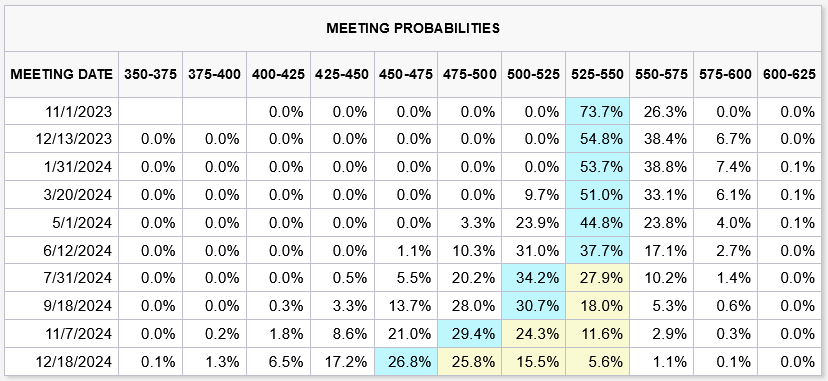
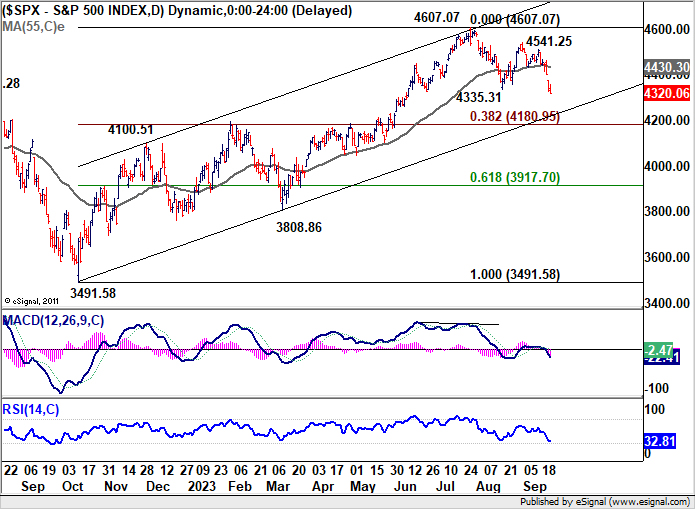
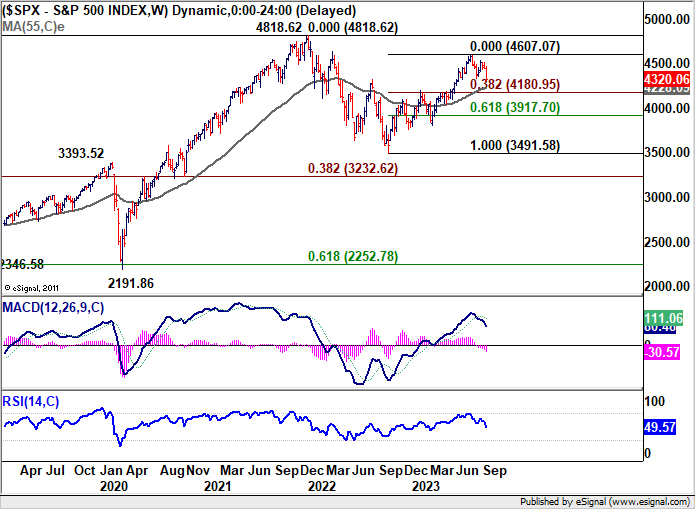
On the technical side, S&P 500's fall from 4607.07 resumed last week by breaking through 4335.31 support. Next target is the support zone between 55 W EMA (now at 4228.09) and 38.2% retracement of 3491.58 to 4607.07 at 4180.95. Strong rebound from there level will maintain near term bullishness for extending the whole rise from 3491.58 at a later stage. However, sustained break of 4180.95 will argue that SPX is already in a medium term down trend, as the third leg of the corrective pattern from 4818.62 (2021 high). In any case, risk will stay on the downside as long as 55D EMA (now at 4430.30) holds.
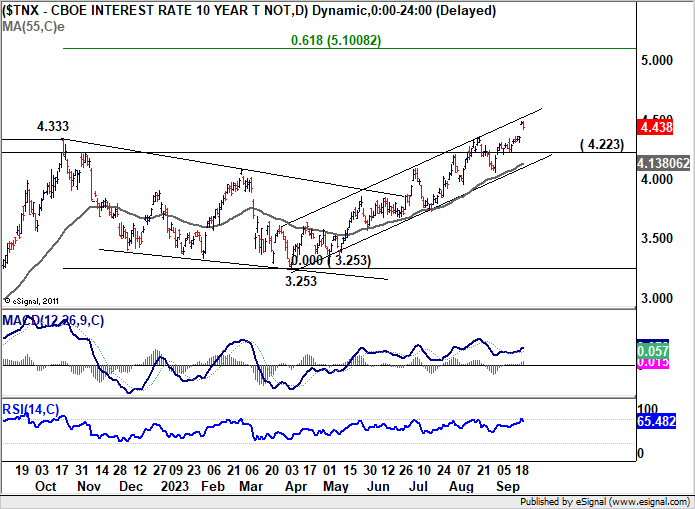
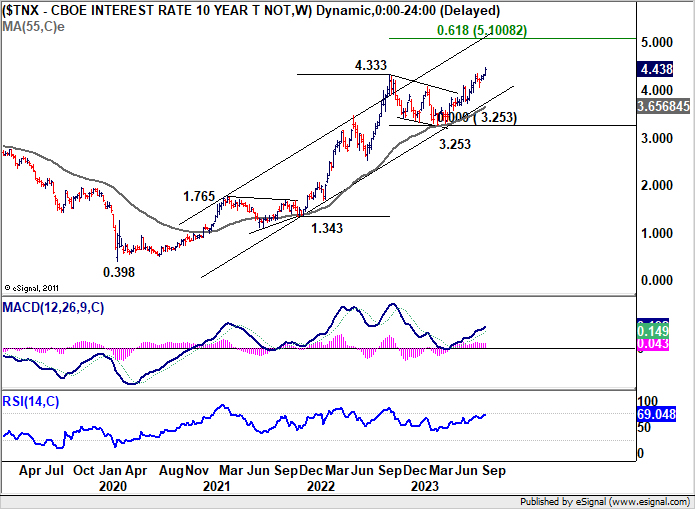
10-year yield surged sharply to as high as 4.490 (in regular hours), before closing at 4.438. Near term outlook will stay bullish as long as 4.223 support holds. Daily MACD suggests upside re-acceleration while W MACD doesn't indicate loss of momentum. Current rally might target 61.8% projection of 1.343 to 4.333 from 4.253 at 5.100, which is above 5% handle.
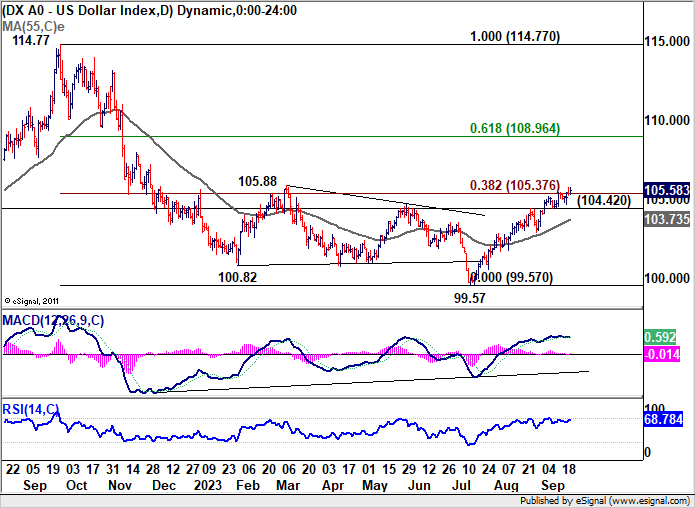
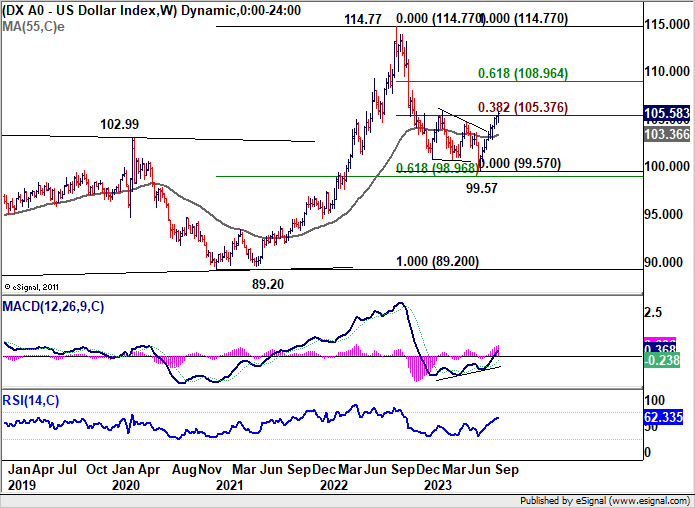
Dollar index edged higher to close at 105.58 but failed to break through 105.88 resistance. But upside momentum is unconvincing as seen in D MACD. It's still unsure if rise from 99.57 is just correcting the down trend from 114.77 (2022 high), or reversing it. DXY is now at a juncture.
Rejection by 105.88, followed by break of 104.42 support will affirm the former case, and bring deeper fall back to 55 D EMA (now at103.73). However, decisive break of 105.88 will affirm the latter case, and target 61.8% retracement of 114.77 to 99.57 at 108.96 next.
EUR/CHF and EUR/GBP in medium term rallies after BoE and SNB holds
Sterling ended as the weakest currency last week, following the shock move of BoE which kept interest rates steady. This decision became notably significant, given that key figures like Governor Andrew Bailey, Deputies Ben Broadbent and Dave Ramsden, and Chief Economist Huw Pill, in alignment with Swati Dhingra, edged out a close 5-4 vote.
In response, a slew of prominent global banks, including Barclays, BNP Paribas, Citigroup, Deutsche Bank, Goldman Sachs, JP Morgan, UBS, and HSBC, have revised their forecasts. Now, the prevalent expectation is that BoE's current 5.25% rate might mark the peak of this cycle.
Swiss Franc followed closely behind Sterling's tumble, ranking as the second-worst performer. This came after SNB chose to maintain status quo, defying market anticipations of a rate increase. Yen wasn't far behind, securing the third spot, as BoJ refrained from providing any hints regarding potential monetary policy adjustments or an exit from negative rates.
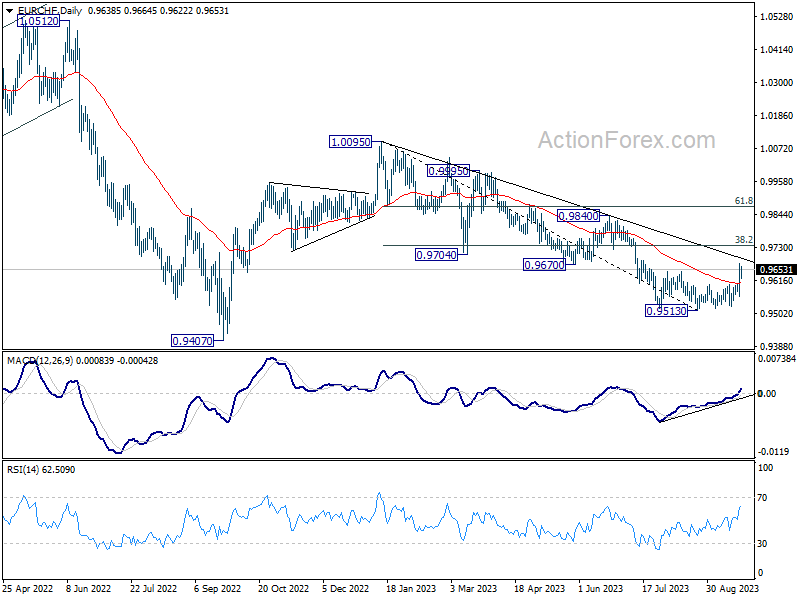
On the technical front, EUR/CHF and EUR/GBP are gearing up for a potential medium-term rally as the aftermath of ECB's recent rate hike combined with BoE's and SNB's inaction. However, given that all three central banks have reached their peak in tightening, the long-term trends will hinge on the intensity and span of the potential upcoming recessions in the region, as well as the implications on the timing for the inaugural rate cut. Still for the immediate future, the dynamics within EUR/CHF and EUR/GBP might alleviate some of the downward pressure on EUR/USD and subsequently limit upward momentum of Dollar Index.
Specifically, a medium term bottom is probably in place at 0.9513 in EUR/CHF, on bullish convergence condition in D MACD. Sustained break of 0.9670 support turned resistance will argue that whole decline from 1.095 has completed, and bring stronger rally to 61.8% retracement at 0.9873.
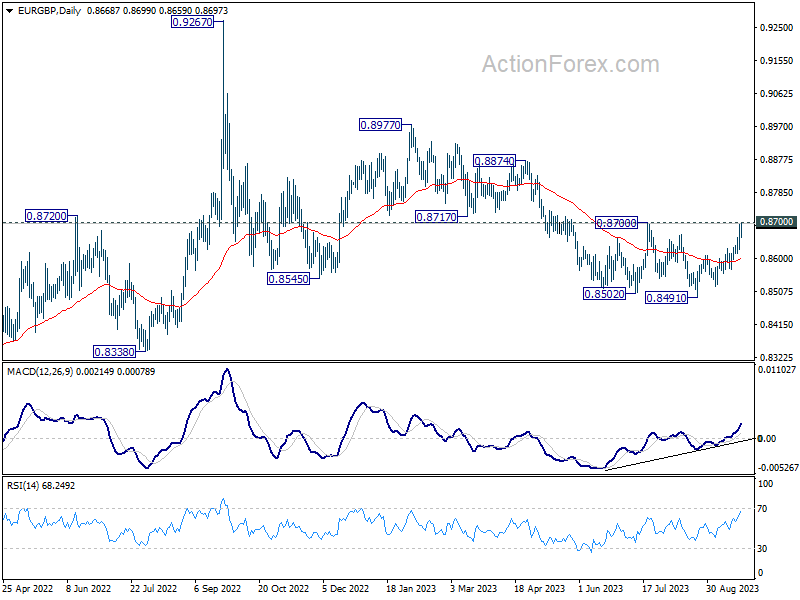
Similarly, for EUR/GBP, firm break of 0.8700 resistance should confirm medium term bottoming at 0.8491, on bullish convergence condition in D MACD. That would also argue that whole down trend from 0.9267 (2022 high) has completed with three waves down to 0.8491. Stronger rally would then be seen to 0.8874/8997 resistance zone.
China's move to relax capital controls bolsters commodity currencies
In a move that defied the prevailing risk aversion in US markets, commodity currencies took the lead as the week's strongest performers. The uplift seems largely tethered to shifting sentiments in the Chinese financial arena.
A marked turnaround was observed in Chinese stocks on Friday, following the nation's announcement of plans to liberalize capital controls in major cities, Beijing and Shanghai. This initiative would grant foreigners more flexibility to channel their funds into and out of the country.
China's move, as articulated by the government, aims to entice overseas investors by paving the way for a more open economy. This could mark a seminal shift, given China's traditionally stringent capital controls.
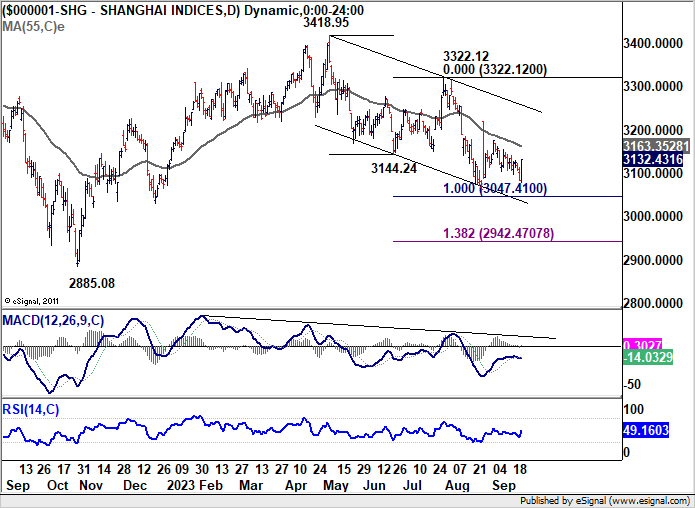
Technically speaking, there is no confirmation of trend reversal in China Shanghai SSE index for now, as sit's still capped well below falling 55 D EMA (now at 3161.35). The decline from 3418.95 could still extend to 100% projection of 3418.95 to 3144.24 from 3322.12 at 3047.41, or even further to 138.2% projection at 2942.47.
Nonetheless, a continued stream of encouraging economic data, coupled with strategic government interventions, could provide the necessary momentum for the index to challenge the aforementioned EMA at least.
USD/CAD Weekly Outlook
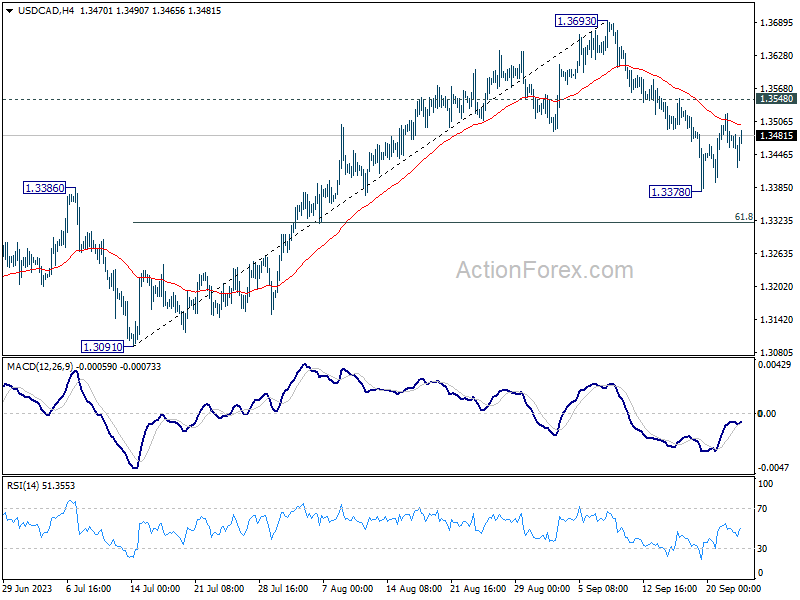
USD/CAD's deep decline last week argues that rise from 1.3091 might have completed at 1.3693 already. Fall from there is probably another leg in the corrective pattern from 1.3976 high. Initial bias stays neutral this week for consolidation above 1.3378 temporary low. But risk stays on the downside as long as 1.3548 resistance holds. Below 1.3378 will target 61.8% retracement of 1.3091 to 1.3693 at 1.3321.
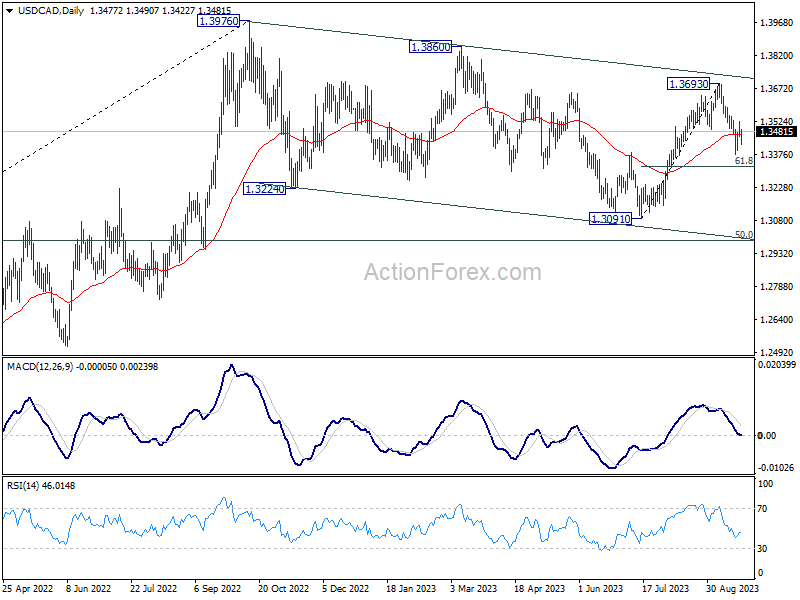
In the bigger picture, price actions from 1.3976 are viewed as a corrective pattern to the up trend from 1.2005 (2021 low). Deeper decline could be seen as the pattern is now extending. But downside should be contained by 50% retracement of 1.2005 to 1.3796 at 1.2991. Rise from 1.2005 is still expected to resume after the correction completes.
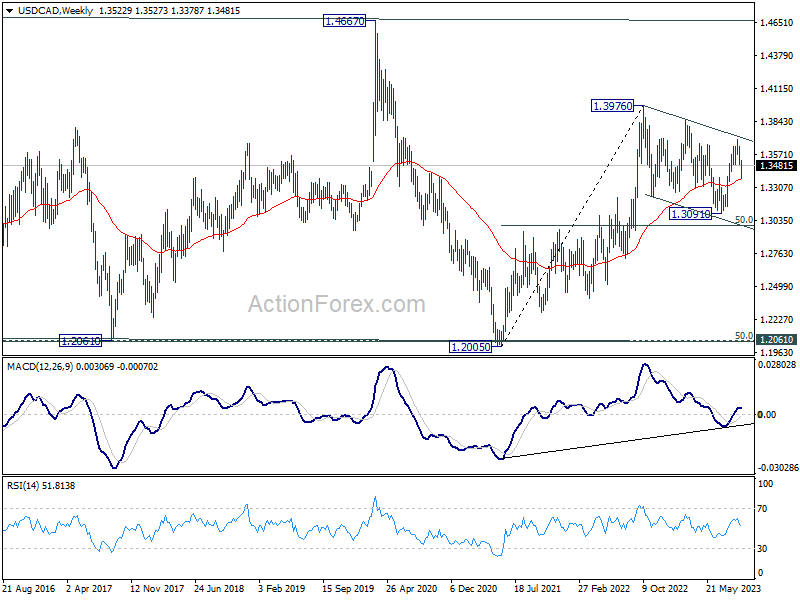
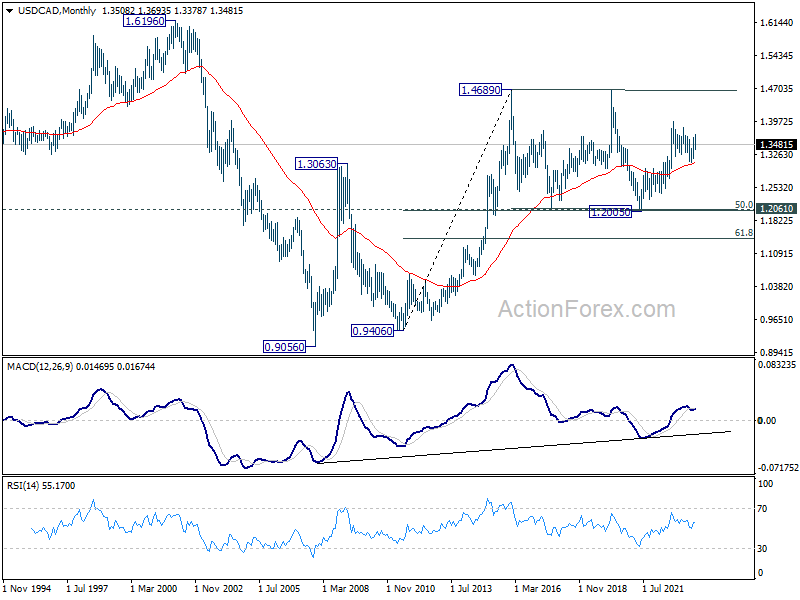
In the longer term picture, price actions from 1.4689 (2016 high) are seen as a consolidation pattern only, which might have completed at 1.2005. That is, up trend from 0.9506 (2007 low) is expected to resume at a later stage. This will remain the favored case as 55 M EMA (now at 1.3082) holds.
EUR/USD Weekly Outlook
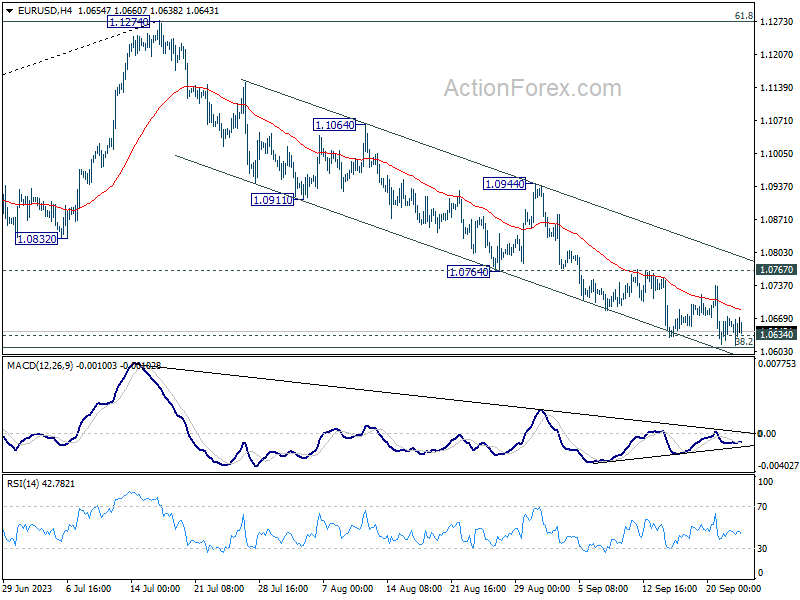
EUR/USD struggled to break through 1.0609/34 cluster support zone last week despite decline attempt. Yet, there is no clear sign of bottoming. Initial bias remains neutral this week first. On the downside, sustained break of 1.0609/34 will carry larger bearish implication. Fall from 1.1274 should then target target 1.0515 support next. Nevertheless, strong rebound from current level, followed by break of 1.0767 resistance, should confirm short term bottoming. Intraday bias will be back on the upside for 1.0944 resistance.
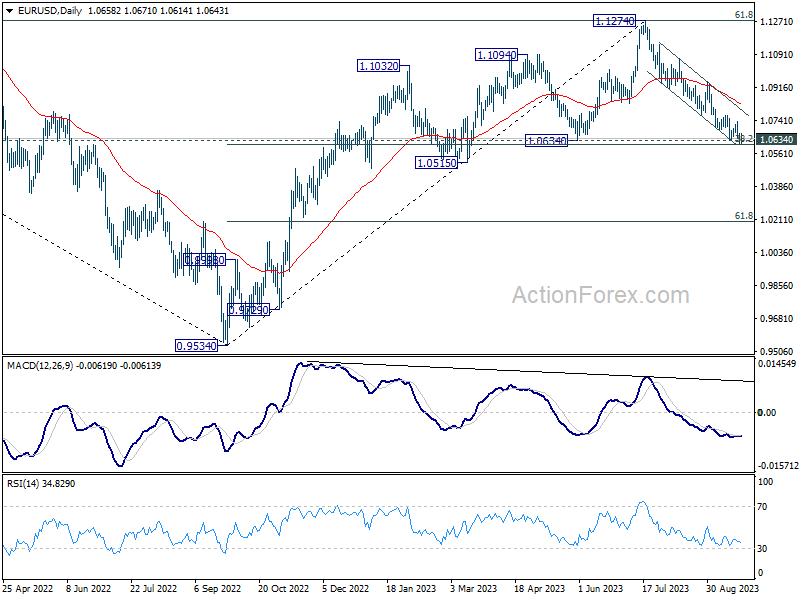
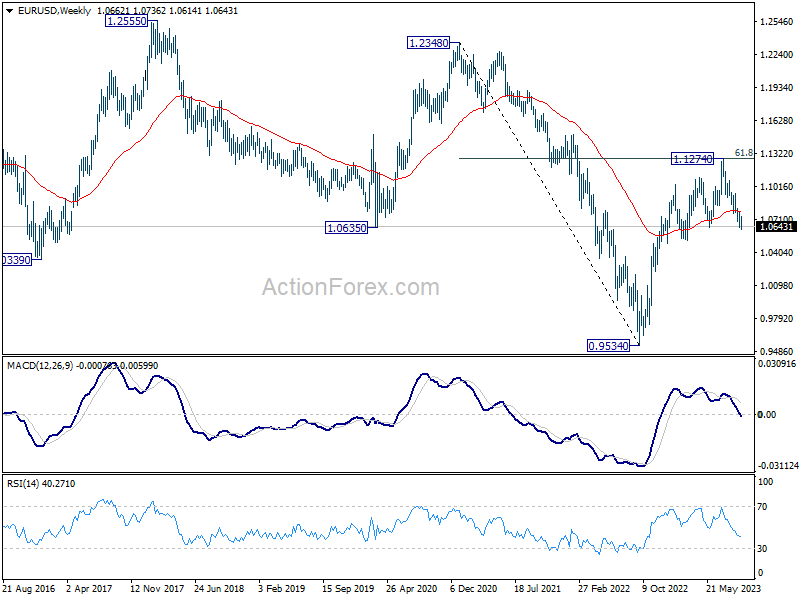
In the bigger picture, fall from 1.1274 medium term top is seen as a correction to up trend from 0.9534 (2022 low). Strong support could be seen from 1.0634 cluster support (38.2% retracement of 0.9534 to 1.1274 at 1.0609) to bring rebound, at least on first attempt. However, sustained break of 1.0609/0634 will raise the chance of bearish trend reversal, and target 61.8% retracement at 1.0199.
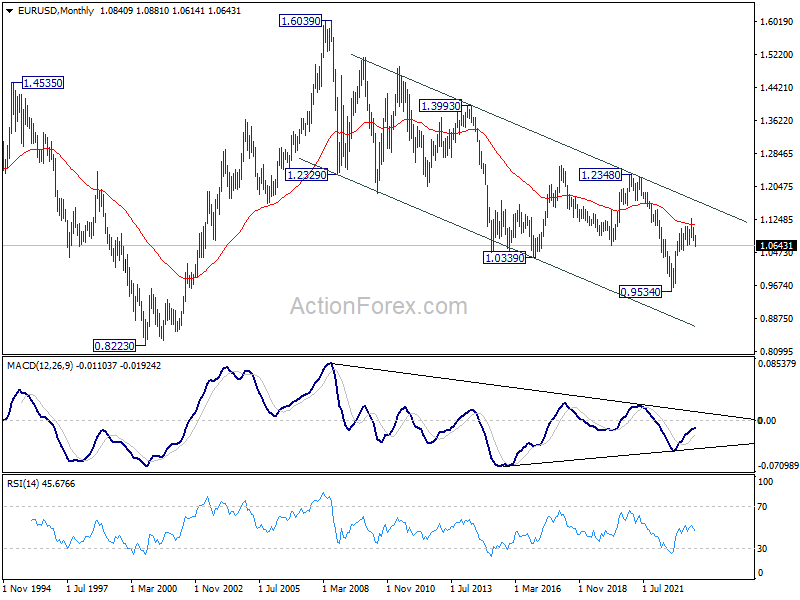
In the long term picture, there is no clear sign of trend reversal yet. That is, down trend from 1.6039 (2008 high) might still be in progress. Rejection by 55 M EMA (now at 1.1108) will retain long term bearishness, for another fall through 0.9534 at a later stage.
USD/JPY Weekly Outlook
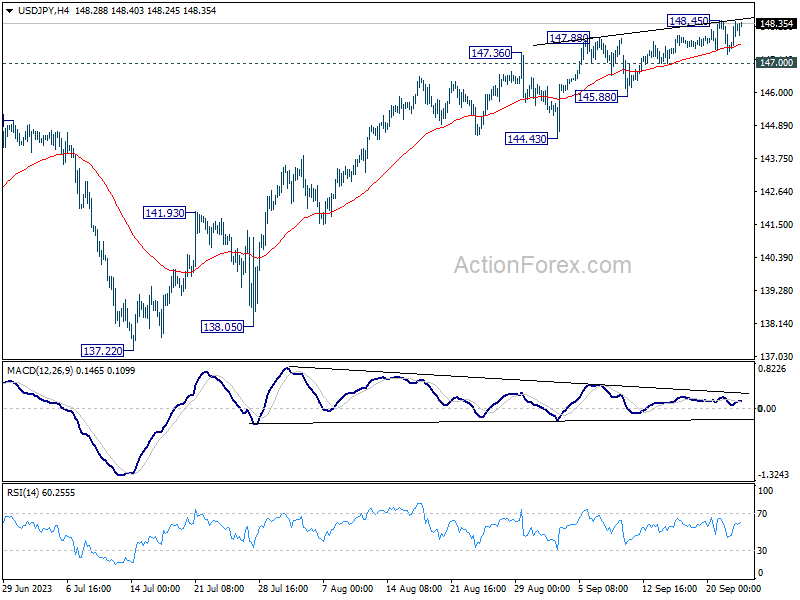
USD/JPY edged higher to 148.45 last week but retreated again. Initial bias remains neutral this week and further rise is mildly in favor with 147.00 support holds. Above 148.45 will resume larger rise from1 27.20 to retest 151.93 high. However, firm break of 147.00 will should confirm short term topping, and turn bias to the downside for 145.88 support and below.
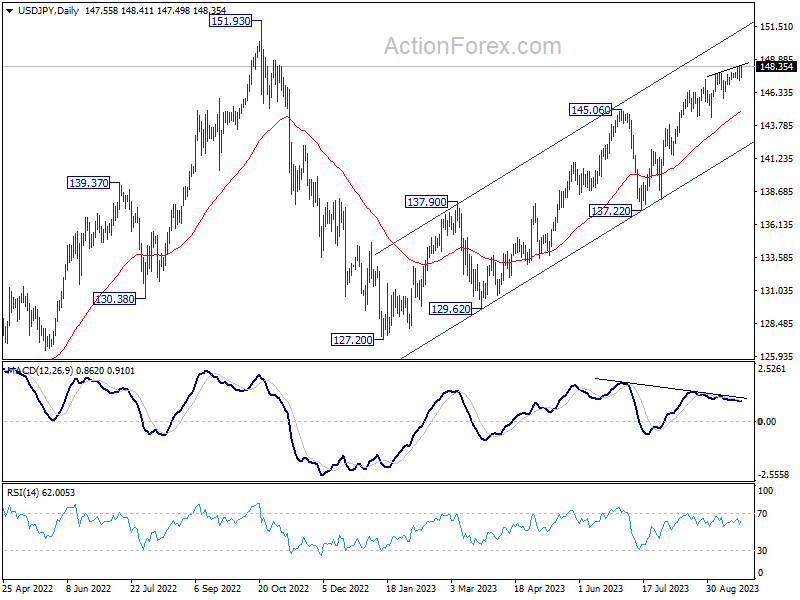
In the bigger picture, while rise from 127.20 is strong, it could still be seen as the second leg of the corrective pattern from 151.93 (2022 high). Rejection by 151.93, followed by break of 137.22 support will indicate that the third leg of the pattern has started. However, sustained break of 151.93 will confirm resumption of long term up trend.
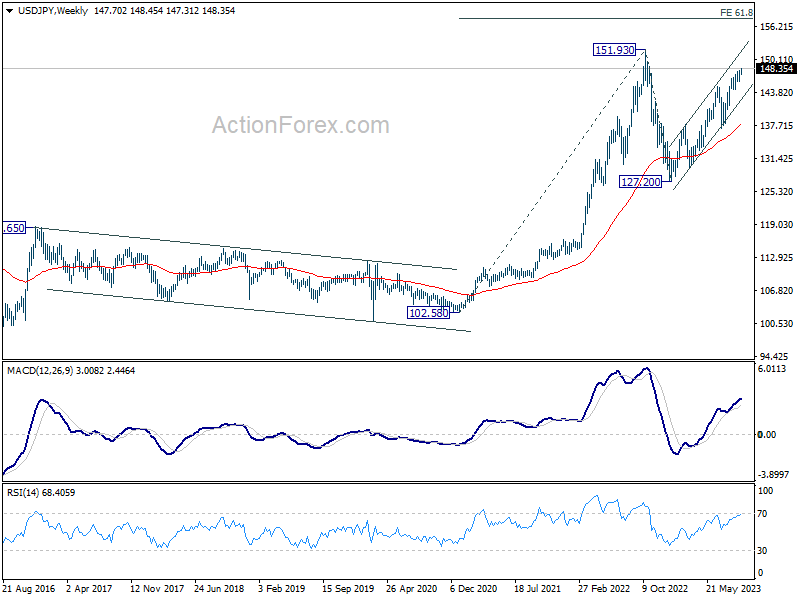
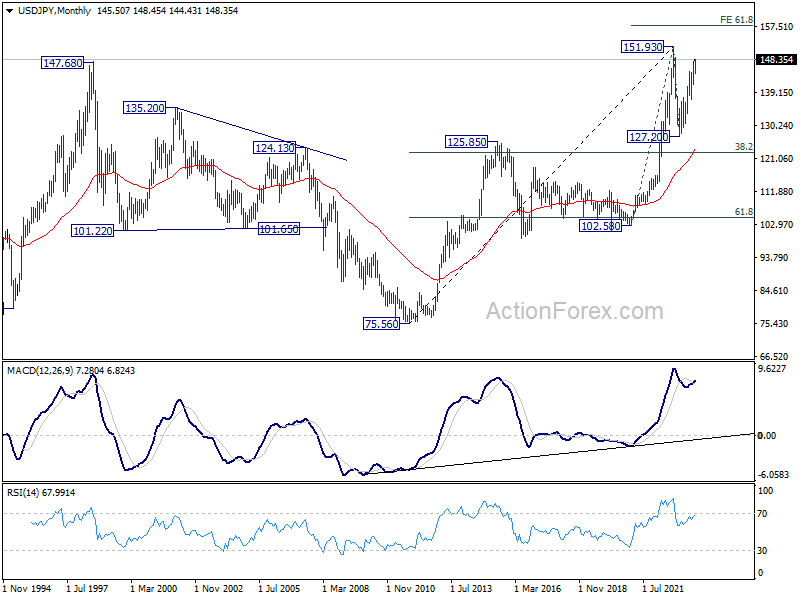
In the long term picture, price action from 151.93 is seen as developing into a corrective pattern to up trend from 75.56 (2011 low). Another falling leg could be seen, but in that case, downside should be contained by 38.2% retracement of 75.56 to 151.93 at 122.75. On resumption, next target would be 61.8% projection of 102.58 to 151.93 from 127.20 at 157.69.
GBP/USD Weekly Outlook
GBP/USD's decline from 1.3141 accelerated lower last week and there is no sign of bottoming yet. Initial bias stays on the downside for 1.2075 fibonacci level. On the upside, above 1.2369 minor resistance will turn intraday bias neutral and bring consolidations. But near term outlook will stay bearish as long as 1.2618 support turned resistance holds, in case of strong recovery.
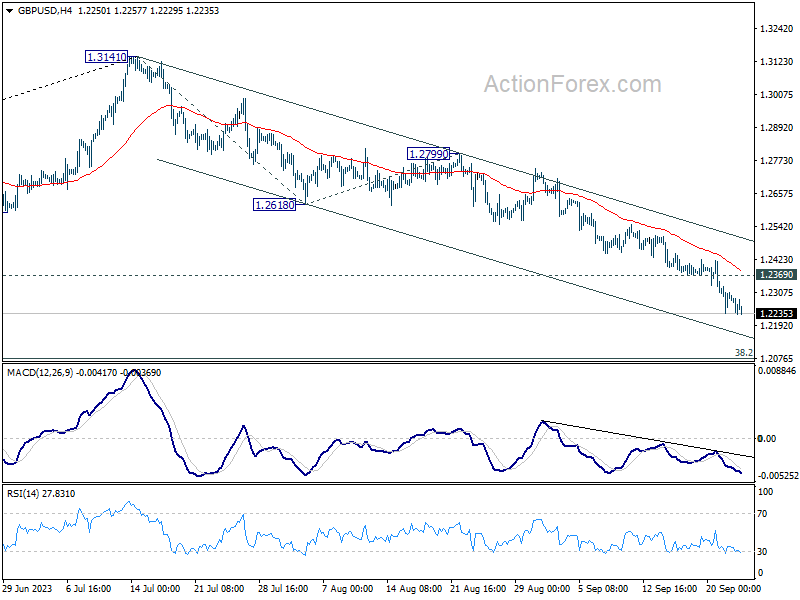
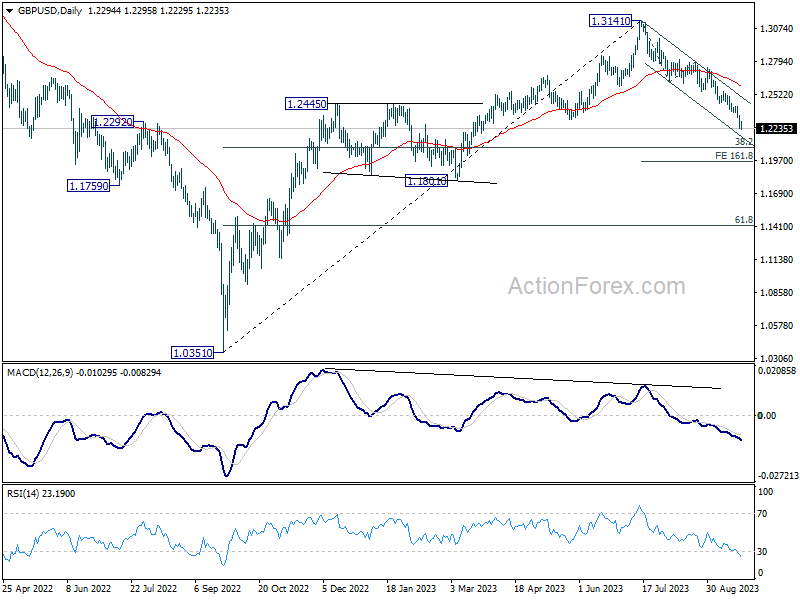
In the bigger picture, fall from 1.3141 medium term top is seen as a correction to up trend from 1.0351 (2022 low). Deeper decline would be seen to 38.2% retracement of 1.0351 to 1.3141 at 1.2075. Strong support would be seen there to bring rebound on first attempt. However, sustained break of 1.2075 will raise the chance of bearish trend reversal and target 1.1801 structural support next.
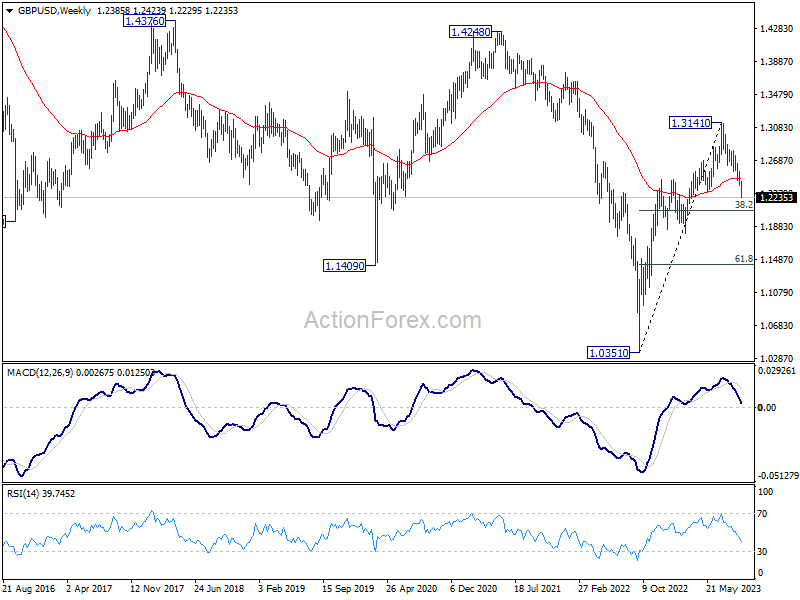
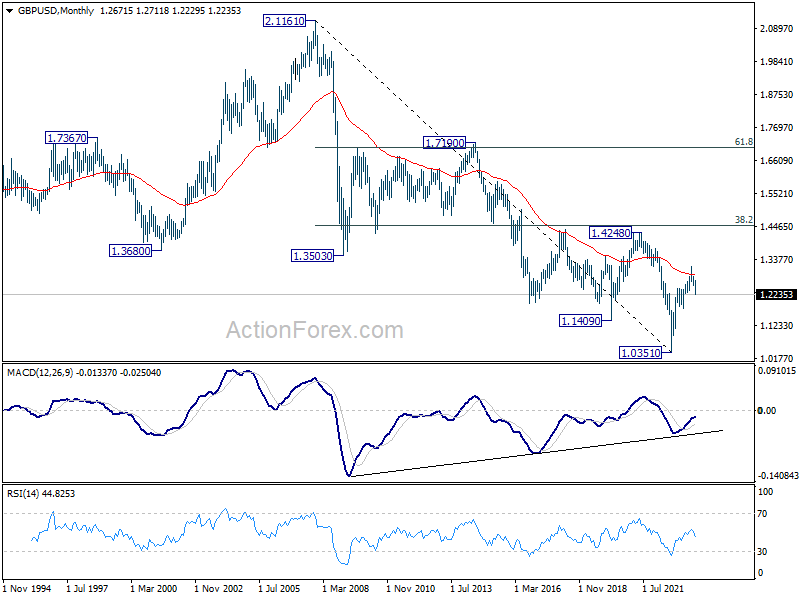
In the long term picture, there is no clear sign of trend reversal yet. Rise from 1.0351 could be part of a consolidation pattern to down trend from 2.1161 (2007 high). Rejection by 55 M EMA (now at 1.2900) will retain long term bearishness for extending the down trend at a later stage.
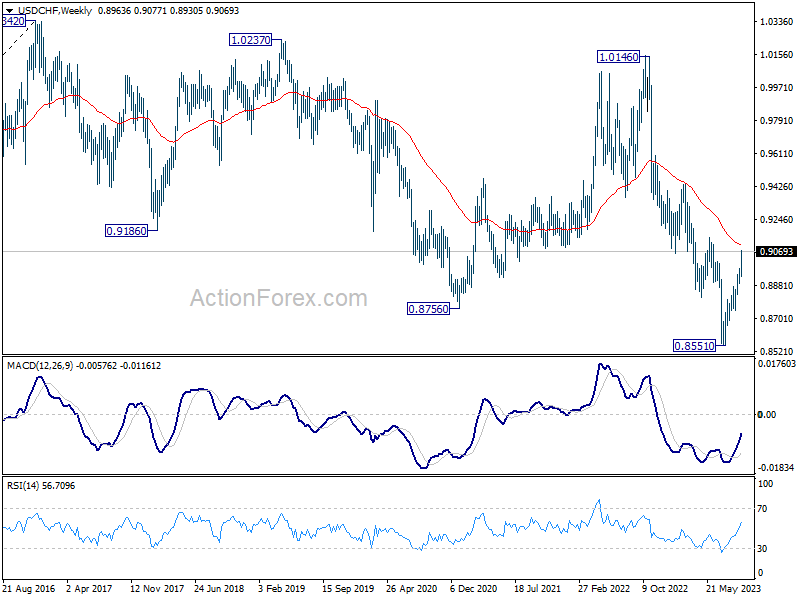
USD/CHF Weekly Outlook
USD/CHF's rally from 0.8851 accelerated higher last week and there is no sign of topping. Initial bias stays on the upside this week for 0.9146/60 cluster resistance. On the downside, break of 0.8982 minor support will turn intraday bias neutral first. But further rally will remain in favor as long as 0.8874 resistance turned support holds, in case of retreat.
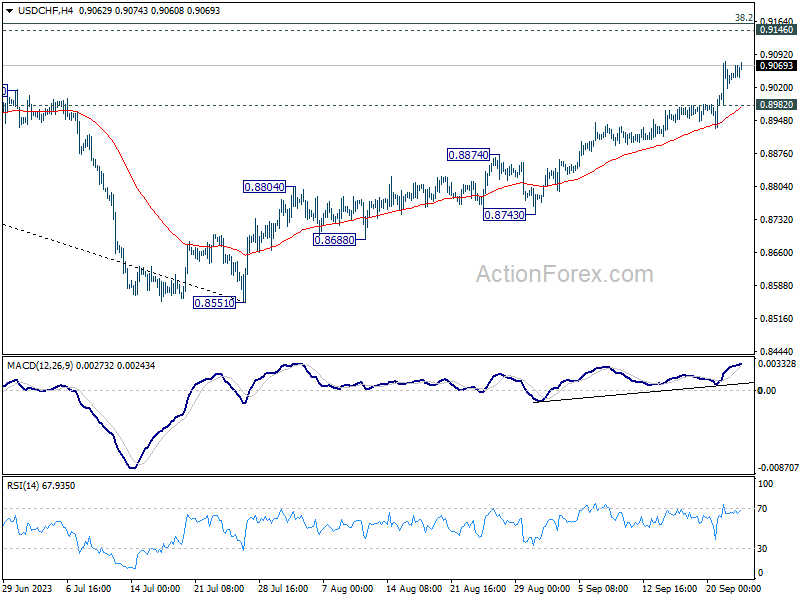
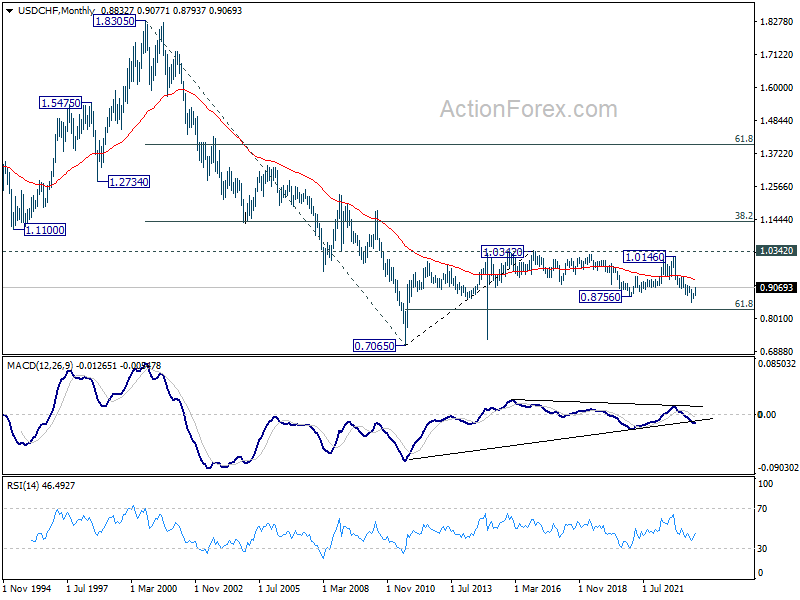
In the bigger picture, rebound from 0.8551 medium term bottom is currently seen as a correction to the downtrend from 1.0146 (2022 high). Further rally would be seen to 0.9146 cluster resistance (38.2% retracement of 1.0146 to 0.8551 at 0.9160). Strong resistance could be seen there to limit upside, at least on first attempt. However, decisive break of 0.9146/60 will indicate trend reversal, and target 61.8% retracement at 0.9537.
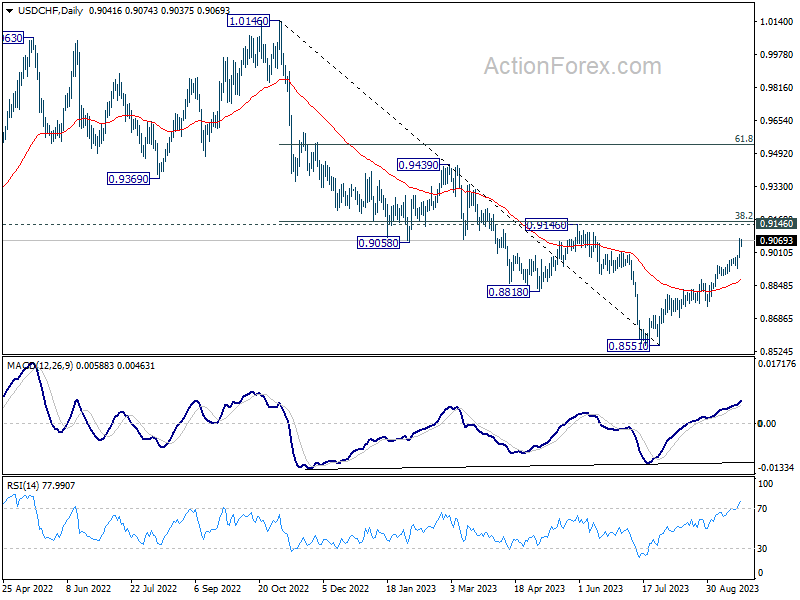
In the long term picture, there is no clear sign that down trend from 1.8305 (2000 high) has completed. With 38.2% retracement of 1.8305 to 0.7065 at 1.1359 intact, outlook is neutral at best.