

Sample Category Title
USD/CHF Mid-Day Outlook
Daily Pivots: (S1) 0.9044; (P) 0.9060; (R1) 0.9086; More....
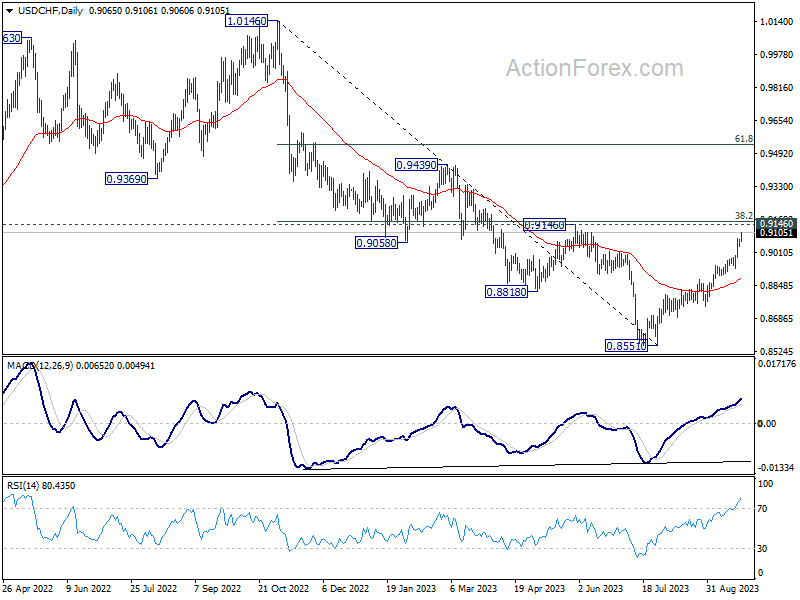
USD/CHF's rally continues today and intraday bias stays on the upside. Current rise from 0.8551 is in progress for 0.9146/60 cluster resistance. On the downside, break of 0.9019 minor support will turn intraday bias neutral first. But further rally will remain in favor as long as 0.8874 resistance turned support holds, in case of retreat.
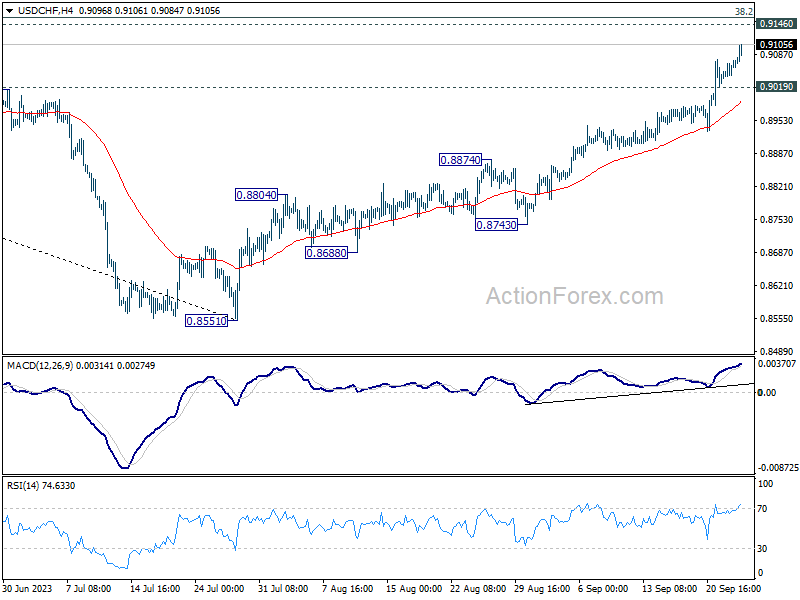
In the bigger picture, rebound from 0.8551 medium term bottom is currently seen as a correction to the downtrend from 1.0146 (2022 high). Further rally would be seen to 0.9146 cluster resistance (38.2% retracement of 1.0146 to 0.8551 at 0.9160). Strong resistance could be seen there to limit upside, at least on first attempt. However, decisive break of 0.9146/60 will indicate trend reversal, and target 61.8% retracement at 0.9537.
Swiss Franc Weakens Amid Rising European Yields; Dollar’s Momentum Uncertain
Swiss Franc weakens broadly today, influenced predominantly by rally in benchmark European yields. Specifically, Germany 10-year yield breached 2.8% mark, reaching an 11-year peak. Euro managed to bounce back against the Australian and New Zealand dollars, which were burdened by concerns surrounding China's property sector. However, Euro's ability to gain against other currencies seems limited at present. While the recent Germany Ifo business climate suggests potential stabilization in the Eurozone's leading economy, a genuine recovery might be some way off.
On another front, Dollar is seeking to extend its recent bullish run against Yen, helped by remarks from BoJ Governor Kazuo Ueda emphasizing a cautious approach. However, a pivotal challenge for the US currency will be breaking past 1.06 key resistance level when pitted against Euro. Also, Dollar remains stagnant against commodity-linked currencies, suggesting that further evidence is required to validate its buying momentum.
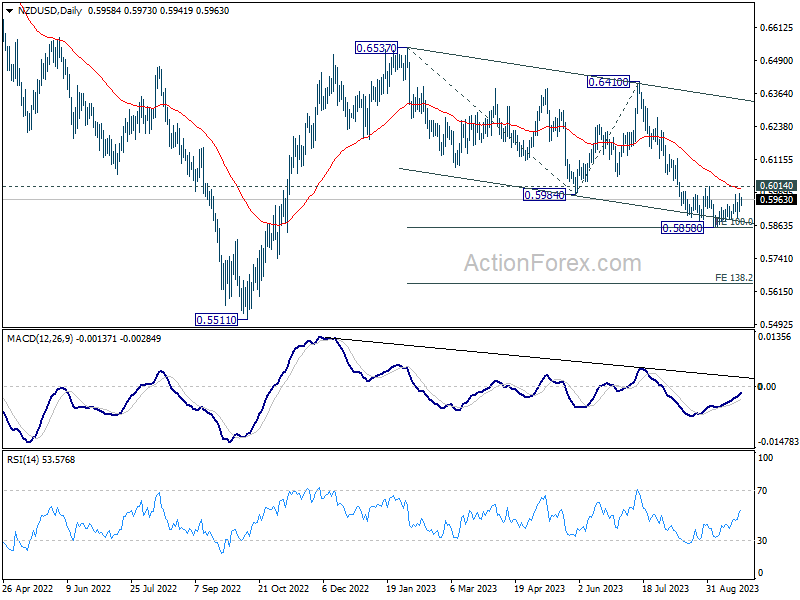
Technically, NZD/USD's choppy recovery from 0.5858 is still extending. Near term outlook remains bearish for now, with 0.6014 resistance, as well as 55 EMA (now at 0.6004) intact. Break of 0.5858 will extend the whole fall from 0.6537 to 138.2% projection of 0.6537 to 0.5984 from 0.6410 at 0.5646. However, sustained break of 0.6014 will raise the chance that the pattern from 0.6537 has completed with three waves down to 0.5858, and bring near term reversal.
In Europe, at the time of writing, FTSE is down -0.89%. DAX is down -0.93%. CAC is down -0.85%. Germany 10-year yield is up 0.0592 at 2.801. Earlier in Asia, Nikkei rose 0.85%. Hong Kong HSI dropped -1.82%. China Shanghai SSE dropped -0.54%. Singapore Strait Times rose 0.33%. Japan 10-year JGB yield fell -0.0182 to 0.731.
Germany Ifo ticked down, but economy appears to have bottomed out
Germany's Ifo Business Climate Index for September recorded a slight dip, moving from 85.8 to 85.7, though it outperformed expectation of 85.2. Current Assessment Index recorded a fall from 89.0 to 88.7, still surpassing forecasted 88.0. Contrastingly, Expectations Index noted an increment, shifting from 82.7 to 82.9, a touch above projected 82.8.
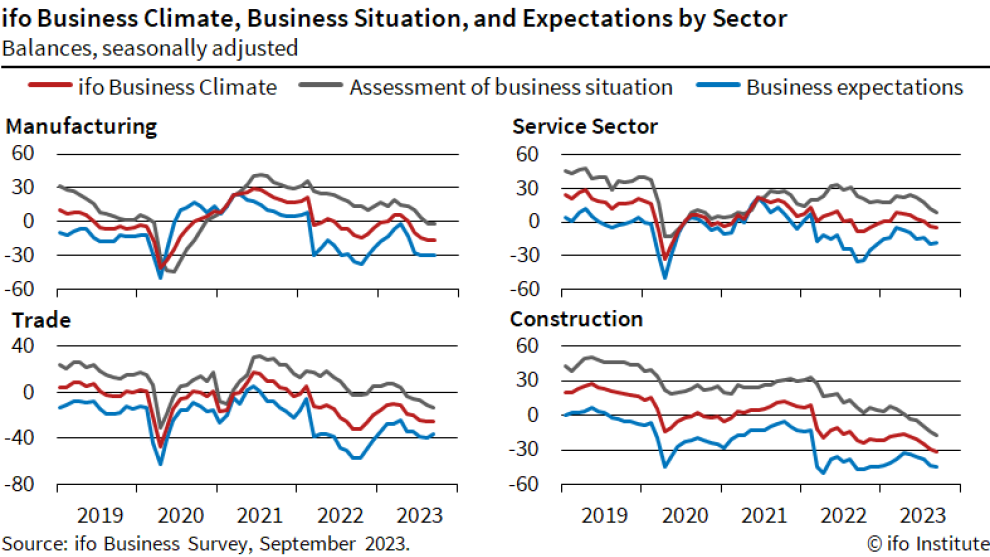
A sectoral breakdown revealed that manufacturing experienced a downturn from -13.8 to -16.6. Services sector witnessed a decline from a positive 1.0 to a negative score of -4.1. Additionally, trade and construction sectors marked declines, moving from -23.7 to -25.6 and from -24.6 to -29.8, respectively.
A statement from Ifo encapsulated the sentiment by saying, "pessimism regarding the coming months dissipated slightly. The German economy appears to have bottomed out."
ECB's de Cos and Villeroy emphasize patience and consistency
In today's conference in Madrid, Pablo Hernandez de Cos, a member of the ECB Governing Council, emphasized the need for patience in the bank's approach to interest rates.
De Cos pointed out, "If we keep rates at these levels long enough, there are very good chances that we will be able to reach our 2% target in a timely manner."
De Cos added that a balanced approach was crucial "to avoid both insufficient tightening, which would impede the achievement of our inflation target, and excessive tightening, which would unnecessarily damage economic activity and employment."
Echoing a similar sentiment, fellow Governing Council member Francois Villeroy de Galhau warned against an aggressive tightening stance. He said, "If the ECB tightens too much, the central bank could run the risk of having to rapidly reverse course."
Villeroy de Galhau further advised against a reckless calibration of monetary policy, asserting, "'testing until it breaks' is not a sensible way." Instead, he recommended a shift in focus from constantly elevating rates to maintaining a consistent policy. In his words, the emphasis should be on "duration rather than level."
BoJ Ueda highlights shifting dynamics in Japan's inflation drivers
BoJ Governor Kazuo Ueda, in a speech today, delineated the two forces in play regarding Japan's inflationary pressures: "The first force, led by import prices, has seen its year-on-year rate of increase decelerate," and he anticipates this force will "gradually wane."
As for the second force, Ueda suggested it is tied to changes in firms' wage and price-setting behaviors, with the potential to strengthen as "wage growth accelerates owing to economic improvement, leading to moderate inflation."
However, he cautioned that the spread and permanence of these behaviors are uncertain, adding, "Changes have started to be seen in some aspects of firms' wage- and price-setting behavior, but there are extremely high uncertainties as to whether these changes will become widespread."
Addressing Japan's broader economic outlook, Ueda described the nation as being in a "critical phase" concerning the interplay between wages and prices. Stressing the importance of fostering nascent economic shifts, he emphasized the need "to carefully nurture the buds of change in the economy."
Ueda reiterated BoJ's stance on monetary policy, stating the need "to patiently continue with monetary easing under the framework of yield curve control."
USD/CHF Mid-Day Outlook
Daily Pivots: (S1) 0.9044; (P) 0.9060; (R1) 0.9086; More....
USD/CHF's rally continues today and intraday bias stays on the upside. Current rise from 0.8551 is in progress for 0.9146/60 cluster resistance. On the downside, break of 0.9019 minor support will turn intraday bias neutral first. But further rally will remain in favor as long as 0.8874 resistance turned support holds, in case of retreat.
In the bigger picture, rebound from 0.8551 medium term bottom is currently seen as a correction to the downtrend from 1.0146 (2022 high). Further rally would be seen to 0.9146 cluster resistance (38.2% retracement of 1.0146 to 0.8551 at 0.9160). Strong resistance could be seen there to limit upside, at least on first attempt. However, decisive break of 0.9146/60 will indicate trend reversal, and target 61.8% retracement at 0.9537.
Economic Indicators Update
| GMT | Ccy | Events | Actual | Forecast | Previous | Revised |
|---|---|---|---|---|---|---|
| 08:00 | EUR | Germany IFO Business Climate Sep | 85.7 | 85.2 | 85.7 | 85.8 |
| 08:00 | EUR | Germany IFO Current Assessment Sep | 88.7 | 88 | 89 | |
| 08:00 | EUR | Germany IFO Expectations Sep | 82.9 | 82.8 | 82.6 | 82.7 |
Crypto Market Seeks Local Support
Market picture
Crypto market capitalisation fell to $1.04 trillion from $1.06 at the start of last week. The Crypto’s Fear and Greed Index briefly dipped into Fear territory at the end of the week but returned to Neutral (47) on Monday.
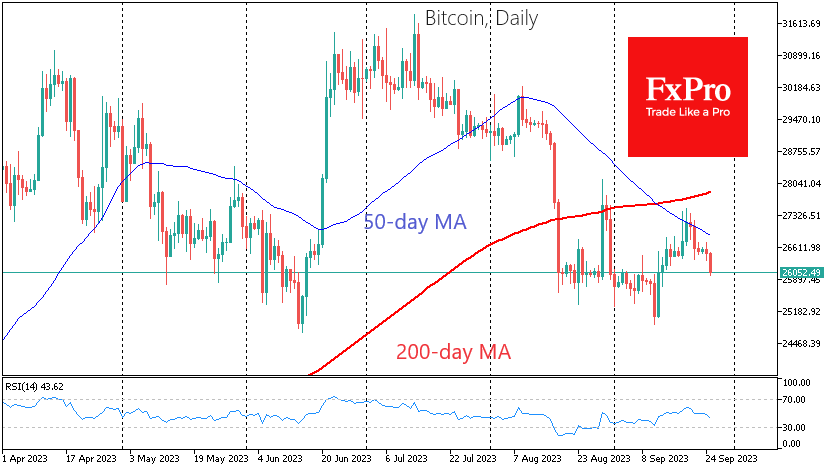
Bitcoin has been unable to break out of its sideways for a prolonged period. Trading at $26.1K at the start of Monday’s session, it’s down just 1.5% over the past 24 hours, 2% over the past seven days, and 0.5% from its level 30 days ago. The 50-day moving average remains active resistance. If the bearish momentum develops, we will closely monitor the dynamics around $25.8K, the previous consolidation area. A failure here could trigger a rapid decline to $25.8K. If the coin doesn’t get bought back here as well a direct path to $20K will open.
Ethereum is still unsuccessfully trying to find support and is trading below $1580. And this downtrend is revealing the general sentiment of market participants, where the risk appetite is diminishing. The move towards $1400 may have already begun.
News background
Anthony Scaramucci, founder of SkyBridge Capital, remains bullish on bitcoin. He believes that BTC has a much better future than gold, whose purchasing power has increased significantly over the past 50 years.
Bloomberg strategist Mike McGlone (Mike McGlone) warned that Bitcoin could fall because of the Federal Reserve’s actions. The Fed continues to pressure the crypto market by tightening monetary policy. The next support level for BTC is $25K.
According to JPMorgan, the April Shanghai update of the Ethereum network failed to meet expectations in terms of results and network activity. In addition, the crypto community had legitimate concerns about the level of network decentralisation.
Bitmain unveiled a powerful new Bitcoin mining machine. The Antminer S21 is highly energy efficient and supports a hash rate of 335 TH/s.
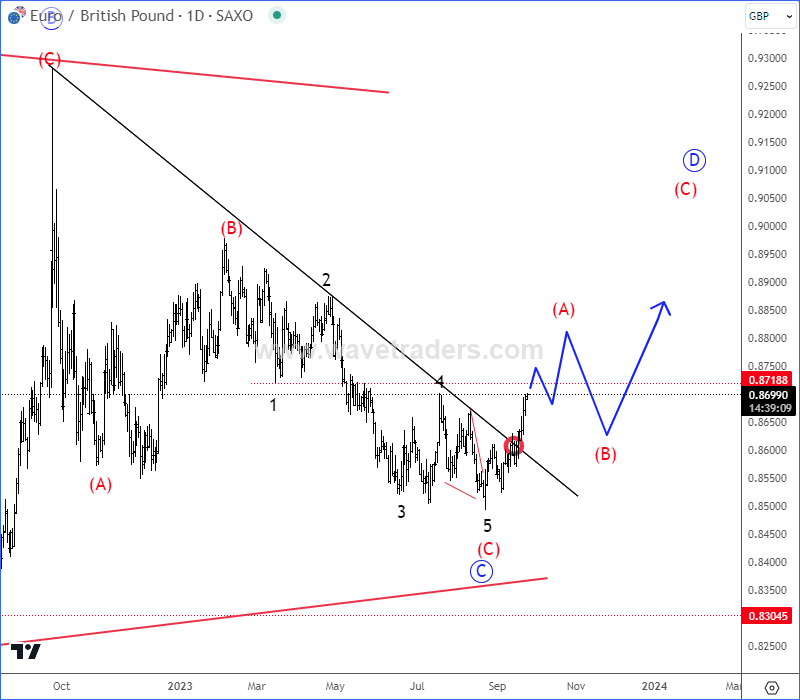
EUR/GBP in New Higher Degree Recovery
EURGBP is slow and sideways and trapped in big range when looking at monthly or weekly charts so ideally, pair is trapped in a very big complex consolidation, possibly even with a triangle now in Y. In triangle, each leg is made by three waves (A)-(B)-(C) and with current strong recovery back above important trendline, seems like a three-wave (A)-(B)-(C) decline within higher degree wave C is completed and new three-wave (A)-(B)-(C) rally within wave D underway. So, watch out for more upside now back towards 0.90 area, just be aware of short-term pullbacks.
Dollar Index Hits New Multi-Month High Against the Basket of Major World Currencies
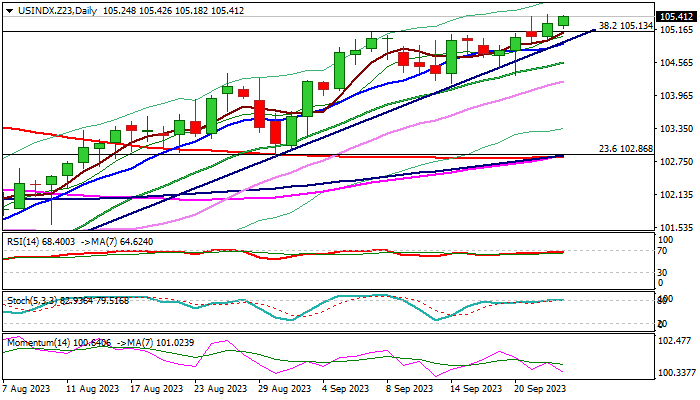
The dollar index keeps firm tone and penetrating thickening weekly cloud in early Monday (cloud base lays at 105.25) after registering a weekly close above pivotal Fibo barrier at 105.13 (38.2% retracement of 114.72/99.20 downtrend) which generated strong bullish signal.
Last week’s advance marked the tenth consecutive week of gains, with the index being on track for the second monthly bullish close, adding to developing reversal signals on larger timeframes and signaling further gains in coming days.
However, bulls may face increased headwinds from the cloud, as well as fading positive momentum and overbought conditions on daily chart.
Limited dips should be ideally contained by 10/DMA /trendline support (104.90) and not to exceed rising 20DMA (104.57) to offer better buying opportunities for fresh push higher.
Sustained break through weekly cloud to spark further advance and expose targets at 106.96 (50% retracement) and 107.88 (Nov 21 high).
Only loss of 104.17/14 (Sep 14 higher low/daily Kijun-sen) would sideline bulls and risk deeper correction.
Res: 105.85; 106.22; 106.96; 107.88.
Sup: 105.13; 104.90; 104.57; 104.17.
USD/JPY: Bulls Hold Grip and Eye 150 Target
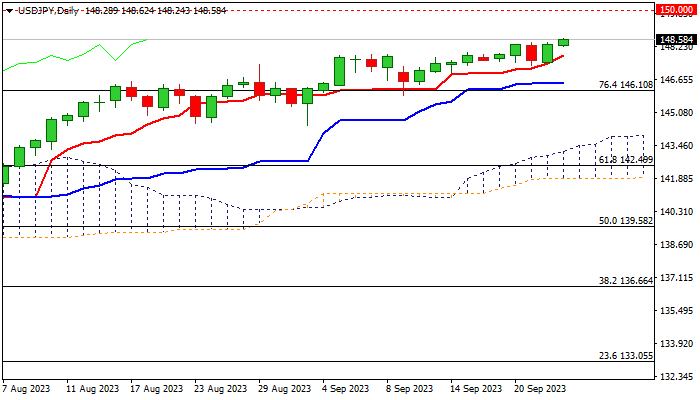
USDJPY extends advance and hit the highest since early November in early Monday, as the greenback enjoys strong support from diverging Fed and BOJ monetary policies and less talks about Japan’s intervention
In the last week’s meeting, the Fed signaled that it may raise interest rates once more this year and likely to keep high borrowing cost for some time, while the Bank of Japan also stayed on hold this time, but also kept dovish stance, which further deflated yen.
Technical picture remains firmly bullish on daily chart, as last Thursday’s shallow pullback was contained by rising daily Tenkan-sen and subsequent bounce on Friday completed bullish engulfing pattern.
The fifth consecutive weekly close above broken Fibo level at 146.10 (76.4% of 151.94/127.22 downtrend) added to growing bullish signals.
Immediate target at 148.84 (Oct 31 high) is under pressure and break here to open way for test of psychological 150.00 barrier, which guards key resistance at 151.94 (2022 high).
Bulls are expected to remain firmly in play while the price holds above ascending daily Tenkan-sen (147.82).
Res: 148.84; 149.70; 150.00; 151.94.
Sup: 148.24; 147.82; 147.32; 146.53.
ECB’s de Cos and Villeroy emphasize patience and consistency
In today's conference in Madrid, Pablo Hernandez de Cos, a member of the ECB Governing Council, emphasized the need for patience in the bank's approach to interest rates.
De Cos pointed out, "If we keep rates at these levels long enough, there are very good chances that we will be able to reach our 2% target in a timely manner."
De Cos added that a balanced approach was crucial "to avoid both insufficient tightening, which would impede the achievement of our inflation target, and excessive tightening, which would unnecessarily damage economic activity and employment."
Echoing a similar sentiment, fellow Governing Council member Francois Villeroy de Galhau warned against an aggressive tightening stance. He said, "If the ECB tightens too much, the central bank could run the risk of having to rapidly reverse course."
Villeroy de Galhau further advised against a reckless calibration of monetary policy, asserting, "'testing until it breaks' is not a sensible way." Instead, he recommended a shift in focus from constantly elevating rates to maintaining a consistent policy. In his words, the emphasis should be on "duration rather than level."
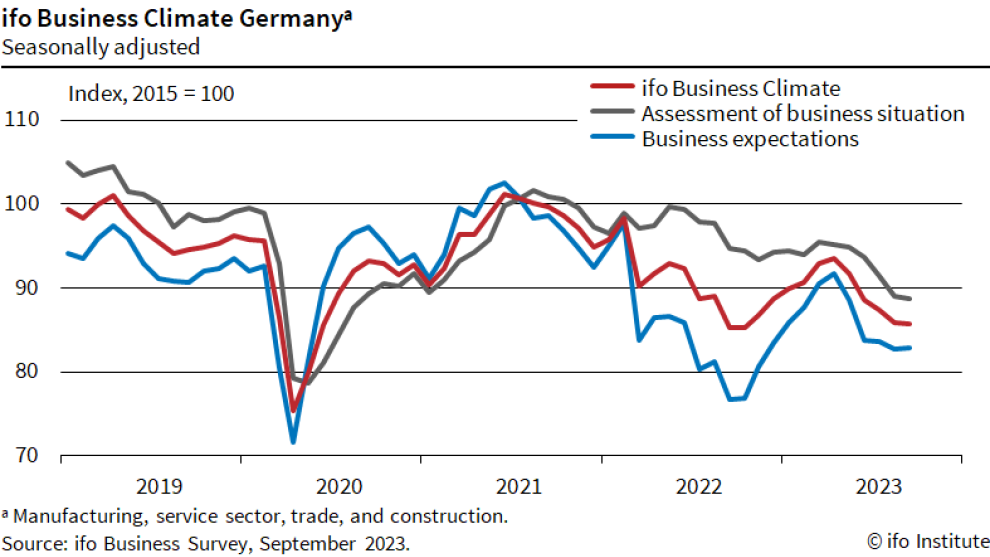
Germany Ifo ticked down, but economy appears to have bottomed out
Germany's Ifo Business Climate Index for September recorded a slight dip, moving from 85.8 to 85.7, though it outperformed expectation of 85.2. Current Assessment Index recorded a fall from 89.0 to 88.7, still surpassing forecasted 88.0. Contrastingly, Expectations Index noted an increment, shifting from 82.7 to 82.9, a touch above projected 82.8.
A sectoral breakdown revealed that manufacturing experienced a downturn from -13.8 to -16.6. Services sector witnessed a decline from a positive 1.0 to a negative score of -4.1. Additionally, trade and construction sectors marked declines, moving from -23.7 to -25.6 and from -24.6 to -29.8, respectively.
A statement from Ifo encapsulated the sentiment by saying, "pessimism regarding the coming months dissipated slightly. The German economy appears to have bottomed out."
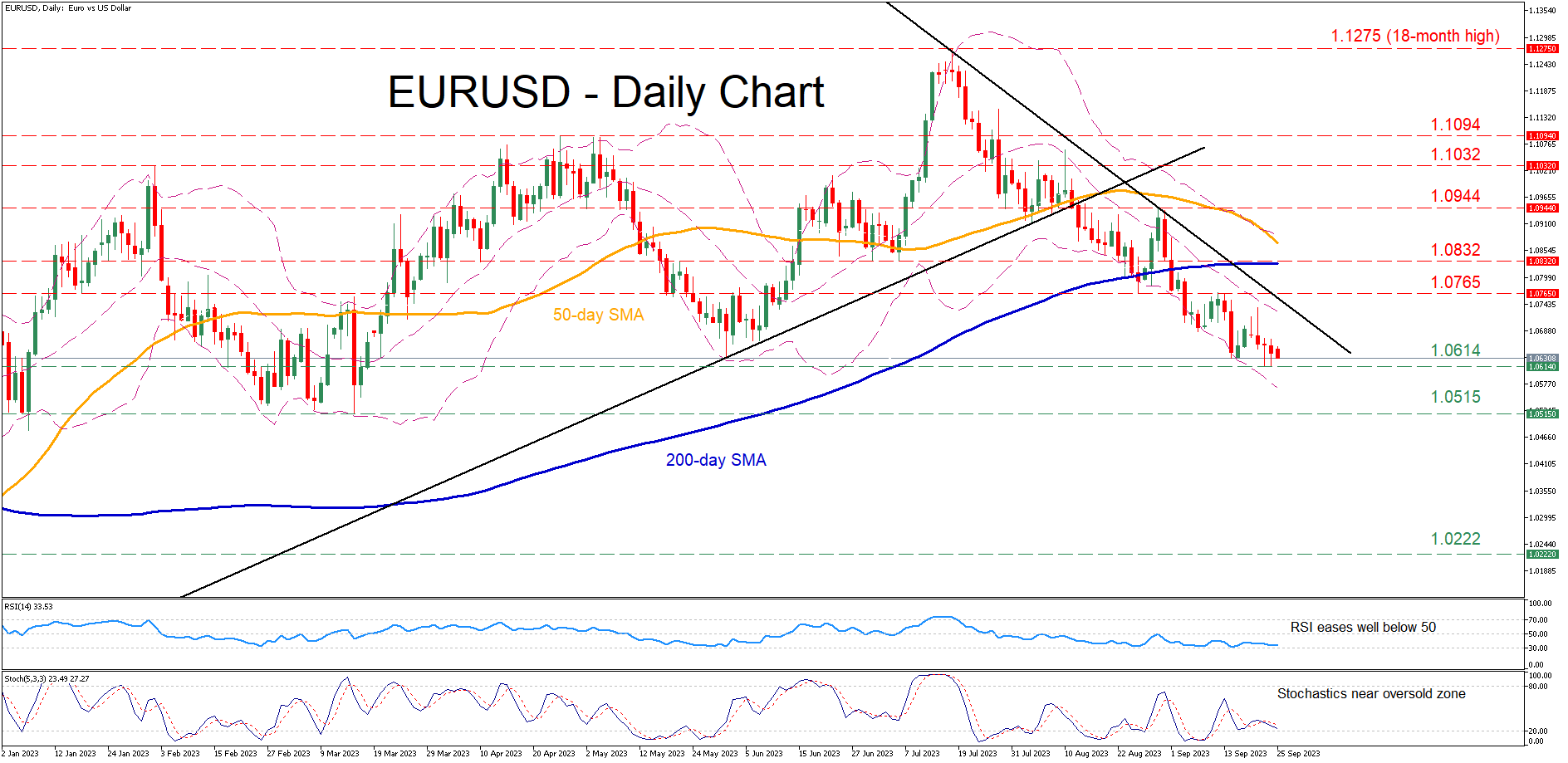
EURUSD Extends Decline to a Fresh 5-month Low
- EURUSD in a clear downtrend, posting a fresh 5-month bottom of 1.0614
- The descending 50-day SMA is approaching 200-day SMA, setting the stage for a death cross
- Momentum indicators are heavily skewed to the bearish side
EURUSD has been in a steady decline after peaking at the 18-month high of 1.1275 on July 18, generating a series of lower highs and lower lows. Meanwhile, the pair dived to a fresh five-month low of 1.0614 before recovering some ground, while the short-term oscillators are pointing to more losses.
Should the bears attempt to push the price lower, the five-month low of 1.0614 could prove to be the first barrier for the pair to clear. A violation of that floor could pave the way for the March bottom of 1.0515. Piercing through that region, the pair might then slide towards the November 2022 support zone of 1.0222.
On the flipside, if the pair reverses back higher, initial advances could be rejected at the recent resistance region of 1.0765. Even higher, the June-July support of 1.0832 may serve as strong resistance in the future before the 1.0944 gets tested. Failing to halt there, the pair could then ascend towards the February peak of 1.1032.
In brief, EURUSD seems to be stuck in a steep downtrend as the bulls continue to stay on the sidelines. However, things could get even worse in the case that a death cross between the 50- and 200-day simple moving averages (SMA) is completed.
GBP/JPY Technical: At the Risk of Multi-Week Bearish Mean Reversion
- The current major uptrend phase of GBP/JPY has almost reached a key inflection/resistance level of 187.30.
- The weekly RSI momentum indicator has flashed out bearish conditions that advocate a potential multi-week bearish mean reversion/counter-trend movement.
- 50 is the key short-term resistance to watch with intermediate supports coming in at 180.60 and 179.20.
Bulls may have hit a major roadblock
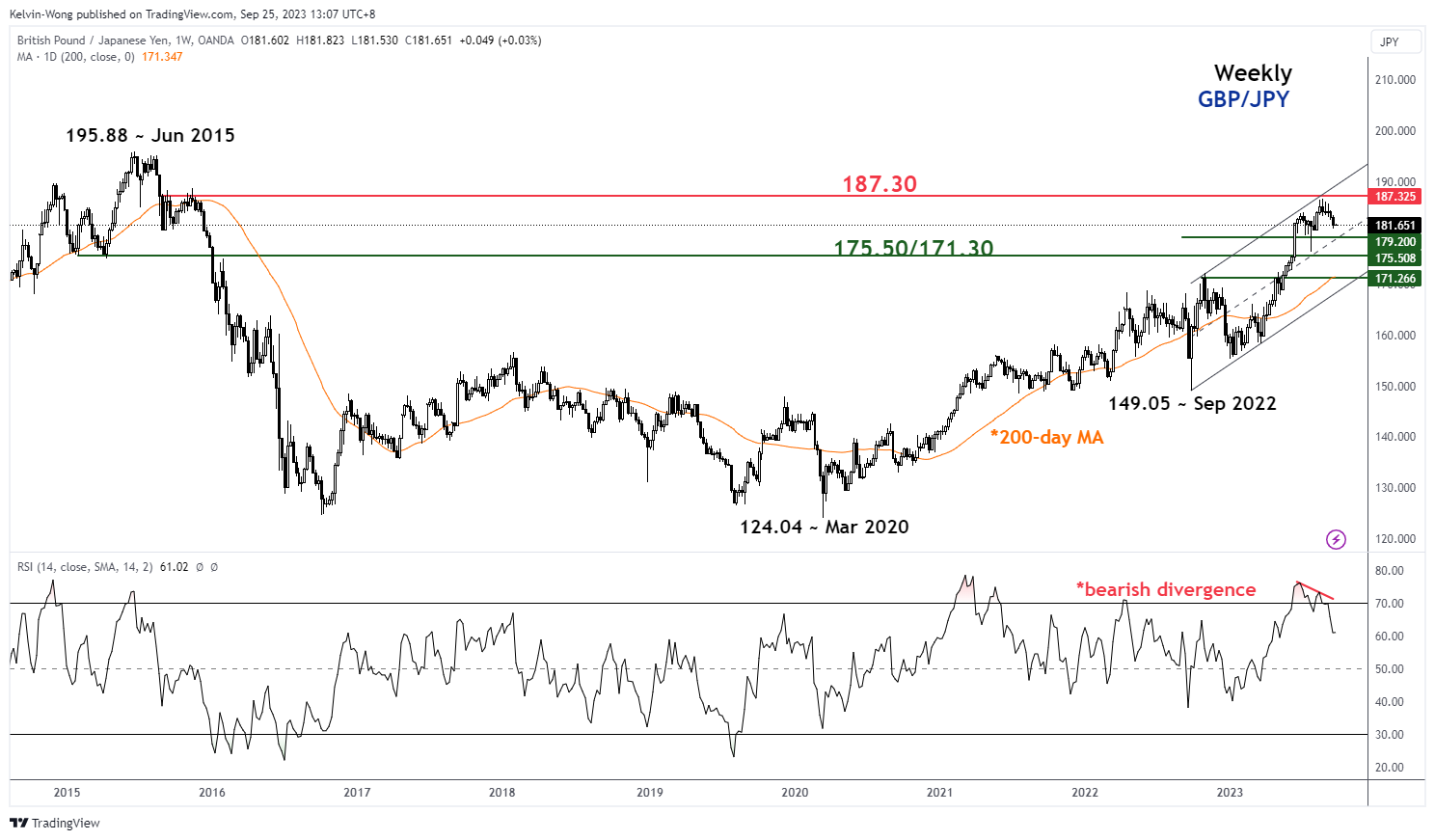
Fig 1: GBP/JPY major trend as of 25 Sep 2023 (Source: TradingView, click to enlarge chart)
The multi-month major uptrend phase of GBP/JPY in place since its September 2022 low of 149.05 has almost reached a key inflection/resistance level of 187.30 (printed an intraday high of 186.77 on 22 August 2023) which is defined by the September/November 2015 swing highs, upper boundary of the major ascending channel from September 2022 low, and a cluster of Fibonacci extension levels projected from various swing lows within the major uptrend.
In addition, the weekly RSI momentum indicator has flashed a bearish divergence condition at its overbought region, suggesting that the upside momentum of the major uptrend phase has eased off. These observations in turn increase the odds of a multi-week bearish mean reversion/counter-trend movement at this juncture.
Oscillating within a steeper minor descending channel
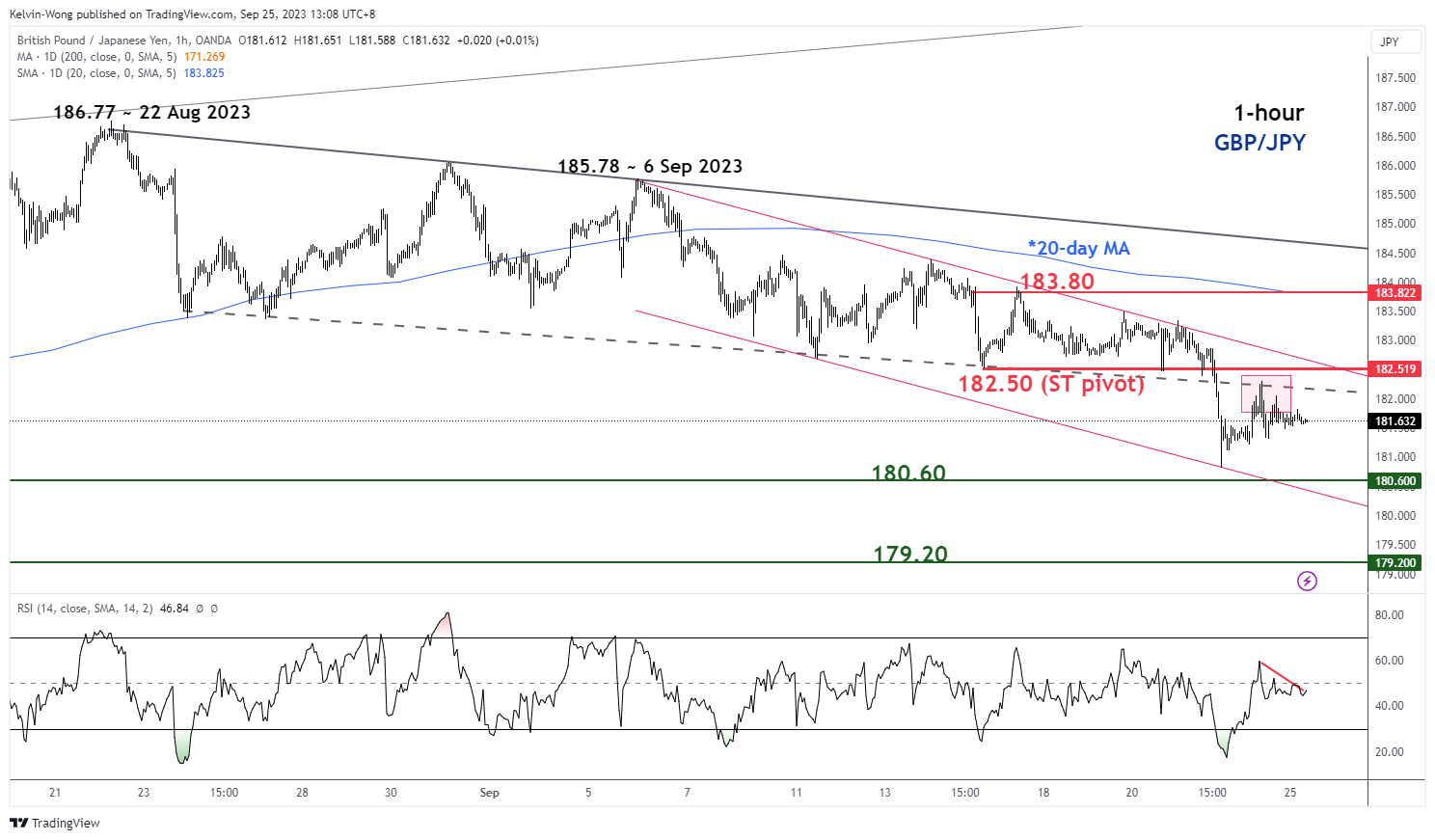
Fig 2: GBP/JPY minor short-term trend as of 25 Sep 2023 (Source: TradingView, click to enlarge chart)
In the shorter term as seen in the 1-hour chart, the price actions of GBP/JPY have started to oscillate within a steeper descending channel in place since the 6 September 2023 high of 185.78. Also, it has accelerated on the downside ex-post Bank of England’s monetary policy decision to keep its policy interest rate unchanged at 5.25% on last Thursday, 21 September.
Interestingly, the minor snap-back in price actions seen last Friday, 22 September after the prior day’s 205 pips intraday plunge has managed to stall at the pull-back resistance of the former broken-down ascending channel support from the 23 August 2023 low and the 61.8% Fibonacci retracement of last Thursday, 21 September intraday plunge from 182.86 high to 180.81 low.
In addition, the hourly RSI has shaped a “lower low” and started to inch lower right below the 50 level, suggesting short-term bearish momentum has resurfaced.
Watch the 182.50 key short-term pivotal resistance to maintain the bearish bias for another potential down leg to test the intermediate supports of 180.60 and 179.20.
However, a clearance above 182.50 negates the bearish tone to see the next resistance coming in at 183.80 (also the downward-sloping 20-day moving average).