

Sample Category Title
GBP/USD Daily Outlook
Daily Pivots: (S1) 1.2184; (P) 1.2221; (R1) 1.2247; More...
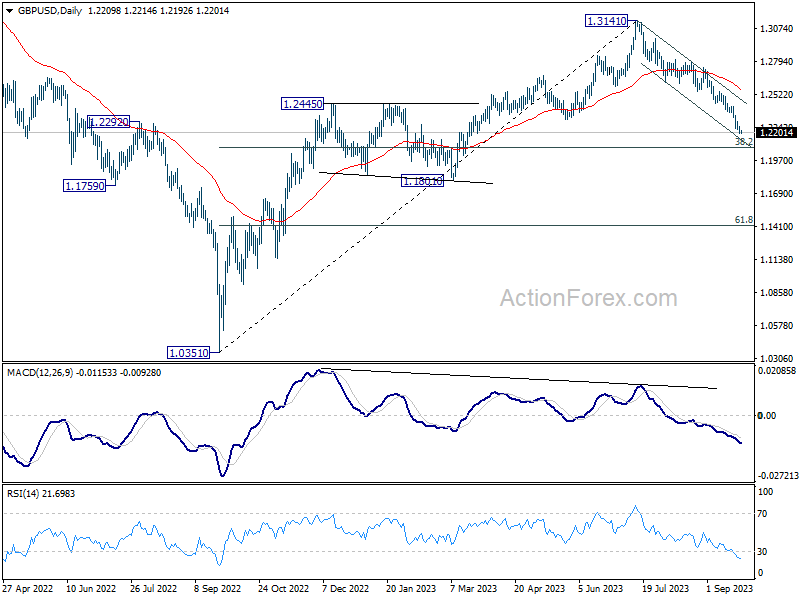
Intraday bias in GBP/USD remains on the downside at this point. Fall from 1.3141 is in progress and should target 1.2075 fibonacci level. On the upside, above 1.2306 minor resistance will turn intraday bias neutral and bring consolidations. But near term outlook will stay bearish as long as 1.2618 support turned resistance holds, in case of strong recovery.
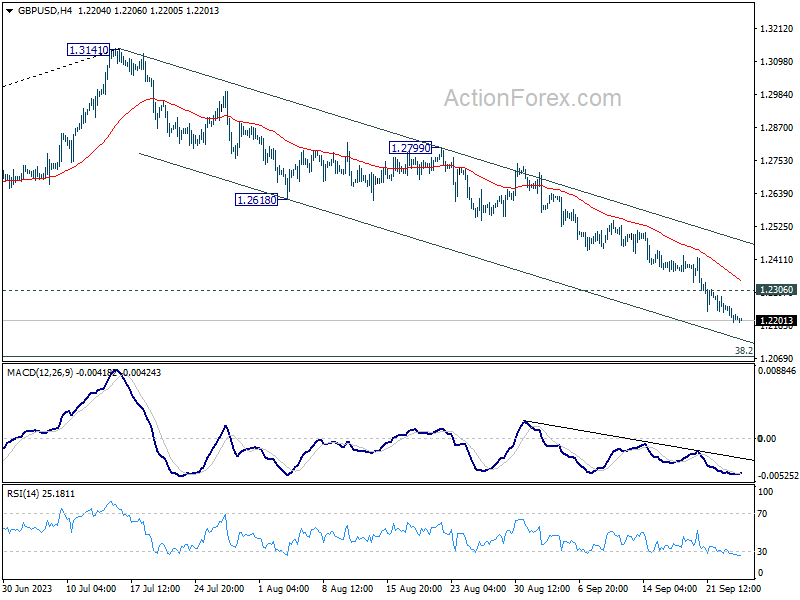
In the bigger picture, fall from 1.3141 medium term top is seen as a correction to up trend from 1.0351 (2022 low). Deeper decline would be seen to 38.2% retracement of 1.0351 to 1.3141 at 1.2075. Strong support would be seen there to bring rebound on first attempt. However, sustained break of 1.2075 will raise the chance of bearish trend reversal and target 1.1801 structural support next.
EUR/USD Daily Outlook
Daily Pivots: (S1) 1.0616; (P) 1.0644; (R1) 1.0673; More...
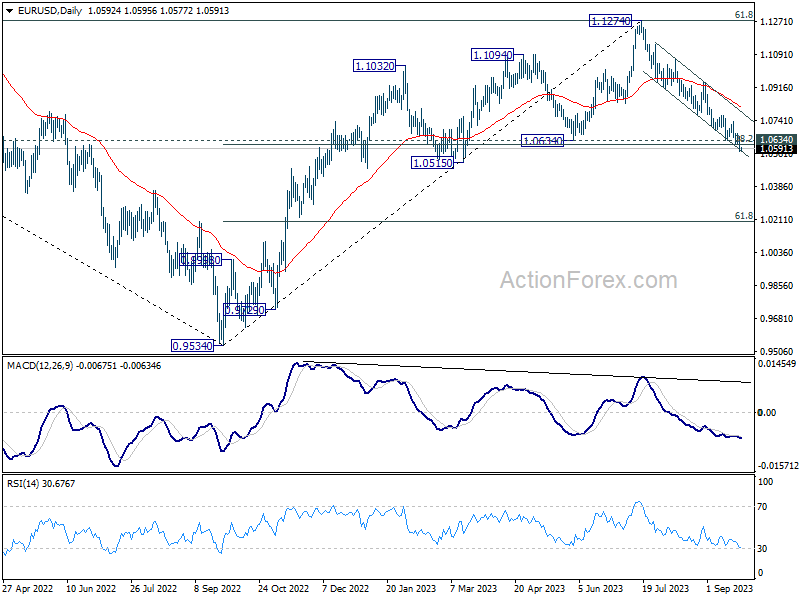
Intraday bias in EUR/USD is back on the downside as fall from 1.1274 resumed after brief consolidations. Sustained trading below 1.0609/34 cluster support will carry larger bearish implication, and target 1.0515 support next. On the upside, above 1.0672 minor resistance will turn intraday bias neutral and bring consolidations. But outlook will stay bearish as long as 1.0764 support turned resistance holds.
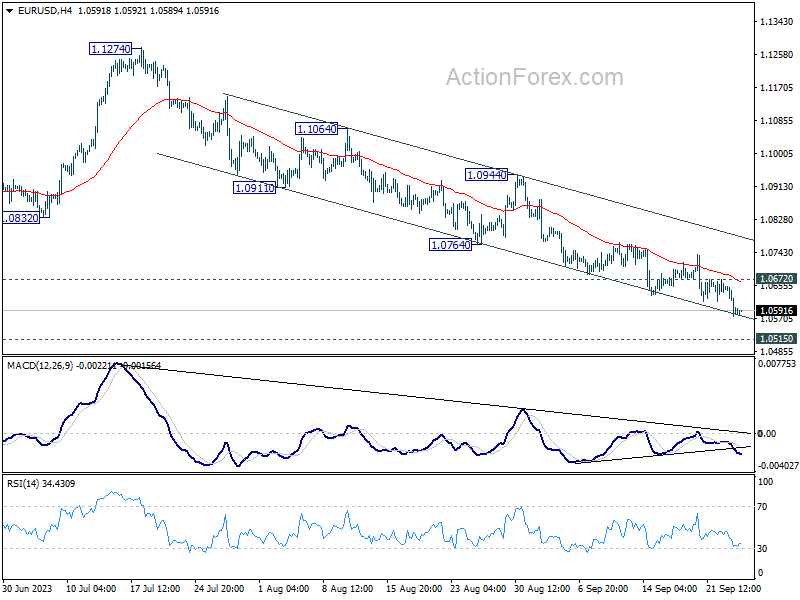
In the bigger picture, focus stays on 1.0634 cluster support (38.2% retracement of 0.9534 to 1.1274 at 1.0609). Sustained trading below there would rase the chance of bearish trend reversal. That is, fall from 1.1274 could be reversing whole rise from 0.9534 (2022 low). But even if it's just a corrective move, deeper decline would be seen to 61.8% retracement at 1.0199. For now, risk will stay on the downside as long as 55 D EMA (now at 1.0825) holds, in case of rebound.
Surging Treasury Yields Propel Dollar to 10-month High, EUR/USD Breaks Key Support
Dollar is being the standout performer this week, bolstered significantly by surging US treasury yields. Dollar index, which gauges the greenback against a basket of six major currencies, reached a high not seen since the previous November, breaking 106 mark. Contributing to the bullish momentum, EUR/USD has plunged through a pivotal support level at 1.06, and USD/JPY is inching closer to 149 mark.
Interestingly, 10-year yield has surged to an impressive 4.5%, marking the highest point since 2007. Initially, a wave of risk aversion propelled Dollar during US trading hours. However, after major stock indexes rallied to end in positive territory, the greenback's ascent moderated. Still, as major Asian markets trended downwards, Dollar managed to hold its ground.
At present, Swiss Franc is lagging, being the week's poorest performer, with the Euro not faring much better. British Sterling is aiming to pare back its losses from the previous week, while Yen is in a flux, with traders cautious due to potential interventions by Japanese authorities. Remarkably, despite Dollar's strength, commodity-linked currencies have managed to showcase some resilience.
Technically an immediate focus now is on whether 10-year yield could power through the medium term channel resistance to accelerate up, and the subsequent impact on other markets. If materialized, TNX could march further to next target at 61.8% projection of 1.343 to 4.333 from 3.253 at 5.100, which is above 5% mark. On the other hand, while a retreat from the current level cannot be ruled out, near term outlook in TNX will stay bullish as long as 4.362 resistance turned support holds. The market will likely get more clarity on these movements in the upcoming days.
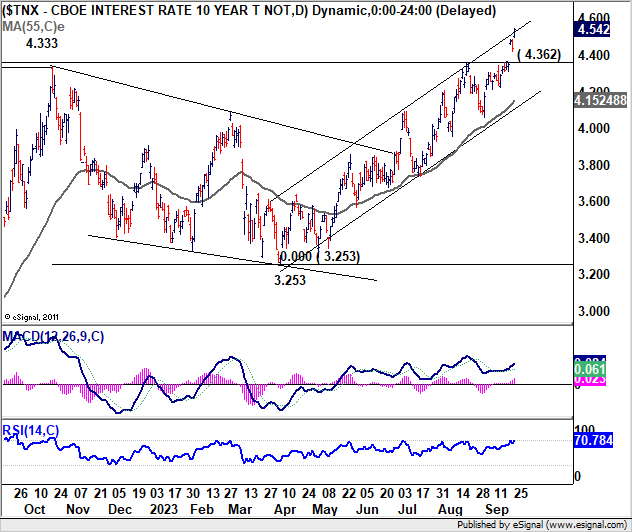
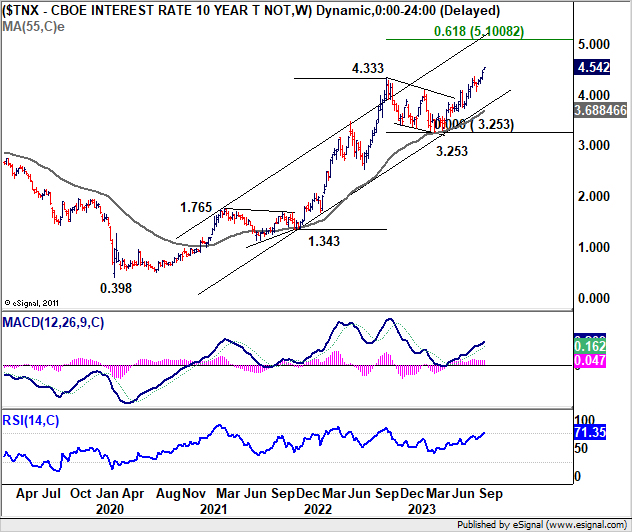
In Asia, at the time of writing, Nikkei is down -0.92%. Hong Kong HSI is down -0.84%. China Shanghai SSE is down -0.33%. Singapore Strait Times is down -0.08%. Japan 10-year JGB yield is up 0.013 a 0.744. Overnight, DOW rose 0.13%. S&P 500 rose 0.40%. NASDAQ rose 0.45%. 10-yea ryield rose 0.104 to 4.542.
Fed's Kashkari: Strong economy might warrant another rate hike
Minneapolis Fed President Neel Kashkari said at an event overngiht that the strength of the economy might necessitate higher interest rates for an extended period.
Kashkari commented, "If the economy is fundamentally much stronger than we realized, on the margin, that would tell me rates probably have to go a little bit higher, and then be held higher for longer to cool things off."
In line with last week's updated dot plot from Fed, where 12 out of 19 members indicated a potential rate hike this year, Kashkari affirmed his position, stating, "I'm one of those folks."
However, Kashkari also pointed out a caveat, suggesting the possibility of rate cuts if inflation undergoes a swift decline next year. He elaborated, "Depending on what is happening in all the economic data that we look at, that then might justify backing off the federal funds rate — not to ease policy but just to stop it from getting tighter from here, and that's something obviously we'll have to look at."
Japanese officials weigh in on Yen's slide as it approaches 149 against Dollar
This week's decline of Yen against Dollar, which seems poised to breach 149 mark, has brought remarks from Japanese officials into sharp focus. Market participants are keen to decipher indications of when Japan might transition from verbal caution to active intervention, even though it's clear that Japan wouldn't pre-announce such a move.
Finance Minister Shunichi Suzuki, reiterating his consistent position, stated today, "Foreign exchange rates should be determined by market forces, reflecting fundamentals."
Suzuki emphasized that "Excessive volatility is undesirable," and assured that the government is monitoring the currency fluctuations with a "high sense of urgency". "We will respond as appropriate to excessive volatility without ruling out any options," he added.
Echoing Suzuki's sentiments, the newly appointed Economy Minister, Yoshitaka Shindo, stressed the significance of stable currency movements that mirror economic realities.
Pointing out the multifaceted impact of the Yen's position, Shindo elaborated, "Weak Yen has various effects on economy such as raising import costs for consumers, improving competitiveness of exporters."
With these comments, the stage is set for a heightened scrutiny of Japan's potential interventions in the currency market. Market participants will no doubt remain vigilant to further remarks and actions by Japanese officials in the coming days.
Looking ahead
The economic calendar is empty in European session. Main focus will be on US consumer confidence to be released later in the day. US house price index and new home sales will also be featured.
EUR/USD Daily Outlook
Daily Pivots: (S1) 1.0616; (P) 1.0644; (R1) 1.0673; More...
Intraday bias in EUR/USD is back on the downside as fall from 1.1274 resumed after brief consolidations. Sustained trading below 1.0609/34 cluster support will carry larger bearish implication, and target 1.0515 support next. On the upside, above 1.0672 minor resistance will turn intraday bias neutral and bring consolidations. But outlook will stay bearish as long as 1.0764 support turned resistance holds.
In the bigger picture, focus stays on 1.0634 cluster support (38.2% retracement of 0.9534 to 1.1274 at 1.0609). Sustained trading below there would rase the chance of bearish trend reversal. That is, fall from 1.1274 could be reversing whole rise from 0.9534 (2022 low). But even if it's just a corrective move, deeper decline would be seen to 61.8% retracement at 1.0199. For now, risk will stay on the downside as long as 55 D EMA (now at 1.0825) holds, in case of rebound.
Economic Indicators Update
| GMT | Ccy | Events | Actual | Forecast | Previous | Revised |
|---|---|---|---|---|---|---|
| 23:50 | JPY | Corporate Service Price Index Y/Y Aug | 2.10% | 1.80% | 1.70% | |
| 13:00 | USD | S&P/CS Composite-20 HPI Y/Y Jul | -0.50% | -1.20% | ||
| 13:00 | USD | Housing Price Index M/M Jul | 0.10% | 0.30% | ||
| 14:00 | USD | Consumer Confidence Sep | 105.9 | 106.1 | ||
| 14:00 | USD | New Home Sales Aug | 700K | 714K |
Japanese officials weigh in on Yen’s slide as it approaches 149 against Dollar
This week's decline of Yen against Dollar, which seems poised to breach 149 mark, has brought remarks from Japanese officials into sharp focus. Market participants are keen to decipher indications of when Japan might transition from verbal caution to active intervention, even though it's clear that Japan wouldn't pre-announce such a move.
Finance Minister Shunichi Suzuki, reiterating his consistent position, stated today, "Foreign exchange rates should be determined by market forces, reflecting fundamentals."
Suzuki emphasized that "Excessive volatility is undesirable," and assured that the government is monitoring the currency fluctuations with a "high sense of urgency". "We will respond as appropriate to excessive volatility without ruling out any options," he added.
Echoing Suzuki's sentiments, the newly appointed Economy Minister, Yoshitaka Shindo, stressed the significance of stable currency movements that mirror economic realities.
Pointing out the multifaceted impact of the Yen's position, Shindo elaborated, "Weak Yen has various effects on economy such as raising import costs for consumers, improving competitiveness of exporters."
With these comments, the stage is set for a heightened scrutiny of Japan's potential interventions in the currency market. Market participants will no doubt remain vigilant to further remarks and actions by Japanese officials in the coming days.
Fed’s Kashkari: Strong economy might warrant another rate hike
Minneapolis Fed President Neel Kashkari said at an event overngiht that the strength of the economy might necessitate higher interest rates for an extended period.
Kashkari commented, "If the economy is fundamentally much stronger than we realized, on the margin, that would tell me rates probably have to go a little bit higher, and then be held higher for longer to cool things off."
In line with last week's updated dot plot from Fed, where 12 out of 19 members indicated a potential rate hike this year, Kashkari affirmed his position, stating, "I'm one of those folks."
However, Kashkari also pointed out a caveat, suggesting the possibility of rate cuts if inflation undergoes a swift decline next year. He elaborated, "Depending on what is happening in all the economic data that we look at, that then might justify backing off the federal funds rate — not to ease policy but just to stop it from getting tighter from here, and that's something obviously we'll have to look at."
GBP/USD Plunges Below 1.2250 As Bears Take Control
- Key Highlights
GBP/USD extended losses and traded below 1.2250.
- A major bearish trend line is forming with resistance near 1.2340 on the 4-hour chart.
- EUR/USD broke the 1.0620 support and is still at risk of more downsides.
- USD/JPY broke the 148.50 resistance and accelerated higher.
GBP/USD Technical Analysis
The British Pound started a fresh decline after it struggled near 1.2420 against the US Dollar. GBP/USD dropped below 1.2350 and 1.2320 to move further into a bearish zone.
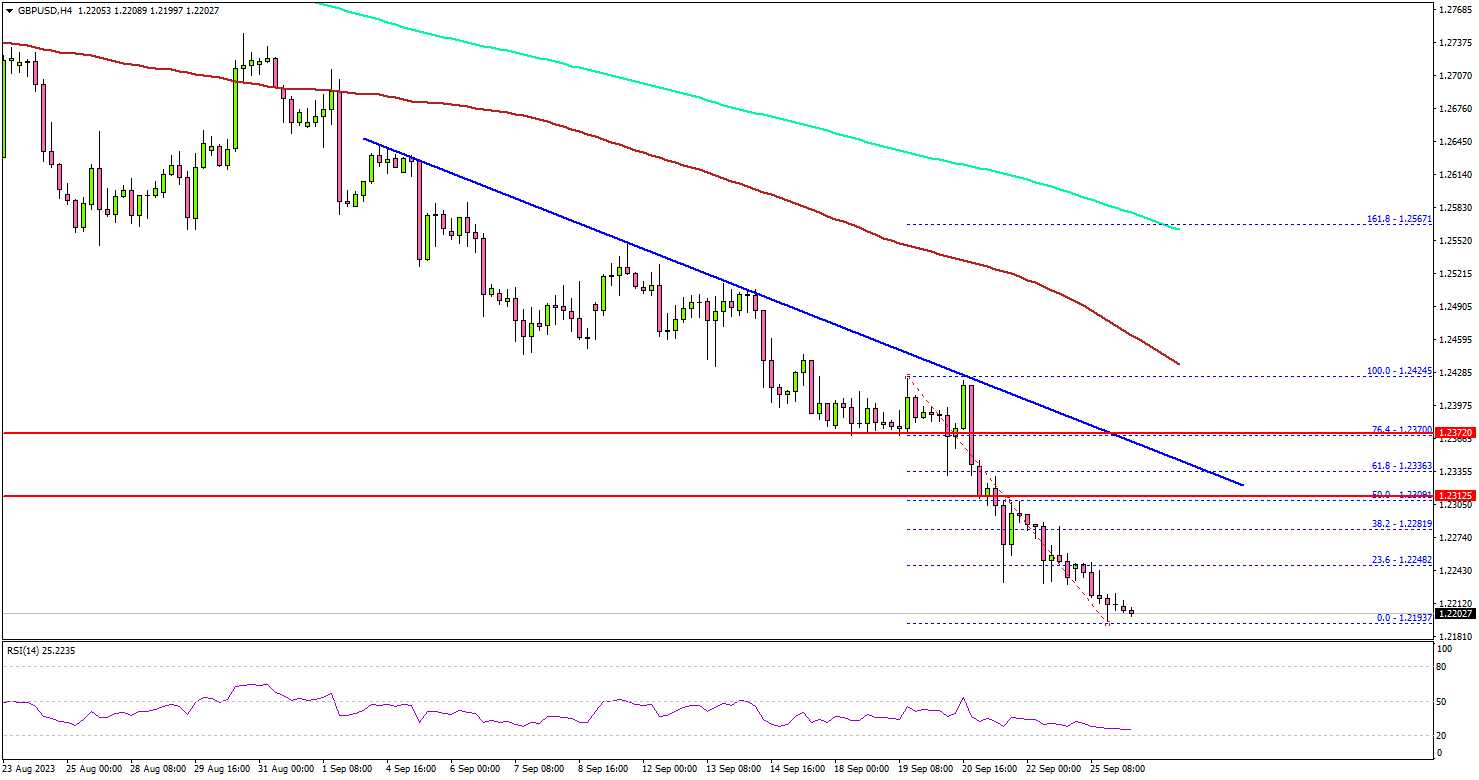
Looking at the 4-hour chart, the pair settled below the 1.2250 level, the 100 simple moving average (red, 4 hours), and the 200 simple moving average (green, 4 hours).
A new multi-week low was formed near 1.2200 and the pair is still at risk of more downsides. If there is a recovery wave, it could face resistance near the 1.2250 level. The first major resistance is near the 1.2300 zone.
The 50% Fib retracement level of the downward move from the 1.2424 swing high to the 1.2200 area is also near 1.2300. The next major resistance is near the 1.2340 zone. There is also a major bearish trend line forming with resistance near 1.2340 on the same chart.
A close above 1.2340 could start a steady increase toward 1.2420. Any more gains might send GBP/USD toward the 1.2500 resistance. On the downside, initial support is near the 1.2180 level. The next key support is seen near the 1.2150 level, below which it could test 1.2050.
If there is a move below 1.2050, the pair could dive toward 1.2000. Any more losses might send the pair toward the 1.1880 level.
Looking at EUR/USD, there were strong bearish moves and the pair even declined below the 1.0620 support zone.
Economic Releases
- US Housing Price Index for July 2023 (MoM) - Forecast +0.1%, versus +0.3% previous.
- US New Home Sales for August 2023 (MoM) – Forecast 2.1% versus 4.4% previous.
EURCAD Wave Analysis
- EURCAD broke support level 1.4290
- Likely to fall to support level 1.4200
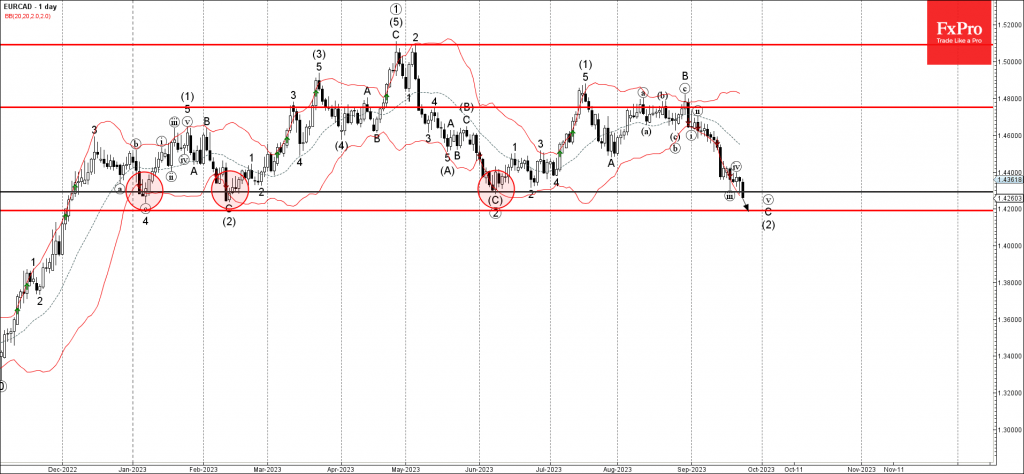
EURCAD today broke below the key support level 1.4290 (which has been reversing the price from the start of January as can be seen below).
The breakout of the support level 1.4290 accelerated the C-wave of the active ABC correction (2) from the middle of July.
Given the bearish euro sentiment seen across the FX markets today, EURCAD can be expected to fall further toward the next support level 1.4200 (target for the completion of the active C-wave).
Gold Wave Analysis
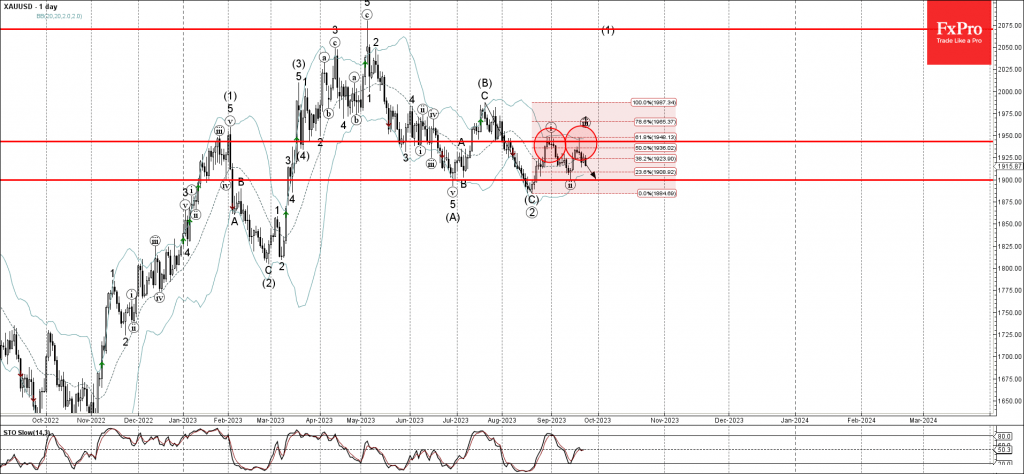
- Gold reversed from key resistance level 1950.00
- Likely to fall to support level 1900.00
Gold recently reversed down from the key resistance level 1950.00 (top of wave I from the start of this month) intersecting with the upper daily Bollinger Band.
The resistance level 1950.00 was further strengthened by the 61.8% Fibonacci correction of the previous downward impulse (C) from July.
Gold can be expected to fall further toward the next support level 1900.00 (low of the previous minor correction ii).
USD/JPY: Intervention risks grow as yen falls to 11-month low
- 30-year Treasury yield rose 12bps to 4.645% vs 15.19% which was the peak at 1981.
- Bloomberg dollar index has best rally in three weeks, which is also highest level since December
- BOJ Governor Ueda stands on dovish ground, yen free to fall; PM Kishida delivers plan to ease inflation pain
Bank of Japan Governor Kazuo Ueda and his deputy governor Uchida are committed to their ultra-easy policy. Governor Ueda noted that there was “very high uncertainty” over whether companies would continue to increase prices and wages. Uchida stated that the central bank needs to patiently continue monetary easing. He also reiterated that they are closely watching FX markets.
Japan’s Prime Minister Kishida also unveiled new economic measures that should help deliver sustainable wage growth. Kishida expressed his unhappiness with the yen, noting that excessive currency moves are not desirable and that he wants to monitor markets with vigilance.
The pressure to stop the yen’s slide is building and the current move in Treasuries makes dollar strength likely to remain intact.
USD/JPY Daily Chart
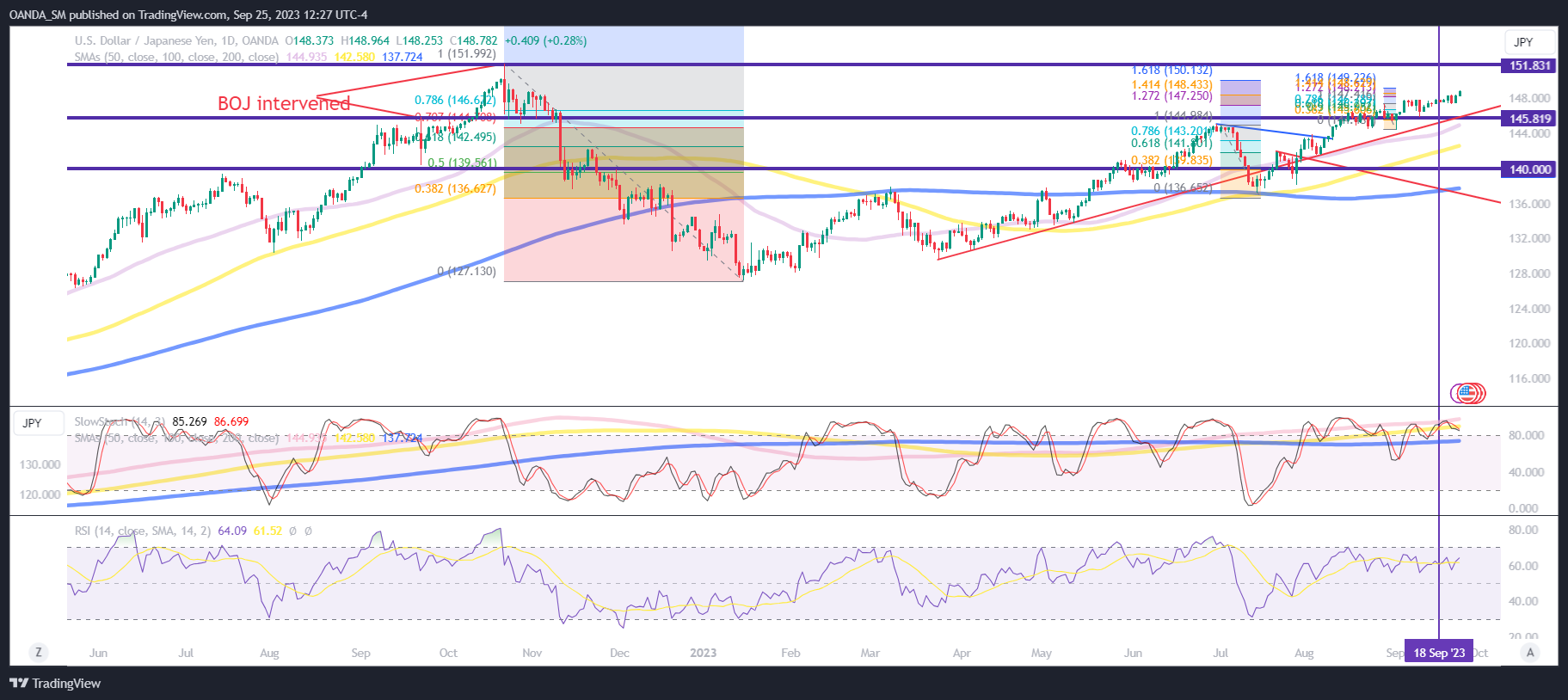
As of late March, the US dollar continues to assert renewed strength as a a result, USD/JPY has retested prior levels that triggered intervention last year. The path to 150 seems like it should be there given the major reset Wall Street is having with pricing in higher-for-longer.
Everyone wants to know when does Japan step in and support the yen, or can they just ditch their easy policy? Excessively overbought territory could last a while longer, but it seems 150 to 155 will remain key levels.
Next months inflation report should include some upward revisions, which should mean traders might become more optimistic about a policy shift or the abandoning of yield curve control. Yen weakness might last a little while longer, but FX traders are anxious for when Japan is ready to make a meaningful policy change.