

Sample Category Title
Sunset Market Commentary
Markets
No post-weekend gamechanger as the war between the US and Israel on the one hand and Iran on the other hand enters its fifth week. There were few indications for a real de-escalation anytime soon. For now, the US didn’t start any ground invasion. Still, a potential seizure of the Irian oil Island Kharg by US forces remains one of the options being considered. At the same time, the Iran allied Houthi’s from Yemen actively joining strikes against Israel and Iran attacking important aluminum facilities in Abu Dhabi and Bahrain only suggest ever growing risk to more supply chain disruptions including from a hampered passage in the Suez Canal/Red Sea. US president Trump in morning comments on social media also gave mixed signals at best. He indicated that the US is in serious discussions with the (new) regime in Iran, but that the US can still destroy Iranian energy infrastructure if the Strait of Hormuz isn’t immediately open for business. Oil prices, still our main pointer on markets’ assessment of supply chain disruptions don’t preposition for improvement. Brent at $115+ is testing the highest levels since the start of the conflict. The reaction on interest rate markets was a bit different from the earlier stages of the conflict. We didn’t see the exact trigger, but markets today apparently focused a bit more on downside growth risks rather than upside inflation risks. US yields decline between 8 bps (5-y) and 5 bps (30-y), building on a downside momentum that already started on Friday. On Thursday, US money markets priced a > 50% chance of a Fed rate hike further out this year. Currently, this scenario is again priced out. European yields follow the US trend, albeit at a distance, with German yields easing between 5.5 bps (5& 10-y) and 4 bps (2-y). Question remains whether the likes of the ECB will have the luxury to disregard higher inflation/ inflation expectations to cope with a potential negative impact on growth. Preliminary German inflation data for March confirmed the feared for jump in inflation with HICP inflation accelerating to 1.2% M/M and 2.8% Y/Y (0.4% M/M and 2.0% in February), marking the highest level since January last year. The benign reaction on bond/yields’ markets also gave some (remarkable?) relief to equity markets. The Eurostoxx 50 ‘rebounds’ 0.5%. US indices add about 0.70-0.90% at the open. Constructive but not enough to reverse Friday’s sell-off. The technical picture of most indices remains fragile anyway (e.g. S&P 500 sub 6500 area). Also a bit remarkable, despite the substantial decline in US yields (bigger than in EMU or the UK) and the rebound in equities (risk-on!?), the dollar outperforms. DXY (100.4) regains the 100-mark with the post-crisis top (100.54) within reach. EUR/USD drops further from 1.1515 to 1.1475.The yen is the exception to the rule. USD/JPY this morning at 160.46 tested the highest level since July 2024, but the yen rebounded after Japanese vice minister for international affairs Atsushi Mimura warned authorities will take decisive action if they see speculative action picking up (USD/JPY currently 159.5).
News & Views
Belgian inflation slowed to 0.12% M/M in March, but that still pushed annual inflation up from 1.45% Y/Y to 1.65% Y/Y. The most significant price increases in March concerned motor fuels and package holidays. However, electricity, meat, alcoholic beverages, hotel rooms and plane tickets have had a decreasing effect on the index. Energy inflation stood at -4.41% Y/Y from -7.89% in February. Other details showed food inflation at -0.88% Y/Y (from +0.68% Y/Y) and services prices going from 4.75% Y/Y to 4.86% Y/Y. Rent inflation decreased from 3.47% to 3.39%. Overall core inflation, excluding energy and unprocessed food stabilized at 2.71% Y/Y (from 2.78%)
The European Commission’s Economic Sentiment Indicator (ESI) declined from 98.2 to 96.6 for the eurozone. The Employment Expectations Indicator (EEI) fell from 98.8 to 96.4. Adding to the decline of February, the marked deterioration of economic sentiment in March drove both indicators away from their long-term average of 100. Consumer confidence plummeted from -12.3 to -16.3, the lowest level since October 2023. On the business side, construction confidence was moderately up while industry confidence remained broadly stable. Services confidence fell slightly with the biggest hit going to retail trade confidence. Managers’ selling price expectations were sharply up in all four business sectors (beyond long-term average), and strikingly so in industry. Consumers’ perceptions of price developments over the past twelve months increased moderately, but their expectations about price developments for the next twelve months surged.
GBP/JPY Mid-Day Outlook
Daily Pivots: (S1) 212.15; (P) 212.65; (R1) 213.08; More...
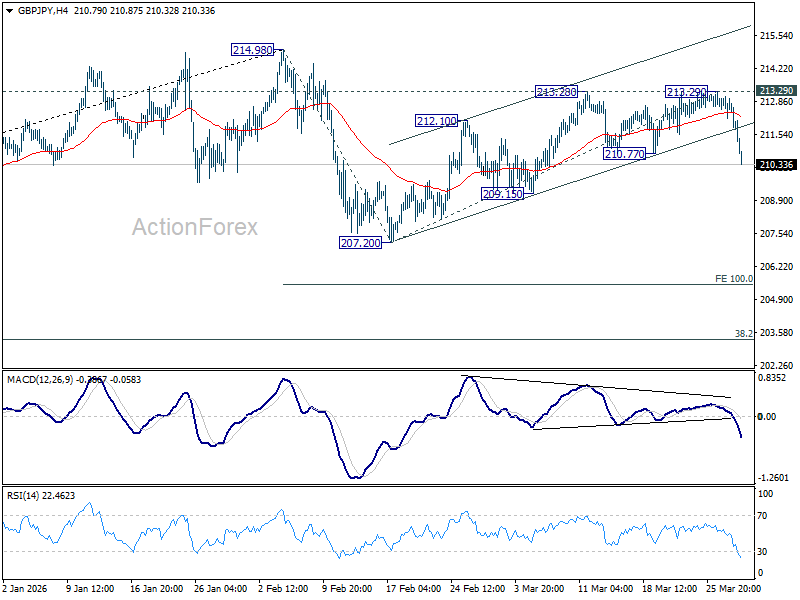
GBP/JPY's strong break of 210.77 support suggests that rebound from 207.20 has completed at 213.29. The pattern from 214.98 should now be in the third leg. Intraday bias is back on the downside for 209.15 support first. Firm break there will target 207.20 next. For now, risk will stay on the downside as long as 213.29 resistance holds, in case of recovery.
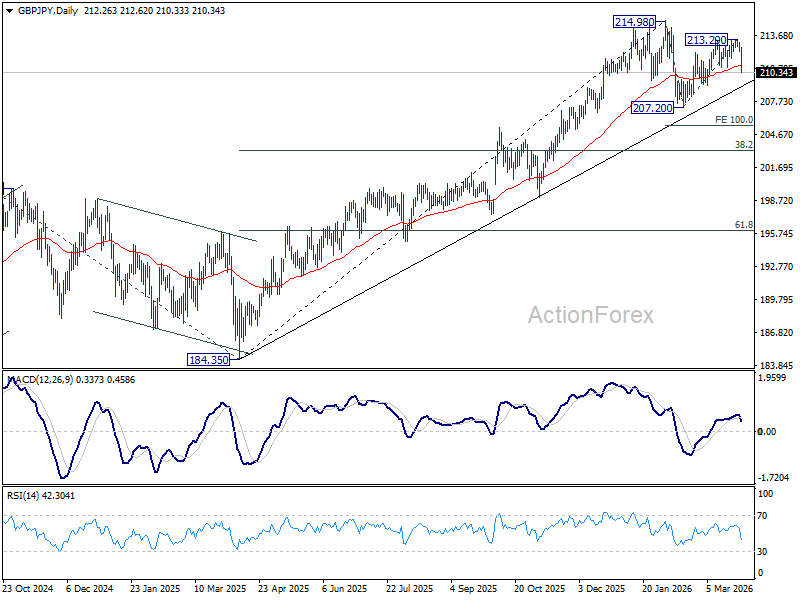
In the bigger picture, up trend from 123.94 (2020 low) is still in progress. Firm break of 214.98 will target 61.8% projection of 148.93 (2022 low) to 208.09 (2024 high) from 184.35 at 220.90. This will remain the favored case as long as 55 W EMA (now at 203.13) holds, even in case of another deep pullback.
GBP/USD Dips Further As EUR/GBP Regains Traction
GBP/USD failed to climb above 1.3500 and corrected some gains. EUR/GBP started a decent increase and might aim for more gains above 0.8700.
Important Takeaways for GBP/USD and EUR/GBP Analysis Today
The British Pound is showing bearish signs below the 1.3400 support.
There is a key bearish trend line forming with resistance near 1.3280 on the hourly chart of GBP/USD at FXOpen.
EUR/GBP is gaining pace and trading above the 0.8660 pivot level.
There is a connecting bullish trend line forming with support at 0.8670 on the hourly chart at FXOpen.
GBP/USD Technical Analysis
On the hourly chart of GBP/USD at FXOpen, the pair failed to stay above the 1.3450 pivot level. As a result, the British Pound started a fresh decline below 1.3400 against the US Dollar.
There was a clear move below 1.3340 and the 50-hour simple moving average. The bears pushed the pair below 1.3250. Finally, there was a spike toward the 1.3200 handle. A low was formed near 1.3202, and the pair is now consolidating losses.
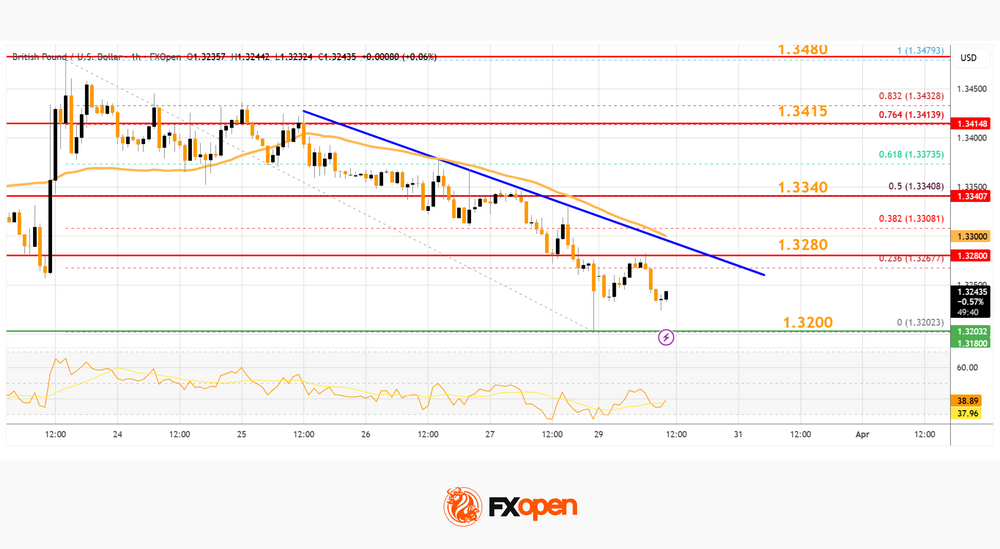
There was a minor move above 1.3240 and the 23.6% Fib retracement level of the downward move from the 1.3479 swing high to the 1.3202 low. On the upside, the GBP/USD chart indicates that the pair is facing resistance near a key bearish trend line at 1.3280.
A close above the trend line might send the pair toward the 50% Fib retracement at 1.3340. If the bulls remain in action, they could aim for more gains.
In the stated case, the pair might rise toward 1.3415. The next major hurdle for GBP/USD sits at 1.3480. On the downside, there is a key support forming near 1.3200. If there is a downside break below 1.3200, the pair could accelerate lower. The next key interest area might be 1.3160, below which the pair could test 1.3120. Any more downside could lead the pair toward 1.3050.
EUR/GBP Technical Analysis
On the hourly chart of EUR/GBP at FXOpen, the pair started a decent increase from 0.8635. The Euro traded above 0.8650 to enter a positive zone against the British Pound.
The pair settled above the 50-hour simple moving average and 0.8660. The pair traded as high as 0.8687 before there was a minor pullback, but the pair stayed above the 23.6% Fib retracement level of the upward move from the 0.8636 swing low to the 0.8687 high.
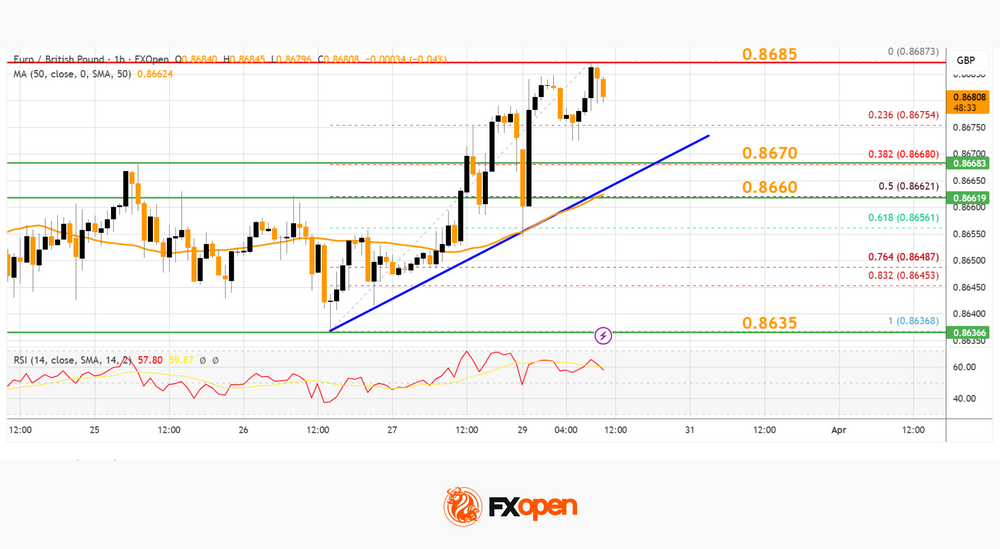
However, the pair is stable above 0.8670. Besides, there is a connecting bullish trend line forming with support at 0.8670.
A downside break below 0.8670 might call for more downsides. In the stated case, the pair could drop toward the 50% Fib retracement level at 0.8660. Any more losses might call for an extended drop toward the 0.8635 pivot zone.
If there is another increase, the EUR/GBP chart suggests that the pair is facing hurdles near 0.8685. A close above 0.8685 might accelerate gains. In the stated case, the bulls may perhaps aim for a test of 0.8700. Any more gains might send the pair to 0.8740.
Trade over 50 forex markets 24 hours a day with FXOpen. Take advantage of low commissions, deep liquidity, and spreads from 0.0 pips (additional fees may apply). Open your FXOpen account now or learn more about trading forex with FXOpen.
This article represents the opinion of the Companies operating under the FXOpen brand only. It is not to be construed as an offer, solicitation, or recommendation with respect to products and services provided by the Companies operating under the FXOpen brand, nor is it to be considered financial advice.
EUR/USD Daily Outlook
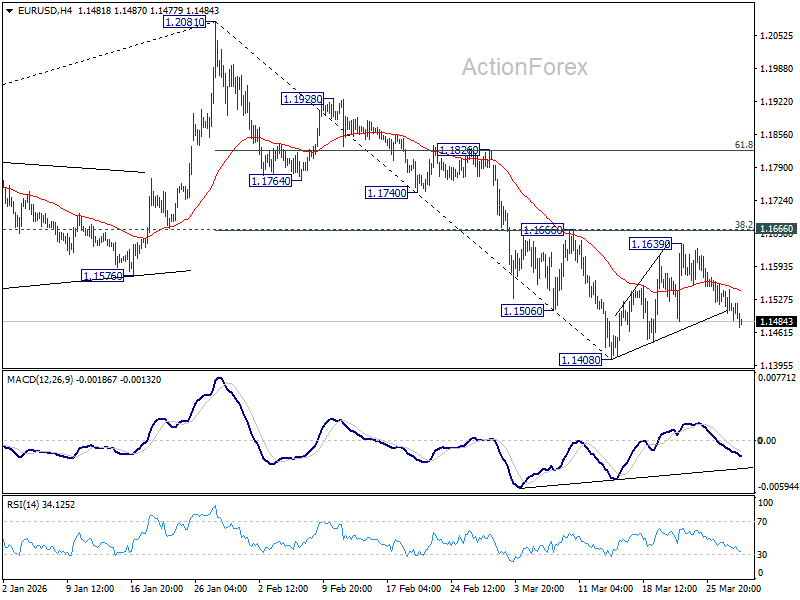
Daily Pivots: (S1) 1.1491; (P) 1.1520; (R1) 1.1537; More….
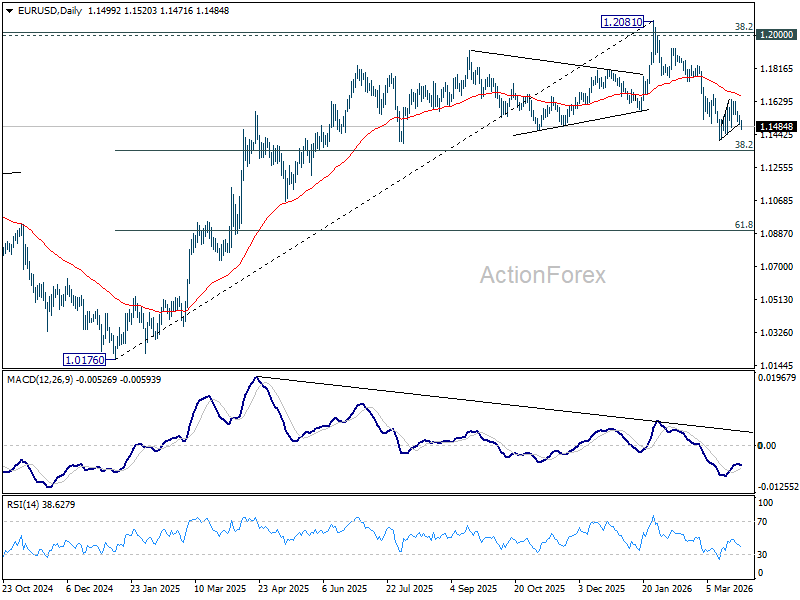
EUR/USD is still staying around mid-point of established range above 1.1408 and intraday bias remains neutral. Further decline is expected with 1.1666 cluster resistance (38.2% retracement of 1.2081 to 1.1408 at 1.1665) intact. On the downside, firm break of 1.1408 will resume the fall from 1.2081 to 38.2% retracement of 1.0176 to 1.2081 at 1.1353. However, decisive break of 1.1666 will argue that the fall from 1.2081 has completed, and turn bias back to the upside for 61.8% retracement of 1.2081 to 1.1408 at 1.1824.
In the bigger picture, prior break of 55 W EMA (now at 1.1497) should confirm rejection by 1.2 key cluster resistance level. The whole up trend from 0.9534 (2022 low) might have completed as a three wave corrective rise too. Deeper fall is expected to long term channel support (now at 1.0535). Meanwhile, risk will stay on the downside as long as 1.2081 holds, even in case of strong rebound.
USD/CHF Mid-Day Outlook
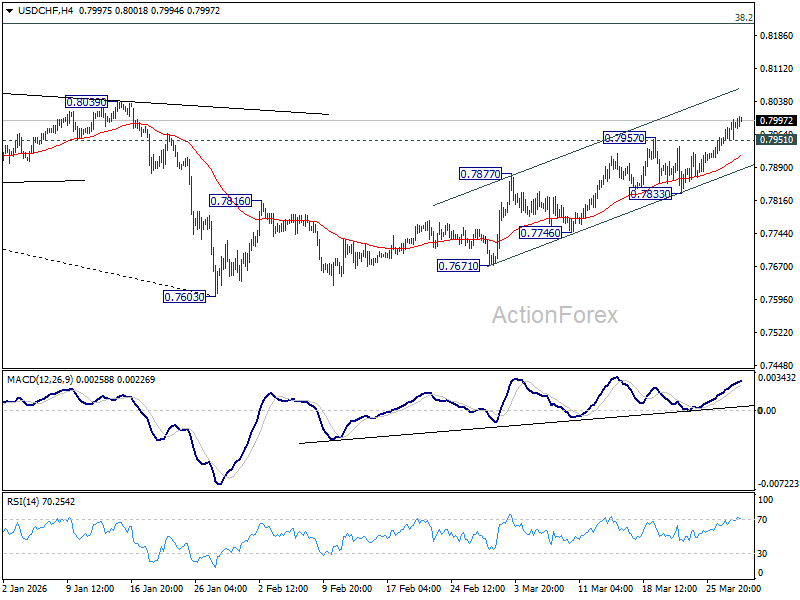
Daily Pivots: (S1) 0.7955; (P) 0.7974; (R1) 0.8009; More….
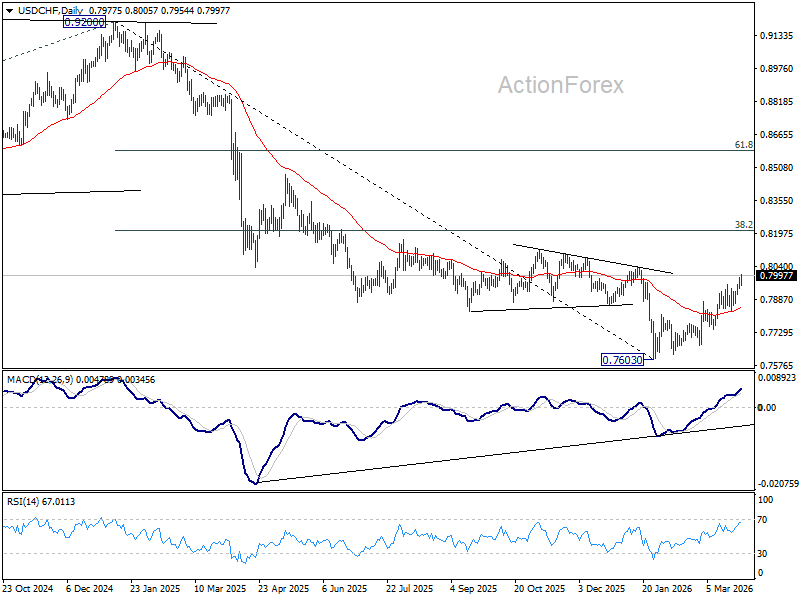
USD/CHF's rally from 0.7603 is in progress and intraday bias stays on the upside. Further rise should be seen to 38.2% retracement of 0.9200 to 0.7603 at 0.8213. On the downside, below 0.7951 minor support will turn intraday bias neutral first. But further rally is expected as long as 0.7833 support holds, in case of retreat.
In the bigger picture, a medium term bottom should be in place at 0.7603 on bullish convergence condition in D MACD. Rebound from there is seen as correcting the fall from 0.9200 only. However, decisive break of 55 W EMA (now at 0.8088) will suggest that it's probably correcting the larger scale down trend from 1.0146 (2022 high). On the other hand, rejection by the 55 W EMA will setup down trend resumption to 100% projection of 1.0146 (2022 high) to 0.8332 from 0.9200 at 0.7382 at a later stage.
GBP/USD Mid-Day Outlook
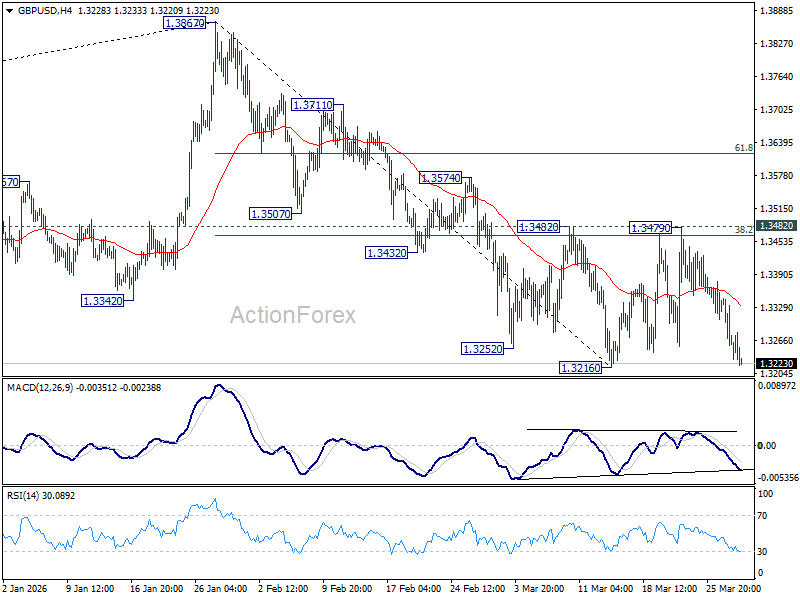
Daily Pivots: (S1) 1.3229; (P) 1.3289; (R1) 1.3318; More...
Immediate focus is now on 1.3216 support in GBP/USD. Firm break there will resume the fall from 1.3867 to 1.3008 structural support. In any case, outlook will continue to stay bearish as long as 1.3482 resistance holds.
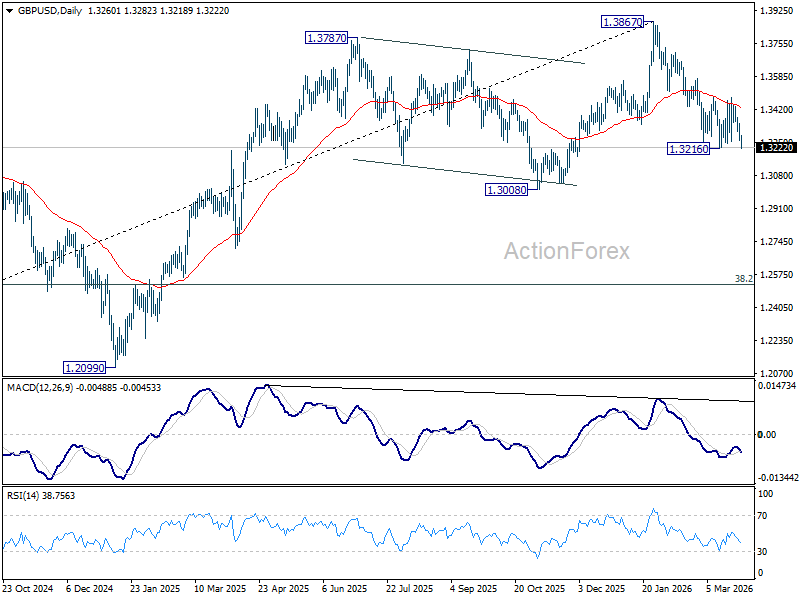
In the bigger picture, considering bearish divergence condition in both D and W MACD, a medium term top should be in place at 1.3867. Firm break of 1.3008 support will argue that fall from 1.3867 is at least correcting the rise from 1.0351 (2022 low) with risk of bearish reversal. That would open up further decline to 38.2% retracement of 1.0351 to 1.3867 at 1.2524. For now, medium term outlook will be neutral at best as long as 1.3867 resistance holds, or until further development.
USD/JPY Mid-Day Outlook
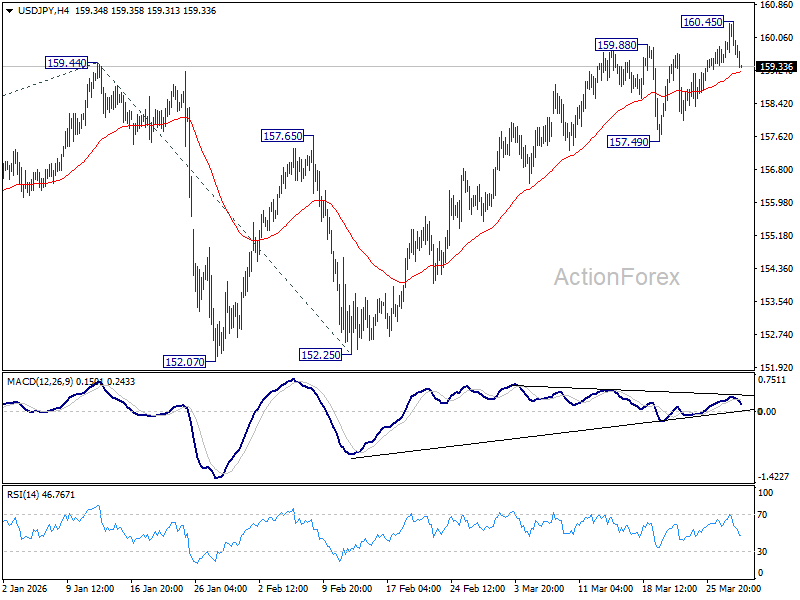
Daily Pivots: (S1) 159.70; (P) 160.05; (R1) 160.65; More...
Intraday bias in USD/JPY stays neutral for the moment. Some consolidations would be seen but further rally is still in favor. Above 160.45 will bring retest of 161.94 high. Nevertheless, considering bearish divergence condition in 4H MACD, sustained break of 55 4H EMA (now at 159.20) will indicate short term topping, and turn bias to the downside for 157.94 support instead.
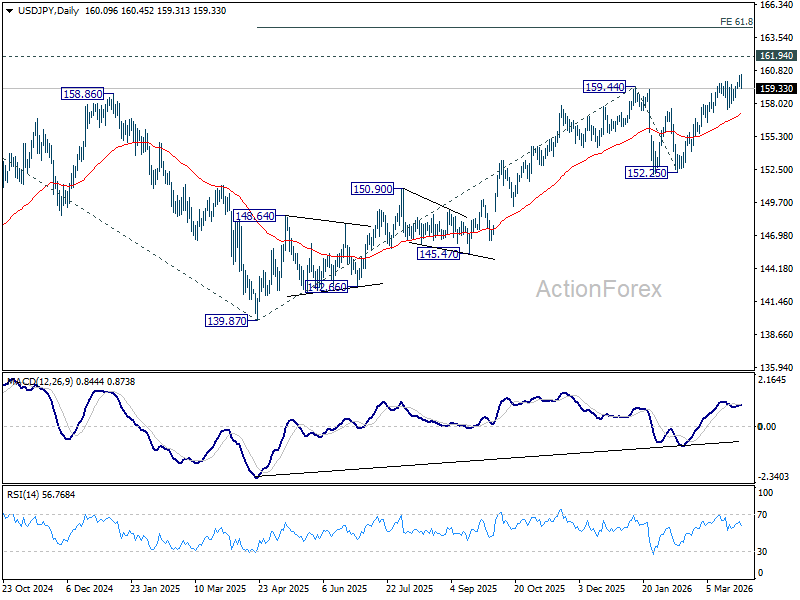
In the bigger picture, outlook is unchanged that corrective pattern from 161.94 (2024 high) should have completed with three waves at 139.87. Larger up trend from 102.58 (2021 low) could be ready to resume through 161.94. This will remain the favored case as long as 55 W EMA (now at 152.97) holds. Firm break of 161.94 will pave the way to 61.8% projection of 102.58 to 161.94 from 139.87 at 176.75.
EUR/JPY Mid-Day Outlook
Daily Pivots: (S1) 184.00; (P) 184.34; (R1) 184.81; More...
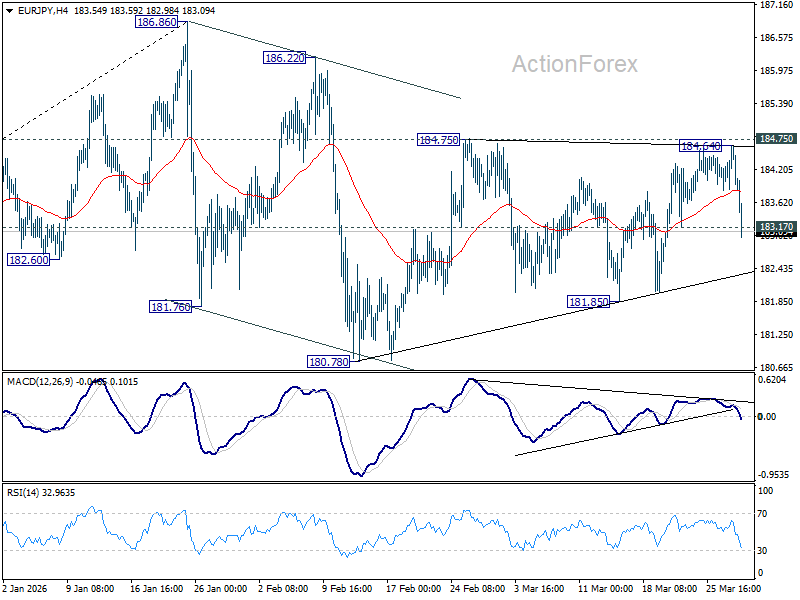
EUR/JPY's accelerated decline and break of 183.17 minor support should confirm rejection by 184.75 resistance. Intraday bias is back on the downside for 181.85 support. Firm break there will argue that the correction from 186.86 is already in the third leg, and should target 180.78 and below. For now, risk will be on the downside as long as 184.64 holds, in case of recovery.
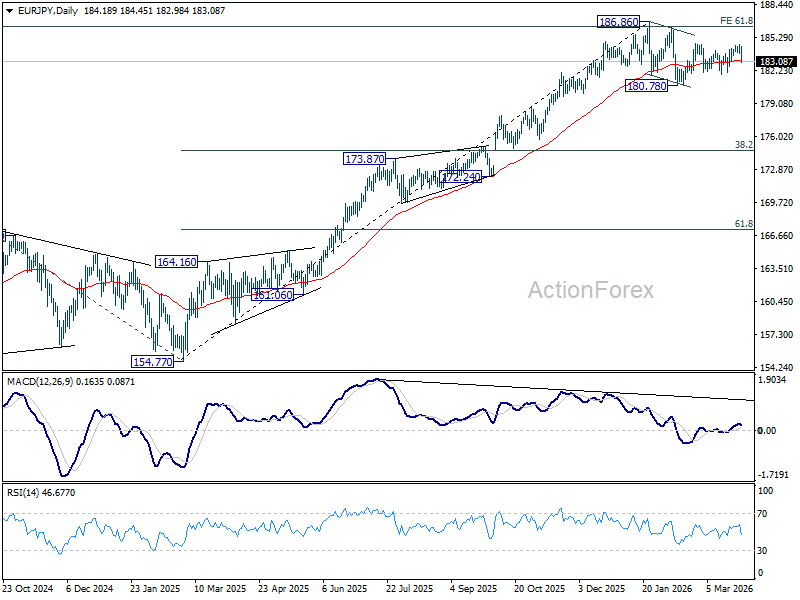
In the bigger picture, a medium term top could be in place at 186.86 and some more consolidations would be seen. Nevertheless, as long as 55 W EMA (now at 175.93) holds, the larger up trend from 114.42 (2020 low) remains intact. Firm break of 186.86 will pave the way to 78.6% projection of 124.37 (2022 low) to 175.41 (2025 high) from 154.77 at 194.88 next.
Dollar Strengthens After Trump Threat to Kharg Island; Yen Gains on “Final Warning”
Dollar strengthened broadly as markets reacted to a sharp escalation in rhetoric from U.S. President Donald Trump, who warned that Iran’s key energy infrastructure could be “completely obliterated” if the Strait of Hormuz is not reopened and a peace deal is not reached “shortly.” In particular, Trump explicitly named Kharg Island—along with Iran’s electric generating plants, oil wells, and desalination facilities—as targets, signaling a shift from targeted strikes toward comprehensive economic disruption.
Kharg Island is central to Iran’s oil exports, handling the vast majority of its crude shipments. Targeting it would effectively remove a significant share of Iranian supply from global markets, intensifying concerns over supply disruption. This explicit threat has heightened fears of a direct hit to global energy flows, reinforcing demand for the Dollar through both safe-haven and energy-linked channels.
The tone of Trump’s comments also suggests a shift in strategy. His reference to a possible extended “stay” in Iran implies more than short-term strikes, raising the prospect of a sustained presence aimed at controlling or disabling key energy hubs. Reports that the Pentagon is preparing to deploy additional ground troops further support the view that markets must now price in a longer-duration conflict.
Meanwhile Yen strengthened as Japanese authorities intensified verbal intervention following USD/JPY’s move toward the 160 threshold. The Ministry of Finance issued what markets interpret as a “final warning,” signaling readiness to act against excessive currency moves "soon". The rebound was further supported by expectations that BoJ policy normalization may come sooner than previously anticipated, after Governor Kazuo's Ueda comment at the parliament.
However, Yen gains remain constrained by the broader strength of the Dollar. Rather than triggering a reversal in USD/JPY, intervention rhetoric is acting as a cap on further upside. As a result, Yen strength is being expressed more clearly in crosses.
Elsewhere, expectations for further tightening are building. Economists are increasingly calling for a more aggressive response from the Reserve Bank of Australia, with forecasts now pointing to consecutive rate hikes in May, June, and August. This reflects growing concern over second-round inflation effects, as higher energy costs are feeding through to wages and services, pushing the RBA from a monitoring stance toward a more proactive tightening phase.
In Europe, markets are also shifting toward a more hawkish outlook for the ECB. Rate hike expectations have firmed, with investors pricing three increases this year, potentially beginning as early as April or June. Policymakers are seen as moving earlier in the cycle, in part to avoid a repeat of the delayed response seen during the previous inflation surge. The overall tone remains cautious, shaped by escalating geopolitical risks and shifting policy expectations.
In currency markets, Yen is the strongest performer so far, followed by Dollar and Swiss Franc, while risk-sensitive currencies such as Aussie and Kiwi remain under pressure.
Gold Rebound From 4100 Suggests “Wyckoff Accumulation,” With Two Key Tests Ahead
Gold’s rebound from 4100 is raising the possibility of a Wyckoff accumulation phase, following a potential selling climax and liquidity flush. However, confirmation still depends on two key tests: a successful secondary test above 4100 and a breakout through the 4600–4800 resistance zone. Until then, the structure remains a developing range rather than a confirmed reversal. Read More.
Japan Issues Intervention “Final Warning” as USD/JPY Breaks 160, but Dollar Strength Prevents Reversal
Japan escalated intervention rhetoric after USD/JPY broke above 160, issuing what markets see as a “final warning.” However, strong Dollar momentum continues to limit the impact, turning intervention into a ceiling rather than a reversal trigger. Yen strength is instead showing more clearly in crosses such as AUD/JPY, where downside has extended. Read More.
BoJ Warns of “Behind the Curve” Risk as Yen Depreciation Amplifies Inflation Pressure
BoJ flagged the risk of falling “behind the curve” as yen depreciation amplifies inflation pressure and raises concerns over second-round effects. Policymakers signaled readiness to accelerate rate hikes if needed, especially if wage growth and cost pass-through persist. The shift highlights growing sensitivity to currency-driven inflation and strengthens the tightening bias. Read More.
Eurozone Sentiment Weakens Further as ESI Falls to 96.6
Economic sentiment in the EU and euro area weakened again in March, driven by sharp declines in consumer and retail confidence. Employment expectations also softened, signaling weaker demand and cautious hiring outlook. Growth momentum appears to be fading. Read More
Swiss KOF Barometer Drops Sharply to 96.1, Signals Broad-Based Economic Weakness
Switzerland’s KOF Economic Barometer dropped sharply to 96.1 in March, missing expectations and signaling a broad slowdown. Weakness across manufacturing, exports, and foreign demand highlights growing external headwinds. The data point to softer growth momentum ahead. Read More
EUR/JPY Mid-Day Outlook
Daily Pivots: (S1) 184.00; (P) 184.34; (R1) 184.81; More...
EUR/JPY's accelerated decline and break of 183.17 minor support should confirm rejection by 184.75 resistance. Intraday bias is back on the downside for 181.85 support. Firm break there will argue that the correction from 186.86 is already in the third leg, and should target 180.78 and below. For now, risk will be on the downside as long as 184.64 holds, in case of recovery.
In the bigger picture, a medium term top could be in place at 186.86 and some more consolidations would be seen. Nevertheless, as long as 55 W EMA (now at 175.93) holds, the larger up trend from 114.42 (2020 low) remains intact. Firm break of 186.86 will pave the way to 78.6% projection of 124.37 (2022 low) to 175.41 (2025 high) from 154.77 at 194.88 next.
Gold Rebound From 4100 Suggests “Wyckoff Accumulation,” With Two Key Tests Ahead
Gold’s current resilience in the face of the broad-based Dollar rally is raising the possibility that the recent decline has transitioned into a “Wyckoff Accumulation” phase. The sharp drop to 4,100 last week, followed by a swift recovery toward 4,600, suggests that what initially appeared to be a breakdown may instead have been a liquidity-driven flush, where supply was absorbed rather than expanded.
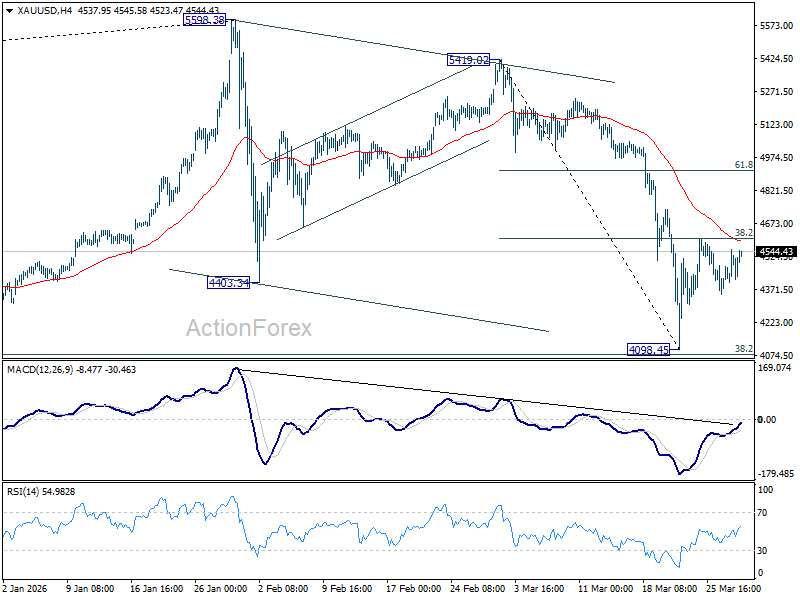
From a Wyckoff perspective, the move to 4100 can be interpreted as a potential “Selling Climax” (SC) after failing for a month from 5,419. Panic selling and triggered stops provided the liquidity for larger players to accumulate positions. The lack of sustained follow-through selling after the initial drop supports the idea that supply may have been largely exhausted, with the rebound acting as an “Automatic Rally” (AR) within a developing trading range.
Technically, the importance of the 4000–4100 zone reinforces this interpretation. The area aligns with key structural support, including the 55 W EMA (now at 4,024.10) and 38.2% retracement of 1,614.60 to 5,598.38 at 4,076.57. The strong defense of this zone adds weight to the argument that the market may be attempting to establish a base rather than continue its prior downtrend.
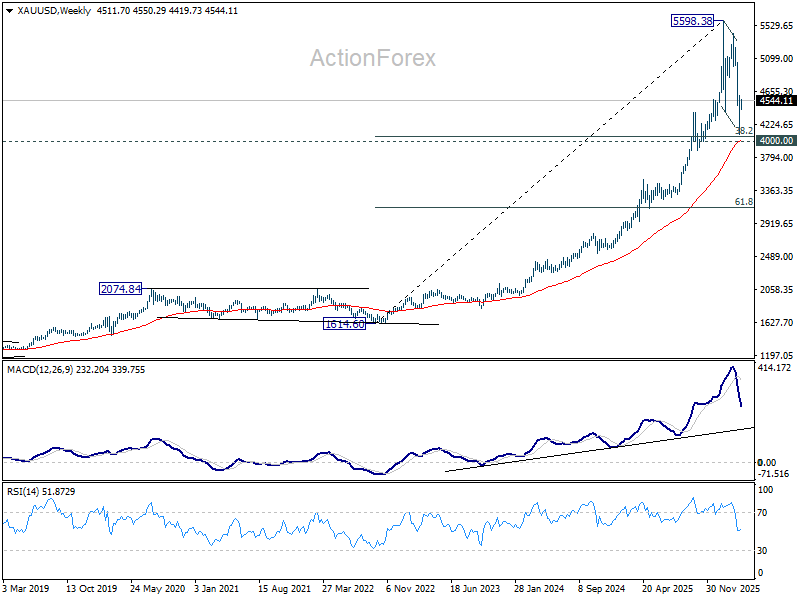
However, the accumulation thesis remains conditional and requires confirmation through two key tests. First, any renewed dip must form a successful “Secondary Test” (ST), ideally on lower volume, holding above the 41,00 region. Such price action would indicate that selling pressure has diminished and that demand is capable of absorbing residual supply.
Second, Gold must break through the resistance zone between 4,600 and 4,800. This area, defined by 38.2% retracement of 5419.02 to 4098.45 at 4602.90 and 55 D EMA (now at 4795.73), represents the upper boundary of the current range. A decisive move above this zone would signal a transition toward the “Markup” phase, confirming that accumulation has progressed sufficiently to support higher prices.
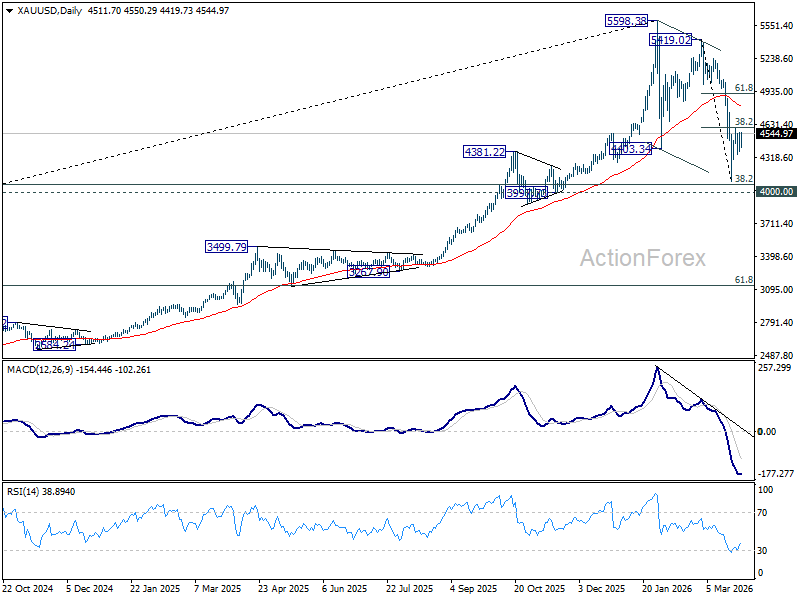
Until these conditions are met, the current structure remains a developing range rather than a confirmed reversal. Failure to hold above 4,100 on a retest would undermine the accumulation view and raise the risk that the broader decline from the March highs is still unfolding.
In the broader macro context, Gold’s ability to hold firm despite Dollar strength suggests that underlying demand is becoming more independent of traditional currency dynamics. This potential decoupling, if sustained, would further support the accumulation scenario, though it remains contingent on confirmation from both price structure and follow-through buying.