Sample Category Title
US Downgrade Will Focus Attention on Other Countries
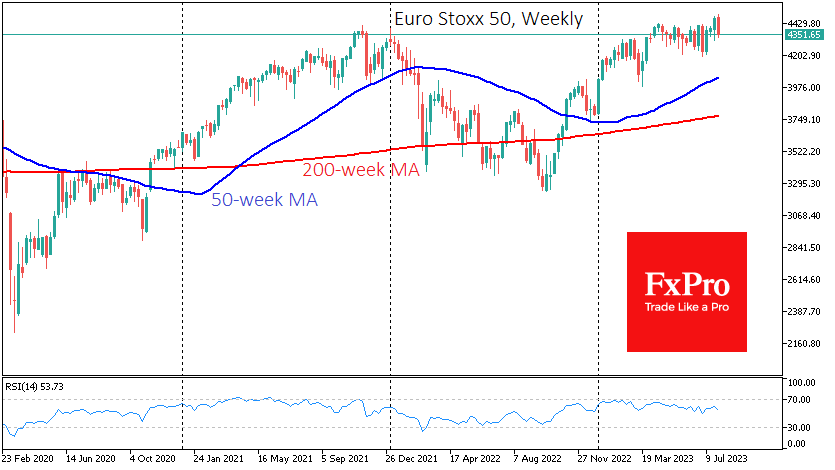
Fitch Ratings unexpectedly cut the US long-term credit rating by one notch to AA+. In response, markets have begun a gradual but broader risk repricing.
The suddenness of Fitch’s move is disconcerting, given that the rating was not under review and the outlook was stable. Moreover, another season of the sovereign debt ceiling saga ended a few months ago, and the next episode is not expected in the coming quarters. Standard & Poor’s actions, which made a similar move twelve years ago, were more logical. Then, for the first time in modern history, the states were faced with gridlocked lawmakers in the debate over the national debt ceiling. But since then, the repetition of the same scenario has made markets less and less reactive, as evidenced by their performance this spring.
Fitch’s rationale for this move is nothing new: deteriorating governance, chronic budget deficits and repeated negotiations to raise the debt ceiling.
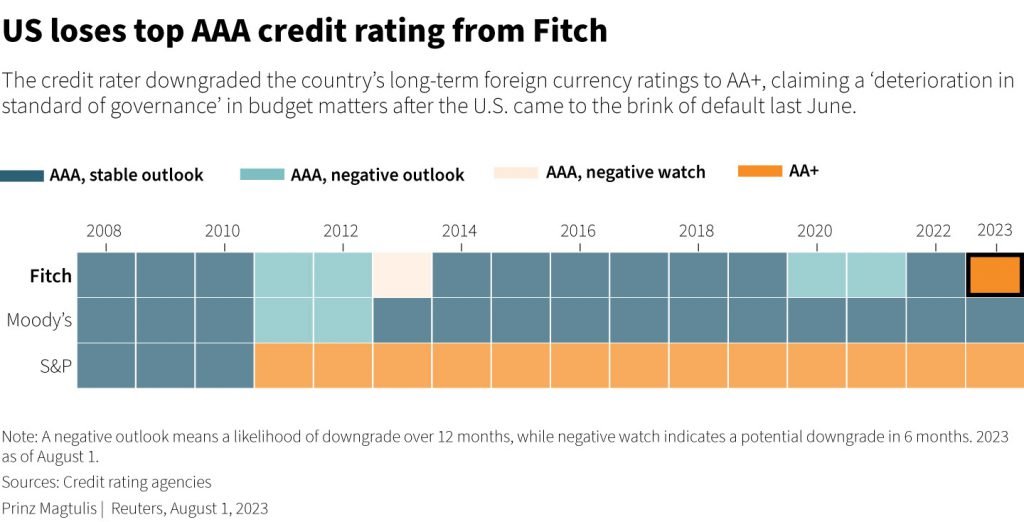
In 2011, after a similar move by the S&P500, the Nasdaq100 lost almost 17%, and the S&P500 lost 18% in four weeks of declines before regaining ground. Such amplitude is unlikely to be repeated, if only because the US economy is now in better shape, with unemployment at multi-decade lows and solid wage growth promising sales and corporate profits.
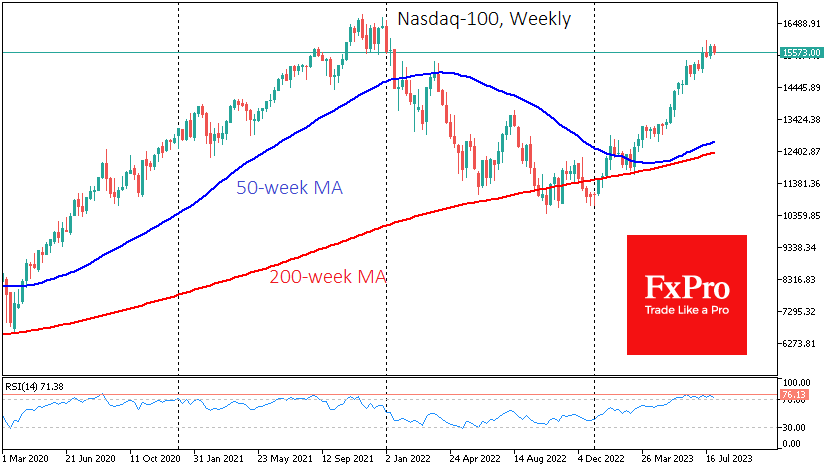
This news should trigger forced portfolio rebalancing by large funds in the coming days. In addition, the overbought conditions that have built up in recent weeks are now working against equity indices, increasing the potential for profit-taking. In short, if markets needed a reason to profit from the spring rally, they have it.
Perhaps in the most pessimistic scenario, the Nasdaq100 is unlikely to fall below 12500 from the current 15700, with more likely targets around 13500. The optimistic scenario suggests increased buying once it breaks below 15000.
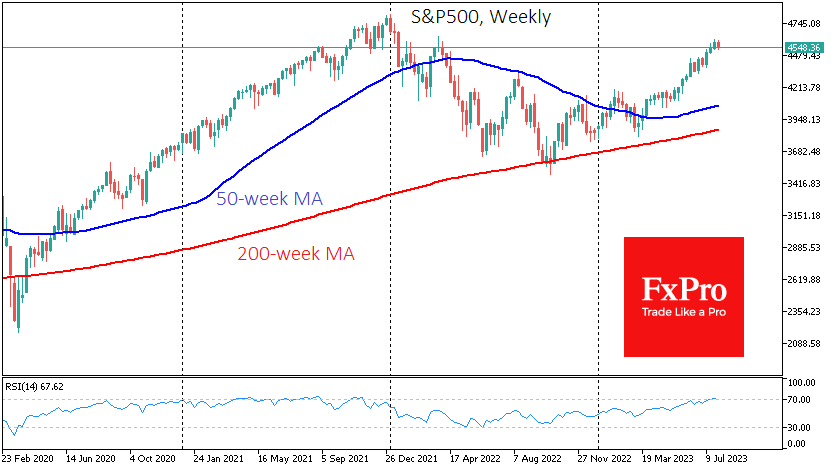
For the S&P500, the worst-case sell-off scenario could end near 4000 from the current 4577. More likely downside targets are around 4200, and it could end near 4400 in an optimistic scenario.
Unlike the actions of the monetary authorities, rating actions can affect both a country’s currency and equity markets, leading to a sell-off in the event of a downgrade.
However, a downgrade of the US credit rating will force investors to scrutinise other markets. Twelve years ago, problems in Greece, Spain and Italy became a significant concern within months. Now, even more than in southern Europe, the debt burden of China and other major emerging markets should be the focus of attention. There is also the question of whether Japan can keep up with the increased servicing of its gargantuan debt.
Major Crypto Market Players Try to Regain Buyers’ Trust
Market picture
The cryptocurrency market has regained its cap to above $1.18 trillion (+1.6% in 24 hours). The market’s initial rebound on buying back the most sagging assets was supported by the unexpected news of Fitch downgrading the US long-term rating on Wednesday, which triggered an impulsive pull into Bitcoin and gold.
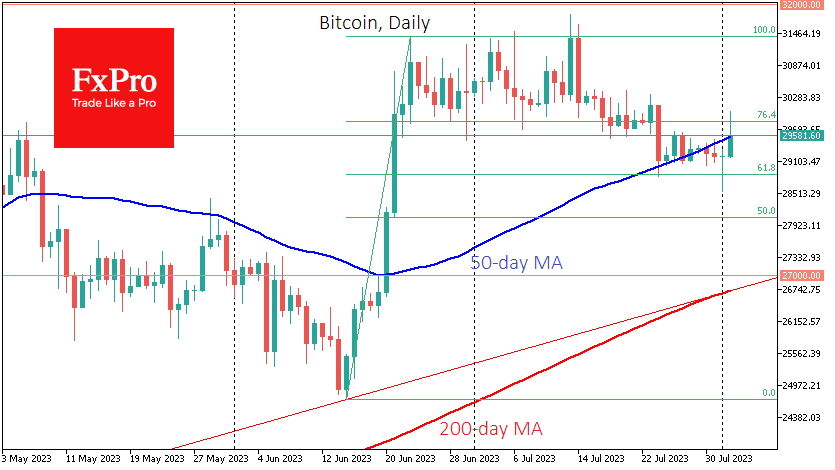
Bitcoin fell to $28.6K on Tuesday, hitting lows since June 21 amid market concerns over the Curve Finance hack and a likely drop in liquidity on the AAVE platform. The first cryptocurrency experienced impressive upward momentum, touching $30.0K early Wednesday morning. Although we do not see the realisation of a rapid decline scenario, for Bitcoin now, the 50-day moving average plays the role of resistance. The chances of a rapid decline will increase sharply with Wednesday’s close below $29.2K.
News background
TRON founder Justin Sun unexpectedly withdrew about $52 million in stablecoins from the decentralised finance protocol AAVE, impacting borrowing rates. In parallel, Sun announced a partnership between Tron and Curve. These actions stopped the slide of confidence in the cryptocurrency market and brought some speculative buyers back.
A positive signal for Bitcoin could be an increase in the reserves of mining pools. They reduced sales of cryptocurrency and resumed its accumulation, noted in CryptoQuant.
The U.S. will tax income from staking. The US Internal Revenue Service (IRS) has issued a new clarification, according to which the funds received from staking are considered income and should be taxed.
Tether, the issuer of USDT, the largest USDT stablecoin by capitalisation, reported excess reserves of $850 million, formed at the end of the second quarter of 2023.
New Zealand Dollar Sinks After Soft Jobs Report
- New Zealand unemployment rate rises
- NZD slide continues
- ADP Employment report smashes estimate
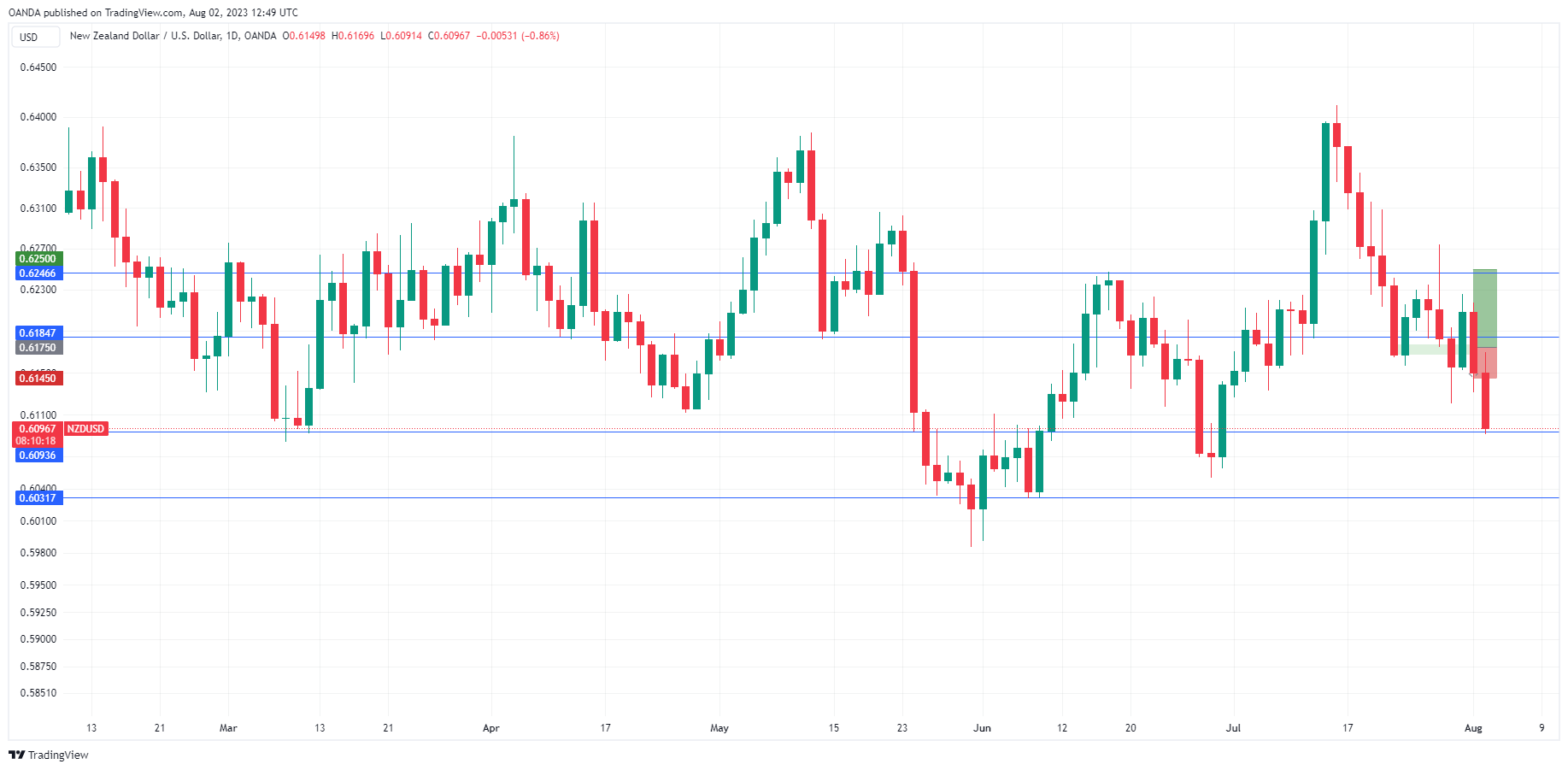
The New Zealand dollar has extended its losses on Wednesday. In the European session, NZD/USD is trading at 0.6093, down 0.91%. Earlier, NZD/USD touched a low of 0.6091, its lowest level since June 30th.
New Zealand unemployment climbs, wages dip
The New Zealand labour market has been tight, despite aggressive tightening by the Reserve Bank of New Zealand. Wednesday’s employment report for the second quarter showed some softening, which has extended the New Zealand dollar’s losses.
The unemployment rate rose to 3.6%, up from 3.4% in the first quarter and above the consensus estimate of 3.5%. Wage growth eased to 4.3%, below the 4.5% reading in Q1 and the estimate of 4.4%. These numbers point to a weaker labour market, but Employment Change rose 1.0%, up from 0.8% in Q1 and above the estimate of 0.5%. The mixed numbers show that the labour market may have lost a step but still remains strong enough to bear further rate hikes from the RBNZ. In July, the central bank maintained the cash rate at 5.50% and meets next on August 16th.
China released July PMIs this week, and the soft readings are weighing on the New Zealand dollar. China is New Zealand’s largest trading partner and the New Zealand dollar is sensitive to Chinese economic releases. We’ll get a look at the Caixin Services PMI on Thursday. The consensus estimate stands at 52.5, following a June reading of 53.9. A reading above 50.0 points to expansion.
In the US, the ADP Employment report kicked off a host of job releases, highlighted by nonfarm payrolls on Friday. ADP impressed with a gain of 327,000 for July, below the June reading of 455,000 but blowing past the consensus estimate of 189,000. A month ago, ADP came in at 497,000, fuelling speculation that nonfarm payrolls might follow suit with a strong release. In the end, nonfarm payrolls fell significantly, as expected. Will the NFP follow ADP’s lead and crush the estimate?
NZD/USD Technical
- NZD/USD is testing support at 0.6093. Below, there is support at 0.6031
- 0.6184 and 0.6246 are the next resistance lines
EUR/USD Mid-Day Outlook
Daily Pivots: (S1) 1.0957; (P) 1.0980; (R1) 1.1008; More...
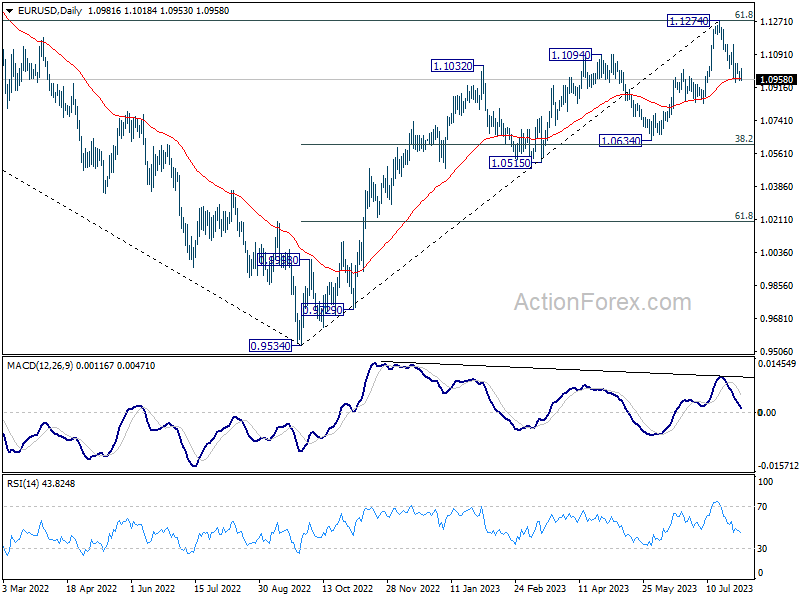
No change EUR/USD's outlook as range trading is still extending above 1.0942. Intraday bias stays neutral and further fall is expected as long as 1.1148 resistance holds. Below 1.0942 will target 1.0832 support next. Nevertheless, break of 1.1148 will argue that the decline has completed and bring retest of 1.1274 high.
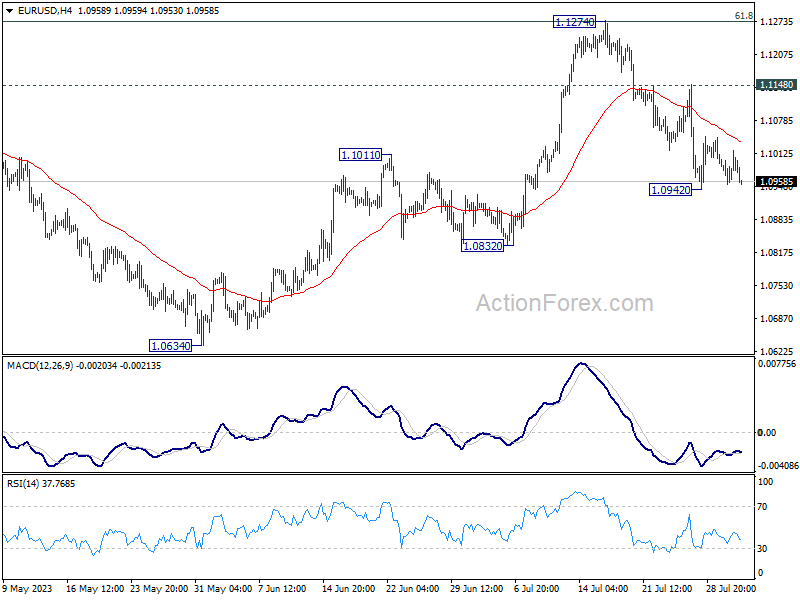
In the bigger picture, a medium term top could be formed at 1.1274, after failing to break through 61.8% retracement of 1.2348 (2021 high) to 0.9534 at 1.1273 decisively, on bearish divergence condition in D MACD. Sustained trading below 55 D EMA (now at 1.0963) will bring deeper correction to 1.0634 cluster support (38.2% retracement of 0.9534 to 1.1274 at 1.0609). Strong support could be seen there, at least on first attempt, to set the range for consolidation.
GBP/USD Mid-Day Outlook
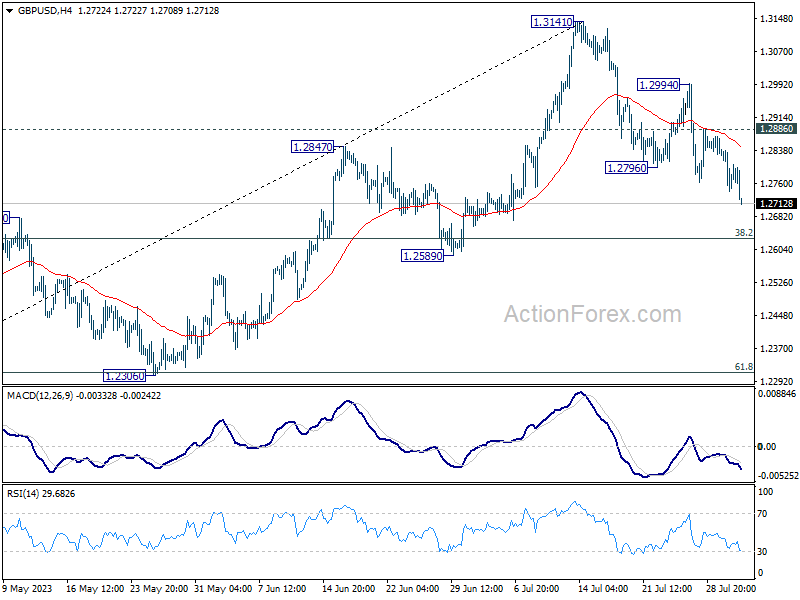
Daily Pivots: (S1) 1.2731; (P) 1.2786; (R1) 1.2832; More...
GBP/USD's fall from 1.3141 continues today and intraday bias stays on the downside. Deep decline would be seen to 38.2% retracement of 1.1801 to 1.3141 at 1.2629, as a correction to rise from 1.1801. On the upside, above 1.2886 minor resistance will turn bias back to the upside for stronger rebound.
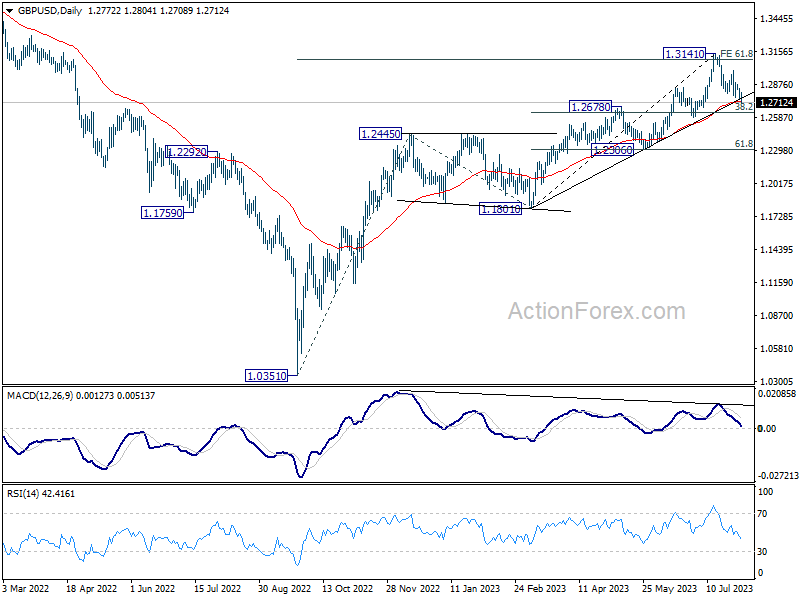
In the bigger picture, as long as 1.2678 resistance turned support holds, rise from 1.0351 (2022 low) is expected to continue through 1.3141 high at a later stage. However, sustained break of 1.2678 will argue that it's at least correcting this rally, with risk of bearish reversal. Deeper fall would be seen to 1.2306 support next.
USD/JPY Mid-Day Outlook
Daily Pivots: (S1) 142.52; (P) 143.03; (R1) 143.86; More...
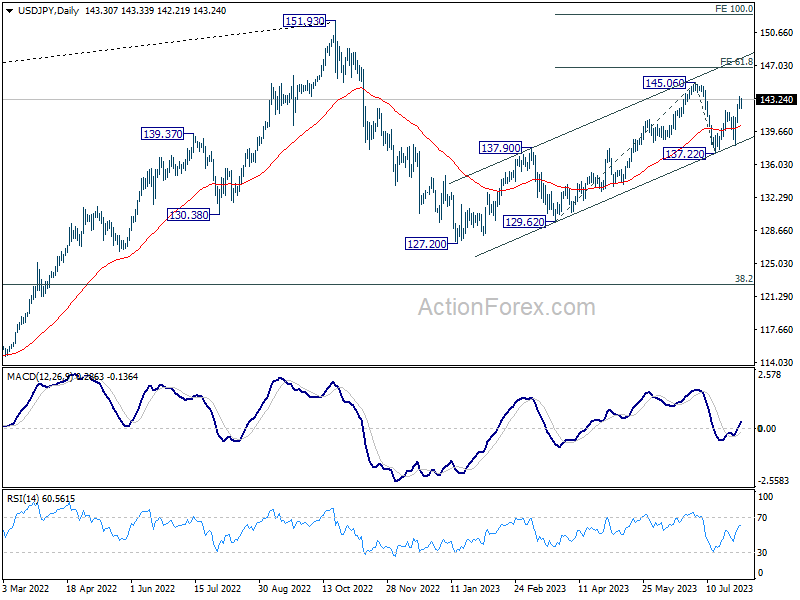
Despite today's retreat, intraday bias in USD/JPY stays on the upside with 141.99 minor support intact. Further rise should be seen to retest145.60 resistance first. Decisive break there will resume whole rally from 172.20. Next target is 61.8% projection of 129.62 to 145.06 from 137.22 at 146.76. On the downside, below 141.99 minor support will mix up the outlook and turn intraday bias neutral first.
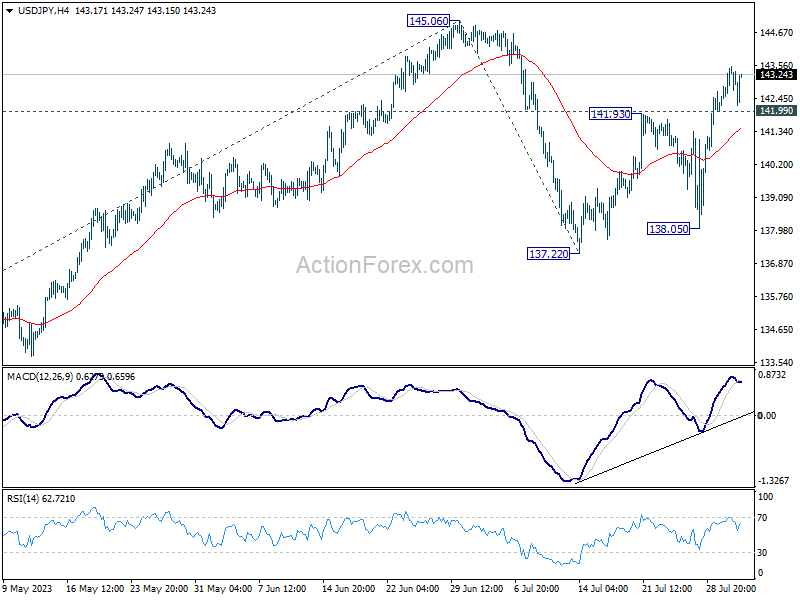
In the bigger picture, overall price actions from 151.93 (2022 high) are views as a corrective pattern. Rise from 127.20 is seen as the second leg of the pattern and could still be in progress. But even in case of extended rise, strong resistance should be seen from 151.93 to limit upside. Meanwhile, break of 137.22 support should confirm the start of the third leg to 127.20 (2023 low) and below.
USD/CHF Mid-Day Outlook
Daily Pivots: (S1) 0.8711; (P) 0.8745; (R1) 0.8784; More....
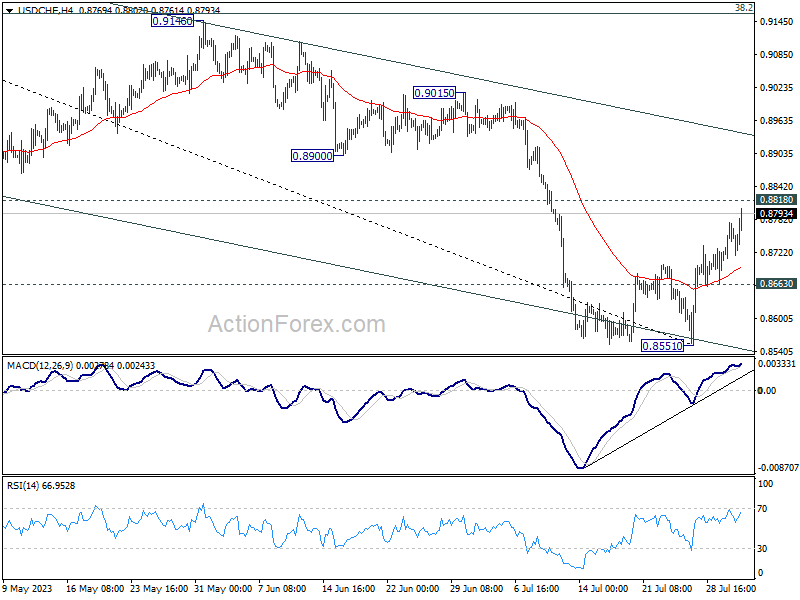
USD/CHF's rebound from 0.8551 is extending higher today and intraday bias stays on the upside. Rejection by 0.8818 support turned resistance will maintain near term bearishness. Further break of 0.8863 minor support will turn bias back to the downside for retesting 0.8551. Nevertheless, decisive break of 0.8818 will carry larger bullish implication, and target 0.9146 cluster resistance.
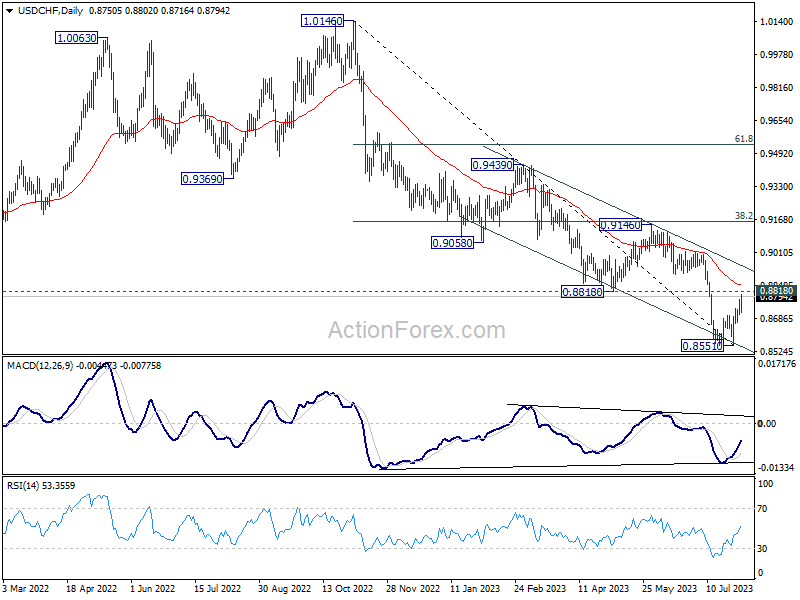
In the bigger picture, down trend from 1.0146 is seen as in progress as long as 0.8188 support turned resistance holds. Next target is 61.8% retracement of 0.7065 (2011 low) to 1.0342 (2016 high) at 0.8317. However, sustained break of 0.8818 should indicate medium term bottoming, and bring stronger rise back to 0.9146 cluster resistance (38.2% retracement of 1.0146 to 0.8551 at 0.9160), even as a correction.
Dollar Getting a Boost from Strong ADP Data and Risk Aversion
Dollar is making an effort to extend its near term rebound in early US session, bolstered by significantly stronger-than-expected ADP private job report. Concurrently, the greenback is finding support from the risk-off mood triggered by Fitch's unexpected downgrade of US sovereign rating, which sent global equities lower. However, Dollar's upside momentum seems far from being decisive, possibly an outcome of the typical summer trading slowdown. Yen, on the other hand, is having a slight recovery today, primarily due to exhaustion in its recent sell-off, though signs of a meaningful resurgence are yet to materialize.
On the European front, major currencies are showing mixed performance, with Euro holding up slightly better. Sterling seems to be in a dormant state, possibly in anticipation of tomorrow's BoE rate decision, while Swiss Franc clearly trails behind. Commodity currencies, however, continue to underperform, with the Canadian Dollar fairing slightly better than its peers. Aussie is facing headwinds from both the risk-off environment and reversal in Copper prices.
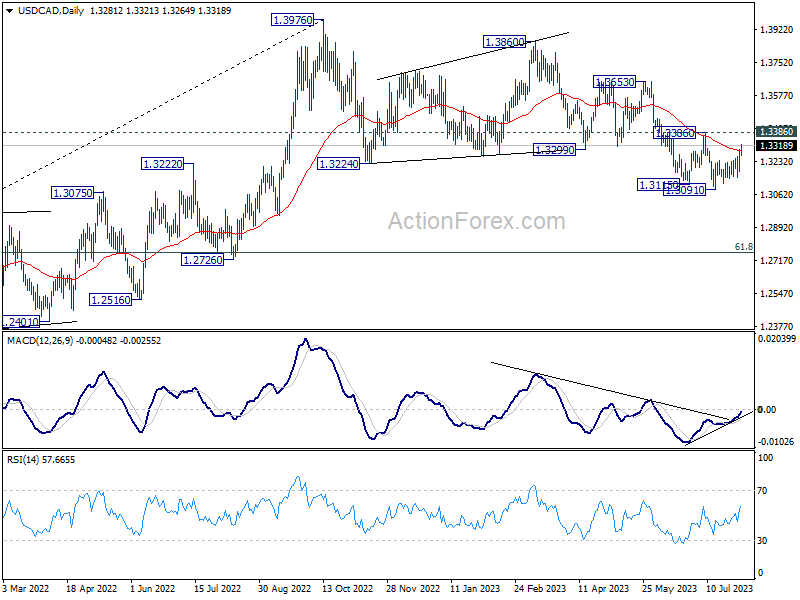
USD/CAD would be an interesting one to watch, even though it's a bit early for a mention now, considering that both US and Canada will publish job data on Friday. Technically speaking, today's break above 55 D EMA (now at 1.3292) is a near term bullish sign. Extended rally through 1.3386 resistance could mark the completion of whole corrective fall from 1.3976 (2022 high), with three waves down to 1.3091. That would set up a short-to-medium term rally back towards this high. Let's see if the data could trigger this scenario.
In Europe, at the time of writing, FTSE is down -0.95%. DAX is down -0.94%. CAC is down -0.56%. Germany 10-year yield is down -0.0434 at 2.515. Earlier in Asia, Nikkei fell -2.30%. Hong Kong HSI fell -2.47%. China Shanghai SSE fell -0.89%. Singapore Strait Times fell -1.45%. Japan 10-year JGB yield jumped 0.0338 to 0.628.
US ADP jobs rose 324k, slowdown in pay growth without broad-based job loss
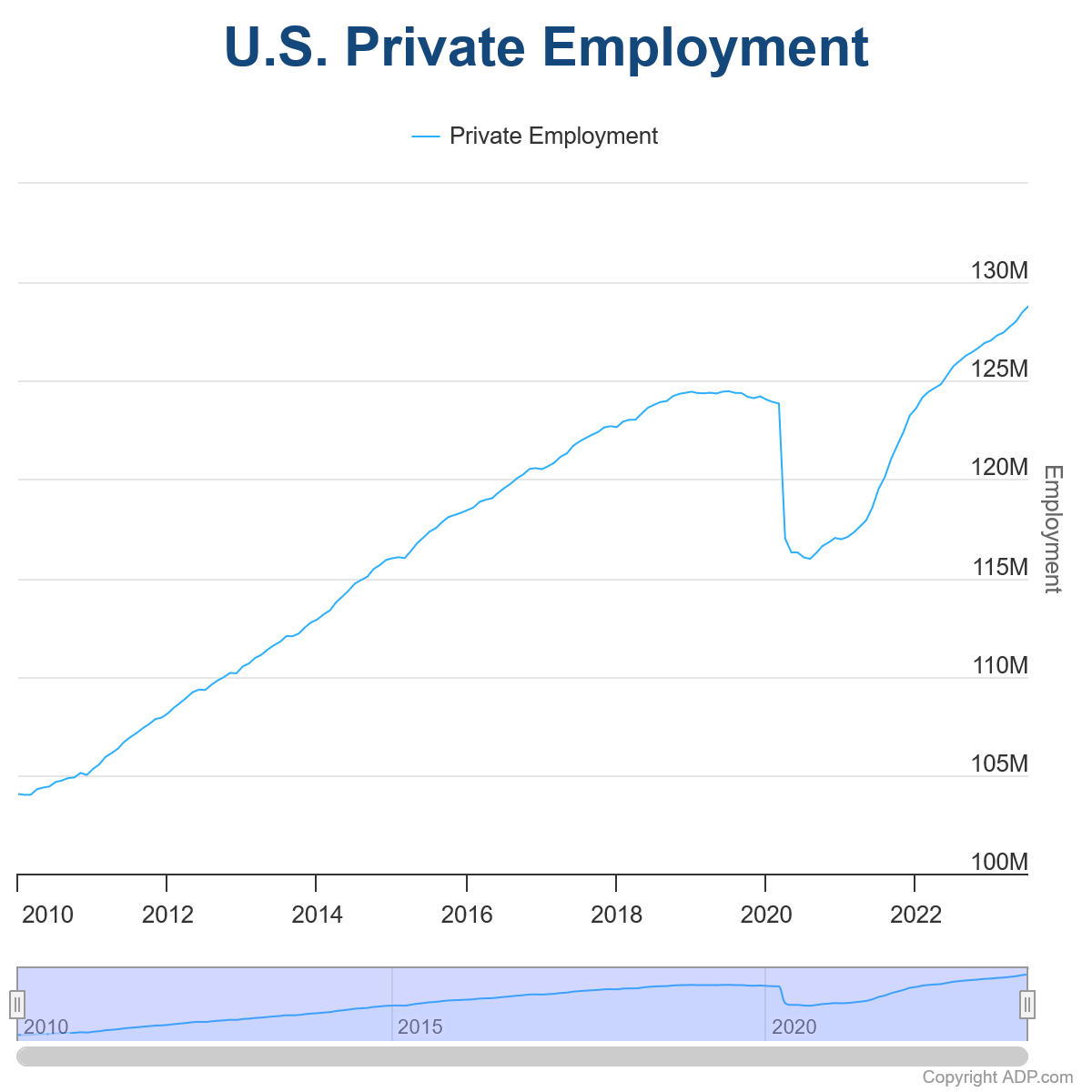
US ADP private employment grew 324k in July, well above expectation of 195k. By sector, goods-producing jobs rose 21k while service-providing jobs rose 303k. By establishment size, small companies added 237k jobs, medium added 138k, large lost -67k. Job-stayers annual pay growth fell to 6.2% yoy, slowest pace since November. Job-changers annual pay growth also fell to 10.2% yoy.
Nela Richardson Chief Economist, ADP, said: "The economy is doing better than expected and a healthy labor market continues to support household spending. We continue to see a slowdown in pay growth without broad-based job loss."
BoJ Uchida: Monetary easing to continue to nurture firms' changing pricing strategies
BoJ Deputy Governor Shinichi Uchida highlighted in a speech today an emerging trend in firms' pricing strategies, noting that "firms are developing more forward-looking strategies for setting prices." According to Uchida, these changes "might be the chance to finally change Japan's economy." Hence, he emphasized BoJ will "patiently continue with monetary easing to carefully nurture these signs."
Uchida was explicit in outlining the Bank's monetary policy stances. Firstly, he ruled out near-term adjustments to short-term interest rate, currently at -0.10%, stating "there is still a long way to go before such decisions are made."
Secondly, BoJ will "maintain the current framework" until sustainable and stable achievement of 2% inflation target "come in sight".
Thirdly, Uchida affirmed the ongoing yield curve control under the present policy framework, aiming to balance its benefits and drawbacks, especially in relation to financial intermediation and the market.
Despite the high economic and price outlook uncertainty, Uchida stated the recent yield curve control modification, allowing the 10-year JGB yield to rise to up to 1%, is aimed at sustaining the ultra-loose policy. "Needless to say, we do not have an exit from monetary easing in mind," he emphasized.
New Zealand employment up 1% in Q2, wage inflation unchanged at 4.3% yoy
New Zealand reported a better-than-expected employment growth of 1.0% in the second quarter of 2023, surpassing market expectations of a 0.6% rise. On the other hand, unemployment rate slightly increased from 3.4% to 3.6%, marginally above the anticipated 3.5%.
The data released showed that employment rate rose from 69.6% to 69.8%, and the participation rate increased from 72.0% to 72.4%. These are the highest rates recorded since the series began in 1986.
In terms of wage growth, all sector wage inflation climbed by 1.1% on a quarterly basis, resulting in an annual increase of 4.3%. "Annual wage costs continued to increase at historically high rates this quarter, equal to the 4.3 percent annual increase last quarter," said Bryan Downes, business prices delivery manager.
Downes noted that the most significant contribution to the Labour Cost Index for the June 2023 quarter came from retail trade and accommodation industry. This sector witnessed 1.5% increase in wages on a quarterly basis, following 0.7% rise in the previous quarter. The wage growth in this industry was primarily driven by rise in minimum wage, thereby pushing up overall wage growth during the quarter.
USD/CHF Mid-Day Outlook
Daily Pivots: (S1) 0.8711; (P) 0.8745; (R1) 0.8784; More....
USD/CHF's rebound from 0.8551 is extending higher today and intraday bias stays on the upside. Rejection by 0.8818 support turned resistance will maintain near term bearishness. Further break of 0.8863 minor support will turn bias back to the downside for retesting 0.8551. Nevertheless, decisive break of 0.8818 will carry larger bullish implication, and target 0.9146 cluster resistance.
In the bigger picture, down trend from 1.0146 is seen as in progress as long as 0.8188 support turned resistance holds. Next target is 61.8% retracement of 0.7065 (2011 low) to 1.0342 (2016 high) at 0.8317. However, sustained break of 0.8818 should indicate medium term bottoming, and bring stronger rise back to 0.9146 cluster resistance (38.2% retracement of 1.0146 to 0.8551 at 0.9160), even as a correction.
Economic Indicators Update
| GMT | Ccy | Events | Actual | Forecast | Previous | Revised |
|---|---|---|---|---|---|---|
| 22:45 | NZD | Employment Change Q2 | 1.00% | 0.60% | 0.80% | 1.10% |
| 22:45 | NZD | Unemployment Rate Q2 | 3.60% | 3.50% | 3.40% | |
| 23:50 | JPY | Monetary Base Y/Y Jul | -1.30% | -0.70% | -1.00% | |
| 23:50 | JPY | BoJ Minutes | ||||
| 07:00 | CHF | SECO Consumer Climate Q3 | -27 | -25 | -30 | |
| 07:30 | CHF | Manufacturing PMI Jul | 38.5 | 44.2 | 44.9 | |
| 12:15 | USD | ADP Employment Change Jul | 324K | 195K | 497K | |
| 14:30 | USD | Crude Oil Inventories | -0.9M | -0.6M |
US ADP jobs rose 324k, slowdown in pay growth without broad-based job loss
US ADP private employment grew 324k in July, well above expectation of 195k. By sector, goods-producing jobs rose 21k while service-providing jobs rose 303k. By establishment size, small companies added 237k jobs, medium added 138k, large lost -67k.
Job-stayers annual pay growth fell to 6.2% yoy, slowest pace since November. Job-changers annual pay growth also fell to 10.2% yoy.
Nela Richardson Chief Economist, ADP, said: "The economy is doing better than expected and a healthy labor market continues to support household spending. We continue to see a slowdown in pay growth without broad-based job loss."
Japanese Yen Gain Rebounds after Dovish Remarks from BoJ
- BoJ says no plans to exit easy monetary policy
- US to release ADP Employment report on Wednesday
- USD/JPY rebounds
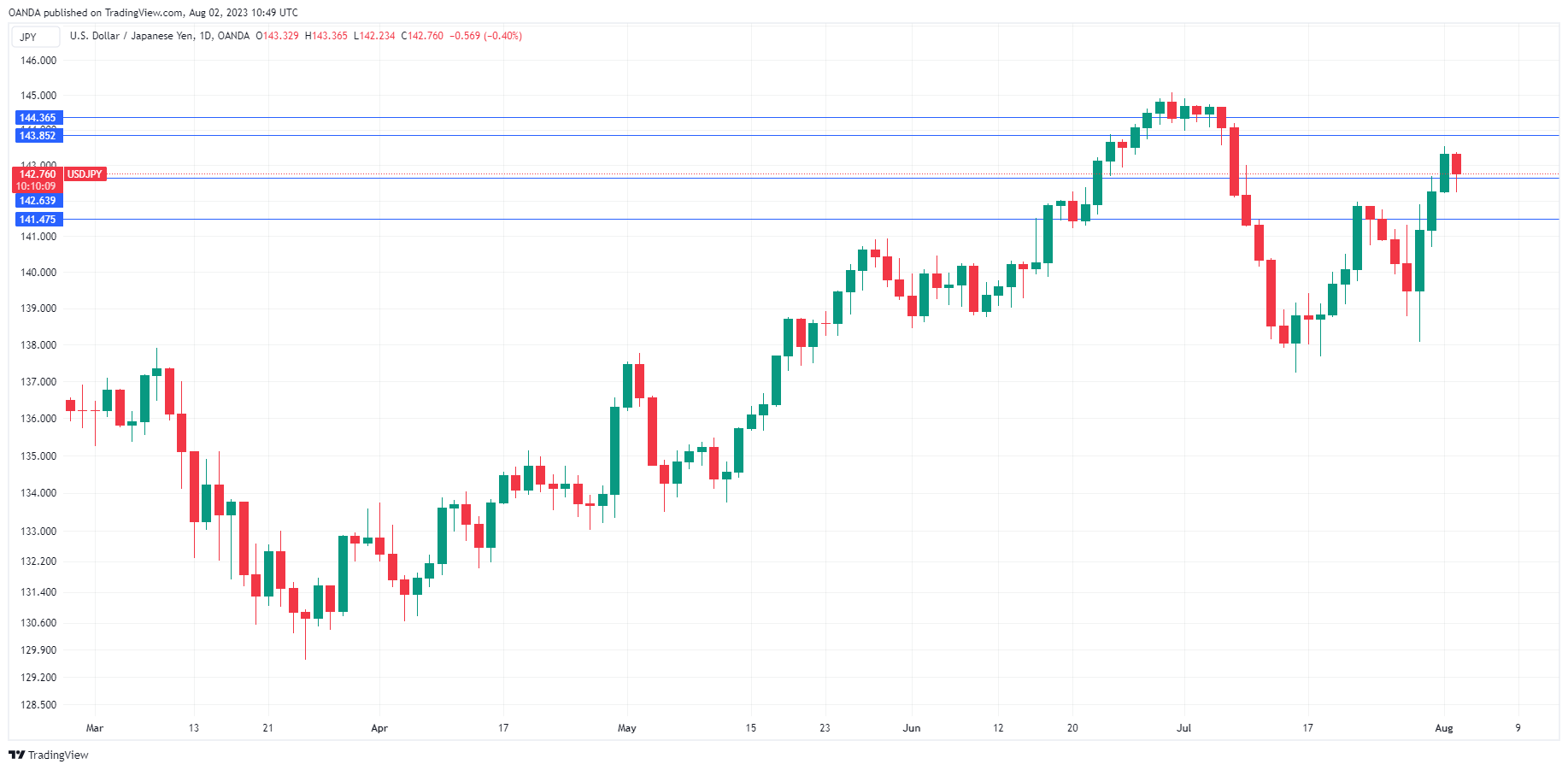
The Japanese yen has reversed a nasty three-day slide on Wednesday. In the European session, USD/JPY is trading at 142.75, down 0.40%.
BoJ says monetary easing to continue
The BoJ triggered some turmoil in the currency markets last week when it unexpectedly eased its yield curve control. This raised speculation that the move marked a shift in the BoJ’s ultra-loose monetary policy, perhaps even the beginning of the end of the policy. The yen has taken a plunge, falling over 400 basis points against the dollar over the past several days.
The BoJ has moved quickly to dampen speculation of an exit from its policy. On Wednesday, Deputy Governor Ichida said that the BoJ’s more flexible threshold for 10-year bond yields was only a modification to sustain its ultra-loose monetary position. Ichida added that the BoJ does not have “an exit from monetary easing in mind”. These comments were a repeat of BoJ Governor Ueda’s comments on Friday that the tweak to the YCC was not a step toward normalization.
Ichida’s comments had the desired effect and provided a boost to the Japanese yen on Wednesday. But for how long? Investors aren’t at all convinced that the central bank won’t shift policy, as the BoJ will often say one thing and then do the opposite in order to catch the markets by surprise. This may enable the BoJ to stay one step ahead of the speculators but it certainly does not enhance the Bank’s credibility. I would not be surprised to see the yen renew its downswing in the short term.
In the US, investors will be keeping a look at today’s ADP Employment report. The report made headlines last week with a massive gain of 497,000, fuelling speculation that nonfarm payrolls might follow suit with a banner release. In the end, nonfarm payrolls fell significantly, as expected, a reminder that ADP is not all that reliable as a precursor of nonfarm payrolls.
USD/JPY Technical
- USD/JPY is testing support at 142.63. Next is support at 141.47
- There is resistance at 143.86 and 144.37