Sample Category Title
XAU/USD: Bulls Taking a Breather Under Record Highs Zone Ahead of Fresh Push Higher
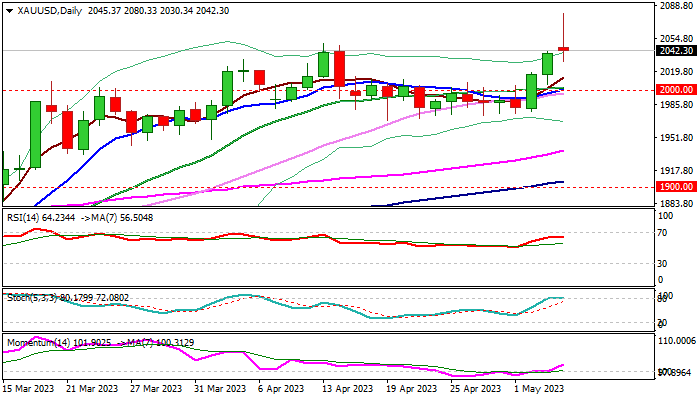
Gold price pulled back from the zone of record highs, which was tested for the third time in post-Fed acceleration, sparked by fresh safe haven demand following the central bank’s dovish steer in rate outlook and growing economic risks.
Gold price remains steady and well above $2000 level, with current easing so far seen as consolidation ahead of firm break of recent record high, which will signal an end of a multi-month range trading ($2074/$1614) and continuation of a larger uptrend.
A number of factors contribute to the bullish outlook for the metal, with primary drivers being Fed’s signals of pause in its policy tightening cycle, growing uncertainty about the US economic growth, hurt by high borrowing costs, increased stress in banking sector and concerns about US debt ceiling.
Markets await release of US labor report for April on Friday (180K f/c vs 236K in March) for further signals, with release at/below consensus to add to signals that growth in hiring remains in a downward trajectory (excluding spikes in July 2022 and Jan 2023) that would add to uncertainty and offer more support to the yellow metal.
Strong headwinds from the $2070/80 zone of record highs were expected, as the action has already pulled back twice after a failure in this area and daily studies are overbought, with limited consolidation to remain above strong support at $2000 zone (psychological, reinforced by converged 10/20DMA’s) to keep bulls intact.
Res: 2048; 2070; 2074; 2080.
Sup: 2030; 2015; 2000; 1978.
European Central Bank Slows The Pace Of Monetary Tightening
Summary
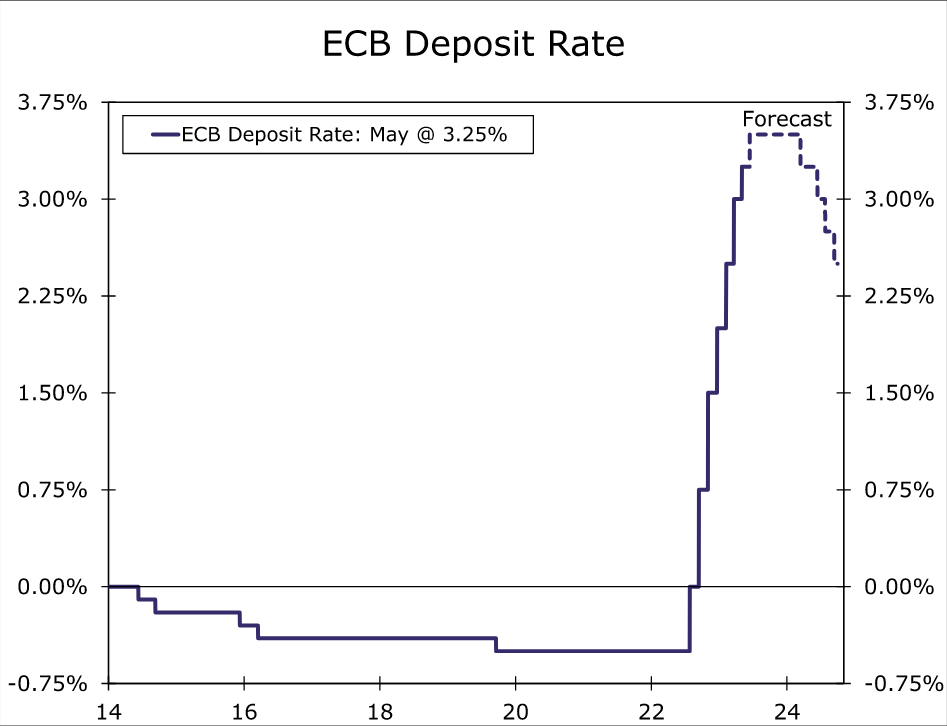
- The European Central Bank (ECB) offered its latest monetary policy assessment today, delivering a smaller rate increase than at previous meetings. In a widely expected move, the ECB raised its Deposit Rate by 25 bps to 3.25%. Meanwhile, the economic message was little changed, in that the ECB said the “inflation outlook continues to be too high for too long.”
- Today's ECB announcement does not meaningfully alter our outlook for Eurozone monetary policy. We think the ECB will deliver at least one more 25 bps rate hike in June, which would take the Deposit rate to 3.50%. If core inflation does not slow meaningfully in the months ahead, then further tightening beyond that remains a distinct possibility. The risks around our peak policy rate forecast of 3.50% remain tilted to the upside.
European Central Bank Slows The Pace Of Monetary Tightening
The European Central Bank (ECB) offered its latest monetary policy assessment today, delivering a smaller rate increase than at previous meetings. In a widely expected move, the ECB raised its Deposit Rate by 25 bps to 3.25%. Meanwhile, the economic message was little changed, in that the ECB said the “inflation outlook continues to be too high for too long.” The ECB said headline inflation has declined over recent months, but underlying price pressures remain strong.
With regard to balance sheet reduction, the ECB's action was also broadly as expected. The ECB said its Asset Purchase Programme portfolio is declining at €15 billion per month on average, and will continue to do so through until June 2023. The ECB said it expects to discontinue reinvestments under the APP as of July 2023. Given that APP redemptions are projected to average €23.3 billion in Q3-2023, €26.2 billion in Q4-2023, and €30.1 billion in Q1-2024, that represents a modest ramping up in the pace of balance sheet reduction. While the ECB's key interest rates and its balance sheet management are distinct elements of its monetary policy toolkit, the fact the ECB is quickening its balance sheet reduction doesn't sound to us like a central bank that has imminently reached the end of its rate hike cycle. Indeed, in the post meeting press conference ECB President Lagarde said it's "very clear that we are not pausing and that we know we have more ground to cover."
Finally, we also note a modest change in language that arguably gave today's announcement a modestly dovish tinge, perhaps in part explaining the decline in the euro and fall in Eurozone government bond yields immediately following the announcement. The ECB said “past rate increases are being transmitted forcefully to euro area financing and monetary conditions.” The use of the word “forceful” is new, and perhaps a reference to the bank lending survey earlier this week that showed tight lending standards and soft loan demand.
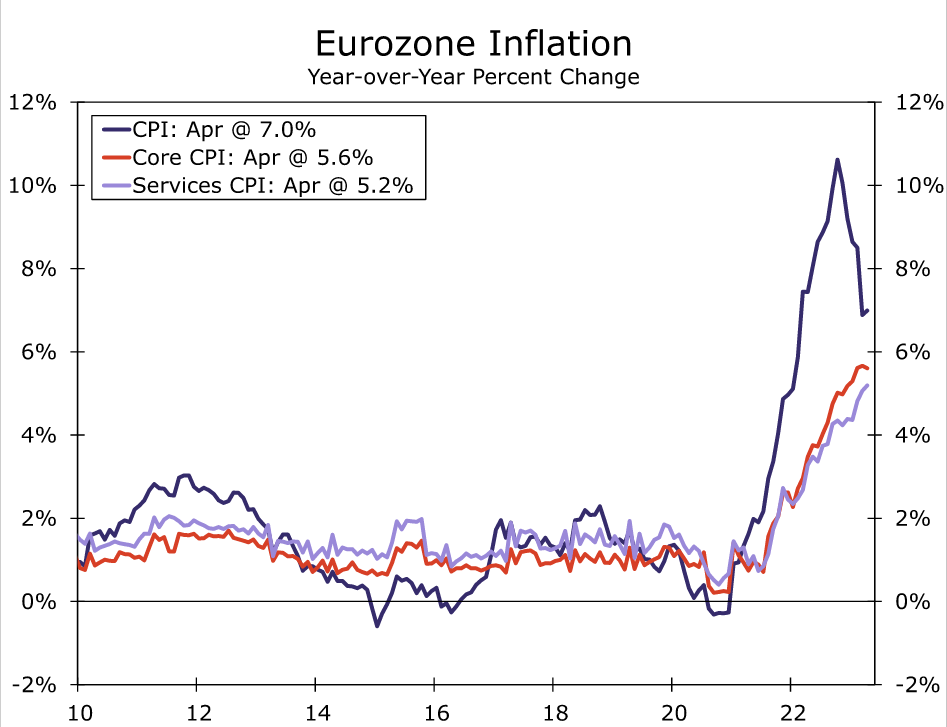
That said, today's ECB announcement does not meaningfully alter our outlook for Eurozone monetary policy. Even given some signs of tighter credit conditions and softer loan growth, we believe it will be inflation trends, and in particular underlying inflation trends, that will be most critical to the ECB's future policy actions. In that context, the Eurozone April CPI released earlier this week was something of a mixed bag. The headline CPI unexpectedly ticked higher to 7.0% year-over-year, and while the core CPI eased to 5.6%, services inflation actually quickened a touch to 5.2%. We think that this pace of inflation will be enough for the ECB to deliver at least one more 25 bps rate hike in June, which would take the Deposit rate to 3.50%. If core inflation does not slow meaningfully in the months ahead, then further tightening beyond that remains a distinct possibility. The risks around our peak policy rate forecast of 3.50% remain tilted to the upside.
Swiss Franc Hits 16-Week High on Dovish Fed
- Swiss inflation expected to rise to 0.5%
- Swiss franc’s appreciation raises concerns at SNB
- Fed raises rates by 25 bp
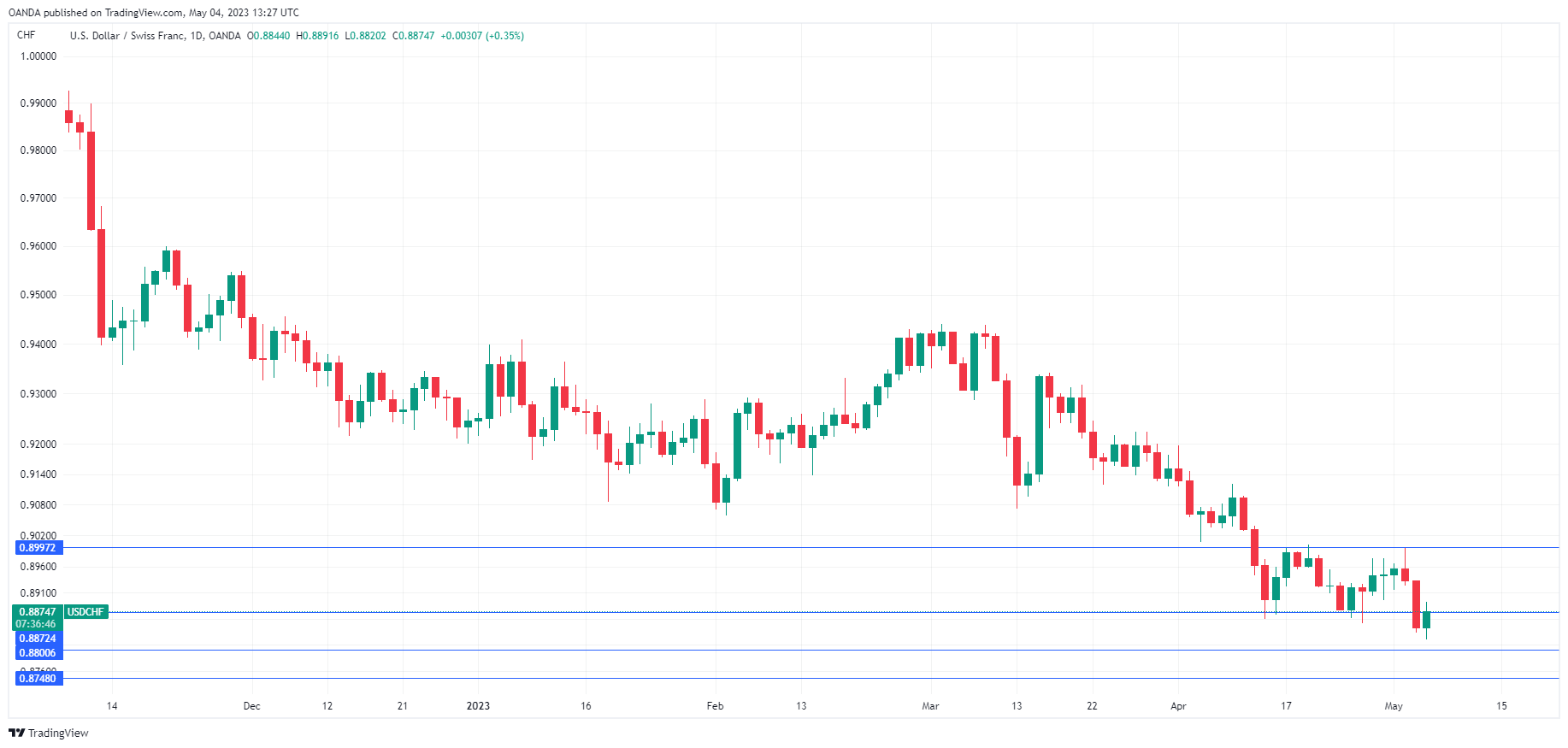
USD/CHF is trading at 0.8872 today, up 0.32%. The pair is recovering after the Swiss franc surged by 1% a day earlier.
USD/CHF falls close to 0.88 line
The Swiss franc pummelled the US dollar on Wednesday and USD/CHF fell as low as 0.8820 today, its lowest level since January 21st. The Swissie has gained around 200 points in just three weeks and 600 points since March 1st. This sharp upswing is likely raising eyebrows at the Swiss National Bank, which has little appetite for sharp exchange rate moves. The central bank keeps a careful eye on the value of the Swiss franc and has on occasion intervened in the currency markets, drawing sharp criticism from the US Treasury Department.
The SNB is concerned that if a rise in the value of the Swiss franc will dampen the economy, which is heavily reliant on exports. This week’s data reiterated that the Swiss economy is showing some signs of strain. Consumer confidence fell to -13 in the second quarter, down from -9 in Q1. Manufacturing PMI continued to decline, slowing from 47.0 to 45.3 in April. The week wraps up with CPI for April on Friday, CPI is expected to rise to 0.5% m/m, up from 0.2% in March. A rise in inflation could weigh on the Swiss franc, which would be good news for central bank policy makers.
Fed hikes by 25 bp
In the US, the Fed raised rates by 25-bp, as widely expected. Investors zoomed in the dovish rate statement, with the Fed removing the phrase “some additional” rate hikes might be needed. It changed the language to say that it would examine various factors in “determining the extent” that further hikes would be needed. The Swiss franc responded with sharp gains against the greenback.
Powell sounded more hawkish in the press conference, saying that higher interest rates had not sufficiently slowed down the economy, the labour market or inflation. Just to be crystal clear, Powell said that “inflation pressures continue to run high, and the process of getting inflation back down to 2% has a long way to go”. Powell said a rate cut was unlikely given high inflation, but the markets have priced in a rate cut in September at 80%.
USD/CHF Technical
- USD/CHF is testing resistance at 0.8872. The next resistance line is 0.8997
- 0.8800 and 0.8748 are providing support
Sunset Market Commentary
Markets
The ECB lift its key policy rates by 25 bps today with the key deposit rate now at 3.25%. That’s a downshift from the previous 50 bps pace which we expected to be continued, but in line with market expectations. The decision wasn’t unanimous, but the 50 bps pace was the minority call. The press statement starts with the notion that the inflation outlook continues to be too high for too long with recent data broadly confirming the inflation outlook as set out in March. Especially underlying price pressures remain strong and risks to the inflation outlook remain tilted to the upside. The final sentence of the statement dropped a first hint as to why the ECB slowed its tightening pace: “the past rate increases are being transmitted forcefully to euro area financing and monetary conditions, while the lags and strength of the transmission to the real economy remain uncertain.” A second one came during ECB Lagarde’s press conference where she made clear that the Bank Lending Survey published earlier this week was decisive for reducing the tightening pace to 25 bps. Loan growth for firms and households weakened owing to higher borrowing rates, tighter credit supply and lower demand. The ECB’s tightening cycle isn’t over though with the central bank continuing to follow a data-dependent approach and vowing to bring policy rates to sufficiently restrictive levels in future decisions (plural, emphasis added; Lagarde namedropped the June, July & September meetings) to achieve a timely return of inflation to the 2% target. As Lagarde said: “it’s clear that the ECB isn’t pausing and that we have more ground to cover”. There’s no magic (policy rate) number for a sufficiently restrictive policy, but we’re not there yet. Perhaps somewhat as a (minor) quid pro quo – though denied by Lagarde – the ECB announced that it expects to discontinue the reinvestments under the APP all together as of July. That compares to the current €15bn/month pace during Q2 and was suggested by the likes of ECB Wunsch and others over the past two weeks. Over the next 12 months, this new APP reinvestment stance suggests that an additional €160bn of liquidity will pulled from the market. These amounts will gain traction in coming years given the way the €3200bn APP portfolio was built mainly during 2016-2018 (average maturity of APP portfolio rapidly declining). Lagarde confirmed that the end goal was an empty APP portfolio in 15 years’ time, but the ECB keeps some optionality in the process. European yields initially dropped at the front end of the curve with markets interpreting the dovish hike as bringing us to a 3.5% terminal rate already by June. The front end recovered somewhat during the press conference as Lagarde stressed that the journey isn’t over yet. Longer bond yields immediately started rising on a combination of ending APP reinvestments, but also on rising inflation expectations. Changes on the German yield curve vary between -5.1 bps (2-yr) and +7.2 bps (30-yr). EUR/USD in a same way fell from 1.1080 to 1.10 before rebounding back to 1.1040. The EuroStoxx50 erased some of the intraday losses on the ECB call to currently lose around 0.5%.
News & Views
The Norwegian central bank raised its policy rate by 25 bps to 3.25% today. In evaluating its March projections it concluded that: inflation (6.5%) was higher than expected, economic activity - private consumption in particular - stronger, the labour market tighter, wage growth faster and the Norwegian krone (much) weaker. The latter just yesterday set a new record low at EUR/NOK 11.89, excluding the illiquid period shortly after the pandemic outbreak. All of the above arguments argue for a higher terminal rate. Yet, the Norges Bank stuck to the March guidance projecting a 3.5% peak policy rate by June. Governor Ida Wolden Bache did finish the policy statement saying that “If the krone remains weaker than projected or pressures in the economy persist, a higher policy rate than envisaged earlier may be needed.” But it is possible that Oslo is looking for new economic forecasts (due in June) to underpin such a higher rate path. With the benefit of the doubt, the Norwegian krone slightly appreciates today to EUR/NOK 10.83. Norwegian swap yields eke out a few bps across the curve.
French Finance Minister Le Maire together with Bank de France and ECB governor Villeroy will discuss potential adjustments to mortgage rules on Friday to ease credit distribution in the country, Agence France-Presse reported citing Le Maire. The two are expected to discuss the so-called usury rate; the maximum rate at which French banks can lend. This cap is being reviewed every month until July instead of every quarter, an exceptionality that authorities may extend. Lending rules that state that banks cannot distribute loans if repayments exceed 35% of borrower’s income are also subject for discussion in a bid to create more lender flexibility.
Euro Dips after ECB Hike, But Stabilize With Help from Lagarde
Euro dips initially after ECB stepped down tightening pace with a 25bps rate hike today. But it then quickly recovers after ECB President Christine Lagarde firmly said in the press conference, "We are not pausing. That's very clear… We know we have more ground to cover." Overall though, Euro is on the weaker side today, just performing slightly better than Swiss France. New Zealand and Canadian Dollar are the better performances together with Sterling. Dollar and Yen are mixed for now. With ECB risk cleared, focuses will turn to tomorrow's US non-farm payrolls.
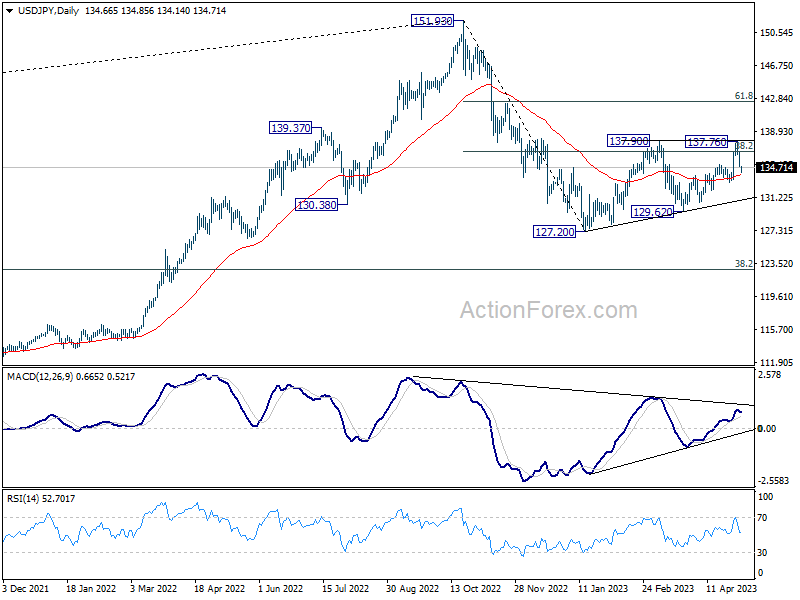
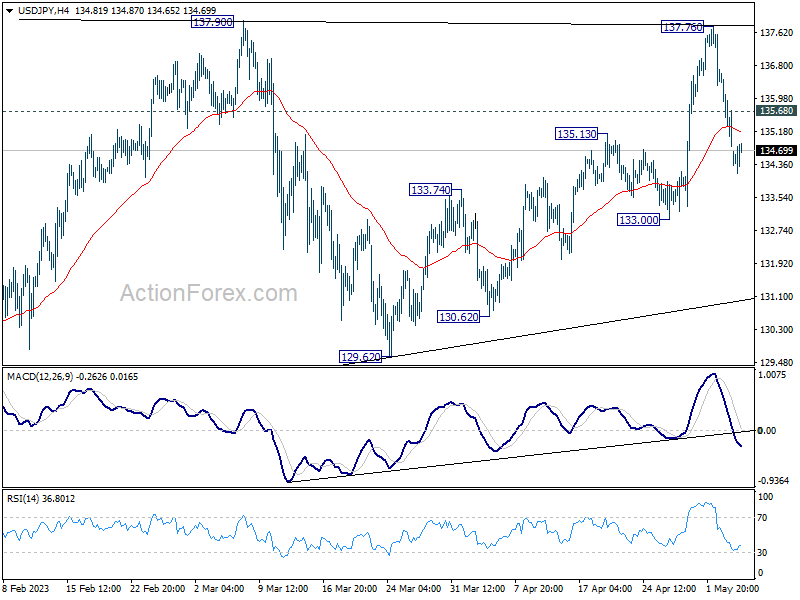
Technically, USD/JPY would be worth a watch in the time leading up to NFP tomorrow. For now, 137.76 should be a short term top and fall from there is in favor to extend lower as long as 135.68 minor resistance holds. Renewed decline in US treasury yields and stocks could prompt deeper fall in the pair through 133.00 support. That would be a sign of investor positioning ahead of the last key event of the week.
In Europe, at the time of writing, FTSE is down -0.76%. DAX is down -0.62%. CAC is down -0.96%. Germany 10-year yield is up 0.0254 at 2.277. Earlier in Asia, Japan was on holiday. Hong Kong HSI rose 1.27%. China Shanghai SSE rose 0.82%. Singapore Strait Times rose 0.22%.
US initial jobless claims jumped to 242k
US initial claims rose 13k to 242k in the week ending April 29, higher than expectation of 235k. Four-week moving average of continuing claims rose 3.5k to 239k.
Continuing claims dropped -38k to 1805k in the week ending April 22. Four-week moving average of continuing claims dropped -4.5k to 1828k.
ECB hikes 25bps, reiterates data-dependent approach
ECB raised its three key interest rates by 25bps today, with main refinancing rate, marginal lending rate, and deposit rate becoming 3.75%, 4.00%, and 3.25%, respectively, effective May 10.
In the accompanying statement, ECB explained that incoming information broadly supports the assessment of the medium-term inflation outlook that the Governing Council formed at its previous meeting." While headline inflation has declined recently, the ECB noted that "underlying price pressures remain strong."
The central bank acknowledged that the transmission of past rate increases to euro area financing and monetary conditions has been forceful, but added that "the lags and strength of transmission to the real economy remain uncertain."
ECB emphasized its commitment to ensuring that policy rates are "sufficiently restrictive" to achieve a timely return of inflation to the 2% medium-term target, stating that rates will be kept at these levels "for as long as necessary".
The Governing Council will continue to follow a data-dependent approach, basing its policy rate decisions on assessments of inflation outlook in light of incoming economic and financial data, underlying inflation dynamics, and strength of monetary policy transmission.
Eurozone PPI at -1.6%mom, 5.9% yoy in Mar
Eurozone PPI came in at -1.6% mom, 5.9% yoy in March, versus expectation of -1.4% mom, 5.9% yoy. For the month, industrial producer prices decreased by -4.8% in energy sector and by -0.4% for intermediate goods, while prices increased by 0.2% for capital goods, by 0.3% for durable consumer goods and by 0.9% for non-durable consumer goods. Prices in total industry excluding energy increased by 0.2%.
EU PPI came in at -1.5% mom, 7.0% yoy. The largest monthly decreases in industrial producer prices were recorded in Greece (-7.3%), Ireland (-4.6%) and Lithuania (-4.0%), while the highest increases were observed in Cyprus (+2.4%), France (+2.0%) and Croatia (+0.5%).
Eurozone PMI services finalized at 12-month High, growth to continue in months ahead
Eurozone PMI Services were finalized at 56.2 in April, up from March's 55.0, marking a 12-month high. PMI Composite was finalized at 54.1, up from March's 53.7, an 11-month high.
Among member states, Italy's PMI composite rose to 55.3, a 17-month high, while Germany's increased to 54.2, a 12-month high. Ireland rose to 53.5, a 2-month high. However, Spain dropped to a 2-month low of 56.2, and France fell to a 2-month low of 52.4.
HCOB noted that the service sector is robust across Eurozone, with companies able to pass on at least some inflation in intermediate inputs to customers. Service firms' confidence was reflected in the solid index reading for business expectations and increased staffing levels compared to the previous month.
However, HCOB also highlighted that Eurozone order backlog grew at a weaker pace, nearly stagnating in Germany and falling slightly in Italy. Despite this, all PMI indicators suggest that growth in the Eurozone services sector will continue in the months ahead.
UK PMI services finalized at 55.9, reignited inflationary pressures
UK PMI Services were finalized at 55.9 in April, marking a significant increase from March's 52.9 and the highest reading since April 2022. S&P Global highlighted that demand conditions continued to improve, with higher salary payments contributing to steeper cost inflation. PMI Composite was finalized at 54.9, up from March's 52.2.
Tim Moore, Economics Director at S&P Global Market Intelligence, stated, "A strong rate of service sector growth meant that the UK economy started the second quarter of 2023 in positive fashion. Overall private sector output expanded at the fastest pace for one year, despite another fall in manufacturing production during April."
Moore added that service providers experienced the steepest upturn in new work for 13 months, as resilient consumer spending combined with a turnaround in demand for business services to boost overall order books. However, he also noted that the swift rebound in customer demand appears to have reignited inflationary pressures, with around 34% of the survey panel reporting a rise in their prices charged in April, roughly three times higher than the pre-pandemic average.
China Caixin PMI manufacturing contracts in Apr, demand softens and prices plunge
China's Caixin PMI Manufacturing dropped to 49.5 in April, down from 50.0 and below the expected 50.8, marking the first contraction reading in three months. According to Caixin, output expanded only marginally due to softening demand conditions. Input costs and selling prices fell at the quickest pace in over seven years.
Wang Zhe, Senior Economist at Caixin Insight Group said: "In a nutshell, manufacturing activity weakened in April. Manufacturing supply saw a marginal slowdown of expansion, demand dipped month-on-month, the labor market worsened further, logistics was relatively smooth, inventories remained stable, and prices plunged. Despite all these factors, businesses maintained high confidence in the economic outlook."
EUR/USD Mid-Day Outlook
Daily Pivots: (S1) 1.1010; (P) 1.1051; (R1) 1.1103; More...
Intraday bias in EUR/USD remains neutral as it retreated ahead of 1.1094 resistance but stays well above 1.0908 support. Further rally remains in favor for now. On the upside, firm break of 1.1094 will resume larger up trend to 1.1273 fibonacci level. Break there will target 61.8% projection of 0.9534 to 1.1032 from 1.0515 at 1.1441 However, considering bearish divergence condition in 4H MACD, break of 1.0908 support will indicate short term topping and turn bias back to the downside.
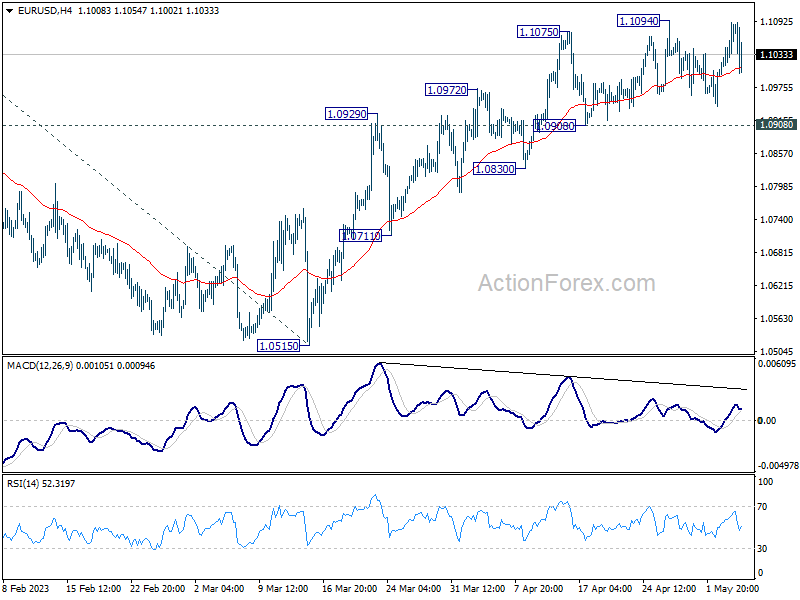
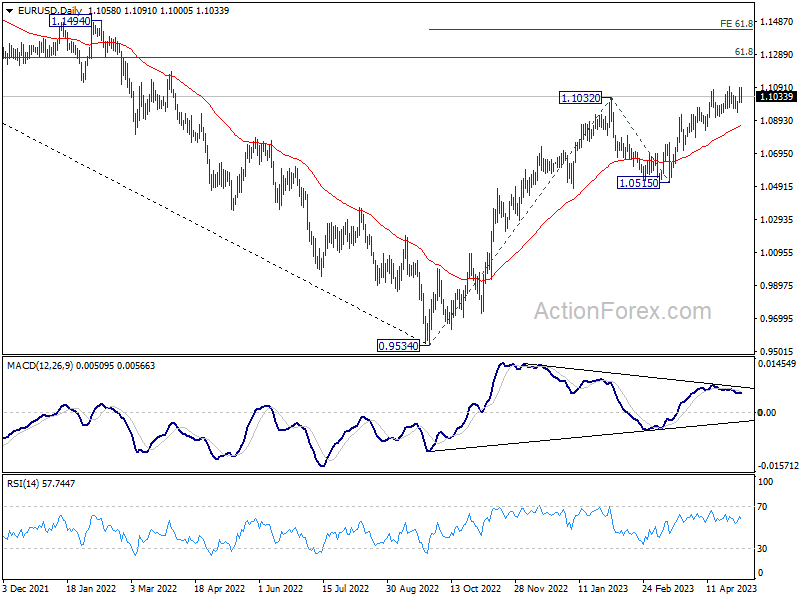
In the bigger picture, rise from 0.9534 (2022 low) is in progress for 61.8% retracement of 1.2348 (2021 high) to 0.9534 at 1.1273. Sustained break there will solidify the case of bullish trend reversal and target 1.2348 resistance next (2021 high). This will now remain the favored case as long as 1.0515 support holds, even in case of deeper pull back.
Economic Indicators Update
| GMT | Ccy | Events | Actual | Forecast | Previous | Revised |
|---|---|---|---|---|---|---|
| 22:45 | NZD | Building Permits M/M Mar | 7.00% | -9.00% | -9.40% | |
| 01:30 | AUD | Trade Balance (AUD) Mar | 15.27B | 13.00B | 13.87B | |
| 01:45 | CNY | Caixin Manufacturing PMI Apr | 49.5 | 50.8 | 50 | |
| 06:00 | EUR | Germany Trade Balance (EUR) Mar | 16.7B | 17.1B | 16.0B | |
| 07:45 | EUR | Italy Services PMI Apr | 57.6 | 56 | 55.7 | |
| 07:50 | EUR | France Services PMI Apr F | 54.6 | 56.3 | 56.3 | |
| 07:55 | EUR | Germany Services PMI Apr F | 56 | 55.7 | 55.7 | |
| 08:00 | EUR | Eurozone Services PMI Apr F | 56.2 | 56.6 | 56.6 | |
| 08:30 | GBP | Services PMI Apr F | 55.9 | 54.9 | 54.9 | |
| 08:30 | GBP | Mortgage Approvals Mar | 52K | 46K | 44K | |
| 08:30 | GBP | M4 Money Supply M/M Mar | -0.60% | 0.10% | -0.40% | -0.30% |
| 09:00 | EUR | Eurozone PPI M/M Mar | -1.60% | -1.40% | -0.50% | -0.40% |
| 09:00 | EUR | Eurozone PPI Y/Y Mar | 5.90% | 5.90% | 13.20% | 13.30% |
| 12:15 | EUR | ECB Main Refinancing Rate | 3.75% | 3.75% | 3.50% | |
| 12:30 | CAD | Trade Balance (CAD) Mar | 1.0B | 1.0B | 0.4B | |
| 12:30 | USD | Initial Jobless Claims (Apr 28) | 242K | 235K | 230K | |
| 12:30 | USD | Trade Balance (USD) Mar | -64.2B | -68.9B | -70.5B | |
| 12:30 | USD | Nonfarm Productivity Q1 P | -2.70% | -0.70% | 1.70% | |
| 12:30 | USD | Unit Labor Costs Q1 P | 6.30% | 8.40% | 3.20% | |
| 12:45 | EUR | ECB Press Conference | ||||
| 14:00 | CAD | Ivey PMI Apr | 59 | 58.2 | ||
| 14:30 | USD | Natural Gas Storage | 51B | 79B |
EUR/USD Mid-Day Outlook
Daily Pivots: (S1) 1.1010; (P) 1.1051; (R1) 1.1103; More...
Intraday bias in EUR/USD remains neutral as it retreated ahead of 1.1094 resistance but stays well above 1.0908 support. Further rally remains in favor for now. On the upside, firm break of 1.1094 will resume larger up trend to 1.1273 fibonacci level. Break there will target 61.8% projection of 0.9534 to 1.1032 from 1.0515 at 1.1441 However, considering bearish divergence condition in 4H MACD, break of 1.0908 support will indicate short term topping and turn bias back to the downside.
In the bigger picture, rise from 0.9534 (2022 low) is in progress for 61.8% retracement of 1.2348 (2021 high) to 0.9534 at 1.1273. Sustained break there will solidify the case of bullish trend reversal and target 1.2348 resistance next (2021 high). This will now remain the favored case as long as 1.0515 support holds, even in case of deeper pull back.
GBP/USD Mid-Day Outlook
Daily Pivots: (S1) 1.2489; (P) 1.2539; (R1) 1.2616; More...
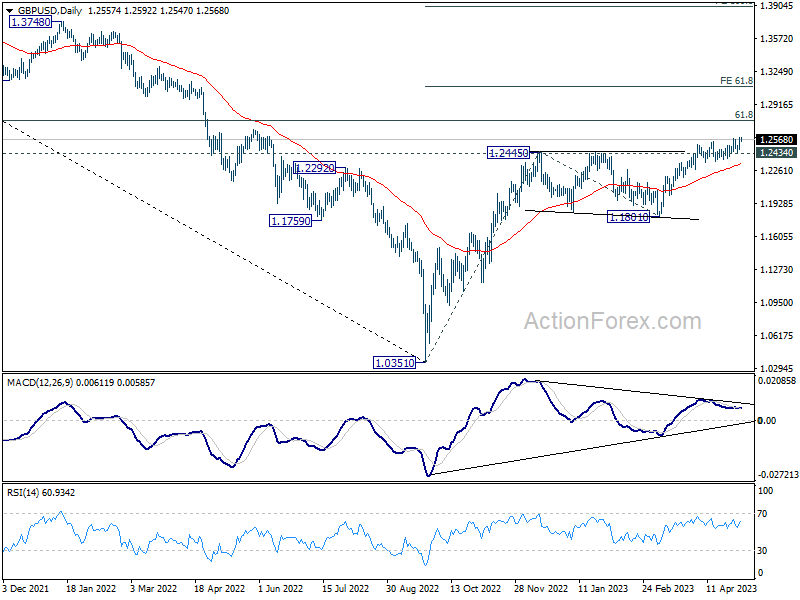
Intraday bias in GBP/USD stays on the upside for the moment. Current rally should now target 1.2759 fibonacci level first. Firm break there will target 61.8% projection of 1.0351 to 1.2445 from 1.1801 at 1.3095. However, considering bearish divergence condition in 4H MACD, break of 1.2434 support will indicate short term topping, and turn bias back to the downside for deeper pull back.
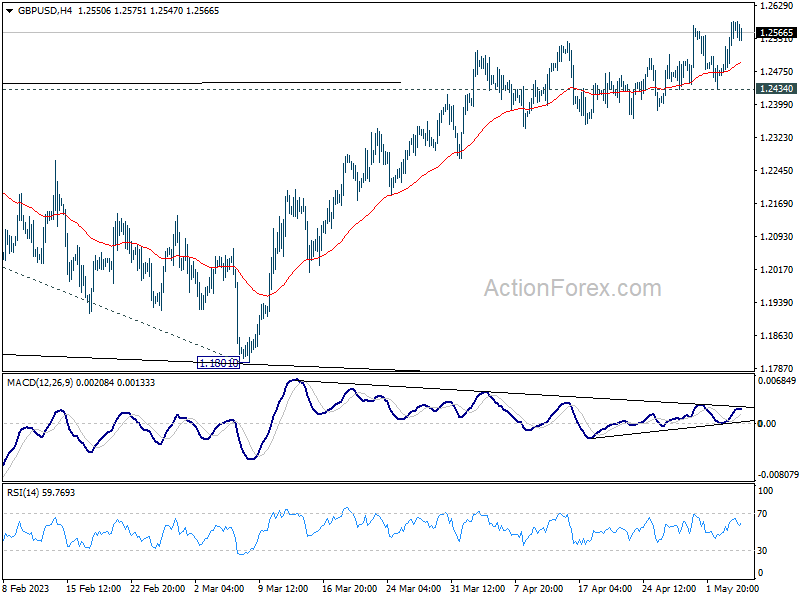
In the bigger picture, the rise from 1.0351 medium term term bottom (2022 low) is in progress for 61.8% retracement of 1.4248 (2021 high) to 1.0351 at 1.2759. Sustained break there will add to the case of long term bullish trend reversal. Further break of 61.8% projection of 1.0351 to 1.2445 from 1.1801 at 1.3095 could prompt upside acceleration to 100% projection at 1.3895. For now, this will remain the favored case as long as 1.1801 support holds, even in case of deep pull back.
USD/CHF Mid-Day Outlook
Daily Pivots: (S1) 0.8880; (P) 0.8906; (R1) 0.8951; More...
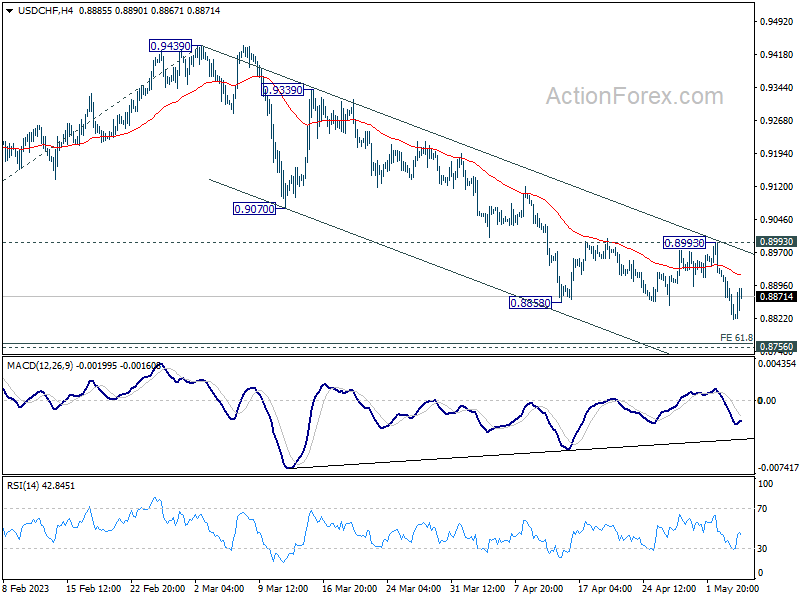
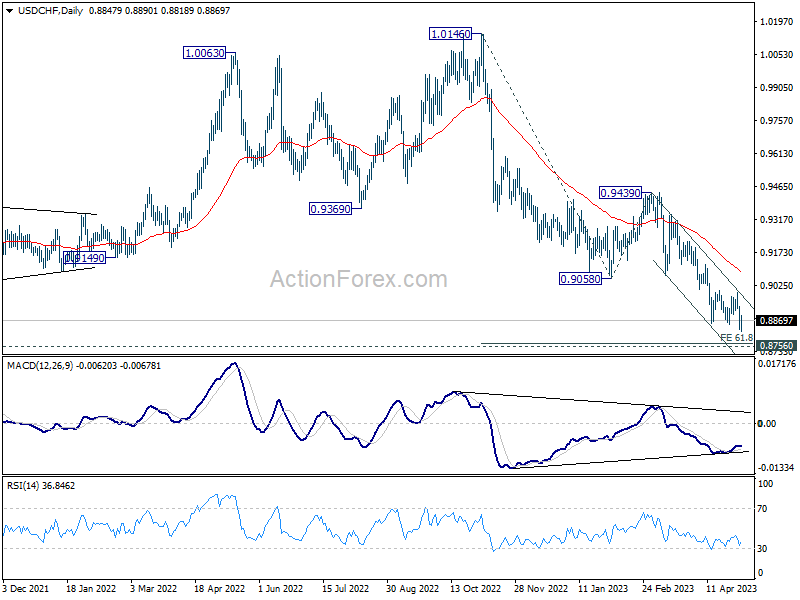
Further decline is expected in USD/CHF with 0.8993 resistance holds. The down trend from 1.0146 would target 61.8% projection of 1.0146 to 0.9058 from 0.9439 at 0.8767, which is close to 0.8756 long term support. Strong support is expected there to bring rebound, at least on first attempt. On the upside, break of 0.8993 resistance will indicate short term bottoming, on bullish convergence condition in 4H MACD, and turn bias back to the upside for stronger rebound.
In the bigger picture, fall from 1.1046 (2022 high) is in progress for 0.8756 support (2021 low). But overall, this fall is still seen as a leg in the long term range pattern from 1.0342 (2016 high). So, downside should be contained by 0.8756 to bring reversal. Sustained break of 0.9058 support turned resistance will be the first sign of medium term bottoming. However, decisive break of 0.8756 will carry larger bearish implications.
USD/JPY Mid-Day Outlook
Daily Pivots: (S1) 134.13; (P) 135.39; (R1) 136.04; More...
Intraday bias in USD/JPY remains on the downside for the moment, as fall from 137.73 continues. This decline is seen as the third leg of the pattern from 137.90. Break of 133.00 will bring deeper fall towards 129.62 support. But still, as long as 129.62 holds, larger rebound from 127.20 is still in favor to resume at a later stage. On the upside, above 135.68 minor resistance will turn bias back to the upside for 137.76.90 instead.
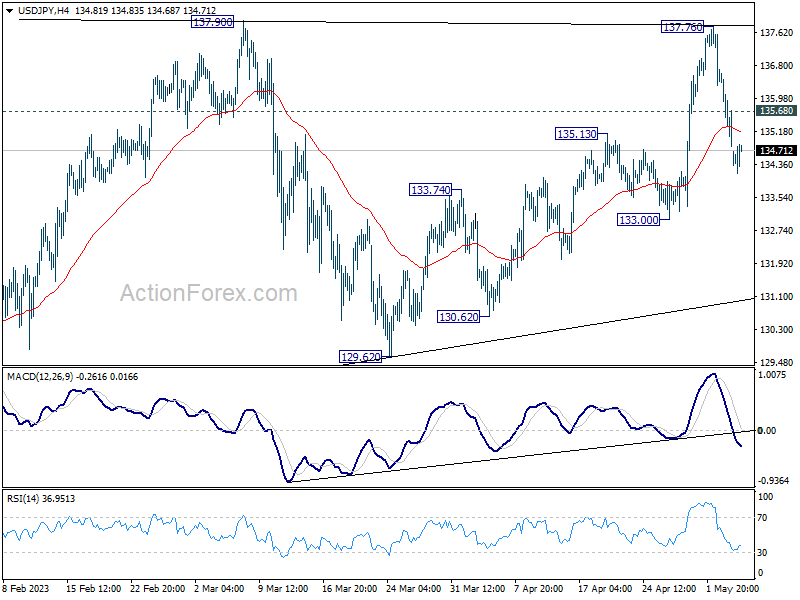
In the bigger picture, price actions from 151.93 high are currently seen as a corrective pattern to the long term up trend. The first leg should have completed at 127.20. Rebound from there is seen as the second leg. Sustained break of 31.8% retracement of 151.93 to 127.20 at 136.34 will bring stronger rebound to 61.8% retracement at 142.48. Meanwhile, break of 129.62 will argue that the third leg is starting through 127.20 low.