Sample Category Title
Australia CPI down to 7.0% yoy in Q1, 6.3% yoy in Mar
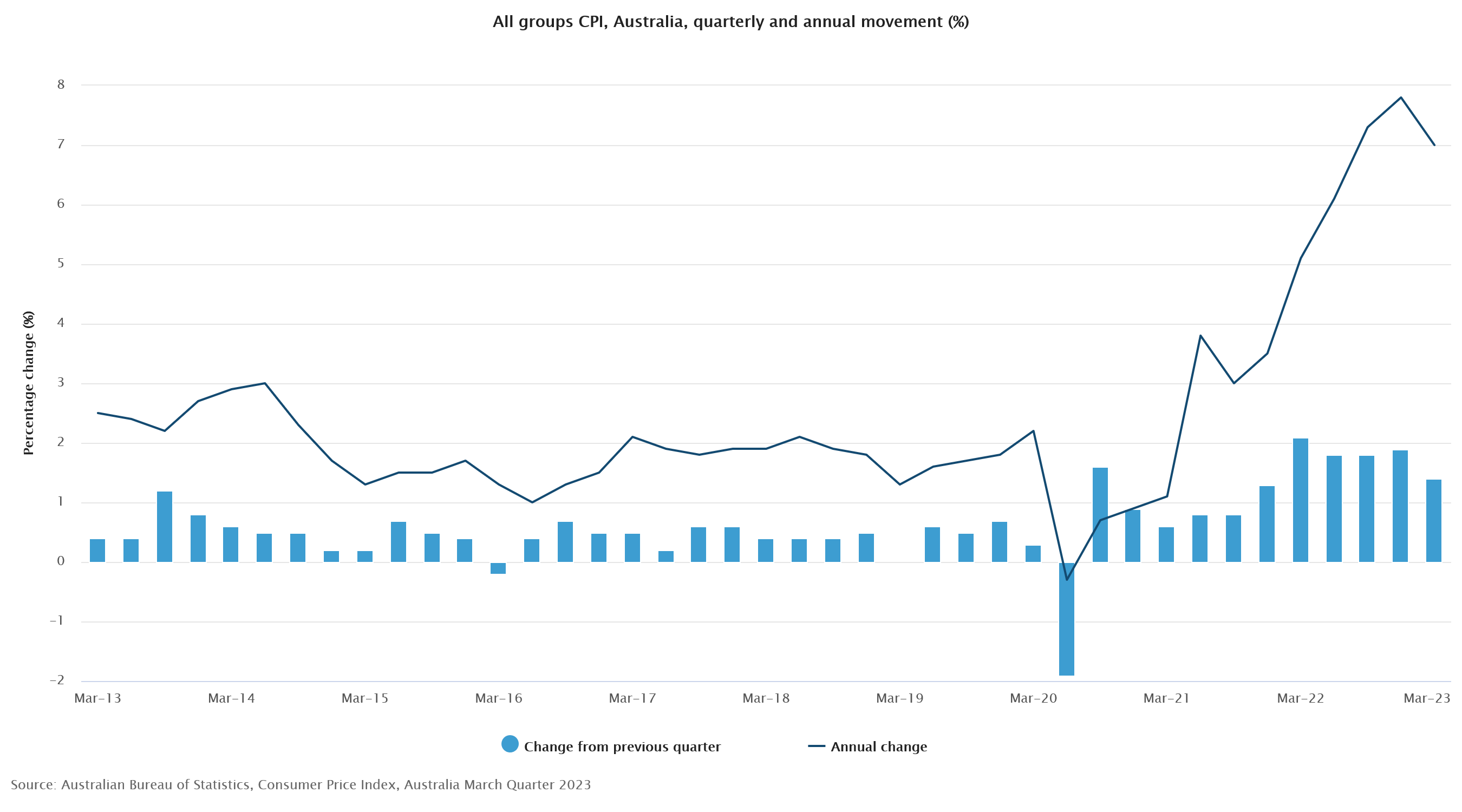
Australia CPI slowed from 7.8% yoy to 7.0% yoy in Q1, slightly above expectation of 6.9% yoy. For the quarter, CPI rose 1.4% qoq, down from prior 1.9% qoq, below expectation of 1.3% qoq. Trimmed mean CPI rose 1.2% qoq, 6.6% yoy while weighted median CPI rose 1.2% qoq, 5.8% yoy.
Michelle Marquardt, ABS head of prices statistics, said "CPI inflation slowed in the March quarter, with the quarterly rise being the lowest since December 2021. While prices continued to rise for most goods and services, many of these increases were smaller than they have been in recent quarters."
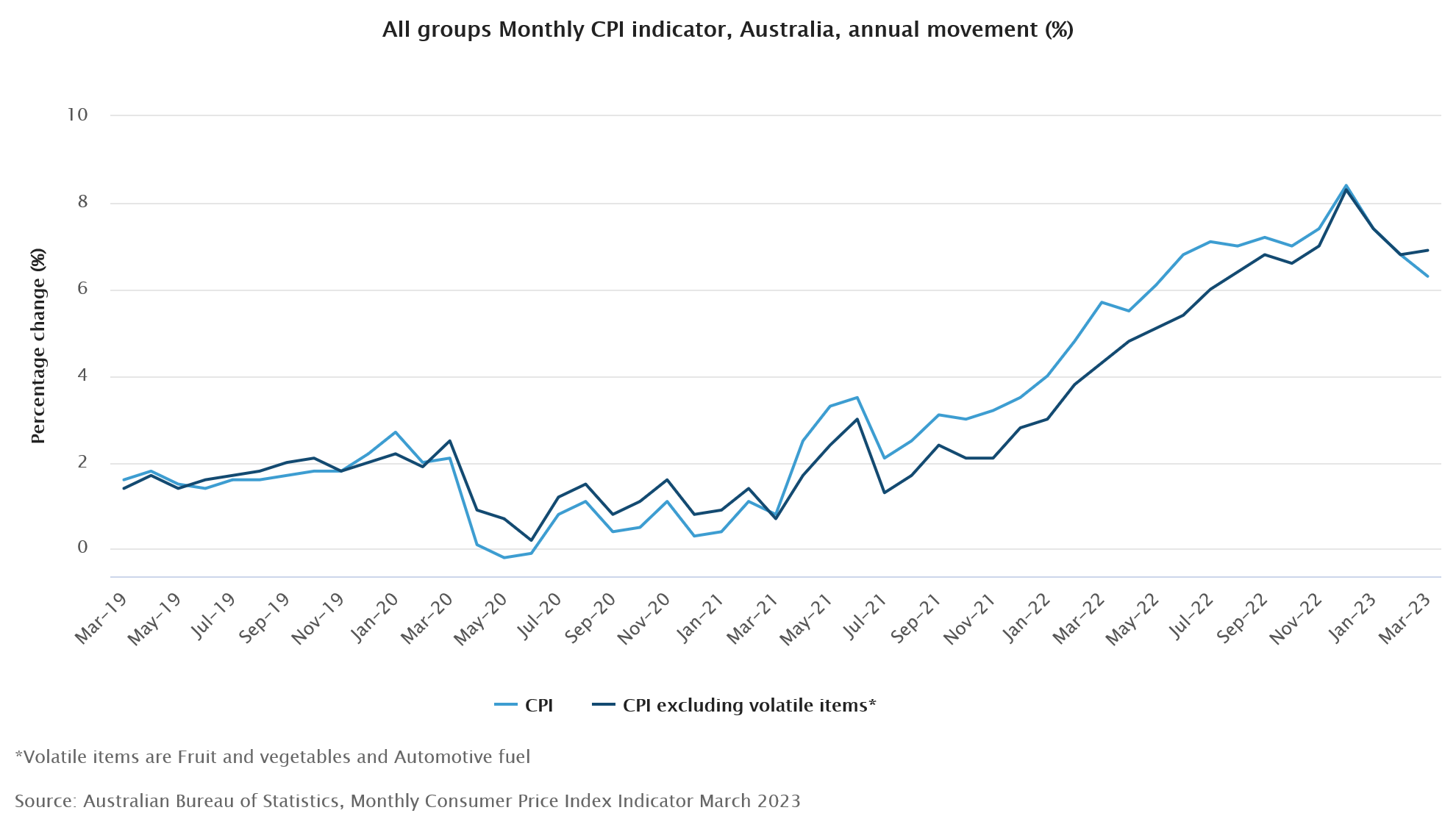
Monthly CPI slowed from 6.8% yoy to 6.3% yoy in March, below expectation of 6.5% yoy. Excluding volatile items (Fruit and vegetables and Automotive fuel) CPI, rose from 6.8% yoy to 6.9% yoy.
Full Australia quarterly CPI release here, and monthly CPI release here.
NZ imports surged 10% yoy, export rose 0.6% yoy in Mar
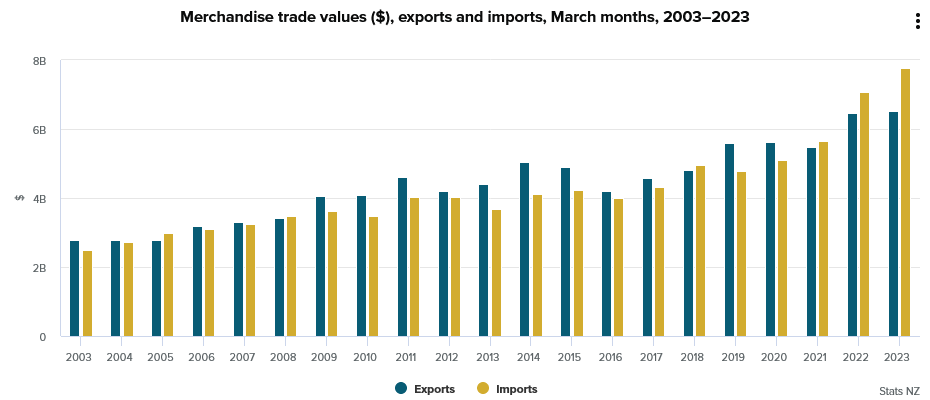
Australia contributed the most to the growth in monthly exports, with a 30% rise. Goods exports to the US was up 4.1%, EU up 28%, but down -9.6% to Japan and down -5.7% to China.
On the other hand, imports from the US leads the monthly rise, up 39%. Imports from EU and South Korea grew 24% and 20% respectively. On the other hand, imports from China was down -13%, Australia down -4.0%.
BoJ Ueda: Dealing with cost-push inflation is very difficult
In an address to parliament today, BoJ Governor Kazuo Ueda highlighted the difficulties central banks face when dealing with cost-push inflation.
Ueda explained, "In general, dealing with cost-push inflation is very difficult for central banks. On the one hand, you'd like to curb inflation. On the other hand, you don't want to tighten monetary policy knowing that cost-push inflation will cool the economy."
The governor emphasized the importance of striking the right balance, which he said, "depends on economic developments at the time, including where inflation stood at the outset."
Ueda also noted that cost-push inflation in Japan is likely to ease as prices of imported raw materials have probably peaked.
These comments come ahead of BoJ's two-day policy meeting starting on Thursday, during which the central bank is widely anticipated to maintain its ultra-loose monetary policy.
BoE Pill: We’ve had a series of transitory inflation shocks one after the other
In an interview on the "Beyond Unprecedented" podcast produced by Columbia University's law school, BoE Chief Economist Huw Pill reiterated the central bank's official forecast, stating that some factors maintaining high inflation are likely to recede in the upcoming months and that inflation could fall below the 2% target in the next few years.
Discussing the continuous inflationary shocks faced by the UK, Pill said, "We've had a series of inflation shocks that just come one after the other." He added, "Each of those shocks was in itself transitory, but they just were timed in a way that inflation never dissipated."
Pill emphasized the need for UK citizens to accept being worse off and to refrain from trying to maintain their real spending power by driving up prices through higher wages or passing on energy costs to customers. Pill observed, "What we're facing now is that reluctance to accept that, yes, we're all worse off and have to take our share."
He also highlighted the UK's status as a major net importer of natural gas and the resulting challenges, noting, "The UK, which is a big net importer of natural gas, is facing a situation that the price of what you're buying from the rest of the world has gone up a lot, relative to the price of what you're selling to the rest of the world, which is mainly services in the case of the UK."
Pill concluded, "If what you're buying has gone up a lot relative to what you're selling, you're going to be worse off."
Crude Oil Price Reaches Key Support, Gold Consolidates
Key Highlights
- Crude oil prices started a downside correction below the $80 support.
- A key bearish trend line is forming with resistance near $78.60 on the 4-hour chart.
- EUR/USD and GBP/USD corrected lower from local highs.
- The US Durable Goods Orders could increase by 0.8% in March 2023.
Crude Oil Price Technical Analysis
Crude oil prices struggled to clear the $83.50 resistance against the US Dollar. The price declined below the $80.00 support to move into a short-term bearish zone.
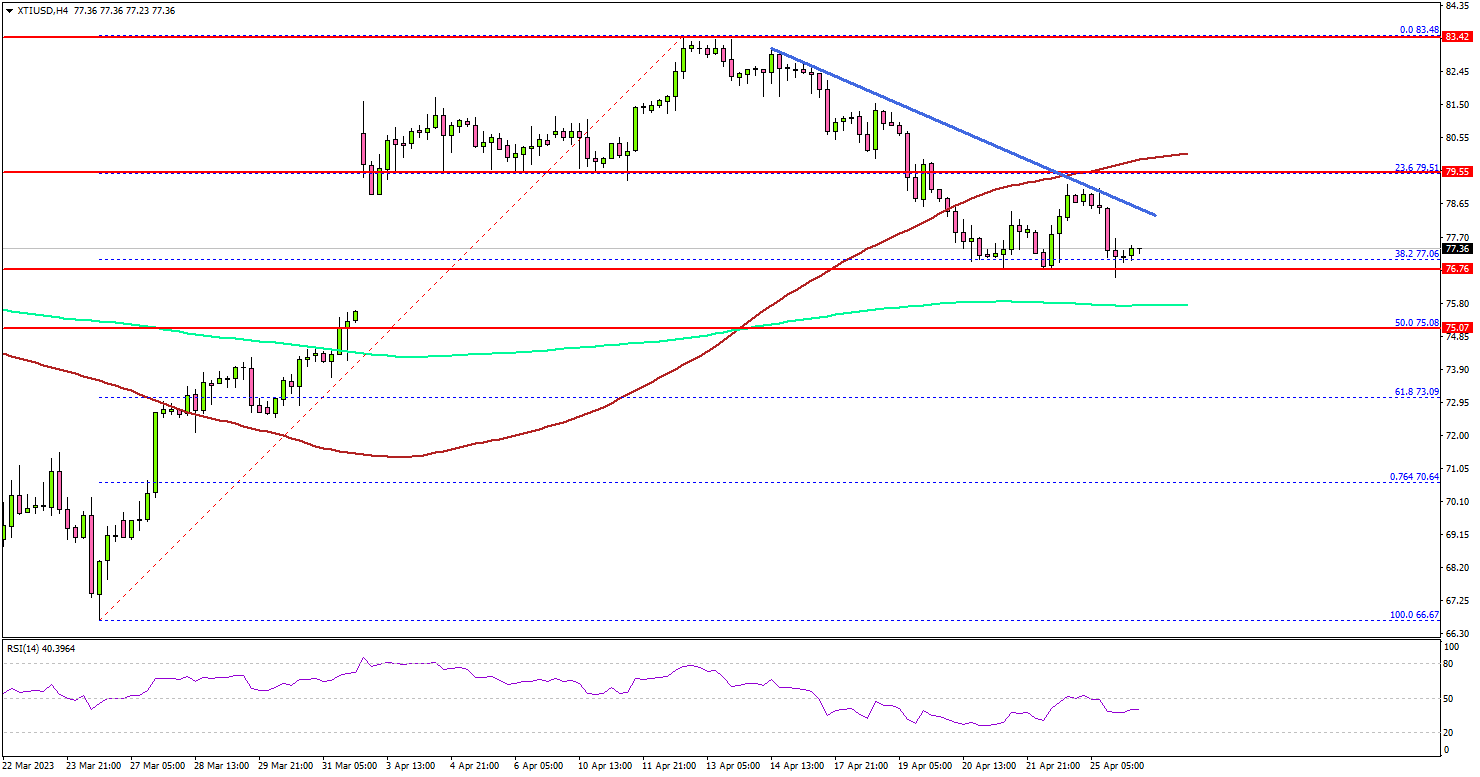
Looking at the 4-hour chart of XTI/USD, the price even declined below $78.80 and the 100 simple moving average (red, 4-hour). It tested the 38.2% Fib retracement level of the upward move from the $66.67 swing low to the $83.48 high.
The next major support sits near the $75.80 level or the 200 simple moving average (green, 4-hour). Any more losses might call for a test of 61.8% Fib retracement level of the upward move from the $66.67 swing low to the $83.48 high at $73.00.
On the upside, the price is facing resistance near the $78.65 level. The next major resistance is near the $79.50 zone and the 100 simple moving average (red, 4-hour).
A clear move above the $79.50 resistance could open the doors for another steady increase toward $80.50 or even $81.20.
Looking at EUR/USD, the pair struggled to gain strength and reacted to the downside from the 1.1050 zone.
Economic Releases to Watch Today
- US Durable Goods Orders for March 2023 – Forecast +0.8% versus -1% previous.
- US Durable Goods Orders Ex Defense for March 2023 – Forecast 0% versus -0.5% previous.
AUD/USD Slips to 2-Week Low Ahead of CPI
- AUD/USD is down almost 1%
- Australian CPI expected to drop to 6.6%
- UoM Consumer Sentiment falls, US New Home Sales jump
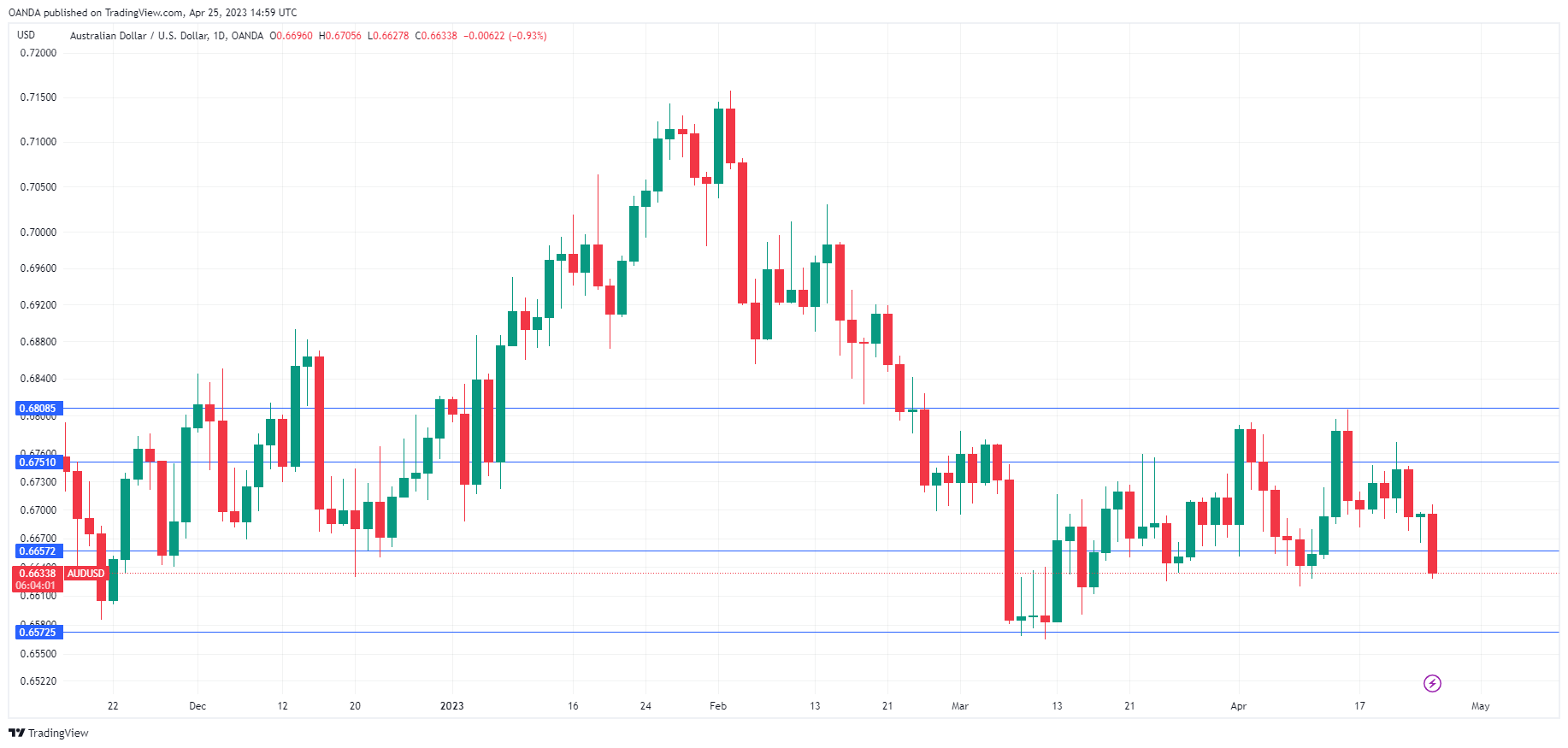
The Australian dollar has plunged on Tuesday. AUD/USD is trading at 0.6632, down 0.95% on the day. The Aussie is under strong downward pressure, having lost around 1.7% since Thursday.
Australian inflation expected to fall
Australia releases inflation on a quarterly basis, which magnifies the impact of the release. Inflation has been falling and this trend is expected to continue in the Wednesday release of first-quarter CPI. The headline figure is expected to fall from 7.8% to 6.9% y/y and from 1.9% to 1.3% q/q. The core rate, which is considered a more reliable gauge, is likewise expected to fall – from 6.9% to 6.7% y/y and from 1.7% to 1.4% q/q.
Investors will be mindful that headline inflation surprised on the upside in Q4, rising from 7.3% to 7.8%. The two monthly inflation reports since the Q4 release in January, however, indicated that inflation was back on its way down, with headline CPI falling from 7.4% to 6.8% and beating expectations.
The RBA would love to pause rates at 3.60% for a second straight month, and another drop in inflation would strongly support a pause at the May 2nd meeting. As well, another deceleration would be a strong indication that inflation has peaked, although the battle is far from over as it will take a long time to achieve the 2% target. The likelihood of another pause in rates stands at 83%, according to the RBA Rate Tracker.
In the US, today’s data has been a mixed bag. UoM Consumer Sentiment for April was expected to remain unchanged at 104.0, but surprised on the downside, falling to 101.3. There was better news from New Home Sales, which soared 9.6% in March, rebounding from -3.9% in February and crushing the estimate of 1.1%.
AUD/USD Technical
- There is resistance at 0.6751 and 0.6808
- AUD/USD is testing support at 0.6657. Next, there is support at 0.6572
Cryptos to Recover Bull-run in May
Bank of Indonesia Governor Perry Warjiyo announced that Jakarta is following the lead of the BRICS bloc to reduce dependence on the USD and diversify the use of currency in international trade. Indonesia is "more concrete" than the BRICS because they have already implemented the currency diversification method with several nations, including Thailand, Malaysia, China, and Japan. And the Indonesian government plans to sign an agreement with South Korea soon. Other countries are seeking alternatives as the US continues to weaponize the dollar. It seems the USD may have to share the spotlight with other currencies soon. The search for alternatives will positively impact the crypto markets as early-bird investors look to capitalize.
BTCUSD - Daily Timeframe
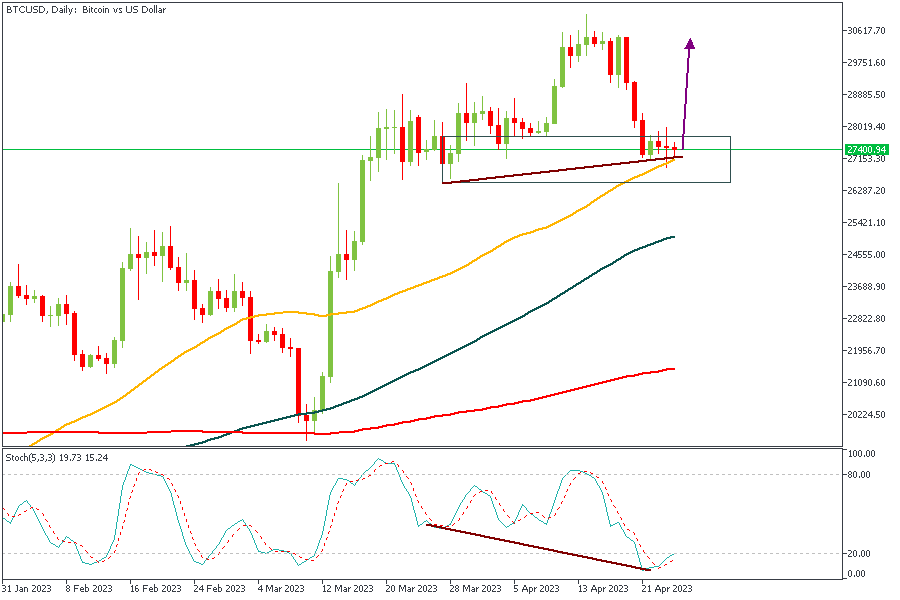
Bitcoin has had a few days of consolidation within a key demand zone. As you can see from the chart, we also have added confluence from the 50-Day Moving Average. Looking at the stochastics, we can establish that there is a divergence that often results in price reversals. With these indicators and considering the fundamental data, I believe it is safe to expect a bullish reversal soon enough.
Analysts’ Expectations:
- Direction: Bullish
- Target: $29,300
- Invalidation: $26,450
ETHUSD - Daily Timeframe
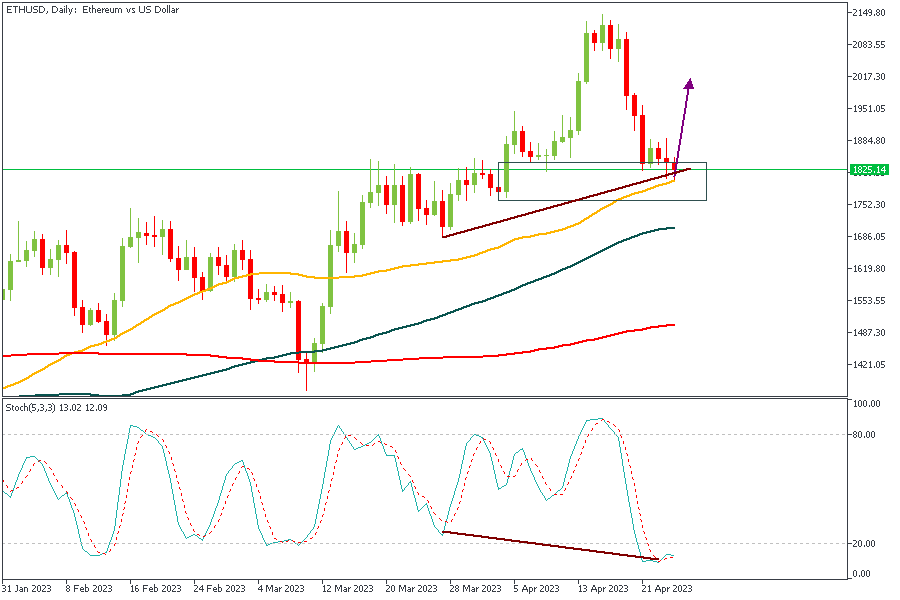
ETHUSD has a very similar outlook to the setup on BTCUSD. The consolidation here on ETHUSD has also lasted a few days and is within a demand zone. The 50-Day Moving Average support is another common confirmation. To top it off, we have a similar divergence setup. This means we can also begin to expect a bullish reversal soon.
Analysts’ Expectations:
- Direction: Bullish
- Target: $2,060
- Invalidation: $1,760
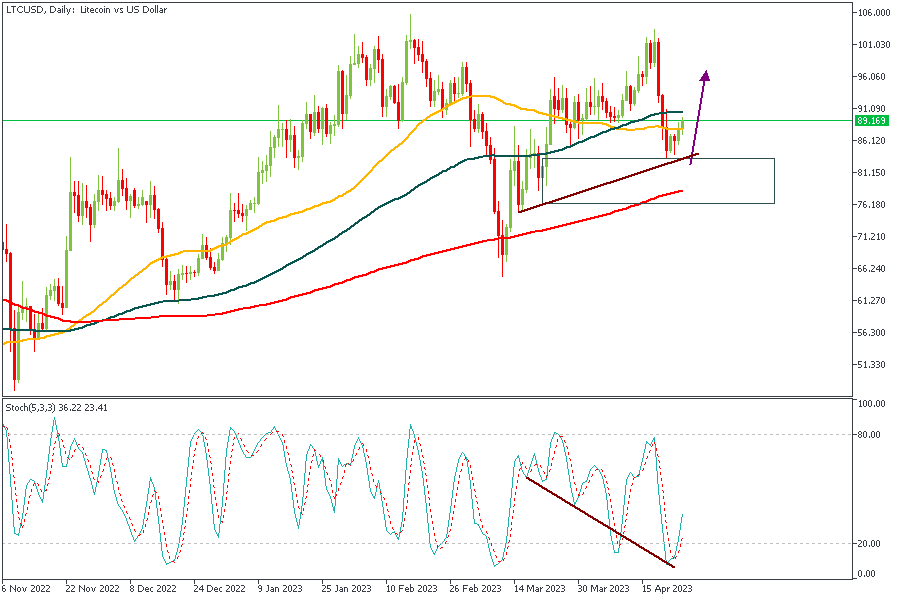
LTCUSD - Daily Timeframe
Litecoin (LTCUSD), on its own, has already reacted from the initial demand zone. There's not much to say about the demand zone, the stochastics divergence, and the 76% Fibonacci retracement level. The sentiment here is also largely bullish.
Analysts’ Expectations:
- Direction: Bullish
- Target: $98.40
- Invalidation: $82.50
P.S: A divergence is a phenomenon that describes a scenario where price makes higher highs on the charts whereas an oscillator indicator (such as the MACD, RSI, or Stochastics) records lower highs, or vice versa.
CONCLUSION
The trading of CFDs comes at a risk. Thus, to succeed, you have to manage risks properly. To avoid costly mistakes while you look to trade these opportunities, be sure to do your due diligence and manage your risk appropriately.
Crypto Seeks Support
Market picture
The cryptocurrency market is down 0.6% over the past 24 hours, falling to $1.15 trillion, as we see reduced volatility and attempts to “buy the bottom”.
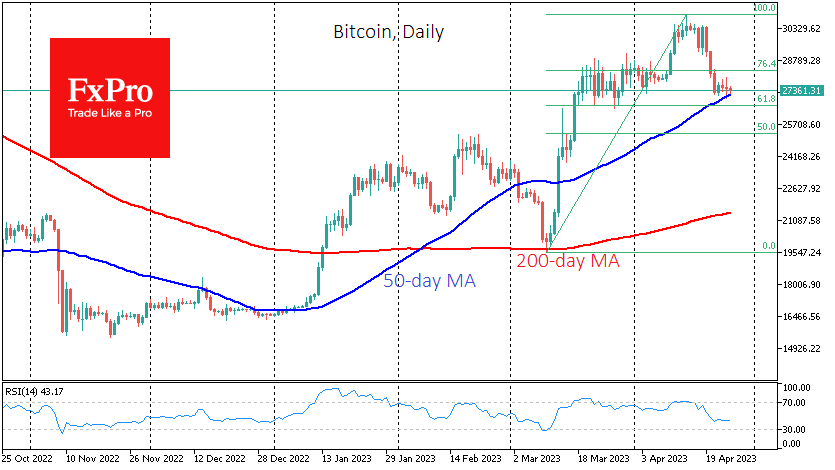
Bitcoin is testing and attempting to hold above its 50-day moving average on Monday and Tuesday. As it does so, we, for now, see some reduced volatility and attempts to form a local bottom. It could be an attempt to return to buying after a corrective pullback or a consolidation before a new downward impulse.
Regarding technical analysis, bitcoin’s correction will only become a new downtrend when the price consolidates below $26.5K, 61.8% of the upside momentum from the March lows and the bottom of last month’s consolidation.
According to CoinShares, investments in crypto funds fell by $30 million last week after four weeks of gains. Bitcoin investments decreased by $53 million, while Ethereum rose by $17 million.
News background
Significant inflows into Ethereum assets indicate growing investor confidence following the successful implementation of the Shapella update.
Crypto winter is over, says Standard Chartered. Bitcoin will benefit from the turmoil in the banking sector and several other factors. By the end of 2024, the price of the first cryptocurrency could reach $100K.
Twitter analyst PlanB, the creator of the Stock-to-Flow model, expects Bitcoin to grow significantly in 2024 after halving. He calculates that BTC will break through $100,000 and could eventually reach $542,000.
In the medium term, BTC could become the world’s reserve currency, according to BitMEX co-founder Arthur Hayes. More and more investors are looking to Bitcoin to preserve capital.
The World Economic Forum (WEF) said Bitcoin mining could significantly reduce greenhouse gas emissions. But only if miners switch to renewable energy sources.
Billy Marcus, the creator of the meme cryptocurrency Dogecoin, called crypto investors “mentally disturbed” and NFT buyers “even more unhealthy”. He said he stopped investing in cryptocurrencies nine years ago, shortly after Dogecoin was launched.
EURGBP Pokes Its Nose Above 0.8865
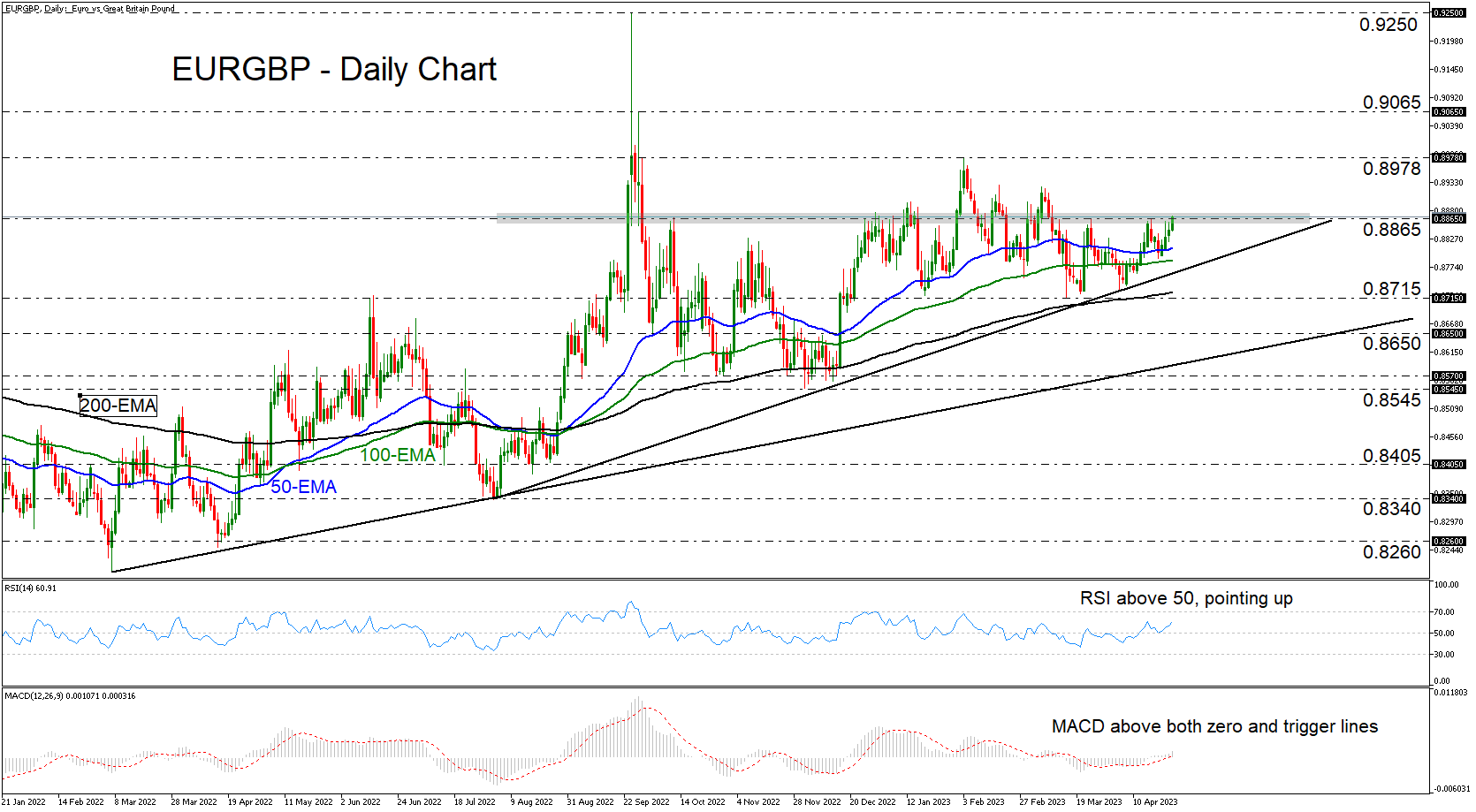
EURGBP has been edging north since April 19 when it hit support slightly above the 100-day exponential moving average (EMA). The pair is trading above all three of the plotted EMAs, as well as above the uptrend line drawn from the low of August 3, which paints a positive medium-term picture.
Our short-term oscillators make the outlook even brighter. The RSI moved higher after rebounding from its 50 line, while the MACD lies above both its zero and trigger lines, pointing up. Both indicators detect upside momentum and support the notion of some further advances.
Today, EURGBP poked its nose above the key barrier of 0.8865, a move that may have opened the door for advances towards the peak of February 3 at around 0.8978. If the bulls are unwilling to let the driver’s seat go, they may extend their march towards the high of September 28 at around 0.9065.
For the outlook to turn bearish, the pair may need to tumble all the way below the 0.8545 area, marked by the low of December 1. Such a slide would take the action below a longer-term uptrend line taken from the low of March 7, and may see scope for extensions towards the 0.8405 territory, marked by the low of August 24.
To wrap up, EURGBP continues to trade above the uptrend line taken from the low of August 3 and above all the plotted EMAs, which suggests that the pair may be destined to continue traveling north for a while longer.