Sample Category Title
Elliott Wave Projects GBPUSD Pullback Should Continue to Find Support
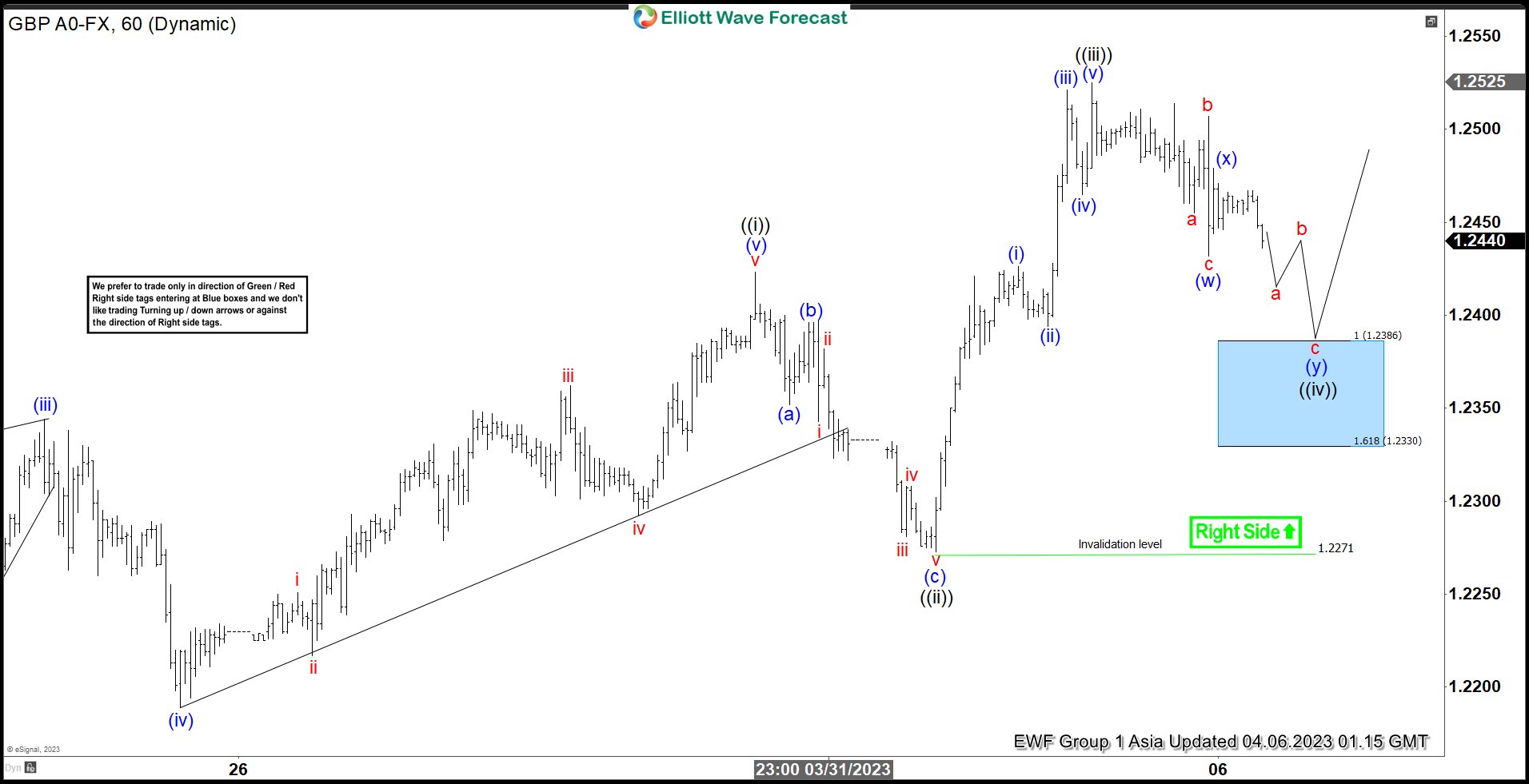
GBPUSD broke above previous peak on 1.23.2023 high at 1.2448 and now shows a bullish sequence from 9.26.2022 low. Cycle from 3.8.2023 low is currently in progress as a 5 waves impulse Elliott Wave structure. Up from 3.8.2023 low, wave (i) ended at 1.2204 and pullback in wave (ii) ended at 1.2009. Pair extends higher in wave (iii) towards 1.2344, and dips in wave (iv) ended at 1.2189. Final leg higher wave (v) ended at 1.2423 which completed wave ((i)).
Wave ((ii)) pullback ended at 1.2271 as the 1 hour chart below shows with internal subdivision as a zigzag. Down from wave ((i)), wave (a) ended at 1.2352, wave (b) ended at 1.2397 and wave (c) lower ended at 1.2271. Pair has resumed higher in wave ((iii)) towards 1.2525 as an impulse. Up from wave ((ii)), wave (i) ended at 1.2426 and wave (ii) ended at 1.2394. Wave (iii) ended at 1.2521, pullback in wave (iv) ended at 1.2465, and final leg wave (v) ended at 1.2525 which completed wave ((iii)). Pullback in wave ((iv)) is in progress as a double three structure. Down from wave ((iii)), wave (w) ended at 1.243 and wave (x) ended at 1.2479. Expect wave (y) to extend lower to 1.233 – 1.2386 blue box area where buyers should appear for further upside.
GBPUSD 60 Minute Elliott Wave Chart
GBPUSD Elliott Wave Video
https://www.youtube.com/watch?v=dEMw8_WdPwM
EURUSD Wave Analysis
- EURUSD under the bearish pressure
- Likely to fall to support level 1.0800
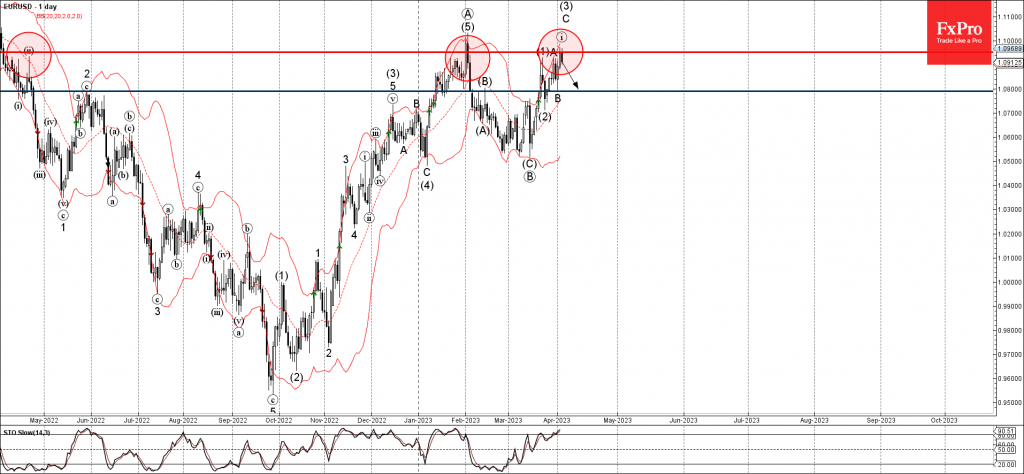
EURUSD under the bearish pressure after the price reversed down from the key resistance area located between the long-term resistance level 1.0950 (which has been reversing the price from the end of April) and the upper daily Bollinger Band.
The price is likely to form the daily Bearish Engulfing – if the pair closes today near the current levels.
Given the overbought daily Stochastic, EURUSD can then be expected to fall further toward the next support level 1.0800 (low of the pervious correction B).
EURJPY Wave Analysis
- EURJPY reversed from key resistance level 145.40
- Likely to fall to support level 142.00
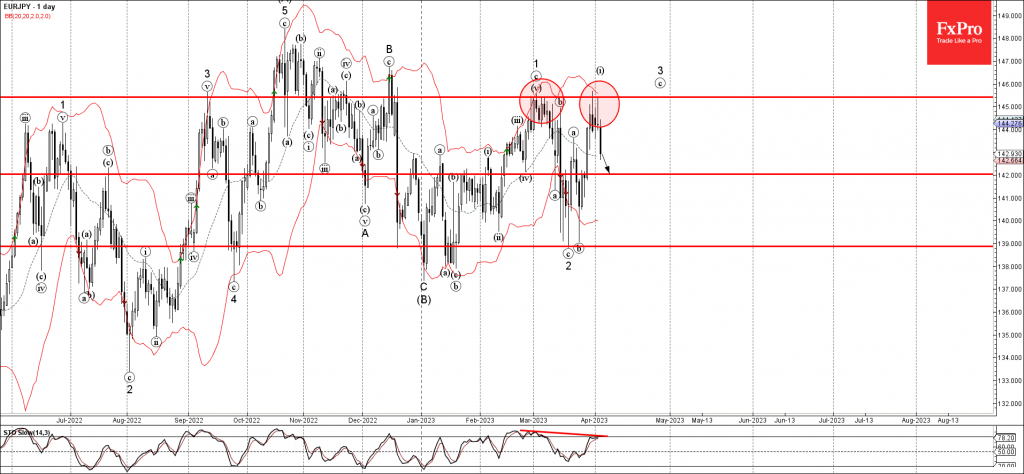
EURJPY recently reversed down from the key resistance level 145.40 (which has been reversing the price from the start of March) intersecting with the upper daily Bollinger Band.
The downward reversal from the resistance level 145.40 created the daily Japanese candlesticks reversal pattern Shooting Star Doji.
Given the strong yen sentiment, EURJPY can then be expected to fall further toward the next support level 142.00.
EUR/USD: Bulls Hold Grip After Weak US Labor Data
The Euro keeps firm tone and holding within a narrow consolidation under new two-month high on Wednesday.
The single currency was lifted by weaker than expected US JOLTS job openings data on Tuesday, with today’s release of US ADP report, which showed that hiring in the private sector fell significantly in March (Mar 145K vs 200K f/c and Feb upwardly revised to 261K), adding to signals that US labor market is cooling.
Another key releases, US non-manufacturing PMI (Mar 54.5 f/c vs Feb 55.1), due today and Friday’s key NFP report (Mar 240K f/c vs Feb 311K) are expected to provide more hints about the conditions in two key sectors and generate more direction signals.
The US economy remains vulnerable due to persisting high inflation, while Fed’s strong rate hikes in the past year did not provide expected results and the latest crisis in banking sector, which was so far contained, but sent strong shockwaves through the entire economy.
All these contribute to weaker dollar and keep the single currency underpinned for further advance.
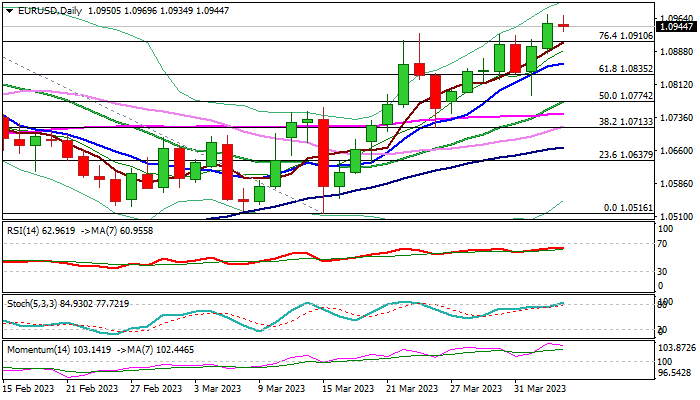
Wednesday’s acceleration resulted in eventual break above the recent range and signaled that bulls are ready to resume after 1.0930/1.0713 pullback and subsequent three-day consolidation (1.0926/1.0788) and attack targets at 1.1000 (psychological) and 1.1032 (Feb 2 peak/2023 high).
Bullish daily studies support the action, though overbought stochastic signals that bulls may face further headwinds, which would slow the action.
Broken Fibo 76.4% barrier (1.0910) reverted to initial support, ahead of rising 10DMA (1.0861) which should keep the downside protected.
Res: 1.0973; 1.1000; 1.1032; 1.1100.
Sup: 1.0930; 1.0910; 1.0861; 1.0835.
Sunset Market Commentary
Markets
It was a stretched run-up to the ADP job report release today during which core bonds lost some ground. US and German yields added a few basis points only to completely reverse course after the ADP report undershot even the lowest end of expectations. The US economy created 145k jobs in March compared to the 210k median estimate. The 19k upward revision to February is nothing more than putting a plaster on a wooden leg. The goods-producing sector added 70k with the manufacturing sector (-30k) acting as a heavy counterweight. Service providers created 75k jobs thanks to the trade, transport & utilities sector and leisure & hospitality. Financial activities (-51k) and business services (-46k) lost jobs. ADP chief economist Richardson said that “Our March payroll data is one of several signals that the economy is slowing” and that “Employers are pulling back from a year of strong hiring and pay growth, after a three-month plateau, is inching down.” It’s the third whammy to core bond yields this week after Monday’s manufacturing ISM and yesterday’s JOLTS. A sub-consensus US services ISM, published after wrapping up this report, has the potential to deliver a fourth one. The short end of the US yield curve outperforms with a double digit intraday move. The 2y yield eases 8.1 bps and is testing the closing lows set in the wake of the mid-March turmoil. The 10y yield is closing in on the intraday lows seen in that same period (around 3.30%) by shedding about 3.2 bps. One of the Fed’s most outspoken hawks, Cleveland’s Mester, saying that it’s too soon to say whether the Fed will raise rates in May obviously doesn’t help. German yields ease 2.8-7.0 bps across the curve with the front outperforming. Interestingly enough, it no longer helps equities this time around. The Euro Stoxx 50 loses 0.3%. Wall Street opens mixed.
The dollar limits losses given the size of the yield correction. EUR/USD left intraday lows around 1.0935 ahead of the ADP release to currently change hands at 1.096. The YtD high at 1.1033 for now isn’t being tested but markets are probably on the lookout for the services ISM. DXY for a similar reason is holding steady at 101.51, near but above the YtD lows. The Japanese yen outperforms. USD/JPY eases half a big figure from 131.71 to 131.03. EUR/JPY drops back below 144 (143.43). Sterling loses a few ticks in what’s mostly a risk-off trade. EUR/GBP used support from the upward sloping trendline connecting the higher lows since August 2022 to trade a little higher at 0.877. BoE’s Tenreyro warned for the impact of the recent turmoil on credit conditions and said that the central bank will take those effects into account when it sets policy. Tenreyro is the most dovish MPC member and her remarks didn’t come as a surprise.
News & Views
According to the Czech statistical office, real retail sales in February decreased further by 0.4% M/M resulting in a 6.4% Y/Y decrease. Y/Y-sales are already in negative territory since May last year. However, the details showed a potential easing in the decline. The decline in food sales still accelerated to 1.8% M/M but sales of non-food goods increased by 0.2% while sales of automotive fuels added 1.5% compared to January. Online retail decreased for the 14th month. The CNB last week acknowledged that domestic demand is weakening. However a tight labour market and expansive fiscal policy still cause the CNB to push back against early rate cut bets and even to leave open the option of a rate hike. At EUR/CZK 23.44, the krona is holding near the early March multi-year peak.
The Ministry of finance of Bulgaria in its spring economic forecast expects GDP growth to slow from 3.4% last year to 1.8% this year. A gradual improvement to 3.2% is expected for 2024 and 2025. Employment growth is seen slowing from 1.3% last year to 0.4% this year. This should result in an unemployment rate of 4.1% this year, falling back to 3.9% in 2024 and 3.8% in 2025 and 2026. The inflation slowdown since end 2022 is expected to continue. HICP is seen easing from 13.0% last year to 8.7% this year and 3.8% in 2024. Regarding politics, the stalemate after last Sunday’s parliamentary elections persists. Former PM Boyko Borissov’ Gerb party won with a thin lead, but no majority. Borissov indicated he will talk with all other parties. He tries to form a government with parties that support the euro entry and subscribe Ukraine’s efforts to resist Russia’s invasion in Ukraine. However, the block of Kiril Petkov, which was a close second in the elections, reiterated he is not prepared to cooperate with Borissov.
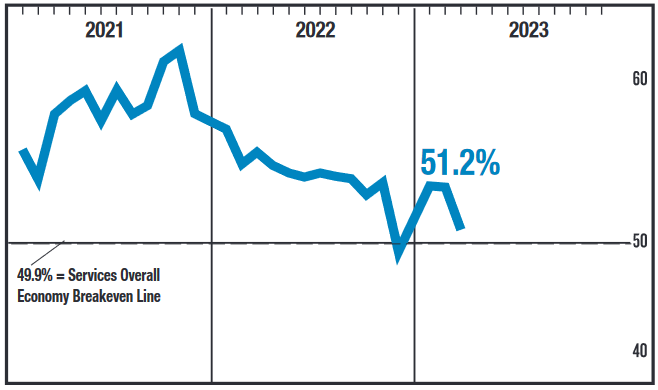
US ISM services dropped to 51.2, sharp decline in new orders
US ISM Services PMI dropped from 55.1 to 51.2 in March, below expectation of 54.5. Looking at some details, business activity/production dropped from 56.3 to 55.4. New orders tumbled sharply from 62.6 to 52.2. New export orders dived from 61.7 to 43.7. Employment dropped from 54.0 to 51.3. Prices dropped from 65.6 to 59.5.
Anthony Nieves, Chair of ISM Services Business Survey Committee: "There has been a pullback in the rate of growth for the services sector, attributed mainly to (1) a cooling off in the new orders growth rate, (2) an employment environment that varies by industry and (3) continued improvements in capacity and logistics, a positive impact on supplier performance. The majority of respondents report a positive outlook on business conditions."
"The past relationship between the Services PMI and the overall economy indicates that the Services PMI for March (51.2 percent) corresponds to a 0.5-percent increase in real gross domestic product (GDP) on an annualized basis."
Canada March Jobs Figures
There are two key fundamental aspects that are pushing the USDCAD in opposite directions. Which one is stronger and which will win out will depend on the evolution of both economic data and political events. Therefore, we could see some increased fluctuation in the currency pair over the coming months. And tomorrow there is the release of some crucial economic data that could have an impact on future expectations.
The fundamental issues in question that could guide the loonie over the coming months can be roughly summarized as:
- Policy: Specifically the widening gap in monetary policy between the BOC and the Fed, as the Canadian central bank holds rates steady while its American counterpart is still expected to keep hiking. This aspect likely weighs more on the longer term, as investors adjust to varying expectations on rates and the economic outlook.
- Oil: The price of crude rose substantially recently after OPEC+ announced voluntary curtailments of production. However, Canada's main buyer is the US, and expectations for demand for fuel south of the border will depend a lot on how the economy is seen developing in the coming months.
Since the whether or not the US slips into a recession is seen dependent in large part on how aggressive the Fed continues to be with its hikes, the two aspects are substantially linked. Given the degree of cross-border trade between the countries, if the Fed can bring inflation down substantially, the BOC will be in a better position to ease rates to support the economy.
What we're looking forward to
Canadian jobs figures tend to fluctuate wildly, so the immediate market impact of the number of jobs created can be muted given the context. What investors are likely looking at are signs of a slowing economy that would push the BOC to move from its current pause stance to a cutting stance. That could weaken the Loonie.
Another option is substantial overperformance in the labor market which could get the BOC worried that inflation might pick up again. However, that's likely to be seen more in ratios than a headline jobs creation number, since the latter tends to fluctuate substantially. What traders are likely to be most interested in is a sign of unexpected tightness in the jobs market that could push labor costs higher. So focus likely on unemployment and participation rate.
The figures in focus
The consensus is that Canada added 10K jobs last month, which would be less than half of those added in February at 21.8K. However, that's expected to be driven entirely by increases in part-time employment, with full-time job numbers expected to show a decline of 5.0K.
The unemployment rate is expected to rise to 5.2% compared to 5.0%, despite an expected drop in the participation rate to 65.5% compared to 65.7%.
Unlike previous events where the release Canadian jobs numbers coincides with US NFP, this time around the US jobs data will come out a day later, when the markets are closed for a holiday.
EUR/USD Mid-Day Outlook
Daily Pivots: (S1) 1.0902; (P) 1.0937; (R1) 1.0992; More...
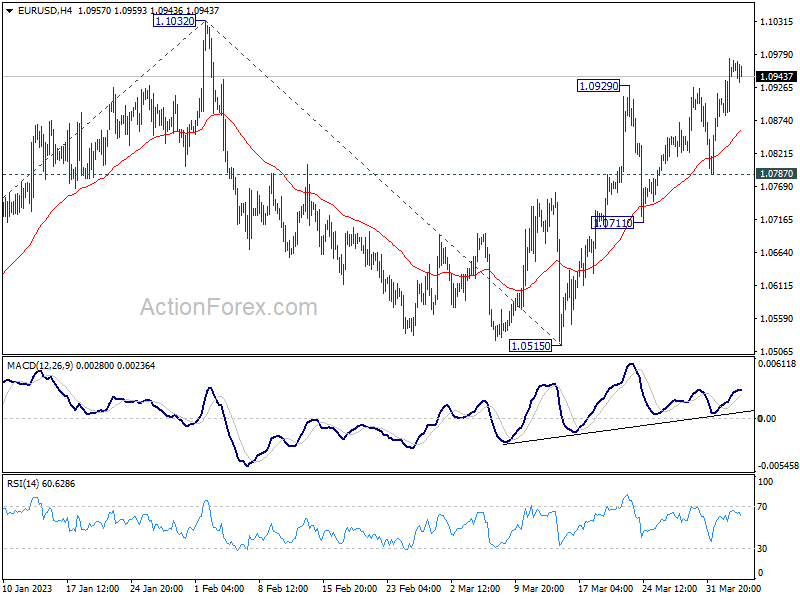
EUR/USD's rise from 1.0515 is in progress and intraday bias stays on the upside. Next target is a retest on 1.1032 high. Decisive break there will resume larger up trend from 0.9534 to 1.1273 fibonacci level next. On the downside, break of 1.0787 support will turn bias back to the downside for 1.0711 support instead.
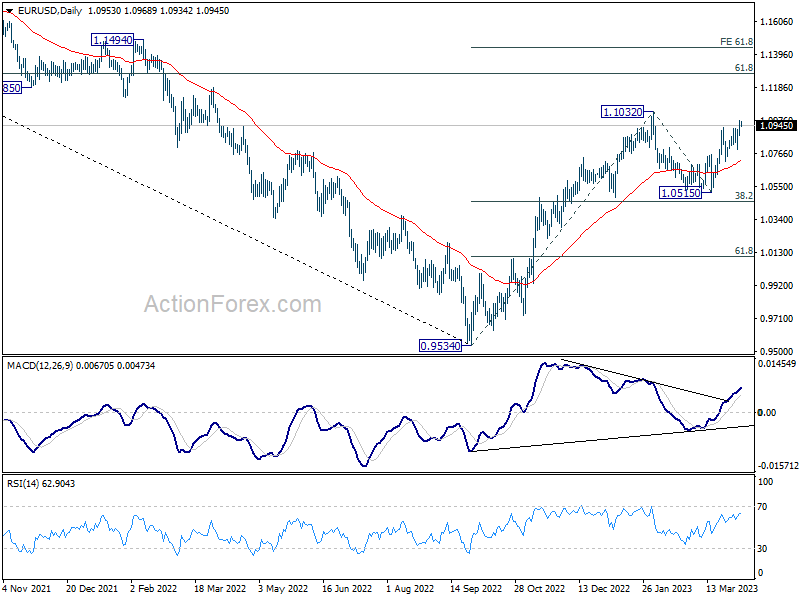
In the bigger picture, rise from 0.9534 (2022 low) is in progress with 38.2% retracement of 0.9534 to 1.1032 at 1.0460 intact. The strong support from 55 week EMA (now at 1.0625) was also a medium term bullish sign. Next target is 61.8% retracement of 1.2348 (2021 high) to 0.9534 at 1.1273. Sustained break there will solidify the case of bullish trend reversal and target 1.2348 resistance next (2021 high).
GBP/USD Mid-Day Outlook
Daily Pivots: (S1) 1.2422; (P) 1.2473; (R1) 1.2552; More...
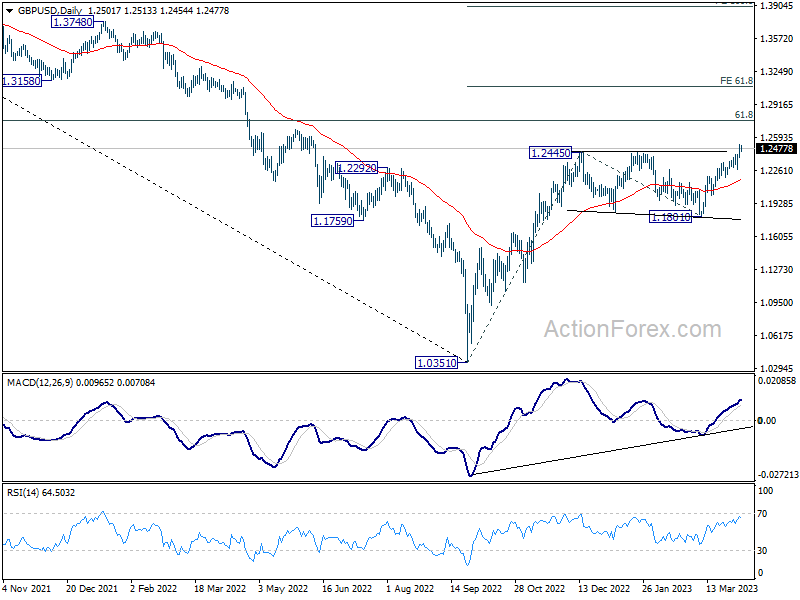
Intraday bias in GBP/USD remains on the upside as rise from 1.1801 is in progress. Whole up trend from 1.0351 should target 1.2759 fibonacci level first . Firm break there will target 61.8% projection of 1.0351 to 1.2445 from 1.1801 at 1.3095. On the downside, below 1.2393 minor support will turn intraday bias neutral first. But retreat should be contained above 1.2203 resistance turned support to bring another rally.
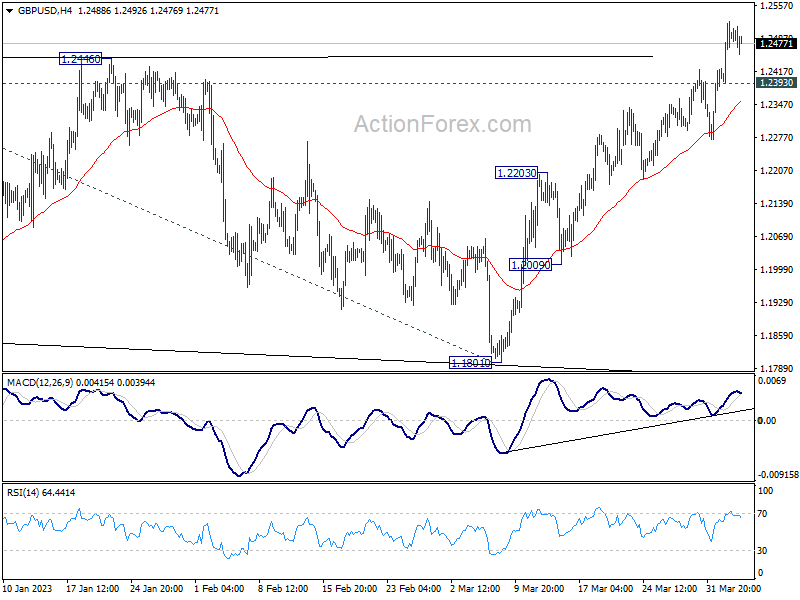
In the bigger picture, the rise from 1.0351 medium term term bottom (2022 low) is in progress for 61.8% retracement of 1.4248 (2021 high) to 1.0351 at 1.2759. Sustained break there will add to the case of long term bullish trend reversal. Further break of 61.8% projection of 1.0351 to 1.2445 from 1.1801 at 1.3095 could prompt upside acceleration to 100% projection at 1.3895. For now, this will remain the favored case as long as 1.1801 support holds, even in case of deep pull back.