

Sample Category Title
USD/JPY Mid-Day Outlook
Daily Pivots: (S1) 131.11; (P) 132.14; (R1) 132.76; More...
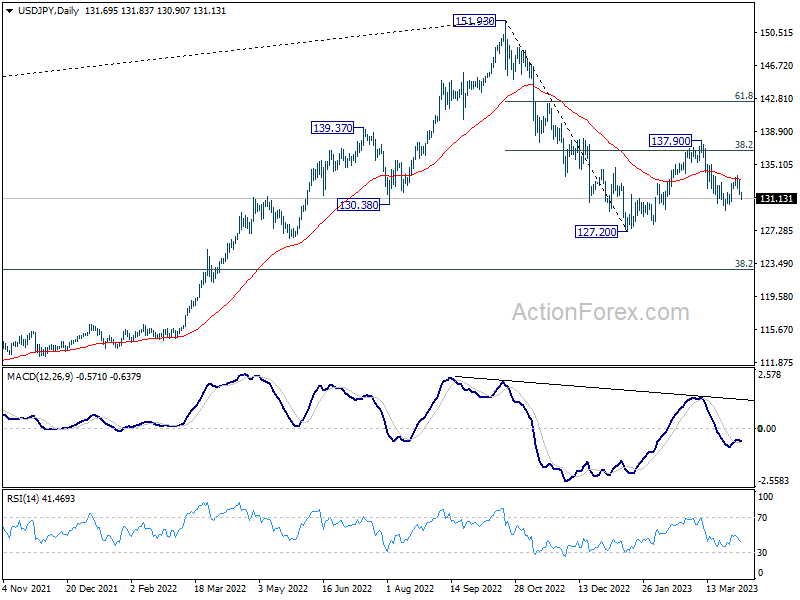
Intraday bias in USD/JPY remains on the downside for the moment. Recovery from 129.62 should have completed at 133.74. Deeper fall is expected to 129.62 first. Break there will resume whole fall from 137.90 to retest 127.20 low. On the upside, however, above 133.74 resistance will turn bias back to the upside for another rise. Overall, eventual downside break out is expected as long as 137.90 resistance holds.
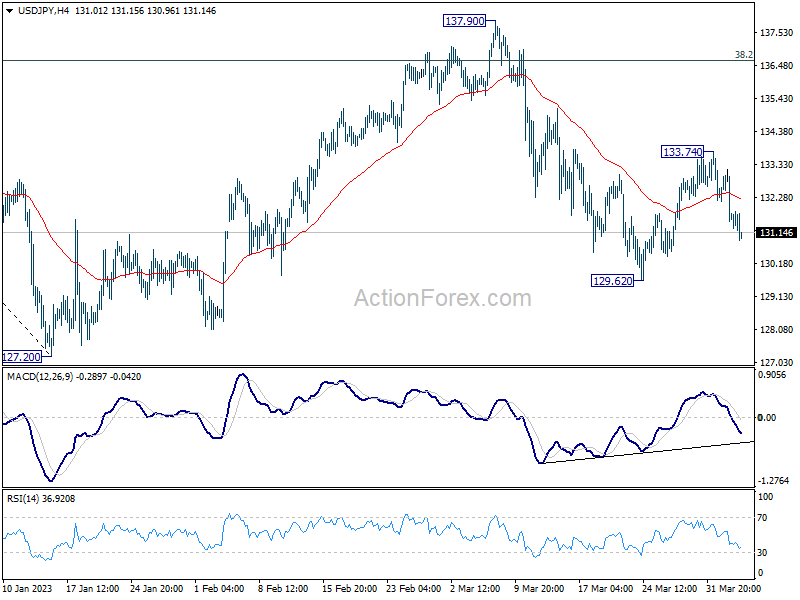
In the bigger picture, corrective pattern from 127.20 might be extending. But after all, down trend from 151.93 is expected to resume at a later stage. Break of 127.20 will resume this down trend and target 61.8% projection of 151.93 to 127.20 from 137.90 at 122.61. This will now be the favored case as long as 137.90 resistance holds.
USD/CHF Mid-Day Outlook
Daily Pivots: (S1) 0.9031; (P) 0.9087; (R1) 0.9118; More...
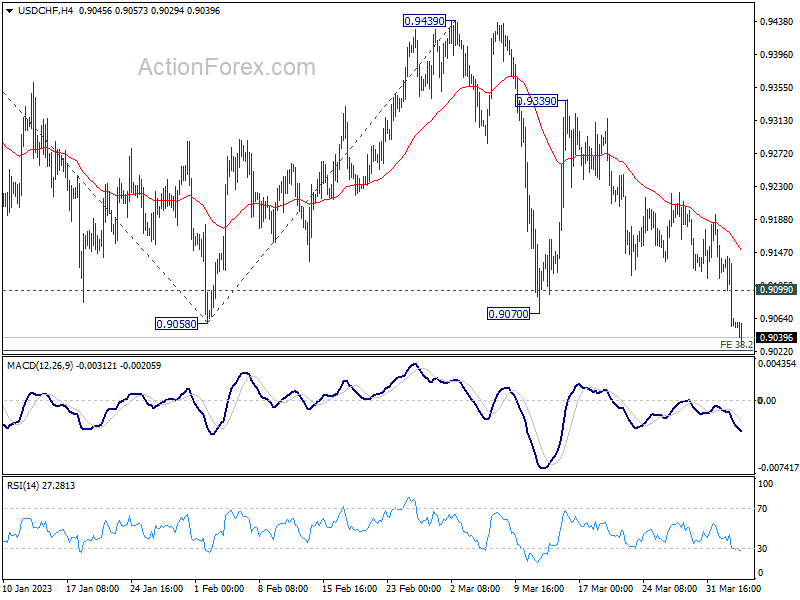
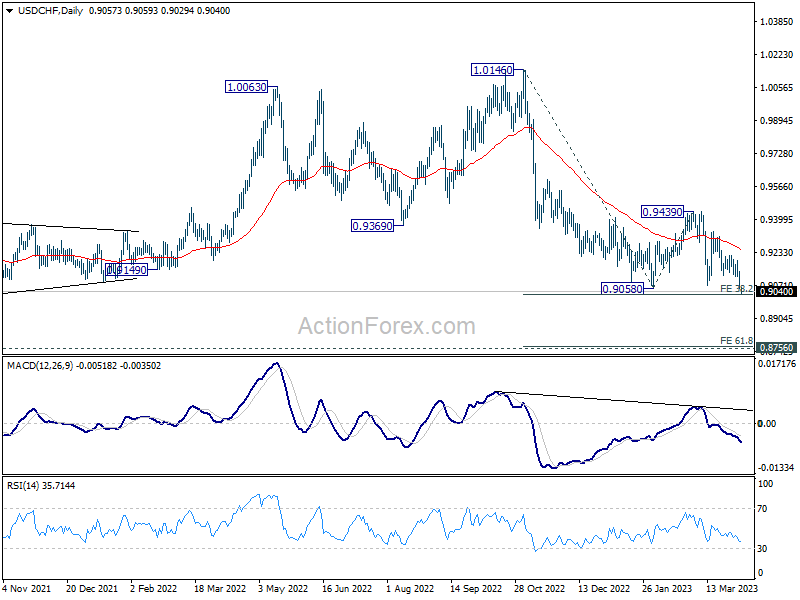
Intraday bias in USD/CHF stays on the downside for 38.2% projection of 1.0146 to 0.9058 from 0.9439 at 0.9023. Decisive break there will extend the down trend from 1.0146 to 61.8% projection at 0.8767.On the upside, above 0.9099 minor resistance will delay the bearish case and turn intraday bias neutral again.
In the bigger picture, outlook will stay bearish as long as 0.9439 resistance holds, and fall from 1.1046 (2022 high) is still in progress. Prior rejection by 55 week EMA was a medium term bearish sign. Sustained of 0.9058 will resume such decline towards 0.8756 support (2021 low). But overall, this fall is still as a leg in the long term range pattern from 1.0342 (2016 high). So, downside should be contained by 0.8756 to bring reversal.
Dollar Remains Weak after Disappointing US ADP Data, Yen and Swiss Franc Rally
Disappointing US private job data doesn't trigger significant fresh selling in Dollar, but it's still maintaining its position as the week's weakest performer so far. Countervailing forces from declining US and European benchmark treasury yields are keeping the greenback's losses against Euro and Sterling in check. However, Swiss Franc and Yen seem to be making headway in broad rallies.
Australian Dollar is currently the day's weakest performer, as post-RBA selloff gains momentum. Meanwhile, New Zealand Dollar is holding onto its gains after a larger-than-expected RBNZ rate hike during the Asian session, although no clear follow-through buying has emerged.
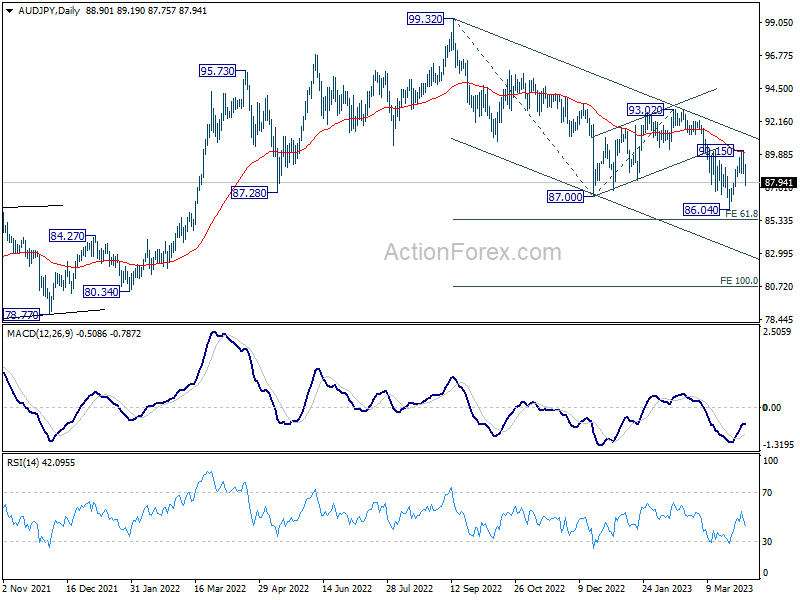
From a technical standpoint, AUD/JPY's rebound from 86.04 is likely complete at 90.15, following a rejection by the 55 day EMA. Deeper decline is now anticipated towards 86.04 and below, resuming the overall downtrend from 99.32. The key level to watch ahead is 61.8% projection of 99.32 to 87.00 from 93.02 at 85.40. Firm break below this level could trigger a more rapid decline to the 100% projection at 80.70, potentially within Q2.
In Europe, at the time of writing, FTSE is up 0.28%. DAX is down -0.51%. CAC is down -0.25%. Germany 10-year yield is down -0.019 at 2.234. Earlier in Asia, Nikkei dropped -1.68%. Japan 10-year JGB yield rose 0.0532 to 0.469. Singapore Strait Times rose 0.23%. Hong Kong and China were on holiday.
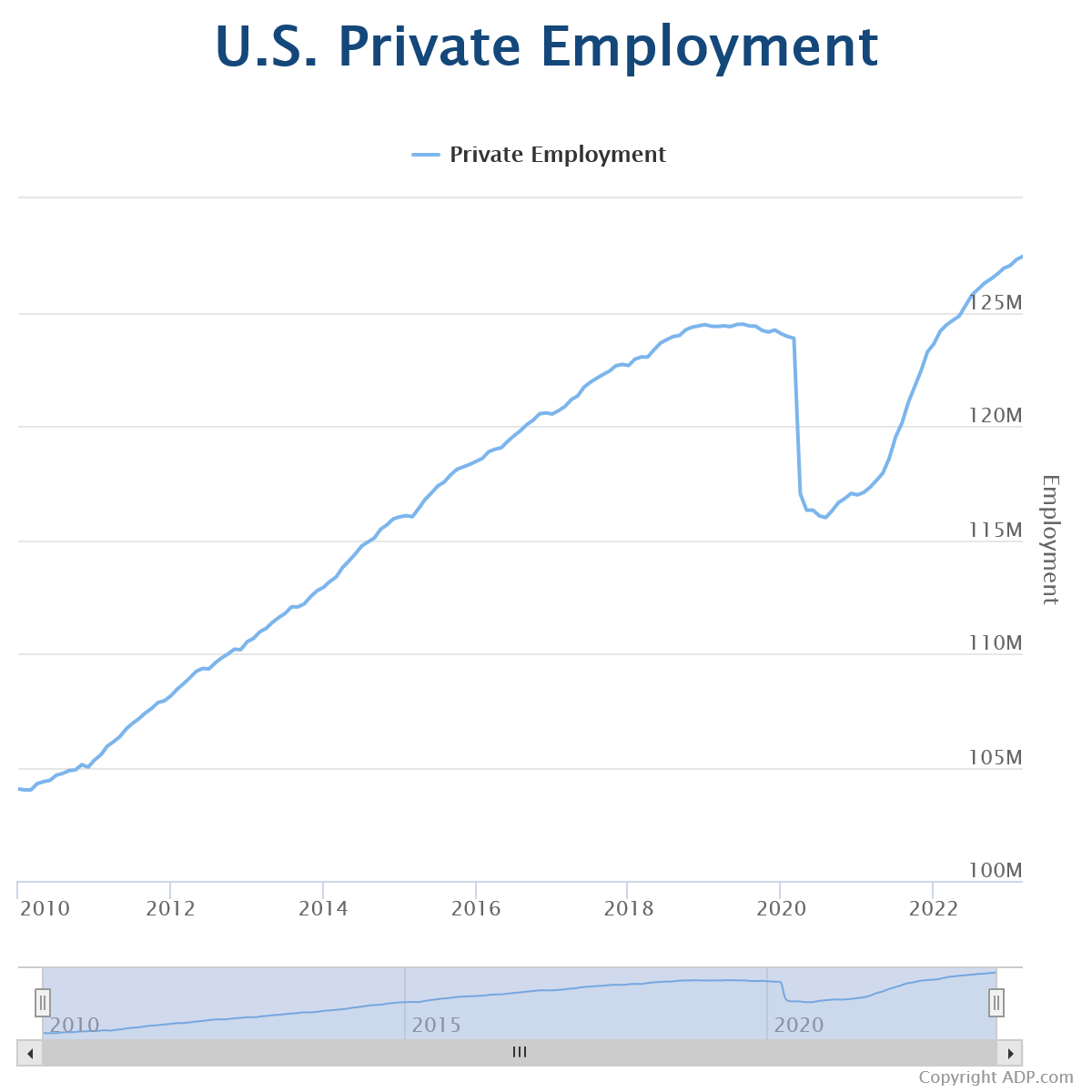
US ADP employment rose only 145k, signals economy is slowing
US ADP private sector employment increased by 145k jobs in March, well below expectation of 200k. By industry sector, goods-producing jobs increased 70k while service-providing jobs increased 75k. By establishment size, small company jobs rose 101k, medium companies rose 33k, and large companies rose 10k.
"Our March payroll data is one of several signals that the economy is slowing," said Nela Richardson, chief economist, ADP. "Employers are pulling back from a year of strong hiring and pay growth, after a three-month plateau, is inching down."
UK PMI services finalized at 52.9, composite at 52.2
UK PMI Services was finalized at 52.9 in March, down from February's 53.5. PMI Composite was finalized at 52.2, down from prior month's 53.1.
Tim Moore, Economics Director at S&P Global Market Intelligence, noted that the UK service sector returned to growth in Q1 2023 due to improved business and consumer confidence, as well as a sustained rebound in new orders. Export sales also boosted the service economy, with the fastest rise in new orders from abroad in over eight years.
Overall business expenses increased at the slowest pace since May 2021, as lower transport bills and falling commodity prices offset rising staff costs. Moore highlighted that prices charged by service sector businesses increased at the weakest rate in 19 months, signaling that competitive pressures and improved supply conditions would likely reduce consumer price inflation in the coming months.
Eurozone PMI composite finalized at 10-month high, but growth varies across countries
Eurozone PMI Services was finalized at 55.0 in March, up from February's 52.7. PMI Composite was finalized at 53.7, up from prior month's 52.0. Both indexes were at their 10-month highs.
Looking at PMI Composite of some member states, improvements were seen in Spain (58.2, 16-month high), Italy (55.2, 16-month high), France (52.7, 10-month high), and Germany (52.6, 10-month high). Ireland dropped to 52.8, 2-month low.
Joe Hayes, Senior Economist at S&P Global Market Intelligence said eurozone economy is rebounding from the slowdown seen in late 2022, and for now, appears to be clear of a recession.
He noted that March's economic activity increase was driven by strong growth in the service sector, but highlighted that growth varies across countries, with significant contributions from Spain and Italy. However, modest activity levels in Germany and France suggest a more conservative outlook for the eurozone's overall economic health.
Hayes also mentioned that the case for further interest rate hikes remains strong, as inflation rates, though cooling from their peaks, continue to run high, especially in the service sector.
RBNZ hikes 50bps after considering a 25bps move too
In an unexpected move, RBNZ raised the Official Cash Rate by 50bps to 5.25%, doubling the anticipated 25bps hike. This bold step reflects the central bank's concerns about persistently high inflation and employment levels.
The RBNZ statement highlighted that "inflation is still too high and persistent, and employment is beyond its maximum sustainable level." Despite lower-than-expected economic activity in the December quarter, demand continues to outstrip supply, exerting further pressure on annual inflation.
The statement also noted that severe weather events in the North Island have contributed to higher prices for some goods and services. This increased near-term CPI inflation poses a risk of inflation expectations remaining above the target range.
In the meeting minutes, the Committee emphasized the need to continue raising the OCR to bring inflation back to the 1-3% target and fulfill their remit. They discussed both 25 and 50 basis point increases, ultimately opting for the more aggressive 50 basis point hike. This decision aims to maintain current lending rates for businesses and households while supporting an increase in retail deposit rates, countering the downward pressure on lending rates caused by falling wholesale interest rates since the February Statement.
RBA Lowe: To hold doesn't imply tightening is over
RBA Governor Philip Lowe, in a speech today, clarified that the decision to keep interest rates unchanged yesterday does not mark the end of tightening measures.
"The decision to hold rates steady this month does not imply that interest rate increases are over. Indeed, the Board expects that some further tightening of monetary policy may well be needed to return inflation to target within a reasonable timeframe," he said.
Acknowledging that monetary policy is now in restrictive territory, Lowe said it was time to hold interest rates steady and gather more information. He also mentioned that RBA will review its monetary policy stance at the next meeting, taking into account updated forecasts and scenarios.
USD/CHF Mid-Day Outlook
Daily Pivots: (S1) 0.9031; (P) 0.9087; (R1) 0.9118; More...
Intraday bias in USD/CHF stays on the downside for 38.2% projection of 1.0146 to 0.9058 from 0.9439 at 0.9023. Decisive break there will extend the down trend from 1.0146 to 61.8% projection at 0.8767.On the upside, above 0.9099 minor resistance will delay the bearish case and turn intraday bias neutral again.
In the bigger picture, outlook will stay bearish as long as 0.9439 resistance holds, and fall from 1.1046 (2022 high) is still in progress. Prior rejection by 55 week EMA was a medium term bearish sign. Sustained of 0.9058 will resume such decline towards 0.8756 support (2021 low). But overall, this fall is still as a leg in the long term range pattern from 1.0342 (2016 high). So, downside should be contained by 0.8756 to bring reversal.
Economic Indicators Update
| GMT | Ccy | Events | Actual | Forecast | Previous | Revised |
|---|---|---|---|---|---|---|
| 02:00 | NZD | RBNZ Interest Rate Decision | 5.25% | 5.00% | 4.75% | |
| 06:00 | EUR | Germany Factory Orders M/M Feb | 4.80% | 0.40% | 1.00% | 0.50% |
| 06:45 | EUR | France Industrial Output M/M Feb | 1.20% | 0.60% | -1.90% | -1.40% |
| 07:45 | EUR | Italy Services PMI Mar | 55.7 | 53 | 51.6 | |
| 07:50 | EUR | France Services PMI Mar F | 53.9 | 55.5 | 55.5 | |
| 07:55 | EUR | Germany Services PMI Mar F | 53.7 | 53.9 | 53.9 | |
| 08:00 | EUR | Eurozone Services PMI Mar F | 55 | 55.6 | 55.6 | |
| 08:30 | GBP | Services PMI Mar F | 52.9 | 52.8 | 52.8 | |
| 09:00 | EUR | Italy Retail Sales M/M Feb | -0.10% | 0.50% | 1.70% | |
| 12:15 | USD | ADP Employment Change Mar | 145K | 200K | 242K | 261K |
| 12:30 | CAD | Trade Balance (CAD) Feb | 0.4B | 2.2B | 1.9B | 1.2B |
| 12:30 | USD | Trade Balance (USD) Feb | -70.5B | -68.5B | -68.3B | -68.7B |
| 13:45 | USD | Services PMI Mar F | 53.8 | 53.8 | ||
| 14:00 | USD | ISM Services PMI Mar | 54.5 | 55.1 | ||
| 14:30 | USD | Crude Oil Inventories | -1.6M | -7.5M |
USD/CAD – Canadian Dollar Eyes Canada’s Job Report
The Canadian dollar has edged lower ahead of the North American session. On the economic front, the US releases ADP Employment Change and the ISM Services PMI later today. There are no tier-1 releases out of Canada today, but we’ll get a look at the March employment report on Thursday.
In the European session, USD/CAD is trading at 1.3464, up 0.14% on the day.
Markets eye NFP after soft JOLTS Jobs Openings
In the US, a soft JOLTS Job Openings release has investors focussed on the health of the US labour market. Employment numbers have been surprisingly strong in the face of rising interest rates, but investors are smelling blood in the water after a weak employment release yesterday. JOLTS Job Openings fell to 9.93 million in February, down from 10.56 million and its lowest level since May 2021.
Will nonfarm payrolls also miss expectations? If so, it would point to weakness in the labour market and the Fed would have an excuse to take a pause in rates at the May meeting. The ADP Employment Change is expected to fall to 200,000, down from 242,000 prior. A weak reading will garner headlines, but the ADP release isn’t considered a reliable precursor of nonfarm payrolls and is unlikely to swing market direction.
Canada’s job numbers up next
Canada’s employment report usually coincides with the US employment report on a Friday. A quirk in the calendar has Canadian markets closed for a holiday on Friday, so Canada’s employment data will be released on Thursday, a day ahead of the US numbers. The economy is expected to have created 12,000 new jobs in March, down from 21,800 in February, while unemployment is projected to inch higher to 5.1%, up from 5.0%.
USD/CAD Technical
- USD/CAD is testing support at 1.3431 earlier today. The next support level is 1.3354
- 1.3590 and 1.3673 are the next resistance line.
US ADP employment rose only 145k, signals economy is slowing
US ADP private sector employment increased by 145k jobs in March, well below expectation of 200k. By industry sector, goods-producing jobs increased 70k while service-providing jobs increased 75k. By establishment size, small company jobs rose 101k, medium companies rose 33k, and large companies rose 10k.
"Our March payroll data is one of several signals that the economy is slowing," said Nela Richardson, chief economist, ADP. "Employers are pulling back from a year of strong hiring and pay growth, after a three-month plateau, is inching down."
USD/CHF: Falls to Multi-Month Low as Pressure on Greenback Rises
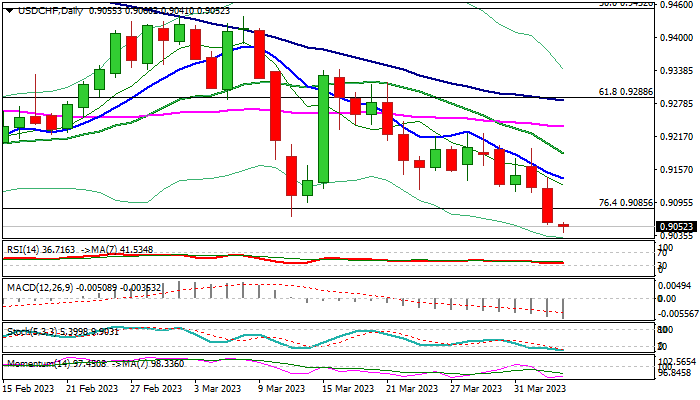
The dollar fell to the lowest level since Aug 2021 against Swiss franc on Wednesday, in extension of sharp bearish acceleration in past two days, when the pair lost 1.1% of its value.
Fresh weakness broke through key med-term supports at 0.9060/80 zone (lows of Nov 2021 / Feb/Mar 2023), signaling continuation of larger downtrend from 1.0147 (Oct 2022 peak) which still requires confirmation on sustained break of these levels.
Initial target lays at 0.9000 (psychological), followed by a higher base at 0.8925/30 (May 2021), which guard key support at 0.8757 (2021 low, the lowest since 2015).
Firmly bearish studies on all larger timeframes (day / week / month) support the notion, although oversold conditions suggest that bears my lose traction and enter consolidation in coming sessions.
Broken Fibo barrier at 0.9085 (76.4% retracement of larger 0.8757/1.0147 downtrend) reverted to initial resistance, ahead of falling 10DMA (0.9140) which is expected to cap extended upticks, to keep bears intact.
The US dollar’s near-term outlook remains weak, with the latest downbeat US data and signals that Fed’s tightening cycle is likely near its end, add to negative stance.
Today’s ADP private sector labor data (Mar 200K f/c vs Feb 242K) is in immediate focus, as markets look for more information about the situation in the US labor sector, with more details to be provided by Friday’s non-farm payrolls report (Mar 240K f/c vs Feb 311K).
Caution on holiday-thinned markets due to Good Friday, which may spark higher volatility.
Res: 0.9085; 0.9119; 0.9140; 0.9186.
Sup: 0.9000; 0.8925; 0.8871; 0.8757.
New Zealand Dollar Surges But Unable to Consolidate after RBNZ Hkes by 50 Basis Points
The New Zealand dollar is showing sharp movement on Wednesday after the Reserve Bank of New Zealand shocked the markets and raised rates by 50 basis points. In the US, JOLTS Jobs Openings was below expectations, raising concerns about the strength of the US labour market.
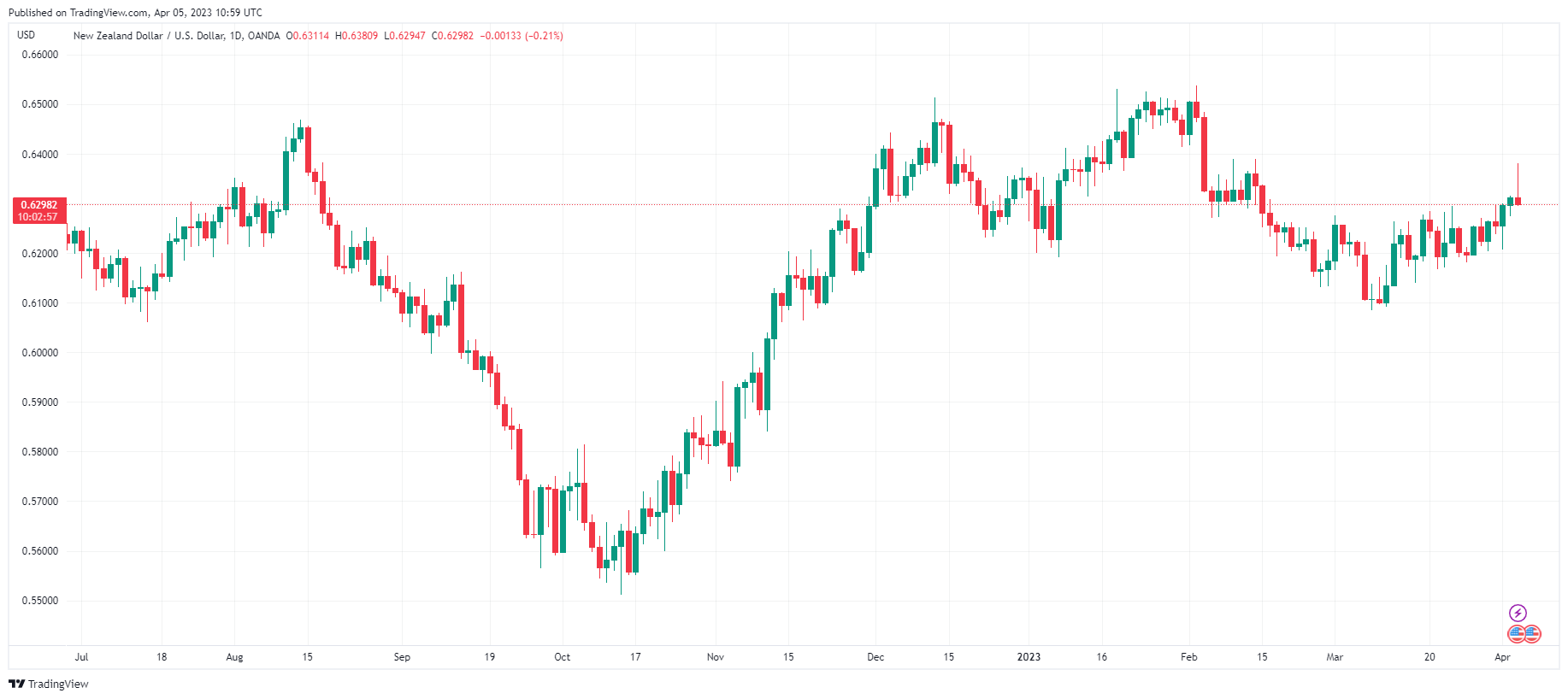
In the European session, NZD/USD is trading at 0.6296, down 0.24%.
RBNZ stuns markets
The RBNZ gets the prize for shocker of the week, after the central bank delivered a 50-bp hike, bringing the benchmark cash rate to 5.25%. Most analysts were expecting a modest 25-bp increase and ahead of the decision, the markets had priced in such a move at a massive 86%. The New Zealand dollar climbed over 1% following the decision, but has pared all of the gains and fallen into negative territory.
The RBNZ statement noted that inflation remains too high, and there’s no arguing that point, as CPI was unchanged in the fourth quarter at 7.2%. The reason that the markets were completely blindsided was that the economy is sputtering. GDP declined by 0.6% in the fourth quarter. The uncertain global outlook doesn’t bode well for the export-dependent economy, and high interest rates and red-hot inflation are hurting domestic demand. This writer suggested yesterday that it seemed a sensible time for the RBNZ to take a breather, but instead, the Bank pushed the rate pedal down even harder than expected.
In the US, a soft JOLTS Job Openings release has the markets abuzz about the strength of the US labour market. JOLTS slipped to 9.93 million, down from 10.56 million and its lowest level since May 2021. The nonfarm payrolls report on Friday will have added significance, as a soft reading would put pressure on the Fed to take a pause at its meeting in May.
NZD/USD Technical
- NZD/USD tested resistance at 0.6362 earlier. Above, there is resistance at 0.6425
- 0.6308 and 0.6245 are providing support
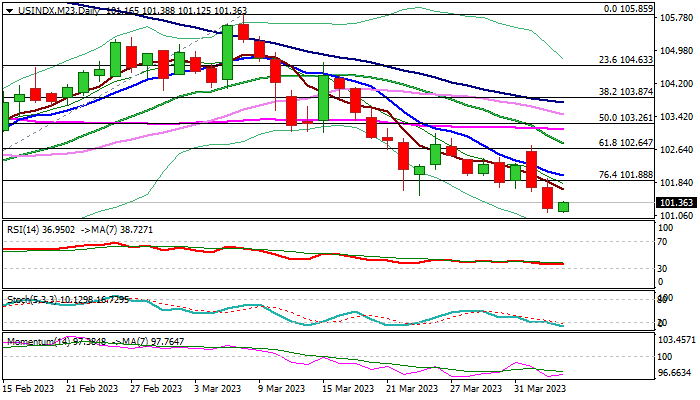
Dollar Index – Consolidation to Precede Final Push Towards 100.66/00 Targets
The dollar index consolidating above new two-month low, posted after a sharp fall in past two days.
The greenback was deflated by renewed risk appetite, while weak latest economic data from the US suggest that economic conditions are fragile and suggest that the Fed likely near the end of its tightening cycle that makes the US currency less attractive for investors.
Markets will continue to closely watch the US data to get more clues about economic growth, particularly due to the banking stress, which would strongly influence dollar’s performance, as the latest crisis in the sector faded, but many remain very cautious regarding this problem.
The latest drop marked retracement of the most of 100.66/105.85 rally and pushed the price close to key support at 100.66 (2023 low), with the action being additionally supported by bearish daily studies.
However, oversold conditions on daily chart signal that larger bears may take a breather and consolidate before final push towards 100.66 and 100.00 (psychological) in extension.
Upticks are expected to stall under falling 10DMA (102.02) to offer better opportunities to re-enter larger bearish market.
Only lift above 102.73/78 (Monday’s top / falling 20DMA) would sideline bears and open way for stronger correction.
Res: 101.53; 101.88; 102.02; 102.64
Sup: 101.12; 100.66; 100.00; 99.30
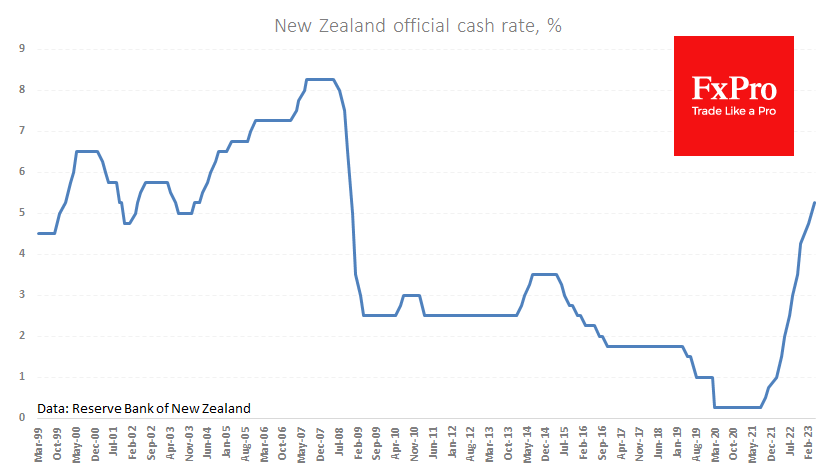
Rate Surprise from New Zealand
The Reserve Bank of New Zealand made another rate hike of 50 points to 5.25%. Contrary to forecasts of a 25-point rate hike and the global trend towards a slowdown in policy tightening, the RBNZ has not slowed down a step. In this cycle, the rate has already been increased by 500 points.
A higher-than-expected rate hike caused the NZDUSD to rise 1.2% within a minute to 0.6378. However, a few minutes later, the excitement for the New Zealand currency eased, and the pair almost erased this rise, returning to the 0.6310 level at the start of the day.
In our view, the pressure on the NZD was due to hints that this could be the end of the RBNZ’s hike cycle, suggesting a slowdown in domestic demand and normalisation of domestic price pressures as the weather in the north of the country normalises.
The NZDUSD has maintained an upward trend for almost a month, receiving support from increasingly higher levels. We consider the smooth reversal to the upside in the pair in March from the 200-day average line as a milestone. On Monday, the Kiwi crossed above its 50-day average, which is also a signal that Today’s intraday trend shows that the bulls cannot increase the momentum of this trend.
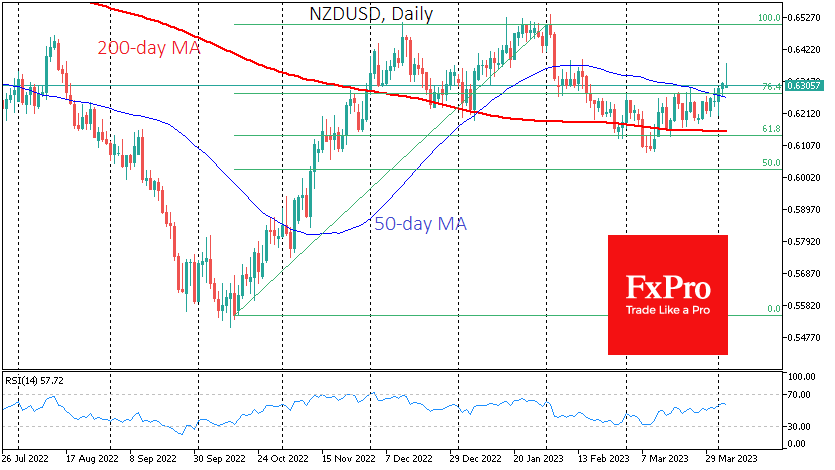
Despite a strong sell-off shortly after the rate decision, the NZDUSD doesn’t look overbought, and there are no significant resistance levels until the area of 0.6500.
And the Kiwi might continue. The pair had an almost canonical Fibonacci retracement from the October-January rise in February and early March and has been moving gently upwards since then, with the potential to reach 0.70-0.71 before the end of the year.
Ethereum’s Overtaking
Market picture
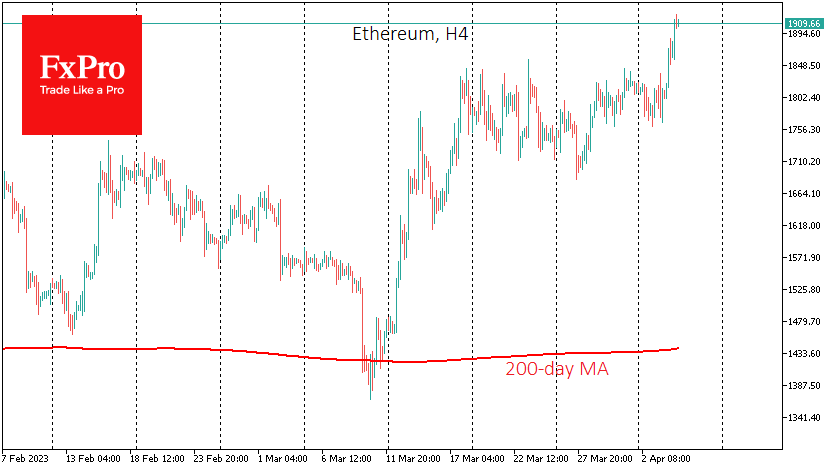
The cryptocurrency market has gained over 3% in the last 24 hours, reaching $1.21 trillion. Interestingly, Bitcoin has yet to keep pace with the overall crypto market growth, adding 2.3% to $28.55K over the same period. Ethereum, on the other hand, has risen by 5.5% to $1910.
The first cryptocurrency is stuck in local highs, above which it has been unable to consolidate since 19th March. This prolonged consolidation sets the stage for the next big move. The resolution of this consolidation is likely to be linked to the market’s reaction to Friday’s Non-Farm Payrolls. Technically, a pullback to the $27k level to correct the rally of the 10th of March is likely.
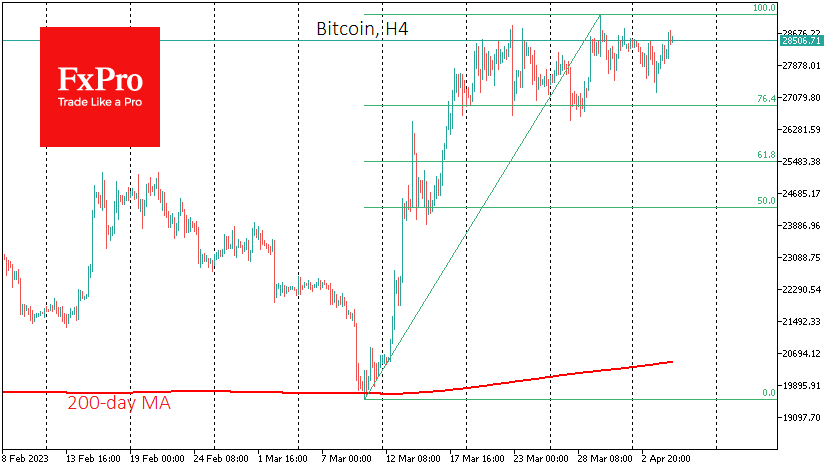
A more bullish scenario is offered by Ethereum, which broke through resistance in a sharp move yesterday and continues to gain traction, reaching an 8-month high. The dynamics within the Fibonacci theory suggest that a target near $2150 could be considered.
News background
According to Kaiko estimates, Binance’s share of the spot crypto market fell by 16% to 54% in the first quarter. The decline was facilitated by removing commission-free trading on several instruments and the CFTC lawsuit.
The CFTC’s lawsuit against Binance did not result in a significant outflow of users from the platform and reduced investor confidence in BTC, Glassnode noted. The transitional structure of the Bitcoin market continues to take shape after a bearish period. The number of addresses holding at least one BTC is approaching 1 million.
According to Brown Brothers Harriman (BBH) research, nearly 3/4 of institutional investors surveyed said they were “extremely or very interested” in cryptocurrency ETFs. Meanwhile, only 25% of respondents plan to increase their investments over the next year.
The US Department of Justice reported seizing $112 million in digital assets from cryptocurrency fraud and money laundering perpetrators.