Sample Category Title
Japan PMIs: Growth continues with strong services but struggling manufacturing
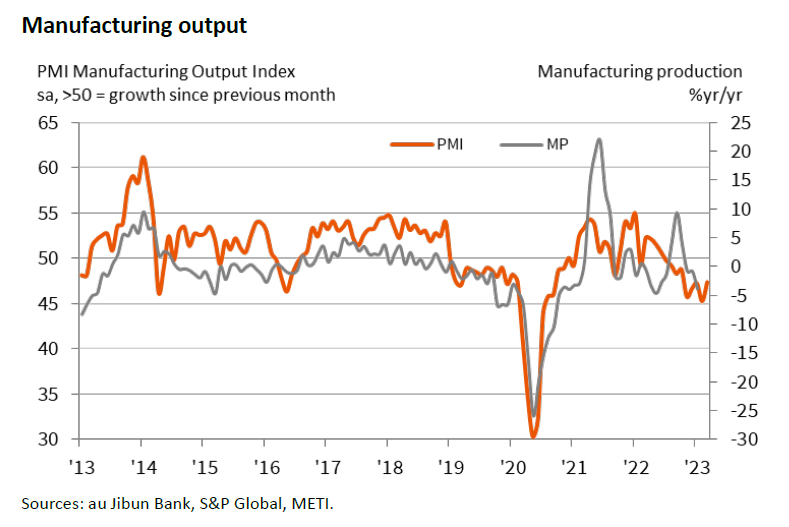
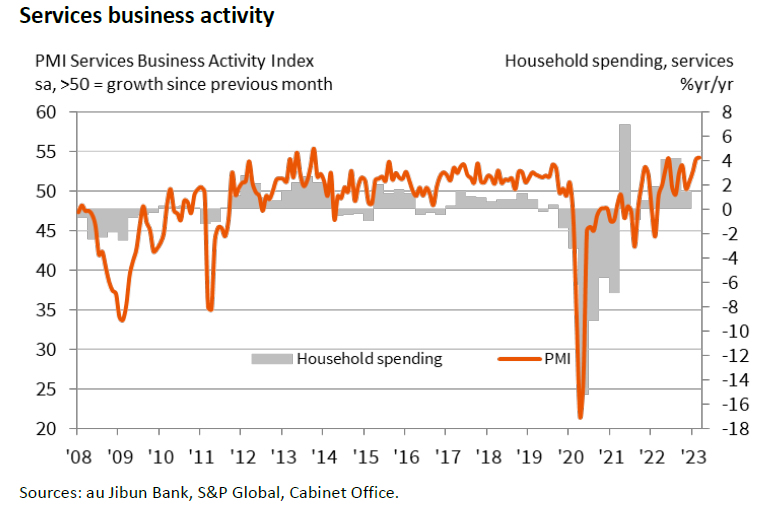
Japan PMI Manufacturing rose from 47.7 to 48.6 in March, slightly above expectation of 48.2. PMI Manufacturing Output rose from 45.3 to 47.4. PMI Services ticked up from 54.0 to 54.2, the best reading since October 2013. PMI Composite improved from 51.1 to 51.9.
Japanese private sector firms experienced growth for the third consecutive month, with the services sector witnessing a notable improvement. Demand conditions strengthened, as government support and the lifting of COVID-19 restrictions in mainland China led to increased activity and new orders.
However, the manufacturing sector continued to face challenges, with output and new orders still contracting, albeit at a slower rate than February. Manufacturers reported ongoing supply chain normalization, as supplier delivery times lengthened at the slowest pace since October 2020.
Australia PMI composite dropped to 48.1, renewed contraction
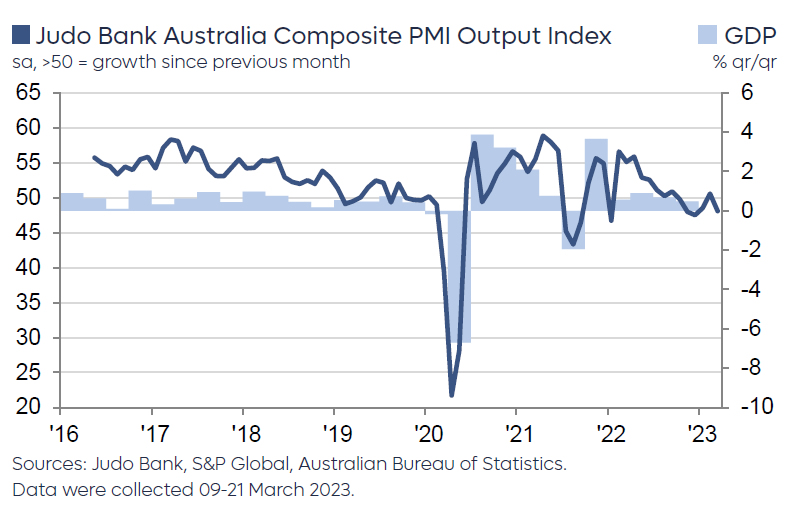
Australia PMI Manufacturing dropped from 50.5 to 48.7 in March, a 34-month low. PMI Services dropped from 50.7 to 48.2, a 3-month low. PMI Composite dropped from 50.6 to 48.1, a 3-month low. All readings indicated renewed contraction in the private sector following improvements in February.
Looking at some details, the results indicate a continued economic slowdown, with composite output and new orders indexes at their lowest since the 2021 Delta lockdowns. Despite easing labor demand, employment indexes suggest businesses are still looking to expand their workforce in 2023. Price indicators have eased but remain elevated, with Australian inflation peaking in late 2022. Service industry input prices are still high, suggesting potential inflationary pressures in 2023 due to labor costs and energy prices.
As the Reserve Bank of Australia (RBA) prepares for its April meeting, it faces a tough decision on whether to pause its tightening cycle amid global financial uncertainty, strong employment numbers, and concerns about inflation levels. Some argue that the RBA should raise the cash rate closer to 4% before pausing to observe the economy's performance over the next few months.
Warren Hogan, Chief Economic Advisor at Judo Bank noted: "There is no point pausing for a month before hiking again. The RBA Board need to get the cash rate to a level that they think will buy them the time to observe how the economy unfolds for at least three months, if not longer."
Cliff Notes: The End of the Global Tightening Cycle
Key insights from the week that was.
The FOMC and Bank of England both delivered 25bp rate hikes at their March meeting, bringing their respective tightening cycles to an end – in our view. The RBA’s policy tightening is also near its end, with one final 25bp move to occur in May.
The March RBA meeting minutes gave a detailed assessment of only one policy option, their decision to hike by 25bps. Though discussion of a pause at the March meeting was not evident, the Board “agreed to reconsider the case for a pause at the following meeting, recognising that pausing would allow for additional time to reassess the outlook for the economy”. It was also interesting to see the Board’s in depth assessment of market pricing, particularly as their commitment to considering a pause in April pre-dated current developments in the global banking sector, which have seen market pricing flip from hikes to cuts offshore and in Australia.
As discussed by Chief Economist Bill Evans in a video update midweek, the minutes support our view of a pause from the RBA in April; however, we do not believe this will mark the end of the tightening cycle. By May, we expect the Board will be presented with a strong Q1 CPI report and an updated set of economic forecasts that justify one final 25bp rate hike, raising the cash rate from 3.60% to a peak of 3.85% in order to fully ensure that inflation risks are contained. Developments thereafter will be centred on the abrupt slowing of growth and easing inflation over the second half of 2023, warranting the RBA remain on hold over the rest of the year to assess before easing in 2024, with 150bps of rate cuts through to mid-2025. For an in-depth summary and state-by-state breakdown of the growth outlook, see the latest edition of Westpac’s Coast-to-Coast.
Before moving on, a quick note on Australian manufacturing. The latest ACCI-Westpac Business Survey reported that manufacturing conditions, after having stalled flat in Q4 2022, posted a modest improvement in Q1 2023. That said, the overall tone of the survey is still downbeat, with expectations for future activity moderating amid broadening headwinds for the sector. Most notably, Australian manufacturers are facing acute cost pressures – a net 70% reporting an increase in input prices in the period – as surging energy costs continue to impact, resulting in margin squeeze and a loss of competitiveness. With regards to production, not only is labour still being cited as a major limiting factor, but evidence is also beginning to emerge that manufacturers are facing pressures in sourcing financing.
Turning to the US, at their March meeting, the FOMC kept the immediate focus on the fight against inflation by hiking 25bps to a mid-point of 4.875% while also recognising the tightening of financial conditions to come as a result of this month’s Silicon Valley Bank and Signature Bank failures. While uncertain in time and scale, the inclusion of “Recent developments are likely to result in tighter credit conditions for households and businesses and to weigh on economic activity, hiring, and inflation” makes clear the Committee’s expectation that the cost to the economy from this crisis of confidence in US regional banks will prove significant. The FOMC could certainly justify hiking once more in May to a peak of 5.125%. However, given the risks around financial conditions and confidence, holding off to assess would be the prudent course, particularly given policy is already contractionary and forward indicators for inflation and the labour market were pointing down ahead of this shock. Accordingly, we confirm our view that the federal funds rate has now peaked for this cycle.
Against market expectations of 3-4 cuts by January 2024, we also confirm our view that the federal funds rate is likely to remain on hold through the remainder of 2023, with a clear need to guard against inflation risks over the period. It is only once inflation is back near target that the FOMC will be confident to cut and, at that time, we believe they will do so aggressively, by 200bps in 2024 and a further 75bp in 2025, back to 2.125% -- a broadly neutral policy level. In assessing the risks to this view, it is important to emphasise as Chair Powell did in the press conference, that there are now multiple financial condition dynamics to assess in real time, each with its own timeline and risk profile. Even as rates are cut in 2024, a tighter regulatory focus on regional banks with less than $250bn in assets will likely continue to constrain lending and consequently investment and employment. It is only after the regulatory regime is reset and confidence fully restored that easier policy will bring growth back above trend on a sustainable basis. This is unlikely before late-2024, at the earliest.
Over in the UK, the Bank of England (BoE) also delivered a 25bp hike, albeit with two members voting instead for no change. In the communications from the meeting, there was little concern over the recent upside surprise for inflation which came as a result of core goods inflation, primary clothing and footwear “which tend to be volatile”. Services inflation meanwhile had proven to be marginally weaker than forecast in February, and the MPC anticipate that Q2 2023 will see a significant deceleration to a rate lower than forecast in February given falls in wholesale energy prices and a three-month extension of the Government’s Energy Price Guarantee from April. It is notable that this confidence in the outlook for inflation comes despite the economy continuing to outperform expectations and the Government giving additional modest support to the economy in the Spring Budget.
Like in the US, another 25bp hike could certainly be justified by the BoE in coming months, though it would come with the risk of a swift reversal. To us, the prudent course for the BoE is instead to remain on hold, providing stability and confidence while the already-contractionary stance of policy and global uncertainty works to cool inflation pressures. Albeit with one more hike to go, on our expectations, the ECB clearly finds itself in a similar position. This week, it was constructive to see ECB speakers much more conscious of the broad array of risks they face for the remainder of 2023 and into 2024.
USD/JPY At Risk of Additional Decline, PMI’s Next
Key Highlights
- USD/JPY started a fresh decline below the 133.50 support zone.
- A major bearish trend line is forming with resistance at 131.80 on the 4-hours chart.
- EUR/USD and GBP/USD rallied above 1.0800 and 1.2220 respectively.
- The US Manufacturing PMI could decline from 47.3 to 47.0 in March 2023 (Preliminary).
USD/JPY Technical Analysis
The US dollar started a fresh decline from well above 134.00 against the Japanese Yen. USD/JPY traded below the 133.50 and 133.00 levels to enter a bearish zone.
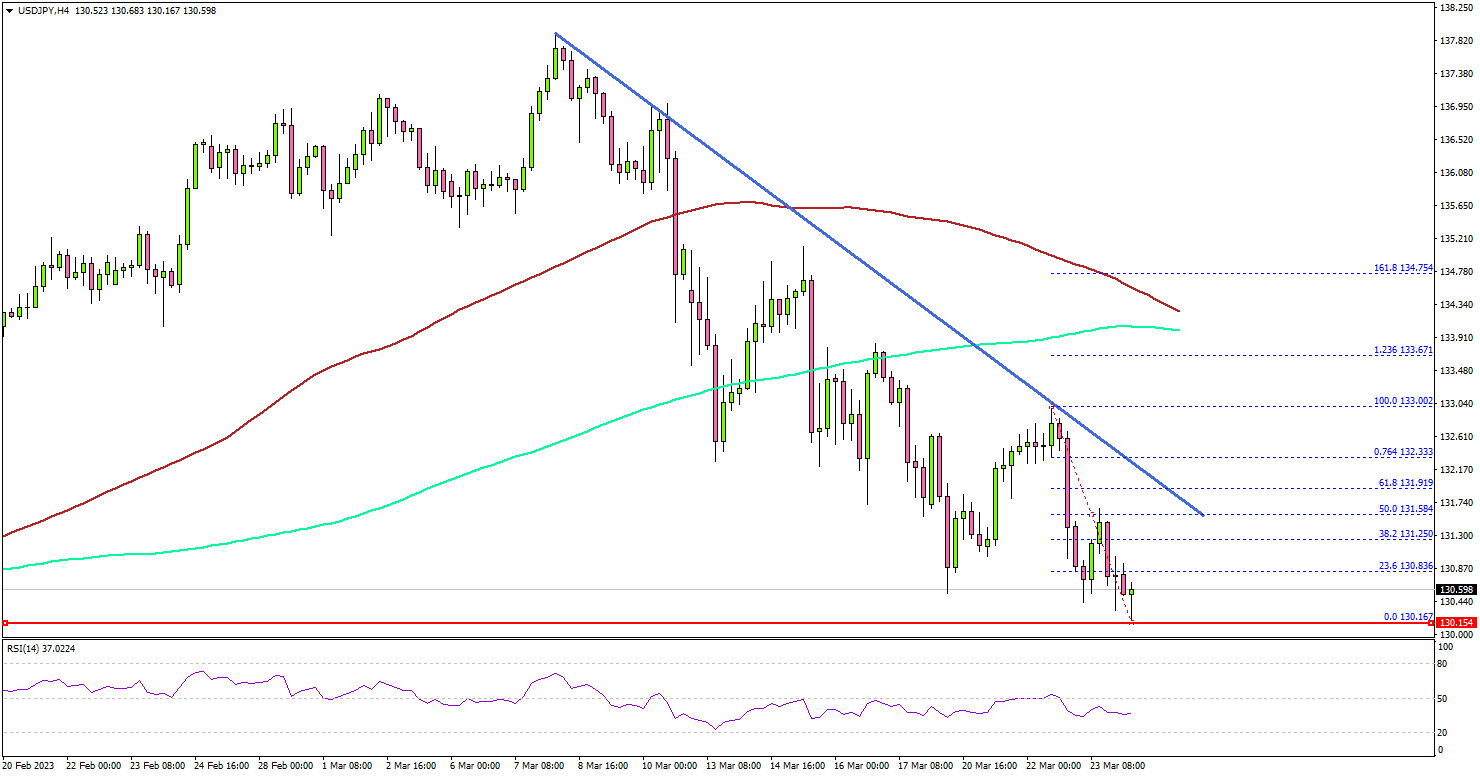
Looking at the 4-hours chart, the pair moved below the 132.50 support level, the 100 simple moving average (red, 4-hours), and the 200 simple moving average (green, 4-hours).
The pair even traded below the 131.20 support. A low is formed near 130.40 and the pair is now consolidating losses. An immediate resistance on the upside is near the 131.55 level.
The first major resistance is near the 131.80 level. There is also a major bearish trend line forming with resistance at 131.80 on the same chart. The next major resistance is near the 132.20. A clear move above the 132.20 resistance might send the pair towards the 133.00 zone.
Any more gains might send the pair towards 133.50 or even 134.00. On the downside, an immediate support is near the 130.50.
The next major support is near the 130.00 level, below which there is a risk of a move towards the 128.80 level or 127.50 in the coming days.
Looking at EUR/USD, the pair gained strength above the 1.0800 resistance zone and even spiked above the 1.0880 level.
Economic Releases
- Germany’s Manufacturing PMI for March 2023 (Preliminary) - Forecast 47.0, versus 46.3 previous.
- Germany’s Services PMI for March 2023 (Preliminary) - Forecast 51.0, versus 50.9 previous.
- Euro Zone Manufacturing PMI for March 2023 (Preliminary) – Forecast 49.0, versus 48.5 previous.
- Euro Zone Services PMI for March 2023 (Preliminary) – Forecast 52.5, versus 52.7 previous.
- US Manufacturing PMI for March 2023 (Preliminary) – Forecast 47.0, versus 47.3 previous.
- US Zone Services PMI for March 2023 (Preliminary) – Forecast 50.5, versus 50.6 previous
Elliott Wave Favors More Downside in GBPJPY
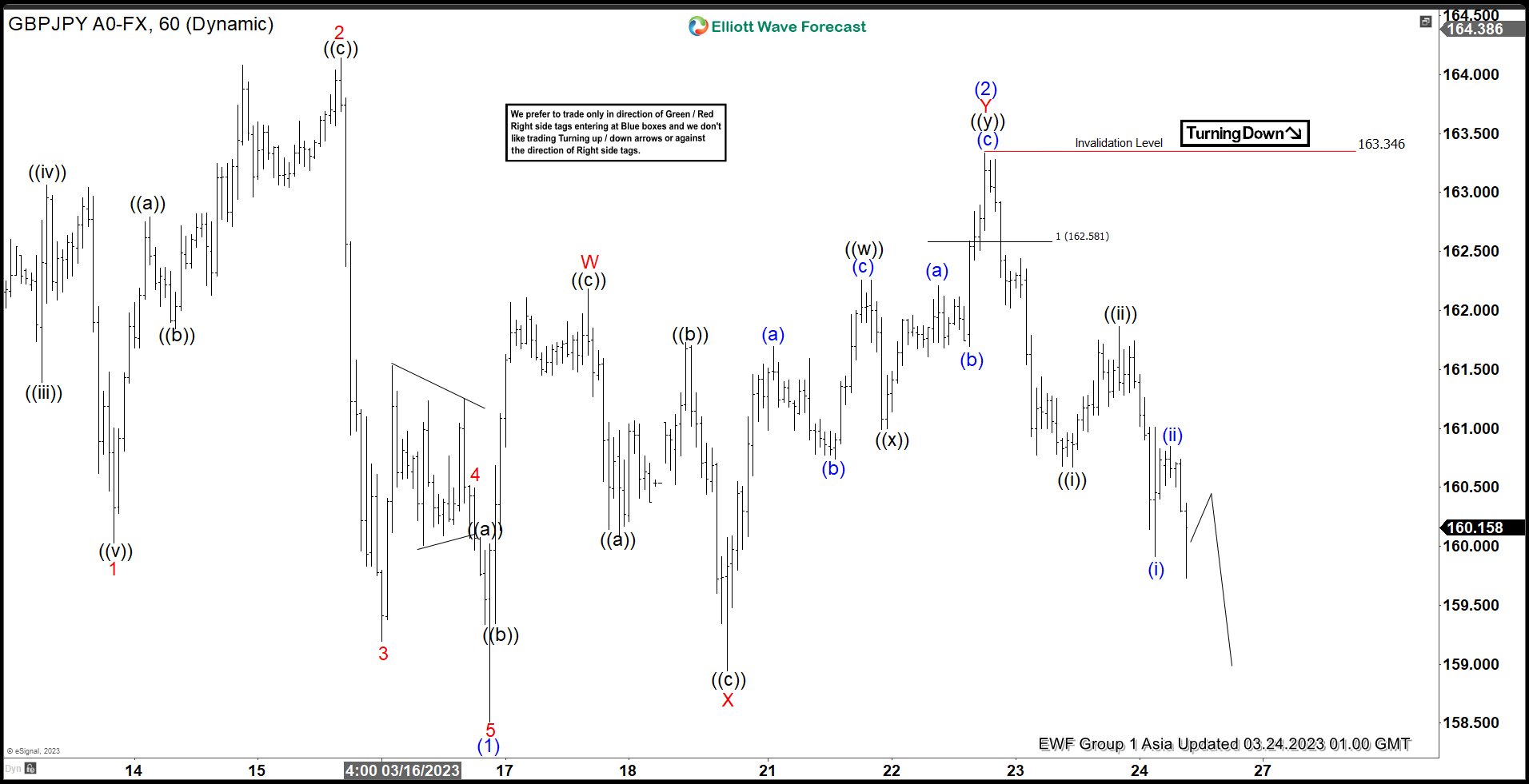
Decline from 2.28.2023 is in progress as a 5 waves impulse Elliott Wave structure. Down from 2.28 high, wave 1 ended at 160.02 and rally in wave 2 ended at 164.14. Pair resumes lower in wave 3 towards 159.19, and wave 4 ended at 160.49. Last leg lower wave 5 ended at 158.51 which completed wave (1). Wave (2) corrective rally ended at 163.34 as a double three Elliott Wave structure. Up from wave (1), wave W ended at 162.18, and pullback in wave X ended at 158.94. Wave Y higher ended at 163.34 which completed wave (2).
Pair resumes lower in wave (3) with internal subdivision as another 5 waves in lesser degree. Down from wave (2), wave ((i)) ended at 160.67 and rally in wave ((ii)) ended at 161.86. Pair has resumed lower in wave ((iii)) and broken below wave ((i)). Down from wave ((ii)), wave (i) ended at 159.91 and wave (ii) rally ended at 161.01. Expect pair to continue lower within wave (iii) of ((iii)). A break below wave (1) at 158.51 would confirm the bearish view and rule out a double correction. Near term, as far as pivot at 163.34 high stays intact, expect rally to fail in 3, 7, or 11 swing for further downside
GBPJPY 1 Hour Elliott Wave Chart
GBPJPY Elliott Wave Video
https://www.youtube.com/watch?v=Ue3pVdKIRDE
AUDNZD Wave Analysis
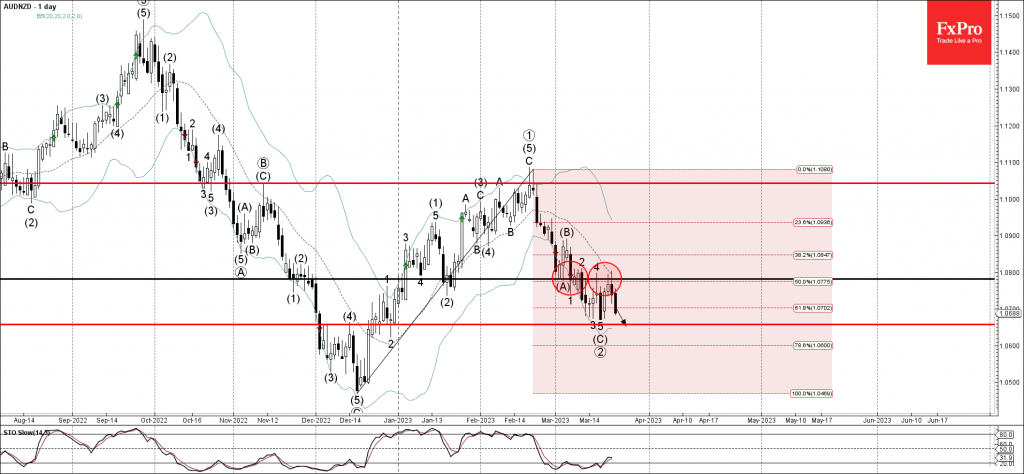
- AUDNZD reversed from resistance level 1.078
- Likely to fall to support level 1.0670
AUDNZD currency pair recently reversed down from the key resistance level 1.078 (former support from the start of March).
The resistance level 1.078 was strengthened by the intersecting 50% Fibonacci correction of the previous upward impulse from December (acting as the resistance after it was broken in March).
AUDNZD can then be expected to fall further toward the next support level 1.0670 (which stopped the previous correction (C)).
Silver Wave Analysis
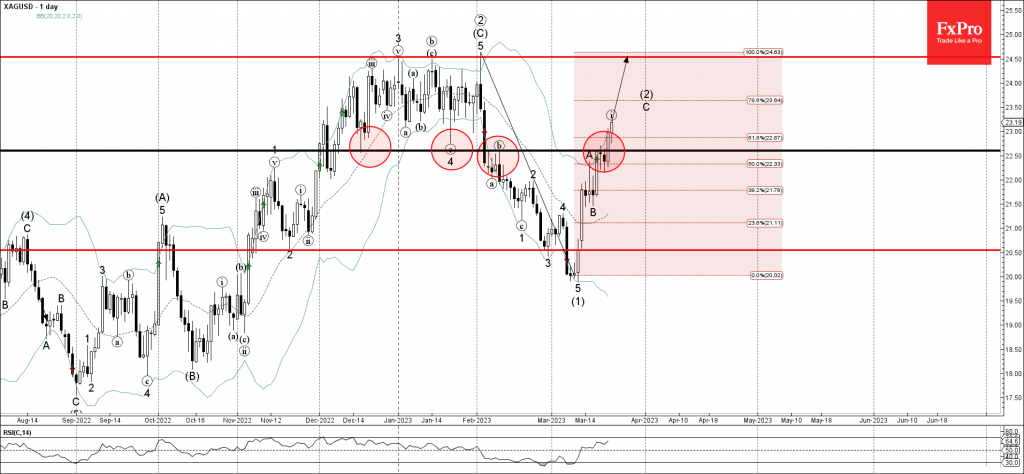
- Silver broke key resistance level 22.60
- Likely to rise to resistance level 24.50
Silver recently broke the key resistance level 22.60 (former support from December, which has been reversing the price from February).
The breakout of the resistance level 22.60 coincided with the breakout of the 50% Fibonacci correction of the previous downward impulse (1) from February (which accelerated the active impulse wave C).
Silver can then be expected to rise further toward the next resistance level 24.50 (previous Triple Top from December and January).
Bank of England Review – Set for Another 25bp Hike in May
- In line with our expectation, the BoE today hiked policy rates by 25bp, bringing the Bank Rate to 4.25%.
- With both growth and domestic inflation having surprised to the upside and given BoE's message today we pencil in an additional 25bp hike in May 2023.
- We thus expect the Bank Rate to peak at 4.50%. We still do not envision rate cuts from BoE before 2024.
In line with our expectation, the Bank of England (BoE) hiked the Bank (policy) Rate by 25bp to 4.25% with 7 members voting for a 25bp hike and two members voting for keeping the Bank Rate unchanged.
Overall, the forward guidance was limited with the BoE leaving the door open for another hike at the May meeting if persistent inflation pressures persist. With February headline inflation surprising sharply to the upside and the near-term path of GDP "likely to be somewhat stronger than previously expected" the majority of Monetary Policy Committee (MPC) voted for an increase of 25bp. Most notably, the most hawkish member Cathrine Mann voted for a 25bp instead of 50bp despite hawkish commentary between meetings. The key concern for the BoE remains developments in wage data as well as service inflation. With both growth and inflation having surprised to the upside, we do not believe that data will have weakened enough for the BoE to pause its hiking cycle at the May meeting. We thus revise our forecast to include a final 25bp hike in May, marking a peak in the Bank Rate at 4.50%.
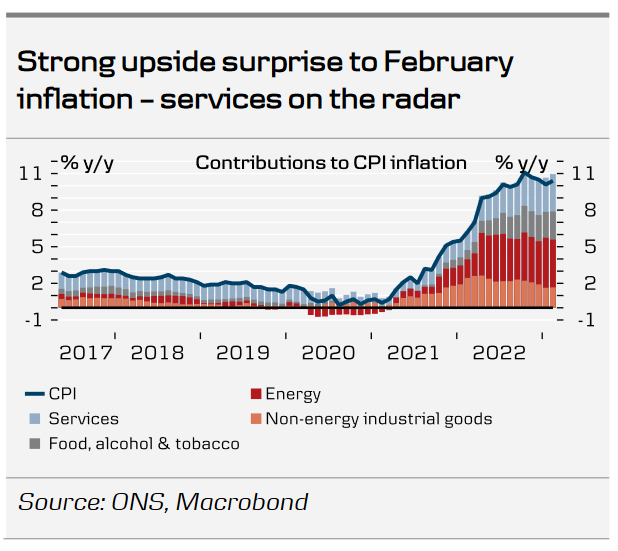
We were left with little guidance in terms of potential cuts later in the year. The two MPC members in favour of keeping the Bank Rate unchanged suggested that policy was becoming "increasingly restrictive, this would bring forward the point at which recent rate increases would need to be reversed". We do not expect any cuts to materialize before 2024.
Rates. As the 25bp hike was fully priced in by markets, the market reaction upon announcement was limited. 10-30Y was close to unchanged while 2Y rates were a few basis points lower. The market pricing of the peak policy rate was pushed slightly lower to 4.5% in August (from 4.6%).
FX. EUR/GBP initially moved lower upon announcement but quickly retraced as little guidance was given in the statement. Further out, EUR/GBP is, in our view, stuck between opposing forces. On the one hand, we expect relative rates to act as a clear tailwind, while global growth slowdown and the relative appeal of UK assets acts as a headwind. We thus expect the cross to remain range bound around 0.87-0.88.
Our call. We revise our call to expect the BoE to deliver a final 25bp hike in May. Our expectations are in line with current market pricing (currently 30bp priced until August 2023) as we expect the rest of the BoE committee to increasingly turn less hawkish amid a weakening growth backdrop and easing labour market conditions. Markets are pricing in 30bp of cuts during H2. We still believe that the first rate cuts will not be delivered before the beginning of 2024.
Bank of England Raises Interest Rate and Optimism
The Bank of England raised its interest rate by 25 points to 4.25%, in line with market expectations. Two members voted to keep rates on hold for the third meeting, while seven others voted against it.
Commenting on the decision, the BoE noted the improved global growth outlook and now expects UK GDP to grow in the second quarter, up from a 0.4% contraction previously. Separately, the fall in gas and oil futures prices is noted.
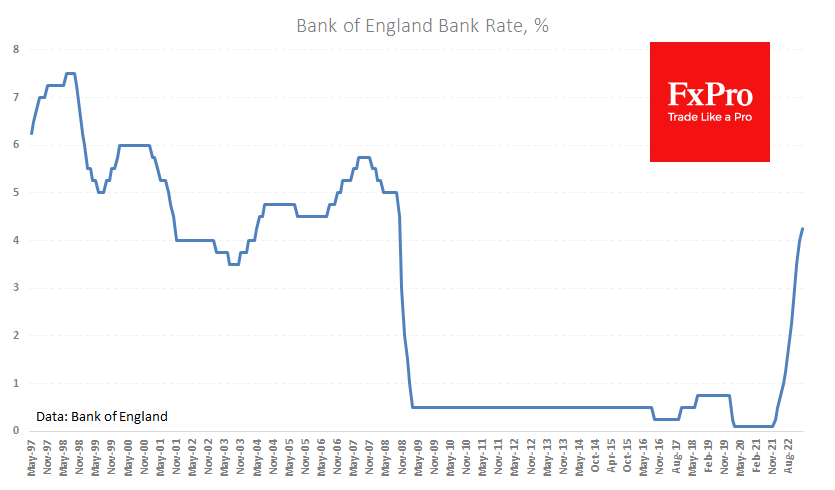
The Bank of England has described the recent unexpected rise in inflation as temporary and continues to see a significant slowdown over the year. This is in no small part due to the current budget changes.
The Bank of England said further policy tightening might be needed if there is evidence of additional inflationary pressures in wages and services costs. This sounds like relatively dovish commentary, expressing more hope than confidence in a sustained return of inflation to the 2% target and the financial sector’s resilience. Indirectly, the regulator’s rhetoric suggests that the baseline scenario remains for rates to stay on hold.
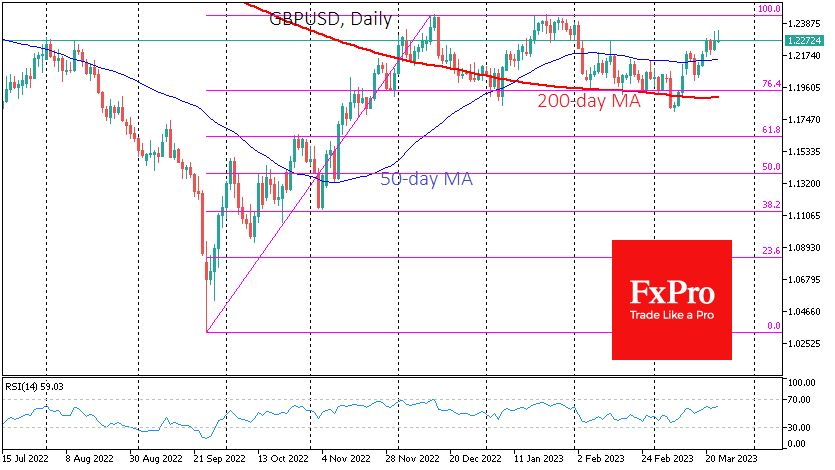
GBPUSD initially reacted positively to the rate decision, returning to the day’s high of 1.2340, but at the time of writing has pulled back below 1.2300. At the same time, the Pound’s momentum against the Dollar is primarily driven by the Dollar. In our view, the GBPUSD completed an almost three-month correction in early March, with the next target near the upper end of the trading range since December at 1.2430. Likely, the strengthening will not stop there, and the pair will have further strength to reach a new level, targeting 1.30.