

Sample Category Title
AUD/USD Daily Report
Daily Pivots: (S1) 0.6652; (P) 0.6704; (R1) 0.6737; More...
Intraday bias in AUD/USD is turned neutral with current retreat. Above 0.6578 will resume the rebound from 0.6563 to 55 day EMA (now at 0.6769). Sustained break there will pave the way back to retest 0.7156 high. On the downside, however, below 0.6648 minor support will turn intraday bias back to the downside for 0.6563 low.
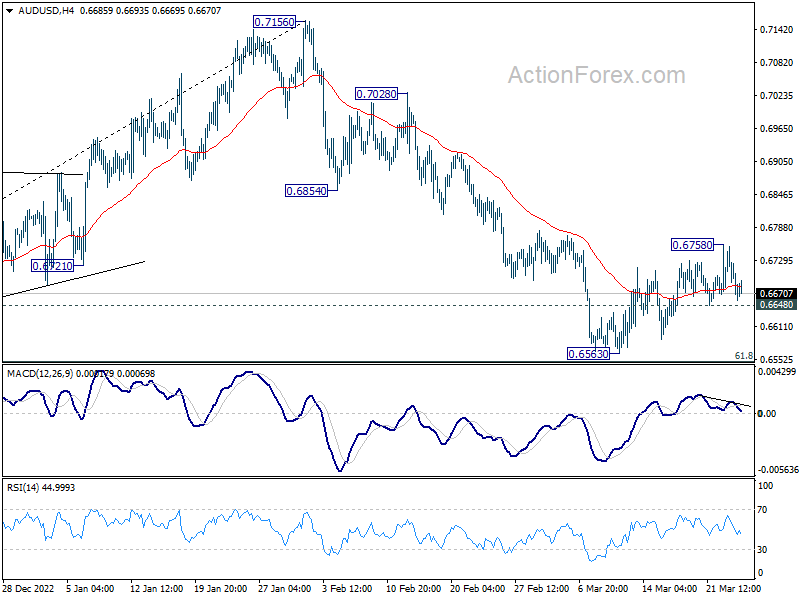
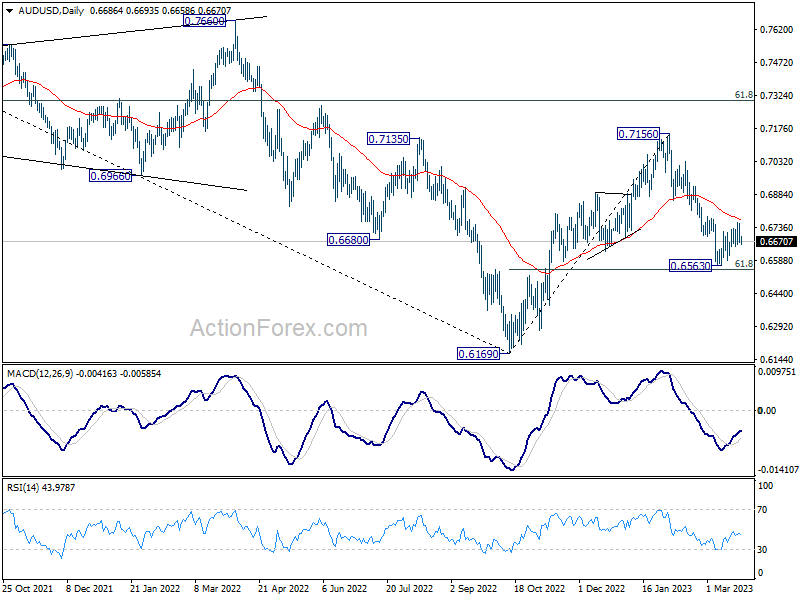
In the bigger picture, as long as 61.8% retracement of 0.6169 to 0.7156 at 0.6546 holds, the decline from 0.7156 is seen as a correction to rally from 0.6169 (2022 low) only. Another rise should still be seen through 0.7156 at a later stage. However, sustained break of 0.6546 will raise the chance of long term down trend resumption through 0.6169 low.
EUR/USD Daily Outlook
Daily Pivots: (S1) 1.0796; (P) 1.0863; (R1) 1.0900; More...
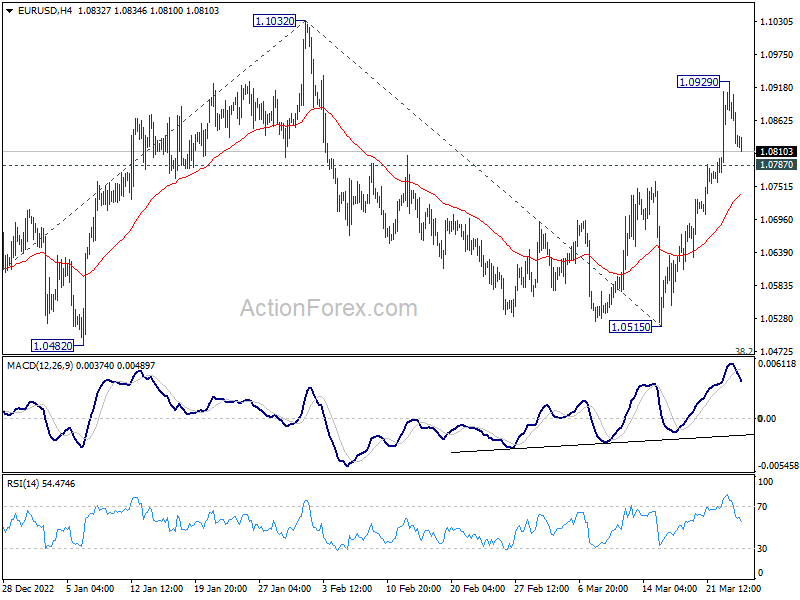
A temporary top is formed at 1.0929 in EUR/USD with current retreat. Intraday bias is turned neutral first. Further rally is in favor as long as 4 hour 55 EMA (now at 1.0739) holds. Above 1.0929 will target 1.1032 high first. Decisive break there will resume whole up trend from 0.9534 and target 1.1273 fibonacci level next. However, firm break of 4 hour 55 EMA will likely extend the corrective pattern from 1.1032 and bring deeper decline back towards 1.0515.
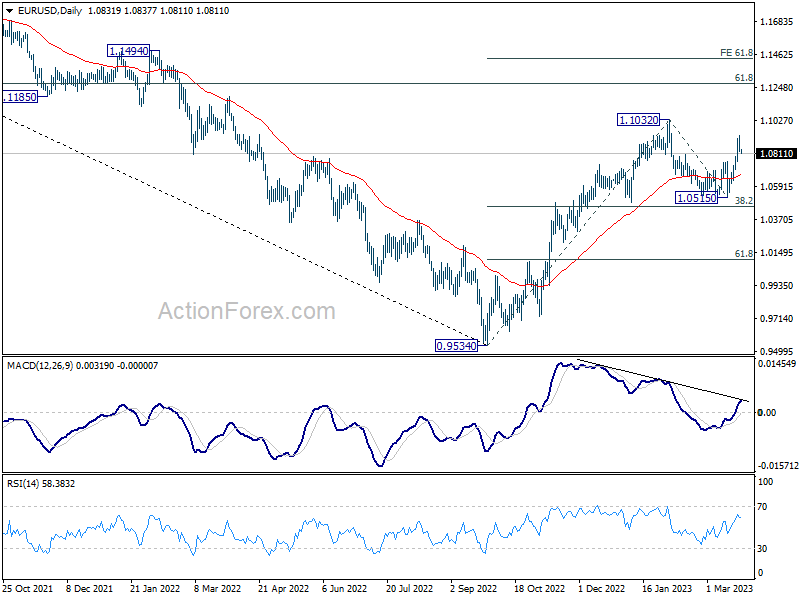
In the bigger picture, rise from 0.9534 (2022 low) is in progress with 38.2% retracement of 0.9534 to 1.1032 at 1.0460 intact. The strong support from 55 week EMA (now at 1.0623) was also a medium term bullish sign. Next target is 61.8% retracement of 1.2348 (2021 high) to 0.9534 at 1.1273. Sustained break there will solidity the case of bullish trend reversal and target 1.2348 resistance next (2021 high).
GBP/USD Daily Outlook
Daily Pivots: (S1) 1.2251; (P) 1.2298; (R1) 1.2333; More...
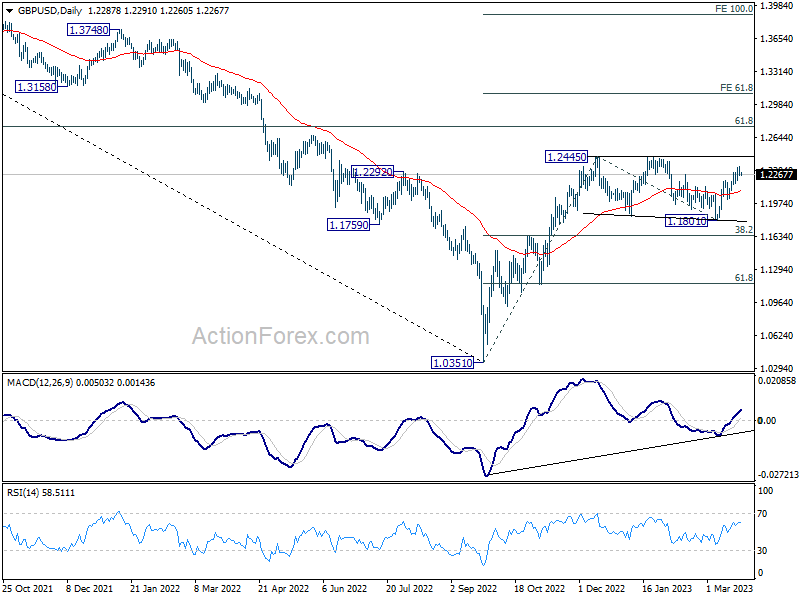
Intraday bias in GBP/USD is turned neutral again with current retreat. For now, further rise is expected as long as 1.2177 minor support holds. Above 1.2342 will target 1.2455/6 resistance zone. Decisive break there will resume larger rise from 1.0351, and target 1.2759 fibonacci level. On the downside, however, break of 1.2177 minor support will argue that corrective pattern from 1.2445 is extending with another falling leg, and turn bias to the downside for 1.2009 support instead.
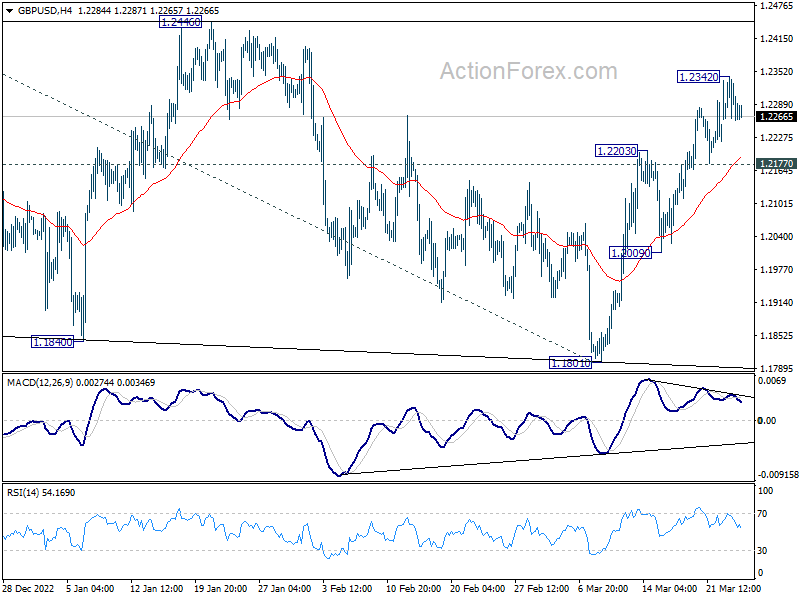
In the bigger picture, price action from 1.2445 are seen as a corrective pattern to rise from 1.0351 medium term bottom (2022 low). Resumption of the rally from 1.0351 is expected and break of 1.2446 will target 61.8% retracement of 1.4248 (2021 high) to 1.0351 at 1.2759. This will remain the favored case as long as 38.2% retracement of 1.0351 to 1.2445 at 1.1645 holds.
USD/CHF Daily Outlook
Daily Pivots: (S1) 0.9129; (P) 0.9156; (R1) 0.9192; More...
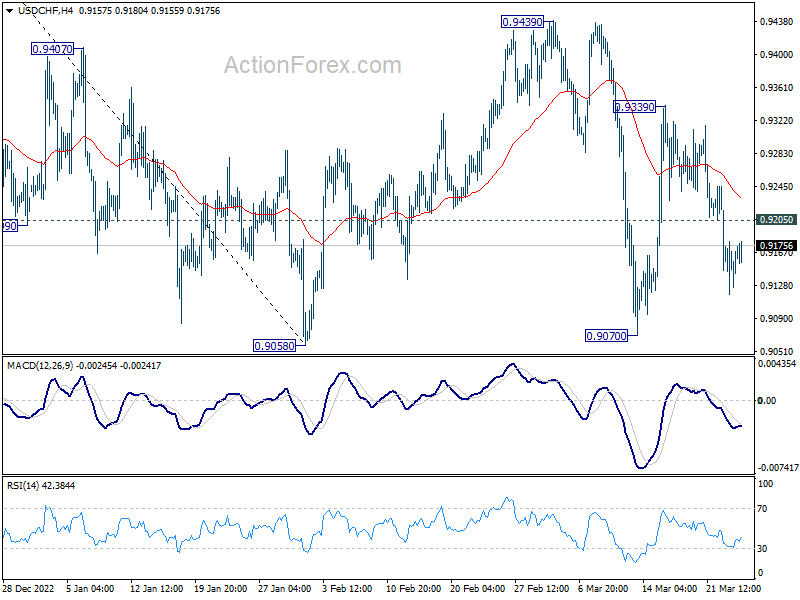
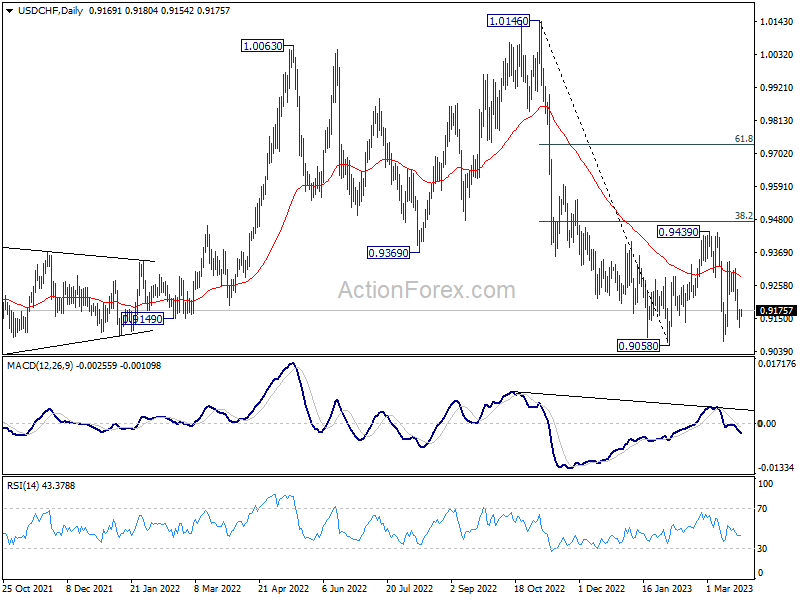
USD/CHF's fall from 0.9339 should still be in progress and intraday bias stays on the downside for retesting 0.9058 low. Decisive break there will resume larger down trend from 1.1046. On the upside, above 0.9205 support turned resistance will turn intraday bias neutral again. Overall outlook will stay bearish as long as 0.9474 fibonacci level holds.
In the bigger picture, fall from 1.1046 (2022 high) should still be in progress with 38.2% retracement of 1.0146 to 0.9058 at 0.9474 intact. Prior rejection by 55 week EMA was a medium term bearish sign. Break of 0.9058 will resume such decline towards 0.8756 support (2021 low). But overall, such fall is still as a leg in the long term range pattern from 1.0342 (2016 high). So, downside should be contained by 0.8756 to bring reversal.
Safe Haven Bids Intensified During US Dealings
Markets
The ECB hiked last week and signaled more to come if the base scenario unfolds. The Fed on Wednesday hiked and struggled to convince markets that this won’t be the last of the cycle. The Bank of England yesterday took a middle road. It raised the policy rate by 25 bps to 4.25%. Inflation in February ran higher than expected but mainly due to what it considers a one-off and it is still expected to ease materially in coming months. Yet, the economy and labour market proved stronger than expected. Against this background, the BoE kept further tightening conditional to evidence of more persistent inflation. About recent financial system developments, the BoE said it’ll consider its potential impact (on credit conditions) in the new forecasts at that May meeting. Money markets bet on one more 25 bps move in Q2 and start pricing in a first rate cut by the end of the year. Short UK gilt yields gapped about 10 bps lower at the open in a catch-up move with the US with losses building to 20 bps later on. Safe haven bids intensified during US dealings, where recessionary and financial stability concerns flared up again. US yields dropped another 10 bps in the 2y-3y segment while adding 4.6 bps at the long end (30y). German Bunds outperformed vs Treasuries, losing 7.2 (30y) - 18.1 (2y) bps despite more hawkish ECB rhetoric. It called off EUR/USD’s attempt to settle above 1.09 with a close at 1.0831 instead. Sterling showed some volatility around the BoE decision but closed higher in the end, helped by a late-session sentiment rebound which also kept US equities off intraday lows. EUR/GBP fell from 0.8849 to 0.8816.
Japanese inflation numbers for February and March PMIs grab the most attention this morning (see below). Asian- Pacific region trade mixed. Core bonds grind higher, pushing US cash yields 2.7-4.3 bps down. Combined with solid Japanese data, the yen receives a little boost. USD/JPY tested the 130 big figure, EUR/JPY falls to 141.
Japanese PMIs were just the start of today’s worldwide coverage. All of them (US, UK end Euro Area) last month showed a large upside surprise, suggesting strong(er than feared) economic resilience. For this month, analysts expect a marginal retreat in US and UK business confidence and a stabilization in the Euro Area. Even in case of an upward surprise (we don’t think the financial ripples to already surface in the March readings), bond markets are unlikely to react accordingly in the current environment. The easiest way for core bond yields is down still, especially in the US. This could quickly cap this morning’s early but very unconvincing attempt by the dollar to recover a bit from the whammy over the recent days.
News and views
Japanese headline inflation slowed as expected from 4.3% Y/Y to 3.3% Y/Y in February. Core CPI (ex fresh food) slowed from 4.2% Y/Y to 3.1% Y/Y. Government energy subsidies are fully responsible for the lower readings. CPI stripping out both fresh food and energy prices rose further from 3.2% Y/Y to 3.5% Y/Y, the highest level since 1981 and outpacing forecasts (3.4% Y/Y)! The data for once don’t add pressure on new BoJ-governor Ueda to take next steps in the policy normalisation process. The recent market turmoil put the spotlight away from the lagging BoJ. Japanese March PMI printed stronger with the composite measure rising from 51.1 to 51.9. Both manufacturing (48.6 from 47.7) and services (54.2 from 54) contributed positively. The Japanese yen is one of the star performers this month with USD/JPY this morning testing the 130 big figure.
Hungarian PM Orban’s envoy to the EU, Janos Boka, said that the EU’s executive arm will early next week respond to Hungarian proposals on judicial reforms which should help unblock €28bn in recovery funds frozen over a rule of law dispute. “We are very close to an agreement and don’t see any open political questions remaining.” In a separate dispute, the EU is withholding €22bn of funds over violations against the EU Charter of Fundamental Rights. On this issue, Boka said that work wasn’t progressing as fast as one would hope. The forint enjoyed a nice comeback over the past days as core bond yields nosedived. EUR/HUF returned from a failed test of 400 towards the low 380- area currently.
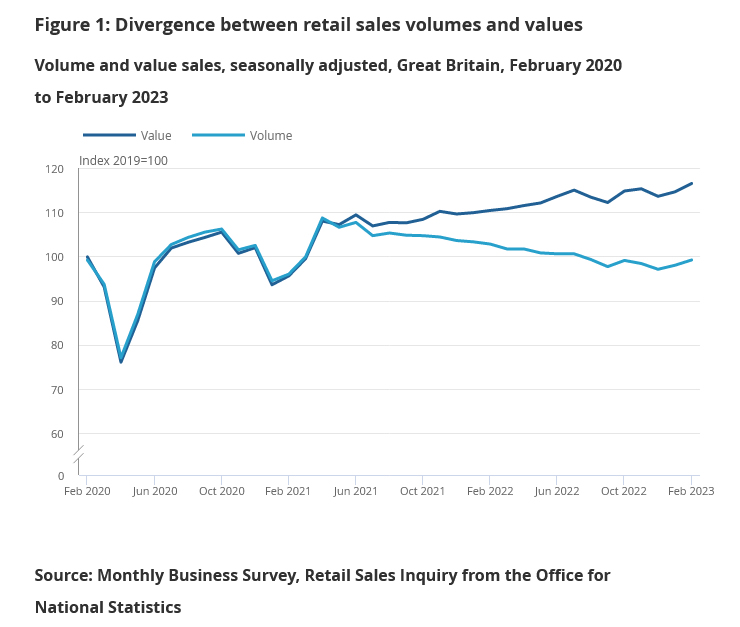
UK retail sales volume up 1.2% mom in Feb, sales value rose 1.6% mom
UK retail sales volume rose 1.2% mom in February, well above expectation of 0.2% mom. Ex-fuel sales volume rose 1.5% mom, above expectation of 0.1% mom. Nevertheless, in the three months to February, comparing to the prior three month, sales volume declined -0.3%, while ex-fuel sales volume dropped -0.4.
In value term, total sales rose 1.6% mom while ex-fuel sale rose 2.2% mom. In the three months to February, comparing to the prior three months, total sales value rose 0.7% while ex-fuel sales value rose 1.0%.
Financial Stress, Recession Worries and Falling Yields: Winners and Losers
The US stocks first fell then gained yesterday. The price action was, again, mostly driven by the bank stocks, both because of, and thanks to Janet Yellen’s comments to US lawmakers.
Remember, on Wednesday, US Treasury Secretary Janet Yellen had said that they don’t consider providing "blanket insurance" for banking deposits after the collapse of Silicon Valley Bank (SVB) – causing renewed pressure on banks, especially on the US small regional banks.
Then yesterday, Janet Yellen said that the US regulators are ready to take additional steps to protect deposits if needed.
Her comments helped stocks recover early-session losses.
Likes of JP Morgan, Goldman Sachs and Citi rebounded after the comment. But trading in Asia hints that the stress over banks is not over just yet. HSBC lost more than 3% in Hong Kong, as news that UBS and Credit Suisse were among banks under the scrutiny of the US DoJ for having helped Russian oligarchs to evade sanctions.
If we summarize
The new market game is being played between two camps: ‘the financial stress and how the authorities are dealing or promising to deal with potential renewed turmoil’ camp, and ‘the recession worries’ camp.
While the recession worries are not entirely bad for the stock valuations – at least in the immediate term, as they pull the yields lower, the financial stress is much less welcome, and there is a much stronger consensus among investors that… financial stress is bad.
The US 2-year yield is now headed to the levels, around 3.80%, that were tested when the SVB collapsed.
Whereas Jerome Powell has been quite clear at his post-FOMC speech Wednesday that the Federal Reserve (Fed) will continue its fight against inflation, that there is certainly one more rate hike on the horizon before the Fed pauses and keeps the rates steady.
But in vain, swap traders give no more than a 50-50 chance for another rate hike, activity on Fed funds futures hints that there will probably be no rate hike at the FOMC’s next meeting, with around 67% chance, and the more worryingly, the bets for a 75 to 100bp cut before the year end is being cemented.
Why? Because last year, on March 21st 2022, Jerome Powell had said that ‘there’s good research by staff in the Fed system that really says to look at the short – the first 18 months – of the yield curve. That’s really what has 100% of the explanatory power of the yield curve. It makes sense. Because if it’s inverted, that means the Fed’s going to cut, which means the economy is weak’.
And bingo, the expected 3m T-bill rate in 18 months and the 3m T-bill today is inverted. The only times this happened in the past was the 2000 tech bubble, the 2007/2008 subprime crisis and the Covid pandemic. So either you believe what Jerome Powell says today, or you believe what he said a year ago. But the markets put more weight to what he said a year ago, and bet on a coming recession.
On the data front, the US durable goods orders and the flash PMI data will be closely monitored for further signs of potential weakness after the weekly unemployment claims came in below expectations yet again, and continue to hint that the US jobs market is doing fine despite tens of thousands job cuts, especially in the tech companies.
For now, though, the falling yields, and the banking turmoil, is a boon for the tech stocks. The FAANG stocks are up by more than 13% since 10 days, and Bitcoin gained up to 50%.
Crude oil shortly spiked above the $70 mark, but saw decent resistance at this level given that the financial stress seriously deteriorated global growth prospects, and demand outlook. Plus the weekly stock inventories data showed that the US crude inventories increased by 1.1 mio barrels last week, while analysts were expecting a 1.7 mio barrel decrease. That’s also not excellent news for the bulls, and also explains why the bears are convincingly selling above the $70 mark.
In the FX, the lower yields keep a decent pressure on the US dollar’s shoulders, giving other pairs field to extend gains. The EURUSD extended gains to 1.0930 yesterday, while Cable rose to 1.2343 after the Bank of England (BoE) raised the interest rates by 25bp as expected, adding that there could be further hikes if the bank sees signs of persistent inflation. For now, they probably also see that inflation in the UK is not headed toward the right direction.
In precious metals, gold continues flirting with the $2000 offers, though I still believe that an eventually waning bank stress is a threat of a decent downside correction, which could pull the price of an ounce all the way down to $1900.
Focus Turns to PMI Data
Market movers today
Today, focus turns to March flash PMIs from Europe and the US. Activity is expected to moderate in service sector as the boost from pent-up demand continues to fade, while manufacturing momentum is set to continue its recovery in Europe while the US index is expected to take a small hit lower. Data for the indices has been collected mid-month so we are curious to see whether the recent turmoil has affected the respondents' sentiment.
In Sweden, PPI data is usually not a market mover but given the heightened attention to inflation developments due to high and soaring food prices in Sweden it may be interesting to look at the leading food price information that is in the PPI domestic supply prices.
In the US, we will also get preliminary durable goods orders for February.
On the speaker list, we have Fed's Bullard and the ECB's de Cos, Nagel and Centeno.
The 60 second overview
Market recap: US bond yields drifted lower yesterday, a move that has continued in Asian trading. EUR/USD also declined while equity markets are broadly flat from yesterday.
High core CPI out of Japan, PMI improves: Japanese CPI released overnight showed a decline in inflation in March to 3.3% from 4.3% in February in line with expectations. It was partly due to energy subsidies, though, and core inflation increased more than expected to 3.5% y/y (consensus 3.4% y/y) from 3.2% y/y in February. Japanese flash PMI manufacturing for March increased to 48.6 from 47.7, thus showing tentative signs of a bottom.
US emergency lending picked up: The latest weekly data suggests that the use of Fed's new Bank Term Funding Program (BTFP) picked up during its first full week of operation to USD53.7bn (from USD11.9bn during the first three days). That said, the rise was partially compensated by lower use of the discount window, which fell to USD110.2bn (from USD152.9bn). Active use of both Fed's emergency lending facilities suggests that Fed has been able to successfully support banks' liquidity situation, and while total bank reserves declined by USD74bn, they remain near the highest levels since last spring. Yesterday, Yellen also emphasized that regulators are prepared to take further action to protect deposits if needed, even if a broader 'blanket' insurance is off the table.
China urges Europe to support peace talks: China's top diplomat Wang Yi urged European nations to "play their due role" in peace talks and support a ceasefire. More nations are entering the arena of peace talks as Spain's Prime Minister, Pedro Sanchez, announced he would be travelling to Beijing next week to speak to China's President Xi Jinping about the peace proposal, Brazil's President Lula will begin a five-day visit to Beijing on Sunday and French President Emmanuel Macron said he would visit Beijing in early April. The US is against a ceasefire as it would freeze the conflict at current lines and believes the peace proposal is biased towards Russia. Reports of Xi going to talk to Ukraine's President Zelensky soon has not yet been confirmed by either side.
Flurry of central bank meetings yesterday: Bank of England (BoE) hiked the policy rate by 25bp to 4.25% as expected. Although they left little guidance, we have pencilled in another 25bp hike for the May meeting as we do not expect data to weaken enough for the BoE to pause the hiking cycle, see Bank of England Review - Set for another 25bp hike in May, 23 March. Norges Bank (NB) also lifted rates by 25bp to 3.0% as widely expected but the forward guidance was clearly to the more hawkish side of expectations. NB guided towards two additional 25bp hikes in Q2 with emphasis on the next hike coming already at the interim meeting in May. Finally, the Swiss National Bank (SNB) hike rates by 50bp taking the policy rate to 1.5%. The SNB left a hawkish message as they now see inflation as more broad-based and continue to echo that they cannot rule out further increases in the policy rate.
Macro data: US initial jobless claims continue to point to a very tight US labour market as they stayed at a low level this week at 191k, broadly flat from last week's 192k. US new home sales increased for the third month in a row to 640.000 from 633.000 (annualised) and while still at a low level, they add to other evidence that the housing market is bottoming out. Euro consumer confidence yesterday showed a small decline in March from -19.1 to -19.2, breaking a five-month streak of increases. It is still at a quite low level signalling little improvement in private consumption.
Equities: US equities rebounded on Thursday, but came off its highs in a volatile session. Similarly, Europe started at a muted setting but improved at the US opening bell. S&P 500 closed up 0.3% and Nasdaq 1% as growth stocks dominated the show since Fed pivot hopes are alive and kicking in markets. Tech outperformed banks by 3p.p. which traded broadly lower for a second day. Most value sectors underperformed, including energy and real estate. Futures are higher this morning.
Credit: Despite the recovery in AT1 spreads seen this week, spreads are still at wide levels following Credit Suisse's CHF16bn stack being written down to zero, which is having ramifications for extension risk. Yesterday Pbb indicated that it would not be exercising its AT1 call in April and other calls are coming up including notably the EUR1.25bn Unicredit AT1 with call in June. Hence, the AT1 segment may not be out of the woods yet. In contrast, the IG corporate bond market was reopened yesterday with Volkswagen placing a well-subscribed green EUR dual-tranche. CDS indices were slightly wider yesterday with iTraxx Main closing at 95bp (+4bp) and Xover at 488bp (+18bp).
FI: Global bond yields continue to decline as 10Y Bunds fell some 13bp to 2.18%, while 10Y Treasuries ended a very volatile day at 3.43% after having been as high at 3.5% before declining to 3.38%. The curves steepened from the short end as 2Y German govt yield declined 18bp, while 2Y Treasuries fell 10bp. Hence, we are seeing the traditional pattern on the US curve as we get closer to the end of the hiking cycle, where the curve begins to steepen ahead of the first rate cut. Given the high correlation between the US curve and core-EU curves, European yield curves follow the US curve even though we still expect ECB to move to 4%.
FX: JPY and NOK were among the winners in G10 FX space yesterday. The former helped by a further drop in US bond yields and the latter by a hawkish Norges Bank that looks far from done raising interest rates. EUR/USD held above 1.08.
USD/JPY Daily Outlook
Daily Pivots: (S1) 130.23; (P) 130.94; (R1) 131.57; More...
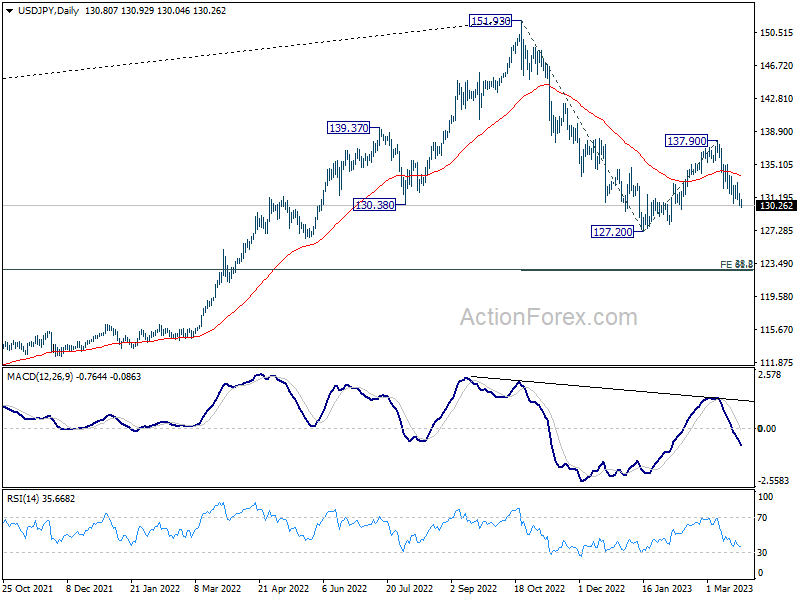
USD/JPY's fall from 137.90 continues today and edged lower to 130.04. Intraday bias remains on the downside for retesting 127.20 low. Decisive break there will resume larger down trend from 151.93 to 122.61 fibonacci projection level. On the upside, break of 132.99 resistance is needed to indicate short term bottoming. Otherwise, outlook will remain bearish in case of recovery.
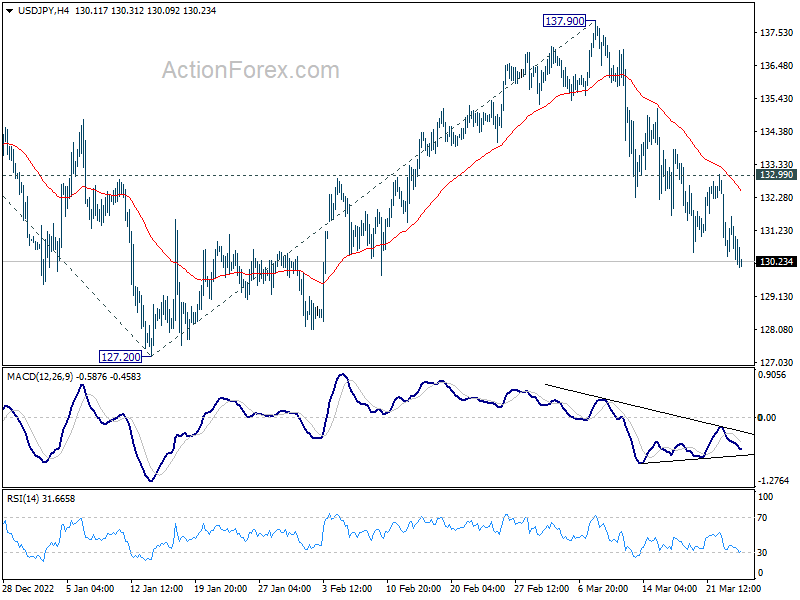
In the bigger picture, rebound from 127.20 should have completed at 137.90 as a corrective move. The down trend from 151.93 (2022 high) is still in progress. Break of 127.20 will resume this down trend and target 61.8% projection of 151.93 to 127.20 from 137.90 at 122.61. This will now be the favored case as long as 137.90 resistance holds.
Yen Takes Center Stage as Falling Yields and Strong Core-Core Inflation Boost Gains
Yen is drawing some attention in today's Asian trading session, supported by declining benchmark US and European treasury yields and robust core-core inflation in Japan. Risk-sensitive currencies, such as Sterling and commodity currencies, are under pressure as major Asian indexes trade lower. Dollar is recovering against the Euro but still lags far behind for the week. Market focus will shift to Eurozone and UK PMI data, Canadian retail sales, and US durable goods orders later today.
For the week, Euro is the standout performer thus far, as ECB's tightening could extend longer, while Fed and BoE appear closer to pausing based on this week's meetings. Yen, currently in second place, could potentially overtake Euro if bond rallies continue. Swiss Franc is the third strongest currency, while Australian and New Zealand dollars are the weakest performers this week, trailed by Dollar and Canadian.
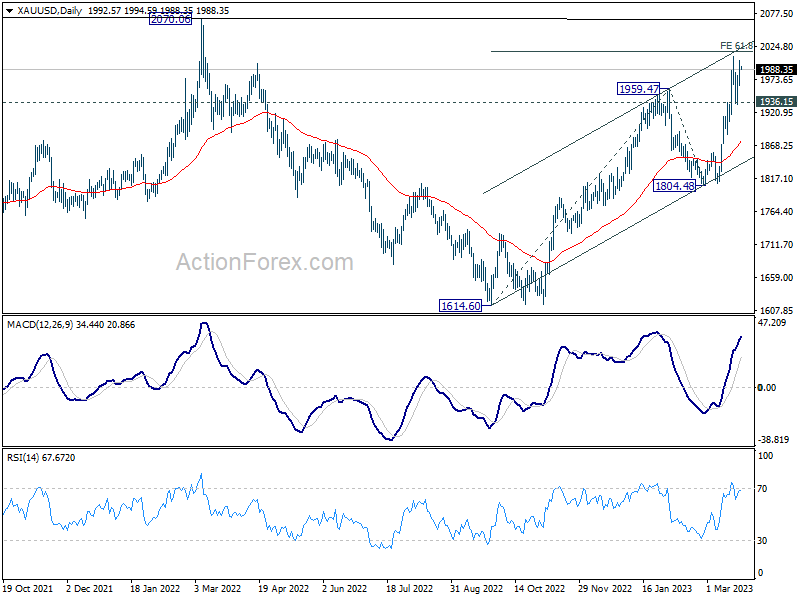
Technically, Gold is back pressing 2000 handle after defending 1936.15 support earlier in the week. The real test lies in 61.8% projection of 1614.60 to 1959.47 from 1804.48 at 2017.60. Sustained break there could solidify upside momentum to push Gold through historical high at 2074.84. If realizes, the development could signal more downside in Dollar, in particular against Yen.
In Japan, Nikkei closed down -0.20%. Hong Kong HSI is down -0.77%. China Shanghai SSE is down -0.73%. Singapore Strait Times is down -0.13%. Japan 10-year JGB yield is down -0.016 at 0.290. Overnight, DOW rose 0.23%. S&P 500 rose 0.30%. NASDAQ rose 1.01%. 10-year yield dropped -0.094 to 3.406.
Japan CPI core down sharply to 3.1%, but core-core rose to 40-yr high
Japan's headline CPI in February experienced a sharp slowdown from 4.3% yoy to 3.3% yoy, falling below the expected 4.1% yoy. CPI core (all items excluding food) dropped from 4.2% yoy to 3.1% yoy, meeting expectations. Meanwhile, CPI core-core (all items excluding food and energy) rose from 3.2% yoy to 3.5% yoy, surpassing the anticipated 3.4% yoy.
Despite the steep decline in CPI core from a 41-year high of 4.2% to 3.1%, the figure remains well above the Bank of Japan's (BoJ) 2% target. The core-core reading, closely monitored by the BoJ as an indicator of domestic demand, reached its highest rate since January 1982.
The data suggests that incoming BoJ Governor Kazuo Ueda may need to address a shift from cost-push inflation to demand-driven inflation, which could prove more sustainable.
Japan PMIs: Growth continues with strong services but struggling manufacturing
Japan PMI Manufacturing rose from 47.7 to 48.6 in March, slightly above expectation of 48.2. PMI Manufacturing Output rose from 45.3 to 47.4. PMI Services ticked up from 54.0 to 54.2, the best reading since October 2013. MI Composite improved from 51.1 to 51.9.
Japanese private sector firms experienced growth for the third consecutive month, with the services sector witnessing a notable improvement. Demand conditions strengthened, as government support and the lifting of COVID-19 restrictions in mainland China led to increased activity and new orders.
However, the manufacturing sector continued to face challenges, with output and new orders still contracting, albeit at a slower rate than February. Manufacturers reported ongoing supply chain normalization, as supplier delivery times lengthened at the slowest pace since October 2020.
Australia PMI composite dropped to 48.1, renewed contraction
Australia PMI Manufacturing dropped from 50.5 to 48.7 in March, a 34-month low. PMI Services dropped from 50.7 to 48.2, a 3-month low. PMI Composite dropped from 50.6 to 48.1, a 3-month low. All readings indicated renewed contraction in the private sector following improvements in February.
Looking at some details, the results indicate a continued economic slowdown, with composite output and new orders indexes at their lowest since the 2021 Delta lockdowns. Despite easing labor demand, employment indexes suggest businesses are still looking to expand their workforce in 2023. Price indicators have eased but remain elevated, with Australian inflation peaking in late 2022. Service industry input prices are still high, suggesting potential inflationary pressures in 2023 due to labor costs and energy prices.
As RBA prepares for its April meeting, it faces a tough decision on whether to pause its tightening cycle amid global financial uncertainty, strong employment numbers, and concerns about inflation levels. Some argue that the RBA should raise the cash rate closer to 4% before pausing to observe the economy's performance over the next few months.
Warren Hogan, Chief Economic Advisor at Judo Bank noted: "There is no point pausing for a month before hiking again. The RBA Board need to get the cash rate to a level that they think will buy them the time to observe how the economy unfolds for at least three months, if not longer."
Looking ahead
UK retail sales, PMIs and Eurozone PMIs are the main focus in European session. Later in the day, Canada will release retail sales. US will publish durable goods orders and PMIs.
USD/JPY Daily Outlook
Daily Pivots: (S1) 130.23; (P) 130.94; (R1) 131.57; More...
USD/JPY's fall from 137.90 continues today and edged lower to 130.04. Intraday bias remains on the downside for retesting 127.20 low. Decisive break there will resume larger down trend from 151.93 to 122.61 fibonacci projection level. On the upside, break of 132.99 resistance is needed to indicate short term bottoming. Otherwise, outlook will remain bearish in case of recovery.
In the bigger picture, rebound from 127.20 should have completed at 137.90 as a corrective move. The down trend from 151.93 (2022 high) is still in progress. Break of 127.20 will resume this down trend and target 61.8% projection of 151.93 to 127.20 from 137.90 at 122.61. This will now be the favored case as long as 137.90 resistance holds.
Economic Indicators Update
| GMT | Ccy | Events | Actual | Forecast | Previous | Revised |
|---|---|---|---|---|---|---|
| 22:00 | AUD | Manufacturing PMI Mar P | 48.7 | 50.5 | ||
| 22:00 | AUD | Services PMI Mar P | 48.2 | 50.7 | ||
| 23:30 | JPY | CPI Y/Y Feb | 3.30% | 4.10% | 4.30% | |
| 23:30 | JPY | CPI ex-Fresh Food Y/Y Feb | 3.10% | 3.10% | 4.20% | |
| 23:30 | JPY | CPI ex Food & Energy Y/Y Feb | 3.50% | 3.40% | 3.20% | |
| 00:01 | GBP | GfK Consumer Confidence Mar | -36 | -35 | -38 | |
| 00:30 | JPY | Manufacturing PMI Mar P | 48.6 | 48.2 | 47.7 | |
| 00:30 | JPY | Services PMI Mar P | 53.8 | 54 | ||
| 07:00 | GBP | Retail Sales M/M Feb | 0.20% | 0.50% | ||
| 07:00 | GBP | Retail Sales Y/Y Feb | -4.70% | -5.10% | ||
| 07:00 | GBP | Retail Sales ex-Fuel M/M Feb | 0.10% | 0.40% | ||
| 07:00 | GBP | Retail Sales ex-Fuel Y/Y Feb | -4.70% | -5.30% | ||
| 08:15 | EUR | France Manufacturing PMI Mar P | 48.2 | 47.4 | ||
| 08:15 | EUR | France Services PMI Mar P | 53 | 53.1 | ||
| 08:30 | EUR | Germany Manufacturing PMI Mar P | 47.1 | 46.3 | ||
| 08:30 | EUR | Germany Services PMI Mar P | 51.1 | 50.9 | ||
| 09:00 | EUR | Eurozone Manufacturing PMI Mar P | 48.9 | 48.5 | ||
| 09:00 | EUR | Eurozone Services PMI Mar P | 52.9 | 52.7 | ||
| 09:30 | GBP | Manufacturing PMI Mar P | 50 | 49.3 | ||
| 09:30 | GBP | Services PMI Mar P | 53.1 | 53.5 | ||
| 12:30 | CAD | Retail Sales M/M Jan | 0.70% | 0.50% | ||
| 12:30 | CAD | Retail Sales ex Autos M/M Jan | 0.60% | -0.60% | ||
| 12:30 | USD | Durable Goods Orders Feb | 0.40% | -4.50% | ||
| 12:30 | USD | Durable Goods Orders ex Transportation Feb | 0.20% | 0.70% | ||
| 13:45 | USD | Manufacturing PMI Mar P | 47.3 | |||
| 13:45 | USD | Services PMI Mar P | 50.6 |