Sample Category Title
GBP/USD: Pound Receives Fresh Support from Hawkish Shift in Rate Expectations as Inflation Rises
Cable jumped to a seven-week high in European trading on Wednesday, after UK inflation report showed unexpected rise in consumer prices, causing a hawkish shift in rate expectations, one day ahead of BOE policy meeting.
Markets now expect a 25 basis points hike to 4.25%, fueling fresh rise of the pound, though Fed policy decision, due later today, will be also closely watched.
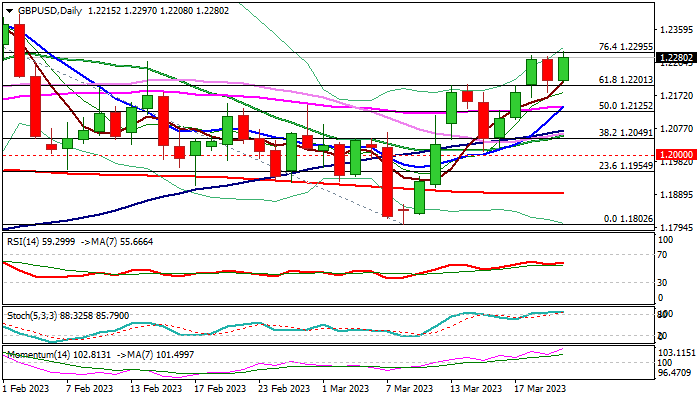
Fresh rise generates an initial signal of bullish continuation as the price action remains above broken pivotal Fibo level at 1.2201 (61.8% retracement of 1.2447/1.1802, also former tops of Mar 13/14) for the third straight day, adding to improved outlook.
Bulls cracked next Fibo level at 1.2295 (76.4% retracement) and pressure round-figure barrier (1.2300), with close above these levels to further firm the structure and expose targets at 1.2402/47 (Feb 2 high / 2023 peak, posted on Jan 23).
Strengthening positive momentum on daily chart and moving averages in full bullish setup, support the action, but overbought stochastic warns that bulls might be running out of steam.
Failure to clear 1.2300 zone would signal that the action may hold in extended consolidation, with bullish bias to remain intact while the price action stays above strong 1.2200 support zone.
Res: 1.2300; 1.2370; 1.2402; 1.2447.
Sup: 1.2244; 1.2200; 1.2141; 1.2152.
GBP/USD Higher Despite Rise in Inflation, BoE Decision Looms
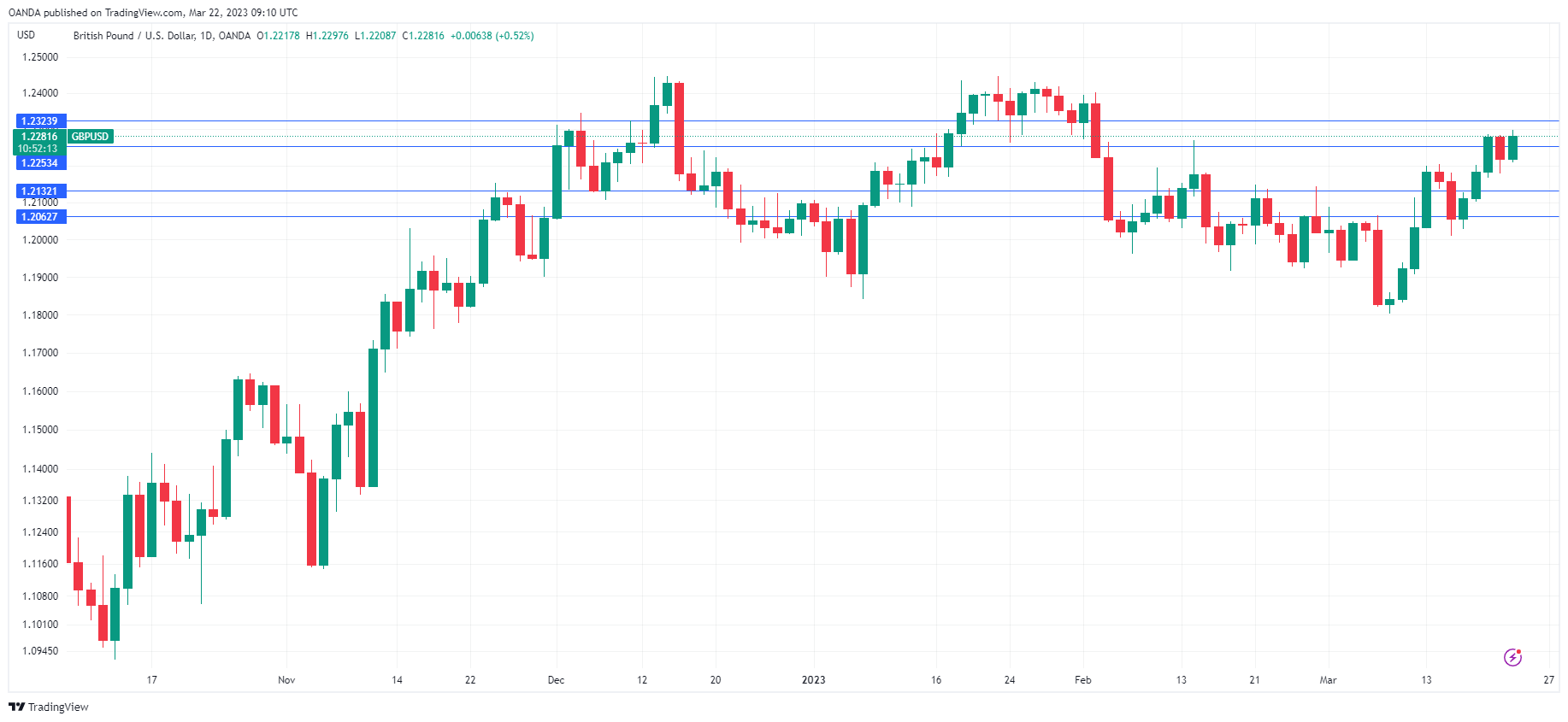
The British pound is in positive territory on Tuesday. In the European session, GBP/USD is trading at 1.2277, up 0.50%.
UK inflation accelerates
For Bank of England policy makers, the “how not to start the day” manual likely included inflation climbing higher. That was the bad news earlier today, as UK headline CPI rose to 10.4% in February, reversing the deceleration trend in recent months. The reading was up from 10.1% in January and above the consensus estimate of 9.8%. The core rate climbed to 6.2% in February, up from 5.8% prior which was also the estimate. The usual suspects were at play, with the food and energy prices driving the increase in inflation.
The inflation print will complicate matters for the BoE, which has hiked rates to 4.0% in a bid to contain inflation. Higher inflation will require further rate hikes, but the fallout from the banking crisis, which has roiled the financial markets, means that central banks will have to tread carefully with rate moves. The BoE is almost certain to deliver a 25-bp hike at the policy meeting on Thursday.
In the US, the response to the banking crisis has been swift and decisive, which has helped soothe market jitters after last week’s panic. Over the weekend, the Federal Reserve and five other major central banks announced coordinated action to bolster liquidity, and Treasury Secretary Yellen said that the bank system was stabilizing and she would intervene if necessary in order to protect depositors of small banks. The Federal Reserve announces its rate decision later today and after massive shifts in market pricing lately, a 25-bp increase is almost a certainty. What will be of interest to investors is whether the Fed follows the stance of the ECB and avoid any direct signals about future rate moves.
GBP/USD Technical
- GBP/USD is testing resistance at 1.2253. The next resistance line is 1.2324
- There is support at 1.2132 and 1.2061
ECB Lagarde stresses robust strategy amid high inflation and market uncertainty
In a speech today, ECB President Christine Lagarde highlighted the challenges posed by persistent high inflation and increasing uncertainty. She noted, "Since July last year we have raised interest rates by 350 basis points. However, inflation is still high, and uncertainty around its path ahead has increased. This makes a robust strategy going forward essential."
Lagarde outlined a three-pronged strategy to tackle these issues:
- Data-dependent rate path: Emphasizing the importance of data dependency in times of high uncertainty, Lagarde stated, "This means, ex ante, that we are neither committed to raise further nor are we finished with hiking rates."
- Liquidity support amidst market volatility: Acknowledging recent financial market turbulence, she assured, "We are ready to act and provide liquidity support to the financial system if needed." Lagarde emphasized the ECB's proven ability to "set the appropriate policy stance to control inflation and at the same time use other instruments to address risks to monetary policy transmission."
- Clear reaction function: The third element focuses on continuous monitoring of three key inputs – inflation outlook, underlying inflation, and policy transmission. Lagarde explained, "The future calibration of the rate path will be determined by – and will require continuous monitoring of – these three key inputs."
Bundesbank Nagel insists fight against inflation continues
In an Financial Times interview, Bundesbank President Joachim Nagel expressed that the fight against inflation is far from over, despite the ECB's efforts to curb it. He stated, "Our fight against inflation is not over. There's certainly no mistaking that price pressures are strong and broad-based across the economy."
Nagel emphasized the need for persistence in combating inflation, suggesting that "If we are to tame this stubborn inflation, we will have to be even more stubborn."
He also highlighted the progress made by ECB, mentioning that they are "approaching restrictive territory." However, he warned against the potential pitfalls of stopping rate hikes too soon and succumbing to calls for rate cuts. According to Nagel, doing so would risk a repeat of the 1970s, when "inflation flared up again" following the oil supply shocks.
As for concerns surrounding the recent banking crisis, Nagel dismissed comparisons to the 2008 financial crisis. He confidently asserted, "We are not facing a repeat of the financial crisis we saw in 2008. We can manage this with the Eurozone's "resilient" banking system.
Will Eurozone PMIs Allow ECB to Continue Raising Rates?
Following the market turbulence triggered last week by concerns about the stability of the global banking system, investors have been scratching their heads to figure out how central banks may proceed henceforth. The ECB disappointed those expecting a smaller-than-telegraphed hike at its last meeting, turning the spotlight to incoming data for its future decisions. With that in mind, euro traders may now lock their gaze on the preliminary Euro area PMIs for March, due to be released on Friday at 09:00 GMT.
To hike or not to hike?
At last week’s gathering, the ECB decided to deliver the previously promised 50bps hike, disappointing those expecting a smaller increase or no increase at all due to the turmoil in the banking sector. At the press conference following the decision, President Lagarde dismissed the idea that the efforts intended to bring inflation to heel are a threat to financial stability, arguing that the Euro area banking system remains resilient and that, if anything, higher rates could bolster margins.
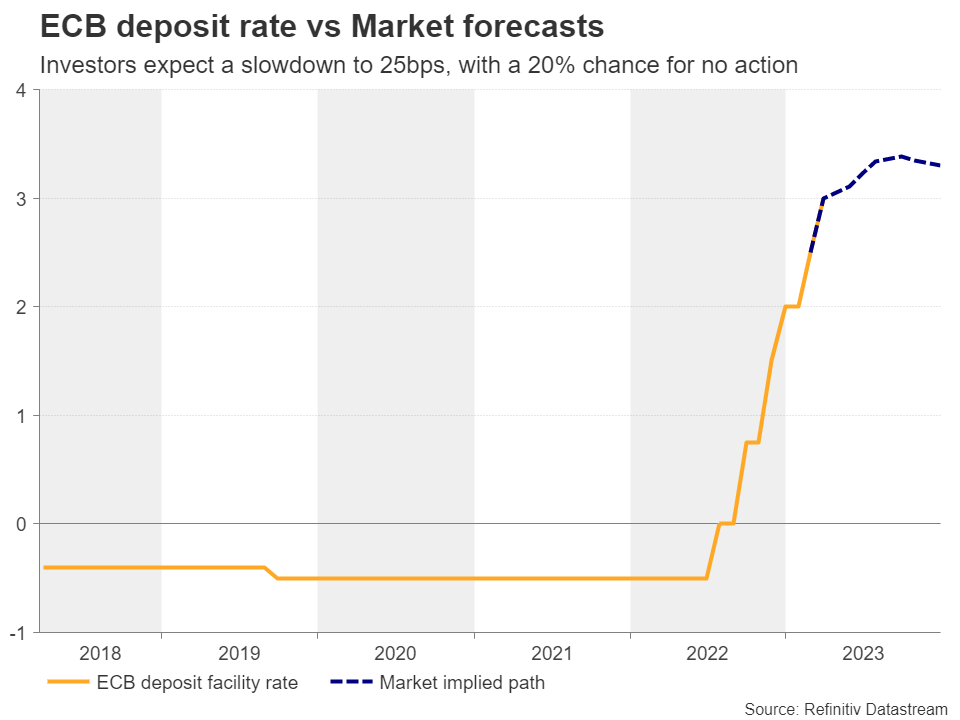
Nonetheless, in the official statement accompanying the decision, the commitment for future rate rises was dropped, with Lagarde later stressing that they will base their future decisions on data. With that in mind, some investors started pricing in the probability of no action at the Bank’s May meeting. At some point on Monday morning, they were nearly certain about that.
On the same day, Lagarde said that the turmoil may do some of the ECB’s work if it dampens demand and thereby inflation, adding credence to expectations of a much slower rate path hereafter. However, she also noted that interest rates will remain the ECB’s main tool for inflation, while for the banking sector, the Bank can utilize existing lending facilities or construct new ones. This suggests that the probability for a hike at the May meeting may be higher than the one initially assigned by the market. Indeed, currently investors see an 80% chance for a 25bps hike, with the remaining 20% pointing to a pause.
Will the PMIs enter the basket of data warranting more hikes?
Now, investors may be eager to see what incoming data will reveal regarding the performance of the Euro area economy and the future path of inflation and thus, they may pay special attention to Friday’s preliminary PMIs for March. The data for February showed that the composite index rose to an 8-month high, adding to hopes that the Euro area may have avoided a previously feared deep recession.
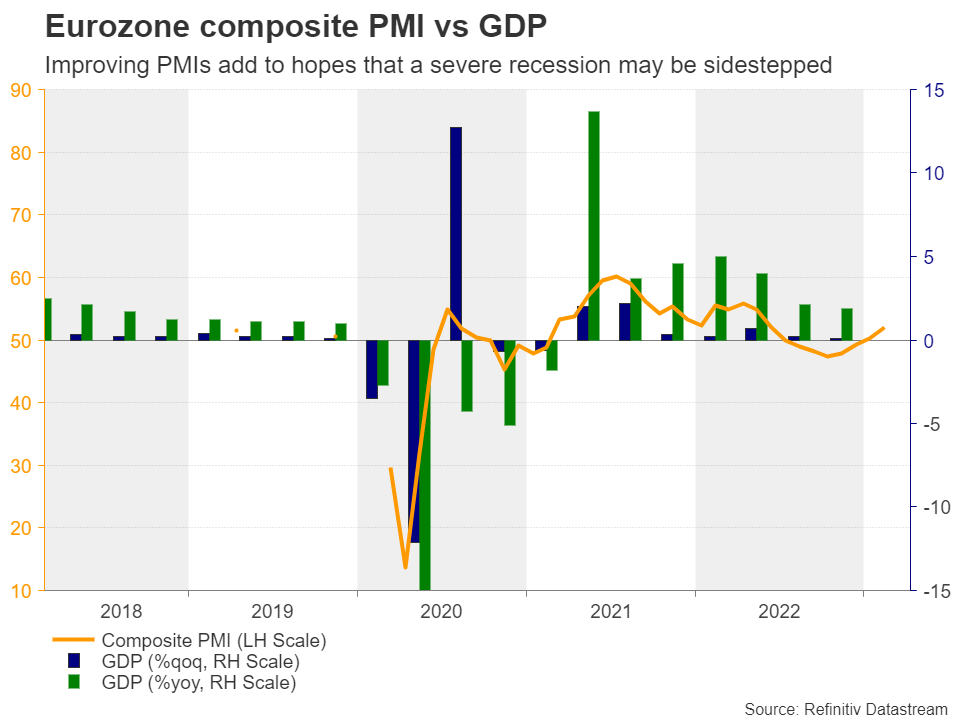
Although the surveys’ results showed that prices charged for goods and services rose at the weakest rate since December 2021, the CPI numbers for the month painted a different picture. Yes, the headline rate continued declining, but much less than the forecast suggested, while the core rate that excludes energy, food, alcohol and tobacco rose to a fresh record high.
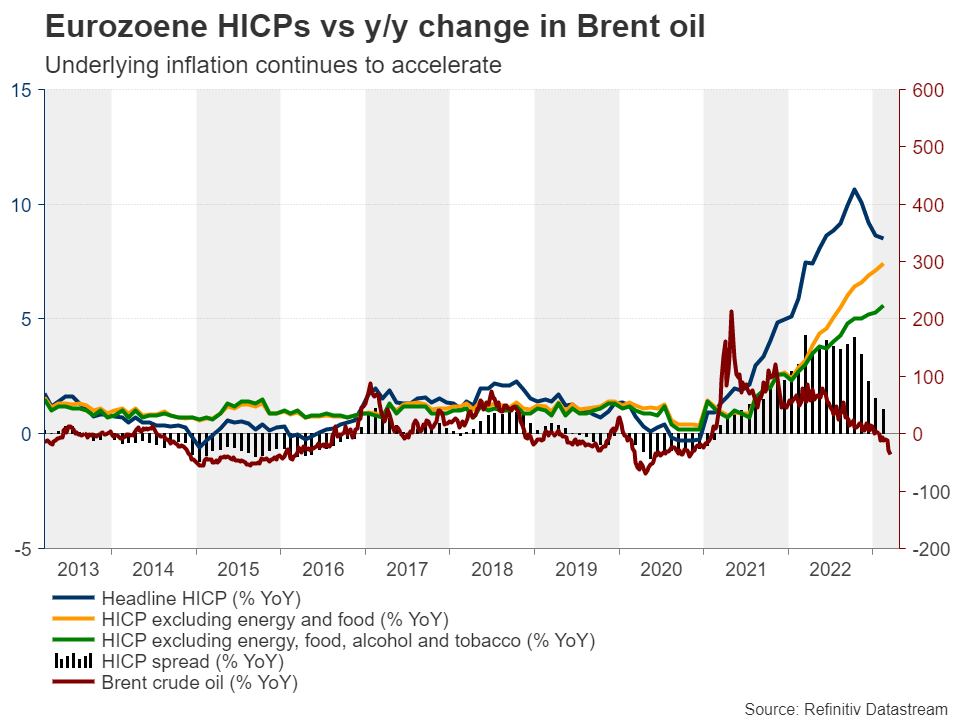
On Friday, the manufacturing index is forecast to have increased to 49.0 from 48.5 and the services to have slid somewhat, to 52.5 from 52.7. This will drive the composite index a tick down to 51.9 from 52.0. With inflation in the Euro area still running hot, such numbers are unlikely to add to speculation for no action at the upcoming ECB gathering. On the contrary, should they be accompanied by rising prices’ subindices, they could prompt investors to increase their hike bets, something that could prove supportive for the euro.
Euro may continue performing better against the loonie
That said, euro/dollar may not be the best gauge for exploiting any potential euro gains, as with investors being so pessimistic regarding the Fed’s future course of action and US inflation running at three times the Fed’s target, the risks arising from Wednesday’s Fed decision may be tilted to the upside. With the Bank of Canada already hitting the pause button and investors expecting only rate reductions henceforth, the loonie may be a better choice.
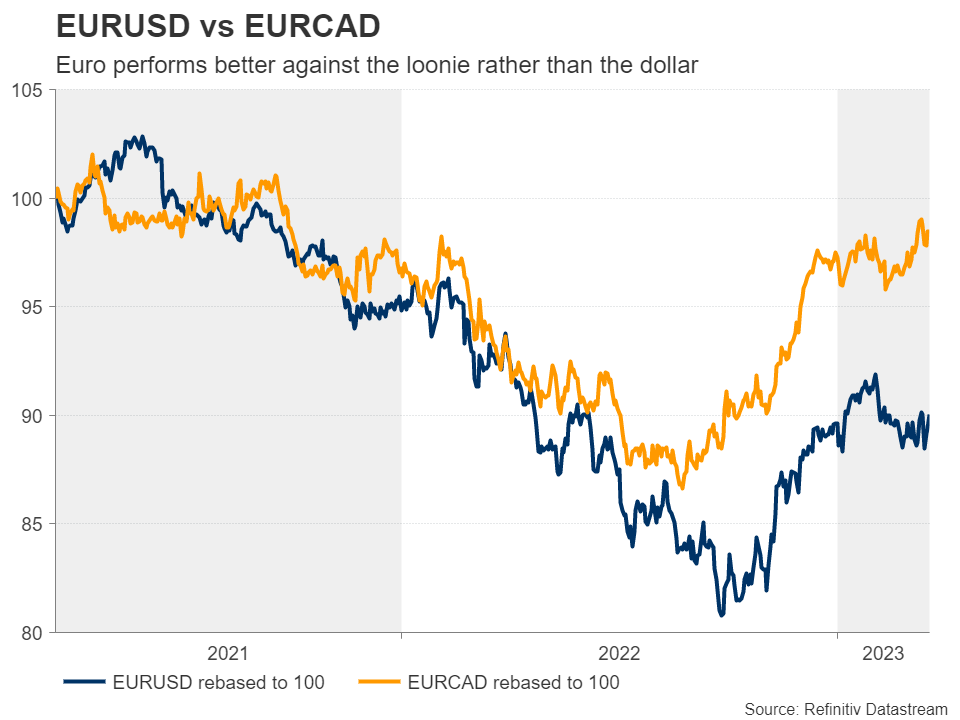
Euro/loonie has been in a recovery mode since March 15, when it tumbled and hit support at 1.4480. Overall, the pair is trading above the uptrend line drawn from the low of September 26, which suggests that the pair may continue drifting north for a while longer.
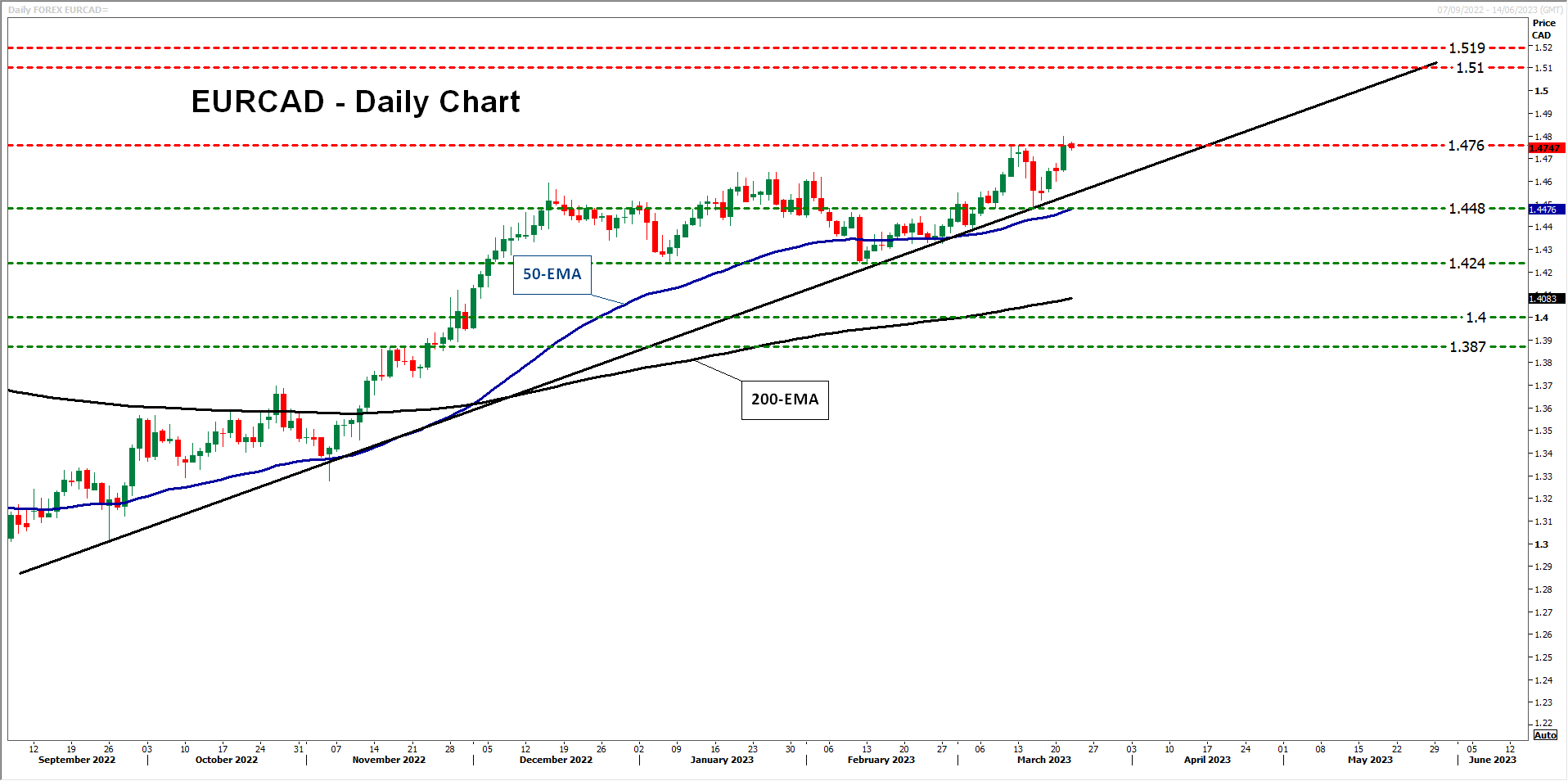
Currently, the pair is oscillating around the high of March 13 at 1.4760, the break of which would confirm a higher high on the daily and bigger timeframes. Such a break could see scope of advances all the way up to the 1.5100 zone, which acted as a ceiling between July 19 and September 20, 2021. If that area fails to stop the bulls this time around, a test near the high of April 21, 2021, at 1.5190 could be possible. Should this zone be violated as well, then the trend might continue towards the high of February 26, 2021, at 1.5385.
On the downside, a dip below 1.4480 could also signify the break below the aforementioned uptrend line, which could encourage the bears to put the 1.4240 zone on their radars. If they manage to reach and breach that territory, they may decide to extend their dive towards the round figure of 1.4000.
USDJPY Finds Support Ahead of FOMC, But Bears Still Loom
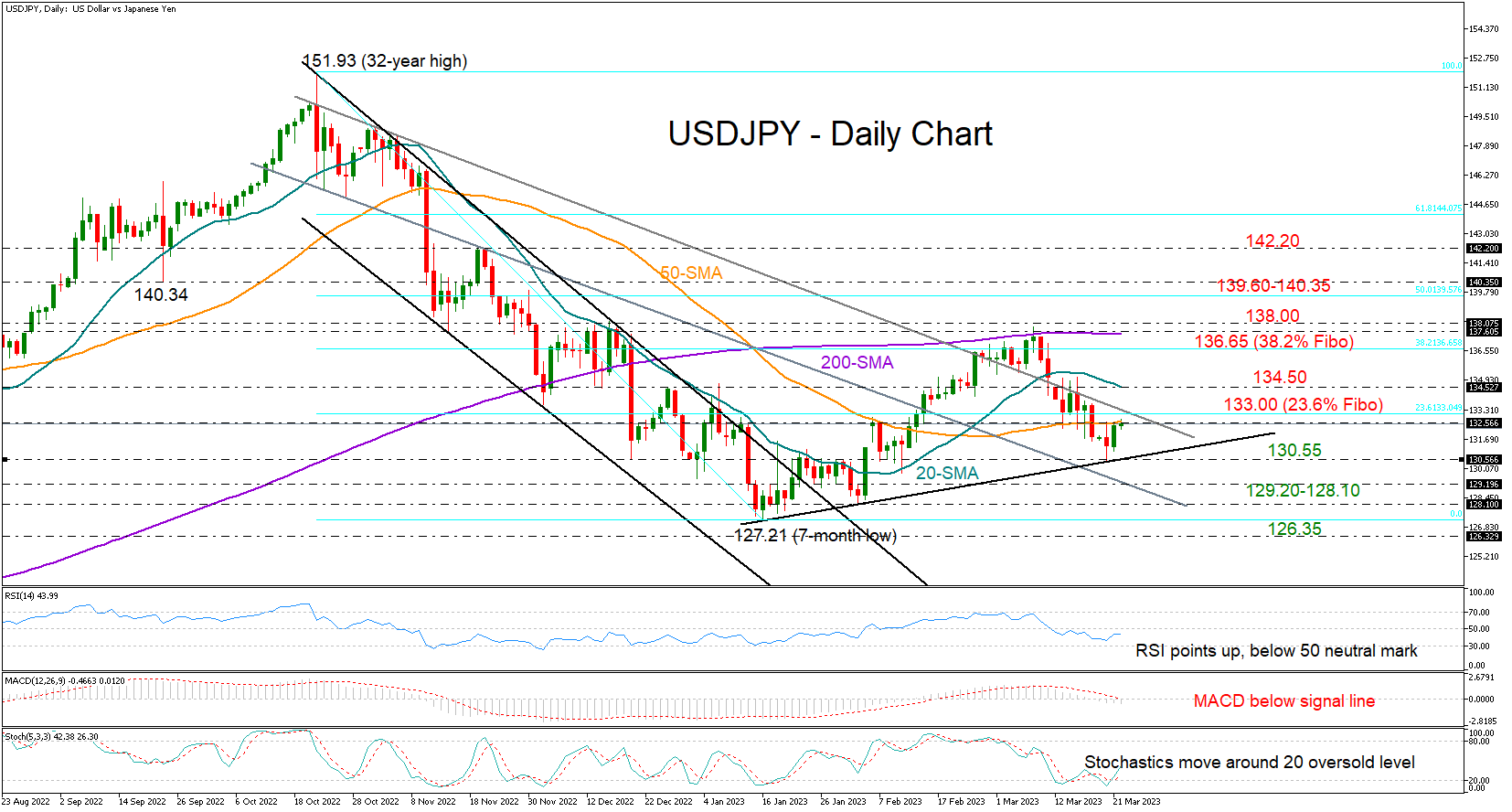
USDJPY turned green ahead of Wednesday’s FOMC policy announcement, pivoting on the tentative support trendline that joins the lows from January and February on Tuesday. Discouragingly though, the pair could not close above Monday’s high of 132.64, unable to complete a bullish engulfing candlestick pattern.
The flattening 50-day simple moving average (SMA) is blocking bullish actions around the same area for the third consecutive day, while not far above, the 23.6% Fibonacci retracement of the 151.93-127.21 downleg at 133.00 might keep traders cautious as well. The extension of October’s descending line is adding extra importance to that zone.
Therefore, a break above 133.00 might be a prerequisite for an advance to the 20-day SMA at 134.50. If that proves easy to pierce through, the pair could stage a quick rally towards the crucial 136.65-137.52 territory formed by the 38.2% Fibonacci level and the 200-day SMA. The 138.00 psychological level will come under consideration too, as any step higher would put the 2023 uptrend back into play.
The momentum indicators, however, have not entered the bullish area yet, dampening hopes for a meaningful rebound in the short term. Specifically, the RSI has not crossed above its 50 neutral mark despite reversing higher. Likewise, the MACD remains comfortably below its red signal and zero lines, while the stochastic oscillator is maintaining a neutral trajectory around its 20 oversold level.
If the 50-day SMA stands firm at 132.55, the price may drift lower to seek support around the ascending trendline at 130.55. Should the bears breach that floor this time, they may initially test the 129.20- 128.10 constraining zone before heading for the 126.35 low taken from May 2022.
In summary, Tuesday’s rebound in USDJPY has not improved market sentiment. The pair will need to overcome the 133.00 level and then violate March’s bearish wave above 134.50 in order to boost buying appetite. Yet only a surge above 138.00 would change the short-to-medium term outlook back to bullish.
Markets Await Clarity on Fed’s Conundrum
The outcome from the ongoing FOMC meeting is shrouded in uncertainty. Still, markets are very much aware that the Fed is stuck between a rock and a hard place, with policymakers’ facing an apparent dilemma between financial stability or price stability.
Fed Funds Futures now point to an 82% chance of a 25bp hike out of this FOMC meeting, even as some economists suggest that the Fed should pause its policy tightening. These scenarios are a far cry from the 50bp hike that was widely expected prior to the recent banking turmoil on either side of the Atlantic.
The Fed’s latest dot plot could expose where policymakers’ bias lies, either towards preserving the stability of the US financial sector or winning the battle against inflation. If the dot plot points to a terminal rate that’s higher than the 5.1% that FOMC officials forecast back in December, such hawkish clues may prompt another risk-off wave across equity markets while potentially erasing the US dollar’s year-to-date declines. Even a hawkish 25bp hike today, with the Fed refusing to close the door on more rate hikes over upcoming meetings, could feed fears that the financial sector is set to sustain more damage in the interim while ramping up recession risks.
On the other hand, a dovish 25bp hike, or even a pause in this rate-hike cycle, may also signal that policymakers fear there’s more to come in the ongoing US banking turmoil. It remains to be seen whether stocks, commodities, and the FX complex, can find solace from Fed Chair Jerome Powell’s press conference, even if he were to signal a more supportive stance in light of growing financial instability.
What’s clear is the tough task ahead for Chair Powell, who has to thread a fine line between preserving the central bank’s inflation-fighting credibility while shoring up sentiment surrounding the US banking sector.
NZDUSD Stuck in Range Ahead of Fed Meeting
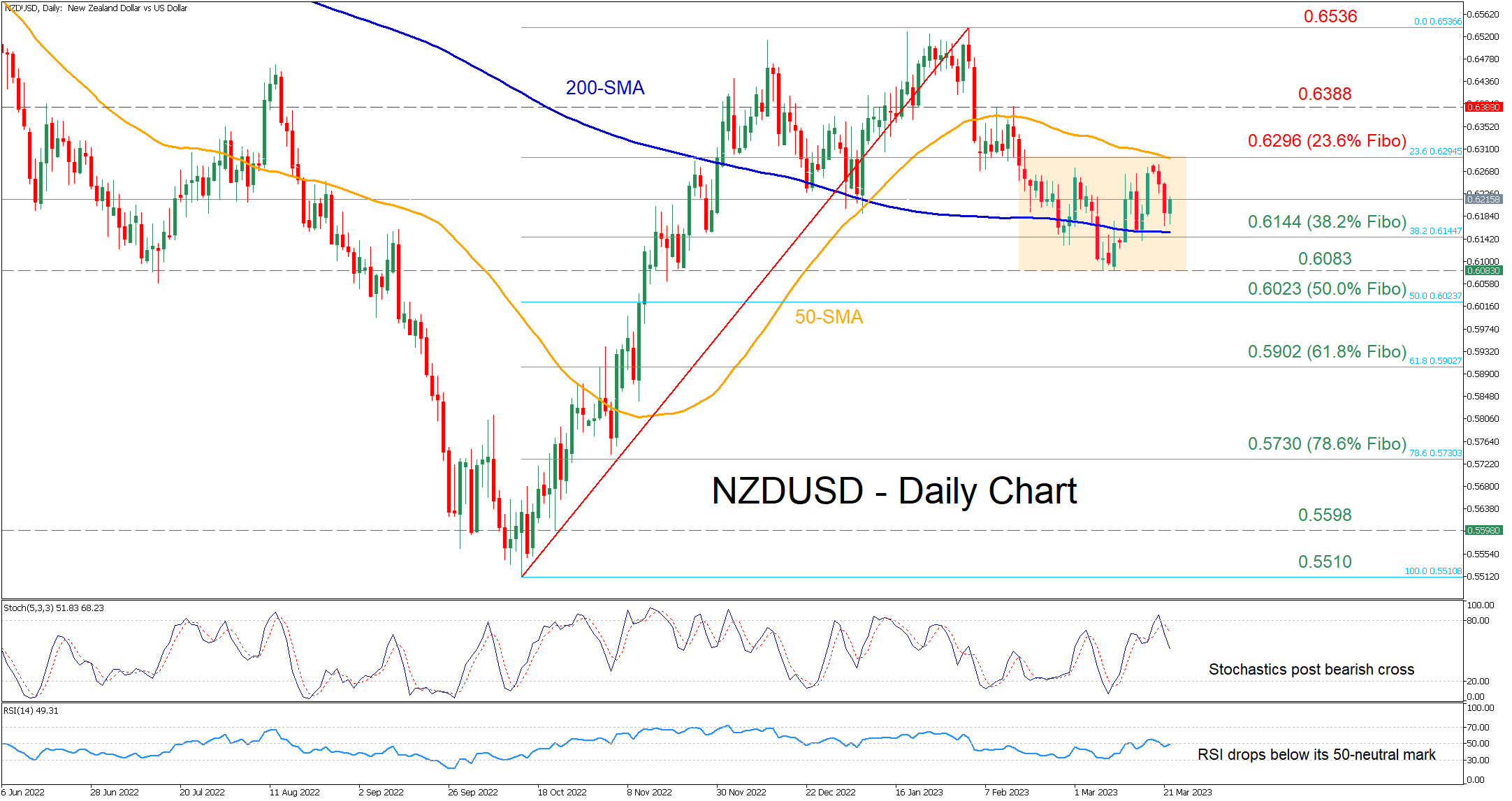
NZDUSD lost ground after peaking at the 2023 high of 0.6536 in early February. Nevertheless, the pair managed to halt its retreat and has been moving sideways within a rectangle pattern for more than a month now.
The momentum indicators currently suggest that near-term risks are tilted to the downside. Specifically, the stochastic oscillator has posted a bearish cross, while the RSI failed to reclaim its 50-neutral mark after breaking below it for the first time in the past seven days.
Should bearish pressures intensify, the price could initially test 0.6144, which is the 38.2% Fibonacci retracement of the 0.5510-0.6536 upleg. If that barricade fails, the 2023 low of 0.6083 might act as the next line of defense. Failing to stop there, the pair could face the 50.0% Fibo of 0.6023.
Alternatively, should buyers re-emerge and push the price higher, immediate resistance could be met at the 23.6% Fibo of 0.6296, which overlaps with the 50-day simple moving average (SMA). Escaping the rangebound pattern, the pair might ascend towards the February resistance of 0.6388. A violation of that territory could set the stage for the 2023 high of 0.6536.
Overall, NZDUSD seems to be in a consolidation phase, waiting for developments that could provide fresh directional impetus. Therefore, a break above or below this sideways pattern is likely to be followed by a significant move in the same direction.
Recovery Rally Pauses ahead of Fed
Equity markets are treading water this morning ahead of the Fed rate decision and following a decent rebound a day earlier.
It very much feels like we're just taking one day at a time at the minute. Every day that passes without drama is one closer to the point at which we can put the mini-banking crisis behind us. But it's still early days and investors are all too aware of that which is why we're seeing a tentative recovery at this point.
This period of calm will no doubt be welcomed by the Fed and allow for it to continue hiking by 25 basis points without much controversy. The question is whether it will adopt a similar position to its counterpart in Europe and refrain from commenting directly on future moves or sending any strong signals.
Unfortunately, it can't entirely avoid offering a view on the outlook as it releases new economic projections including the dot plot, displaying policymakers' views on where rates will go. It could caveat this with a statement that those forecasts were made on the basis of data collected prior to the turmoil of the last couple of weeks but still, it may prove too hard a topic to dodge. Perhaps the caveat will instead be that forecasts are based on the assumption of risks being contained but even that isn't clear cut.
Either way, that is what markets will be monitoring closely, as opposed to the rate hike itself. While 50 basis points were once up for discussion, it would be a big shock if the Fed reverted back to larger rate hikes now considering everything that's happened this past couple of weeks.
A crushing blow for the BoE
Whatever flexibility the Bank of England may have thought it would have tomorrow was wiped out by this morning's inflation data and once more, the topic of conversation has shifted to whether 25 basis points will be enough. The UK CPI report for February showed prices rising by 10.4%, reversing the trend of declines we'd seen in recent months, while the core CPI number also reversed higher to 6.2%.
Considering both were expected to decline, a large increase has come as a nasty shock. And while it could prove to be a blip, there really isn't anything positive we can take away from this release. And certainly, nothing that would justify a pause tomorrow from the MPC, even against the backdrop of financial stability concerns and the knock-on effects of aggressive rate hikes. Inflation is still expected to fall considerably over the course of the year but we need to see much more evidence of that than we've had so far.
Stalled recovery
Oil prices are slipping again today after recovering strongly from the lows over the last couple of days. There's still a lot of lost ground to make up which may highlight the apprehension behind the recovery as well as the potential longer-term consequences for the economy.
Time will tell how significant an impact that will have but the fact that we're already seeing profit-taking isn't a great signal. That said, we're also seeing the recovery in stock markets stalling ahead of the Fed decision so perhaps this is having a similar impact on crude as we await their assessment of the situation.
Pause ahead of the Fed
We're also seeing a pause in the gold correction ahead of the Fed later in the day. It's gone from a rare foray above $2,000 to pulling back almost 4% while remaining well above its pre-banking crisis lows. A hawkish Fed could see it extend the decline, with $1,900 being the next big test below, followed by $1,860.
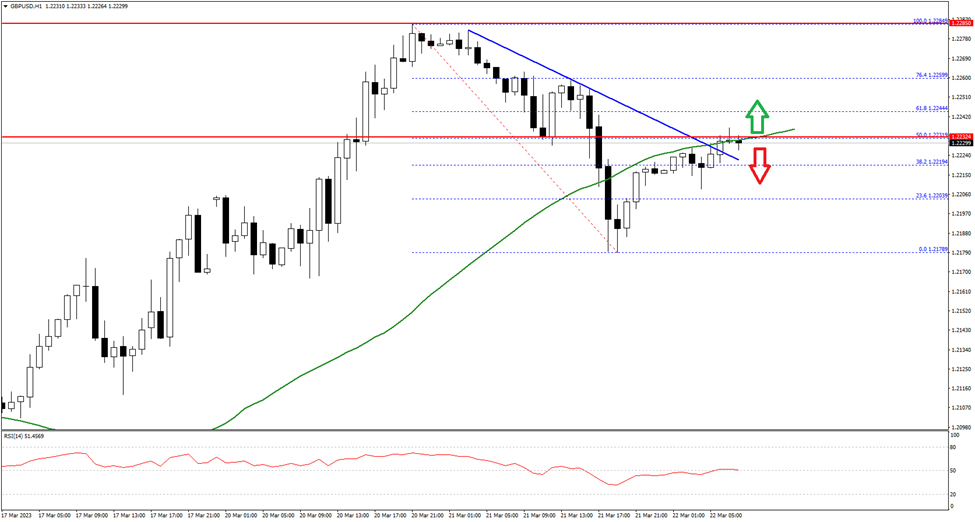
GBP/USD Pair Consolidating Near 1.2220
The British Pound started a fresh increase from the 1.2180 zone against the US Dollar. The GBP/USD pair gained pace for a move above the 1.2220 level.
The pair even cleared a major bearish trend line with resistance near 1.2220 on the hourly chart. It is now consolidating near the 1.2220 zone the 50 hourly simple moving average. An immediate resistance is near the 1.2230 level.
The first major resistance is near the 1.2245 level. If there is a clear upside break above the 1.2245 resistance, the pair could rise steadily towards the 1.2280 level in the near term. The next major resistance sits near the 1.2320 level.
On the downside, the first major support is near 1.2200 on FXOpen. The main support is forming near the 1.2180 level. A break below the 1.2180 support could push the pair towards the 1.2140 support.