

Sample Category Title
FOMC Hikes Policy Rate by 25 Basis Points, Cautions on Bank Stress
The Federal Reserve Open Market Committee (FOMC) lifted the federal funds rate by a quarter point to the 4.75% to 5.0% range and announced a continuation of its balance sheet runoff.
The Fed adjusted to acknowledge the current banking stress stating, "the U.S. banking system is sound and resilient. Recent developments are likely to result in tighter credit conditions for households and businesses and to weigh on economic activity, hiring, and inflation. The extent of these effects is uncertain. The Committee remains highly attentive to inflation risks.".
It also shifted its language on the future path of policy in a more dovish direction, adding that "the Committee will closely monitor incoming information and assess the implications for monetary policy." Also shifting from "ongoing increases in the target range" in January, to "The Committee anticipates that some additional policy firming may be appropriate in order to attain a stance of monetary policy that is sufficiently restrictive".
The Fed's Summary of Economic Projections was updated from December, downgrading growth over the near term, but upgrading inflation as follows:
- The median projection for real GDP growth for 2023, 2024, 2025, and the longer run came in at 0.4%, 1.2%, 1.9% and 1.8% (from 0.5%, 1.6%, 1.8%, and 1.8%), respectively.
- The median unemployment rate forecast for 2023, 2024, 2025, and the longer run came in at 4.5%, 4.6%, 4.6% and 4.0% (from 4.6%, 4.6%, 4.5%, and 4.0%), respectively.
- On inflation, the median estimate for core PCE was assumed to be 3.6% in 2023, 2.6% in 2024, and 2.1% in 2025.
- The median projection for the fed funds rate was 5.1% in 2023, 4.3% in 2024, and 3.1% in 2025. The long-run neutral rate was assumed to be 2.5%.
All of the members of the FOMC voted in favor of the decision
Key Implications
This was one of the most contentious decisions the Fed has had to make. When inflation was its singular focus over the last year, raising rates was the only option. But now that the stability of the financial system has been brought to the forefront, the Fed is having to toe a fine line. By raising rates, while focusing the statement on the tail risks, it is acknowledging the flow through of financial market stress on the broader economy. The changes in the Fed's economic projections were for weaker growth over the next two years and higher inflation. In contrast to what was signaled a short time ago, the median "dot" for the end of this year was unchanged, suggesting that the downdraft from tighter credit conditions is expected to weigh on economic momentum enough to negate the need for the further rate hikes discussed only two short weeks ago.
Chair Powell is ready to speak, and we expect a flurry of questions, with investors eager to know how the Fed expects to manage its policy rate with so many crosscurrents challenging the outlook. Even though the Fed's projections point to another forthcoming rate hike, markets are getting ready for cuts to start by this summer. That would be an incredibly quick turnaround should the Fed hike again in May. This aggressive pricing has bond yields falling again. Let's see if Powell tries to lean against markets once more.
Fed chair Jerome Powell press conference live stream
https://www.youtube.com/watch?v=Co3WU9xjQkM
Fed hikes 25 bps, terminal rate forecast unchanged at 5.1%
Fed raise interest rate by 25bps to 4.75-5.00% as mostly expected, on unanimous vote. Tightening biased is maintained as "the Committee anticipates that some additional policy firming may be appropriate in order to attain a stance of monetary policy that is sufficiently restrictive to return inflation to 2 percent over time".
The terminal rate is still put at 5.00-5.25% this year. But a smaller rate cut is projected in 2024. Growth projections are lowered for 2023 and 2024. Core inflation forecasts were raised slightly for this year and next.
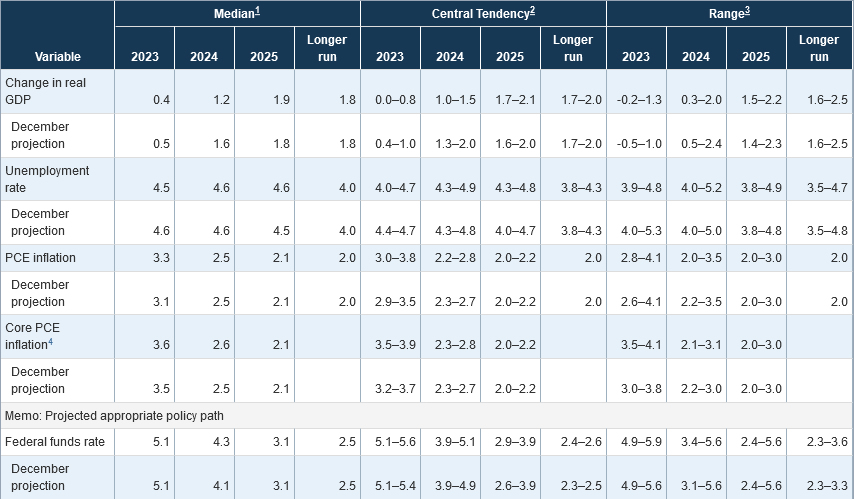
In the new economic projections (median):
- Federal funds rate for 2023 was unchanged at 5.1%.
- Federal funds rate for 2024 was raised from 4.1% to 4.3%.
- Federal funds rate for 2025 was unchanged at 3.1%.
- GDP growth in 2023 was lowered from 0.5% to 0.4%.
- GDP growth in 2024 was lowered from 1.6% to 1.8%.
- GDP growth in 2025 was raised from 1.8% to 1.9%.
- Unemployment rate in 2023 was lowered from 4.6% to 4.5%.
- Unemployment rate in 2024 was unchanged at 4.6%.
- Unemployment rate in 2025 was raised from 4.5% to 4.6%.
- Headline PCE inflation in 2023 was raised from 3.3% to 3.1%.
- Headline PCE inflation in 2024 was unchanged at 2.1%.
- Headline PCE inflation in 2025 was unchanged at 2.1%.
- Core PCE inflation in 2023 was raised from 3.5% to 3.6%.
- Core PCE inflation in 2024 was raised from 2.5% to 2.6%.
- Core PCE inflation in 2025 was unchanged at 2.1%.
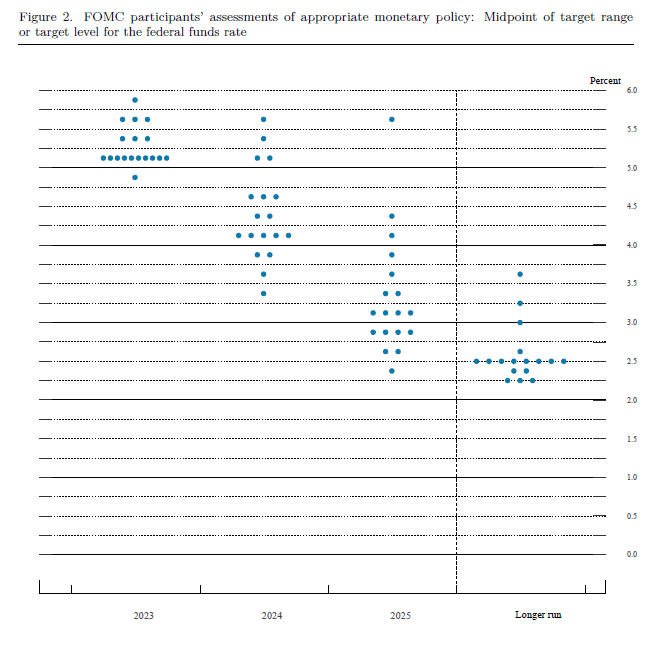
In the new dot plot:
- In 2023, the majority, 10 committee members, expect interest rate at 5.00-5.25% , with only one expecting lower rates.
- In 2024, 14 members at least at least two rate cut from 5.00-5.25% level. Majority of 10 members expect rates to be between 4.00-4.75% range.
(FED) Federal Reserve Issues FOMC Statement
Recent indicators point to modest growth in spending and production. Job gains have picked up in recent months and are running at a robust pace; the unemployment rate has remained low. Inflation remains elevated.
The U.S. banking system is sound and resilient. Recent developments are likely to result in tighter credit conditions for households and businesses and to weigh on economic activity, hiring, and inflation. The extent of these effects is uncertain. The Committee remains highly attentive to inflation risks.
The Committee seeks to achieve maximum employment and inflation at the rate of 2 percent over the longer run. In support of these goals, the Committee decided to raise the target range for the federal funds rate to 4-3/4 to 5 percent. The Committee will closely monitor incoming information and assess the implications for monetary policy. The Committee anticipates that some additional policy firming may be appropriate in order to attain a stance of monetary policy that is sufficiently restrictive to return inflation to 2 percent over time. In determining the extent of future increases in the target range, the Committee will take into account the cumulative tightening of monetary policy, the lags with which monetary policy affects economic activity and inflation, and economic and financial developments. In addition, the Committee will continue reducing its holdings of Treasury securities and agency debt and agency mortgage-backed securities, as described in its previously announced plans. The Committee is strongly committed to returning inflation to its 2 percent objective.
In assessing the appropriate stance of monetary policy, the Committee will continue to monitor the implications of incoming information for the economic outlook. The Committee would be prepared to adjust the stance of monetary policy as appropriate if risks emerge that could impede the attainment of the Committee's goals. The Committee's assessments will take into account a wide range of information, including readings on labor market conditions, inflation pressures and inflation expectations, and financial and international developments.
Voting for the monetary policy action were Jerome H. Powell, Chair; John C. Williams, Vice Chair; Michael S. Barr; Michelle W. Bowman; Lisa D. Cook; Austan D. Goolsbee; Patrick Harker; Philip N. Jefferson; Neel Kashkari; Lorie K. Logan; and Christopher J. Waller.
Bank of England & Swiss National Bank Both Set to Hike
Summary
- The Bank of England and Swiss National Bank both make monetary policy announcements tomorrow, March 23.
- Our base case is for the Bank of England to raise its policy rate 25 basis points to 4.25% this week, and then pause tightening. However, an unexpected quickening of inflation has added some uncertainty to that outlook. In the absence of a closer, or finely balanced, vote in favor of a rate hike, or a softening in the Bank of England's language, we will be inclined to adjust our outlook towards further tightening, an adjustment that could also be positive for the pound.
- In Switzerland, growth appears to be bottoming out and there has been an uptick in inflation. While Swiss markets have been dominated by banking sector strains over the past week, with some sense of relative calm restored and after the European Central Bank's rate hike last week, we still expect the Swiss National Bank to raise its policy rate by 50 basis points to 1.50% at this week's announcement.
Bank of England to Hike, But Will They Signal More To Come?
The Bank of England (BoE) announces its monetary policy decision on March 23, with market participants focused on both the size of any potential rate hike and any signals of potential future rate hikes. Our base case has been for the Bank of England to hike its policy rate by 25 basis points to 4.25% at this week, a view with which we are still comfortable. In recent days, as banking sector strains in the U.S. and Switzerland led to unsettled global markets, market discussion has centered on whether the Bank of England could even pause at this week's meeting. However, with those strains alleviated to a modest extent, further tightening now seems very likely at this week's meeting.
A more interesting question, in our view, is whether there will be any further tightening beyond this week's meeting. Our base case has been that this week's rate increase will be the last of the current cycle. The Bank of England's economic projections, which forecast a moderate U.K. recession and below-target inflation over the medium-term, are consistent with a pause from the Bank of England after this week. In our view, some key policymakers have also been quite balanced in their comments and are looking for opportunities to pivot towards a pause. For example, Governor Bailey recently said in early March, “I would caution against suggesting either that we are done with increasing Bank Rate, or that we will inevitably need to do more”.
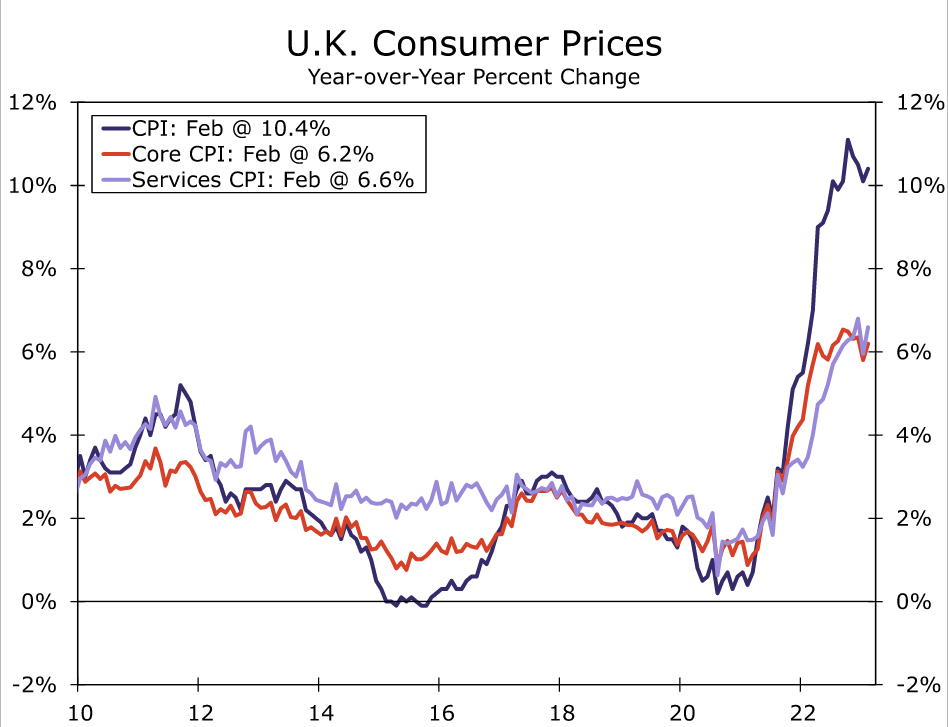
A moderate slowing in inflation over the last few months had opened the door slightly ajar, in our view, to a Bank of England pause. However, that pause has been thrown into doubt by the U.K. February CPI. U.K. inflation was an upside surprise, with the headline and core CPI unexpectedly quickening to 10.4% and 6.2% year-over-year, respectively. Today's Federal Reserve monetary policy decision may also be a factor—while it is not our base case, if the Fed does hike rates at its meeting, it could potentially make it easier for the Bank of England to deliver additional rate hikes after this week as well. Hence, while we are reasonably confident the BoE will hike rates 25 basis points this week, we will be scrutinizing the accompanying statement closely for signs of a pause (or not) going forward. In particular:
- The Bank of England voted 7-2 at its February meeting to hike rates, with the two dissents in favor of holding rates steady. We look for a closer vote split (6-3 or 5-4) as a hint that this week's hike could be the last. However, if the vote remains decisively in favor of a rate increase, more hikes could be forthcoming.
- The BoE also said it “will continue to monitor closely indications of persistent inflationary pressures, including the tightness of labor market conditions and the behavior of wage growth and services inflation. If there were to be evidence of more persistent pressures, then further tightening in monetary policy would be required.” (Note: Our bolding). Should the BoE once again highlight these persistent inflationary risks, that would be a signal of further tightening in our view.
To sum up, we will be looking for a closer vote split and a softening in the Bank of England's language to support the view of a potential pause. In the absence of those elements, we will be inclined to adjust our outlook towards further Bank of England tightening, and adjustment that could also be positive for the pound.
Swiss National Bank to Hike Despite Banking Sector Strains
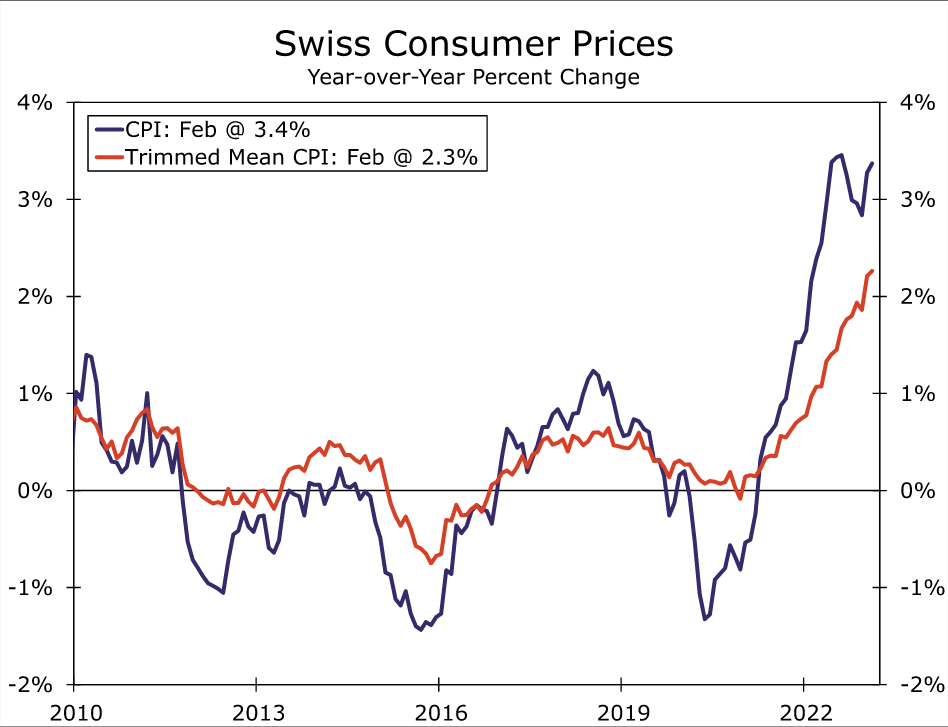
Early last week, we wrote on the Swiss economy, highlighting that growth appears to be bottoming out while CPI inflation has shown a renewed uptick, as the trimmed mean CPI rose 2.3% year-over-year in February. This led us to anticipate a 50 basis point hike from the Swiss National Bank (SNB) at its March 23 announcement. Since then, Swiss markets have been dominated by banking sector strains, which ultimately saw authorities engineer a takeover of Credit Suisse by rival firm UBS. The deal led the SNB to provide 100 billion francs of liquidity support for UBS, and the Swiss government to provide a guarantee of 9 billion francs against potential losses. With those developments having restored some relative calm to markets (the emphasis here is very much on the relative rather than the calm), and with the European Central Bank having raised its policy rate 50 basis points last week, we still expect the SNB to raise its policy rate by 50 basis points to 1.50% at this week's meeting. Moreover, while Swiss growth could be softer than previously expected, CPI inflation will likely remain mildly elevated above the central bank's 2% inflation target for the time being. If the SNB does raise rates 50 basis points this week, even in the context of recent market events, we believe it will also deliver a 25 basis point rate hike at its June meeting amid what we expect will be calmer markets conditions.
USD/CHF: We Expect a Fall Within the Bearish Impulse
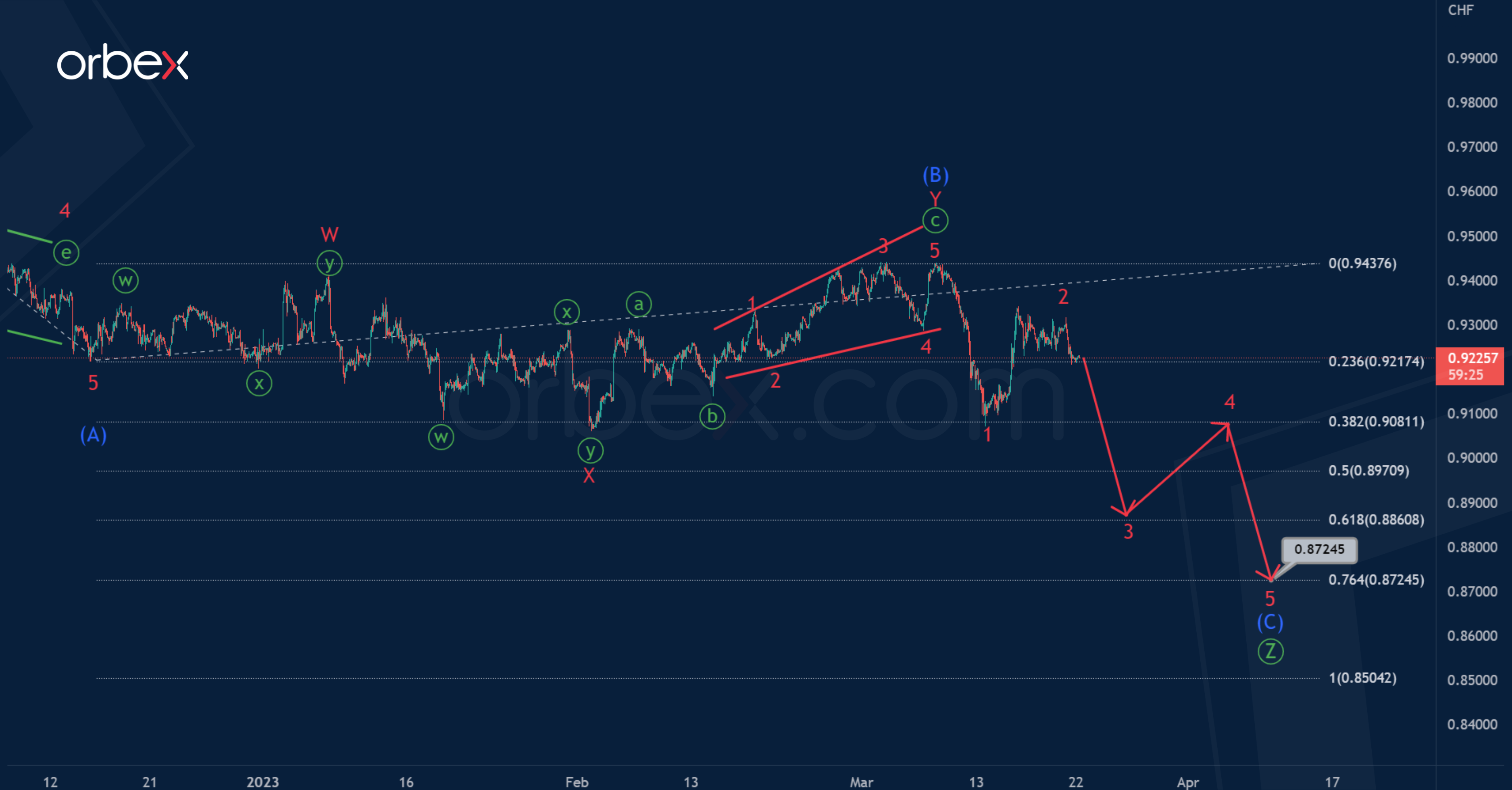
In the long term, the USDCHF pair can build a triple zigzag Ⓦ-Ⓧ-Ⓨ-Ⓧ-Ⓩ. Its final part, wave Ⓩ, is under development.
The primary wave Ⓩ may end in the form of a standard intermediate zigzag (A)-(B)-(C). Wave (A) is a 5-wave bearish impulse, wave (B) has a horizontal internal structure of a double three W-X-Y.
Thus, the formation of the final intermediate wave (C) can be expected in the near future. Its internal structure is shown by trend lines. Perhaps it will be at 76.4% of impulse (A), and will end near 0.872.
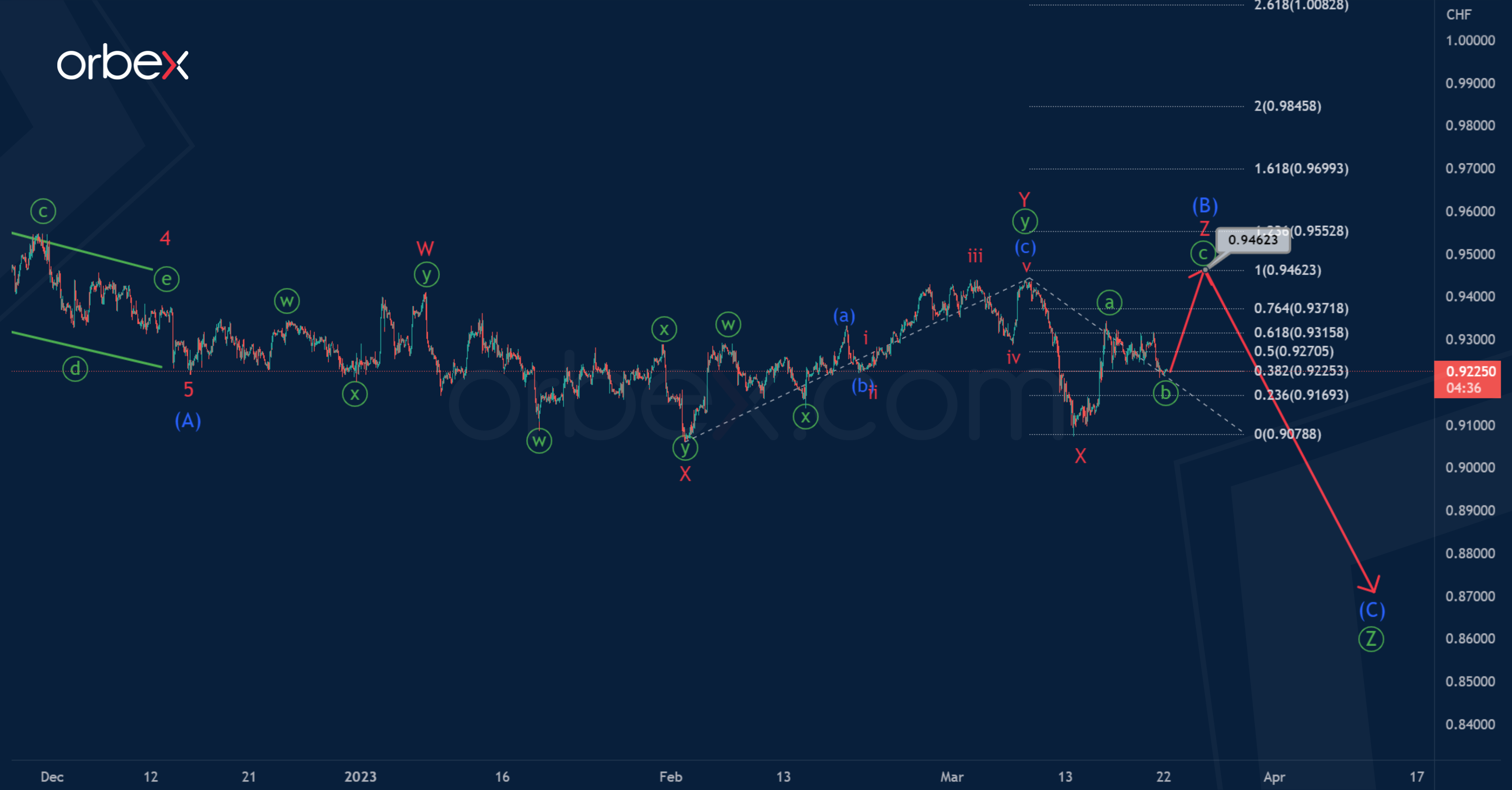
Let's consider a scenario where the development of correction (B) can be continued. In this view, it can take the form of a triple three consisting of sub-waves W-X-Y-X-Z.
The minor sub-waves W-X-Y-X have been completed. To complete the final bullish wave Z, which can take a zigzag shape, it is necessary that the minute impulse wave ⓒ be built.
Probably, the bulls will send the market to the level of 0.946. At that level, minor wave Z will be equal to wave Y.
Will Fed Boom or Bust the Dollar?
Struck right between a rock and hard place, today the Fed will deliver its difficult policy choice. The FOMC will have to choose between supporting the financial system and fighting inflation. They can do both, but both results will be mediocre.
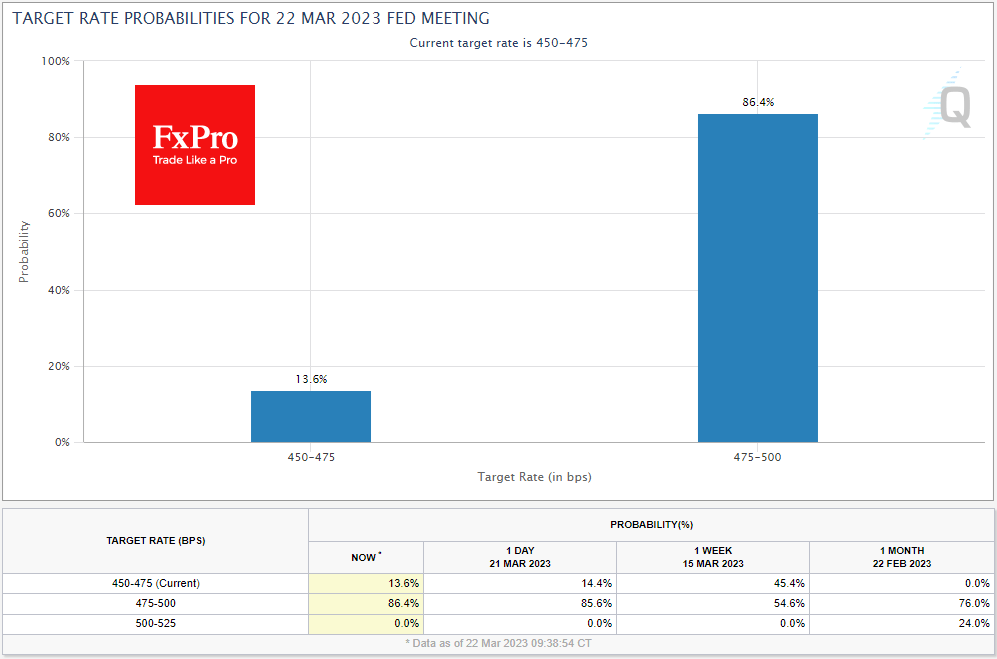
Economists’ and markets’ expectations are for a 25-point hike (with about 86% probability). But the big intrigue is whether this will be the last hike in this cycle and when we can expect a rate cut.
On the one hand, there is high inflation, which is already linked to soaring labour costs and sustained demand rather than higher commodity and energy prices, as was the case a year ago when the hiking cycle began. Powell’s speech to Congress at the beginning of March led markets to expect a 50-point move on the back of persistently high inflation.
If the Fed is indeed responding to the data, today’s decision should include hints of further policy tightening in addition to the actual rate hike. This is necessary to prevent inflation from becoming entrenched. Put simply, the US needs a “clean-up” recession that cools the labour market.
Such a straightforward approach to fulfilling the Fed’s mandate could give the dollar a boost.
On the other hand of the Fed, is the resilience of the financial system, which we have heard a lot of crunch about again in recent weeks. The suffering of the regional banks is one of the consequences of the rate hike. Further policy tightening will only make things worse. There is also the risk that a recession and a shrinking labour market will increase defaults, further eroding banks’ balance sheets and resilience.
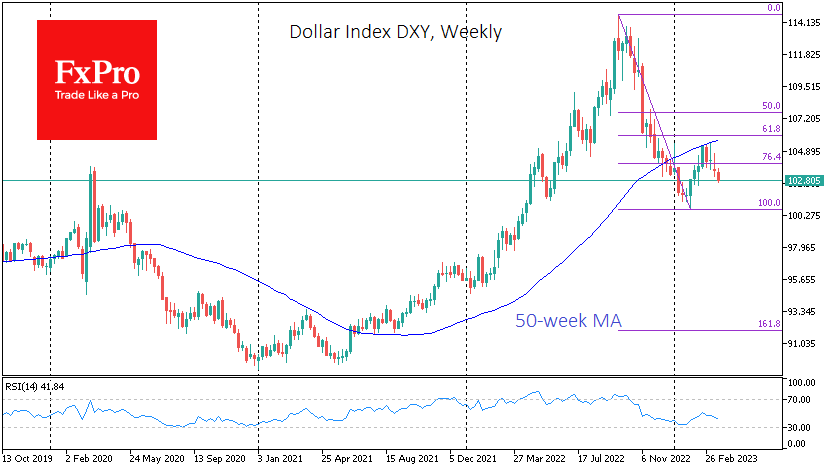
Judging by the performance of markets and the dollar index, speculators are betting on this policy reversal and paying attention to financial stability, believing that the Fed is scared enough to follow through. If this happens, equity markets will take a massive hit and the dollar will surely return to growth. A return to the March highs above 105.5 from the current 102.8 would be a matter of a few days, and the rally is unlikely to stop there.
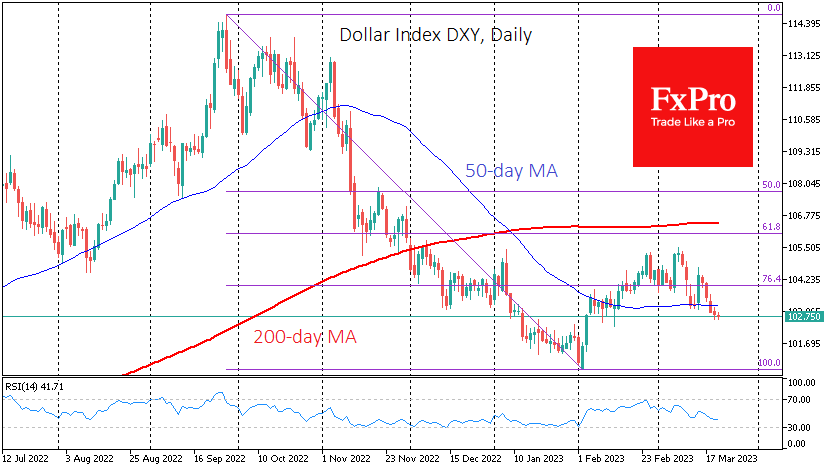
The Dollar Index has slipped below 103, the area of the lows of the last six weeks. Its steady decline over the past few days suggests that we have seen nothing more than a corrective bounce in February. The weekly chart clearly shows that the Dollar Index is perfectly contained near its 50-week moving average, confirming the long-term downtrend.
Furthermore, the DXY is not only in danger of falling below 100.6 (February lows). The long-term target for this decline is seen at 92.0, which would almost wipe out the dollar’s gains over the course of the policy tightening cycle. Looking at the charts so far, this seems the most likely scenario, although there could be surprises.
Euro Still Outperforms Dollar
Markets
The countdown to this evening’s Fed policy decision was spiced by comments from ‘The ECB and its Watchers’ conference organized by the Institute for Monetary and Financial Stability at the Goethe University in Frankfurt. At the opening speech, ECB chair Lagarde repeated the messages from last week’s press conference. After Thursday’s 50 bps hike, the ECB shifted to a data-dependent approach. Still, if its baseline scenario holds, the ECB has ‘ground to cover to make sure that inflation pressures are stamped out’. At the same time, the ECB is ‘ready to act and provide liquidity support to the financial system if needed and to preserve the smooth transmission of monetary policy’. In this respect, there is no trade-off between price stability and financial stability. Further ECB steps are guided by the inflation outlook, underlying inflation and an analysis of the process of monetary transmission (how do tighter monetary conditions translate into slower demand?). Other ECB members (Lane, Rehn) later confirmed Lagarde’s assessment. Was it due to the ECB comments or ‘simple’ follow-through action as uncertainty eased further, German yields rose another 14 bps (2-y) to 5.0 bps (30-y). Gilts underperform (2-y +23 bps) both Bunds and Treasuries. UK February CPI data published this morning (headline 1.1% M/M and 10.4% Y/Y, from 10.1%, core up from 5.8% to 6.2%) leave the BoE little choice but to raise the policy rate by 25 bps tomorrow. Markets also again embrace the idea of a BoE policy rate peak beyond 4.5%. Awaiting this evening’s Fed policy decision US yields currently gain between 7 bps (2-y) and 1 bp (30-y). Equites extend this week’s rebound (Euro Stoxx 50+0.5%, S&P little changed). On FX markets, the euro still outperforms the dollar, with EUR/USD intraday testing the 1.0803 resistance (currently 1.0785). The move isn’t solely euro strength. USD DXY slipped further south to test the 103 area. Higher core yields still put the yen in the defensive, but losses are smaller than at yesterday’s repositioning (USD/JPY 132.8). Sterling gains stay modest despite additional interest rate support post this morning’s CPI data with EUR/GBP holding near 0.88(1). Of course, current intraday trends are highly conditional to this evening’s Fed policy decision.
US money markets currently see an 80%+ probability for a 25 bps Fed rate hike bringing the target range for the Fed funds rate to 4.75-5%. We expect the Fed to take a similar approach similar to the ECB, using specific/separate tools to address price stability and financial stability. Also take a close look at the new projections (dots) of the governors on the Fed rate path going forward. We expect a big majority of the Fed governors to put the end of year level for the policy rate well beyond 5.0%, a scenario that also rejects current market pricing of Fed rate cuts in H2. Such a scenario might support a further rise in US short-term yields and help put a floor for the dollar.
News & Views
Czech National Bank deputy governor Zamrazilova is pushing back against the idea of policy rate cuts this year. The CNB’s core approach is keeping interest rates elevated for a longer period of time. Before any rate cut debate can start, she wants inflation to fall back in single digit territory and review Q2 wage growth and household consumption data (published in September). “We definitely won’t start lowering rates until we see some easing of these persistent economic imbalances stemming from the tight labor market and loose fiscal policy”, she added. The Czech currency is expected to remain strong, reflecting strong bank-asset quality as well. EUR/CZK today declines from 23.85 to 23.70. CZK swap yields rise by up to 16 bps at the 2y tenor and 11.5 bps at the 10y.
Belgian consumer confidence dipped slightly in March, from -8 to -9 and thus staying below the long term average (1990-2022) of around -7. Household confidence faltered after four consecutive months of improvement (-27 low in September & October). Households have revised downwards their expectations of the general economic situation over the next twelve months (-16 from -13) and expressed growing fears of a rise in unemployment (19 from 16). On the personal level, households have stepped up their saving intentions (4 from 1), while expectations of their own financial situation remain basically the same (-4 from -3).
Gold: Top-down Technical Analysis
During tumultuous times like the current Credit Suisse-bailout period, the top-down technical analysis could be the compass for market investors/traders. Focusing on multiple timeframes can protect from decisions based purely on the very short-term periods examined. This process tends to be more time-consuming and ignored by most traders, but the benefits clearly outweigh the negatives. In this report, we analyse gold, which along with other financial instruments continue to feel the banking sector crisis aftershocks, starting from the longer-term and gradually moving to the lower time periods.
Starting point: Weekly timeframe
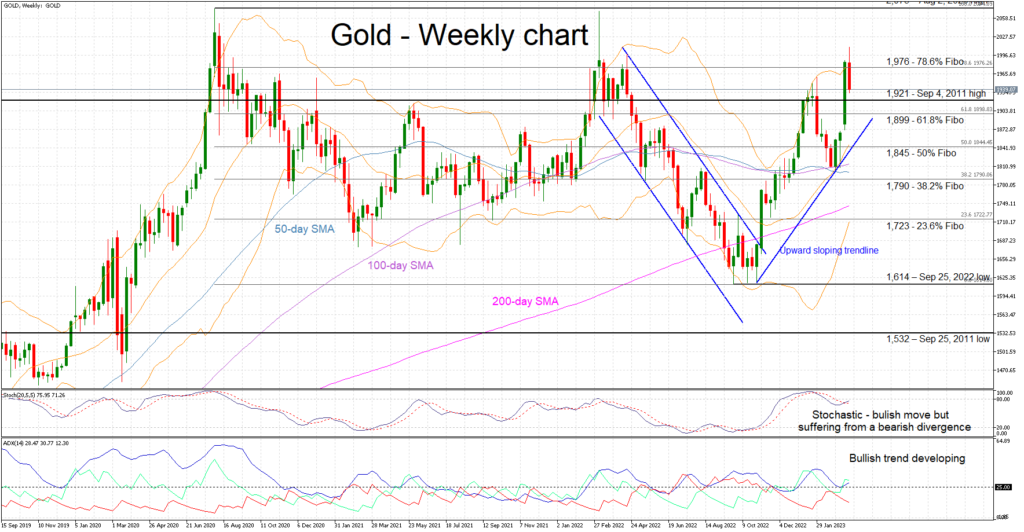
We start from the weekly chart and the aim is to find the long-term trend and key support/resistance levels. Gold has made an impressive rally since the September 2022 low of 1,614 and has traded again above the 2,000 threshold. This is the third time that gold has penetrated this key psychologically important area since August 2020. This is not unexpected considering the grave developments both economically and financially that the world has been going through since the Covid pandemic and more recently the soaring inflation phase.
The current price level remains above the various simple moving averages (SMAs) employed here and a key upward sloping trendline. In the meantime, the Average Directional Movement Index (ADX) is trading above the 25 level threshold, signaling a trending market. While the technical picture is still pointing to a bullish trend, the stochastic oscillator is trying to contradict it. The higher high in gold has been met with lower high by the stochastic oscillator. This bearish divergence could allow the bears to push the gold price lower, with the September 4, 2011 high of 1,921 being their first target.
Next step: Daily timeframe
The daily chart is the favorite among traders and attracts the biggest interest. In addition to key levels, we focus on local peaks and troughs, and start to pay more attention to the SMAs and Fibonacci retracement levels.
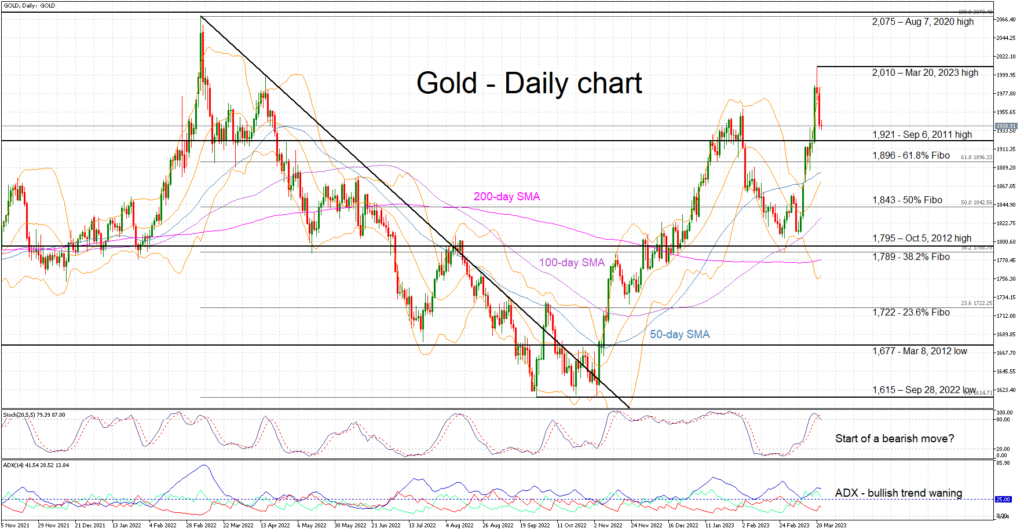
The strong rally seen since March 8 has pushed to 2,010, the highest level since March 9, 2022. Gold has been dropping in the past three sessions, as the overall market sentiment appears to have improved somewhat from last week. This is depicted in the ADX where the bullish trend appears to top out. Similarly, the stochastic oscillator is trying to break below its overbought territory. Such a move could provoke a bearish reaction with the September 6, 2011 high of 1,921 standing nearby. This area appears to trouble the bears when examining gold’s performance during the March-April 2022 and January 2023 period respectively. Such a correction though could even suit the bulls considering the aggressive rally last week, provided that the next local trough is above the 1,800 area.
Third step: 4-hour timeframe
Long-term investors would be content with the weekly and daily analysis while very short-term trades would look at the 4-hour chart very briefly before delving into the 1-hour and 15-minute timeframes. For our purpose, the 4-hour seems sufficient to understand the shorter-term dynamics, identify the key levels for potential entry and exit in the market.
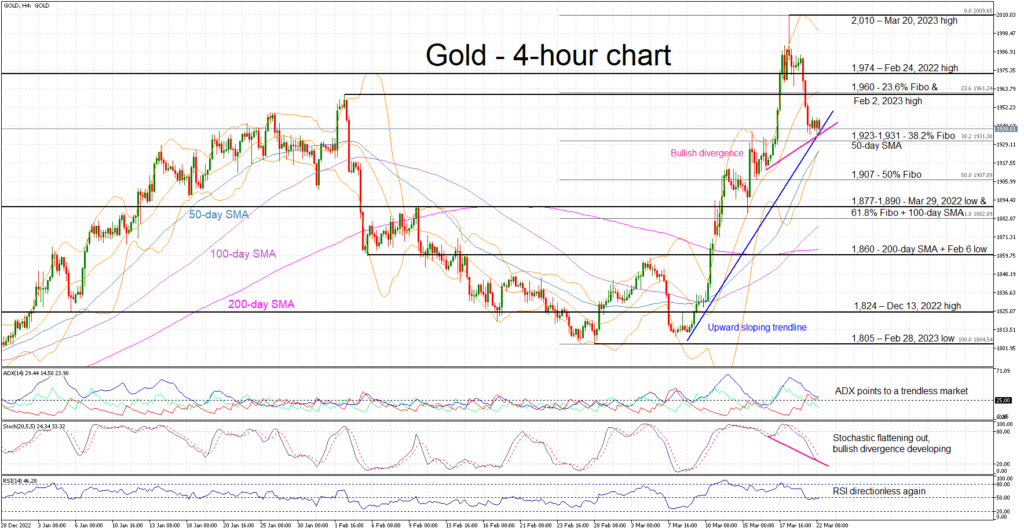
Gold has recorded an impressive move since the March 8 lows, pushing above the 2,000 psychological level. A correction has occurred in the three daily sessions as the market is trying to find a new balance around the 1,840 area. The overall technical picture is pointing to a more balanced market, potentially preparing for the next move. The ADX is just above its “trendless” territory and the RSI is hovering around its 50-midpoint. In addition, the stochastic oscillator appears to be flattening out just above its oversold area.
However, the bulls might be able to find courage from the courage for a developing bullish divergence (pink line at the 4-hour chart). The higher low in gold’s price action has been met by a lower low in the stochastic. The next resistance would come at 1,960, the 23.6% Fibonacci retracement of the February 28 – March 23 uptrend and the February 2 high. On the other hand, the bears would have to battle with the March 9 upward sloping trendline and eventually the combination of the 38.2% Fibonacci retracement and the 50-day SMA at the 1,923-1,931 range.
Putting everything together
The process of examining multiple timeframes tends to be time-consuming, but it remains a better way of analyzing the market. The timeframes examined can be adjusted to the profile of each trader, but we believe that the above top-down process should feature in every traders’ armory. Regarding gold analysed here:
- In the weekly chart, the bullish trend remains in place. Bears need a break below the 1,850 to change the market’s fate.
- The correction appears to have legs considering the current momentum indicators and provided that the bears manage to break the 1,920 area.
- The overall picture points to balanced market although a bullish divergence and a weakening bullish trend could reignite the bulls’ appetite.