

Sample Category Title
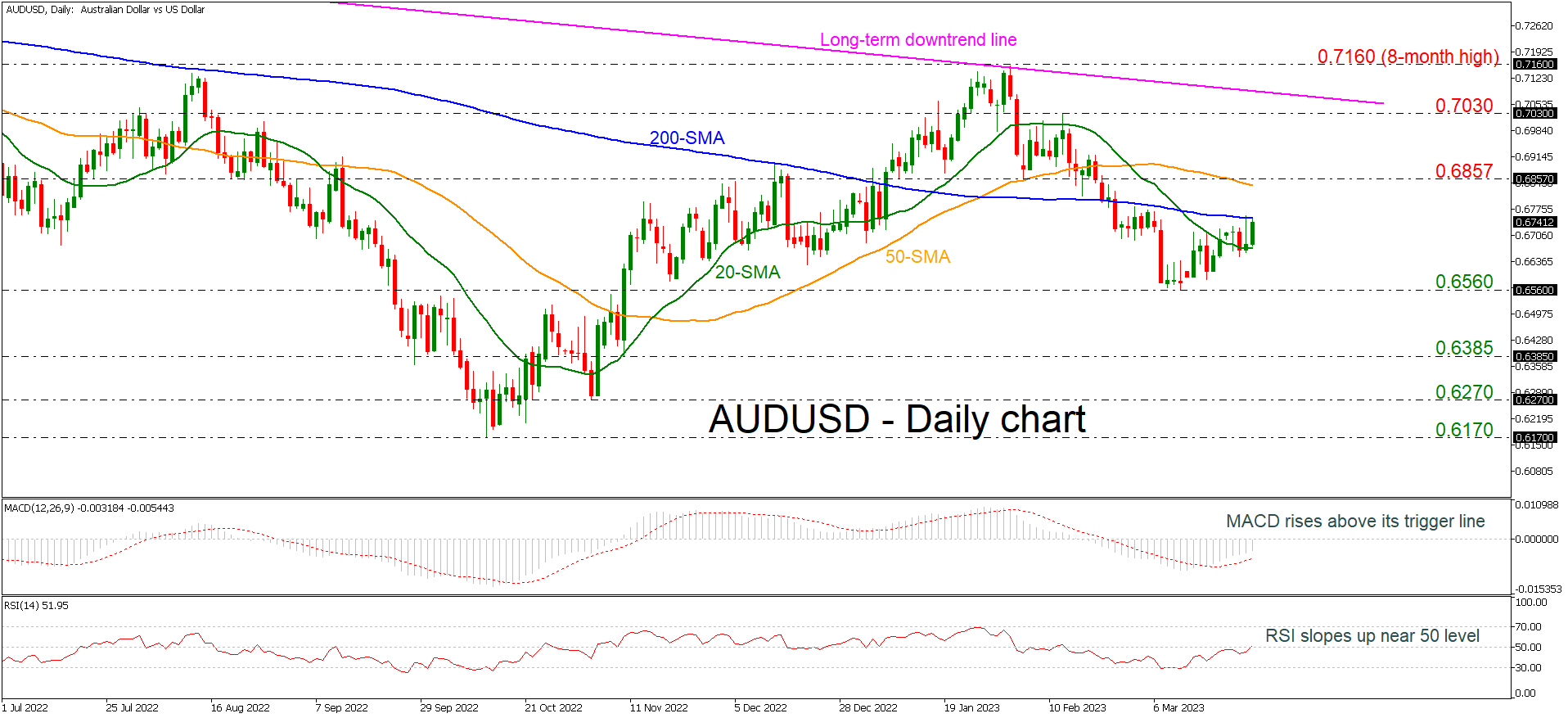
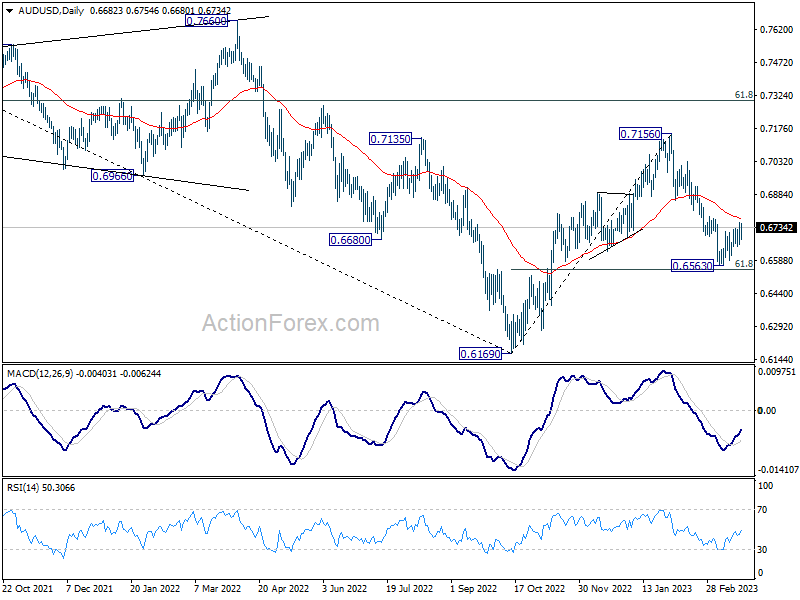
AUDUSD Tests 200-day SMA After Rebound Off 0.6560
AUDUSD rebounded off the 0.6560 support level and is heading towards the 200-day simple moving average (SMA), which stands near 0.6755. The bulls may be optimistic for more upside movements as the MACD is heading north above its trigger line in the negative region and the RSI is crossing the 50 level to the upside.
In the positive scenario, in case of a successful climb above the 200-day SMA, then the market may challenge the 50-day SMA around the 0.6857 resistance. More gains could lead the market towards the 0.7030 resistance ahead of the long-term descending trend line around 0.7070.
On the other hand, a dive below the 20-day SMA could endorse the bearish structure that started from the pullback off the eight-month peak at 0.7160 and hit the 0.6560 barrier. Steeper declines could open the way until the 0.6385 support.
In brief, despite its resilience above 0.6560, AUDUSD has yet to show any clear bullish signals, remaining exposed to downside corrections in the medium-term outlook.
USD/CAD Daily Outlook
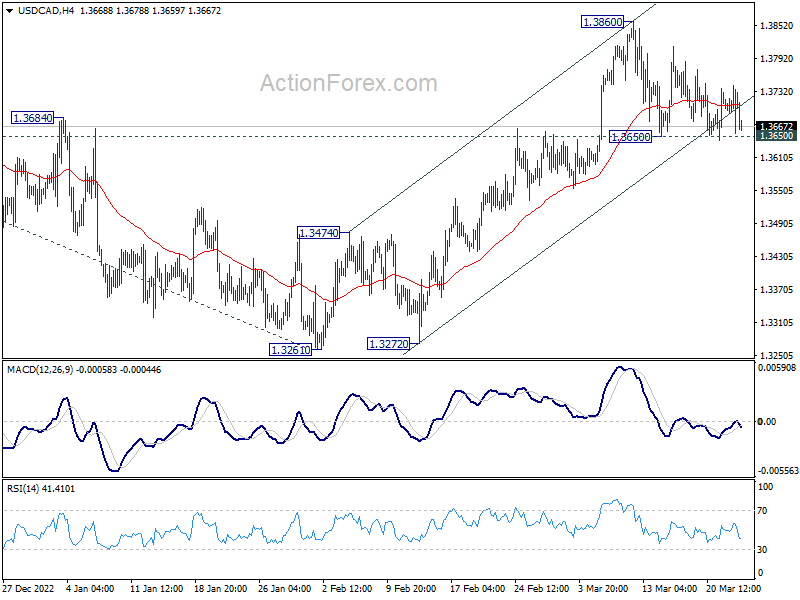
Daily Pivots: (S1) 1.3677; (P) 1.3711; (R1) 1.3765; More....
Outlook in USD/CAD remains unchanged and intraday bias stays neutral first. Further rally is expected with 1.3650 support intact. On the upside, break of 1.3860 will resume the rally from 1.3261 to retest 1.3976 high. However, firm break of 1.3650 will mix up the near term outlook and bring deeper pullback to 55 day EMA (now at 1.3576).
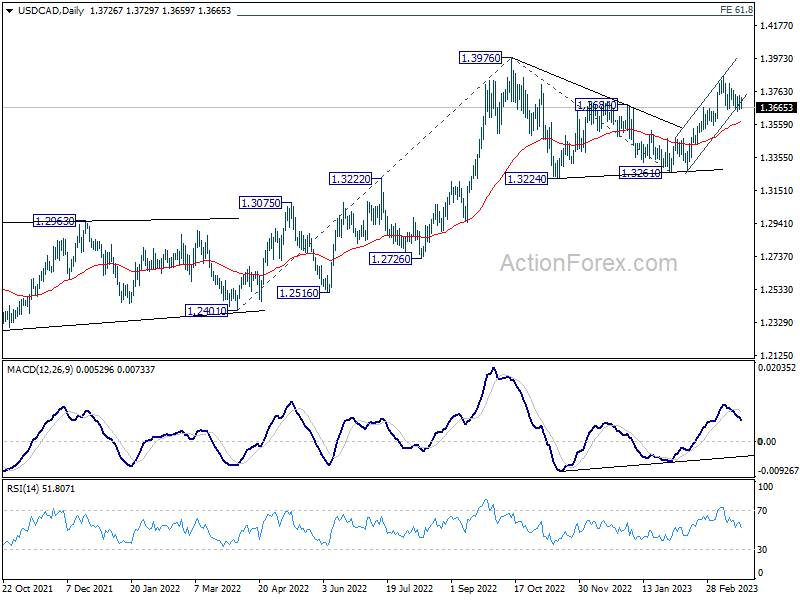
In the bigger picture, the up trend from 1.2005 (2021 low) is still in progress. Break of 1.3976 will confirm resumption and target 61.8% projection of 1.2401 to 1.3976 from 1.3261 at 1.4234. Firm break there will pave the way to long term resistance zone at 1.4667/89 (2016, 2020 highs). On the downside, break of 1.3261 support is needed to confirm medium term topping. Otherwise, outlook will remain bullish even in case of deep pull back.
AUD/USD Daily Report
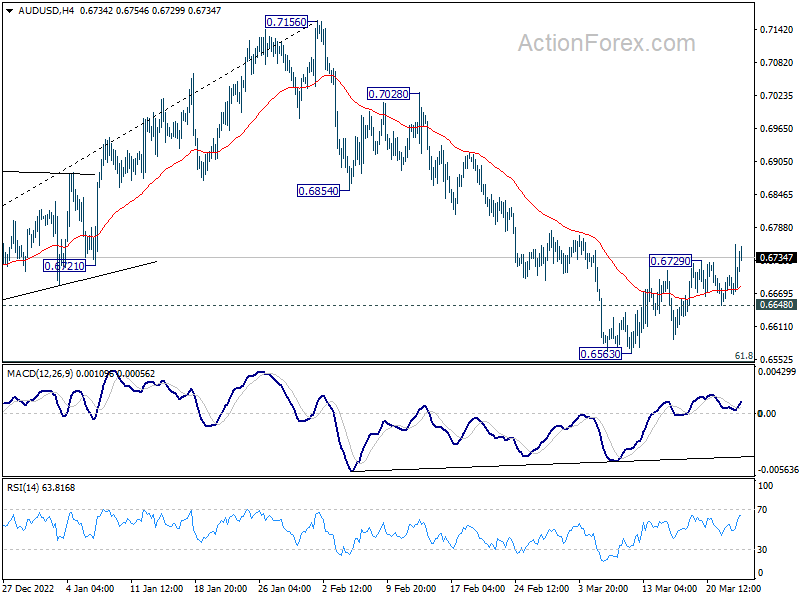
Daily Pivots: (S1) 0.6643; (P) 0.6701; (R1) 0.6741; More...
AUD/USD's break of 0.6729 resistance should confirm short term bottoming at 0.6563. Fall from 0.7156 might have also completed just ahead of 0.6546 fibonacci level. Intraday bias is on the upside for 55 day EMA (now at 0.6773). Sustained break there will pave the way back to retest 0.7156 high. On the downside, however, below 0.6648 minor support will turn intraday bias neutral again first.
In the bigger picture, as long as 61.8% retracement of 0.6169 to 0.7156 at 0.6546 holds, the decline from 0.7156 is seen as a correction to rally from 0.6169 (2022 low) only. Another rise should still be seen through 0.7156 at a later stage. However, sustained break of 0.6546 will raise the chance of long term down trend resumption through 0.6169 low.
XAU Remains High
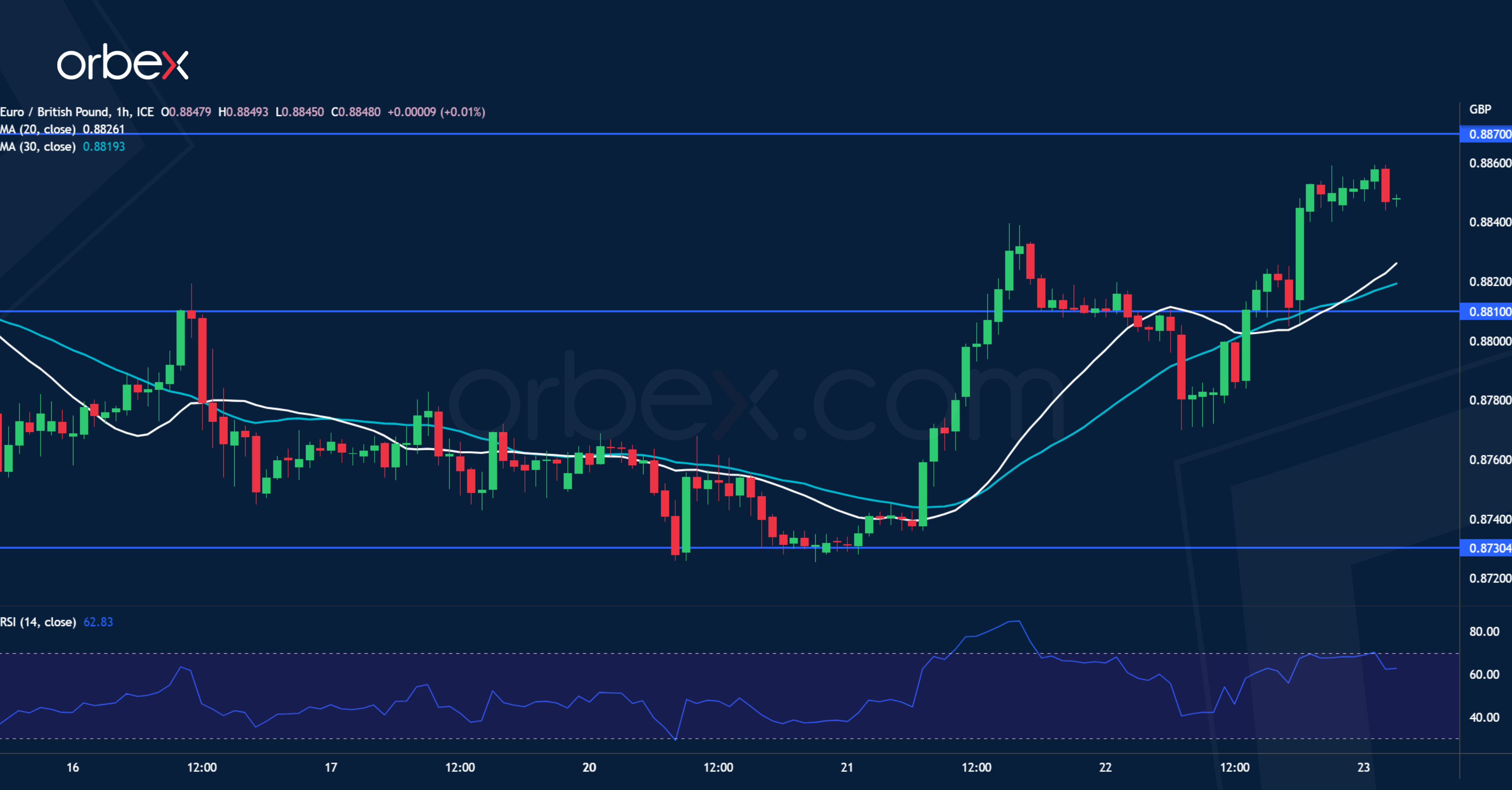
EUR/GBP breaks resistance
The pound struggles as a jump in February’s CPI may force the BoE to press for more rate hikes. The euro has bounced off this year’s low of 0.8730 and a subsequent surge above the key supply area around 0.8840 prompted sellers to cover their positions, easing the downward pressure. As the RSI flirts again with the overbought area, the next step is to see follow-up buying around the fresh support of 0.8810. A close above 0.8870 would attract more momentum buyers and extend the rally to the March high of 0.8920.
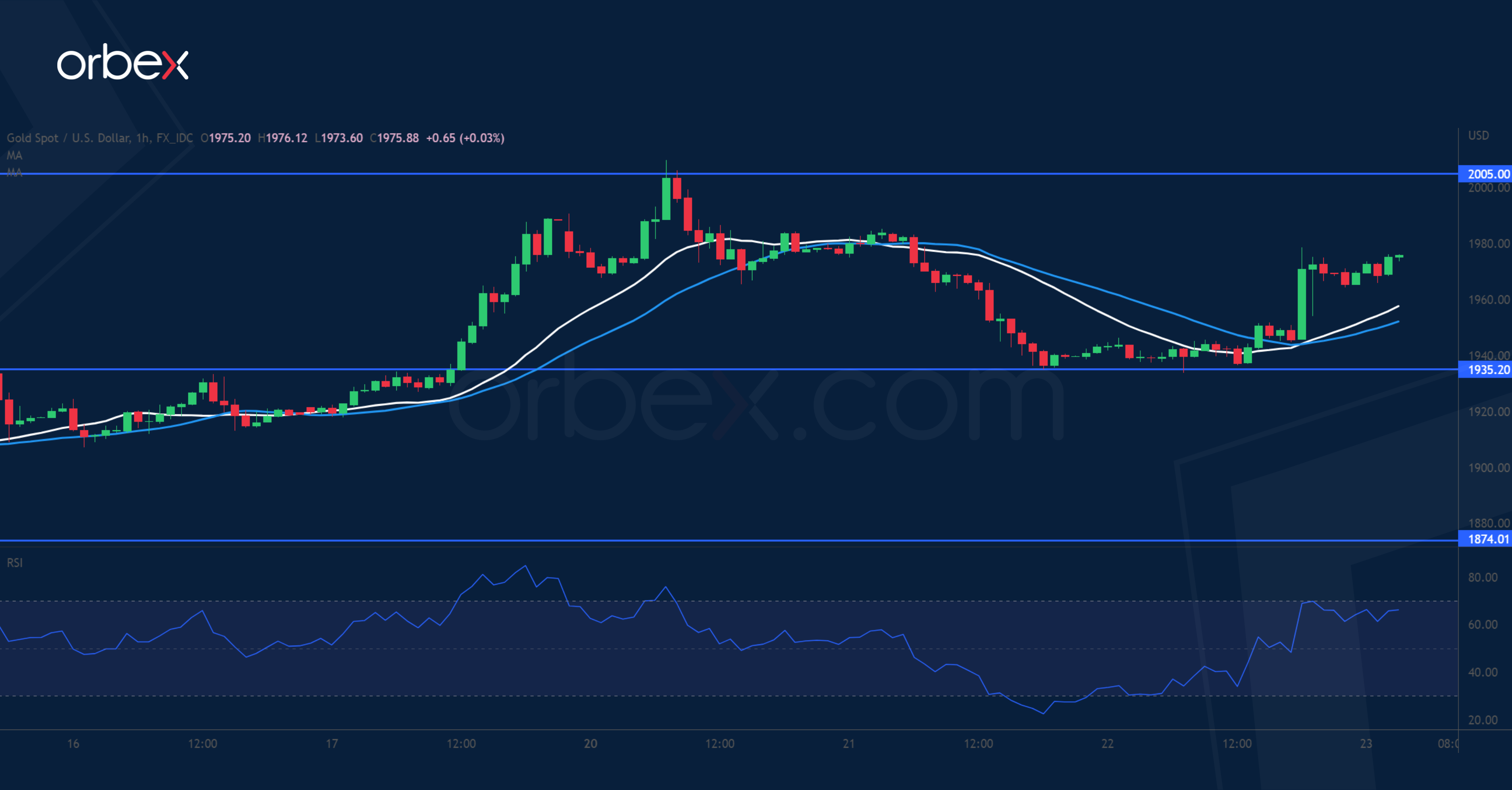
XAU/USD tests peak
Gold bounces back as safe haven demand jumps amid ongoing tightening. The precious metal has soared to a 11-month high at the psychological level of 2000. While the bullish MA cross shows an acceleration to the upside, the RSI’s double top in the overbought area suggests that the bulls could use some breathing room. On the hourly chart, 1935 saw bids from short-term trend-followers. Further down, 1874 over the 20-day SMA would be the bulls’ second layer of defence. A pop above 2005 would resume the climb.
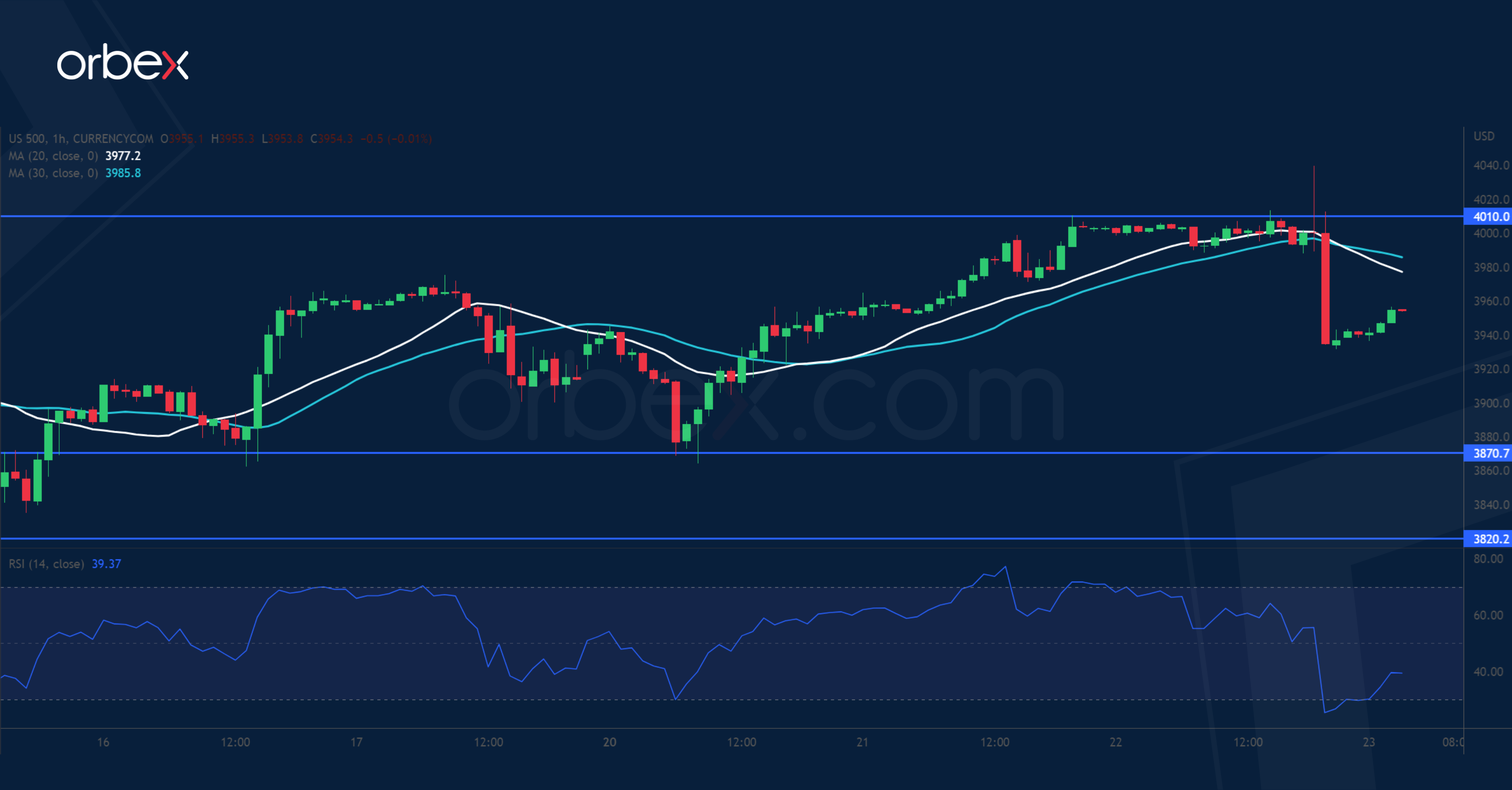
S&P 500 drops back
The S&P 500 closed lower after the Fed kept its options open for future hikes despite systemic worries. After the market stabilised and found a bottom at 3820, a series of higher lows has helped the index claw back previous losses. However, the supply zone between the psychological level of 4000 from a previous sell-off and 4010 has proven to be a tough hurdle to overcome with a shooting star suggesting a rejection of the breakout. With the RSI back into the oversold area 3870 is a key support to keep the recent recovery valid.
Contrast Between ECB at Watcher Conference and Fed Was Striking
Markets
The contrast between the ECB at the Watcher conference and the Fed yesterday was striking. Delivering a 50 bps rate hike last week, it said then and again yesterday that there is still more ground to cover. The Fed hiked rates by 25 bps to 4.75-5%. Language about future tightening in the policy statement was softened from “ongoing increases in the target range” to “some additional policy firming”. The updated dot plot suggested one more 25 bps move this year but that would be the end of it. Growth forecasts were revised down for this year (0.4%) and the next (1.2%) while inflation was seen a bit higher at 3.3% in 2023 and at an unchanged 2.5% in the next. Unemployment is still expected at a low 4.5-4.6% across the horizon, suggesting ongoing faith in a (very) strong labour market. The recent banking turmoil and its effect on credit flows and thus consumption and demand is uncertain. But Chair Powell said that a potential pullback in lending would indeed do some of the work of monetary policy. He kept the other option of still-higher interest rates open in case of only a modest economic impact and given still-elevated inflation and the excellent shape of the labour market but the lack of conviction was palpable. Powell also downplayed chances for rate cuts already this year with the dot plot showing none. Markets came to a different conclusion though. After a one in two chance for a final hike in May, they expect economic activity to cool down so much that it would prompt the Fed into 75 bps of rate cuts in the second half of this year. US yields across the curve fell by 8 (30-y) to 25.9 bps (3-y). Losing this much of interest rate support, the dollar slid from EUR/USD 1.076 to 1.085. DXY fell from 103.19 to 102.34 and USD/JPY dropped from 132.51 to 131.44. US equities lost about 1.65% despite the sharp drop in US bond yields. The declines were partially inspired by comments from US Treasury Secretary Yellen (see headline below).
Asian-Pacific equity markets trade mixed this morning as they digest the Fed’s message yesterday. Hong Kong outperforms while Japan lags behind. The USD extends losses against all G10 peers and that probably won’t change for now. EUR/USD surpasses 1.09. Short-term US yields lose another 4 bps. German Bund yields are set to open lower. Focus today shifts to European soil. The economic calendar contains several central bank policy meetings by the Norges Bank (+25 bps expected), the Swiss National Bank (+50 bps expected) and the Bank of England. The latter was served an ugly inflation print yesterday. Prices unexpectedly accelerated again, de facto fulfilling the condition of “evidence of more persistent inflationary pressures”. This paves the way for a probably final 25 bps hike to 4.25%. The Bank of England has long been split in whether to tighten further or stand pat. After the Fed’s policy decision yesterday, the debate is now likely settled. That means more scope for EUR/GBP to run higher.
News Headlines
US Treasury Secretary Yellen yesterday pushed back against the recently floated idea of providing a blanket deposit insurance to stabilize the US financial system. “I have not considered or discussed anything having to do with blanket insurance or guarantees of deposits,” she said before a Senate subcommittee. Bloomberg earlier this week reported that the US Treasury is studying ways to temporarily raise the federal insurance cap above $250k if smaller lenders face difficulties. In her opening remarks, she stressed that shareholders and bondholders of failed banks are not being protected by the US government.
The Hungarian economic development ministry announced that it will extend a cap on large bank deposits – due to expire end of March – by three months. Under the cap, Hungarian commercial banks cannot pay an interest rate above the 3-month discount-bill yield for deposits of up to a year. To protect the economy, the economics ministry has also banned the unrestricted transfer of central bank discount bills.
USD/JPY Daily Outlook
Daily Pivots: (S1) 130.69; (P) 131.84; (R1) 132.68; More...
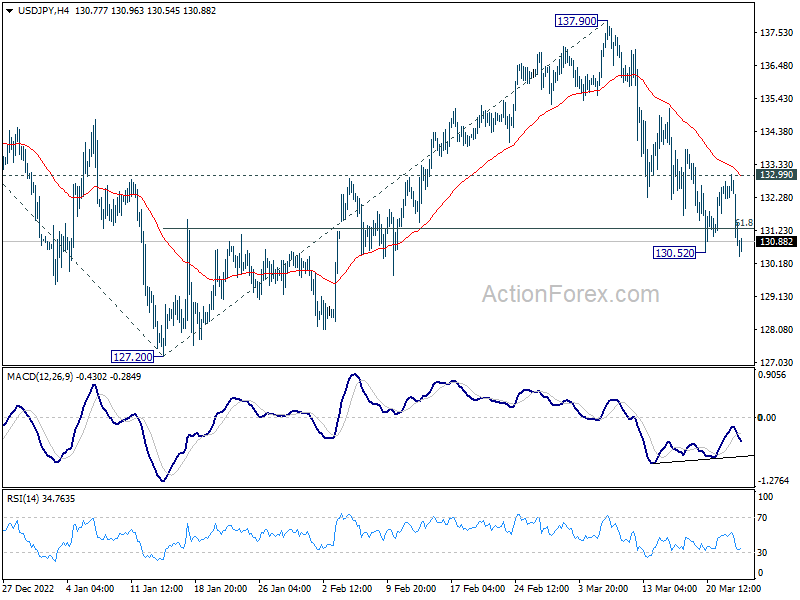
USD/JPY's is trying to resume the fall from 137.90 by breaching 130.52 temporary low, and intraday bias is back on the downside. Sustained trading below 61.8% retracement of 127.20 to 137.90 at 131.28 will pave the way to retest 127.20 low next. On the upside, however, break of 132.99 resistance will suggest short term bottoming and turn bias back to the upside for stronger rebound.
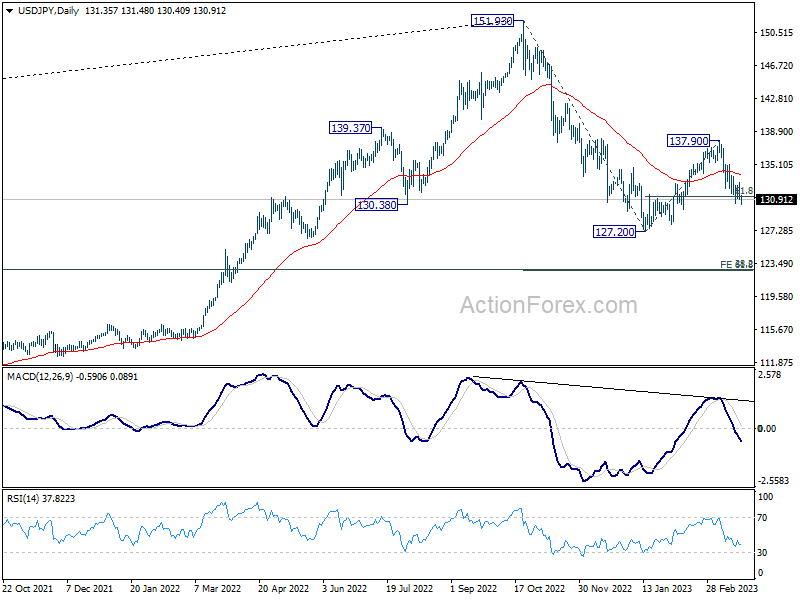
In the bigger picture, rebound from 127.20 should have completed at 137.90 as a corrective move, with strong break of 55 day EMA. The down trend from 151.93 (2022 high) is not over yet. Break of 127.20 will resume this down trend and target 61.8% projection of 151.93 to 127.20 from 137.90 at 122.61. This will now be the favored case as long as 137.90 resistance holds.
USD/CHF Daily Outlook
Daily Pivots: (S1) 0.9132; (P) 0.9189; (R1) 0.9230; More...
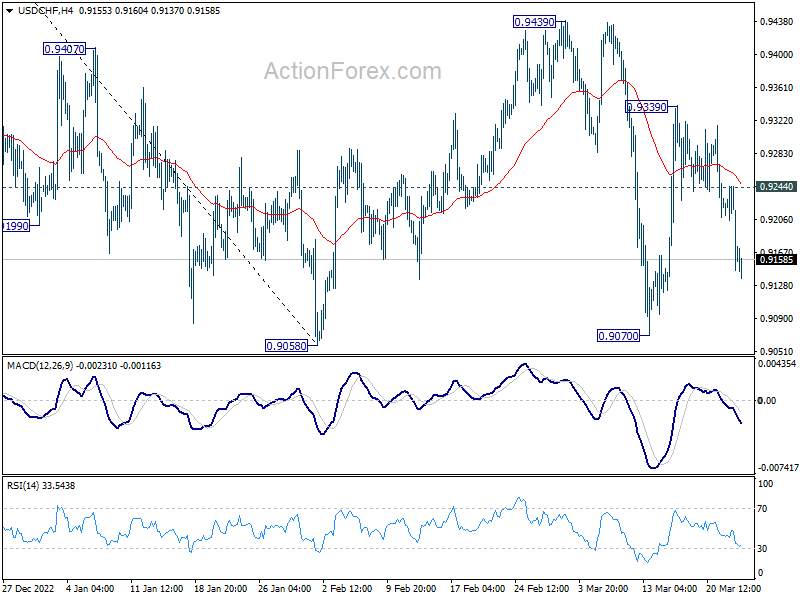
Intraday bias in USD/CHF is back on the downside as recovery from 0.9070 should have completed at 0.9439 already. Deeper fall would be seen to retest 0.9058 low first. Decisive break there will resume larger down trend from 1.1046. On the upside, above 0.9244 minor resistance will turn intraday bias neutral again. Overall outlook will stay bearish as long as 0.9474 fibonacci level holds.
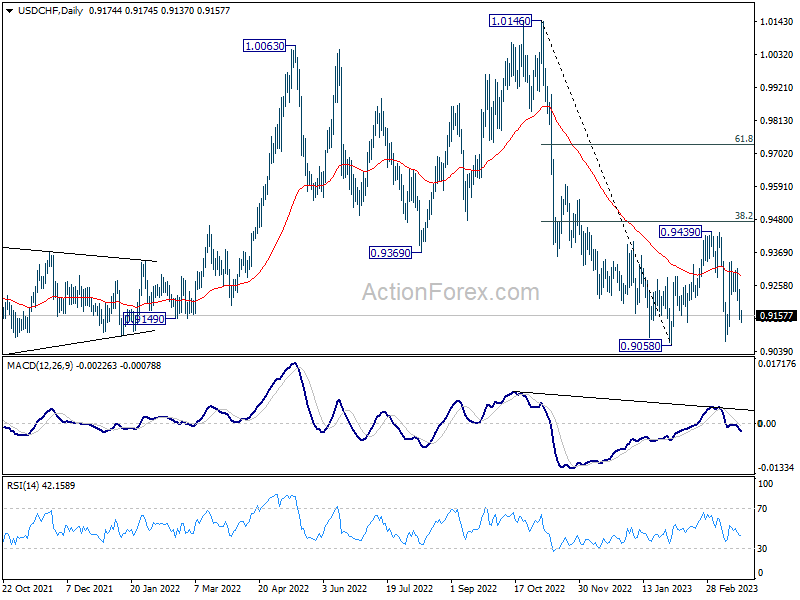
In the bigger picture, fall from 1.1046 (2022 high) should still be in progress with 38.2% retracement of 1.0146 to 0.9058 at 0.9474 intact. Prior rejection by 55 week EMA was a medium term bearish sign. Break of 0.9058 will resume such decline towards 0.8756 support (2021 low). But overall, such fall is still as a leg in the long term range pattern from 1.0342 (2016 high). So, downside should be contained by 0.8756 to bring reversal.
GBP/USD Daily Outlook
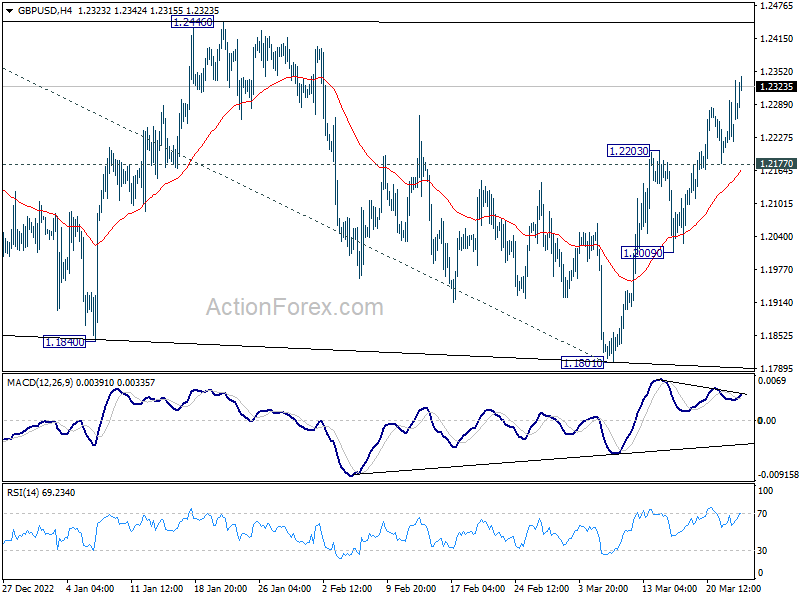
Daily Pivots: (S1) 1.2207; (P) 1.2271; (R1) 1.2333; More...
Intraday bias in GBP/USD remains on the upside at this point. Rise from 1.1801 is in progress for retesting 1.2445/6 resistance zone. Decisive break there will resume larger rise from 1.0351, and target 1.2759 fibonacci level. On the downside, break of 1.2177 minor support will argue that corrective pattern from 1.2445 is extending with another falling leg, and turn bias to the downside.
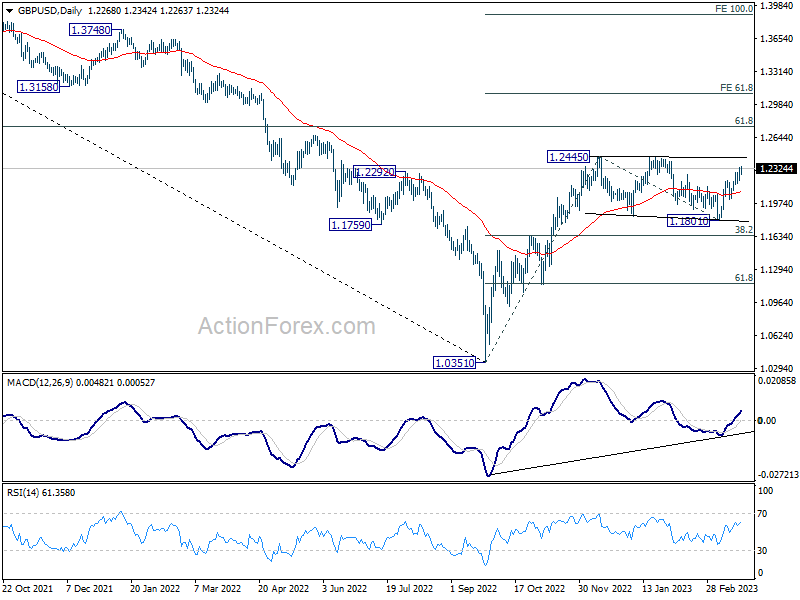
In the bigger picture, price action from 1.2445 are seen as a corrective pattern to rise from 1.0351 medium term bottom (2022 low). Resumption of the rally from 1.0351 is expected and break of 1.2446 will target 61.8% retracement of 1.4248 (2021 high) to 1.0351 at 1.2759. This will remain the favored case as long as 38.2% retracement of 1.0351 to 1.2445 at 1.1645 holds.
Fed Hikes 25bp, BoE is Next to Decide
Yesterday’s Federal Reserve (Fed) decision was relatively hawkish.
The Fed raised the rates by 25bp, as broadly priced in, but Fed Chair Jerome Powell signaled that there would be another 25bp hike on the wire before this tightening cycle ends. That was hawkish.
The Fed confirmed that the Quantitative Tightening (QT) is up and running at the speed of $95bn per month.
The latest dot plot was unchanged with most members expecting the Fed rate to reach 5.10%. That would’ve been interpreted as being dovish if the meeting took place two weeks ago, before the Silicon Valley Bank (SVB) debacle – when Powell was still hinting that the Fed would speed up rate hikes to abate inflation.
Now, it’s not even sure that there would be another rate hike.
The Fed’s policy no longer depends on inflation only, it also depends on how the latest bank stress will impact credit availability. As Powell says, a decent ‘credit tightening from baking troubles’ in a way ‘substitutes for rate hikes’.
And uncertainty regarding a potential credit tightening brings confusion on the table regarding the Fed policy.
For equity traders, the combination of a 25bp hike, the hint of another 25bp, and the risk of credit tightening was too much to cheer. The S&P500 lost 1.65%.
But, on the bonds front, the perception of the latest Fed decision was different. The US 2-year yield fell despite Powell insisting that the tightening may not be over due to ‘inflation still running too hot’.
Moreover, the markets went on pricing a 100bp cut for the year end. The gap between the dot plot and market pricing widened, yet again, raising, one more time, the credibility issues that Powell is encountering right now.
And activity on Fed funds futures tells that the chance of another 25bp hike is no more than 35% in the wake of Powell’s comments.
In other words, bond traders don’t believe Powell. And Powell’s job has just gotten more complicated with financial stress joining the inflation headache.
The US dollar index fell after the FOMC decision yesterday, along with the yields.
US futures are in the positive at the time of writing. It is well possible that the post-FOMC equity selloff quickly reverses, at falling yields are supportive of equity valuations – if financial stress is contained and economic data is not too bad.
ECB, BoE expectations remain hawkish
The dollar’s sharp fall led to a strong rally in the EURUSD yesterday. The pair traded past the 1.0910 level as a couple of hours before the Fed decision and Powell’s speech, the European Central Bank (ECB) President Christine Lagarde repeated that the ECB will keep a ‘robust’ approach to respond to inflation risks, and that the 2% inflation target is non-negotiable.
Oh, how the tables turned
This year, we are faced with a decidedly hawkish ECB and a weakened Fed. And the sufficiently hawkish ECB and softening Fed expectations hint that the EURUSD has potential to extend gains above the 1.10 mark in the coming months. The 1.1275 is now a reasonable target for the bulls.
Across the Channel, Cable also rallied yesterday. It rallied because the latest inflation report from the UK was a shocker. The headline inflation unexpectedly ticked above the 10% mark, as food prices rose 18% last month. But core inflation, which doesn’t take into account food and energy prices, unexpectedly rose as well, and sat above the 6% level, again.
The latest set of CPI figures threw Mr. Bailey’s prediction of a ‘sharp fall’ in inflation under the bus.
And because inflation won’t ease by itself, it is almost certain that the Bank of England (BoE) will hike its own policy rate by 25bp when it meets today.
Cable is preparing to test the January highs as the softening Fed expectations due to bank stress and hawkish BoE expectations due to high inflation hint that the pair could continue its advance to 1.25 in the continuation of the actual positive trend.
Fed Holds a Steady Course
Market movers today
A rather quiet day in terms of data, and hence, focus remains on central banks with a number of monetary policy announcements and several ECB speakers scheduled.
The Swiss National Bank is the first to announce their decision, and despite the turmoil in the country's banking system, we and consensus expect them to hike the policy rate by 50bp to 1.50%.
Norges Bank comes next, and we expect them to hike the policy rate by 25bp to 3.00% as they have been signalling.
The Central Bank of Turkey rate decision is also due today and market consensus is for 'on hold'.
Lastly, we expect the Bank of England to announce their final 25bp hike in the afternoon, bringing the Bank rate to 4.25%. After an upside inflation surprise yesterday, markets are also more convinced and the hike is fully priced in (see also Bank of England Preview - Final hike in store, 17 March).
On data front, we get US home sales for February and euro area preliminary consumer confidence for March.
The 60 second overview
Fed: As widely expected, the Federal Reserve hiked rates by 25bp last night. In line with our expectations, no changes were made to the QT, and the 2023 median 'dot' was unchanged at 5.1%. That said, both the statement and Powell's comments were tilted to the dovish side, highlighting that the 'Recent (banking sector) developments are likely to result in tighter credit conditions for households and businesses and to weigh on economic activity, hiring, and inflation'. US Treasury yields declined and EUR/USD ticked higher towards 1.09 as a response, but equity markets were under pressure after Yellen commented that the US is not considering a 'blanket insurance' for bank deposits. For now, we stick to our call of a final Fed hike in May, and no rate cuts through 2023. Going forward, we will closely follow the upcoming macro and bank lending data, which will provide first concrete insights into how the uncertainty has affected the real economy. See our full Fed review: A cautious 25bp hike, 22 March.
ECB: President Lagarde delivered a fairly balanced speech at the ECB watchers conference, stressing that the central bank will adopt a robust data-dependent approach that allows it to respond to inflation risks as needed, but also aid financial markets if threats emerge. She also repeated that if the ECB's baseline holds there will be more ground to cover in terms of future rate hikes - a message mirrored by comments from Bundesbank President Nagel earlier that ECB is not yet done raising rates. Lagarde said officials will keep a close eye on the banking sector in the next weeks and months to see whether firms are becoming more reluctant to lend. Markets have now repriced the ECB peak rate back to 3.5%. As more time lapses (without negative news on the banking turmoil), more focus will return to macro data - which still warrants further repricing higher in our view.
FI: There was a solid rally in US Treasury bonds after the FOMC meeting. The Federal Reserve raised rates by 25bp as expected, but signaled that the problems in the US banking sector could dampen the need to do more. However, they remain committed to bringing down inflation and are confident that raising rates should not deepen the current problems in the US banking sector. 2Y US Treasury yields dropped 23bp, while 10Y Treasuries dropped 18bp.
FX: The USD sold off yesterday. It started before the FOMC meeting and continued after the 25bp hike was announced and during the press conference. EUR/USD rose to around 1.09 and USD/JPY fell to around 131. Scandies failed to benefit from the weaker USD, which likely reflects the setback in equities.
Credit: Credit markets were in a wait-and-see mode ahead of the Fed decision last night, with iTraxx Main broadly unchanged at 90bp (-1bp) and Xover at 470bp (-2bp). The AT1 market saw further stabilisation with prices generally increasing again. Meanwhile, UBS launched a tender offer totalling EUR2.75bn in its recently issued senior HoldCo bonds at the reoffer price, in what seems to be a move to please credit investors.
Nordic macro
We expect Norges Bank to hike the policy rate by 25bp to 3.00% as it has been signalling. We also expect the bank to signal a further hike, most likely in June. This will be reflected in the policy rate path in the new monetary policy report, which will probably also show a possibility of a third hike in late summer/autumn. The most interesting part will be to see how NB will balance the risk of inflation from a weaker NOK vs. the current risk in the financial system.
Yesterday it was communicated that Riksbank's Henry Ohlsson will retire early, in June, whereas his current term ends in 2026. He started in 2015 and finally, you could say, the consistent rate hawk got his way. There is no drama in this, in our view. The chairman of the General Council said he will propose that there will be no replacement of Ohlsson, though the formal decision will be taken on 21 April. The new Riksbank law stipulates that there will be only five Board members from 2028 at the latest. Today, Erik Thedéen gives a speech with the interesting title "My view on monetary policy" (15:00). The mantra so far is that they are data dependent, but of course they are concerned with the uptrend in core inflation accelerating.