Sample Category Title
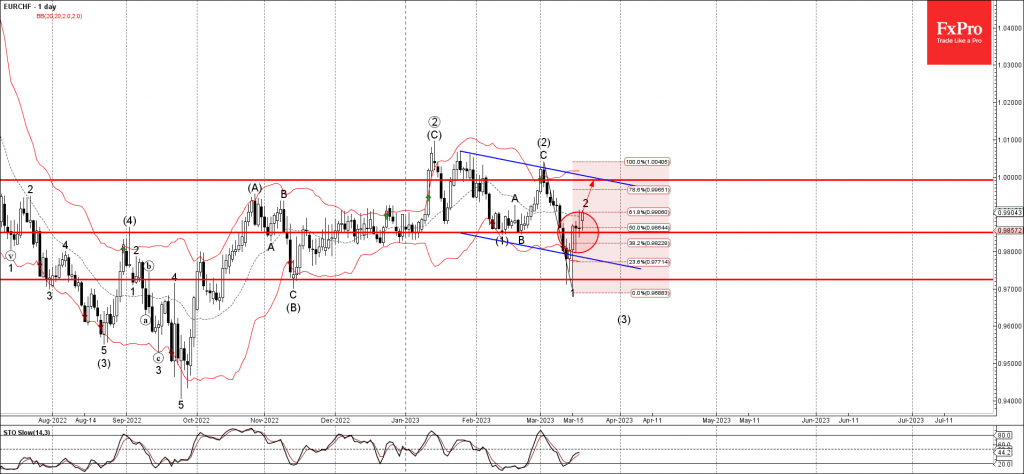
EURCHF Wave Analysis
- EURCHF broke resistance level 0.9850
- Likely to rise to resistance level 1.0000
EURCHF recently broke the resistance level 0.9850 (former support from February) intersecting with the 50% Fibonacci correction of the downward impulse 1 from the start of March.
The breakout of the resistance level 0.9850 accelerated the active short-term correction 2.
Given the strongly bearish Swiss franc sentiment, EURCHF currency pair can then be expected to rise further toward the next round resistance level at parity, 1.0000.
EURNZD Wave Analysis
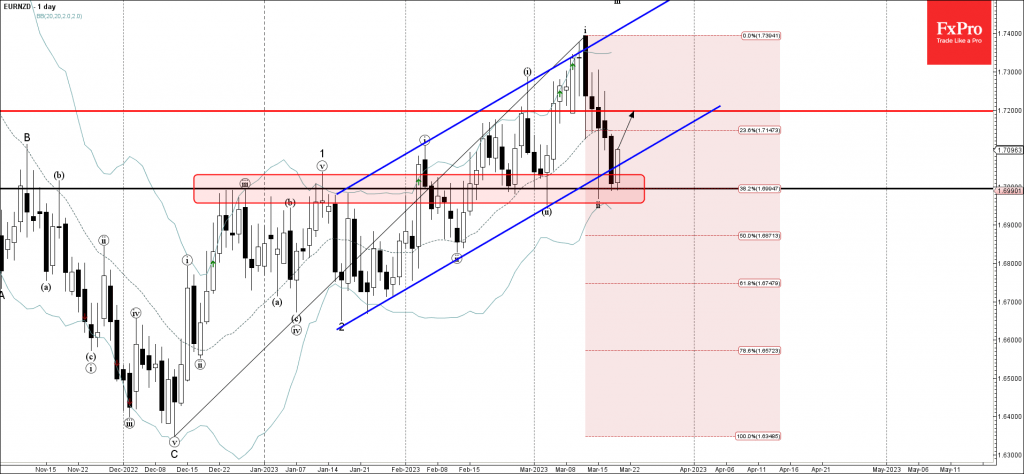
- EURNZD reversed from round support level 1.7000
- Likely to rise to resistance level 1.7200
EURNZD recently reversed up from the round support level 1.7000 (former resistance from December and January, acting as the support after it was broken in February).
The support level 1.7000 was further strengthened by the 38.2% Fibonacci correction of the upward impulse from December and the support trendline of the daily up channel from January.
EURNZD can then be expected to rise further toward the next resistance level 1.7200.
Bundesbank: German economy faces slight Q1 decline, core inflation extraordinarily persistent
Bundesbank's latest monthly report suggests that Germany's economic activity is set to decline in the current quarter, though the contraction is anticipated to be smaller than the -0.4% qoq witnessed in Q4 2022.
Despite the downturn, employment leading indicators remained largely stable in positive territory in February, which bodes well for a continued positive development in employment over the coming months.
Inflation in Germany rose slightly to 9.3% in February 2023, up 0.1 percentage points from January. Meanwhile, the core inflation rate increased by 0.3 percentage points to 5.4%, matching the historical high set in December 2022.
Bundesbank predicts a significant drop in the headline inflation rate for March, primarily attributed to the base effect in energy prices. However, the report said, "the core rate is proving to be extraordinarily persistent".
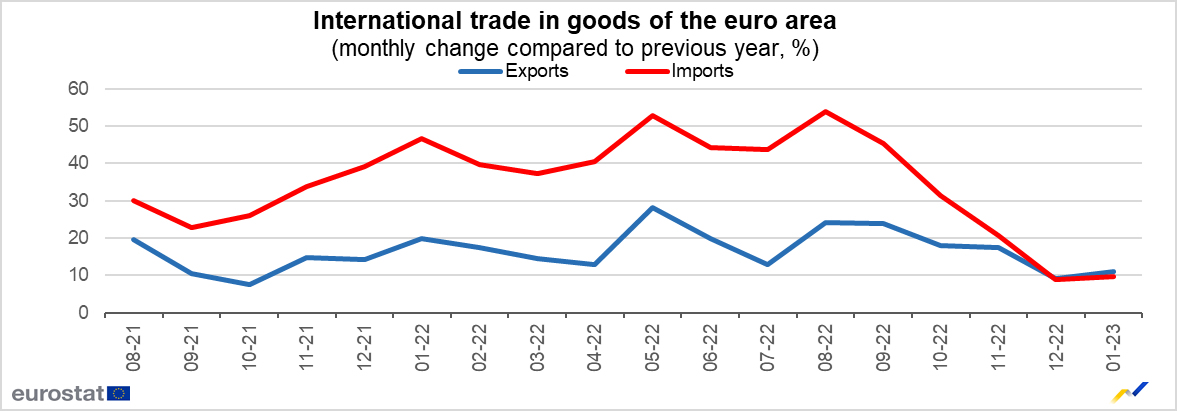
Eurozone exports rose 11.0% yoy in Jan, imports rose 9.7% yoy
Eurozone exports of goods rose 11.0% yoy to EUR 222.9B in January. Imports rose 9.7% yoy to EUR 253.5B. Trade deficit came in at EUR -30.6B. Intra-eurozone trade rose 11.6% yoy to EUR 223.8B.
In seasonally adjusted term, exports fell -1.1% mom to EUR 241.5B. Imports declined -1.8% mom to EUR 252.9B. Trade deficit narrowed slightly from EUR -13.4B to EUR -11.3B, smaller than expectation of EUR -17.3B. Intra-eurozone trade dropped from 239.1B to EUR 229.2B.
Bitcoin in All its Glory. Where’s the Stop?
Market picture
Bitcoin jumped 24% last week to close at $28K. Ethereum added 16.2% to $1800. Other leading altcoins in the top 10 gained between 6.6% (Polkadot) and 19.3% (BNB).
The total capitalisation of the crypto market, according to CoinMarketCap, rose 14% over the week to $1.17 trillion.
Last week proved to be the best week for bitcoin in the last five years, since February 2018. BTC rose sharply along with gold as market participants began to see it as a safe haven for capital amid problems with banks.
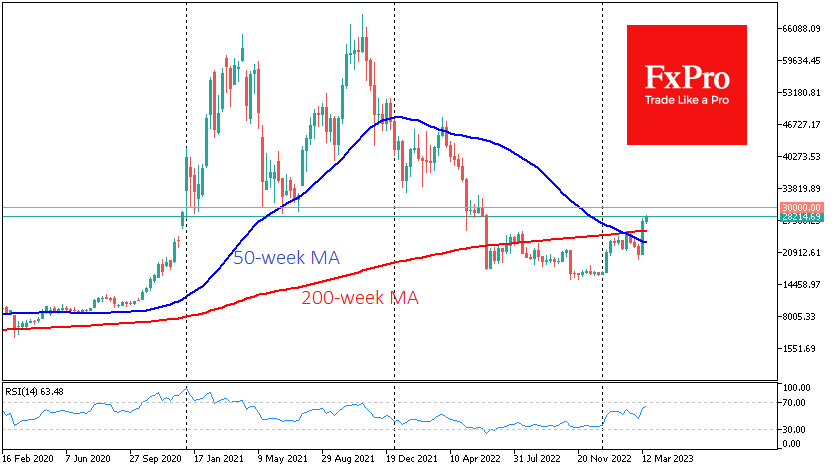
At the same time, bitcoin’s positive traction has been boosted by technical factors. Having found itself in the $25K+ territory, the first cryptocurrency appears to be facing an impressive short squeeze.
As is often the case with cryptocurrencies, they only become attractive to speculators after strong moves. The recent momentum still has some upside potential. The $30K area was a significant support for a year and a half until the middle of last year and now has a high chance of acting as resistance. As we approach the $30K level, we should be prepared for the bulls to start taking massive profits, much as we have seen since the second half of February.
News background
Ryan Selkis, CEO of analyst firm Messari, has predicted that the first cryptocurrency will hit $100K within 12 months. He sees bitcoin as a safe investment amid problems in the US economy.
Moody’s believes that the recent decoupling of USD Coin (USDC) from the US dollar could hinder the development of stablecoin and lead to tighter regulation.
Cryptocurrency exchange Coinbase is exploring the possibility of creating a new trading platform outside of US jurisdiction, Bloomberg reports. Launching an offshore exchange would allow Coinbase to insulate itself from hostile US regulation and offer international customers new products that are not approved in its home market.
Ethereum co-founder Vitalik Buterin has called for self-storage of digital assets. He said that he personally and the Ethereum Foundation use the MultiSig wallet to store most of their funds.
Euro Edges Lower, ECB and Other Central Banks Take Joint Action
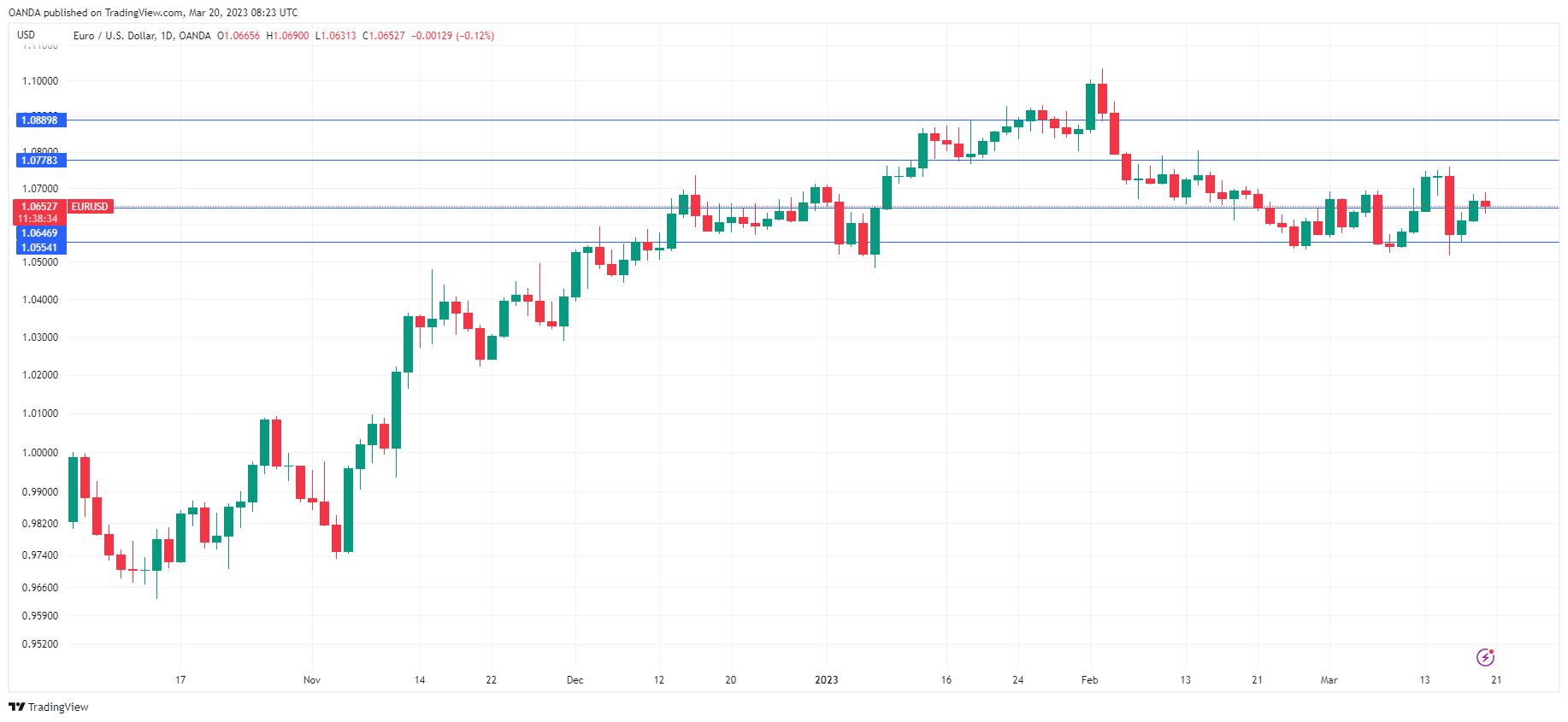
After a tumultuous week in the financial markets, things appear to have settled down. The euro is showing limited movement, trading at 1.0655.
Central banks move in unison to contain contagion
It was anything but a quiet Sunday, as the Swiss government engineered a bank merger, with UBS agreeing to buy Credit Suisse, the second largest bank in Switzerland. At the same time, six major central banks, including the Federal Reserve and the ECB, announced a joint move to ensure liquidity in the financial system.
Both moves were aimed at restoring confidence after two US banks collapsed and Credit Suisse shares plunged. This has caused market turmoil and battered the global banking system, with European, Japanese and US bank shares all down by around 10%. The palpable fear is that the contagion could spread and trigger a full-blown financial crisis. The decisive action by the Swiss government and the major central banks appears to have brought some calm to the markets.
The ECB kept the pedal on the floor last week, delivering a 50-basis point rate hike which brought the cash rate to 3.0%. The move came in the middle of the banking crisis, and there was speculation that the Bank would opt for a modest 25-bp increase. There were two strong reasons for the oversize rate hike. First, ECB President Lagarde had stated that the ECB would raise rates by 50 bp, and not following through could have damaged the Banks’ credibility. Second, inflation remains high at 8.5%, and with Germany and the eurozone showing some decent economic numbers, the conditions were ripe for a 50-bp move. The ECB is lagging behind other central banks with a cash rate of 3.0% and will have to continue raising rates to lower inflation closer to the target of around 2%.
EUR/USD Technical
- 1.0622 has been a key level throughout the week. EUR/USD is testing resistance at this line. Next is 1.0718
- There is support at 1.0542 and 1.0446
EUR/USD Recovery Loses Traction on Growing Fears about Crisis in Banking Sector
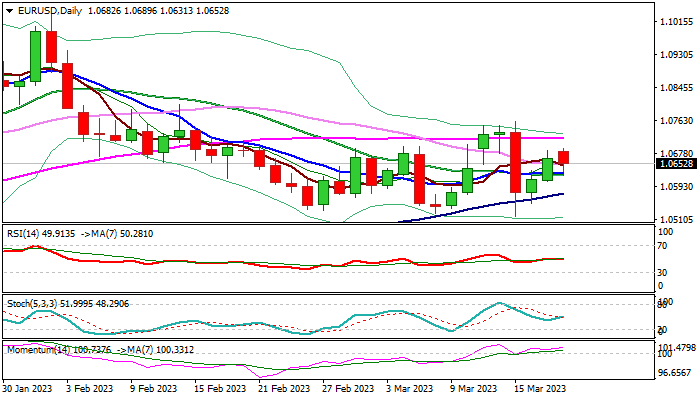
The Euro dips in early European trading on Monday, generating initial signal that recovery from last week’s spike low (1.0516) might be over.
Growing concerns about the contagion in the banking sector and fears that authorities won’t be able to contain crisis, despite announcement from major central banks about the joint action, released over the weekend, sparked fresh risk aversion.
Technical studies on daily chart are still bullishly aligned (positive momentum / converged 10/20DMA’s holding below the price) but the price action remains capped by the rising base of thinning daily Ichimoku cloud.
Adding to growing negative signals was last week’s bearish and long-legged weekly Doji candle, which points to strong indecision, as recovery stalled under the top of falling weekly cloud, reinforced by weekly Tenkan-sen, keeping the price action within the cloud.
Fresh weakness is pressuring pivotal supports at 1.0625 zone (converged 10/20DMA’s / Fibo 38.2% of 1.0516/1.0689 recovery leg), loss of which would weaken near-term structure and risk deeper drop, to generate reversal signal.
Initial resistance lays at 1.0685/89 (Fri / today’s highs), followed by more significant Fibo 38.2% of 1.1032/1.0516 (1.0713) and daily cloud base (1.0730), with sustained break higher needed to neutralize fresh bears.
Res: 1.0689; 1.0713; 1.0730; 1.0759.
Sup: 1.0620; 1.0600; 1.0582; 1.0551.
Gold Jumps Above Crucial $2,000 Mark
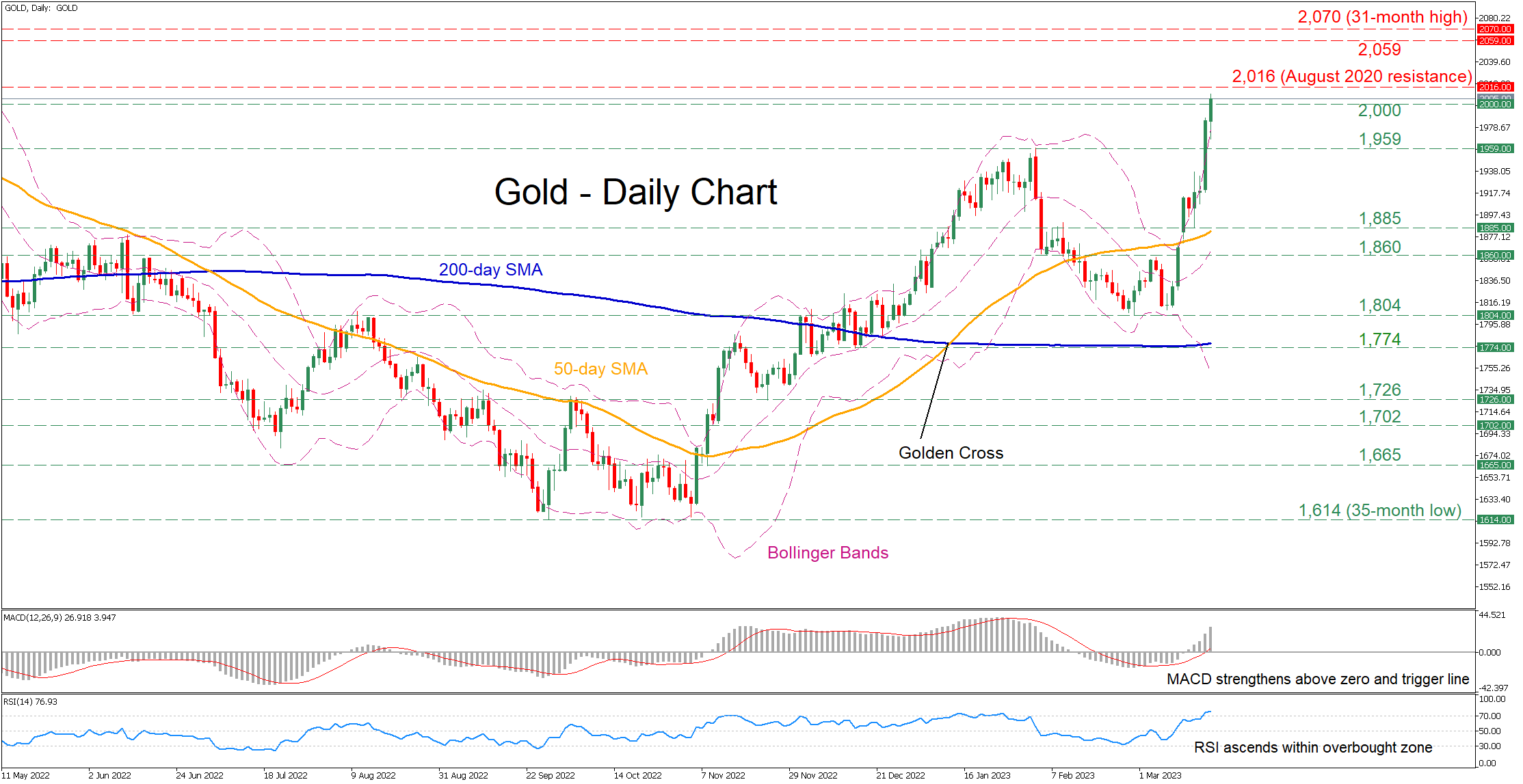
Gold has been in a steep uptrend since early March due to the ongoing turmoil in the global banking sector. In today’s session, bullion managed to rise above the 2,000 psychological mark for the first time in a year, eyeing the peaks observed after the Russian invasion of Ukraine.
The momentum indicators currently suggest that the recent rally could be overstretched as both the RSI and the MACD histogram are strengthening well within their overbought territories. Hence, a potential downside correction may be on the cards.
Should gold extend its advance above the 2,000 mark, the August 2020 resistance of 2,016 could initially cap its upside. Conquering this barricade, the price might ascend to challenge the 2,059 hurdle registered in March 2022. A break above that zone could set the stage for the 31-month high of 2,070.
On the flipside, if sellers re-emerge and push the price lower, the recent resistance region of 1,959 could act as support in the future. If that barrier fails, further declines could cease at 1,885, which overlaps with the 50-day simple moving average (SMA). Even lower, the February bottom of 1,804 could provide downside protection.
Overall, gold has staged a massive rally jumping above the 2,000 mark and is currently trading above its upper Bollinger band. Nevertheless, short-term oscillators are currently within overbought territories, so a move to the downside should not be ruled out.
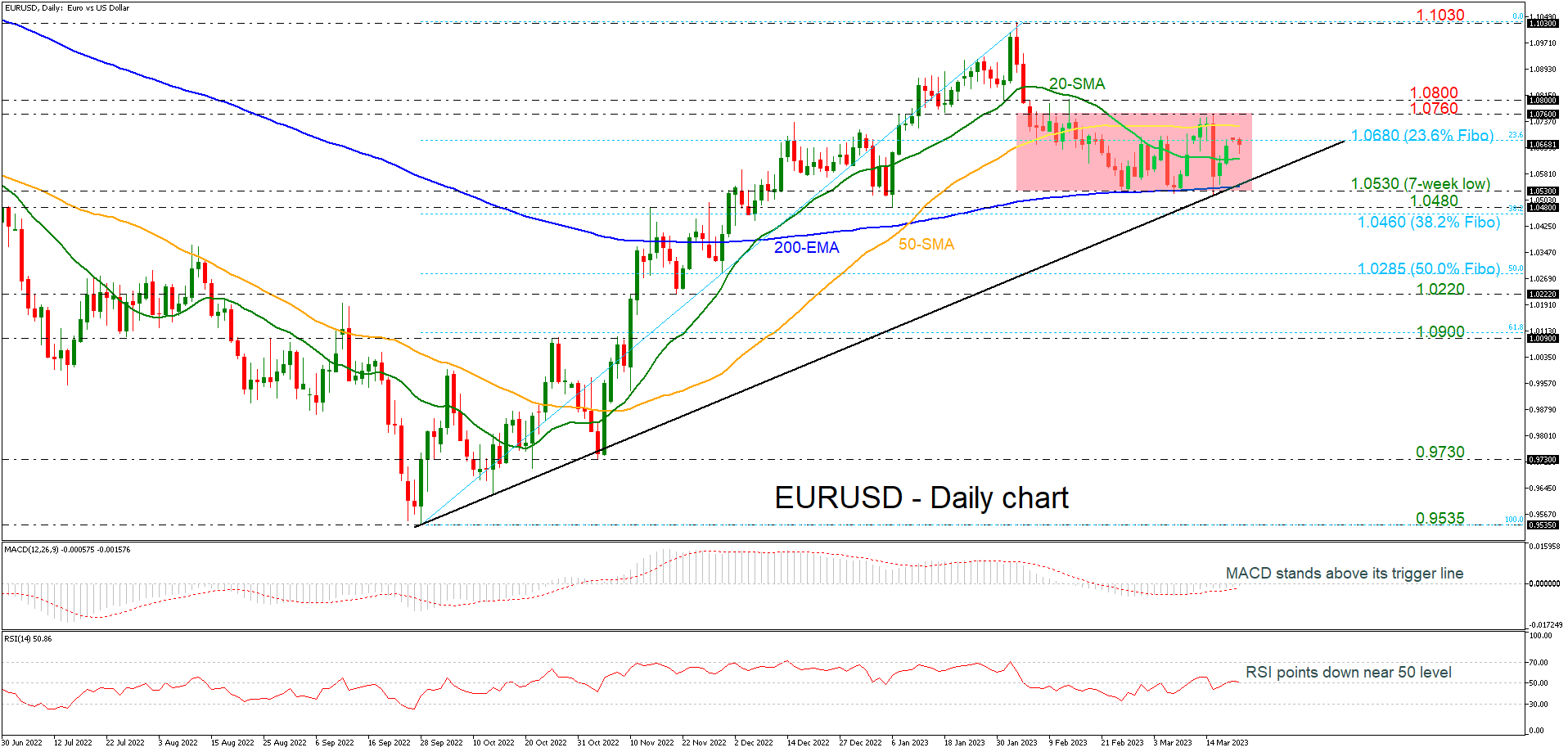
EURUSD Holds Above Long-term Support Trendline; Neutral in Short-term
EURUSD has been in a consolidating mode since February 6 and is holding within the 20- and the 50-day simple moving averages (SMAs). Also, the 23.6% Fibonacci retracement level of the upward wave from 0.9535 to 1.1030 at 1.0680 is acting as strong resistance for the bulls. However, in the longer timeframe, the pair is still bullish as it is holding above the uptrend line, drawn on September 28.
From the technical perspective, the MACD oscillator is holding slightly above its trigger line in the negative region, while the RSI is pointing marginally south near the neutral threshold of 50.
Should EURUSD make a run higher, it’s likely to meet resistance at the 50-day SMA at 1.0725 ahead of the 1.0760 barrier. A successful break above this key resistance area would open the way for the 1.0800 psychological mark before meeting the 1.1030 peak.
If prices turn lower, the 20-day SMA at 1.0630 is the nearest support that could halt steeper declines. A potentially more important support, though, is the 200-exponential moving average (EMA) at 1.0530, which is also the lower band of the short-term trading range. If breached, it would shift the focus to the downside and prices would slip beneath the ascending line, erasing any remaining positive bias.
In the bigger picture, EURUSD would need to make a sustained climb above 1.0800 for the outlook to become convincingly bullish.
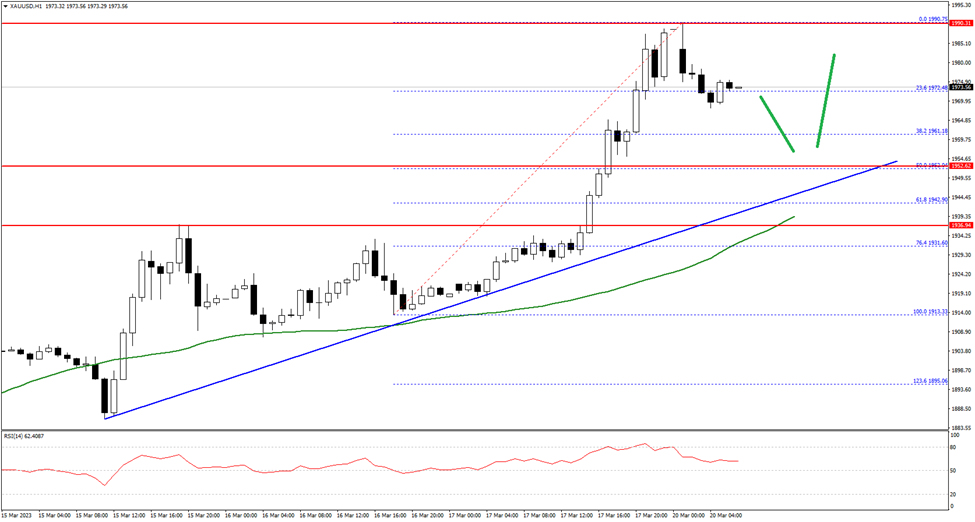
Gold Price is Now Consolidating Gains from $1,990
Gold price started a fresh rally above the $1,880 resistance against the US Dollar. The price cleared a major hurdle near $1,950 and the 50 hourly simple moving average.
The price even broke the $1,980 resistance and traded as high as $1,990 high. It is now consolidating gains, with an immediate resistance on the upside near the $1,990 level.
The first major resistance is near the $1,992 level. The next main resistance could be near the $2,000 zone, above which the price could extend its rally towards the $2,040 level. Any more gains might send the price towards $2,050 on FXOpen.
On the downside, an immediate support is near the $1,965 level. The next major support is near the $1,950 level, below which the price might decline towards the $1,935 support level and the 50 hourly simple moving average.