Sample Category Title
USD Under Pressure
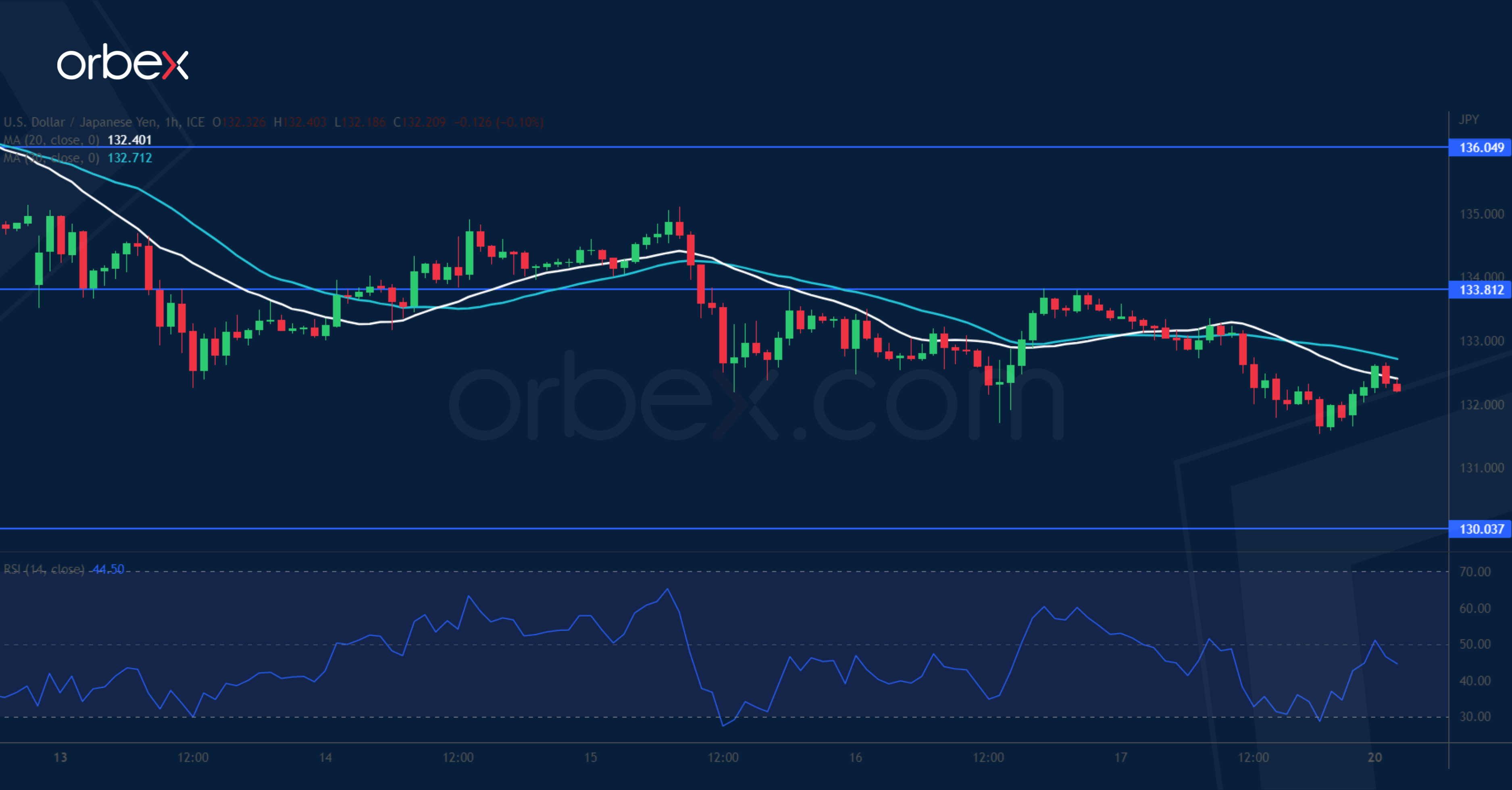
USD/JPY drifts lower
The US dollar slips as traders expect a modest 25 bp hike from the Fed amid banking troubles. A drop below the recent swing low of 132.40 has invalidated the rebound and put the pair back on a bearish trajectory in the short-term. The breach of 132.00 may attract more selling interests. The psychological level of 130.00 is a daily support and the start of a breakout rally back in early February, making it an important level to expect the bulls to fight back. On the upside, 133.80 is the first hurdle to lift in case of a bounce.
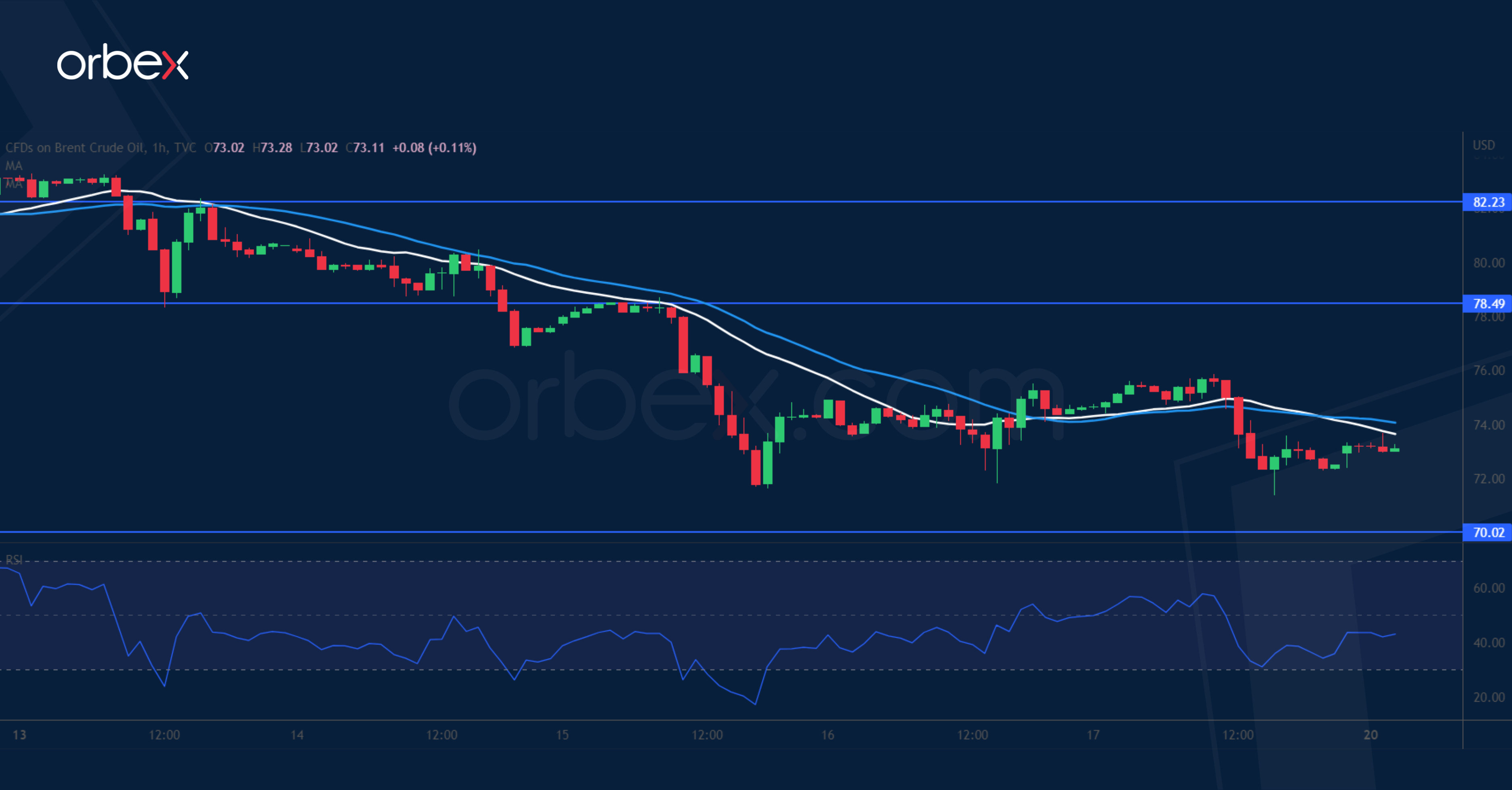
UK Oil grinds critical floor
Brent crude tumbles over concerns of a hard-landing for the global economy. The latest sell-off has sent the commodity below December’s low of 75.50, renewing the downward pressure in the medium-term. The price is now hovering above the psychological level of 70.00. The RSI’s deeply oversold condition has led bears to take some chips off the table, driving the quote up momentarily with 78.50 as the first test. Meaningful buying may only emerge if the price manages to gain a foothold through a series of higher lows.
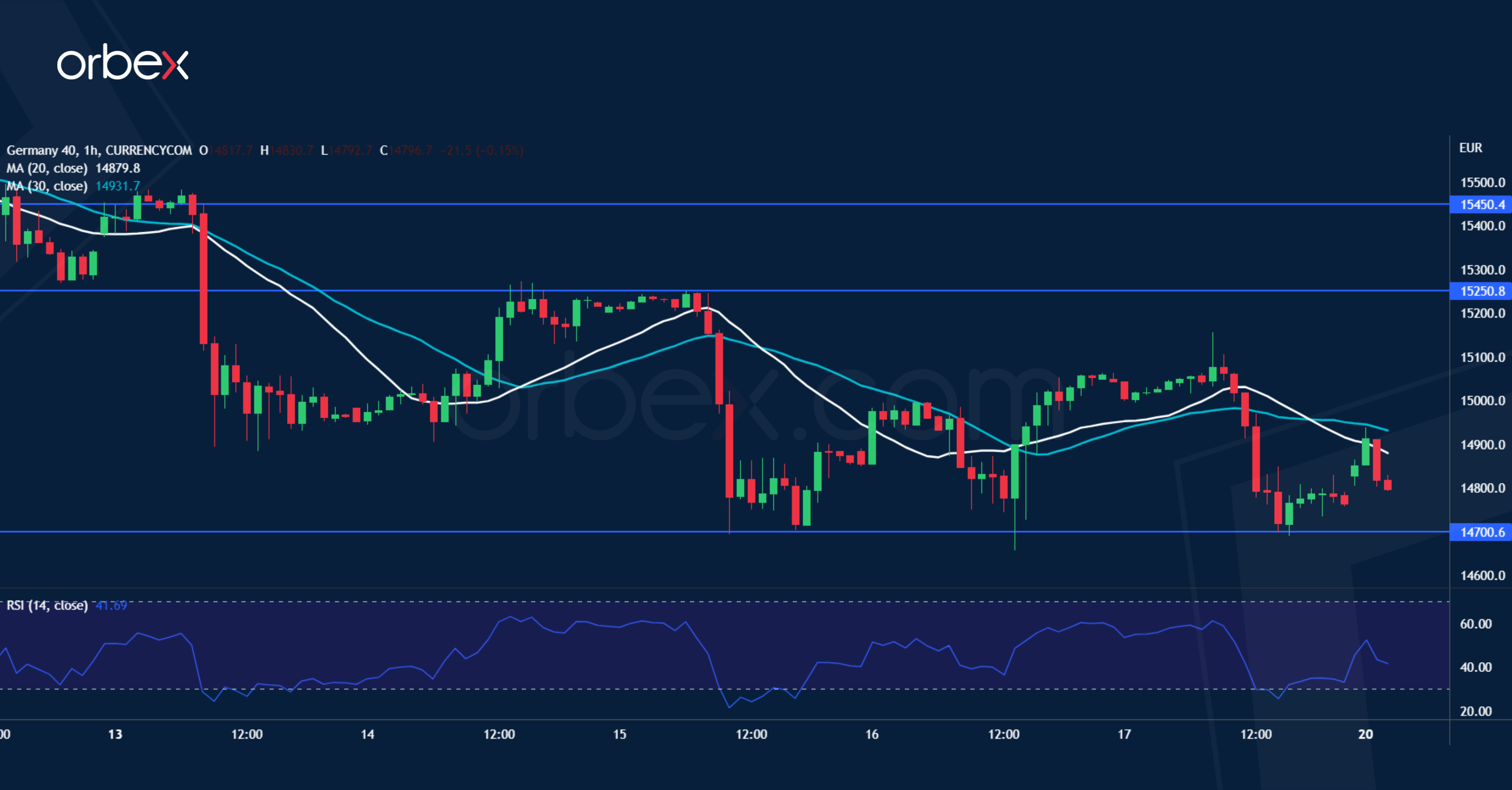
DAX 40 heads lower
The Dax 40 creeps lower on bank contagion fears in Europe. A bearish MA cross on the daily chart is a worrying sign that the index could be turning lower after failing to stay afloat above 15000. A timid rebound from 14900 has struggled to make a difference, which suggests that the path of least resistance could be down. A drop below 14700 may cause momentum selling, opening the door towards 14400 and potentially 14000 near January’s lows. Only a close above the supply zone around 15250 would turn the mood around.
Gold hits record against Aussie, breaks 2000 against Dollar
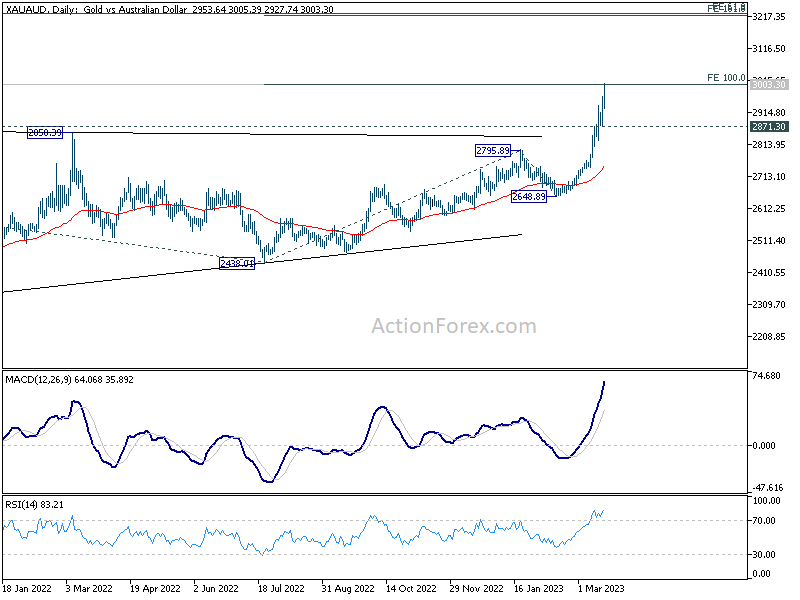
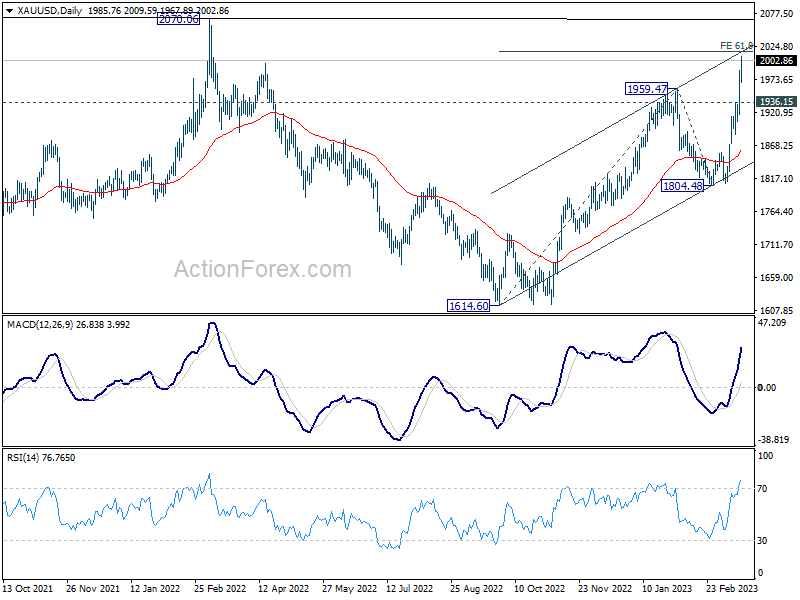
Gold breaks above 2000 handle against US Dollar today, and even hit a new record high surpasses 3000 handle against Australian Dollar . Risk selloff picks up momentum as European investors start to react to weekend's news about UBS takeover of the troubled Credit Suisse. Apparently, the announcement did little to calm investors' nerve.
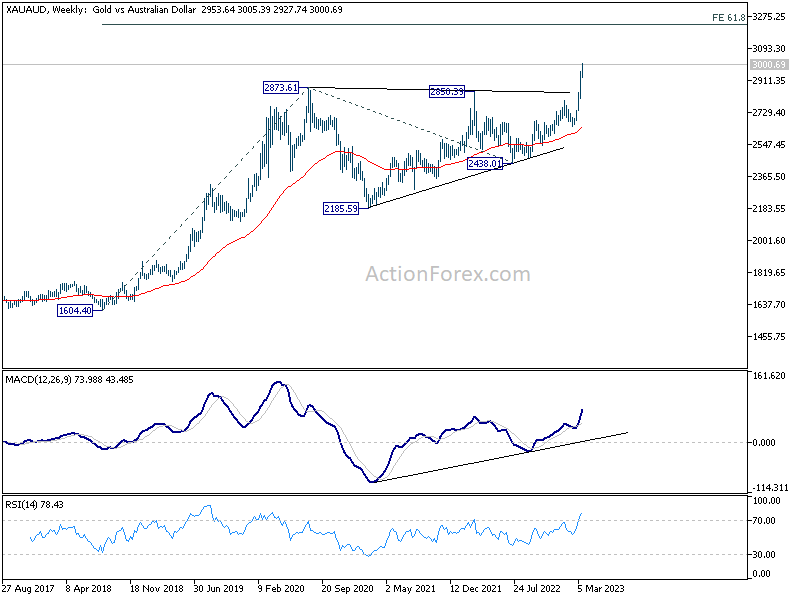
For XAU/AUD, it broke through 2873.61 record high (made in 2020) last week and the up trend continues today. For now, near term outlook will stay bullish as long as 2871.30 support holds. Immediate focus is on 100% projection of 2438.01 to 2795.89 from 2648.89 at 3006.77. Sustained break there could prompt further upside acceleration to 161.8% projection at 3227.93. That level is close to long term level of 61.8% projection of 1604.40 to 2873.61 from 2438.01 at 3222.38.
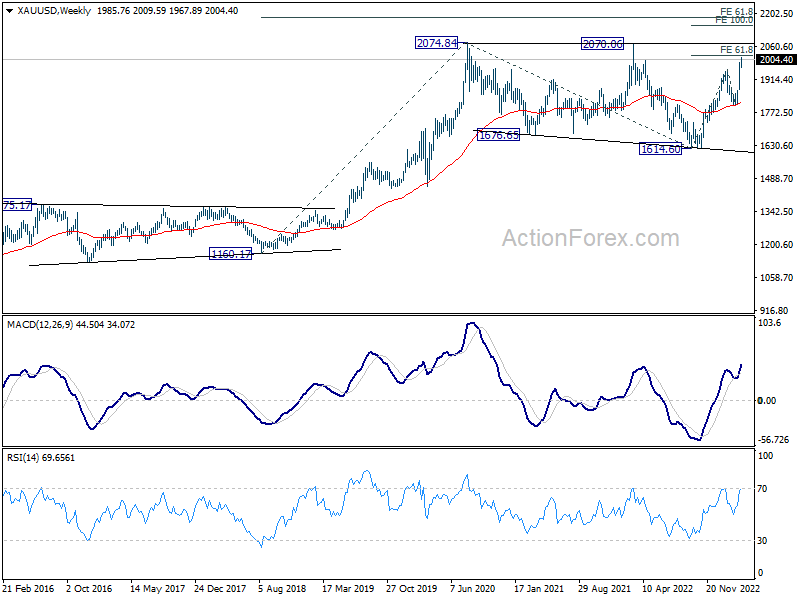
Meanwhile XAU/USD's rise from 1614.60 is on track to 61.8% projection of 1614.60 to 1959.47 from 1804.48 at 2017.60. A firm break through this level will pave the way for a retest of the 2074.84 record high. In any case, outlook in XAU/USD will remain bullish as long as 1936.15 resistance turned support holds. The long-term uptrend could also be set to resume, potentially reaching 61.8% projection of 1160.17 to 2074.85 from 1614.60 at 2179.86.
Dollar Again Failed to Capitalize on Risk-off Environment
Markets
Core bond yields at least tried to keep their heads above water. After opening on Friday near Thursday’s post-ECB closing levels, trading soon revolved again around expectations for Swiss policymakers to try to hammer out a solution to the Credit Suisse problems in the looming weekend. Safe haven flows made US yields crash 7.5-32 bps, the front end outperforming. German yields tanked 15.5-22.5 bps. Peripheral yield spreads vs. Germany’s 10y yield rose. Italy and Greece lagged peers, adding 4 and 5 bps respectively. Equity markets in Europe and the US lost 1%, give or take. The dollar again failed to capitalize on the risk-off environment; a reminder that the issues for the likes of First Republic Bank in the US aren’t over yet either? Narrowing yield differentials supported EUR/USD from the low 1.06 to 1.067. The trade-weighted dollar index fell through double support at 103.94/96 to close at 103.708. The Japanese yen instead was the grand victor of the day. USD/JPY fell from 133.74 to 131.85. EUR/JPY’s test of 142 failed and ended up in losing 1.5 big figures instead (140.67).
Negotiating around the clock, a deal was indeed made over the weekend. UBS agreed to buy Credit Suisse for CHF 3bn. It comes with a CHF 100bn liquidity backstop by the Swiss National Bank and a CHF 9bn government guarantee to cover potential losses that exceed a CHF 5bn threshold. The deal avoids an imminent collapse of Credit Suisse which could have sparked panic across markets. But it does include a complete CHF 16bn wipe-out of AT1 bonds whereas equity holders still get a little back. It triggers a massive sell-off in that submarket in Asian dealings this morning. The news was accompanied by coordinated central bank action to offer dollar liquidity (see headline below). But the initial sigh of relief in Asian-Pacific markets quickly faded. A 17.5 bps jump in the US 2y yield completely reversed to trade 18 bps lower as we near the European open. Stocks all across the region tumble with Hong Kong underperforming. European/US equity futures turn from green to (dark) red. The Japanese yen is again taking the lead on the currency scoreboard. The Swiss franc trades a little stronger at EUR/CHF 0.867.
This morning’s abrupt sentiment change shows the theme may remain with us for a little longer, causing an ongoing repricing of risk premia as investors count down to the Fed policy meeting later this week. Markets currently see a bigger chance for the Fed to hold rates steady rather than raise them by 25 bps. The latter is our preferred scenario and would display confidence similar to the ECB last week. In the run-up to it though, we’d be cautious to swim against the current tide. In case of outright risk-off, we still favour the dollar over the euro (but not over the yen). ECB president Lagarde appears before the European Parliament today. We expect her to repeat the need for further rate hikes, despite the recent turbulence. Belgium is hitting the bond market today.
News and views
The BoC, the BoE, the BoJ, the ECB, the Fed and the SNB announced a coordinated action to enhance the provision of liquidity via the standing US dollar liquidity swap line arrangements. They have agreed to increase the frequency of 7-day maturity operations from weekly to daily from today until at least through the end of April. The network of swap lines among these central banks is a set of available standing facilities and serves as an important liquidity backstop to ease strains in global funding markets, thereby helping to mitigate the effects of such strains on the supply of credit to households and businesses.
Rating agency S&P affirmed the Belgian AA rating. Risks to Belgium's budgetary position are rising in the context of slowing growth, persistent spending pressures, and the ECB's monetary tightening. S&P expects the budget deficit to reach 4.9% of GDP in 2023 and net general government debt to stay elevated at 95% of GDP. Nevertheless, proactive debt management has over the past decade significantly improved the government debt profile, with an average maturity of over 10 years and an average effective cost of debt that declined continuously to reach 1.4% in 2022. The stable outlook reflects the view that risks to Belgium's public finances are mitigated by its resilient economy and strong labor market, as well as its strong institutions. Negative action could follow in case of weaker-than-expected nominal growth or a fast deterioration of budget deficits, as both of them risk putting the debt ratio on a steep upward path. The other big rating agencies, Moody’s and Fitch, scale Belgium one notch lower than S&P at Aa3 and AA- with Fitch also applying a negative outlook.
UBS Buys Credit Suisse to End Stress
UBS bought Credit Suisse (CS) in a government-brokered deal for 0.76 cents of franc per share, or CHF3bn in total.
The Swiss National Bank (SBN) offered UBS $100 billion in liquidity to make sure that the takeover would go smoothly, and Swiss government offered 9 billion francs guarantee on CS losses. The deal triggered a complete write-down of all CS’s additional tier 1 bonds.
US Dollar weakened and US futures opened in the positive but reversed losses while the Japanese Nikkei fell 1.42%, Hang Seng dropped more than 3%.
The next few hours of trading will give us a better picture on whether the crisis is contained. In theory, there is no reason for the Credit Suisse crisis to extend, as what triggered the last quake for Credit Suisse was a confidence crisis – which doesn’t concern UBS - a bank outside of the turmoil, with, in addition, ample liquidity and guarantee from the SNB and the government.
Fed decision time
So, if all goes well, shaky days across banks will soon be left behind and investors could concentrate on the Federal Reserve (Fed) decision.
One thing is important to note: the Fed’s Quantitative Tightening (QT) was clearly out of the window since the Silicon Vally Bank (SVB) debacle. The Fed’s balance sheet ticked higher last week, to help easing stress across banks.
But the QT and last week’s emergency intervention are conceptionally different.
And more interestingly, while we could think that the reverse-QT, could have some negative implications for inflation – because the Fed is adding liquidity into the system - an index on financial conditions in the US suggests that the financial conditions have tightened sharply since last week, to the tightest levels since last fall and that could be an argument for the Fed to pause its rate hikes.
But perhaps not from this week. The expectation for this week’s meeting is still a 25bp hike from the Fed. Activity on Fed funds futures gives around 60% chance for a 25bp hike this Wednesday.
The March dot plot and Powell’s accompanying statement will be as important as the rate decision.
On the data front, US short-term inflation expectations fell in March to the lowest levels since 2021. That’s excellent news for the Fed’s inflation battle as inflation expectations have a material impact on where inflation, itself, is headed.
A boon for the Big Tech
The banking turmoil has been a boon for the tech stocks last week. The sharp fall in rate hike expectations which resulted in a sharp fall in yields drove more than $500 billion in market value to Microsoft, Apple, Google and Amazon last week.
Microsoft rallied more than 15%, Amazon gained almost 15% as well and flirted with the $100 psychological mark. Same with Google, it also gained around 15% and closed the week above the $100 for the first time since the beginning of February, while Apple added 6%.
And Bitcoin, which has a strong correlation with tech stocks, gained 45% since the March 10 dip – and more importantly, showed that it could act as a hedge to a global bank stress.
It’s yet to be seen whether the Big Tech could hold on to their gains if the Fed brings its inflation battle back on the table.
Oversold
Crude oil kicked off the week under pressure, below the $70pb level as the bank stress weigh on global growth prospects and sent the price of a barrel below this psychological level. The RSI indicator suggests that the American crude stepped into oversold market conditions, meaning that crude oil has been sold too fast in a too short period of time, and a positive correction would be healthy at the current levels.
GBP/JPY Daily Outlook
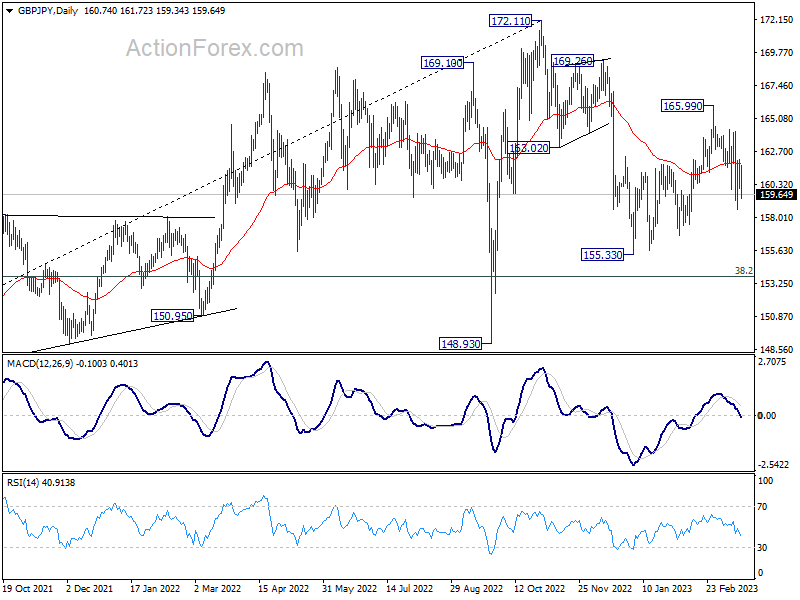
Daily Pivots: (S1) 159.80; (P) 160.99; (R1) 161.86; More...
Intraday bias in GBP/JPY remains neutral and consolidation from 158.54 temporary low could extend. But still, current development suggests that fall from 165.99 is a falling leg of the whole decline from 172.11. Deeper decline is expected as long as 164.12 resistance holds. Break of 158.54 will target a retest on 155.33 low.
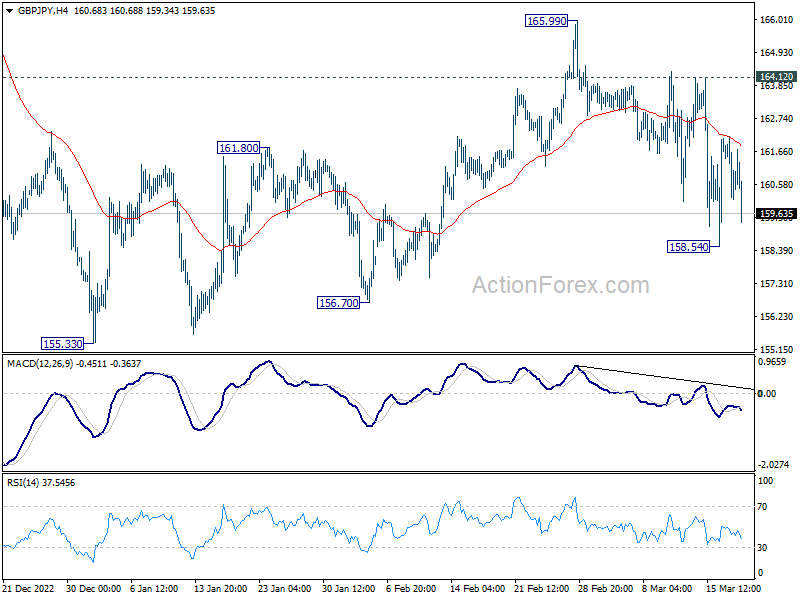
In the bigger picture, as long as 38.2% retracement of 123.94 (2020 low) to 172.11 (2022 high) at 153.70 holds, medium term bullishness is retained. That is, larger up trend from 123.94 (2020 low) is still in progress. Break of 172.11 high to resume such up trend is expected at a later stage.
EUR/JPY Daily Outlook
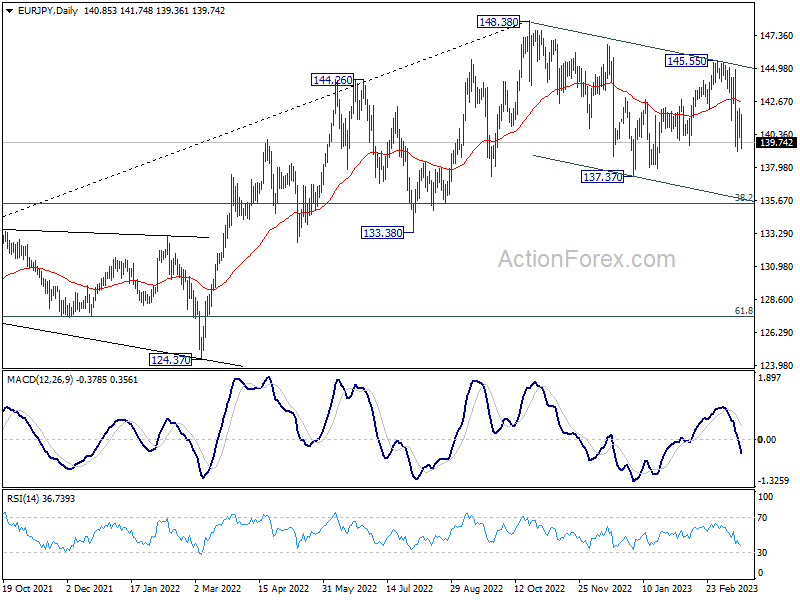
Daily Pivots: (S1) 139.82; (P) 141.01; (R1) 141.86; More....
Intraday bias in EUR/JPY remains neutral first and consolidation from 139.11 temporary low could extend. Still, outlook is unchanged that fall from 145.55 is the third leg of the whole corrective decline from 148.38. Risk stays on the downside as long as 4 hour 55 EMA (now at 142.55) holds. Below 139.11 will target 137.37 low, and then 135.40 fibonacci level.
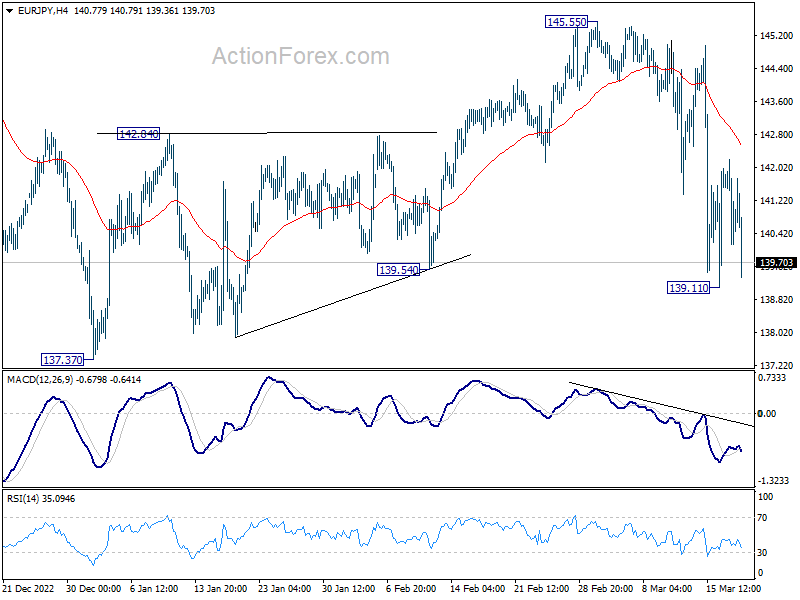
In the bigger picture, as long as 55 week EMA (now at 139.54) holds, larger up trend from 114.42 (2020 low) is still in progress for 149.76 long term resistance. However, firm break of 55 week EMA will bring deeper fall to 38.2% retracement of 114.42 to 148.38 at 135.40. Sustained break there will raise the chance of trend reversal, and target 61.8% retracement at 127.39.
EUR/GBP Daily Outlook
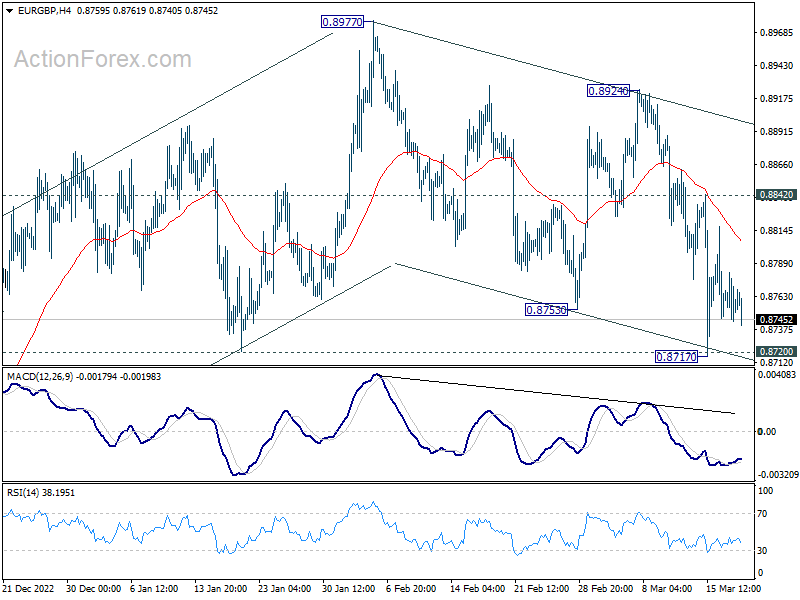
Daily Pivots: (S1) 0.8740; (P) 0.8761; (R1) 0.8778; More...
Intraday bias in EUR/GBP remains neutral for the moment. On the upside, break of 0.8842 resistance will argue that corrective fall from 0.8977 has completed, after touching 0.8720 support. Further rise should be seen back to 0.8924 resistance and above. However, sustained break of 0.8720 will bring deeper decline to 0.8545 instead.
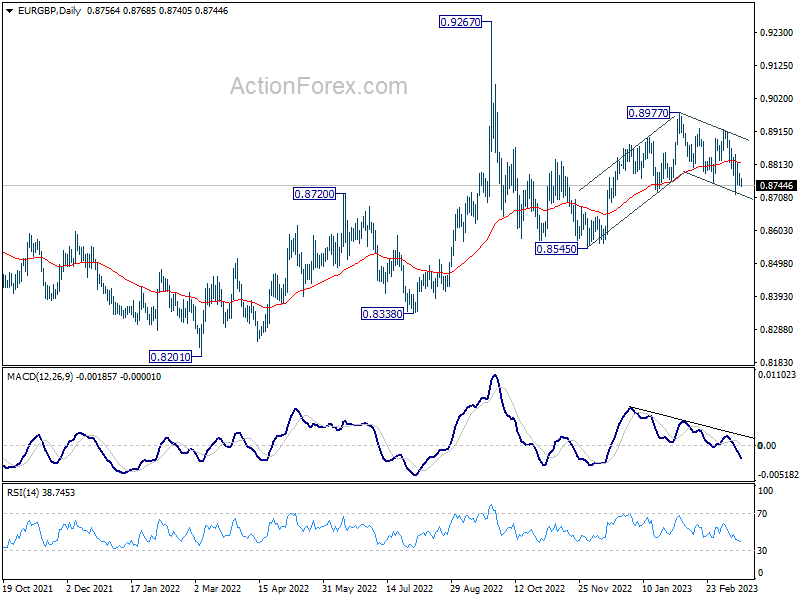
In the bigger picture, outlook is rather mixed for now, except that price actions from 0.9267 (2022 high) are part of the long term range pattern from 0.9499 (2020 high). With 0.8720 support intact, rise from 0.8545 is in favor to continue through 0.8977. However, firm break of 0.8720 will argue that such rebound has completed, and open up deeper fall through this support level.
EUR/AUD Daily Outlook
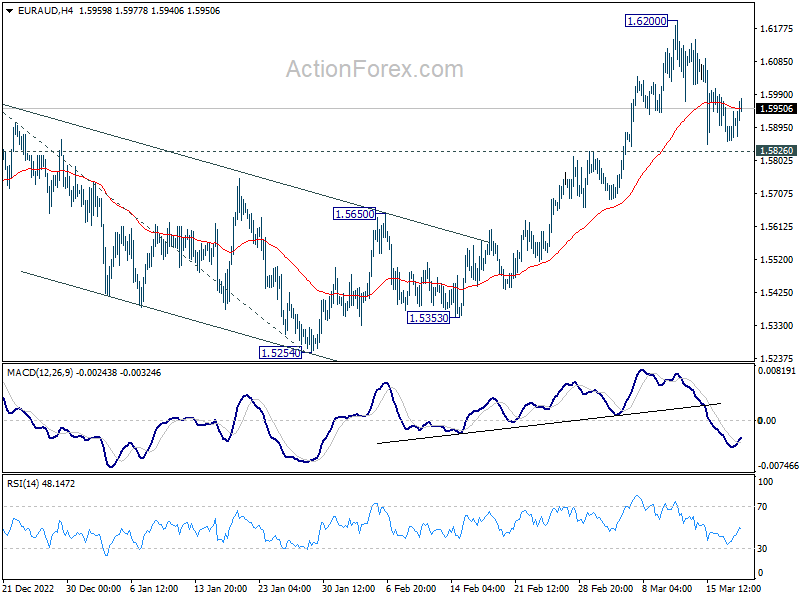
Daily Pivots: (S1) 1.5865; (P) 1.5911; (R1) 1.5966; More...
EUR/AUD is staying in consolidation in range of 1.5826/6200 and intraday bias remains neutral. Outlook will remain bullish as long as 1.5826 resistance turned support holds. Break of 1.6200 will will resume the larger rise from 1.4281 to 61.8% projection of 1.4281 to 1.5976 from 1.5254 at 1.6302 next. However, firm break of 1.5826 will confirm short term topping, and bring deeper fall to 55 day EMA (now at 1.5695).
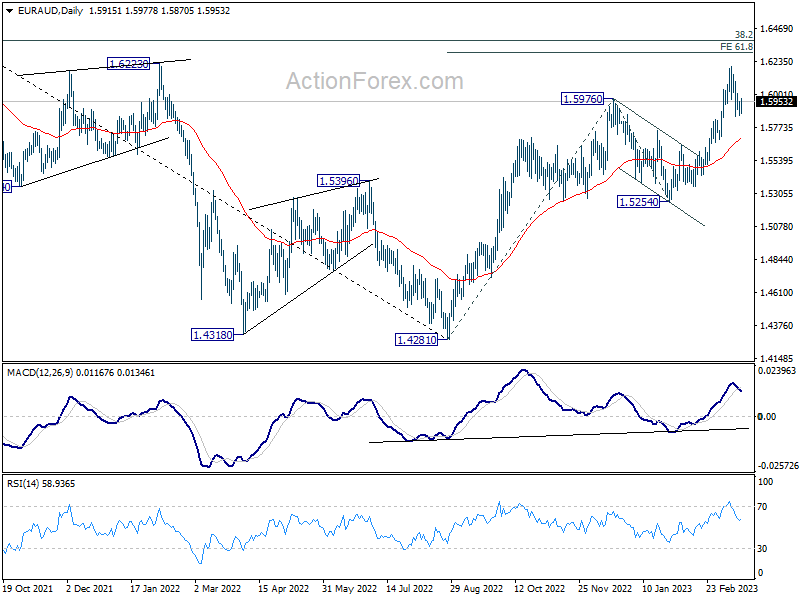
In the bigger picture, the strong support from 55 week EMA (now at 1.5404) is raising the chance of bullish trend reversal. Focus is now on 1.6434 cluster resistance (38.2% retracement of 1.9799 to 1.4281 at 1.6389). Sustained break there should confirm that whole down trend from 1.9799 (2020 high) has completed. Further rally should then be seen to 61.8% retracement at 1.7691. However, rejection by this cluster resistance will make medium term outlook neutral at best.
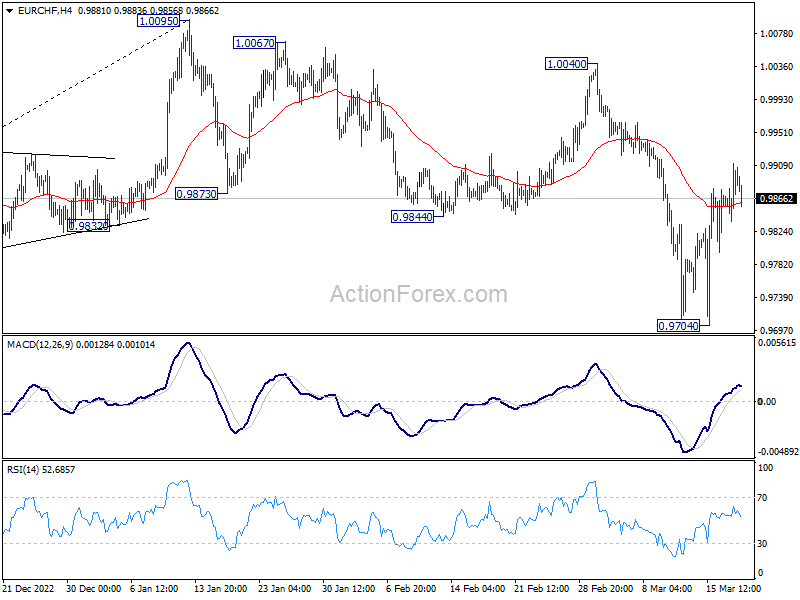
EUR/CHF Daily Outlook
Daily Pivots: (S1) 0.9843; (P) 0.9877; (R1) 0.9915; More...
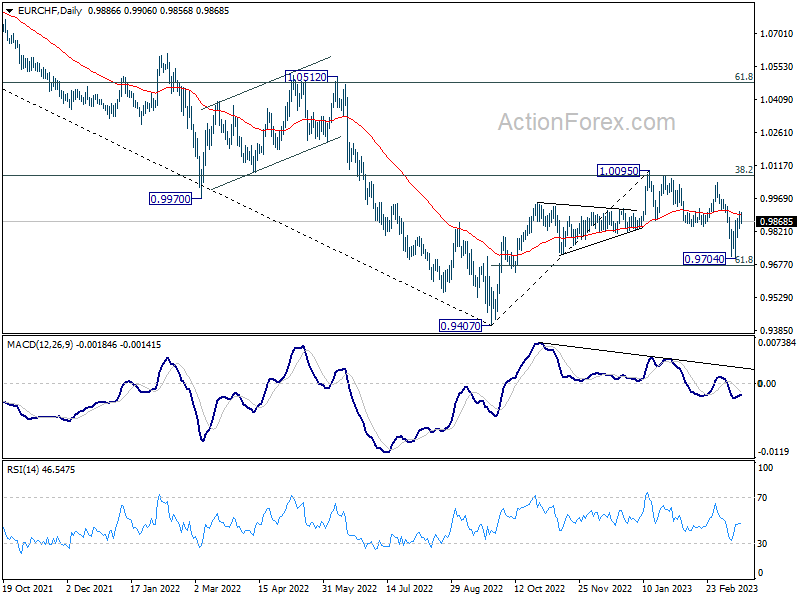
Intraday bias in EUR/CHF remains neutral for the moment. Near term risk stays on the downside as long as 55 day EMA (now at 0.9899) holds. Rebound 0.9407 could have completed at 1.0095 already. Below 0.9711 will target 61.8% retracement of 0.9407 to 1.0095 at 0.9670. Firm break there will bring deeper fall to retest 0.9407 low. However, sustained trading above 55 day EMA will bring stronger rise back to retest 1.0095 instead.
In the bigger picture, rejection by 55 week EMA (now at 1.0011) and 38.2% retracement of 1.1149 to 0.9407 at 1.0072 suggests that medium term outlook is staying bearish. That is, down trend from 1.2004 is not completed yet and is in favor to resume through 0.9407 at a later stage. For now, this will be the favored case as long as 1.0095 resistance holds.
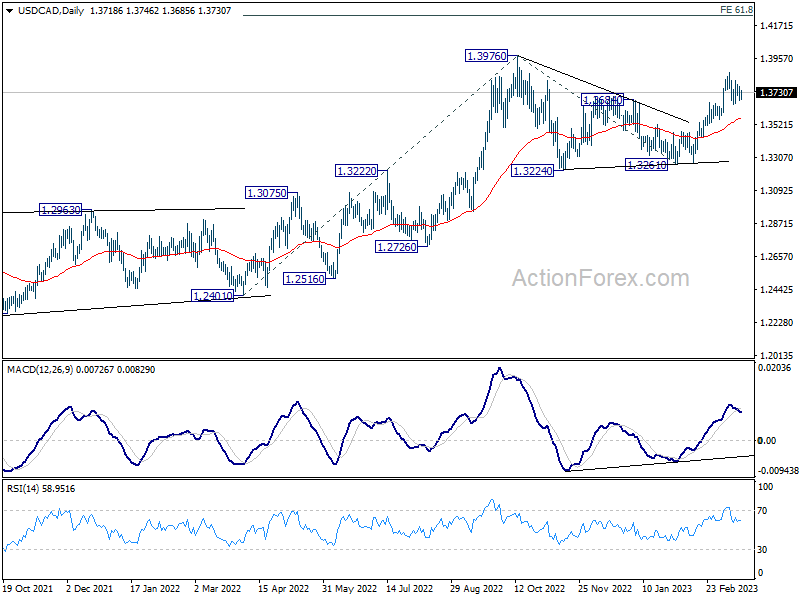
USD/CAD Daily Outlook
Daily Pivots: (S1) 1.3680; (P) 1.3726; (R1) 1.3775; More....
USD/CAD is still bounded in consolidation below 1.3860 and intraday bias remains neutral first. Further rally is expected with 1.3650 support intact. On the upside, break of 1.3860 will resume the rally from 1.3261 to retest 1.3976 high. However, firm break of 1.3650 will mix up the near term outlook and bring deeper pullback first.
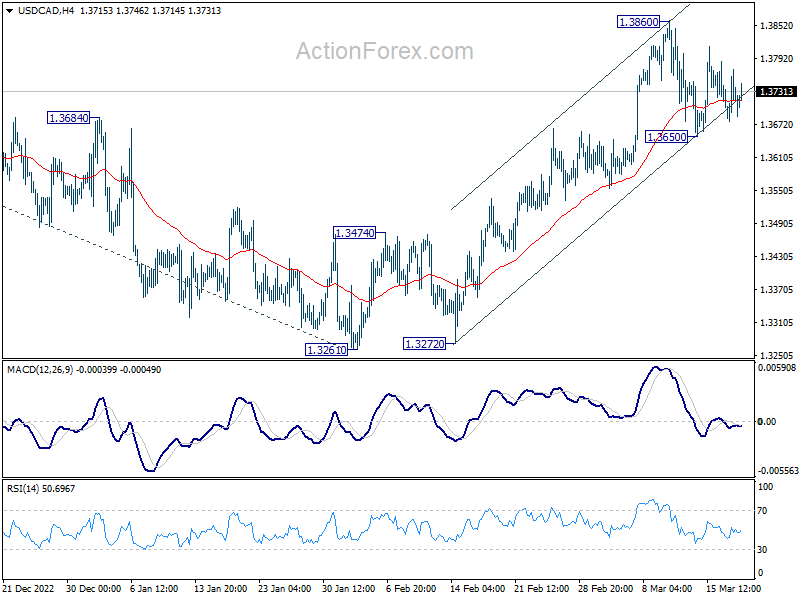
In the bigger picture, the up trend from 1.2005 (2021 low) is still in progress. Break of 1.3976 will confirm resumption and target 61.8% projection of 1.2401 to 1.3976 from 1.3261 at 1.4234. Firm break there will pave the way to long term resistance zone at 1.4667/89 (2016, 2020 highs). On the downside, break of 1.3261 support is needed to confirm medium term topping. Otherwise, outlook will remain bullish even in case of deep pull back.