Sample Category Title
EUR/AUD Weekly Outlook
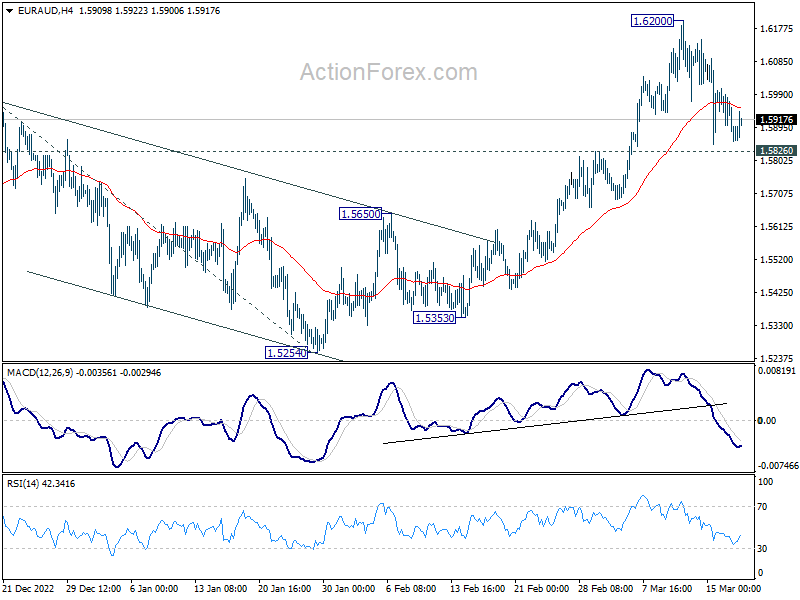
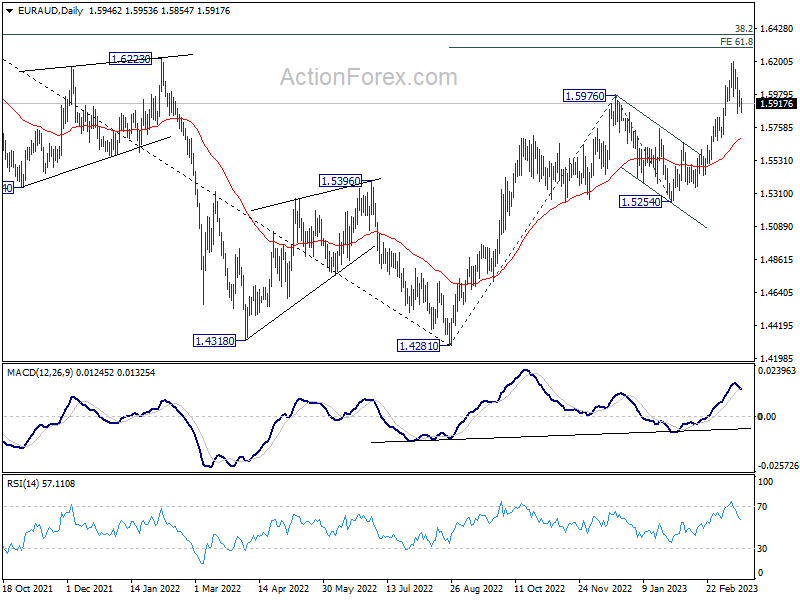
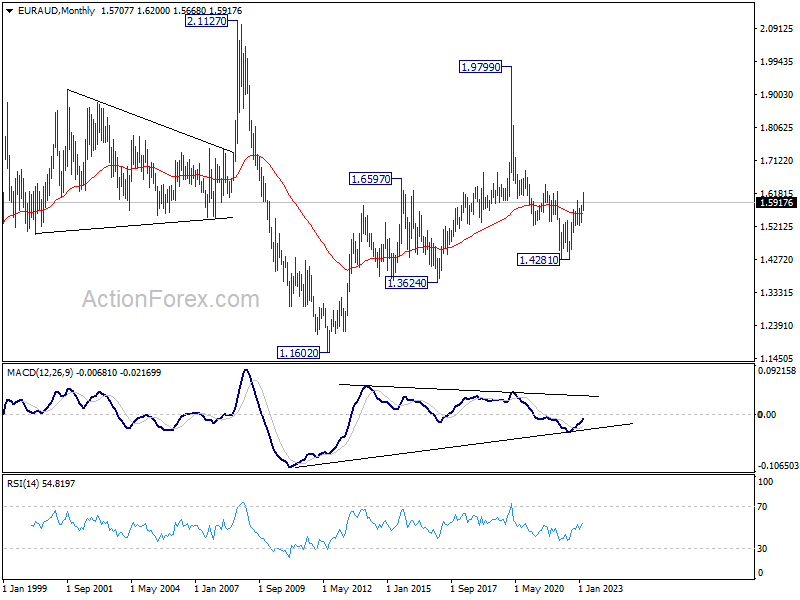
EUR/AUD turned into consolidation after initial rise to 1.6200 last week. Initial bias remains neutral this week first. Outlook will remain bullish as long as 1.5826 resistance turned support holds. Break of 1.6200 will will resume the larger rise from 1.4281 to 61.8% projection of 1.4281 to 1.5976 from 1.5254 at 1.6302 next. However, firm break of 1.5826 will confirm short term topping, and bring deeper fall to 55 day EMA (now at 1.5685).
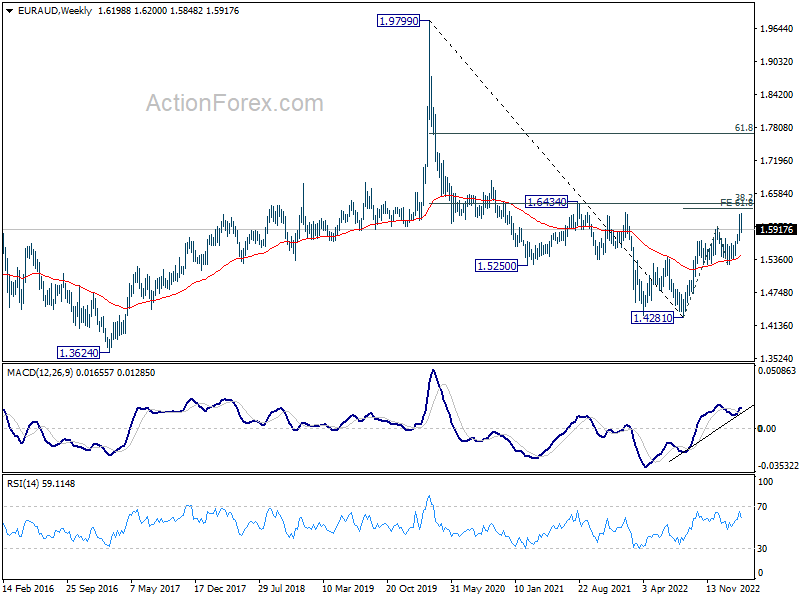
In the bigger picture, the strong support from 55 week EMA (now at 1.5404) is raising the chance of bullish trend reversal. Focus is now on 1.6434 cluster resistance (38.2% retracement of 1.9799 to 1.4281 at 1.6389). Sustained break there should confirm that whole down trend from 1.9799 (2020 high) has completed. Further rally should then be seen to 61.8% retracement at 1.7691. However, rejection by this cluster resistance will make medium term outlook neutral at best.
In the longer term picture, the strong break above 55 week EMA (now at 1.5616) raised the chance of bullish trend reversal. Firm break of 1.6434 resistance should confirm that the down trend from 1.9799 has completed. It's still early to decide if the up trend from 1.1602 (2012 low) is resuming. An assessment will be made after rise from 1.4281 reveals more of its structure.
EUR/JPY Weekly Outlook
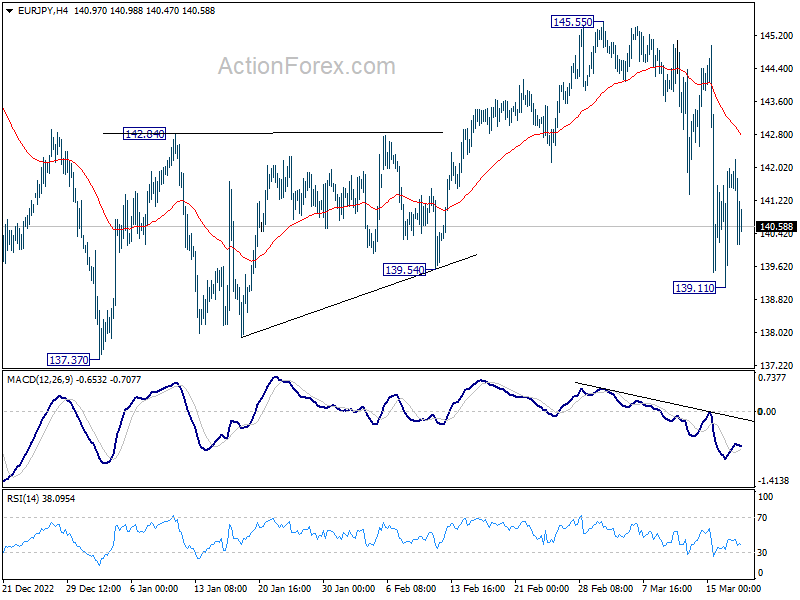
EUR/JPY fell to as low as 139.11 last week before forming a temporary low there and recovered. Current development suggests that fall from 145.55 is the third leg of the whole corrective decline from 148.38. Risk stays on the downside as long as 4 hour 55 EMA (now at 142.85) holds. Below 139.11 will target 137.37 low, and then 135.40 fibonacci level.
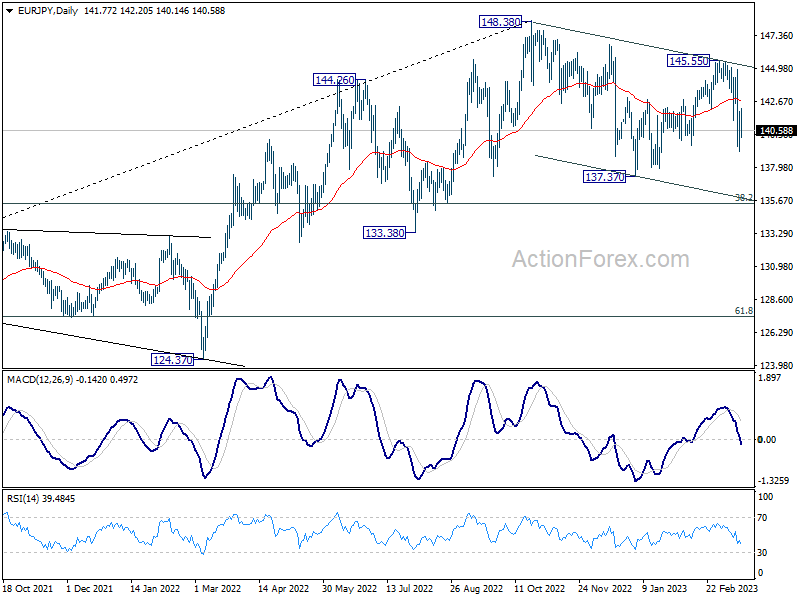
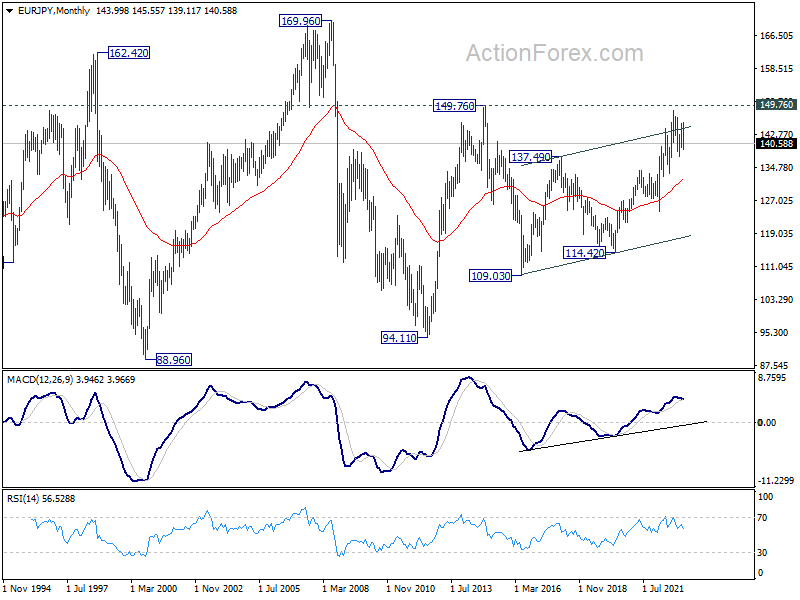
In the bigger picture, as long as 55 week EMA (now at 139.54) holds, larger up trend from 114.42 (2020 low) is still in progress for 149.76 long term resistance. However, firm break of 55 week EMA will bring deeper fall to 38.2% retracement of 114.42 to 148.38 at 135.40. Sustained break there will raise the chance of trend reversal, and target 61.8% retracement at 127.39.
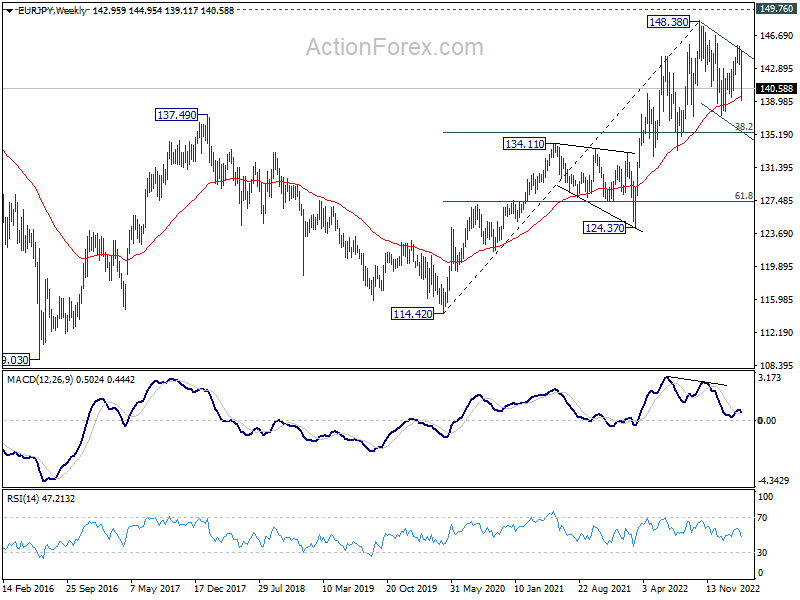
In the long term picture, outlook will stay bullish as long as 134.11 resistance turned support holds (2021 high). Sustained break of 149.76 (2014 high) will open up further rally, as resumption of the rise from 94.11 (2012 low), towards 169.96 (2008 high).
GBP/JPY Weekly Outlook
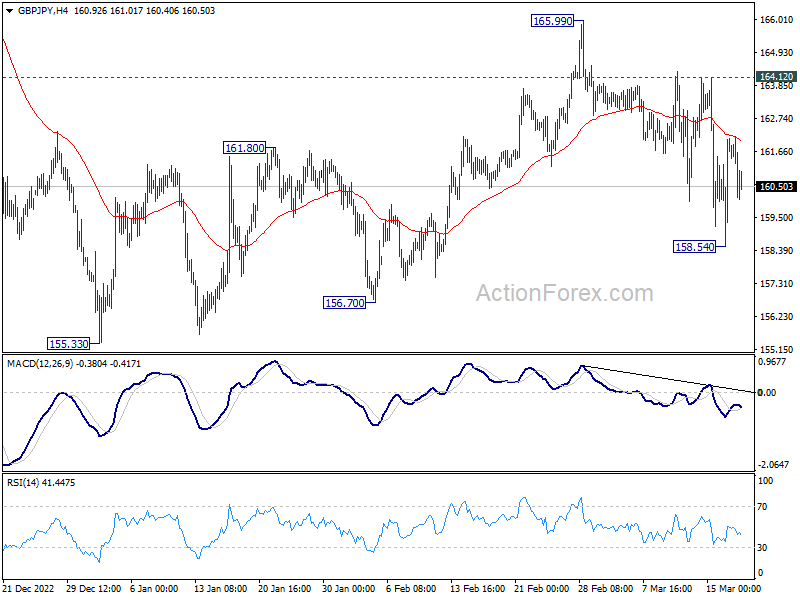
GBP/JPY fell to as 158.54 last week but recovered since then. Initial bias remains neutral this week first. Current development suggests that fall from 165.99 is a falling leg of the whole decline from 172.11. Deeper decline is expected as long as 164.12 resistance holds. Break of 158.54 will target a retest on 155.33 low.
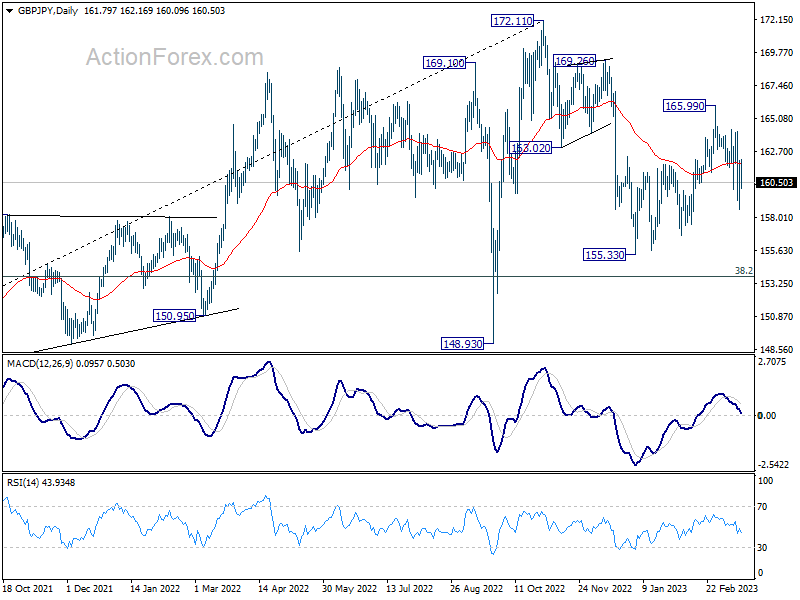
In the bigger picture, as long as 38.2% retracement of 123.94 (2020 low) to 172.11 (2022 high) at 153.70 holds, medium term bullishness is retained. That is, larger up trend from 123.94 (2020 low) is still in progress. Break of 172.11 high to resume such up trend is expected at a later stage.
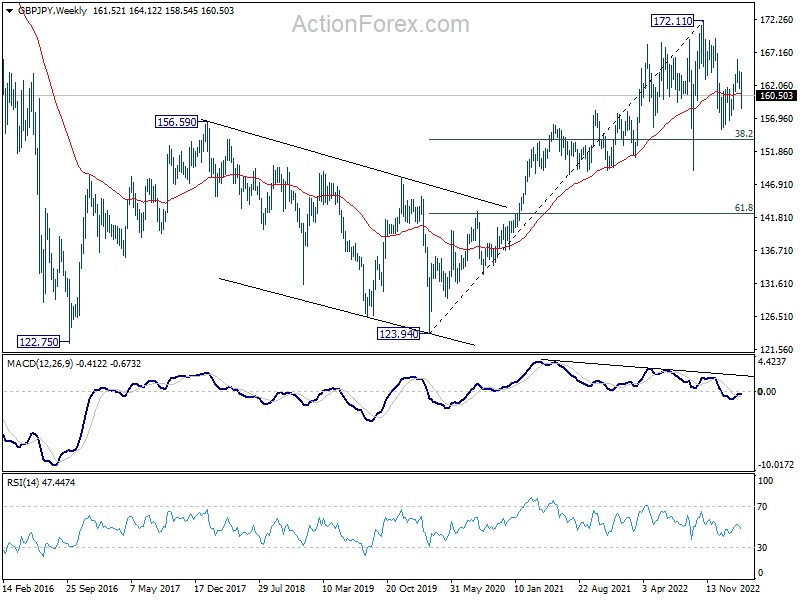
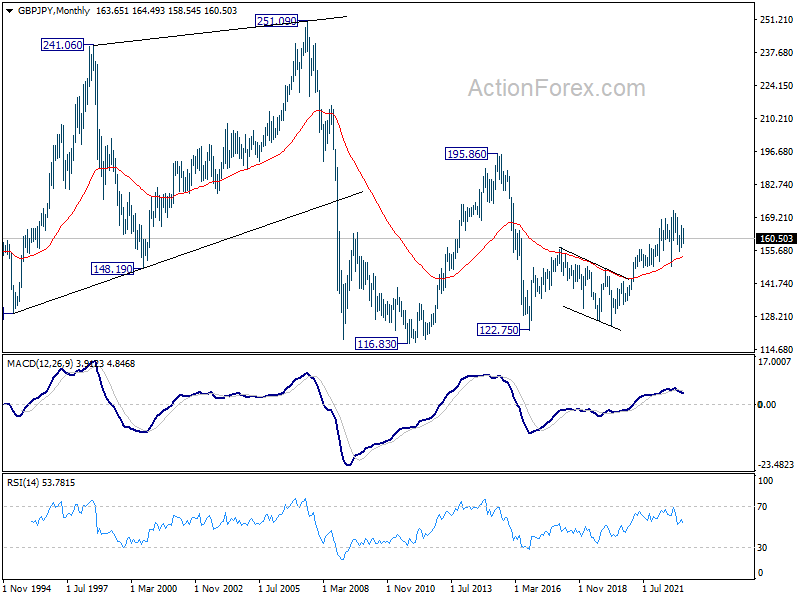
In the longer term picture, as long as 55 month EMA (now at 153.06) holds, rise from 122.75 (2016 low) could still extend higher at a later stage to 195.86 (2015 high).
EUR/CHF Weekly Outlook
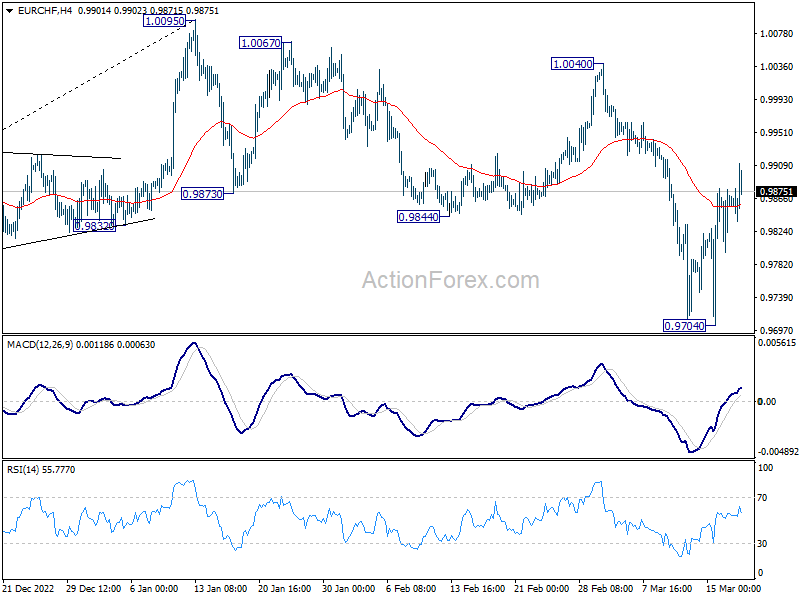
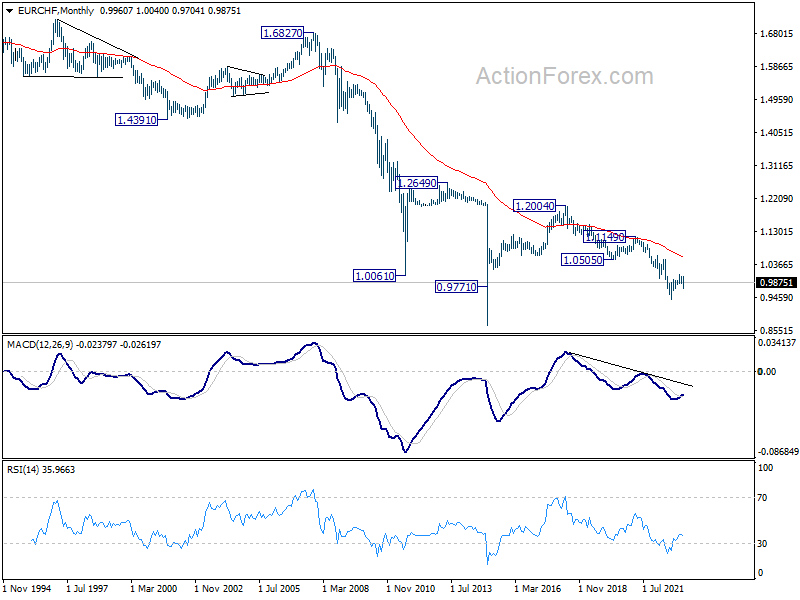
EUR/CHF rebounded strongly after initial fall to 0.9704 last week. Initial bias stays neutral this week first. But risk will stay on the downside as long as 55 day EMA (now at 0.9899) holds. Rebound 0.9407 could have completed at 1.0095 already. Below 0.9711 will target 61.8% retracement of 0.9407 to 1.0095 at 0.9670. Firm break there will bring deeper fall to retest 0.9407 low. However, sustained trading above 55 day EMA will bring stronger rise back to retest 1.0095 instead.
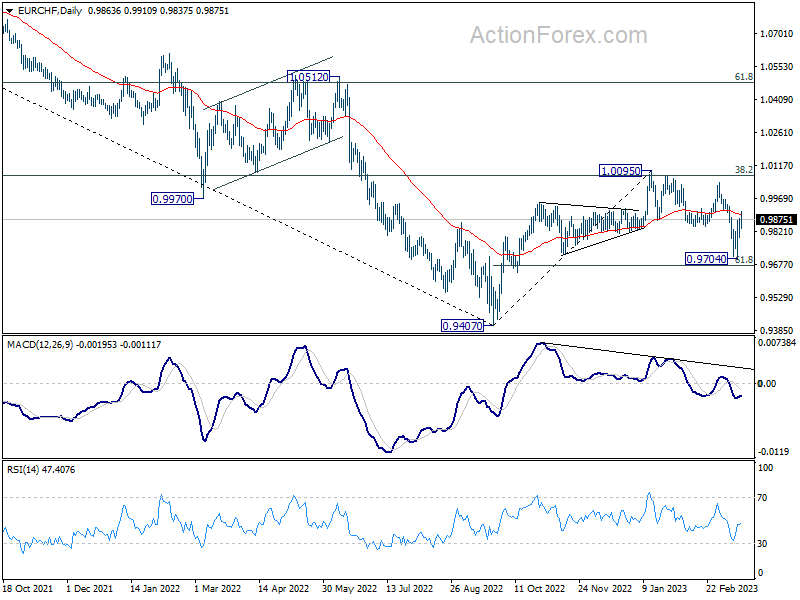
In the bigger picture, rejection by 55 week EMA (now at 1.0011) and 38.2% retracement of 1.1149 to 0.9407 at 1.0072 suggests that medium term outlook is staying bearish. That is, down trend from 1.2004 is not completed yet and is in favor to resume through 0.9407 at a later stage. For now, this will be the favored case as long as 1.0095 resistance holds.
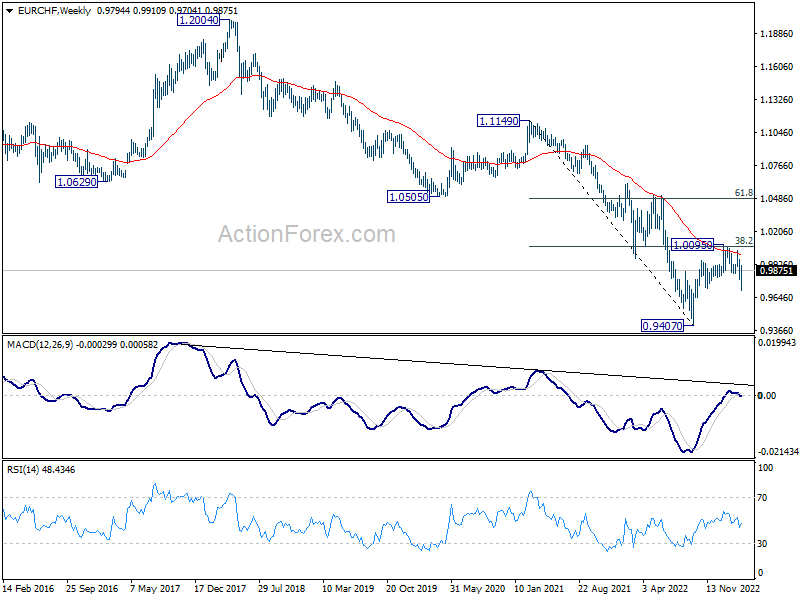
In the long term picture, it's still way too early too call for bullish trend reversal with upside capped well below 55 month EMA and 1.0505 support turned resistance (2020 low). The multi-decade down trend could still continue.
Yen Dominates as Market on Brink of International Banking Crisis
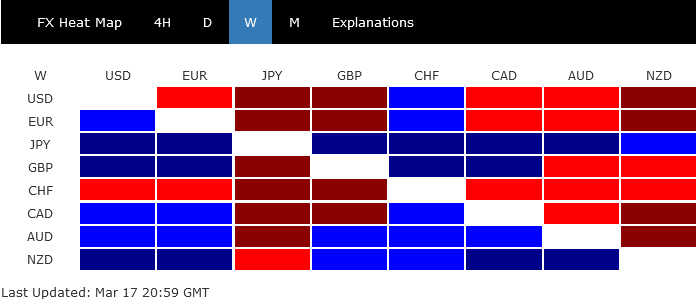
Last week, the world appeared to be on the brink of an international banking crisis. The situation might have stabilized with Silicon Valley Bank filing for Chapter 11 bankruptcy, First Republic Bank receiving aid in the form of deposits from major players, and Credit Suisse obtaining a CHF 50B lifeline from SNB. Despite these developments, market reactions suggest investors may be positioning for worse outcomes ahead.
In the currency markets, Yen emerged as the clear winner due to risk aversion and a boost from falling benchmark treasury yields in US and Europe. Swiss Franc, Dollar, and Euro were the weakest performers as the crisis unfolded on two fronts. Australian and New Zealand Dollars showed surprising resilience, but this is likely because they were not at the center of the storm.
Risk-off moves gather steam, suggesting more turbulence ahead
A casual glance at US stock performance might not reveal the full extent of last week's market upheaval caused by the banking crisis. While the DOW registered some losses, both S&P 500 and NASDAQ closed higher. However, the situation in Europe paints a different picture, with FTSE 100 experiencing its worst week in a year, dropping 5.3%, and DAX losing 4.3%.
In the bond market, the US 2-year yield saw its largest weekly decline in over 35 years, closing at 3.825. 10-year yield dropped to 3.395, while Germany's 10-year yield fell to its lowest level since early February at 2.110. UK 10-year yield also dipped to an early-February low of 3.287.
Safety-seeking funds didn't just flow into bonds. Gold surged more than 5.5%, its most significant gain since March 2020, and appears poised to challenge historical highs. Bitcoin, considered by some as a safe haven asset for now, broke through a crucial technical resistance at around 25,000 and reached its highest level in nine months. In contrast, WTI crude oil, not typically considered a safe asset, plunged to a 15-month low.
The strong momentum of moves in FTSE, DAX, and Gold suggests that market turbulence is far from over. Three central banks are set to meet in the coming days, and all are expected to continue tightening. Most market participants anticipate 25bps hikes from Fed and BoE, with a 50bps hike expected from SNB. However, the final outcomes will heavily depend on developments leading up to the meetings. Furthermore, the results themselves are likely to contribute to market volatility. So, brace for potential turbulence ahead.
Rare display of optimism in NASDAQ
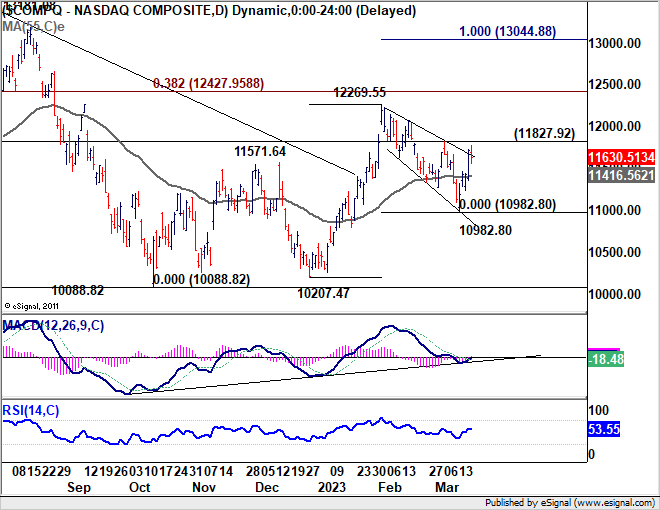
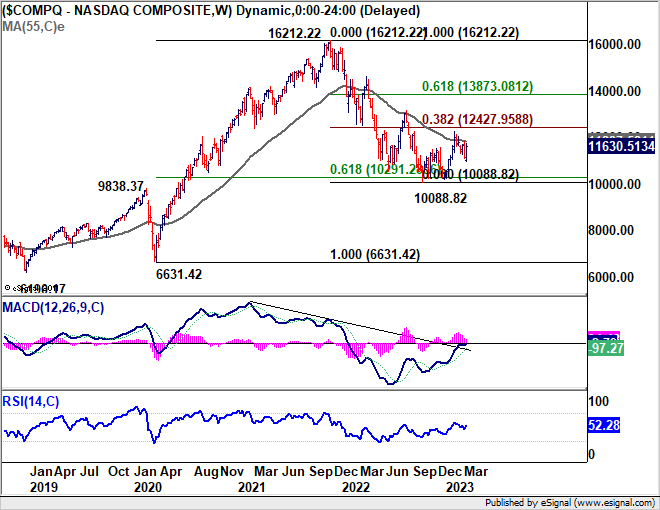
In a rare display of optimism last week, the NASDAQ experienced a robust rebound. This development indicates that the corrective pullback from 12269.55 may have completed at 10982.80. In the coming days, the immediate focus will shift to 11827.92 resistance level. A decisive break above this level would likely resume the overall rebound from 10,088.82, pushing through 12269.55 towards 38.2% retracement of 16212.22 to 10088.82 at 12427.95. However, the trajectory of the NASDAQ will also hinge on developments in other markets.
FTSE faces deep trouble, DAX vulnerable as well
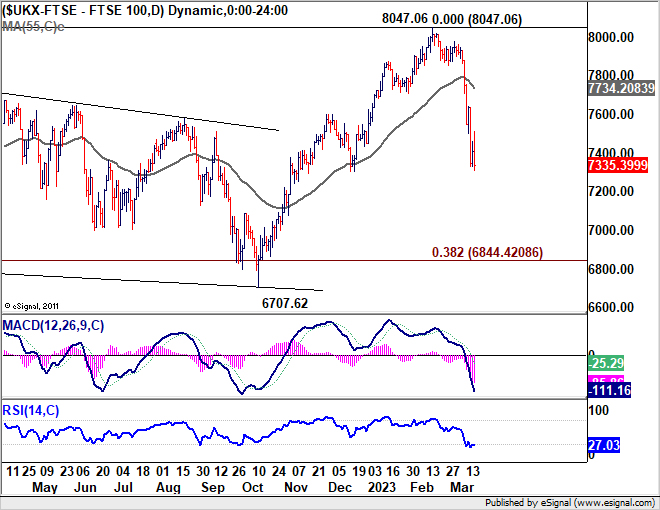
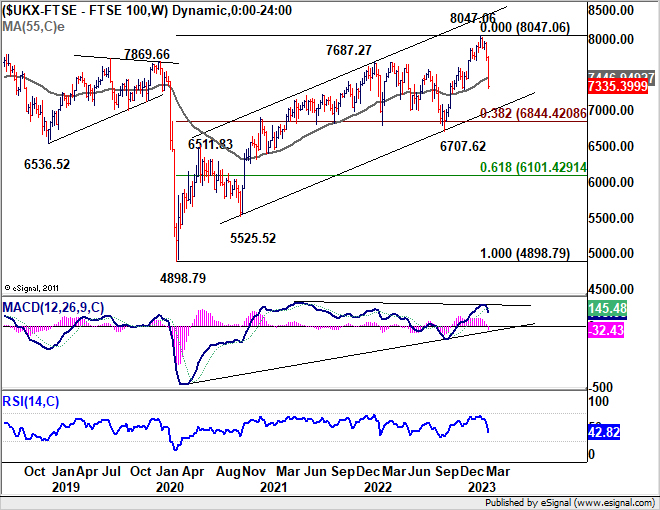
FTSE's sharp decline and close below its 55 week EMA (now at 7446.94) suggest that 8047.06 record high may represent at least a medium-term peak. More significantly, the uptrend from the 2020 low of 4898.79 could have reached completion as a five-wave impulse. As FTSE enters a correction phase, near-term outlook remains bearish, as long as 55 day EMA (now at 7734.20) holds. Deeper fall could be seen to 38.2% retracement of 4898.79 to 8047.06 at 6844.42 before bottoming.
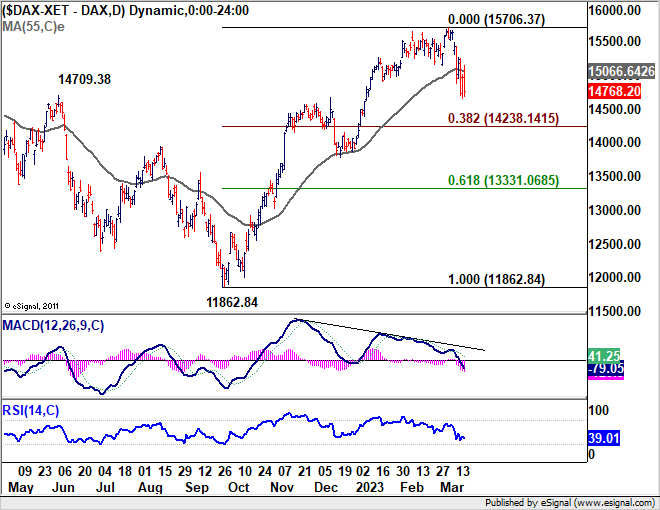
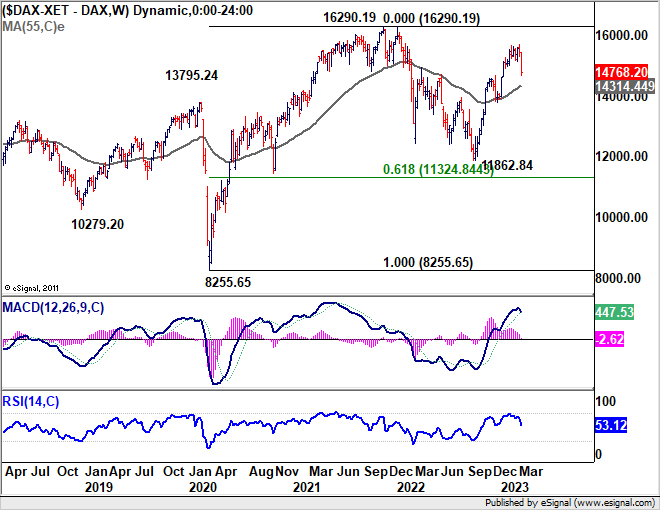
Though the outlook for DAX is less negative than that of FTSE, it remains concerning. The break below its 55 day EMA (now at 15066.64) implies that a medium-term top has formed at 15706.37, accompanied by bearish divergence in daily MACD. In the near term, DAX is expected to decline further to 38.2% retracement of 11862.84 to 15706.37 at 14238.14. Sustained break at this level, and below the 55 week EMA (now at 14314.46), would indicate the start of the third leg of the corrective pattern from 16290.19 (2021 high). Such a development would pave the way for a deeper fall toward the 2022 low of 11862.84 (2022 low).
US 10-year yield to extend correction through 3.334
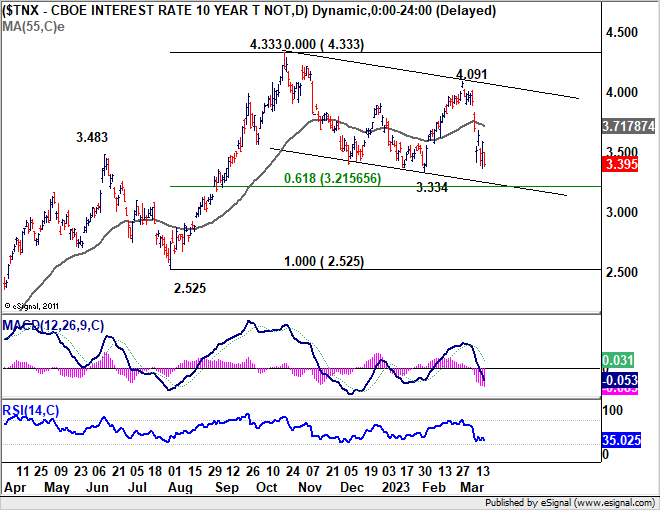
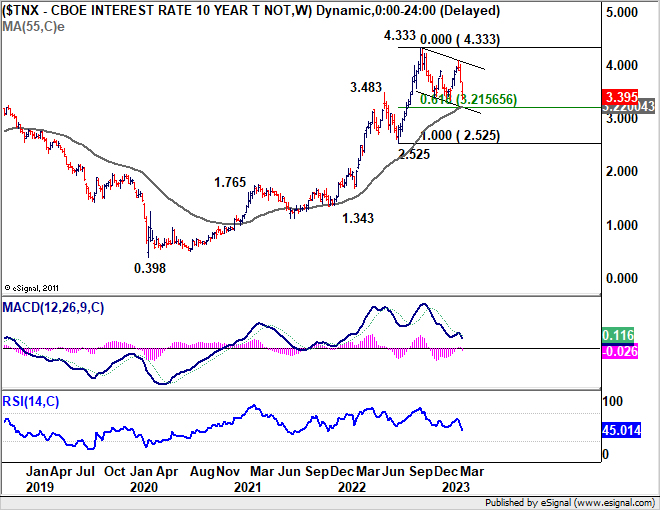
Turning over to the bond markets, US 10-year yield extended the decline from 4.091 to close at 3.395. Although the fall may have slowed slightly ahead of 3.334 support level, risk remains heavily skewed to the downside as long as the 55 day EMA (now at 3.717) holds. TNX is now in the third leg of its medium-term correction from 4.333.
Significant support could emerge from 61.8% retracement level of 2.525 to 4.333 at 3.215, which is in close proximity to 55 week EMA (now at 3.220). This zone may provide a solid foundation for TNX to bottom out. However, a sustained break through the 3.2 handle would signal even larger troubles on the horizon.
Gold's resurgence signals potential retest of record highs
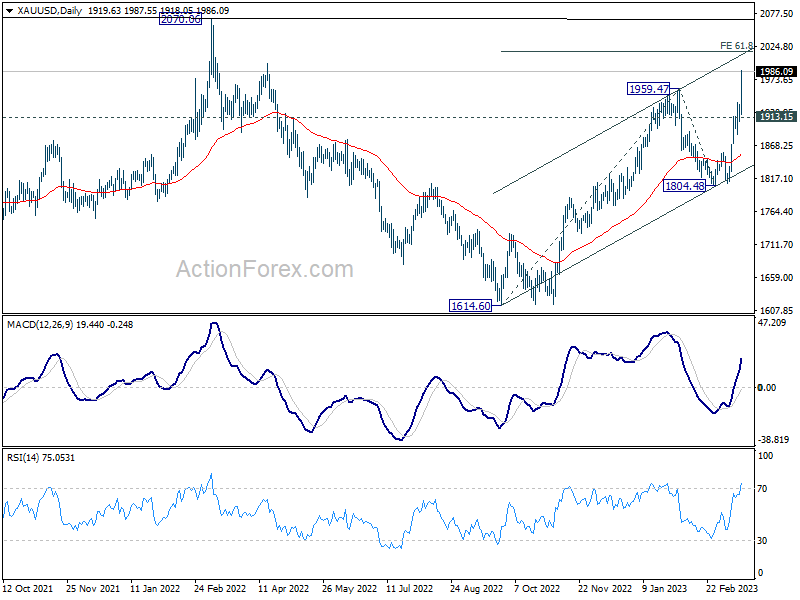
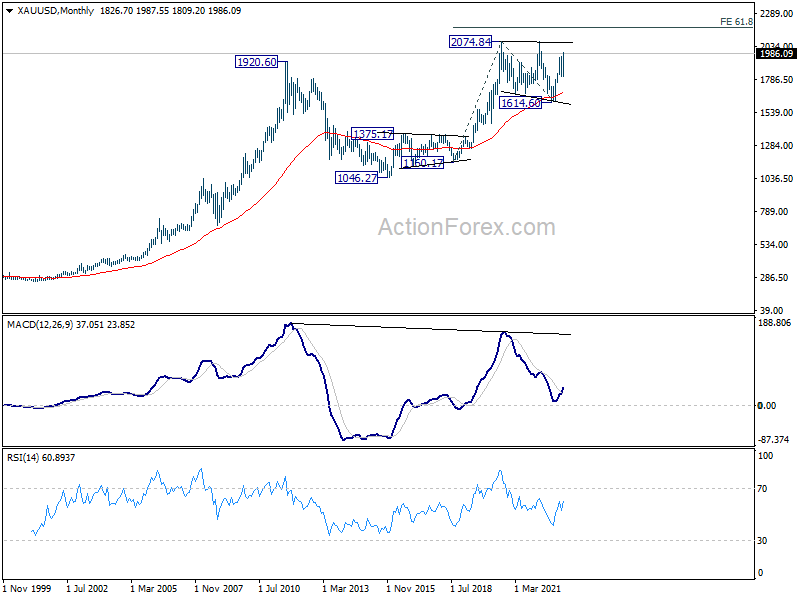
Gold's rise from 1614.60 resumed last week by powering through 1969.47 resistance to close at 1986.09. Near-term outlook will remain bullish as long as the 1913.15 support holds. The next target is the 61.8% projection of 1614.60 to 1959.47 from 1804.48 at 2017.60. A firm break through this level will pave the way for a retest of the 2074.84 record high.
More significantly, the current upside momentum strengthens the argument that long-term consolidation pattern from the 2074.84 (2020 high), with three waves down to 1615.60, has been completed. The long-term uptrend could be set to resume, potentially reaching the 61.8% projection of 1160.17 to 2074.85 from 1614.60 at 2179.86 in Q2.
Bitcoin's rally carries bullish implications amid market uncertainty
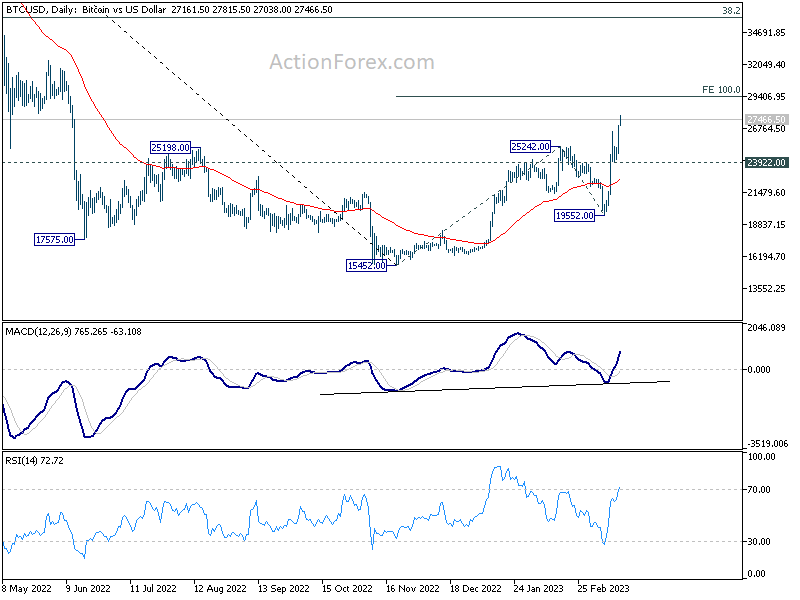
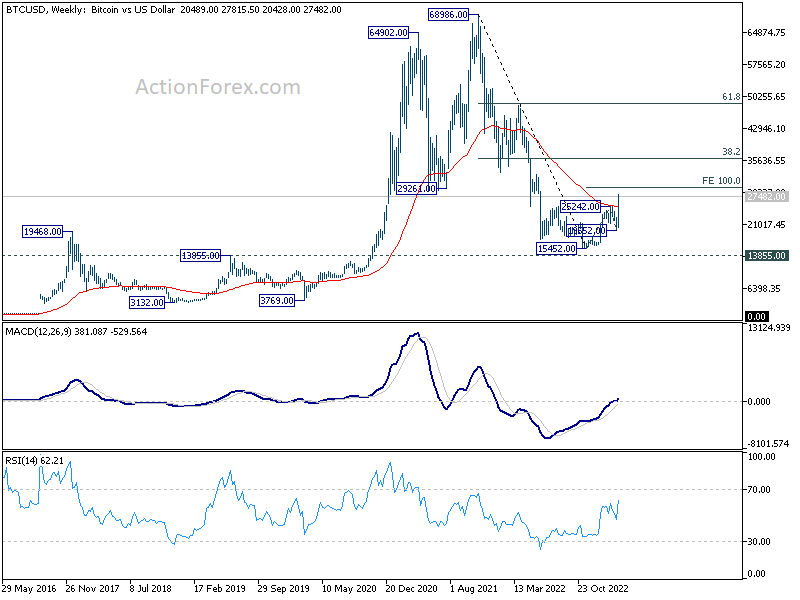
The role of Bitcoin as a safe-haven asset or a barometer for the tech sector remains a topic of debate. Nevertheless, last week's rally and the strong break through 25198/25242 resistance zone, along with 55 week EMA, point to bullish implications. Rise from 15452 appears to be at least a correction to the downtrend from record high of 68986 set in 2021.
Near-term outlook for Bitcoin will remain bullish as long as 23922 support level holds. Next target is 100% projection of 15452 to 25242 from 19552 at 29342. A decisive break through this level would affirm the bullish case mentioned above and set sights on the 38.2% retracement of 68986 to 15452 at 35901.
WTI crude oil to search for a bottom after tumbling, could it?
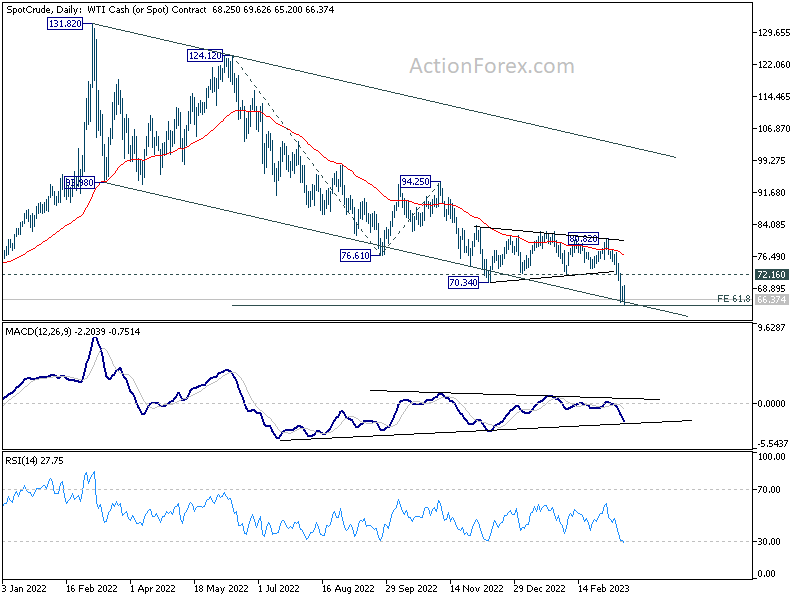
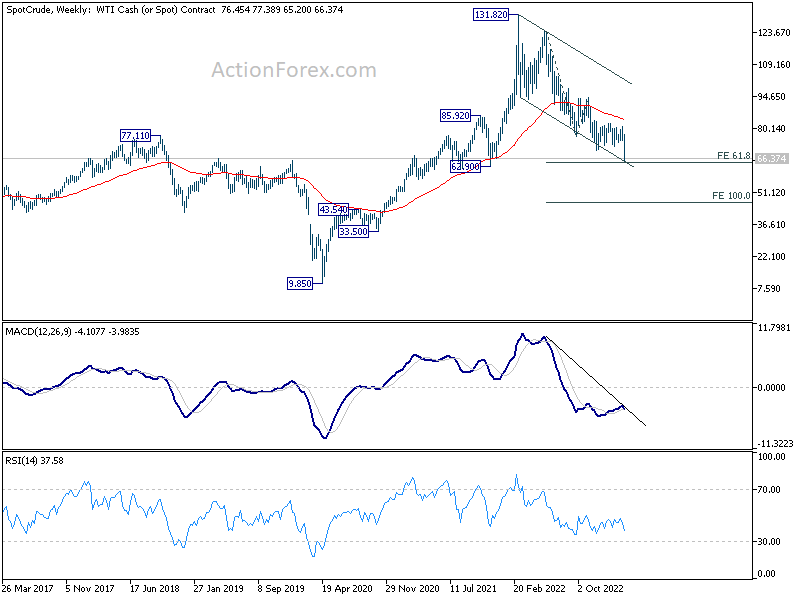
Whether it's due to recession fears or the banking crisis, WTI crude oil tumbled sharply last week, closing at 66.37 after being briefly above 80 just two weeks ago. Theoretically, this price range is where WTI could find its bottom. It's close to the 61.8% projection of 124.12 to 76.61 from 94.25 at 64.88, and nearing the long-term channel support at around 65.54. A break above 72.16 support-turned-resistance level would be the first sign of stabilization.
However, a firm break below 64.88 could trigger an even steeper decline with downside acceleration. In that case, 100% projection at 46.74 could be easily within reach.
EUR/JPY Weekly Outlook
EUR/JPY fell to as low as 139.11 last week before forming a temporary low there and recovered. Current development suggests that fall from 145.55 is the third leg of the whole corrective decline from 148.38. Risk stays on the downside as long as 4 hour 55 EMA (now at 142.85) holds. Below 139.11 will target 137.37 low, and then 135.40 fibonacci level.
In the bigger picture, as long as 55 week EMA (now at 139.54) holds, larger up trend from 114.42 (2020 low) is still in progress for 149.76 long term resistance. However, firm break of 55 week EMA will bring deeper fall to 38.2% retracement of 114.42 to 148.38 at 135.40. Sustained break there will raise the chance of trend reversal, and target 61.8% retracement at 127.39.
In the long term picture, outlook will stay bullish as long as 134.11 resistance turned support holds (2021 high). Sustained break of 149.76 (2014 high) will open up further rally, as resumption of the rise from 94.11 (2012 low), towards 169.96 (2008 high).
Summary 3/20 – 3/24
Monday, Mar 20, 2023
| GMT | Ccy | Events | Consensus | Previous |
|---|---|---|---|---|
| 23:50 | JPY | BoJ Summary of Opinions | ||
| 00:01 | GBP | Rightmove House Price Index M/M Mar | 0.000% | |
| 07:00 | EUR | Germany PPI M/M Feb | -1.20% | -1.00% |
| 07:00 | EUR | Germany PPI Y/Y Feb | 12.40% | 17.80% |
| 10:00 | EUR | Eurozone Trade Balance (EUR) Jan | -17.3B | -18.1B |
| 11:00 | EUR | German Buba Monthly Report | ||
| 21:45 | NZD | Trade Balance (NZD) Feb | -1800M | -1954M |
| GMT | Ccy | Events | |
|---|---|---|---|
| 23:50 | JPY | BoJ Summary of Opinions | |
| Forecast: | Previous: | ||
| 00:01 | GBP | Rightmove House Price Index M/M Mar | |
| Forecast: | Previous: 0.000% | ||
| 07:00 | EUR | Germany PPI M/M Feb | |
| Forecast: -1.20% | Previous: -1.00% | ||
| 07:00 | EUR | Germany PPI Y/Y Feb | |
| Forecast: 12.40% | Previous: 17.80% | ||
| 10:00 | EUR | Eurozone Trade Balance (EUR) Jan | |
| Forecast: -17.3B | Previous: -18.1B | ||
| 11:00 | EUR | German Buba Monthly Report | |
| Forecast: | Previous: | ||
| 21:45 | NZD | Trade Balance (NZD) Feb | |
| Forecast: -1800M | Previous: -1954M | ||
Tuesday, Mar 21, 2023
| GMT | Ccy | Events | Consensus | Previous |
|---|---|---|---|---|
| 00:30 | AUD | RBA Minutes | ||
| 07:00 | CHF | Trade Balance (CHF) Feb | 3.45B | 5.08B |
| 07:00 | GBP | Public Sector Net Borrowing (GBP) Feb | 10.5B | -6.2B |
| 10:00 | EUR | Germany ZEW Economic Sentiment Mar | 22.6 | 28.1 |
| 10:00 | EUR | Germany ZEW Current Situation Mar | -35.1 | -45.1 |
| 10:00 | EUR | Eurozone ZEW Economic Sentiment Mar | 23.2 | 29.7 |
| 12:30 | CAD | CPI M/M Feb | 0.50% | |
| 12:30 | CAD | CPI Y/Y Feb | 5.90% | |
| 12:30 | CAD | CPI - Core M/M Feb | 0.10% | |
| 12:30 | CAD | CPI Median Y/Y Feb | 5.00% | |
| 12:30 | CAD | CPI Trimmed Y/Y Feb | 5.10% | |
| 12:30 | CAD | CPI Common Y/Y Feb | 6.60% | |
| 14:00 | USD | Existing Home Sales Feb | 4.17M | 4.00M |
| 23:30 | AUD | Westpac Leading Index M/M Feb | -0.10% |
| GMT | Ccy | Events | |
|---|---|---|---|
| 00:30 | AUD | RBA Minutes | |
| Forecast: | Previous: | ||
| 07:00 | CHF | Trade Balance (CHF) Feb | |
| Forecast: 3.45B | Previous: 5.08B | ||
| 07:00 | GBP | Public Sector Net Borrowing (GBP) Feb | |
| Forecast: 10.5B | Previous: -6.2B | ||
| 10:00 | EUR | Germany ZEW Economic Sentiment Mar | |
| Forecast: 22.6 | Previous: 28.1 | ||
| 10:00 | EUR | Germany ZEW Current Situation Mar | |
| Forecast: -35.1 | Previous: -45.1 | ||
| 10:00 | EUR | Eurozone ZEW Economic Sentiment Mar | |
| Forecast: 23.2 | Previous: 29.7 | ||
| 12:30 | CAD | CPI M/M Feb | |
| Forecast: | Previous: 0.50% | ||
| 12:30 | CAD | CPI Y/Y Feb | |
| Forecast: | Previous: 5.90% | ||
| 12:30 | CAD | CPI - Core M/M Feb | |
| Forecast: | Previous: 0.10% | ||
| 12:30 | CAD | CPI Median Y/Y Feb | |
| Forecast: | Previous: 5.00% | ||
| 12:30 | CAD | CPI Trimmed Y/Y Feb | |
| Forecast: | Previous: 5.10% | ||
| 12:30 | CAD | CPI Common Y/Y Feb | |
| Forecast: | Previous: 6.60% | ||
| 14:00 | USD | Existing Home Sales Feb | |
| Forecast: 4.17M | Previous: 4.00M | ||
| 23:30 | AUD | Westpac Leading Index M/M Feb | |
| Forecast: | Previous: -0.10% | ||
Wednesday, Mar 22, 2023
| GMT | Ccy | Events | Consensus | Previous |
|---|---|---|---|---|
| 07:00 | GBP | CPI M/M Feb | 0.20% | -0.60% |
| 07:00 | GBP | CPI Y/Y Feb | 9.80% | 10.10% |
| 07:00 | GBP | Core CPI Y/Y Feb | 5.70% | 5.80% |
| 07:00 | GBP | RPI M/M Feb | 0.80% | 0.00% |
| 07:00 | GBP | RPI Y/Y Feb | 13.20% | 13.40% |
| 07:00 | GBP | PPI Input M/M Feb | 0.70% | -0.10% |
| 07:00 | GBP | PPI Input Y/Y Feb | 10.80% | 14.10% |
| 07:00 | GBP | PPI Output M/M Feb | 0.80% | 0.50% |
| 07:00 | GBP | PPI Output Y/Y Feb | 12.50% | 13.50% |
| 07:00 | GBP | PPI Core Output M/M Feb | 0.40% | 0.60% |
| 07:00 | GBP | PPI Core Output Y/Y Feb | 9.90% | 11.10% |
| 09:00 | EUR | Eurozone Current Account (EUR) Jan | 16.5B | 15.9B |
| 12:30 | CAD | New Housing Price Index M/M Feb | -0.10% | -0.20% |
| 14:30 | USD | Crude Oil Inventories | 1.6M | |
| 18:00 | USD | Fed Interest Rate Decision | 5.00% | 4.75% |
| 18:30 | USD | FOMC Press Conference |
| GMT | Ccy | Events | |
|---|---|---|---|
| 07:00 | GBP | CPI M/M Feb | |
| Forecast: 0.20% | Previous: -0.60% | ||
| 07:00 | GBP | CPI Y/Y Feb | |
| Forecast: 9.80% | Previous: 10.10% | ||
| 07:00 | GBP | Core CPI Y/Y Feb | |
| Forecast: 5.70% | Previous: 5.80% | ||
| 07:00 | GBP | RPI M/M Feb | |
| Forecast: 0.80% | Previous: 0.00% | ||
| 07:00 | GBP | RPI Y/Y Feb | |
| Forecast: 13.20% | Previous: 13.40% | ||
| 07:00 | GBP | PPI Input M/M Feb | |
| Forecast: 0.70% | Previous: -0.10% | ||
| 07:00 | GBP | PPI Input Y/Y Feb | |
| Forecast: 10.80% | Previous: 14.10% | ||
| 07:00 | GBP | PPI Output M/M Feb | |
| Forecast: 0.80% | Previous: 0.50% | ||
| 07:00 | GBP | PPI Output Y/Y Feb | |
| Forecast: 12.50% | Previous: 13.50% | ||
| 07:00 | GBP | PPI Core Output M/M Feb | |
| Forecast: 0.40% | Previous: 0.60% | ||
| 07:00 | GBP | PPI Core Output Y/Y Feb | |
| Forecast: 9.90% | Previous: 11.10% | ||
| 09:00 | EUR | Eurozone Current Account (EUR) Jan | |
| Forecast: 16.5B | Previous: 15.9B | ||
| 12:30 | CAD | New Housing Price Index M/M Feb | |
| Forecast: -0.10% | Previous: -0.20% | ||
| 14:30 | USD | Crude Oil Inventories | |
| Forecast: | Previous: 1.6M | ||
| 18:00 | USD | Fed Interest Rate Decision | |
| Forecast: 5.00% | Previous: 4.75% | ||
| 18:30 | USD | FOMC Press Conference | |
| Forecast: | Previous: | ||
Thursday, Mar 23, 2023
| GMT | Ccy | Events | Consensus | Previous |
|---|---|---|---|---|
| 08:30 | CHF | SNB Interest Rate Decision | 1.50% | 1.00% |
| 12:00 | GBP | BoE Rate Decision | 4.25% | 4.00% |
| 12:00 | GBP | MPC Official Bank Rate Votes | 7--0--2 | 7--0--2 |
| 12:30 | USD | Current Account (USD) Q4 | -217B | |
| 12:30 | USD | Continuing Jobless Claims (Mar 10) | 1.684M | |
| 12:30 | USD | Initial Jobless Claims (Mar 17) | 195K | 192K |
| 12:30 | USD | Initial Jobless Claims 4-week average (Mar 17) | 196.5K | |
| 14:00 | USD | New Home Sales Feb | 650K | 670K |
| 14:30 | USD | Natural Gas Storage | -58B | |
| 22:00 | AUD | Manufacturing PMI Mar P | 50.5 | |
| 22:00 | AUD | Services PMI Mar P | 50.7 | |
| 23:30 | JPY | CPI Y/Y Feb | 3.10% | 4.30% |
| 23:30 | JPY | CPI ex-Fresh Food Y/Y Feb | 4.20% | |
| 23:30 | JPY | CPI ex Food & Energy Y/Y Feb | 3.20% |
| GMT | Ccy | Events | |
|---|---|---|---|
| 08:30 | CHF | SNB Interest Rate Decision | |
| Forecast: 1.50% | Previous: 1.00% | ||
| 12:00 | GBP | BoE Rate Decision | |
| Forecast: 4.25% | Previous: 4.00% | ||
| 12:00 | GBP | MPC Official Bank Rate Votes | |
| Forecast: 7--0--2 | Previous: 7--0--2 | ||
| 12:30 | USD | Current Account (USD) Q4 | |
| Forecast: | Previous: -217B | ||
| 12:30 | USD | Continuing Jobless Claims (Mar 10) | |
| Forecast: | Previous: 1.684M | ||
| 12:30 | USD | Initial Jobless Claims (Mar 17) | |
| Forecast: 195K | Previous: 192K | ||
| 12:30 | USD | Initial Jobless Claims 4-week average (Mar 17) | |
| Forecast: | Previous: 196.5K | ||
| 14:00 | USD | New Home Sales Feb | |
| Forecast: 650K | Previous: 670K | ||
| 14:30 | USD | Natural Gas Storage | |
| Forecast: | Previous: -58B | ||
| 22:00 | AUD | Manufacturing PMI Mar P | |
| Forecast: | Previous: 50.5 | ||
| 22:00 | AUD | Services PMI Mar P | |
| Forecast: | Previous: 50.7 | ||
| 23:30 | JPY | CPI Y/Y Feb | |
| Forecast: 3.10% | Previous: 4.30% | ||
| 23:30 | JPY | CPI ex-Fresh Food Y/Y Feb | |
| Forecast: | Previous: 4.20% | ||
| 23:30 | JPY | CPI ex Food & Energy Y/Y Feb | |
| Forecast: | Previous: 3.20% | ||
Friday, Mar 24, 2023
| GMT | Ccy | Events | Consensus | Previous |
|---|---|---|---|---|
| 00:01 | GBP | GfK Consumer Confidence Mar | -35 | -38 |
| 00:30 | JPY | Manufacturing PMI Mar P | 48.2 | 47.7 |
| 00:30 | JPY | Services PMI Mar P | 53.8 | 54 |
| 07:00 | GBP | Retail Sales M/M Feb | 0.20% | 0.50% |
| 07:00 | GBP | Retail Sales Y/Y Feb | -5.10% | |
| 07:00 | GBP | Retail Sales ex-Fuel M/M Feb | 0.40% | |
| 07:00 | GBP | Retail Sales ex-Fuel Y/Y Feb | -5.30% | |
| 08:15 | EUR | France Manufacturing PMI Mar P | 48.2 | 47.4 |
| 08:15 | EUR | France Services PMI Mar P | 53.0 | 53.1 |
| 08:30 | EUR | Germany Manufacturing PMI Mar P | 47.1 | 46.3 |
| 08:30 | EUR | Germany Services PMI Mar P | 51.1 | 50.9 |
| 09:00 | EUR | Eurozone Manufacturing PMI Mar P | 48.9 | 48.5 |
| 09:00 | EUR | Eurozone Services PMI Mar P | 52.9 | 52.7 |
| 09:30 | GBP | Manufacturing PMI Mar P | 50.0 | 49.3 |
| 09:30 | GBP | Services PMI Mar P | 53.1 | 53.5 |
| 12:30 | CAD | Retail Sales M/M Jan | 0.50% | |
| 12:30 | CAD | Retail Sales ex Autos M/M Jan | -0.60% | |
| 12:30 | USD | Durable Goods Orders Feb | 1.60% | -4.50% |
| 12:30 | USD | Durable Goods Orders ex Transportation Feb | 0.30% | 0.70% |
| 13:45 | USD | Manufacturing PMI Mar P | 47.3 | |
| 13:45 | USD | Services PMI Mar P | 50.6 |
| GMT | Ccy | Events | |
|---|---|---|---|
| 00:01 | GBP | GfK Consumer Confidence Mar | |
| Forecast: -35 | Previous: -38 | ||
| 00:30 | JPY | Manufacturing PMI Mar P | |
| Forecast: 48.2 | Previous: 47.7 | ||
| 00:30 | JPY | Services PMI Mar P | |
| Forecast: 53.8 | Previous: 54 | ||
| 07:00 | GBP | Retail Sales M/M Feb | |
| Forecast: 0.20% | Previous: 0.50% | ||
| 07:00 | GBP | Retail Sales Y/Y Feb | |
| Forecast: | Previous: -5.10% | ||
| 07:00 | GBP | Retail Sales ex-Fuel M/M Feb | |
| Forecast: | Previous: 0.40% | ||
| 07:00 | GBP | Retail Sales ex-Fuel Y/Y Feb | |
| Forecast: | Previous: -5.30% | ||
| 08:15 | EUR | France Manufacturing PMI Mar P | |
| Forecast: 48.2 | Previous: 47.4 | ||
| 08:15 | EUR | France Services PMI Mar P | |
| Forecast: 53.0 | Previous: 53.1 | ||
| 08:30 | EUR | Germany Manufacturing PMI Mar P | |
| Forecast: 47.1 | Previous: 46.3 | ||
| 08:30 | EUR | Germany Services PMI Mar P | |
| Forecast: 51.1 | Previous: 50.9 | ||
| 09:00 | EUR | Eurozone Manufacturing PMI Mar P | |
| Forecast: 48.9 | Previous: 48.5 | ||
| 09:00 | EUR | Eurozone Services PMI Mar P | |
| Forecast: 52.9 | Previous: 52.7 | ||
| 09:30 | GBP | Manufacturing PMI Mar P | |
| Forecast: 50.0 | Previous: 49.3 | ||
| 09:30 | GBP | Services PMI Mar P | |
| Forecast: 53.1 | Previous: 53.5 | ||
| 12:30 | CAD | Retail Sales M/M Jan | |
| Forecast: | Previous: 0.50% | ||
| 12:30 | CAD | Retail Sales ex Autos M/M Jan | |
| Forecast: | Previous: -0.60% | ||
| 12:30 | USD | Durable Goods Orders Feb | |
| Forecast: 1.60% | Previous: -4.50% | ||
| 12:30 | USD | Durable Goods Orders ex Transportation Feb | |
| Forecast: 0.30% | Previous: 0.70% | ||
| 13:45 | USD | Manufacturing PMI Mar P | |
| Forecast: | Previous: 47.3 | ||
| 13:45 | USD | Services PMI Mar P | |
| Forecast: | Previous: 50.6 | ||
The Weekly Bottom Line: Some Banks Fail, But It’s Not a Free Fall
U.S. Highlights
- Following the collapse of SVB and Signature Bank, policymakers were quick to put together a rescue package over the weekend to allay depositor fears and reassure financial markets.
- Despite recent market jitters, economic data out this week including CPI, retail sales, and housing starts all suggest more tightening is still required to cool demand and return price stability.
Canadian Highlights
- The effects of US bank collapses have spilled over into Canadian markets. Canadian banks, however, are better insulated to protect against similar events.
- The Bank of Canada is likely looking through the turmoil and instead focusing on incoming data. Interest rate hikes are working their way to household budgets and the Canadian housing market is showing signs of reaching its bottom.
Financial Highlights
- A classic run on banks rippled through the financial system, but the regional banks’ equity underperformance reflects the idiosyncratic nature of this episode.
- Risk sentiment tightens financial conditions and feeds through to the real economy if it remains unresolved for a period of time. At this early juncture, it may not deter the Fed from raising interest rates on March 22nd, but can certainly put the May meeting on ice if pressures persist.
U.S. - Lifelines Extended, But Uncertainty Remains
Can policymaker’s walk while chewing gum? We’ll soon find out. The Federal Reserve’s attempt at reining in multidecade inflation without causing a recession was always thought to be a lofty goal. However, last week’s failure of both SVB and Signature Bank followed by the subsequent deposit run at First Republic has added a new layer of complexity.
In an effort to allay depositor fears and reassure financial markets, the FDIC, Federal Reserve, and U.S. Treasury implemented a rescue plan over the weekend. Deposit insurance for all deposits over $250k was extended, while a Bank Term Funding Program was also established, allowing all depository institutions to borrow at the Fed at a low rate using standard collateral. Moreover, the collateral could be valued at par rather than “marked to market” as is the case with other Fed liquidity facilities. Not only will this increase the amount of capital that troubled banks can access, but it will also prevent institutions from having to sell assets at significant losses, which should help to shore up confidence and stem the tide on further deposit outflows.
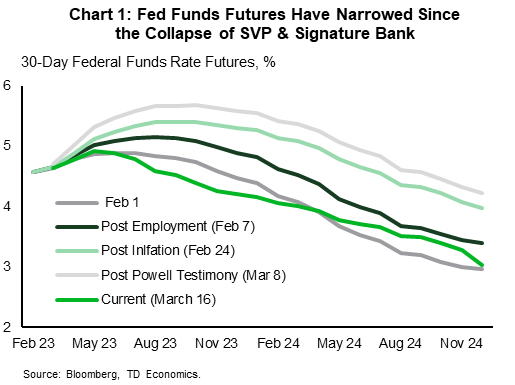
While sound in theory, investors remained skeptical that the risk remained contained to just a handful of regional banks. And this skepticism was only reinforced when news came that Credit Suisse may also be experiencing similar liquidity issues. Market sentiment soured mid-week but was quick to recover following news that First Republic had secured a rescue package and that the Swiss Central Bank would provide a liquidity backstop for Credit Suisse. After a volatile week, the S&P 500 finished 2% higher, while the 10-year yield fell 25bps landing at 3.45%. Investors also significantly recalibrated expectations on the future path of the fed funds rate, with a 25bps hike at next week’s announcement only 75% priced and rate cuts again priced for later this year (Chart 1).
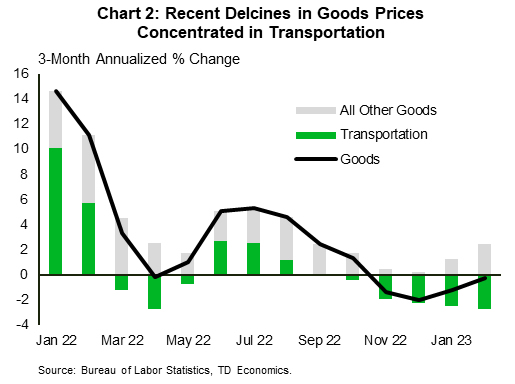
Only time will tell if this sharp repricing is overdone, but at the moment, the Fed appears stuck between a rock and a hard place. It is clear that the rapid adjustment in interest rates over the past year has pinched a nerve within a sub-segment of the banking sector. But on the other hand, the recent flow of economic data suggests more tightening is still required to cool the economy and return price stability. This was evident in February’s reading of CPI, where core inflation accelerated on the month – rising by 0.5% m/m – pushing the 3-month annualized change to a four-month high of 5.2%. Considerable breadth was seen across the cyclical component of services, which is closely tied to discretionary spending. And while goods prices were flat on the month, that was largely due to another sizeable decline in used vehicle prices, offsetting an acceleration across most other goods categories (Chart 2). Outside of inflation, retail sales (-0.4% m/m) softened in February but that was only after an outsized gain in January, while housing starts ended a 5-month slide and surged 10% m/m to 1.45M. The data is definitely telling the FOMC to hike, but the financial stability concerns also cannot be ignored. Provided risks remain contained, we expect the Fed to push ahead with another 25bps hike next week.
 Canada – Seeing Past the Noise
This week served up an important reminder that fragilities in the global financial system exist. The crisis-like banking events that transpired in the U.S. and Europe over the past week sent shockwaves through global markets. Spillover to Canadian markets sent yields across curve tumbling, with 2-and 10-year yields sliding by as much as 70 bps and 50 bps, respectively, over the week. At the time of writing, the TSX is down ~3% and the Canadian dollar is up 5-tenths of a cent to 0.727 on the back of broad USD weakening across most major currencies.
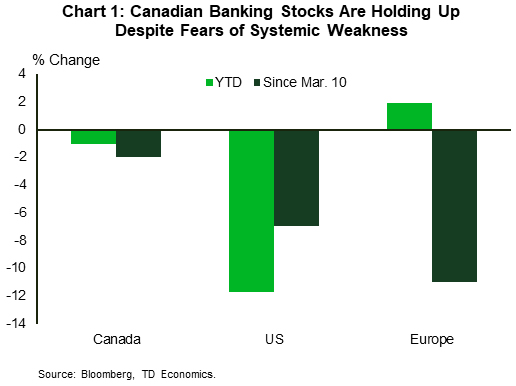
Should Canadians worry about similar events occurring on home soil? The short answer is no. Knee-jerk reactions by Canadians are understandable, but the likelihood of a Canadian bank failure is exceptionally low. The plumbing of the Canadian system is fundamentally different than that of the U.S., with a highly concentrated subset of large banks carrying more systematic importance. Further, Canada’s banks are subject to rigorous liquidity standards, have more robust capital ratios, are diversified across industries and business lines, and are more diligently regulated. All said, Canadian banks are positioned more favourably to withstand mounting pressures in the sector. Case in point, (Chart 1) illustrates how Canadian bank stocks have been less affected than those in the U.S. and Europe since the initial news of the SVB collapse on March 10.
The Bank of Canada (BoC) appears to be sitting in a more comfortable position and likely isn’t as pressured as other major central banks to alter course in the wake of current events. We expect the BoC to look through the turbulence and remain in a wait and see mode, holding the policy rate at 4.50% through the remainder of the year.
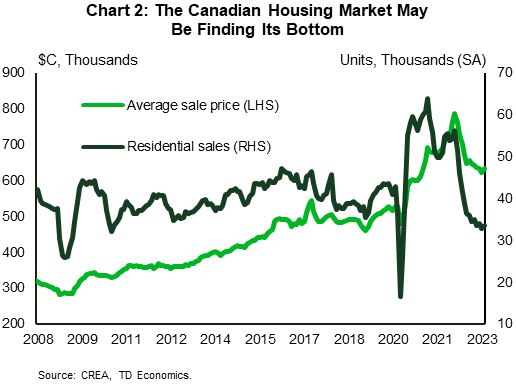
Household balance sheet data for Q4-2022 revealed that elevated interest rates are slowly working their way to the resilient Canadian consumer, as debt servicing costs have been pushed upward and debt repayments slowed. The BoC would still like to see further evidence of this passthrough helping to further cool the domestic impulse to still-elevated inflation. Higher interest rates have had more pronounced effects in the Canadian housing market. Existing home sales for the month of February increased by 2.3% month-on-month (m/m), which puts sales growth effectively flat on a 3-month moving average basis. The overall level of home sales is still depressed, having retraced by 40% compared to 2022 peak sales, but the recent data suggest a bottom may be forming (Chart 2). Average home prices advanced 1.7% m/m in February, while the MLS home price index that accounts for composition in home prices, slipped by 1.1% m/m.
Next week’s highlight is the February CPI release where we expect a further cooling in headline and core inflation measures. Also on tap, retail sales for January are tracking another gain, following strong consumer spending in December. Lastly, the BoC will release its Summary of Deliberations from their March 8th policy meeting.
Financial – Some Banks Fail, but It's Not a Free Fall
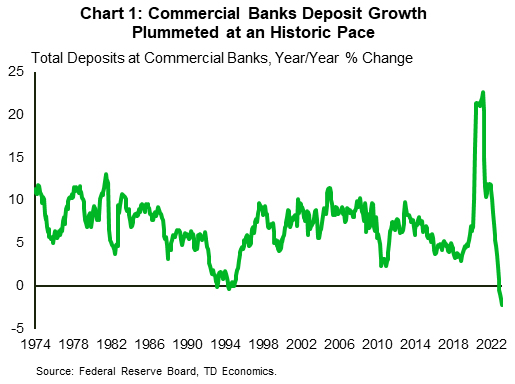
The Federal Reserve was blind sighted by an evolving risk that was right under its nose. While it tightened monetary policy at an unprecedented pace, deposit growth within commercial banks plummeted at an historic pace (Chart 1). Some of this movement reflected the outcome of quantitative tightening and some reflected a shift in depositor preferences into higher yielding products. Predicting this shift was actually well within forecast models, offering little element of surprise. Predicting individual behaviors and market confidence, however, is another story.
Unless you’ve been completely cut off from every form of communication, by now it’s well known that the sudden failure of Silicon Valley Bank was more than a classic “run on a bank”. The aggressive rate hike cycle pressured the market value of the bank’s financial assets, even though these were deemed high quality and liquid. Meanwhile, a concentration of a large amount of uninsured deposits from start-up companies left the bank exposed to a sudden shift in confidence. Once the financial market participants witnessed a mass deposit exit and a swift bank failure, it opened the door to lurking risks within other institutions. The fear of the known unknown kicked in.
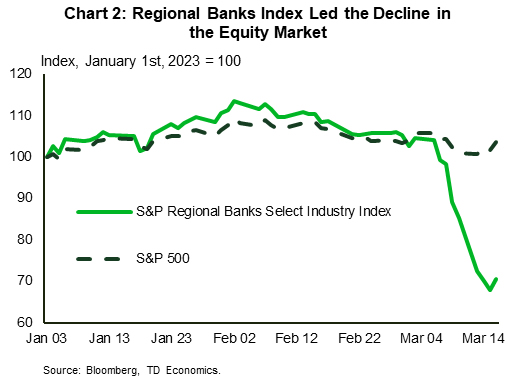
However, that fear has largely been contained, at least at this juncture. The pressure on equity markets was not economy wide. A concentration within the banking sector was further narrowed to the regional banks' sub-sector. In the period between March 8th and March 15th, the S&P's Regional Banks Sub-Industry Index lost more than 30% of its value while the S&P 500 index declined by 2.5%, half of which was due to the pressure on the banking sector (Chart 2). While large, the magnitude of change is not unprecedented. During the Global Financial Crisis – the poster child of the banking sector crisis – the index lost almost 80% of its value (albeit, in a period of six months), while its maximum daily loss was 1.5 times greater than the current episode.
The relative containment of the crisis doesn’t negate the seriousness of the situation. Look no further than within expectations for the fed funds rate. In a matter of ten days, the futures market turned upside down, shifting its pricing from a 50-basis point hike in March and a 5.75% terminal rate, to 25-basis point hike and a terminal rate 85 basis points lower. On March 13th, the two-year yield collapsed by 57 basis points to 4.03% – the largest decline since the Black Monday market crash of 1987. This initially pushed the U.S. dollar down 2% relative to other currencies. But, the greenback reclaimed its strength as a safe-haven currency as soon as the confidence shock drifted over the Atlantic. As the biggest shareholder of Credit Suisse declared no interest in upping its funding commitment to the already-beleaguered institution, the greenback finished 1.5% below March 8th level.
In both cases, the respective regulators and the central bank stepped in to provide a liquidity backstop, having learned from the past that the first order of business is to stabilize financial market shocks that have the potential to seize up the system if left unchecked. The second order of business will be to ensure guard rails are in place to limit a future episode. This usually comes in the form of more oversight. Market chatter has already settled on one possible change for U.S. mid-and-small sized banks to lower the banks' asset threshold at which stricter capital and liquidity rules start to apply from $250 to $100 billion. Another proposal being bantered about is to put more rigor into the stress test that assesses valuation of banks capital during a hypothetical macroeconomic recession scenario.
From an economic perspective, any permanency in tighter financial conditions among mid- and smaller-sized banks that flows through to tighter credit standards will impact loan demand and the real economy. The irony is that this feedback loop might help the Fed tap down domestic demand and contain inflationary pressures, as long as pressure on financial conditions remain 'controlled'. Up until now, the U.S. economy was described as stronger-for-longer, with consumers and job demand completely defying the odds. Time will tell.
Weekly Economic & Financial Commentary: FOMC – To Hike or Not to Hike on March 22?
Summary
United States: Top O' the Cycle?
- In February, the headline and core CPI rose 0.4% and 0.5%, respectively. The headline PPI fell 0.1%. Retail sales declined 0.4% during February, while industrial production was flat (0.0%). Housing starts and permits jumped 9.8% and 13.8%, respectively. The Leading Economic Index dipped 0.3%. The preliminary University of Michigan Sentiment Index fell to 63.4 in March.
- Next week: Existing Home Sales (Tue), New Home Sales (Thu), Durable Goods (Fri)
International: European Central Bank Delivers Large Hike, but Refrains from Future Guidance
- In a widely anticipated monetary policy announcement, the European Central Bank (ECB) raised its Deposit Rate 50 bps to 3.00%, saying that inflation is projected to remain far too high. However, in a nod to recent financial market strains, the ECB highlighted elevated uncertainty, emphasized a data-dependent approach to policy rate decisions and refrained from signaling any future rate moves. That said, with inflation elevated we still expect further tightening and forecast a peak policy rate of 3.50% by June this year.
- Next week: Swiss National Bank (Thu), Bank of England (Thu), Eurozone PMIs (Fri)
Interest Rate Watch: FOMC: To Hike or Not to Hike on March 22?
- It's a close call, but we expect the recent banking crisis to lead the FOMC to temporarily pause its tightening cycle at its policy meeting on March 22. Assuming the current crisis remains contained, we look for the FOMC to hike rates again starting on May 3.
Topic of the Week: The State of the U.S. Banking Sector
- Recent tightening of financial conditions triggered by the collapse of a few U.S. regional banks has led to fears that other institutions may be in a similar position of not being able to meet obligations to depositors due to losses on securities holdings. We believe that authorities will take the necessary steps to prevent another global financial crisis, but there will likely be lasting consequences in the form of tighter financial conditions.
Week Ahead – More Turmoil to Come?
US
A week ago, a lot of economists were thinking the Fed was going to pick up the pace of rate hikes as disinflation trends were struggling given a robust core services inflation reading and tight labor market conditions. A banking crisis however is changing how policymakers are assessing the impact of the first eight rate hikes.
Fed expectations are all over the place with Nomura analysts calling for a rate cut, while most investors are between a hold or a final quarter-point rate rise. How broader financial turmoil plays out leading to the FOMC decision could greatly influence how policymakers place their rate vote.
In addition to the FOMC decision, it will be a busy week of economic data releases. On Tuesday, existing home sales data is expected to show a modest rebound. Thursday contains the release of initial jobless claims, the Chicago Fed national activity index, and new home sales data. On Friday we get the first look at February’s durable goods data and the flash PMIs.
Earnings season winds down with key results from Accenture, China Mobile, China Pacific Insurance Group, China Petroleum & Chemical, China Shenhua Energy, China Telecom, General Mills, Nike, RWE, Tencent, and Xiaomi.
Eurozone
It goes without saying that the focus in Europe next week will be firmly on the banking sector and whether recent turmoil has had any ripple effects on weaker institutions or highlighted any vulnerabilities. The ECB opted to hike by 50 basis points, as planned, on Thursday despite recent events but refused to commit further and so comments from President Lagarde next week as the situation evolves will be monitored very closely. Flash PMIs on Friday will also be of interest but against the backdrop of recent events, won’t pack the punch they may otherwise have.
UK
The Bank of England meeting on Thursday will be fascinating. Not only does it have recent turmoil in financial markets to contend with but policymakers were already divided on the correct course of action prior to it. At the last meeting, two voted to leave rates on hold and could feasibly now consider backing a cut. What’s more, in the budget this week, the Chancellor confirmed that the OBR sees inflation falling to 2.9% by the end of the year, and while the BoE will use its own forecasts, others may be tempted to pause the tightening cycle to see what further fallout there will be in the banking sector if any.
Markets are torn on whether the MPC will hike or not, putting it at a 50/50 chance and it may well be swung by whether there’s any further disruption prior to the meeting, as well as the inflation data that is released the day before. It promises to be a very interesting announcement.
Russia
A quiet week following the CBR decision to leave interest rates unchanged on Friday. PPI inflation data is the only notable economic release.
South Africa
The SARB is likely at or near the end of its tightening cycle and recent activity may encourage a cautious approach when it next meets in two weeks. That said, the inflation data may allow for that anyway with the core annual figure already in its 3-6% target range and the headline rate expected to fall close to that when it’s released on Wednesday.
Turkey
The CBRT is expected to leave interest rates unchanged on Thursday but as is always the case with the Turkish central bank, nothing can be assumed. It started cutting the repo rate again last month and you wouldn’t put it past it continuing that on the 23rd.
Switzerland
Another central bank meeting next week and in light of events this week, heavily centered around one of its own, Credit Suisse, it will be very interesting to see whether it sticks with plans for a 50 basis point hike. While it hasn’t hiked rates much so far, the SNB has a low tolerance for inflation so may remain determined to stick with the plan despite inflation being only 3.4% in March.
China
The key event from China will be the loan prime rate fixing. China is expected to keep the LPR steady for a seventh straight month as they try to keep support in place for property markets. The one-year loan prime rate is at 3.65% and the five-year is at 4.30%, which are both at the lowest level in the past two decades.
India
No major releases are expected from India. Markets are still pricing in one more rate hike in the tightening cycle at the next meeting on April 6th as inflation still remains well above their 6% target ceiling.
Australia & New Zealand
On Monday, Reserve Bank of Australia Assistant Governor Christopher Kent is expected to speak at the KangaNews DCM Summit in Sydney. The focus in Australia will fall on the minutes to the March 7th rate decision that saw a 25 bps rate increase, but also a signal that they will have a ‘completely open mind’ at the April 4th policy meeting. The Westpac Leading index for February will also be released on Wednesday.
In New Zealand traders are eyeing February trade data and Westpac consumer confidence.
Japan
It is all about inflation in Japan this week. The national CPI reading for February is expected to cool from 4.3% to 3.3% as utility bills softened over energy subsidies. Pricing pressures however should remain robust as the ex-fresh food and energy is expected to rise on an annual basis from 3.2% to 3.4%.
Singapore
High inflation has been keeping pressure on MAS to keep policy tight. The February inflation report is expected to show inflation decelerated from 6.6% to 6.5%, with some analysts expecting a stronger drop to 5.8%.
Economic Calendar
Saturday, March 18
Economic Events
- The safe-transit deal for grain exports from three Ukrainian Black Sea ports is due to expire
- German Chancellor Scholz to meet with Japanese PM Kishida in Japan
Sunday, March 19
Economic Events
- House Republicans begin a three-day policy retreat in Orlando, Florida
Monday, March 20
Economic Data/Events
- China loan prime rates
- Taiwan export orders
- EU foreign ministers, defense ministers meet in Brussels
- RBA’s Kent speaks at the KangaNews DCM Summit in Sydney
- ECB President Lagarde appears before European Parliament’s economic committee
Tuesday, March 21
Economic Data/Events
- Fed begins two-day policy meeting
- US existing home sales
- Canada CPI
- Eurozone new car registrations
- Germany ZEW survey expectations
- New Zealand trade
- UK Chancellor Hunt appears in the House of Commons and before the House of Lords economic affairs committee
- Chinese President Xi Jinping expected to visit Moscow for a meeting with Russian leader Putin
- ECB’s Enria speaks at the European Parliament’s economic committee to discuss fallout from SVB’s collapse
- ECB President Lagarde and Villeroy speak at Bank for International Settlements “innovation summit”
- RBA releases minutes of its March policy meeting
- Finnish economic forecast from ETLA research institute
- Riksbank’s Breman speaks on the economy and monetary policy in Stockholm
Wednesday, March 22
Economic Data/Events
- FOMC rate decision: Banking turmoil has shifted expectations from a half-point rate rise to a possible hold. Inflation worries should support one last quarter-point rate hike
- Australia leading index
- Japan machine tool orders
- Mexico international reserves
- New Zealand consumer confidence
- South Africa CPI
- UK CPI
- ECB’s Lagarde, Lane, Wunsch and Panetta speak at “The ECB and Its Watchers” conference at the Goethe Institute in Frankfurt
- Bundesbank President Nagel speaks on the future of the euro area at OMFIF in London
- ECB’s Rehn speaks in Brussels on “Lessons from Europe’s crises”
- US Treasury Secretary Yellen to appear at a Senate subcommittee hearing focused on 2024 budget
- Riksbank Governor Thedeen speaks on a panel organized by the Bank of International Settlements
- BOC releases summary of most recent deliberations
- EIA crude oil inventory report
Thursday, March 23
Economic Data/Events
- US new home sales, initial jobless claims
- BOE rate decision: Expected to raise bank rate by 25bps to 4.25%
- SNB rate decision: Expectations are between a 25-50bps rate increase
- Norges rate decision: Expected to raise rates by 25bps to 3.00%
- CBRT rate decision: Expected to keep rates steady at 8.50%
- China Swift global payments
- Eurozone consumer confidence
- Japan department store sales
- New Zealand heavy traffic index
- Singapore CPI
- Taiwan industrial production, rate decision
- Thailand trade
- EU leaders meet in Brussels for a two-day summit
- ECB’s Holzmann speaks after the release of the Austrian National Bank annual report
- Hungary’s parliament may vote on approval of the accession of Finland and Sweden to NATO
- US Treasury Secretary Yellen testifies on the budget to a House Appropriations subcommittee
- President Joe Biden to visit Canada
Friday, March 24
- Economic Data/Events
- US durable goods
- Australia PMI
- Canada retail sales
- European Flash PMIs: Eurozone, Germany, France, and the UK
- Japan CPI, PMI
- Singapore industrial production
- Spain GDP
- Taiwan jobless rate, money supply
- Thailand foreign reserves, forward contracts
- Bundesbank President Nagel speaks on the labor market
- BOE’s Mann speaks at a Global Interdependence Center conference
Sovereign Rating Updates
- Germany (S&P)
- Poland (Moody’s)
- Finland (DBRS)
- France (DBRS)
Fed to Go Ahead with 25 bp Hike; Canadian CPI Growth to Slow
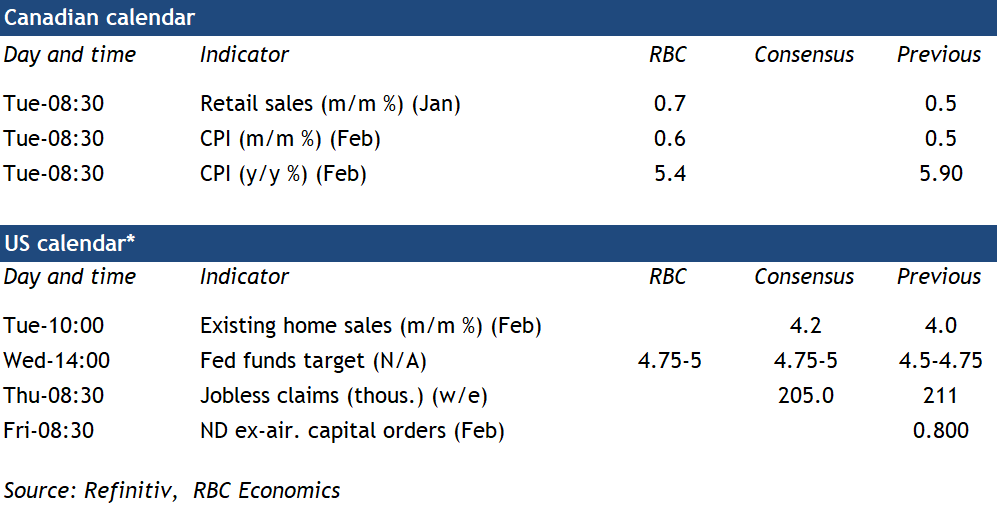
The Federal Reserve’s March interest rate decision comes amid significant market turmoil that has raised the prospect of a pause on its tightening cycle. On one hand, there are good arguments for the Fed opting to take a wait-and-see approach amid (by some measures) the worst bond market volatility since the global financial crisis. Recent developments should tighten lending standards and dent confident, doing some of the Fed’s “tightening” work for it. On the other hand, the Fed clearly think it has more work to do when it comes to inflation — just last week (before financial stability concerns intensified) Chair Powell opened the door to a 50 bp hike. Recent data has been firm, on balance, with payrolls surprising to the upside yet again in February and underlying inflation remaining too strong for the Fed’s liking. As of this morning, the market is leaning toward a 25 bp hike. Validating that could be seen as a vote of confidence in the banking sector, and an indication that actions taken over the past week free up monetary policy to continue to address inflation. Assuming fresh financials stability concerns don’t emerge early next week, we think the Fed will go ahead with a 25 bp increase.
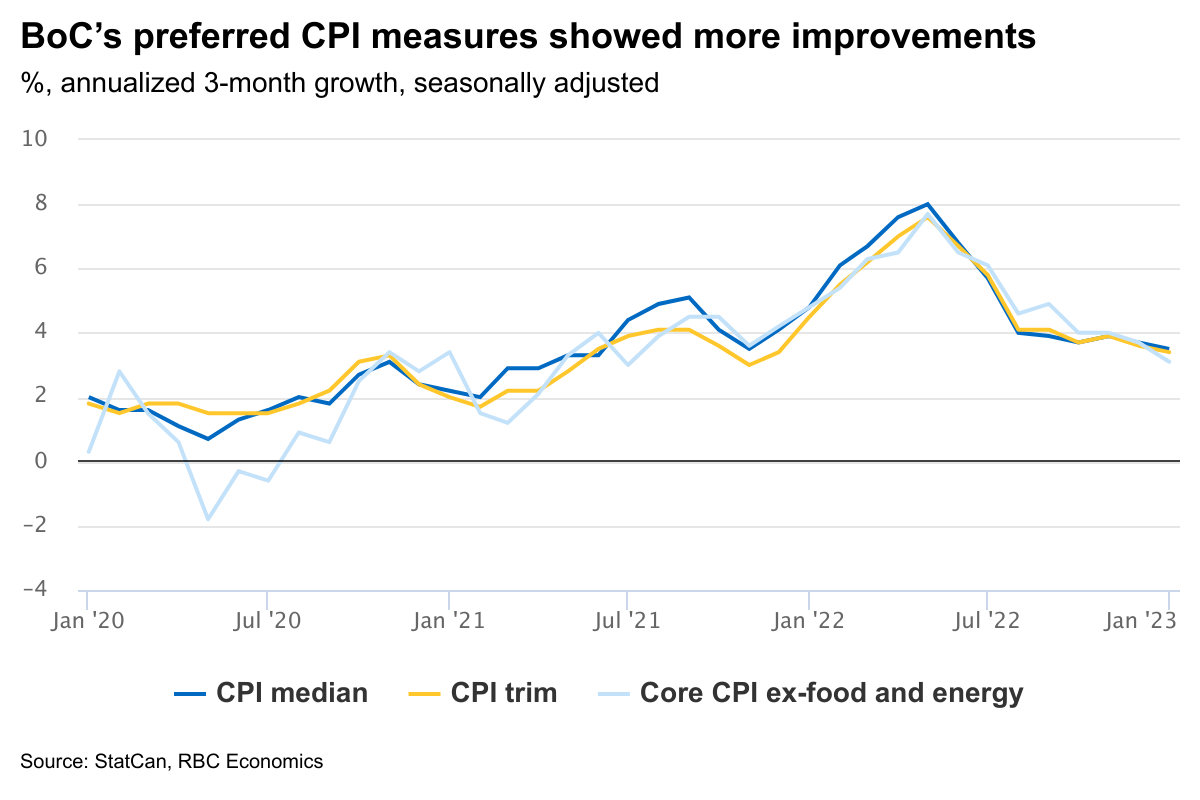
The Bank of Canada already announced a pause in interest rate hikes in January and followed through by leaving the overnight rate unchanged in March. That pause however is contingent on inflation pressures continuing to ease, and we expect Canadian headline CPI growth slipped to 5.4% year-over-year in February from 5.9% in January. Lower gasoline prices in February (down 3.6% monthly) could push energy CPI below year-ago levels for the first time in two years. Food inflation is still exceptionally high, and likely remained elevated in February. Shelter CPI is expected to have trended over, though accelerating mortgage interest costs partially offset weaker price growth for expenses related to home-buying. More importantly, the BoC’s preferred core measures – CPI trim and median – are expected to continue to moderate on a three-month moving average basis. That together with narrowing breadth of inflation pressure suggests persistent easing in fundamental price pressure, which should be enough to keep the BoC on hold through the end of this year.
Week ahead data watch
Next Friday, StatCan will release January’s retail sales estimate, where we look for a 0.7% monthly increase driven mostly by higher gas station sales, in line with StatCan's advance estimate. Motor vehicle and parts sales likely eked out a small increase after a surge in January. New estimates next week will be based on the updated 2022 North American Industry Classification System (NAICS) and should better reflect sales made within the digital economy.