Sample Category Title
Fed Preview – Rate Hikes Continue Despite the Volatility
- With market sentiment stabilizing, underlying inflation still elevated & systemic crisis risks now seemingly contained, we think Fed will continue hiking next week.
- Even if a broader crisis is averted, the tightening credit standards in regional US banks could weigh on economic growth, and inflation expectations.
- We still expect a 25bp hike next week and a terminal rate of 5.00-5.25% by May.
This week, the ECB emphasized that there is no trade-off between inflation and financial stability risks, and we expect Fed to deliver a similar message next week. The new Bank Term Funding Program, allowing banks to tap liquidity from the Fed against collateral valued at par, provided banks with USD11.9 billion during its first three days of use.
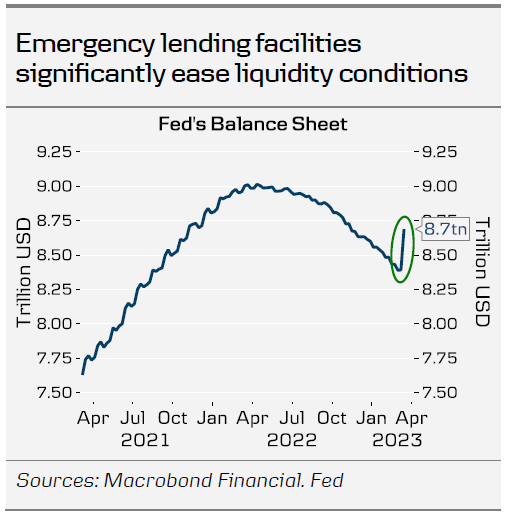
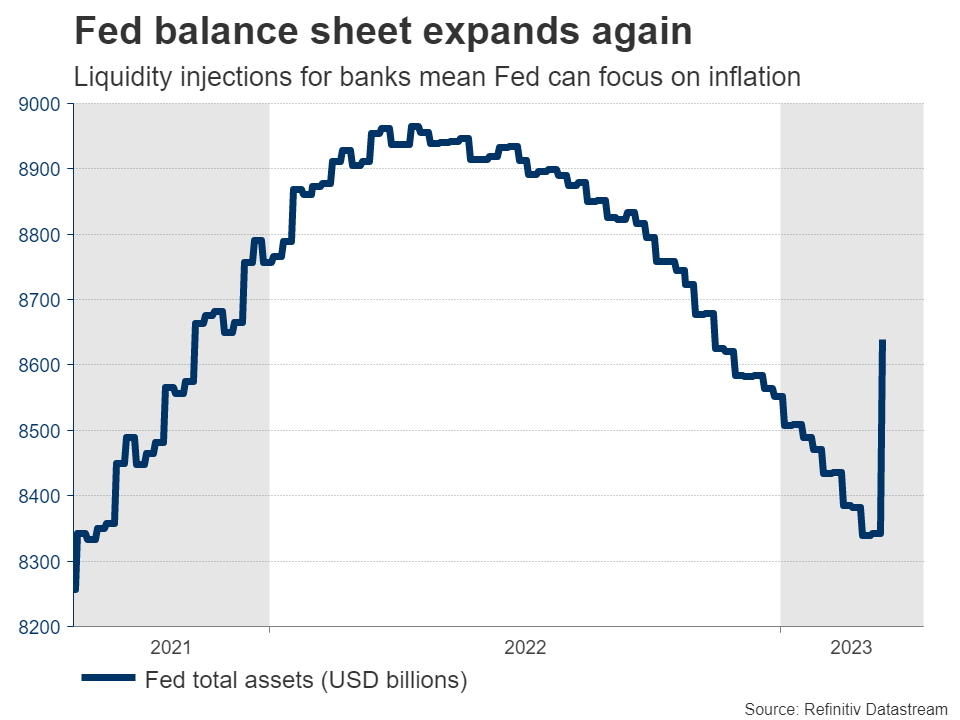
Fed's more traditional 'emergency lending facility', the discount window, was tapped for 152.9bn (up from 4.6bn the week before), while Fed funded the bridge-banks for SVB and Signature bank by around 142.8bn. The discount window values collateral at market value, but accepts a wider range of collateral compared to the BTFP. All together, Fed's balance sheet grew by 298bn, reversing the impact of past four months of QT. The fact that banks are tapping the emergency lending facilities is not worrying on its own. Rather, it seems some of the negative stigma related to using the facilities appears to have faded with the volatility. Hence, we also think calls for Fed to end QT and/or restart QE are misplaced.
Fed cannot afford to stop tightening monetary policy and by no means start easing given that underlying price pressures remain sticky, or even accelerate, as we highlighted in Global Inflation Watch - Central banks balance inflation and financial stability risks, 15 March. For now, it seems the emergency measures have managed to stabilize the acute contagion risks, but as ECB demonstrated, they open up the door for further rate hikes even amid the ongoing uncertainty. The extent further tightening will be needed depends on how the banking crisis affects the macroeconomic outlook.
While the small regional banks are not as large systemic threats as say, Credit Suisse is, they do still account for a significant share of lending in the US. Thus, as uncertainty remains high, tighter credit standards could weigh on lending growth and the economy.
Reflecting the downside risks, oil prices have fallen and short-term market-based inflation expectations have declined by ~75bp. If a similar move is seen in consumers' expectations as well, Fed could turn towards cutting nominal rates earlier. But if growth, and consequently inflation turn out more resilient, recovering market sentiment could quickly bring rate hikes back to the table. For now we do not expect rate cuts before next year.
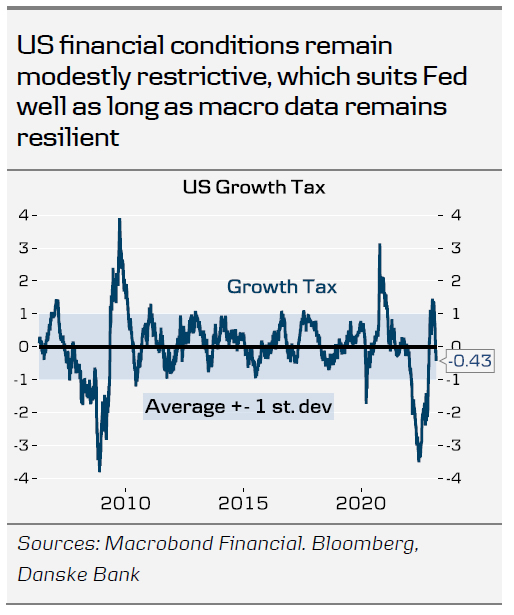
So far, short-term real rates and broader financial conditions have remained relatively stable. Our in-house 'growth tax' measure is at modestly restrictive territory, as the tightening in credit and equity components has compensated for the lower yields and mortgage rates. This suits Fed well as long as macro data remains strong, and for the time being, we like our call of a 25bp rate hike next week and a terminal rate at 5.00-5.25% in May. Hence, we see modest upside risks to short-term rates from current levels
Bank of England Preview – Final Hike in Store
- We expect the Bank of England (BoE) to hike the Bank Rate by 25bp.
- We expect this to mark the peak in the Bank Rate of 4.25% as the BoE is set to signal a pause in the hiking cycle.
- EUR/GBP is set to move lower upon announcement - yet we highlight that changes to systemic risk fears will remain the key driver of the cross short-term.
BoE call. We expect the Bank of England (BoE) to hike the Bank Rate (key policy rate) by 25bp on 23 March bringing it to 4.25%. Markets are currently pricing around 15bp for the meeting, thus close to an equal implied probability for an increase of 25bp in the Bank Rate and an unchanged decision. While the latest UK economic data releases, in our view, still support a 25bp hike on Thursday, we acknowledge that the probability of the BoE keeping the policy rate unchanged has risen considerably amid rising systemic risk fears. This risk is only supported by what we consider to be a fairly cautious Monetary Policy Committee (MPC).
We do not get updated projections at this meeting nor a press conference.
Since the last monetary policy decision on 2 February, both wage growth and inflation releases should have eased BoE fears of inflation spiralling out of control. The latest labour market report showed continued tightness as unemployment remained unchanged at 3.7% and unfilled vacancies moved only modestly lower. However, wage growth showed signs of slowing, supporting the BoE's monthly Decision Maker Panel (DMP) survey which showed that expected year-ahead wage growth seemingly has peaked. Combined with core inflation, this remains a key release for the MPC in order to determine persistency of inflation pressures. Although inflation figures for February will not be published until the day before the rate announcement, the figures from January came in lower than expected for both headline and core inflation, with core printing below 6% for the first time since last June. Most importantly, a key data input for the BoE, core service inflation, ticked sharply lower.
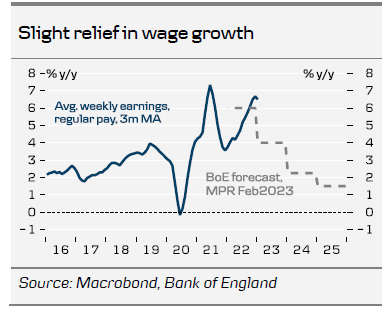
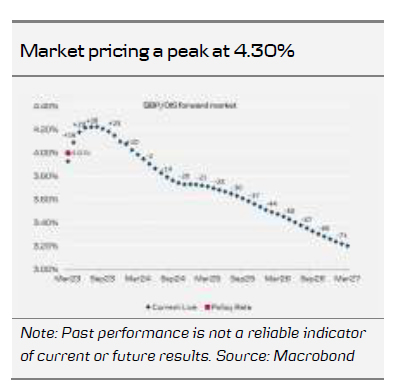
We expect this to be the final hike before the BoE turns to a more wait and see approach. This is slightly fewer hikes than priced in markets (currently 30bp until September 2023). Also we do not expect rate cuts to be delivered by BoE before 2024.
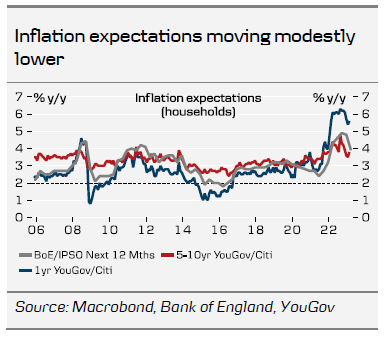
Growth outlook. The UK economy narrowly avoided negative GDP growth in Q4. This was not least due to stronger than expected growth during October and November, while data has pointed to weaker signals for December. This, however, does not mean that the UK economy will avoid a recession, but merely that it will come later than originally pencilled in.
FX. In our base case of a 25bp hike, we expect EUR/GBP to move slightly lower upon announcement. In its statement we expect the BoE to prime markets for a pause in the hiking cycle as the central banks want to fully evaluate the effect from previous Bank Rate increases. Overall, we regard the relative central bank outlook to be a positive for EUR/GBP but with other factors acting as a headwind, we increasingly see a case for continued range trading in the cross.
March Flashlight for the FOMC Blackout Period: The Flashlight Needs Fresh Batteries
Summary
- The FOMC downshifted its pace of policy tightening, lifting the fed funds rate by 25 bps to a range of 4.50-4.75%, at the conclusion of its last meeting on February 1. Since then, the ground under the Fed has shifted enormously.
- The economic data have been decisively strong since the FOMC last met. Nonfarm payrolls rose by a combined 815K in January and February, and the inflation data remained uncomfortably high over the same period. Furthermore, upward revisions to the hiring and inflation data covering the end of last year suggest that the strength cannot be fully chocked up to an unusually warm first two months of the year. Rather, it appears monetary policy tightening to date has had a less potent effect on dampening demand growth and inflation than many observers would have thought previously.
- In isolation, the recent economic data are supportive of further tightening at the March 22 FOMC meeting. However, recent developments in the financial system have clouded the outlook to a considerable degree. Financial conditions tightened abruptly following the failures of Silicon Valley Bank (SVB) and Signature Bank on March 10 and 12, respectively. Financial markets have been highly volatile but clearly have reduced the amount of anticipated policy tightening by the Federal Reserve.
- Further hiking the fed funds rate would be a crystal-clear signal of the FOMC's commitment to reducing inflation while also displaying confidence in the measures put in place to stem recent financial market stress.
- However, the dust is still settling from the nation's second and third largest bank failures in history. We look for the FOMC to briefly pause its tightening efforts to ensure the situation is under control. In our view, the last thing the FOMC wants is more financial instability that threatens the banking system and forestalls any additional rate hikes down the road. But, neither a hike nor a pause would surprise us.
- If, as we anticipate, the FOMC opts to hold the fed funds rate at 4.50-4.75% at next week's meeting, it could use the "dot plot" to clearly signal that the tightening cycle is unlikely to be over just yet. Between the economic data's recent strength and the presumption that efforts to stem stress in the financial system will be effective, we expect the median dot for 2023 to move up 25 bps to a range of 5.25-5.50%.
- With some FOMC members likely to believe that rates will also need to be held above neutral for longer, we expect the median estimate for the fed funds rate at the end of 2024 to move up 25 bps from its December range of 4.00-4.25%.
What a Difference A Week Makes
The most recent FOMC inter-meeting period has been quite the roller coaster ride. Since the FOMC concluded its past meeting on February 1, data have suggested that the economy has significantly more positive momentum than previously believed. The resilience of the labor market and inflation in particular raised the prospect of the Committee re-accelerating the pace of rate hikes. With Chair Powell appearing open to such a move, the odds of a 50 bps move seemed a bit better-than-not in the days leading up to the blackout period. As recently as March 8, markets were priced for roughly a 70% change of a 50 bps rate hike.
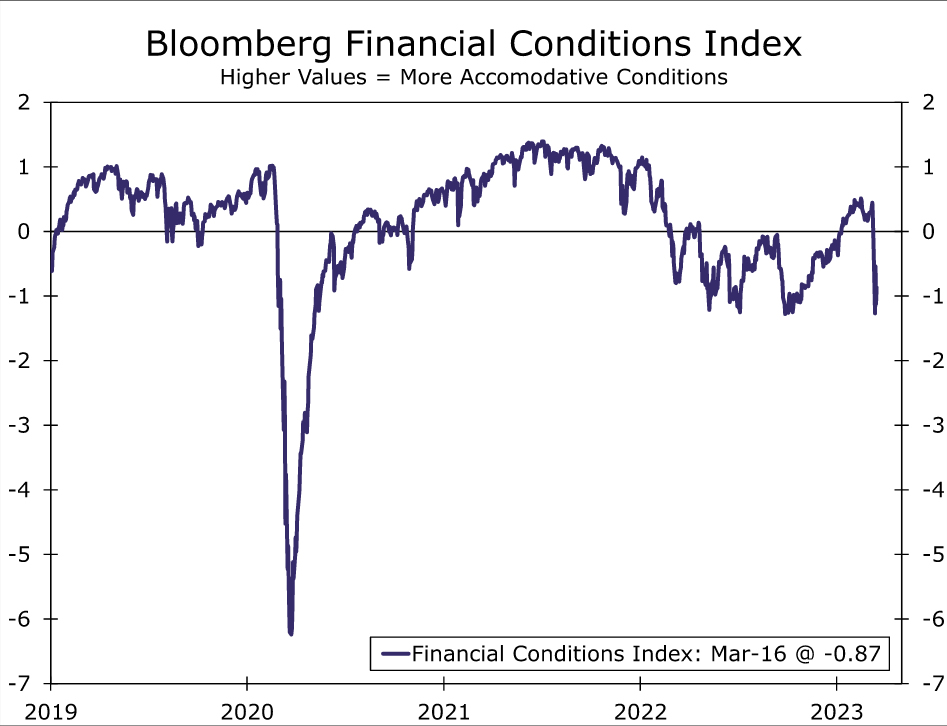
How quickly the world can change. Financial conditions tightened abruptly following the failures of Silicon Valley Bank (SVB) and Signature Bank on March 10 and 12, respectively (Figure 1). Policymakers responded swiftly to stem concerns that other financial institutions may find themselves in a similar position. On Sunday, March 12, the Federal Reserve announced a new lending facility—the Bank Term Funding Program—which allows eligible depository institutions to borrow against Treasury securities, mortgage-backed-securities and certain other securities at par. In addition, the Fed, FDIC and Treasury Department issued a joint statement on March 12 that included an assurance that even depositors with balances above the $250,000 FDIC insured threshold would be made whole.
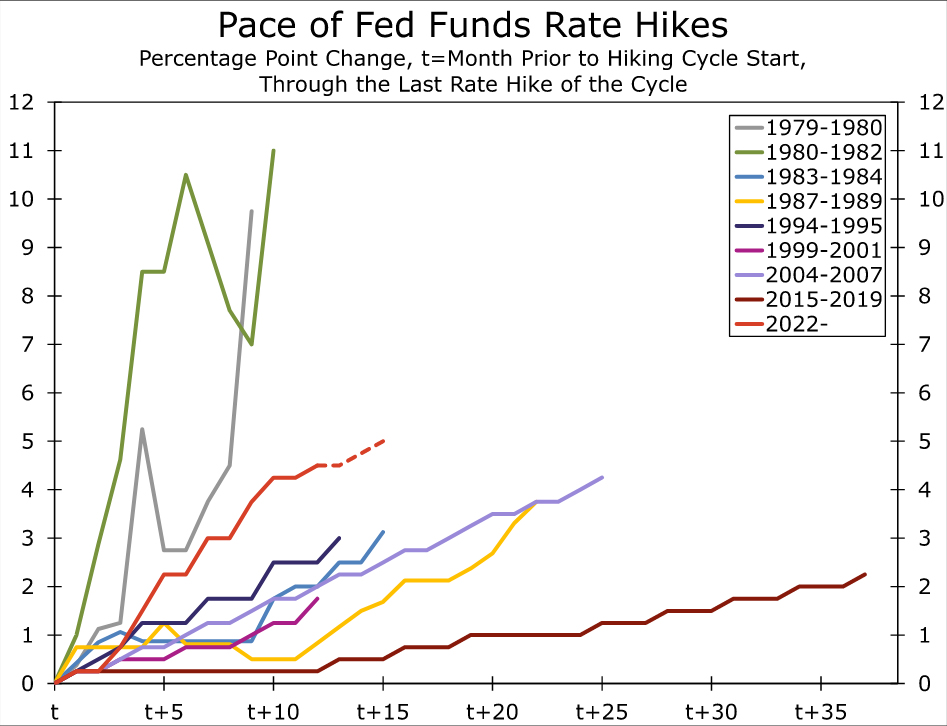
We covered these bank failures and the policy response in a recent special report. Both SVB and Signature Bank had some unique characteristics that made them particularly susceptible to a bank run. However, the failures brought to light the risks to financial stability that lurk behind the most aggressive monetary policy tightening in four decades (Figure 2). The FOMC was already performing a delicate dance by trying to rein in inflation without inflicting undue harm on the labor market. The recent financial market turmoil adds another dimension as policymakers must balance their efforts to quell inflation against the risk of igniting additional financial system stress.
Scales Tilted Toward a Pause, but It's a Close Call
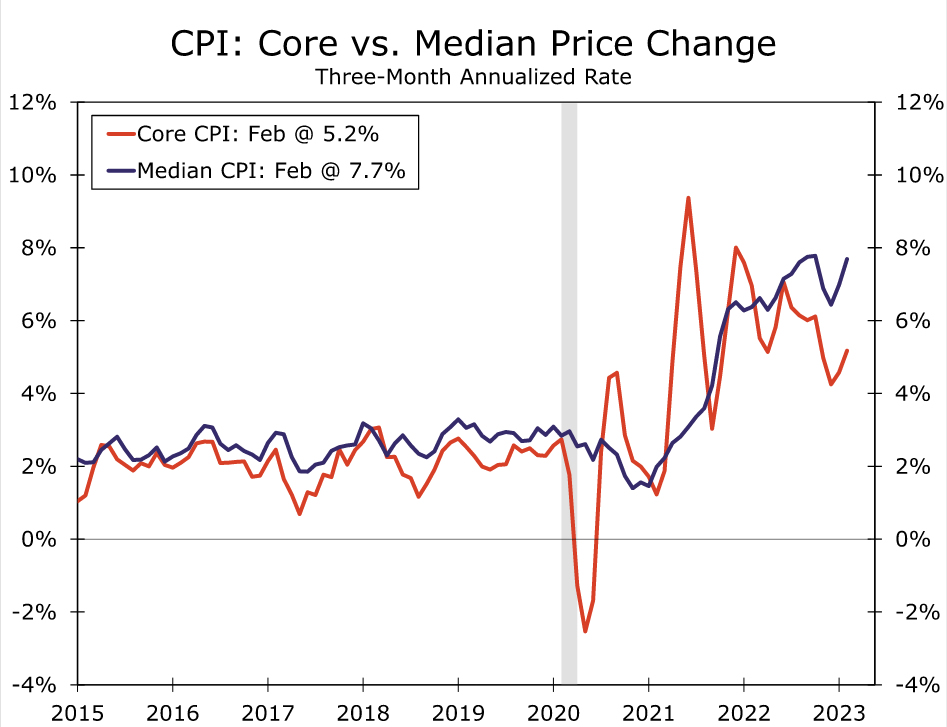
Whether or not the FOMC will proceed with policy tightening at its March meeting is not an easy call. Recent economic data clearly argue for at least another 25 bps rate hike. Not only does inflation remain well above target, but the underlying trend appears even higher than when the FOMC concluded its last meeting. Upward revision to last year's inflation data and hot reports in January and February pushed the three-month annualized change in core CPI to 5.2%. Gains remain broad-based, with the median CPI advancing at a 7.7% annualized clip over the same period (Figure 3). What’s more, job growth has remained exceptionally strong. The economy added a combined 815K jobs in January and February on top of meaningful upward revisions to hiring in the fourth quarter of last year. Even with nascent signs of the jobs market cooling, such as the unemployment rate ticking up and average hourly earnings growth ticking down, the labor market remains incredibly tight. Opting to continue its tightening campaign would be a crystal-clear signal of the Fed’s commitment to bringing down inflation. It would also display confidence in the measures put in place to stem recent financial system stress.
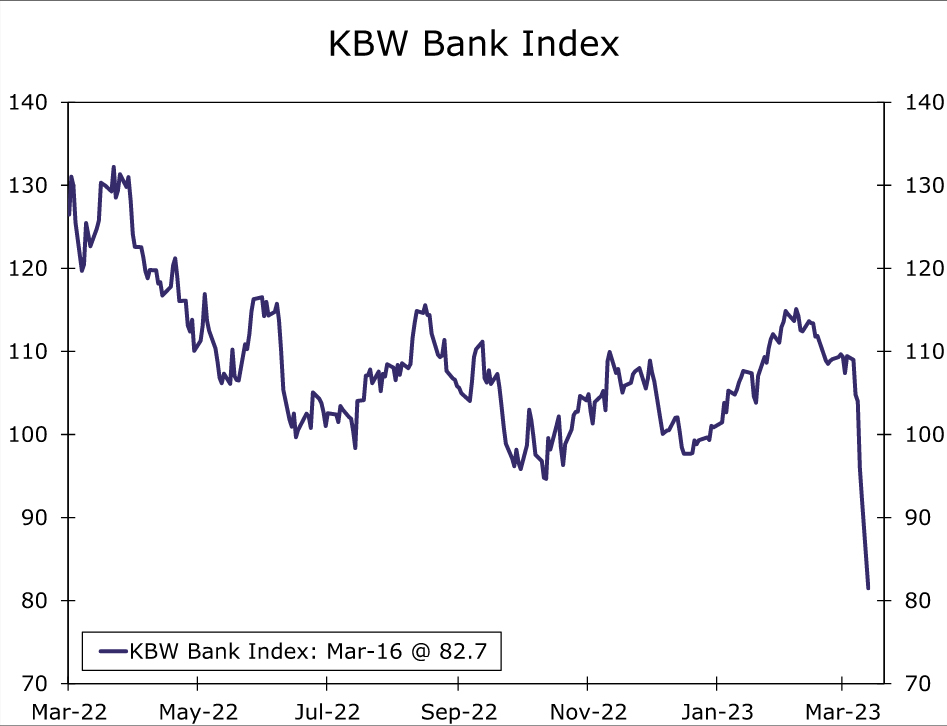
However, we believe the FOMC will pause its hiking campaign at next week’s meeting. The dust is still settling on the fallout from the second and third largest bank failures in the nation’s history. Headlines have swirled this week about additional financial system stresses, and share prices of many banks have tumbled (Figure 4). A brief pause gives policymakers time to ensure they have the situation under control and signal that they are attuned to the wide range of possible outcomes that could occur. Once financial markets have stabilized, additional monetary policy tightening can resume at subsequent meetings. Although there could be a small cost to the Fed's inflation-fighting credibility with a pause, we believe the cost is outweighed by the possibility of fanning the flames at a time of heightened vulnerability. Put another way, the last thing the FOMC wants is more financial instability that threatens the banking system and forestalls any additional rate hikes down the road.
Ultimately, neither outcome would surprise us. A 25 bps rate hike at the March 22 meeting is clearly on the table, and other outcomes, such as a rate hike but a pause to quantitative tightening, strike as plausible, albeit less likely. Regardless, Chair Powell and his colleagues will have a very difficult tightrope to walk with their communication. We suspect the statement will include new language that references recent events but expresses confidence in the financial system and calls for additional monetary policy tightening to ensure the inflation fight is seen through to its conclusion. Chair Powell's public remarks likely will reinforce this message. Looking ahead, we forecast that the FOMC will resume its tightening cycle in subsequent meetings with a 25 bps hike on May 3 and a final 25 bps increase on June 14. See our most recent U.S. Monthly Economic Outlook for more details regarding our forecast.
Summary of Economic Projections: The Tightening Cycle Is Unlikely to Be Over Yet
Even if the FOMC opts to pause, we doubt most members of the Committee will want to signal that the current tightening cycle has come to an end. The post-meeting statement and Chair Powell's press conference will contain clues, but this meeting will also include an update to the Summary of Economic Projections (SEP). Chair Powell stated in his congressional testimony on March 7 & 8 that the recent stronger-than-expected data "suggests that the ultimate level of interest rates is likely to be higher than anticipated". But, that was before the recent bank failures and subsequent financial system stress.
In the most recent SEP, published at the December 2022 meeting, participants' median expectation for the fed funds target range at the end of 2023 was 5.00-5.25%, roughly a quarter-point higher than the market at the time of its publication. But, the distribution skewed higher (Figure 5). Given the recent financial system turmoil, we doubt the dots will move higher in a major way. But, with inflation's momentum proving more difficult to break and the economy continuing to expand at a solid rate, we expect the median dot for 2023 to shift up to a target range of 5.25-5.50%, 25 bps higher than the December projections. An increase of a similar magnitude for the median dots in 2024 and 2025 also strikes us as reasonable. In our view, this would be a way for the FOMC to illustrate its intentions that, despite a brief pause, monetary policy tightening will resume in the near future.
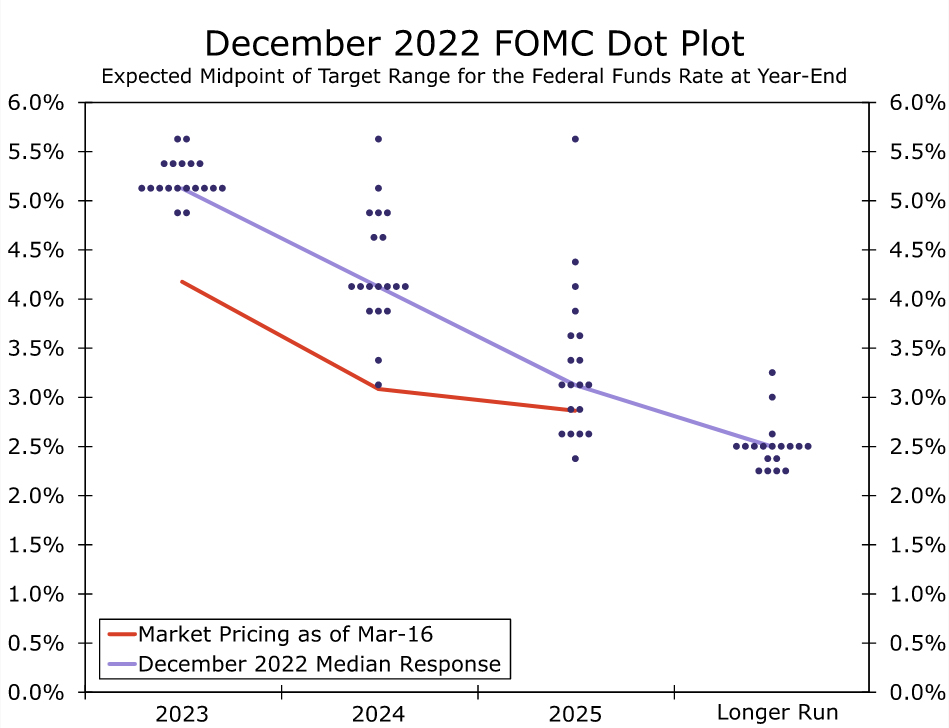
We suspect the dispersion of the dots will become even wider. In the December projections, most of the 2023 dots were clustered between 5.0% and 6.0%. Yet in 2024 and 2025, there was a much broader ranger of views among Committee members, with the lowest 2024 dot (3.125%) well below the highest 2024 dot (5.625%). Given the elevated uncertainty in the economic outlook, we would not be surprised if the distribution of dots becomes even less concentrated for 2023 and beyond.
The recent strength of the economy and inflation are likely to be evident in the Committee's economic projections. We estimate that real consumer spending grew at a solid 2.8% annualized rate in Q1, and, as a result, we expect the Committee's median projection for 2023 real GDP growth, which was 0.5% in the December projections, to be revised up by at least a few tenths-of-a-percentage point. However, with the effects of policy tightening seeming to take longer to feed through to the economy, we would not be surprised to see the median GDP growth estimate for 2024, most recently at 1.6%, revised somewhat lower.
Similarly, the year-end 2023 estimate for the unemployment rate is likely to be revised down slightly. The unemployment rate ended 2022 two-tenths of a percentage point lower than the FOMC's projection in December, and it stood at just 3.6% in February. If the median estimate for the unemployment rate in Q4 remained unchanged at 4.6%, it would imply FOMC participants expect the labor market to deteriorate more rapidly this year, which seems unlikely.
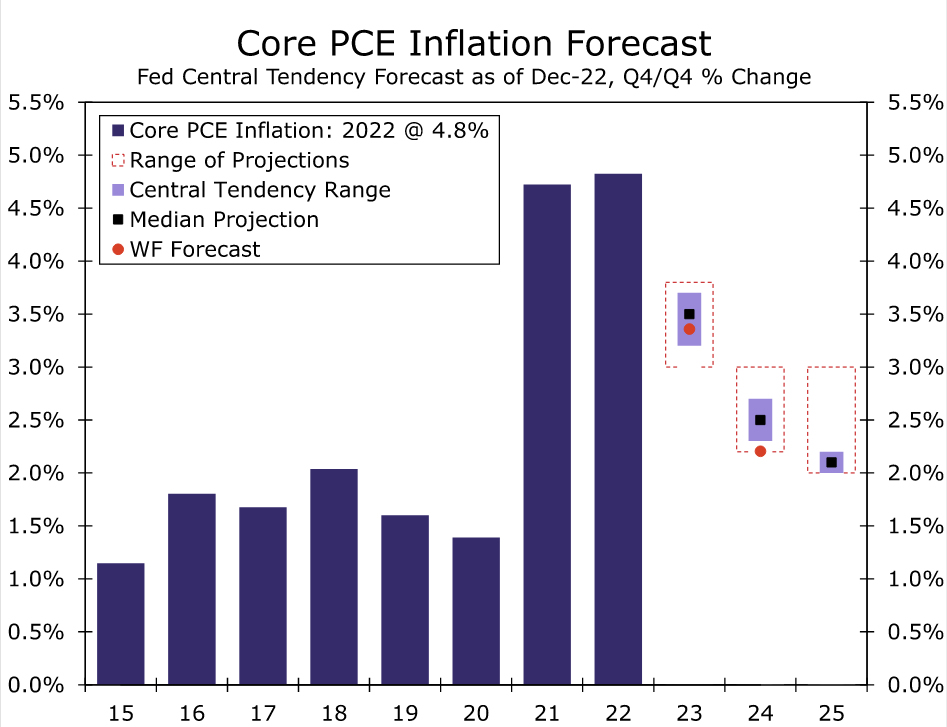
While the recent run of strong inflation data has led market participants and many economists, including ourselves, to mark up inflation forecasts, Fed officials appear to have been less caught off guard. The median estimate for Q4/Q4 core PCE inflation was 3.5% in the December SEP, roughly half a percentage point above the December Bloomberg consensus and median submission to the New York Fed's December primary dealer survey. Our most recent forecast is for core PCE inflation of 3.4% in Q4-2023 (Figure 6). We think the Committee's median inflation projections for 2023 and beyond could tick higher by a tenth or two, but we would be surprised by a move any larger than that.
Week Ahead – Fed Decision to Fuel Volatility in Nervous Market
With cracks appearing in the US banking system, markets think there’s a chance the Fed won’t raise rates next week. But considering that the Fed has already taken measures to ease financial stress and that inflation is still raging, the most likely outcome is a rate increase accompanied by high rate projections, which could boost the dollar. The Bank of England and the Swiss National Bank meet as well.
Fed dilemma
It’s going to be a difficult meeting for Fed officials on Wednesday, who will have to decide whether the priority is to safeguard the stability of the US financial system or fight inflation at all costs.
Traders are betting that the episode in the banking sector will force the Fed to stop its tightening cycle soon, perhaps even at this meeting. The implied probability of a quarter-point rate increase next week stands at 80%, with a 20% chance that the Fed does nothing at all. Beyond that, markets are pricing in rate cuts for the summer.
Admittedly, this speculation seems overblown. The broader banking system and especially the big US players are well capitalized, so there isn’t much threat of a Lehman-style meltdown. Most of the stress is in smaller regional banks, which the Fed has already rushed to support by rolling out an emergency lending program.
Instead, the real enemy is still inflation. Fed officials have stressed that the metric they care most about is services inflation excluding shelter, which printed 6.9% last month. That’s too hot, and coupled with the strength in employment indicators, it doesn’t allow policymakers any room to stop tightening.
It was only last week that the Fed Chairman warned rates might be raised higher than what his central bank projected in December. Back then, Fed officials expected rates to end the year at 5.1%, but current market pricing sees them at only 4.2% by year-end. That’s a huge gap, and if those projections are maintained or raised further next week, it would probably ‘shock’ markets.
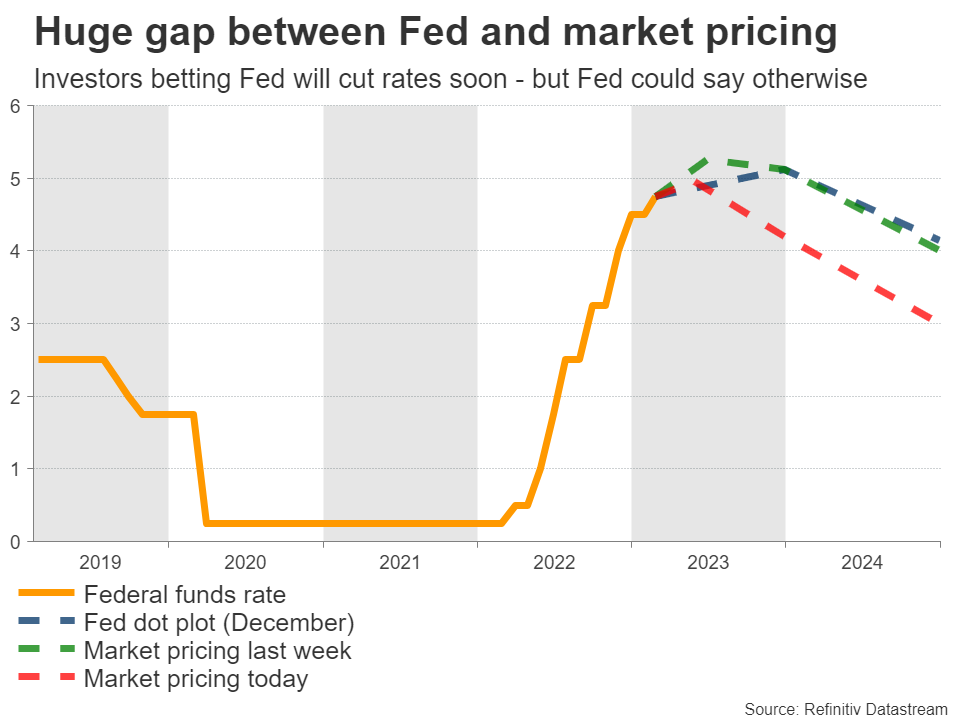
In other words, investors believe that if there is a rate increase next week, it will be the final one this cycle. But the Fed might say otherwise. It has already taken measures to shore up the banking system, and inflation is far too high to stop raising rates.
If the Fed indeed sticks to its guns, that could spark a strong repricing in the markets, propelling US yields higher and boosting the dollar in the process. In contrast, the main casualty might be the Japanese yen, so dollar/yen could experience a particularly violent reaction.
BoE meeting a coin toss
The United Kingdom has remained out of the spotlight lately, as investors are more nervous about banks in the US and Eurozone. In fact, most UK news has been positive lately, both politically and economically.
After several months of business surveys warning about a UK recession, the latest batch painted a brighter picture, revealing a recovery in new business orders that is positive news for future growth. Of course, the economy is not out of the woods. Inflation is still running at double-digits, as electricity prices have surged dramatically and post-Brexit worker shortages have exacerbated the issue.
Investors will receive an inflation update on Wednesday, ahead of the latest business surveys that will be released Friday alongside retail sales. But the main event will be on Thursday, when the Bank of England announces its decision.
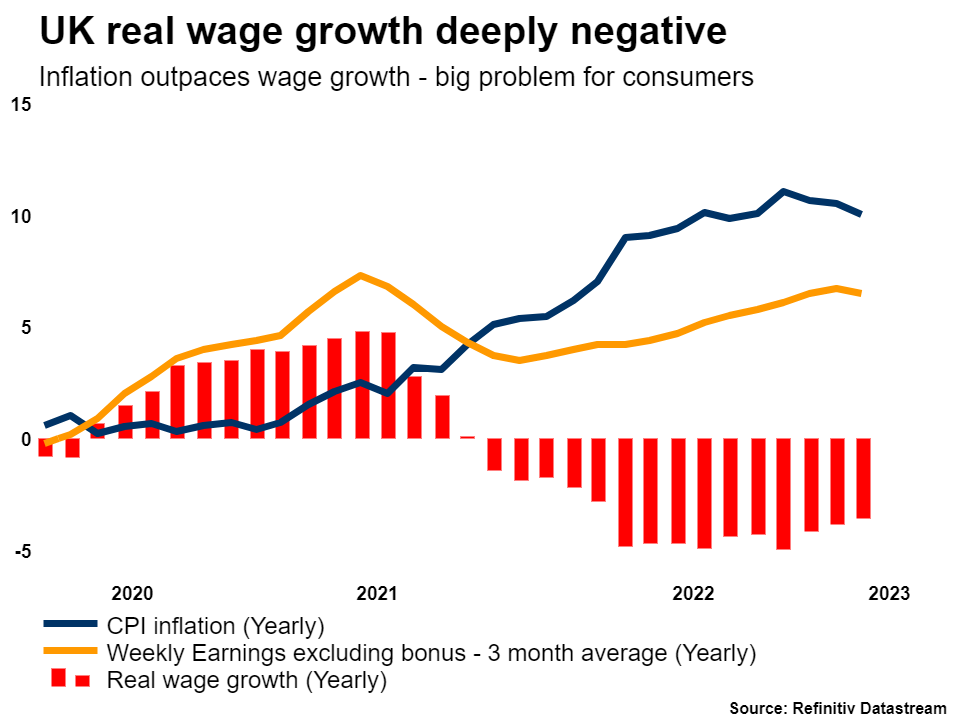
Markets see this rate decision as a coin toss, pricing in 50-50 chances for a quarter-point rate increase or no action. This pricing seems fair, as the British economy is not in great shape and central bank officials have been hesitant to raise rates overall. Since the data flow has been stronger lately, the odds likely favor a rate hike, but it’s a close call.
As for sterling, the outlook seems cautiously negative. The UK economy might be stabilizing but is still fragile, its inflation problem is bigger than other nations, and the BoE is near the end of its tightening campaign. Combined with the pound’s sensitivity to the global investment mood at a time of turbulence in the markets, it’s tough to be optimistic.
Switzerland’s banking troubles
Switzerland has been at the epicenter of the recent banking panic, amid fears about the solvency of Credit Suisse. Nerves calmed after the Swiss National Bank pledged $54bn in emergency funding to the troubled bank, but the stress hasn’t disappeared as there is still elevated demand for derivatives that protect against a Credit Suisse default.
Despite this turmoil, investors still expect the SNB to raise rates by a quarter of a percent on Thursday. The rate increase is already fully priced in, so the market reaction will depend mostly on the economic commentary and any signals about future actions.
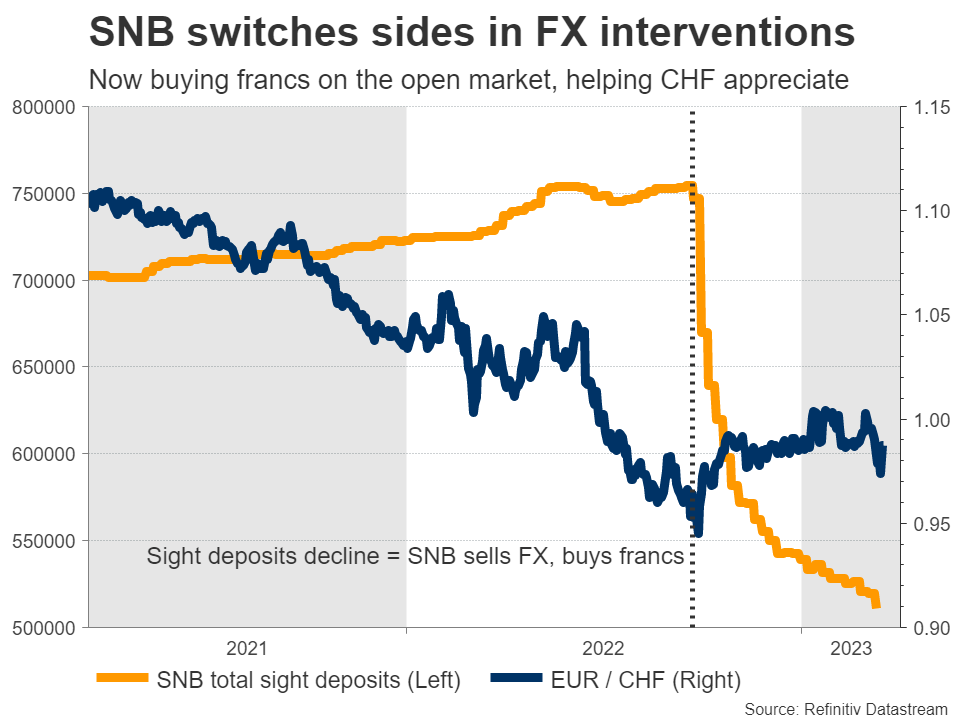
Bank troubles aside, the outlook for the Swiss franc looks positive. The SNB is still intervening in the FX market but it has switched sides in recent quarters - it is now buying francs on the open market to help the currency appreciate. Coupled with ongoing rate hikes and resurfacing concerns about the world economy, the environment is favorable for the safe-haven franc.
The wild card is Credit Suisse, but judging by the forceful policy response, it is likely that it will be protected.
Finally on the data front, the spotlight will fall on the Eurozone, where the latest PMI business surveys will be released Friday. Over in Canada, inflation and retail sales stats will be released Tuesday ahead of the minutes of the latest Bank of Canada meeting on Wednesday.
Weekly Focus – ECB Holds the Course Through Stormy Waters
After a long period of unusually low interest rates, some may have been concerned that when central banks hike interest rates rapidly, eventually something could break. Events unfolding in the past seven days have served as a sharp reminder that there may be a trade-off between central banks' fight against inflation and financial stability. Referring to ECB President Lagarde's press conference this week, they disagree though.
The ECB hiked interest rates by 50bps and repeated their commitment to hike more. As long as the baseline persists i.e. inflation remains sticky and a systemic crisis is avoided, the ECB has 'a lot more room to cover'. The ECB sees no contradiction in sustaining price and financial stability at the same time, which we consider a signal that the threshold not to hike is high. If necessary, new 'creative' measures can be introduced to address liquidity issues. We keep our call for a 50bp hike in May and a peak policy rate reached in July of 4%, see Flash ECB Review: 50bp hike but no guidance for May, 16 March.
Last weekend, the US authorities took control over two banks that had ended in an acute liquidity crisis. The response was stark: All deposits in the two banks would be covered and the Fed set up a new term-funding program where banks could access liquidity against high-quality collateral, valued at par. It is unusual for a central bank not to protect itself from credit losses by imposing haircuts on collateral, and by all measures, the response can be considered impactful. Yet, on Thursday, concerns focused on another US bank, First Republic, until it received a USD 30bn deposit from larger lenders. Fears are also reflected in the swelling of Fed's new lending facility, in a flow of deposits from medium-sized to large US banks and in investors' flight to money market funds.
Worries regarding banking sector health quickly crossed the Atlantic. In Europe, the SNB was forced to step in and provide a liquidity loan to its second largest bank Credit Suisse on Wednesday evening after the share price had plummeted and the CDS market was pricing in a rising risk of default. By Thursday, the share price had started to recover but the CDS was still trading at distressed levels. Some systemic risk indicators have also risen. For example, expected volatility has increased in the stock market and even more in the bond market. Money market risk premia has increased slightly but remains far from the very distressed levels seen during the global financial crisis.
Despite financial stability concerns, inflation woes persist. In the US, February CPI came in close to our expectations but core surprised to the upside. We keep our call for a 25bp hike by the Fed next week (Global Inflation Watch - Central banks balance inflation and financial stability risks, 15 March). Also, February CPI in Sweden came in higher than expected, and as a result, we changed our Riksbank call and now expect a peak rate at 4.25% (prev. 3.75%) Flash Comment: Riksbank to hike 75bp + 50bp from here, 15 March.
Apart from the obvious market focus on Fed next week, flash PMIs from Europe and the US are likely to attract interest. We pay close attention to whether confidence has been shaken by the recent developments (data has been collected mid-month). We will also follow closely Lagarde's speech on Tuesday for any change in tone. We expect the Bank of England to deliver their final hike next Thursday, bringing the bank rate to 4.25%.
Silver Bulls Still Hungry, But Technical Picture Complicated
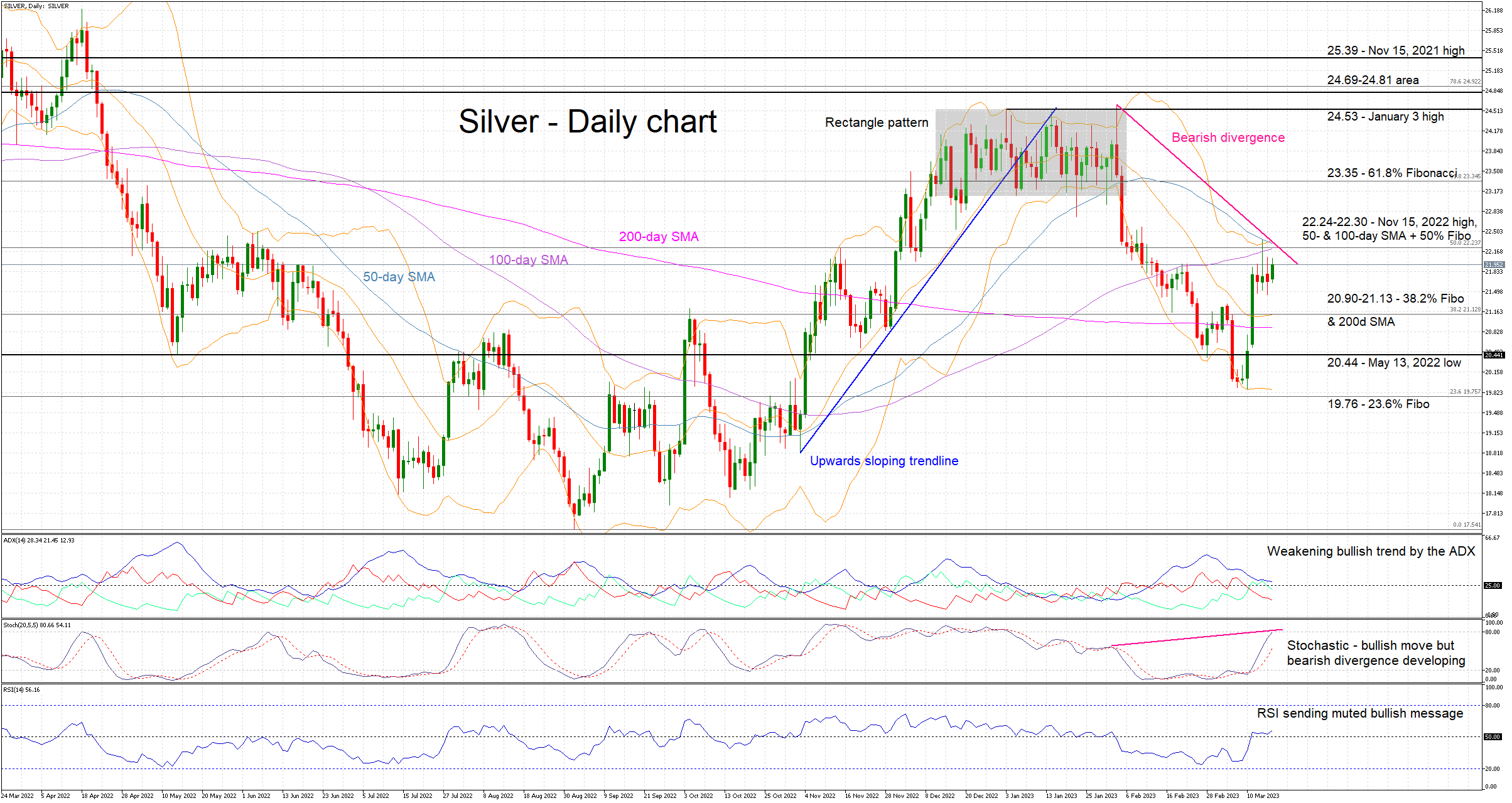
Silver appears to have found a new balance around the 21.70 area, recovering somewhat from the 4-month low of 19.88 recorded on March 10. This area has been a thorn in the bulls’ side in both the June-July 2022 and November 2022 periods, with an upside breakout eventually taking place.
At this juncture, the silver bulls are facing strong resistance from the trifecta of the 50% Fibonacci retracement of March 8 – September 1 downtrend and the 50- and 100-day simple moving averages (SMAs) at the 22.24-22.30 area.
While the recent moves by both the stochastic oscillator and RSI are sending a bullish message, there are two factors that should potentially worry the bulls in the market. The Average Directional Movement Index (ADX) is signaling a weakening bullish trend, potentially throwing a spanner in the works for the bulls. In addition, the higher high seen in the stochastic oscillator has not been matched with a higher high in the silver price action. This is usually an indication of a bearish divergence developing in the market.
Should the bulls remain confident, their initial target could come at the busy 22.24-22.30 area. Higher, the 61.8% Fibonacci retracement of 23.35 could trouble them, ahead of the key January 3 high of 24.53.
On the other hand, the bears appear to have a clear path until the 20.90-21.13 range set by the - 38.2% Fibonacci retracement and the 200-day SMA. Even lower, the May 13, 2022 low at 20.44 could be an area where the bulls might decide to set up their defense.
To conclude, silver bulls are trying to break above a busy area, but there are increasing signs not favouring them at this juncture.
Did the ECB Just Predict the Fed?
Since the start of the banking crisis just a week ago, markets have been recalibrating their expectations for central banks. It's broadly understood that the main driver of weakness in the banking sector at the moment is higher interest rates. This has led to the natural conclusion that the Fed won't hike as aggressively, or at all, when it meets next week. But, that could be based on a couple of hasty assumptions.
The Fed might still be in tightening mode
After the last meeting, the Fed essentially communicated that there would be another 25bps hike in March. Evidently it was couched in conditionalities, Powell clearly conveyed the idea that the Fed was getting ready to pause. He explicitly said a "couple" of more hikes, which would presumably include the meetings of March and May.
Since then, speculation of what the Fed would do varied wildly, depending on events. 50bps was first hinted at after the blow-out jobs number in January. It became the dominant theme less than two weeks ago when Powell provided testimony before Congress, suggesting that the Fed could increase the pace of hikes. Now, that has completely reversed, with a 50/50 chance of a 25bps hike or no hike at all.
Too much speculation?
The thing is, all of these changes have been based on reading the tea leaves of what the Fed might think of data points. As far as the Fed's "narrative" is concerned, 25bps is still the game plan. That's what was officially conveyed after the meeting, and what officials were talking about right up until the Fed's blackout period. In other words, if the Fed were to do a quarter point, it wouldn't be a change from any previous guidance that it has provided.
Enter the ECB, which just yesterday hiked rates by 50bps as expected, with hardly any reaction in the EURUSD. The ECB went through with their telegraphed plan, saying they were focused on inflation, and that other measures would be taken to address the banking issue. This is the separation of the policy and intervention aspects that we mentioned previously. Central banks are generally seen as having two main tools to affect markets: the interest rate, and the balance sheet. While they are the main policy tools, central banks can use other measures to address specific issues. Which is why it might be a little early to assume the Fed will pull back on its efforts to control inflation in order to shore up the banking sector, just as it might have been a little too early to suppose the Fed would hike by 50bps.
The market getting ahead of itself again
Last Sunday, the Fed announced a new mechanism known as BTFP, which would effectively provide unlimited short-term loans for banks that needed liquidity and were affected by high interest rates. Although it didn't shore up stock traders, and bank shares have fallen dramatically in the last few days, it might be seen as sufficient by Fed officials. Just like the ECB figured that the SNB's actions to protect Credit Suisse was enough.
The ECB's use of this principle without any dramatic ill effects - in fact, European bank shares rose following the ECB's decision - could encourage similar action from the Fed. Maybe not a 50bps hike, since the Fed hasn't really said that it would do that at the next meeting. But the Fed is likely to be still keen to maintain its inflation-fighting credibility, which it can do by following through on its forecast of a quarter point hike next week.
Now we'll have to see if the market adjusts to that kind of thinking before Wednesday.
How Will Euro Move After the ECB
The European Central Bank (ECB) raised its interest rates by 0.5% to 3%, as planned, to combat inflation, despite some investors' calls to delay the hike due to banking sector turmoil. The ECB is expecting inflation to exceed its 2% target through 2025. The Euro gained poitively against the Dollar and Pounds, and Swiss Francs as a result of the fundamental data, the technical outlook, however, would determine what our reaction to this situation would be.
EURUSD
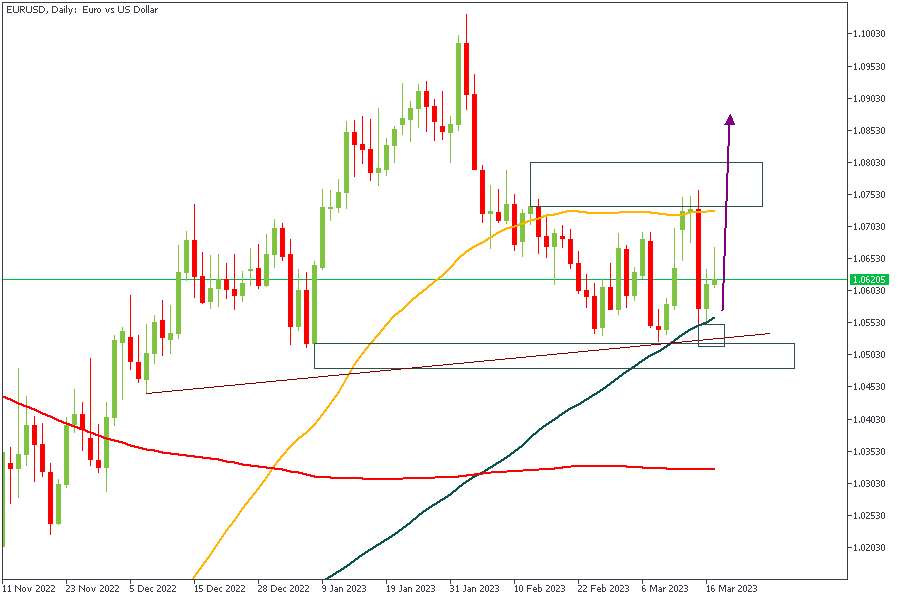
EURUSD has made an initial reaction to the drop-base-rally demand zone. At this juncture, we also see how the demand zone aligns perfectly with the 100-Day Moving Average, the trendline support, and the 88% Fibonacci retracment area. The sentiment is clearly, largely bullish.
Analysts’ Expectations:
- Direction: Bullish
- Target: 1.08700
- Invalidation: 1.04850
EURGBP
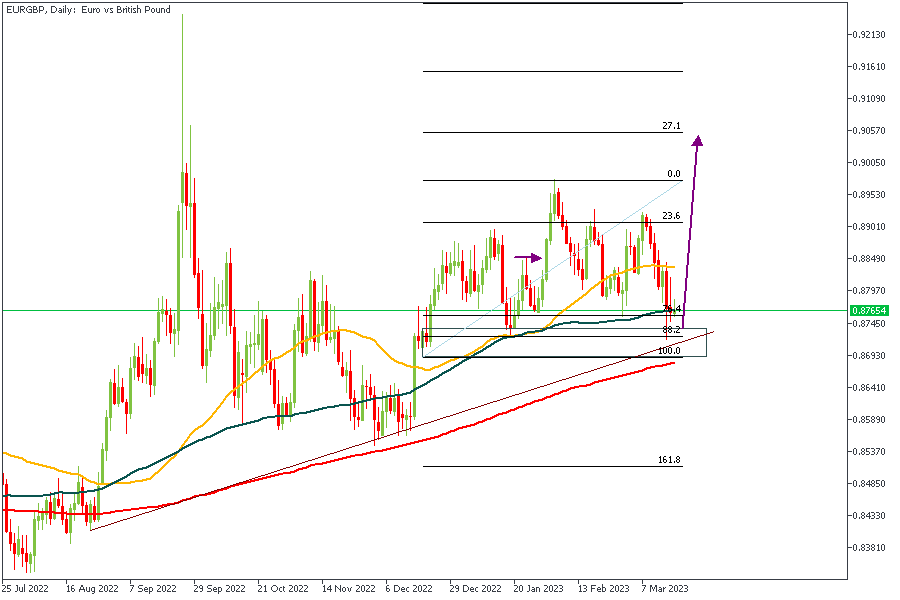
Similar to what we had on EURUSD, we see here how EURGBP also made an initil reaction away from the demand zone. In the case of EURGBP, however, we see the MAs arrayed in a bullish pattern. Based on the confluence of the trendline support, the 200-Day moving average, the MA array, the 88% of the Fibonacci retracement tool, and finally, the demand zone, I will keep my sentiments bullish on EURGBP.
Analysts’ Expectations:
- Direction: Bullish
- Target: 0.90560
- Invalidation: 0.86930
EURJPY
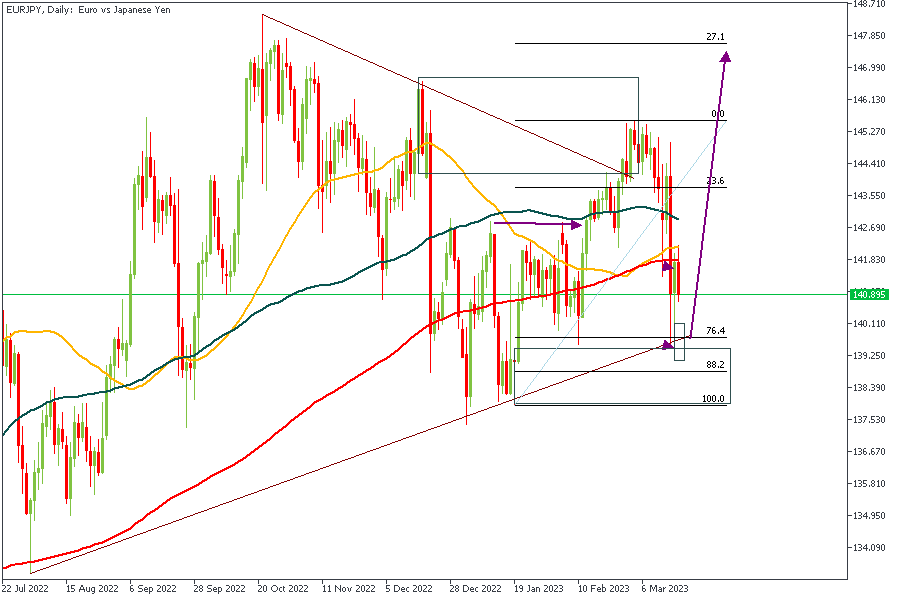
EURJPY recently broke out of a wedge pattern, after which price has made a retracement into the demand zone responsible for that break of structure. It is important to note that as a result of the fact that the demand zone aligns perfectly with the 76% Fibonacci level, as well as the deop-base-rally demand zone, it is only logical to conclude in favour of a bullish outcome.
Analysts’ Expectations:
- Direction: Bullish
- Target: 147.30
- Invalidation: 137.30
EURNZD
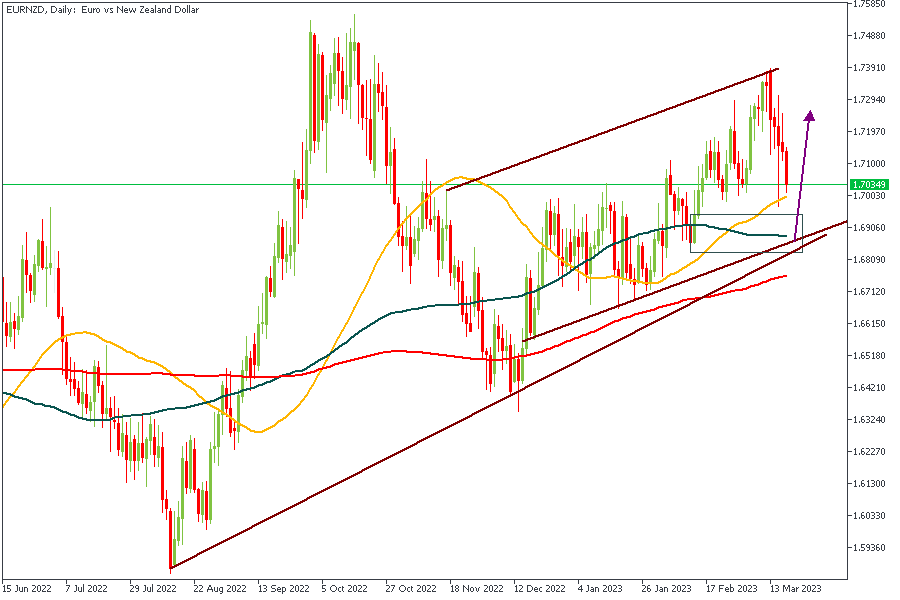
EURNZD is my favourite setup as far as this piece goes, for very obvious reasons. The daily timeframe shows price currently trading within a channel, with the current price action heading towards the trendline support of the channel. The interesting aspect of this setup, however, is the fact that the trendline support has other confluences from the drop-base-rally demand zone, the MA array, the 100-Day MA, and a secondary trendline support.
Analysts’ Expectations:
- Direction: Bullish
- Target: 1.72940
- Invalidation: 1.68090
CONCLUSION
The trading of CFDs comes at a risk. Thus, to succeed, you have to manage risks properly. To avoid costly mistakes while you look to trade these opportunities, be sure to do your due diligence and manage your risk appropriately.
EUR/USD Mid-Day Outlook
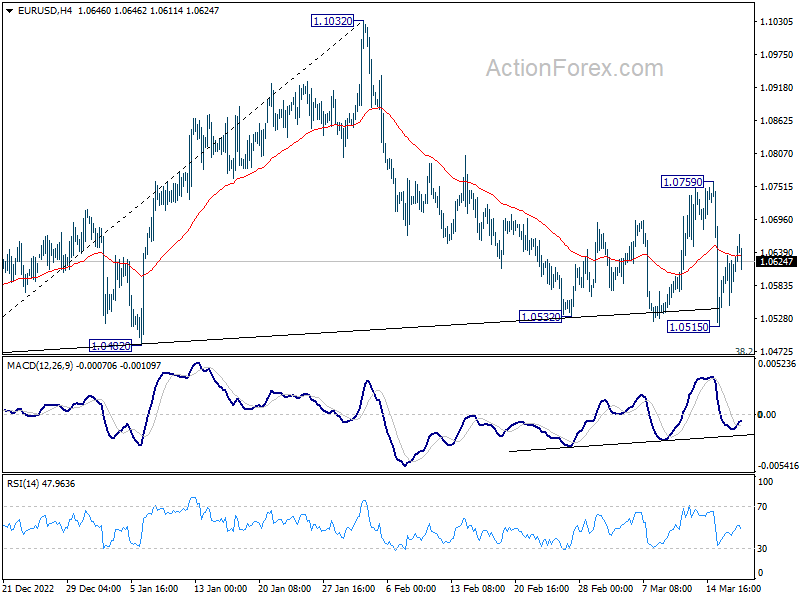
Daily Pivots: (S1) 1.0565; (P) 1.0600; (R1) 1.0649; More...
Intraday bias in EUR/USD stays neutral for the moment. On the upside, break of 1.0759 resistance will argue that corrective fall from 1.1032 has completed at 1.0515, ahead of 38.2% retracement of 0.9534 to 1.1032 at 1.0258. Intraday bias will be turned back to the upside for retesting 1.1032 high. Nevertheless, sustained break of 1.0258 will complete a head and shoulder top (ls: 1.0733, h: 1.1032, rs: 1.0759). Outlook will be turned bearish fro 61.8% retracement at 1.0106.
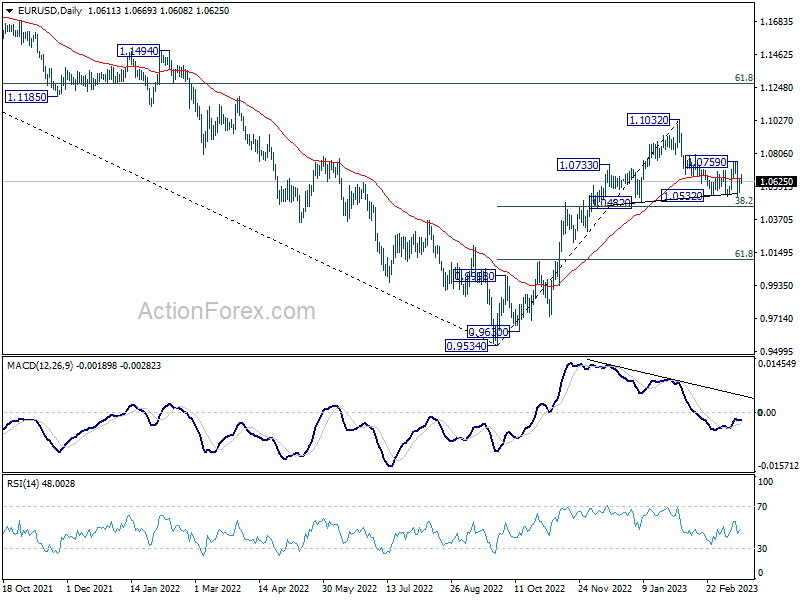
In the bigger picture, as long as 1.0482 support holds, rise from 0.9534 (2022 low) should continue to 61.8% retracement of 1.2348 (2021 high) to 0.9534 at 1.1273. However, sustained break of 1.0482 will bring deeper fall to 61.8% retracement of 0.9534 to 1.1032 at 1.0106, with risk of breaking through 0.9534 eventually.
GBP/USD Mid-Day Outlook
Daily Pivots: (S1) 1.2051; (P) 1.2089; (R1) 1.2151; More...
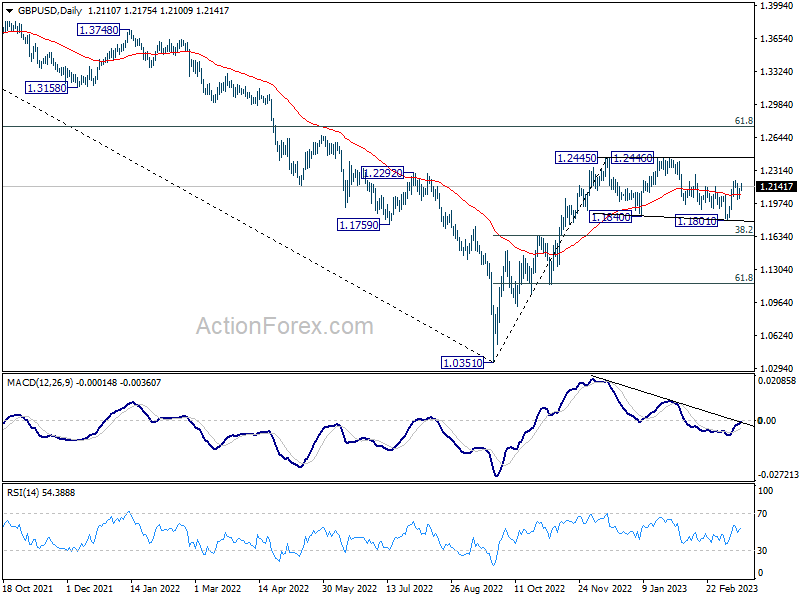
Intraday bias in GBP/USD stays neutral and outlook is unchanged. Corrective pattern from 1.2445 could have completed with three waves to 1.1801 already. On the upside, above 1.2203 will resume the rally from 1.2445/6 resistance zone next. However, decisive break of 4 hour 55 EMA (now at 1.2055) will argue that the pattern from 1.2445 is extending with another falling leg, and turn bias to the downside for 1.1801 again.
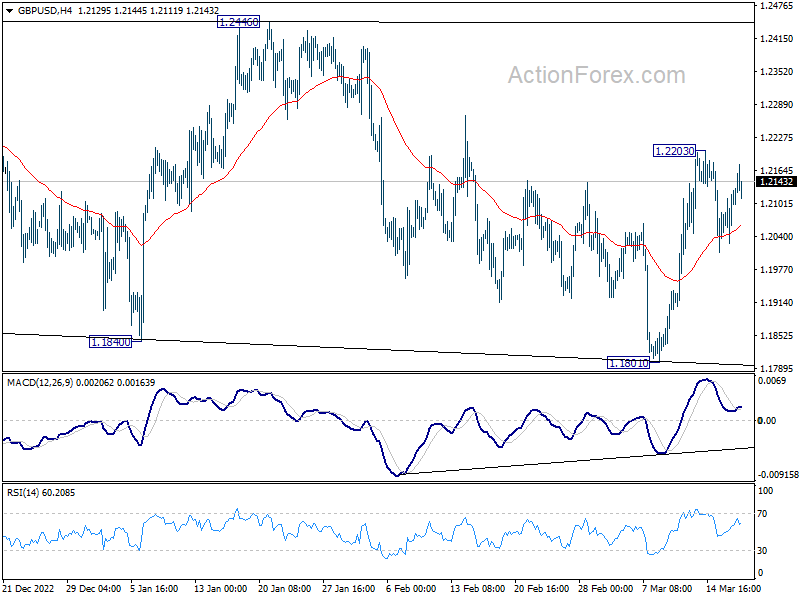
In the bigger picture, price action from 1.2445 are seen as a corrective pattern to rise from 1.0351 medium term bottom (2022 low). Resumption is expected as a later stage and firm break of 1.2446 will target 61.8% retracement of 1.4248 (2021 high) to 1.0351 at 1.2759. This will remain the favored case as long as 38.2% retracement of 1.0351 to 1.2445 at 1.1645 holds.