

Sample Category Title
Focus Remains on Financial Stability Risks
Markets
The Credit Suisse liquidity stopgap helped restore some calm in the run-up to the ECB meeting. The central bank pushed through with its flagged 50 bps rate hike despite recent financial stability concerns. They lifted the deposit rate from 2.5% to 3% as inflation is projected to remain too high for too long (>2% over policy horizon). From now on, Lagarde and co shift to data-dependence when it comes to future policy decisions. Not only in order to assess the inflation outlook, dynamics of underlying inflation and the strength of monetary policy transmission, but also to monitor current market tensions closely and stand ready to respond as necessary to preserve financial stability in the euro area as well as price stability. Regarding the former, the statement suggests providing liquidity support if needed. At the press conference ECB Lagarde said that the central bank has a lot more ground to cover if the inflation baseline persists and uncertainty would remove around financial tensions. Overall, the ECB’s tone remained hawkish on inflation. There’s no trade-off between price stability and financial stability with the ECB ready to address each in its own manner. The first via interest rates, the second via liquidity tools. Financial markets remained extremely stoic from the release of the press statement up until the end of Lagarde’s Q&A session. Afterwards, we finally saw European bond yields come off intraday lows. German yields closed the session 16.7 bps (30-yr) to 20.2 bps (2-yr) higher. Money markets currently discount a final 25 bps rate hike in May or June which is way too conservative in our view. Daily changes on the US curve varied between +5.7 bps (30-yr) and +27.1 bps (2-yr). The ECB’s reaction function might give a glimpse on what the Fed will do next week. In that scenario, also US markets are currently way too dovish positioned. EUR/USD closed at 1.0610 from an open at 1.0577.
Focus shifted during US trading hours to the First Republic Bank, another regional bank which suffered significant deposit outflows in the wake of the SVB and Signature turmoil. Other banks were obviously on the receiving end of these transactions and – in an effort to stave off liquidity concerns and boost confidence – yesterday made a combined amount of $30bn of uninsured deposits back in First Republic. The Treasury Department, Federal Reserve, Federal Deposit Insurance Corp. and the Office of the Comptroller of the Currency said in a joint statement that “this show of support by a group of large banks is most welcome, and demonstrates the resilience of the banking system.” The rescue action has echoes to the handling of the 1998 LTCM crisis. US equity markets opened with losses, but closed 1.2% (Dow) to 2.5% (Nasdaq) higher. Asian risk sentiment remains constructive overnight. EUR/USD rises from the 1.06 area towards 1.0650. Today’s eco calendar is irrelevant. Focus remains on financial stability risks. Liquidity efforts in the US and Switzerland should help to put the recent volatility/scare to bed. Next week’s Fed meeting is the next high profile event.
News Headlines
The French government used a special constitutional procedure (Article 49.3) to get its plan approved to raise the French retirement age to 64 year. This procedure allows the proposal to by adopted without a vote in the National Assembly. The procedure requires that the French government survives a vote of confidence in Parliament related to the topic. Otherwise the bill wouldn’t become effective and the government would have to step down. The opposition also has other procedures at its disposal to delay the reform, including a review by the Constitutional Court or starting a procedure that might result into a referendum.
Data Published by the Fed showed that banks borrowed a combined $164.8bn from two Federal reserve backstop facilities in the week that ended March 15. Banks borrowed $152.85bn from the discount window, up from $4.58bn in the week up to March 08. Banks also borrowed $11.9bn form the Fed’s new Bank Term Funding Program that was put in place last weekend. Rating agency S&P affirmed its AA+ long term credit rating for the US. The stable outlook reflects the U.S.'s institutional checks and balances, strong rule of law, and free flow of information that contribute to stability and predictability in economic policies. It also assumes that Congress will either raise or suspend the debt ceiling to ensure that the Treasury can remain timely on its debt service obligations.
EUR/USD Daily Outlook
Daily Pivots: (S1) 1.0565; (P) 1.0600; (R1) 1.0649; More...
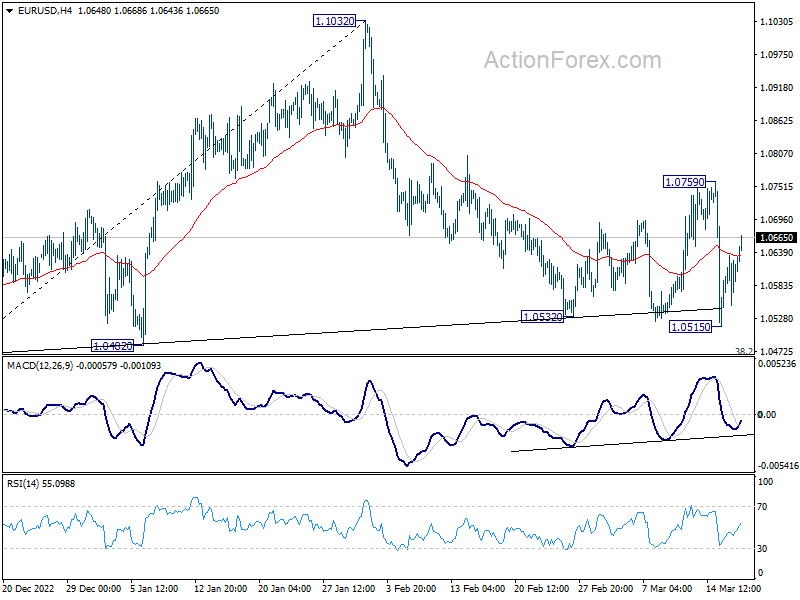
Intraday bias in EUR/USD remains neutral at this point. On the upside, break of 1.0759 resistance will argue that corrective fall from 1.1032 has completed at 1.0515, ahead of 38.2% retracement of 0.9534 to 1.1032 at 1.0258. Intraday bias will be turned back to the upside for retesting 1.1032 high. Nevertheless, sustained break of 1.0258 will complete a head and shoulder top (ls: 1.0733, h: 1.1032, rs: 1.0759). Outlook will be turned bearish fro 61.8% retracement at 1.0106.
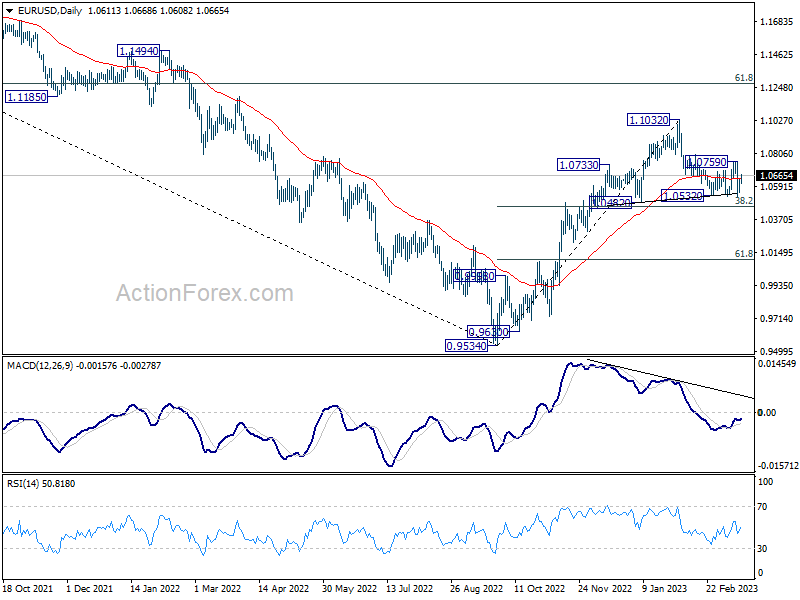
In the bigger picture, as long as 1.0482 support holds, rise from 0.9534 (2022 low) should continue to 61.8% retracement of 1.2348 (2021 high) to 0.9534 at 1.1273. However, sustained break of 1.0482 will bring deeper fall to 61.8% retracement of 0.9534 to 1.1032 at 1.0106, with risk of breaking through 0.9534 eventually.
GBP/USD Daily Outlook
Daily Pivots: (S1) 1.2051; (P) 1.2089; (R1) 1.2151; More...
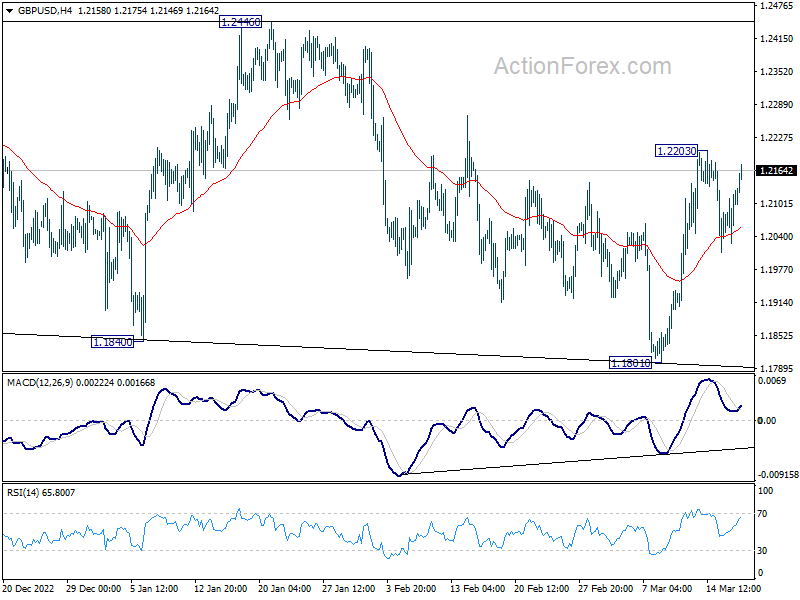
Intraday bias in GBP/USD remains neutral for the moment. Corrective pattern from 1.2445 could have completed with three waves to 1.1801 already. On the upside, above 1.2203 will resume the rally from 1.2445/6 resistance zone next. However, decisive break of 4 hour 55 EMA (now at 1.2055) will argue that the pattern from 1.2445 is extending with another falling leg, and turn bias to the downside for 1.1801 again.
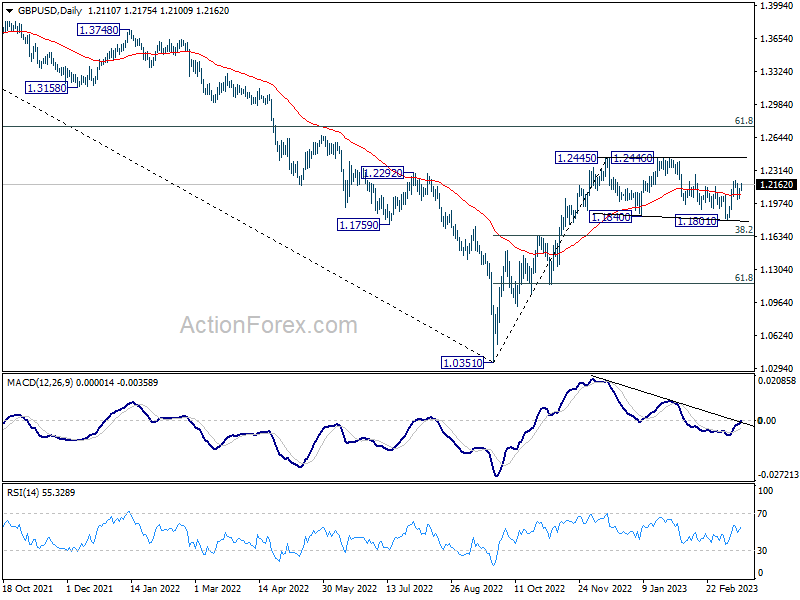
In the bigger picture, price action from 1.2445 are seen as a corrective pattern to rise from 1.0351 medium term bottom (2022 low). Resumption is expected as a later stage and firm break of 1.2446 will target 61.8% retracement of 1.4248 (2021 high) to 1.0351 at 1.2759. This will remain the favored case as long as 38.2% retracement of 1.0351 to 1.2445 at 1.1645 holds.
USD/CHF Daily Outlook
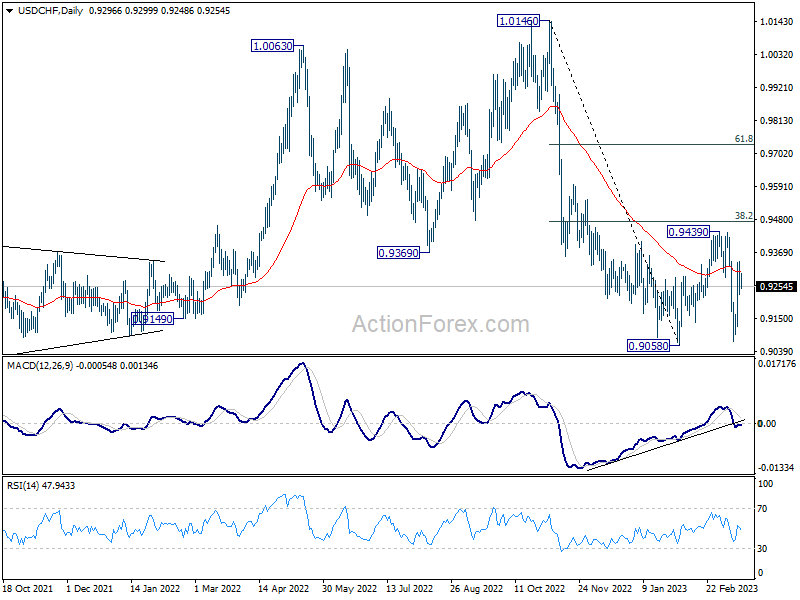
Daily Pivots: (S1) 0.9234; (P) 0.9289; (R1) 0.9347; More...
Intraday bias in USD/CHF remains neutral at this point. Outlook is unchanged that corrective pattern from 0.9058 is still extending. Above 0.9339 will target 0.9439 resistance and possibly above. But overall, outlook will stay bearish as long as 0.9474 fibonacci level holds, and another decline through 0.9058 is expected at a later stage.
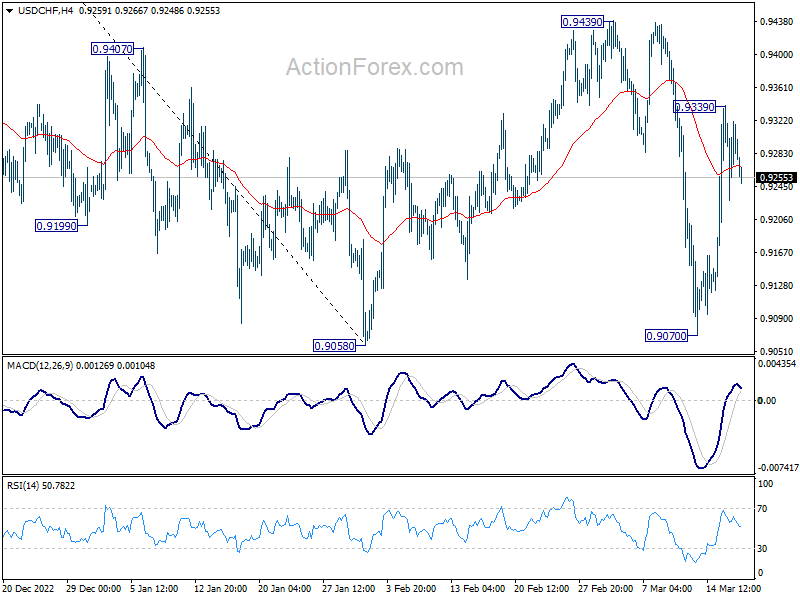
In the bigger picture, fall from 1.1046 (2022 high) should still be in progress with 38.2% retracement of 1.0146 to 0.9058 at 0.9474 intact. Rejection by 55 week EMA was a medium term bearish sign. Break of 0.9058 will resume such decline towards 0.8756 support (2021 low). But overall, such fall is still as a leg in the long term range pattern from 1.0342 (2016 high). So, downside should be contained by 0.8756 to bring reversal.
USD/JPY Daily Outlook
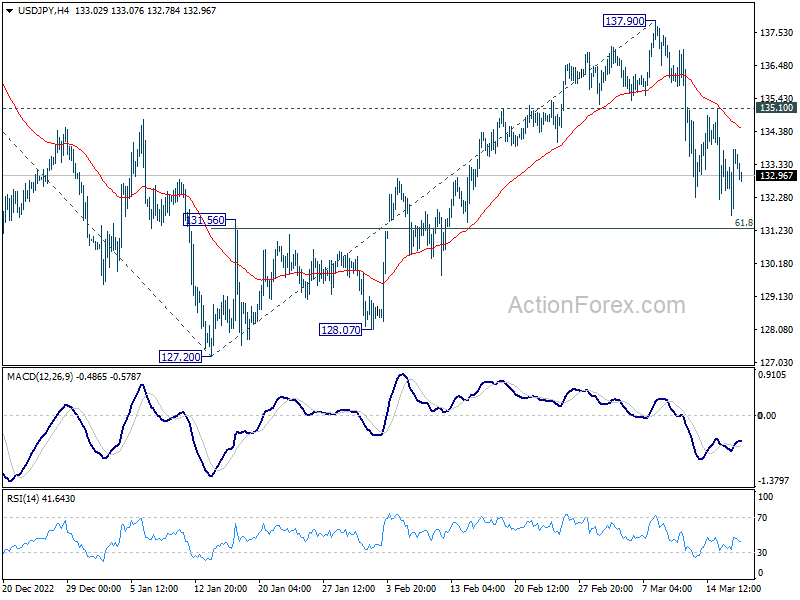
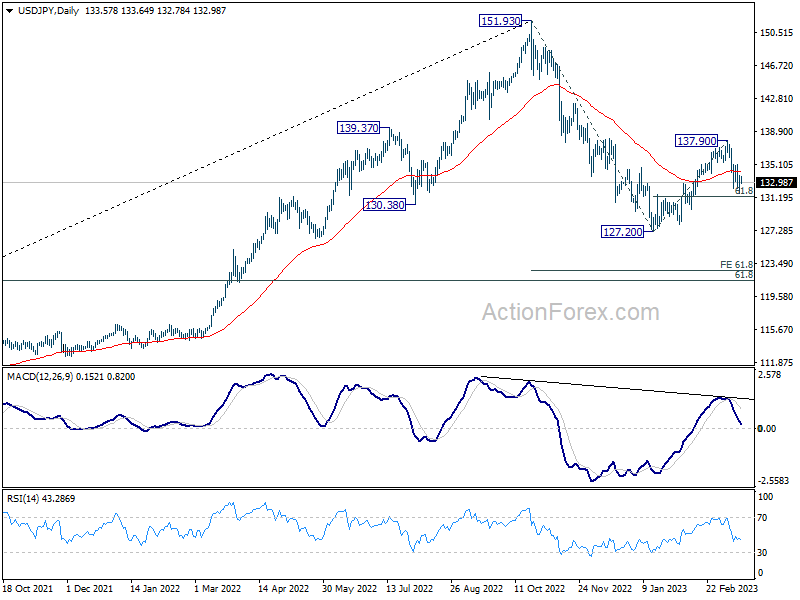
Daily Pivots: (S1) 132.38; (P) 133.10; (R1) 134.49; More...
USD/JPY is losing downside momentum as seen in 4 hour MACD. But further decline is still in favor as long as 135.10 resistance holds. Firm break of 61.8% retracement of 127.20 to 137.90 at 131.28 will pave the way to retest 127.20 low. However, break of 135.10 will argue that fall from 137.90 is completed and turn bias back to the upside for retesting this high.
In the bigger picture, rebound from 127.20 should have completed at 137.90 as a corrective move, with strong break of 55 day EMA. The down trend from 151.93 (2022 high) is not over yet. Break of 127.20 will resume this down trend and target 61.8% projection of 151.93 to 127.20 from 137.90 at 122.61. This will now be the favored case as long as 137.90 resistance holds.
USD/CAD Daily Outlook
Daily Pivots: (S1) 1.3694; (P) 1.3741; (R1) 1.3768; More....
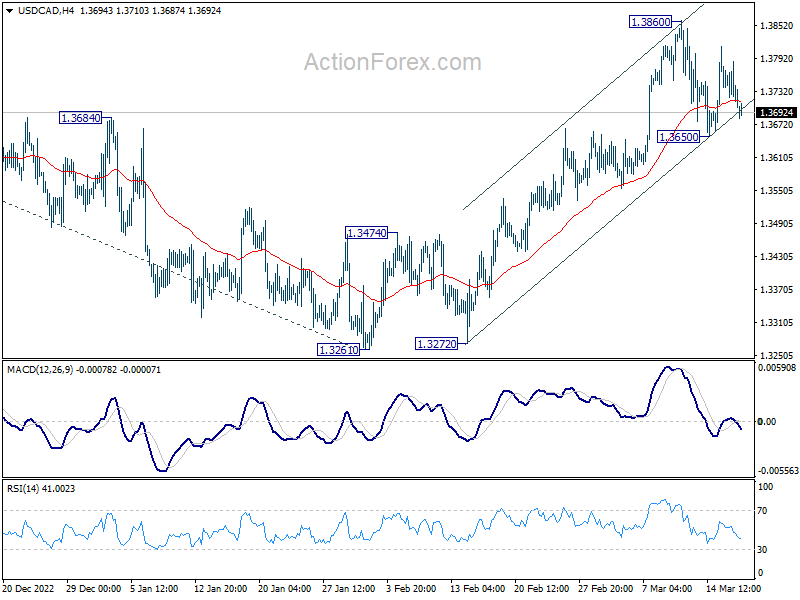
Range trading continues in USD/CAD and intraday bias stays neutral first. Further rally is expected with 1.3664 support intact. On the upside, break of 1.3860 will resume the rally from 1.3261 to retest 1.3976 high. However, firm break of 1.3664 will mix up the near term outlook and bring deeper pullback first.
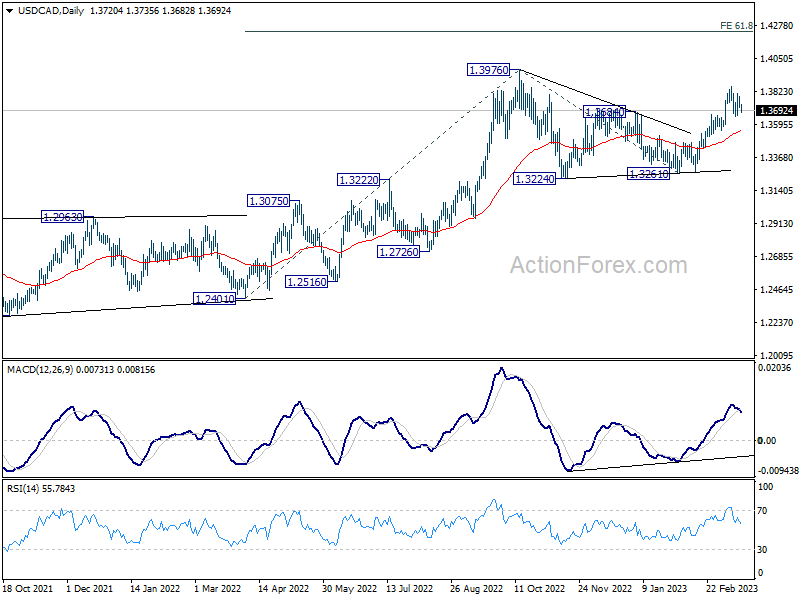
In the bigger picture, the up trend from 1.2005 (2021 low) is still in progress. Break of 1.3976 will confirm resumption and target 61.8% projection of 1.2401 to 1.3976 from 1.3261 at 1.4234. Firm break there will pave the way to long term resistance zone at 1.4667/89 (2016, 2020 highs). On the downside, break of 1.3261 support is needed to confirm medium term topping. Otherwise, outlook will remain bullish even in case of deep pull back.
ECB Sticks to Inflation Fight, Hints that Fed Could Do the Same
The European Central Bank (ECB) decision yesterday was important as it offered a first indication of what the banking stress meant for the monetary policy.
And it did not mean much – a relaxing news for markets.
The ECB chose not to fan the banking worries and went ahead and announced a 50bp hike at yesterday’s policy decision pointing at high inflation.
The opening sentence of ECB Chief Christine Lagarde’s speech was that the bank predicts ‘inflation to remain too high for too long’.
And indeed, the final CPI data due out today is expected to confirm a February inflation at around 8.5% - which is high, but not bad compared to double-digit levels printed a couple of months earlier, but core inflation is now at record, and it needs to be addressed.
Regarding the bank turmoil, Lagarde said that the European banks are strong and resilient, they have ample liquidity, and, in all cases, the ECB has a toolkit – other than the interest rates and broad monetary policy - that could help address liquidity issues if needed.
That was clear, and well played.
What was unclear however was, what will happen next to the ECB policy. Lagarde gave no indication on the future. She said the future decisions will depend on economic data.
The lack of conviction for further 50bp hikes is certainly what held the euro back from recording a better rally after the ECB’s 50bp hike yesterday.
The EURUSD gained ground, but the advance was barely noticeable. The next natural target for the bulls is the 50-DMA, which stands around the 1.0730 level, and whether the pair could break it depends on what will happen on the Fed front.
What will the Fed do?
The ECB’s clear focus on inflation, and not on bank stress, reinforced the expectation of a 25bp hike from the Federal Reserve (Fed) next week.
The ECB decision came as a hint that the Fed could also play down stress in banking sector, highlight that the liquidity issues could be addressed with available tools and keep focus on economic data.
At the wake of the ECB decision, activity on Fed funds futures gives more than 80% chance for a 25bp hike. This probability was around 65% before the ECB’s decision.
What does that mean for the US dollar? It probably means a further wind down of the early-year gains as we are now back to the scenario where the Fed would hike by a final 25bp and pause. That was the expectation as we stepped into this year, before the Fed’s peak rate expectations shot up to 5.6%. That bet is nearly dead. It could come back to life, but the impact of Fed tightening on banks could help to restrict borrowing from here and ease inflation, and need for further Fed action.
There’s your pivot, ladies and gentlemen.
Licking the wounds
The US bond markets are now licking the past week’s wounds. The US 2-year yield is up but remains well below the pre-SVB collapse levels. BoFA’s MOVE index, which is the implied treasury volatility, hasn’t been this high since the 2008 subprime crisis, which calls for caution.
Caution, but stock markets are on a full-cheer mood. European indices loved the dovish 50bp hike from the ECB yesterday.
Plus, the relief on Credit Suisse in Switzerland and the First Republic Bank boosted sentiment across the Atlantic as well. The Stoxx 600 bounced off the goal post and rebounded after testing the major 38.2% Fibonacci retracement on October to February rally, the S&P500 rebounded around 1.75% and closed the day above the 200-DMA, whereas Nasdaq 100 spiked nearly 1.70% higher, as Amazon, Alphabet and Microsoft jumped more than 4%, Nvidia gained above 5%, Intel above 6%, and AMD nearly 8% after US big banks decided to deposit $30 billion with First Republic Bank as a show of support.
Bitcoin – which tends to move closely with the tech stocks, rallied more than 30% since last week and is now above the $25K psychological level, looking for a further advance to the $30K mark.
Will the joy last? Jim Cramer tweeted ‘short this Nasdaq and invite me to your funeral’.
The volatility index on stocks is at reasonable levels, but a 4, 5, 6, 8% jump in big stock prices is a sign that volatility is threatening and calls for caution.
Anyway, the last trading day of a chaotic week could be a calm one (tough you never know !) Investors will monitor the US industrial production and the University of Michigan’s sentiment index, expect some further, upside correction in yields and pray that nothing major happens before next Wednesday’s FOMC decision.
ECB Determined to Fight Inflation Despite Market Turmoil
Market movers today
Financial news and perhaps follow-ups to the ECB meeting yesterday will likely be the most important things to watch today. On the data side, we get the Michigan consumer confidence including inflation expectations in the US which the Fed has cited in the past, and also industrial production and capacity utilisation for February. In the Euro Area, we get the final HICP for February, but unlike with the January figure, we do not expect major revisions this time.
The 60 second overview
Markets stabilised somewhat yesterday after extreme volatility on Wednesday. Equities ended in positive territory, US Treasury yields higher, USD broadly weakened and crude oil prices rose. The positive momentum was initially led by a rebound from Credit Suisse after news that the bank could lend CHF54bn from the Swiss National Bank, which alleviated some concerns. ECB also helped calm markets at the press conference after the monetary policy decision (more below) by communicating that the bank is ready to respond to preserve financial stability while still being committed to fighting inflation. In the US, First Republic Bank secured USD30bn from the largest national banks in an attempt to bolster the bank's finances, as lack of confidence from investors and customers is weighing on the bank. Additionally, data from the Fed yesterday showed that banks have borrowed USD152.9bn through the emergency loan programme and another USD11.9bn through the newly introduced Bank Term Funding Program (BTFP) essentially reversing the Fed's QT.
The ECB hiked its three key policy rates by 50bp yesterday and gave no indications for the coming rate path in line with our expectations. The ECB communication clearly highlighted the risks prevailing to the economic and inflation outlooks, but should the baseline prevail once the current turmoil subsides, more rate hikes may be needed. We keep our call for a 50bp rate hike in May due to the still high underlying inflation, and a peak policy rate reached in July of 4%.
Lagarde's communication showed a clear preference and focus on inflation over financial stability. For example, the first sentence in the ECB decision was 'Inflation is projected to remain too high for too long'. She also said there is no trade-off between price stability and financial stability. While we believe that it is a very fine balance, the fact that she says this clearly shows to us the ECB is willing to take the necessary measures to allow it to further hike and fight inflation.
Equities: Global equities rallied yesterday as the fear of a prolonged liquidity crisis in banks faded. Please note, banks were not the biggest outperformers yesterday. Banks were (of course) rallying but cyclical growth was the biggest beneficiaries of the relief rally yesterday. If the fear of a banking sector meltdown is abating now, we will be left with yields at a lower level which supports growth versus value and in that perspective no surprise to the see the rotation yesterday. Growth has outperformed value by almost 5% this week while quality has outperformed the broader market with 2%. In US yesterday, Dow +1.2%, S&P 500 +1.8%, Nasdaq +2.5% and Russell 2000 +1.5%. Asian markets catching up this morning with green screens across the region. Solid gains in European futures while US fturues positive but in limited gains.
FI: US Treasury yields ended the day higher on the back of several of the big US banks pouring money into First Republic Bank as expectations for monetary tightening from the Federal Reserve rose once again. We stick to our call of 25bp at the upcoming meeting even though there has been speculation in the market that the Federal Reserve would be on hold.
FX: ECB went on to hike by 50bp, but refrained from giving any guidance for the May meeting. EUR/USD traded remarkably stable following the decision, but overnight the cross found some support. Following the past days' tug-of-war between the hawkish inflation print and fragile risk sentiment, the SEK also found some support as the systemic risks faded somewhat yesterday. Neighbouring NOK, however, is clearly lacking any support currently, with NOK/SEK falling below 0.98 for the first time in 18 months.
Credit: Credit markets rebounded on Thursday after the Swiss central bank pledged to support Credit Suisse with up to USD75bn in liquidity, if needed. Major CDS indices rallied on the news, with Itraxx main tightening 4.8bp to close at 99.4bp, while Itraxx Xover tightened 24.1bp to close at 483.2bp. Primary markets were still somewhat muted, despite the turnaround in risk sentiment.
Nordic macro
Danmarks Nationalbank (DN) followed ECB and hiked its key policy rate 50bp to 2.60%. We expect the Danish central bank to track ECB the coming months where more rate hikes await, which brings the key policy rate to 3.60% in July.
Sweden: The February Labour Force Survey (LFS) is released at 08.00 CET. We expect the seasonally adjusted unemployment rate to have remained stable at 7.3 %. Thus far, the Swedish labour market has been surprisingly sanguine and we do not see that changing today.
AUD/USD Daily Report
Daily Pivots: (S1) 0.6623; (P) 0.6645; (R1) 0.6680; More...
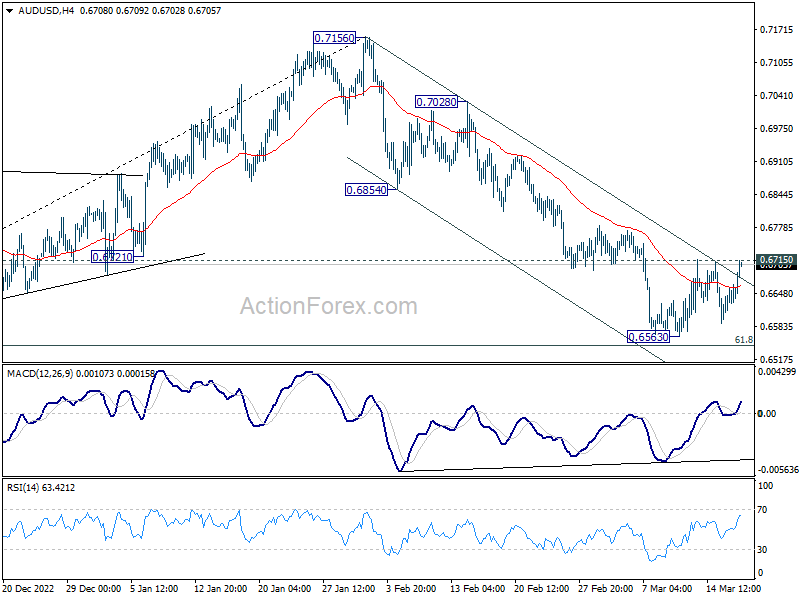
Intraday bias in AUD/USD stays neutral first with focus on 0.6715 resistance. Decisive break there will confirm short term bottoming at 0.6563, just ahead of 0.6546 fibonacci level. Intraday bias will be back on the upside for 55 day EMA (now at 0.6784). Sustained break there will pave the way back to retest 0.7156 high. On the downside, however, sustained break of 0.6546 will carry larger bearish implication and target 0.6169 low.
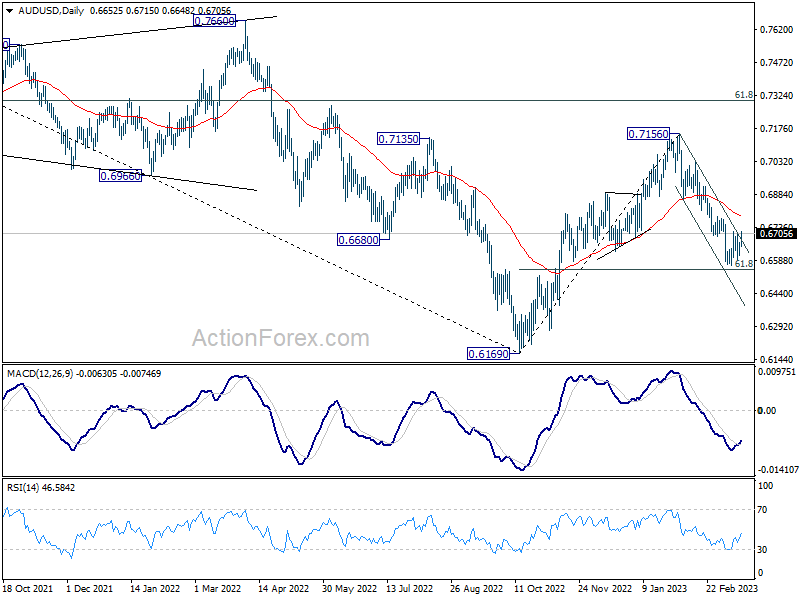
In the bigger picture, rise from 0.6169 (2022 low) has completed at 0.7156, after rejection by 55 month EMA (now at 0.7158). Deeper decline would then be see back to 61.8% retracement of 0.6169 to 0.7156 at 0.6546, even as a corrective fall. Sustained break there will raise the chance of long term down trend resumption through 0.6169 low.
Aussie Gaining Momentum, Dollar Pressured as Banking Fears Subside
Dollar faces renewed selling pressure as Asian markets exhibit a positive tone, following the overnight rebound in US stocks. The question remains: is the banking crisis over? It seems likely, at least temporarily, as major banks rushed to support First Republic and the situation surrounding Credit Suisse stabilized. If Wall Street's rebound continues to gain momentum, the greenback could face further downside risk today. However, given that FOMC rate decision is less than a week away, investors may opt to take profits and adopt a more cautious stance in the meantime.
Currently, Australian Dollar leads as the best performer for the week, closely followed by New Zealand Dollar. Both currencies appear to be gaining momentum. Despite struggling to extend earlier gains, Japanese Yen remains the third strongest currency. Swiss Franc, on the other hand, is the weakest performer, followed by Dollar. The post-ECB selloff in Euro didn't last but it lacks momentum for rebound, and it's now the third weakest. Both the British Pound and the Canadian Dollar are mixed for the week.
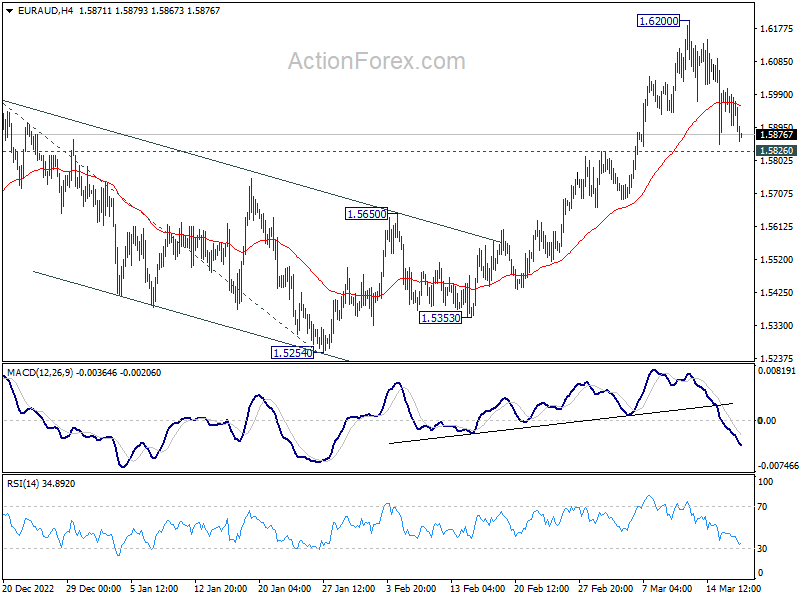
Technically, Aussie is worth a watch before the weekly. AUD/USD is now pressing 0.6715 resistance and firm break there will indicate short term bottoming at 0.6563. On the other hand, EUR/AUD is holding just slightly above 1.5826 support. Firm break of this support will indicate short term topping 1.6200. In this case, deeper decline would be seen back to 1.5650 resistance turned support and possibly below. Let's see how Aussie goes.
In Asia, Nikkei rose 1.20%. Hong Kong HSI is up 1.12%. China Shanghai SSE is up 0.58%. Singapore Strait Times is up 0.67%. Japan 10-year JGB yield is down -0.0062 at 0.291. Overnight, DOW rose 1.17%. S&P 500 rose 1.76%. NASDAQ rose 2.48%. 10-year yield rose 0.093 to 3.585.
NASDAQ displays bullish sign after major banks rescue First Republic
US stocks experienced a notable rebound overnight as major banks stepped in to rescue the beleaguered First Republic Bank, preventing the potential contagion from evolving into a full-blown banking crisis.
Bank of America, Goldman Sachs, JP Morgan, and others have collectively agreed to deposit USD 30B in First Republic, which has faced a mass withdrawal of customer funds in the wake of Silicon Valley Bank's collapse and concerns that First Republic could be next.
In a joint statement on Thursday, the banks expressed their confidence in the US banking system, stating, "Together, we are deploying our financial strength and liquidity into the larger system, where it is needed the most."
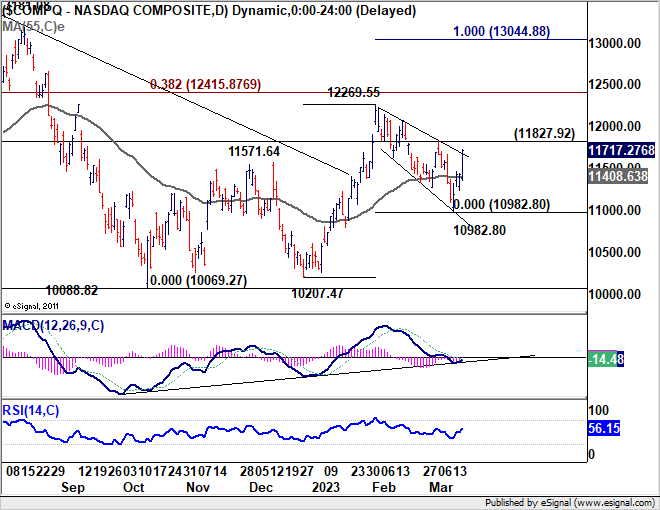
Among the major US stock indexes, NASDAQ led the way with an impressive 2.48% rally. From a technical perspective, there are indications of bullish momentum, as the index closed above the near-term trend line resistance. This development suggests that the corrective pullback from 12269.55 may have concluded at 10982.80 already.
In the coming days, reaction to the 11827.92 resistance level should be closely monitored. A firm break above this threshold would solidify the bullish case, potentially leading to a resumption of the rally from 10207.47 through the 12269.55 resistance level.
Bitcoin broke key resistance, safe-haven asset or tech sector barometer?
Bitcoin has showcased remarkable resilience amid recent turmoil in financial markets, prompting discussions about its potential status as a safe-haven asset. The leading cryptocurrency has outperformed traditional safe havens such as gold this week, further fueling this debate.
Interestingly, Bitcoin has displayed a correlation with the NASDAQ index, suggesting that it may serve as a leading indicator or confirmation signal for risk appetite, particularly in the technology sector. It's could still be more of a tech sector barometer.
In either case, the breakthrough of 25242 resistance indicates that rally from 15452 is resuming. More significantly, the break above the 55 week EMA and 25198 structural resistance suggests that Bitcoin is now in the midst of correcting the entire downtrend from its 2021 record high of 68986, as a medium term move.
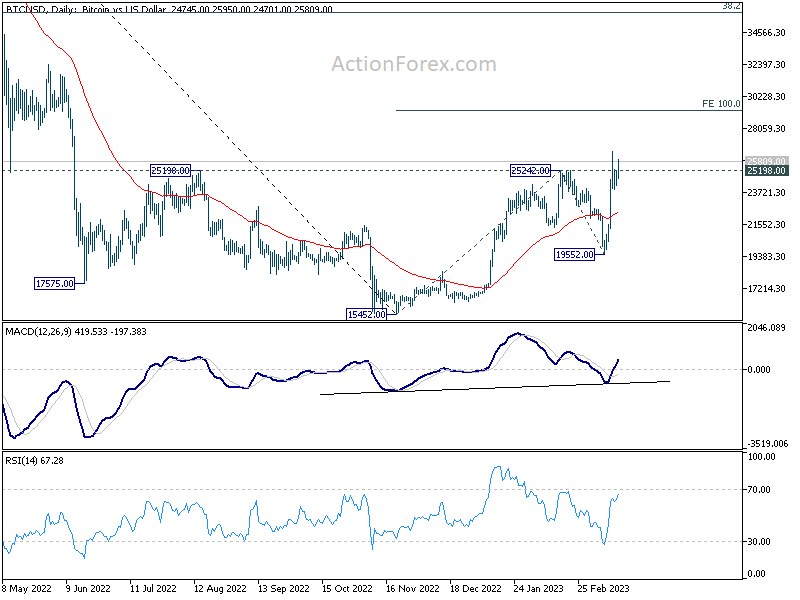
In the short term, further gains are expected, with a target of 100% projection of 15452 to 25242 from 19552 at 29342. The market's reaction at this level will provide insight into the potential trajectory of the medium-term rise from 15452.
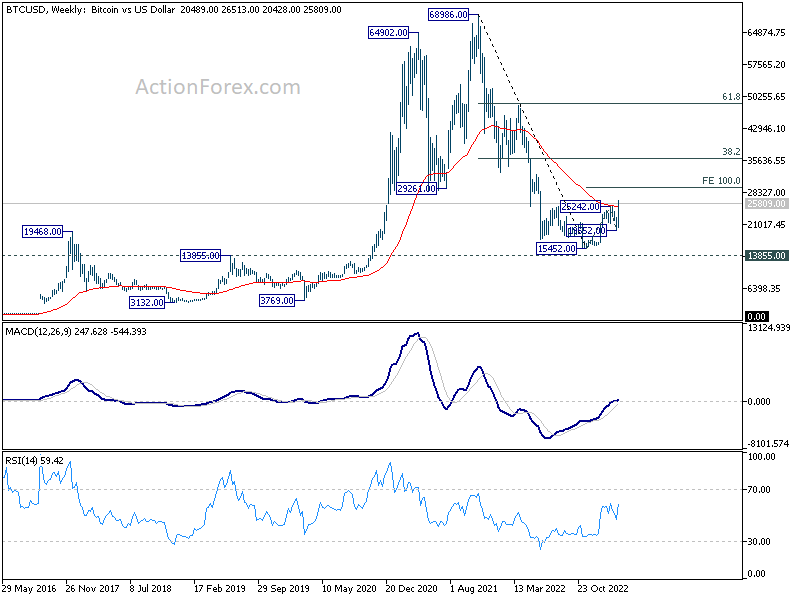
Additionally, the momentum of Bitcoin's ascent could be an important factor in determining the likelihood of NASDAQ breaking through the 12269.55 resistance level.
As market participants keep a close eye on these developments, Bitcoin's performance may hold broader implications for the technology sector and the overall market sentiment.
Looking ahead
Italy trade balance and Eurozone CPI final will be released in European session. Later in the day, Canada will release IPPI and RMPI. US will release industrial production and U of Michigan consumer sentiment.
AUD/USD Daily Report
Daily Pivots: (S1) 0.6623; (P) 0.6645; (R1) 0.6680; More...
Intraday bias in AUD/USD stays neutral first with focus on 0.6715 resistance. Decisive break there will confirm short term bottoming at 0.6563, just ahead of 0.6546 fibonacci level. Intraday bias will be back on the upside for 55 day EMA (now at 0.6784). Sustained break there will pave the way back to retest 0.7156 high. On the downside, however, sustained break of 0.6546 will carry larger bearish implication and target 0.6169 low.
In the bigger picture, rise from 0.6169 (2022 low) has completed at 0.7156, after rejection by 55 month EMA (now at 0.7158). Deeper decline would then be see back to 61.8% retracement of 0.6169 to 0.7156 at 0.6546, even as a corrective fall. Sustained break there will raise the chance of long term down trend resumption through 0.6169 low.
Economic Indicators Update
| GMT | Ccy | Events | Actual | Forecast | Previous | Revised |
|---|---|---|---|---|---|---|
| 04:30 | JPY | Tertiary Industry Index M/M Jan | 0.90% | 0.30% | -0.40% | |
| 09:00 | EUR | Italy Trade Balance (EUR) Jan | 1.50B | 1.07B | ||
| 09:30 | GBP | Consumer Inflation Expectations | 4.80% | |||
| 10:00 | EUR | Eurozone CPI Y/Y Feb F | 8.60% | 8.60% | ||
| 10:00 | EUR | Eurozone CPI Core Y/Y Feb F | 5.60% | 5.60% | ||
| 12:30 | CAD | Industrial Product Price M/M Feb | -0.30% | 0.40% | ||
| 12:30 | CAD | Raw Material Price Index Feb | -0.20% | -0.10% | ||
| 13:15 | USD | Industrial Production M/M Feb | 0.60% | 0.00% | ||
| 13:15 | USD | Capacity Utilization Feb | 78.50% | 78.30% | ||
| 15:00 | USD | Michigan Consumer Sentiment Index Mar P | 67 | 67 |