

Sample Category Title
ECB Review: 50bp Hike, But No Guidance for May
- As expected, the ECB hiked its three key policy rates by 50bp today and gave no indications for the coming rate path. The ECB communication clearly highlighted the number of risks prevailing to the economic and inflation outlook, but should the baseline prevail once the current turmoil subsides, more rate hikes may be needed. We keep our call for a 50bp rate hike in May due to the still high underlying inflation, and a peak policy rate reached in July of 4%.
- The ECB argued there is no trade-off between price and financial stability, which shows the ECB is willing to introduce measures to allow it to keep fighting inflation.
Inflation prevails – and remains too high for too long
Lagarde's communication today showed a clear preference and focus on inflation over financial stability. For example, the first sentence in the ECB decision was 'Inflation is projected to remain too high for too long'. She also said there is no trade-off between price stability and financial stability. While we believe that it is a very fine balance, the fact that she says this clearly shows to us the ECB is willing to take the necessary measures to allow it to further hike and fight inflation.
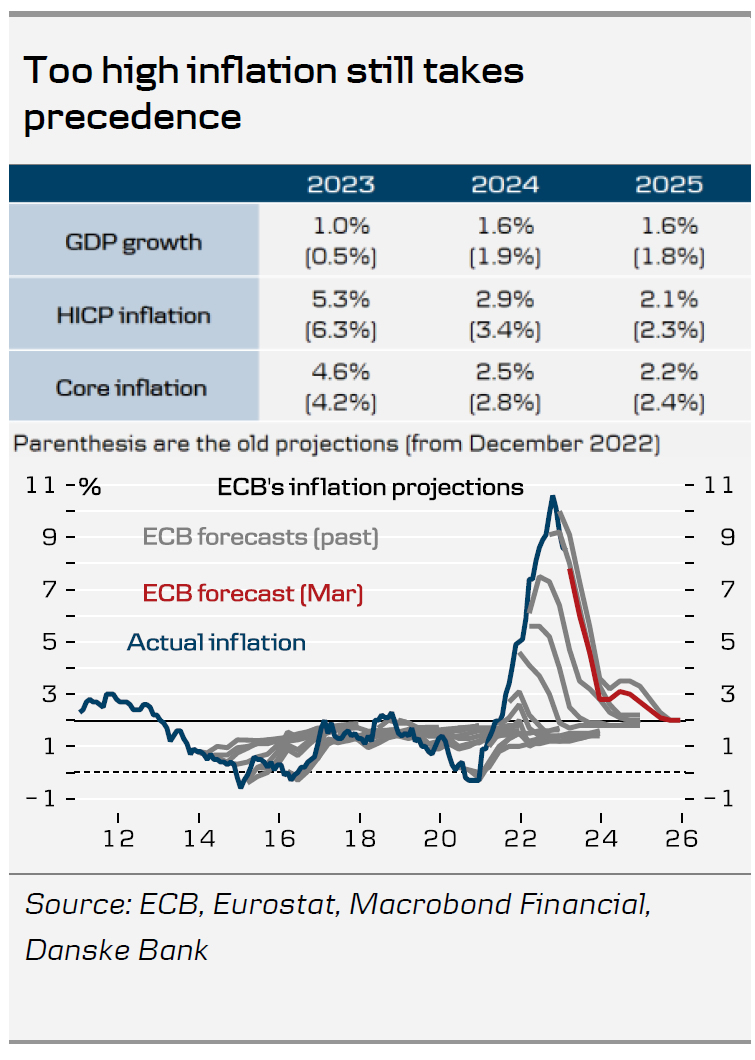
The new (though already outdated) staff projections showed both headline and core inflation remaining above the 2% target by the end of the forecast horizon in 2025. Growth and core inflation were revised higher in the near term, in light of the ongoing resilience of the economy. The ECB staff expects the euro area recovery to continue in the coming quarters, though risk to the growth outlook remains tilted to the downside, particularly from adverse confidence effects in financial markets impacting credit conditions.
With a strong labour market and still building wage pressures, Lagarde stressed that the ECB cannot afford to waver in its commitment to fight inflation. We agree, as underlying price pressures remain too strong and pipeline pressures mean high core inflation could remain a worry for the ECB for some time yet.
No guidance for May
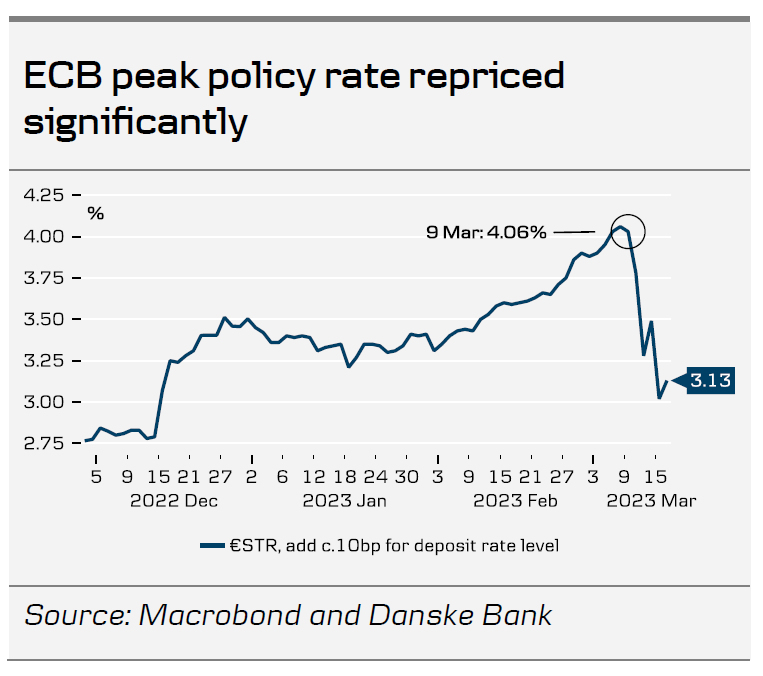
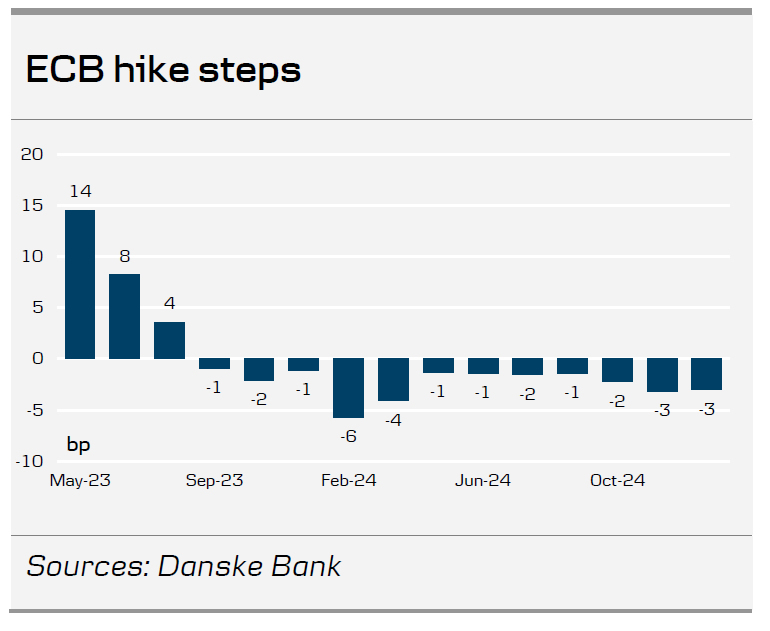
The ECB statement did not give any explicit guidance for the size of the May policy decision. However, Lagarde said they will remain data dependent, and should the baseline persist, then 'we have a lot more ground to cover', thereby also saying that more hikes are coming – and potentially this could be another 50bp in March. As we are yet to see if this turns into a macroeconomic crisis or if the turmoil stays isolated, we continue to like our call for a 50bp rate hike in May and a peak policy rate reached in July at 4%. Ahead of the decision today, no option other than the 50bp rate hike was discussed and the decision was taken by a very large majority. She said that three or four GC members didn't support the decision, as they would have liked to see more data before taking that decision.
Future rate path
The ECB's decision statement laid out what will form the future rate path: 1) its assessment of the inflation outlook in light of the incoming economic and financial data; 2) the dynamics of underlying inflation; and 3) the strength of monetary policy transmission. Specifically, Lagarde said she is already seeing a 'good transmission' of rate hikes in the credit sector, although it may take longer to feed through. Notably, the weakened and delayed pass through has been discussed by both Chief Economist Lane and ECB board member Schnabel recently.
Financial stability and uncertain outlook – but no measures
While financial stability features prominently, focus was on the alertness and preparedness, should it be needed. Both de Guindos and Lagarde emphasised that compared with previous crises, euro area banks are in completely different and vastly improved capital positions.
50/50 for a rate hike in May – limited market reaction
Markets are little changed after the press conference today and are now pricing in a 50/50 probability of the ECB hiking in May at all. However, as we see it, the question boils down to whether or not this turmoil in the banking sector turns into a macroeconomic crisis; the market pricing represents this very binary outcome space. If yes, this is deflationary in itself – and therefore sizeable rate cuts could follow, which could lead to a significant steepening of the curves; however, if no, (our baseline), markets appear ripe for a repricing higher in yield as inflation is still stubbornly high for the central bank to accept. This suggests more curve inversion. That means we should see a significant repricing once the dust settles. After the FOMC next week, we believe markets will focus again on the macro picture, which is too high inflation.
Despite the large uncertainty with respect to the rate decision, the reaction in FX markets was remarkably limited. We entered the meeting with a fundamental predisposition of wanting to sell EUR/USD rallies on a 50bp hike but the cross hardly reacted with the FRA curve flattening upon announcement. Looking ahead, systemic risk fears look set to dominate price action among majors. Our bias remains for systemic fears to subside over the coming weeks, but we humbly acknowledge the high sensitivity to negative news, which leaves us side-lined with no high-conviction calls near term. On a 3-6M horizon, we still pencil in a lower EUR/USD compared with current spot levels.
European Central Bank Delivers, Again
Summary
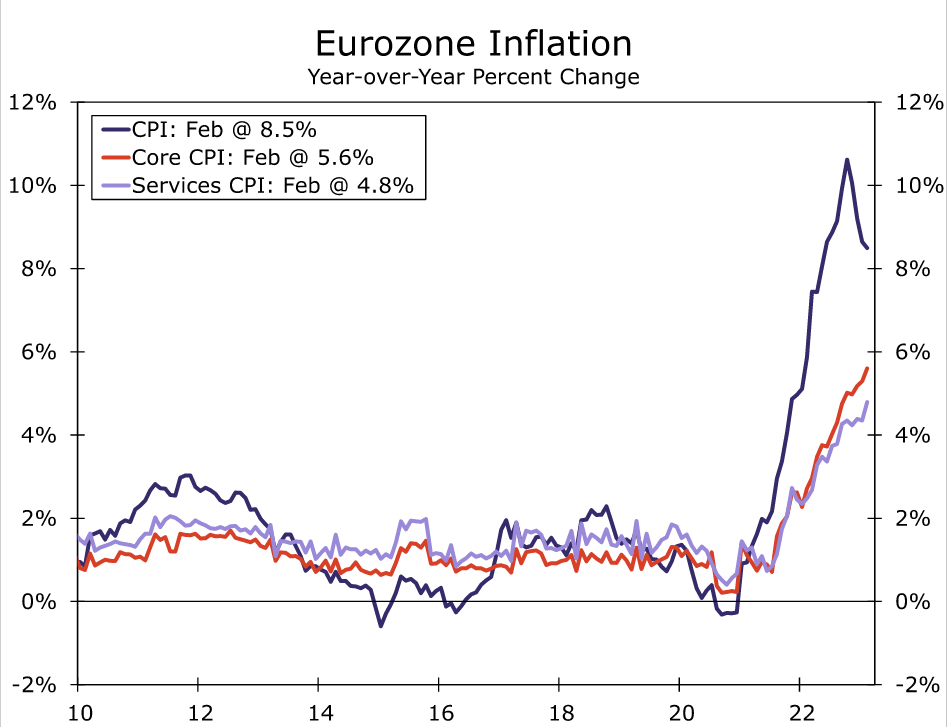
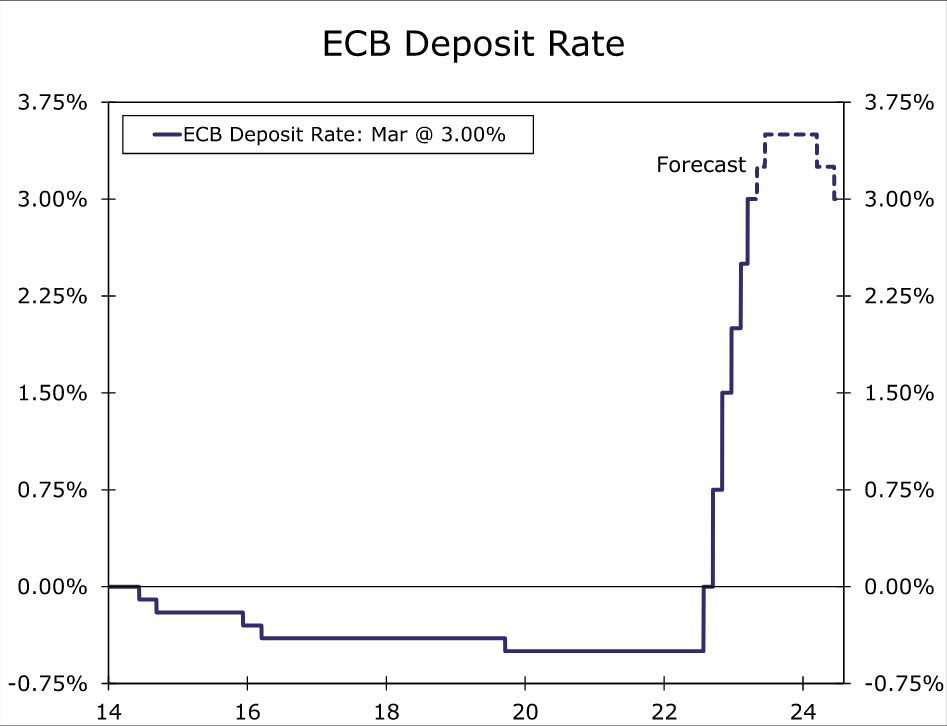
- In a widely anticipated monetary policy announcement, the European Central Bank (ECB) raised its Deposit Rate 50 basis points to 3.00%. In raising interest rates, the ECB said "inflation is projected to remain too high for too long." Indeed, we observe the ECB projects headline and core inflation to remain above target over its entire forecast horizon.
- In a nod to recent financial market strains, the ECB highlighted elevated uncertainty, emphasized a data-dependent approach to policy rate decisions, and refrained from signaling any future rate moves in its statement.
- That said, should market strains ease and volatility recede in the weeks and months ahead, persistent inflation should in our view be enough to elicit further European Central Bank tightening. We still expect the ECB's Deposit Rate to peak at 3.50% by June this year. In that context, market pricing, which currently implies a peak policy rate of around 3.09%, appears light to us.
European Central Bank Delivers, Again
In a widely anticipated monetary policy announcement, coming amid financial market strains seen in recent days, the European Central Bank held true to its pledge and delivered another large policy rate hike at this week's meeting. The ECB raised its Deposit Rate 50 basis points to 3.00%, following through on the strong signal it had sent at its early February meeting. In raising interest rates, the ECB said “inflation is projected to remain too high for too long.”
In fact, updated projections show inflation is forecast to remain above the ECB's inflation target essentially through its entire forecast horizon. Headline CPI inflation is seen at 5.3% in 2023, 2.9% in 2024 and 2.1% in 2025. Excluding food and energy, inflation is projected at 4.6% in 2023, 2.5% in 2024 and 2.2% in 2025. Meanwhile, Eurozone GDP growth is expected to remain quite resilient at 1.0% in 2023 and 1.6% in 2024 and 2025. Keep in mind, however, these projections were finalized before the emergence of recent tensions.
ECB policymakers did acknowledge recent market developments, saying it “is monitoring current market tensions closely and stands ready to respond as necessary to preserve price stability and financial stability in the euro area.” However, the ECB added the Eurozone “banking sector is resilient, with strong capital and liquidity positions. In any case, the ECB’s policy toolkit is fully equipped to provide liquidity support to the euro area financial system if needed and to preserve the smooth transmission of monetary policy.” We broadly concur with this statement, having recently published a report that shows in aggregate, the Eurozone banking sector remains in reasonably solid shape.
One important takeaway from today's announcement, in the context of current elevated level of uncertainty, was the ECB's “data dependent” approach to policy rate decisions. In that sense, and unlike its announcement in February, the ECB refrained from signaling any future rate moves in its statement this month. Still, despite the lack of guidance, the ECB's above target inflation forecast provides some insight into potential future moves. Should market strains ease and volatility recede in the weeks and months ahead, persistent inflation should in our view be enough to elicit further European Central Bank tightening. Accordingly, after today's decision, our near-term outlook for ECB monetary policy remains unchanged. We expect a further 25 basis point rate hike in May followed by a final 25 basis point rate hike in June, which would see the ECB's Deposit Rate for the current cycle peak at 3.50%. In that context, market pricing, which currently implies a peak policy rate of around 3.09%, appears light to us. Our more forceful outlook for ECB policy is an important factor supporting our outlook for medium term strength in the euro versus the U.S. dollar.
Sunset Market Commentary
Markets
Credit Suisse’s pre-market announcement that it plans to take up CHF 50bn offered in liquidity by the Swiss National Bank (fully collateralized) under a Covered Loan Facility as well a short-term liquidity facility helped restore confidence in the run-up to ECB policy decision. The liquidity stopgap nevertheless remains a temporary measure with structural action (merger, split-up, (government) equity injection,…) still likely.
The ECB pushed through with its flagged 50 bps rate hike despite recent financial stability concerns. They lifted the deposit rate from 2.5% to 3% as inflation is projected to remain too high for too long. Headline inflation forecasts faced a downward revision mainly owing to a smaller contribution from energy prices. ECB staff now see inflation averaging 5.3% in 2023 (from 6.3%), 2.9% in 2024 (from 3.4%) and 2.1% in 2025 (from 2.3%). At the same time, the ECB revised up its core inflation forecast for this year: avg 4.6% in 2023 (from 4.2%) before decelerating to 2.5% in 2024 (from 2.8%) and 2.2% in 2025 (from 2.4%). Inflation is thus still expected to remain above the 2% inflation target over the policy horizon. The central banks adds that forecasts data back to before the recent tensions on financial markets, implying bigger uncertainty around them. From now on, Lagarde and co shift to data-dependence when it comes to future policy decisions. Not only in order to asses the inflation outlook, dynamics of underlying inflation and the strength of monetary policy transmission, but also to monitor current market tensions closely and stand ready to respond as necessary to preserve financial stability in the euro area as well as price stability. Regarding the former, the statement suggests providing liquidity support if needed. In a reference to earlier days “monitor closely” ranked junior to “monitor very closely” and “strong vigilance” when it comes to the ECB’s readiness for action. It suggests that financial tensions aren’t top of the central bank’s problem list as for now. The ECB adds that the euro banking sector is resilient, with strong capital and liquidity positions. New baseline projections for growth showed an upgrade for this year (1% from 0.5%) and a weaker-than-expected pick-up in 2024 (1.6% from 1.9%) and 2025 (1.6% from 1.8%). Risks are tilted to the downside.
At the press conference ECB Lagarde said that the central bank has a lot more ground to cover if the inflation baseline persists and uncertainty would remove around financial tensions. It isn’t waning on its commitment to fight inflation. Lagarde said that the 50 bps rate hike was the only option on the table, taken at a record time, with only 3-4 members wanting more time to monitor the situation. Overall, the ECB’s tone remained hawkish on inflation. There’s no trade-off between price stability and financial stability with the ECB ready to address each in its own matter. The first via interest rates, the second via liquidity tools. We conclude from today’s hawkish tone that current market turmoil won’t derail the ECB from additional rate hikes at upcoming meetings. Financial markets remain extremely stoic during and after the Q&A session: on FI, FX and stock markets!! News & Views
Riksbank’s deputy governor Floden said the central bank must keep the focus on inflation after yesterday’s “very bad” data showed price pressures unexpectedly accelerating in February. Both the (core) readings for January and last month (far) exceeded the Riksbank’s forecasts. Floden hoped to see signs of a turnaround materializing but instead the opposite happened. On the recent repricing of tightening by others (ECB, Fed), Floden said it helped the Riksbank a little. It coped with a relative disadvantage as markets considered the Swedish central bank to have less leeway than its peers to raise rates further, denting a.o. the SEK’s investor appeal. EUR/SEK is unchanged at 11.20.
A council member of Poland’s national bank said there are no conditions for lowering rates given the central bank’s inflation projection. Kotecki said he was concerned that price pressures aren’t yet showing signs of weakening. February inflation yesterday accelerated to 18.4% and core measures published today showed a speeding up to 12%, bringing prospects of rate cuts to a more distant future. Kotecki has been a member of the hawkish minority at the NBP for some time now. His comments also go against governor Glapinski’s view/hopes of rate cuts in Q4 this year. The zloty traded volatile today, swinging from losses to gains to eventually trade flat at EUR/PLN 4.70 currently.
ETHUSD Retraces Lower after Posting Fresh 6-month High
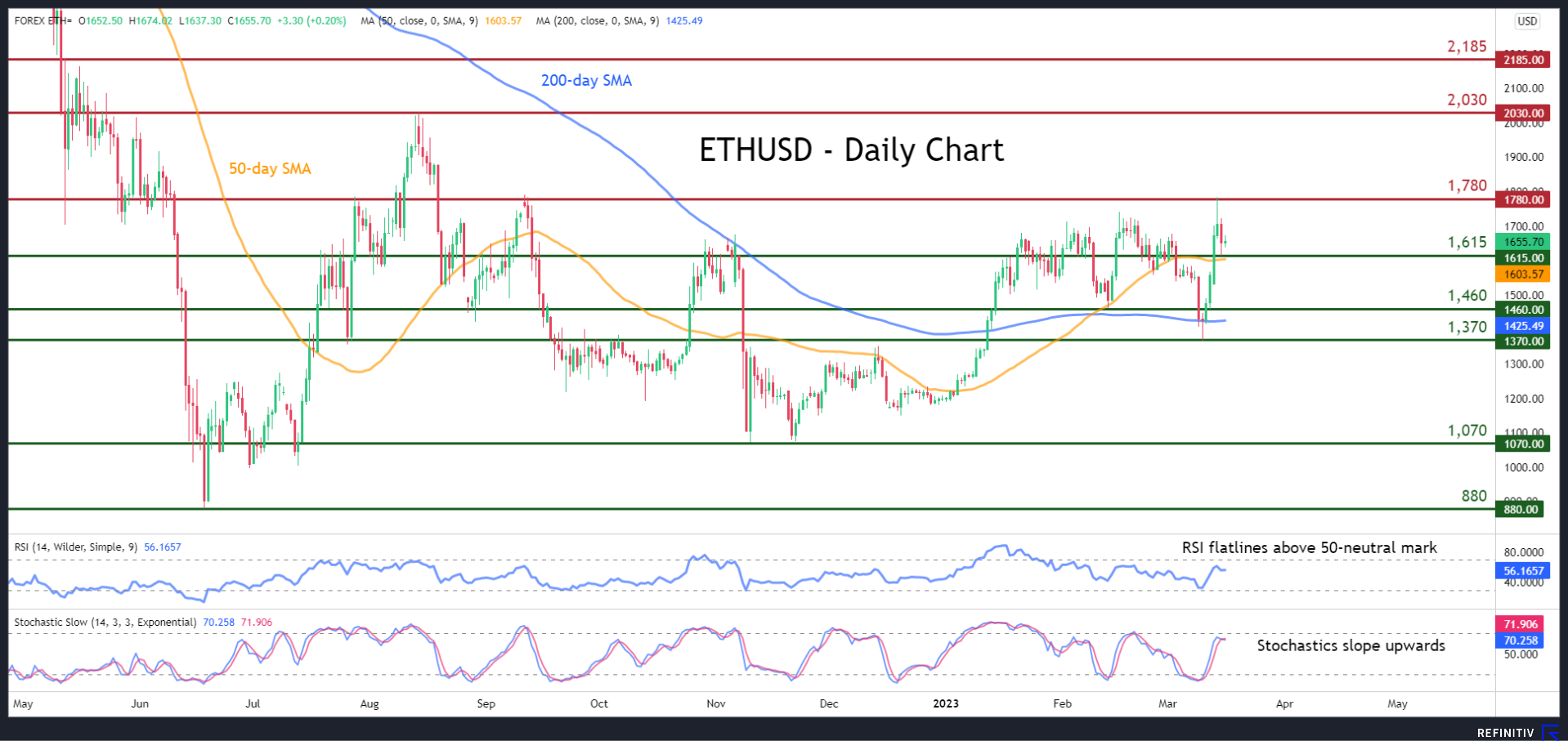
ETHUSD (Ethereum) experienced a significant correction after its 2023 rally stalled around the 1,740 zone in mid-February. However, the digital asset managed to stage a solid comeback, generating a fresh six-month high of 1,780 before paring some gains.
The momentum indicators currently suggest that the bullish forces are in control. Specifically, the stochastic oscillator is ascending, while the RSI has flatlined above its 50-neutral mark.
If the price edges higher, the recent six-month peak of 1,780 could act as initial resistance. Conquering this barricade, the bulls may aim for the August high of 2,030. Should that obstacle fail, further advances may cease at 2,186.
Alternatively, should sellers re-emerge and push the price lower, immediate support could be found at the 1,615 hurdle, which lies close to the 50-day simple moving average (SMA). Sliding beneath that floor, the price could challenge the February low of 1,460 before the spotlight turns to the March bottom of 1,370. A violation of the latter could pave the way for the November double-bottom region of 1,070.
Overall, despite its recent multi-month peak, ETHUSD appears to be lacking the necessary momentum to extend its upside move. Therefore, the digital asset could be entering a consolidation period, waiting for developments that could provide fresh directional impetus.
USD/JPY Mid-Day Outlook
Daily Pivots: (S1) 132.06; (P) 133.59; (R1) 134.95; More...
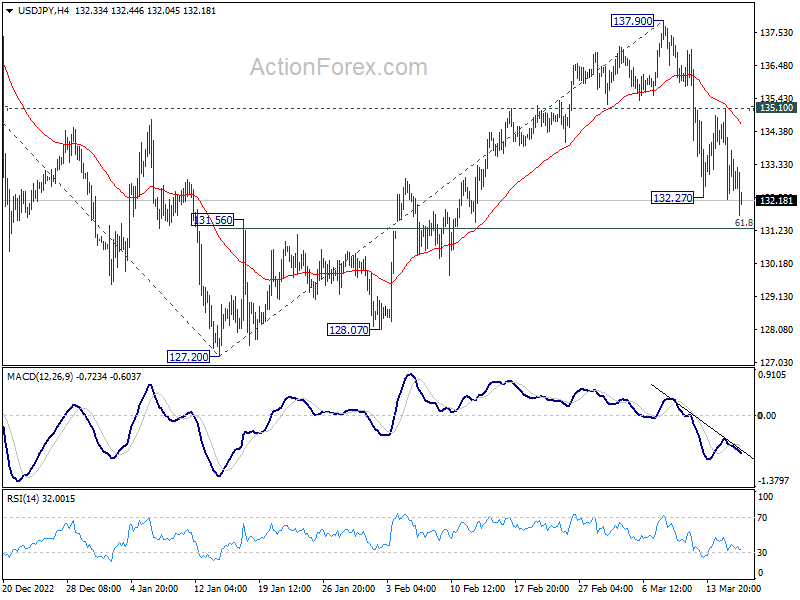
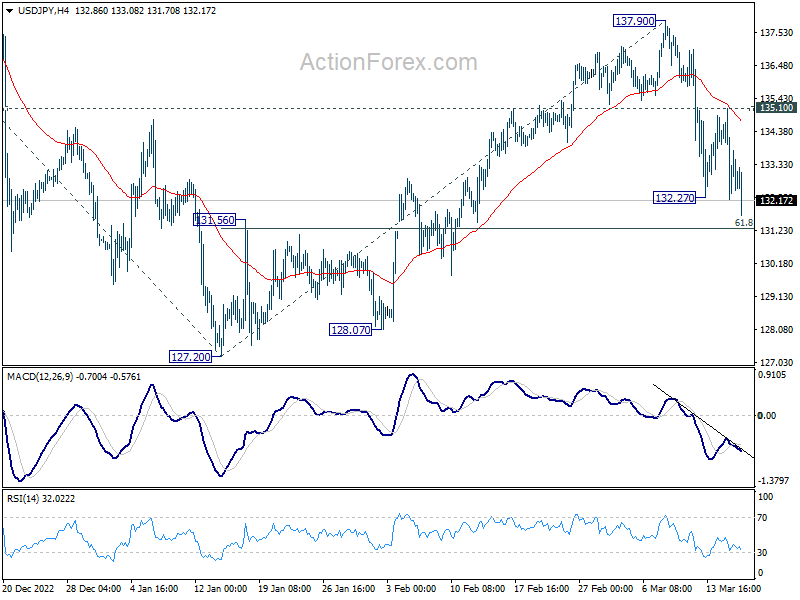
USD/JPY's fall from 137.90 resumed by breaking 132.27 and intraday bias is back on the downside. Sustained break of 61.8% retracement of 127.20 to 137.90 at 131.28 will pave the way to retest 127.20 low. On the upside, break of 135.10 resistance is needed to confirm completion of the decline. Otherwise, risk will stay on the downside in case of recovery.
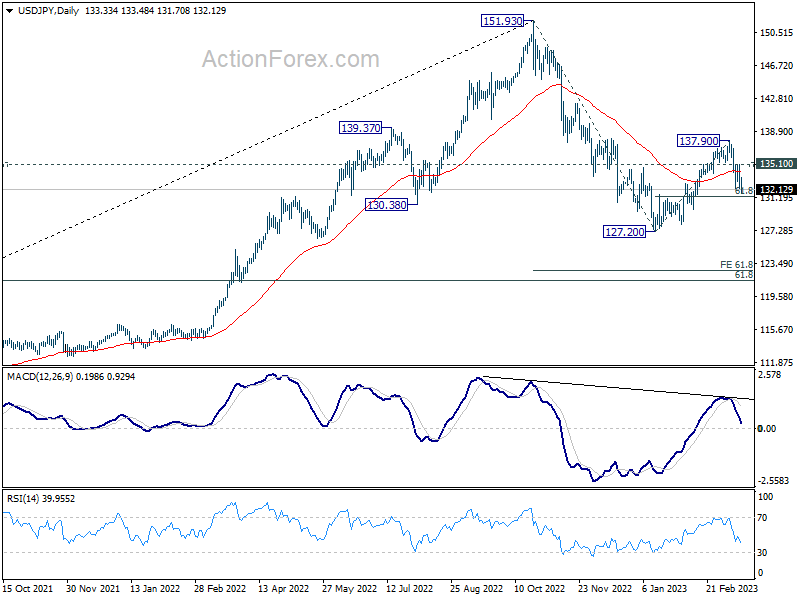
In the bigger picture, rebound from 127.20 should have completed at 137.90 as a corrective move, with strong break of 55 day EMA. The down trend from 151.93 (2022 high) is not over yet. Break of 127.20 will resume this down trend and target 61.8% projection of 151.93 to 127.20 from 137.90 at 122.61. This will now be the favored case as long as 137.90 resistance holds.
USD/CHF Daily Outlook
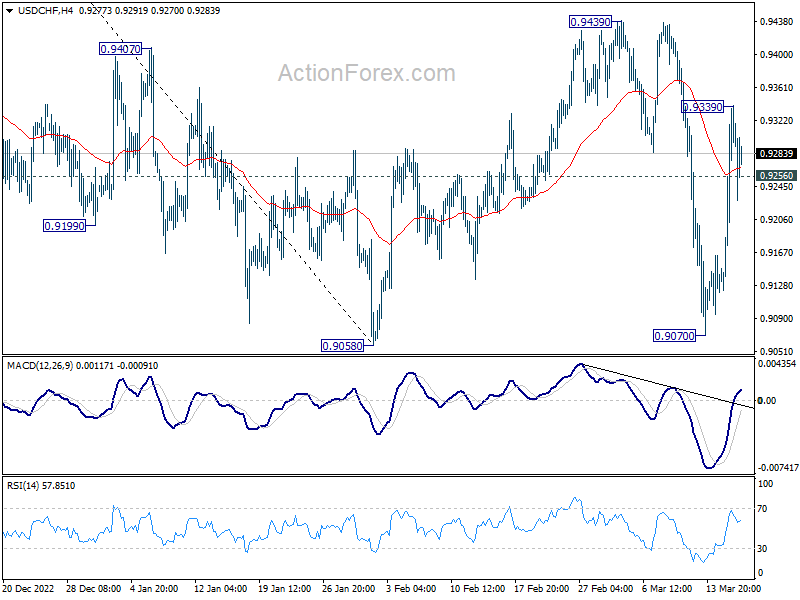
Daily Pivots: (S1) 0.9192; (P) 0.9266; (R1) 0.9408; More...
Intraday bias in USD/CHF is turned neutral first with break of 0.9256 minor support. Outlook is unchanged that corrective pattern from 0.9058 is still extending. Above 0.9339 will target 0.9439 resistance and possibly above. But overall, outlook will stay bearish as long as 0.9474 fibonacci level holds, and another decline through 0.9058 is expected at a later stage.
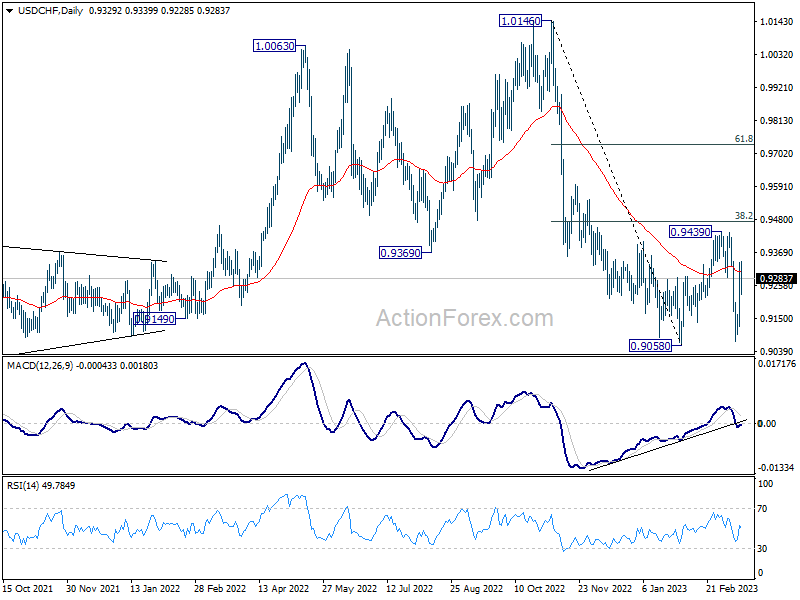
In the bigger picture, fall from 1.1046 (2022 high) should still be in progress with 38.2% retracement of 1.0146 to 0.9058 at 0.9474 intact. Rejection by 55 week EMA was a medium term bearish sign. Break of 0.9058 will resume such decline towards 0.8756 support (2021 low). But overall, such fall is still as a leg in the long term range pattern from 1.0342 (2016 high). So, downside should be contained by 0.8756 to bring reversal.
GBP/USD Mid-Day Outlook
Daily Pivots: (S1) 1.1983; (P) 1.2083; (R1) 1.2154; More...
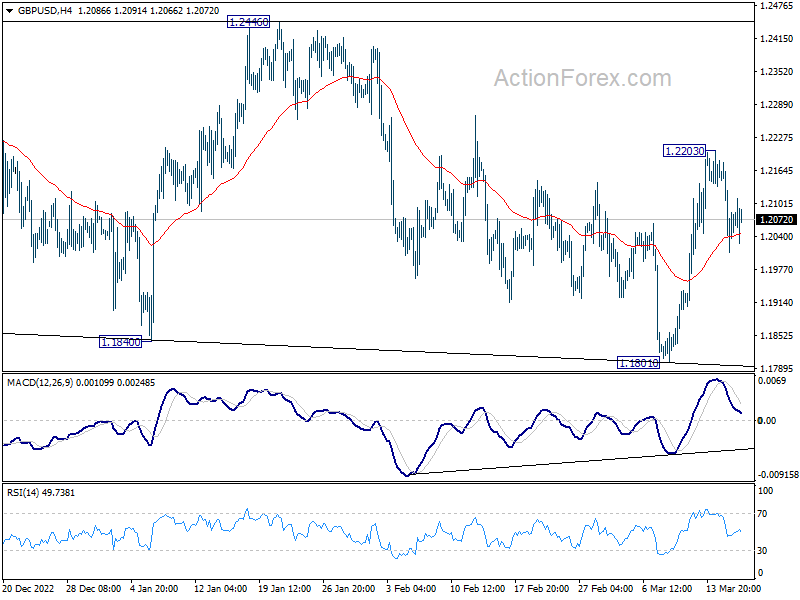
Intraday bias in GBP/USD remains neutral and outlook is unchanged. Corrective pattern from 1.2445 could have completed with three waves to 1.1801 already. On the upside, above 1.2203 will resume the rally from 1.2445/6 resistance zone next. However, decisive break of 4 hour 55 EMA (now at 1.2042) will argue that the pattern from 1.2445 is extending with another falling leg, and turn bias to the downside for 1.1801 again.
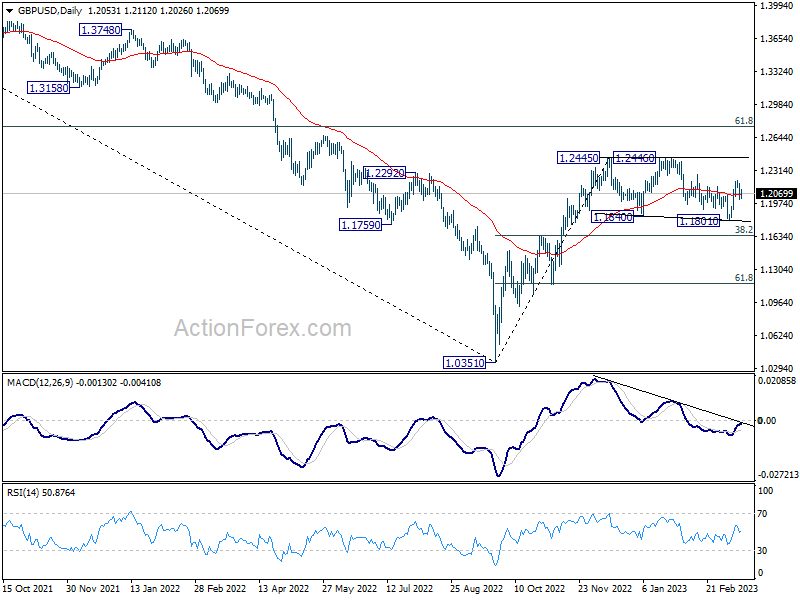
In the bigger picture, price action from 1.2445 are seen as a corrective pattern to rise from 1.0351 medium term bottom (2022 low). Resumption is expected as a later stage and firm break of 1.2446 will target 61.8% retracement of 1.4248 (2021 high) to 1.0351 at 1.2759. This will remain the favored case as long as 38.2% retracement of 1.0351 to 1.2445 at 1.1645 holds.
EUR/USD Mid-Day Outlook
Daily Pivots: (S1) 1.0475; (P) 1.0618; (R1) 1.0718; More...
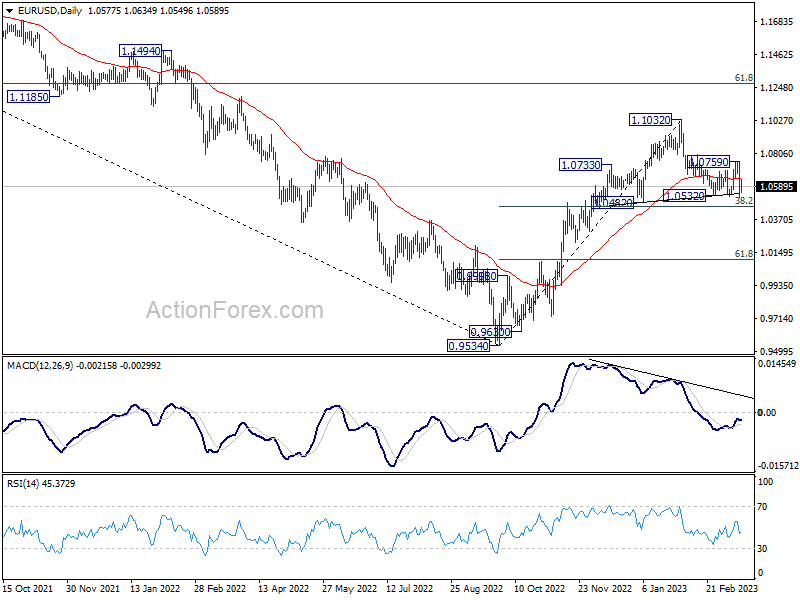
EUR/USD dips mildly after failing to break through 4 hour 55 EMA and intraday bias stays neutral first. Focus remains on support zone between 38.2% retracement of 0.9534 to 1.1032 at 1.0258 and 1.0482. Strong support from there, followed by rebound through 1.0759 resistance, will retain near term bullishness. However, sustained break of 1.0258 will complete a head and shoulder top (ls: 1.0733, h: 1.1032, rs: 1.0759). Outlook will be turned bearish fro 61.8% retracement at 1.0106.
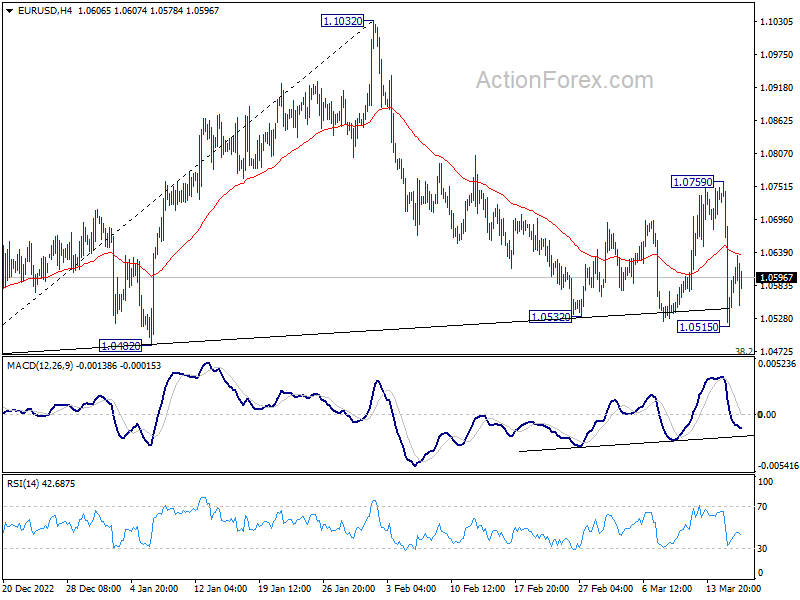
In the bigger picture, as long as 1.0482 support holds, rise from 0.9534 (2022 low) should continue to 61.8% retracement of 1.2348 (2021 high) to 0.9534 at 1.1273. However, sustained break of 1.0482 will bring deeper fall to 61.8% retracement of 0.9534 to 1.1032 at 1.0106, with risk of breaking through 0.9534 eventually.
Euro Mildly Lower after Dovish ECB Hike, Yen Resuming Rally
Euro weakens mildly following the ECB's decision to increase interest rates by 50bps, in line with their previously stated intentions. However, the absence of any reference to future rate hikes in the accompanying statement hints at the possibility of a pause in upcoming monetary policy meetings. Concurrently, Yen is resuming its recent rally in early US trading as the US 10-year yield drops back to 3.4% level. Despite positive job data, Dollar remains mixed and continues to trade within a familiar range against commodity currencies.
Meanwhile, it is worth noting that due to the ongoing banking crisis, market expectations now point towards a final 25 basis point rate hike from the Federal Reserve next week. In fact, Fed fund futures currently suggest a greater than 70% probability of a rate cut in June, returning to a range of 4.50-4.75%. By year-end, there is a 70% chance that the federal funds rate will revert to a range of 3.75-4.00%.
Technically, USD/JPY's fall from 137.90 resumes by breaking through 132.27 support today. Immediate focus is now on 61.8% retracement of 127.20 to 137.90 at 131.28. Sustained break there will pave the way to retest 127.20 low. For now, risk will stay on the downside as long as 135.10 resistance holds, in case of recovery.
In Europe, at the time of writing, FTSE is up 0.21%. DAX is up 0.33%. CAC is up 0.60%. Germany 10-year yield is up 0.055 at 2.180. Earlier in Asia, Nikkei dropped -0.80%. Hong Kong HSI dropped -1.72%. China Shanghai SSE dropped -1.12%. Singapore Strait times dropped -0.55%. Japan 10-year JGB yield dropped -0.0193 to 0.297.
ECB hikes 50bps, next move data-dependent
ECB raises the three key interest rates by 50bps today. After that, the main refinancing, marginal lending facility and deposit facility rates will be 3.50%, 3.75%, and 3.00% respectively.
There was no reference to further tightening in upcoming meetings. Instead the governing council will continue with a "data-dependent approach", with decisions determined by inflation outlook, dynamics of underlying inflation, and strength of monetary policy transmission.
In the new economic projections, headline inflation forecast was revised down across the horizon. But core inflation forecast was revised up in 2023. GDP growth forecast is also revised up in 2023.
- Headline inflation is forecast to average 5.3% in 2023, 2.9% in 2024, and 2.1% in 2025. The estimate was downgraded from December's 6.3% in 2023, 3.4% in 2024, and 2.3% in 2025.
- Core inflation is projected to average 4.6% in 2023, 2.5% in 2025, and 2.2% in 2025. Comparing to December projections of 4.2% in 2023, 2.8% in 2024, and 2.4% in 2025.
- GDP growth is forecast to average at 1.0% in 2023, 1.6% in 2024, and 1.6% in 2025, comparing to December's forecast of 0.5% in 2023, 1.9% in 2024, and 1.8% in 2025.
But the central noted that the macroeconomic projections were finalized before recent emergence of financial market tensions. Hence, there is additional uncertainty around the above baseline assessments.
US initial jobless claims dropped to 192k
US initial jobless claims dropped -20k to 192k in the week ending March 11, below expectation of 205k. Four-week moving average of initial claims dropped -750 to 196.5k. Continuing claims dropped -29k to 1684k in the week ending March 4. Four-week moving average of continuing claims dropped -1750 to 1676.5k.
Also from the US, Philly Fed manufacturing survey rose from -24.3 to -23.2 in March, but missed expectation of -16.
Swiss SECO: Growth below average this year, but no recession
Swiss economic growth projections for 2023 and 2024 have been revised by the State Secretariat for Economic Affairs (SECO), as recent forecasts indicate mixed outcomes for the nation.
The Swiss economy, adjusted for sporting events, is now anticipated to grow by 1.1% in 2023, a slight increase from December's 1.0% forecast. However, the outlook for 2024 has been lowered, with an expected growth rate of 1.5% compared to the previous 1.6% projection. While 2023's growth rate remains below average, it is not expected to plunge the economy into a recession.
Meanwhile, inflation is forecast to decelerate from 2.8% in 2022 to 2.4% in 2023, a revision from the initial 2.2% estimate, before settling at 1.5% in 2024, in line with prior expectations.
Early indicators for the first quarter of 2023 suggest a robust performance for the Swiss economy. Private consumption is projected to experience modest growth in the coming quarters, supported by a strong labor market and nominal wage increases. However, investment growth is likely to remain below average under current conditions.
SECO predicts that the European energy situation will stabilize further by the end of 2024, contributing to a gradual decline in global inflation rates. This should lead to a recovery in international demand. Nevertheless, the Swiss economy may outperform these projections if the energy landscape and inflation rates prove to be more favorable than anticipated, potentially resulting in stronger demand both domestically and globally.
Japan posted record February trade deficit
In February, Japan exports rose 6.5% yoy to JPY 7655B, below expectation of 7.1% yoy. Imports rose 8.3% yoy to JPY 8552B, below expectation of 12.2% yoy. Consequently, the country experienced its largest February trade deficit to date at JPY -897.7B.
The breakdown of trade relations painted an interesting picture, with the US and China displaying contrasting trends. Exports to the US surged by 14.9% yoy, while imports increased by 6.6%, resulting in a favorable surplus of JPY 530.5B. However, trade with China proved more challenging, as exports dipped by -10.9% yoy and imports saw a marginal decrease of 0.6% yoy, culminating in a deficit of JPY -209.8B.
On a more positive note, seasonally adjusted figures highlighted a 4.4%mom rise in exports to JPY 8146B, accompanied by a 3.0% mom drop in imports to JPY 9336B. As a result, trade deficit narrowed to JPY -1191B, outperforming the expected JPY -1460B.
Australia employment grew 64.6k in Feb, unemployment rate dropped to 3.5%
Australia employment grew 64.6k in February, well above expectation of 48.5k. Full-time employment rose 74.9k. Part-time employment decreased -10.3k.
Unemployment rate dropped from 3.7% to 3.5%, below expectation of 3.6%. Participation rate rose 0.1% to 66.6%. Monthly hours worked rose 3.9% mom.
Bjorn Jarvis, ABS head of labour statistics said: "with employment increasing by around 65,000 people, and the number of unemployed decreasing by 17,000 people, the unemployment rate fell to 3.5 per cent. This was back to the level we saw in December.
"The February increase in employment follows consecutive falls in December and January. In January, this reflected a larger than usual number of people waiting to start a new job, the majority of whom returned to or commenced their jobs in February.
NZ GDP contracted -0.6% qoq in Q4, RBNZ may slow tightening
New Zealand's Q4 GDP contracted by -0.6% qoq, missing the expected contraction of 0.2% qoq. The primary industries fell by 1.3%, service industries were down by 0.1%, and goods-producing industries were down by 0.3%.
Although the Finance Minister Grant Robertson acknowledged that the GDP could fluctuate as the country continues to recover from COVID, he also highlighted that the economy is nearly 6.7% larger than pre-pandemic levels, outpacing other countries.
Despite this, the GDP figure is significantly below RBNZ's forecast of 0.7% growth, suggesting that the central bank may not need to be as aggressive with its tightening in the future. As a result, economists are now predicting that the RBNZ will opt for a more modest 25bps rate hike in April instead of the previously expected 50bps
EUR/USD Mid-Day Outlook
Daily Pivots: (S1) 1.0475; (P) 1.0618; (R1) 1.0718; More...
EUR/USD dips mildly after failing to break through 4 hour 55 EMA and intraday bias stays neutral first. Focus remains on support zone between 38.2% retracement of 0.9534 to 1.1032 at 1.0258 and 1.0482. Strong support from there, followed by rebound through 1.0759 resistance, will retain near term bullishness. However, sustained break of 1.0258 will complete a head and shoulder top (ls: 1.0733, h: 1.1032, rs: 1.0759). Outlook will be turned bearish fro 61.8% retracement at 1.0106.
In the bigger picture, as long as 1.0482 support holds, rise from 0.9534 (2022 low) should continue to 61.8% retracement of 1.2348 (2021 high) to 0.9534 at 1.1273. However, sustained break of 1.0482 will bring deeper fall to 61.8% retracement of 0.9534 to 1.1032 at 1.0106, with risk of breaking through 0.9534 eventually.
Economic Indicators Update
| GMT | Ccy | Events | Actual | Forecast | Previous | Revised |
|---|---|---|---|---|---|---|
| 21:45 | NZD | GDP Q/Q Q4 | -0.60% | -0.20% | 2.00% | 1.70% |
| 23:50 | JPY | Trade Balance (JPY) Feb | -1.19T | -1.46T | -1.82T | |
| 23:50 | JPY | Machinery Orders M/M Jan | 9.50% | 1.80% | 1.60% | |
| 00:00 | AUD | Consumer Inflation Expectations Mar | 5.00% | 5.10% | ||
| 00:30 | AUD | Employment Change Feb | 64.6K | 48.5K | -11.5K | -10.9K |
| 00:30 | AUD | Unemployment Rate Feb | 3.50% | 3.60% | 3.70% | |
| 04:30 | JPY | Industrial Production M/M Jan F | -5.30% | -4.60% | -4.60% | |
| 08:00 | CHF | SECO Economic Forecasts | ||||
| 12:30 | CAD | Wholesale Sales M/M Jan | 2.40% | 0.10% | -0.80% | -0.70% |
| 12:30 | USD | Initial Jobless Claims (Mar 10) | 192K | 205K | 211K | 212K |
| 12:30 | USD | Housing Starts Feb | 1.45M | 1.32M | 1.31M | 1.321M |
| 12:30 | USD | Building Permits Feb | 1.524M | 1.35M | 1.34M | 1.339M |
| 12:30 | USD | Import Price Index M/M Feb | -0.10% | -0.20% | -0.20% | -0.40% |
| 12:30 | USD | Philadelphia Fed Manufacturing Survey Mar | -23.2 | -16 | -24.3 | |
| 13:15 | EUR | ECB Main Refinancing Rate | 3.50% | 3.50% | 3.00% | |
| 13:45 | EUR | ECB Press Conference | ||||
| 14:30 | USD | Natural Gas Storage | -62B | -84B |