Sample Category Title
New Zealand Dollar Extends Losses as GDP Contracts
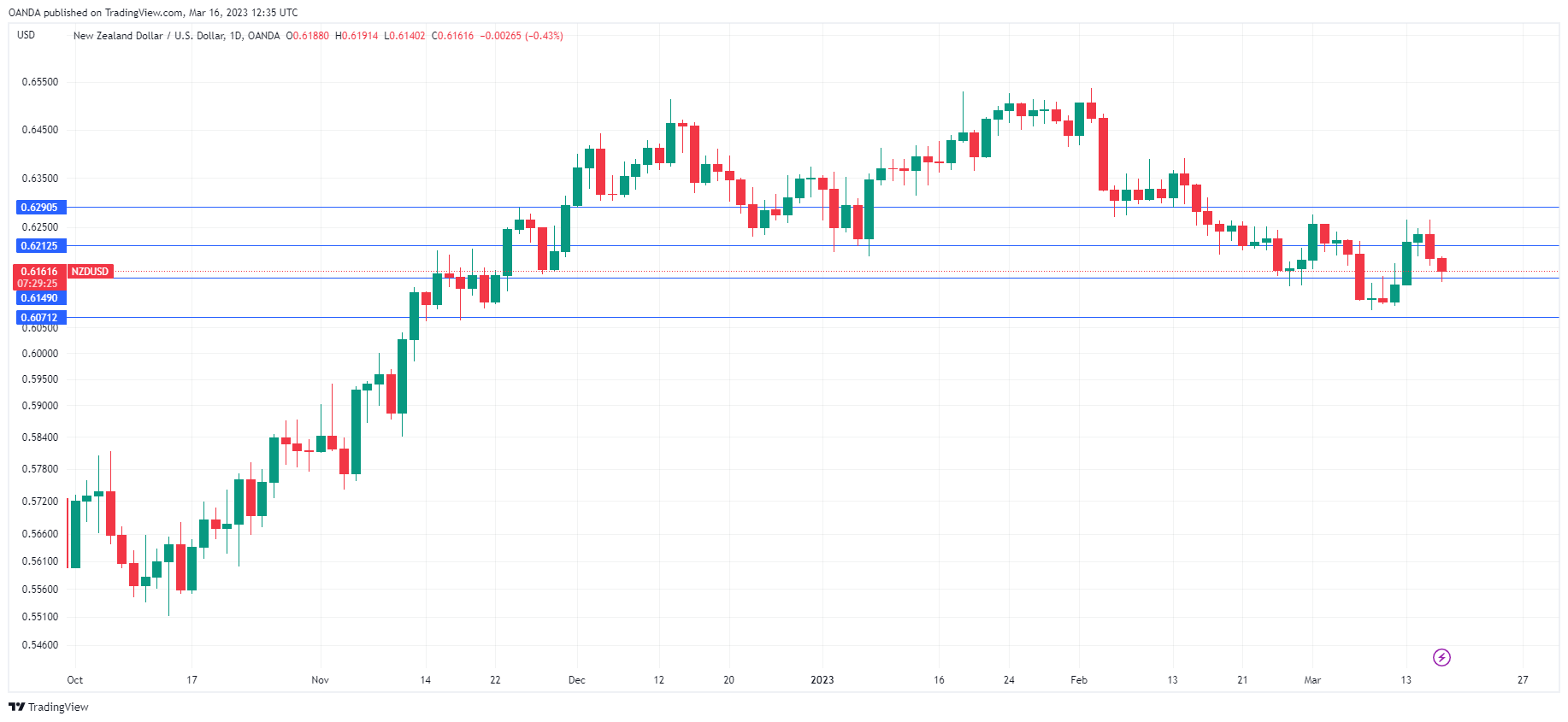
The New Zealand dollar has had a busy week, which is not surprising given the turmoil which has gripped the markets. NZD/USD has extended its losses on Thursday and is trading at 0.6162, down 0.40%.
New Zealand GDP declines
The markets were braced for a soft GDP report for Q4, but the decline was sharper than expected. GDP slowed to 2.2% y/y, down from 6.4% in Q3 and shy of the estimate of 3.3%. On a monthly basis, GDP fell 0.6%, following a gain of 2.0% in Q3 and shy of the estimate of -0.2%. The Reserve Bank of New Zealand had projected 0.7% growth, and the miss could mean the central bank will ease up on the pace of rate hikes.
The economy is showing weakness across the board, including manufacturing, consumer spending and trade. The RBNZ had projected that the economy would tip into a recession in the second quarter of 2023, but the contraction in Q4 may signal that the economy is already in recession. The forecast for Q1 of 2023 is gloomy, exacerbated by the severe flooding in January and February.
Given this bleak backdrop, the central bank may have to back its tightening plans. The markets had priced in the RBNZ hiking the cash rate by another 75 basis points to 5.50% by the third quarter, but this has fallen to 5.10%. The RBNZ meets next on April 5 and the market is 50/50 on whether the next hike will be 25 or 50 basis points.
In the US, today’s data was a mixed bag. Unemployment claims fell to 192,000, down from 212,000 and lower than the forecast of 205,000. This points to a resilient US labour market, a key pillar of support for the Fed’s hawkish rate stance. Manufacturing has been struggling and the Philly Fed Manufacturing Index ticked higher to -23.2, compared to -24.3 prior and well below the forecast of 14.5 points. This release follows the Empire State Manufacturing Index, which tumbled to -24.6, down from -5.8 and below the forecast of -8.0 points.
NZD/USD Technical
- NZD/USD is testing support at 0.6149. Below, there is support at 0.6071
- 0.6212 and 0.6290 are the next resistance lines
WTI Oil: Holding Firmly Below $70 on Growing Fears of Deeper Crisis in Financial World
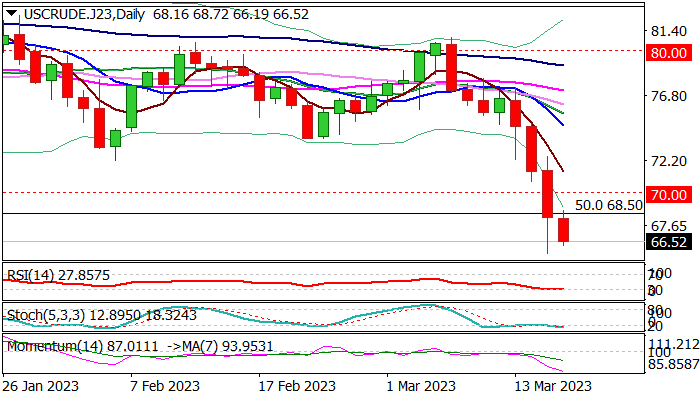
WTI oil price remains in red on Thursday but so far holding above 15-moth low ($65.69), posted after Wednesday’s sharp acceleration lower.
Existing negative sentiment was additionally soured by news that Credit Suisse Bank asked for a massive financial support from the Swiss National Bank, fueling growing fears of broader instability in global banking sector after a collapse of two banks in the US last week sent an initial shockwave through financial world.
Oil price is in a steep downtrend since Mar 7 on demand concerns, as most of developed economies are showing signs of slowdown and recession, while optimism from strong growth of China’s economy in post-Covid period, proved to be insufficient to offset negative impact on oil price.
Wednesday’s break below psychological $70 level (the first since late December 2021), further weakened the structure, as WTI contract is on track for the biggest weekly fall in 2023 (down over 12% so far).
Bears broke below pivotal Fibo support at $68.50 (50% retracement of larger $6.52/$130.48 rally), which added to negative signals from firmly bearish technical studies on daily and weekly chart.
Temporary footstep was found at $66.14 (200WMA), though consolidation above this level is likely to be very limited, despite oversold conditions on daily chart, as the price action is currently driven mainly by fundamentals.
Loss of 200WMA support would risk test of a higher base at $61.80 (mid-Aug 2021) and psychological $60 support in extension.
Potential upticks would be mainly seen as positioning for fresh weakness and should be capped by strong resistances at $70.00/$72.50 (psychological / 200MMA) to keep larger bears intact.
Res: 68.50; 70.00; 72.50; 73.77.
Sup: 65.69; 62.42; 61.80; 60.00.
ECB press conference live stream
https://www.youtube.com/watch?v=eqwfatWtILg
ECB hikes 50bps, next move data-dependent
ECB raises the three key interest rates by 50bps today. After that, the main refinancing, marginal lending facility and deposit facility rates will be 3.50%, 3.75%, and 3.00% respectively.
There was no reference to further tightening in upcoming meetings. Instead the governing council will continue with a "data-dependent approach", with decisions determined by inflation outlook, dynamics of underlying inflation, and strength of monetary policy transmission.
In the new economic projections, headline inflation forecast was revised down across the horizon. But core inflation forecast was revised up in 2023. GDP growth forecast is also revised up in 2023.
- Headline inflation is forecast to average 5.3% in 2023, 2.9% in 2024, and 2.1% in 2025. The estimate was downgraded from December's 6.3% in 2023, 3.4% in 2024, and 2.3% in 2025.
- Core inflation is projected to average 4.6% in 2023, 2.5% in 2025, and 2.2% in 2025. Comparing to December projections of 4.2% in 2023, 2.8% in 2024, and 2.4% in 2025.
- GDP growth is forecast to average at 1.0% in 2023, 1.6% in 2024, and 1.6% in 2025, comparing to December's forecast of 0.5% in 2023, 1.9% in 2024, and 1.8% in 2025.
But the central noted that the macroeconomic projections were finalized before recent emergence of financial market tensions. Hence, there is additional uncertainty around the above baseline assessments.
(ECB) Monetary policy decisions
Inflation is projected to remain too high for too long. Therefore, the Governing Council today decided to increase the three key ECB interest rates by 50 basis points, in line with its determination to ensure the timely return of inflation to the 2% medium-term target. The elevated level of uncertainty reinforces the importance of a data-dependent approach to the Governing Council's policy rate decisions, which will be determined by its assessment of the inflation outlook in light of the incoming economic and financial data, the dynamics of underlying inflation, and the strength of monetary policy transmission.
The Governing Council is monitoring current market tensions closely and stands ready to respond as necessary to preserve price stability and financial stability in the euro area. The euro area banking sector is resilient, with strong capital and liquidity positions. In any case, the ECB's policy toolkit is fully equipped to provide liquidity support to the euro area financial system if needed and to preserve the smooth transmission of monetary policy.
The new ECB staff macroeconomic projections were finalised in early March before the recent emergence of financial market tensions. As such, these tensions imply additional uncertainty around the baseline assessments of inflation and growth. Prior to these latest developments, the baseline path for headline inflation had already been revised down, mainly owing to a smaller contribution from energy prices than previously expected. ECB staff now see inflation averaging 5.3% in 2023, 2.9% in 2024 and 2.1% in 2025. At the same time, underlying price pressures remain strong. Inflation excluding energy and food continued to increase in February and ECB staff expect it to average 4.6% in 2023, which is higher than foreseen in the December projections. Subsequently, it is projected to come down to 2.5% in 2024 and 2.2% in 2025, as the upward pressures from past supply shocks and the reopening of the economy fade out and as tighter monetary policy increasingly dampens demand.
The baseline projections for growth in 2023 have been revised up to an average of 1.0% as a result of both the decline in energy prices and the economy's greater resilience to the challenging international environment. ECB staff then expect growth to pick up further, to 1.6%, in both 2024 and 2025, underpinned by a robust labour market, improving confidence and a recovery in real incomes. At the same time, the pick-up in growth in 2024 and 2025 is weaker than projected in December, owing to the tightening of monetary policy.
Key ECB interest rates
The Governing Council decided to raise the three key ECB interest rates by 50 basis points. Accordingly, the interest rate on the main refinancing operations and the interest rates on the marginal lending facility and the deposit facility will be increased to 3.50%, 3.75% and 3.00% respectively, with effect from 22 March 2023.
Asset purchase programme (APP) and pandemic emergency purchase programme (PEPP)
The APP portfolio is declining at a measured and predictable pace, as the Eurosystem does not reinvest all of the principal payments from maturing securities. The decline will amount to €15 billion per month on average until the end of June 2023 and its subsequent pace will be determined over time.
As concerns the PEPP, the Governing Council intends to reinvest the principal payments from maturing securities purchased under the programme until at least the end of 2024. In any case, the future roll-off of the PEPP portfolio will be managed to avoid interference with the appropriate monetary policy stance.
The Governing Council will continue applying flexibility in reinvesting redemptions coming due in the PEPP portfolio, with a view to countering risks to the monetary policy transmission mechanism related to the pandemic.
Refinancing operations
As banks are repaying the amounts borrowed under the targeted longer-term refinancing operations, the Governing Council will regularly assess how targeted lending operations are contributing to its monetary policy stance.
***
The Governing Council stands ready to adjust all of its instruments within its mandate to ensure that inflation returns to its 2% target over the medium term and to preserve the smooth functioning of monetary policy transmission. The ECB's policy toolkit is fully equipped to provide liquidity support to the euro area financial system if needed. Moreover, the Transmission Protection Instrument is available to counter unwarranted, disorderly market dynamics that pose a serious threat to the transmission of monetary policy across all euro area countries, thus allowing the Governing Council to more effectively deliver on its price stability mandate.
The President of the ECB will comment on the considerations underlying these decisions at a press conference starting at 14:45 CET today.
Brent Futures Recoup Losses after Losing More Than 13%
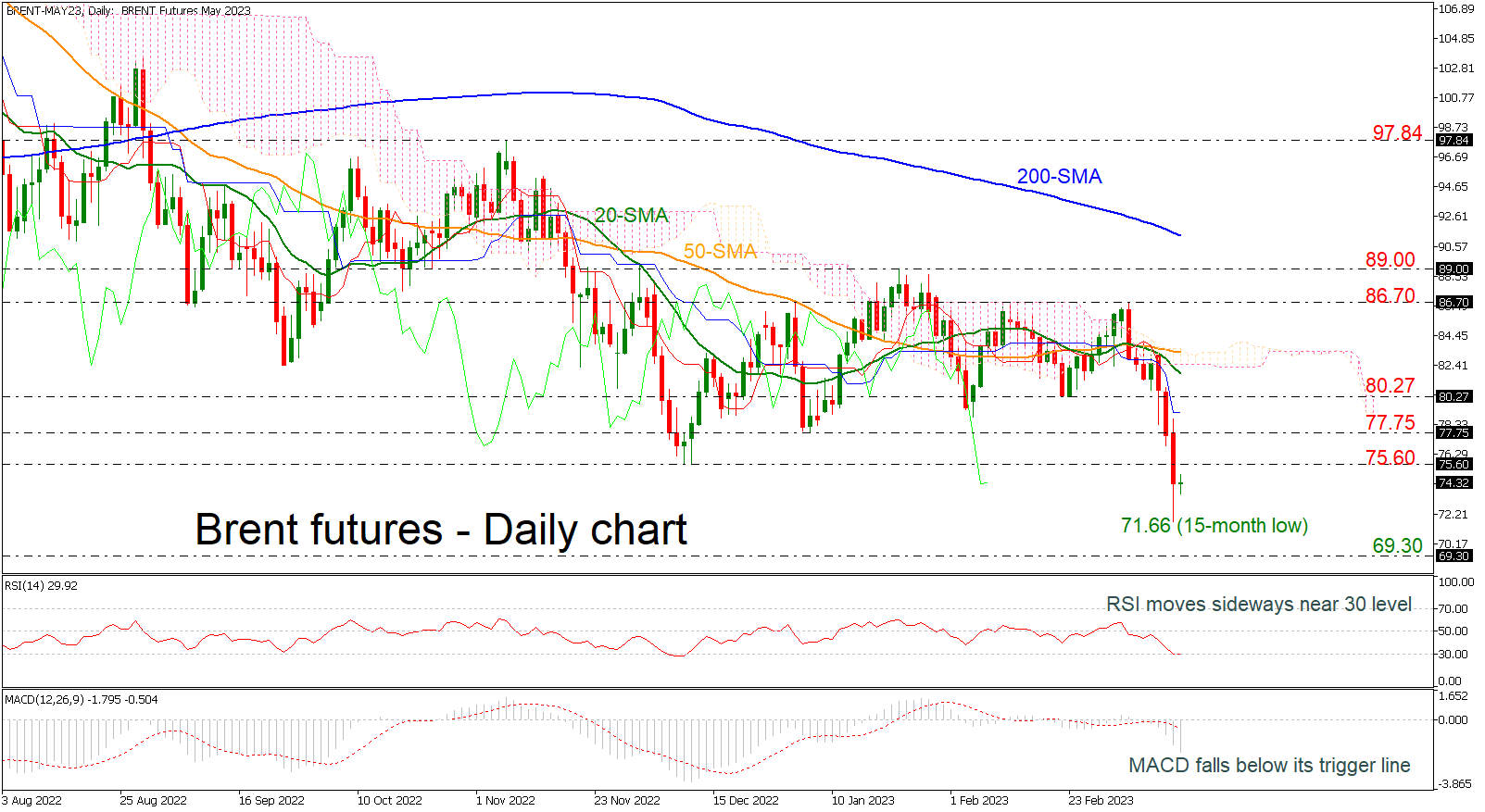
Brent crude oil lost more than 13% in the preceding three trading sessions, recording a fresh 15-month low of 71.66. Currently, the market is rising slightly but the tendency is bearish after the break below 75.60. The RSI indicator is moving sideways near the oversold region, while the MACD is extending its negative structure beneath its trigger and zero lines.
Should prices decline, immediate support could be found around the 69.30 barrier, taken from the lows in November 2021, confirming the medium-term bearish move. Then a leg below that level, could hit the 65.30 line, achieved in November 2021 as well.
However, if the market manages to pick up speed, the immediate inside swing lows at 75.60 and 77.75 could offer nearby resistance ahead of the 80.27 mark. A significant close above the latter could meet the 20- and the 50-day simple moving averages (SMAs) at 81.90 and 83.30 respectively.
In the medium-term, the outlook shifted to negative and only a climb back above the short-term SMAs may change the bias to neutral again.
US initial jobless claims dropped to 192k
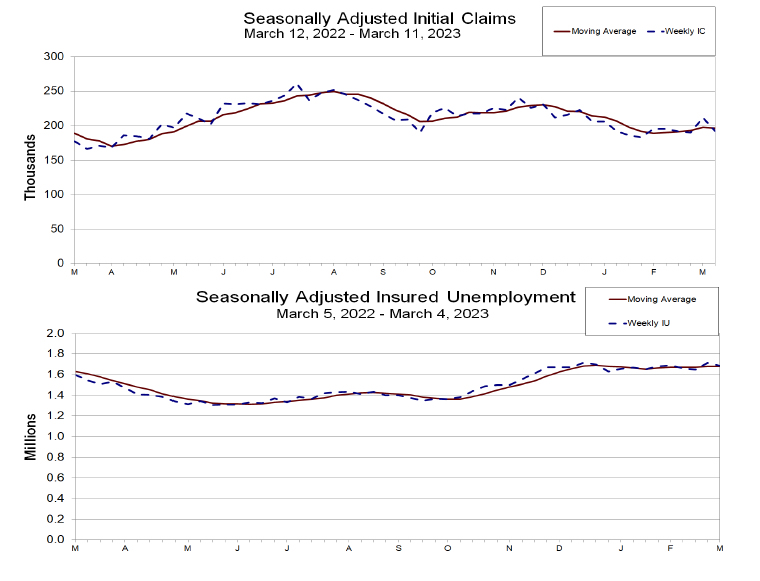
US initial jobless claims dropped -20k to 192k in the week ending March 11, below expectation of 205k. Four-week moving average of initial claims dropped -750 to 196.5k.
Continuing claims dropped -29k to 1684k in the week ending March 4. Four-week moving average of continuing claims dropped -1750 to 1676.5k.
Credit Suisse Crisis Muddies ECB, EUR Putlook
A week is indeed a long time in global financial markets, and the calculus for central bank rate hikes has been dramatically altered by the SVB and Credit Suisse crises in recent days.
The market’s prior foregone conclusion of a 50-bps hike by the European Central Bank has been whittled down to a coin toss today. A 50bp hike may be too much for now, in light of the still-fragile sentiment surrounding the banking sector on both sides of the Atlantic.
The ECB’s dilemma pits consumer price stability against financial systemic stability, and markets will be attuned to where the ECB’s bias lies.
The central bank’s policy signals later today could serve as a canary in the coal mine, at least ahead of the Fed’s meeting next week, as contagion fears continue to permeate global financial markets.
Although Eurozone assets, including the bloc’s currency and equity markets, are finding relief in the fact that the SNB has come to Credit Suisse’s aid, traders and investors are still highly sensitive to the ECB’s current take on matters.
A hawkish 25bp hike today, suggesting that the ECB views this Credit Suisse crisis as transitory, could push EURUSD closer to 1.0690. Such a bullish move would have to be predicated on the belief that the ECB can extend its rate hike cycle and preserve its inflation-fighting credibility without incurring too much damage along the way.
However, a more cautious pause today would suggest that policymakers are now increasingly wary about financial stability risks, serving instead as a negative loop to drag the euro lower against its G10 peers.
EUR/USD – Credit Suisse Woes Knock Down Euro, Will ECB Hike Today?
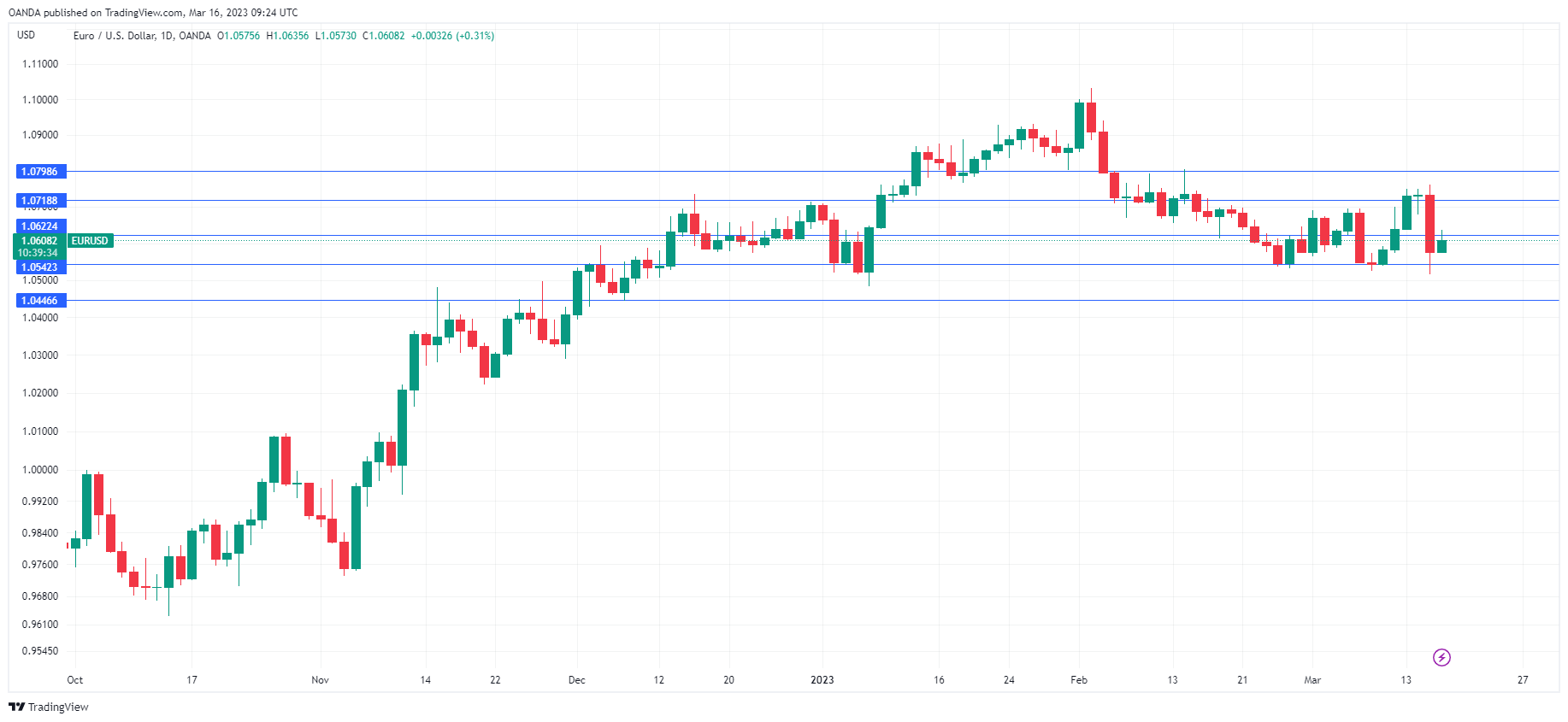
The euro has rebounded on Thursday after sliding 1.5% a day earlier, its worst daily showing since September 2022. In the European session, EUR/USD is trading at 1.0613, up 0.35%.
The financial markets are in turmoil, with fears growing that the Silicon Valley collapse could lead to a full-blown banking crisis. Stock markets have fallen sharply and global banks took a hit on Wednesday after Credit Suisse stocks plunged by 25%. Credit Suisse dragged the euro sharply lower and US Treasury yields and eurozone bond also tumbled. Investors are understandably jittery and the lack of any action from the authorities is not helping matters.
How will this volatile situation impact on the ECB decision later today? Given all the market turmoil, it’s anyone’s guess what ECB policy makers will do. Just last week, the markets had priced in an 85% chance of a 50 basis-point increase, but that has been shaved to 25 bp since the SVB collapse. ECB President Lagarde had signalled very clearly that the central bank would raise rates by 50 bp, and if the ECB doesn’t deliver it risks damaging credibility. A pause in rates is unlikely, but given the ugly economic backdrop, such a move cannot be discounted.
Inflation in the eurozone is red-hot at 8.50% and remains the ECB’s number one concern. The current banking crisis may have shifted attention away from inflation, but the ECB will have to continue raising rates to bring inflation closer to the 2% target. The current market turmoil could lead the ECB to be more cautious at today’s meeting, but I expect that policy makers won’t shift their aggressive rate policy. The ECB will release an updated inflation forecast at the meeting, and if, as expected, the core rate projection is revised upwards, hawkish policy members at the ECB will be calling for more rate hikes.
EUR/USD Technical
- EUR/USD is testing resistance at 1.0718. The next resistance level is 1.0798
- There is support at 1.0622 and 1.0542
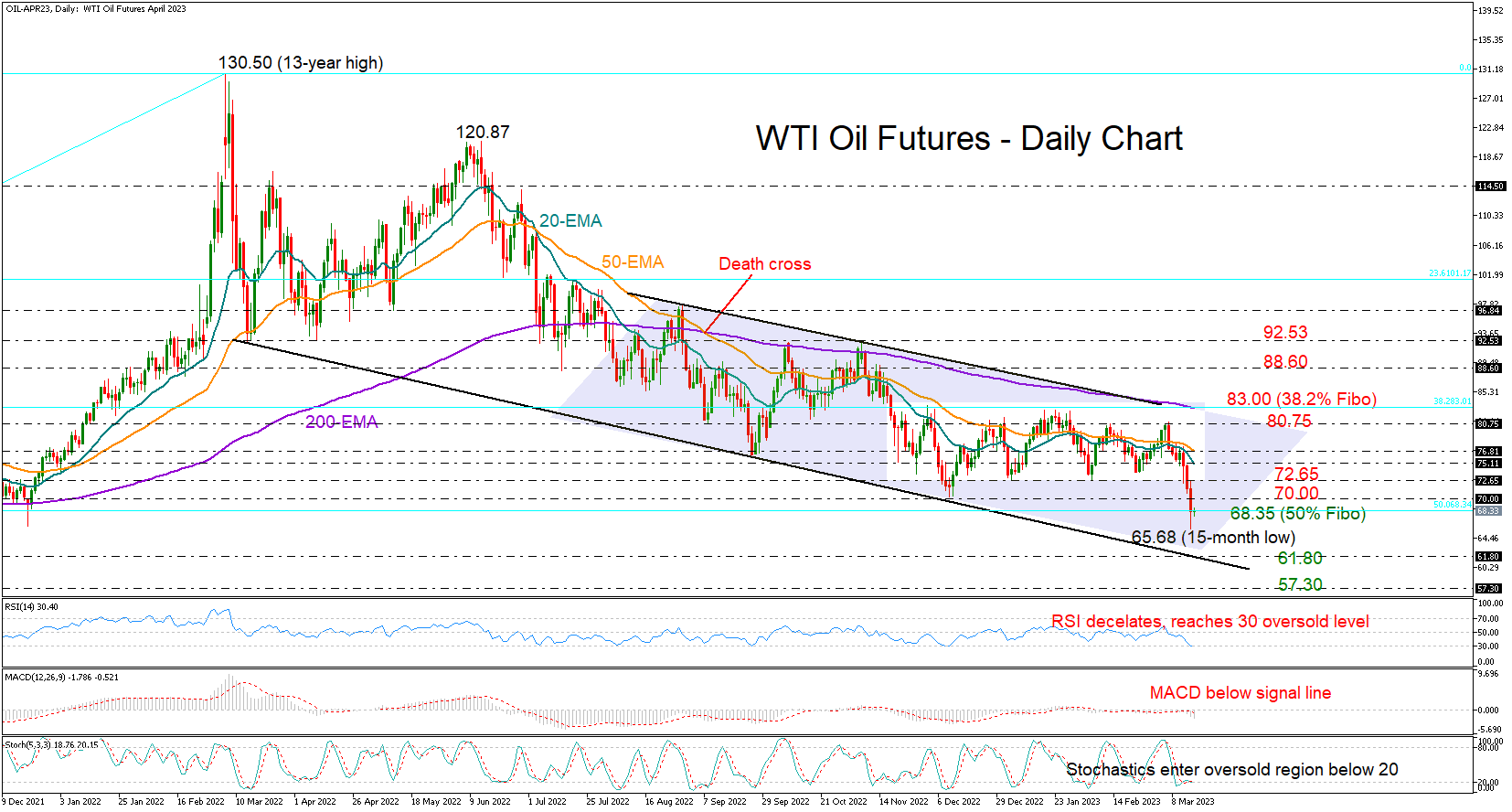
WTI Oil Futures Resume Bearish Outlook
WTI oil futures collapsed to a 15-month low of 65.68 on Wednesday after breaking the four-month-old range below the 72.65 floor.
The price, however, managed to close around the 50% Fibonacci retracement of the 2020-2021 rally at 68.35, increasing the odds for an upside correction or some stabilization as the RSI and the Stochastic oscillator hover near oversold levels. Yet, the decline in the indicators has not ceased yet, suggesting the downside pressures may dominate for a bit longer before the market switches to recovery mode. Meanwhile, the negative slope in the 20- and 50-day exponential moving averages (EMAs) is promoting the resumption of the bearish trend.
Should the price close below the 68.35 base, the sell-off could speed up towards the lower boundary of the bearish channel seen around 61.80. A continuation lower could halt near the March 2021 floor of 57.30, while a steeper decline could reach the former resistance of 53.80.
Alternatively, a bullish correction could initially pause near the 70.00 psychological mark, where the price almost bottomed in December. A successful move higher may attempt to re-enter the previous range above 72.65, with the 20- and 50-day EMAs likely coming next on the radar ahead of the key 80.75 bar.
In brief, the short-term bias for WTI oil futures points to more downside, though with the market trading within oversold waters, the ongoing sell-off might be nearing a bottom.