Sample Category Title
Swiss SECO: Growth below average this year, but no recession
Swiss economic growth projections for 2023 and 2024 have been revised by the State Secretariat for Economic Affairs (SECO), as recent forecasts indicate mixed outcomes for the nation.
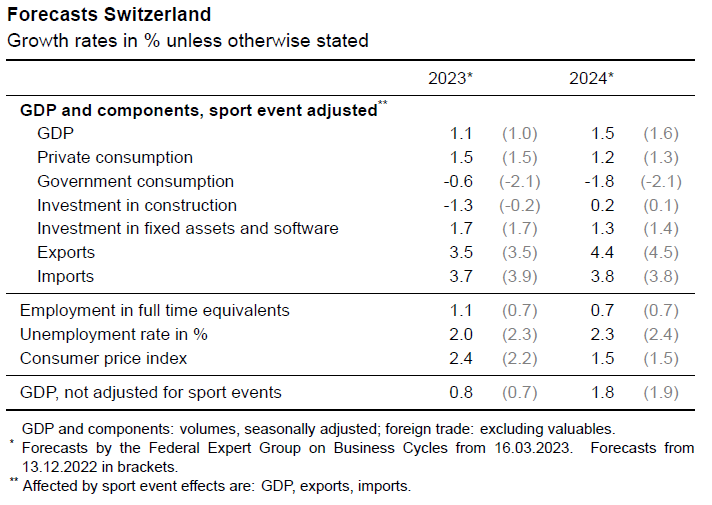
The Swiss economy, adjusted for sporting events, is now anticipated to grow by 1.1% in 2023, a slight increase from December's 1.0% forecast. However, the outlook for 2024 has been lowered, with an expected growth rate of 1.5% compared to the previous 1.6% projection. While 2023's growth rate remains below average, it is not expected to plunge the economy into a recession.
Meanwhile, inflation is forecast to decelerate from 2.8% in 2022 to 2.4% in 2023, a revision from the initial 2.2% estimate, before settling at 1.5% in 2024, in line with prior expectations.
Early indicators for the first quarter of 2023 suggest a robust performance for the Swiss economy. Private consumption is projected to experience modest growth in the coming quarters, supported by a strong labor market and nominal wage increases. However, investment growth is likely to remain below average under current conditions.
SECO predicts that the European energy situation will stabilize further by the end of 2024, contributing to a gradual decline in global inflation rates. This should lead to a recovery in international demand. Nevertheless, the Swiss economy may outperform these projections if the energy landscape and inflation rates prove to be more favorable than anticipated, potentially resulting in stronger demand both domestically and globally.
US Oil Resumes Downtrend
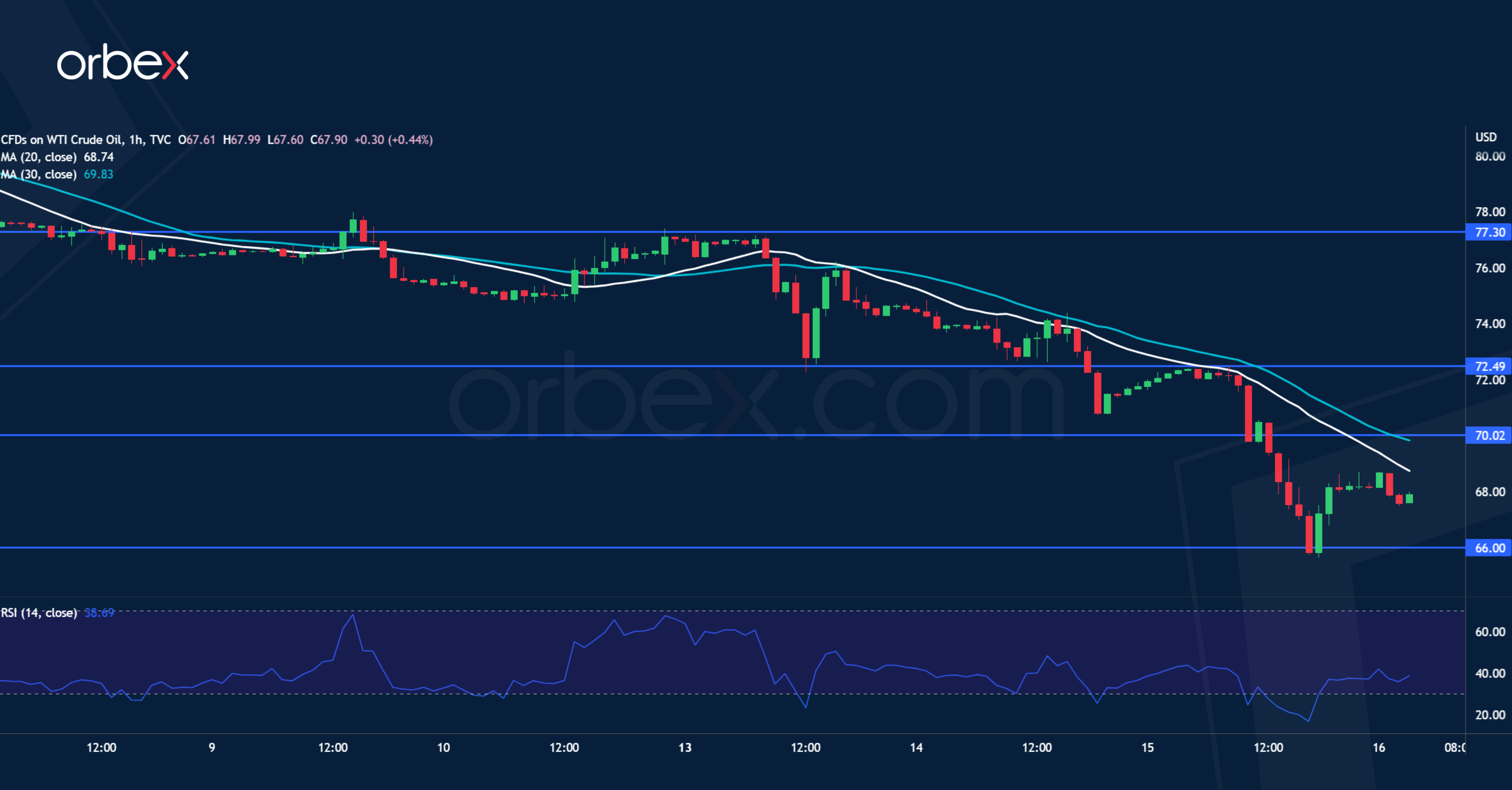
WTI crude plunges over mounting recession worries as the bank drama unfolds. A previous break below the daily low of 73.80 has put the commodity under pressure. Then a decisive close below December’s low and the psychological level of 70.00 has labelled the three-month long consolidation as a bull trap. As the price reaches a 15-month low at 66.00, the RSI’s repeated dip into the oversold zone may temporarily drive the price up. 70.00 is the first resistance and more selling could be expected around 72.50 from trend followers.
AUD/USD Breaks Support
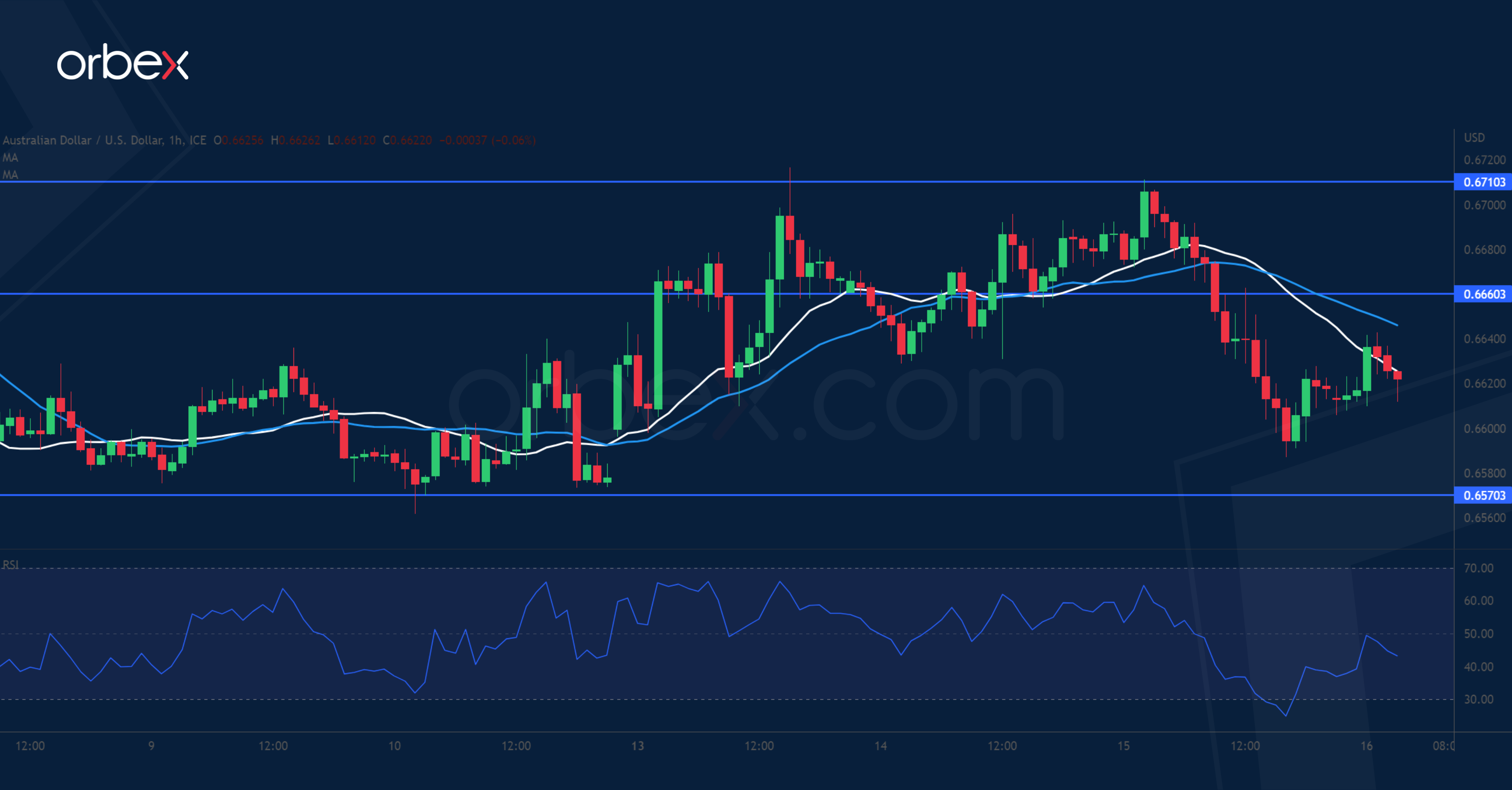
The Australian dollar slips as market sentiment grows cautious across risk asset classes. The bulls’ second attempt at the demand-turned-supply zone around 0.6710 has failed to impress. A drop below 0.6660 has turned it into resistance, prompting intraday buyers to close their bets and compounding the pressure. This suggests that the bias would remain bearish after the previous break below the yearly low of 0.6700. The latest rally would turn out to be a dead cat bounce if losses extend beyond the swing low of 0.6570.
EUR/USD Grinds Major Support
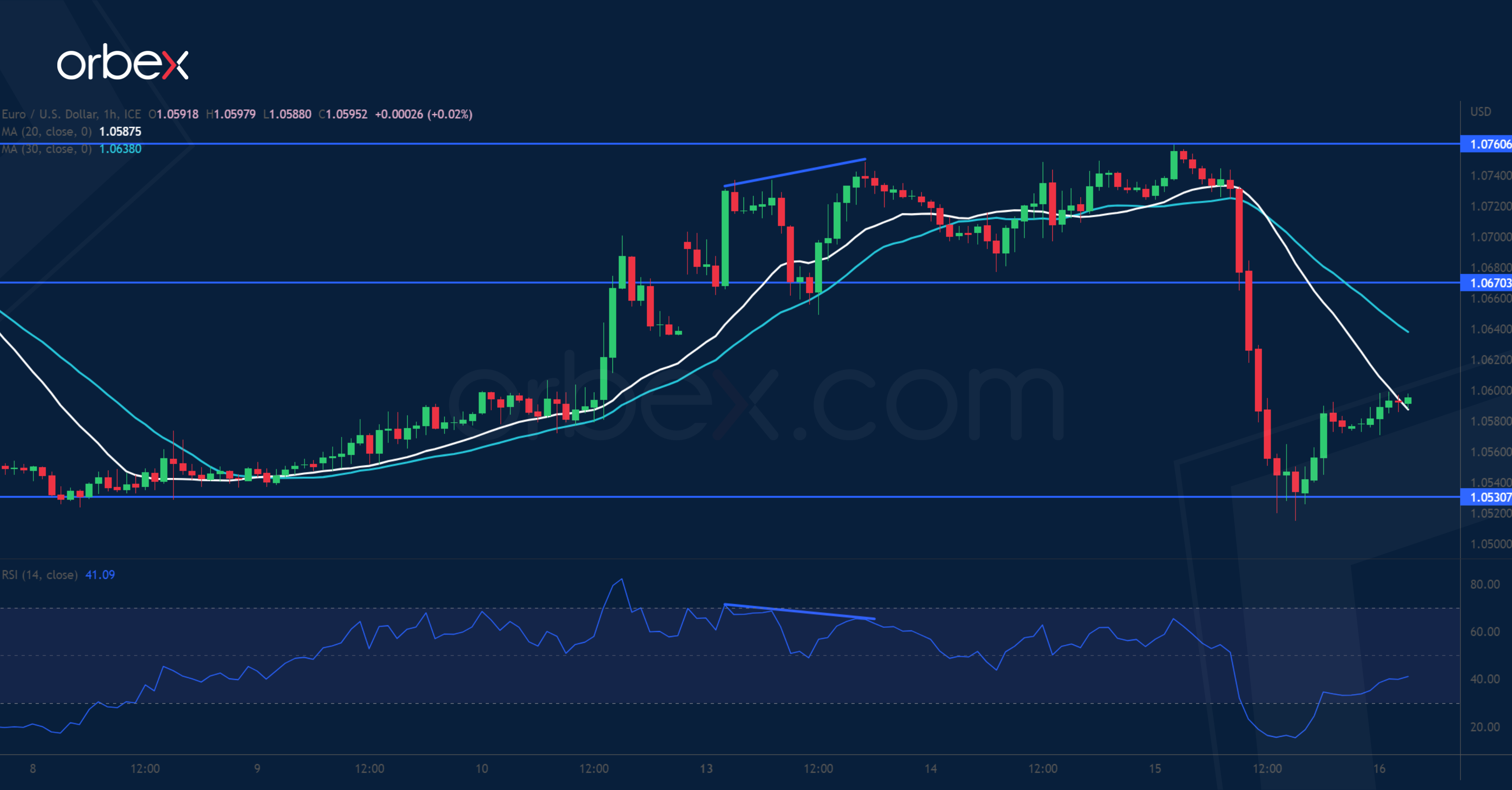
The US dollar surged as Credit Suisse's difficulties spurred safe-haven buying. A bearish RSI divergence was a warning sign of a deceleration in the latest rally. The confirmation came in in the shape of an abrupt halt at the mid-February spike of 1.0760 and a clean cut through previous higher lows of 1.0680 and 1.0650. The liquidation of leveraged long positions exacerbated the volatility. The daily support at 1.0530 may trigger some profit-taking as the RSI sank into the oversold area. 1.0670 is the first hurdle in case of a bounce.
We Expect ECB to Stick to 50 bps Hike
Markets
Tuesday’s trading session and yesterday’s Asian session both suggested that the US government & Fed’s combined measures to limit the fallout from the Silicon Valley Bank and Signature Bank’s collapse managed to restore market confidence. This lasted until Credit Suisse’s largest shareholder (Saudi National Bank) decided to put the spotlight on the troubled Swiss lender by ruling out raising its 9.9% stake. It sent the company’s stock price in tail spin with investors worrying about liquidity issues and again raising the specter of global financial stability risks. Core bond yields followed Credit Suisse’s share price south with investors questioning central bank’s ability to push through with the flagged 50 bps rate hike in case of the ECB (this afternoon) and to implement another 25 bps rate hike in case of the Fed (next Wednesday). German bond yields fell 26.6 bps (30-yr) to 48.3 bps (2-yr). The German 10-yr yield lost an uptrend line in place since December and tested 62% retracement on the increase from the December low to the March high (2.13%). EU swap yields ended 10 bps (10-yr) to 21 bps (2-yr) lower. US yields lost 16 bps (30-yr) to 36 bps (2-yr). The US 10-yr yield is tested support around 3.4%. The YTD low stands at 3.32%. Risk aversion ruled European dealings with main equity indices ceding around 3.5%. The banking sector obviously underperformed (-8%). Yesterday’s market focus on Credit Suisse and Europe in general and the loss on interest rate support pulled the single currency lower. EUR/USD closed at 1.0577 from an open at 1.0733, testing the March low (1.0525) in the process. Key support stands at 1.0484/61 (YTD low/38% retracement on Sep/Jan rally). EUR/GBP closed at 0.8773 from an open at 0.8828, testing the YTD low at 0.8722. Peripheral yield spreads vs Germany widened by 19 bps for Greece, by 14 bps for Italy and by 3-7 bps for most other countries.
Credit Suisse overnight announced that it plans to take up CHF 50bn offered in liquidity by the Swiss National Bank (fully collateralized) under a Covered Loan Facility as well a short-term liquidity facility. It also announces to repurchase certain senior debt securities for cash of up to approximately CHF 3bn. It helps restore confidence in Asian trading, but the proof of the eating will follow during European hours. Apart from financial stability, focus turns to the ECB meeting. Lagarde and co vowed to lift rates by another 50 bps at today’s meeting. In light of recent events, money markets expect a more moderate 25 bps hike. For some reasons, we expect the ECB to stick to the 50 bps hike. First as the central bank stayed radio-silent over the past couple of days. Second as increased core CPI forecasts can’t be put aside. Recent events have no immediate impact on the real economy neither. Macroprudential measures should in first instance come to the rescue. Third, as it allows the ECB to keep a wait-and-see approach going into the May policy meeting. Downshifting to a 25 bps rate hike today would probably require another commitment to keep hiking in May (because of inflation dynamics) which risks complicating the picture given increased global uncertainty and will be tough to communicate (vs sticking to the flagged +50 bps). Finally as downshifting to 25 bps could be seen as a panic move and amplify market turmoil.
News Headlines
New Zealand Q4 GDP data showed an unexpectedly sharp contraction of 0.6% Q/Q resulting in only a 2.2% Y/Y growth figure. In Q3, the economy still showed solid growth at 1.7% Q/Q. De decline in activity was rather broad-based as 9 of 16 industries experienced a decrease in activity. Today’s data are raising the risk that the economy might be heading for a recession. Since October 2021, the Reserve Bank of New Zealand raised its policy rate from 0.25% to 4.75%. At its Feb 22 meeting, the RBNZ maintained its guidance to raise it further to a potential rate peak of 5.50%. Money markets now only discount a 70% chance of an additional 25 bps rate hike in April with a peak rate between 5% and 5.25%. The kiwi dollar declined from the NZD/USD 0.6190 area to currently near 0.616.
February Australian labour market data were much stronger than expected. The economy last month added 64.5k jobs (-10.9k in January). The gain was solely due to a rise in full-time employment. The unemployment rate declined sharply from 3.7% to 3.5%. The participation rate rose to 66.6%. The data suggest that the Reserve Bank of Australia could maintain a tightening bias. However financial stability considerations will come into play after recent market turmoil. Money markets currently rule out further rate hikes. The strong labour data failed to trigger a rebound in Australian bond yields this morning (2-yr: -25 bps at 2.87%). The Aussie dollar is little changed at AUD/USD 0.664.
What Will the ECB Do?
Banks were on the chopping block on Wednesday, after Saudi National Bank’s Chairman Mr. Al Khudairy told Bloomberg TV that they wouldn’t inject more money to Credit Suisse (CS) as they already hold 9.9% of the bank and going above 10% would mean further regulatory and statutory requirements.
Credit Suisse stock sold off to a fresh record. At its worst, the stock was down by more than 30% and closed the session with a 24% loss.
The selloff in CS shares spread to other bank shares as well, and the bank stocks pulled the market down with them.
The SMI index lost 1.87%, the Stoxx 600 dived 2.92%, the DAX plunged more than 3%, the bank-heavy FTSE 100 shed almost 4%. In the US, the S&P500 was also under a decent selling pressure led by banks, yet the news that the Swiss National Bank (SNB) would provide liquidity to Credit Suisse in case of need, and the confirmation from the Swiss watch-dog FINMA that CS meets the higher capital and liquidity requirements applicable to systemically important banks – that both came after the European market close - helped the US stocks paring some losses.
The S&P500 closed the session only around 0.70% down, while Nasdaq gained 0.42%. If the bank risk is contained, the falling yields look appetizing for stock investors.
The global yields were on a sharp decline again yesterday. The US 2-year yield slumped more than 8.5% to 3.72%, while the German 2-year yield fell to the lowest since the beginning of the year, to around 2.35% as investors cut their European Central Bank (ECB) rate expectations, again.
According to the latest news, Credit Suisse agreed to borrow as much as 50 billion francs from the SNB and offered to repurchase debt to improve market confidence.
What will the ECB do?
With yesterday’s fresh stress on bank stocks, a 50bp hike from the ECB at today’s monetary policy meeting is less than certain.
Although the hotter-than-expected inflation data from France would’ve granted a 50bp hike, and a few more to come, the ECB may opt for a softer rate hike, or no rate hike at today’s meeting, to let the dust settle before acting further.
But maybe, the ECB will remain on course and hike by 50bp today.
It’s hard to tell. The visibility on monetary policies from the big central banks is heavily lessened by the banking stress and it’s difficult to foresee how much weight the policymakers will give to the bank stress versus inflation.
Today, the ECB has the difficult task to be the first major central bank to decide what to do amid the banking crisis. It’s decision could change the expectations for other central banks.
For now, the base case scenario for next week’s Bank of England (BoE) meeting is no hike.
While activity on Federal Reserve (Fed) funds futures still points at a 25bp hike next week, with around 65% chance, as of this morning.
But swaps now price in a 100bp cut from the Fed by December, and the peak rate is now seen at 4.85%, down from 5.6% last week, after Fed Chair Powell’s speech to the US Senate, when Powell didn’t know that winds would abruptly change direction a few hours later.
On the data front, happily for the Fed, a soft set of data from the US yesterday showed that the producer price inflation unexpectedly fell in February. Retail sales, which jumped 3.2% last month and fueled inflation fears, fell more than expected in February. And the Empire Manufacturing index plunged to -24, much worse than a decline to -8 expected in March.
FX and energy
The US dollar index rebounded after hitting 50-DMA earlier this week.
The rebound in the US dollar sent the EURUSD shortly below its 100-DMA. The pair is around the 1.06 mark at the time of writing.
Where the euro is headed next will depend on the ECB decision. A 50bp hike from the ECB should help the single currency extend gains against the greenback, while anything less than a 50bp hike today could encourage a further selloff. The major support on the EURUSD daily chart stands at 1.0473, the major 38.2% Fibonacci retracement on September to February rally. A fall below this level will send the euro into the bearish consolidation zone against the greenback.
On the energy front, the bank stress weighed heavily on energy prices as it worsened the prospects of global growth – and that despite the set of good economic data from China.
The barrel of American crude slumped to $65 per barrel yesterday. Saudi Arabia energy minister Prince Abdulaziz bin Salman said that OPEC+ will stick to production cuts agreed upon in October until the end of the year, but the attention is heavily on the demand side right now. Therefore, it is well possible that the $70pb level, which acted as a strong support since the end of last year becomes the new resistance.
Resurfacing Banking Fears. ECB Still to Hike 50bp
Market movers today
The main event today is the ECB meeting, where we still expect a 50bp rate hike but probably very little guidance, given the financial uncertainty, see below.
The 60 second overview
Fear and flight to safety dominated the trading session yesterday on concerns of the US banking turmoil spreading to Europe where specifically Credit Suisse was in focus. While the flight to safety was dominated on concern of Credit Suisse, rate markets saw widespread repercussions, led by the front end. The 2y German Schatz broke the record rally of 41bp on Monday by going down by 48bp to 2.37%, but also the 5y point ended massively lower at -37bp on the day to 2.12%. Italian-German bond spreads widened 13bp and approaching 200bp. Today, markets focus on the ECB meeting, where we continue to expect ECB to deliver a 50bp rate hike, although only 29bp was priced at the close of business yesterday. The ECB peak policy has have repriced more than 1pp lower to 3.12% in just one week.
Last night, the SNB and the Swiss regulator issued a joint statement on Credit Suisse. They say that Credit Suisse meets all capital and liquidity requirements. The statement also said that they would provide a liquidity line if it is needed. Overnight, a Credit Suisse statement said that they have tapped the SNB for a CHF50bn loan and offered to buy back CHF3bn of its debt.
New Riksbank call: February inflation numbers came in higher than expected with CPIF ex energy reaching a new high of 9.3% y/y, way above the Riksbank's forecast of 8.0%. The gap between the Riksbank forecast and actual outcome therefore has widened from 0.6% in January to an enormous 1.3% in February and is likely to increase further in March. The Riksbank will therefore be forced to deviate from their most recent rate path forecast (indicating 25bp or 50bp hike in April) and deliver a 75bp hike. Especially after Board members already yesterday during the parliamentary hearing delivered a hawkish message, emphasizing the willingness to act accordingly on the back of incoming data. We also lift our June call from 25bp to 50bp as our inflation forecast does not indicate that the Riksbank will have enough positive data to lower the pace to 25bp increments.
Equities: Global equities in renewed turmoil yesterday. This time triggered from Europe with investors losing faith in Credit Suisse. With fear of yet another bank failure, this time a systemically important bank, not surprising to see banks being sold off across the board and cyclicals underperforming defensives. Fast forward to late last night and early this morning, European futures are higher on the SNB news with Eurostoxx 50 future being up more than 2% at time of writing.
FI: German ASW widened markedly, led by the shorter end with 12bp wider Schnatz-ASW spread to 88bp. The key events today are both how the fear evolves after the SNB ensured a liquidity line to Credit Suisse last night but clearly also the ECB meeting. Yesterday markets took out more than 2x25bp rate hikes to the peak policy rate, now just above 3%. For the meeting today, ECB is priced for 29bp. That said, given that we are yet to see the macroeconomic implications of the recent turmoil, we stick to our 50bp rate hike - and still see significant upside risks to the peak ECB policy rate priced at 3.12% current.
FX: Fears of systemic risks spread to European banks and the EUR paid the price yesterday, with EUR/USD falling a massive 2% during the European session, before recovering some ground late in the US session. CHF and NOK also underperformed sharply against the greenback, the former as focus turned towards the risks surrounding Credit Suisse, whereas the latter suffered in generally poor risk sentiment and falling oil prices. The SEK had a volatile session, initially strengthening on the back of yesterday's inflation data, later somewhat moderated by poor risk sentiment.
Credit: Itraxx main widened 10.6bp to close at 100.9bp, while Itraxx Xover widened 41.5bp to close at 500.2bp. The Itraxx CDS indices closed at their widest levels since early December 2022, effectively cancelling the massive rally seen at the start of this year. The primary market was effectively closed, with not even the strongest investment grade issuers being able to tap the market.
Nordic macro
The previous round of Norges Bank's regional survey pointed to a clear slowdown in the economy. Capacity utilisation was on the way down, expected profitability was clearly negative, and expectations for employment and investment were around neutral. The growth outlook will probably be somewhat brighter than in the previous round, but still point to deterioration. The most important information this time around, however, will be for capacity utilisation, because this is the most important driver of domestic inflation in the medium term in the central bank's models. If capacity utilisation falls further, the upside risk to inflation will be smaller, and it will be easier for Norges Bank to look through today's high inflation, especially with inflation expectations being well anchored and prevailing interest rates being considered contractionary. In this case, Norges Bank will be better able to stick to its strategy of gradual rate hikes.
Sweden: The Prospera quarterly inflation expectations survey will be out today and especially the 5Y horizon is important to keep an eye one which so far have been stable. Note that yesterday we changed our call on the Riksbank due to inflation figures once again surprising on the upside. We now expect 75bp in April and 50bp in June. This means that we see the peak policy rate at 4.25% from earlier 3.75%.
EUR/USD Daily Outlook
Daily Pivots: (S1) 1.0475; (P) 1.0618; (R1) 1.0718; More...
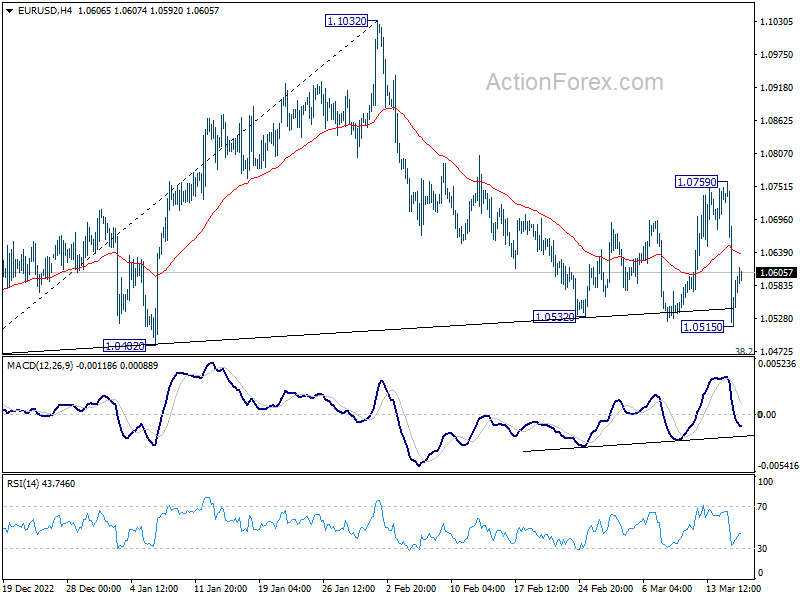
EUR/USD recovered after dipping to 1.0515 and intraday bias is turned neutral first. Focus remains on support zone between 38.2% retracement of 0.9534 to 1.1032 at 1.0258 and 1.0482. Strong support from there, followed by rebound through 1.0759 resistance, will retain near term bullishness. However, sustained break of 1.0258 will complete a head and shoulder top (ls: 1.0733, h: 1.1032, rs: 1.0759). Outlook will be turned bearish fro 61.8% retracement at 1.0106.
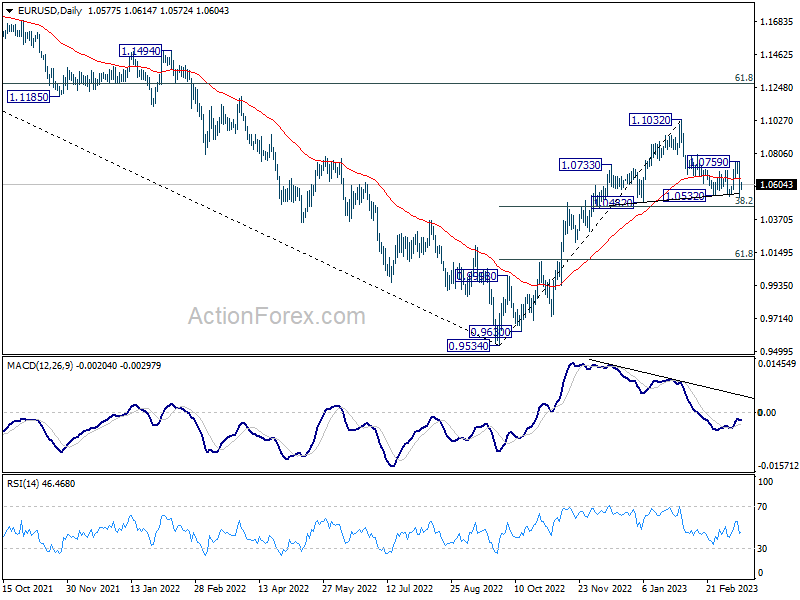
In the bigger picture, as long as 1.0482 support holds, rise from 0.9534 (2022 low) should continue to 61.8% retracement of 1.2348 (2021 high) to 0.9534 at 1.1273. However, sustained break of 1.0482 will bring deeper fall to 61.8% retracement of 0.9534 to 1.1032 at 1.0106, with risk of breaking through 0.9534 eventually.
GBP/USD Daily Outlook
Daily Pivots: (S1) 1.1983; (P) 1.2083; (R1) 1.2154; More...
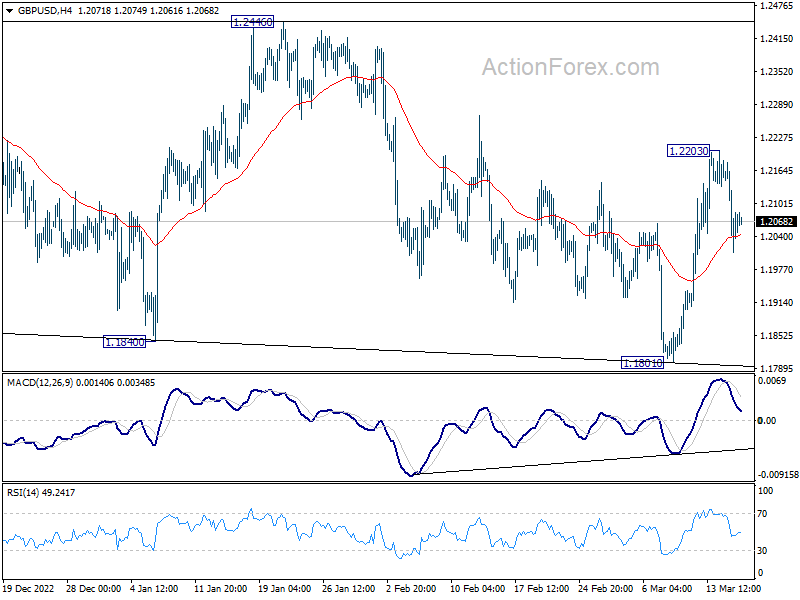
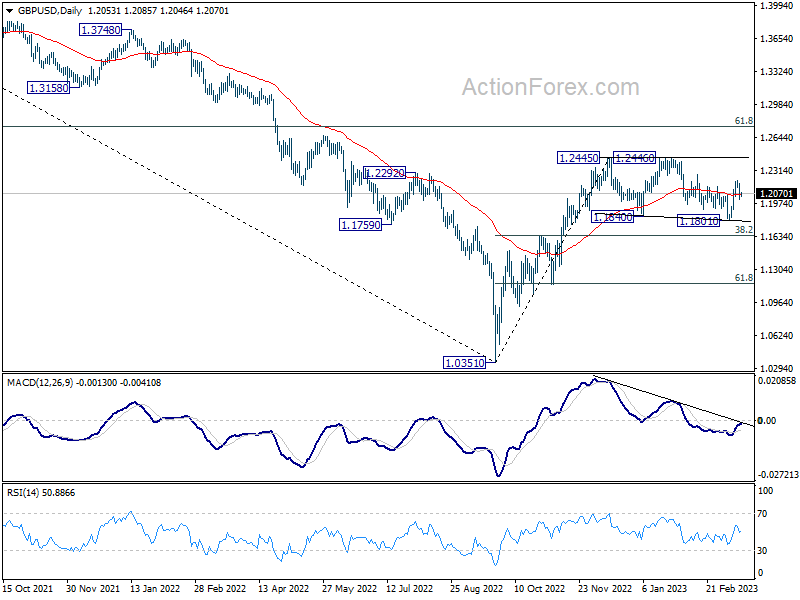
Intraday bias in GBP/USD stays neutral at this point. On the upside, above 1.2203 will resume the rally from 1.2445/6 resistance zone next. However, decisive break of 1.2045 and 4 hour 55 EMA (now at 1.2042) will argue that the pattern from 1.2445 is extending with another falling leg, and turn bias to the downside for 1.1801 again.
In the bigger picture, price action from 1.2445 are seen as a corrective pattern to rise from 1.0351 medium term bottom (2022 low). Resumption is expected as a later stage and firm break of 1.2446 will target 61.8% retracement of 1.4248 (2021 high) to 1.0351 at 1.2759. This will remain the favored case as long as 38.2% retracement of 1.0351 to 1.2445 at 1.1645 holds.
USD/JPY Daily Outlook
Daily Pivots: (S1) 132.06; (P) 133.59; (R1) 134.95; More...
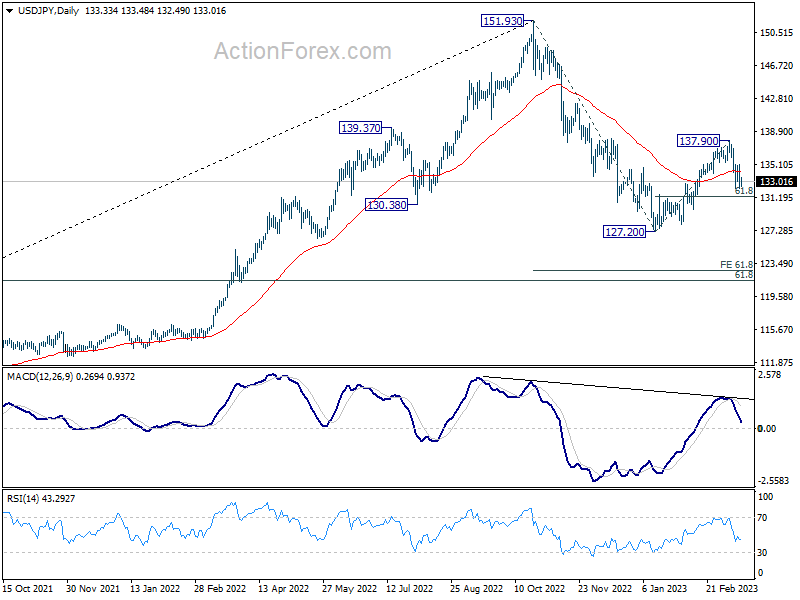
Intraday bias in USD/JPY remains neutral at this point and some more consolidations could be seen. But fall from 137.90 is in favor to extend lower and break of 132.27 will target 61.8% retracement of 127.20 to 137.90 at 131.28. Sustained break there will pave the way to retest 127.20 low. Break of 137.90 resistance is needed to confirm resumption of the rally from 127.20, or risk will stay on the downside.
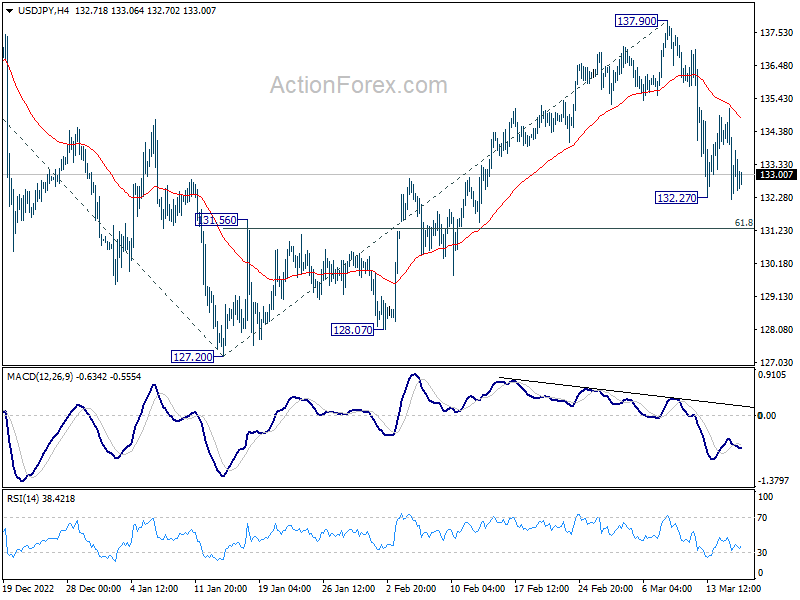
In the bigger picture, rebound from 127.20 should have completed at 137.90 as a corrective move, with strong break of 55 day EMA. The down trend from 151.93 (2022 high) is not over yet. Break of 127.20 will resume this down trend and target 61.8% projection of 151.93 to 127.20 from 137.90 at 122.61. This will now be the favored case as long as 137.90 resistance holds.