Sample Category Title
Canadian GDP estimates to show slower Q4 but resilient January
Next week’s GDP report will likely show output up a modest 1.5% (annualized) in the final quarter of 2022—just half the average pace of the first three quarters of last year. Some positive signs remained: higher retail and food services sales are pointing to an uptick in consumer spending following a 1% decline in the third quarter. But we expect another large drop in residential investment in the fourth quarter as housing markets continue to retrench. Meantime, a drop in equipment imports is pointing to another quarterly decline in business investment.
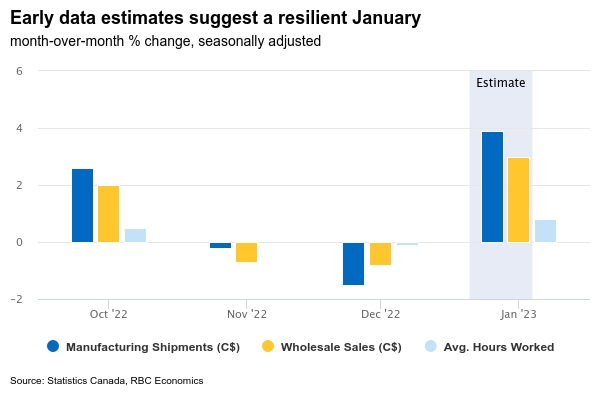
Growth likely slowed into the end of the fourth quarter. Our own RBC cardholder data shows spending plateauing in the back half of 2022, as consumers started to feel the pinch of high inflation and the Bank of Canada’s interest rate hikes dug in. Statistics Canada’s advance estimate of December output was “essentially unchanged.” Still, that is in part due to another pull-back in non-conventional oil production that is likely more due to temporary production disruptions at some of the larger oil production facilities in Alberta (these will reverse as production resumes.) And early data is pointing to a likely sizable bounce-back in January GDP. A surge in employment in January pushed hours worked up 0.8% from December and advance estimates for manufacturing and wholesale trade jumped by 3.9% and 3.0%, respectively.
Nevertheless, the lagged impact of record interest rate hikes (+425 basis points in less than a year) will continue to elevate household debt payments over the first half of 2023—cutting into consumer demand. As a result, though early economic data in 2023 has been better than feared, the most likely base-case remains at least a mild recession starting in the first half of the year.
Week ahead data watch
The annual Business CAPEX intentions survey is expected to show weaker investment plans in 2023. This was reflected in the Bank of Canada’s Business Outlook Survey (BOS) which showed 80% of firms had either lower or static investment intentions in 2023. Still structural labour shortages are expected to persist beyond the near-term. That could prompt businesses to cut investment less than typically might be the case in an economic downturn.
Week Ahead – Inflation Issues Sinking In
Disinflation trends are struggling and now Wall Street will look to see if improving manufacturing and service activity will further fuel pricing pressures. On Monday, durable goods data for January is expected to show higher borrowing costs are hurting manufacturers. Wall Street will also get a couple of Fed regional surveys from Dallas and Richmond. Traders will pay close attention to Wednesday’s ISM manufacturing report and Friday’s Services Index.
Central bank speak will be closely monitored, especially new Fed member Goolsbee’s comments on Tuesday. Jefferson will speak on inflation and the dual mandate on Monday, while Waller will talk about the outlook on Thursday. On Friday, we will hear from Logan, Bostic, and Bowman.
US President Biden will also host German Chancellor Scholz at the White House. Traders will look to see if they announce any new efforts to support Ukraine or sanctions against Russia.
Earnings season continues with key updates from Bayer, Berkshire Hathaway, Broadcom, Budweiser Brewing Co. Apac, Costco Wholesale, CRH, Dell Technologies, Dollar Tree, HP, Kroger, Kuehne + Nagel International, Lowe’s, Merck, National Bank of Canada, Occidental Petroleum, Salesforce, Toronto-Dominion Bank, VMware, and Workday.
Next week offers a number of economic data points, the most notable of which will be the flash HICP readings. While headline inflation has been falling, core remains at the peak and policymakers are unlikely to ease off the brake until they’re seeing progress on this front. Forecasts suggest it’s still a little early for that. Markets are still pricing in a 50 basis point hike at the meeting in March although there’s an almost equal chance of 75, based on current rates.
Which brings us nicely to the central bank speak, kicking off with President Lagarde who’s due to appear at the G20 conference over the weekend.
UK
It’s all a bit calm next week, with central bank appearances the most notable thing on the calendar. That includes Governor Bailey on Wednesday and Chief Economist Pill on Thursday. With 25 basis points almost entirely priced in for March and the committee clearly a little divided on the correct path going forward, I’m not sure what they could say that would cause much of a shock at this point.
Russia
Unemployment is expected to have jumped to 4% in January, from 3.7% the month before. Meanwhile PMIs on manufacturing and services on Wednesday and Friday, respectively, will be eyed.
South Africa
A quiet week in store with unemployment the only notable release.
Turkey
The CBRT cut rates last week by an unusually modest 50 basis points, taking the repo rate to 8.5%. Inflation remains extraordinarily high, with the official rate released by the Turkish Statistical Institute, sitting at 57.68%. The February reading will be released on Friday, while GDP data is due on Tuesday.
Switzerland
A selection of data points will be eyed this upcoming week which should give an up-to-date view on the state of the economy. The week will start with GDP data on Tuesday for the fourth quarter, alongside the KOF indicator for February. This will be followed by retail sales for January and the manufacturing PMI for February on Wednesday.
China
The official manufacturing and non-manufacturing PMIs for January will be released on Wednesday, in what will otherwise be a relatively quiet week. Of course, all eyes are on the transition and how quickly and strongly the economy will bounce back, with stimulus measures over the next couple of months likely to turbo-charge the recovery.
India
GDP and PMI data eyed next week, with the economy seen performing strongly again in the third quarter and surveys indicating ongoing optimism.
Australia & New Zealand
The RBNZ’s first interest rate meeting of the year last week was in line with market expectations of another 50 basis point hike. The central bank minutes mentioned that a potential recession in the second quarter of this year might occur, putting pressure on the New Zealand dollar.
Focus this week will be on Australian retail sales data for January and GDP for the fourth quarter, and New Zealand retail sales for the fourth quarter.
According to Japanese lawmakers, BOJ Governor nominee Kazuo Ueda is to speak in the upper house on 27 February, and deputy governor nominees are to appear in the upper house on 28 February. Ueda will attend the hearing at the National Diet and give a speech, which may have an impact on Japanese markets.
Retail Sales and the Tokyo core CPI will be in focus next week.
Singapore
Retail sales and the February PMI survey are the only releases of note.
Economic Calendar
Saturday, Feb. 25
Economic Events
- Berkshire Hathaway reports earnings
- G-20 finance ministers and central bank governors conclude meetings
Sunday, Feb. 26
Economic Events
- German Chancellor Scholz meets with Indian PM Modi
- Japan’s ruling LDP holds its annual convention
Monday, Feb. 27
Economic Data/Events
- US durable goods
- Eurozone economic confidence, consumer confidence
- Hong Kong trade
- Israel unemployment
- Japan BOJ outright bond purchases
- Mexico trade
- US Congress returns after a recess
- US Treasury Secretary Yellen talks with President Zelenskiy
- ECB chief economist Lane speaks on “Macro-Financial Stability in the EU”
- ECB’s de Cos speaks at EIB event in Luxembourg
- BOE’s Broadbent speaks at a digital technologies conference in London
Tuesday, Feb. 28
Economic Data/Events
- US wholesale inventories, Conference Board consumer confidence
- Australia current account, retail sales
- Canada GDP
- Finland GDP
- France CPI, GDP
- India GDP
- Japan industrial production, retail sales
- Mexico international reserves
- Singapore unemployment
- South Africa unemployment, trade balance
- Sweden GDP
- Switzerland GDP
- Thailand trade
- Turkey GDP
- Chevron investor day
- Mayoral election in Chicago
- New Fed member Goolsbee speaks at Ivy Tech Community College
- BOE chief economist Huw Pill makes closing remarks at digital technologies conference
- BOE’s Mann and ECB’s Vujcic speak at the EIB forum in Luxembourg
- Earnings from Target
Wednesday, March 1
Economic Data/Events
- US construction spending, ISM Manufacturing, light vehicle sales
- Australia GDP
- China manufacturing PMI, non-manufacturing PMI, Caixin manufacturing PMI
- European Manufacturing PMIs: Eurozone, Germany, France, and the UK
- Germany CPI, unemployment
- India Manufacturing PMI
- New Zealand building permits
- Russia unemployment
- Start of the annual Conservative Political Action Conference (CPAC)
- Bundesbank publishes annual report
- BOJ’s Nakagawa speaks in Fukushima
- BOE Governor Bailey speaks at a conference focused on the cost of living crisis
- ECB’s Villeroy speaks at the French National Assembly’s finance committee
- ECB’s Visco speaks in Frankfurt
- Earnings reports from Dollar Tree, Kohl’s, Salesforce, and Lowe’s
Thursday, March 2
Economic Data/Events
- Australia building approvals
- Brazil GDP
- Eurozone CPI, unemployment
- Hong Kong retail sales
- Hungary GDP
- Italy CPI, unemployment
- Japan capital spending
- Mexico unemployment
- South Korea industrial production
- Spain unemployment
- Sri Lanka rate decision
- US initial jobless claims
- Bloomberg Intelligence’s Market Structure event in New York. Speakers include Securities and Exchange Commission Chair Gary Gensler and NYSE COO Michael Blaugrund
- The due date for the DOJ’s amicus brief with its view on Donald Trump’s claim that he should get absolute immunity against civil lawsuits seeking to hold him liable for the Jan. 6, 2021 attack on the US Capitol
- ECB publishes accounts of February policy meeting
- Bank of Japan board member Hajime Takata gives speech in Kanagawa
- BOE chief economist Huw Pill speaks on the economic outlook
- Retail earnings continue with Macy’s, Costco, and Nordstrom all reporting
Friday, March 3
Economic Data/Events
- US President Biden and German Chancellor Scholz meet at the White House
- China Caixin services PMI
- Czech Republic GDP
- Eurozone Services PMI, PPI
- France industrial production
- Italy GDP
- Japan unemployment, Tokyo CPI
- Singapore retail sales
- ECB’s Vasle and Muller speak on inflation
- Italian PM Meloni visits Abu Dhabi
- BOE’s Hauser speaks at a workshop on market dysfunction hosted by the Initiative on Global Markets in Chicago
Sovereign Rating Updates
- Austria (Fitch)
- Czech Republic (Fitch)
- Hungary (Moody’s)
- European Union (DBRS)
Could Economy Finally Allow BoJ to Plot a Course Towards Normalization?
With the market dissecting BoJ governor nominee Ueda’s appearance at the House of Representatives, next week brings a rather busy schedule that includes retail sales and the Tokyo CPI. There is growing speculation about BoJ Governor Kuroda’s actions at his last meeting in charge in two weeks’ time. However, everyone acknowledges that a monetary policy tweak needs solid economic evidence. Could this set of data allow Kuroda to say “goodbye” with a loud bang?
Speculation is rife about the March meeting
The market loves big events and the speculation built around them. With the current BoJ governor preparing for his last gathering, the market is trying hard to predict the post-meeting announcements. Will the BoJ pull the plug on the yield curve framework and wipe the slate clean for the new governor or opt to do nothing, giving the opportunity to Ueda to decide the best course of action? Both sides have sound arguments, especially the “withdraw the yield curve control framework” camp as the BoJ head nominee comes from the pre-Kuroda era and as such he does not carry the current administration’s successes and failures on his record. However, whatever is decided depends on the economic undercurrents. There have definitely been some positive signs when examining the inflation metrics and the latest average earning prints, but there are still certain dark stains in the economy.
Tokyo CPI frontrunning the nationwide print
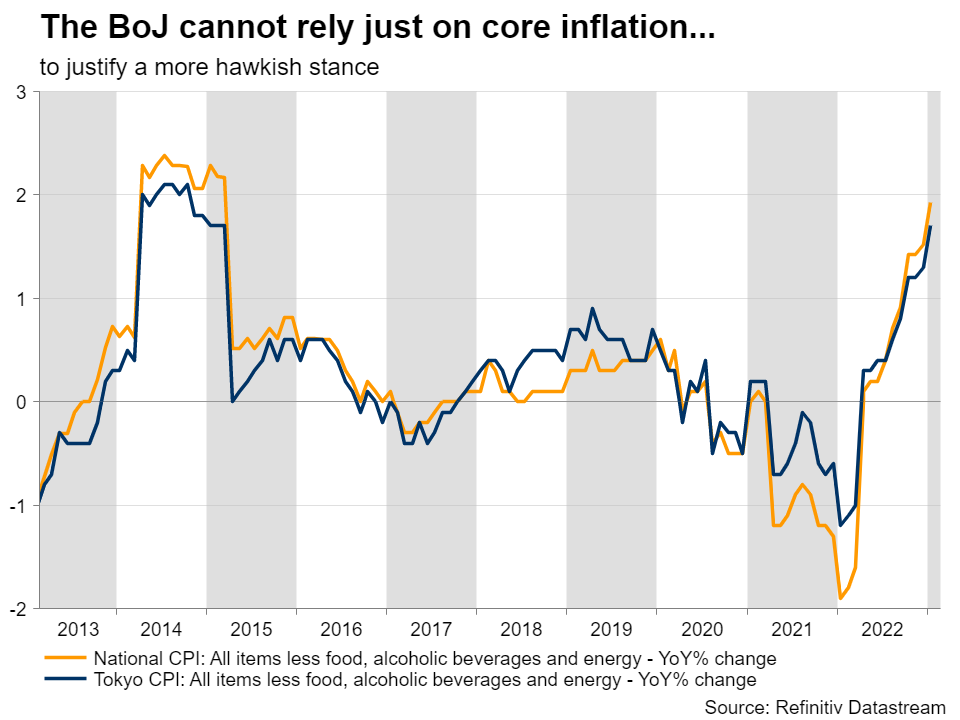
With most developed countries flirting with double-digit inflation rates, Japan’s nationwide headline CPI figure managed to reach the 4.3% level in January. Next week we get the February Tokyo CPI, an early preview of the ongoing inflation pressures. The January print came at 4.4%, the strongest yearly growth since June 1981, and hence another strong print on Friday could set the scene for a similar figure on a national level. While the headline inflation numbers look tempting for the BoJ, the core CPI, excluding food, energy, and alcoholic beverages remains disappointing, thus, potentially tying BoJ’s hand. Last month’s nationwide print came at 1.9%, below the artificially inflated March 2014 figures. Considering the global inflationary pressure, a core CPI print in the region of 1-2% is nothing to write home about, but clearly represents progress compared to the BoJ's recent record.
Decent retail sales growth despite low consumer confidence
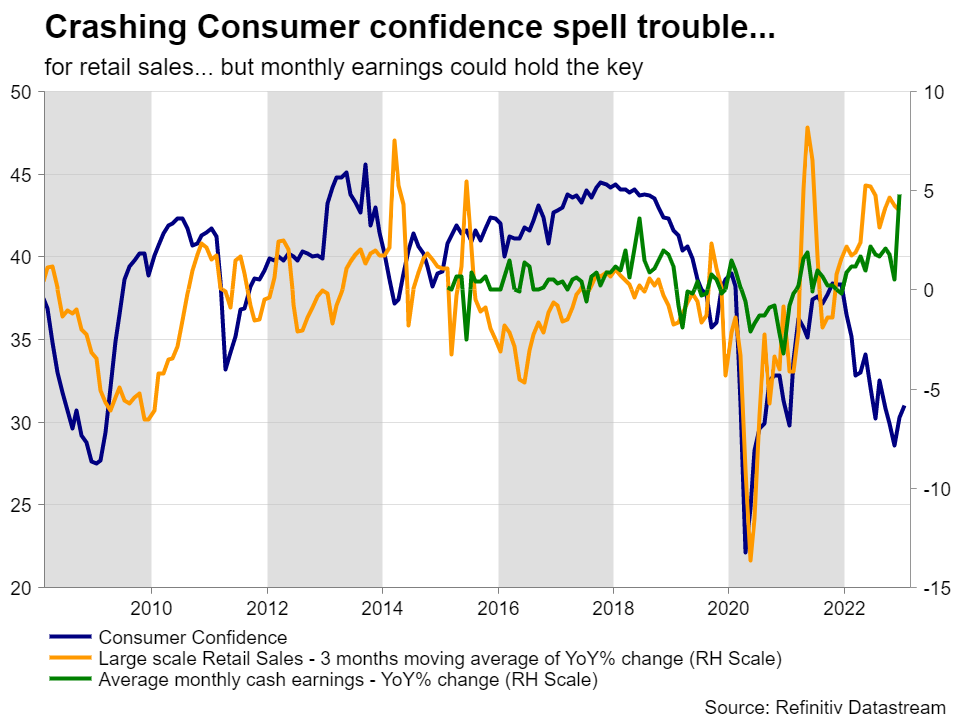
While the market has been almost exclusively focusing on the CPI prints, the BoJ has been all over the consumer spending data. When examining the retail sales figures against the consumer confidence, we get an interesting disparity. While the latter has dropped aggressively, retail sales growth remains at elevated levels. This gap is even more evident when analyzing the large-scale retail shops data. Putting aside the volatile nature of the sales dataset, recent history points to a possible correction in retail sales ahead. However, the recent surprising jump in the average monthly cash earnings could mean that there is some underlying strength among consumers. If this strength gets confirmed at next week’s data releases, it could allow the BoJ to consider more aggressive scenarios for its 2023 strategy.
Industrial production raises question about GDP growth
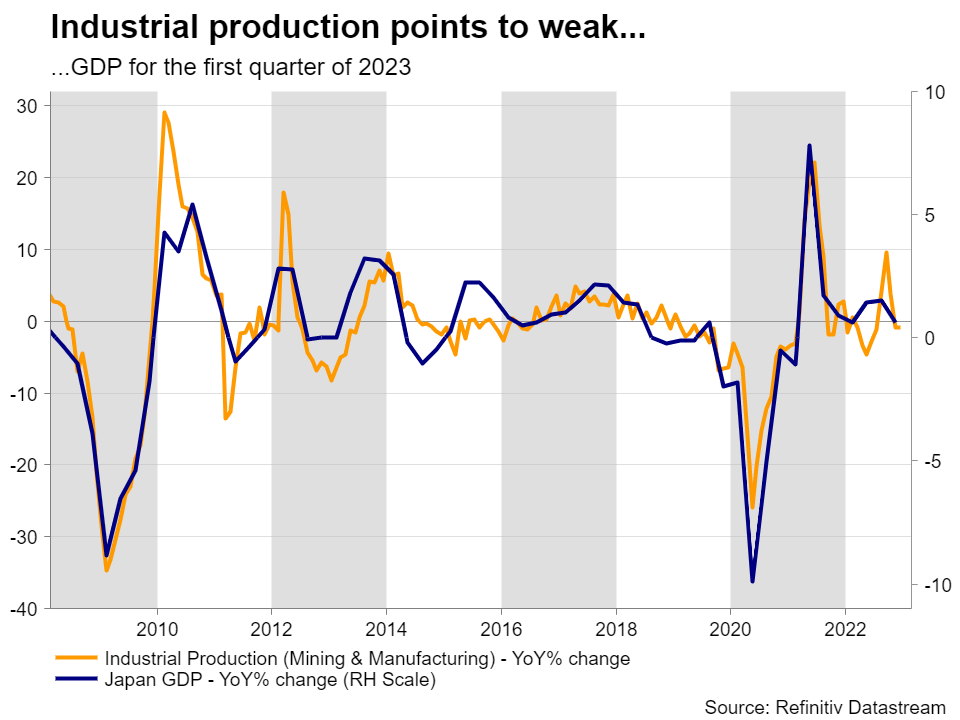
With the fourth-quarter GDP report disappointing on February 14, the market would be looking closely at the preliminary February industrial production data on Tuesday morning. The January figure was equally disheartening and if we get another negative print, we could see the market pricing in an equally weak first-quarter GDP, potentially even negative. In addition, a weak industrial production result could raise questions on the expected impact of the Chinese reopening on goods demand and the supply lines in the region and globally.
Yen tries to recoup some of 2022 losses
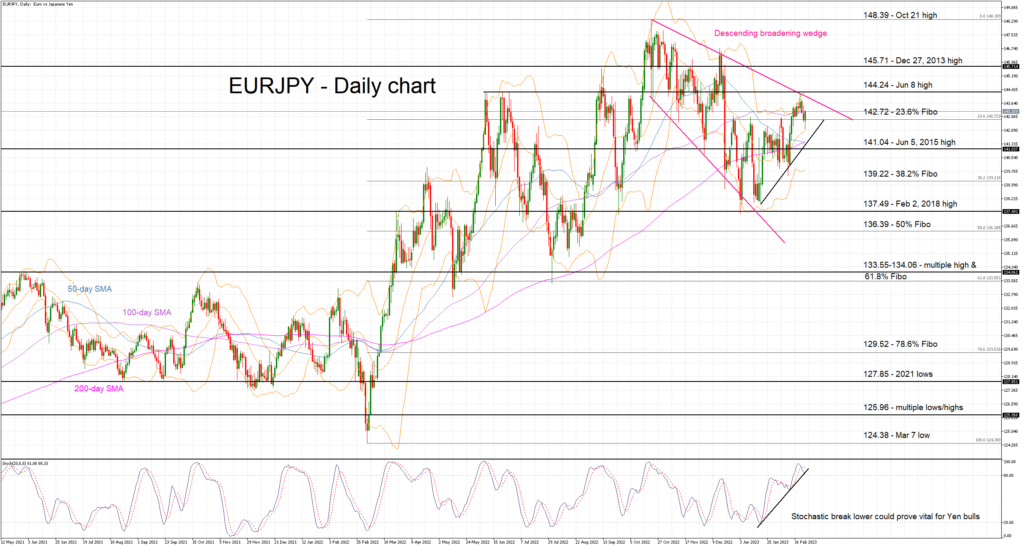
The yen had a dreadful 2022 against the euro. A 19% rally pushed this pair to the highest level since December 2014, on the back of the divergent central banks’ policy stance and the overall economic developments. Yen bulls have been trying to stage a comeback since the October 21 high of 148.39, but the move lower has not been easy. The euro/yen pair continues to hover inside a descending broadening wedge as euro bulls seem to lack the appetite to push it above the upper boundary. The absence of a strong trend reveals the hesitance from both sides to make bold moves as they wait for the appropriate trigger. Yen fans would enjoy a drop towards the 141.04 area, but would loathe a break above 144.24 that could potentially open the door to a much stronger rally.
Week Ahead – US ISM PMIs and Eurozone CPI Data Enter the Spotlight
Following a relatively busy week, the calendar becomes lighter next week. However, that doesn’t mean there are no important economic releases on the agenda. On the contrary, with market participants trying to figure out how many more rate hikes the US economy can withstand, they may pay extra attention to the ISM PMIs for February. Also, with most ECB policymakers arguing that more 50bps worth of rate hikes are needed to tame inflation, the Eurozone’s preliminary CPI numbers for February will likely take center stage as well.
ISM PMIs the dollar’s next test
Getting the ball rolling with the US, last week, the preliminary S&P Global PMIs surprised to the upside, with the composite index returning from contractionary to expansionary territory. This was the latest piece of data confirming investors’ decision to drastically revise up their implied rate path projections. With January CPI data also suggesting that inflation is stickier than previously expected, they are now expecting interest rates to peak at around 5.35% in July, while they see them ending the year at 5.15%.
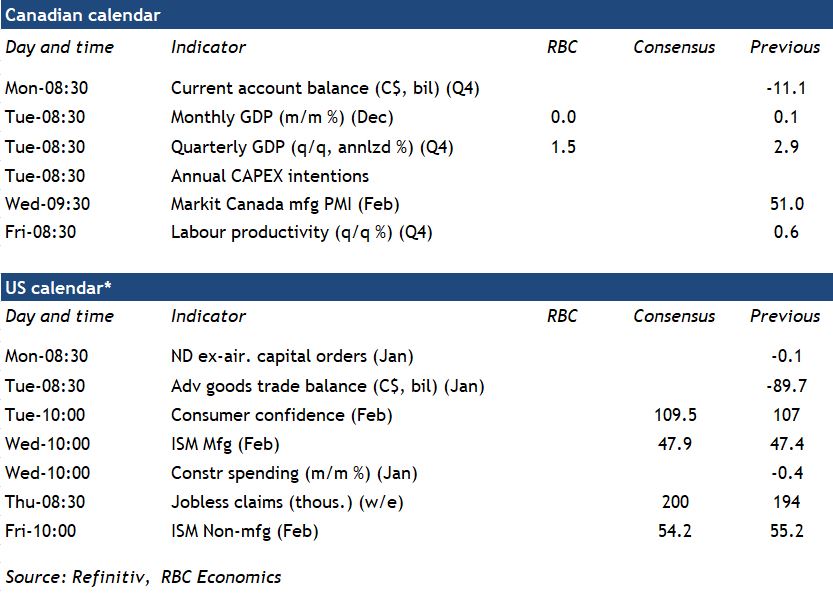
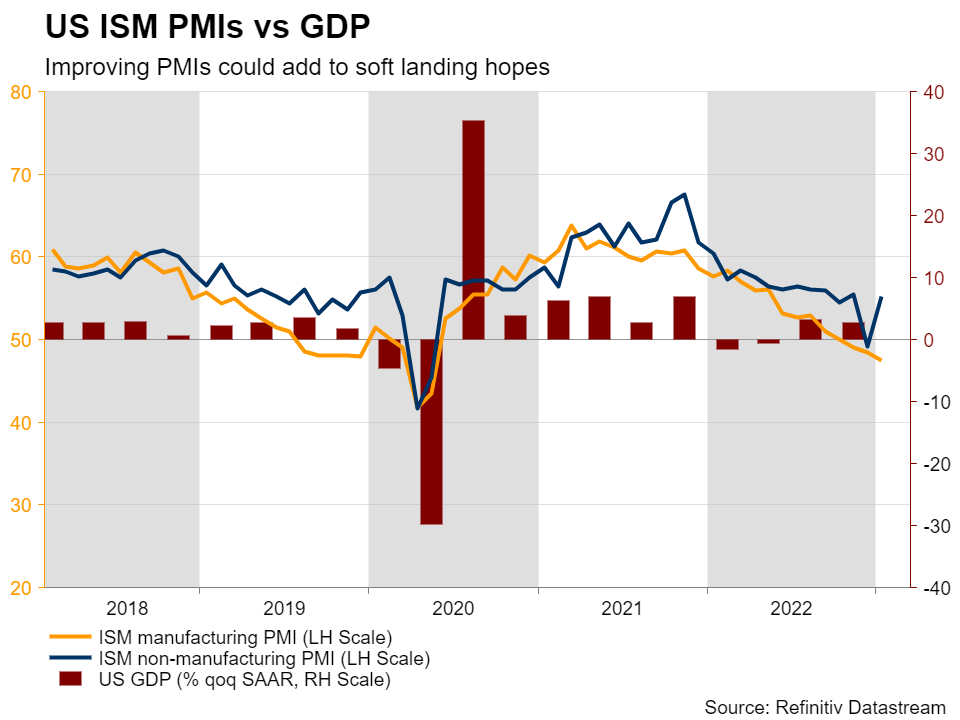
In that respect, the ISM PMIs on Wednesday and Friday are likely to attract special attention. Will they confirm or contradict the S&P Global indices? The forecasts point to a mixed picture, with the manufacturing PMI expected to have risen to 47.9 from 47.4, and the non-manufacturing PMI expected to have declined to 54.2 from 55.2. Nonetheless, given that the services index accounts for nearly 80% of US GDP, another print decently above 50 is unlikely to alter much expectations about the Fed’s future course of action.
The durable goods orders for January and the Conference Board consumer confidence index for February are also coming out on Monday and Tuesday respectively.
Anything adding to hopes that the US is likely to dodge a severe recession could support the US dollar on speculation that the Fed will continue raising interest rates at levels higher than it projected in December. That said, arguing about a full-scale bullish reversal in the US dollar remains premature as ahead of the March meeting, the market will have to digest the employment and CPI reports for February. On top of that, the Fed is not the only central bank for which investors have upended their rate hike bets.
Will Eurozone inflation numbers shake ECB bets?
One of them is the ECB. Most ECB officials have been adamant that more double hikes are needed, with President Lagarde confirming at the last meeting that another 50bps hike will be the case in March and several others hinting at a similar move in May. The only policymaker sounding a bit cautious was Chief Economist Philip Lane, who noted last week that the Governing Council may not need to proceed as forcefully as before.
Yes, headline inflation has slowed notably after peaking at 10.6% in October and could slow even further in the months to come as the year-on-year change in oil prices continues to slide. Nonetheless, core inflation is proving tenacious, and Thursday’s data is expected to reveal a modest slowdown for the month of February to 6.9% y/y from 7.1%. The minutes of the latest ECB meeting are also on Thursday’s schedule.
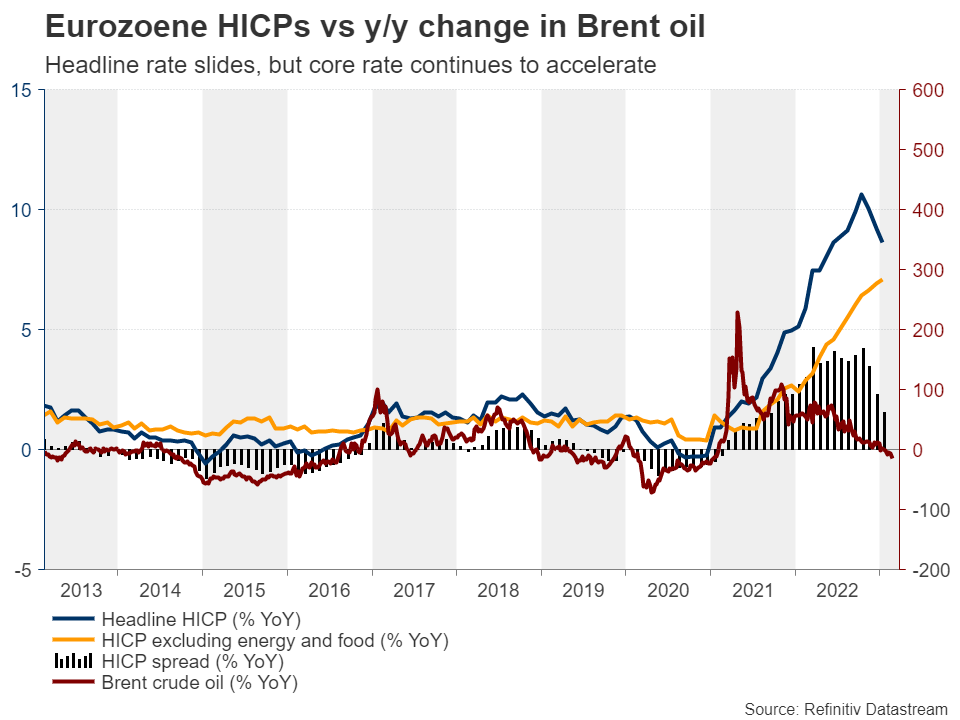
Combined with improving PMIs in the Euro area, stubbornly high underlying inflation and more hawkish rhetoric by ECB officials could allow investors to maintain bets about a triple hike at the upcoming meeting. Currently, they are assigning a 30% probability for a 75bps increment, with the remaining 70% pointing to 50bps. They also see a total of 130bps worth of additional rate hikes before the Bank takes the sidelines, while just a week ago, they were seeing 100bps.
Increasing ECB hike bets are complicating things for euro/dollar sellers, but they also increase the downside risk in the case of an upcoming economic release disappointing. The same goes for the dollar. Therefore, the outlook for euro/dollar seems somewhat blurry for now. Maybe both currencies will perform better against the risk-linked ones as increasing hike expectations have been weighing on risk sentiment lately. With the slowdown in Canada’s inflation for January congealing expectations that the BoC may refrain from hiking rates further, the loonie may be the best choice.
Canadian and Australian GDP, as well as Chinese PMIs on tap
Loonie traders could place some hopes on Canada’s GDP figures, but with the m/m rate for December expected to have held steady at a modest 0.1% and the annualized q/q rate estimated to have declined to 1.5% from 2.9%, the picture for the loonie looks anything but bright.
Australia also releases GDP data for Q4, as well as its CPIs for January. In contrast to the BoC, the RBA raised interest rates by 25bps and dropped from its statement a part that put the option of a pause on the table, arguing that more hikes are necessary in the coming months. So, improving GDP and further acceleration in inflation would add credence to that view and perhaps allow the aussie to gain.
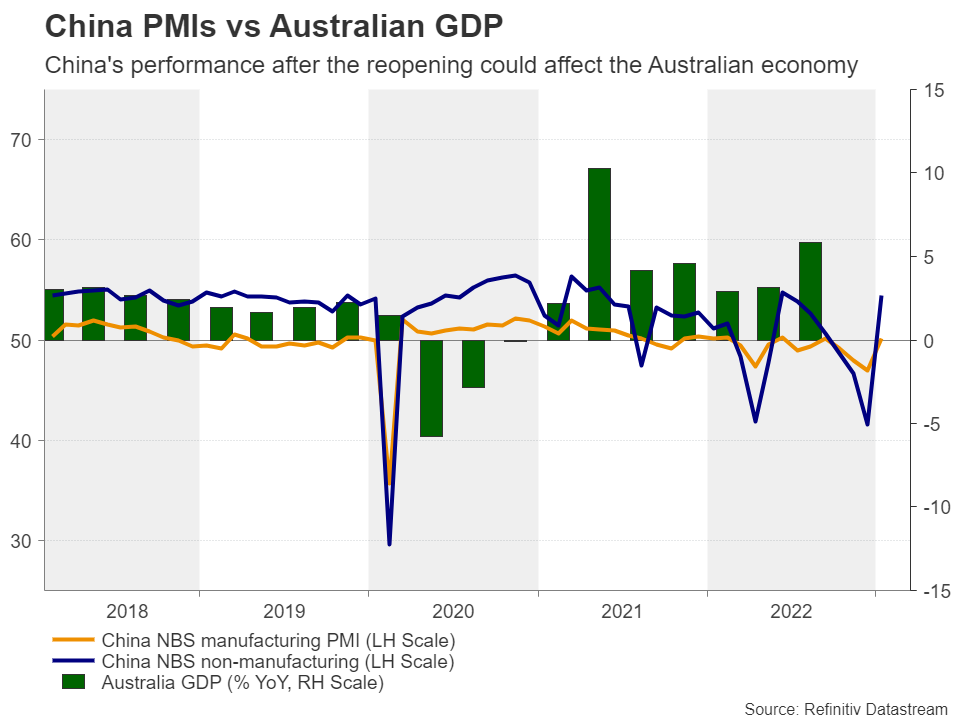
That said, with investors raising their bets with regards to more aggressive action by other major central banks as well, risk appetite has been very subdued lately, which is negative for risk-linked currencies like the aussie and the loonie. Thus, with the risk trade becoming a more or less zero-sum game in aussie/loonie, the Australian currency has more potential to gain against its Canadian counterpart rather than any other risk-linked currency, as the main driving force for this pair may be the divergence in monetary policy between the RBA and the BoC.
Aussie traders may also pay attention to the Chinese PMIs for February which come out just an hour after the Australian data. Given that China is Australia’s main trading partner, they may be eager to find out how the world’s second largest economy has been performing after the reopening.
After Ueda’s testimony, yen traders turn to the data
Flying from China to Japan, the world’s third biggest economy, next week’s agenda includes the industrial production and retail sales numbers for January on Tuesday and the Tokyo CPIs for February on Friday.
At his testimony before the lower house of the Japanese parliament, BoJ Governor nominee Kazuo Ueda said that the central bank must maintain ultra-low interest rates to support the economy, and while it signaled the chance of tweaking the yield curve control policy in the future, he seemed in no rush to overhaul the controversial policy.
So, as investors try to estimate when this could happen, they could pay close attention to the aforementioned data, especially the Tokyo CPI numbers, as they are a very good gauge of National inflation. Although they are not a major market moving data set, investors will have a first glimpse as to where inflation is headed and if it is set to continue to accelerate, they may start speculating a move towards normalization sooner rather than later.
Weekly Focus – Geopolitical and Inflation Risks Remain Elevated
The upbeat macro data releases continued to push markets towards pricing in tighter financial conditions. February Flash PMIs beat expectations both in the euro area and the US, with especially the services sector activity recovering faster than many had anticipated. Price indicators gave more mixed signals, as input price pressures appear to be easing while output prices continue to rise at a rapid pace.
While the strong leading indicators have eased recession fears, inflation risks remain elevated. In Sweden, the January Core CPIF inflation accelerated to 8.7% y/y (from 8.4%; consensus 8.2%), which combined with the hawkish Riksbank comments and February minutes continued to support Swedish rates and the krona. We have lifted our expectations on the upcoming Riksbank rate hikes, see more in Flash Comment Riksbank - February 2023 Minutes - We now expect 50bp in April and 25bp in June, 20 February.
Rising inflation expectations have lifted markets' expectations of policy rates elsewhere as well. Interestingly, the recent uptick in markets' inflation expectations has not coincided with higher commodity prices, which could signal fears of more persistent underlying inflation. The February FOMC minutes hawkishly signalled that some Fed members had favoured a 50bp hike in the previous meeting. In addition, some participants considered that the past easing in financial conditions could warrant a tighter monetary policy stance, even though Powell has downplayed the risk in the past. Markets are already pricing three 25bp Fed hikes by summer, and rates remaining above 5 % through 2023.
This morning, core inflation ticked higher to 4.2% even in Japan. We think it is just a matter of time before the Bank of Japan adjusts the YCC to allow the 10y government bond yield to rise further, and eventually exits the negative policy rate. The monetary policy shift will also be a supporting factor for JPY FX, which we now reflect in our FX Trading Portfolio - Time to go short USD/JPY as tactical trade, 23 January.
Today marks exactly one year since Russia began its attack into Ukraine. World's foreign policy leaders met at the Munich Security Conference last weekend but failed to spark much optimism around a resolution to the war. Relations remain tense not just between the West and Russia, but increasingly also China, whose top diplomat Wang Yi visited Moscow this week to deepen the countries' bilateral relations. This morning, China published its 12-point proposal for peace (you can read the full text here), but we still think talks about peace are highly premature as neither of the sides of the conflict has shown any willingness to compromise on their original military objectives. US has even accused China of planning to deliver weapons for Russia to be used in the war, but we doubt China is willing to risk falling under severe sanctions for no economic upside.
Next week, the focus turns to the euro area flash HICP figures on Thursday, consensus is looking for a further downtick in the headline data, but stable core inflation around 5.3% y/y. US February ISM indices are likely to tick higher following the PMIs this week, and we expect a decent rise to the Chinese Caixin Manufacturing PMI as well. While the official NBS PMIs rebounded already in January, we generally expect the data to confirm a front-loaded recovery in China.
Sunset Market Commentary
Markets
“It would be a cardinal sin to let up too soon.” ECB governing council member Nagel gave some hawkish comments on the sidelines of the G20 meeting of finance ministers. He expects the (flagged) robust rate increase in March and added that he doesn’t exclude further significant rate hikes may be needed beyond March. European money markets are currently more convinced about a downshift to 25 bps rate hikes from the May ECB policy meeting, rather than sticking with the 50 bps pace. Nagel says that recession fears are increasingly disappearing into the background, but with core inflation still much too high, monetary policy therefore has to tighten the reins. Next week’s February EMU CPI numbers could be crucial in shaping in expectations beyond March. Consensus expects monthly headline inflation to grow strongly (0.5% M/M) with the yearly number slowing from 8.6% Y/Y to 8.2% Y/Y. The German Bund started drifting from the start after these Nagel comments. The rest of European trading couldn’t really inspire with the focus turning to US January PCE deflators. Normally, this “outdated” news fails to trigger any market reaction given that CPI numbers are released earlier on the month and help shape expectations. This time around though, PCE deflators significantly beat consensus, rising by 0.6% M/M for both headline and core measure with upward revisions to January (and long term) data. The headline Y/Y-reading accelerated slightly from 5.3% Y/Y to 5.4% Y/Y with the core number up from 4.6% Y/Y to 4.7% Y/Y. Simultaneously, income and spending numbers were more mixed with the former rising by a lower-than-forecast 0.6% M/M, but the latter holding strong(er than expected) at 1.8% M/M. PCE deflators are the Fed’s preferred price gauge and suggests that more work has to be done this tightening cycle to get the inflation genie back in the bottle. US money markets are attaching more weight to the possibility that the Fed will have to return to a 50 bps rate hike in March. The US yield curve becomes more inverse with yields rising over 10 bps at the front end (2-yr tests 2022 high) and 3.4 bps at the very long end. The US 10-yr yield is attempting a weekly close above 3.9% which would be technically important and open the path for a return to the 2022 top at 4.33%. The German yield curve moves in parallel fashion with yields 11.1 bp higher for the 2-yr and 6.7 bps for the 10-yr. The latter is again testing key resistance at 2.55%. The core bond sell-off leaves its traces on stock markets with main European indices around 1% lower and key US benchmarks opening 1%-1.5% softer. The dollar extends this week’s gains in the risk-off climate with EUR/USD moving below 1.0550. The trade-weighted dollar moves above 105 for the first time since early January. USD/JPY tests 38% recovery on the decline between October ‘22 and January this year (136.67) with JPY-weakness amplifying the move following BoJ governor-nominee Ueda’s balanced parliamentary hearing this morning. It’s clearly too soon to frontrun a next Japanese normalization step.
News Headlines
The PBOC in its quarterly monetary policy report said it will provide “sustainable” support for the real economy without resorting to “flood-style” stimulus. Growth will rebound in 2023, the central bank expects, but the external environment remains “severe and complex” while drivers for the domestic recovery are not yet “solid”. Measures will be forceful but targeted, with a focus on domestic demand expansion, stabilizing growth, employment and prices. The PBOC expects inflation, currently at 2.1% (January), to remain mild overall but stressed the need to look out for potential price pressures in the future. On a sidenote, current PBOC governor Yi Gang is expected to step down when a government position reshuffle takes place next month. His successor, probably veteran banker Zhu Hexin, isn’t seen as a major gamechanger for monetary policy though.
The US announced new sanctions against Russia’s metal and mining sector. At today’s one year anniversary of the war Ukraine, the White House said it will raise tariffs on more than 100 Russian metals, minerals and chemical products, worth some $2.8bn to Russia. It didn’t specify by much though, only that it will “significantly increase costs for aluminum that was smelted or cast in Russia to enter the US market”. Bloomberg citing people familiar with the matter reported early February that the US was preparing a 200% import tariff. Russian industrial metals account for some 10% of US imports.
US Dollar Outlook Ahead of March NFP
As we await the publication of the Nonfarm payrolls on the 3rd of March, the technical side of things does not seem to favor the US Dollar. Let's see how the Dollar looks up from the technical side of things.
US Dollar
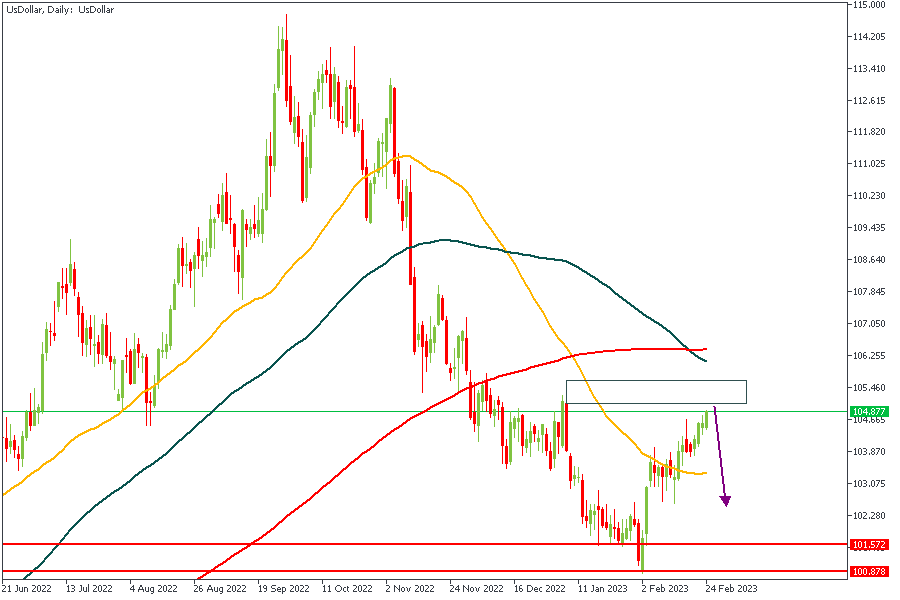
On the Daily timeframe, the US Dollar can be seen approaching a rally-base-drop supply zone. The 88% of the Fibonacci retracement and the 100-Day moving average serve as additional confluences for the bearish sentiment. Should this be the case, we can expect bullish price action from the XXX-USD pairs.
EURUSD
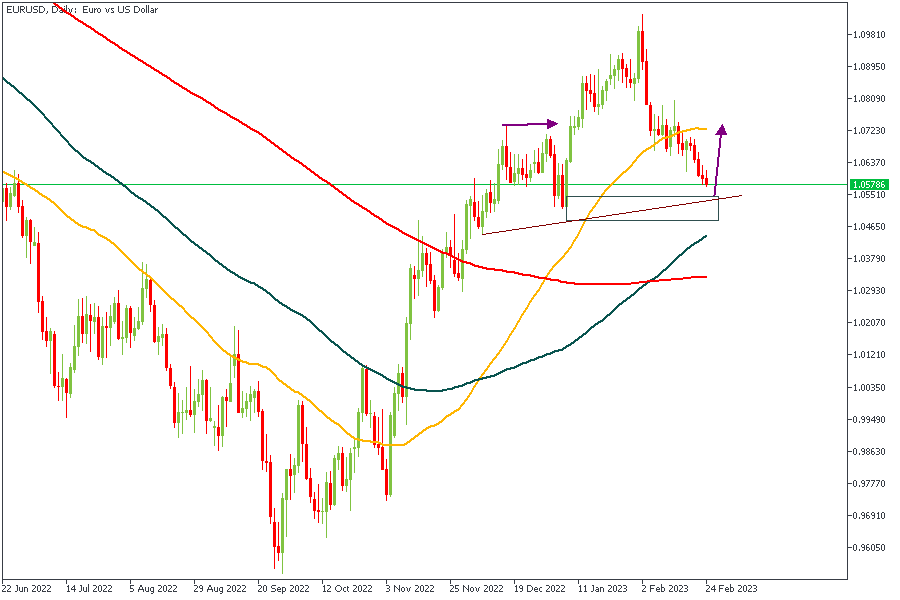
EURUSD, on the Daily timeframe, is approaching a drop-base-rally demand zone from the previous break above the marked high. The demand zone falls within 88% of the Fibonacci retracement, and we can also see trendline support just within reach of the current price action. On this note, my sentiment here is bullish.
- Analysts’ Expectations:
- Direction: Bullish
- Target: 1.07230
- Invalidation: 1.04550
GBPUSD
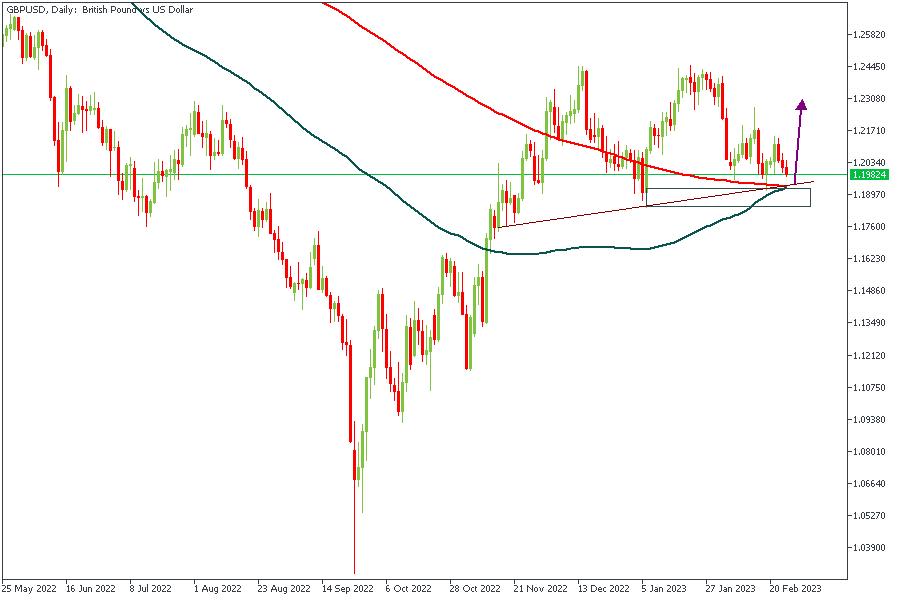
Similar to the price action on EURUSD, GBPUSD is also approaching a demand zone, where is also trendline support. In this case, however, the added confluence of the 100 and 200-day moving averages exists.
- Analysts’ Expectations:
- Direction: Bullish
- Target: 1.2300
- Invalidation: 1.1800
XAUUSD
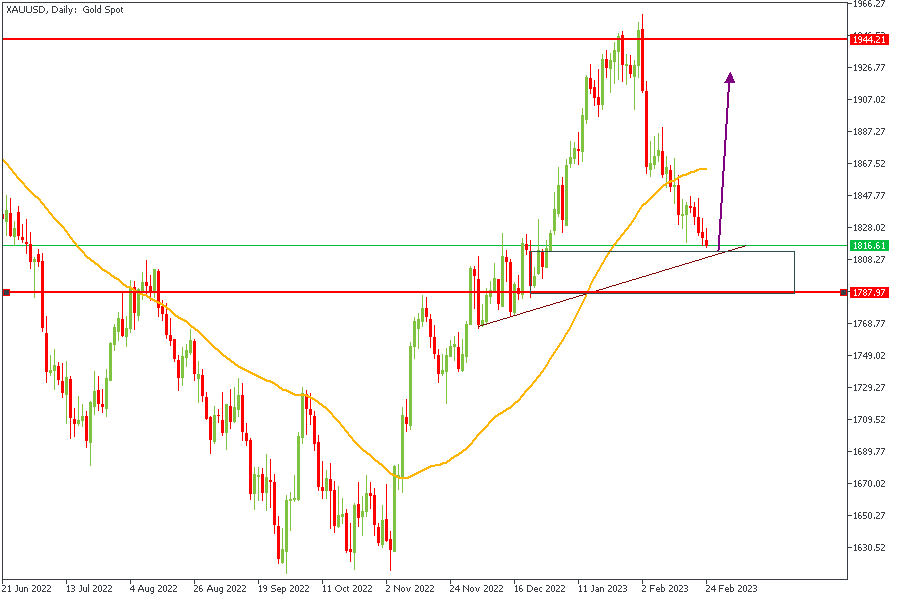
Gold has presented us with a similar scenario as we have already discussed. Similar confluences and sentiments as well.
- Analysts’ Expectations:
- Direction: Bullish
- Target: $1910
- Invalidation: $1787
CONCLUSION
The trading of CFDs comes at a risk. Thus, to succeed, you have to manage risks properly. To avoid costly mistakes while you look to trade these opportunities, be sure to do your due diligence and manage your risk appropriately.
US: Income and Spending Growth Accelerates in January
Personal income growth accelerated to 0.6% month-on-month (m/m) in January, from 0.3% m/m in December (revised up from 0.2% m/m) – but was below market expectations for growth of 1.0%m/m. Compensation of employees (+0.9% m/m) accounted for most of the growth. However, the gain was partially offset by a 1.4% m/m drop in government social benefits as the extended child tax credit expired and a decline in one-time refundable tax credits issued by states.
Subtracting inflation and taxes, real personal disposable income rose an impressive 1.4% m/m in January.
Personal consumption gained 1.8% on the month, from an upwardly revised reading of -0.1% m/m in December, reversing last month's losses. This was higher than 1.4% increase expected by the consensus.
Growth in goods spending was driven durable goods, as purchases of motor vehicles rebounded from December's weakness, as well as "other" nondurable goods (led by pharmaceuticals).
Services spending growth was mainly supported by food services.
Adjusting for inflation, real spending rose 1.1% m/m, reflecting solid gains in goods (+2.2%) and services (+0.6%) outlays.
The personal consumption price deflator rose 0.6% m/m, and 5.4% on a year-on-year (y/y) basis – stronger than the expected 5.0% y/y reading.
The Fed's preferred measure of inflation – core PCE – rose 0.6% m/m (v. 0.4% expected) from an upwardly revised 0.4% m/m in December, accelerating to 4.7% year-on-year (from an upwardly revised 4.6% in December). This was higher than expected 4.3% y/y growth.
The personal saving rate continues to normalize with a 4.7% reading in January. Revisions to fourth quarter income and spending resulted in an increase in our estimate of excess savings by $50 billion at the end of Q4 2022.
Key Implications
The American consumer continues to spend. Even when adjusted for inflation, growth looks like an outlier when compared to a decelerating trend of the second half of last year, especially given downwardly revised growth in Q4 2022. Today's strong report puts real spending on a slightly stronger footing, with growth estimated to advance in range of 1.5-2.0% (annualized) in the first quarter.
Revisions also affected the distribution of price growth, making December's and January's core PCE deflator stronger than previously believed. Nevertheless, real disposable income growth has been positive in every month since June 2022, accelerating strongly this month. This helped shore up more savings and will keep consumer financially strong in the coming months. We expect the FOMC to continue to hike the federal funds rate by 25 bps at each of its next two policy meetings.
USD/JPY Mid-Day Outlook
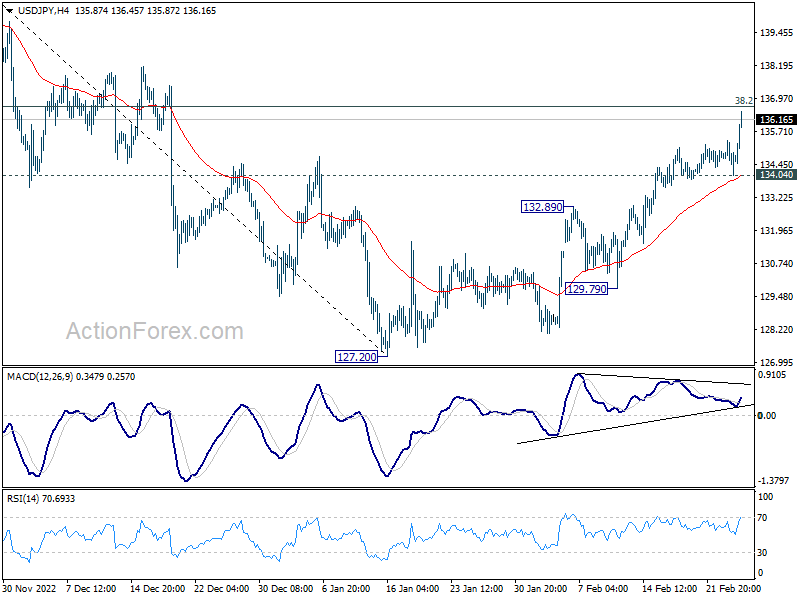
Daily Pivots: (S1) 134.32; (P) 134.85; (R1) 135.20; More...
Intraday bias in USD/JPY remains on the upside for 38.2% retracement of 151.93 to 127.20 at 136.64. Strong resistance could be seen there to complete the rebound from 127.20. Break of 134.04 minor support will turn bias back to the downside for 55 day EMA (now at 133.44) and below. However, sustained trading above 136.64 will indicate that fall from 151.93 has completed, and bring further rally to 61.8% retracement at 142.48.
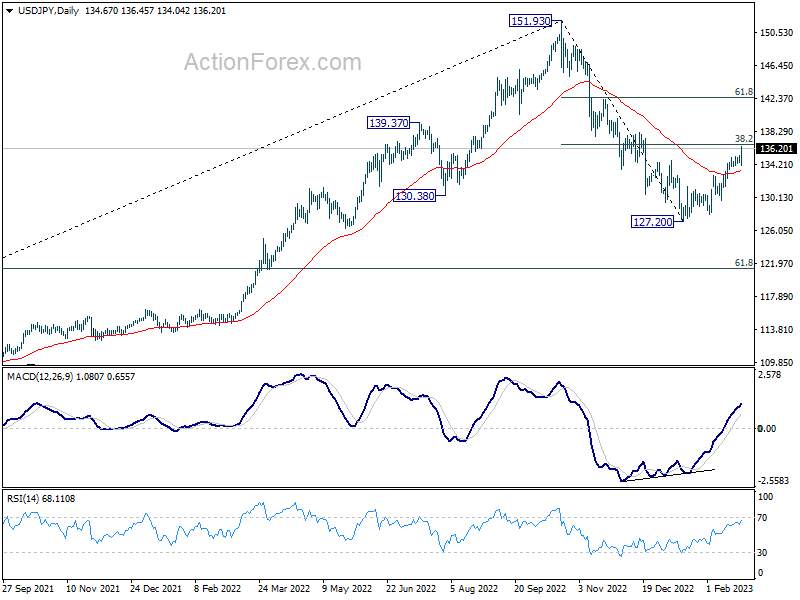
In the bigger picture, focus is now on 38.2% retracement of 151.93 to 127.20 at 136.64. Sustained break there will indicate that price actions from 151.93 medium term are merely a corrective pattern. Such development will maintain long term bullishness. Rejection by 136.64 will, on the downside, extend the fall from 151.93 to 61.8% retracement of 102.58 to 151.93 at 121.43 at a later stage.
USD/CHF Mid-Day Outlook
Daily Pivots: (S1) 0.9304; (P) 0.9326; (R1) 0.9363; More...
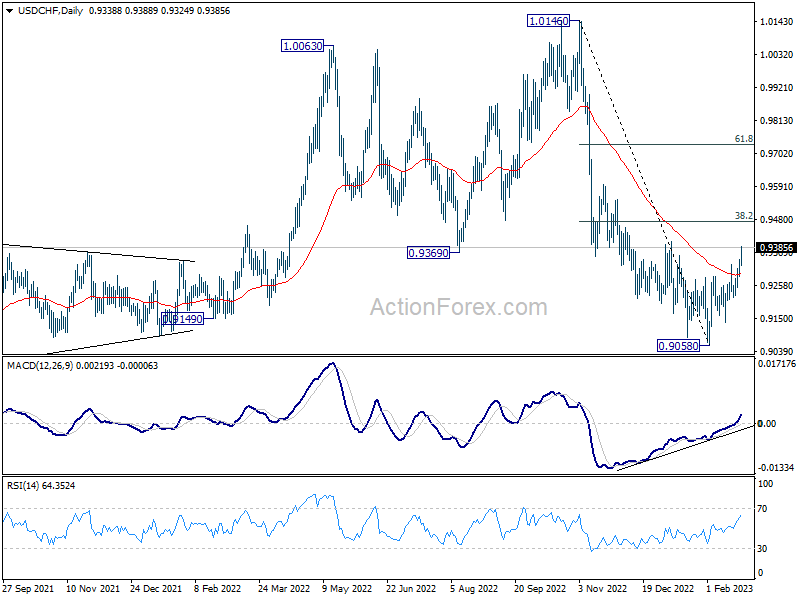
Intraday bias in USD/CHF remains on the upside at this point. Current rebound from 0.9058 should target 38.2% retracement of 1.0146 to 0.9058 at 0.9474. On the downside, below 0.9289 minor support will turn intraday bias neutral first.
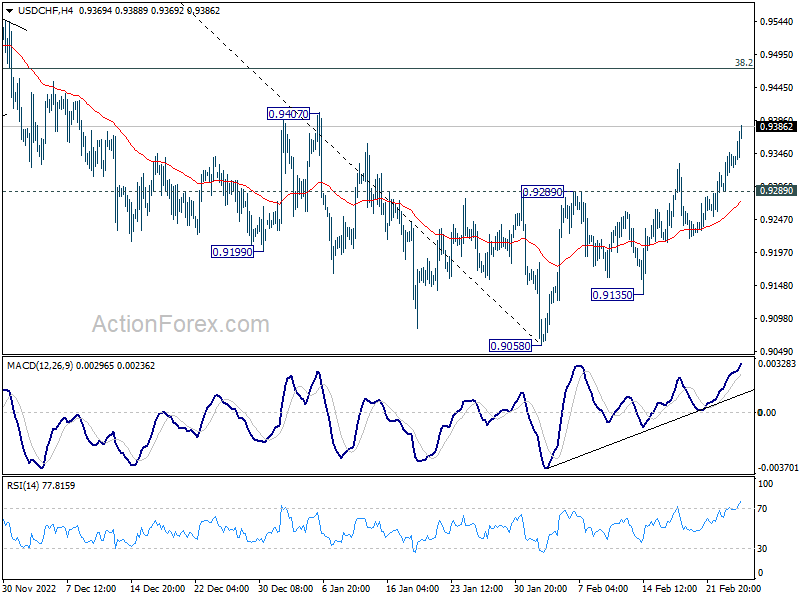
In the bigger picture, decline from 1.0146 is seen as part of a long term sideway pattern. As long as 38.2% retracement of 1.0146 to 0.9058 at 0.9474 holds, another fall is in favor through 0.9058. However, sustained trading above 0.9474 will indicate that the medium term trend has reversed, and open up further rally to 1.0146 again.