Sample Category Title
GBP/USD Mid-Day Outlook
Daily Pivots: (S1) 1.1980; (P) 1.2028; (R1) 1.2063; More...
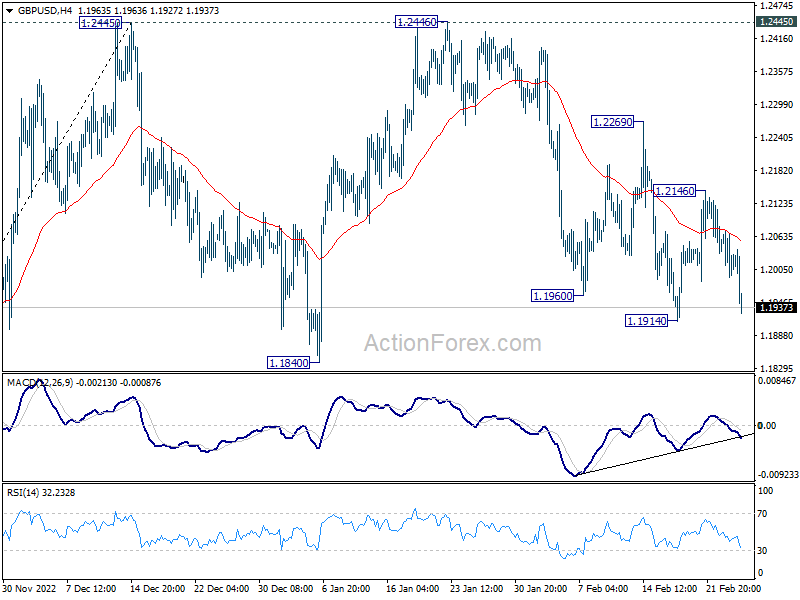
Immediate focus is now on 1.1914 in GBP/USD with today's decline. Break there will resume the fall from 1.2446, as the third leg of the corrective pattern from 1.2445, to 1.1840 support and possibly below. On the upside, break of 1.2146 resistance will turn bias back to the upside for further rebound to 1.2269 and above.
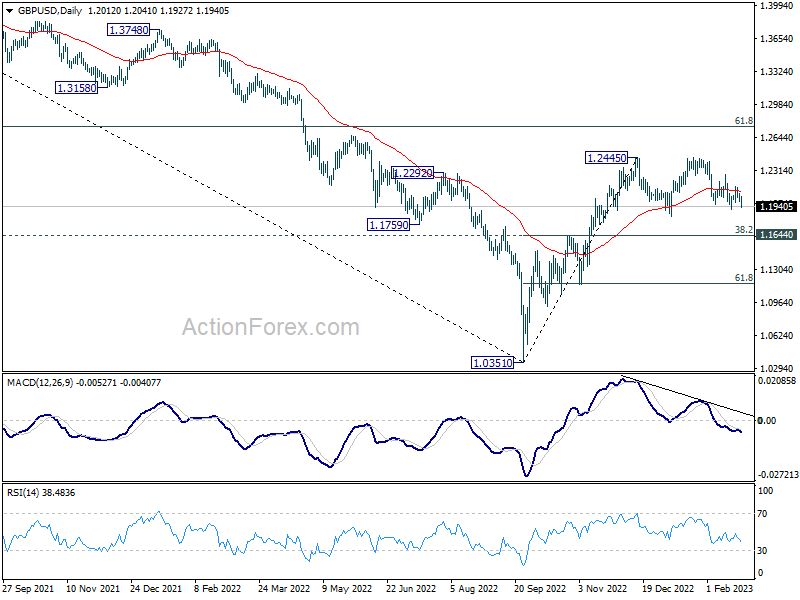
In the bigger picture, rise from 1.0351 medium term bottom is at least correcting whole down trend from 1.4248 (2021 high). Further rise is expected as long as 1.1644 resistance turned support holds. Next target is 61.8% retracement of 1.4248 to 1.0351 at 1.2759. Sustained break there will pave the way back to 1.4248.
EUR/USD Mid-Day Outlook
Daily Pivots: (S1) 1.0572; (P) 1.0600; (R1) 1.0623; More...
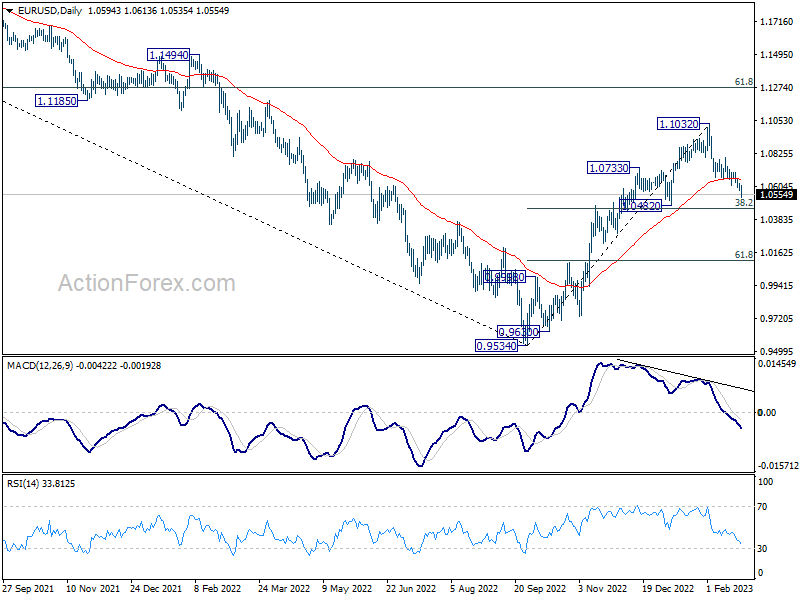
EUR/USD's fall from 1.1032 continues today and intraday bias stays on the downside for 38.2% retracement of 0.9534 to 1.1032 at 1.0463. Strong support should be seen around there to bring rebound, at least on first attempt. On the upside, above 1.0668 support turned will turn bias back to the upside for 1.0803 resistance and above. However, sustained break of 1.0463 will carry larger bearish implications.
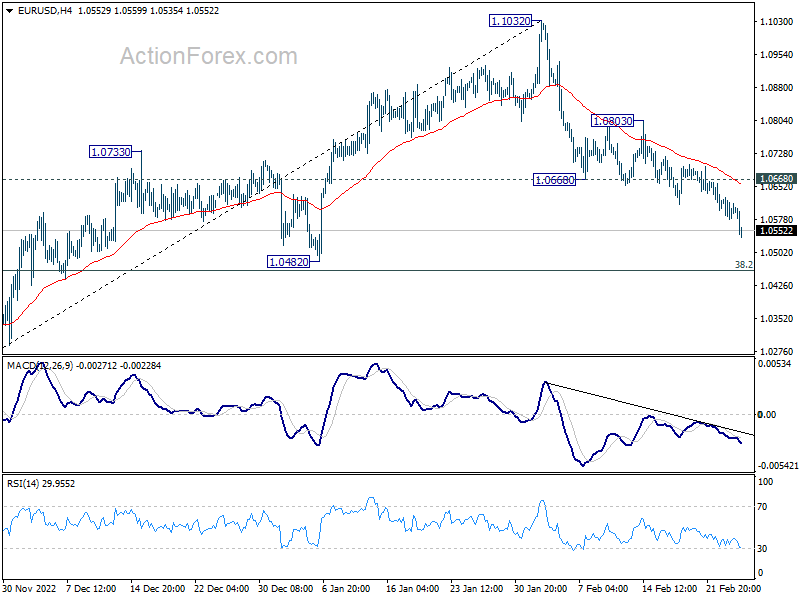
In the bigger picture, the rally from 0.9534 low (2022 low) is a medium term up trend rather than a correction. Further rise is in favor to 61.8% retracement of 1.2348 (2021 high) to 0.9534 at 1.1273 next. This will remain the favored case as long as 1.0482 support holds.
Dollar Soars as PCE Inflation Unexpectedly Re-accelerates
Dollar jumps in early US session follow data that showed surprised re-acceleration in PCE inflation, and core. Stocks tumble at open while treasury yields rise. The situation for Fed interest to "stay longer and higher" continues to solidify. Selloff is more concentrated on Yen and commodity currencies while European majors are mixed.
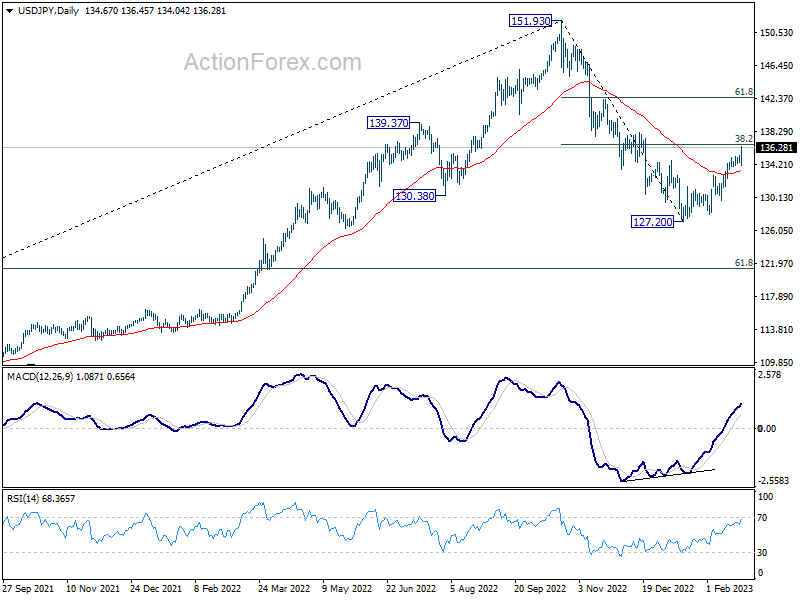
Technically, USD/JPY will be testing a major fibonacci resistance at 38.2% retracement of 151.93 to 127.20 at 136.64 soon. Strong break there will lower the chance of a long term bearish reversal. That will also bring further rally to 61.8% retracement at 142.48, even as just the second leg of the corrective pattern from 151.93.
In Europe, at the time of writing, FTSE is down -0.19%. DAX is down -1.21%. CAC is down -1.16%. Germany 10-year yield is up 0.075 at 2.556. Earlier in Asia, Nikkei rose 1.29%. Hong Kong HSI dropped -1.68%. China Shanghai SSE dropped -0.62%. Singapore Strait Times rose 0.53%. Japan 10-year JGB yield rose 0.0024 to 0.506.
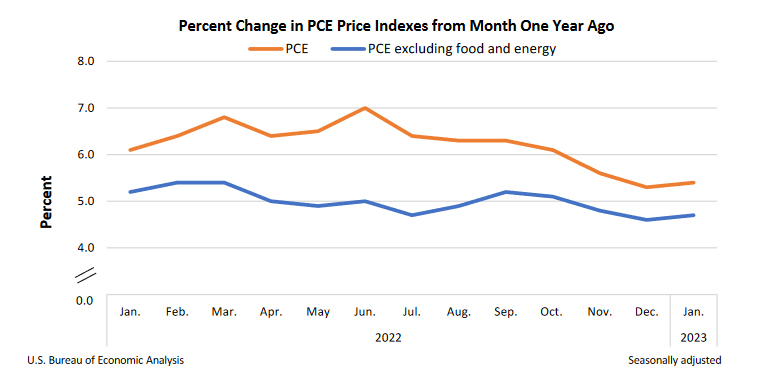
US PCE inflation rose to 5.4% yoy, PCE core rose to 4.7% yoy
US personal income rose 0.6% mom or USD 131.1B in January, below expectation of 1.0% mom. But personal spending rose 1.8% mom or USD 312.5B, above expectation of 1.0% mom.
For the month, PCE price index rose 0.6% mom, above expectation of 0.5% mom. Core PCE (excluding food and energy) rose 0.6% mom, above expectation of 0.4% mom. Prices for goods and services rose 0.6% mom. Food prices rose 0.4% mom. Energy prices rose 2.0% mom.
For the year, PCE price index accelerated from 5.3% yoy to 5.4% yoy, above expectation of 4.9% yoy. Core PCE accelerated from 4.6% yoy to 4.7% yoy, above expectation of 4.1% yoy. Goods prices rose 4.7% yoy. Services rose 5.7% yoy. Food rose 11.1% yoy and energy rose 9.6% yoy.
Bundesbank Nagel: Stopping tightening too early is a cardinal error
Bundesbank President Joachim Nagel said, "What seems distinctive to me is that core inflation will remain at a very high level beyond March."
"That's why I don't rule out that further significant interest rate hikes beyond March will be necessary,: he added.
Nagel also said ECB's interest rate is not restrictive yet. He warned that stopping tightening too early would be a "cardinal error."
Germany Gfk consumer confidence rose to -30.5, firmly on the path to recovery
Germany Gfk Consumer Confidence for March rose from -33.8 to -30.5, slightly below expectation of -30.0. In February, economic expectations rose from -0.6 to 6.0. Income expectations rose from -32.2 to -27.3. Propensity to buy rose from -18.7 to -17.3.
"Despite ongoing crises, such as the war in Ukraine, a weakening global economy, and high inflation rates, consumer sentiment has once again increased noticeably. It thus remains firmly on the path to recovery, even if the level remains low. Consumer pessimism, which peaked last fall, is fading", explains Rolf Bürkl, GfK consumer expert.
"Recent drops in energy prices and reports that experts believe a recession in Germany this year can now be avoided mean that optimism is slowly returning."
BoJ Ueda: Current policy a necessary, appropriate means to achieve 2% inflation
At a parliamentary confirmation hearing, incoming BoJ Governor Kazuo Ueda said, "current policy is a necessary, appropriate means to achieve 2% inflation," despite various side effects emerging from the stimulus.
"Japan's trend inflation is likely to rise gradually. But it will take some time for inflation to sustainably and stably achieve the BOJ's 2% target," he said.
"Consumer inflation is likely to fall below 2% in the latter half of the next fiscal year. It takes time for the effect of monetary policy to appear on the economy. "
"It's standard practice to act preemptively to demand-driven inflation, but not respond immediately to supply-driven inflation. Otherwise, the BOJ will be cooling demand, worsening economy and pushing down prices by tightening monetary policy."
"If trend inflation heightens significantly and sustained achievement of the BOJ's 2% target comes into sight, the central bank must consider normalizing policy. But if trend inflation lacks strength, the bank must continue how to maintain its ultra-easy policy, while paying attention to deterioration in market function."
Japan CPI core hit 41-yr high at 4.2% in Jan
Japan all item CPI rose from 4.0% yoy to 4.3% yoy in January, below expectation of 4.5% yoy. CPI core (all-item ex-food) rose from 4.0% yoy to 4.2% yoy, matched expectations. CPI core-core (all-item ex-food and energy) rose from 3.0% yoy to 3.2% yoy, matched expectations.
Core CPI rate of 4.2% was the highest in 41-year since September 1981. The core inflation rate stayed above BoJ's 2% target for nine consecutive months.
RBNZ Silk: A tightening pause is being contemplated now
RBNZ Assistant Governor Karen Silk said in a Bloomberg interview "there's still more work to do here" on interest rate and fighting inflation. While "all levels are on the table" for April meeting, the central bank is not contemplating a pause.
"This is still an economy that has excess demand, a tight labor market, and as a consequence both headline inflation and core inflation at levels that are well outside the (target) band," she said.
Regarding April meeting, "all levels are on the table for discussion at every meeting," she said. "I'm not going to turn round and comment on whether we would be looking at 25, 50 or 75, they will all be on the table for discussion and they will depend on the information at hand."
Nevertheless, a pause in tightening is "certainty not something that we're contemplating at this point in time," she said.
Silk also noted that some upside risk was built into the forecast interest peak of 5.5%. However, "without building that in, any variation to that peak would have been still at the margin," she said. "There's potentially still some upside risk on the fiscal side of it. Let's just see how it plays out over the next six weeks."
EUR/USD Mid-Day Outlook
Daily Pivots: (S1) 1.0572; (P) 1.0600; (R1) 1.0623; More...
EUR/USD's fall from 1.1032 continues today and intraday bias stays on the downside for 38.2% retracement of 0.9534 to 1.1032 at 1.0463. Strong support should be seen around there to bring rebound, at least on first attempt. On the upside, above 1.0668 support turned will turn bias back to the upside for 1.0803 resistance and above. However, sustained break of 1.0463 will carry larger bearish implications.
In the bigger picture, the rally from 0.9534 low (2022 low) is a medium term up trend rather than a correction. Further rise is in favor to 61.8% retracement of 1.2348 (2021 high) to 0.9534 at 1.1273 next. This will remain the favored case as long as 1.0482 support holds.
Economic Indicators Update
| GMT | Ccy | Events | Actual | Forecast | Previous | Revised |
|---|---|---|---|---|---|---|
| 23:30 | JPY | National CPI Core Y/Y Jan | 4.20% | 4.20% | 4.00% | |
| 00:01 | GBP | GfK Consumer Confidence Feb | -38 | -40 | -45 | |
| 07:00 | EUR | Germany Gfk Consumer Confidence Mar | -30.5 | -30 | -33.9 | -33.8 |
| 07:00 | EUR | Germany GDP Q/Q Q4 F | -0.40% | -0.20% | -0.20% | |
| 13:30 | USD | Personal Income M/M Jan | 0.60% | 1.00% | 0.20% | 0.30% |
| 13:30 | USD | Personal Spending Jan | 1.80% | 1.00% | -0.20% | -0.10% |
| 13:30 | USD | PCE Price Index M/M Jan | 0.60% | 0.50% | 0.10% | 0.20% |
| 13:30 | USD | PCE Price Index Y/Y Jan | 5.40% | 4.90% | 5.00% | 5.30% |
| 13:30 | USD | Core PCE Price Index M/M Jan | 0.60% | 0.40% | 0.30% | 0.40% |
| 13:30 | USD | Core PCE Price Index Y/Y Jan | 4.70% | 4.10% | 4.40% | 4.60% |
| 15:00 | USD | Michigan Consumer Sentiment Index Feb F | 66.4 | 66.4 | ||
| 15:00 | USD | New Home Sales Jan | 620K | 616K |
US PCE inflation rose to 5.4% yoy, PCE core rose to 4.7% yoy
US personal income rose 0.6% mom or USD 131.1B in January, below expectation of 1.0% mom. But personal spending rose 1.8% mom or USD 312.5B, above expectation of 1.0% mom.
For the month, PCE price index rose 0.6% mom, above expectation of 0.5% mom. Core PCE (excluding food and energy) rose 0.6% mom, above expectation of 0.4% mom. Prices for goods and services rose 0.6% mom. Food prices rose 0.4% mom. Energy prices rose 2.0% mom.
For the year, PCE price index accelerated from 5.3% yoy to 5.4% yoy, above expectation of 4.9% yoy. Core PCE accelerated from 4.6% yoy to 4.7% yoy, above expectation of 4.1% yoy. Goods prices rose 4.7% yoy. Services rose 5.7% yoy. Food rose 11.1% yoy and energy rose 9.6% yoy.
Yen Enters a New Downfall
Consumer prices in Japan continue to rise steadily, but this is of little concern to the central bank – a brutal combination for the Yen, which could repeat last year’s alarming decline.
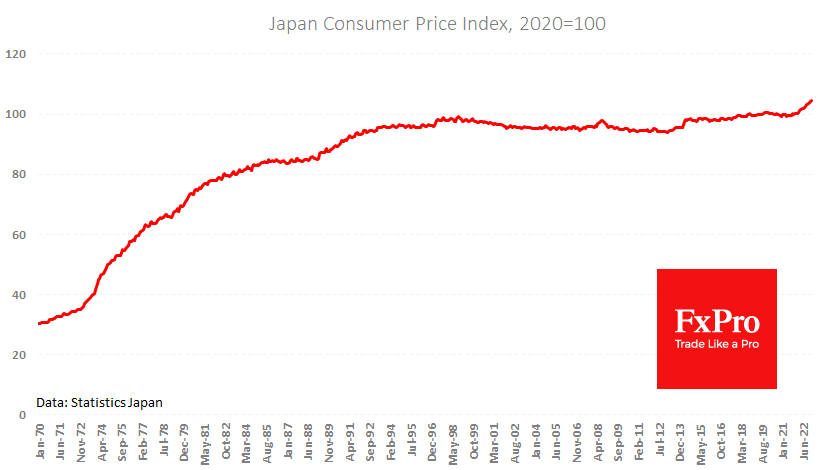
Japan’s CPI rose 0.5% in January, the 15th month without a decline. The annual rate of increase also continues to grow, taking headline inflation to 4.3% and, excluding food and energy, to 3.2% y/y. This is the highest rate of price increases since the early 1980s.
From a technical point of view, the nominal CPI has broken through the resistance of the peaks at the end of 1998 and continues to rise steadily. Nevertheless, there are concerns that the monetary and fiscal authorities still need to change their policy stance.
The primary candidate for the BoJ chairmanship confirmed in his speech today that low-interest rates are now acceptable, as inflation is being driven by rising import prices rather than demand.
These comments have the potential to finally undermine hopes that the Bank of Japan has followed much of the rest of the world in turning its back on inflation. Expectations of such a turnaround have recently worked in favour of a stronger Yen. Before, in October and November, demand for the Yen was driven by verbal and actual interventions in defence of the national currency.
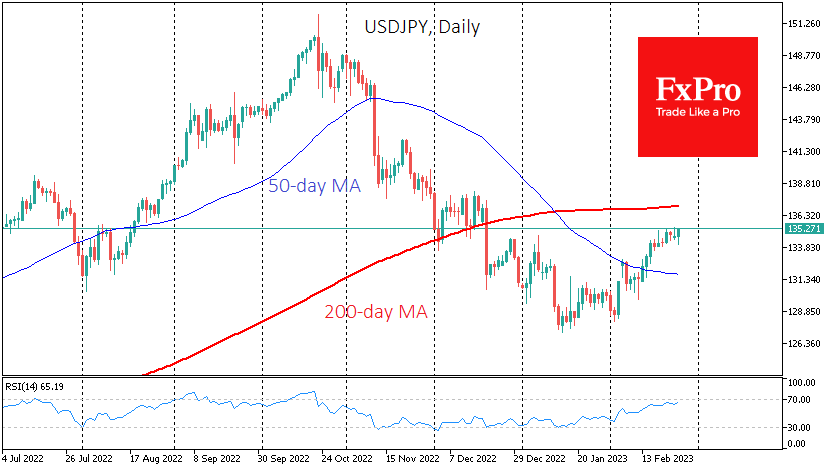
The USDJPY is down more than 15% from its October high of 152 and has found support on the downside at 127, where a local reversal area from last May’s upward correction and a 50% retracement of the rally from the 2021 lows at 102.6 coincide.
Comments from the country’s monetary authorities suggest a new wave of pressure on the yen after three months of easing or ‘recharging’. With the Bank of Japan not changing policy, the yen is potentially under pressure from an intensified interest rate differential game. And this game promises to be more aggressive now than a year ago, as yield spreads between Japan and the US have widened for both short and long-term yields.
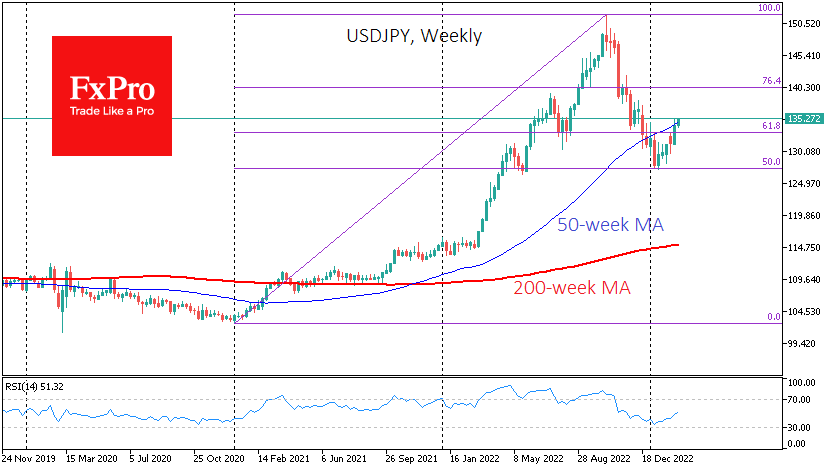
Without a reversal by the BoJ, the USDJPY could be back around 150 by June. The yen would then be 15% lower than a year ago, which aligns with the standard depreciation rate for developed market currencies. Our observation is that officials only move from words to deeds when the exchange rate deviates by more than 20% YoY.
The current higher interest rate environment is an opportunity for Japan to competitively devalue its currency to support national exporters, which it failed to do in the last decade in the era of zero interest rates.
Gold Bulls Pick a Fight with the Fed
Gold prices have been falling all month, and it opens the question whether this is a new trend, or can we see a turn around? Well, the latest macro data from the US paints a somewhat gloomy picture for gold in the short term. But beyond that, things get a little murky; and uncertainty is where gold tends to shine.
The US provided a second look at its Q4 GDP, revising it down by two decimals to 2.7% from the flash number. The result shows that the economy remains resilient, despite the actions taken by the Fed. That came in line with the better retail sales and stronger jobs numbers seen earlier in the month, all of which contributed to bringing down the price of gold.
There's more to the picture
The GDP number was revised lower after considering slower than initially expected consumer spending. Americans are spending less, which means there is trouble in the largest component to the economy. With inflation causing real wages to turn negative for over a year now, people are seeing the pinch in their wallets. While that is overall bad for the people and the economy, because of technical quirks, it can be reflected as positive in the statistics.
One of the larger components driving positive GPD is a shrinking trade deficit. While that sounds good that the country is getting its spending in order, the reason why is worrisome: Americans are buying less, which translates into less imports. And they are buying less because of inflation. With consumer spending under pressure, this is generally a bad sign for the economy in the medium to long term.
Will things turn around?
One of the reasons a recession is expected is because the Fed could keep raising rates, potentially over tightening and causing the economy to falter. On the other hand, if inflation continues to run rampant, then consumers might see their purchasing power devalued so much that it also causes a recession.
Traditionally, gold tends to outperform during a recession as people seek safe havens. So, the prospect of a recession could give some hope that gold could rise sometime in the future. But, for now, with the macro indicators pointing to the economy being able to withstand more tightening, gold bulls are effectively picking a fight with the Fed.
It's about rising rates
The number of economists forecasting that the Fed will hike by 50bps at the next meeting is still relatively small. Just over a quarter, as a matter of fact. But, it's a growing consensus; and there are still more than 3 weeks before the meeting. Meanwhile, from the minutes of the last meeting, it turns out the Fed is starting to get worried about the labor market getting too tight.
With the Fed expected to keep raising rates in the short term, the dollar could keep getting stronger. That would make it harder for gold to get back to the $1,900 level. That could change if a recession starts to manifest. But the Fed insists that won't happen. The data coming out in the next few months will show who is right.
USD/CNH: End of Impulse Hints at a Fall in a Bearish Correction
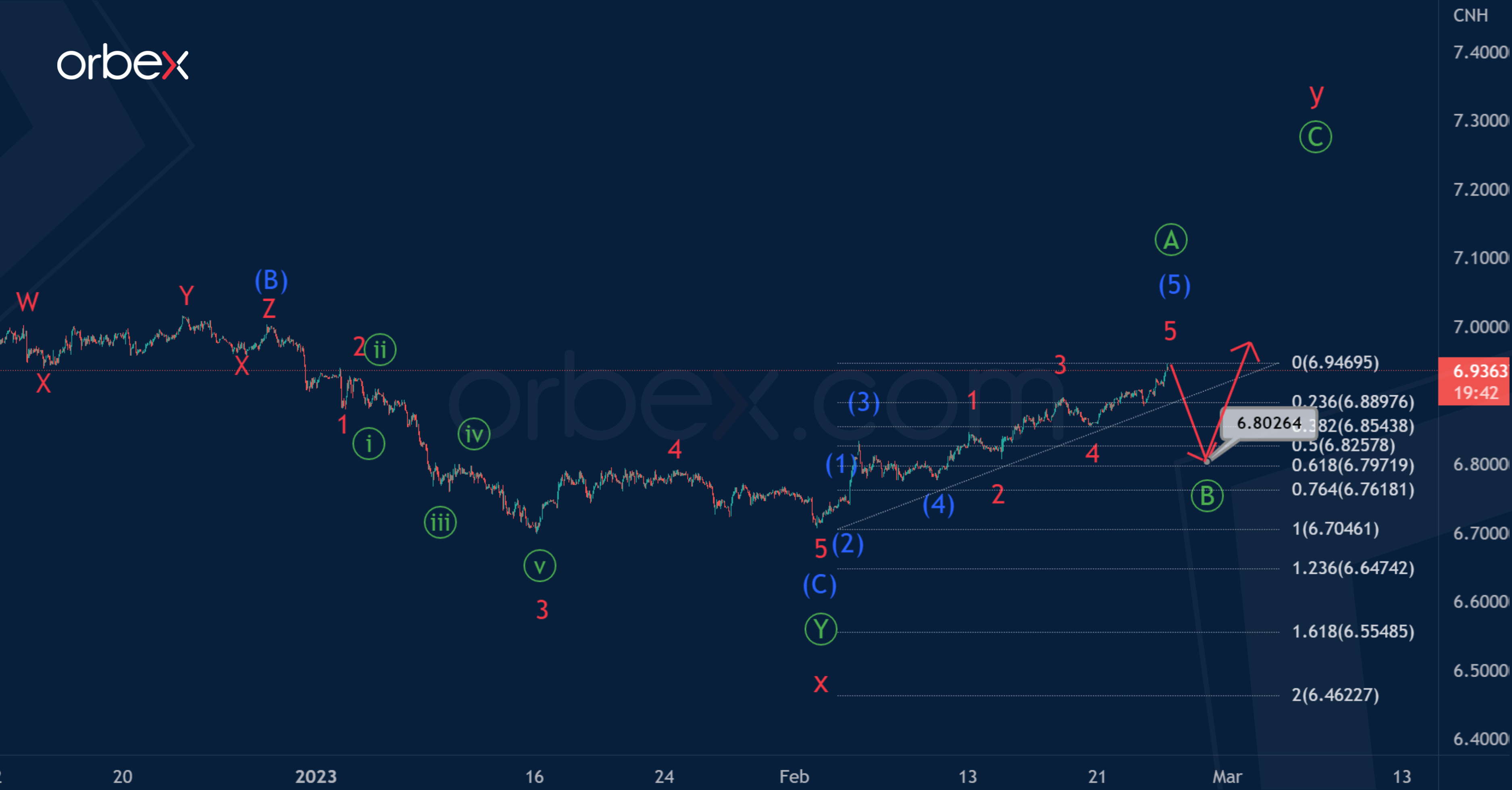
USDCNH seems to be forming a double zigzag w-x-y of a cycle degree. By the beginning of this month, the bearish intervening wave x has come to an end, it looks like a primary double zigzag Ⓦ-Ⓧ-Ⓨ.
It is assumed that in the last section of the chart, the actionary wave Y is being constructed. Perhaps it will take the form of a standard zigzag Ⓐ-Ⓑ-Ⓒ.
The primary impulse wave Ⓐ could come to an end, so in the near future the price may be adjusted in the wave Ⓑ. Its finale is expected near 6.802. At that level, it will be at 50% of impulse Ⓐ.
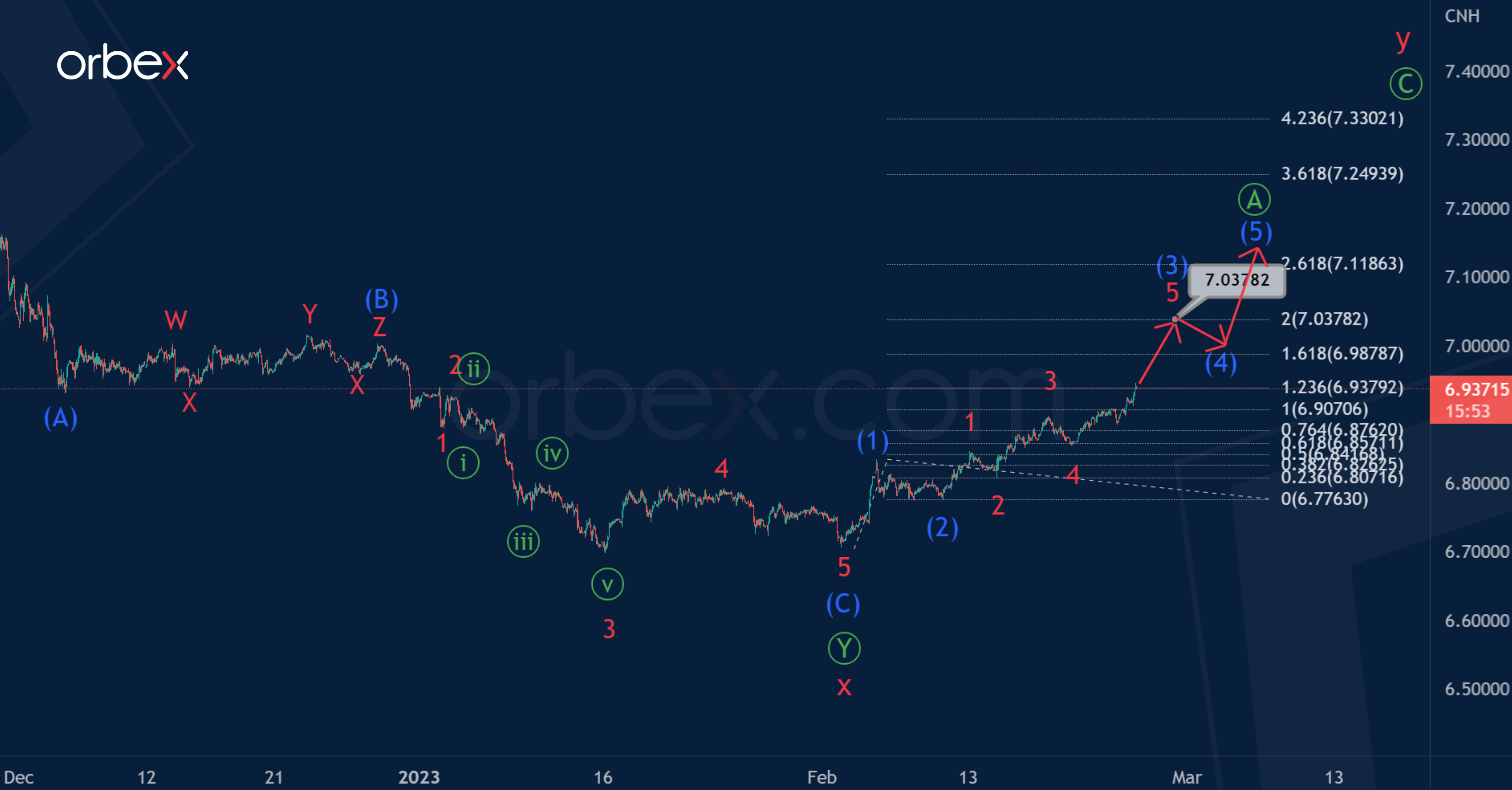
In the second option, the price can continue to move up in the primary impulse wave Ⓐ.
It is possible that at the moment only two intermediate sub-waves (1)-(2) have been completed in the impulse Ⓐ. In the near future, the price may rise in impulse (3) to 7.037. At that level, it will be at the 200% Fibonacci extension of impulse (1).
An approximate scheme of possible future movement is shown on the chart.
Yen Edges Lower after BoJ’s Ueda Testimony
The Japanese yen is slightly weaker on Friday. In the European session, USD/JPY is trading just above the 135 line.
Ueda pledges to continue easy policy
Incoming Bank of Japan Governor Kazuo Ueda appeared at a parliamentary hearing on Friday and the markets were all ears. The buzz-word from Ueda was ‘continuity’, which really wasn’t a surprise. Ueda has already said that the current policy is appropriate and he maintained this stance at the hearing. Ueda said that ultra-low rates are needed while the economy is fragile and ruled out fighting inflation by tightening policy.
With inflation running at 4%, above the BoJ’s target of 2%, there is pressure on Ueda to abandon or at least adjust the Bank’s yield control policy (YCC), which is being criticised for distorting market functions. Ueda treated this hot potato with caution. He acknowledged that the YCC had caused side effects but said that the BoJ should evaluate whether recent steps such as widening the band around the yield target would ease these problems.
The takeaway from Ueda’s testimony is that he is in no hurry to shift central bank policy. Still, there is strong pressure on Ueda to address YCC, which is damaging the bond markets. Investors should not discount the possibility that Governor Kuroda could widen the target yield band at the March meeting in order to relieve pressure on Ueda. If Kuroda doesn’t act, the bond markets could respond with massive selling before Ueda takes the helm of the BoJ in April.
The inflation pressures facing the BOJ were underscored by National Core CPI for January, which rose from 4.0% to 4.2%. This was just shy of the 4.3% estimate, but still the highest reading since 1981. The BoJ has insisted that inflation is temporary (remember that line from the ECB and the Fed?), and is hoping that the government’s massive stimulus package, which includes subsidies for electricity, will help bring down inflation.
USD/JPY Technical
- USD/JPY is testing resistance at 134.85. Above, there is resistance at 135.75
- 1.3350 and 131.90 are providing support
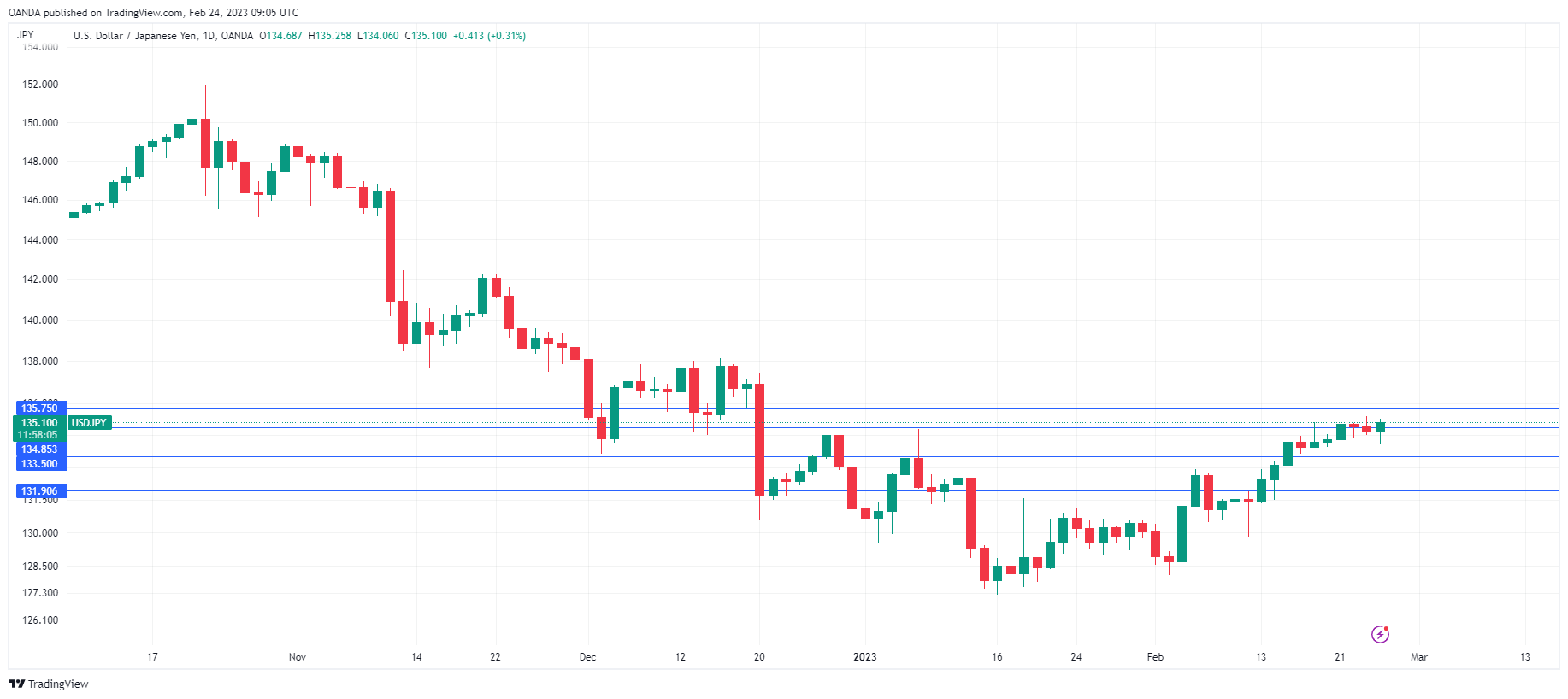
USD/JPY: Bulls May Hold in Extended Consolidation Before Attacking Key Barriers
The USDJPY regained traction and rose near new multi-week high in early Friday’s trading, but the price action is still within the limits of a consolidation range of past three days.
The dollar remains supported by Fed’s recent hawkish comments which signal prolonged policy tightening cycle, keeping bullish stance for fresh acceleration higher.
Technical studies on daily chart show moving averages (10/20/30/55) in bullish setup and underpinning the action with a number of bull-crosses, although positive momentum is fading and stochastic is heading south after forming a bearish divergence before emerging from overbought territory.
This may produce headwinds to larger bulls and delay fresh push higher for test of targets at 136.66/90 (Fibo 38.2% of 151.94/127.22 / daily cloud top).
Extended consolidation should stay above rising 10DMA (134.17) which tracks the ascend for past three weeks, however deeper dips towards 133.05 (broken Fibo 23.6%) cannot be ruled out, but expected not to be very harmful for larger bulls.
Traders turn their focus to the key economic event today, release of US PCE index, Fed’s preferred gauge of inflation, due to be released later today and expected to provide fresh signals for the greenback.
Res: 135.36; 136.66; 136.90; 137.47.
Sup: 134.17; 133.44; 133.05; 132.54.
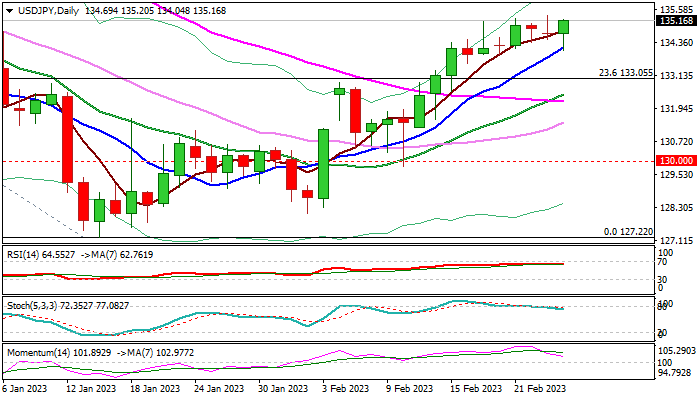
EUR/USD: Euro Looks Set for Further Losses
The Euro remains at the back foot in early Friday and on track for a weekly loss of around 1%, which adds to negative near-term outlook.
Risk aversion keeps the single currency under pressure, as US dollar received fresh boost from hawkish stance of the Fed.
The data released today, showed stronger than expected contraction of the German economy and along with recent weaker than expected economic data, adding to signals that Eurozone’s largest economy likely slid into recession in the first three months of 2023, which contributes to pressure on Euro.
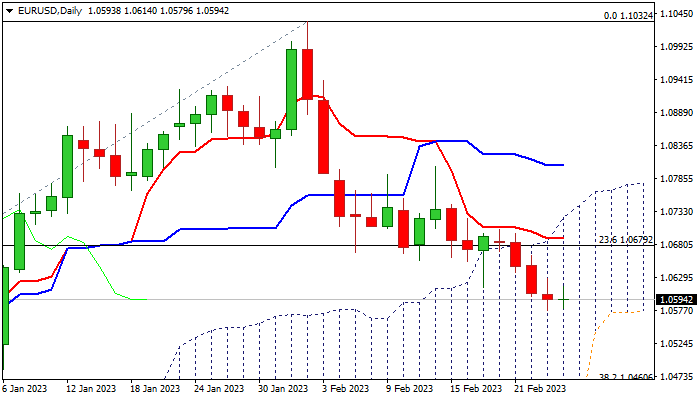
The daily chart shows the EURUSD pair heading south, deep in thick daily Ichimoku cloud, with bearishly aligned studies adding to prospect of further weakness.
Bears eye initial support at 1.0544 (daily cloud base), break of which would unmask next key levels at 1.0483/60 (2023 low, posted on Jan 6 / Fibo 38.2% of 0.9535/1.1032 ascend).
Meanwhile, bears may take a breather for consolidation, as stochastic is oversold and 14-d momentum bounced, but remaining in the negative territory.
In such configuration, limited upticks, which would offer better levels to re-join bearish market, would be likely scenario.
Falling 10DMA (1.0663) and broken Fibo 23.6%, reverted to resistance (1.0679), should ideally cap extended upticks and guard upper pivot at 1.0742 (daily cloud top).
Res: 1.0627; 1.0663; 1.0679; 1.0715.
Sup: 1.0577; 1.0483; 1.0460; 1.0443.