Sample Category Title
Dow Jones 30 Hits Resistance
The Dow Jones 30 steadies as traders await Fed minutes. A long upper wick in the supply zone near 34400 suggests rejection after the index struggled to grind higher. A drop below the swing low of 33520 has put the bulls on the defensive. A rising trendline has been supporting the choppy rally in the past two months and is an important level to keep the trajectory up. Its breach at 33480 could trigger a broader liquidation towards the daily support at 33000. 34000 is the first hurdle before the price could make its way back.

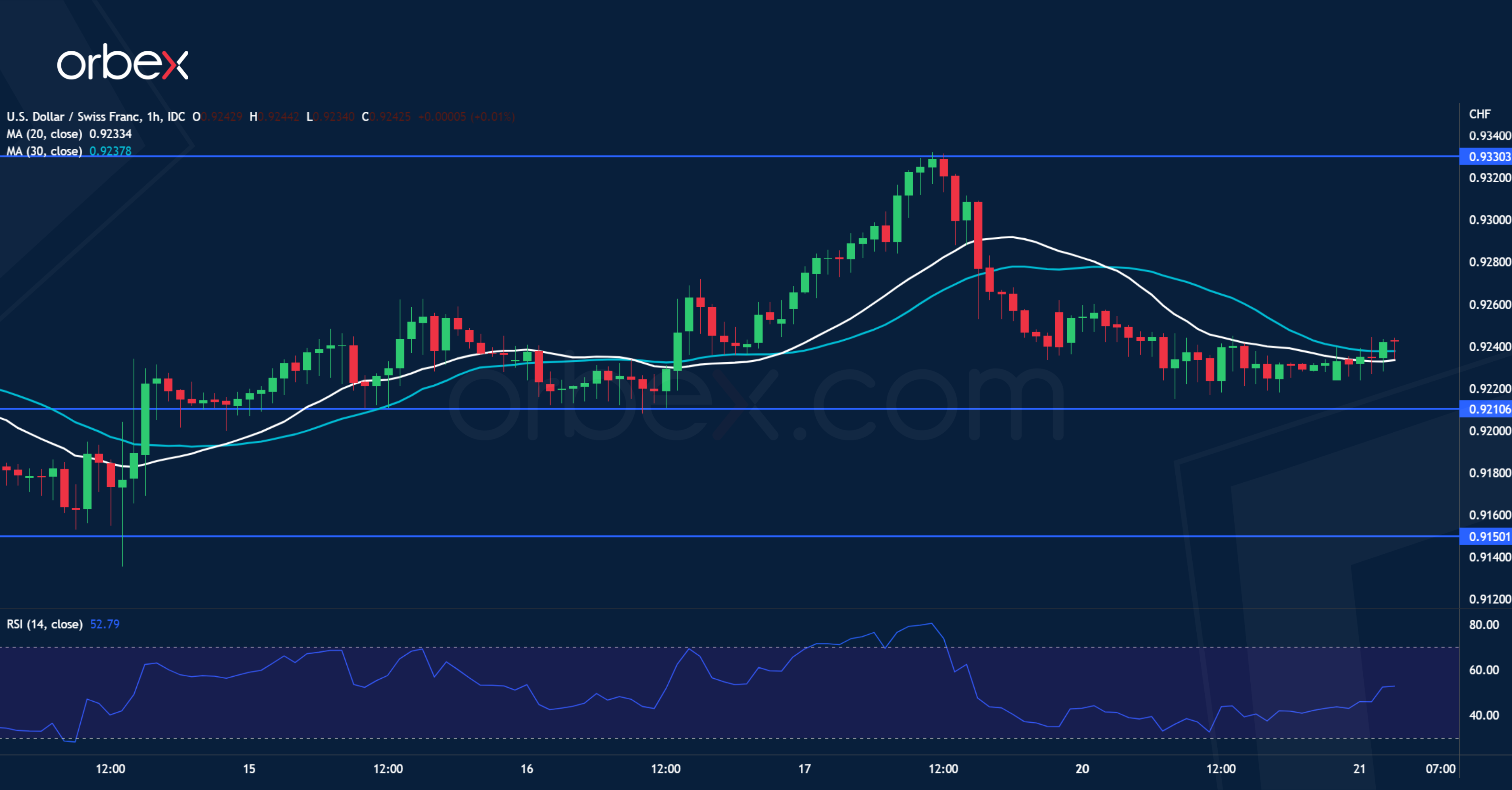
USD/CHF Bounces Back
The US dollar consolidates its gains as money markets expect higher peak rates from the Fed. Following a bounce off 0.9150, a pop above this month’s high of 0.9290 has prompted the bears to trim their exposure. 0.9120 at the bottom of the latest rally is a key level to keep the momentum intact. A recovery above 0.9330 would send the greenback to the daily resistance at 0.9400, paving the way for a full-fledged rebound in the medium-term. Failing that, a bearish breakout would trigger a retest of 0.9150.
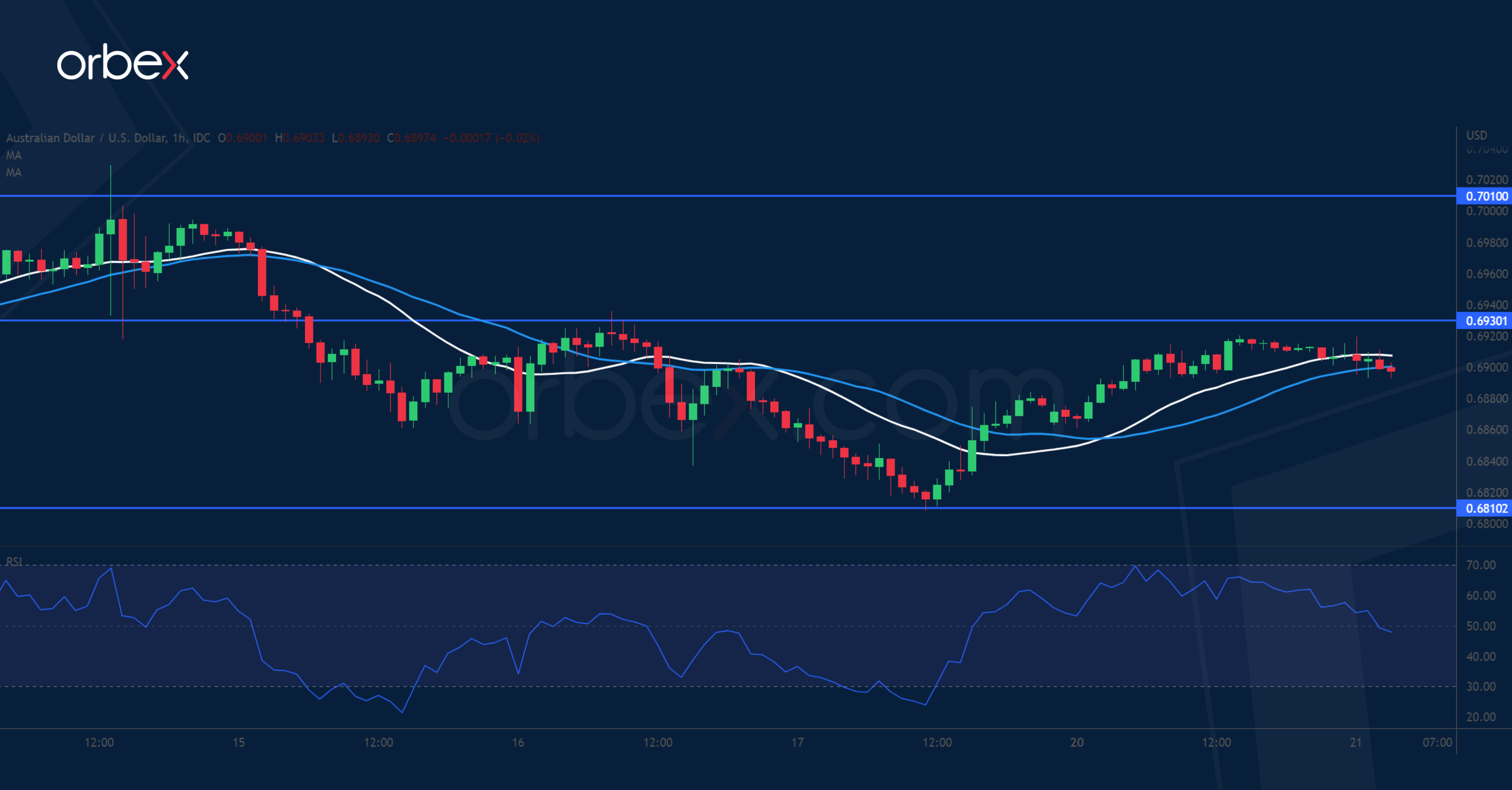
AUD/USD Tests Resistance
The Australian dollar struggles as the RBA’s hawkish meeting minutes put a cap on risk appetite. The price action has fallen back to the consolidation area around 0.6800 from late December. The RSI’s double dip in the oversold zone has attracted some buying interests. 0.6930 is the closest hurdle and the bulls will need to lift the top of a previously faded rebound at 0.7010 before they could turn short-term sentiment around. A drop below the fresh support of 0.6810 would extend the correction to the year’s low at 0.6700.
All Eyes Will on Flash PMIs from Europe and US
Market movers today
Today, all eyes will be on flash PMIs from Europe and the US. In the euro area, we look for potentially more evidence of rebounding activity amid easing inflation pressures. In the US, NY Fed's Empire and Philly Fed Manufacturing indices have sent mixed signals thus far for February but we still expect the PMIs to edge higher.
The German ZEW index will also be released today, and consensus expects a further improvement in both the forward-looking assessment as well as on the respondents' assessment on the current situation.
Overnight, the Reserve Bank of New Zealand will announce their rate decision. A 50bp hike is a clear base case.
The 60 second overview
Market sentiment: Stock market futures are in red and the euro is slightly down against the dollar this morning as markets tune in for PMI signals on economic growth. While global financial conditions eased substantially from November until January this year, February has marked a U-turn. The conflict between stronger growth and persistent price pressures still remains, and as the global economy has fared better than expected, also underlying price pressures persist. Higher short-term inflation expectations are reflected in steeper yield curve inversions and expectations of higher central bank rates for longer.
Chinese peace proposal: Several media outlets have reported that China is planning to present its own proposal for peace in Ukraine this week, as the first anniversary for Russia's invasion looms. Details have not been revealed but China has said their proposal would uphold the principles of territorial integrity while also respecting "Russia's legitimate security interests". For now, the West has shown a sceptical response to China's proposal as they are seen as an ally to Russia, and hence, hardly impartial. Western officials have also highlighted that the only way to a lasting peace is through Russia withdrawing its troops from Ukraine.
As the war drags on, rifts in the global community will most likely continue to grow. Many countries in the global south have opted to stay neutral, as for historical reasons they have little sympathy towards a US/European alliance. Many low income or lower middle income economies also see that the West could use its resources more wisely, not on warfare. Within Europe, cracks may also emerge as Eastern European countries continue to have a very hawkish stance on Russia while large Western European countries could be more attracted to peace proposals. Sentiment in the US, which is by far the greatest contributor to Ukraine's military, may also change as the 2024 election approaches.
FI: With US closed and little news on the wires, European rates traded mostly sideways. Only late in the afternoon, markets recorded a small sell-off which thereby left rates 1bp higher for most countries in core and semi-core and marginally more in the periphery. Most curves parallel shifted higher.
FX: Yesterday's session was all about the strengthening of the SEK and the spill-over effects to neighbouring NOK. EUR/SEK is now back below 11.10 while EUR/NOK has settled in the low 10.90s. EUR/USD did nothing on a day where US markets were out with EUR/USD still trading south of 1.07. EUR/GBP is back below 0.89 while the rally in USD/JPY has paused.
Credit: It was a busy day in corporate primary market yesterday as Swiss pharmaceutical company Roche, the UK-Dutch consumer goods group Unilever and French luxury firm Kering all printed EUR dual-tranche deals, while UK supermarket chain Tesco brought a GBP/EUR dual-tranche to the market. The EUR FIG segment saw only covered bonds placed while no unsecured issuance took place. Meanwhile, CDS indices were broadly unchanged with iTraxx Main holding steady at 78bp and Xover widening 4bp to 409bp in yesterday's trading.
Nordic macro
Both Martin Flodén and Henry Ohlsson from the Riksbank board will speak today at two different events. As minutes have been released, they are now free to comment on monetary policy and there may well be some comments on everything ranging from the weak Krona to yesterday's inflation surprise, which would not have been to the board's liking.
US PMIs Might Have the Biggest Market Moving Potential
Markets
Yesterday’s US President’s Day holiday narrowed down trading volumes to an absolute minimum, with European markets going nowhere in absence of any relevant eco data. This morning’s RBA minutes offer a glimpse of what to expect from tomorrow’s FOMC Minutes as well. The key question being how large the hawkish Fed minority was in favour of sticking to a 50 bps rate hike pace, as suggested by Fed Mester and Bullard last week around. To fill the void until these Minutes, S&P global will serve February PMI surveys today. European gauges are expected to show another modest improvement in both manufacturing (49.3 from 48.8) and services (50.7 from 50.3). Risks are probably tilted to the upside of expectations as the economy and labour market turn out to be more resilient than feared. Simultaneously, they could still see sticky price pressures in the details of the report. Such outcome could reinforce market trends in place since early February. From a market point of view, we think US PMI’s might have the biggest market moving potential. PMI’s over the past month deteriorated both faster and stronger than “comparable” ISM’s. Up until recently, the idea was that ISM’s would converge towards PMI’s. Following this year’s earlier economic releases, the balance started shifting with PMI’s likely painting a too pessimistic picture. The composite US PMI fell below the 50 boom/bust mark in July and remained “under water” ever since. Consensus today expects a marginal improvement from 46.8 to 47.5. Any (substantial?) upward surprises are expected to put new selling pressure on US Treasuries while the dollar’s faith will depend on the stock market reaction. We’ve been proven wrong earlier this year, but stick to the view that higher core bond yields (bond sell-off) will eventually hurt risk sentiment as well, that way supporting USD. The main mechanism through which this will work is when (money) markets start pricing a 50 bps rate hike in March. Key markets remain near important technical levels, suggesting that a break higher won’t be easy. Specifically, the US 10-yr yield tested 3.9% resistance last week, the German 10-yr yield 2.55% resistance and EUR/USD the 1.0650 support area.
News and views
The Bank of Israel raised its policy rate by a more-than-expected 50 bps to 4.25%. Yesterday’s move brought to policy rate to its highest level since 2008. The Bank of Israel started its hiking cycle in April last year at 0.1%. January inflation printed at 5.4% Y/Y, still holding well above the 1-3% target of the central bank. Deputy governor Andrew Abir stressed that the central bank was determined to bring inflation down. Yesterday’s 50 bps step was justified by ongoing strong growth, a tight labour market and an increase in the broader inflationary environment. The Bank of Israel also cited currency volatility as a factor. Even as it indicates that monetary tightening is working, some further adjustments remains possible depending on the data. The central bank holds its next policy meeting on April 3. The 50 bps rate hike met with critics from foreign minister Eli Cohen. The shekel over the previous month depreciated from USD/ILS 3.35 to currently USD/ILS 3.57. Part of the weakening might be due to uncertainty related to political reforms in the judicial system. A weaker currency might slow the disinflationary process.
Minutes of the 7 February policy meeting by the Reserve Bank of Australia showed that the RBA considered both the option to raise the policy rate by 25 bps and by 50 bps. The arguments for a 50 bps increase stemmed from the concern on incoming prices and wages data exceeding expectations, and a risk that high inflation would be persistent. If so, there would be significant costs, including higher interest rates and a larger increase in unemployment later on. Arguments for a 25 bps point increase also recognized the need to bring demand and supply into balance, but noted that inflation was expected to have peaked and that consumption might soften. Monthly meetings provided the Board with frequent opportunities to assess these uncertainties and to adjust policy if needed. In this respect, the MPC opted for a 25 bps hike to 3.35%. Members also agreed that further increases in the interest rate are needed over the months ahead. Contrary to December, the Board didn’t retain the option of keeping the cash rate unchanged. The 2-y Australia government bond yield gains 2 bps this morning. The Aussie dollar (AUD/USD 0.689) eases slightly on a mild broader bid for the USD.
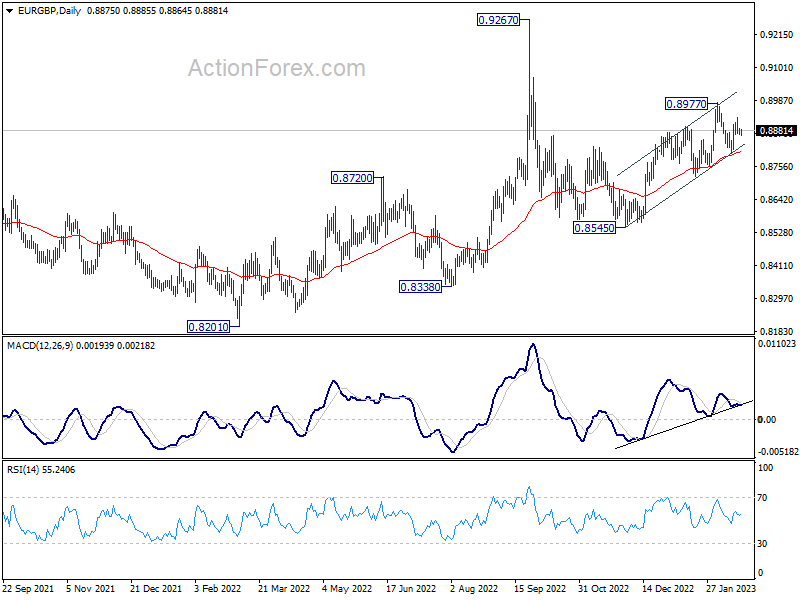
EUR/GBP Daily Outlook
Daily Pivots: (S1) 0.8867; (P) 0.8879; (R1) 0.8888; More...
Intraday bias in EUR/GBP remains neutral at this point. Further rally is expected as long as 0.8802 support holds. Above 0.8927 will target 0.8977 resistance. Firm break there will confirm resumption of whole rally from 0.8545. However, break of 0.8802 will now be a sign of reversal and turn bias back to 0.8720 support instead.
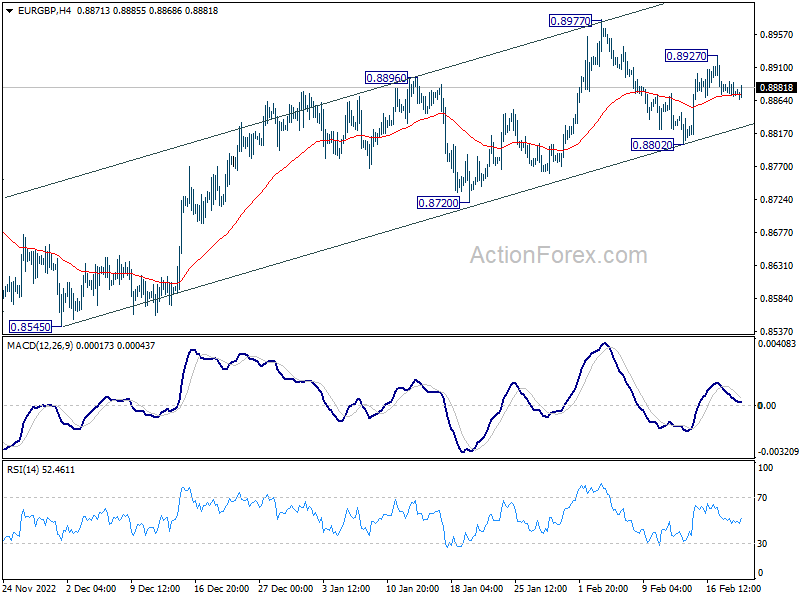
In the bigger picture, the notable support from 55 day EMA (now at 0.8804) retains near term bullishness. Break of 0.8977 should target 0.9267 (2022 high) and possibly above, to resume whole up trend from 0.8201 (2022 low). However, sustained trading below 55 day EMA will set the stage for 0.8545 and below.
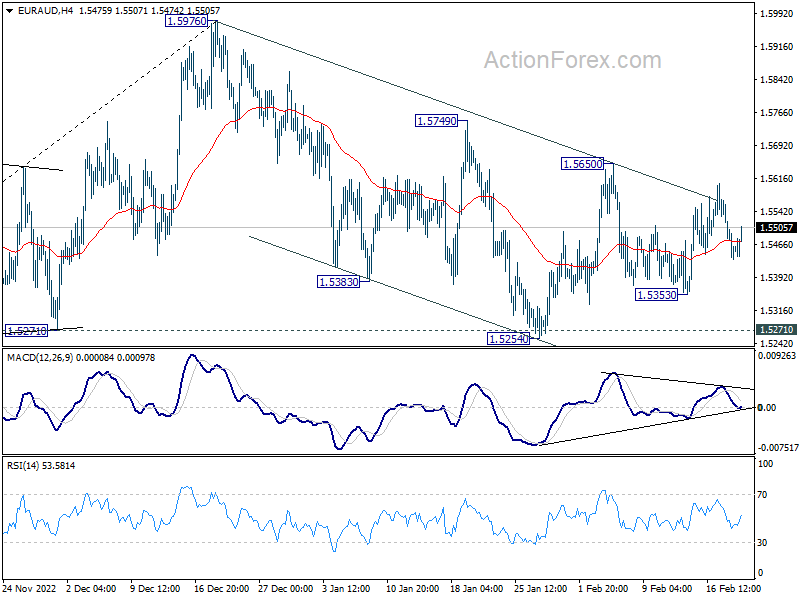
EUR/AUD Daily Outlook
Daily Pivots: (S1) 1.5409; (P) 1.5488; (R1) 1.5540; More...
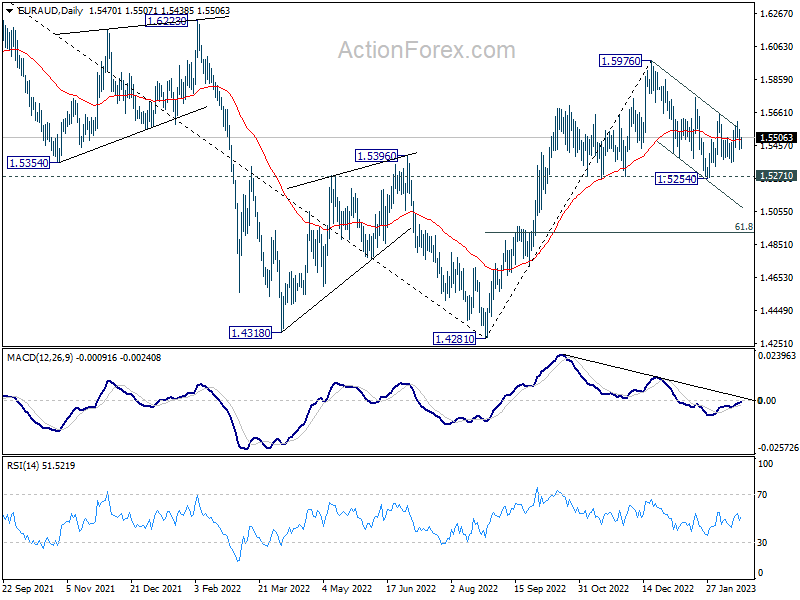
Intraday bias in EUR/AUD remains neutral for the moment. On the upside, break of 1.5650 resistance will revive that case that correction from 1.5976 has completed at 1.5254. Intraday bias will be back on the upside for 1.5749 resistance first. On the downside, firm break of 1.5254/71 will carry larger bearish implication and resume the fall from 1.5976.
In the bigger picture, it's still early to confirm if rise from 1.4281 represents bullish trend reversal. But as long as 1.5271 support holds, such rally is in favor to continue. Break of 1.5976 will target 1.6434 key resistance next. On the other hand, firm break of 1.5271 will retain medium term bearishness instead.
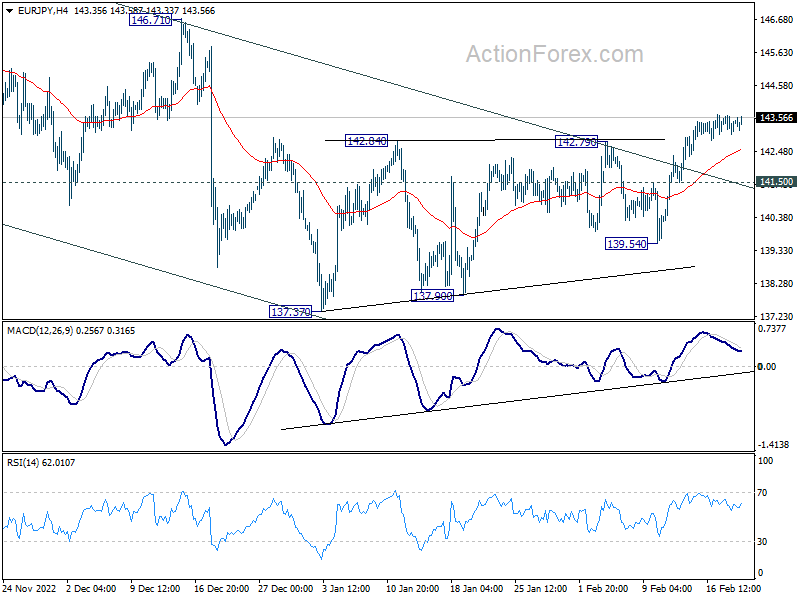
EUR/JPY Daily Outlook
Daily Pivots: (S1) 143.13; (P) 143.39; (R1) 143.76; More....
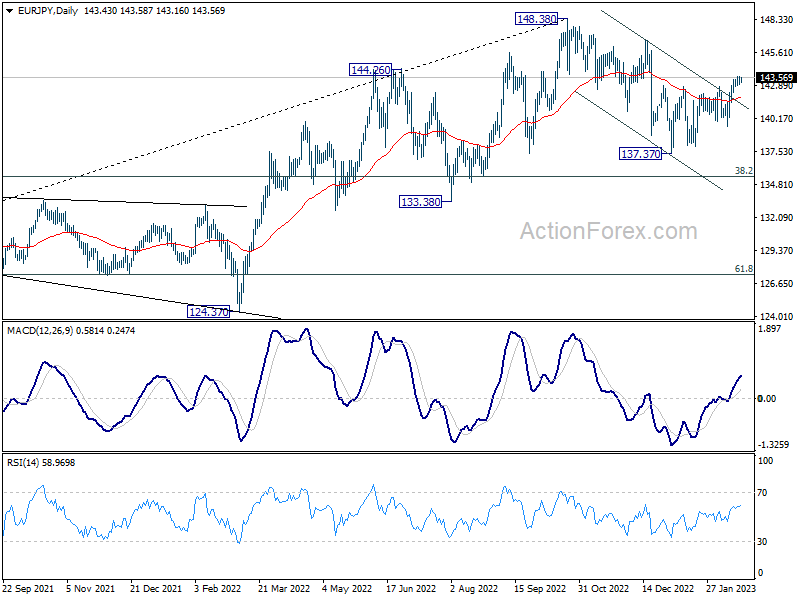
Further rise is expected in EUR/JPY as long as 141.50 minor support holds. Corrective fall from 148.38 should have completed at 137.37. Further rally should be seen to 146.71 resistance. On the downside, though, below 141.40 minor support will dampen this bullish view, and turn intraday bias back to the downside for 139.54 support instead.
In the bigger picture, as long as 55 week EMA (now at 139.03) holds, larger up trend from 114.42 (2020 low) is still in progress for 149.76 long term resistance. However, firm break of 55 week EMA will bring deeper fall to 38.2% retracement of 114.42 to 148.38 at 135.40. Sustained break there will raise the chance of trend reversal, and target 61.8% retracement at 127.39.
GBP/JPY Daily Outlook
Daily Pivots: (S1) 161.32; (P) 161.53; (R1) 161.88; More...
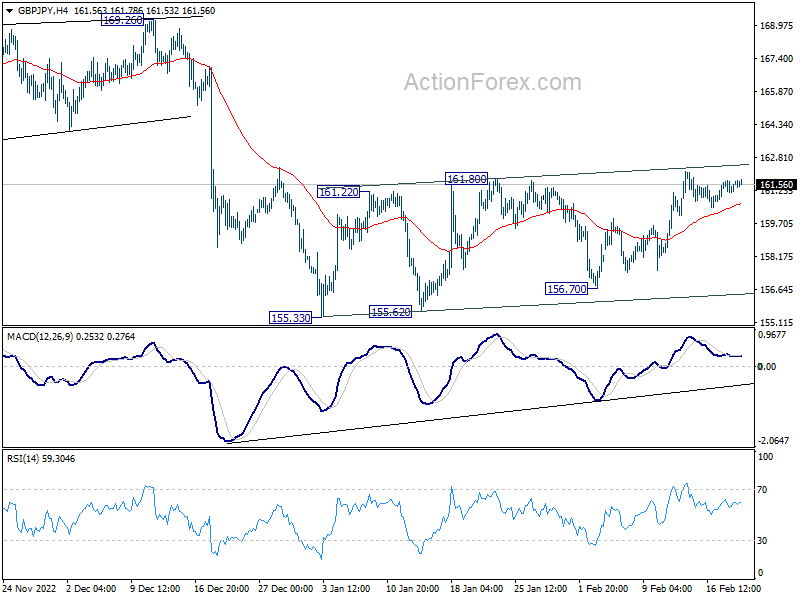
Intraday bias in GBP/JPY stays neutral and outlook is unchanged. On the upside, decisive break of 161.80 resistance will argue that whole correction from 172.11 has completed at 155.33. Further rally should be seen back to 169.26/172.11 resistance zone. On the downside, break of 155.33 low will resume the fall from 172.11 to 153.70 fibonacci level next.
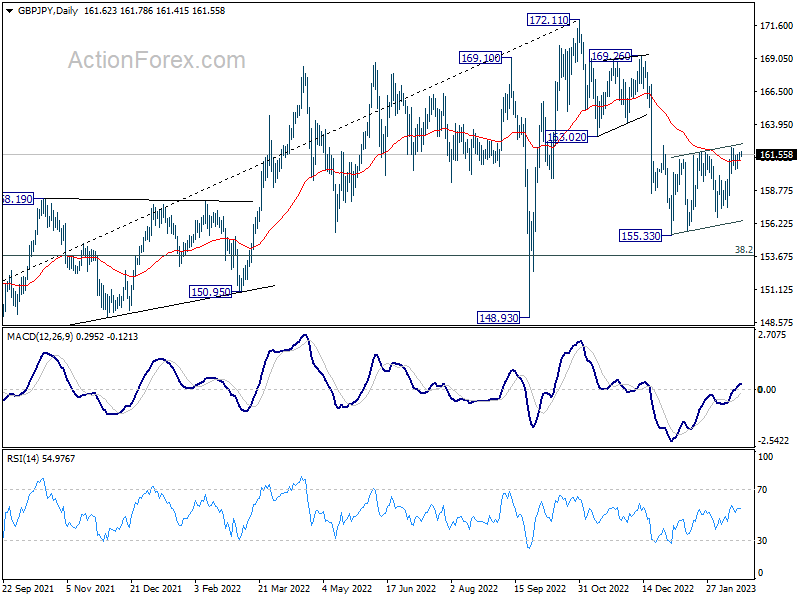
In the bigger picture, as long as 163.02 support turned resistance holds, decline from 172.11 medium term top is expected to continue to 38.2% retracement of 123.94 to 172.11 at 153.70. Sustained break there will raise the change of trend reversal and target 61.8% retracement at 142.34. Nevertheless, break of 163.02 support turned resistance will argue that the decline has completed, and retain medium term bullishness.
EUR/CHF Daily Outlook
Daily Pivots: (S1) 0.9845; (P) 0.9872; (R1) 0.9888; More....
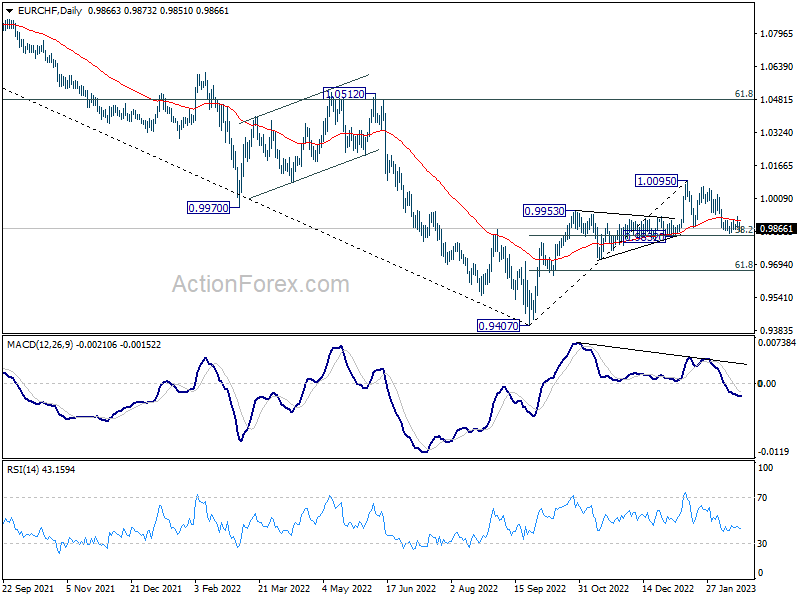
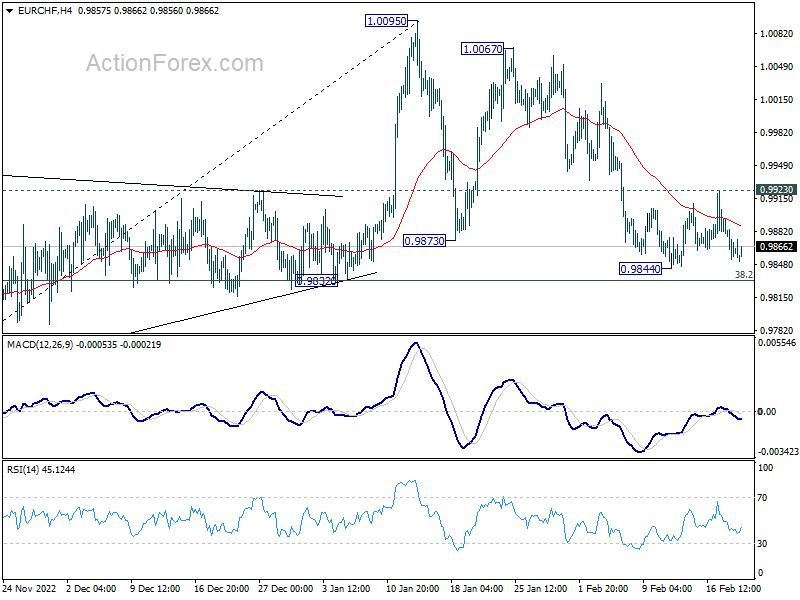
Intraday bias in EUR/CHF stays neutral at this point. In case of another fall, downside should be contained by 38.2% retracement of 0.9407 to 1.0095 at 0.9832, to complete the corrective pattern from 1.0095. Break of 0.9923 will turn bias back to the upside for stronger rebound towards 1.0067/0095 resistance zone.
In the bigger picture, the rejection by 55 week EMA (now at 1.0025) mixed up the outlook. On the upside, sustained trading above 55 week EMA will raise the chance of bullish trend reversal. Rise from 0.9407 should then target 1.0505 cluster resistance (2020 low at 1.0505, 61.8% retracement of 1.1149 to 0.9407 at 1.1484). However, firm break of 0.9832 support will revive medium term bearishness and bring retest of 0.9407 low instead.