Sample Category Title
Sunset Market Commentary
Markets
It’s a directionless, low-volume trading session in absence of US investors (President’s Day) and awaiting events later this week. For the record: German Bunds are broadly unchanged with UK Gilts outperforming (-4 bps for 10y). European stock markets trade near opening levels with both EUR/USD (1.0680) and EUR/GBP (0.8875) a tad softer. Later this week, we first of all look forward to global PMI’s. These could strengthen the picture that the global economy is actually showing much more resilient than feared. Second, to Wednesday’s FOMC Minutes. Last week’s “coming out” of Fed governors Mester and Bullard suggested that the early Fed decision to downshift the pace of rate hikes from 50 bps to 25 bps wasn’t so unanimous after all. Both argued in favour of sticking to 50 bps and will do so again in March. Minutes could show how big the hawkish minority within the Fed already was ahead of the January data releases (stellar payrolls, stubborn inflation and strong retail sales). The Fed’s preferred PCE deflators on Friday are this week’s final data point, though there direction is probably known given this month’s earlier CPI prints. The US Treasury’s end-of-month refinancing operation (2y-5y-7y) and central bank speeches serve as wildcards.
News & Views
Swedish headline inflation fell at the start of the year. January prices dropped by 1.1% m/m to be up 11.7% compared to the same month last year. CPIF, using a fixed interest rate, fell 1.3% m/m (9.3% y/y). Both measures printed below expectations. The Riksbank’s preferred gauge, however, did not. CPIF excluding energy unexpectedly rose 0.4% m/m (-0.2% expected) to be up 8.7%, quicker than in December (8.4%). Strong and stubborn (underlying) price dynamics are the reason the central bank delivered a 50 bps rate hike to 3% earlier this month with more hikes to come. The Riksbank penciled in a terminal rate of about 3.5% but that may not suffice according to swap markets. They expect the peak somewhere between 3.75-4%. Swap yields jump between 8.6-12.6bps across the curve. The Swedish krone strengthens from EUR/CZK 11.20 to 11.06 but remains weak historically. This is a (policy statement-official) source of concern for the Riksbank, since it fuels inflation further. This become obvious once more with the release of the meeting minutes today in which governor Thedeen stressed his desire for a stronger SEK, adding that it is important to also evaluate the actions of other central banks.
The Bundesbank in its monthly report said the economy shrink slightly in 2023 though added that it may fare a little better compared with the December forecast for a 0.5% contraction this year. The reasons for still anticipating a decline in GDP are subdued exports amid softer global demand, inflation weighing on consumption and construction sector momentum cooling. They offset the upside coming from an easing energy crunch and manufacturing bottlenecks dissolving. After a contraction in the first three months of 2023, bringing Germany in a technical recession, things will pick up slowly over the course of the year. The Bundesbank expects underlying inflation pressures to ease only slowly in coming months, warning that stronger wage deals will keep it elevated for some time through second-round effects.
Belgian consumer confidence continued its climb in February, rising from -12 to -8, the highest level since February of last year. In the space of four months, the confidence indicator has risen almost 20 points and is approaching its long-term average. Details showed broad-based strength except for a slight fall in savings intentions (1 from 3). Consumers expressed clearly more optimistic views on the trend in unemployment (16 from 27) and, to a lesser extent, the general economic situation (-13 from -18). Households also expect their financial situation to improve somewhat (-3 from -6). All sub-indicators express
US Dollar Has to Retreat
The market major starts this new week of February with an attempted correction. EUR/USD is balancing near 1.0690. After the lows of the previous week, this is good news though right now the bounce does not look really confident.
Investors are beginning to have more and more doubts that the Federal Reserve System will put aside its tightening monetary policy and include the expectations of further interest rate increases in the quotes. While previously traders used to expect a pause after two subsequent increases by 25 base points this year, now there are no such guarantees.
It is a day off in the US today, which means volatility will be smoothed out.
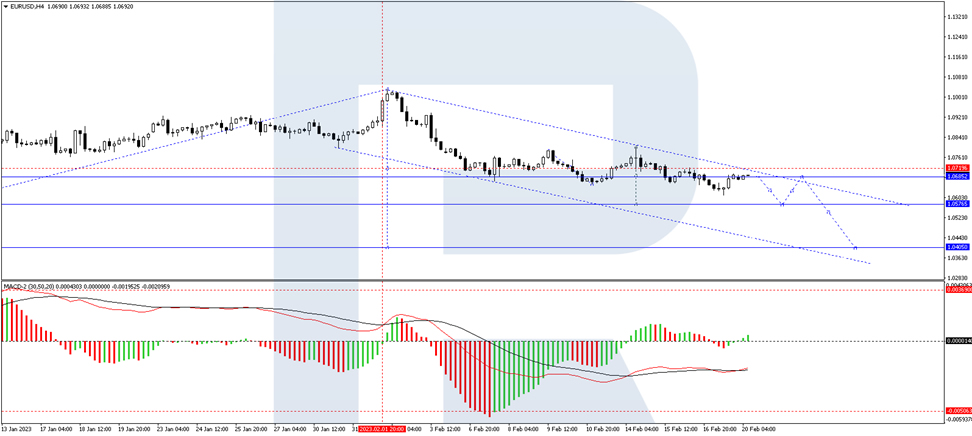
On the EUR/USD H4 chart, a consolidation range formed around 1.0720. The market extended it downwards to 1.0612. A link of correction to 1.0720 is not excluded (a test from below). Then a decline to 1.0577 should follow, from where the wave might extend to 1.0500. Technically, the scenario is confirmed by the MACD, whose signal line is under zero. Wait for the lows to be renewed.
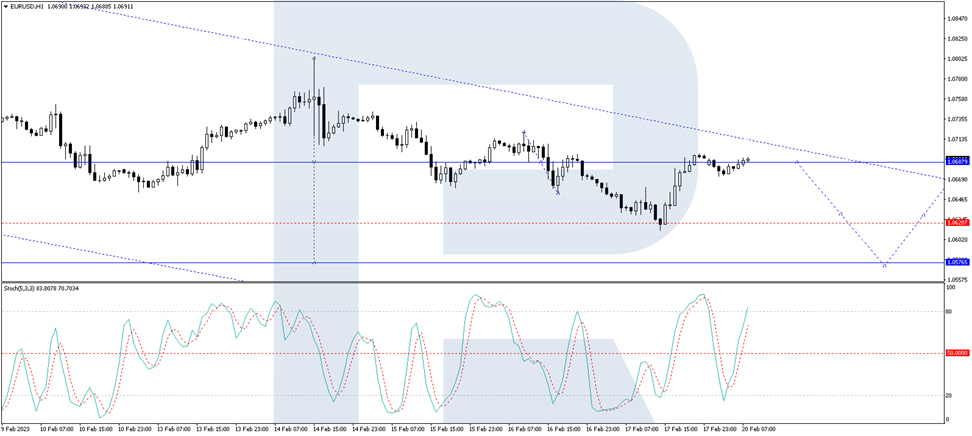
On H1, the currency pair has completed a wave of decline to 1.0612 and a correction to 1.0690. A consolidation range is expected to form around this level. With an escape downwards, a new wave of decline to 1.0577 should start. Technically, this scenario is confirmed by the Stochastic oscillator. Its signal line is above 50, and a decline to 20 is to follow.
EUR/GBP: Near-term Structure Weakens But Price Still Holding Above Initial Support
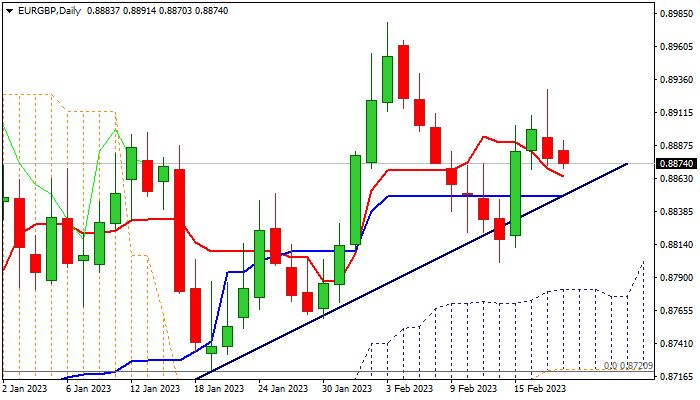
The cross remains at the back foot on the first day of the week, after strong upside rejection left bearish daily candle with long upper shadow, signaling recovery stall and increasing pressure.
Fresh bears pressure pivotal support at 0.8864 (daily Tenkan-sen/50% retracement of 0.8800/0.8928 upleg) with firm break here to confirm negative signal risk attack at next key support at 0.8850 (daily Kijun-sen/Fibo 61.8%/bull-trendline drawn off 0.8560 low).
Fading bullish momentum on daily chart and south-heading stochastic weigh on near-term action, though countered with daily Tenkan / Kijun-sen, still in bullish setup.
Ability to hold above daily Tenkan-sen will signal that bulls remain in play and look for fresh push higher after correction, while close below daily Kijun-sen would sideline bulls and open way for test of key near-term support at 0.8800 (Feb 14 low).
Res: 0.8898; 0.8928; 0.8940; 0.8978.
Sup: 0.8864; 0.8850; 0.8830; 0.8800.
Loonie Would Love a Stronger CPI, But Not the Bank of Canada
With the next BoC meeting scheduled in just two weeks, loonie followers will have the chance to evaluate the current economic state. The deceleration in inflation pressures has been the global theme in the past three months providing significant breathing space to both households and governments. Will this week’s data confirm this recent trend or could the BoC be forced to consider an even tighter monetary policy ahead?
A reevaluation of monetary policy stance on the cards?
At its first meeting for 2023 on January 25 the BoC signaled the intention to pause after 425 bps of rate hikes in just 10 months. This makes sense as a period of stable monetary policy would allow the economy to absorb the higher rates giving the chance to the central bank to evaluate the overall impact. This viewpoint potentially applies to other developed economies, but only the BoC appears determined to adopt this strategy. Other central banks will potentially soon follow the BoC’s example if inflation rates continue to surprise on the downside. Therefore, this week’s releases will be the first true test of the BoC’s commitment to its "pause" strategy.
Inflation to ease further?
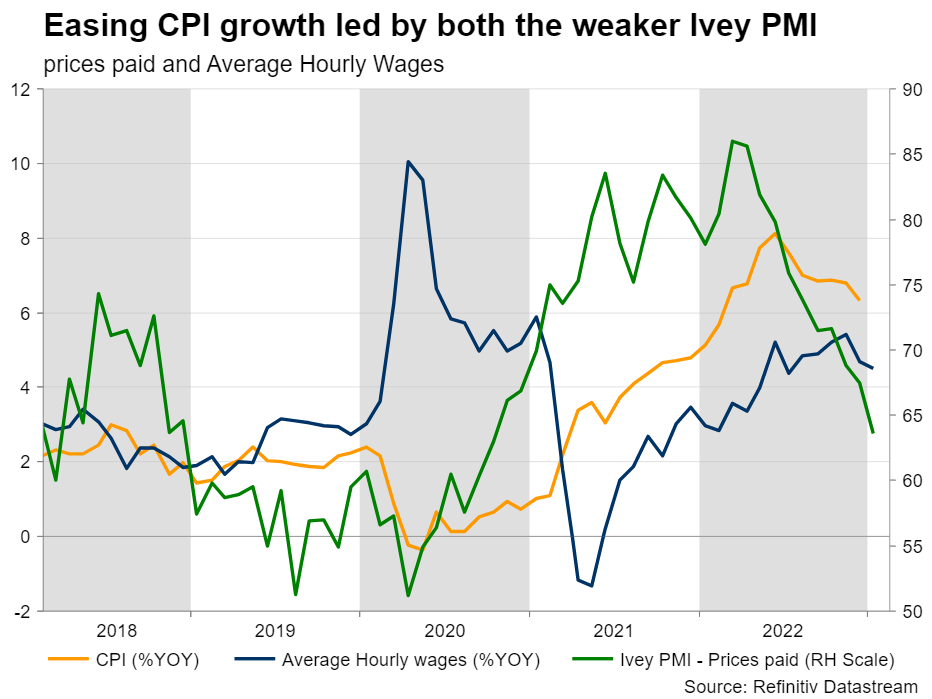
The January headline CPI is seen rising by 6.1% on a year-on-year basis, down from the 6.3% increase seen in December. If confirmed, it will be the lowest print since March 2022 giving significant breathing space to Canadian households and potentially offering some early confirmation that the BoC strategy could be correct. However, when examining the January prints in other developed countries, there is a sizeable probability that the inflation figure could surprise on the upside. Should this be the case at Tuesday's release, we could see renewed expectations for a tighter monetary policy stance. The market is currently pricing in one 25 bps rate by the July meeting, compared to the almost three rate hikes seen by the US Fed during 2023.
Retail sales key going forward
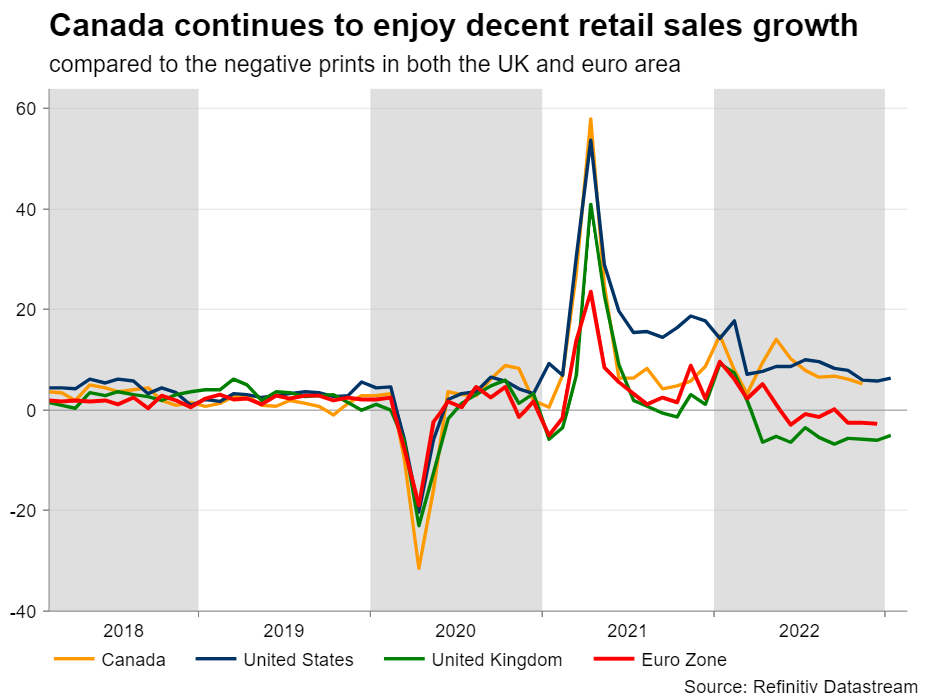
One of the indicators expected to come to prominence going forward is the retail sales. Unquestionably, this dataset has been followed by market participants and central bankers, particularly considering the rising cost of living globally over the past two years. But it is now expected to rise to the top of the food chain as consumers, on the back of lower utility bills and renewed confidence, are expected to gradually return to their previous spending behaviour. Not only retail firms will benefit, but also the government coffers should enjoy the increased revenues. Government finances have been greatly affected by the continued financial support offered especially in the euro area.
Could the loonie recover part of its losses since August 2022?
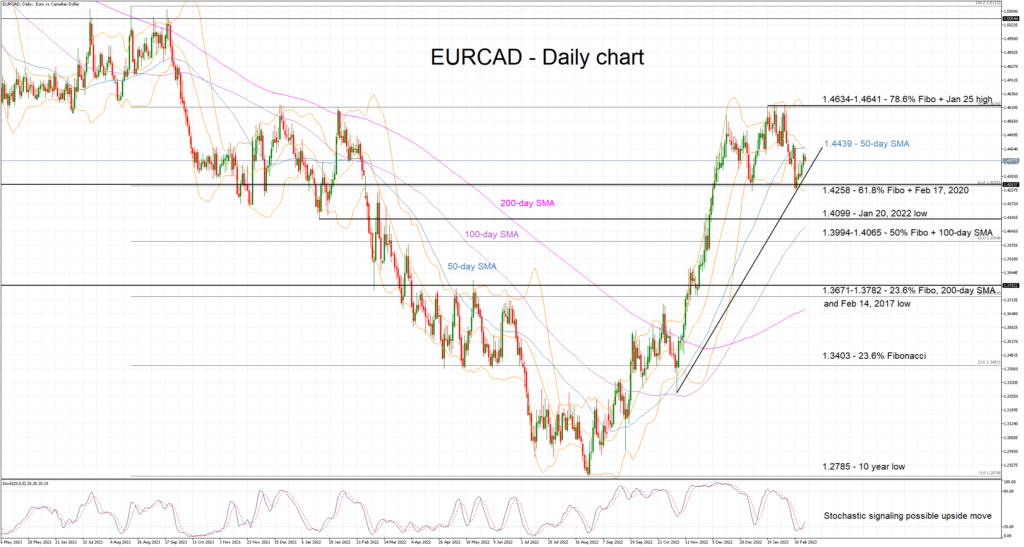
Amidst this volatile environment, the loonie has been under severe pressure against the euro since August 25. The 13.7% rally in the euro/loonie pair paused at 1.4641 with loonie bulls managing to stage a decent recovery towards the 1.4370 area. Since the start of 2023 this pair has been trading inside a wide 1.4235-1.4641 rectangle. A similar pattern formed in the October 2021 – February 2022 period when, following two failed breakouts, the pair finally broke downwards and opened the door for the 10-year low of 1.2785 seen on August 25. Loonie bulls would enjoy retesting the 1.4263 area and, if overcoming it successfully, make a move towards the 1.4099 level.
Treading Water
Stock markets in Europe are treading water in thin trade at the start of the week amid a light economic calendar and a US bank holiday.
It was always likely to be a slow day under the circumstances and that's exactly what it's turning out to be. Stock markets remain in a surprisingly strong position despite the uncertain outlook and rising interest rate expectations due to stubborn inflation.
While other areas of the market appear to have adopted a more defensive position, equity investors remain undeterred. It would appear it's going to take a lot more than a few nasty economic releases to put a dent in their optimism.
China optimism remains
The outlier is once again China, where stocks have enjoyed a very good start to the week. That came despite one and five-year loan prime rates remaining unchanged, as was widely expected following last week's MLF hold.
The bullish case for the Chinese economy remains solid and the likely release of stimulus over the next couple of months as it gathers pace could super-charge that. Domestic demand is going to be the cornerstone of the economic revival and policymakers appear poised to unleash that to its full potential. How they plan to do so should become clearer over the next month although we've already seen big steps in the right direction.
Choppy trade continues
Oil prices are bouncing back a little after slipping throughout the last week from their recent highs. The optimism around China today may be responsible for the gains we're seeing in crude which would make a lot of sense given it's the world's largest importer and expected to recover strongly from the Covid transition.
But as we've seen over the last few months, there's more to this story than just China and the decline over the last week was likely a reflection of more pessimistic global expectations against the backdrop of higher interest rate forecasts. Sentiment remains very fragile and the economic data is inconsistent. Until we see an improvement in the latter, the former will likely remain choppy, as will the price of oil.
Does the correction have further to run?
Gold traders do not share the eternal optimism that equity and crypto traders possess and recent weeks have highlighted that perfectly. The yellow metal fell into a corrective pattern and has struggled to get out since. It pared some losses on Friday to end the session higher around notable support in the $1,820 region. The long lower wick from the days' trade may be a bullish signal in the near term, although I'm not convinced the correction has run its course. Below here, the key zone falls around $1,780-$1,800.
Eternal optimism
Cryptos are seemingly existing in a world of their own with bitcoin rising 2% again on Monday and eyeing the highs of the last week once more. This could be a really pivotal level for bitcoin and a break of it could generate plenty more enthusiasm. And we've all seen what happens when enthusiasm and euphoria exist in cryptos. The price can take off regardless of fundamentals or broader sentiment. That isn't to say we'll necessarily see that on this occasion but the 50% recovery so far this year does suggest something may be happening.
AUD/USD: Aussie Bounces Strongly after Rejection at Rising Cloud Top
The AUDUSD rebounds strongly on Monday, lifted by further rise in iron ore, one of Australia’s top contributors to earnings from exports, as fresh signals of stronger recovery of China’s demand boosted sentiment.
Daily chart shows improving conditions after Friday’s action faced strong downside rejection at the top of rising daily cloud (daily Doji with very long tail), pointing to strong bids.
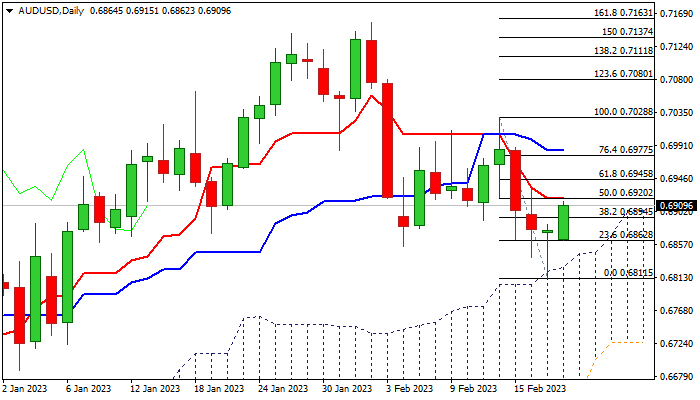
Fresh recovery acceleration is pressuring pivotal barrier at 0.6920 (daily Tenkan-sen /50% retracement of 0.7028/0.6811 bear-leg) break of which would further firm near-term structure and open way for stronger recovery.
However, signals on daily chart are still mixed and fresh bulls need extension through pivots at 0.6945/77 (Fibo 61.8% / 76.4% of 0.7028/0.6811) to neutralize underlying bears and expose targets at 0.7000/28 (psychological / Feb 14 peak).
Caution on failure at these levels that would keep the downside vulnerable, despite strong support from rising daily cloud.
Can the UK PMIs Come to the Pound’s Rescue?
After selling the pound due to the slowdown in the UK CPIs for January, traders are now turning their attention to the preliminary PMIs for February, to be released on Tuesday at 07:30 GMT. With the BoE now trailing both the Fed and the ECB in terms of rate hike expectations, can the PMIs come to the pound’s rescue?
Inflation slowdown confirms BoE’s guidance change
At its last meeting, the BoE decided to raise interest rates by 50bps as was broadly expected, but there was a change in the forward guidance, with officials noting that further tightening would be required if there is evidence of more persistent price pressures. In previous statements, they were stating that they “would respond forcefully as needed”.
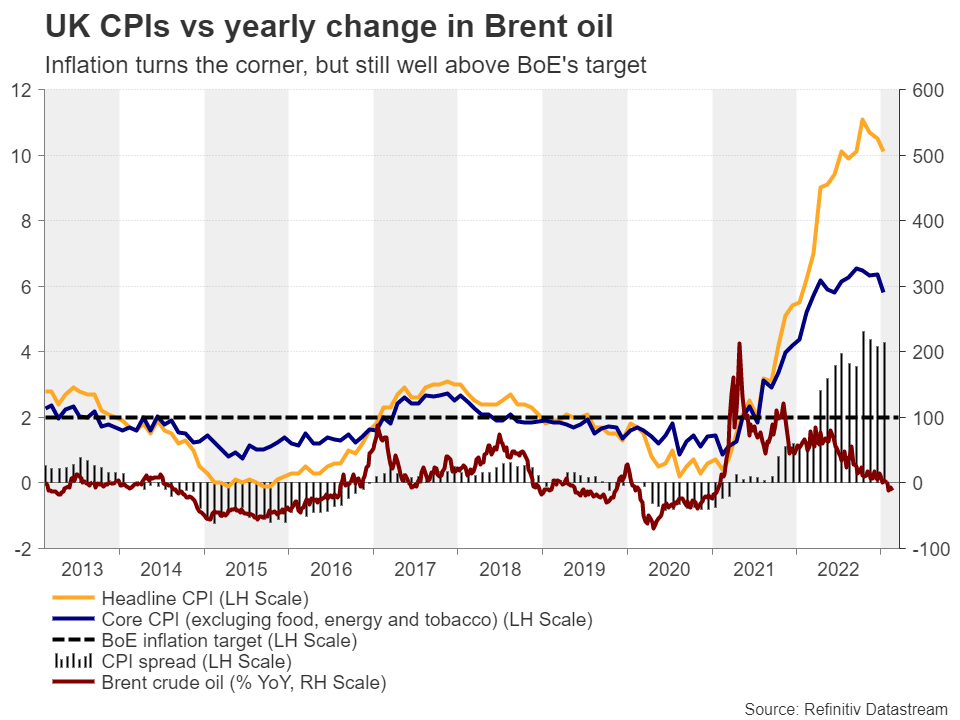
Governor Bailey made it clear that the change reflected a turning of the corner in the fight against inflation, and he was proven right just last Wednesday, when the UK CPIs for January were released. Both the headline and core rates fell to 10.1% y/y and 5.8% y/y from 10.5% and 6.3% respectively, below estimates of 10.3% and 6.2%. Although headline inflation is still in double digits, the slide in the core rate may have bolstered expectations that the BoE is nearing the exit of this tightening campaign.
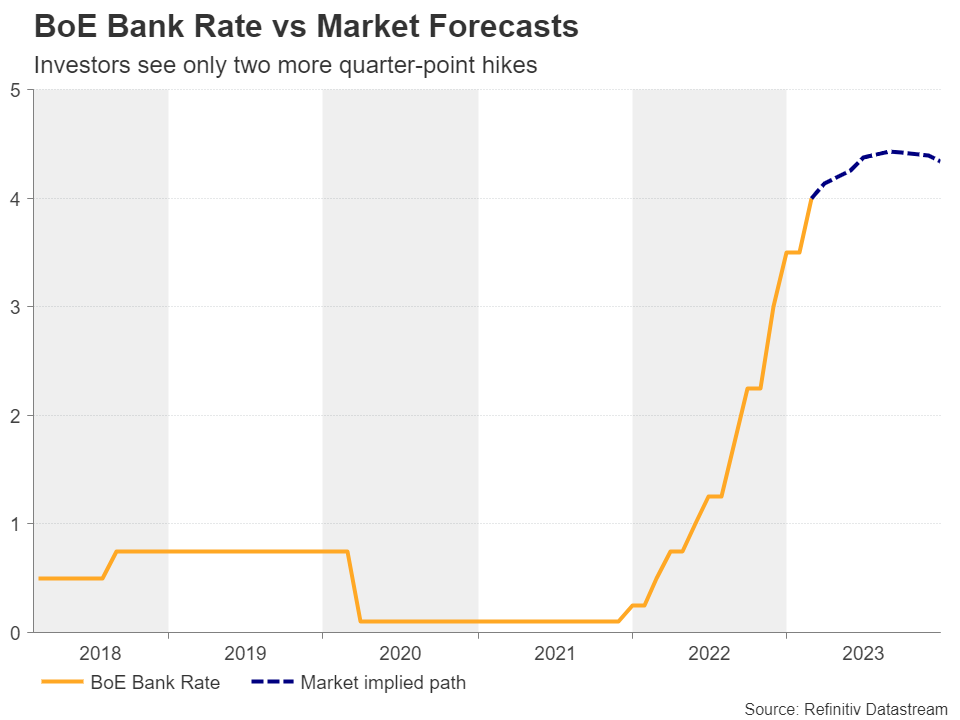
Investors are currently assigning around a 75% probability for a 25bps hike at the upcoming meeting, with the remaining 25% pointing to no action. As for thereafter, they see only one more quarter-point increment before the Bank presses the stop button.
Economic risks are far from vanished
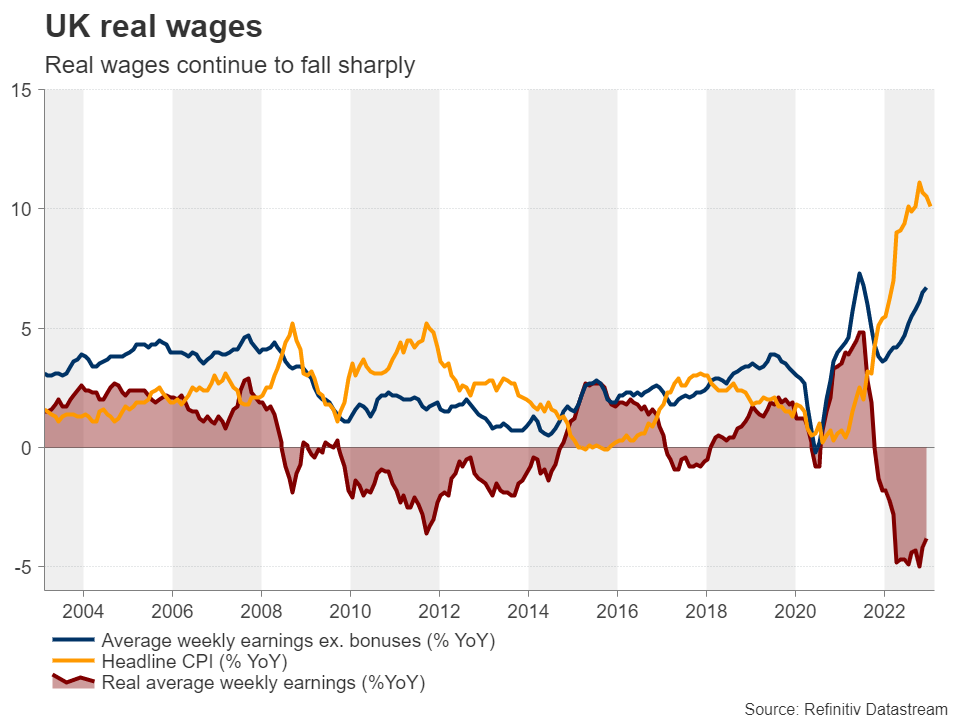
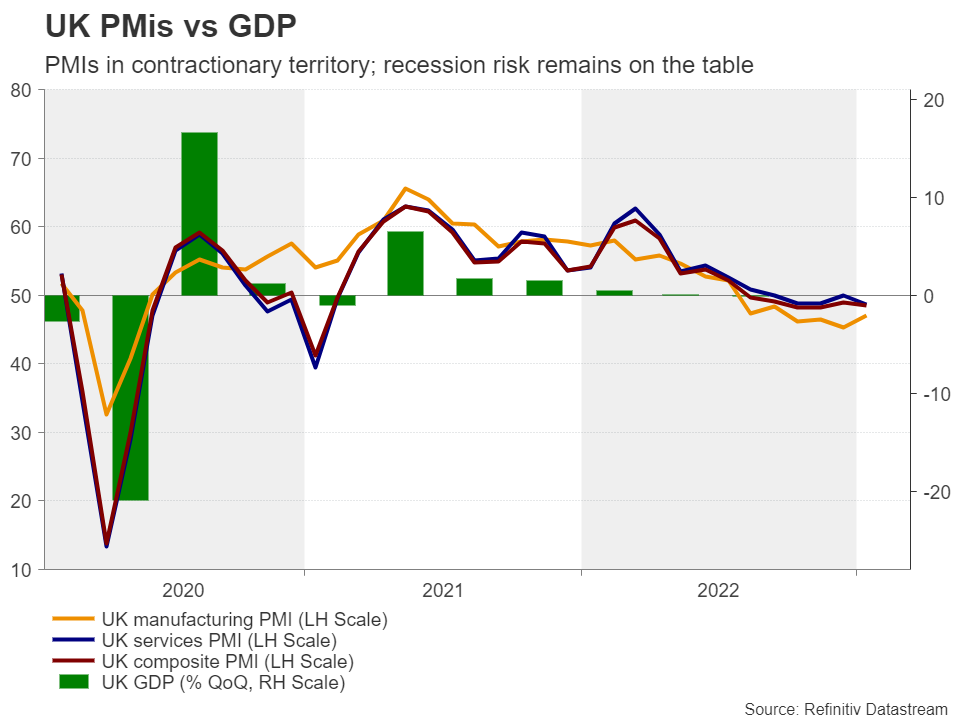
The British economy showed zero economic growth in the last three months of 2022 after contracting 0.2% q/q in Q3, just enough to dodge a recession. That said, the composite PMI slid further below 50 in January, which suggests that although the risks of a sharp recession in the UK have lessened, they are far from vanished. What makes things worse is that inflation for food and non-alcoholic drinks slowed to just 16.7% from a 45-year record of 16.8%, which means that households are still experiencing a severe cost-of-living squeeze. Average earnings excluding bonuses accelerated to 6.7% in December, but this was during a period when headline inflation was at 10.5%, leaving real wage growth well into the negative territory.
On Tuesday, the preliminary PMIs for February are expected to improve but to stay in contractionary territory. Specifically, the manufacturing index is expected to increase to 47.4 from 47.0, while the services index is anticipated to rise to 49.2 from 48.7. This would take the composite PMI up to 48.7 from 48.5. Ergo, another round of below-50 numbers could increase the chances of negative economic growth during the first quarter of 2023. Indeed, the GDP tracker of the National Institute of Economic and Social Research (NIESR) is currently pointing to a 0.2% contraction.
So, how fast or slow the Bank needs to move hereafter has no straightforward answer. On the one hand, they must keep raising interest rates to bring sky-high inflation to heel, but on the other hand, they must be careful enough to not bring about deeper economic wounds. So, even if they improve, the February PMIs could confirm the notion that the BoE may need to proceed much less aggressively than the Fed and the ECB.
Pound’s path of least resistance remains to the downside
The pound could initially rebound somewhat on the improving figures, but should investors maintain bets for only a couple more quarter-point increases, the British currency may be sold again. Pound/dollar could fall below the 1.1900 zone, which has been acting as key support since November 30. This could pave the way towards the 1.1645 barrier, marked by the inside swing high of October 27. If there are no buyers to be found there either, the slide may extend towards the low of November 4, at 1.1350.
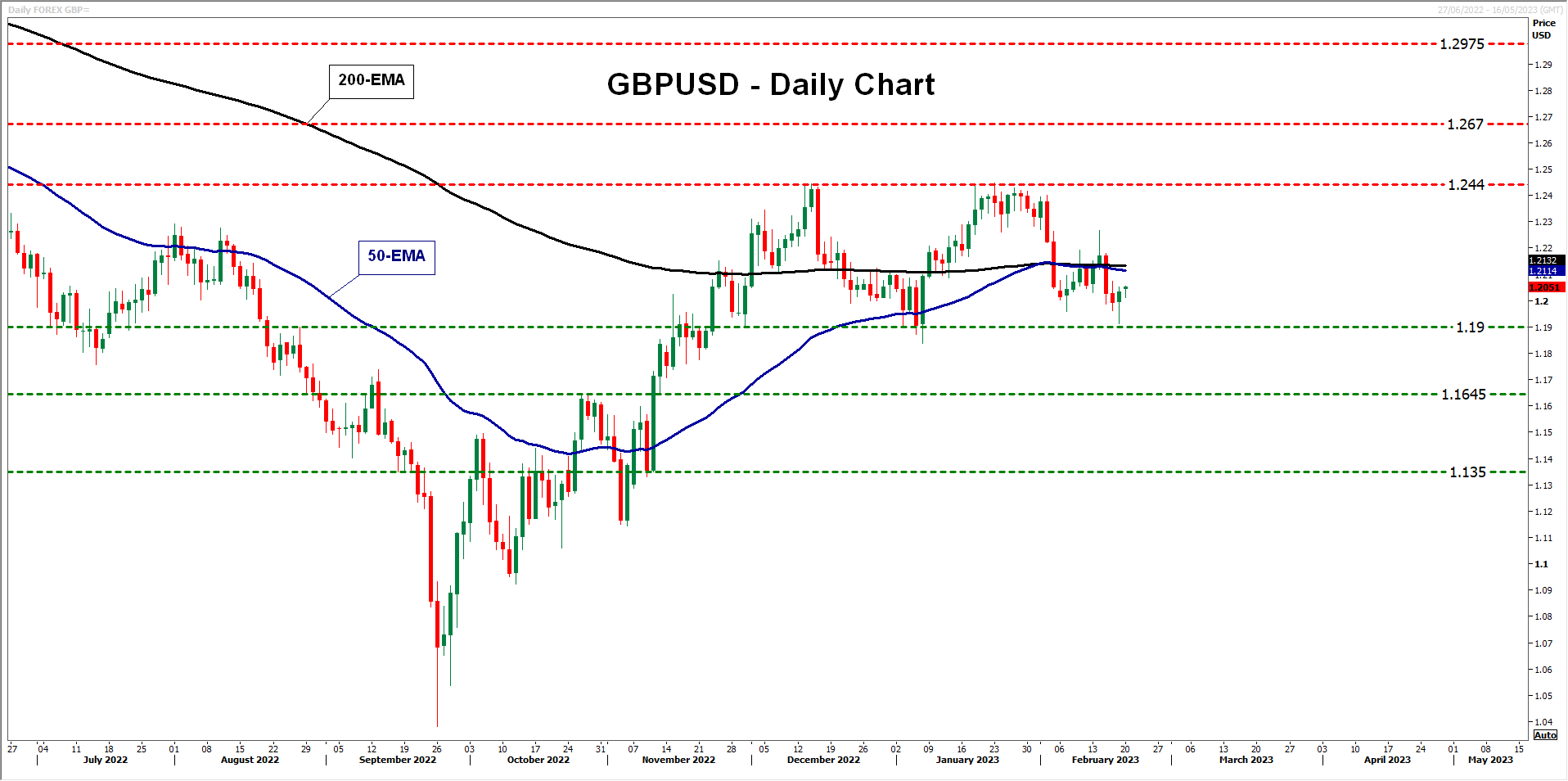
Now, if future data suggests that inflation is stickier than previously expected and at the same time, the economy is in a better-than-feared shape, the pair could rise to the 1.2440 area. Nonetheless, a break above that zone may be needed for the outlook to turn overly positive again. Such a move would confirm a higher high and could initially target the 1.2670 area, defined as resistance by the high of May 27. If the bulls are strong enough to overcome that hurdle as well, they might then climb towards the 1.2975 territory, which provided support back in March and April 2022 before being broken on April 22.
Euro Drifting, Markets Eye PMIs
The euro showed some volatility at the start of last week but since then it has been in calm waters and has stayed close to the 1.0.7 line.We’ll get a look at eurozone and German PMIs on Tuesday.
ECB signals another 50 bp hike
The ECB has been criticized for sending mixed messages to the markets, but Christine Lagarde was crystal clear last week when she told EU lawmakers that “in view of the underlying inflation pressures we intend to raise interest rates by another 50 basis points at our next meeting in March”. Lagarde said the ECB would then evaluate future moves, but with inflation still high, the risks for further rate hikes are skewed to the upside.
The ECB’s primary focus is to tame inflation. Headline inflation fell to 8.5% in January, down from 9.2% in December, but is still unacceptably high. Core CPI has been stickier than expected and wage increases are stemming the drop in inflation. ECB member Isabel Shnabel said last that investors risk underestimating inflation, a warning that the Fed has also made to the markets that have consistently been more dovish about rate policy than the Fed. Schnabel noted that the disinflation process has not started in the eurozone, another signal that the central bank will remain in a hawkish mode for the near future.
Fed members continue to pound out the message that inflation remains too high and more rate hikes are needed. Investors are clearly concerned that the Fed will make good on these statements, which has sent risk sentiment lower and the US dollar higher. The markets had high hopes that the March rate increase would be a ‘one and done’, but it looks like the Fed will continue raising rates into the second quarter. According to CME’s FedWatch, the markets have priced in an 83% of a 25-bp hike and a 17% of a 50-bp increase.
EUR/USD Technical
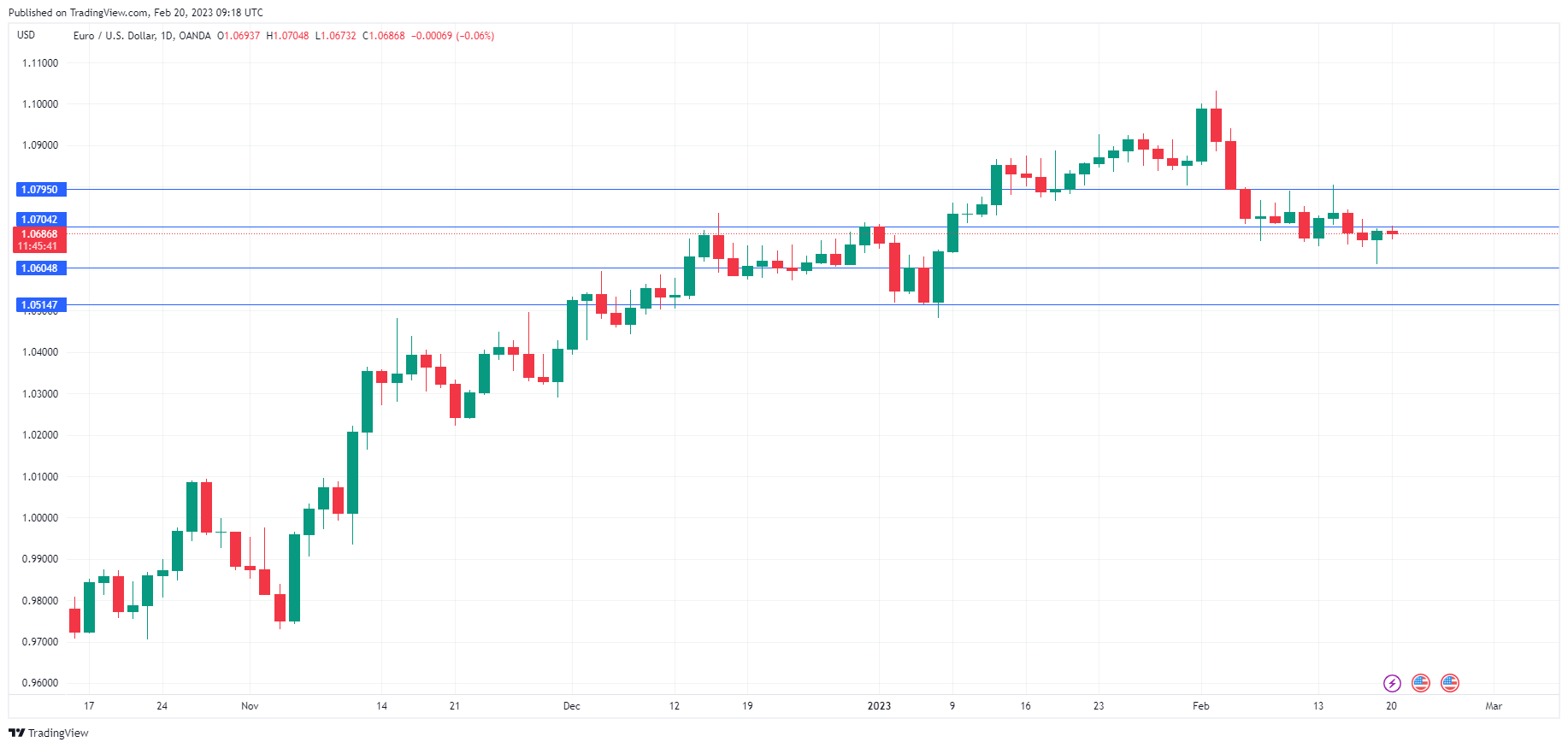
- EUR/USD is testing resistance at 1.0704. Above, there is resistance at 1.0795
- 1.0604 and 1.0513 are the next support lines
Dollar Index: Bulls Taking a Breather Under New Six-Week Gigh
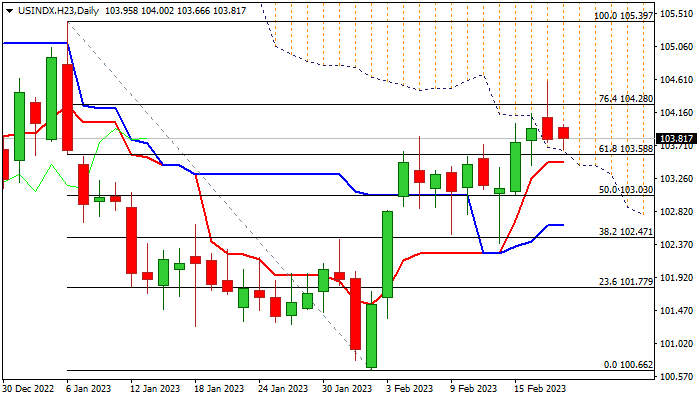
Friday’s close in red with long upper shadow of daily candle and formation of bull-trap above Fibo 76.4% of 105.39/100.66 / top of weekly cloud, signals that bulls might be losing traction.
The price action is so far holding within daily cloud, with cloud base marking strong supports at 103.50 zone, along with broken Fibo 61.8% and daily Tenkan-sen.
Immediate bias is expected to remain with bulls while these supports hold, though initial signals of stall and possible pullback are developing.
Daily Tenkan-sen / Kijun-sen turned sideways, while stochastic is heading south after forming a bearish divergence, though negative signals were so far countered by daily MA’s on bullish configuration and still strong positive momentum.
Expect stronger direction signals on break of either side barriers, with 103.50/00 marking lower pivots (loss of which would weaken near-term structure and risk deeper pullback), while sustained lift above 104.60 (Friday’s spike high / weekly cloud top) would bring bulls fully in play for fresh acceleration higher.
With Monday’s action expected to be quiet due to US holidays, traders turn focus towards economic releases due later this week (US Housing data, GDP, weekly jobless claims, PCE).
Res: 104.28; 104.60; 105.04; 105.39.
Sup: 103.50; 103.03; 102.68; 102.47.
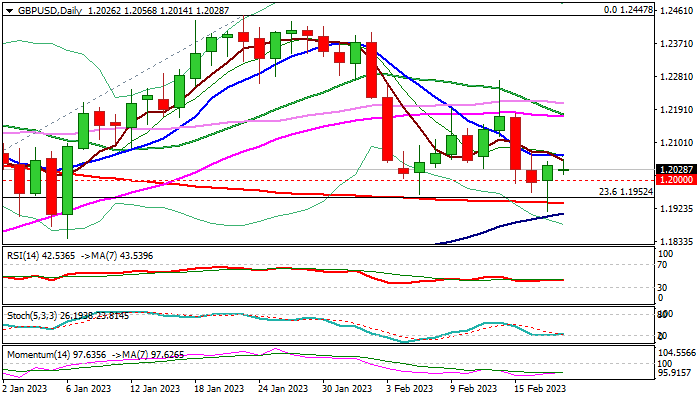
GBP/USD: Bear-Trap Under 200DMA Looks for More Upside Action to be Confirmed
Cable remains constructive at the start of the week, although with limited upside so far, following Friday’s bullish daily candle with long tail, which generated positive signal on strong downside rejection under pivotal 200DMA support (1.1937) and possible bear-trap.
On the other hand, two consecutive weekly Dojis signal strong indecision and lack of direction, which is additionally supported by conflicting signals from daily chart.
Pivotal points lay at 1.1937 (200DMA) and 1.2092/1.2104 (daily Tenkan-sen / cloud top) with break of either side to generate fresh direction signal.
Traders focus on UK PMI data on Tuesday, which would provide fresh information about the condition of Britain’s economy.
Res: 1.2069; 1.2104; 1.2180; 1.2181.
Sup: 1.2000; 1.1952; 1.1937; 1.1908.