Sample Category Title
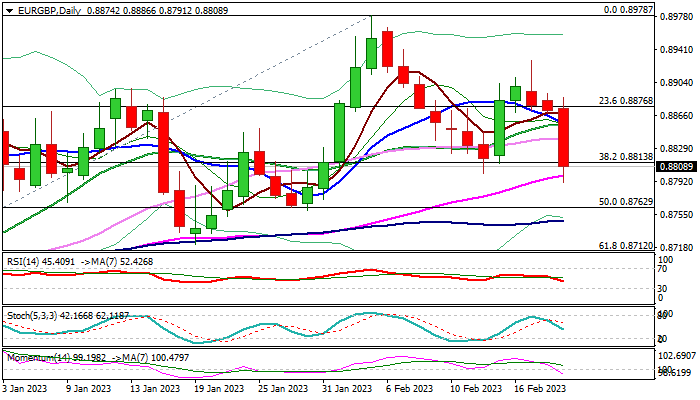
EUR/GBP: Falls Sharply after Upbeat UK Data
The cross accelerated sharply lower in European trading on Tuesday, falling 0.9% during the session.
Much stronger than expected UK services PMI data signaled significant improvement in the activity in UK economy’s dominant service sector which brightens the outlook and eases recession concerns.
Fresh weakness cracked key supports at 0.8813/0.8799 zone (Fibo 38.2% of 0.8547/0.8978 / Feb 14 former low / 55DMA) and looks for close below these levels to confirm bearish signal on completion of failure swing pattern on daily chart.
Daily studies weakened as MA’s (10/20/30) turned to bearish setup and south-heading momentum indicator broke into negative territory, but fresh bears may face strong headwinds from rising daily cloud (top of the cloud lays at 0.8780).
Res: 0.8839; 0.8857; 0.8876; 0.8891.
Sup: 0.8780; 0.8748; 0.8722; 0.8701.
Sunset Market Commentary
Markets
Today’s PMI’s should further shape markets’ and central bankers’ assessment on how much further policy tightening is needed to bring inflation back to target in a sustainable way. EMU February PMI’s at least suggest that tightening already put in place by the ECB (and other central banks) probably didn’t restore the demand supply balance in a way that guarantees a sustained return to the 2% target. The composite PMI rebounded decisively further into expansionary territory from 50.3 to 52.3 (vs 50.7 expected). The move was driven by the services sector (53 from 50.8 vs 51.0 expected). The headline figure for the manufacturing sector declined slightly from 48.8 to 48.5, but this was partially due to lower delivery times. Input prices cooled, especially in the manufacturing sector. However, regarding prices charged for goods and services, S&P said they are still increasing at a solid rate as firms sought to pass higher costs on to customers, including in many cases greater staff costs. Firms are further hiring, albeit at a slower pace than in January, but this is partially due to labour shortages. The main message from the PMI’s is that activity in the EMU economy is improving faster than expected with a better outlook. While many bottlenecks disappeared, especially selling prices remain elevated for an important part due to high wages. S&P global concludes that this ‘will naturally encourage a bias towards further policy tightening in the months ahead’. German/European yields continued recent protracted uptrend. German yields are rising between 5.5 bps (2-y) and 7.5 bps (10-y). The 2-y yield continues to set new cycle peak levels as money markets are considering the ECB raising its policy rate (well) beyond 3.50% by the summer. The German 10-y yield continues to attack the 2.50%/2.57% resistance. US bond markets clearly ‘feared’ strong US PMI’s with yields already gaining up to 9 bps points in the run-up to the release. The US February composite PMI (50.5 from 46.8 vs 47.5 expected) indeed improved much more than expected, narrowing the gap with much more optimistic signs from (especially) the services ISM. US yields currently are rising between 12.25 bps (5-y) and 9 bps (2& 30-y). The dollar recorded modest gains for most of the day, but is gaining some further traction post US PMI’s. EUR/USD trades in the 1.0650 rea. USD/JPY is attacking the 135 big figure. US equities opened with losses of 0.75% (Dow) to 1.15% (Nasdaq). The Euro Stoxx 50 again outperforms (-0.33%). Losses hardly grow post US PMI.
News & Views
The UK February composite PMI unexpectedly spiked from 48.5 to 53, an 8-month high. The services PMI showed a similar jump (53.3 from 48.7) with the manufacturing PMI still below the 50 boom/bust mark, but increasing from 47 to 49.2. Details showed a swift and significant jump in output. Supplier delivery times improved at the fastest rate since June 2009 for manufacturers. New work rose at the quickest pace since May 2022 for services. The easing of input prices (especially manufacturing) didn’t translate into improved costs for customers. The services sector referred to rising salary costs while skills shortages remain widespread. Following PMI’s, UK markets followed recent trends witnessed in the EMU and the US: discounting a more hawkish policy rate path for the central bank. UK Gilts underperform with yields rising between 11.5 (bps) and 19.5 bps (2-yr). Money markets start pondering the possibility that the BoE’s policy rate will end up above 4.5% this summer (4% now). Sterling enjoys the rate support with EUR/GBP tanking around 1 big figure to levels below 0.88.
Headline Canadian inflation rose slightly less than forecast in January, up 0.5% M/M vs 0.7% consensus. Higher gasoline prices contributed the most to M/M increase, followed by a rise in mortgage interest costs and meat prices. The Y/Y comparison slowed from 6.3% to 5.9%. Prices for cellular services and passenger vehicles contributed most to the deceleration. Underlying core CPI slowed less than the headline outcome with the median down from 5.2% Y/Y to 5% Y/Y and the trimmed mean measure decelerating from 5.3% Y/Y to 5.1% Y/Y. The loonie ticked lower on the data (USD/CAD 1.35) as they leave room for the flagged conditional pause in the policy rate cycle by the Bank of Canada in March. It remains a tight call though following blowout Canadian payrolls earlier this month.
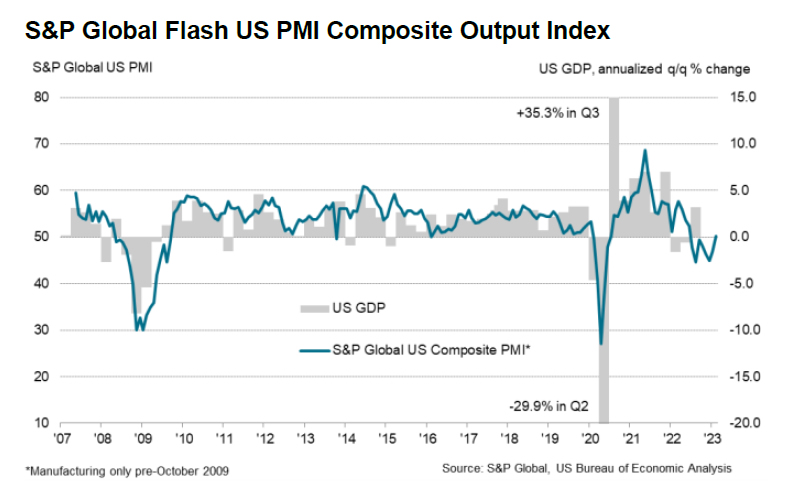
US PMI composite rose to 50.2, welcome steadying of business activity
US PMI Manufacturing rose from 46.9 to 47.8 in February. PMI Services rose from 46.8 to 50.5, an 8-month high. PMI Composite rose from 46.8 to 50.2, also an 8-month high.
Chris Williamson, Chief Business Economist at S&P Global Market Intelligence said:
"February is seeing a welcome steadying of business activity after seven months of decline. Despite headwinds from higher interest rates and the cost of living squeeze, the business mood has brightened amid signs that inflation has peaked and recession risks have faded. At the same time, supply constraints have alleviated to the extent that delivery times for inputs into factories are improving at a rate not seen since 2009.
"However, there are some caveats to the good news. The upturn is being driven by the services sector, which in part reflects unseasonably warm weather, and although the manufacturing survey data are showing signs of improvement, the factory sector remains in contraction and focused on inventory reduction.
"Furthermore, the improved supply situation has taken price pressures out of manufacturing supply chains, but the survey data underscore how the upward driving force on inflation has now shifted to wages amid the tight labor market. By potentially stoking concerns over a wage-price spiral, accelerating service sector price growth will add to calls for higher interest rates, which could in turn subdue the nascent expansion."
USD/JPY Mid-Day Outlook
Daily Pivots: (S1) 133.97; (P) 134.25; (R1) 134.58; More...
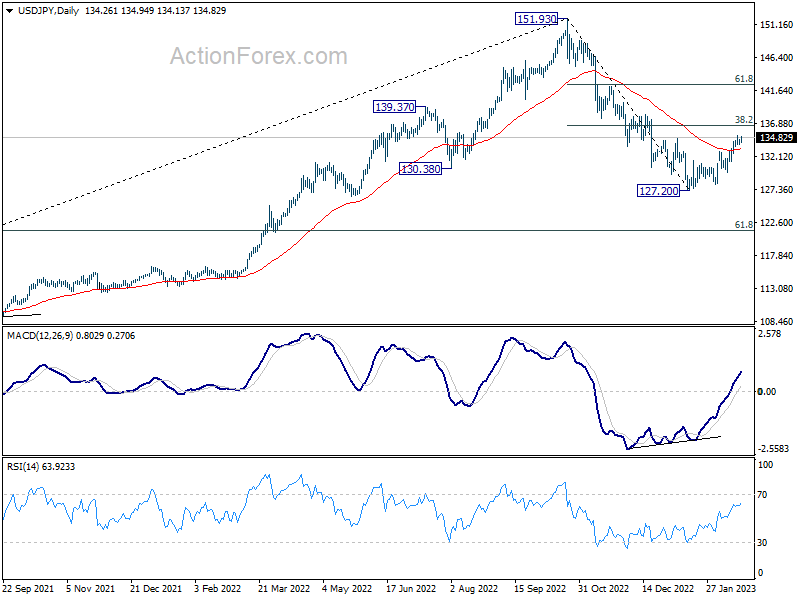
Intraday bias in USD/JPY remains neutral at this point. On the upside, break of 135.09 will resume the rise from 127.20 to 38.2% retracement of 151.93 to 127.20 at 136.64. Strong resistance could be seen there to complete the corrective rebound. On the downside, break of 132.89 resistance turned support will bring deeper fall to 129.79 support.
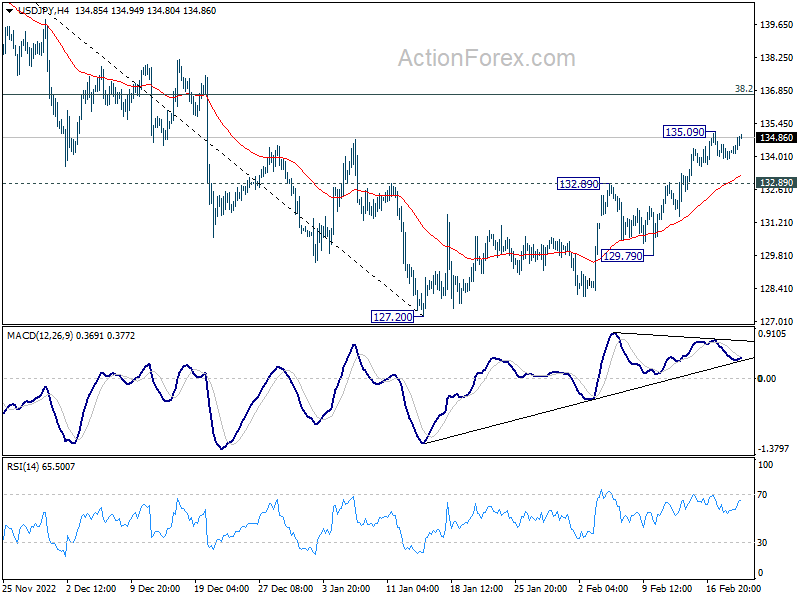
In the bigger picture, prior break of 55 week EMA (now at 131.47) raises the chance of medium term bearish reversal, but that's not confirmed yet. Strong rebound from current level, followed by sustained break of 38.2% retracement of 151.93 to 127.20 at 136.64 will argue that price actions from 151.93 is merely a corrective pattern. However, rejection by 136.64 will solidify medium term bearishness for 61.8% retracement of 102.58 to 151.93 at 121.43 and 38.2% retracement of 75.56 to 151.93 at 122.75.
USD/CHF Mid-Day Outlook
Daily Pivots: (S1) 0.9213; (P) 0.9238; (R1) 0.9255; More...
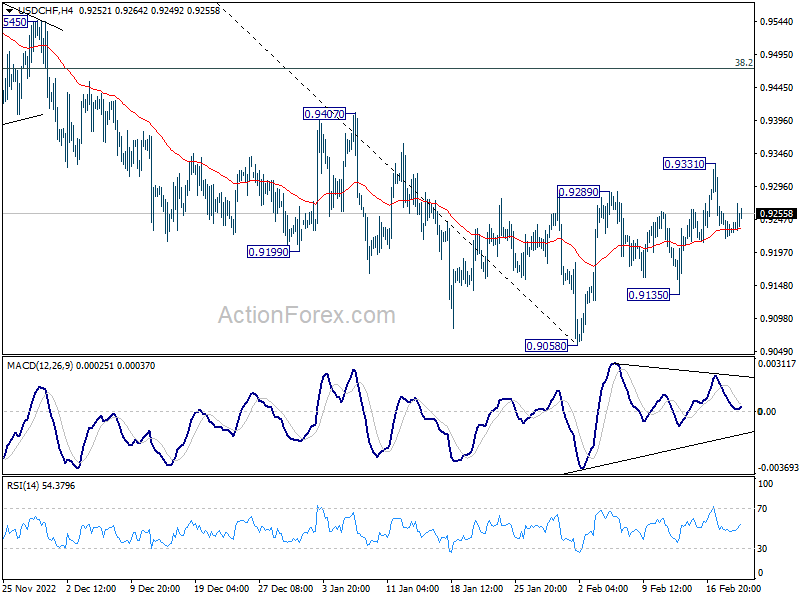
Intraday bias in USD/CHF remains neutral. On the upside, break of 0.9331 will resume the rebound from 0.9058 to 38.2% retracement of 1.0146 to 0.9058 at 0.9474. However, break of 0.9135 will indicate that the rebound has completed and bring retest of 0.9058 low.
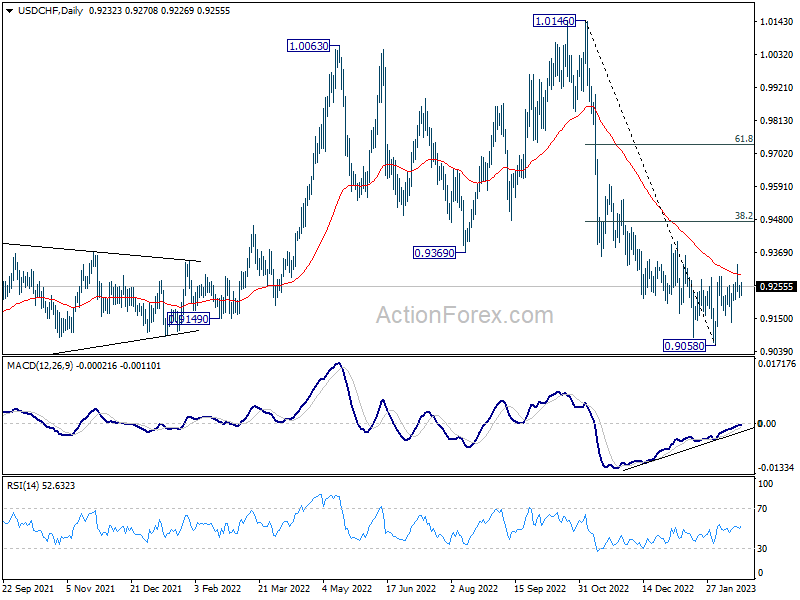
In the bigger picture, decline from 1.0146 is seen as part of a long term sideway pattern. As long as 38.2% retracement of 1.0146 to 0.9058 at 0.9474 holds, another fall is in favor through 0.9058. However, sustained trading above 0.9474 will indicate that the medium term trend has reversed, and open up further rally to 1.0146 again.
EUR/USD Mid-Day Outlook
Daily Pivots: (S1) 1.0669; (P) 1.0687; (R1) 1.0703; More...
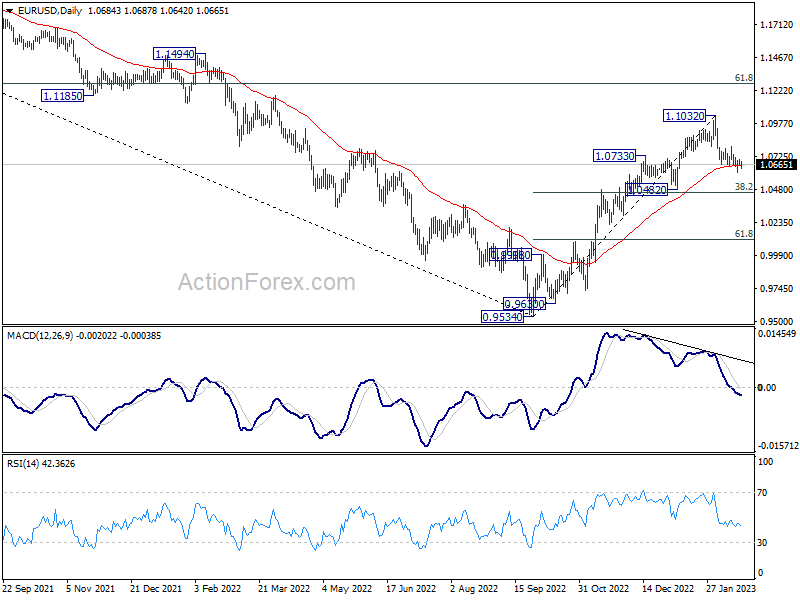
Intraday bias in EUR/USD remains neutral and risk stays on the downside with 1.0803 resistance intact. On the downside, break of 1.0610 will resume the corrective fall from 1.1032 and 38.2% retracement of 0.9534 to 1.1032 at 1.0463. Strong support should be seen around there to bring rebound, at least on first attempt.
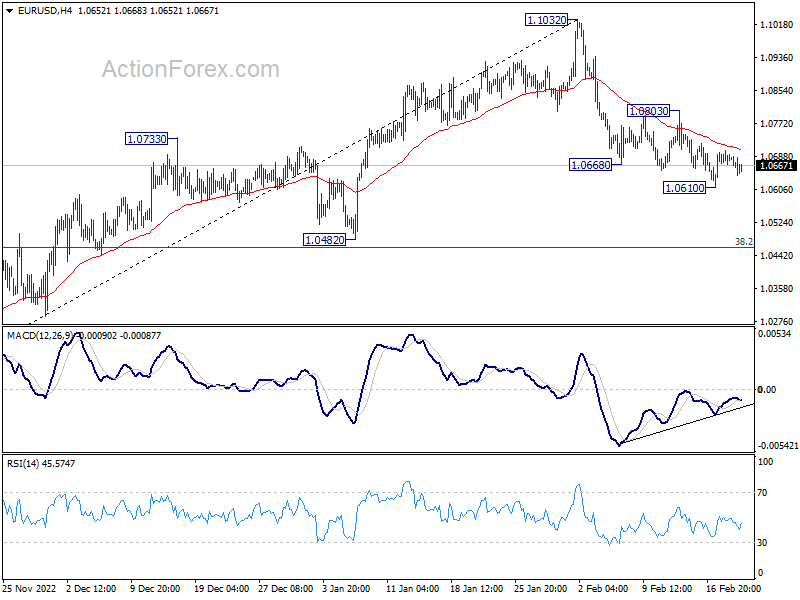
In the bigger picture, the rally from 0.9534 low (2022 low) is a medium term up trend rather than a correction. Further rise is in favor to 61.8% retracement of 1.2348 (2021 high) to 0.9534 at 1.1273 next. This will remain the favored case as long as 1.0482 support holds.
Canada: Inflation Continues to Cool in January
Consumer price inflation continued to decelerate in January, up 5.9% versus a year ago (y/y), from 6.3% in December.
Prices for cellular services and passenger vehicles contributed to the deceleration, as holiday discounting spilled in to January in the case of the former, and improved supply chains contributed to the decline for the latter.
Energy prices rose in January, as prices at the pump surged 4.7% month-on-month (m/m). However, gasoline prices are only 2.9% higher than a year ago.
Shelter prices continued to increase, as "the mortgage interest cost index continued to rise at a faster year-over-year pace amid the higher interest rate environment, rising 21.2% in January, the largest increase since September 1982."
Food inflation also rose in January, up 10.4% y/y, versus 10.1% in December. Food at grocery stores continues to see high inflation, while food at restaurants is picking up stream (+8.2% y/y from +7.7% in December).
Underlying inflation pressures eased, with CPI ex-food and energy up 4.9% y/y, down from 5.3% in December. The BoC's core inflation measures moved in a positive direction in January, with CPI-trim at 5.1% y/y (5.3% in Dec.) and CPI-median at 5.0% y/y (5.2% in Dec.).
Key Implications
January's CPI report showed that inflation continues to cool in Canada. Headline and core measures are falling on a year-on-year basis and should decline even further over the coming months as the base effect of last year's first half price surge washes out of the data.
For the Bank of Canada, it will need to see this trend continue for it to be comfortable remaining on the sidelines. As we highlighted in our Quarterly Economic Forecast, a slowing in economic momentum will be needed for inflation to decisively fall back towards the 1% to 3% target range. The recent uptick in employment and spending data complicate this. But given the improvement in inflation data today, the BoC will not feel rushed to jump back in with another rate hike just yet.
GBP/USD Mid-Day Outlook
Daily Pivots: (S1) 1.2018; (P) 1.2037; (R1) 1.2060; More...
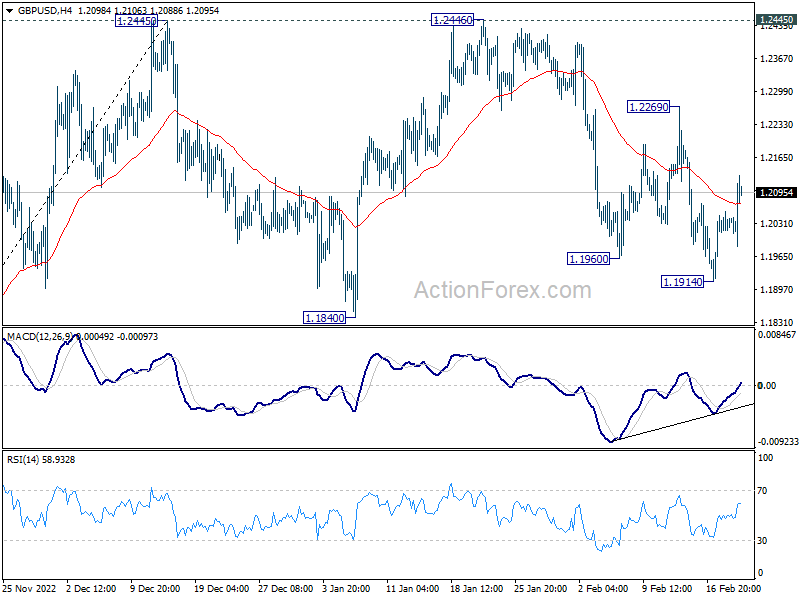
GBP/USD's rebound from 1.1914 extends higher today but stays well below 1.2269 resistance. Intraday bias remains neutral and another fall could still be seen. Below 1.1914 will resume the fall from 1.2446, as the third leg of the corrective pattern from 1.2445, to 1.1840 support and possibly below. Nevertheless, firm break of 1.2269 will bring retest of 1.2445/6 resistance.
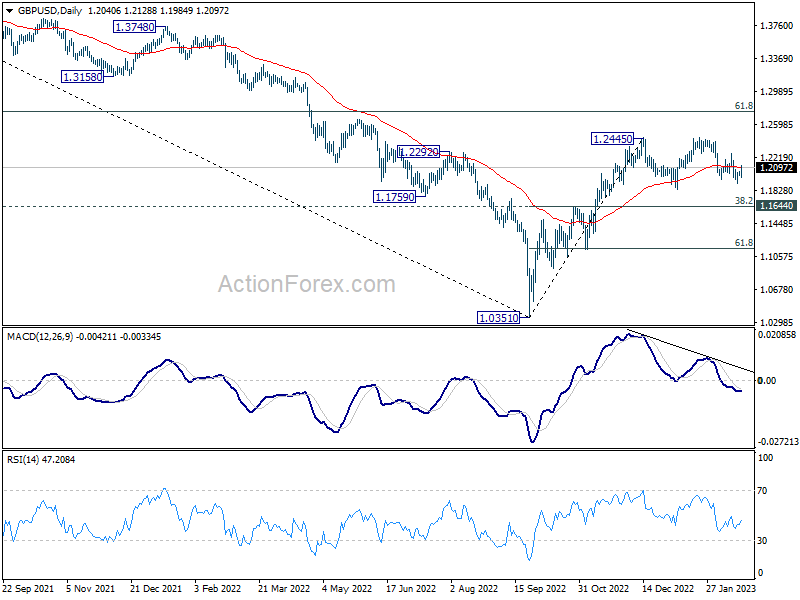
In the bigger picture, rise from 1.0351 medium term bottom is at least correcting whole down trend from 1.4248 (2021 high). Further rise is expected as long as 1.1644 resistance turned support holds. Next target is 61.8% retracement of 1.4248 to 1.0351 at 1.2759. Sustained break there will pave the way back to 1.4248.
Sterling Surges on Strong PMIs, Dollar Following
Sterling rises broadly today as stronger than expected PMI data indicate that near-term recession odds have fallen considerably. European majors are also trading higher after positive Eurozone PMI and Germany ZEW. Nevertheless, Dollar is following the Pound as the second strongest, with some help from risk aversion. Australian Dollar is the worst performing one, followed by Yen, and then other commodity currencies.
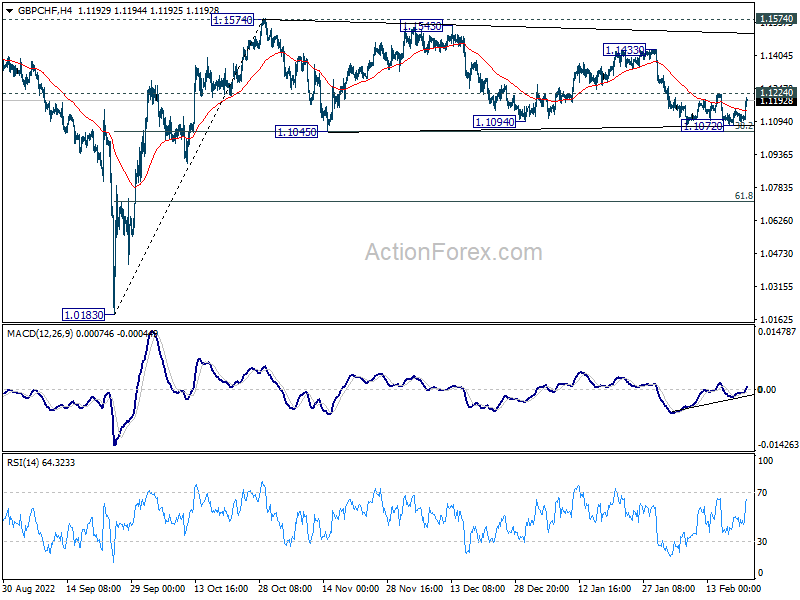
Technically, while the near term reversal is delayed, GBP/CHF's bounce today argue that fall from 1.1433 might have finally completed at 1.1072. Break of 1.1224 will also suggest that whole consolidation from 1.1574 has completed too, and rise from 1.0183 is ready to resume. Let's see Sterling could ride on the current momentum further.
In Europe, at the time of writing, FTSE is down -0.41%. DAX is down -0.47%. CAC is down -0.39%. Germany 10-year yield is up 0.0515 at 2.516. UK 10-year yield is up 0.127 at 3.600. Earlier in Asia, Nikkei dropped -0.21%. Hong Kong HSI dropped -1.71%. China Shanghai SSE rose 0.49%. Singapore Strait Times dropped -0.06%. Japan 10-year JGB yield dropped -0.0018 to 0.503.
Canada CPI slowed to 5.9% yoy in Jan, Ex food and energy down to 4.9% yoy
Canada CPI slowed from 6.3% yoy to 5.9% yoy in January. StatsCan noted that "Prices for cellular services and passenger vehicles contributed to the deceleration in the all-items CPI. However, mortgage interest cost and prices for food continue to rise." Excluding food and energy, CPI also slowed to 4.9% yoy while ex-mortgage CPI slowed to 5.4% yoy.
CPI median was unchanged at 5.0% yoy. CPI trimmed slowed form 5.3% yoy to 5.1% yoy. CPI common was unchanged at 6.6% yoy.
On a monthly basis, CPI rose 0.5% mom. Higher gasoline prices contributed the most to the month-over-month increase, followed by a rise in mortgage interest cost and meat prices.
Canada retail sales rose 0.5% mom in Dec
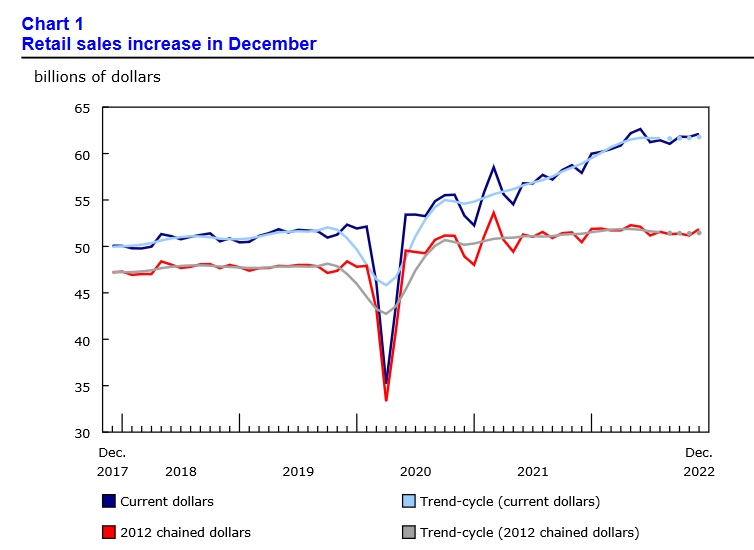
Canada retail sales rose 0.5% mom to CAD 62.1B in December. Sales increased in 7 of 11 subsectors, representing 75.1% of retail trade. Higher sales at motor vehicle and parts dealers (+3.8%) and general merchandise stores (+1.7%) led the increase. Ex-gasoline and auto sales rose 0.4% mom. In volume term, retail sales increased 1.3% mom.
Advance estimate suggests that retail sales rose further by 0.7% mom in January.
UK PMI composite jumped to 53, near-term recession odds fallen considerably
UK PMI Manufacturing rose from 47.0 to 49.2 in February, a 7-month high. PMI Services rose sharply from 48.7 to 53.3, an 8-month high. PMI Composite jumped from 48.5 to 53.0, an 8-month high.
Chris Williamson, Chief Business Economist at S&P Global Market Intelligence said: "Much better than anticipated PMI data for February indicate encouraging resilience of the economy in the face of headwinds which include rising interest rates, the ongoing cost of living crisis, labour shortages and strikes...
"However, while the data suggest that near-term recession odds have fallen considerably, elevated inflation pressures clearly remain a concern, especially in the service sector. As such, the resilience of the economy and the stickiness of the survey's inflation gauges add to the likelihood of the Bank of England tightening policy further, and potentially more aggressively, which may dampen future growth expectations and suggests that the possibility of recession later in the year should not be ruled out."
Eurozone PMI composite rose to 52.3, accelerating growth and stubbornly elevated price pressures
Eurozone PMI Manufacturing dropped from 48.5 to 48.8 in February. PMI Services rose from 50.8 to 53.0, an 8-month high. PMI Composite rose from 50.3 to 52.3, a 9-month high.
Chris Williamson, Chief Business Economist at S&P Global Market Intelligence said:
"Business activity across the eurozone grew much faster than expected in February, with growth hitting a nine-month high thanks to resurgent service sector activity and a recovering manufacturing economy. February's PMI is broadly consistent with GDP rising at a quarterly rate of just under 0.3%....
"However, although inflationary pressures have continued to moderate in February, the survey hints at persistent elevated price trends in the service sector, linked in part to higher wage growth, which will concern ECB policymakers. The combination of accelerating growth and stubbornly elevated price pressures will naturally encourage a bias towards further policy tightening in the months ahead."
German ZEW rose to 28.1, but current situation still unfavorable
Germany ZEW Economic Sentiment rose form 16.9 to 28.1 in February, above expectation of 22.8. Current Situation index rose from -58.6 to -45.1, above expectation of -50.0.
Eurozone ZEW Economic sentiment rose form 16.7 to 29.7, above expectation of 22.3. Current Situation Index rose 13.2 pts to -41.6.
ZEW President Professor Achim Wambach said: "Meanwhile a large fraction of the survey participants expects the economic situation to improve in six months' time. However, the current situation is still assessed as relatively unfavourable.
"As in the previous month, the increase in expectations can be traced back to higher profit expectations in the energy- and export-oriented sectors as well as the consumer-related parts of the economy. Expectations for long-term interest rates are also rising and the banking sector indicator has reached its highest level since 2004."
RBA minutes: 25bps and 50bps hike considered at Feb meeting
Minutes of RBA's February 7 meeting revealed that both the options of 25bps and 50bps hike were considered. But the case for a 25bps hike was stronger, with "the monthly meetings provided the Board with frequent opportunities to assess how these uncertainties were being resolved and to adjust policy if needed".
The minutes also noted, "members agreed that further increases in interest rates are likely to be needed over the months ahead to ensure that inflation returns to target and that the current period of high inflation is only temporary."
Australia PMI composite rose to 49.2, on the narrow path to achieve soft landing
Australia PMI Manufacturing ticked up from 50.0 to 50.1 in February. PMI Services rose from 48.6 to 49.2. PMI Composite also rose from 48.5 to 49.2.
Warren Hogan, Chief Economic Advisor at Judo Bank said: "Australian business activity improved in February 2023 with a second consecutive small rise in the flash composite output index to 49.2. The economy has slowed from the strong rates of growth in 2022 to be on a more sustainable footing in early 2023. We still appear to be on the narrow path to achieve a soft landing for the economy in 2023...
"At this stage the Judo Bank PMIs are pointing to a welcome slowdown in the economy that may help take upward pressure off interest rates. While this will do little to alter the RBA's intentions to raise interest rates further over the months ahead, it does indicate that we may be close to the point where the RBA Board can pause the current tightening cycle."
Japan PMI manufacturing dropped to 47.4, services rose to 53.6
Japan PMI Manufacturing dropped from 48.9 to 47.4 in February, below expectation of 49.3. It's also the worst reading in over two-and-a-half years. Manufacturing Output dropped sharply from 47.2 to 44.9. PMI services, on the other hand, rose from 52.3 to 53.6. PMI Composite was unchanged at 50.7.
Andrew Harker, Economics Director at S&P Global Market Intelligence, said:
"The modest, stable growth signalled by the au Jibun Bank Flash Japan Composite PMI in February masked widely differing trends between the manufacturing and service sectors midway through the first quarter of the year.
"Service providers posted sharper rises in activity and new business as the latest wave of the COVID-19 pandemic faded, providing a boost to demand.
"The picture was much less positive in the manufacturing sector, however, where new orders and production dropped to the greatest extents in just over two-and-a-half years."
GBP/USD Mid-Day Outlook
Daily Pivots: (S1) 1.2018; (P) 1.2037; (R1) 1.2060; More...
GBP/USD's rebound from 1.1914 extends higher today but stays well below 1.2269 resistance. Intraday bias remains neutral and another fall could still be seen. Below 1.1914 will resume the fall from 1.2446, as the third leg of the corrective pattern from 1.2445, to 1.1840 support and possibly below. Nevertheless, firm break of 1.2269 will bring retest of 1.2445/6 resistance.
In the bigger picture, rise from 1.0351 medium term bottom is at least correcting whole down trend from 1.4248 (2021 high). Further rise is expected as long as 1.1644 resistance turned support holds. Next target is 61.8% retracement of 1.4248 to 1.0351 at 1.2759. Sustained break there will pave the way back to 1.4248.
Economic Indicators Update
| GMT | Ccy | Events | Actual | Forecast | Previous | Revised |
|---|---|---|---|---|---|---|
| 21:45 | NZD | PPI Input Q/Q Q4 | 0.50% | 0.50% | 0.80% | |
| 21:45 | NZD | PPI Output Q/Q Q4 | 0.90% | 0.40% | 1.60% | |
| 22:00 | AUD | Manufacturing PMI Feb P | 50.1 | 50 | ||
| 22:00 | AUD | Services PMI Feb P | 49.2 | 48.6 | ||
| 00:30 | AUD | RBA Meeting Minutes | ||||
| 00:30 | JPY | Manufacturing PMI Feb P | 47.4 | 49.3 | 48.9 | |
| 07:00 | CHF | Trade Balance (CHF) Jan | 5.08B | 3.75B | 2.83B | 2.77B |
| 07:00 | GBP | Public Sector Net Borrowing (GBP) Jan | -6.2B | 2.3B | 26.6B | 24.8B |
| 08:15 | EUR | France Manufacturing PMI Feb P | 47.9 | 50.7 | 50.5 | |
| 08:15 | EUR | France Services PMI Feb P | 52.8 | 50 | 49.4 | |
| 08:30 | EUR | Germany Manufacturing PMI Feb P | 46.5 | 48 | 47.3 | |
| 08:30 | EUR | Germany Services PMI Feb P | 51.3 | 51 | 50.7 | |
| 09:00 | EUR | Eurozone Manufacturing PMI Feb P | 48.5 | 49.4 | 48.8 | |
| 09:00 | EUR | Eurozone Services PMI Feb P | 53 | 51 | 50.8 | |
| 09:30 | GBP | Manufacturing PMI Feb P | 49.2 | 47.5 | 47 | |
| 09:30 | GBP | Services PMI Feb P | 53.3 | 49.4 | 48.7 | |
| 10:00 | EUR | Germany ZEW Economic Sentiment Feb | 28.1 | 22.8 | 16.9 | |
| 10:00 | EUR | Germany ZEW Current Situation Feb | -45.1 | -50 | -58.6 | |
| 10:00 | EUR | Eurozone ZEW Economic Sentiment Feb | 29.7 | 22.3 | 16.7 | |
| 13:30 | CAD | Retail Sales M/M Dec | 0.50% | 0.50% | -0.10% | 0% |
| 13:30 | CAD | Retail Sales ex Autos M/M Dec | -0.60% | -0.10% | -0.60% | -0.50% |
| 13:30 | CAD | CPI M/M Jan | 0.50% | 0.20% | -0.60% | |
| 13:30 | CAD | CPI Y/Y Jan | 5.90% | 5.70% | 6.30% | |
| 13:30 | CAD | CPI Core M/M Jan | 0.10% | 0.30% | ||
| 13:30 | CAD | CPI Median Y/Y Jan | 5.00% | 4.90% | 5.00% | |
| 13:30 | CAD | CPI Trimmed Y/Y Jan | 5.10% | 5.20% | 5.30% | |
| 13:30 | CAD | CPI Common Y/Y Jan | 6.60% | 6.50% | 6.60% | |
| 14:45 | USD | Manufacturing PMI Feb P | 47.4 | 46.9 | ||
| 14:45 | USD | Services PMI Feb P | 47.3 | 46.8 | ||
| 15:00 | USD | Existing Home Sales Jan | 4.06M | 4.02M |
Canada retail sales rose 0.5% mom in Dec
Canada retail sales rose 0.5% mom to CAD 62.1B in December. Sales increased in 7 of 11 subsectors, representing 75.1% of retail trade. Higher sales at motor vehicle and parts dealers (+3.8%) and general merchandise stores (+1.7%) led the increase. Ex-gasoline and auto sales rose 0.4% mom. In volume term, retail sales increased 1.3% mom.
Advance estimate suggests that retail sales rose further by 0.7% mom in January.