Sample Category Title
FTSE 100 Consolidates
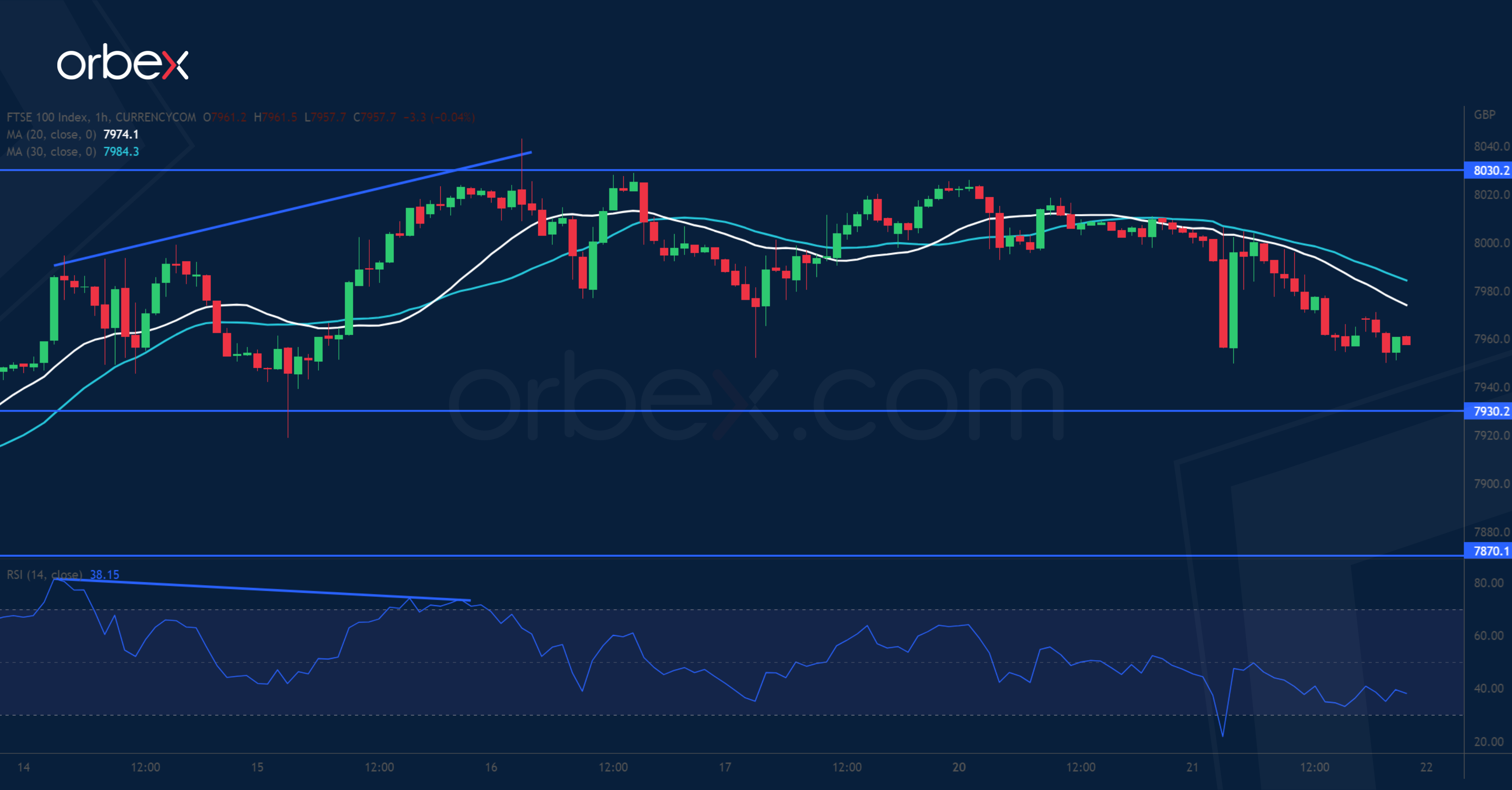
The FTSE 100 turns lower on fears of more rate hikes by the BoE. On the daily chart, the RSI’s overbought condition indicates overextension though there is no confirmation of a fallback yet. A bearish RSI divergence on the hourly chart shows a deceleration. 7930 is the immediate support and its beach may corroborate the observation in these time frames. Then 7870 on the 30-day SMA would be a key level to gauge the strength of follow-up interests. On the upside, a close back above 8030 would resume the uptrend.
USD/CAD Bounces Higher
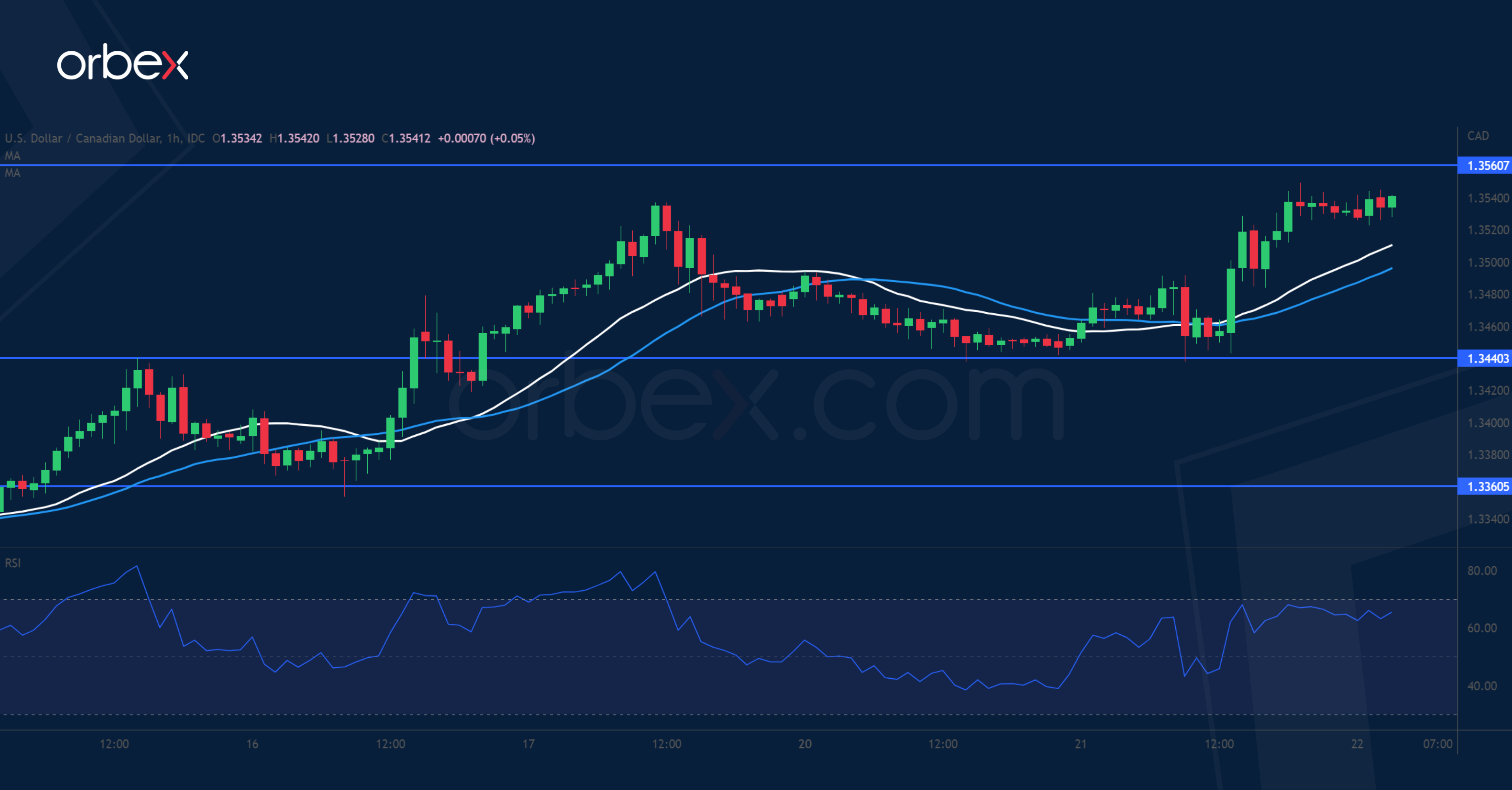
The Canadian dollar tanked as easing inflation may keep the BoC at bay. A break above the supply zone 1.3470-1.3510 has helped the bulls regain control of the direction. A series of higher highs is a sign of mounting buying pressure and so far buyers have seen pullbacks as opportunities to stake in. 1.3440 is a fresh support and 1.3360 is an important level to keep the upward bias intact. Some resistance could be felt near the previously failed support at 1.3560 before the rally could extend to the daily resistance of 1.3660.
EUR/USD Drifts Lower
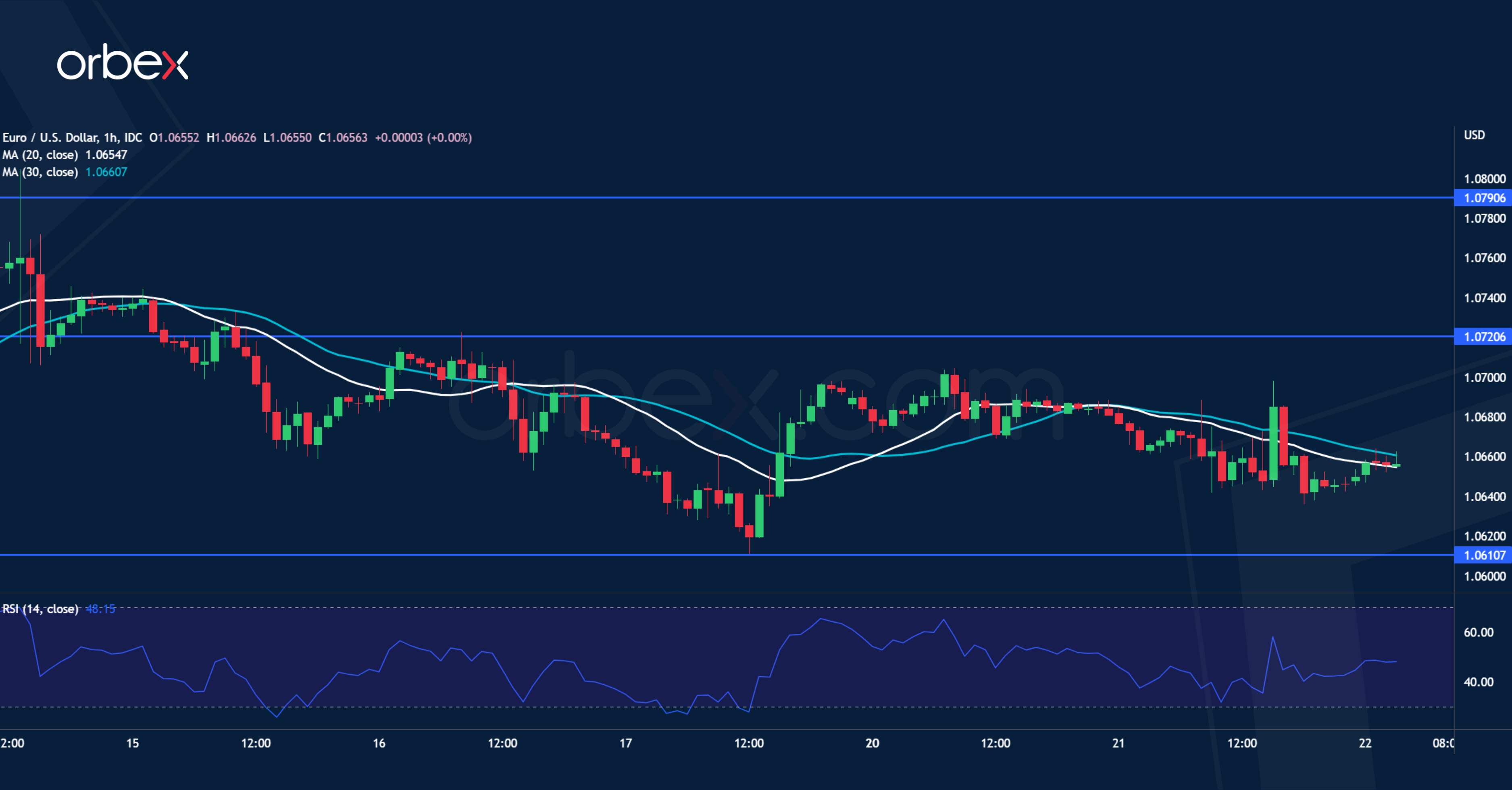
The US dollar extended gains helped by upbeat PMIs in February. On the daily chart, a bearish MA cross after the price pierced the moving averages suggests that a correction is due after a three-month long rally. The pair is grinding the demand zone around 1.0610 from last January’s bullish breakout. 1.0720 is the closest hurdle and only a clean break above 1.0790, a twice-tested resistance, would turn short-term sentiment around. Failing that, the single currency could sink towards the critical floor at 1.0500.
Outcome of Fed March Meeting Becoming Fat-Tailed Towards a Possible 50 bps Rate Hike
Markets
US Treasuries went into full sell-off mode again yesterday following February US PMI’s. The composite PMI returned above the 50 boom/bust mark again for the first time since June 2022, surging from 46.8 to 50.2 (vs 47.5 consensus). The spike came on account of a similar move in the services gauge while the manufacturing PMI’s improvement was way more modest (47.8 from 46.9). Despite headwinds from higher interest rates and the cost of living squeeze, the business mood has brightened amid signs that headline inflation has peaked and recession risks have faded. At the same time, supply constraints have alleviated to the extent that delivery times for inputs into factories are improving at a rate not seen since 2009. However, the survey data underscore how the upward driving force on inflation has now shifted to wages amid the tight labor market. A potential wage-price spiral could accelerate service sector price growth, one of the specific items the Fed is following closely. PMI’s can be added to this month’s list of stellar payrolls, stubborn CPI, strong retail sales and hawkish Fed comments. All of which triggered a fierce, and ongoing, repositioning in US money markets. The outcome of the March meeting is becoming fat-tailed towards a possible 50 bps rate hike. Tonight’s FOMC Minutes will give an indication on how big last week’s dissent in favour of such move already in February was. Fed Bullard and Mester already revealed being part of this (outdated?) minority view. After US close, heavyweight NY Fed governor Williams (more moderate profile within FOMC) discusses the inflation outlook. Indications that inflation won’t come down as easily as hoped, won’t go unnoticed. US yields ended yesterday’s session 10 to 15 bps higher with the belly of the curve underperforming the wings. The US 2-yr yield came an inch away of setting a new cycle top (4.73% intraday high). The US 5-yr yield (4.15%) builds on last week’s break above 4.04% resistance which paves the way to the 2022 top around 4.5%. The US 10-yr yield is currently breaking above similar resistance (3.9%) which - if confirmed - opens the path to 4.33%. Yesterday’s bond sell-off spilled to stock markets in an echo to market correlation in the first 9 months of last year. US stock markets lost 2% to 2.5%. The dollar’s performance could have been better in this context (yield advantage & risk-off). EUR/USD closed only marginally weaker at 1.0648. Just as for the stock market, we think it is only a matter of time before the pair cracks as US money markets gradually embrace the 50 bps hike scenario in March. Support kicks in at 1.0484/66 (2023 low/38% retracement on September/February comeback). Sterling profited from rising UK yields (2-y +17 bps) after strong PMI’s suggested that also the Bank of England has more ground to cover in its normalisation cycle. EUR/GBP is testing first support around 0.88. EUR/GBP 0.8722 will be a tough nut to crack.
News and views
The Reserve Bank of New Zealand today raised its policy rate (OCR) by 50 bps to 4.75%. The Committee agreed that the OCR still needs to increase, as indicated in the November Statement, to ensure inflation returns to within its target range over the medium term. (Core) consumer price inflation remains too high, employment is still beyond its maximum sustainable level and near-term inflation expectations remain elevated. There are early signs that demand is easing but it continues to outpace supply as reflected in strong domestic inflation (7.2% headline). The RBNZ expects that inflation will stay high in the near term and is likely only to begin decline significantly from the second half of 2023. The central bank indicated that it is too early to accurately assess the monetary policy implications of recent disrupting weather events. In its monetary policy statement the RBNZ still sees the peak in the OCR at 5.5% toward the end of this year. The hawkish tone from the RBNZ communication caused the 2-y government bond yield to rise 10 bps. The kiwi dollar jumped from NZD/USD 0.621 to 0.06245, but gains eased on broader USD strength.
The Australian Bureau of Statistics released data showing wages in the country rising by 0.8% Q/Q to be up 3.3.% Y/Y. (from 1.1% and 3.2% in Q3). While the 3.3% yearly pay growth was the highest since Q4 2021, markets still expected a bigger increase to about 3.5%. The Q4 pay growth was also slightly lower than the expectations of the Reserve bank of Australia. After taking a softer stance end last year, the RBA recently indicated that it will have to raise rates further to bring inflation back to target. However, softer-than-expected wages this morning triggered a correction on the recent rise in yields. After touching a new cycle top at 3.69%, the 2-y government bond yield dropped back to 3.57%. The Aussie dollar also loses further ground trading at around AUD/USD 0.6835.
Poor Appetite ahead of FOMC Minutes
US stocks now join the treasury selloff, and the US dollar pushes higher on the back of the increasingly hawkish Federal Reserve (Fed) bets.
The US 2-year yield was again above the 3.70% mark, whereas the 10-year yield flirted with the 4% for the first time since last November.
The preliminary services PMI in the US came in better than expected for February, and the services PMI ticked above the 50 mark, into the contraction zone, for the first time since last July.
The strong economic data further fueled the Fed hawks. But this time, the stocks sold off as well, despite the strong economic data. The weak outlook from Walmart and Home Depot left the no-landing bets under the dark shadow of higher US yields.
The S&P500 dived 2% on Tuesday, below the minor 23.6% Fibonacci retracement on the latest October to February rally, and below the 4000 psychological mark.
Nasdaq 100 slipped 2.41% and closed the day a few points above the major 38.2% retracement. Falling below this level will send the index into the bearish consolidation zone.
Today, the FOMC minutes will be closely watched. We know that the Fed officials will sound concerned with the strong jobs market and will point at the resilience of the economy to continue hiking the rates.
So, the chances are that the minutes will be hawkish, and could further weigh on sentiment. But there is always a chance that the market sees the glass half full than half empty.
But the negative correlation between stocks and bonds, after stocks rallied and bonds fell – the exact opposite of what we have predicted at the start of the year – may be coming to an end, as in the absence of recession talk, the Fed expectations will continue driving markets, and the increasingly hawkish Fed expectations are bad for both stock and bond valuations.
Fed hawks are supportive of the US dollar, however. The dollar index is now testing two important technical resistances to the upside: the minor 23.6% retracement on the end of September to the beginning of February retreat – which gave that much-needed space to breath to other currencies, and the 2021-2022 bullish trend.
It’s still early to talk about a medium term bearish reversal.
The EURUSD, for example, has been under pressure since the beginning of February, but the major 38.2% Fibonacci retracement, which would call the end of the positive trend is still a way to go. It stands a touch below the 1.05 mark. But of course, we know that the Fed can go much further than expectations. Speaking of rate hikes, the Reserve Bank of New Zealand (RBNZ) hiked its interest rates by 50bp today, after a three-month break. The bank warned that Cyclone Gabrielle could lead to higher inflation and output disruptions in the near term and that rebuilding work will boost activity in coming years, which is also bad for inflation.
The RBNZ decision gave a boost to the kiwi today. Whether the pair could hold ground above the 200-DMA, and above the major 38.2% retracement on the latest rally will depend on the… US dollar appetite, of course.
Positive Data Surprises Continue
Market movers today
Today, we get the final January CPI data from Germany and IFO index for February. FOMC minutes will be released tonight but considering the upside surprises in US data lately and the hawkish remarks by several FOMC members, the message from the minutes may well be outdated by now.
The 60 second overview
Geopolitics: In his speech yesterday, Russian President Putin announced his country would suspend its observation of the new START nuclear weapons treaty with the US. US Secretary of State Blinken called this move irresponsible, while President Biden vowed his support for Ukraine sending a clear message to Putin that Russia will not win the war. A top US Treasury Department official Wally Adeyemo warned yesterday that companies around the world, including in China, could be sanctioned if they continue to violate US sanctions against Russia. Meanwhile, China's top diplomat Wang Yi, after his meeting with Russian Security Council Secretary Nikolai Patrushev, said the ties between the two countries were "solid as a rock and will stand the trials of the changing international situation".
RBNZ: As widely expected, the Reserve Bank of New Zealand hiked rates by 50bp to 4.75%. The RBNZ still sees the peak rate at 5.5% but now thinks they will reach it in the fourth quarter of 2023 instead of the third. The central bank is yet to fully assess the impacts from Cyclone Gabrielle that hit the island state last week. While its impact on economic growth near term will be negative, it may also cause supply side bottlenecks and add to capacity constraints in the construction sector, which would be inflationary. For now, the markets are pricing in a 40% probability of a 50bp hike in April.
US data: US February Flash PMIs continued the streak of upside macro data surprises, as the manufacturing index edged higher to 47.8 (Jan. 46.9) and the services index rebounded back to growth territory at 50.5 (Jan 46.8). Notably, output price and employment indices ticked higher, although input price pressures eased. Even though the January NFP figures were most likely supported by positive seasonality, overall labour market conditions appear to have remained strong in February as well. January home sales disappointed by declining modestly, but the strong PMIs were enough to support another leg higher in US yields, while the S&P500 had the worst day of the year so far (-2.0%). Market fully prices in 3x25bp Fed hikes by summer, and around 15-20% probability of Fed moving back to 50bp hikes in March. We think the latter still appears unlikely, but keep a close eye on inflation expectations for further signs of more persistent inflation risks.
Euro area data: French flash PMI beat expectations in February driven by growth in the service sector. The French economy seems to be a tale of two stories: strong services PMI at 52.8 (exp. 49.8.) while manufacturing returned to contractionary territory with index at 47.9 vs. exp. 51. New orders fell in both services and manufacturing, while price components signalled a further weakening of cost pressures across the country. German PMIs painted a similar picture as in France, but with smaller changes to the prints. Services was slightly higher than consensus at 51.3 vs. 51.0 while manufacturing suffered again to 46.5 vs. 48.1 consensus. German manufacturers maintained a preference for higher output charges despite seeing purchasing costs fall. On employment, the private sector saw a further rise, although the job creation was the joint-weakest over the past two years. The German ZEW index also came in stronger than expected with both current (-45.1 vs. -50.5) and expectations (28.1 vs. 23) components beating estimates. The slew of better than expected data certainly puts a 50bp rate hike in play for ECB in May. While a 50bp hike in March is fully priced in, markets are now also pricing in a roughly 50% chance of a similar hike in May.
FI: The sell-off in the US Treasury market continued yesterday with 10Y US Treasuries close to breaking through 4% on the back of a robust US economy and the expectations for more rate hikes from the Federal Reserve. European bond yields also continue to rise given the expectations for ECB to do more and we have seen the terminal rate for both the Federal Reserve and the ECB rise. Furthermore, the risk is that policy rates will remain "high for long" rather than seeing rates cuts already late in 2023/early 2024.
FX: The sell-off in the US Treasury market continued yesterday with 10Y US Treasuries close to breaking through 4% on the back of a robust US economy and the expectations for more rate hikes from the Federal Reserve. European bond yields also continue to rise given the expectations for ECB to do more, and we have seen the terminal rate for both the Federal Reserve and the ECB rise.
Credit: The soft sentiment yesterday was also reflected in the credit market as CDS indices widened. iTraxx Main was wider by 3bp to 81bp, while Xover widened by 16bp to 425bp. Even so, primary issuance continued with especially FIG issuers being active in euros, bringing a total of EUR2.2bn to the market in unsecured format comprising both senior and subordinated deals. That being said, the softer sentiment is also visible in the primary market where new issue concessions have been creeping higher again.
Nordic macro
New Riksbank Governor Erik Thedèen talks about the economic outlook and current monetary policy at 09.00 CET at a seminar on the residential property market arranged by Fastighetsvärlden. He will be available for media comments after the speech so look out for any flashes afterwards.
GBP/JPY Daily Outlook
Daily Pivots: (S1) 162.10; (P) 162.93; (R1) 164.37; More...
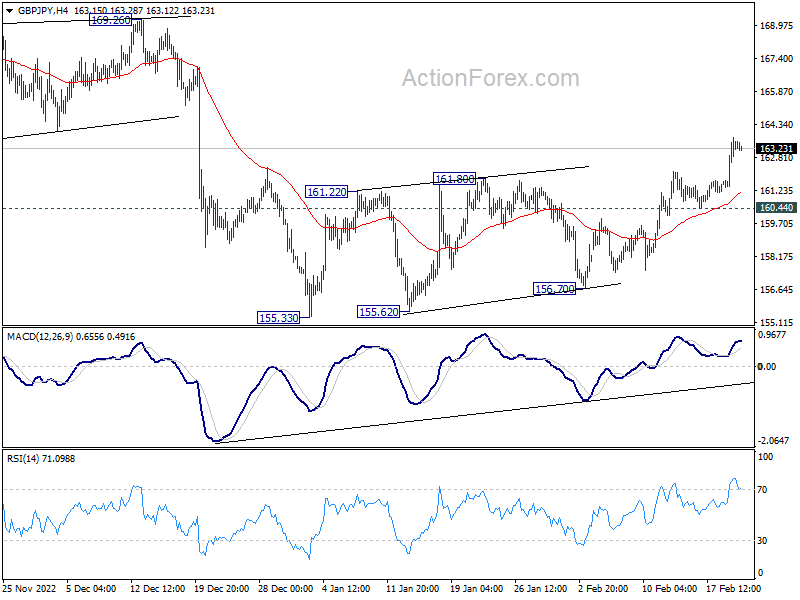
Intraday bias in GBP/JPY remains on the upside for the moment. Correction from 172.11 should have completed with three waves down to 155.33. Further rise should be seen to retest 169.26/172.11 resistance zone. For now, further rally will remain in favor as long as 160.44 minor support holds, in case of retreat.
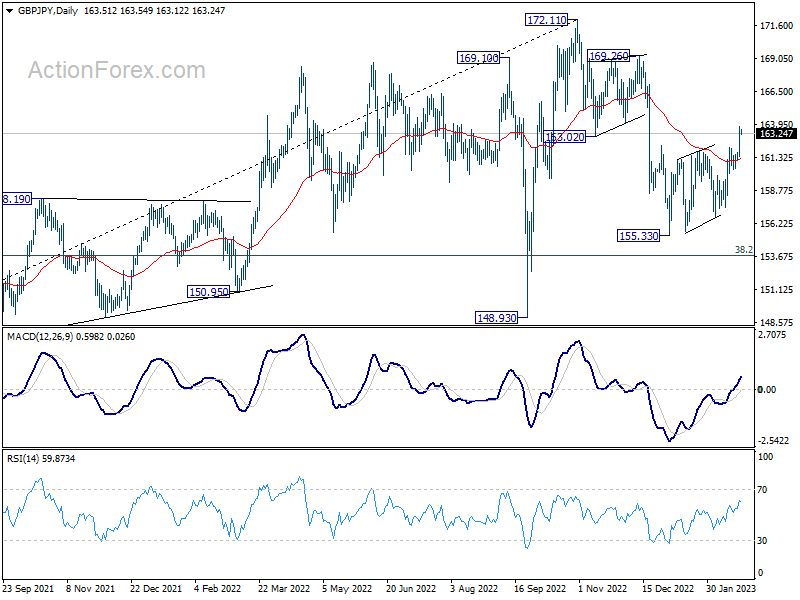
In the bigger picture, corrective decline from 172.11 medium term should have completed at 155.33. With 38.2% retracement of 123.94 to 172.11 at 153.70 intact, medium term bullishness is retained. That is, larger up trend from 123.94 (2020 low) is still in progress. Break of 172.11 high to resume such up trend is expected at a later stage.
EUR/JPY Daily Outlook
Daily Pivots: (S1) 143.35; (P) 143.76; (R1) 144.16; More....
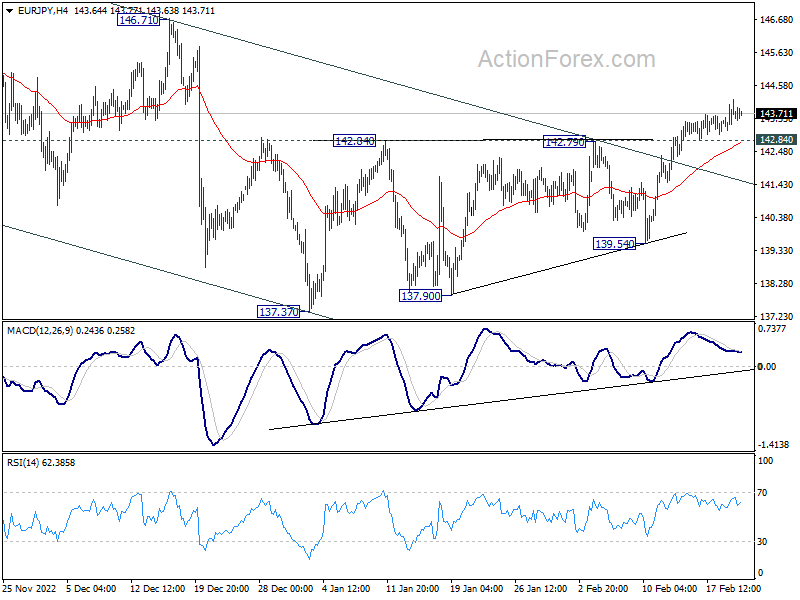
Intraday bias sin EUR/JPY stays on the upside at this point, despite loss of upside moment. Corrective fall from 148.38 should have completed at 137.37. Further rally should be seen to 146.71 resistance. On the downside, though, below 142.84 minor support will turn intraday bias neutral first.
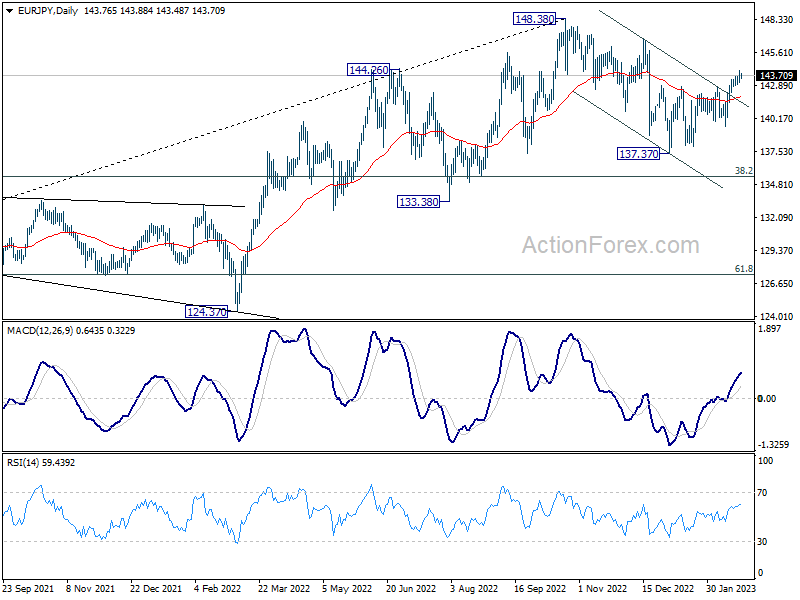
In the bigger picture, as long as 55 week EMA (now at 139.03) holds, larger up trend from 114.42 (2020 low) is still in progress for 149.76 long term resistance. However, firm break of 55 week EMA will bring deeper fall to 38.2% retracement of 114.42 to 148.38 at 135.40. Sustained break there will raise the chance of trend reversal, and target 61.8% retracement at 127.39.
EUR/GBP Daily Outlook
Daily Pivots: (S1) 0.8758; (P) 0.8823; (R1) 0.8855; More...
Intraday bias in EUR/GBP remains on the downside at this point. Rebound from 0.8545 might have completed at 0.8977 already. Further fall would be seen to 0.8720 support first. Break there will bring deeper decline to retest 0.8545. For now, risk will stay on the downside as long as 0.8927 resistance holds, in case of recovery.
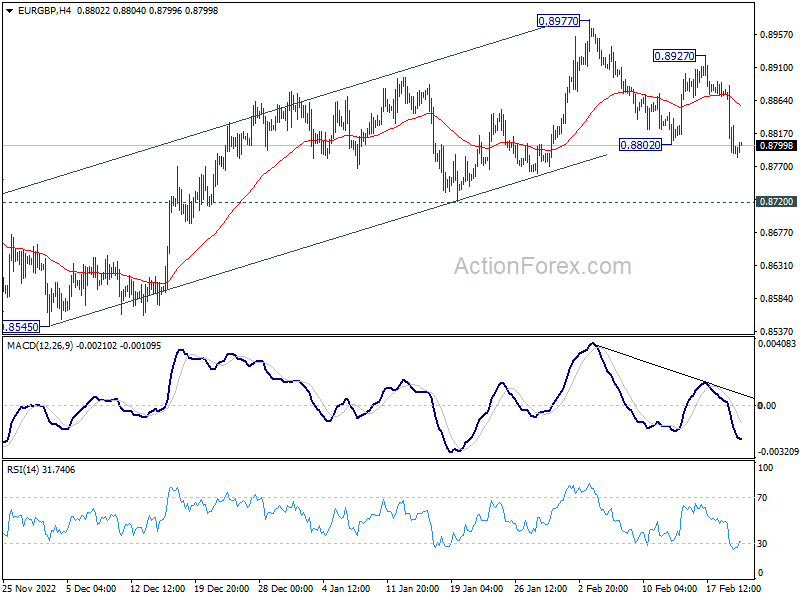
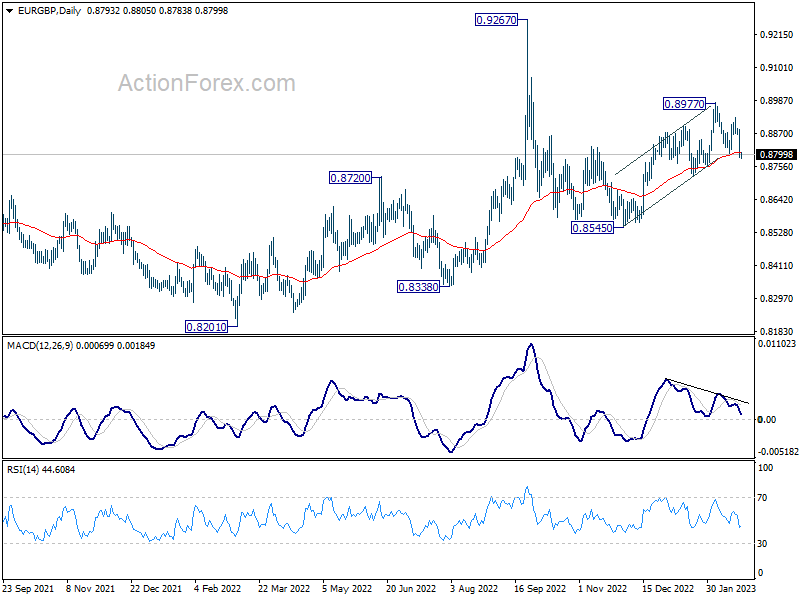
In the bigger picture, focus is back on 55 day EMA (now at 0.8804). Sustained trading below there will argue that fall from 0.9267 is in progress. Such decline is seen as a leg inside long term range pattern from 0.9499 (2020 high). Break of 0.8545 will pave the way back to 0.8201 (2022 low).
EUR/AUD Daily Outlook
Daily Pivots: (S1) 1.5483; (P) 1.5515; (R1) 1.5564; More...
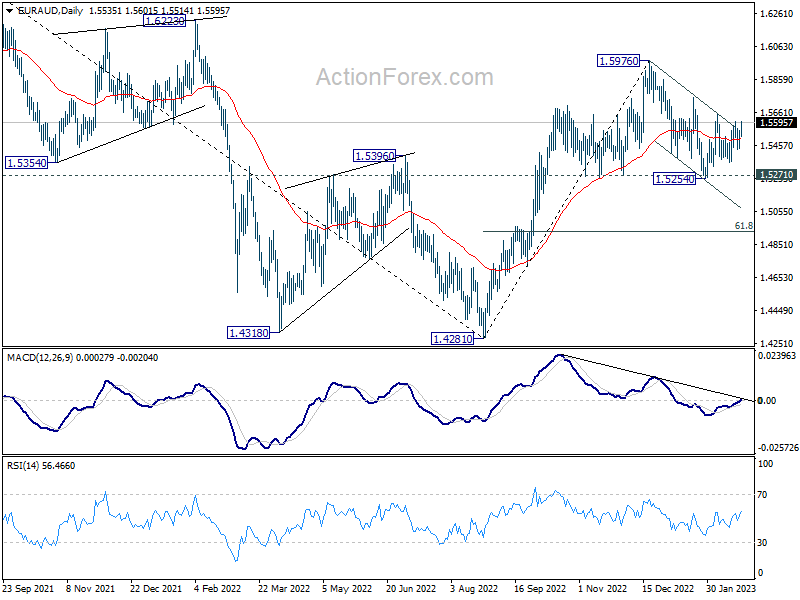
Range trading continues in EUR/AUD and intraday bias stays neutral. On the upside, break of 1.5650 resistance will revive that case that correction from 1.5976 has completed at 1.5254. Intraday bias will be back on the upside for 1.5749 resistance first. On the downside, firm break of 1.5254/71 will carry larger bearish implication and resume the fall from 1.5976.
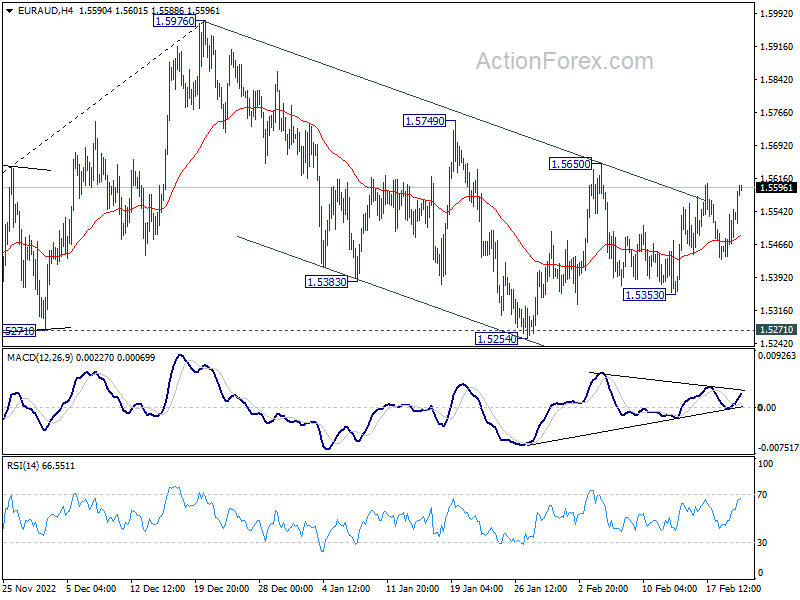
In the bigger picture, it's still early to confirm if rise from 1.4281 represents bullish trend reversal. But as long as 1.5271 support holds, such rally is in favor to continue. Break of 1.5976 will target 1.6434 key resistance next. On the other hand, firm break of 1.5271 will retain medium term bearishness instead.