Sample Category Title
Sunset Market Commentary
Markets
Core bond yields initially extended gains after a sharp move on yesterday’s stronger-than-expected PMIs on either side of both the Atlantic and the Canal. German Bunds underperformed US Treasuries this time. French ECB Villeroy was acting spoilsport for the day though. He backtracked on his comments made end last week. Implicitly referring to an ECB rate of 4% as he saw the tightening cycle ending in September, he added today that markets overreacted a little and that the central bank “in no way” is obliged to hike at every meeting in the runup to it. His intervention called off the early 2-4 bps rise in European rates. The German yield curve turns slightly less inverse with yields declining 1.8 bps in the 2-5y segment but with the long end still adding a few bps. US yields eased 3.6 bps (30y) to 5.6 bps (2y). Fed’s Bullard repeated his call for a 5.25-5.5% Fed policy rate and getting there ASAP but sounded optimistic about “beating inflation in 2023” citing the ongoing disinflationary process. It triggered some additional UST gains, coming from the central bank’s most outspoken hawk. UK gilts notably underperform. After Tuesday’s sharp (services) PMI rebound markets are reconsidering their (too pessimistic?) views on the economy and monetary policy. Curve inversion deepens with yield changes ranging between +1.2 bps (30y) to +4 bps (2y).
Catching up with Wall Street yesterday, European stocks deepened opening losses to a little over 1% in the Euro Stoxx 50 before bottoming early afternoon. The timing coincided with Bullard’s not-so-hawkish interpreted speech but the technicals helped too. The lower bound of the upward trading range was tested multiple times but held tight, triggering a countermove instead. Current losses amount to 0.3% only. US indices open with small gains. Gradually improving sentiment lifted EUR/USD from the intraday lows around 1.062. The pair is still slightly down on a net daily basis though (around 1.064). The trade-weighted DXY struggles to surpass resistance at 104.11 (23.6% recovery on the Sep-Feb downleg). Sterling’s intraday fall and rise corelated with risk sentiment. EUR/GBP’s attempt to recoup some of yesterday’s almost 100 point drop ended in tears. The pair is currently trading unchanged just below 0.88. News & Views
Germany reported a final CPI figure for January with the domestic CPI index confirmed at 1.0% M/M and 8.7% Y/Y. However, a revision introducing a new base year 2020 resulted in the figure of December 2022 and November 2022 being downgraded to 8.1% and 8.8% respectively from 8.6% and 10.0% before the revision. In this respect, the Federal Statistical Office concluded that ‘the price increase thus accelerated at the beginning of the year’. According to the head of the Federal Statistical Office it is ‘observing price rises for many goods and to an increasing degree also for services. Households paid higher prices in particular for energy and also food prices in January’.
The government of South Africa today announced its budget for fiscal year 2023. In the economic projection supporting the budget, the government sees growth slowing down to 0.9% this year from 2.5% in 2022. Inflation is expected to ease to 5.3% from 6.9%. The 2022/2023 budget deficit is expected to come out at 4.2% of GDP, better than the October forecast of 4.9%. The budget deficit is expected to gradually decline further to 3.2% in 2025/2026. The government also announced it will provide ZAR 254 bn in debt relief for the power utility Eskom. Part of the debt relief will be funded via the budget while ZAR 118 bn will be additional borrowing. Amongst others, this will raise gross debt to 73.6 % of GDP in 2025/26 compared to 71.1% expected for current fiscal year. The rand initially gained modestly after the budget statement, but at USD/ZAR 18.22 it returned most of its intraday gains. The rand recently lost ground, partially due to uncertainty on the economic impact from ever growing power blackouts.
According to the monthly business survey of the National Bank of Belgium, business sentiment in the country improved slightly in February. The NBB indicated that the situation varies depending on the sector. Business climate improved in the manufacturing (-14.8 from -16.7) and building industries (-5.8 from -6.6), but deteriorated in the business-related services (-7.2 from -6.6) and, above all, in trade (-24.2 from -14.2). The overall synthetic curve improved from -13.5 in January to -12.8 this month.
Aussie Dips After Soft Wage Data
The Australian dollar has extended its losses on Wednesday. In North American trade, AUD/USD is trading at 0.6824, down 0.47%.
Wage growth misses forecast
Australian wage growth was short of the forecast, with a gain of 0.8% q/q in Q4 2020. This was down from 1.1% in Q3 and below the forecast of 1.0%. Annual wage growth rose to 3.3%, up from 3.2% but below the estimate of 3.5%. This will be welcome news to the RBA, which is concerned that high inflation could lead to a price-wage spiral that would entrench inflation expectations and complicate efforts to curb inflation.
The RBA has hiked interest rates by 325 basis points in the current cycle but the battle against inflation rages on. Inflation rose to 7.8% in Q4 2022, its highest level since March 1990. The central bank’s steep tightening is yet to curb inflation, and Lowe faced criticism of his rate policy when he appeared before a parliamentary committee last week. Lowe told the lawmakers that high inflation was “dangerous” and reiterated that future rate moves would be data-driven. The cash rate is currently at 3.35% and the markets have priced a peak rate of 4.1%. The RBA has signalled that more rate hikes are coming and we’re likely to see a 25-basis point hike for a fifth straight time at the March meeting, barring some unexpected data.
All eyes are on the Federal Reserve, which will release the minutes of its February meeting later on Wednesday. The Fed raised rates by 25 bp, but investors will be interested in the extent of support for a 50-bp hike at the meeting as a clue what to expect from the March 22 meeting. It was only a few weeks ago that the markets were confident that the March meeting would provide a ‘one and done’ rate increase and the Fed would cut rates late in the year. The blowout employment report, a strong retail sales release and higher-than-expected inflation have changed that narrative. The markets have moved closer to the Fed’s hawkish stance, and Goldman Sachs and the Bank of America are projecting three more rate hikes in 2023.
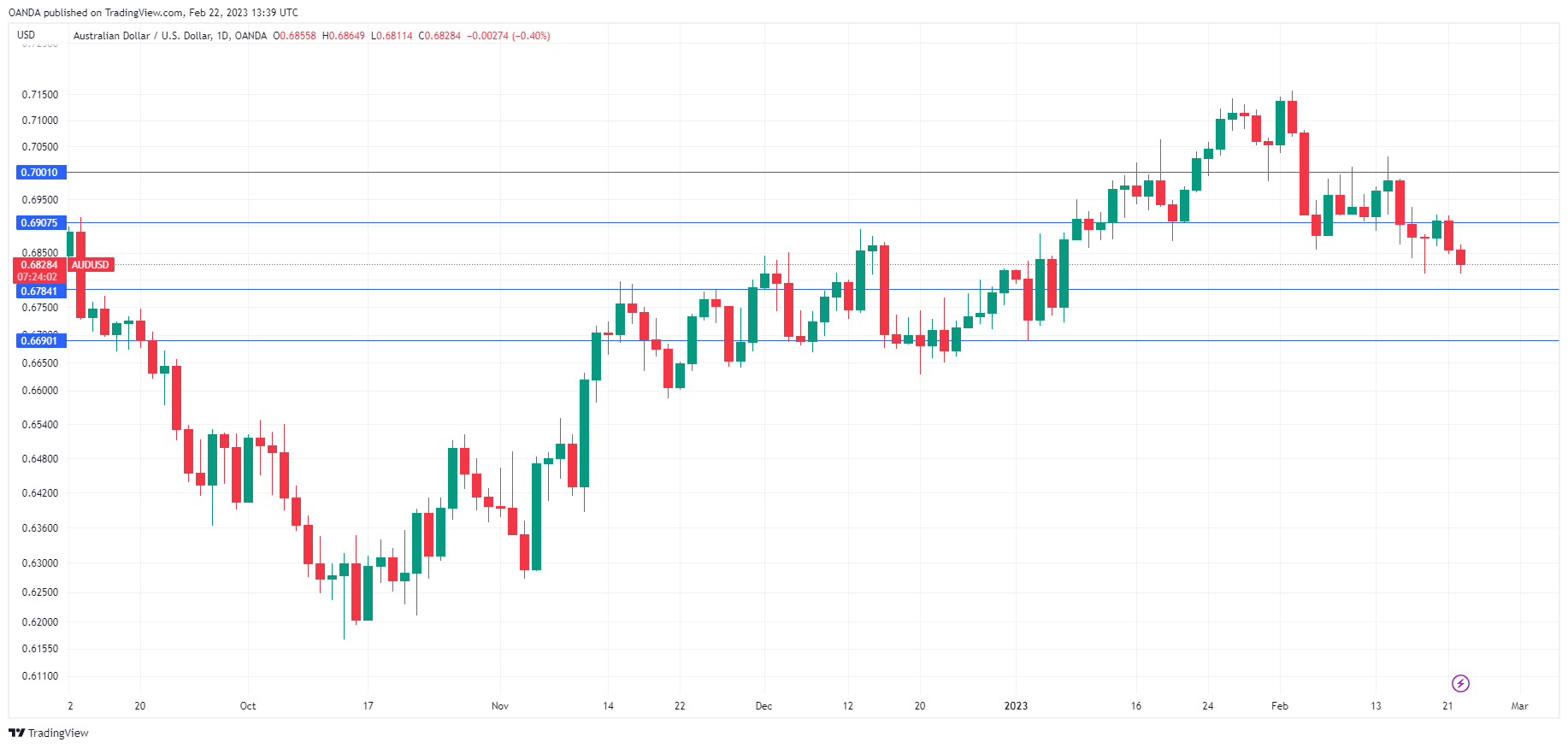
AUD/USD Technical
- AUD/USD has support at 0.6784 and 0.6690
- There is resistance at 0.6907 and 0.7001
AUD/USD: Fresh Risk Aversion Deflates Aussie Dollar
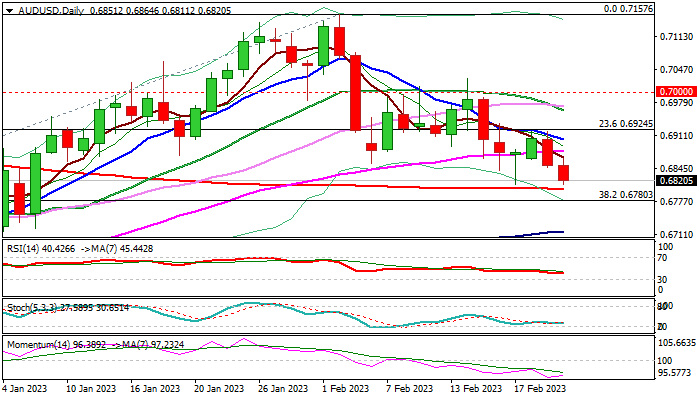
The AUDUSD remains in red for the second consecutive day on Wednesday, after recovery attempts were repeatedly capped by daily Tenkan-sen/50% retracement of 0.7028/0.6811 downleg (0.6920) and bears regained full control on renewed risk aversion.
Softer than expected Australian wage growth in Q4 also contributed to Aussie dollar’s fresh weakness.
Revived bears penetrated into rising daily Ichimoku cloud (on track to register the first daily close within the cloud since Nov 28) which was underpinning the action during this period.
Bears cracked key near-term support at 0.6811 (the upper boundary of strong support zone at 0.6811/02, consisting of Feb 17 spike low and 200DMA) which guards nearby pivotal Fibo support at 0.6780 (38.2% of 0.6170/0.7157 uptrend).
Clear break of these levels would open way for deeper correction of 0.6170/0.7157 rally and expose supports at 0.6724/17 (daily cloud base / 100DMA) and 0.6687 (2023 low of Jan 3).
Daily studies maintain strong negative momentum and multiple bear-crosses of MA’s add to downside pressure, although the headwinds at current levels cannot be ruled out.
Upticks should be ideally capped by broken 55DMA (0.6881) to offer better selling opportunities. Only sustained break above daily Tenkan-sen would neutralize bears and generate strong reversal signal on formation of a double-bottom (0.6811).
Res: 0.6864; 0.6894; 0.6920; 0.6945.
Sup: 0.6802; 0.6780; 0.6717; 0.6663.
RBNZ Warns It Is Not Done With Tightening
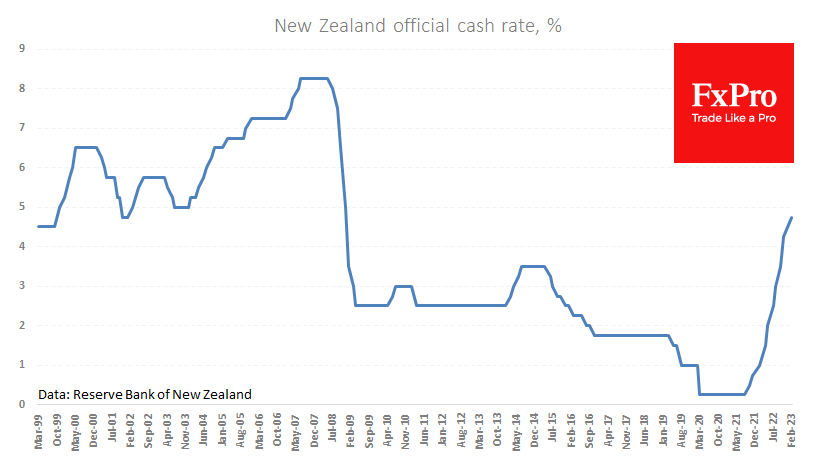
The Reserve Bank of New Zealand hiked its cash rate by 50 points to 4.75% early in the day. The rate has been raised by 425 points over the last ten meetings since October 2021, the sharpest uninterrupted hike in modern history.
In an accompanying commentary, the Bank forecasted a hike to 5.5% by September this year, leaving considerable room for further increases at subsequent meetings. Even so, New Zealand’s interest rates are now at their highest level since 2008. Before the “era of zero interest rates” that began after the global financial crisis, rates above 5% were the norm. Expected rates are, therefore, well within the norm. Moreover, the RBNZ expects the cash rate to fall later.
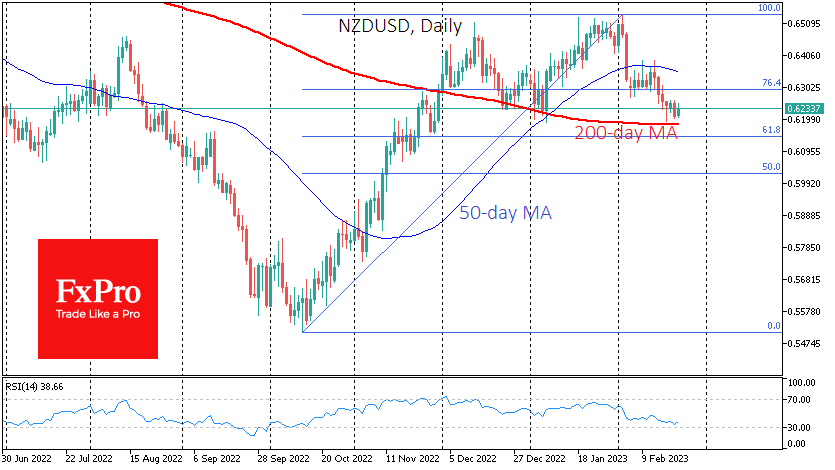
The NZDUSD initially received buying support from the RBNZ’s decision and comments but later came under pressure from the global reduction in risk appetite that started earlier in the US. At the time of writing, the NZDUSD is slightly declining so far this week but has managed to hold above its significant 200-day moving average. The pair has withstood the onslaught of sellers on the way down in December and January.
Relatively hawkish comments from the RBNZ have supported the NZD, suggesting New Zealand will go further than many developed central banks in raising interest rates. At the same time, it is essential to recognise the widening trade deficit, creating a permanent capital outflow. On balance, it is too early to say that the NZDUSD has corrected the initial upward momentum from October and is preparing for a new wave of strengthening above 0.6500. It should be ready to fight for the trend in the coming days. A victory for the bulls can only be declared when the NZDUSD crosses 0.6350, while a victory for the bears can be declared when it falls below 0.6190.
Bullard’s Projections Suggest Fed’s Work is Almost Done
US stock turned positive after Fed’s Bullard stated that markets might be over-pricing US recession risk. Bullard said his projections for rates are to reach 5.375%, which implies 75 bps more in rate increases. Bullard is one of the more hawkish members, so if he thinks we only have a little ways to go here, the peak in rates might be properly priced in. The disagreement between the Fed and markets on how high rates to go might be over and that could provide a tentative boost for stocks.
China
China’s top diplomat, Wang Yi said China is willing to deepen ties with Russia. Wang is expected to meet President Putin on Wednesday. China is well aware that more sanctions could be coming their way. The West is concerned China could be providing weapons to Russia. China has continued to deny claims that they are supporting Russia with weapons.
Russia President Putin’s comments on China emphasized that ‘everything is progressing, developing’. It appears Putin is confident that whatever extra Western sanctions come towards China won’t derail their relationship.
Deglobalization is not going away anytime soon and that ultimately should prove to be very inflationary.
RBNZ
The New Zealand central bank (RBNZ) raised its key rate by a half-point to 4.75% and kept its forecast for it to peak at 5.50%. Rates are at 14-year high after the downshift 50 bps rate rise. They noted a consideration for a 75-basis point increase, but not a quarter point hike.
RBNZ Governor Orr still expects a recession over a 9–12-month period, which means they expect growth to take a big hit as policy gets even more restrictive.
Oil
Crude prices pared losses after interruptions with the Caspian Pipeline Consortium could make Kazakhstan curb output. The CPC terminal is vital for taking oil from Kazakh and Russian fields and bad weather has stopped it from loading tankers on February 19th.
Oil is still feeling heavy as energy traders anticipate a hawkish Fed will contemplate larger rate hikes that will likely send the US economy into a recession. Energy traders not only have to keep up with all the latest supply and demand drivers, but also on how much the dollar might rebound given the Fed’s tightening path. Oil will likely remain heavy here as inventories are up, refinery maintenance is here, and on global growth concerns.
Gold
Gold prices are slightly higher as the bond market selloff takes a break ahead of the FOMC minutes. The bond market will need very hawkish minutes for the 10-year to break above the 4.00%, which could spell trouble for gold. The big question is if the minutes will open the door for some to expect four more Fed rate hikes. After Fed Bullard's peak of 5.375% comment, traders might not expect them to be that hawkish.
Very hawkish Fed minutes could happen, but will it take gold back below last week’s lows of $1827 is the big question?
Bitcoin
Bitcoin edges lower ahead of FOMC minutes. Bitcoin’s small decline is meaningless as traders brace for what a lot of traders believe could be hawkish Fed minutes. Bitcoin’s rally has stalled at $25,250 and depending on what happens with risk appetite at 2pm EST could determine if we see the February consolidation continue or if we have a breakout. If the $25,500 is reached, momentum traders might try to support a rally towards the psychological $30,000 level. If bearish momentum returns, Bitcoin has strong support at the $22,500 region.
Risk Sentiment Stabilized, Dollar Looks Into FOMC Minutes
Risk sentiment appears to have stabilized as markets enter into US session. There have been increasing speculation that Fed would revert to a 50bps rate hike in March. Traders might try to scrutinize FOMC minutes to get more hints on the chance. But overall, that's not the majority's opinion for now. In the currency markets, Sterling remains the strongest one for the week, followed by Dollar and Kiwi. Aussie is the worst followed by Euro and then Canadian.
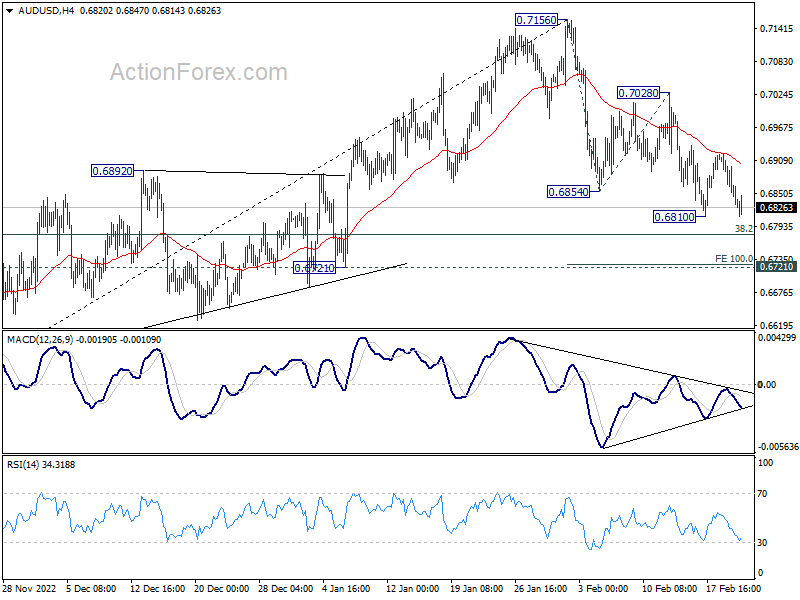
Technically, USD/CAD has resumed near term rally yesterday. It could be AUD/USD's turn in the current session. Break of 0.6810 temporary low will resume whole corrective fall from 0.7156 to 100% projection of 0.6854 to 0.7028 from 0.6854 at 0.6736, which is close to 0.6721 key structural support. Breakout in AUD/USD could be triggered by resumed selloff in stocks after FOMC minutes.
In Europe, at the time of writing, FTSE is down -0.78%. DAX is down -0.09%. CAC is down -0.18%. Germany 10-year yield is up 0.0008 at 2.532. Earlier in Asia, Nikkei dropped -1.34%. Hong Kong HSI dropped -0.51%. China Shanghai SSE dropped -0.47%. Singapore Strait Times dropped -0.21%. Japan 10-year JGB yield dropped -0.0001 to 0.503.
Fed Bullard: Let's be sharp and get inflation under control in 2023
St. Louis Fed President James Bullard told CNBC, "Our risk now is inflation doesn't come down and reaccelerates and then what do we do.
"We are going to have to react, and if inflation doesn't start to come down, you know, you risk this replay of the 1970s where you had 15 years and you're trying to battle the drag, and you don't want to get into that.
"Let's be sharp now, let's get inflation under control in 2023 and it's a good time to fight inflation because the labor market is still strong," He added.
Bullard reiterated his view that Federal funds rate at 5.25-5.50% rate would be adequate for the task.
Germany Ifo rose to 91.1, gradually working out of weakness
Germany Ifo Business Climate rose from 90.2 to 91.1 in February, matched expectations. Current Assessment Index dropped from 94.1 to 93.0, below expectation of 94.3. Expectations Index rose from 86.4 to 88.5, above expectation of 94.7.
By sector, manufacturing rose form -0.7 to 1.5. Services rose from 0.2 to 1.3. Trade rose from -15.4 to -10.6. Construction rose from -21.7 to -19.6.
Ifo said: "The German economy is gradually working its way out of a period of weakness."
Villeroy: ECB in no way obliged to hike at every meeting
ECB governor François Villeroy de Galhau told French daily Les Echos that investors have "overreacted" to ECB communication since last week.
"There is an excess of volatility in the terminal rate expectations," he said. "Put differently, markets have overreacted a little since Thursday."
Villeroy also noted that while interest rate could peak by the end of summer, ECB is "in no way" obliged to raise borrowing costs at every meeting between now and September.
RBNZ hikes 50bps, sees OCR peaking at 5.5%
RBNZ raises the Official Cash Rate by 50bps to 4.75% as widely expected. It also maintained hawkish bias and noted, "monetary conditions need to tighten further".
Regarding cyclone Gabrielle, it's "too early to accurately assess the monetary policy implications".. The committee will also "look through" the "short-term output variations and direct price effects" related to the weather event.
In the economic projections, RBNZ sees OCR peaking at 5.5% in Q4 2023, and stays above 5% until Q1 2025. GDP is projected to contract in Q2, Q3 and Q4 this year. Inflation is projected to drop gradually from 7.3% in Q1, but only falls back below 3% in Q3 2024.
In the post meeting press conference, RBNZ Governor Adrian Orr said that all options remain on the table today, "including 25, 50 and 75 bps hikes." There was "very little discussion of a 25bp rate hike", while "most focus was on 50bp".
Australia Westpac leading index ticked up, growth below trend through most of 2023
Australia Westpac-MI leading index ticked up slightly in January. Growth in the three to nine months period is estimated to be -1.04% below trend, comparing to -1.09% in December.
Westpac added that growth would remain below trend through most of 2023, with global factors, monetary policy and, recently, hours worked have weighed heavily on the Index.
Regarding RBA policy, Westpac expects another 25bps hike at March meeting to 3.60%. The cash rate is expected to peak at 3.85%, but recent communications from RBA "imply upside risks to that forecast".
BoJ Tamura: Appropriate to maintain monetary easing for now
BoJ board member Naoki Tamura said, "we're now in a phase where we need to scrutinise whether Japan can achieve a positive wage-inflation cycle. As such, it's appropriate to maintain monetary easing for now."
Tamura also noted that December's decision to double to yield cap was aimed at making monetary easing more sustainable, not at tightening. "At this stage, it's important to follow carefully and humbly how markets would stabilise and to what extent market functions will improve," he said.
EUR/USD Mid-Day Outlook
Daily Pivots: (S1) 1.0623; (P) 1.0661; (R1) 1.0683; More...
Range trading continues in EUR/USD and intraday bias stays neutral first. Further decline is in favor with 1.0803 resistance intact. On the downside, break of 1.0610 will resume the corrective fall from 1.1032 and 38.2% retracement of 0.9534 to 1.1032 at 1.0463. Strong support should be seen around there to bring rebound, at least on first attempt.
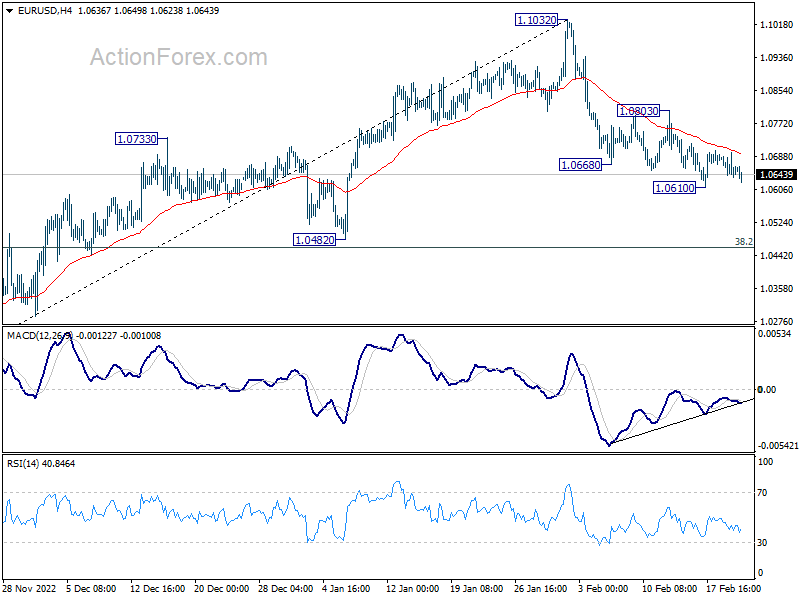
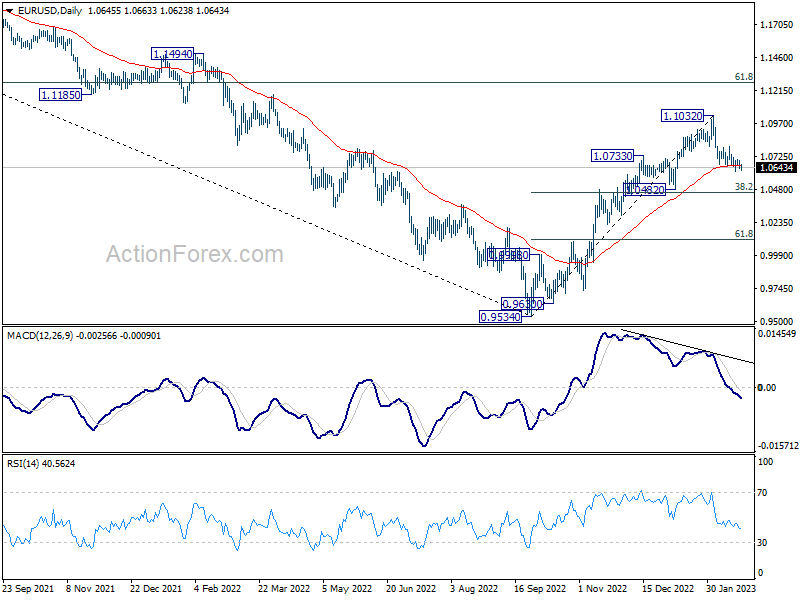
In the bigger picture, the rally from 0.9534 low (2022 low) is a medium term up trend rather than a correction. Further rise is in favor to 61.8% retracement of 1.2348 (2021 high) to 0.9534 at 1.1273 next. This will remain the favored case as long as 1.0482 support holds.
Economic Indicators Update
| GMT | Ccy | Events | Actual | Forecast | Previous | Revised |
|---|---|---|---|---|---|---|
| 21:45 | NZD | Trade Balance (NZD) Jan | -1954M | -475M | -636M | |
| 23:30 | AUD | Westpac Leading Index M/M Jan | -0.10% | -0.10% | -0.20% | |
| 23:50 | JPY | Corporate Service Price Index Y/Y Jan | 1.60% | 1.50% | 1.50% | |
| 00:30 | AUD | Wage Price Index Q/Q Q4 | 0.80% | 1.00% | 1.00% | 1.10% |
| 00:30 | AUD | Construction Work Done Q4 | -0.40% | 1.60% | 2.20% | |
| 01:00 | NZD | RBNZ Rate Decision | 4.75% | 4.75% | 4.25% | |
| 02:00 | NZD | RBNZ Press Conference | ||||
| 07:00 | EUR | Germany CPI M/M Jan F | 1.00% | 1.00% | 1.00% | |
| 07:00 | EUR | Germany CPI Y/Y Jan F | 8.70% | 8.70% | 8.70% | |
| 09:00 | CHF | ZEW Expectations Feb | -12.3 | -40 | ||
| 09:00 | EUR | Germany IFO Business Climate Feb | 91.1 | 91.1 | 90.2 | |
| 09:00 | EUR | Germany IFO Current Assessment Feb | 93.9 | 94.3 | 94.1 | |
| 09:00 | EUR | Germany IFO Expectations Feb | 88.5 | 84.7 | 86.4 | |
| 13:30 | CAD | New Housing Price Index M/M Jan | -0.20% | 0.10% | 0.00% | |
| 19:00 | USD | FOMC Minutes |
EUR/USD Mid-Day Outlook
Daily Pivots: (S1) 1.0623; (P) 1.0661; (R1) 1.0683; More...
Range trading continues in EUR/USD and intraday bias stays neutral first. Further decline is in favor with 1.0803 resistance intact. On the downside, break of 1.0610 will resume the corrective fall from 1.1032 and 38.2% retracement of 0.9534 to 1.1032 at 1.0463. Strong support should be seen around there to bring rebound, at least on first attempt.
In the bigger picture, the rally from 0.9534 low (2022 low) is a medium term up trend rather than a correction. Further rise is in favor to 61.8% retracement of 1.2348 (2021 high) to 0.9534 at 1.1273 next. This will remain the favored case as long as 1.0482 support holds.
GBP/USD Mid-Day Outlook
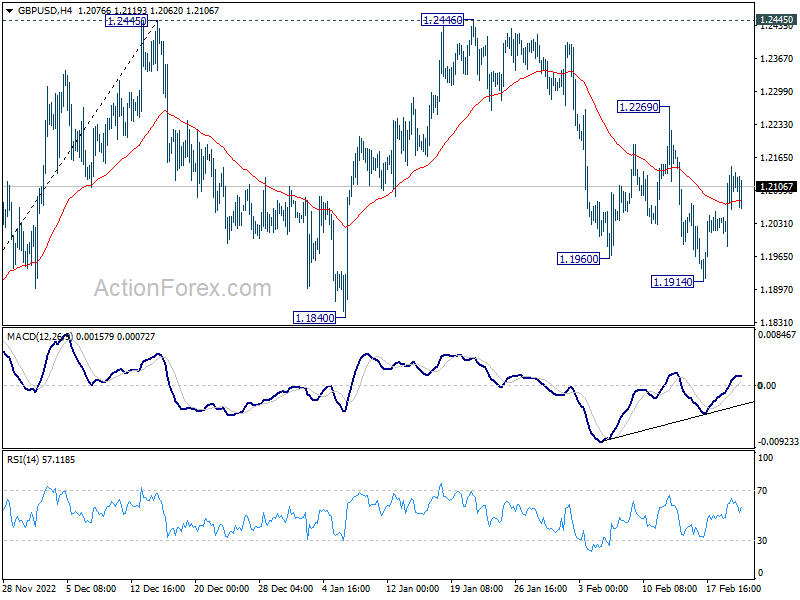
Daily Pivots: (S1) 1.2017; (P) 1.2082; (R1) 1.2177; More...
Intraday bias in GBP/USD stays neutral and outlook is unchanged. Another fall could be seen as long as 1.2269 resistance holds. On the downside, break of 1.1914 will resume the fall from 1.2446, as the third leg of the corrective pattern from 1.2445, to 1.1840 support and possibly below. Nevertheless, firm break of 1.2269 will bring retest of 1.2445/6 resistance.
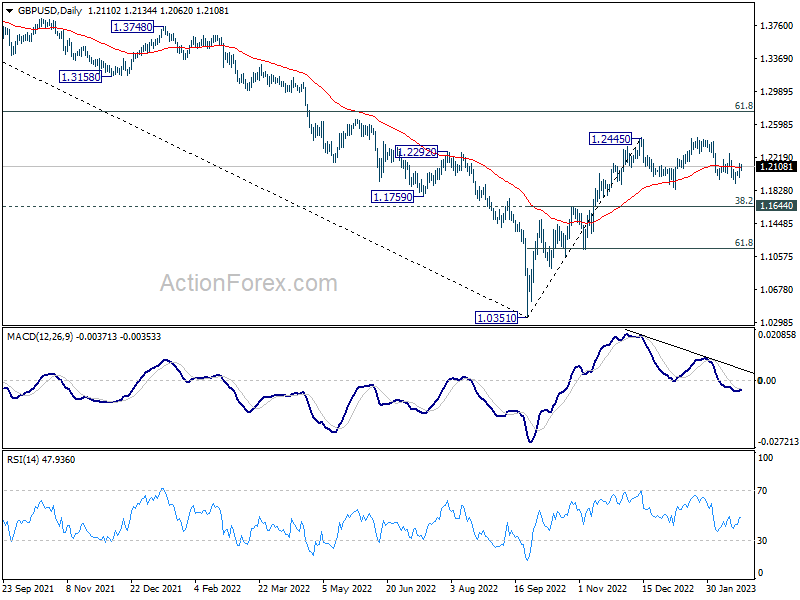
In the bigger picture, rise from 1.0351 medium term bottom is at least correcting whole down trend from 1.4248 (2021 high). Further rise is expected as long as 1.1644 resistance turned support holds. Next target is 61.8% retracement of 1.4248 to 1.0351 at 1.2759. Sustained break there will pave the way back to 1.4248.
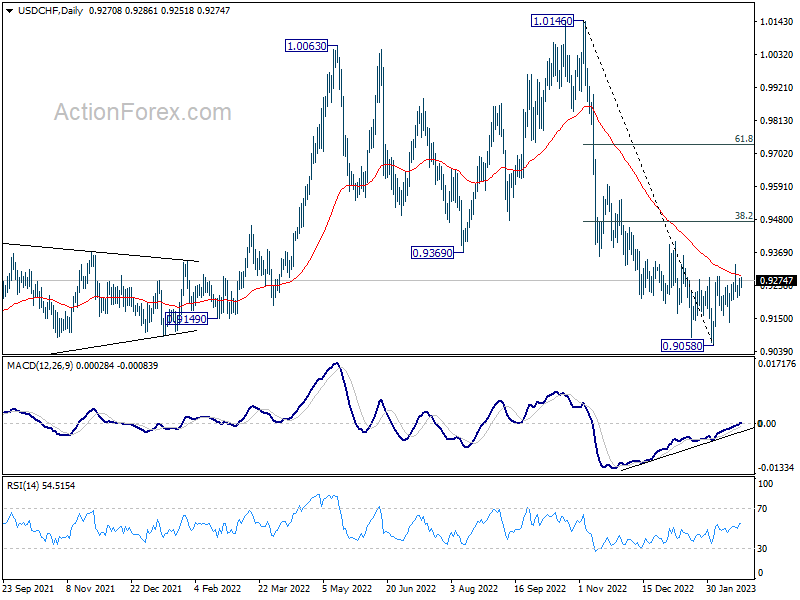
USD/CHF Mid-Day Outlook
Daily Pivots: (S1) 0.9246; (P) 0.9265; (R1) 0.9296; More...
Intraday bias in USD/CHF stays neutral at this point. On the upside, break of 0.9331 will resume the rebound from 0.9058 to 38.2% retracement of 1.0146 to 0.9058 at 0.9474. However, break of 0.9135 will indicate that the rebound has completed and bring retest of 0.9058 low.
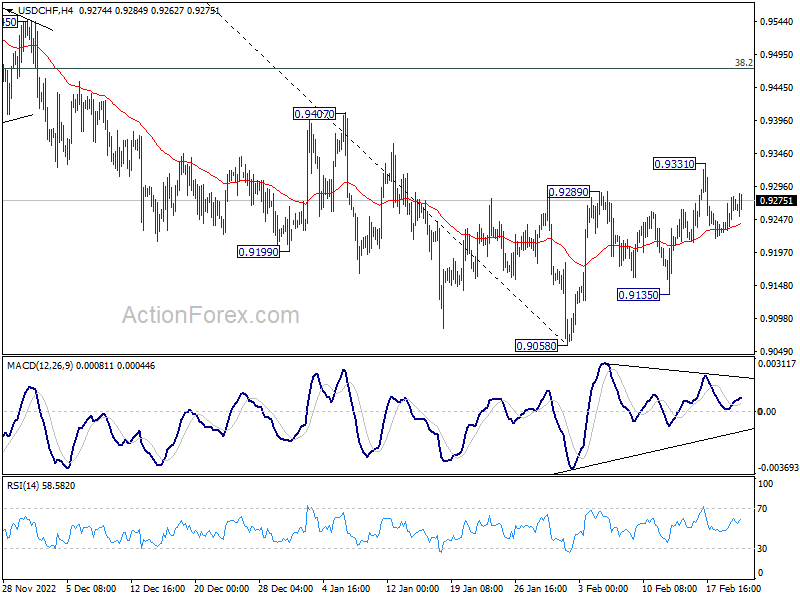
In the bigger picture, decline from 1.0146 is seen as part of a long term sideway pattern. As long as 38.2% retracement of 1.0146 to 0.9058 at 0.9474 holds, another fall is in favor through 0.9058. However, sustained trading above 0.9474 will indicate that the medium term trend has reversed, and open up further rally to 1.0146 again.