

Sample Category Title
Dollar Breaking Out after Fed Minutes, Yen Recovering
Reaction to FOMC minutes overnight was relatively muted with major US indexes closing mixed, while 10-year yield dipped slightly. Dollar, however, is making some progress by breaking to the upside against Euro. But momentum of the greenback is so far rather weak. At the same time, Yen is trying to recover against Europeans and commodity currencies, in a limited way.
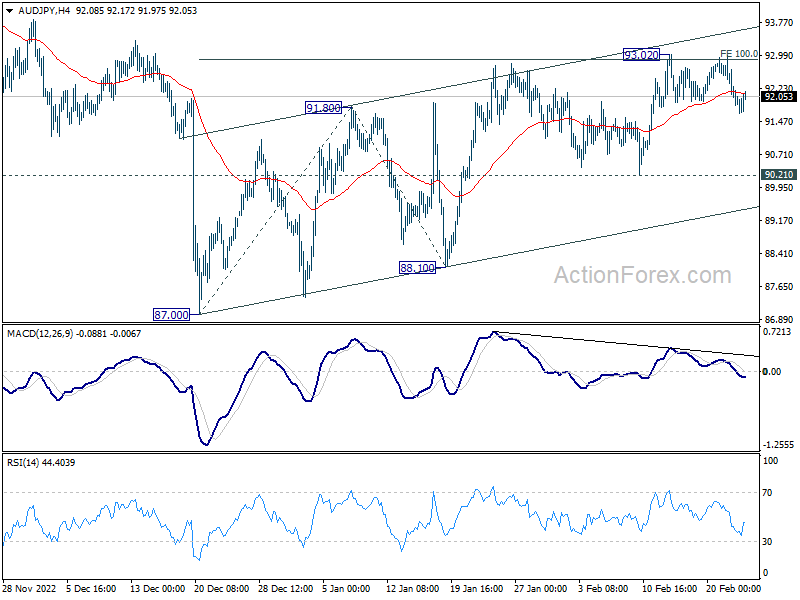
Technically, one focus for the rest of the month would be whether Yen's rebound could gain more momentum. AUD/JPY's recovery from December low at 87.00 is so far rather corrective looking. Downside momentum has been diminishing since late January, as seen in 4 hour MACD. While another rise cannot be ruled out, upside will likely be limited. On the other hand, break of 90.21 support will suggest that the recovery has completed and bring retest of 87.00 low.
In Asia, at the time of writing, Hong Kong HSI is up 0.54%. China Shanghai SSE is up 0.07%. Singapore Strait Times is down -0.83%. Japan is on holiday. Overnight, DOW dropped -0.26%. S&P 500 dropped -0.16%. NASDAQ rose 0.13%. 10-year yield dropped -0.032 to 3.923.
FOMC minutes: A few participants favored 50bps hike
Minutes of January 31–February 1 FOMC meeting reveal that "almost all participants agreed that it was appropriate to raise the target range for the federal funds rate 25 basis points at this meeting."
"Many of these participants observed that a further slowing in the pace of rate increases would better allow them to assess the economy's progress... as they determine the extent of future policy tightening that will be required."
Yet, "A few participants stated that they favored raising the target range for the federal funds rate 50 basis points at this meeting or that they could have supported raising the target by that amount."
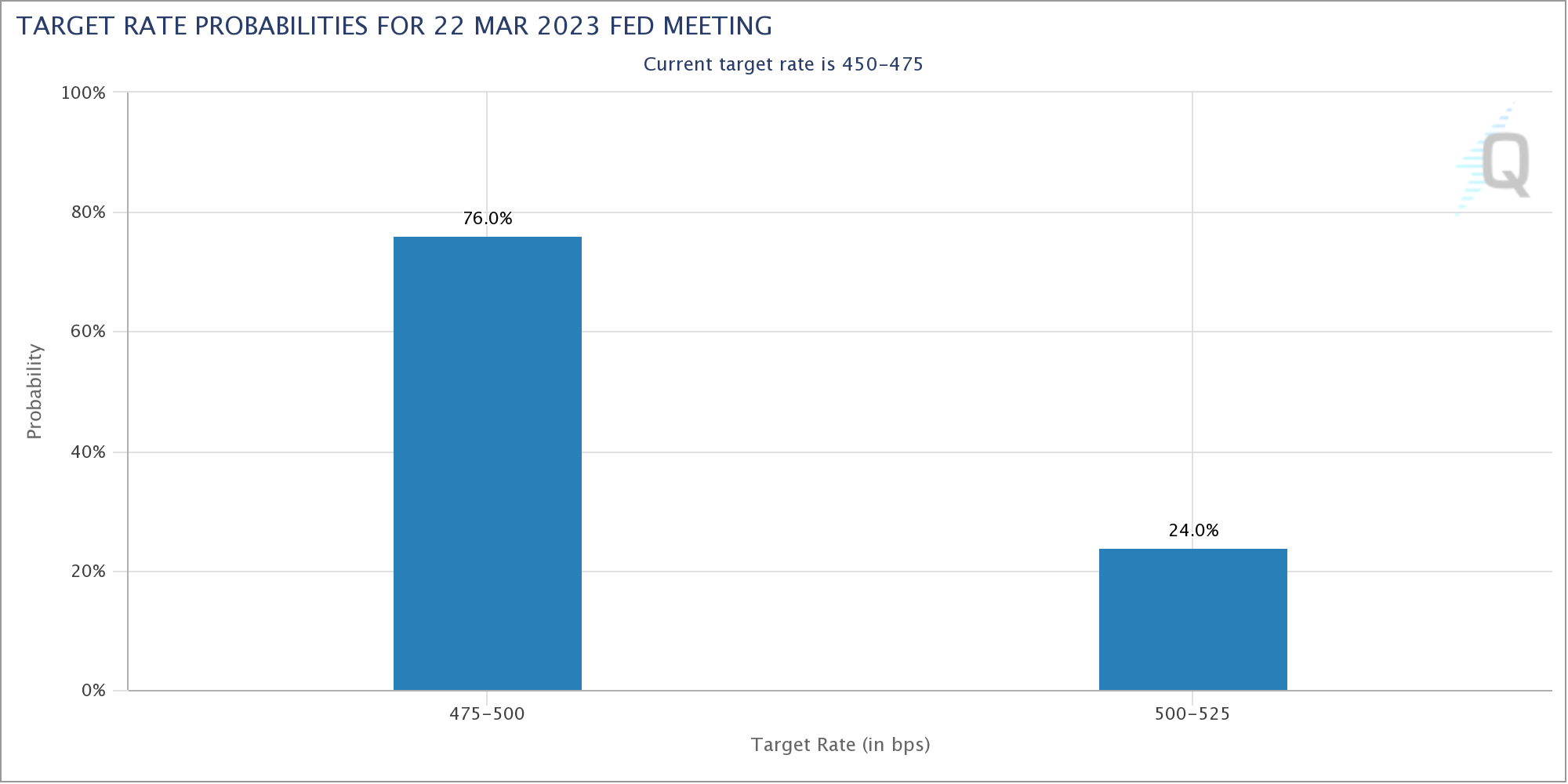
While there are more speculations regarding a revert to 50bps at March meeting, 25bps is still the majority of bets. For now, fed fund futures are pricing in 76% chance of another 25bps hike in March, and just 24% for 50bps.
Fed Williams: Our job is clear to restore price stability
New York Fed President John Williams said yesterday at a conference,"Our job is clear: our job is to make sure we restore price stability, which is truly the foundation of a strong economy."
Williams noted that the global supply chains are still disrupted, thus, "although goods prices have come down in last several months, there are signs this may not go as quickly as hoped."
At the same time, inflation in core services, excluding food, energy and shelter, remains far too high, as driven by excessive demand relative to supply.
RBNZ Orr: Cyclone rebuilding could add 1% to GDP over coming years
RBNZ Governor Adrian Orr told Bloomberg TV that rebuilding after the damage by cyclone Gabrielle is expected to boost activity and raise price pressure. There is a risk that OCR might be required to stay higher for longer as a result.
"We're looking at about a 1% addition to GDP over coming years," Orr said. "That is well manageable within the current monetary settings. But if inflation expectations continue, if core inflation is more persistent, then tighter for longer is certainly an outcome."
On the other hand, some of the global downside risks are "actually assisting on the inflation battle," Orr noted. "Economies are evolving broadly as anticipated, excluding these ongoing shocks. So I'm very confident that low and stable inflation will return."
Looking ahead
Eurozone CPI final is the only feature in European session. US will release jobless claims and GDP revision later in the day.
EUR/USD Daily Outlook
Daily Pivots: (S1) 1.0581; (P) 1.0623; (R1) 1.0646; More...
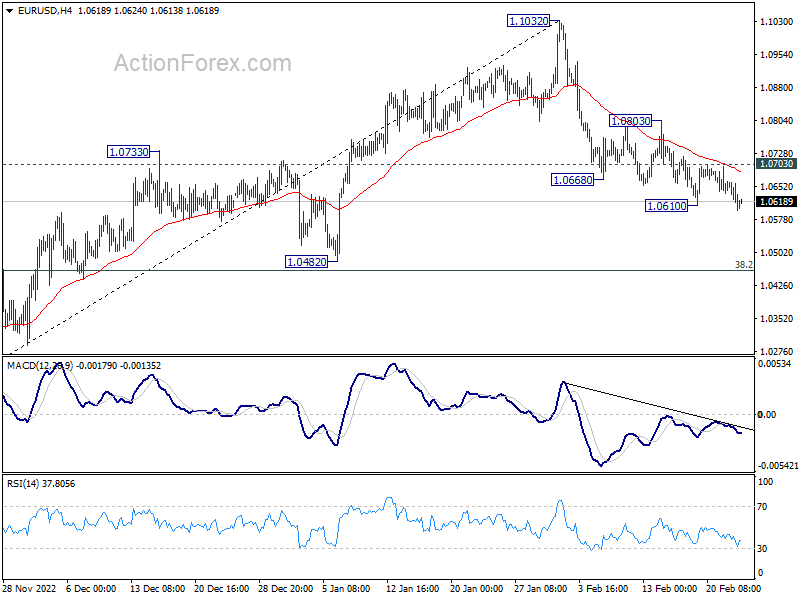
EUR/USD's corrective fall from 1.1032 resumed by breaking 1.0610 temporary low. Intraday bias is back on the downside. Further decline should be seen to 38.2% retracement of 0.9534 to 1.1032 at 1.0463. Strong support should be seen around there to bring rebound, at least on first attempt. On the upside, above 1.0703 minor resistance will turn intraday bias neutral first. But risk will continue to stay on the downside as long as 1.0803 resistance holds.
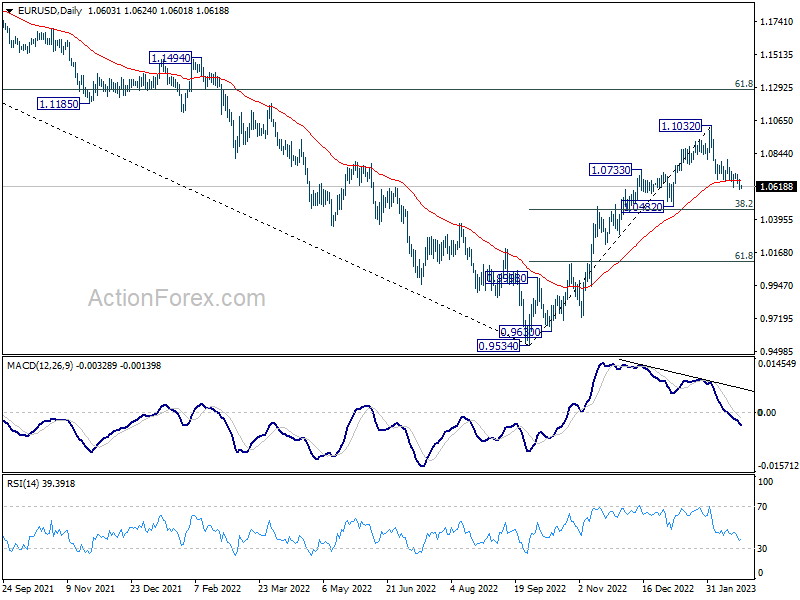
In the bigger picture, the rally from 0.9534 low (2022 low) is a medium term up trend rather than a correction. Further rise is in favor to 61.8% retracement of 1.2348 (2021 high) to 0.9534 at 1.1273 next. This will remain the favored case as long as 1.0482 support holds.
Economic Indicators Update
| GMT | Ccy | Events | Actual | Forecast | Previous | Revised |
|---|---|---|---|---|---|---|
| 00:30 | AUD | Private Capital Expenditure Q4 | 2.20% | 1.40% | -0.60% | |
| 10:00 | EUR | Eurozone CPI Y/Y Jan F | 8.50% | 8.50% | ||
| 10:00 | EUR | Eurozone CPI Core Y/Y Jan F | 5.20% | 5.20% | ||
| 13:30 | USD | Initial Jobless Claims (Feb 17) | 194K | |||
| 13:30 | USD | GDP Annualized Q4 P | 2.90% | 2.90% | ||
| 13:30 | USD | GDP Price Index Q4 P | 3.50% | 3.50% | ||
| 15:30 | USD | Natural Gas Storage | -60B | -100B | ||
| 16:00 | USD | Crude Oil Inventories | 2.9M | 16.3M |
RBNZ Orr: Cyclone rebuilding could add 1% to GDP over coming years
RBNZ Governor Adrian Orr told Bloomberg TV that rebuilding after the damage by cyclone Gabrielle is expected to boost activity and raise price pressure. There is a risk that OCR might be required to stay higher for longer as a result.
"We're looking at about a 1% addition to GDP over coming years," Orr said. "That is well manageable within the current monetary settings. But if inflation expectations continue, if core inflation is more persistent, then tighter for longer is certainly an outcome."
On the other hand, some of the global downside risks are "actually assisting on the inflation battle," Orr noted. "Economies are evolving broadly as anticipated, excluding these ongoing shocks. So I'm very confident that low and stable inflation will return."
Fed Williams: Our job is clear to restore price stability
New York Fed President John Williams said yesterday at a conference,"Our job is clear: our job is to make sure we restore price stability, which is truly the foundation of a strong economy."
Williams noted that the global supply chains are still disrupted, thus, "although goods prices have come down in last several months, there are signs this may not go as quickly as hoped."
At the same time, inflation in core services, excluding food, energy and shelter, remains far too high, as driven by excessive demand relative to supply.
FOMC minutes: A few participants favored 50bps hike
Minutes of January 31–February 1 FOMC meeting reveal that "almost all participants agreed that it was appropriate to raise the target range for the federal funds rate 25 basis points at this meeting."
"Many of these participants observed that a further slowing in the pace of rate increases would better allow them to assess the economy's progress... as they determine the extent of future policy tightening that will be required."
Yet, "a few participants stated that they favored raising the target range for the federal funds rate 50 basis points at this meeting or that they could have supported raising the target by that amount."
While there are more speculations regarding a revert to 50bps at March meeting, 25bps is still the majority of bets. For now, fed fund futures are pricing in 76% chance of another 25bps hike in March, and just 24% for 50bps.
AUD/USD Remains Vulnerable, US GDP Report Next
Key Highlights
- AUD/USD moved into a bearish zone below the 0.7000 support.
- It is facing resistance near 0.6880 and a bearish trend line on the 4-hours chart.
- Crude oil price is showing bearish signs below the $78 pivot level.
- The US Gross Domestic Product could grow 2.9% in Q4 2022 (Preliminary).
AUD/USD Technical Analysis
The Aussie Dollar started a major decline from well above 0.7120 against the US Dollar. AUD/USD declined below the 0.7000 support zone to enter a bearish zone.
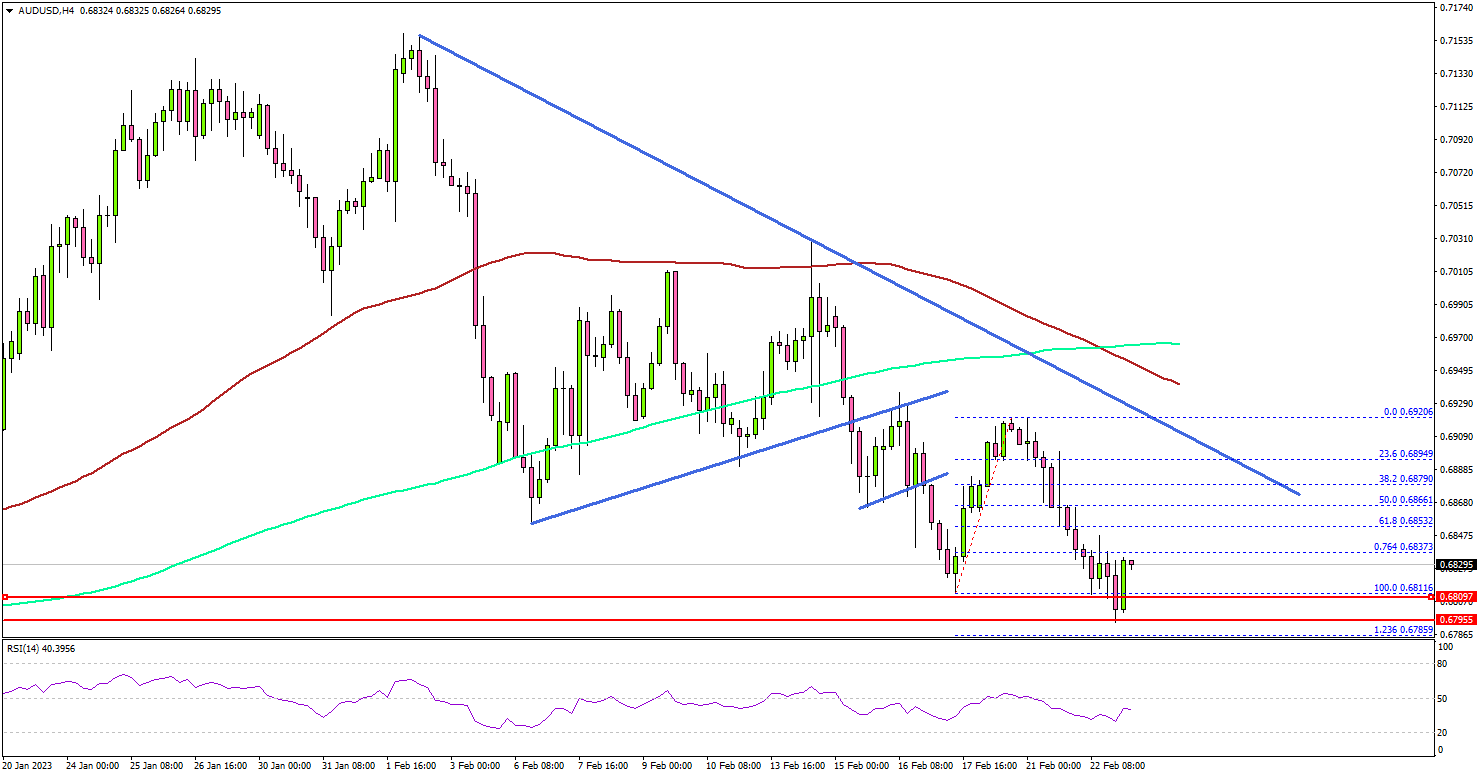
Looking at the 4-hours chart, the pair settled below the 0.6950 level, the 100 simple moving average (red, 4-hours), and the 200 simple moving average (green, 4-hours).
There was a clear move below the 0.6880 support zone. The pair even spiked below the 0.6820 level and remains at a risk of more losses. On the downside, an immediate support is near the 0.6800 level.
The next major support is near the 0.6750 level, below which there is a risk of a move towards the 0.6720. Any more losses could open the doors for a drop towards 0.6650.
On the upside, an immediate resistance is near the 0.6860 level. The next major resistance is near the 0.6880 level and a connecting bearish trend line on the same chart. The main resistance is now forming near 0.7000 and the 100 simple moving average (red, 4-hours).
A clear move above the 0.7000 resistance might start a steady increase towards the 0.7080 resistance zone. Any more gains could open the doors for a move towards the 0.7150 level.
Looking at EUR/USD, the pair is still in a negative zone below the 1.0700 level and recoveries might face hurdles.
Economic Releases
- US Initial Jobless Claims - Forecast 200K, versus 194K previous.
- US Gross Domestic Product Q4 2022 (Preliminary) – Forecast 2.9% versus previous 2.9%.
Is The Chinese Crypto Narrative Bullish for Bitcoin?
Following the September 2021 cryptocurrency ban by the Chinese government, it was gathered that some economists urged the government to reconsider crypto trading and mining favorably. One such person is Huang Yiping, an economics professor and former adviser to the Chinese Central Bank. We are now beginning to see a more lenient approach toward crypto investors in Asia, leading to what many are tagging as the next bull run. The question remains, is the Chinese crypto narrative bullish for mainstream cryptos?
BTCUSD -Weekly Timeframe
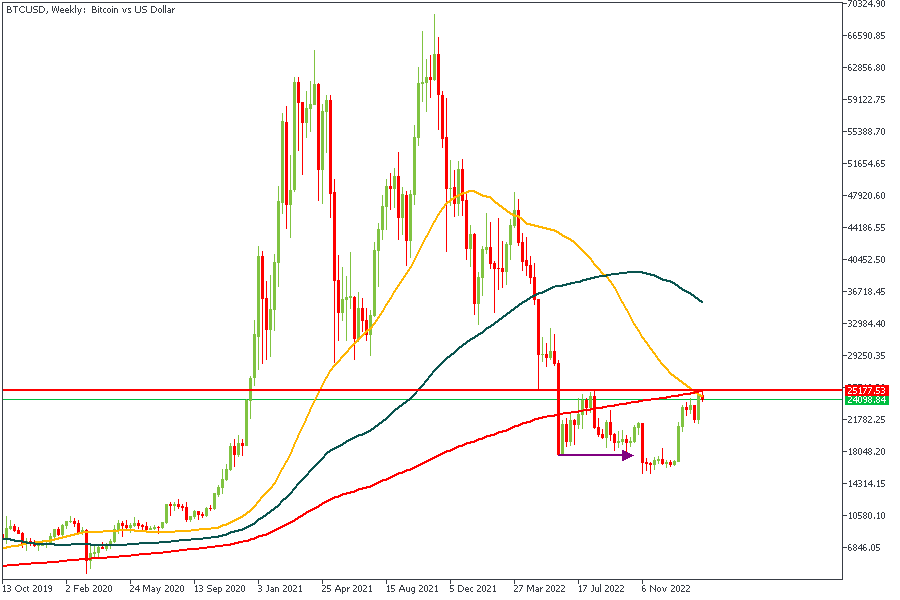
Bitcoin is under pressure from the 50 and 200 period moving averages on the weekly timeframe. There is also considerable impact from the pivot line at $25k. These factors point credibly to a bearish intent. However, we will also consider the outlook on the Daily timeframe.
BTCUSD - Daily Timeframe
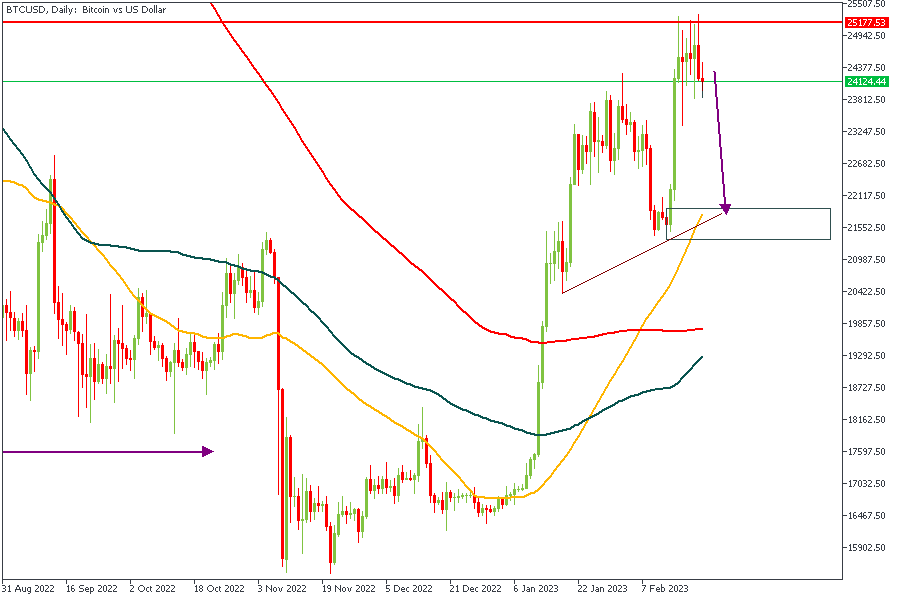
Based on what we've seen from the weekly timeframe and the current reaction, we see clearly from the resistance line in the daily timeframe. The primary target would be the $22k area.
Analysts’ Expectations:
- Direction: Bearish
- Target: $22 000
- Invalidation: $25 000
ETHUSD - Weekly Timeframe
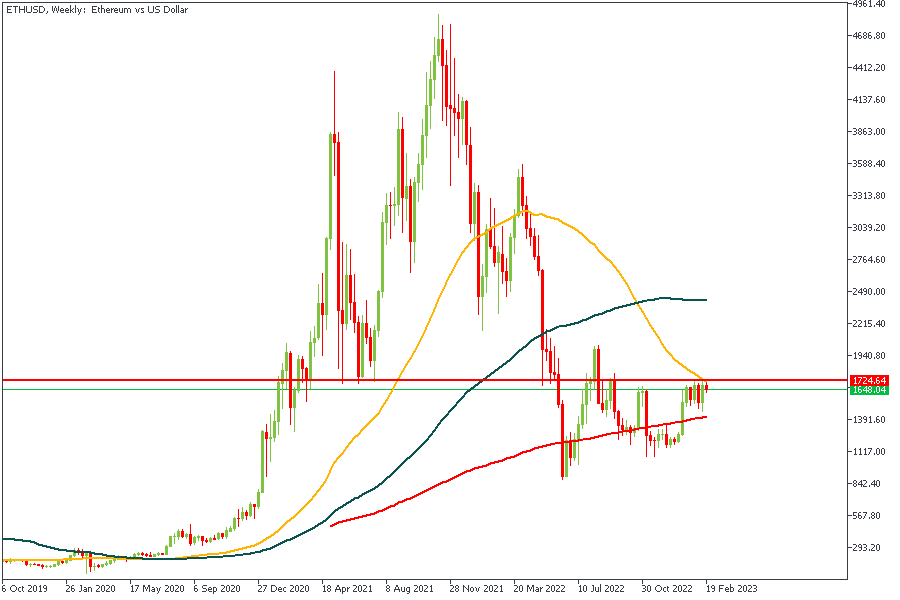
Here is the weekly timeframe chart for ETHUSD. So far, $1724 has acted as a natural resistance zone, pushing the price down quickly. There is also the 50-period moving average glaring down viciously at a price. To conclude this sentiment as a mature one, let's see how things are looking on the daily timeframe.
ETHUSD - Daily Timeframe
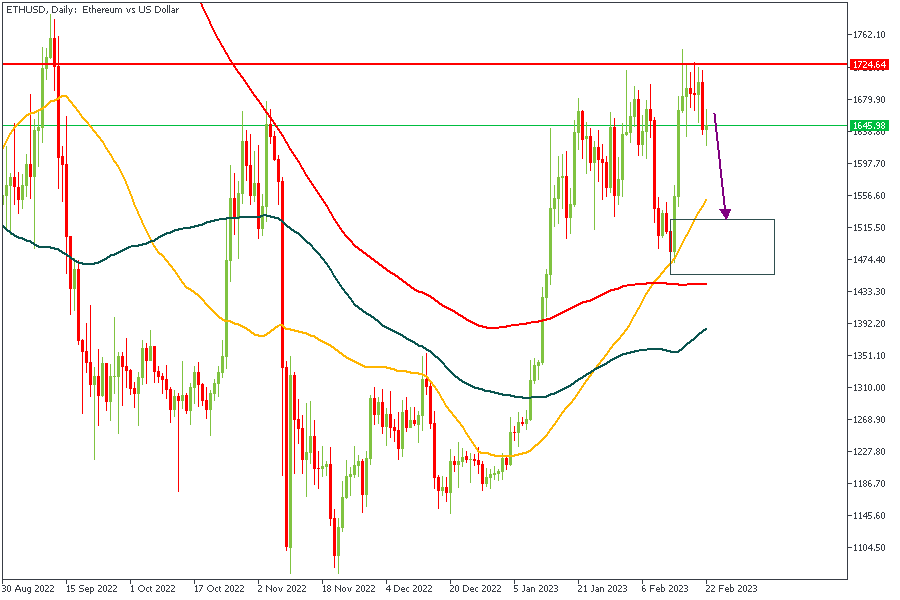
The Daily price action here confirms our sentiment from the weekly timeframe. The $1724 resistance is a key zone even though we have the 50-day moving average closing in on the price.
Analysts’ Expectations:
- Direction: Bearish
- Target: $1550
- Invalidation: $1725
CONCLUSION
The trading of CFDs comes at a risk. Thus, to succeed, you have to manage risks properly. To avoid costly mistakes while you look to trade these opportunities, be sure to do your due diligence and manage your risk appropriately.
AUDNZD Wave Analysis
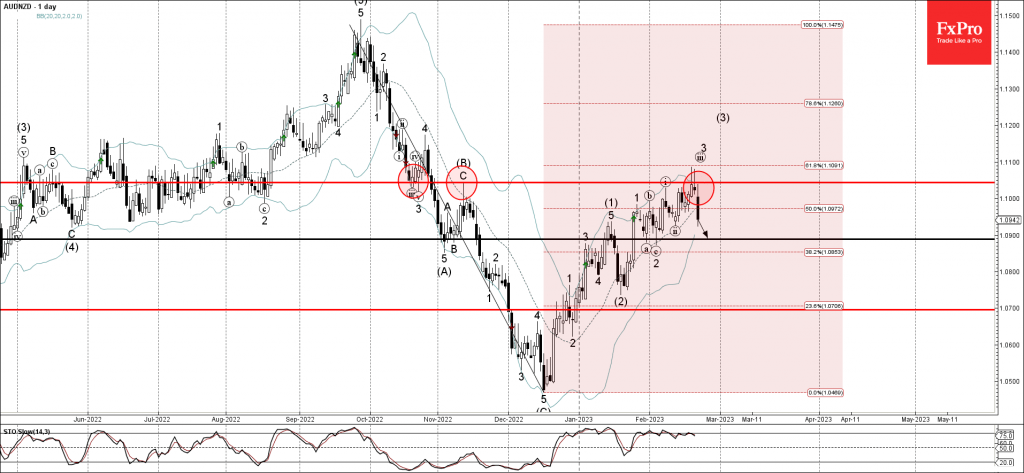
- AUDNZD reversed from resistance level 1.1045
- Likely to fall to support level 1.0900
AUDNZD currency pair recently reversed down with the two daily Shooting Stars from the resistance level 1.1045 (former monthly high from November).
The downward reversal from the resistance level 1.1045 stopped the previous impulse waves (iii) and 3, which belong to wave (3) from January.
Given the triple bearish divergence on the daily Stochastic, AUDNZD can be expected to fall further toward the next support level 1.0900 (low of the previous correction 2).
GBPNZD Wave Analysis
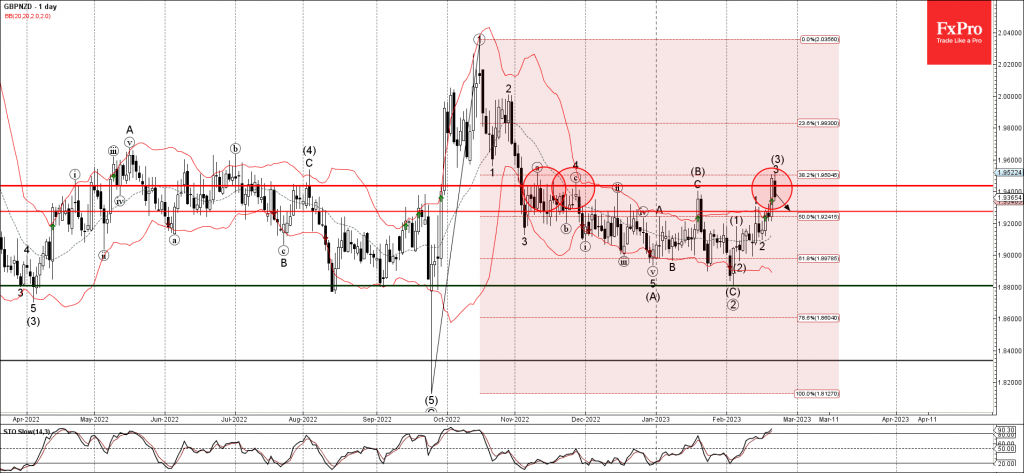
- GBPNZD reversed from resistance level 1.9436
- Likely to fall to level 1.9275
GBPNZD currency pair recently reversed down from the resistance level 1.9436 (which has been reversing the price from the start of November) standing above the upper daily Bollinger Band.
The downward reversal from the resistance level 1.9436 stopped the previous intermediate impulse wave (3).
Given the overbought daily Stochastic, GBPNZD can be expected to fall further toward the next support level 1.9275 (former top of the impulse wave 1).
Fed Minutes Showed that Rates Will Continue to Move Higher
The minutes from the Jan. 31-Feb. 1, 2023 Federal Open Market Committee (FOMC) meeting showed that the Fed remains committed to bringing inflation back to target.
On the progression of the economy, the Committee members noted that "recent indicators pointed to modest growth in spending and production. Nonetheless, job gains had been robust in recent months, and the unemployment rate remained low. Inflation had eased somewhat but remained elevated."
The minutes showed that "almost all participants agreed that it was appropriate to raise the target range for the federal funds rate 25 basis points at this meeting." Members that supported a 50-basis point increase believe that a larger increase would more quickly get them to a sufficiently restrictive position to enable achieving price stability in a timely way.
On the future path of monetary policy, committee members anticipated that "ongoing increases in the target range for the federal funds rate would be appropriate to achieve the Committee’s objectives." Moreover, that it is important to maintain a restrictive stance until there is clear evidence that inflation is moving toward the Fed's 2% target.
Key Implications
Today's minutes confirmed that further rate hikes are on tap, and will largely depend on incoming data. While the disinflationary process has begun, January's CPI print shows that the Fed has more work to do to get inflation on a sustainable path towards its 2% target. This sentiment has been echoed by multiple Fed members and is reflected in the U.S. 2-year Treasury yield, which has increased by 58 basis points since the beginning of February.
A host of stronger-than-expected data releases to begin the year has undoubtedly caught the attention of the Fed. Financial markets have also adjusted their view of the future path of rates upward. Economic momentum is expected to slow in 2023 as the full impact of the Fed's historic rate increases weighs. Recession fears refuse to abate, with the Fed acknowledging the risk. We expect the Fed will continue to raise rates to a peak of 5.25%, before pausing to assess the impact of its actions on the economic backdrop.
(FED) Minutes of the Federal Open Market Committee
January 31–February 1, 2023
A joint meeting of the Federal Open Market Committee and the Board of Governors of the Federal Reserve System was held in the offices of the Board of Governors on Tuesday, January 31, 2023, at 10:00 a.m. and continued on Wednesday, February 1, 2023, at 9:00 a.m.1
Attendance
Jerome H. Powell, Chair
John C. Williams, Vice Chair
Michael S. Barr
Michelle W. Bowman
Lael Brainard
Lisa D. Cook
Austan D. Goolsbee
Patrick Harker
Philip N. Jefferson
Neel Kashkari
Lorie K. Logan
Christopher J. Waller
Thomas I. Barkin, Raphael W. Bostic, Mary C. Daly, Loretta J. Mester, and Helen E. Mucciolo, Alternate Members of the Committee
James Bullard and Susan M. Collins, Presidents of the Federal Reserve Banks of St. Louis and Boston, respectively
Kelly J. Dubbert, Interim President of the Federal Reserve Bank of Kansas City
Joshua Gallin, Secretary
Matthew M. Luecke, Deputy Secretary
Brian J. Bonis, Assistant Secretary
Michelle A. Smith, Assistant Secretary
Mark E. Van Der Weide, General Counsel
Richard Ostrander, Deputy General Counsel
Trevor A. Reeve, Economist
Stacey Tevlin, Economist
Beth Anne Wilson, Economist
Shaghil Ahmed, Roc Armenter, James A. Clouse, Brian M. Doyle, Eric M. Engen, Anna Paulson, Andrea Raffo, and William Wascher, Associate Economists
Patricia Zobel, Manager pro tem, System Open Market Account
Stephanie R. Aaronson, Senior Associate Director, Division of Research and Statistics, Board
Jose Acosta, Senior Communications Analyst, Division of Information Technology, Board
Isaiah C. Ahn, Information Management Analyst, Division of Monetary Affairs, Board
Alyssa Arute,2 Manager, Division of Reserve Bank Operations and Payment Systems, Board
Kartik B. Athreya, Executive Vice President, Federal Reserve Bank of Richmond
Penelope A. Beattie, Section Chief, Office of the Secretary, Board
Travis J. Berge, Principal Economist, Division of Research and Statistics, Board
David Bowman, Senior Associate Director, Division of Monetary Affairs, Board
Isabel Cairó, Principal Economist, Division of Monetary Affairs, Board
Prabal Chakrabarti, Executive Vice President, Federal Reserve Bank of Boston
Kathryn B. Chen, Director of Cross Portfolio Policy & Analysis, Federal Reserve Bank of New York
Laura Choi, Senior Vice President, Federal Reserve Bank of San Francisco
Daniel M. Covitz, Deputy Director, Division of Research and Statistics, Board
Stephanie E. Curcuru, Deputy Director, Division of International Finance, Board
Marnie Gillis DeBoer, Senior Associate Director, Division of Monetary Affairs, Board
Navtej S. Dhillon, Special Adviser to the Board, Division of Board Members, Board
Burcu Duygan-Bump, Special Adviser to the Board, Division of Board Members, Board
Rochelle M. Edge, Deputy Director, Division of Monetary Affairs, Board
Charles A. Fleischman, Adviser, Division of Research and Statistics, Board
Glenn Follette, Associate Director, Division of Research and Statistics, Board
Carlos Garriga, Senior Vice President, Federal Reserve Bank of St. Louis
Michael S. Gibson, Director, Division of Supervision and Regulation, Board
Christine Graham, Deputy Associate Director, Division of Supervision and Regulation, Board
Joseph W. Gruber, Executive Vice President, Federal Reserve Bank of Kansas City
Valerie S. Hinojosa, Section Chief, Division of Monetary Affairs, Board
Jane E. Ihrig, Special Adviser to the Board, Division of Board Members, Board
Michael T. Kiley, Deputy Director, Division of Financial Stability, Board
Anna Kovner, Director of Financial Stability Policy Research, Federal Reserve Bank of New York
David E. Lebow, Senior Associate Director, Division of Research and Statistics, Board
Sylvain Leduc, Director of Research, Federal Reserve Bank of San Francisco
Andreas Lehnert, Director, Division of Financial Stability, Board
Karen Leone de Nie, Vice President, Reserve Bank of Atlanta
Kurt F. Lewis,2 Special Adviser to the Board, Division of Board Members, Board
Laura Lipscomb, Special Adviser to the Board, Division of Board Members, Board
Francesca Loria, Senior Economist, Division of Monetary Affairs, Board
Andrew Meldrum, Assistant Director, Division of Monetary Affairs, Board
Ann E. Misback, Secretary, Office of the Secretary, Board
Michelle M. Neal, Head of Markets, Federal Reserve Bank of New York
Giovanni Olivei, Senior Vice President, Federal Reserve Bank of Boston
Ander Perez-Orive, Principal Economist, Division of Monetary Affairs, Board
Nellisha D. Ramdass, Deputy Director, Division of Monetary Affairs, Board
Julie Ann Remache, Head of Cross Market & Portfolio Analysis, Federal Reserve Bank of New York
Linda Robertson, Assistant to the Board, Division of Board Members, Board
Zina Bushra Saijid, Senior Financial Analyst, Division of International Finance, Board
Zack Saravay, Financial Institution and Policy Analyst, Division of Monetary Affairs, Board
Samuel Schulhofer-Wohl, Senior Vice President, Federal Reserve Bank of Dallas
Chiara Scotti, Deputy Associate Director, Division of Financial Stability, Board
Nitish Ranjan Sinha, Special Adviser to the Board, Division of Board Members, Board
Ellis W. Tallman, Executive Vice President, Federal Reserve Bank of Cleveland
Manjola Tase, Principal Economist, Division of Monetary Affairs, Board
Alene G. Tchourumoff, Senior Vice President, Federal Reserve Bank of Minneapolis
Robert J. Tetlow, Senior Adviser, Division of Monetary Affairs, Board
Clara Vega, Special Adviser to the Board, Division of Board Members, Board
Jeffrey D. Walker,2 Associate Director, Division of Reserve Bank Operations and Payment Systems, Board
Min Wei, Senior Associate Director, Division of Monetary Affairs, Board
Jonathan Willis, Vice President and Senior Economist, Federal Reserve Bank of Atlanta
Paul R. Wood, Special Adviser to the Board, Division of Board Members, Board
Rebecca Zarutskie, Special Adviser to the Board, Division of Board Members, Board
Annual Organizational Matters3
The agenda for this meeting reported that advices of the election of the following members and alternate members of the Federal Open Market Committee for a term beginning January 31, 2023, were received and that these individuals executed their oaths of office.
The elected members and alternate members were as follows:
John C. Williams, President of the Federal Reserve Bank of New York, with Helen E. Mucciolo, Interim First Vice President of the Federal Reserve Bank of New York, as alternate
Patrick Harker, President of the Federal Reserve Bank of Philadelphia, with Thomas I. Barkin, President of the Federal Reserve Bank of Richmond, as alternate
Austan D. Goolsbee, President of the Federal Reserve Bank of Chicago, with Loretta J. Mester, President of the Federal Reserve Bank of Cleveland, as alternate
Lorie K. Logan, President of the Federal Reserve Bank of Dallas, with Raphael W. Bostic, President of the Federal Reserve Bank of Atlanta, as alternate
Neel Kashkari, President of the Federal Reserve Bank of Minneapolis, with Mary C. Daly, President of the Federal Reserve Bank of San Francisco, as alternate.
By unanimous vote, the following officers of the Committee were selected to serve until the selection of their successors at the first regularly scheduled meeting of the Committee in 2024:
| Jerome H. Powell | Chair |
| John C. Williams | Vice Chair |
| Joshua Gallin | Secretary |
| Matthew M. Luecke | Deputy Secretary |
| Brian J. Bonis | Assistant Secretary |
| Michelle A. Smith | Assistant Secretary |
| Mark E. Van Der Weide | General Counsel |
| Richard Ostrander | Deputy General Counsel |
| Charles C. Gray | Assistant General Counsel |
| Trevor A. Reeve | Economist |
| Stacey Tevlin | Economist |
| Beth Anne Wilson | Economist |
| Shaghil Ahmed | |
| Roc Armenter | |
| James A. Clouse | |
| Brian M. Doyle | |
| Eric M. Engen | |
| Beverly J. Hirtle | |
| Anna Paulson | |
| Andrea Raffo | |
| Chiara Scotti4 | |
| William Wascher | Associate Economists |
By unanimous vote, the Committee selected the Federal Reserve Bank of New York to execute transactions for the System Open Market Account (SOMA).
By unanimous vote, the Committee selected Patricia Zobel to serve at the pleasure of the Committee as deputy manager of the SOMA through February 20, 2023, and Roberto Perli and Julie Ann Remache to serve at the pleasure of the Committee as manager and deputy manager of the SOMA, respectively, effective February 21, 2023, on the understanding that these selections were subject to being satisfactory to the Federal Reserve Bank of New York.
Secretary's note: The Federal Reserve Bank of New York subsequently sent advice that the selections indicated previously were satisfactory.
As part of the annual review of the Committee's governance documents for open market operations and foreign currency transactions, the Committee unanimously approved a new governance document titled "FOMC Authorizations and Continuing Directives for Open Market Operations."3 The new document includes (1) authorizations previously in the Committee's Authorization for Foreign Currency Operations and Authorization for Domestic Open Market Operations; (2) a new "Continuing Directive for Domestic Open Market Operations," which combines direction to the Desk in the Standing Repurchase Agreement Facility and FIMA Repurchase Agreement Facility resolutions with direction to the Desk to continue to carry out other ongoing activities; (3) the Foreign Currency Directive; and (4) two other existing documents related to contingency arrangements. The new unified document improves clarity and transparency in the governance of Desk activities but does not make substantive changes to governance. The domestic policy directive released after each FOMC meeting will have modest conforming changes going forward.
Ahead of the vote on policies relating to information security, external communications, and investment and trading, the Chair commented on the critical importance of maintaining the public's trust and confidence in the Federal Reserve as an institution and indicated that these policies were very important in that regard. All participants indicated support for, and agreed to abide by the requirements of, the Program for Security of FOMC Information (Program), the FOMC Policy on External Communications of Committee Participants, the FOMC Policy on External Communications of Federal Reserve System Staff, and the Investment and Trading Policy for FOMC Officials. The Committee voted unanimously to reaffirm all four policies without revision.3
As part of the Committee's annual organizational review process, all participants indicated support for the Statement on Longer-Run Goals and Monetary Policy Strategy, and the Committee voted unanimously to reaffirm it without revision.3
Developments in Financial Markets and Open Market Operations
The manager pro tem turned first to a review of U.S. financial market developments. Market participants generally expected U.S. economic growth to moderate this year, although there was a wide dispersion in views about the extent of a potential slowdown. Market participants interpreted incoming data as pointing to moderating inflation risks. Against this backdrop, market participants judged that the FOMC would likely slow the pace of rate increases further at the current meeting, and respondents to the Desk's Survey of Primary Dealers and Survey of Market Participants widely expected the Committee to implement a 1/4 percentage point increase in the target range for the federal funds rate. Survey respondents assessed that uncertainty around the likely peak level of the policy rate narrowed relative to the comparable results from the December surveys and, on average, placed significant probability on a target federal funds rate range close to 5 percent. A significant share of survey respondents anticipated that the Committee would hold the policy rate stable for much of 2023.
Moderating inflation in the United States and improving global growth prospects lifted market sentiment. While most Desk survey respondents expected subdued growth or a mild recession in 2023, market participants continued to see notable uncertainties ahead, including prospects for a deeper downturn or the potential for more persistent inflation.
Regarding the international outlook, signs of a faster reopening in China and a less severe downturn in Europe eased concerns about global growth, contributing to a depreciation in the exchange value of the dollar and supporting optimism about emerging market economies. Narrowing interest rate differentials between the United States and other advanced foreign economies also contributed to dollar depreciation, as some foreign central bank communications suggested a need for further monetary policy tightening to address inflation pressures. In addition, the Bank of Japan unexpectedly widened its yield curve control band at its December meeting to address market functioning issues in the market for Japanese government bonds. Over the period, some other central banks communicated that they were at or near a point where it would be appropriate to pause policy rate increases and assess the effects of cumulative policy tightening.
The manager pro tem turned next to a discussion of money markets and Federal Reserve operations. Money market rates were stable over the period, with the year-end passing smoothly. As expected, balances in the overnight reverse repurchase agreement (ON RRP) facility increased at year-end but quickly retraced. Market participants generally expected usage of the ON RRP facility to continue a downward trend in 2023, moderating the decline in reserve balances as the Federal Reserve's holdings of securities continue to run off. Should transitory pressures occur in money markets over the course of the year, the manager pro tem noted that the standing repurchase agreement (repo) facility and discount window would be available to help support effective monetary policy implementation.
The manager noted that, over coming months, developments affecting the Treasury General Account (TGA) and Treasury financing could influence money market conditions. An increase in TGA balances associated with April individual tax receipts could result in a temporary decline in reserve balances. In subsequent months, uncertainties associated with the debt limit could also be important. In particular, the Treasury could increase bill issuance to rebuild TGA balances once the debt limit is lifted, reducing reserves and potentially lifting money market rates. The manager pro tem noted that in recent months, investors in the ON RRP facility had responded to small increases in money market rates by shifting balances into private investments, and that reductions in ON RRP volumes may help smooth adjustments in money markets.
By unanimous vote, the Committee ratified the Desk's domestic transactions over the intermeeting period. There were no intervention operations in foreign currencies for the System's account during the intermeeting period.
Staff Review of the Economic Situation
The information available at the time of the January 31–February 1 meeting indicated that labor market conditions remained tight in December, with the unemployment rate at a historical low. Consumer price inflation—as measured by the 12-month percent change in the price index for personal consumption expenditures (PCE)—continued to step down in November and December but was still elevated. Real gross domestic product (GDP) increased at a solid pace in the fourth quarter of last year.
Total nonfarm payroll employment increased solidly in December, although at a slower pace than in the previous two months. The unemployment rate moved back down to 3.5 percent in December. The unemployment rate for African Americans was unchanged, and the unemployment rate for Hispanics ticked up; the unemployment rates for both groups remained above the aggregate measure. The aggregate measures of both the labor force participation rate and the employment-to-population ratio edged up. The private-sector job openings rate, as measured by the Job Openings and Labor Turnover Survey, was flat in November and remained high.
Measures of nominal wage growth slowed at the end of last year but continued to be elevated. The three-month change in the employment cost index (ECI) of hourly compensation in the private sector slowed to a 4.0 percent annual rate in December, while the three-month change measure of average hourly earnings (AHE) for all employees eased to an annual rate of 4.1 percent. Over the 12 months ending in December, the ECI increased 5.1 percent, and AHE rose 4.6 percent.
Consumer price inflation eased in November and December but remained elevated. Total PCE price inflation was 5.0 percent over the 12 months ending in December, 1.1 percentage points lower than the October figure. Core PCE price inflation, which excludes changes in consumer energy prices and many consumer food prices, was 4.4 percent over the 12 months ending in December, down 0.7 percentage point from its October reading. The trimmed mean measure of 12-month PCE price inflation constructed by the Federal Reserve Bank of Dallas was 4.4 percent in December, 0.3 percentage point lower than in October. The latest survey-based readings on longer-term inflation expectations from the University of Michigan Surveys of Consumers and the Federal Reserve Bank of New York's Survey of Consumer Expectations remained within the range of their values reported in recent months, while near-term measures of inflation expectations from these surveys moved down along with actual inflation.
Although real GDP expanded at an annual rate of 2.9 percent in the fourth quarter, real private domestic final purchases (PDFP)—which includes PCE, residential investment, and business fixed investment—increased at a subdued annual rate of 0.2 percent. Real GDP growth was bolstered especially by a large gain in inventory investment and a notable contribution from net exports, as imports fell more than exports. Both inventories and net exports are volatile categories in aggregate spending. Regarding production, U.S. manufacturing output declined sizably in both November and December.
Foreign economic growth slowed in the fourth quarter, weighed down by the COVID-19-related slowdown in China and repercussions of Russia's war against Ukraine. Weaker global demand and a rebalancing from goods to services also resulted in a pronounced slowdown in manufacturing, which weighed on activity in emerging Asia. In China, the pivot away from its zero-COVID policy appears to have resulted in a rapid surge in virus cases late in the year, but also in a rebound in activity as restrictions were rapidly removed. In Europe, the slowdown in economic growth was tempered by mild winter weather, which also prompted further declines in energy prices. A decline in retail energy as well as food prices contributed to an easing in headline consumer price inflation in many foreign economies. With core inflation remaining elevated amid tight labor markets, however, many central banks continued to tighten monetary policy.
Staff Review of the Financial Situation
Over the intermeeting period, the market-implied federal funds rate path was little changed for 2023 but moderately moved down further out. Nominal Treasury yields were little changed, while swaps-based inflation compensation measures fell notably. Stock market indexes were slightly higher, and market volatility declined but remained slightly elevated. Businesses and households continued to face elevated borrowing costs. Credit quality remained strong overall, although there were some signs of deterioration for consumer loans.
The market-implied federal funds rate path for 2023 was little changed, on net, during the intermeeting period but fell moderately beyond mid-2024. On net, nominal Treasury yields were roughly unchanged, and swaps-market-implied inflation compensation measures fell notably.
Broad stock price indexes ended the intermeeting period only slightly higher despite sizable fluctuations. Equity prices fell sharply following the December FOMC statement but recovered over the remainder of the period in response to data releases. The VIX—the one-month option-implied volatility on the S&P 500—decreased somewhat but remained slightly above the median range of its historical distribution. Spreads on investment-grade and high-yield corporate bonds narrowed somewhat, on net, over the intermeeting period, while spreads on municipal bonds narrowed substantially.
Conditions in short-term funding markets remained stable over the intermeeting period, with the December increase in the target range for the federal funds rate and the associated increases in the Federal Reserve's administered rates passing through quickly to overnight money market rates. In secured markets, repo rates were roughly the same as the ON RRP offering rate but continued to occasionally print slightly higher around days with Treasury bill and coupon settlements. Daily take-up in the ON RRP facility remained elevated, reflecting continued elevated assets under management (AUM) for money market mutual funds (MMFs), ongoing uncertainty around the policy path, and limited supply of alternative investments such as Treasury bills. Net yields on MMFs rose further over the intermeeting period, mostly passing through the increase in administered rates. Bank deposit rates gradually increased but continued to lag cumulative increases in the federal funds rate.
Over the intermeeting period, investor perceptions of an improved economic outlook in China and Europe contributed to increases in foreign risky asset prices and weighed on the exchange value of the dollar. Global equity indexes rose, supported in part by lower European natural gas prices and China's decision to abandon its zero-COVID policy. Sovereign yields increased notably in the euro area and Japan, reflecting more-restrictive-than-expected communications from the European Central Bank and the Bank of Japan's decision to widen its yield curve control target band, respectively. In contrast, yields in other major advanced foreign economies were little changed on net. The staff's broad dollar index declined over the intermeeting period, with larger declines against emerging market economy (EME) currencies amid significant inflows into EME-focused investment funds in January on improved investor sentiment. Narrowing yield differentials between the United States and some advanced foreign economies also contributed to the depreciation of the dollar.
In domestic credit markets, businesses and households continued to face elevated borrowing costs. Yields for corporate bonds declined, while borrowing costs for leveraged loans were little changed at elevated levels. Bank interest rates for commercial and industrial (C&I) loans continued to trend upward in the fourth quarter. Yields on municipal bonds declined during the intermeeting period but remained above their historical average. Residential mortgage rates were little changed over the intermeeting period and remained well above their levels in the previous tightening cycle, notwithstanding the decline from their peak in early November. Interest rates on existing credit cards continued to increase in recent months, and interest rates on new auto loans also rose through mid-January.
Credit remained broadly available for businesses and households with strong credit quality but remained tight for lower-rated borrowers. Lending standards tightened further for bank-dependent borrowers. Issuance of corporate bonds was subdued in December before picking up somewhat in January. New launches of leveraged loans were notably subdued in December and January, likely reflecting soft investor demand and higher reference rates on floating-rate loans.
In the January Senior Loan Officer Opinion Survey on Bank Lending Practices (SLOOS), banks reported having tightened C&I and commercial real estate (CRE) lending standards over the previous three months. Although C&I loans at banks continued to expand through December, they decelerated relative to earlier in the year, in line with tighter lending standards and weaker demand for C&I loans over the fourth quarter. CRE loan growth on domestic banks' balance sheets remained robust in the fourth quarter. Meanwhile, issuance of commercial mortgage-backed securities remained slow in November and December, amid high base interest rates and spreads. Some tightening in lending conditions was also evident for small businesses, with the share of small firms reporting that it was more difficult to obtain credit compared with three months earlier continuing to trend up through December.
Credit was broadly available in the residential mortgage market for high-credit-score borrowers who met standard conforming loan criteria. Credit availability for households with lower credit scores was considerably tighter, though comparable to levels prevailing before the pandemic. Purchase mortgage applications and refinance applications were both little changed over the intermeeting period. Home equity line of credit (HELOC) balances at banks continued to grow through the fourth quarter, on net, potentially reflecting homeowners using HELOCs as a preferred way of extracting home equity in the presence of high current mortgage rates. In the January SLOOS, banks reported tighter standards for all consumer loans. Even so, total credit card balances increased at a solid pace in November, while auto loans grew modestly.
Overall, credit quality remained strong, although there was some deterioration for credit card and auto loan borrowers and some predictors of future credit quality worsened a bit further. The volume of corporate bond rating downgrades outpaced upgrades in December, although the level of downgrades remained moderate. Leveraged loans experienced notable net rating downgrades in December, but the pace moderated in January. Default rates on corporate bonds and leveraged loans remained low. Measures of expected default probabilities for corporate bonds and leveraged loans remained elevated relative to their historical distributions. The credit quality of businesses that borrow from banks remained sound, on balance, although, in the January SLOOS, banks reported expecting a deterioration in the quality of business loans in their portfolio over 2023. Delinquencies on small business loans continued to edge up in November but remained low relative to historical levels.
The credit quality of households also remained strong, on balance, despite some signs of deterioration. Delinquencies for Federal Housing Administration mortgages increased slightly, but overall mortgage delinquency rates were still near pre-pandemic lows. Delinquency rates for credit cards and auto loans continued to rise during the third quarter. While delinquency rates on credit cards were still relatively low, those on auto loans rose above pre-pandemic levels. In the January SLOOS, banks reported expecting a further deterioration in the quality of household loans in 2023, especially for consumer loans.
The staff provided an update on its assessment of the stability of the financial system and, on balance, characterized the financial vulnerabilities of the U.S. financial system as moderate. The staff judged that asset valuation pressures remained notable. In particular, the staff noted that measures of valuations in both residential and commercial property markets remained high, and that the potential for large declines in property prices remained greater than usual. In addition, the forward price-to-earnings ratio for S&P 500 firms remained above its median value despite the decline in equity prices over the past year. The staff assessed that valuation pressures had eased for corporate bonds and leveraged loans, as spreads in both markets had increased from recent lows.
The staff assessed that vulnerabilities associated with household and business leverage remained moderate, noting that although measures of business leverage were at or near a historically high level, the ability of firms to service their debt has kept pace with rising debt loads and interest rates. Household borrowing rose for borrowers with prime credit scores but declined for households with lower credit scores. Vulnerabilities associated with financial leverage also remained moderate. In particular, risk-based capital ratios for banks increased slightly, a staff measure of leverage at life insurance companies remained relatively flat in recent quarters, and leverage among private credit funds has remained steady for several years. While measures of hedge fund leverage have decreased since the pandemic shock, the staff noted that leverage among the largest funds was on track to return to 2019 levels.
Vulnerabilities associated with funding risks were characterized as moderate. The rising rate environment has prompted inflows into prime retail MMFs, while AUM at prime institutional funds, which have proved more sensitive to turmoil in the past, have grown much less. Assets in open-end mutual funds that invest in less liquid instruments like bank loans or high-yield corporate bonds have declined notably over the past year. In response to vulnerabilities at MMFs and open-end mutual funds, the Securities and Exchange Commission has proposed rules to make these funds more resilient.
Staff Economic Outlook
The forecast for the U.S. economy prepared by the staff for this FOMC meeting had a somewhat higher path for the level of real GDP and a modestly lower path for the unemployment rate than in the December projection, reflecting both the recent data and a small additional boost to output from a lower projected path for the dollar. Although recent data indicated that real GDP growth in the fourth quarter of 2022 was stronger than expected, real PDFP growth was weaker than previously forecast, and the large, unexpected boost to GDP growth from inventory investment was not projected to persist. In part reflecting the lagged effects of previous monetary policy tightening, the staff still projected real GDP growth to slow markedly this year and the labor market to soften. The staff forecast continued to include a pickup in real GDP growth starting next year, although projected output growth in 2024 and 2025 remains below the staff's estimate of potential output growth. The level of real output was expected to move down to the staff's estimate of potential near the end of 2025. Likewise, the unemployment rate was projected to gradually move up to the staff's estimate of its natural rate at the end of 2025.
On a four-quarter change basis, total PCE price inflation was forecast to be 2.8 percent in 2023, and core inflation was expected to be 3.2 percent, both lower than in the December projection. With the effects of supply–demand imbalances in goods markets expected to further unwind and labor and product markets projected to become less tight, the staff continued to forecast that inflation would decline further over 2024 and 2025. On a four-quarter change basis, core goods inflation was projected to move down further this year and then remain subdued, housing services inflation was expected to peak later this year and then move down, and core nonhousing services inflation was forecast to slow as nominal wage growth eased. With steep declines in consumer energy prices and a substantial moderation in food price inflation expected for this year, total inflation was projected to step down markedly this year and then to track core inflation over the following two years. In 2025, both total and core PCE price inflation were expected to be near 2 percent.
The sluggish growth in real private domestic spending expected this year and the persistently tight financial conditions were seen as tilting the risks to the downside around the baseline projection for real economic activity, and the staff still viewed the possibility of a recession sometime this year as a plausible alternative to the baseline. Moreover, with core PCE price inflation having slowed in recent months, along with the cumulative upward revisions to the core inflation projection over the past year and the expected softening in economic growth, the staff now viewed the risks around the baseline forecast for inflation this year as balanced. For beyond this year, the staff continued to view the risks around the inflation projection as skewed to the upside, reflecting concerns about the potential persistence of inflation.
Participants' Views on Current Conditions and the Economic Outlook
In their discussion of current economic conditions, participants noted that recent indicators pointed to modest growth in spending and production. Nonetheless, job gains had been robust in recent months, and the unemployment rate remained low. Inflation had eased somewhat but remained elevated. Participants recognized that Russia's war against Ukraine was causing tremendous human and economic hardship and was contributing to elevated global uncertainty. Against this background, participants continued to be highly attentive to inflation risks.
Participants agreed that cumulative policy firming to date had reduced demand in the most interest-rate-sensitive sectors of the economy, particularly housing. Participants observed that growth in economic activity in 2022 had been below its longer-run trend and expected that real GDP growth would slow further in 2023. While real GDP growth had rebounded in the second half of 2022, several participants noted that growth in PDFP had nearly stalled in the fourth quarter. With inflation remaining unacceptably high, participants expected that a period of below-trend growth in real GDP would be needed to bring aggregate demand into better balance with aggregate supply and thereby reduce inflationary pressures. Some participants judged that recent economic data signaled a somewhat higher chance of continued subdued economic growth, with inflation falling over time to the Committee's longer-run goal of 2 percent, although some participants noted that the probability of the economy entering a recession in 2023 remained elevated.
In their discussion of the household sector, participants observed that real consumer spending had declined in November and December—in part reflecting the tightening in financial conditions over the past year—and anticipated that consumption would likely grow at a subdued rate in 2023. Participants noted that excess savings accumulated during the pandemic had continued to support consumption, although several participants remarked that the importance of this factor would likely wane over time as excess savings continued to be drawn down or eroded by inflation. A couple of participants observed that some consumers were shifting their spending to less expensive alternatives. A few participants noted the effects of higher interest costs in restraining consumption or inhibiting the ability of some households to repay their loans, while a couple of participants noted that inflation was eroding households' purchasing power. However, a couple of participants noted that some states could return part of their sizable budget surpluses to households through tax cuts or rebates, which would provide support to consumption. Participants agreed that activity in the housing market had continued to weaken, largely reflecting the increase in mortgage rates over the past year.
Regarding the business sector, participants observed that growth in business fixed investment spending had been subdued in the fourth quarter and was being restrained by past interest rate increases. A number of participants commented that supply bottlenecks continued to ease, although supply chain issues remained a challenge in some sectors. Several participants remarked that the recent strong growth in inventory investment will likely slow; a couple of those participants noted that businesses appeared more confident that significant supply bottlenecks would not reemerge and might therefore choose to hold smaller inventories. Some participants commented that the easing of COVID-related lockdown restrictions in China or stronger-than-expected growth in economic activity in the euro area could provide support to final demand in the United States.
Participants agreed that the labor market remained very tight and assessed that labor demand substantially exceeded the supply of available workers. Participants noted that the unemployment rate had returned to a historically low level in December, job vacancies remained high, and wage growth remained elevated. Several participants noted that recent reductions in the workforces of some large technology businesses followed much larger increases over the previous few years and judged that these reductions did not appear to reflect widespread weakness in the demand for labor. A few participants remarked that some business contacts appeared keen to retain workers even in the face of slowing demand for output because of their recent experiences of labor shortages and hiring challenges. Participants agreed that labor supply remained constrained by structural factors such as the effects from the pandemic, including those on early retirements, and the reduced availability and increased cost of childcare. Nevertheless, participants noted tentative signs that imbalances between demand and supply in the labor market were improving, with job vacancies and payroll gains declining somewhat from high levels, the average number of hours worked falling, and growth in wages and employment costs slowing. Some participants commented on the recent reduction in temporary employment, which previously had often preceded more widespread reductions in labor demand. Under appropriate monetary policy, participants expected labor market demand and supply to come into better balance over time, easing upward pressure on nominal wages and prices. A number of participants commented on the importance of recognizing that, to the extent national unemployment increases, historical evidence indicates that even larger increases in the unemployment rate for some demographic groups—particularly African Americans and Hispanics—would be likely to occur.
With inflation still well above the Committee's longer-run goal of 2 percent, participants agreed that inflation was unacceptably high. A number of participants commented that the costs of elevated inflation are particularly high for lower-income households. Participants noted that inflation data received over the past three months showed a welcome reduction in the monthly pace of price increases but stressed that substantially more evidence of progress across a broader range of prices would be required to be confident that inflation was on a sustained downward path. Participants noted that core goods prices had declined notably over the previous few months as supply bottlenecks had eased but anticipated that price declines for this component would dissipate as the downward pressure on goods prices from resolving supply bottlenecks fades. Participants judged that housing services inflation would likely begin to fall later this year, reflecting continued smaller increases, or potentially declines, in rents on new leases. Participants agreed that they had observed less evidence of a slowdown in the rate of increase of prices for core services excluding housing, a category that accounts for more than half of the core PCE price index. Participants judged that as long as the labor market remained very tight, wage growth in excess of 2 percent inflation and trend productivity growth would likely continue to put upward pressure on some prices in this component. A couple of participants observed that changes in wages tend to lag changes in prices, which can complicate the assessment of inflation pressures. A couple of participants remarked that the poor performance of labor productivity growth last year was restraining aggregate supply, which was contributing to imbalances between aggregate demand and aggregate supply and therefore to upward pressure on inflation. Several participants noted the possibility that as consumers become more price sensitive, businesses might accept lower profit margins in an effort to maintain market share, which could reduce inflation temporarily. Participants observed that indicators of short-term inflation expectations from surveys of households and businesses as well as from financial markets had come down and that longer-term inflation expectations remained well anchored. A number of participants noted the importance of longer-term inflation expectations remaining anchored and remarked that the longer inflation remained elevated, the greater the risk of inflation expectations becoming unanchored. In that adverse scenario, it would be more costly to bring inflation down to achieve the Committee's statutory objectives of maximum employment and price stability.
Participants observed that financial conditions remained much tighter than in early 2022. However, several participants observed that some measures of financial conditions had eased over the past few months. A few participants noted that increased confidence among market participants that inflation would fall quickly appeared to contribute to declines in market expectations of the federal funds rate path beyond the near term. Participants noted that it was important that overall financial conditions be consistent with the degree of policy restraint that the Committee is putting into place in order to bring inflation back to the 2 percent goal.
Participants observed that the uncertainty associated with their outlooks for economic activity, the labor market, and inflation was high. Regarding upside risks to inflation, participants cited a variety of factors, including the possibility that price pressures could prove to be more persistent than anticipated due to, for example, the labor market staying tight for longer than anticipated. Participants also saw a number of upside risks surrounding the outlook for inflation stemming from factors abroad, such as China's relaxation of its zero-COVID policies and Russia's continuing war against Ukraine. However, a few participants remarked that the risks to their inflation outlook had become more balanced. Participants agreed that the risks to the outlook for economic activity were weighted to the downside. Participants noted that sources of such risks included the prospect of unexpected negative shocks tipping the economy into a recession in an environment of subdued growth, the effects of synchronous policy firming by major central banks, and disruptions in the financial system and broader economy associated with concerns that the statutory debt limit might not be raised in a timely manner.
In their discussion of issues related to financial stability, several participants discussed vulnerabilities in the financial system associated with higher interest rates, including the elevated valuations for some categories of assets, particularly in the CRE sector; the susceptibility of some nonbank financial institutions to runs; and the effect of large, unrealized losses on some banks' securities portfolios. A few participants commented that international stresses had the potential to transmit to the U.S. financial system. A number of participants noted the importance of orderly functioning of the market for U.S. Treasury securities and stressed the importance of the appropriate authorities continuing to address issues related to the resilience of the market. Although several participants noted that the Federal Reserve's standing liquidity facilities could be helpful in addressing significant pressures in funding markets, should they arise, several participants also noted the challenges of addressing potential disruptions in U.S. core market functioning. A few participants remarked that recent failures of companies involved in crypto finance have had a limited effect on the broader financial system. These participants indicated that this limited effect reflected the minimal extent of the crypto market's connections to the banking system thus far, consistent with the risks associated with many of these activities. Several participants discussed the value of the Federal Reserve taking additional steps to understand the potential risks associated with climate change or to assess the materiality of such risks in the context of carrying out its responsibilities to evaluate risks in the banking system and broader financial system. A number of participants stressed that a drawn-out period of negotiations to raise the federal debt limit could pose significant risks to the financial system and the broader economy.
In their consideration of appropriate monetary policy actions at this meeting, participants concurred that the Committee had made significant progress over the past year in moving toward a sufficiently restrictive stance of monetary policy. Even so, participants agreed that, while there were recent signs that the cumulative effect of the Committee's tightening of the stance of monetary policy had begun to moderate inflationary pressures, inflation remained well above the Committee's longer-run goal of 2 percent and the labor market remained very tight, contributing to continuing upward pressures on wages and prices. Against this backdrop, and in consideration of the lags with which monetary policy affects economic activity and inflation, almost all participants agreed that it was appropriate to raise the target range for the federal funds rate 25 basis points at this meeting. Many of these participants observed that a further slowing in the pace of rate increases would better allow them to assess the economy's progress toward the Committee's goals of maximum employment and price stability as they determine the extent of future policy tightening that will be required to attain a stance that is sufficiently restrictive to achieve these goals. A few participants stated that they favored raising the target range for the federal funds rate 50 basis points at this meeting or that they could have supported raising the target by that amount. The participants favoring a 50-basis point increase noted that a larger increase would more quickly bring the target range close to the levels they believed would achieve a sufficiently restrictive stance, taking into account their views of the risks to achieving price stability in a timely way. All participants agreed that it was appropriate to continue the process of reducing the Federal Reserve's securities holdings, as described in its previously announced Plans for Reducing the Size of the Federal Reserve's Balance Sheet.
In discussing the policy outlook, with inflation still well above the Committee's 2 percent goal and the labor market remaining very tight, all participants continued to anticipate that ongoing increases in the target range for the federal funds rate would be appropriate to achieve the Committee's objectives. Participants affirmed their strong commitment to returning inflation to the Committee's 2 percent objective. In determining the extent of future increases in the target range, participants judged that it would be appropriate to take into account the cumulative tightening of monetary policy, the lags with which monetary policy affects economic activity and inflation, and economic and financial developments. Participants observed that a restrictive policy stance would need to be maintained until the incoming data provided confidence that inflation was on a sustained downward path to 2 percent, which was likely to take some time.
Participants discussed the heightened uncertainty regarding the economic outlook and a number of factors that could affect inflation and real economic activity. Participants generally noted that the Committee's future decisions regarding policy would continue to be informed by the incoming data and their implications for the outlook for economic activity and inflation. A number of participants observed that financial conditions had eased in recent months, which some noted could necessitate a tighter stance of monetary policy.
Participants also discussed a number of risk-management considerations related to the conduct of monetary policy.Almost all participants observed that slowing the pace of rate increases at the current juncture would allow for appropriate risk management as the Committee assessed the extent of further tightening needed to meet the Committee's goals. Several of those participants observed that risks to the economic outlook were becoming more balanced. With inflation still well above the Committee's longer-run goal, participants generally noted that upside risks to the inflation outlook remained a key factor shaping the policy outlook, and that maintaining a restrictive policy stance until inflation is clearly on a path toward 2 percent is appropriate from a risk-management perspective. A number of participants observed that a policy stance that proved to be insufficiently restrictive could halt recent progress in moderating inflationary pressures, leading inflation to remain above the Committee's 2 percent objective for a longer period, and pose a risk of inflation expectations becoming unanchored.
Participants noted that the runoff of the balance sheet had been proceeding smoothly. A few participants observed that money markets could experience some temporary pressures as reserves declined if use of the Federal Reserve's ON RRP facility continued to remain high. They noted, however, that such pressures, should they occur, would likely cause an upward re-pricing of private money-market rates that could encourage market participants to reduce their use of the facility.
Committee Policy Actions
In their discussion of monetary policy for this meeting, members agreed that recent indicators pointed to modest growth in spending and production. Members also concurred that job gains had been robust in recent months, and the unemployment rate had remained low. Members agreed that inflation had eased somewhat but remained elevated. Members concurred that Russia's war against Ukraine was causing tremendous human and economic hardship and was contributing to elevated global uncertainty. Members also concurred that they remained highly attentive to inflation risks.
Members agreed that the Committee seeks to achieve maximum employment and inflation at the rate of 2 percent over the longer run. In support of these goals, members agreed to raise the target range for the federal funds rate to 4-1/2 to 4-3/4 percent. Members anticipated that ongoing increases in the target range would be appropriate in order to attain a stance of monetary policy that is sufficiently restrictive to return inflation to 2 percent over time. Members concurred that, in determining the extent of future increases in the target range, they would take into account the cumulative tightening of monetary policy, the lags with which monetary policy affects economic activity and inflation, and economic and financial developments. In addition, members agreed that they would continue reducing the Federal Reserve's holdings of Treasury securities and agency debt and agency mortgage-backed securities, as described in its previously announced plans. The Committee remained strongly committed to returning inflation to its 2 percent objective.
Members agreed that, in assessing the appropriate stance of monetary policy, they would continue to monitor the implications of incoming information for the economic outlook. They would be prepared to adjust the stance of monetary policy as appropriate if risks emerge that could impede the attainment of the Committee's goals. Members agreed that their assessments will take into account a wide range of information, including readings on labor market conditions, inflation pressures and inflation expectations, and financial and international developments.
At the conclusion of the discussion, the Committee voted to authorize and direct the Federal Reserve Bank of New York, until instructed otherwise, to execute transactions in the SOMA in accordance with the following domestic policy directive, for release at 2:00 p.m.:
"Effective February 2, 2023, the Federal Open Market Committee directs the Desk to:
- Undertake open market operations as necessary to maintain the federal funds rate in a target range of 4-1/2 to 4-3/4 percent.
- Conduct overnight repurchase agreement operations with a minimum bid rate of 4.75 percent and with an aggregate operation limit of $500 billion; the aggregate operation limit can be temporarily increased at the discretion of the Chair.
- Conduct overnight reverse repurchase agreement operations at an offering rate of 4.55 percent and with a per-counterparty limit of $160 billion per day; the per-counterparty limit can be temporarily increased at the discretion of the Chair.
- Roll over at auction the amount of principal payments from the Federal Reserve's holdings of Treasury securities maturing in each calendar month that exceeds a cap of $60 billion per month. Redeem Treasury coupon securities up to this monthly cap and Treasury bills to the extent that coupon principal payments are less than the monthly cap.
- Reinvest into agency mortgage-backed securities (MBS) the amount of principal payments from the Federal Reserve's holdings of agency debt and agency MBS received in each calendar month that exceeds a cap of $35 billion per month.
- Allow modest deviations from stated amounts for reinvestments, if needed for operational reasons.
- Engage in dollar roll and coupon swap transactions as necessary to facilitate settlement of the Federal Reserve's agency MBS transactions."
The vote also encompassed approval of the statement below for release at 2:00 p.m.:
"Recent indicators point to modest growth in spending and production. Job gains have been robust in recent months, and the unemployment rate has remained low. Inflation has eased somewhat but remains elevated.
Russia's war against Ukraine is causing tremendous human and economic hardship and is contributing to elevated global uncertainty. The Committee is highly attentive to inflation risks.
The Committee seeks to achieve maximum employment and inflation at the rate of 2 percent over the longer run. In support of these goals, the Committee decided to raise the target range for the federal funds rate to 4-1/2 to 4-3/4 percent. The Committee anticipates that ongoing increases in the target range will be appropriate in order to attain a stance of monetary policy that is sufficiently restrictive to return inflation to 2 percent over time. In determining the extent of future increases in the target range, the Committee will take into account the cumulative tightening of monetary policy, the lags with which monetary policy affects economic activity and inflation, and economic and financial developments. In addition, the Committee will continue reducing its holdings of Treasury securities and agency debt and agency mortgage-backed securities, as described in its previously announced plans. The Committee is strongly committed to returning inflation to its 2 percent objective.
In assessing the appropriate stance of monetary policy, the Committee will continue to monitor the implications of incoming information for the economic outlook. The Committee would be prepared to adjust the stance of monetary policy as appropriate if risks emerge that could impede the attainment of the Committee's goals. The Committee's assessments will take into account a wide range of information, including readings on labor market conditions, inflation pressures and inflation expectations, and financial and international developments."
Voting for this action: Jerome H. Powell, John C. Williams, Michael S. Barr, Michelle W. Bowman, Lael Brainard, Lisa D. Cook, Austan D. Goolsbee, Patrick Harker, Philip N. Jefferson, Neel Kashkari, Lorie K. Logan, and Christopher J. Waller.
Voting against this action: None.
To support the Committee's decision to raise the target range for the federal funds rate, the Board of Governors of the Federal Reserve System voted unanimously to raise the interest rate paid on reserve balances to 4.65 percent, effective February 2, 2023. The Board of Governors of the Federal Reserve System voted unanimously to approve a 1/4 percentage point increase in the primary credit rate to 4.75 percent, effective February 2, 2023.5
It was agreed that the next meeting of the Committee would be held on Tuesday–Wednesday, March 21–22, 2023. The meeting adjourned at 10:20 a.m. on February 1, 2023.
Notation Vote
By notation vote completed on January 3, 2023, the Committee unanimously approved the minutes of the Committee meeting held on December 13–14, 2022.
_______________________
Joshua Gallin
Secretary
1. The Federal Open Market Committee is referenced as the "FOMC" and the "Committee" in these minutes; the Board of Governors of the Federal Reserve System is referenced as the "Board" in these minutes. Return to text
2. Attended through the discussion of the economic and financial situation. Return to text
3. Committee organizational documents are available at www.federalreserve.gov/monetarypolicy/rules_authorizations.htm. Return to text
4. Chiara Scotti's selection was set to be effective upon her employment with the Federal Reserve Bank of Dallas. Return to text
5. In taking this action, the Board approved requests to establish that rate submitted by the Boards of Directors of the Federal Reserve Banks of Boston, New York, Philadelphia, Richmond, Atlanta, Chicago, Kansas City, Dallas, and San Francisco. The vote also encompassed approval by the Board of Governors of the establishment of a 4.75 percent primary credit rate by the remaining Federal Reserve Banks, effective on the later of February 2, 2023, or the date such Reserve Banks inform the Secretary of the Board of such a request. (Secretary's note: Subsequently, the Federal Reserve Banks of Cleveland, St. Louis, and Minneapolis were informed of the Board's approval of their establishment of a primary credit rate of 4.75 percent, effective February 2, 2023.) Return to text