

Sample Category Title
EUR/JPY Weekly Outlook
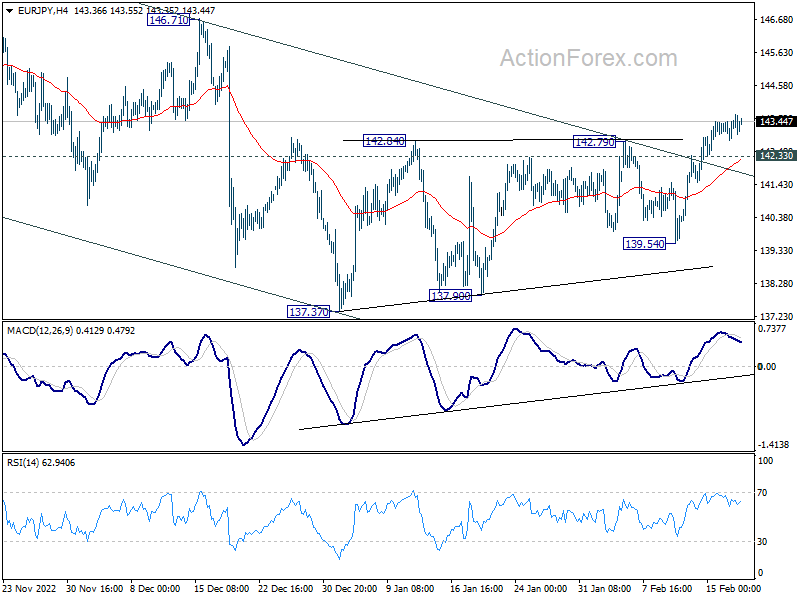
EUR/JPY's break of 142.84 resistance argues that corrective fall from 148.38 has completed at 137.37. Initial bias stays on the upside for further rally to 146.71 resistance. On the downside, though, below 142.33 minor support will dampen this bullish view, and turn intraday bias neutral again.
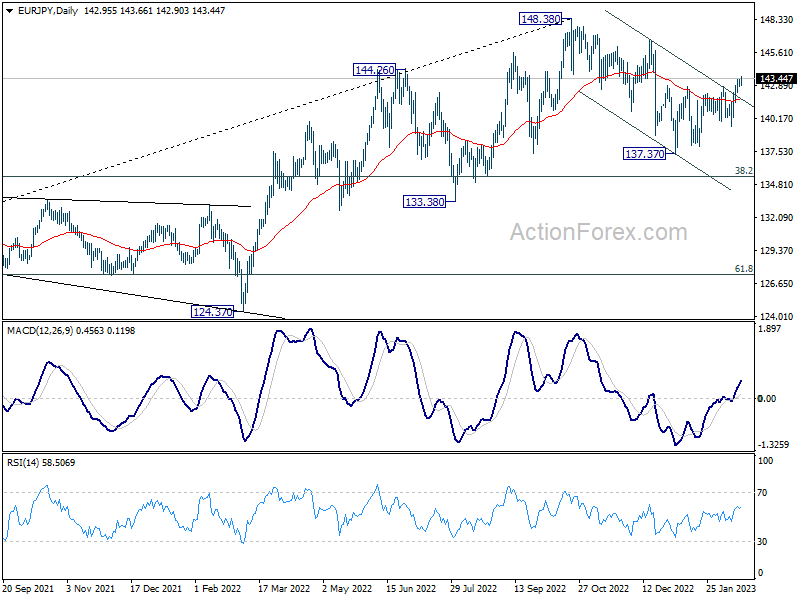
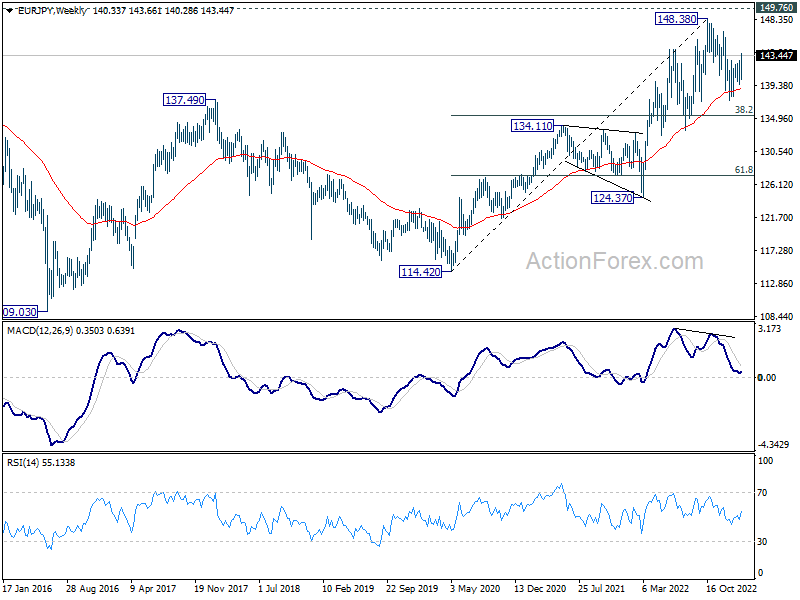
In the bigger picture, as long as 55 week EMA (now at 139.03) holds, larger up trend from 114.42 (2020 low) is still in progress for 149.76 long term resistance. However, firm break of 55 week EMA will bring deeper fall to 38.2% retracement of 114.42 to 148.38 at 135.40. Sustained break there will raise the chance of trend reversal, and target 61.8% retracement at 127.39.
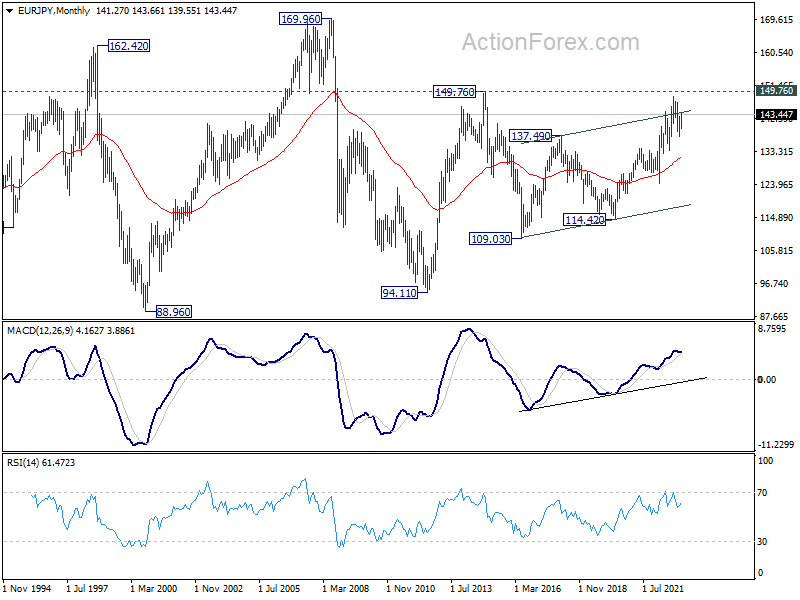
In the long term picture, outlook will stay bullish as long as 134.11 resistance turned support holds (2021 high). Sustained break of 149.76 (2014 high) will open up further rally, as resumption of the rise from 94.11 (2012 low), towards 169.96 (2008 high).
EUR/GBP Weekly Outlook
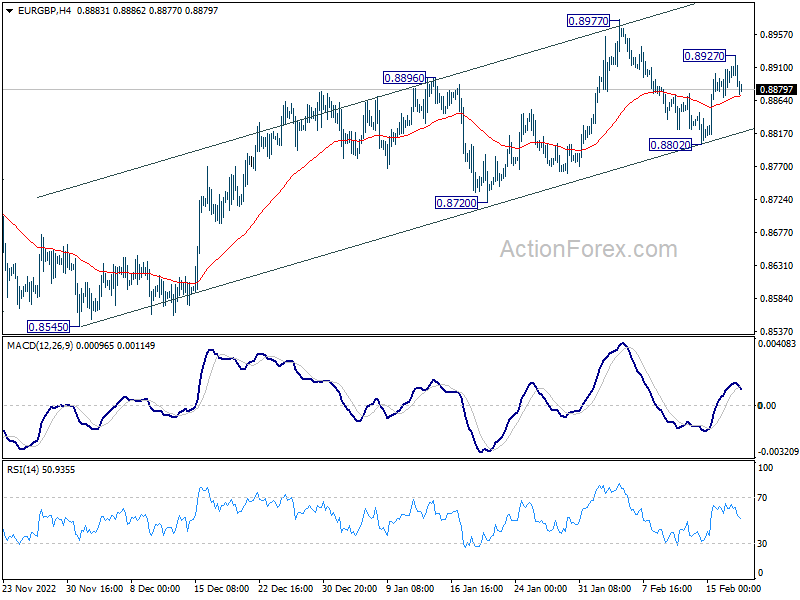
EUR/GBP recovered after hitting channel support last week. But upside was capped at 0.8927. Initial bias is turned neutral this week first. Further rally is expected as long as 0.8802 support holds. Above 0.8927 will target 0.8977 resistance. Firm break there will confirm resumption of whole rally from 0.8545. However, break of 0.8802 will now be a sign of reversal and turn bias back to 0.8720 support instead.
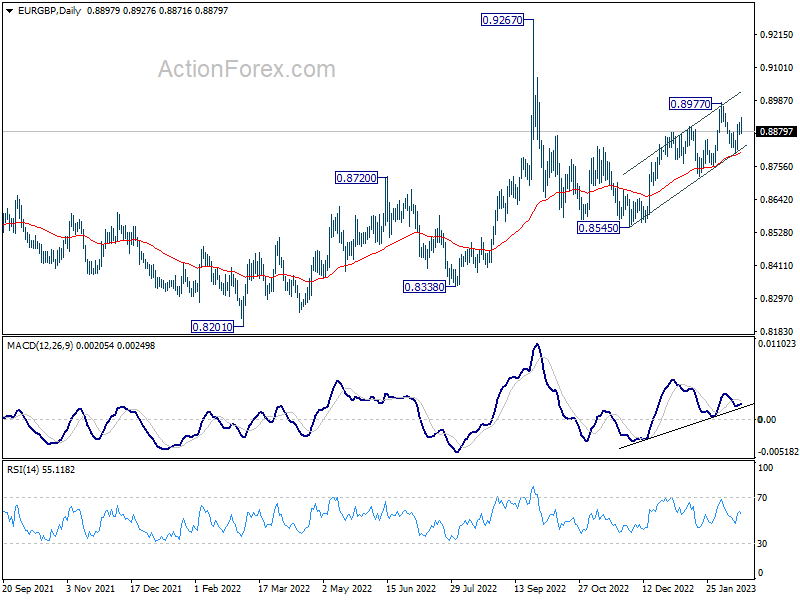
In the bigger picture, the notable support from 55 day EMA (now at 0.8801) retains near term bullishness. Break of 0.8977 should target 0.9267 (2022 high) and possibly above, to resume whole up trend from 0.8201 (2022 low). However, sustained trading below 55 day EMA will set the stage for 0.8545 and below.
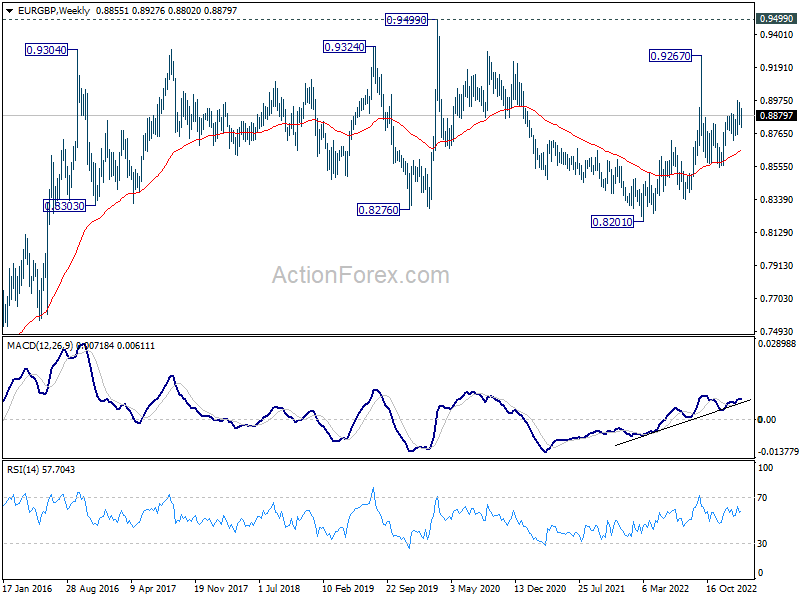
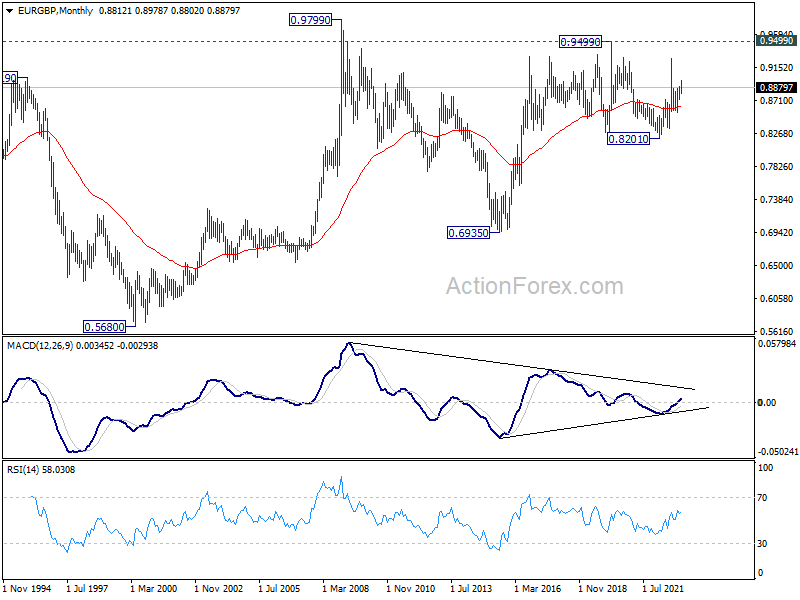
In the long term picture, long term range pattern is extending. But rise from 0.6935 (2015 low) is expected to extend at a later stage, to 0.9799 (2009 high).
EUR/AUD Weekly Outlook
EUR/AUD recovered last week but stayed below 1.5650 resistance. Initial bias remains neutral this week first. On the upside, break of 1.5650 will revive that case that correction from 1.5976 has completed at 1.5254. Intraday bias will be back on the upside for 1.5749 resistance first. On the downside, firm break of 1.5254/71 will carry larger bearish implication and resume the fall from 1.5976.
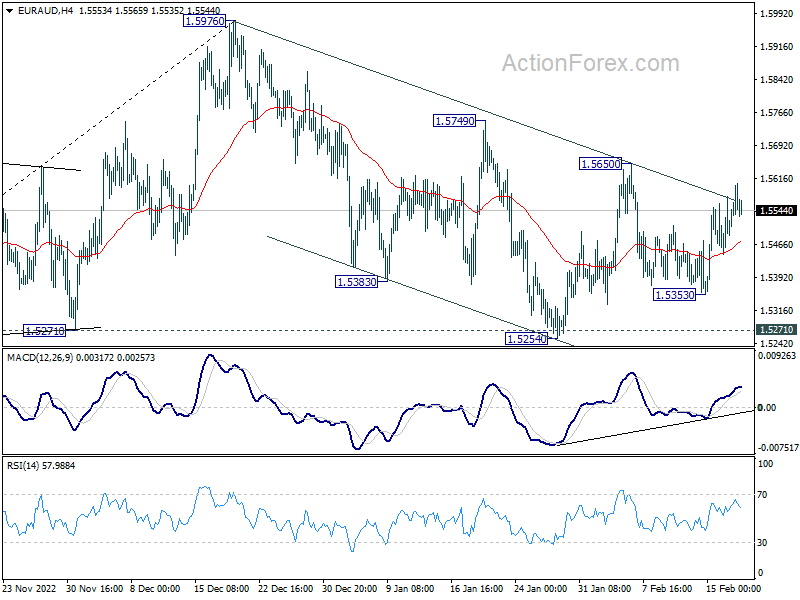
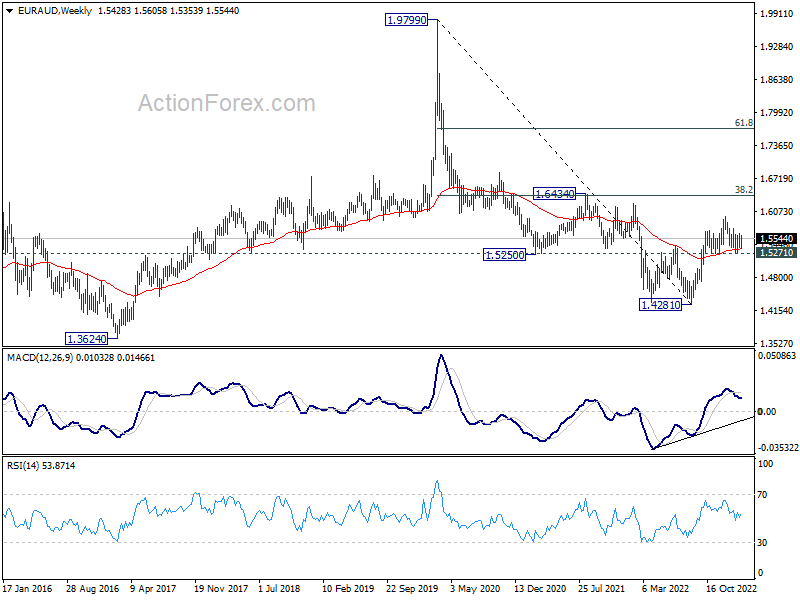
In the bigger picture, it's still early to confirm if rise from 1.4281 represents bullish trend reversal. But as long as 1.5271 support holds, such rally is in favor to continue. Break of 1.5976 will target 1.6434 key resistance next. On the other hand, firm break of 1.5271 will retain medium term bearishness instead.
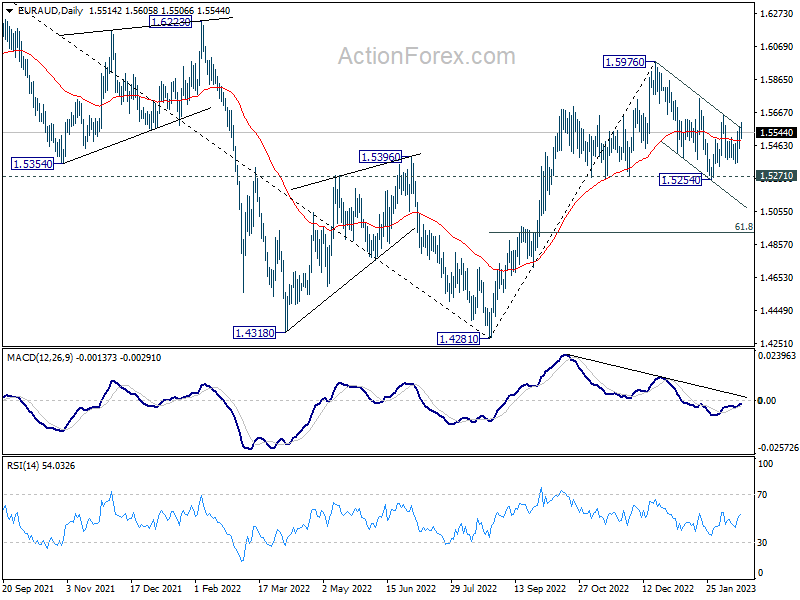
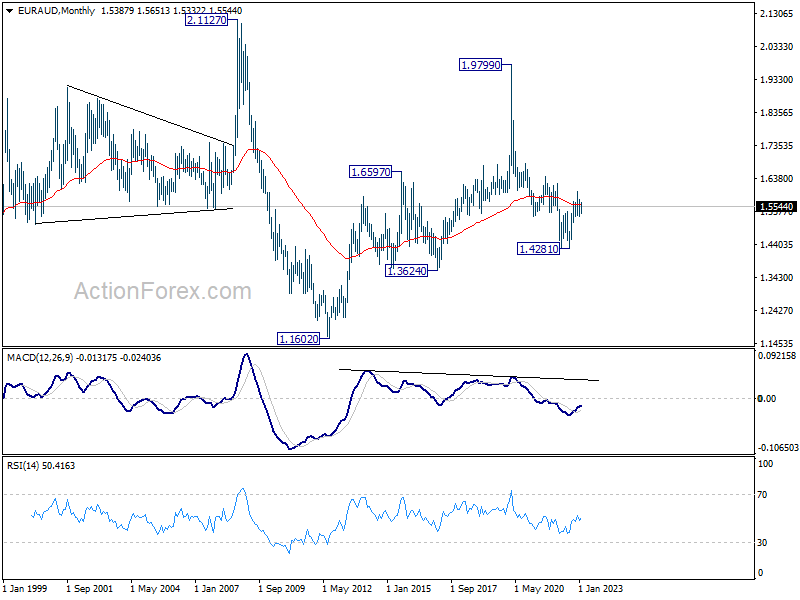
In the longer term picture, focus stays on 55 month EMA (now at 1.5590). Sustained trading above there will raise the chance of bullish trend reversal, and at least bring further rally to 1.6434 cluster resistance, 38.2% retracement of 1.9799 (2020 high) to 1.4281 at 1.6389. However, rejection by 55 month EMA will suggest that down trend from 1.9799 is still in progress for another low below 1.4281.
EUR/CHF Weekly Outlook
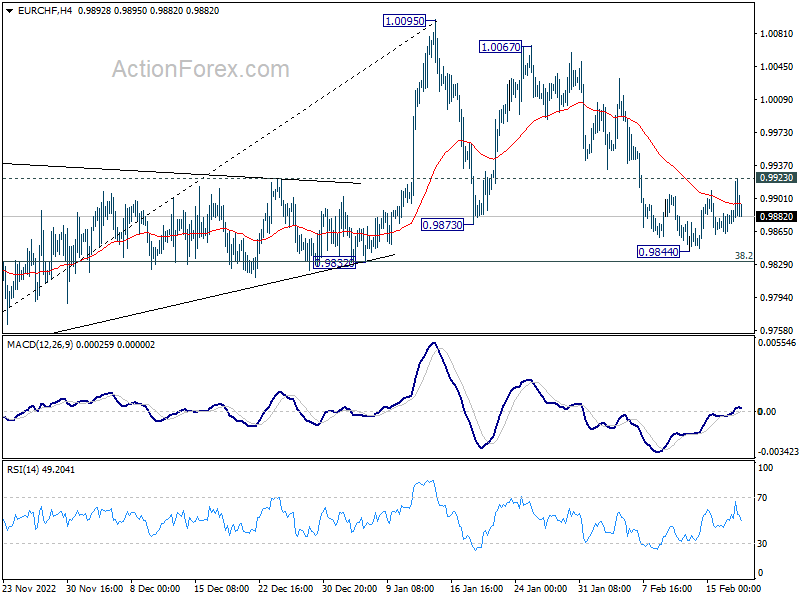
EUR/CHF's recovery was capped at 0.9923 last week despite brief break of 4 hour 55 EMA. Initial bias remains neutral this week first. Still, in case of another fall, downside should be contained by 38.2% retracement of 0.9407 to 1.0095 at 0.9832, to complete the corrective pattern from 1.0095. Break of 0.9923 will turn bias back to the upside for stronger rebound towards 1.0067/0095 resistance zone.
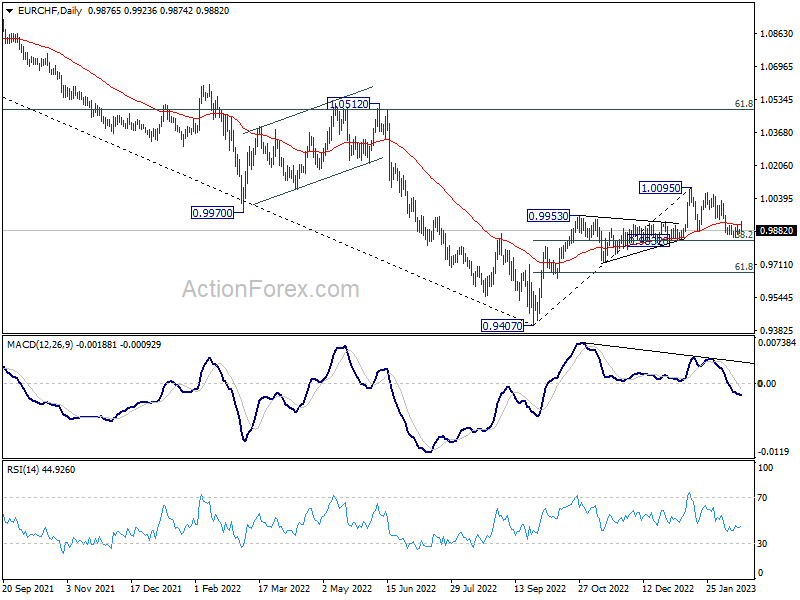
In the bigger picture, the rejection by 55 week EMA (now at 1.0025) mixed up the outlook. On the upside, sustained trading above 55 week EMA will raise the chance of bullish trend reversal. Rise from 0.9407 should then target 1.0505 cluster resistance (2020 low at 1.0505, 61.8% retracement of 1.1149 to 0.9407 at 1.1484). However, firm break of 0.9832 support will revive medium term bearishness and bring retest of 0.9407 low instead.
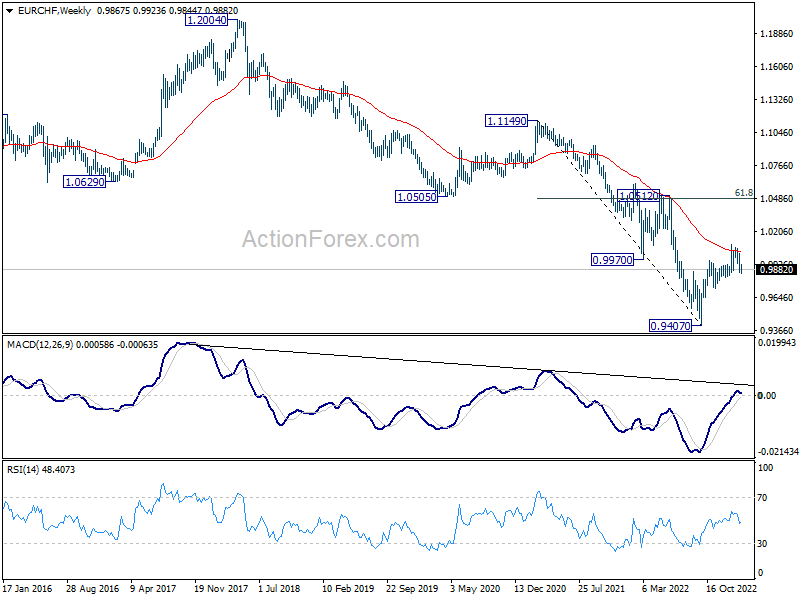
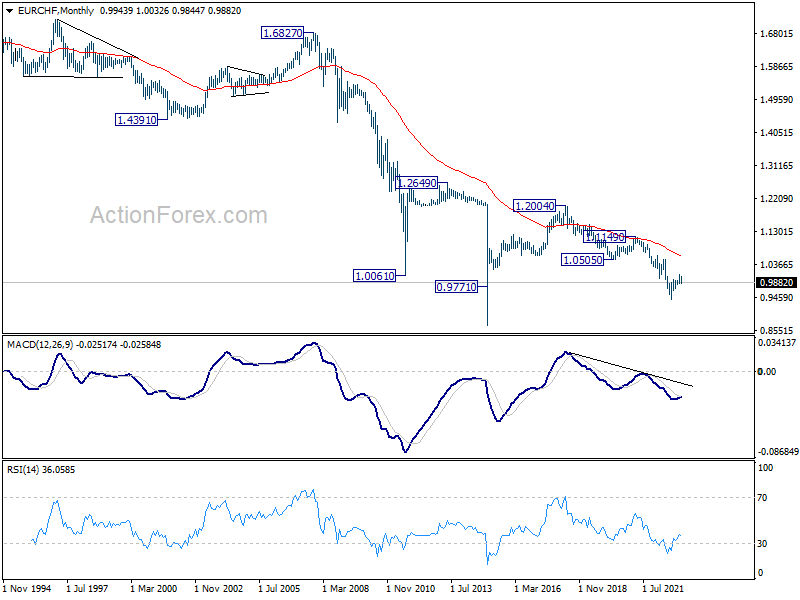
In the long term picture, it's still way to early too call for bullish trend reversal with upside capped well below 55 month EMA and 1.0505 support turned resistance (2020 low).
Dollar Rose on Fed Expectations But Momentum Capped Again By Risk Sentiment
Dollar ended as the best performer last week, after data argued that the slow disinflation process could prompt Fed to tightening further to a higher terminal rate. Yet, buying remained rather uncommitted, as show in Friday's late pull back. Resilient risk sentiment continued to cap the greenback's upside, and could continue to do so.
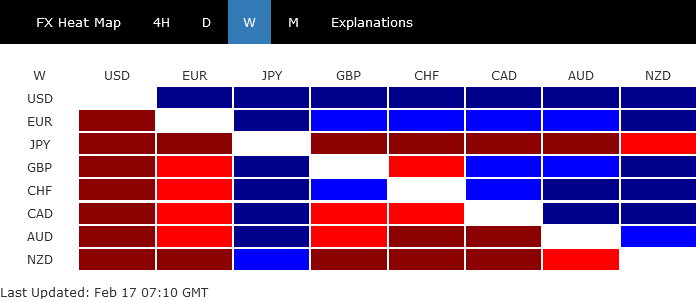
Elsewhere in the forex markets, Euro ended as second strongest as ECB officials reiterated that they staying the course, and tightening could extend well into summer. Swiss Franc and Sterling were the next strongest ones. Yen was the worst performer on widening yield gap with Europeans and Americans. Also, the nomination of the new BoJ governor provided little hope of a U-turn in monetary policy. Commodity currencies were the worst performers.
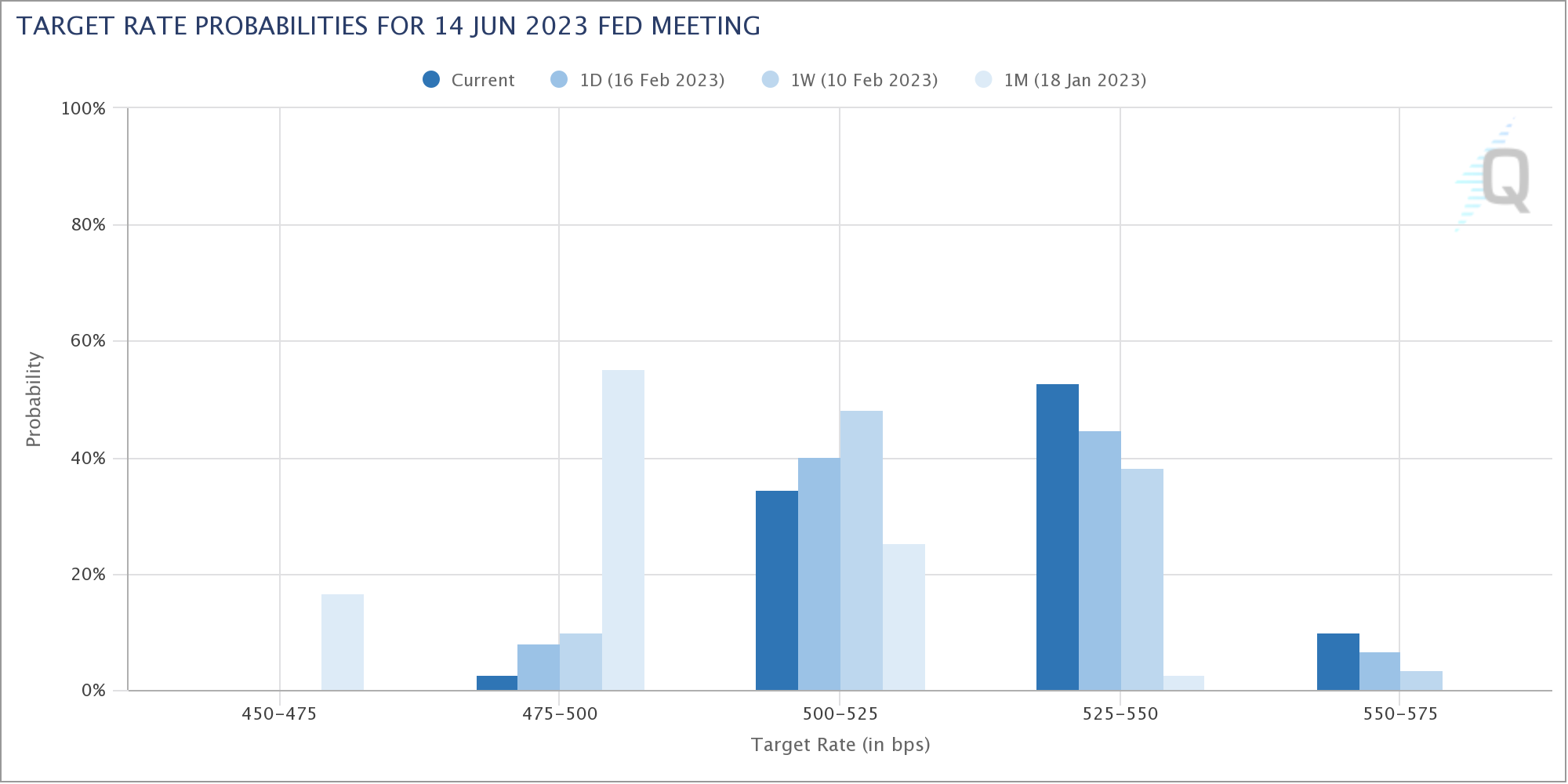
Over 60% chance of three more Fed hikes
January inflation data from the US released last week showed that while disinflation process is continuing, it's disappointingly slow. Together with hawkish comments from Fed officials, markets have been raising their bets on a higher terminal rate.
As indicated by Fed fund futures, there is now 62.9% chance of interest rate reaching 5.25-5.50% after June meeting. That's notably higher than 41.8% a week ago, and that mere 2.7% a month ago. That target range is even higher that Fed's down median estimate of 5.1%, and equivalent to three more 25 bps hike from the current 4.50-4.75%.
US stocks resilient, S&P 500 and NASDAQ staying on higher track
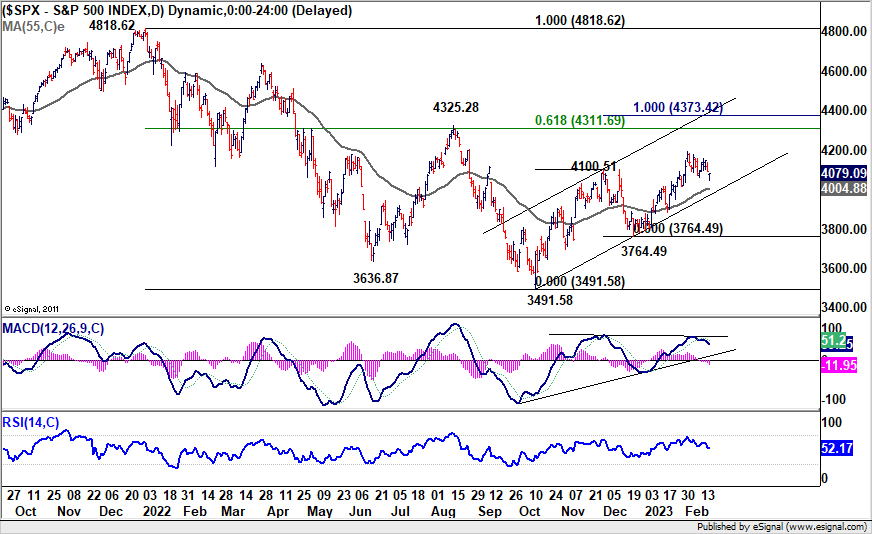
US stocks have been rather resilient. While there was some selloff after the inflation data, late buying on Friday indicated that investors had not given up. DOW and S&P 500 just closed the weekly slightly lower while NASDAQ ended up with gain.
S&P 500 is holding well inside the channel support that started last year at 3491.58. Further rise is expected as long as 55 day EMA (now at 4004.88) holds. Even as a corrective move, rise from 3491.58 would target 4325.28 resistance, or even further to 100% projection of 3491.58 to 4100.51 from 3764.49 at 4373.42.
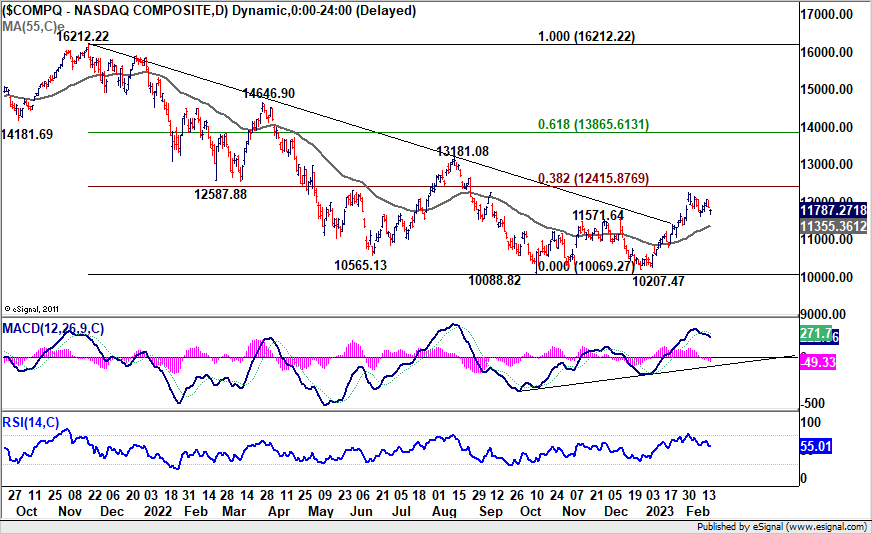
There is also no sign of reversal in NASDAQ despite loss of upside moment. Further rally is expected as long as 55 day EMA (now at 11355.36) holds. Firm break of 38.2% retracement of 16212.22 to 10088.82 at 12415.87 will pave the way to 13181.08 resistance.
10-year yield pressing 3.905 resistance as rally extended
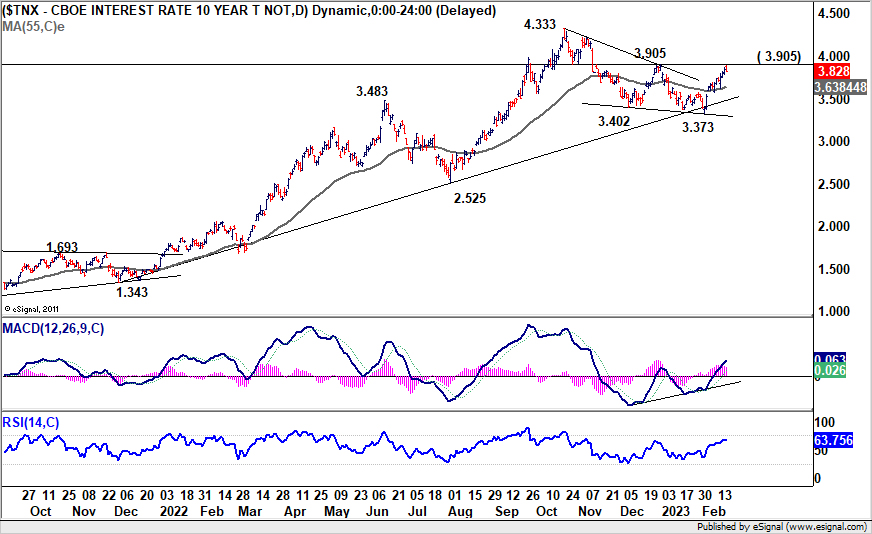
10-year yield extended the rebound from 3.373 and hit as high as 3.900 but failed to break through 3.905 resistance. Outlook is nonetheless unchanged that corrective pattern from 4.333 has completed with three waves down to 3.373. Further rise is expected as long as 55 day EMA (now at 3.638 holds). Decisive break of 3.905 could set the stage for a retest on 4.333 high.
Dollar index extended corrective rebound, with disappointing momentum
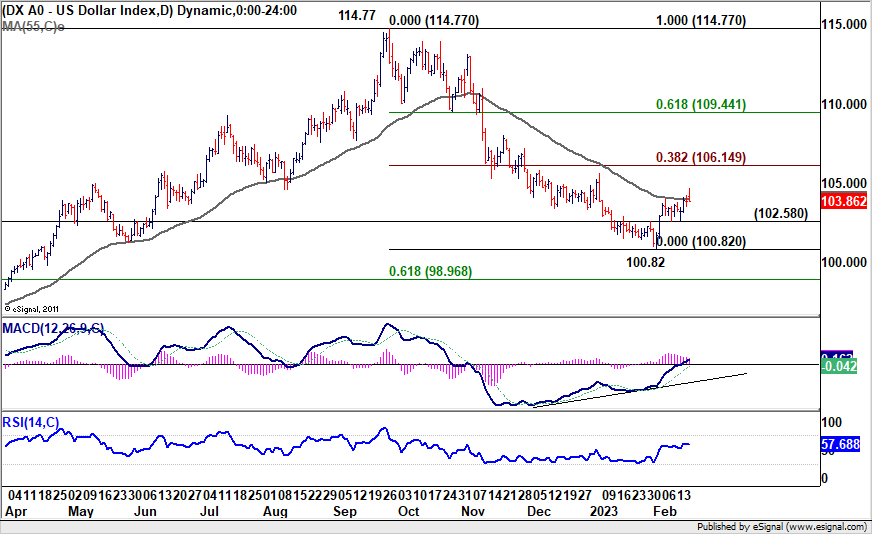
Rising treasury yields and expectations of higher Fed terminal rate should be supportive to Dollar. Yet, the positive force has been offset by resilient risk-on sentiment. Overall movements in the greenback remained rather indecisive, except versus Yen for now. That's reflected clearly in Friday's disappointing upside breakout.
The countering forces argue that Dollar index is merely in a corrective rebound, moving two steps forward one step back. For now, further rise is expected in DXY as long as 102.58 support holds. Next target is 38.2% retracement of 114.77 to 100.82 at 106.14. Strong resistance could be seen there to limit upside.
Bitcoin pressing 25198 resistance as risk sentiment improved
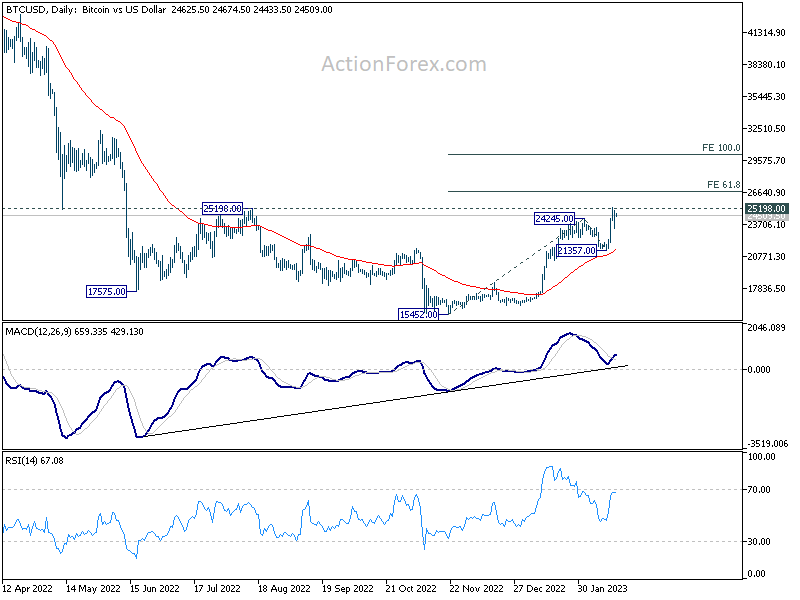
Bitcoin is seen as a proxy to overall risk appetite, the development is inline with the bullish outlook in NASDAQ. Rise from 15452 resumed last week and breached 25000 handle. Initial rejection was seen from 25198 structural resistance. But the retreat was so far rather shallow. Further rise is in favor as long as 21357 support holds. Firm break of 25198 will target 61.8% projection of 15452 to 24245 from 21357 at 26791.
For now, it's still early to see if Bitcoin will break through 26791 decisively. But if it does, next target will be 100% projection at 30150. That could also mean that NASDAQ is breaking through 13181.08 resistance as mentioned, which would be another medium term bullish signal for stocks, but bearish signal for Dollar.
USD/CAD Weekly Outlook
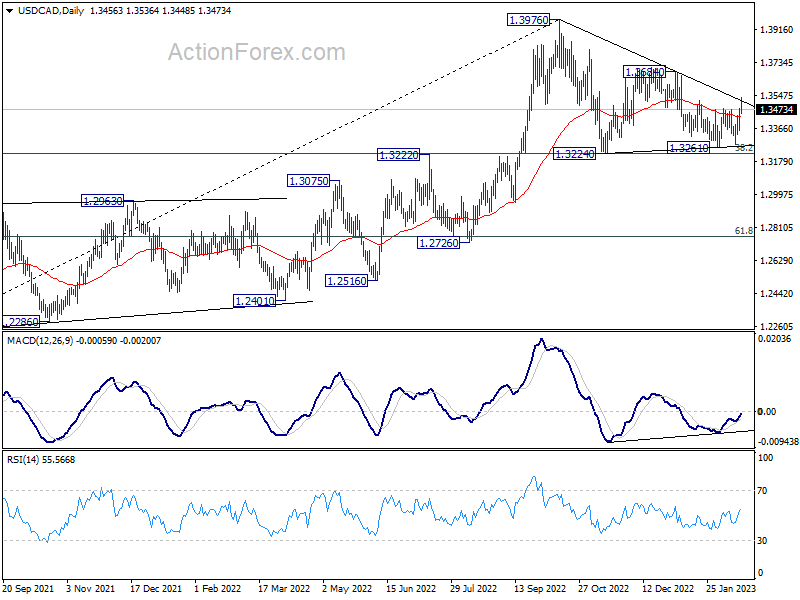
USD/CAD's break of 1.3474 resistance last week confirmed short term bottoming at 1.3261. More importantly, the corrective pattern from 1.3976 should have completed too. Initial bias stays on the upside this week for 1.3684 resistance. Firm break there will bring retest 1.3976 high. Nevertheless, break of 1.3421 minor support will dampen this bullish case and turn intraday bias neutral again.
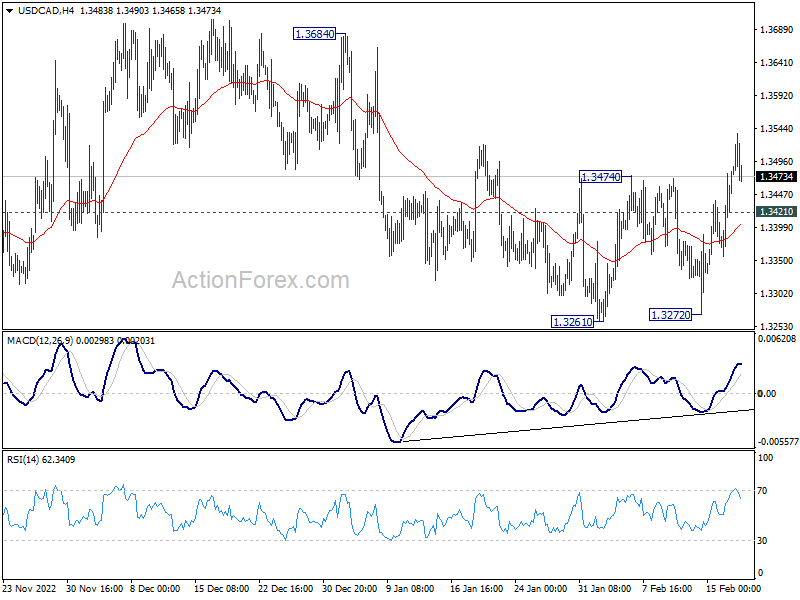
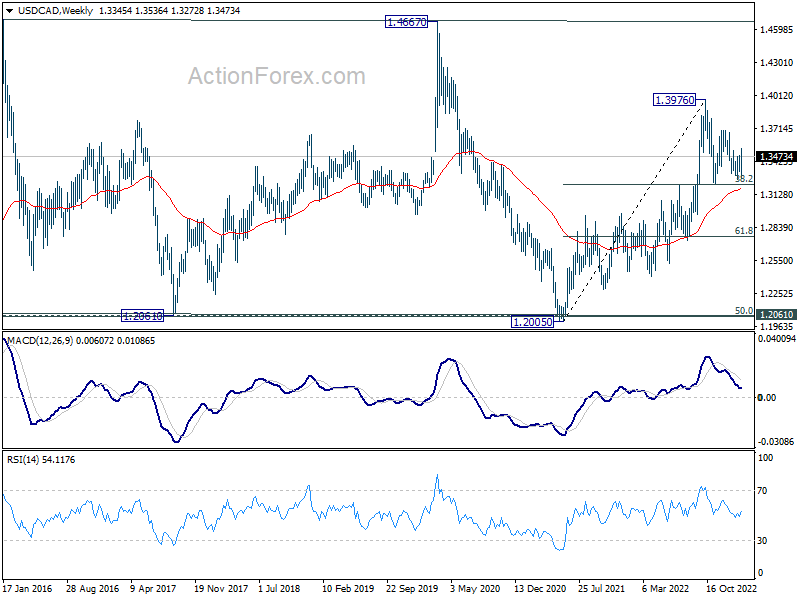
In the bigger picture, as long as 1.3222 cluster support (38.2% retracement of 1.2005 to 1.3976 at 1.3223) holds, larger up trend from 1.2005 (2021 low) is still expected to resume through 1.3976 high at a later stage. However, firm break of 1.3222/3 will indicate that the trend might have reversed. Deeper fall would be seen to next cluster support at 1.2726 (61.8% retracement at 1.2758).
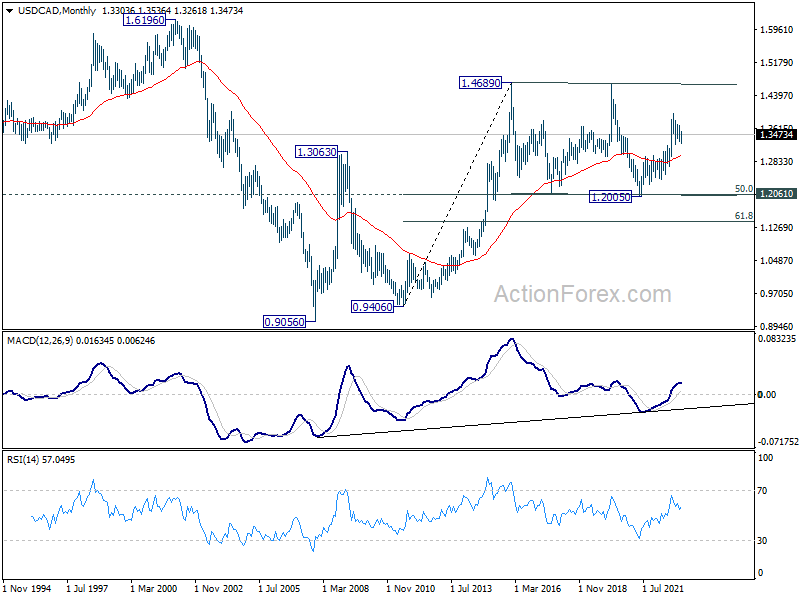
In the longer term picture, price actions from 1.4689 (2016 high) are seen as a consolidation pattern only, which might have completed at 1.2005. That is, up trend from 0.9506 (2007 low) is expected to resume at a later stage. This will remain the favored case as 55 month EMA (now at 1.2967) holds.
Summary 2/20 – 2/24
Monday, Feb 20, 2023
| GMT | Ccy | Events | Consensus | Previous |
|---|---|---|---|---|
| 00:01 | GBP | Rightmove House Price Index M/M Feb | 0.90% | |
| 15:00 | EUR | Eurozone Consumer Confidence Feb P | -19 | -21 |
| 21:45 | NZD | PPI Input Q/Q Q4 | 0.50% | 0.80% |
| 21:45 | NZD | PPI Output Q/Q Q4 | 0.40% | 1.60% |
| 22:00 | AUD | Manufacturing PMI Feb P | 50 | |
| 22:00 | AUD | Services PMI Feb P | 48.6 |
| GMT | Ccy | Events | |
|---|---|---|---|
| 00:01 | GBP | Rightmove House Price Index M/M Feb | |
| Forecast: | Previous: 0.90% | ||
| 15:00 | EUR | Eurozone Consumer Confidence Feb P | |
| Forecast: -19 | Previous: -21 | ||
| 21:45 | NZD | PPI Input Q/Q Q4 | |
| Forecast: 0.50% | Previous: 0.80% | ||
| 21:45 | NZD | PPI Output Q/Q Q4 | |
| Forecast: 0.40% | Previous: 1.60% | ||
| 22:00 | AUD | Manufacturing PMI Feb P | |
| Forecast: | Previous: 50 | ||
| 22:00 | AUD | Services PMI Feb P | |
| Forecast: | Previous: 48.6 | ||
Tuesday, Feb 21, 2023
| GMT | Ccy | Events | Consensus | Previous |
|---|---|---|---|---|
| 00:30 | AUD | RBA Meeting Minutes | ||
| 00:30 | JPY | Manufacturing PMI Feb P | 49.3 | 48.9 |
| 07:00 | CHF | Trade Balance (CHF) Jan | 3.75B | 2.83B |
| 07:00 | GBP | Public Sector Net Borrowing (GBP) Jan | 2.3B | 26.6B |
| 08:15 | EUR | France Manufacturing PMI Feb P | 50.7 | 50.5 |
| 08:15 | EUR | France Services PMI Feb P | 50.0 | 49.4 |
| 08:30 | EUR | Germany Manufacturing PMI Feb P | 48.0 | 47.3 |
| 08:30 | EUR | Germany Services PMI Feb P | 51.0 | 50.7 |
| 09:00 | EUR | Eurozone Manufacturing PMI Feb P | 49.4 | 48.8 |
| 09:00 | EUR | Eurozone Services PMI Feb P | 51.0 | 50.8 |
| 09:30 | GBP | Manufacturing PMI Feb P | 47.50 | 47 |
| 09:30 | GBP | Services PMI Feb P | 49.40 | 48.7 |
| 10:00 | EUR | Germany ZEW Economic Sentiment Feb | 19 | 16.9 |
| 10:00 | EUR | Germany ZEW Current Situation Feb | -58.6 | |
| 10:00 | EUR | Eurozone ZEW Economic Sentiment Feb | 17.3 | 16.7 |
| 13:30 | CAD | Retail Sales M/M Dec | 0.20% | -0.10% |
| 13:30 | CAD | Retail Sales ex Autos M/M Dec | -0.60% | -0.60% |
| 13:30 | CAD | CPI M/M Jan | 0.20% | -0.60% |
| 13:30 | CAD | CPI Y/Y Jan | 5.70% | 6.30% |
| 13:30 | CAD | CPI Core M/M Jan | 0.30% | |
| 13:30 | CAD | CPI Median Y/Y Jan | 5.00% | |
| 13:30 | CAD | CPI Trimmed Y/Y Jan | 5.30% | |
| 13:30 | CAD | CPI Common Y/Y Jan | 6.60% | |
| 14:45 | USD | Manufacturing PMI Feb P | 46.8 | 46.9 |
| 14:45 | USD | Services PMI Feb P | 46.6 | 46.8 |
| 14:45 | USD | Composite PMI Feb P | 46.6 | 46.8 |
| 15:00 | USD | Existing Home Sales Jan | 4.06M | 4.02M |
| 21:45 | NZD | Trade Balance (NZD) Jan | -475M | |
| 23:30 | AUD | Westpac Leading Index M/M Jan | -0.10% | |
| 23:50 | JPY | Corporate Service Price Index Y/Y Jan | 1.50% | 1.50% |
| GMT | Ccy | Events | |
|---|---|---|---|
| 00:30 | AUD | RBA Meeting Minutes | |
| Forecast: | Previous: | ||
| 00:30 | JPY | Manufacturing PMI Feb P | |
| Forecast: 49.3 | Previous: 48.9 | ||
| 07:00 | CHF | Trade Balance (CHF) Jan | |
| Forecast: 3.75B | Previous: 2.83B | ||
| 07:00 | GBP | Public Sector Net Borrowing (GBP) Jan | |
| Forecast: 2.3B | Previous: 26.6B | ||
| 08:15 | EUR | France Manufacturing PMI Feb P | |
| Forecast: 50.7 | Previous: 50.5 | ||
| 08:15 | EUR | France Services PMI Feb P | |
| Forecast: 50.0 | Previous: 49.4 | ||
| 08:30 | EUR | Germany Manufacturing PMI Feb P | |
| Forecast: 48.0 | Previous: 47.3 | ||
| 08:30 | EUR | Germany Services PMI Feb P | |
| Forecast: 51.0 | Previous: 50.7 | ||
| 09:00 | EUR | Eurozone Manufacturing PMI Feb P | |
| Forecast: 49.4 | Previous: 48.8 | ||
| 09:00 | EUR | Eurozone Services PMI Feb P | |
| Forecast: 51.0 | Previous: 50.8 | ||
| 09:30 | GBP | Manufacturing PMI Feb P | |
| Forecast: 47.50 | Previous: 47 | ||
| 09:30 | GBP | Services PMI Feb P | |
| Forecast: 49.40 | Previous: 48.7 | ||
| 10:00 | EUR | Germany ZEW Economic Sentiment Feb | |
| Forecast: 19 | Previous: 16.9 | ||
| 10:00 | EUR | Germany ZEW Current Situation Feb | |
| Forecast: | Previous: -58.6 | ||
| 10:00 | EUR | Eurozone ZEW Economic Sentiment Feb | |
| Forecast: 17.3 | Previous: 16.7 | ||
| 13:30 | CAD | Retail Sales M/M Dec | |
| Forecast: 0.20% | Previous: -0.10% | ||
| 13:30 | CAD | Retail Sales ex Autos M/M Dec | |
| Forecast: -0.60% | Previous: -0.60% | ||
| 13:30 | CAD | CPI M/M Jan | |
| Forecast: 0.20% | Previous: -0.60% | ||
| 13:30 | CAD | CPI Y/Y Jan | |
| Forecast: 5.70% | Previous: 6.30% | ||
| 13:30 | CAD | CPI Core M/M Jan | |
| Forecast: | Previous: 0.30% | ||
| 13:30 | CAD | CPI Median Y/Y Jan | |
| Forecast: | Previous: 5.00% | ||
| 13:30 | CAD | CPI Trimmed Y/Y Jan | |
| Forecast: | Previous: 5.30% | ||
| 13:30 | CAD | CPI Common Y/Y Jan | |
| Forecast: | Previous: 6.60% | ||
| 14:45 | USD | Manufacturing PMI Feb P | |
| Forecast: 46.8 | Previous: 46.9 | ||
| 14:45 | USD | Services PMI Feb P | |
| Forecast: 46.6 | Previous: 46.8 | ||
| 14:45 | USD | Composite PMI Feb P | |
| Forecast: 46.6 | Previous: 46.8 | ||
| 15:00 | USD | Existing Home Sales Jan | |
| Forecast: 4.06M | Previous: 4.02M | ||
| 21:45 | NZD | Trade Balance (NZD) Jan | |
| Forecast: | Previous: -475M | ||
| 23:30 | AUD | Westpac Leading Index M/M Jan | |
| Forecast: | Previous: -0.10% | ||
| 23:50 | JPY | Corporate Service Price Index Y/Y Jan | |
| Forecast: 1.50% | Previous: 1.50% | ||
Wednesday, Feb 22, 2023
| GMT | Ccy | Events | Consensus | Previous |
|---|---|---|---|---|
| 00:30 | AUD | Wage Price Index Q/Q Q4 | 1.00% | 1.00% |
| 00:30 | AUD | Construction Work Done Q4 | 1.60% | 2.20% |
| 01:00 | NZD | RBNZ Rate Decision | 4.75% | 4.25% |
| 02:00 | NZD | RBNZ Press Conference | ||
| 07:00 | EUR | Germany CPI M/M Jan F | 1.00% | 1.00% |
| 07:00 | EUR | Germany CPI Y/Y Jan F | 8.70% | 8.70% |
| 09:00 | CHF | ZEW Expectations Feb | -40 | |
| 09:00 | EUR | Germany IFO Business Climate Feb | 91.1 | 90.2 |
| 09:00 | EUR | Germany IFO Current Assessment Feb | 94.3 | 94.1 |
| 09:00 | EUR | Germany IFO Expectations Feb | 84.7 | 86.4 |
| 13:30 | CAD | New Housing Price Index M/M Jan | 0.10% | 0.00% |
| 19:00 | USD | FOMC Minutes |
| GMT | Ccy | Events | |
|---|---|---|---|
| 00:30 | AUD | Wage Price Index Q/Q Q4 | |
| Forecast: 1.00% | Previous: 1.00% | ||
| 00:30 | AUD | Construction Work Done Q4 | |
| Forecast: 1.60% | Previous: 2.20% | ||
| 01:00 | NZD | RBNZ Rate Decision | |
| Forecast: 4.75% | Previous: 4.25% | ||
| 02:00 | NZD | RBNZ Press Conference | |
| Forecast: | Previous: | ||
| 07:00 | EUR | Germany CPI M/M Jan F | |
| Forecast: 1.00% | Previous: 1.00% | ||
| 07:00 | EUR | Germany CPI Y/Y Jan F | |
| Forecast: 8.70% | Previous: 8.70% | ||
| 09:00 | CHF | ZEW Expectations Feb | |
| Forecast: | Previous: -40 | ||
| 09:00 | EUR | Germany IFO Business Climate Feb | |
| Forecast: 91.1 | Previous: 90.2 | ||
| 09:00 | EUR | Germany IFO Current Assessment Feb | |
| Forecast: 94.3 | Previous: 94.1 | ||
| 09:00 | EUR | Germany IFO Expectations Feb | |
| Forecast: 84.7 | Previous: 86.4 | ||
| 13:30 | CAD | New Housing Price Index M/M Jan | |
| Forecast: 0.10% | Previous: 0.00% | ||
| 19:00 | USD | FOMC Minutes | |
| Forecast: | Previous: | ||
Thursday, Feb 23, 2023
| GMT | Ccy | Events | Consensus | Previous |
|---|---|---|---|---|
| 00:30 | AUD | Private Capital Expenditure Q4 | 1.40% | -0.60% |
| 10:00 | EUR | Eurozone CPI Y/Y Jan F | 8.50% | 8.50% |
| 10:00 | EUR | Eurozone CPI Core Y/Y Jan F | 5.20% | 5.20% |
| 13:30 | USD | Initial Jobless Claims (Feb 17) | 194K | |
| 13:30 | USD | GDP Annualized Q4 P | 2.90% | 2.90% |
| 13:30 | USD | GDP Price Index Q4 P | 3.50% | 3.50% |
| 15:30 | USD | Natural Gas Storage | -100B | |
| 16:00 | USD | Crude Oil Inventories | 16.3M | |
| 23:30 | JPY | National CPI Core Y/Y Jan | 4.20% | 4.00% |
| GMT | Ccy | Events | |
|---|---|---|---|
| 00:30 | AUD | Private Capital Expenditure Q4 | |
| Forecast: 1.40% | Previous: -0.60% | ||
| 10:00 | EUR | Eurozone CPI Y/Y Jan F | |
| Forecast: 8.50% | Previous: 8.50% | ||
| 10:00 | EUR | Eurozone CPI Core Y/Y Jan F | |
| Forecast: 5.20% | Previous: 5.20% | ||
| 13:30 | USD | Initial Jobless Claims (Feb 17) | |
| Forecast: | Previous: 194K | ||
| 13:30 | USD | GDP Annualized Q4 P | |
| Forecast: 2.90% | Previous: 2.90% | ||
| 13:30 | USD | GDP Price Index Q4 P | |
| Forecast: 3.50% | Previous: 3.50% | ||
| 15:30 | USD | Natural Gas Storage | |
| Forecast: | Previous: -100B | ||
| 16:00 | USD | Crude Oil Inventories | |
| Forecast: | Previous: 16.3M | ||
| 23:30 | JPY | National CPI Core Y/Y Jan | |
| Forecast: 4.20% | Previous: 4.00% | ||
Friday, Feb 24, 2023
| GMT | Ccy | Events | Consensus | Previous |
|---|---|---|---|---|
| 00:01 | GBP | GfK Consumer Confidence Feb | -40 | -45 |
| 07:00 | EUR | Germany Gfk Consumer Confidence Mar | -30 | -33.9 |
| 07:00 | EUR | Germany GDP Q/Q Q4 F | -0.20% | -0.20% |
| 13:30 | USD | Personal Income M/M Jan | 1.00% | 0.20% |
| 13:30 | USD | Personal Spending Jan | 1.00% | -0.20% |
| 13:30 | USD | PCE Price Index M/M Jan | 0.50% | 0.10% |
| 13:30 | USD | PCE Price Index Y/Y Jan | 4.90% | 5.00% |
| 13:30 | USD | Core PCE Price Index M/M Jan | 0.40% | 0.30% |
| 13:30 | USD | Core PCE Price Index Y/Y Jan | 4.10% | 4.40% |
| 15:00 | USD | Michigan Consumer Sentiment Index Feb F | 66.4 | 66.4 |
| 15:00 | USD | New Home Sales Jan | 620K | 616K |
| GMT | Ccy | Events | |
|---|---|---|---|
| 00:01 | GBP | GfK Consumer Confidence Feb | |
| Forecast: -40 | Previous: -45 | ||
| 07:00 | EUR | Germany Gfk Consumer Confidence Mar | |
| Forecast: -30 | Previous: -33.9 | ||
| 07:00 | EUR | Germany GDP Q/Q Q4 F | |
| Forecast: -0.20% | Previous: -0.20% | ||
| 13:30 | USD | Personal Income M/M Jan | |
| Forecast: 1.00% | Previous: 0.20% | ||
| 13:30 | USD | Personal Spending Jan | |
| Forecast: 1.00% | Previous: -0.20% | ||
| 13:30 | USD | PCE Price Index M/M Jan | |
| Forecast: 0.50% | Previous: 0.10% | ||
| 13:30 | USD | PCE Price Index Y/Y Jan | |
| Forecast: 4.90% | Previous: 5.00% | ||
| 13:30 | USD | Core PCE Price Index M/M Jan | |
| Forecast: 0.40% | Previous: 0.30% | ||
| 13:30 | USD | Core PCE Price Index Y/Y Jan | |
| Forecast: 4.10% | Previous: 4.40% | ||
| 15:00 | USD | Michigan Consumer Sentiment Index Feb F | |
| Forecast: 66.4 | Previous: 66.4 | ||
| 15:00 | USD | New Home Sales Jan | |
| Forecast: 620K | Previous: 616K | ||
The Weekly Bottom Line: Rate Jitters Ahead of Inflation Release
U.S. Highlights
- The week’s data reminded markets that inflation is far away from the Fed’s target. Both headline and core CPI came in on par with expectations, but details suggest that disinflationary forces are softening.
- Retail sales rebounded from the year-end weakness. The biggest gains were picked up by auto dealers, but other categories were strong beyond expectations.
- More evidence of economic resilience means the Fed may need to fight harder to keep inflation under control. The probability of a 50-basis point hike in March rose from 9% to 21% on the week.
Canadian Highlights
- This week’s housing data showed more weakness than expected as housing starts plunged 13% month-on-month (m/m) to 215.4k units in January.
- While the housing market is feeling the hurt of higher borrowing costs, a strong labour market has kept people spending.
- All eyes will be on next week’s inflation report to get a sense of whether more moves from the Bank of Canada will be necessary.
U.S. - Higher for Longer
“Resilient” is the epithet that describes this week’s economic data the best. Retail sales came in a full percentage point stronger than expected, while inflation figures point to a slower descent than expected. The reaction of the equity market was mixed: stock prices dipped after the initial releases but then bounced back, losing less than 1% on the week. Bond markets, on the other hand, continued to price in higher rates, with 2-year and 10-year yields rising by 18 and 22 basis points on the week (at the time of writing).
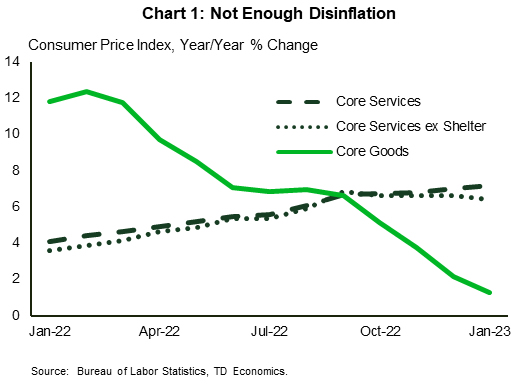
The source of this divergence is interpretation. The Consumer Prices Index (CPI) came in on par with expectations for both the headline and core (ex. food & energy) measures, which gained 0.4% and 0.5% on the month, respectively. Relative to last year, the pace of growth slowed to 6.4% for headline CPI and to 5.6% for core CPI. However, there were few convincing signs of weakness in core services inflation, even when excluding the shelter component – the most important metric for the monetary policy outlook, according to Chair Powell (Chart 1). This is at the time when the disinflationary contribution from core goods inflation appears to have taken a break, especially if the car prices turn higher next month (as signaled by the Manheim price index for used vehicles).
More inflationary pressure was also reported in the Producer Price Index (PPI), which surprised to the upside in January. The headline measure rose 0.7% month-on-month (m/m), while core inflation gained 0.5% m/m. A change in the PPI doesn’t always result in parallel changes in the CPI, but its volatile dynamic proves that the path to disinflation is not a straight line.
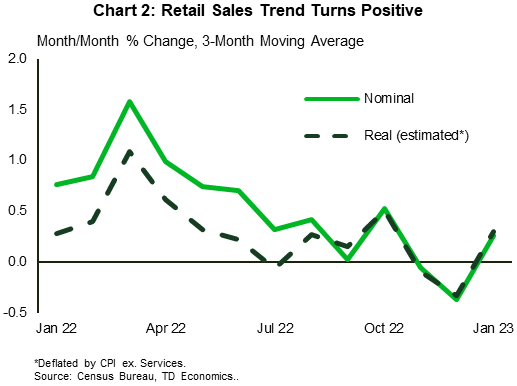
In the context this week’s retail sales report, however, persistent inflation seems less surprising. A warmer January helped heat up consumers’ aptitude to spend. The biggest gains were picked up by auto dealers, primed by the remaining pent-up demand and improved supply as production continues to recover. Predictably, nicer weather made dining out more pleasant, making restaurants the second largest contributor to growth last month. But other categories (department stores, e-commerce, and furniture & electronics stores to name a few) were also robust beyond expectations. This suggests that demand remains resilient: our estimate of real sales was up 2.8% on the month, turning the three-months trend positive (Chart 2).
What didn’t respond to warm weather is housing starts, which fell by 4.5% m/m in January, coming in below the consensus forecast. Both single- and multi-family segments were softer, but while the former remains below its pre-pandemic average, the latter remains 27% stronger relative to 2018-19. Still, housing construction is the only measure that held a course towards disinflation this week. The rest of the economic data makes a “compelling economic case” to bring rates higher and keep them there for longer. As a result, the probability of a 50-basis point hike in March rose from 9% to 21% on the week, while bets on fewer rate cuts by the end of the year jumped higher. We now expect the Fed will raise the policy rate to 5.25% and keep it there until the fourth quarter of 2023.
Canada – Rate Jitters Ahead of Inflation Release
In this week's edition of, "The economy is more resilient than we thought," a heatlhy U.S. consumer price index (CPI) inflation print was behind a sharp rise in North American bond yields. Markets are repricing how far they think the Fed needs to go to tame inflation, and have pushed the U.S. 10-year yield up 22 basis points since Tuesday. Canadain bond yields, never immune to financial market ructions south of the border, followed sharply higher with the 10-year yield rising 21 basis points over the same time period. Yet, for policymakers things are not so clear cut north of the 49th parallel due to the outsized role of Canada's housing market.
This week's housing data showed more weakness than expected. Housing starts plunged 13% month-on-month (m/m) to 215.4k units in January. While the trailing six-month moving average shows a still healthy 259.4k units (Chart 1), January's drop comes after a year where prices and sales cratered. In fact, sales data released Wednesday showed the slowdown in activity extended into January as existing home sales fell another 3.0% m/m for the month. With new listings ticking up (+3.3% m/m), average home prices continued their slide - falling another 1.8% in the month. Prices are now 21% below their peak last February, with Ontario (-21%) and B.C. (-18%) feeling the brunt of the fall.
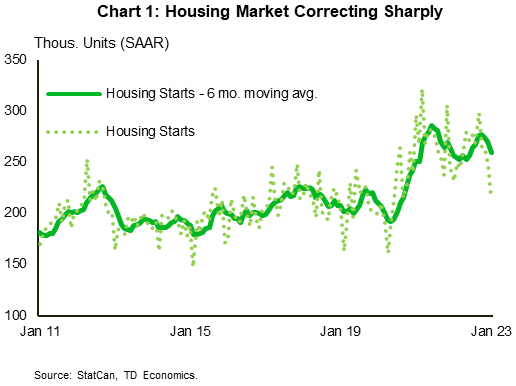
The housing market is clearly showing the strain of a year's worth of super-sized rate hikes from the Bank of Canada (BoC). While forced selling is not yet increasing housing supply, policymakers are going to be wary of pushing too far with rate hikes and doing undue damage to the economy in order to tame inflation.
While the housing market is feeling the hurt of higher borrowing costs, a strong labour market has kept people spending. As we recently wrote about, credit and debit card transaction data showed a bounce-back in outlays to close out 2022. December's official retail sales data are due next Tuesday, but things are building towards a healthy print.
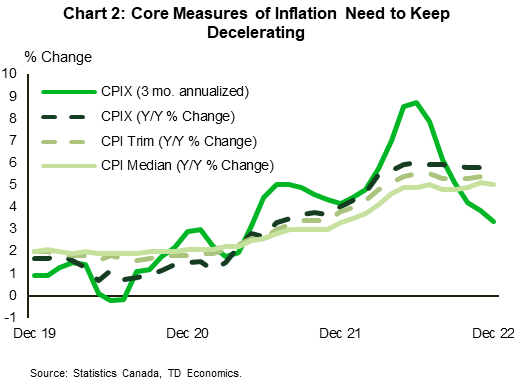
Given the backdrop, next week's inflation report is a big deal. Policymakers will have a tough time ignoring any more evidence that the cumulative rate hikes have not slowed down demand enough to take some heat off prices. With improving supply conditions and slowing goods demand, the key item to look for will be further moderation in services prices. Also of interest will be the CPIX measure, as officials will be looking through the recent large swings in energy prices (like gasoline) and rising mortgage interest costs that are the result of loans resetting at higher interest rates (Chart 2).
The Bank stated that they would pause rate hikes to evaluate the cumulative effects of 425 basis points of tightening over the last year, but as the upside surprises keep coming all eyes will be on next week's inflation report to get a sense of whether more moves will be necessary. Should inflation prove to be more sticky than expected the BoC's planned pause may be shorter than they would have liked.
Weekly Economic & Financial Commentary: Rates Market Reset
Summary
United States: Do Not Go Quietly Into That Good Night
- Resilience was on full display in this week's economic indicators and market-based rate expectations moved closer in line to the forecast we have maintained for months: that the Federal Reserve will guide its main borrowing rate higher still to 5.25% and hold it there through year-end.
- Next week: Existing Home Sales (Tue), Personal Income & Spending (Fri), New Home Sales (Fri)
International: Inflation Is Hot and Growth Is Not. What's New?
- In good news, inflation in the U.K. receded for the third straight month in January, with the headline rate coming in at 10.1% year-over-year. In bad news, this is still five times the Bank of England's 2% target. Elsewhere, Japan's economy rebounded 0.2% quarter-over-quarter in Q4 after a negative print in Q3, and we expect these mixed growth trends to continue this year. Down under in Australia, the job market failed to regain its footing last month, with employment declining for the second month in a row. Notably in contrast to the December jobs report, this drop in employment was completely due to a decline in full-time employment.
- Next week: Eurozone PMIs (Tue), U.K. PMIs (Tue), Canada CPI (Tue)
Interest Rate Watch: Rates Market Reset
- Treasury yields have climbed higher in recent weeks amid a string of especially hot economic data. The yield on a 10-year Treasury note is nearly back to where it started the year, and the two-year note yield is above its 2023 starting point.
Topic of the Week: The Bottom Line: Margin's Getting Squeezed
- S&P 500 profit data show that even as sales continued to grow in the fourth quarter, margins compressed. We won't get economy-wide margins until the end of March, but we look for a similar squeeze. Declining profitability can motivate firms to keep prices high or force cost-cutting to protect the bottom line; neither is good for the economy.
Week Ahead – Economic Data Dominates
US
The latest round of economic data (retail sales, CPI, PPI, jobless claims) are all signaling more Fed rate hikes are coming. Wall Street will pay close attention to the flash PMIs, which could show manufacturing and service sector activity is stabilizing, existing home sales, jobless claims, and personal income & spending data. The second look at Q4 GDP and core PCE are also expected as is the final sentiment reading from the University of Michigan.
The debate between quarter-point and 50 basis point rate rises by the Fed has returned. The FOMC minutes will closely be watched, especially after Fed’s Bullard and Mester noted they were thinking about half-point rises. Fed speak includes appearances by Bostic and Daly on Thursday, while Jefferson, Collins, and Waller speak on Friday.
Earnings seasons continues with key updates from Alibaba, Baidu, BASF, BHP, Block, Booking, CIBC, Cheniere Energy, Deutsche Telekom, eBay, Engie, Eni, Home Depot, HSBC, Iberdrola, Intuit, Keurig Dr Pepper, Moderna, Munich Re, Nvidia, Rio Tinto, Walmart, and Warner Bros Discovery.
Eurozone
It’s unlikely to be a game-changing week but there are some very interesting economic data releases that traders will pay close attention to. The one that stands out is the HICP inflation data, although being a revised number we may not get much from it. The PMI surveys could be of greater consequence, being flash readings that will continue to paint a picture of how well the bloc is holding up.
UK
A quiet week for the UK with the early part bringing PMIs from the services and manufacturing sectors and the latter BoE appearances. The outlook for the UK remains confusing despite all of the optimism and just as we’re seeing setbacks elsewhere, there will likely be plenty here too. Investors appear convinced the end of the tightening cycle is nigh, buoyed by the MPC’s confidence on the path of inflation this year. The PMIs will offer further insight into the state of the economy while the speeches may shed a little more light on what this all means ahead of next month’s meeting.
Russia
The monetary policy report may be of interest next week, although rates have now been on hold for the last five months. PPI data is expected to show the deflation trend remains intact, something that may trigger a change in thought on rates should it filter through to the CPI numbers.
South Africa
Unemployment and PPI data are released next week, the latter of which may catch the eye a little more given the potential implications for CPI inflation and interest rates. We’re still a way off from the next SARB meeting which takes place at the end of March but with inflation now only a little above the 3-6% target range and core well within, the case for further rate hikes is weakening.
On Wednesday, Finance Minister Enoch Godongwana will deliver the National Budget speech to Parliament. The government has numerous priorities that it must address and finding that balance will be no easy feat. Markets, as ever, will be watching.
There’s no doubt what the main event is next week. The CBRT is expected to resume its easing program with another 1% cut, taking the key rate to 8%. The central bank hasn’t been shy about going further than markets expect before, or particularly concerned about the consequences. So we shouldn’t be surprised if it does so again.
Switzerland
Very little of note on the agenda next week, the most notable possibly being the ZEW survey. A 0.5% rate hike is still expected at the next scheduled meeting on 23 March but with inflation still running uncomfortably above target; the only risk is the SNB won’t wait that long.
The amount of support that will get pumped into China’s economy might depend on how well their reopening goes. This week’s main event for China is the decision on loan prime rates. Given the PBOC kept the key rate steady earlier this month, both the 1-year and 5-year loan prime rates are expected to remain unchanged from a month ago at 3.65% and 4.30% respectively.
China is still widely expected to ease sometime soon and that should keep the outlook strong for Asia.
India
No major economic releases or events are expected.
Australia & New Zealand
The RBNZ is widely expected to deliver its 10th-straight rate hike, with the majority of analysts expecting a half-point rate rise to 4.75%. The consensus range is anywhere from a quarter-point rate rise to as high as a 75 bp rate increase. Extreme weather may keep inflation pressures going, so the RBNZ should remain somewhat hawkish.
New Zealand’s second-tier data releases also include PPI, trade balance, and credit card spending.
The main economic release for Australia is Q4 wage data that is expected to show pay growth remained, but struggled to keep up with inflation. The release of Q4 private capital expenditure should show an improvement from -0.6% to +0.9%.
Japan
The focus in Japan will be on two big events. Kazuo Ueda, the government’s nominee to become the next BOJ governor, is expected to speak at a confirmation hearing at the lower house of parliament on February 24th. Japan’s inflation report is also expected to show core prices rose to the fastest levels since 1981.
Singapore
The January inflation report is expected to be hot as the labor market remains tight and foreign travelers return. Industrial production is also expected to improve, with the year-over-year reading increasing from -3.1% to -1.9%.
Economic Calendar
Saturday, Feb. 18
Economic Events
- Major leaders attend the 59th Munich Security Conference
- Hungary PM Orban gives his annual state-of-the-nation speech
Sunday, Feb. 19
Economic Event
- US Secretary of State Blinken’s European trip includes visits to Turkey, Germany, and Greece
Monday, Feb. 20
Economic Data/Events
- US markets closed for President’s Day
- China loan prime rates
- Eurozone consumer confidence
- Finland CPI
- Malaysia trade
- Philippines balance of payments
- Sweden CPI
- Taiwan export orders
- Thailand GDP
- US President Joe Biden is scheduled to visit Poland
- EU foreign ministers meet in Brussels
- Sweden’s Riksbank releases minutes from its February monetary policy meeting
- BOE’s Woods speaks at the Association of British Insurers annual dinner
Tuesday, Feb. 21
Economic Data/Events
- US existing home sales, PMI
- Canada retail sales, CPI
- Eurozone PMI, new car registrations
- Finland unemployment
- France PMI
- Germany PMI, ZEW survey expectations
- Japan PMI
- Mexico retail sales, international reserves
- UK PMI
- Russian President Putin to deliver his first state-of-the-nation address
- RBA releases minutes from its February policy meeting
- Riksbank’s Floden speaks
- Riksbank’s Ohlsson participates in a roundtable about the current economic situation
Wednesday, Feb. 22
Economic Data/Events
- Fed releases minutes from its Jan. 31-Feb. 1 policy meeting
- Germany CPI, IFO business climate
- Italy CPI
- New Zealand trade
- Russia industrial production
- US MBA mortgage applications
- Reserve Bank of New Zealand rate decision: Expected to raise rates by 50bp to 4.75%
- ECB Governing Council meets in Lapland, for a non-monetary-policy meeting
- BOJ board member Naoki Tamura speaks in Gunma, Japan
- Riksbank’s Governor Thedeen speaks about the economy and monetary policy
- South African Finance Minister Godongwana presents the national budget
- Hong Kong annual budget presentation
Thursday, Feb. 23
Economic Data/Events
- US 2nd look at Q4 GDP, initial jobless claims
- Eurozone CPI
- Singapore CPI
- Taiwan industrial production
- G-20 finance ministers and central bank governors meet in India
- Turkey interest-rate decision: Expected to cut rates by 100bps to 8.00%
- Mexico’s central bank releases minutes from its February policy meeting
- Fed’s Bostic speaks at the bank’s 2023 banking outlook conference
- BOE’s Mann speaks at the Resolution Foundation on “The Results of Rising Rates: Expectations, Lags and the Transmission of Monetary Policy”
- BOE’s Cunliffe delivers a keynote address at a G-20 financial and central bank deputies meeting on “Leveraging National Payment Systems to Enhance Cross-Border Payment Arrangements”
- Riksbank’s Floden speaks on the economy and monetary policy
- Japan Emperor’s Day holiday
Friday, Feb. 24
Economic Data/Events
- US PCE deflator, personal spending, new home sales, University of Michigan consumer sentiment
- Germany GDP
- Japan CPI
- Mexico GDP
- Singapore industrial production
- One-year mark of Russia’s invasion of Ukraine
- German Chancellor Scholz leaves for a three-day trip to India
- BOE’s Tenreyro participates in a panel discussion titled, “Back to 2% inflation?”
- BOJ governor-nominee Kazuo Ueda appears before Japan’s lower house
Sovereign Rating Updates
- Netherlands (Fitch)
- Austria (S&P)
- Austria (Moody’s)
- Sweden (Moody’s)
Week Ahead – Fed Minutes and RBNZ Decision Coming Up
Investors will receive another dose of crucial data releases next week that can fuel FX volatility. The highlight will be the minutes of the last FOMC meeting, where there’s a risk that policymakers strike a different tone than Powell did back then. Over in New Zealand, the central bank is about to roll out another rate hike. Meanwhile, the latest set of business surveys will provide a timely update on the health of the global economy.
Dollar tries to capitalize on Fed bets
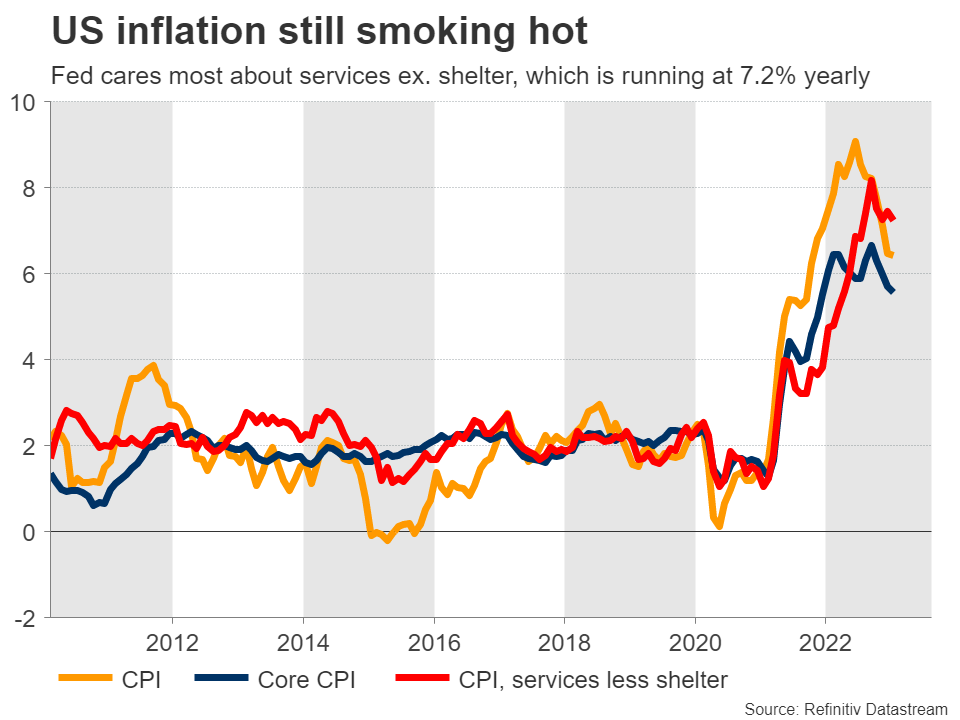
A lot has happened in US markets over the past week, mainly pointing in the direction of tighter Fed policy for a longer period. Inflation came in hotter than expected in January, and the part that was especially hot was the metric the Fed cares most about.
Services inflation excluding shelter clocked in at 7.2% from last year, suggesting that there’s still a long road before inflation is crushed as the stickier categories and producer prices are not really cooling down. Supporting this notion was the latest batch of retail sales, which revealed that consumer demand is still in good shape.
Markets responded by pushing up the expected ‘peak’ in Fed rates to a new cycle high of 5.28%, and by pricing out the rate cuts that were anticipated at the end of the year. That propelled US yields higher, yet the dollar’s advance was not impressive. It outperformed the yield-sensitive yen, but it barely edged out new highs against the euro.
We’ll find out whether this was just a short-term trading anomaly or something more worrisome next week, when a storm of US data is released. The show will start on Tuesday with the business surveys for February, ahead of the Fed minutes on Wednesday. Then on Thursday, the second estimate of GDP for Q4 is out, before the week concludes with the latest core PCE price index on Friday.
Most of the focus will be on the FOMC minutes. This was the meeting when the Fed chief signaled that a ‘disinflationary’ impulse had started to emerge, sending the dollar tumbling. That said, the tone of Fed officials since this meeting has been much more hawkish, with many stressing that rates might need to go higher than previously envisioned.
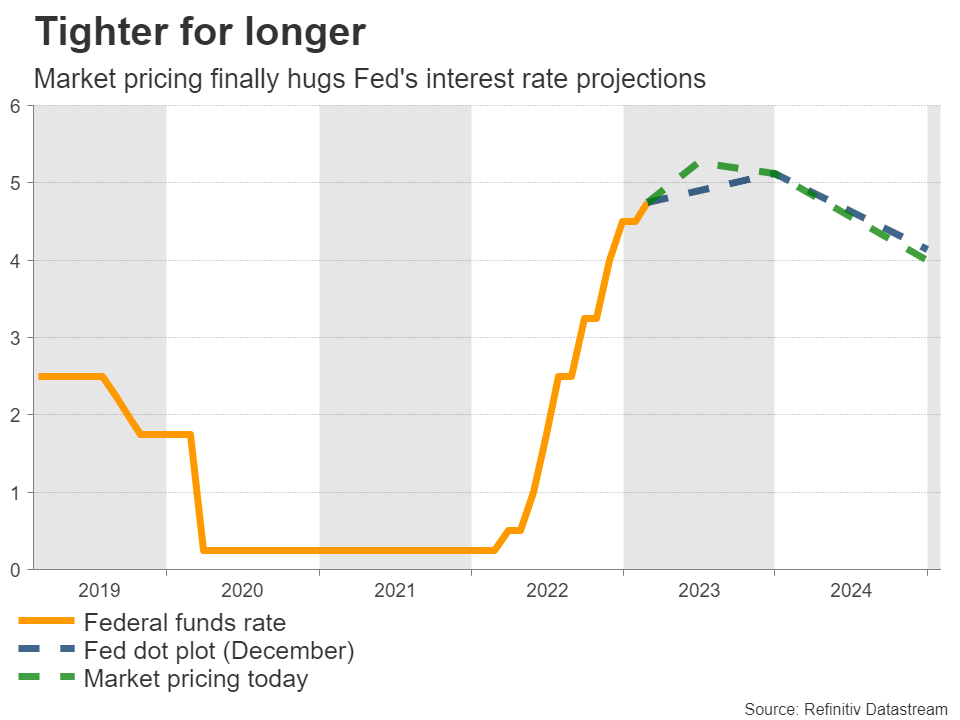
If something similar is reflected in the minutes, it could reinforce the upward pressure on US yields, although whether the dollar can capitalize properly this time remains to be seen.
RBNZ: Not the time to pause
The Reserve Bank of New Zealand meets Wednesday for its first rate setting decision of 2023. With all other major central banks having kicked off the new year with rate hikes, the RBNZ is not about to buck the trend. Policymakers are widely anticipated to raise borrowing costs by a further 50 basis points, taking the cash rate to 4.75%.
Even more crucial will be whether policymakers raise their projected terminal rate even higher than the lofty 5.50% they estimated back in November. If they leave this number unchanged, the New Zealand dollar’s best chance of finding some upside will be some hawkish commentary, particularly the language around inflation.
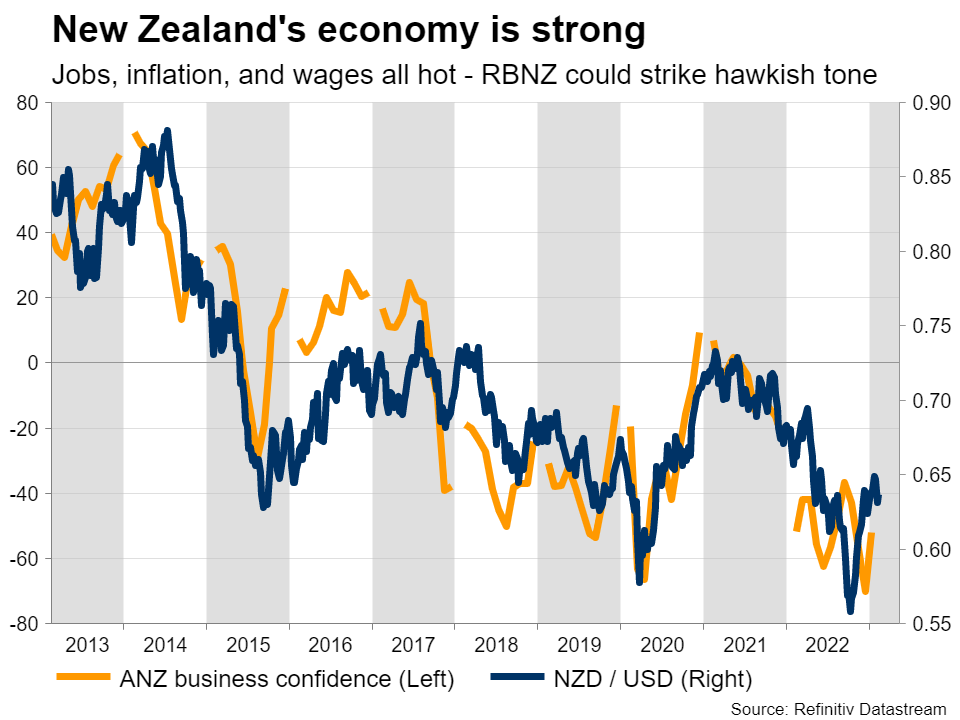
Recent data suggests it’s too early for the RBZN to ease up on its tightening campaign – unemployment remains very low, wages are rising at a record pace, inflation has only recently started to plateau, and inflation expectations are elevated. The RBNZ will therefore likely be wary about cornering itself by talking about a pause, maintaining some flexibility in case rates have to be raised even higher than 5.50%.
Eurozone and UK business surveys eyed
Crossing into Europe, the latest business surveys from the Eurozone and United Kingdom will hit the markets early on Tuesday. As always, these will be crucial in shaping the outlook for investors, providing an early glimpse into how corporations view the economic landscape.
In the euro area, the previous round of these surveys painted a rosier picture, highlighting an improvement in growth momentum and suggesting the region might escape a recession after all. These hopes underpinned the euro, but it’s important to stress that most of this progress was due to warmer weather conditions.
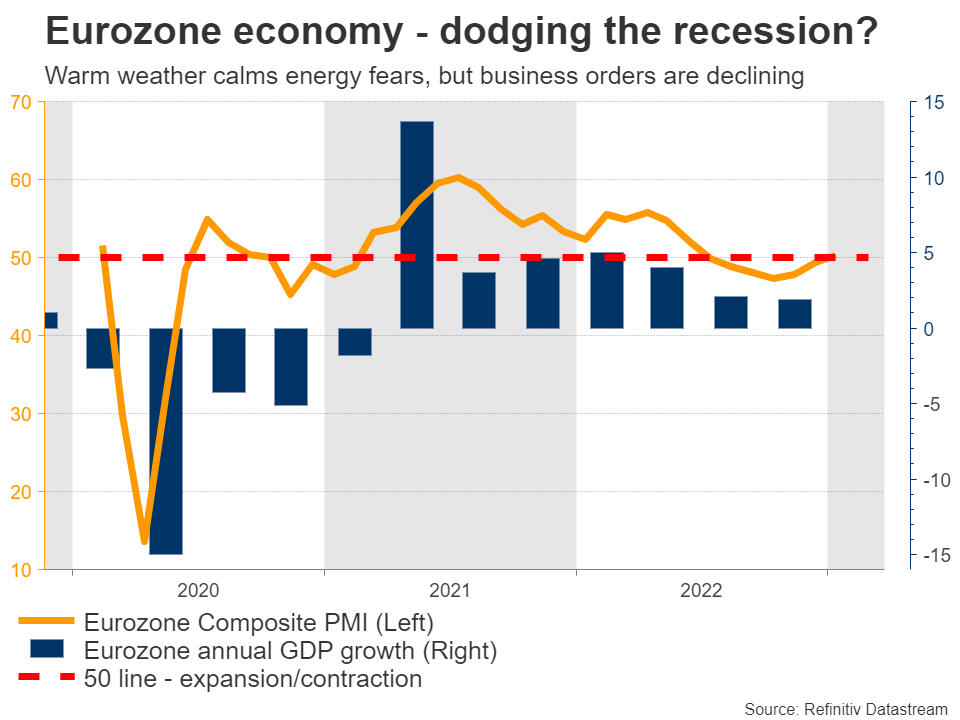
New business orders kept falling, which suggests that economic growth will likely be anemic in the coming quarters, even if the Eurozone ultimately dodges a recession. Whether this pattern continues in the February surveys could decide the longevity of the euro’s recovery.
Germany’s inflation report will be released Wednesday, after it was delayed earlier this month.
Over in the UK, the situation appears even worse. Britain has a greater inflation problem to deal with, as electricity bills have surged more than most of Europe and post-Brexit worker shortages have added upward pressure on wages. Meanwhile, the economy is teetering on the verge of recession, something both the IMF and the Bank of England already expect in their forecasts.
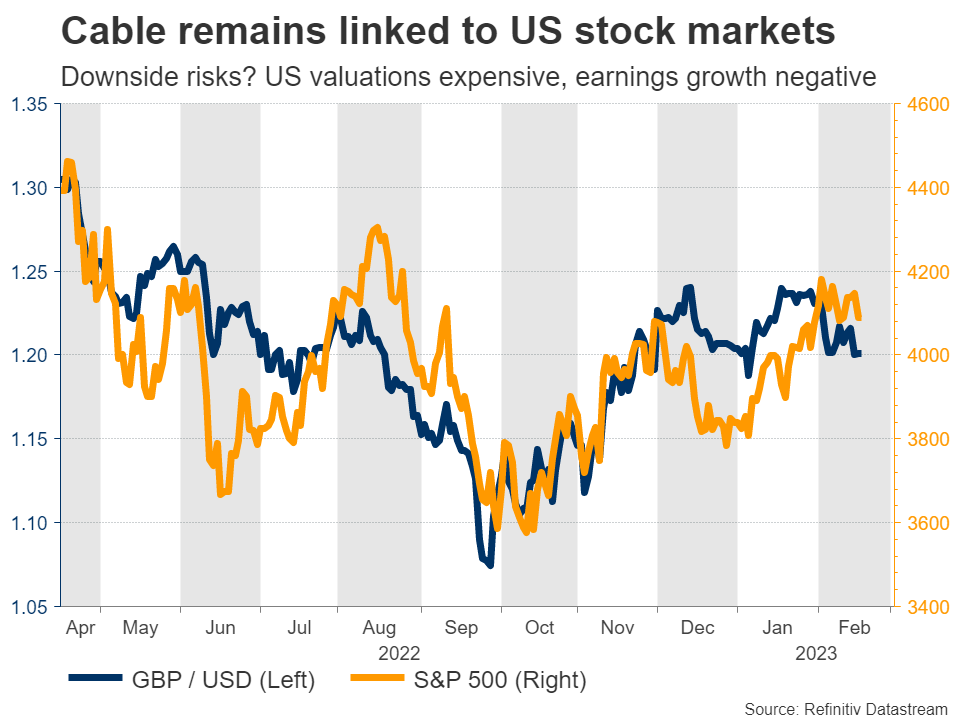
As for sterling, the outlook is quite gloomy. The UK is probably the weakest major economy right now, market pricing suggests the Bank of England will pause its tightening cycle soon, and the pound’s sensitivity to stock markets leaves it exposed considering the expensive valuations in US markets while earnings growth has turned negative.
Elsewhere, traders of commodity-sensitive currencies will keep a close eye on Canada’s inflation and retail sales stats on Tuesday, ahead of Australian wage numbers on Wednesday. Finally in Japan, the inflation report that’s out on Friday will likely confirm that price pressures are firing up, feeding speculation for further policy adjustments by the Bank of Japan.