

Sample Category Title
GBP/USD: Bears Eye 100DMA and 2023 Low at 1.1841
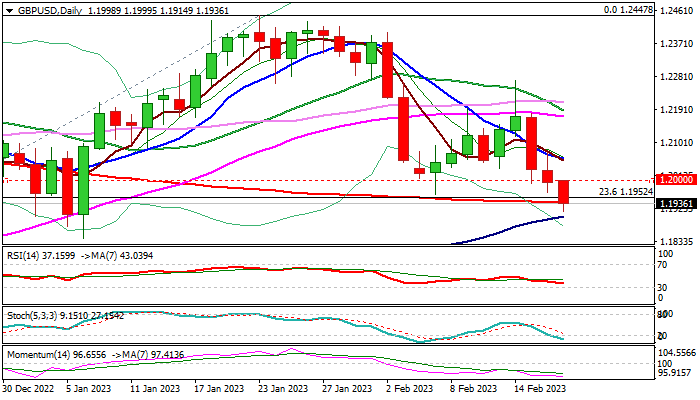
Cable maintains firm bearish tone on Friday and extends steep fall into third consecutive day.
Friday’s action holds below psychological 1.20 level, which reverted to solid barrier, with fresh bearish acceleration probing below next significant support at 1.1938 (200DMA) and pressuring 100DMA (1.1900), the last obstacle on the way towards key support at 1.1841 (2023 low of Jan 6).
Break of the latter would complete a double-top pattern and weaken the larger structure, opening way for a deeper correction of 1.0348/1.2447 advance.
Upticks should remain under 1.20 barrier to keep fresh bears intact.
Res: 1.1984; 1.2000; 1.2072; 1.2092.
Sup: 1.1900; 1.1841; 1.1796; 1.1763.
Finally Hitting Home
Equity markets are ending the week in the red after finally falling victim to the persistent disappointment of US economic data on Thursday.
It's taken a lot but it would appear investors' eternal optimism is being shaken, with the latest PPI figures finally driving the message home that bringing the economy in for a soft landing will be extraordinarily challenging and there'll likely be plenty of turbulence along the way.
In reality, the message should have sunk in much sooner but investors were seemingly so convinced that these were just blips in the data that they failed to see how quickly they were stacking up.
Don't get me wrong, I'm still of the view that the data will improve again but I'm not so willing to turn a blind eye to what it's telling us now. And most importantly, neither is the Fed which has been less willing to get carried away with what came before.
Suddenly the topic of conversation has changed from one more 25 basis point hike and then two cuts later in the year, a few weeks back, to perhaps reverting back to 50 in March and hiking by another 75 in total. It was always going to be a rollercoaster ride this quarter and maybe next and the first seven weeks of the year have been just that.
Oil slides but remains in range
We’re continuing to see oil prices fluctuate, although recent choppiness has occurred largely near the upper end of their range since early December. Brent and WTI are on the decline on Friday, matching up with overall risk appetite in the markets but broadly speaking, little has changed.
One major upside risk to prices remains China and its recovery from the transition to living with Covid. Russian output remains another, following reports that its output will fall by half a million barrels per day from March as a result of the price cap. Some suggest that could double later in the year. There are downside risks, of course, not least a slower global economy as a result of much higher interest rates. But for now, traders seem content with it remaining in the range.
Warm weather has enabled gas prices to continue drifting lower, albeit at a slower pace after falling back to pre-war levels. European gas stores remain strong as a result, although that could shrink over the remainder of the winter.
Another setback
Thursday’s PPI numbers were the latest setback for gold, coming on the back of the red-hot jobs report, stubborn CPI data, and strong retail sales. Gold has fallen around 7% over the last couple of weeks and it appeared to be stabilizing around $1,820-$1,830 on Thursday.
It's trending lower once more today though, off almost 1% but there isn't an enormous amount of momentum at this point. We could see it consolidate around here or even pare losses, although a break of $1,820 could see the sell-off intensify again with $1,780-$1,800 being the next major test.
Taking off?
Bitcoin is in retreat at the end of the week, not immune it seems to the sharp shift in risk appetite throughout the markets. That comes after an immense rally earlier this week that saw it hit an eight-month high on Thursday. While the risk element will no doubt be a key factor, that the correction is occurring in the $24,500-$25,500 zone suggests to me that there's a coincidental element to it as well, as we could have expected to see some profit-taking around these levels regardless. The risk mood may have just helped that along. Regardless, bitcoin bulls will no doubt be excited by recent developments in the price and may feel more optimistic than they have since 2021.
EUR/USD: Increased Risk of Deeper Fall
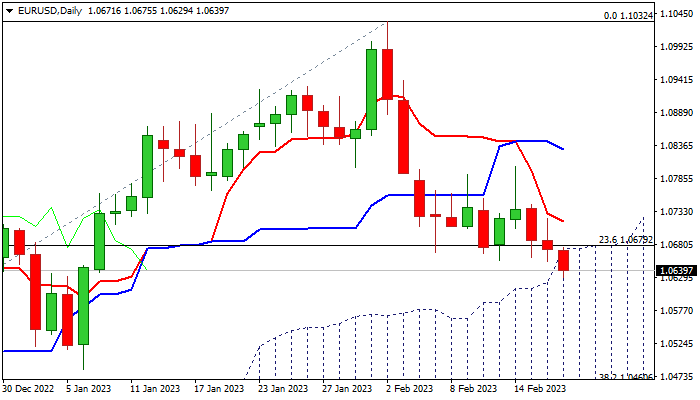
The Euro dips to the lowest levels since Jan 6 on Friday, with break below the floor of recent multi-day range, signaling bearish continuation.
Fresh weakness also broke into rising daily cloud which offered significant support, adding to growing bearish signals, which will be confirmed on close within the cloud.
Stronger dollar on growing expectations that the US central bank will remain on policy tightening path, keeps the single currency under pressure.
The pair is on track for the third weekly close in red, with long upper shadow on this week’s candle, signaling that the Euro is strongly offered.
Daily studies maintain strong bearish momentum, which contributes to negative setup of moving averages and south-heading RSI.
Bears turn focus towards targets at 1.0483/1.0460 (Jan 6 low/Fibo 38.2% of 0.9535/1.1032), which guard pivotal daily cloud base (1.0361).
Daily cloud top (1.0675) reverted to initial resistance, followed by daily Tenkan-sen (1.0716) which should ideally cap upticks.
Res: 1.0675; 1.0716; 1.0795; 1.0830.
Sup: 1.0629; 1.0596; 1.0519; 1.0483.
ETHUSD Edges Lower, Bulls Continue to Vie for a Breakout Above 1,700
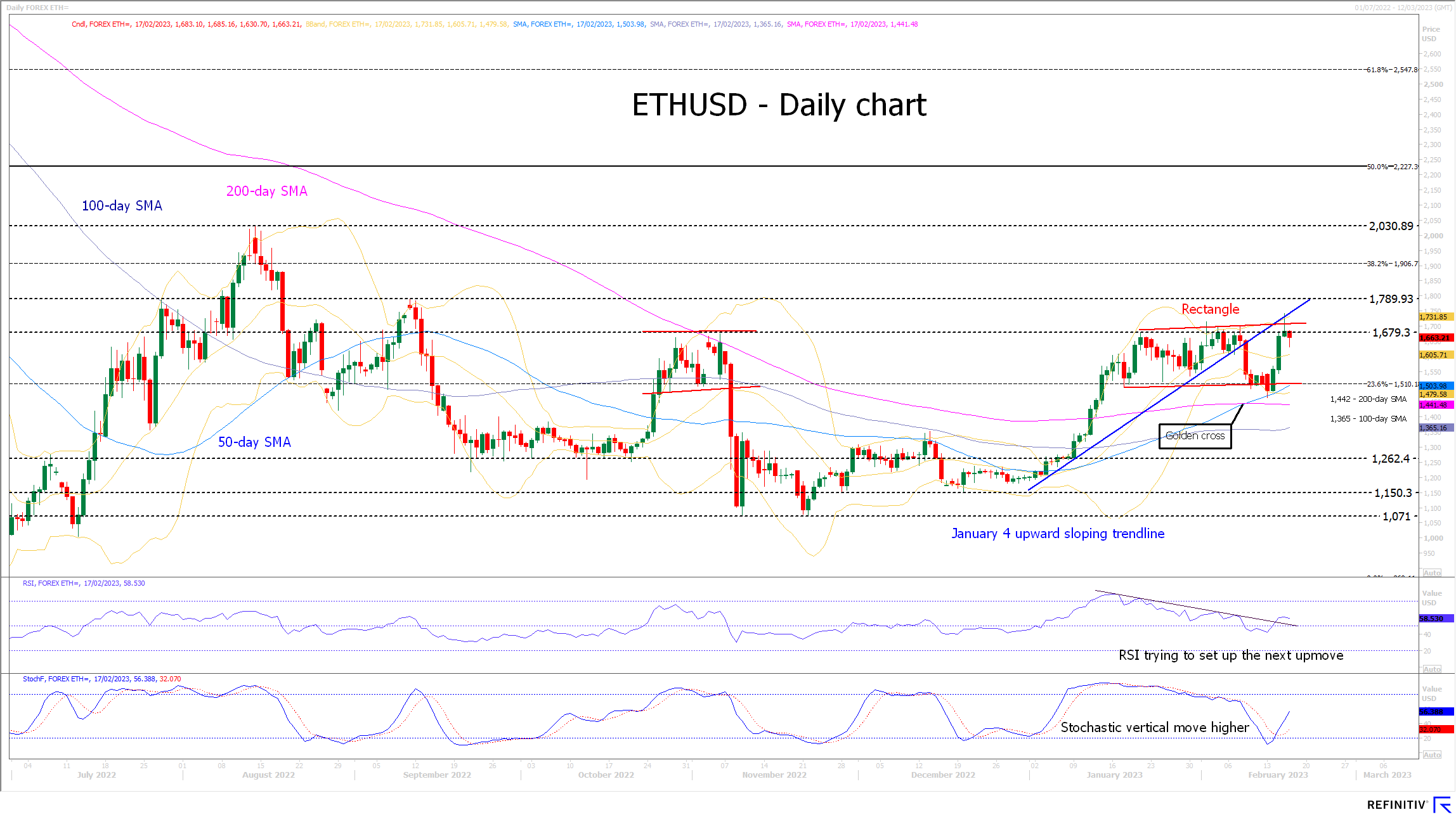
ETHUSD is edging lower today following three days of advances that pushed it momentarily above the 1,700 area. It remains inside the nicely shaped 1,500-1,710 rectangle that has formed since January 16, in line with the 23.6% Fibonacci retracement level of the April 4, 2022 –June 18, 2022 downtrend of 1,510. ETHUSD made unsuccessful attempts to break down the rectangle on both the downside and upside, but the market appears to be in a fine balance at the moment. Market participants would prefer a decisive close outside the rectangle boundaries in order to make an informed decision about the next move.
The momentum indicators have acknowledged the recent upward move. The RSI has edged above the 50 midpoint with the downward sloping trendline now acting as support. Additionally, the stochastic oscillator is moving higher almost in a vertical fashion and thus revealing the strength of the current move.
If the bears manage to push ETHUSD towards the 1500s area, they would be faced with both the lower boundary of the rectangle and 50-day simple moving average (SMA). If successful in breaking these levels, the next target could be at the 1,365-1,442 range, populated by the 200- and 100-day SMAs. Even lower, the 1,262 level set by multiple lows and highs during 2022 could prove tougher to crack.
On the other hand, the bulls appear to be perplexed by the resistance met at the 1,700 area as their attempts to overcome it in the past six months have failed. Should they manage to break this level, they could test the January 4 upward sloping line just ahead of the September 11 high of 1,790. Even higher, the 38.2% Fibonacci retracement at 1,907 could prove to be a stronger resistance point.
To sum up, ETHUSD continues to hover inside the recent rectangle. The bulls would love a move above the 1,700s area while the bears hope for a repeat of the move seen during the September-November range trading episode.
USD/JPY Breaks Above 135
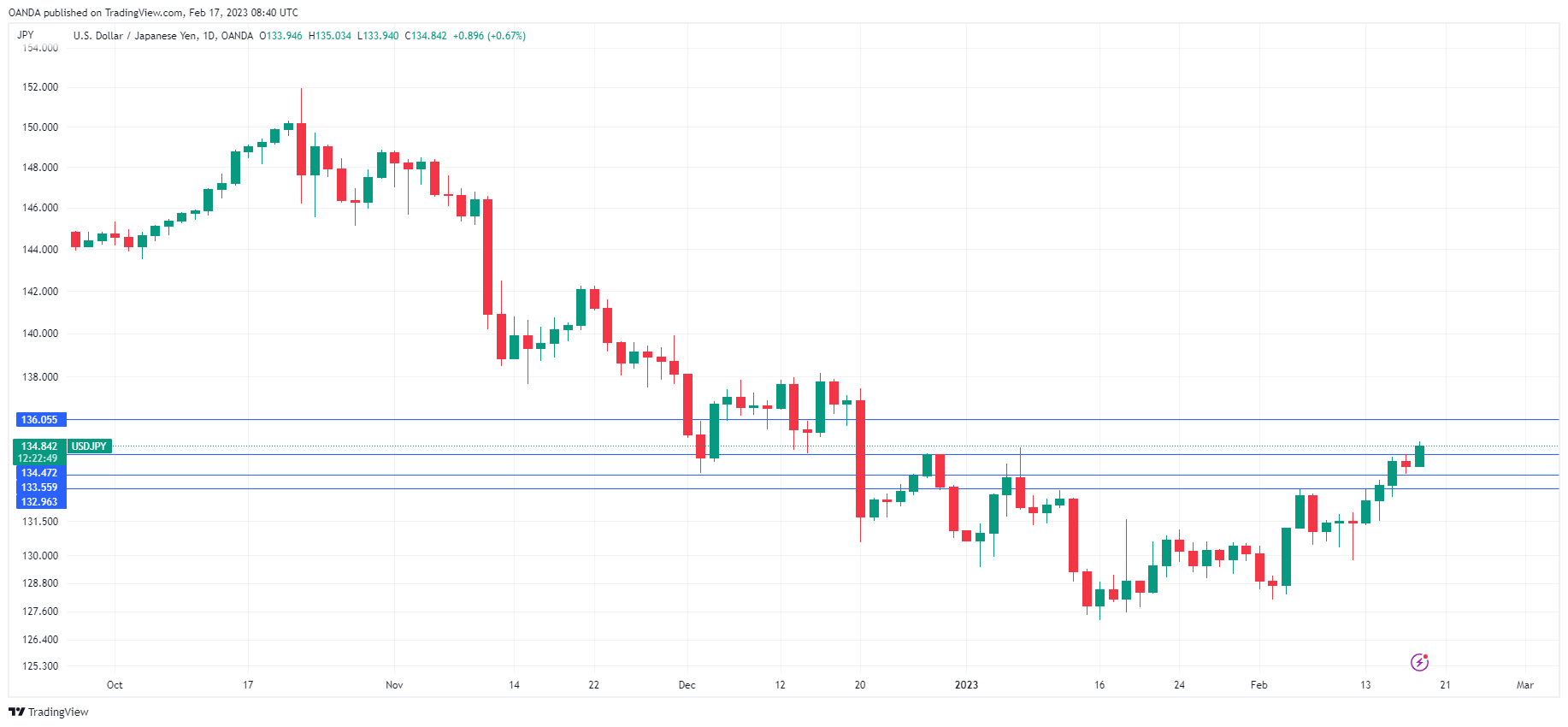
The Japanese yen is down sharply on Friday. In the European session, USD/JPY is trading at 134.93, up 0.73%. The yen fell below 135 earlier today for the first time since December 23.
Solid US data sends dollar higher
The US dollar is broadly higher and has pummelled the yen, climbing 2.6% this week. Strong US numbers have boosted the dollar, as the Fed is likely to remain hawkish with the economy remaining strong. Retail sales impressed with a 3% gain earlier this week, and PPI and unemployment claims were both better than expected. Consumer inflation ticked lower but was stronger than expected. Is the disinflation process stalled?
The economy has proven to be surprisingly resilient to rising interest rates, leading to hopes for a soft landing or even a ‘no landing’. The Fed has been consistent in its message of ‘higher for longer’ with regard to rates, but the markets haven’t really been listening, assuming that the Fed would have to pivot and even cut rates later in the year. The stronger-than-expected releases, from nonfarm payrolls to inflation to retail sales have forced the markets to revise their stance and move closer to the Fed position that the terminal rate will be above 5%.
Fed speak remains hawkish
Fed member Mester said she saw a strong case for raising rates by 50 basis points at the last Fed meeting, a sign that the Fed could move away from the moderate 25-bp hikes if inflation isn’t falling quickly enough. Mester said that she didn’t see inflation falling to 2% until 2025, which points to a long disinflation process.
The depreciation of the yen will be raising eyebrows in Tokyo. The Bank of Japan and the Ministry of Finance have often voiced unease when the yen has plunged and this has led to currency interventions in order to prop up the yen. It’s a delicate time for the Bank of Japan, as Kozo Ueda is set to take over as Governor in April. If the yen continues to lose ground, we’re sure to hear warnings from the BoJ and the Ministry of Finance, possibly with threats of intervention.
USD/JPY Technical
- USD/JPY is testing resistance at 134.47. Above, there is resistance at 136.05
- There is support at 1.3355 and 1.3296
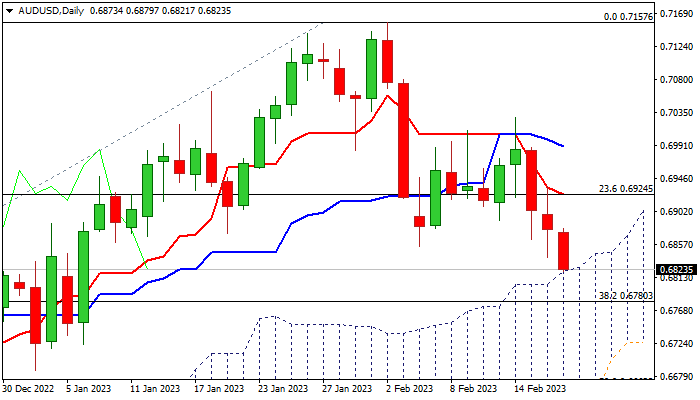
AUD/USD: Extended Bears Test Key Support Zone
The AUDUSD holds in a steep fall for the third straight day, pressured by risk aversion as the US dollar rises on expectations of further rate hikes.
Fresh bearish acceleration on Friday (the pair was down 0.7% in Asia / early Europe) cracks the upper boundary of strong support zone at 0.6820/0.6780 zone, consisting of the top of rising daily cloud, 200DMA and Fibo 38.2% of 0.6170/0.7157).
Bears may face headwinds here as daily stochastic is oversold and 14-d momentum stretched, adding to prospects of consolidation / mild correction, before bears break lower and signal continuation of the downtrend from 0.7157 (2023 peak, posted on Feb 2).
Former low at 0.6855 (Feb 6 low) offers initial resistance, followed by broken 55DMA at 0.6872 and daily Tenkan-sen / broken Fibo 23.6% (0.6925) to limit extended upticks and keep bearish bias.
Res: 0.6855; 0.6872; 0.6925; 0.6973.
Sup: 0.6804; 0.6780; 0.6722; 0.6687.
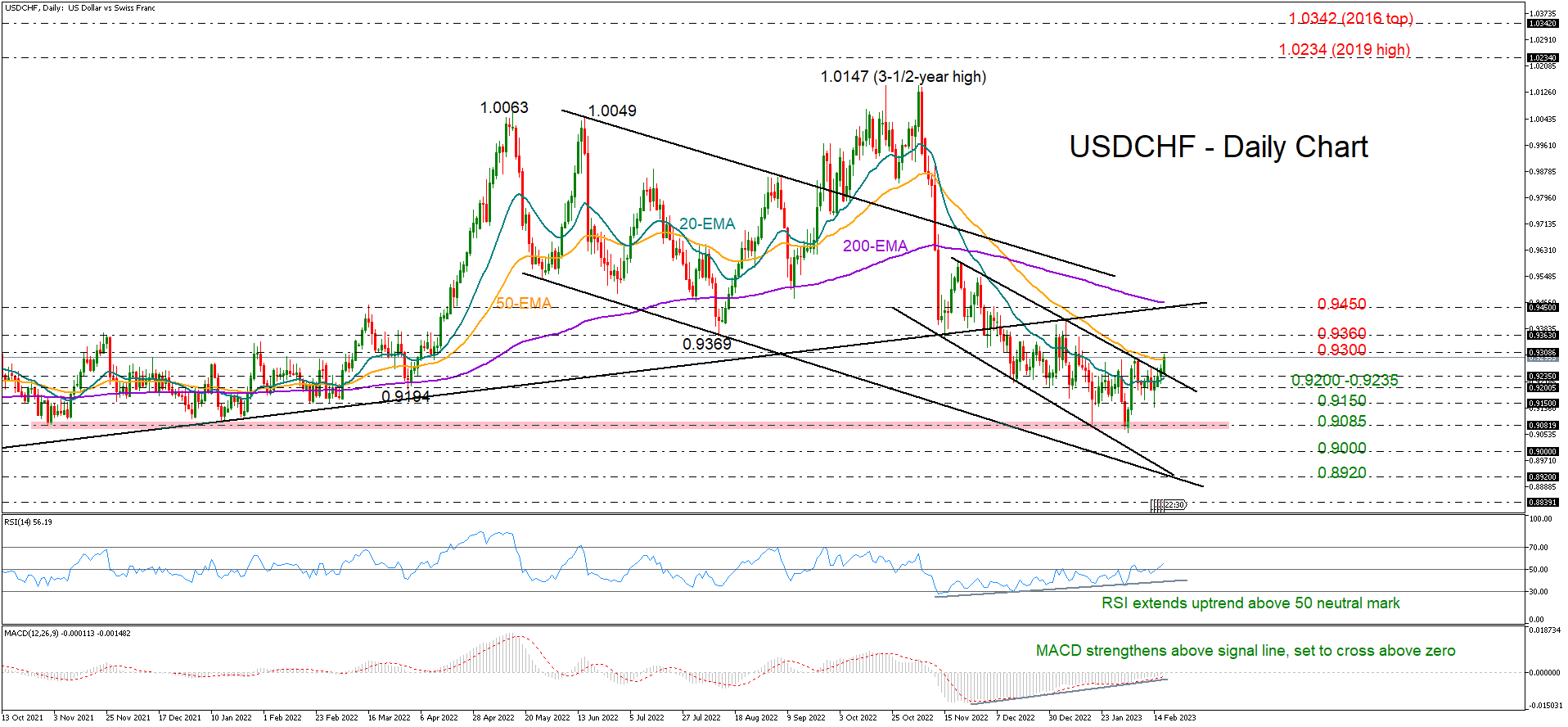
USDCHF Bulls Gain Impetus; 0.9300 in Focus
USDCHF is getting bullish vibes, aiming to close significantly above the resistance trendline that has been keeping buying pressures under control since the end of November at 0.9245.
The RSI has finally stretched its uptrend clearly above its 50 neutral mark, backing the positive momentum in the price. Likewise, the MACD continues to strengthen above its red signal line, set to cross above zero, reflecting growing optimism in the market too.
Still, traders may remain patient until the price successfully overcomes the 50-day exponential moving average (EMA) and the 0.9300 round-level before they target the next barrier at 0.9360. Breaching the latter, the pair may advance towards the broken ascending trendline from the 2020 lows, which is slightly below the 200-day EMA at 0.9450.
Should upside forces falter, the price may drift lower to seek support around 0.9235 and the 20-day EMA. Failure to pivot here could bring the 0.9200 handle under examination, while a step below 0.9150 may threaten a downtrend resumption below the key 0.9085 floor. Another defeat at this point could shift attention to the 0.9000 psychological number.
In brief, USDCHF looks set for its next bullish phase. A clear close above 0.9300 may attract fresh buying interest in the short term.
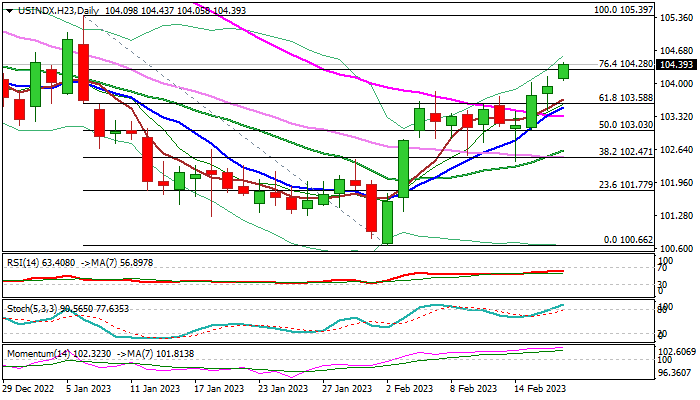
Dollar Index: Dollar Rises to New Multi-Week High, Signaling Bullish Continuation
The US dollar rose to new six week high in early Friday’s trading, with fresh extension higher signaling continuation of the bull-leg from 100.66 (2023 low, posted on Feb 2), which paused for eight-day consolidation.
The greenback remains well supported by growing expectations for further rate hikes by the Fed after US inflation rose above expectations in January, while weak UK German data released today, added pressure on greenback’s major counterparts.
Break above the recent congestion and penetration of falling thick daily cloud, signal that dollar regained traction and resuming rally.
Bulls cracked pivotal barrier at 104.32 (top of rising weekly cloud, opening way for test of 105.39 (2023 high, posted on Jan 6).
Bullish momentum continues to rise on daily chart and underpins near-term action, along with a number of bull-crosses of daily moving averages (10;20;30;55), although overbought stochastic gives initial warning of consolidation in coming sessions.
The greenback is also on track for the third consecutive bullish week, with additional positive signal expected on today’s close above rising weekly Ichimoku cloud, which would become support and further underpin the action.
Recent range tops at 104.00 zone, now offer initial support, followed by broken Fibo barrier at 103.58 (61.8% of 105.39/100.68), with daily cloud base (103.65) marking key support, which should limit potential dips and keep bulls in play.
Res: 104.63; 105.04; 105.39; 105.78.
Sup: 104.28; 103.80; 103.65; 103.40.
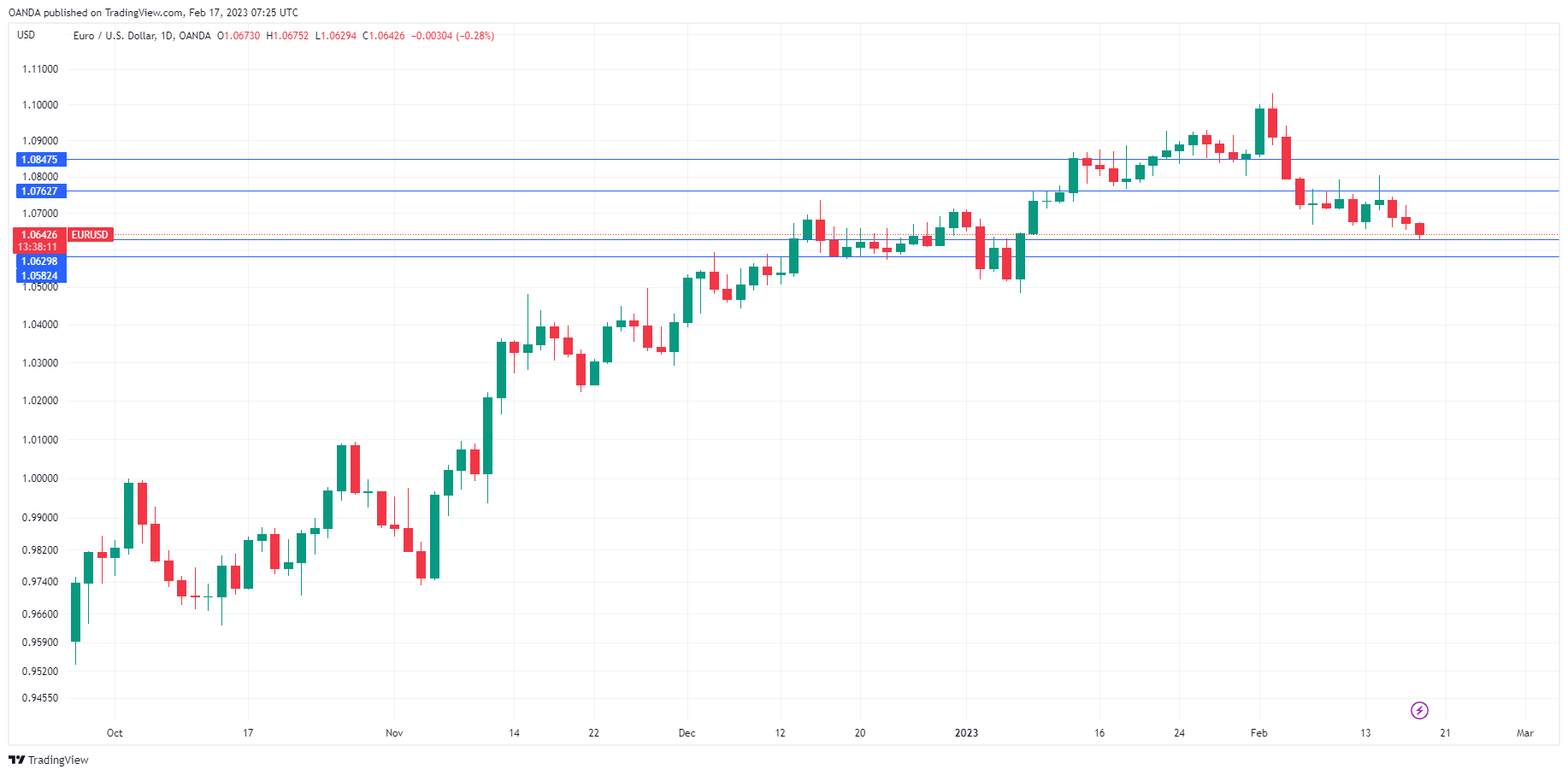
EUR/USD at 3-Week Low after Strong US Data
The euro is down for a third straight day and fell earlier to 1.0629, its lowest level since Jan. 23. In the European session, EUR/USD is trading at 1.0639, down 0.30%.
US dollar flexing muscles
The US dollar is showing some strength this week against the majors, as US data continues to shine. Retail sales impressed with a 3% gain earlier this week, and PPI and unemployment claims were both better than expected. Is the disinflation process stalled?
The markets didn’t expect such good numbers, but the economy has proved to be surprisingly resilient to rising interest rates. The Fed has been preaching ‘higher for longer’ for some time, but the markets stuck to their dovish stance, expecting that the Fed would have to pivot and even cut rates later in the year. The host of strong US numbers has forced investors to recalibrate, and the markets have revised upwards their peak rate forecast to above 5%.
The US dollar has been the big winner of the shift in market thinking, and US Treasury yields are at their highest level this year. Fed member Mester said she saw a strong case for raising rates by 50 basis points at the last Fed meeting, a sign that the Fed could move away from the moderate 25-bp hikes if inflation isn’t falling quickly enough. Mester said that she didn’t see inflation falling to 2% until 2025, which points to a long disinflation process.
The ECB raised rates by 50 basis points in February and has signalled that it will do the same at the Mar. 16 meeting. The main financing rate is currently at 3%, well below the Fed (4.5%) and other major central banks. It’s not clear what the Bank has planned after the first quarter, but with inflation running at 8.5%, the risk for further rate hikes is skewed to the upside. The ECB has made it clear that rates will remain high until there is evidence that inflation is falling toward the target, which means that the current rate-tightening cycle isn’t anywhere near its end.
EUR/USD Technical
- EUR/USD is testing support at 1.0629. Below, there is support at 1.0581
- 1.0762 and 1.0847 are the next resistance lines
ECB Schnabel: We may have to act more forcefully
ECB Executive Board member Isabel Schnabel said in a Bloomberg interview, "we are still far away from claiming victory", adding that "we may have to act more forcefully." She also noted that a broad disinflation process has not even started." Meanwhile, "wage growth has picked up substantially" and could be "more persistent.
Schnabel also indicated that market pricing of a terminal rate of 3.50% may be too optimistic. "Markets are priced for perfection," she said. "They assume inflation is going to come down very quickly toward 2% and it is going to stay there, while the economy will do just fine. That would be a very good outcome, but there is a risk that inflation proves to be more persistent than is currently priced by financial markets."
A 50 basis-point hike next month is "necessary under virtually all plausible scenarios," she said. "There is no inconsistency between our principle of data-dependency and these intentions because it's very unlikely that the incoming data is going to put this intention into question."