Sample Category Title
10-y Testing January Top of 3.90%
Markets
Yesterday, especially US bond markets further adapted to guidance that persistent high inflation will require the Fed to raise its target rate well above 5.0% to stay there for a long period of time. US data were mixed. Jobless claims (194k) brought more evidence of a tight labour market. In line with the CPI on Tuesday, US PPI inflation reaccelerated more than expected to 0.7% M/M for the headline and 0.6% for the core measure, resulting in Y/Y readings of 6.0% and 4.5% respectively. On the other hand housing starts and permits declined more than expected and the Philly Fed business outlook posted an awful miss (-24.3 from -8.9 vs -7.5 expected). However, contrary to what would have happened a few weeks ago, it didn’t hinder the reigning trend to higher yields. It was again longer yields taking the lead with the curve turning a bit less inverse. The US 2-y yield gained 0.9 bp. The 30-y added 7.3 bps. Later in the session, Fed’s Bullard further reopened the debate on a 50 bps step at the March meeting, joining recent signs from Fed’s Mester. Changes in German yields due to a late session intraday comeback were smaller (less than 1 bp across the curve). Even so, the 2-y German yield holds at the cycle peak (2.88%) while the 10-y tested the 2.50% barrier intraday. The EMU 10-y swap is holding north of 3.0%. After remarkable resilience of equity markets to the rise in yields of late, charts yesterday showed some tentative cracks. After nervous intraday swings, US indices lost between 1.26% (Dow) and 1.78% (Nasdaq). The Euro Stoxx 50 stayed in green (+0.40%) but off the intraday peak. The dollar gradually gained further ground (EUR/USD close 1.0674, DXY 103.85), even as there was still some hesitation intraday. Sterling lost further ground with EUR/GBP closing just north of 0.89. BoE’s Pill indicated that the pace of BoE hikes might slow and warned on the risk of overtightening.
This morning, Asian markets felt the spill-over from the losses on WS, with most regional indices ceding about 0.5%-1.0%. US yields continue drifting higher (2-4 bps). The risk-off also propels the dollar above first resistance (DXY currently at 104.5, EUR/USD 1.064; USD/JPY 134.75). There are hardly any eco data with market moving potential in EMU or in the US. We look out for speeches of ECB’s Villeroy and especially Fed’s Barkin (on the labour market). Both European (cfr supra) and US yields are near important technical levels going into the weekend. The US 2-y yield (4.67%) is closing in on the cycle top of 4.80%. The 10-y is testing the January top of 3.90%. A break would be highly significant. After 10 days of ‘consolidation’, the dollar finally might get additional support from a less bright risk sentiment. EUR/USD breaking below the 1.0735/1.0656 area opens the way for a return to the 1.0484 2023 low. This morning, UK retail sales printed better than expected (ex-auto fuels 0.4% M/M and -5.3% Y/Y). Sterling gains a few ticks immediately after the release, but we doubt the it will be a (positive) game-changer for sterling.
News Headlines
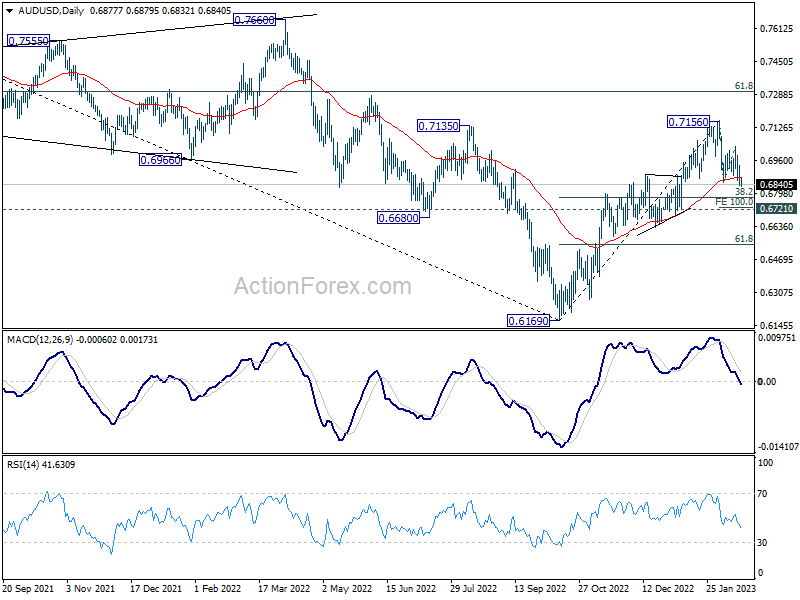
RBA governor Lowe in before the House on Thursday stuck to his view expressed in the Senate that more rate hikes are needed to crush inflation. He refrained from giving estimates for the terminal rate, saying that it is dependent on how the (world) economy and inflation evolves and the job outlook. Regarding the latter, Lowe downplayed the January labour market report, which wasn’t available yet at the Senate hearing and showed employment growth declining for a second month straight. It didn’t change his overall assessment, explaining that seasonal factors typically affect both December and January data. Lowe did say he would likely reassess the outlook if the February report was weak too. Australian government bond yields jump between 5 and 8.8 bps, steepening the curve. AUD/USD loses some ground but this is mainly due to overall USD strength. The pair fell from 0.6879 to 0.684.
US household debt jumped by the most in two decades in Q4 last year, data from the NY Fed showed. By adding a whopping $394bn (nominal), total overall debt now stands at a record $16.9tn. Mortgage balances remain the biggest form of debt ($11.92tn) and spurred the surge while mortgage originations due to the aggressive Fed tightening campaign fell to the lowest since 2019. But the increase was broad-based. Credit cards registered the largest jump since recording began in 1999. Overall delinquency rates remain below pre-pandemic levels but are rising fast. Losing one’s job is usually the reason for delinquencies to pick up. But with the unemployment rate at historically low levels, the NY Fed concludes that the recent rise is more due to inflation and rising rates.
No Landing?
The equity marathon that kept going on for questionable reasons since Tuesday ended in tears yesterday, with the arrival of a new set of economic data that crushed the optimistic rhetoric of soft landing.
Released yesterday, the latest data showed that US producer price inflation rose more than expected on a monthly basis, both for headline and core data, and the core PPI eased less than expected – similar to what we saw in the CPI data, BUT the Philli Fed manufacturing index was a disaster with an unexpected drop from -8.9 to -24.3 – the expectation was a -7.4 print.
So that crushed the idea that the economy is strong, without however fueling the Federal Reserve (Fed) cut expectations, as the slowdown in inflation needs to be addressed for some more time.
And of course, comments from two Fed members were the last nails in the coffin yesterday. Loretta Mester said that she would go for a 50bp hike if she had the right to vote in the latest FOMC meeting. And James Bullard said that he would back a 50bp hike in March, if he could vote this year.
Happily, for the equity bulls, both Mester and Bullard don’t vote this year. But their non-voting status didn’t make their comments sound any less scary.
As a result, the odds for a 50bp hike at the March FOMC meeting stand now around 18%, whereas this probability was just around 9% at the start of this week.
Money markets see the Fed funds rate climb to 5.24%, compared to around 4.90% just two weeks ago.
And the treasury yields extend their advance on the back of stronger-than-expected inflation and way-softer-than-expected Philly Fed index.
The US 2-year yield consolidates a touch below 4.70%, while the 10-year yield hit 3.90% for the first time this year.
The S&P500 gave back nearly 1.40% yesterday, while the more rate-sensitive Nasdaq fell nearly 2%.
US futures hint at further selloff before the weekly closing bell, as in the absence of important data, investors will have to digest the week’s mixed data. And the bad news is, the European stock traders will also have to think whether a further rally in European stocks makes sense, when the EURUSD is trending lower.
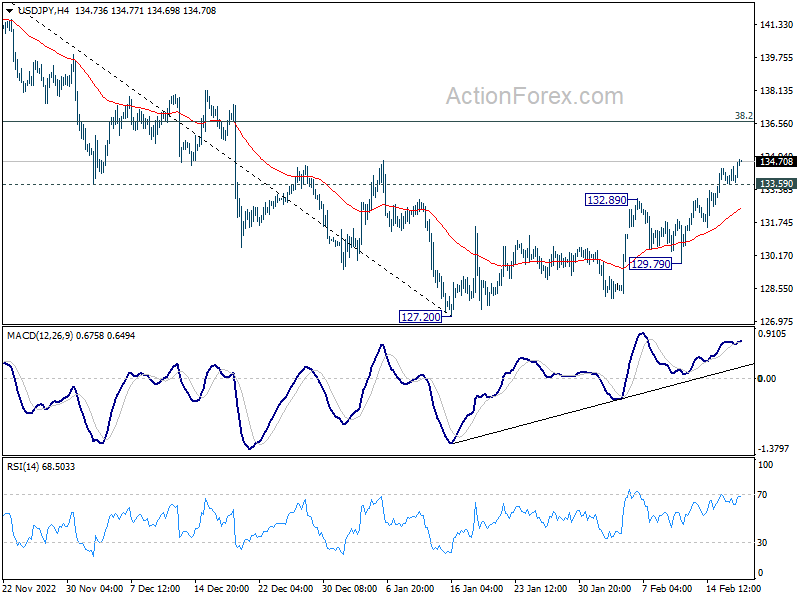
The EURUSD extended losses to 1.0630 on the back of a broadly strong US dollar, and the dollar-yen rallied past the 134.80 level in Japan today, despite the news that the Bank of Japan’s (BoJ) next move under the leadership of the new Governor Ueda would be to scrap the non-sense YCC policy and start tightening by July. From a technical perspective, the 135-137 range, which includes a psychological mark, the major 38.2% Fibonacci retracement and the 200-DMA could be interesting top selling levels for those who bet that the Japanese bankers will finally come back to their senses.
Zooming out, the strong US dollar is responsible for most FX moves right now. The US dollar index cleared 104 resistance, which was the minor 23.6% Fibonacci resistance on September to February selloff, and stepped back into the long term bullish trend.
Gold fell to $1823 per ounce on the back of higher US yields – that increase the opportunity cost of holding the non-interest-bearing gold, and the stronger US dollar.
Rising tensions between US and China somehow helped gold eke out small gains yesterday, especially after Beijing said that they were banning Lockheed Martin and Raytheon for selling arms to Taiwan.
But happily for all of us who don’t want to see more geopolitical tensions, but unhappily for all those who have a long position in gold, US President Joe Biden said he intends to speak with Xi about the whole balloon tragedy. We will see if it helps.
For now, gold is headed lower, and the next key support stands at $1814 per ounce, which is the major 38.2% Fibonacci retracement on the November to February rebound, and slipping below this level will send the precious metal into the medium-term bearish consolidation zone with prospect of a deeper dive.
In cryptocurrencies, Bitcoin eased after hitting the $25K mark yesterday. We notice a significant fall in correlation between Bitcoin and Nasdaq 100 stocks lately, which could spare Bitcoin from a further selloff if things get uglier in the traditional markets.
But will things get uglier, is yet to be seen, because we have seen evidence of a very strong optimism in the markets over the past few weeks, that no one, or no data has been able to hammer for good.
No landing?
The early-year optimism gave birth to the new concept of ‘no landing’.
No landing is the scenario where inflation remains high, but the economy remains strong as well.
And unfortunately, it’s as realistic as a no landing scenario in a commercial plane. At some point, there will be no fuel, and the plane will have to land. If both the economy and inflation is strong, that means that the Fed could continue raising the rates until the economic strength gives in. And rising Fed rates will mathematically hit equity valuations. So that no landing scenario is nothing more than wishful thinking.
US January PPI Signals Persistent Inflation Pressures
Market movers today
We end the week in a quiet fashion, with only tier-2 data releases on the agenda. As markets remain caught between the soft-landing vs. overheating narrative, a range of Fed speakers could get market attention this afternoon in terms of their assessment of this week's data releases.
In Sweden, we look for a further rise in unemployment during January.
The 60 second overview
US: The US January PPI surprised to the upside yesterday both in headline (+0.7% m/m) and core (+0.5% m/m) terms. Prices rose rapidly for both goods and services, but especially the sharp uptick in core goods PPI (+0.6%) suggests that Fed's anticipated disinflation has taken a breather. In the evening, Fed's Mester (non-voter) admitted that demand was not softening as anticipated, and did not rule out a larger hike at the March meeting. Bullard (hawk, non-voter) called for a terminal rate of 5.25-5.50%. The hawkish tones combined with the strong data weighed on equity and bond market sentiment and supported the broad USD. Markets are now pricing in over 50% chance of Fed continuing its hiking cycle beyond May.
US-China relations: Last night, US president Biden commented that he is expecting to discuss the issue of Chinese balloon that US shot down last week with Xi Jinping in the near future. Earlier yesterday, China banned Lockheed Martin and Raytheon from exporting to and importing from China by placing the companies onto its 'unreliable entity list', most likely as a retaliation to the balloon incident (see Reuters). The list was created during the trade war with Trump, but so far no companies had been placed on it. Chinese officials commented previously that China 'is strongly opposed to this and will take countermeasures against relevant US entities that have undermined our sovereignty and security'. The balloon was shot down by an F-22 fighter jet produced by Lockheed Martin, using an AIM-9X Sidewinder missile produced by Raytheon.
War in Ukraine: Next week, on 24 February, it has been a year since Russia started its unprovoked attack on Ukraine. Last weeks have brought no signs of the situation calming down, as Russia continued its barrage of missile strikes yesterday, hitting Ukraine's largest oil refinery. Western officials including German Scholz and French Macron gather at Munich today to discuss the situation. We take a look at the long-term consequences of the war in Research Russia-Ukraine: One year since Russia's invasion - Europe faces three changes as it settles into new reality, 17 February.
Equities: Equity sentiment turnaround late yesterday in the US cash session. No major changes to the economic narrative with data still pointing to overheating. Yields moved higher as Fed members started talking about the need for another 50bp hike. It should not be surprising to see the cyclical growth stock disliking this, the surprising part is how resilient they were earlier this week. In US, Dow -1.3%, S&P 500 -1.4%, Nasdaq -1.8% and Russell 2000 -1.0%. Asian markets are lower this morning in line with the negative development on Wall Street yesterday. More interestingly, US futures down again this morning led by growth stocks. European futures also lower but not much in light of the relative outperformance by European cash yesterday.
FI: The European bond market remains under pressure from both hawkish comments from some of the more hawkish ECB members (Nagel), while ignoring some of the more dovish members such as Panetta and Stournaras as well as Lane. Lane argued that much of the impact of the rate increases has yet to be seen on inflation. Hence, there seems to be growing difference between the ECB members on the size of hikes going forward. FX: Weaker SEK with EUR/SEK spending this week edging slightly higher yet within the 11.10-1120 range as the Riksbank effect is fading for now. Also NOK has been trading on the back-foot. Sterling is weaker while cable back below 1.20. USD stronger vs EUR, JPY and CNH where USD/JPY is making new year-highs, approaching 135. Credit: The credit markets traded sideways yesterday, still trying to balance the risk of central bank hawkishness versus the chance of a more benign economic outlook. ITraxx main was unchanged at 75.6bp while Xover widened 0.5bp to 393bp. The overall risk appetite for new issues remained intact resulting in another busy day in the primary markets, where for example Telia printed a 9Y EUR500m issue at a spread of MS+73bp (corresponding to a yield of 3.8%).
Nordic macro
Sweden: Today, we receive the Swedish labour market report for January. Unemployment has shown a modest increase since the bottom this summer. On the back of deteriorating fundamentals in terms of rising layoffs, slowing hiring plans and bankruptcies, we would expect a further rise in unemployment.
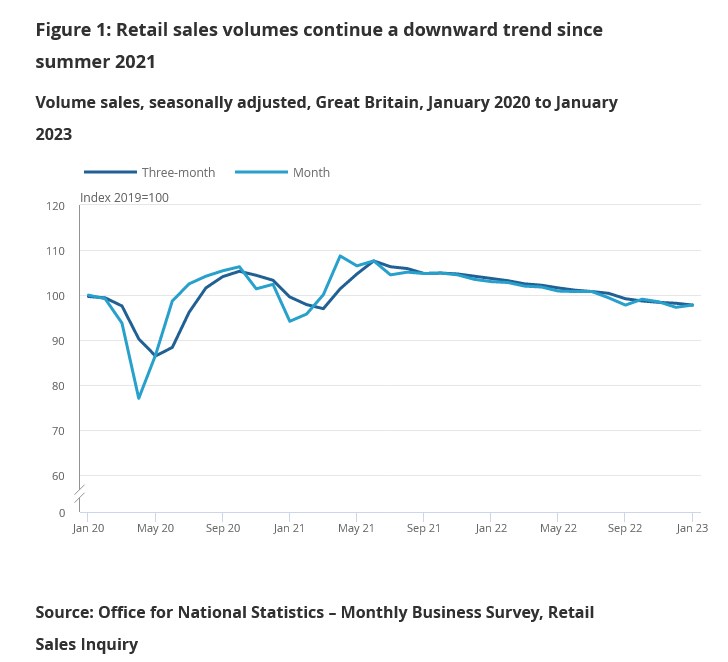
UK retail sales volume rose 0.5% mom in Jan, value up 0.6% mom
UK retail sales volume rose 0.5% mom in January, much better than expectation of -0.2% mom decline. Ex-fuel sale volume rose 0.4% mom, above expectation of 0.0% mom.
Compare with a year ago, retail sales volume dropped -5.1% yoy, versus expectation of of -5.5% yoy. Ex-fuel sales volume dropped -5.3% yoy, matched expectations.
In value term, retail sales rose 0.6% mom, 4.1% yoy. Ex-fuel sales rose 0.5% mom, 3.7% yoy.
EUR/USD Daily Outlook
Daily Pivots: (S1) 1.0645; (P) 1.0683; (R1) 1.0712; More...
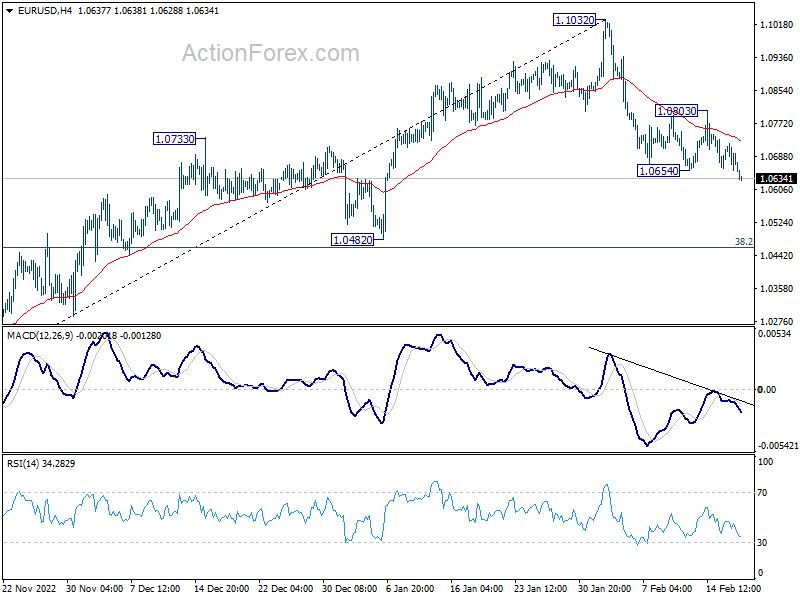
EUR/USD's corrective fall from 1.1032 resumed by breaking through 1.0654. Intraday bias is back on the downside for 38.2% retracement of 0.9534 to 1.1032 at 1.0463. Strong support should be seen around there to bring rebound, at least on first attempt. But break of 1.0803 is need to indicate completion of the correction. Otherwise, risk will stay on the downside in case of recovery.
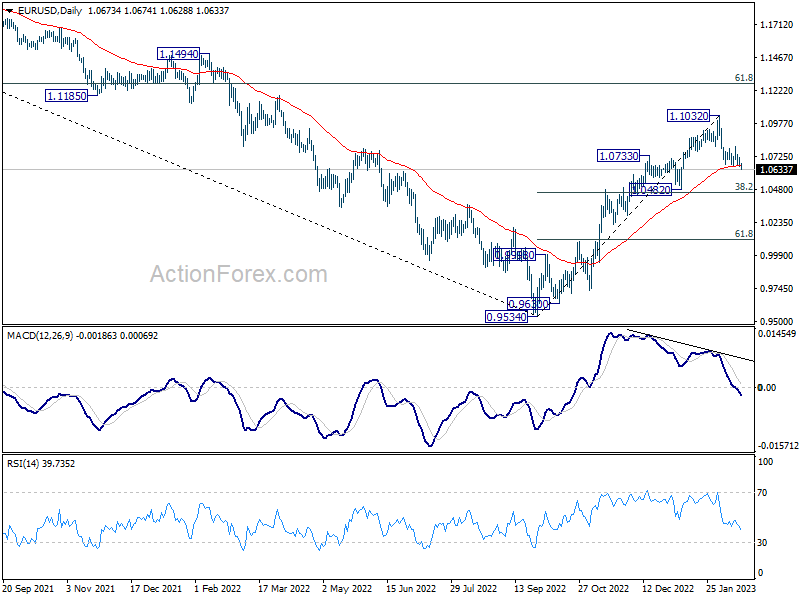
In the bigger picture, the rally from 0.9534 low (2022 low) is a medium term up trend rather than a correction. Further rise is in favor to 61.8% retracement of 1.2348 (2021 high) to 0.9534 at 1.1273 next. This will remain the favored case as long as 1.0482 support holds.
GBP/USD Daily Outlook
Daily Pivots: (S1) 1.1944; (P) 1.2010; (R1) 1.2053; More...
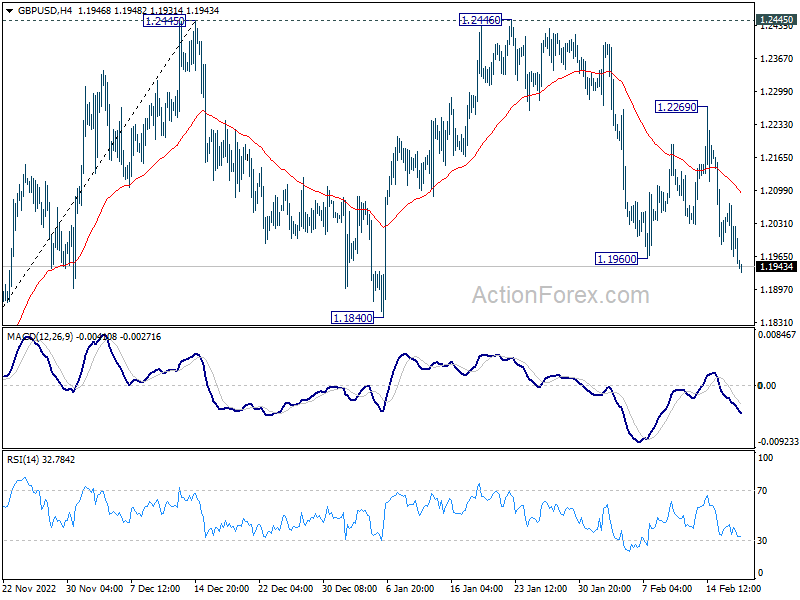
GBP/USD's decline from 1.2446 resumed by breaking through 1.1960 support and intraday bias remains on the downside. Such decline is seen as the third leg of the corrective pattern from 1.2445. Deeper fall would be seen to 1.1840 support and possibly below. For now, risk will now stay mildly on the downside as long as 1.2269 resistance holds, in case of recovery.
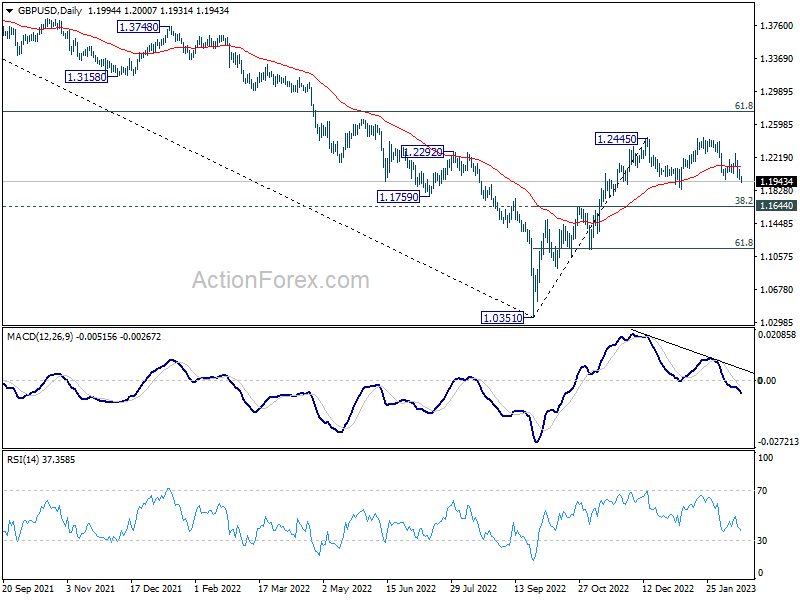
In the bigger picture, rise from 1.0351 medium term bottom is at least correcting whole down trend from 1.4248 (2021 high). Further rise is expected as long as 1.1644 resistance turned support holds. Next target is 61.8% retracement of 1.4248 to 1.0351 at 1.2759. Sustained break there will pave the way back to 1.4248.
USD/CHF Daily Outlook
Daily Pivots: (S1) 0.9223; (P) 0.9248; (R1) 0.9281; More...
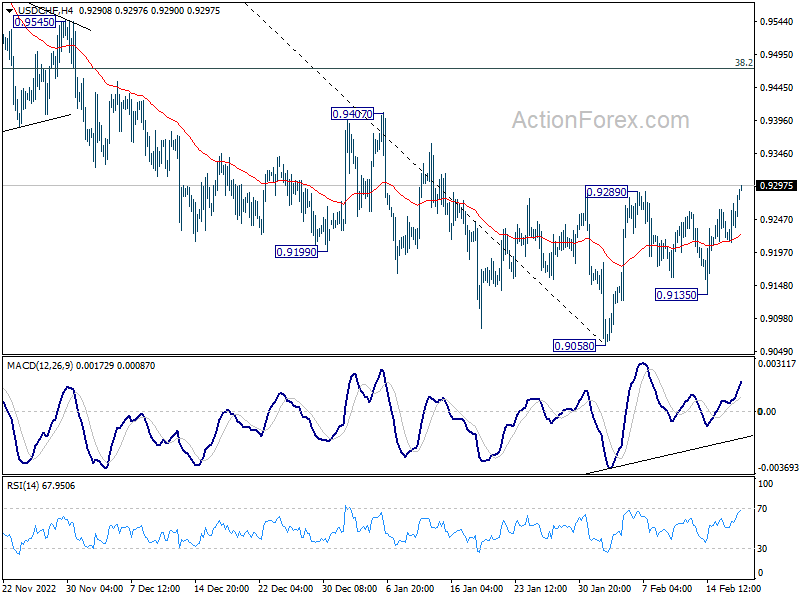
USD/CHF's break of 0.9289 resistance confirms short term bottoming at 0.9058. Intraday bias is back on the upside. Further rise would be seen to 0.9407 resistance, or possibly further to 38.2% retracement of 1.0146 to 0.9058 at 0.9474. For now, further rise will remain mildly in favor as long as 0.9135 support holds, in case of retreat.
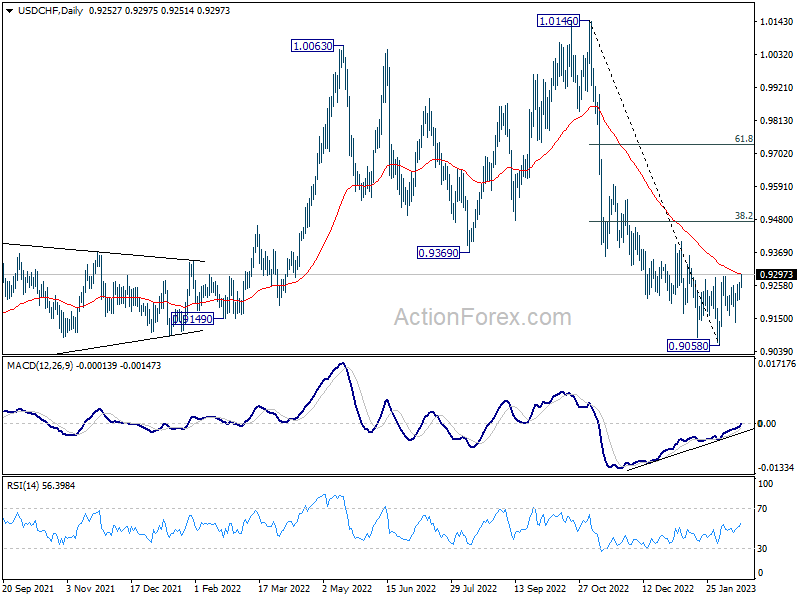
In the bigger picture, decline from 1.0146 is seen as part of a long term sideway pattern. As long as 38.2% retracement of 1.0146 to 0.9058 at 0.9474 holds, another fall is in favor through 0.9058. However, sustained trading above 0.9474 will indicate that the medium term trend has reversed, and open up further rally to 1.0146 again.
USD/JPY Daily Outlook
Daily Pivots: (S1) 133.55; (P) 134.00; (R1) 134.40; More...
Intraday bias in USD/JPY remains on the upside for the moment. Rise from 127.20 short term bottom should target 38.2% retracement of 151.93 to 127.20 at 136.64. Strong resistance could be seen there to complete the corrective rise. On the downside, break of 133.59 minor support will turn intraday bias neutral again first.
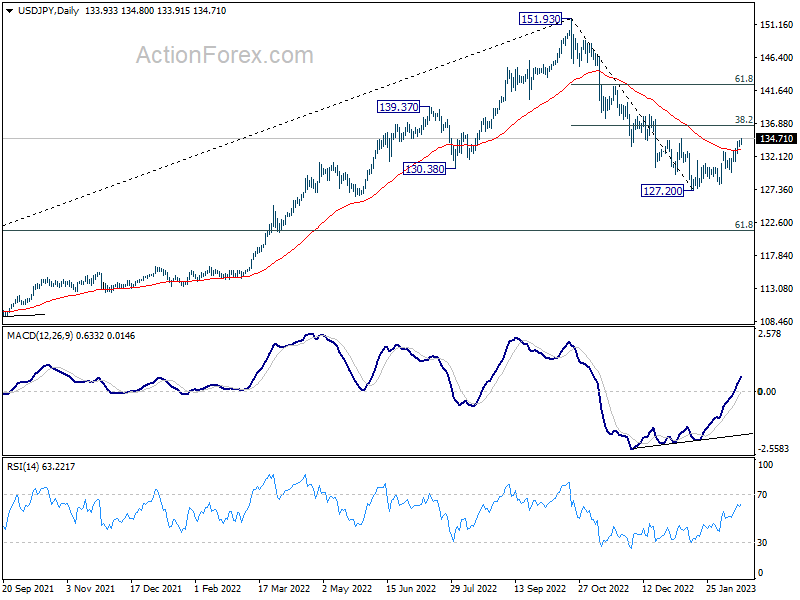
In the bigger picture, prior of 55 week EMA (now at 131.47) raises the chance of medium term bearish reversal, but that's not confirmed yet. Strong rebound from current level, followed by sustained break of 38.2% retracement of 151.93 to 127.20 at 136.64 will argue that price actions from 151.93 is merely a corrective pattern. However, rejection by 136.64 will solidify medium term bearishness for 61.8% retracement of 102.58 to 151.93 at 121.43 and 38.2% retracement of 75.56 to 151.93 at 122.75.
USD/CAD Daily Outlook
Daily Pivots: (S1) 1.3384; (P) 1.3431; (R1) 1.3505; More....
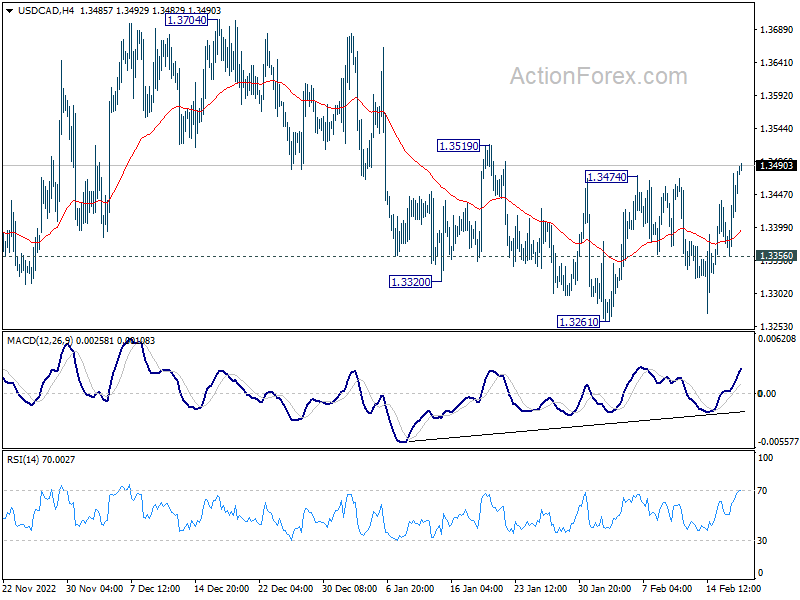
Break of 1.3474 resistance should confirm short term bottoming at 1.3261. Also, corrective fall from 1.3704 should have completed too. Intraday bias is back on the upside. Firm break of 1.3519 will pave the way to retest 1.3704 high. Nevertheless, break of 1.3356 minor support will dampen this bullish case and turn intraday bias neutral again.
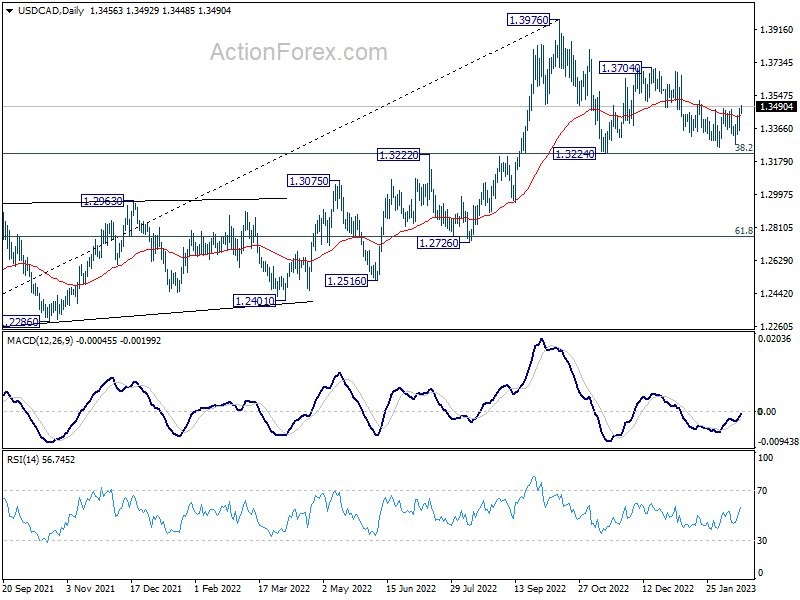
In the bigger picture, as long as 1.3222 cluster support (38.2% retracement of 1.2005 to 1.3976 at 1.3223) holds, larger up trend from 1.2005 (2021 low) is still expected to resume through 1.3976 high at a later stage. However, firm break of 1.3222/3 will indicate that the trend might have reversed. Deeper fall would be seen to next cluster support at 1.2726 (61.8% retracement at 1.2758).
AUD/USD Daily Report
Daily Pivots: (S1) 0.6835; (P) 0.6885; (R1) 0.6930; More...
AUD/USD's break of 0.6854 support confirms resumption of corrective decline from 0.7156. Intraday bias is back on the downside. Next target is 100% projection of 0.6854 to 0.7028 from 0.6854 at 0.6736, which is close to 0.6721 key structural support. Strong support is expected there to bring rebound. But still, break of 0.7028 resistance is needed to confirm completion of the correction. Otherwise, further fall is in favor in case of recovery.
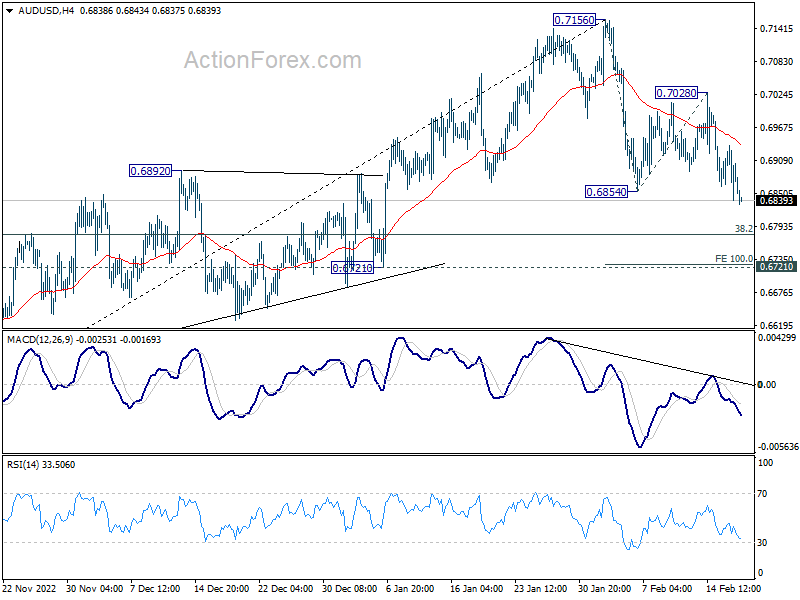
In the bigger picture, corrective decline from 0.8006 (2021 high) should have completed with three waves down to 0.6169 (2022 low). Further rally should be seen to 61.8% retracement of 0.8006 to 0.6169 at 0.7304. Sustained break there will pave the way to retest 0.8006. This will now remain the favored case as long as 0.6721 support holds.