Sample Category Title
Fed Mester: Need to bring rate above 5% and hold it there for some time
Cleveland Federal President Loretta Mester said, "at this juncture, the incoming data have not changed my view that we will need to bring the fed funds rate above 5% and hold it there for some time to be sufficiently restrictive to ensure that inflation is on a sustainable path back to 2%."
"Setting aside what financial market participants expected us to do, I saw a compelling economic case for a 50-basis-point increase, which would have brought the top of the target range to 5%," she said.
"It is welcome news to see some moderation in inflation readings since last summer, but the level of inflation matters and it is still too high," She said. Adding that the January CPI data "showed a jump in the monthly rate of overall inflation and no improvement in underlying inflation"
Mester said "I continue to see the risks to the inflation forecast as tilted to the upside for a number of reasons." She also said "the transition back to price stability will take some time and will not be without some pain."
The impact of Fed policy actions "will result in growth well below trend this year and some cooling off in labor markets, with slower employment growth and an increase in the unemployment rate from its very low level."
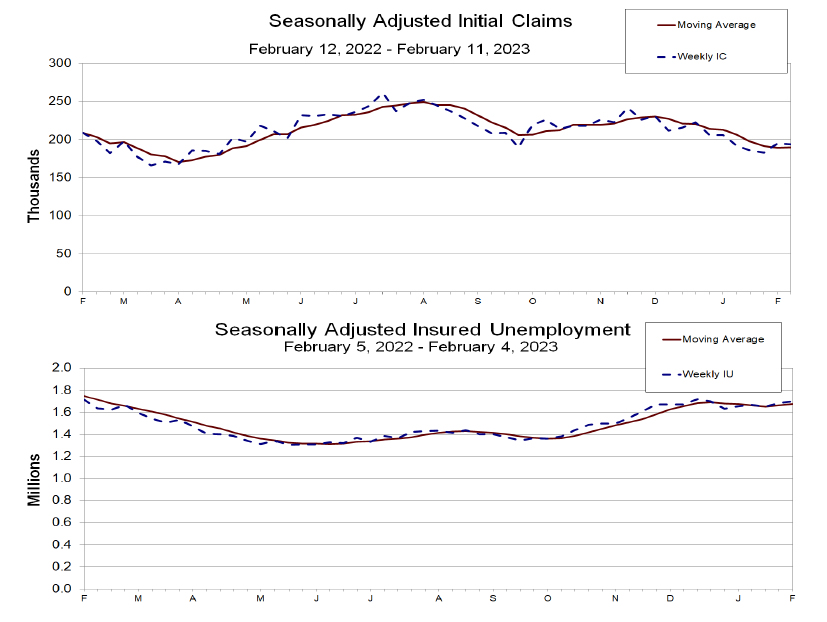
US initial claims ticked down to 194k
US initial jobless claims dropped -1k to 194k in the week ending February 11, below expectation of 200k. Four-week moving average of initial claims rose 500 to 189.5k.
Continuing claims rose 16k to 1696k in the week ending February 4. Four-week moving average of continuing claims rose 10k to 1673k.
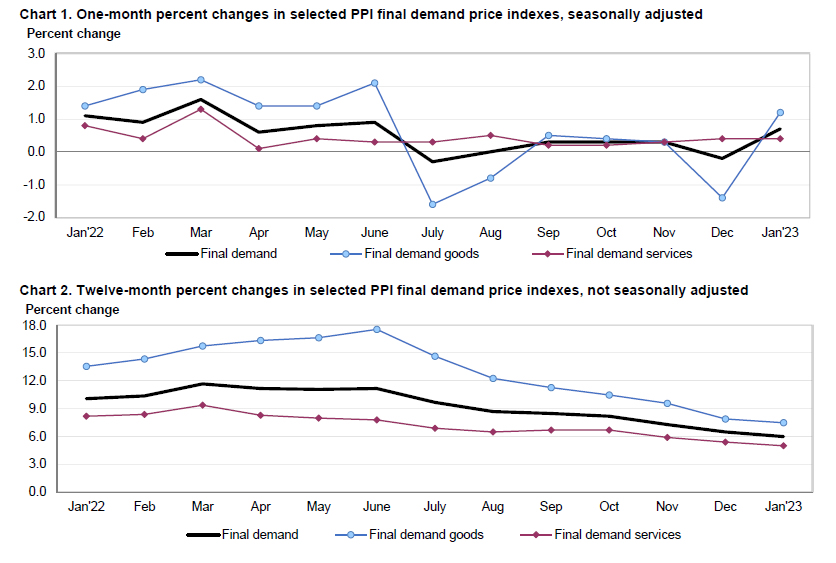
US PPI up 0.7% mom, 6.0% yoy in Jan
US PPI for final demand rose 0.7% mom in January, above expectation of 0.4% mom. PPI goods led the advance and rose 1.2% mom while services rose 0.4% mom. PPI less foods, energy, and trade services rose 0.6% mom, largest advance since March 2022.
For the 12 months period, PPI rose 6.0% yoy, above expectation of 5.1% yoy. PPI less foods, energy and trade services rose 4.5% yoy.
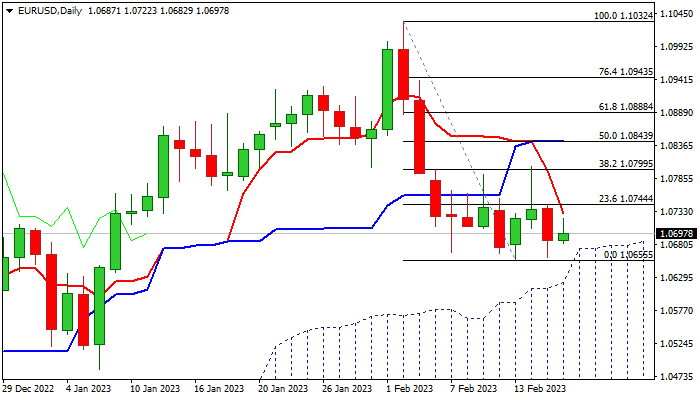
EUR/USD: Downside Was So Far Protected by Fibo 23.6%
The Euro ticks higher on Thursday but lacks direction as the price remains within the range for the fifth consecutive.
The downside was so far protected by Fibo 23.6% of 0.9535/1.1032 (1.0679) and nearby top of rising daily cloud which provide solid supports.
At the upside, falling 10DMA (1.0721) caps the action for now and keep the range intact.
Daily techs are bearishly aligned as 14-d momentum stays deep in the negative territory and stochastic is heading south, but signals were partially countered by rising daily cloud and 100/200DMA bull-cross.
We are sidelined and awaiting clearer direction signals, with penetration of rising cloud to signals further weakness, while sustained break above 1.0800 zone pivots (range top / 20DMA) would revive bulls.
US housing data, PPI and weekly jobless claims are in focus today for fresh signals.
Res: 1.0721; 1.0744; 1.0800; 1.0844.
Sup: 1.0679; 1.0655; 1.0573; 1.0483.
GBP/USD Steadies, Eyes UK Retail Sales
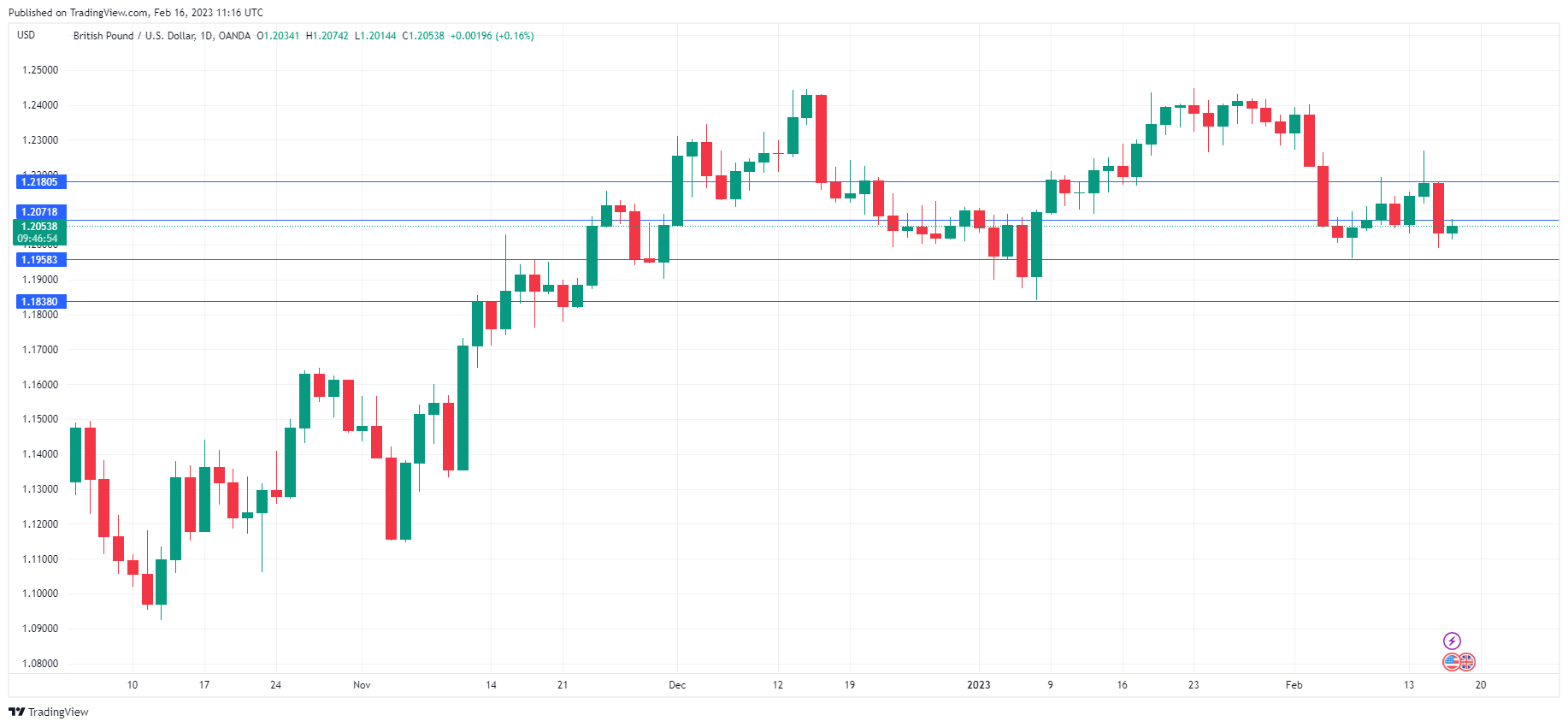
The British pound has steadied on Thursday. In the European session, GBP/USD is trading at 1.2053, up 0.25%. This follows a sharp drop of 1.2% a day earlier.
UK inflation continues to fall but remains disturbingly high. Headline inflation fell to 10.1% in January, down from 10.5% in December and below the consensus of 10.3%. The drop in inflation is welcome news, but food prices, a key driver of inflation, surged by 16.8% in January. With inflation still in double digits, the Bank of England will have to continue raising rates, with the most likely scenario being a 25-basis increase at the Mar. 22 meeting. The market probability of a 25-bp hike rose as high as 73% on Wednesday before dipping to 66% today, according to Refinitiv data.
In the US, retail sales delivered an impressive gain of 3% in January, above the estimate of 1.8%. This was a strong rebound from the December reading of -1.1% and marked the largest gain since January 2022. This positive release follows the January inflation report that ticked lower to 6.4% but was higher than expected. These strong numbers translated into strong gains for the US dollar on Wednesday, as the Fed will likely raise rates even higher in order to put the brakes on the strong economy.
The UK wraps up the week with retail sales on Friday. The markets are braced for bad news, with an estimate of -5.5% y/y for the headline figure (-5.8% prior) and -5.3% for the core rate (-6.1%). A weak retail sales report could sour investors on the pound and send the currency lower.
GBP/USD Technical
- GBP/USD tested resistance at 1.2071 earlier in the day. The next resistance line is 1.2180
- 1.1958 and 1.1838 are providing support
ECB Panetta: Resolute in the right direction, but not drive like crazy at night
ECB Executive Board member Fabio Panetta said in a speech "as policy rates move more firmly into restrictive territory and the energy shock abates, the risks to the inflation outlook have become more balanced."
"The outlook for the economy and inflation has become increasingly uncertain, both globally and in the euro area."
In this environment, we no longer need to overweight upside risks to avoid worst-case scenarios. We now need to take into account the risk of overtightening alongside the risk of doing too little." he said.
A "data-dependent calibration of monetary policy" offers the best way forward while "smoothing our policy moves we ensure that their cost to the economy is minimal."
"This doesn't mean we will not be resolute in the fight against inflation. It means being resolute in the right direction. What we do not want is "to drive like crazy at night with our headlights turned off" – as Italian singer Lucio Battisti once put it."
AUDUSD Meets the Lower Boundary of the Channel; Bullish Outlook
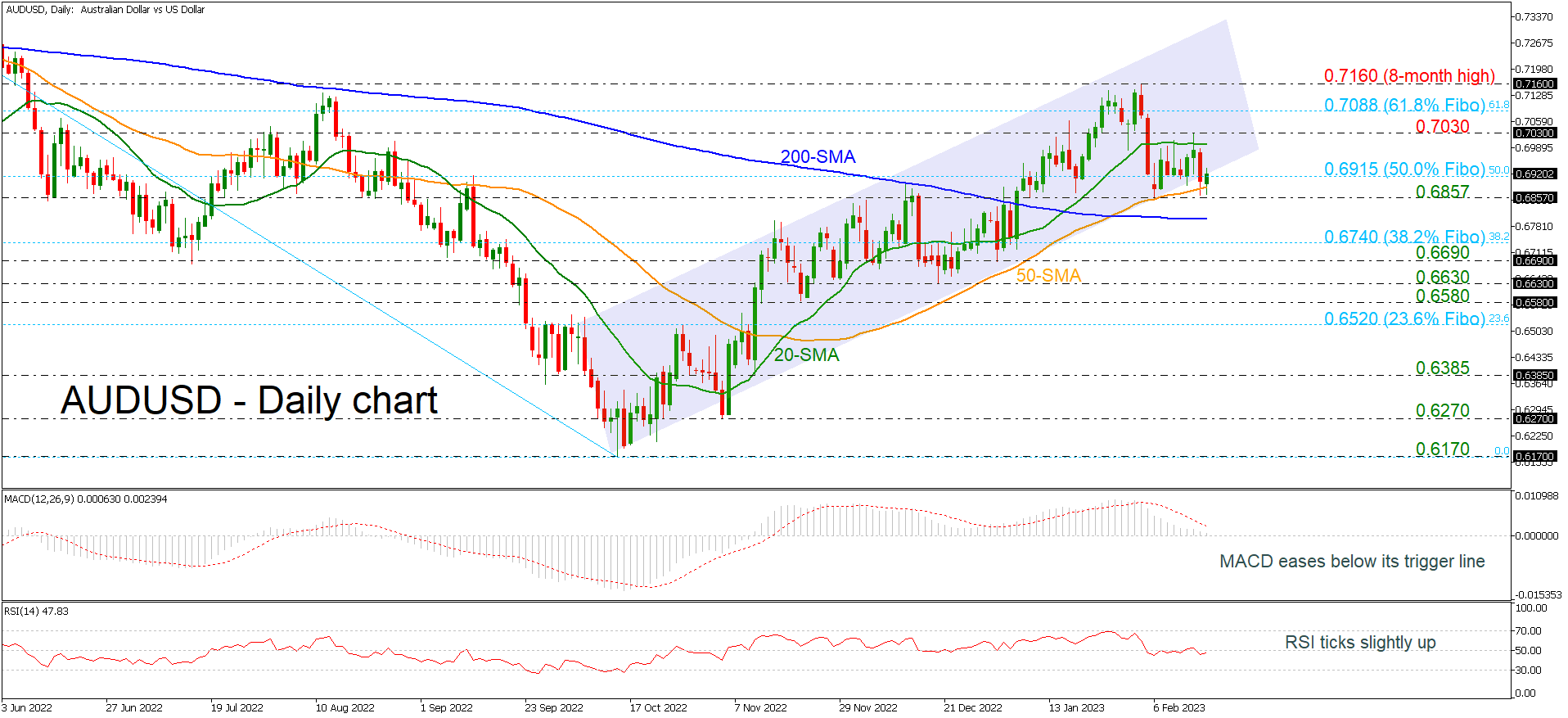
AUDUSD is battling with the lower boundary of the medium-term upward sloping channel near the 50.0% Fibonacci retracement level of the downleg from 0.7660 to 0.6170 at 0.6915. The price is finding a key support level near the 0.6870 barrier and the 50-day simple moving average (SMA).
Technically, the oscillators are giving some contradictory signs as the MACD is losing momentum beneath its trigger line and near the zero level, while the RSI is pointing marginally up near the neutral threshold of 50.
Upside moves are likely to find resistance at the 20-day SMA at 0.7000 ahead of the immediate resistance at 0.7030. Also, there is an important zone between the 23.6% Fibonacci at 0.7088 and the eight-month high of 0.7160 that traders could focus on. Rising above this area would help shift the attention to the upside again.
On the other hand, the next target to the downside is the nearby support at 0.6857 before resting near the flat 200-day SMA at 0.6800. At this stage the market would likely see a resumption of the short-term downward move from the 0.7160 peak and put in place a lower low at the 38.2% Fibonacci at 0.6740 and the 0.6690 barrier.
Summarizing, AUDUSD is rebounding off a crucial support of 0.6857 and if there is a successful climb back into the channel, the pair would continue the upside structure. Otherwise, a drop beneath the 200-day SMA may switch the outlook to bearish.
Aussie Shaky After Soft Job Data
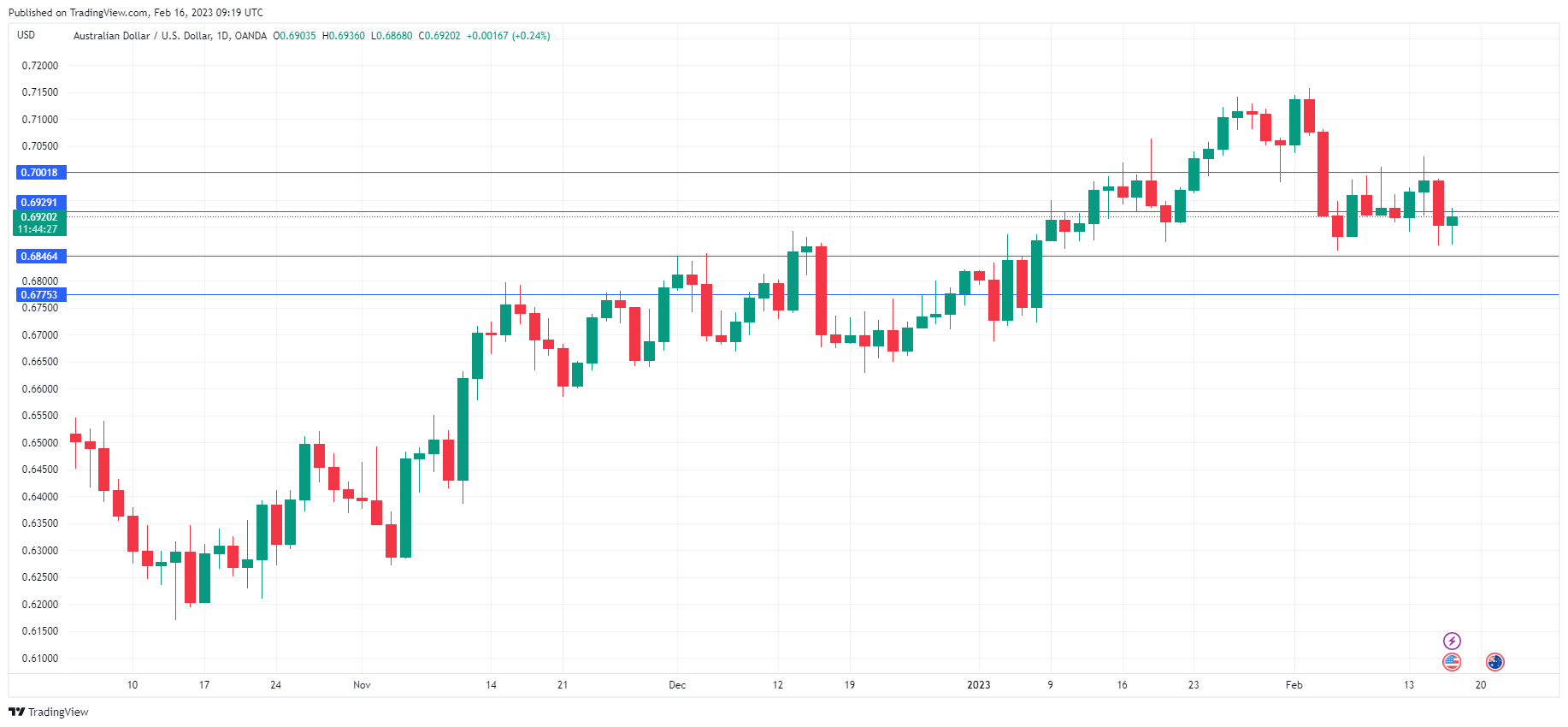
It has been a busy session for the Australian dollar, which started the day with losses but has recovered. In European trade, AUD/USD is trading at 0.6919, up 0.23%.
Mixed Australian data
Australia delivered some mixed data earlier today. The headline Employment Change for January surprised on the downside at -11,500 after -14,600 prior, well below the forecast of 20,000. There was better news on the inflation front, as Consumer Inflation Expectations for February fell to 5.1%, down from 5.6% expected and prior. The Australian dollar initially declined after these releases but has recovered and eked out small gains.
The Aussie had a miserable outing on Wednesday, falling 1.1%. This was courtesy of hawkish remarks from RBA Governor Lowe, which unnerved investors. Lowe appeared before a parliamentary committee and confirmed that further rate hikes are on the way. The central bank has tightened sharply but this has not brought down inflation. In December, CPI hit 7.8%, the highest level since 1990, which Lowe admitted was “way too high”. The double whammy of rising rates and red-hot inflation is squeezing households and businesses, but Lowe is insistent that the number one priority is to curb inflation and avoid inflation expectations from becoming entrenched.
US retail sales surprised with a huge 3% gain in December, the largest gain since January 2022. This rosy reading comes on the heels of an inflation release that was higher than expected. These strong numbers should have been bullish for the US dollar, as the Fed will likely raise rates even higher in order to put a brake on the strong economy. Investors, however, shrugged off the inflation and retail sales data and sent equities higher on Wednesday with a “bad news is good news” view. With risk appetite still intact, the US dollar hasn’t been able to capitalize on the inflation and retail sales releases.
AUD/USD Technical
- AUD/USD is testing resistance at 0.6929. Above, there is resistance at 0.7001
- 0.6846 and 0.6774 and providing support
Dollar Index: Dollar Bulls Lose Traction Under Thick Daily Cloud and Renewed Risk Sentiment
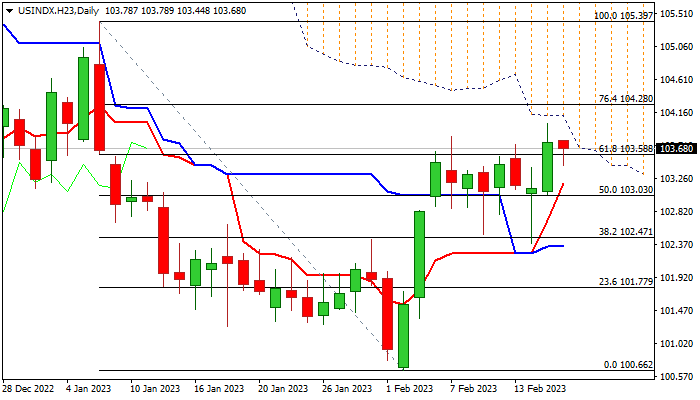
The US dollar edged lower in European trading on Thursday, reversing a part of Wednesday’s 0.65% advance, which tested the upper boundary of the near-term range and approached strong barrier provided by the base of falling thick daily cloud.
The dollar was boosted by renewed expectations that the US central bank would stay in prolonged tightening cycle after inflation unexpectedly rose in January, bur sharp rebound in the US retail sales partially offset bullish impact and contributed to fresh risk sentiment on growing signs of fading recession threats.
Daily studies show that bullish momentum is easing, adding to pressure from a massive daily cloud and suggesting that the greenback’s price may remain in extended sideways mode, on failure to penetrate the cloud.
Bullish bias is expected to remain intact while the price stays above rising daily Tenkan-sen (103.19), while break here would push the price into the lower part of the range and weaken bullish structure.
Caution on loss of pivotal supports at 102.37/33 (range low / daily Kijun-sen) which would signal that corrective phase from 100.66 (Feb 2 low) is likely over.
Res: 103.43; 103.83; 104.14; 104.28.
Sup: 103.44; 103.19; 102.85; 102.33.
WTI Oil Futures Trade Within a Bearish Rectangle
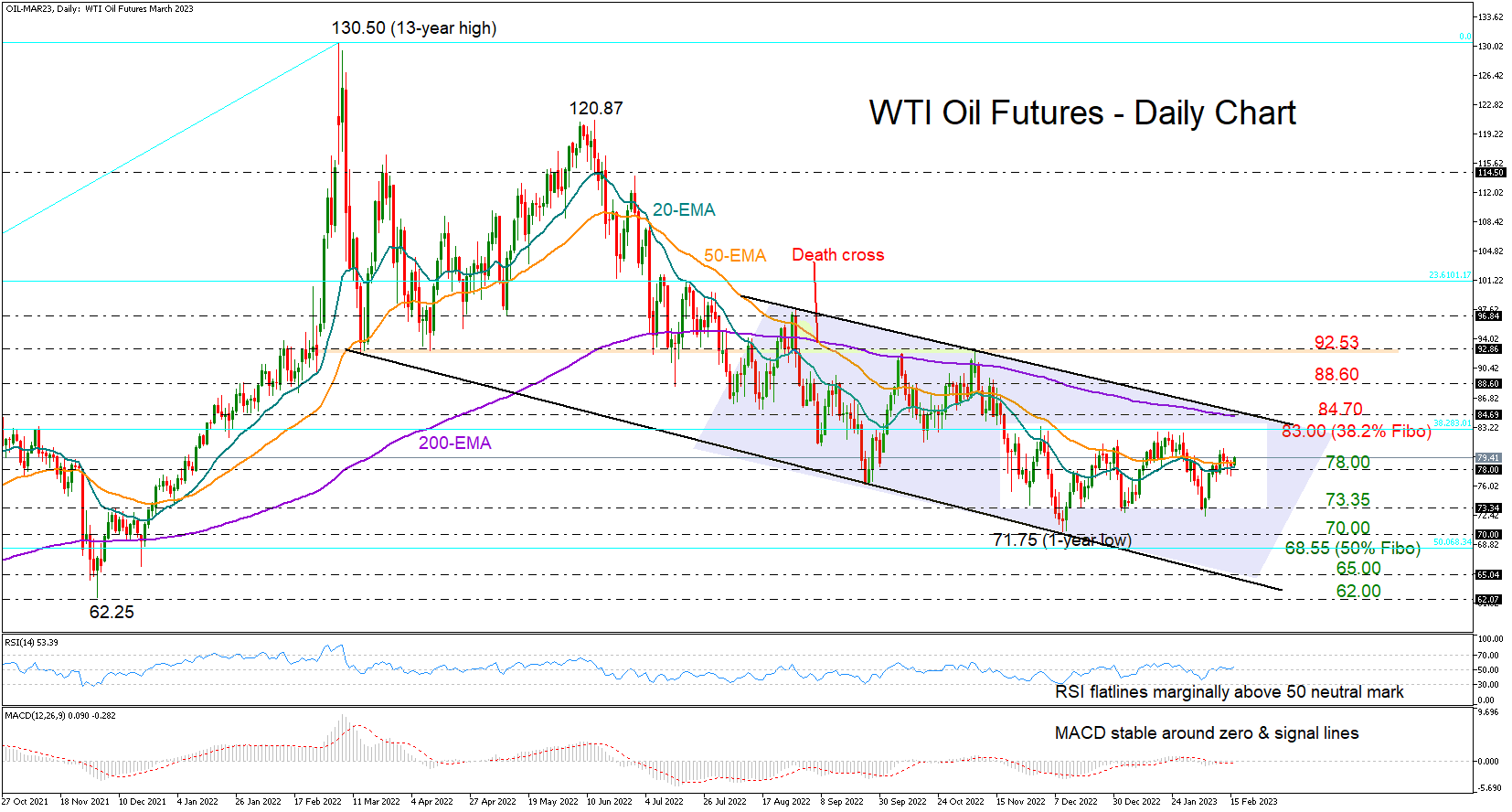
WTI oil futures have been trading within a rectangle since their downtrend stalled at a one-year low of 71.75 in December, unable to make any headway either way.
Although the floor around 73.35 is creating speculation that sellers are losing power, there is barely any convincing sign that the market is transitioning from a downtrend to an uptrend. The price has yet to mark a new higher high above the tough ceiling around 83.00, which coincides with the 38.2% Fibonacci retracement of the 2020-2021 upleg. Moreover, the death cross between the 50- and 200-day exponential moving averages (EMAs) keeps endorsing the broad negative direction in the market. Overall, rectangles are considered a continuation pattern, displaying a pause in the current bearish trend with the expectation that it will eventually resume.
Hence, a decisive close below the 73.35 base is expected to stretch the downtrend aggressively towards the 70.00-68.35 region, which encapsulates the 50% Fibonacci level. If the bears claim that area too, the next stop could occur around the support line drawn from March seen near 65.00.
In the meantime, the 78.00 handle is adding a strong footing under the price. If that persists, the bulls may re-challenge the wall at 83.00-84.70, where the 200-day EMA and the tentative resistance line from August are placed. A successful break higher could last till the 88.60 area, while a continuation above November’s peak of 92.50 would confirm a bullish trend reversal.
In a nutshell, the horizontal move in WTI oil futures has not eliminated selling interest yet. For that to happen, the price will need to bounce forcefully above the 83.00-84.70 zone.