

Sample Category Title
Can Eurozone PMIs Recover Further in February?
The Eurozone economy has been showing some signs of improvement over the last three months but is not out of the woods yet. Will the flash PMIs for February point to a further rebound when released on Tuesday at 09:00 GMT? The euro has been consolidating this month as markets re-evaluate how many additional rate hikes are in the pipeline by the Federal Reserve. Can the data put the single currency back on the front foot against the resurgent US dollar?
Recession vs stagnation
Despite the energy crisis, rising interest rates and the ongoing war in Ukraine, the euro area has so far been able to steer itself away from a recession. The bleak PMI numbers registered in the autumn did not translate to negative GDP prints, and so the worst case scenario for the bloc’s economy has been upgraded from a ‘severe’ to a ‘mild’ recession. As things stand, stagnation is the most likely outcome. Not that this is anything to shout about, but it’s a far cry from the even gloomier predictions a few months ago.
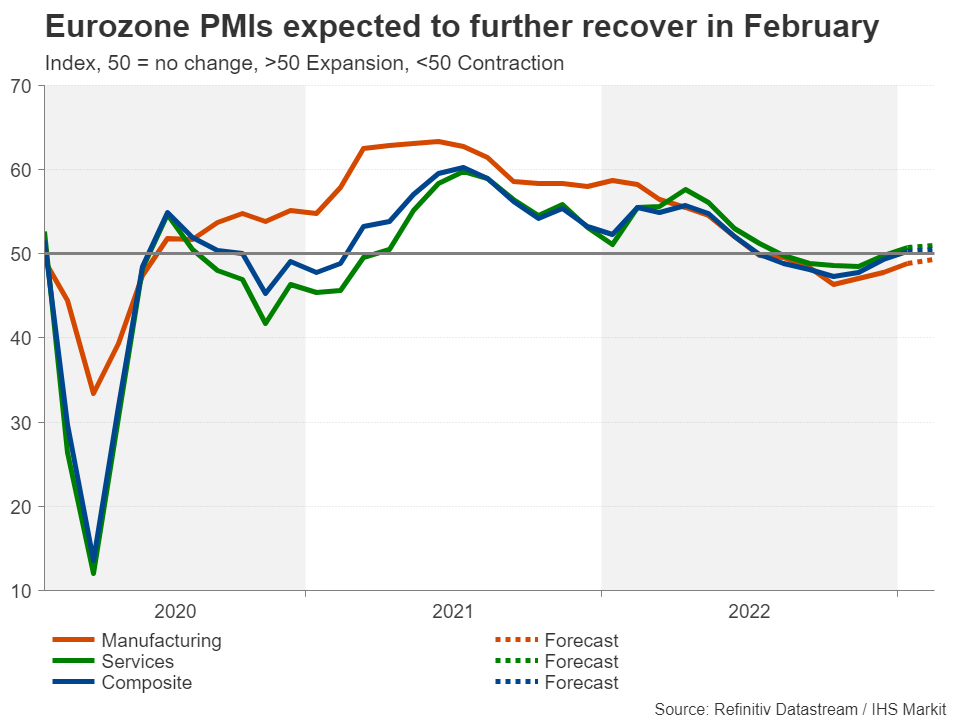
The composite PMI rose to 50.3 in January, expanding for the first time since June. The uptick was led by a solid rebound in the services component, though the manufacturing sector continued to contract. With other business surveys also pointing up and the positive boost to exporters from China’s reopening starting to filter through, another modest increase in both the services and manufacturing PMIs is likely in February.
Euro is losing momentum
The question for the euro now is whether the incoming data can continue to significantly surprise to the upside rather than simply improve in line with expectations. The euro has shown a strong correlation to Citigroup’s economic surprise indicator, especially relative to the US. Its recent pullback coincides with a dip in the Eurozone’s index and a jump for the US.
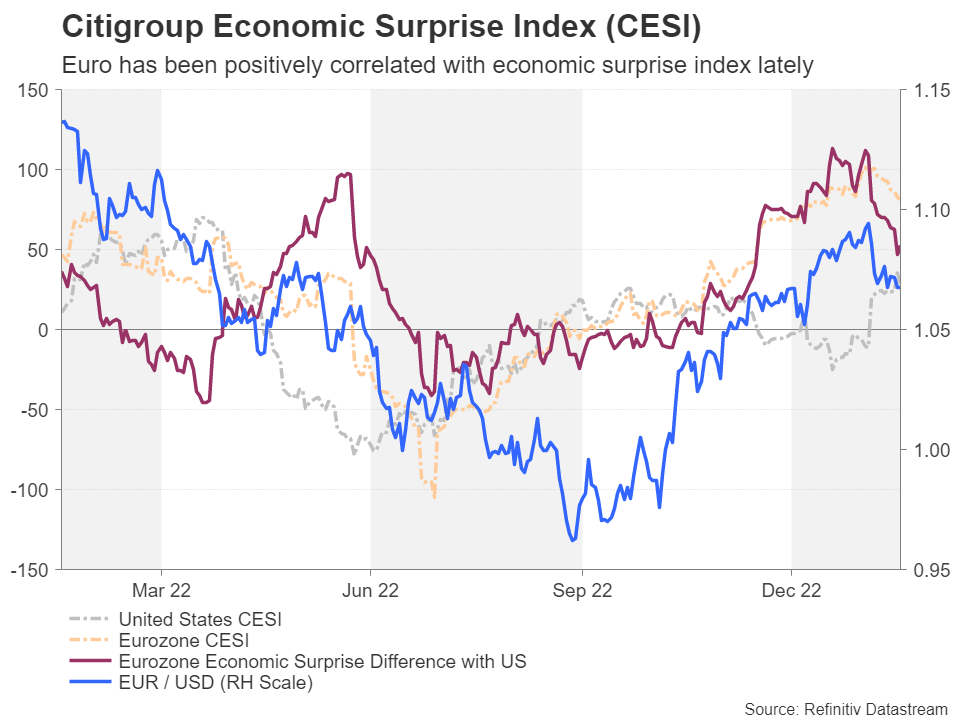
But even if it becomes more difficult for the euro to maintain the same positive momentum as before, the European Central Bank’s hawkish stance is a powerful impediment on the downside. Although headline inflation in the euro area has eased substantially from its peak of 10.6% in October, underlying inflation has continued to climb and this is a big worry for policymakers.
ECB rates seen peaking higher
The combination of a resilient economy and sticky price pressures give the ECB a very strong incentive to keep hiking rates. So, at the very least, the ECB is seen matching the Fed on additional rate increases going forward, if not exceed it. Investors have been steadily upping their bets on how high the ECB will raise the deposit rate, with the latest market pricing implying that rates will peak just under 3.75%. Only a few months ago, it was inconceivable that the ECB would lift rates above 3.0%.
Euro still consolidating
The euro has just slipped below its 50-day moving average (MA) after being unable to advance beyond the $1.0790 mark. Stronger-than-expected PMI figures could help achieve a break above this key level as well as the $1.08 handle to make a dash for the early February peak of $1.1033.
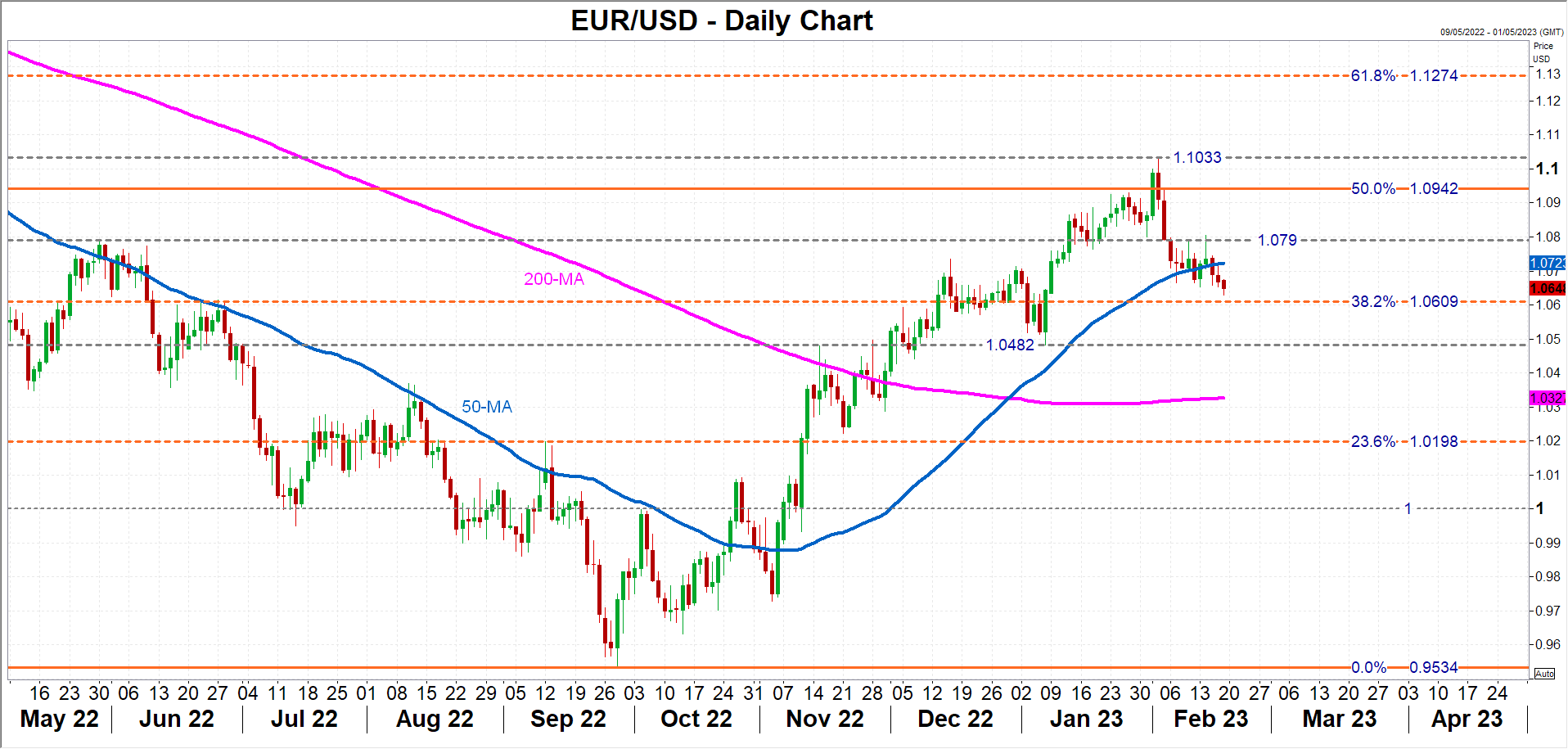
However, if the flash estimates underwhelm and the US PMIs impress in comparison, the euro could test the $1.06 level – the 38.2% Fibonacci of the 2021-2022 downtrend – before potentially dipping towards the January low of $1.0482.
Looking further out to the rest of the year, it’s possible that a recession has merely been delayed rather than averted. But the same also holds true for the US economy and so what traders will be watching very closely for is signs on who will press the pause button first – the ECB or the Fed.
Weekly Focus – Markets Price in High Rates for Longer
A slew of US macro data this week confirmed that the US economy stands strong, and as a response, market are pricing in high rates for longer. US curve inversion steepened, and in line with our call for a stronger USD, EUR/USD slid to below 1.07 level. The US January CPI details continued to illustrate persistent underlying price pressures. Headline CPI grew 0.5% m/m and core CPI 0.4%. Core Services ex. shelter inflation remained steady at 0.6% m/m, but excluding healthcare and shelter, a key measure of core services inflation picked up to 0.65% m/m (from 0.35%). Also, US January retail sales topped expectations with core sales (excl. motor vehicles & gas stations) rising by 2.6% m/m. The strong momentum appears to have continued in February as well, as NAHB housing market index and NY Fed's Empire Manufacturing index also surprised to the upside.
While the recovering macro indicators point towards lower recession risks in the near-term, they also raise the risk of underlying price pressures being protracted. In our Global Inflation Watch - High services inflation remains a worry for central banks, 15 February, we highlight how core price pressures remain sticky on both sides of the Atlantic. For now, we stick to our forecast of two more 25bp Fed hikes, and first rate cuts only in early 2024, but we also highlight that both market and consumer survey based inflation expectations have ticked slightly up recently, supporting the case for keeping nominal rates higher for longer. We expect the ECB to hike rates by 50bp in March and by 25bp in May.
Over the weekend, senior policy makers will gather for the Munich Security Conference. On the sidelines, a meeting between US Secretary of State Anthony Blinken and China's top foreign policy official Wang Yi is possible. Also, one week from now marks exactly one year since Russia started its invasion of Ukraine, and the war will undoubtedly be on the meeting's agenda. Back in 2007, it was this same conference where Russian President Putin held his infamous speech where he criticised NATO's eastern expansion. In our Research Russia-Ukraine: One year since Russia's invasion - Europe faces three changes as it settles into new reality, 17 February, we explain how the war has changed the European security order, our energy model and decision makers' priorities.
Next week's focus will be on February flash PMI releases. In the euro area, we are interested to see whether the data brings more evidence of rebounding activity amid easing inflation pressures. In the US we expect PMIs to edge higher, although signals from NY Fed's Empire and Philly Fed Manufacturing indices have been mixed. A clear upside surprise could push markets to price in further tightening in financial conditions We will also get the FOMC minutes on Wednesday, but given that the market narrative has changed a lot since the February meeting due to the strong data releases, the minutes are likely somewhat outdated. In the euro area, the final January HICP figures could show an upside revision on Thursday, given the impact from the delayed German figures.
It will be a rather quiet central bank week but we do have RBNZ meeting on Wednesday where a 50bp hike is the clear base case, while the Central Bank of Turkey, after the devastating earthquakes, is again expected to resort to a 100bp rate cut.
Will the Fed Hike by 50-bp Next Month?
General risk appetite took a turn for the worse yesterday after a couple of key comments from Fed members. Normally the market wouldn't hinge on just some comments, but they came at the tail end of some worrying data. That helped give the dollar a boost.
The latest boost in the dollar came on top of comparable currencies getting some fundamental weakness. For example, the Euro was a little weaker after Greece's ECB representative talked down the threat of inflation. And Japan has been drawing out the nomination of a new BOJ governor, suggesting that a swift shift away from ultra-easy policy likely wasn't in the cards.
What happened?
Bullard was the one who outright suggested that a 50bps hike could be in the cards for the next Fed meeting. He responded to a question about the possibility, and said it wasn't ruled out. He's not a voter this time around, and it's not unusual for the Fed to plant certain ideas in the market through non-voters ahead of the meeting. This is another one of those, by itself, it doesn't mean much. But taken into context, it added to what was said by Mester, which is more significant.
Mester wasn't a voter last time but will rotate on to the FOMC for the next meeting. She said that she would have supported a 50bps hike at the last meeting when the Fed ultimately hiked by just 25bps. We don't have the minutes yet to know how the opinions on a "double" hike break down. They will be coming out next Wednesday. But that might have been enough to incline the balance. And it implies that she will be more likely to support 50bps at the next meeting.
What did the market do?
The market and the Fed have long been in disagreement about just how high rates are going to go. The Fed insists that it will keep hiking and hold rates higher. The market generally hasn't believed that and has been betting on rates topping out at a lower range than what the Fed is implying. Powell's comments that there were only a couple more rate hikes coming led to cheers in the markets, but it still required accepting that rates might need to go up above 5.00%, the upper limit the market had been pricing in until then.
For now, the strong majority of economists are on the side of just a 25bps hike at the next FOMC meeting. But the amount of economists forecasting a 50bps hike nearly doubled to 18% after both Mester and Bullard's comments. Several more Fed officials will be talking before the release of the FOMC minutes on Wednesday, and likely the topic of 50bps will come up again. At the very least, the possibility of a double hike has been planted in the conversation, and risk appetite is reacting accordingly.
Other factors pushing the narrative
US PPI also came in hotter than expected, suggesting that inflation isn't fully under control. This came after CPI figures were in line, but the annual comparable was higher than expected. Additionally, the prior month's CPI figure was adjusted higher.
Initial jobless claims also came slightly below expectations, reviving the notion that the labor market is not only healthy, but potentially too tight. Several Fed officials had been pointing to the labor market as being of concern, which could also raise bets for a larger hike in the March meeting.
How Can a New Head of BOJ Affect Yen?
There are rumors from influential sources pointing at Kazuo Ueda as the next governor of the Bank of Japan (BOJ). This decision could lead to the commencement of policies in favor of raising interest rates and monetary policy tightening. Seeing how his appointment is coming after the Yen has lost ground against the Dollar and other top economies, it is only natural to expect a yen recovery. However, let's check the technical factors for confirmation of this prediction to see if the stars align.
USDJPY
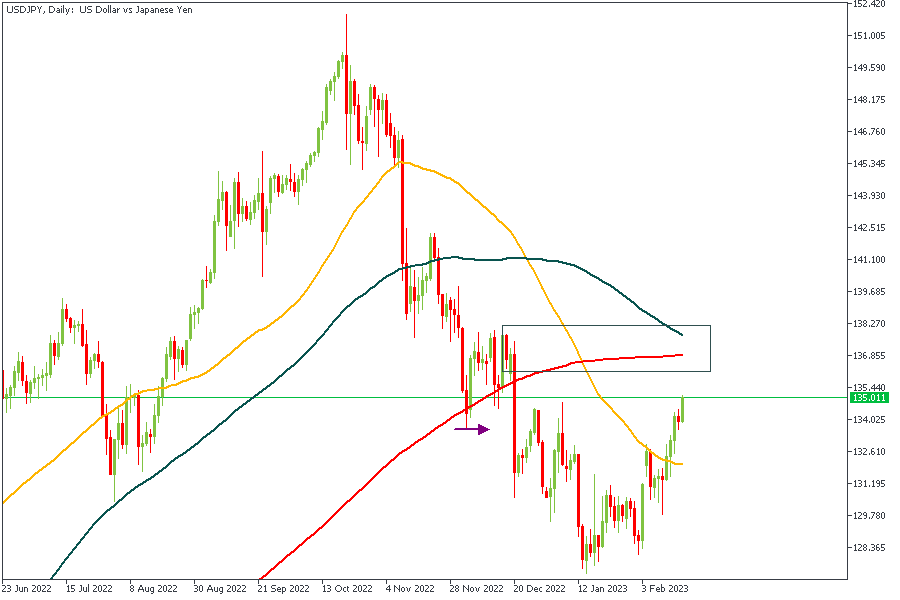
The horizontal arrow marks the previous low that was recently broken. At the same time, the rectangle highlights the order block (supply zone) responsible for the breakout. The 100 and 200-day moving averages align with the supply zone, increasing the chance for a bearish reaction from that area. The 88% of the Fibonacci retracement tool can be considered an added confluence in favor of the bearish move.
Analysts’ Expectations:
- Direction: Bearish
- Target: 131.5
- Invalidation: 138.2
EURJPY
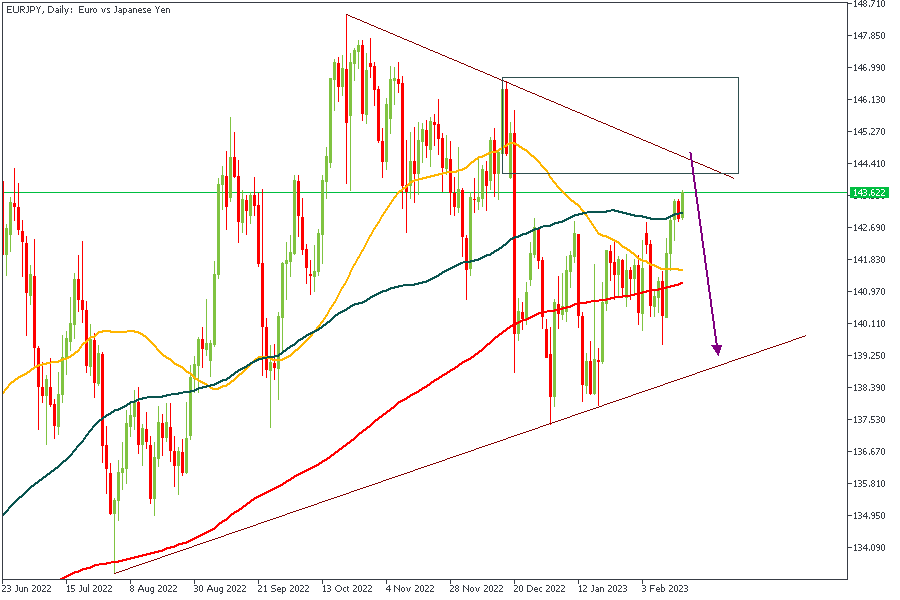
The two trendlines slightly inching towards each other have formed a wedge pattern on the daily timeframe of the EURJPY chart. Based on the fact that the most recent break of the structure was bearish, the supply zone responsible has been highlighted. It is also worthy of note that the supply zone falls within 76% of the Fibonacci retracement zone and aligns with a trendline resistance. These factors lead to a convincing bearish sentiment.
Analysts’ Expectations:
- Direction: Bearish
- Target: 141.5
- Invalidation: 146.5
CADJPY
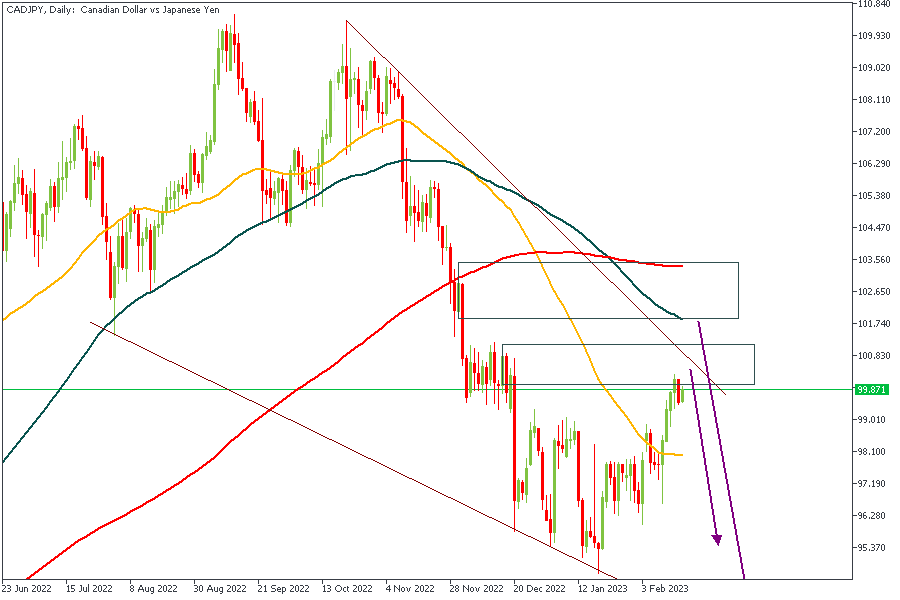
CADJPY is poised for a bearish rejection a short while from now. The clause here is that price has presented us with two possible supply areas. The first supply zone aligns with the trendline resistance, while the other has the 100 and 200-day moving averages as confluences for the supply zone. While either scenario can play out, I'd rather err on the side of caution by choosing the second supply zone since it has a slightly better chance.
Analysts’ Expectations:
- Direction: Bearish
- Target: 103.56
- Invalidation: 97
CHFJPY
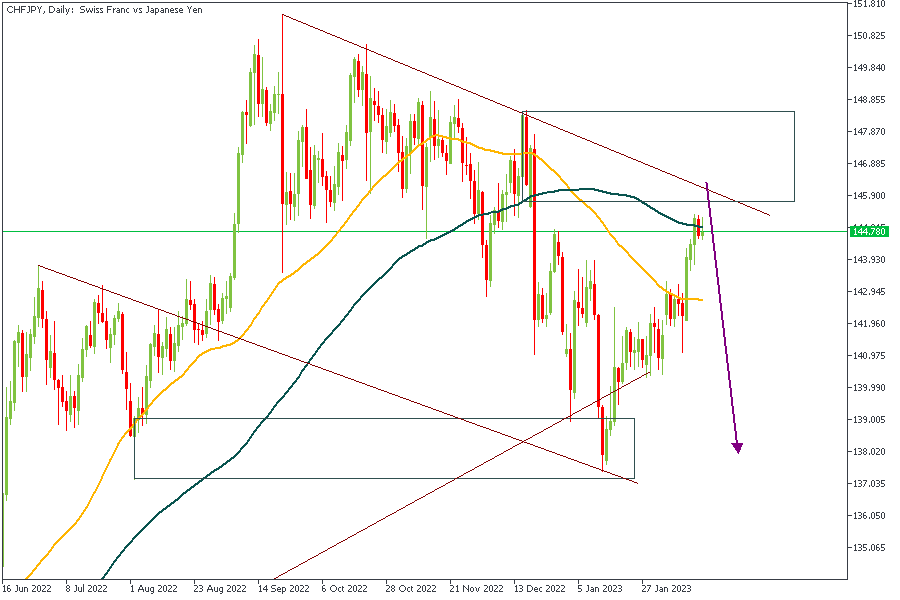
CHFJPY has the cleanest setup in this article. Here we see the descending channel with confluences from the 100-day moving average, trendline resistance, supply zone, and the 76% Fibonacci retracement level. The sentiment here is bearish.
Analysts’ Expectations:
- Direction: Bearish
- Target: 139.5
- Invalidation: 148
CONCLUSION
The trading of CFDs comes at a risk. Thus, to succeed, you have to manage risks properly. To avoid costly mistakes while you look to trade these opportunities, be sure to do your due diligence and manage your risk appropriately.
Dollar Marches On With Negative Risk Sentiment
Risk sentiment appeared to have turned negative after this week's strong inflation data as well as hawkish comments from central bankers, not limited to Fed. Dollar is set to end as the best performer on expectations of higher terminal interest rate and risk aversion. But Euro is not too far away considering that ECB is not yet that close on a pause. Yen will likely end as the worst with additional pressure from rising US and European benchmark yields. Commodity currencies are also set to end lower.
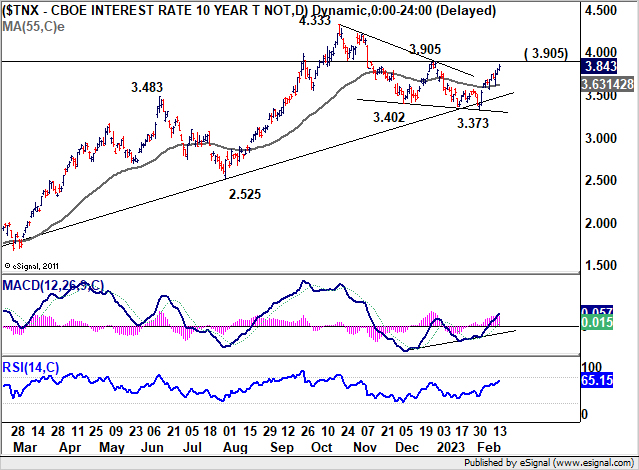
Technically, if 10-year yield could break through 3.905 resistance and close the week above there, that would be a rather bullish sign. Such development should confirm that corrective pattern from 4.333 has completed at 3.373. While it might still be a bit early to call for up trend resumption, TNX should at least have a go at above 4% level in the very near term.
In Europe, at the time of writing, FTSE is down -0.23%. DAX is down -0.67%. CAC is down -0.45%. Germany 10-year yield is up 0.0138 at 2.496. Earlier in Asia, Nikkei dropped -0.66%. Hong Kong HSI dropped -1.28%. China Shanghai SSE dropped -0.77%. Singapore Strait Times rose 0.52%. Japan 10-year JGB yield dropped -0.0038 to 0.503.
ECB Schnabel: We may have to act more forcefully
ECB Executive Board member Isabel Schnabel said in a Bloomberg interview, "we are still far away from claiming victory", adding that "we may have to act more forcefully." She also noted that a broad disinflation process has not even started." Meanwhile, "wage growth has picked up substantially" and could be "more persistent.
Schnabel also indicated that market pricing of a terminal rate of 3.50% may be too optimistic. "Markets are priced for perfection," she said. "They assume inflation is going to come down very quickly toward 2% and it is going to stay there, while the economy will do just fine. That would be a very good outcome, but there is a risk that inflation proves to be more persistent than is currently priced by financial markets."
A 50 basis-point hike next month is "necessary under virtually all plausible scenarios," she said. "There is no inconsistency between our principle of data-dependency and these intentions because it's very unlikely that the incoming data is going to put this intention into question."
ECB Villeroy: Interest rate would probably peak in summer
ECB Governing Council member Francois Villeroy de Galhau said that interest rate would probably peak in the summer, which technically ends in September. Meanwhile, a rate cut this year is out of question.
But he also emphasized there is no "automatic moves" at each meeting. the central criteria is a "shift in the inflation path", especially underlying inflation.
He also noted that interest rate will be kept at the peak level as long as necessary to bring inflation back to 2% target.
UK retail sales volume rose 0.5% mom in Jan, value up 0.6% mom
UK retail sales volume rose 0.5% mom in January, much better than expectation of -0.2% mom decline. Ex-fuel sale volume rose 0.4% mom, above expectation of 0.0% mom.
Compare with a year ago, retail sales volume dropped -5.1% yoy, versus expectation of of -5.5% yoy. Ex-fuel sales volume dropped -5.3% yoy, matched expectations.
In value term, retail sales rose 0.6% mom, 4.1% yoy. Ex-fuel sales rose 0.5% mom, 3.7% yoy.
RBA Lowe: We need to make clear to the community we were not done yet
In the second parliamentary grilling today, RBA Governor Philip Lowe said, "based on the currently available information, the board expect that further increases will be needed over the months ahead to ensure that inflation returns to target."
"Given there is a significant demand element to inflation, we need to respond to that with further monetary policy and we need to make that clear to the community that we were not done yet," Lowe said.
"The RBA and many other central banks are managing two risks," he said. "One is the risk of not doing enough, which would result in high inflation persisting and then later proving very costly to get down. The other is the risk that we move too fast, or too far."
USD/CHF Mid-Day Outlook
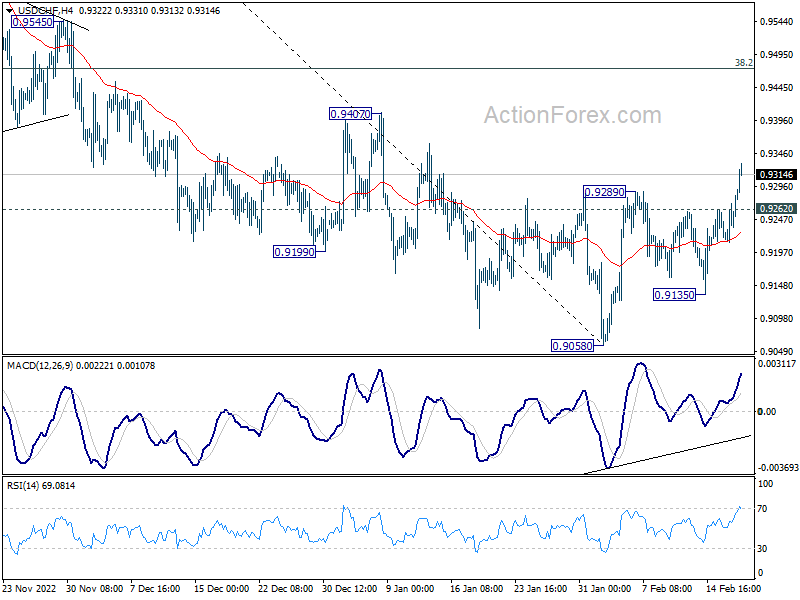
Daily Pivots: (S1) 0.9223; (P) 0.9248; (R1) 0.9281; More...
Intraday bias in USD/CHF remains on the upside for the moment. Rally from 0.9058 short term bottom should target 0.9407 resistance, or possibly further to 38.2% retracement of 1.0146 to 0.9058 at 0.9474. On the downside, below 0.9262 minor support will turn intraday bias neutral first.
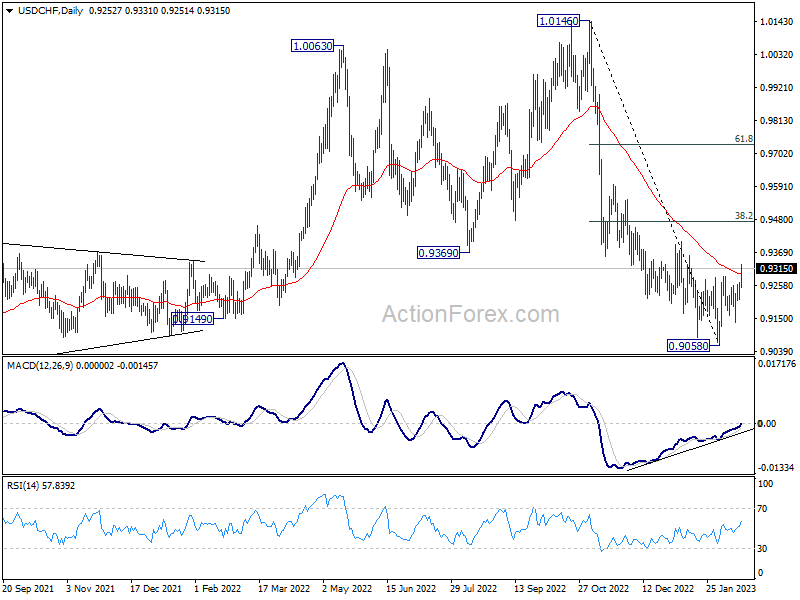
In the bigger picture, decline from 1.0146 is seen as part of a long term sideway pattern. As long as 38.2% retracement of 1.0146 to 0.9058 at 0.9474 holds, another fall is in favor through 0.9058. However, sustained trading above 0.9474 will indicate that the medium term trend has reversed, and open up further rally to 1.0146 again.
Economic Indicators Update
| GMT | Ccy | Events | Actual | Forecast | Previous | Revised |
|---|---|---|---|---|---|---|
| 07:00 | GBP | Retail Sales M/M Jan | 0.50% | -0.20% | -1.00% | -1.20% |
| 07:00 | GBP | Retail Sales Y/Y Jan | -5.10% | -5.50% | -5.80% | -6.10% |
| 07:00 | GBP | Retail Sales ex-Fuel M/M Jan | 0.40% | 0.00% | -1.10% | -1.40% |
| 07:00 | GBP | Retail Sales ex-Fuel Y/Y Jan | -5.30% | -5.30% | -6.10% | -6.50% |
| 07:00 | EUR | Germany PPI M/M Jan | -1.00% | -1.60% | -0.40% | |
| 07:00 | EUR | Germany PPI Y/Y Jan | 17.80% | 16.40% | 21.60% | |
| 09:00 | EUR | Eurozone Current Account (EUR) Dec | 15.9B | 5.1B | 13.6B | 12.8B |
| 13:30 | CAD | Industrial Product Price M/M Jan | 0.40% | -0.10% | -1.10% | |
| 13:30 | CAD | Raw Material Price Index Jan | -0.10% | -0.20% | -3.10% | |
| 13:30 | USD | Import Price Index M/M Jan | -0.20% | -0.10% | 0.40% |
EUR/USD Mid-Day Outlook
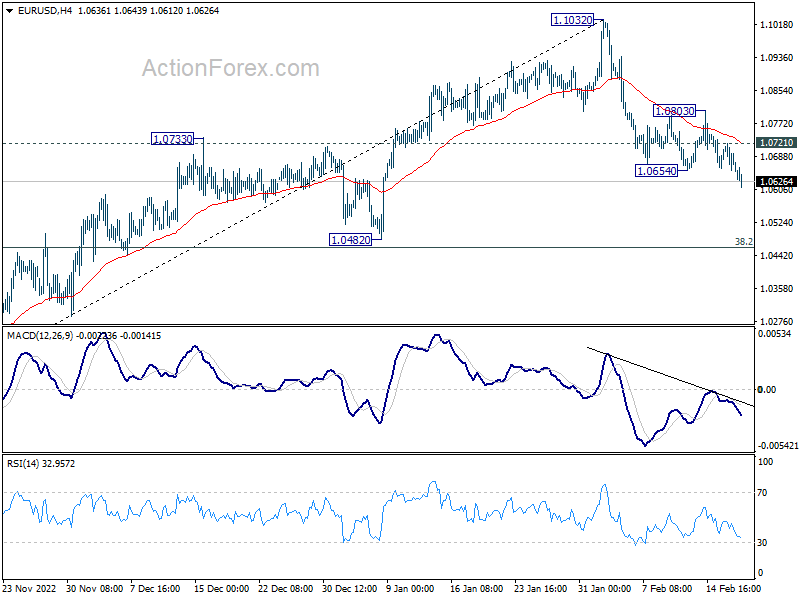
Daily Pivots: (S1) 1.0645; (P) 1.0683; (R1) 1.0712; More...
Intraday bias in EUR/USD remains on the downside for the moment. Current fall form 1.1032 should target 38.2% retracement of 0.9534 to 1.1032 at 1.0463. Strong support should be seen around there to bring rebound, at least on first attempt. On the upside, above 1.0721 minor resistance will turn intraday bias neutral first. But risk will stay on the downside as long as 1.0803 resistance holds.
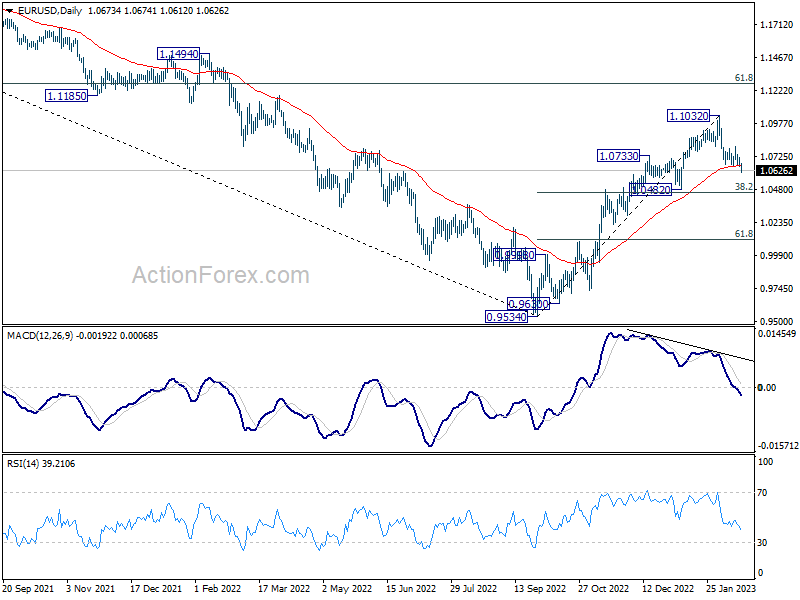
In the bigger picture, the rally from 0.9534 low (2022 low) is a medium term up trend rather than a correction. Further rise is in favor to 61.8% retracement of 1.2348 (2021 high) to 0.9534 at 1.1273 next. This will remain the favored case as long as 1.0482 support holds.
GBP/USD Mid-Day Outlook
Daily Pivots: (S1) 1.1944; (P) 1.2010; (R1) 1.2053; More...
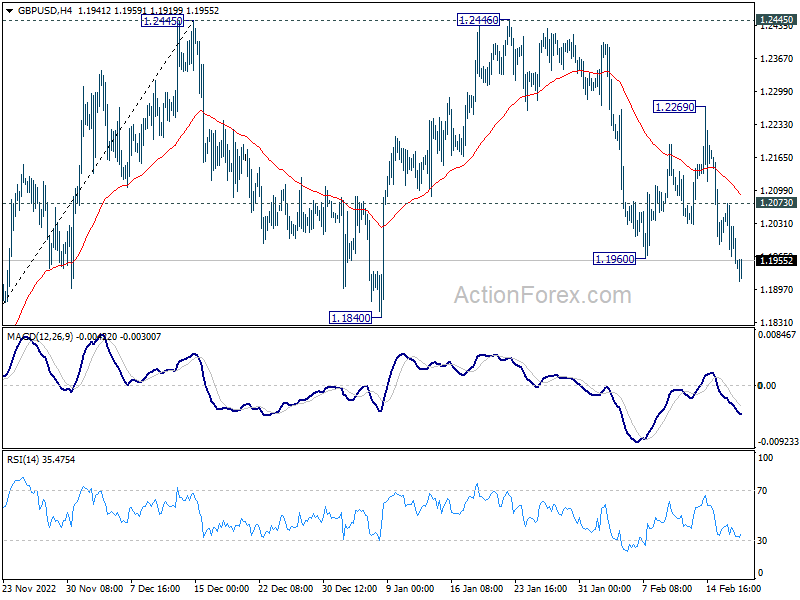
Intraday bias in GBP/USD remains on the downside for the moment. Fall from 1.2446, as the third leg of the corrective pattern from 1.2445, should target 1.1840 support and possibly below. On the upside, above 1.2073 minor resistance will turn intraday bias neutral first.
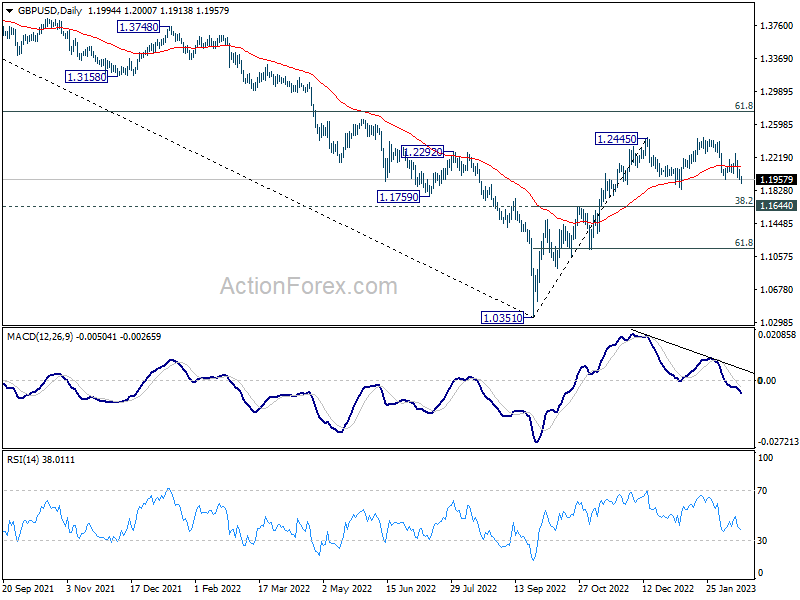
In the bigger picture, rise from 1.0351 medium term bottom is at least correcting whole down trend from 1.4248 (2021 high). Further rise is expected as long as 1.1644 resistance turned support holds. Next target is 61.8% retracement of 1.4248 to 1.0351 at 1.2759. Sustained break there will pave the way back to 1.4248.
USD/CHF Mid-Day Outlook
Daily Pivots: (S1) 0.9223; (P) 0.9248; (R1) 0.9281; More...
Intraday bias in USD/CHF remains on the upside for the moment. Rally from 0.9058 short term bottom should target 0.9407 resistance, or possibly further to 38.2% retracement of 1.0146 to 0.9058 at 0.9474. On the downside, below 0.9262 minor support will turn intraday bias neutral first.
In the bigger picture, decline from 1.0146 is seen as part of a long term sideway pattern. As long as 38.2% retracement of 1.0146 to 0.9058 at 0.9474 holds, another fall is in favor through 0.9058. However, sustained trading above 0.9474 will indicate that the medium term trend has reversed, and open up further rally to 1.0146 again.
USD/JPY Mid-Day Outlook
Daily Pivots: (S1) 133.55; (P) 134.00; (R1) 134.40; More...
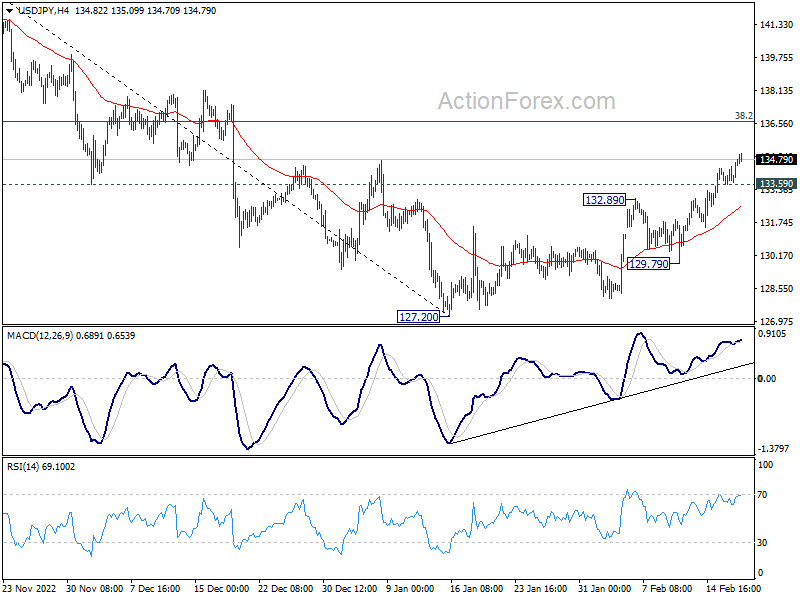
USD/JPY's rally is still in progress and intraday bias stays on the upside. Rise from 127.20 short term bottom should target 38.2% retracement of 151.93 to 127.20 at 136.64. Strong resistance could be seen there to complete the corrective rise. On the downside, break of 133.59 minor support will turn intraday bias neutral again first.
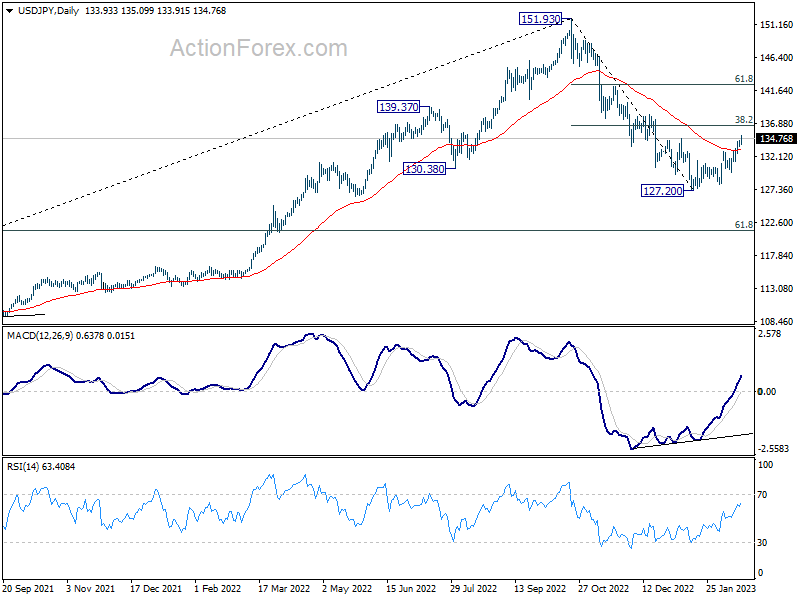
In the bigger picture, prior of 55 week EMA (now at 131.47) raises the chance of medium term bearish reversal, but that's not confirmed yet. Strong rebound from current level, followed by sustained break of 38.2% retracement of 151.93 to 127.20 at 136.64 will argue that price actions from 151.93 is merely a corrective pattern. However, rejection by 136.64 will solidify medium term bearishness for 61.8% retracement of 102.58 to 151.93 at 121.43 and 38.2% retracement of 75.56 to 151.93 at 122.75.
ECB Villeroy: Interest rate would probably peak in summer
ECB Governing Council member Francois Villeroy de Galhau said that interest rate would probably peak in the summer, which technically ends in September. Meanwhile, a rate cut this year is out of question.
But he also emphasized there is no "automatic moves" at each meeting. the central criteria is a "shift in the inflation path", especially underlying inflation.
He also noted that interest rate will be kept at the peak level as long as necessary to bring inflation back to 2% target.