Sample Category Title
ECB Review – Hawkish 50bp – More Hikes to Come
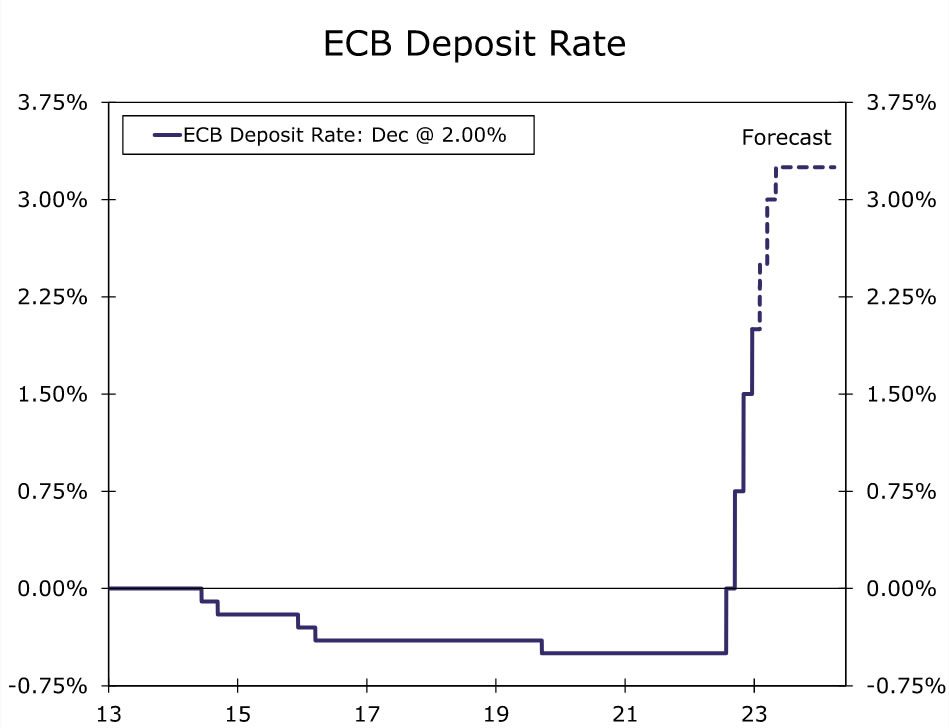
At today's ECB meeting, the ECB delivered a 50bp rate hike in all three policy rates as widely anticipated, so now the ECB deposit rate is at 2%. The ECB also announced that the end to full APP reinvestments would start in March 2023, which was more specific than the presentation of key principles expected. The ECB guided that from March 2023 to June 2023, its securities holdings will decline by EUR15bn per month on average. The pace beyond that is still to be determined.
Lagarde highlighted the data dependent and meeting by meeting approach, but at the same time also gave a firm guidance that today's 50bp rate hike will not be a single 50bp rate hike and that more will follow.
While we expected an open-ended wording of more rate hikes to come, we were surprised by the significant hawkish guidance Lagarde gave today. In our preview, we had already pointed to the risk to our forecast for longer/more than our baseline and as a result of today's meeting we revise our ECB call and add another 50bp to the peak cycle rate to 3.25%, so our new call is for 50bp in February (unchanged), 50bp in March (+25bp) and 25bp in May (new). We remain open to further rate hikes in June next year.
Here A Hike, There A Hike, Everywhere a Rate Hike
Summary
- The European Central Bank (ECB) delivered a 50 basis point hike, taking its Deposit Rate to 2.00% at today's monetary policy meeting, while also announcing plans to begin quantitative tightening from March.
- The ECB's accompanying commentary and press conference were also hawkish in tone. The ECB forecasts above target inflation over the medium term, while ECB President Lagarde signaled that interest rates would keep rising at a rapid pace for now, and perhaps by more than market participants expect. Accordingly, we now forecast another 125 basis points of rate hikes during the first half of 2023, which would see the Deposit Rate peak at 3.25%.
- The Bank of England (BoE) also raised its policy rate by 50 basis points to 3.50%, although the tone of its accompanying comments were more balanced. Still, the BoE said the labor market remains tight, wage growth is elevated, and that it will act forcefully as needed. That does not sound like a central bank that views an end to monetary tightening as imminent. We now forecast two more 25 basis point rate hikes from the BoE, which would see the policy rate peak at 4.00%.
- The Swiss National Bank raised its policy rate 50 basis points to 1.00%. It's accompanying comments leaned hawkish, and the central bank forecasts CPI inflation creeping back above the 2% inflation target by 2025. Against the backdrop, we expect a final 50 basis point rate hike from the Swiss National Bank in Q1-2023.
- Norway's central bank raised its policy rate 25 basis points to 2.75%, while adding that inflation has been a bit higher than expected, the labor market has been sturdier than expected, and the outlook for mainland GDP growth is less pessimistic than previously. We remain comfortable with our forecast for two more 25 basis point hikes from the Norges Bank in January and March, which would see Norway's policy rate peak at 3.25%.
ECB Hikes Again and Announces Quantitative Tightening
In what was a particularly busy day for central banks across Europe, the most significant announcement came from the European Central Bank (ECB). The ECB announced policy shifts on two fronts:
- Policymakers raised key policy interest rates by 50 basis points, including a hike in the Deposit Rate from 1.50% to 2.00%. The increase in interest rates was in line with the consensus forecast.
- It also announced plans to begin quantitative tightening, starting in March. The ECB's holdings under its Asset Purchase Program (APP) will be allowed to decline at a measured and predictable pace, as the ECB will not fully reinvest principal payments from maturing securities. The decline in holdings will average €15B per month until the end of Q2-2023, with the subsequent pace to be determined over time. The pace of decline in the ECB's balance sheet was at the more conservative end of market expectations.
With respect to the accompanying comments and projections, the ECB's announcement was hawkish in tone. The ECB said that based on a substantial upward revision to the inflation outlook, it expects to raise interest rates further, adding:
“In particular, the Governing Council judges that interest rates will still have to rise significantly at a steady pace to reach levels that are sufficiently restrictive to ensure a timely return of inflation to the 2% medium-term target.”
In fact, in the post-meeting press conference ECB President Lagarde went further, saying we should expect the ECB to raise rates at a 50 basis point pace for a period of time, and that the ECB needs to do more on interest rates than what is currently implied by market pricing (note that as of yesterday, interest rate futures suggested a peak ECB Deposit Rate of just over 2.75%).
With respect to its economic projections, the ECB raised its CPI forecasts to 6.3% for 2023, 3.4% for 2024 and 2.3% for 2025. In addition, the ECB also sees CPI inflation excluding food and energy at 4.2% in 2023, 2.8% in 2024 and 2.4% in 2025. Notably, the outlook for inflation in 2025 is still above the ECB's 2% inflation target. Finally, with respect to growth, the ECB projects a short and shallow recession beginning late this year, and sees overall Eurozone GDP growth at 0.5% in 2023, before rebounding to 1.9% in 2024 and 1.8% in 2025.
Overall, the tone of the ECB's announcement along with the above-target inflation projections suggest the European Central Bank should raise interest rates further than we had previously expected. We still anticipate a 50 basis point policy rate increase in February, but now also expect a 50 basis point rate increase in March, and a final 25 basis point increase in May, which would see the ECB's Deposit Rate peak at 3.25%. Considering the likelihood that the Eurozone economic downturn will be intensifying during the early part of 2023 and inflation should be receding, we expect the removal of policy accommodation to transition away from interest rate increases and towards balance sheet reduction beyond May next year.
Bank of England Raises Interest Rates and Strikes a Balanced Tone
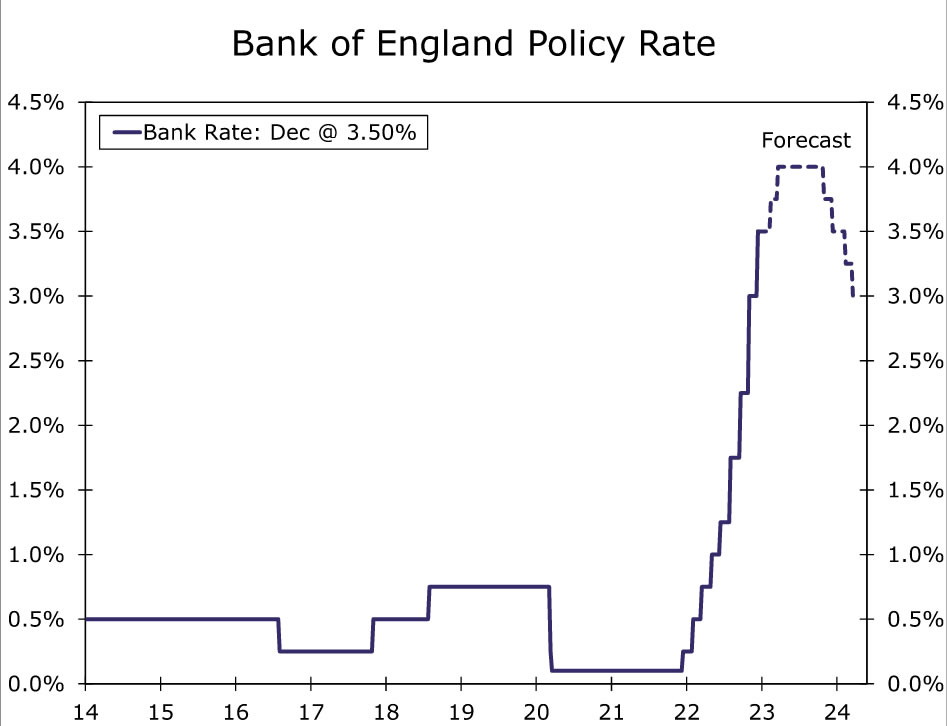
Another central bank announcement that attracted plenty of attention today was that of the Bank of England (BoE). The BoE delivered, as expected in terms of its policy action, raising its Bank Rate by 50 basis points to 3.50%. However, there was a mildly dovish tilt around that rate increase action. While six policymakers voted to raise interest rates by 50 basis points, two policymakers voted for no change, and only one policymaker voted for a larger 75 basis point rate hike.
To be fair, some of the BoE's other comments were supportive of further monetary tightening. The central bank said:
- The labor market remains tight, and domestic wage and price pressures are elevated. Wage growth has been around 0.5 percentage points stronger than projected as recently as November.
- It now forecasts a smaller 0.1% quarter-over-quarter decline in Q4 GDP.
- The fiscal consolidation announced by the government in the Autumn Statement will have little effect on U.K. GDP in the near-term, and instead a more restraining effect on U.K. GDP over the medium-term.
Overall the BoE's Monetary Policy Committee said:
“Should the economy evolve broadly in line with the November Monetary Policy Report projections, further increases in Bank Rate may be required for a sustainable return of inflation to target. There are considerable uncertainties around the outlook. The Committee continues to judge that, if the outlook suggests more persistent inflationary pressures, it will respond forcefully, as necessary.”
To us, that does not sound like a central bank that believes an end to monetary tightening is imminent. As a result, we now see a slightly higher peak in Bank of England interest rates than previously. We expect that BoE to raise its policy interest rate by 25 basis points at both its February and March meetings next year, which would see the BoE's policy rate peak at 4.00% by March next year, before the BoE embarks on rate cuts by the end of 2023.
Swiss National Bank Delivers a 50 Basis Point Hike, While Norway's Central Bank Delivers 25 Basis Points
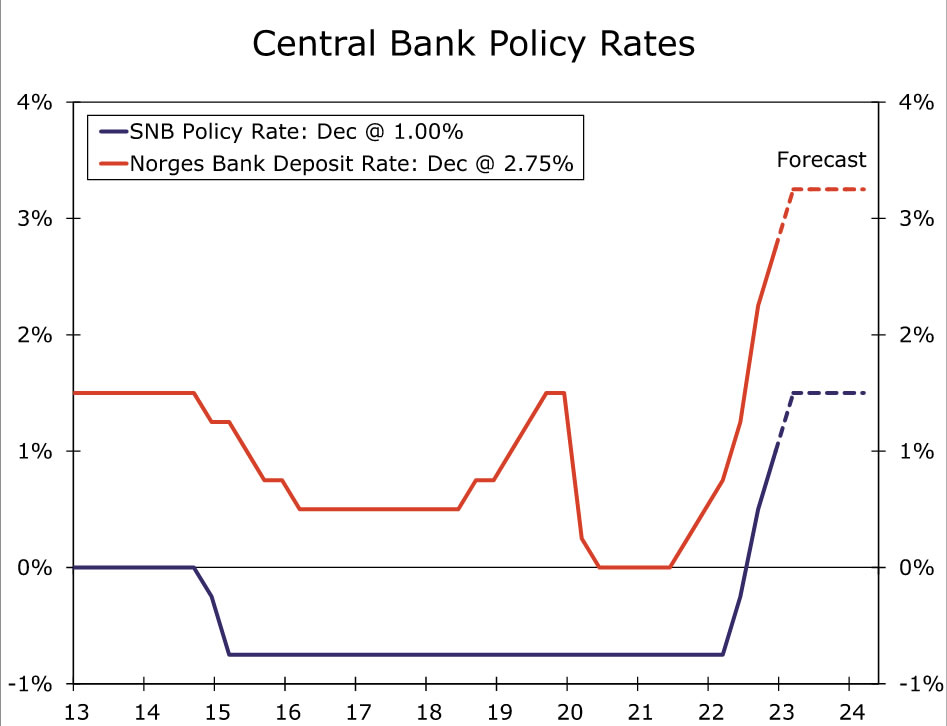
The rate hike action continued elsewhere today as well, with the Swiss National Bank raising its policy rate by 50 basis points to 1.00%. The increase was in line with the consensus forecast, but a bit less than the 75 basis point increase we had expected. The SNB's accompanying comments leaned hawkish, as SNB President Jordan said:
- “It was pretty clear that 50 basis points is the right decision, If you look at our inflation forecasts over the medium term, inflation is still slightly above our 2% threshold.”
- “There is a danger that inflation could remain elevated in Switzerland in the medium term owing to second-round effects” and “The renewed tightening of our monetary policy is therefore necessary.”
The SNB projects inflation of 2.4% in 2023, slowing to 1.8% in 2024. However, by the middle of 2025 the SNB sees CPI inflation creeping back up above 2%. That's in contrast to the central bank's inflation target, which defines price stability as inflation below 2%. With respect to Swiss GDP growth, the central bank forecasts GDP growth of 0.5% in 2023, down from around 2% in 2022.
As in previous announcements, the SNB said “it cannot be ruled out that additional rises in the SNB policy rate will be necessary to ensure price stability over the medium term.” With concerns that inflation could otherwise remain elevated for longer, we forecast a final 50 basis point rate hike to the SNB policy rate, which would see a peak at 1.50% in Q1-2023.
Finally, Norway's central bank (the Norges Bank), in what was a unanimous decision, raised its policy rate 25 basis points to 2.75% and signaled that rates will most likely be raised further in Q1-2023. The Norges Bank said that since its last Monetary Policy Report, inflation has been higher that it had forecast and is now expected to remain higher for longer. The central bank also observed that labor market trends have been sturdier than expected.
Thus, even with an outlook for an eventual slowing in Norway's economy, the Norges Bank has become slightly less pessimistic on the prospects for economic activity. The Norges Bank now see a 0.2% decline in Norway's mainland GDP in 2023, compared to a previously forecast fall of 0.3%. While Norges Bank Governor Ida Woldan Bache said the policy rate will be around 3% next year, given only modest (and mildly hawkish) changes in comments from the central bank in today's announcement, we remain comfortable with our call for two more 25 basis point hikes from the Norges Bank in January and March, which would see Norway's policy rate peak at 3.25%.
Swiss National Bank Raises Rate Slower than Others
The Swiss National Bank raised its rate by 50 points to 1.0% after two hikes of 50 and 75 points at the previous two meetings. In an accompanying commentary, the NBS said it was countering rising inflationary pressures.
In the commentary, the central bank says that “further rate hikes are not ruled out”. This is a milder formulation than other G10 central banks without Japan. However, the exact phrase was in the two previous decision comments, so we cannot speak of a softening tone in this case.
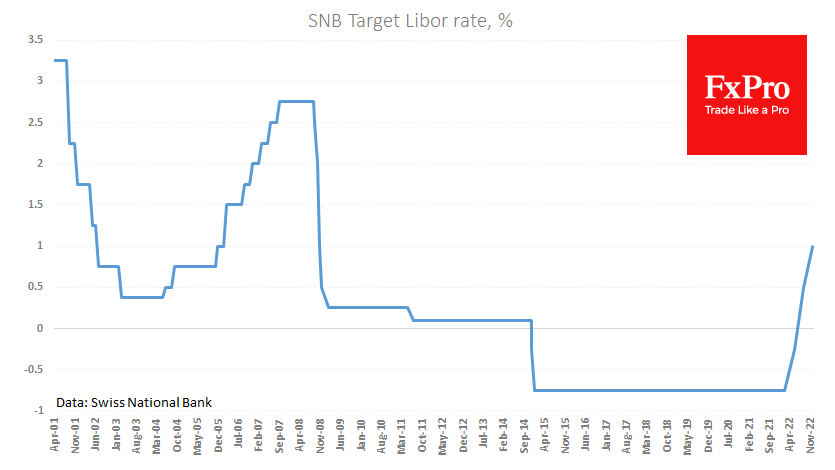
At the recent and previous meetings, the step-up was the same as for our colleagues from the Fed and the ECB: now by 0.5 percentage points, in September by 0.75. However, remember that SNB meetings are twice as rare, so Swiss policy tightening is less drastic. For the year Swiss central bank raised the rate by 175 points against 250 points for the ECB (including the expected +50 today), 340 (also including the forthcoming decision) for the Bank of England and 425 for the Fed.
On the other hand, inflation is not as acute here, having retreated from a peak of 3.5% y/y to 3.0% in the last three months. The producer and import price index retreated to 3.8% y/y in November from 6.9% in June.
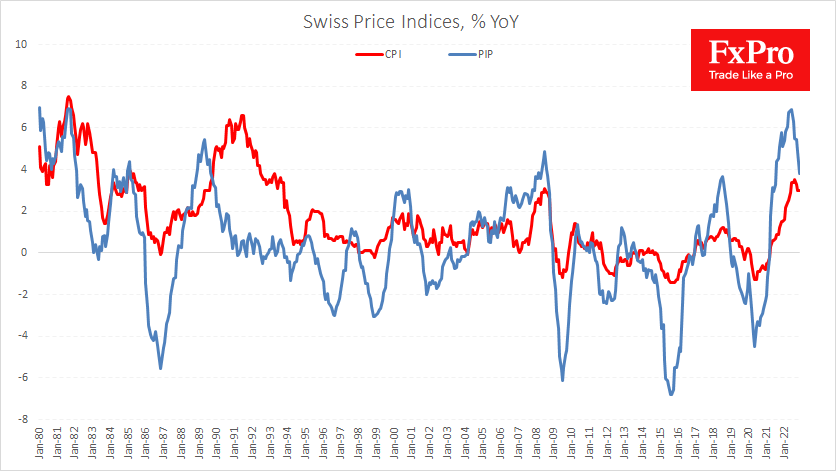
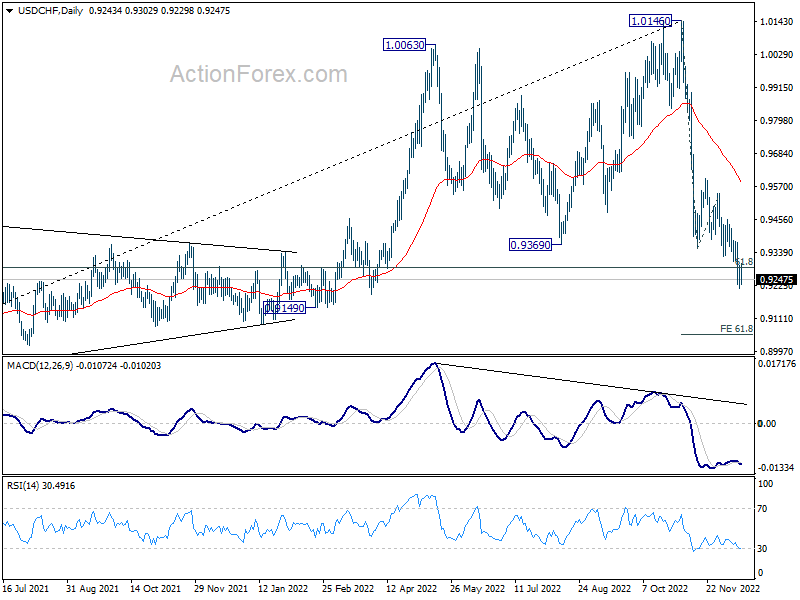
Historically, Switzerland has comparatively lower inflation which is the reason for the lower key rate. Therefore, the current slower pace of monetary policy tightening is not likely to fundamentally undermine the Swiss franc. By playing up the divergence in the speed of rate hikes, the USDCHF could develop a rebound without encountering significant resistance to 0.9400, which looks like a very modest pullback after a more than 9% decline since November 3.
Bank of England Review – A Dovish 50bp as BoE Nears the End of Hiking Cycle
In line with our expectation, the BoE today hiked policy rates by 50bp, bringing the Bank Rate to 3.50%.
We expect the increasingly weak growth outlook to support a near-term ending to the hiking cycle.
We maintain our call for a 25bp hike in February with risks to our call skewed towards additional hikes in 2023 if inflation pressures show increasing persistence.
In line with our expectation, the Bank of England (BoE) hiked the Bank Rate by 50bp to 3.50% with 6 members voting for a 50bp hike, one member voting for 75bp and two members voting for keeping the Bank Rate unchanged. As expected, there was no news in regards to QT-communication as outright selling of government bonds commenced on 1 November.
Overall, the December meeting offered little news, as the MPC judged that there has been limited news in economic data since the projections presented in the November Report. The BoE thus continues to expect a challenging growth backdrop where the UK is "to be in a recession for a prolonged period." This supports our expectation of the Bank nearing the end of its hiking cycle as tighter financial conditions, easing in labour market and the recession tears on the economy. Likewise, the two most dovish members that preferred to leave the Bank Rate unchanged at 3.00% referred to "increasing signs that the downturn was starting to affect the labour market" and the lag in effects of monetary policy as past rate increases "were still to come through". We expect this view to transmit onto the rest of the MPC in the coming months and thus keep the rest of our forecast unchanged, expecting a final 25bp hike in February 2023.
The increased focus from the government led by PM Rishi Sunak on closing the fiscal gap was broadly confirmed by the Autumn Statement on 17 November. On fiscal policy, the MPC thus estimates that "the overall impact on CPI inflation projection at all of these horizons is estimated to be small".
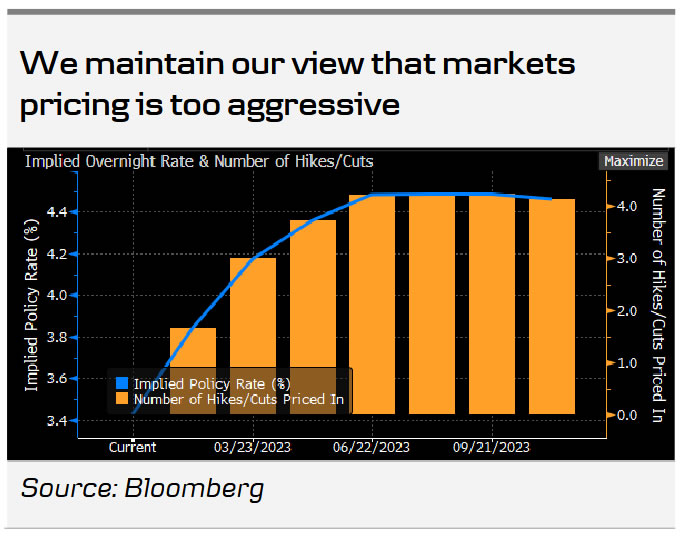
Rates. Gilts yields on all horizons ticked lower on announcement, although seemingly reversing at the time of writing with 2Y and 10Y now trading at respectively 3.4% and 3.3%. Like us, investors seem to interpret today's meeting as dovish as the peak rate was pushed lower to 4.5% in June/August 2023 from 4.57% yesterday. Our base case remains that of a peak in the policy rate of 3.75% in February 2023.
FX. EUR/GBP initially moved modestly higher upon announcement to 0.8630 from 0.8600, as expected but partly retraced the move afterwards. We see a case for the EUR/GBP cross to move modestly lower as a global growth slowdown and the relative appeal of UK assets to investors are a positive for GBP relative to EUR.
Our call. We continue to expect the BoE to deliver a final 25bp hike in February. Our expectations fall below current market pricing (currently 100bps until August 2023) as we expect the rest of the BoE committee to eventually turn less hawkish amid a weakening growth backdrop and easing labour market conditions.
Sunset Market Commentary
Markets
The ECB raised its key policy rates by 50 bps, bringing the deposit rate at 2%. The central bank sticks to its hawkish guidance saying that they aim to significantly raise them further at a steady pace based on the substantial upward revision to the inflation outlook. During the Q&A session, ECB Lagarde said that a steady pace means increments of 50 bps – a stark difference with yesterday’s Fed message suggesting a downshift to 25 bps from next year onwards. Keeping interest rates at restrictive levels will over time reduce inflation by dampening demand and will also guard against the risk of a persistent upward shift in inflation expectations. The ECB raised its average CPI forecasts for the 2022-2024 period from 8.1%-5.5%-2.3% in September to 8.4%-6.3%-3.4% with the first indication for 2025 at 2.3%. Inflation is thus set to remain above the 2% inflation target over the policy horizon even as the ECB will go into restrictive territory from next year onwards. Underlying core CPI is expected to average 3.9% this year and rise to 4.2% in 2023, before moderating to 2.8% and 2.4% in 2024 and 2025 respectively. Risks remain primarily to the upside, especially in the near term. The central bank puts forward a relatively short-lived and shallow recession with growth forecasts at 3.4% this year, 0.5% next year, 1.9% in 2024 and 1.8% in 2025. Higher interest rates will from March 2023 onwards be complemented with an end to the reinvestment policy of the roughly €3.2tn APP portfolio. The decline will amount to €15bn/month on average until the end of Q2 2023 and its subsequent pace will be determined over time. The ECB’s hawkish message hit complacent markets in the face. German yields add 8 bps to 26 bps on a daily basis with EUR/USD feeling the tailwind and surging beyond 1.07. European stock markets lose 3%.
The Bank of England followed the downshift to 50 bps, lifting the policy rate from 3% to 3.5%. Three out of nine governors dissented. One in favour of a 75 bps hike and two in favour of unchanged rates. BoE governor Bailey confirmed that the majority judged that further increases will follow should the economy evolve broadly in line with the November projections. Inflation may already have peaked, but risks remain very high in the next few months and located on the upside. The BoE expects the UK economy to be in recession now with fiscal stimulus raising the end of 2023 GDP forecast by 0.4%. The central bank pointed at last month’s reference to the market implied policy rate path, which by that time was thought to be too aggressive. Market pricing shifted downward since, expecting a 4.5% policy rate peak by mid next-year, something the Bailey and co can align themselves with. UK yields fell around 5 bps across the curve with EUR/GBP moving away from the 0.86 big figure and the ECB accelerating the move.
News Headlines
Norway’s central bank lifted its policy rate by an expected 25 bps to 2.75% today. The Norges Bank said that the previously delivered tightening started to have an effect on the economy, perhaps even more than expected in September. Mainland growth was revised lower to 0.6% for next year and 2024. This hangs in the balance with a slightly tighter labour market than anticipated and above-target inflation of 6.5% (5.7% core) in November. Monetary policy-relevant CPI forecasts were revised upwards in 2023 (5.2%), 2024 (3.6%) and 2025 (2.7%). On balance, the Norges Bank believes additional tightening will be necessary in Q1 2023. It remains data-dependent but for now kept the expected terminal rate at 3%, meaning the cycle may be close to the end. All in all, the December meeting held little new information, causing few ripples in Norwegian swap rates and the krone. EUR/NOK trades slightly higher, just north of 10.4.
Switzerland, 50 (basis) points. The SNB brought the policy rate to 1% today and with it a straightforward analysis. Inflation (3% in November) declined in recent months but remains above the 2% target. New forecasts see inflation dipping from 2.4% in 2023 to 1.8% through 2024 before picking up again to 2.1% in 2025Q3. Hence the need for further rate hikes, even as growth is seen at a mere 0.5% next year with risks mainly tilted to the downside. The SNB stays committed in intervening in FX markets to support the franc to achieve the “appropriate monetary conditions”. SNB president Jordan during the press conference said the central bank has indeed done so in recent months. EUR/CHF trades unchanged at 0.9875 with a slightly stronger euro post ECB keeping the franc in check.
ECB Lagarde expects more steady 50bps hikes, EUR/CAD accelerates up
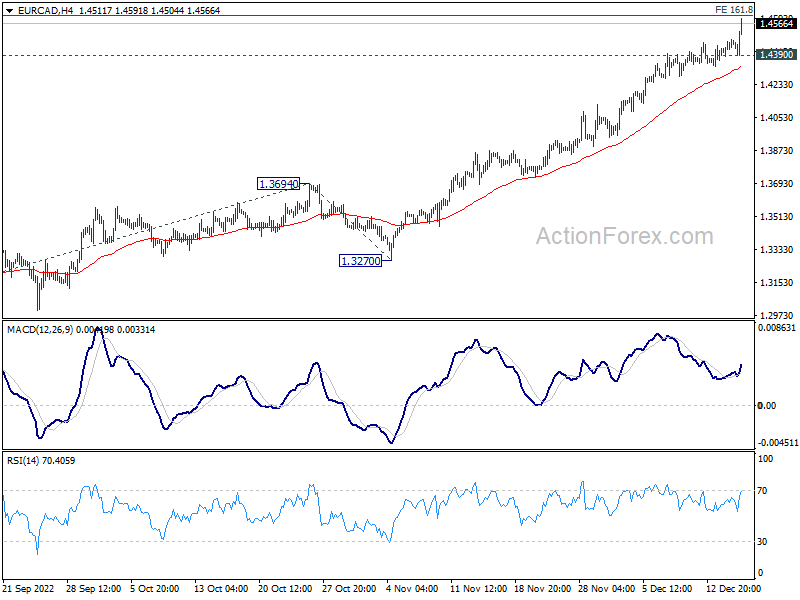
Euro is given a further boost after ECB President Christine Lagarde said in the the post-meeting press conference that "interest rates will still have to rise significantly and at a steady pace." She added, "Obvious that we should expect 50 bps hikes for period of time." The clarity of Lagarde's message was a rather big surprise to the markets.
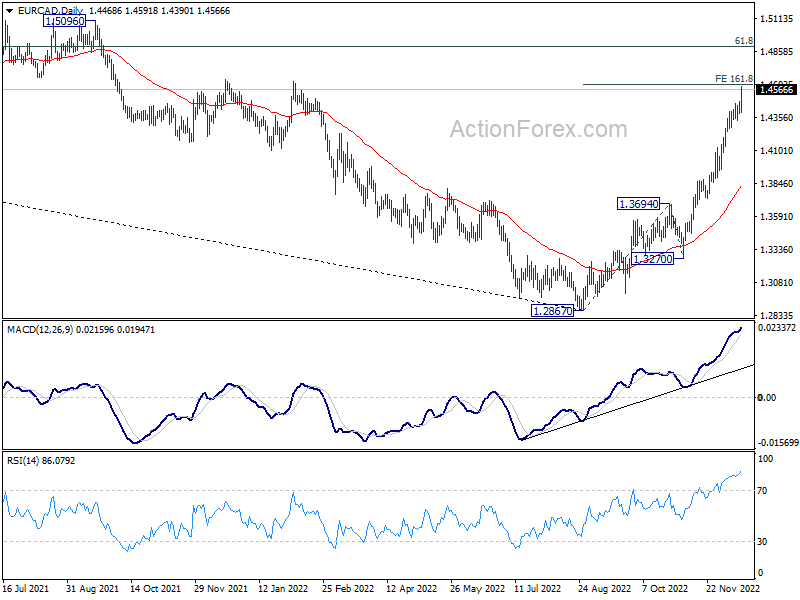
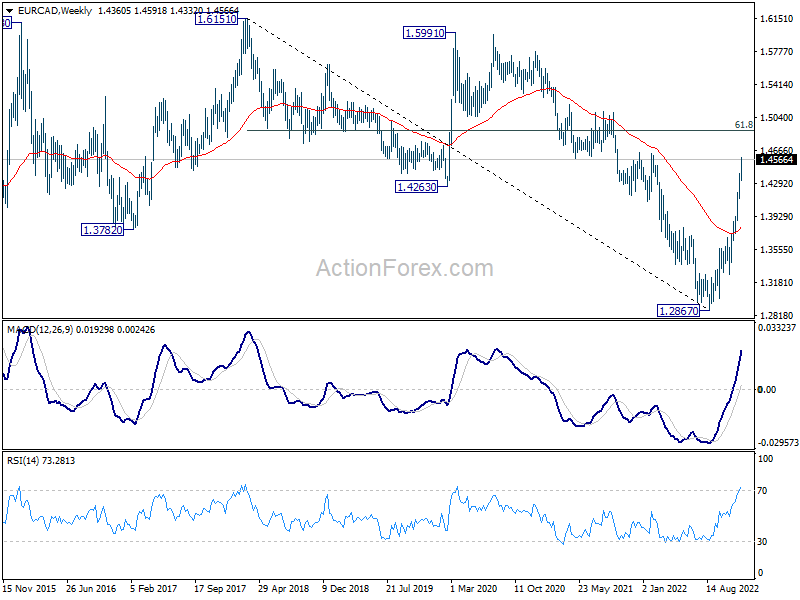
EUR/CAD's rally accelerates to as high as 1.4591 and it's on track to 161.8% projection of 1.2867 to 1.3694 from 1.3270 at 1.4608. Firm break there will put focus to key long term fibonacci level of 1.6151 to 1.2867 at 1.4897.
EUR/USD Mid-Day Outlook
Daily Pivots: (S1) 1.0635; (P) 1.0665; (R1) 1.0711; More...
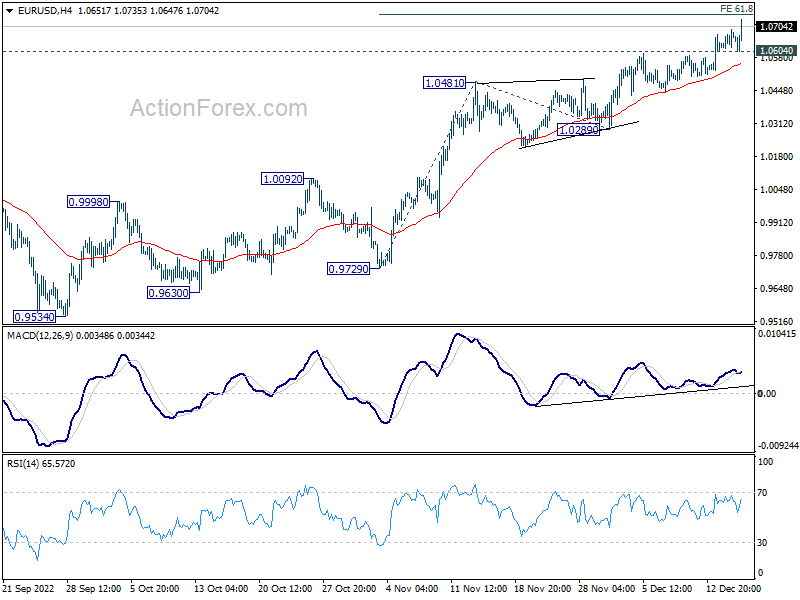
EUR/USD's rally continues in early US session and intraday bias stays on the upside for 61.8% projection of 0.9729 to 1.0481 from 1.0289 at 1.0754. Firm break there could prompt upside acceleration to 100% projection at 1.1041. On the downside, break of 1.0604 minor support will turn intraday bias neutral first. But further rally will remain in favor as long as 1.0481 resistance turned support holds.
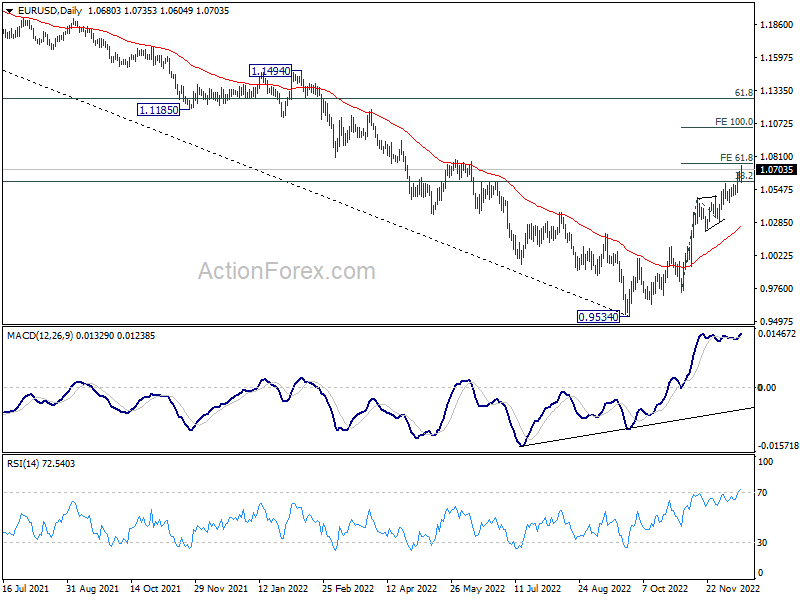
In the bigger picture, focus stays on 38.2% retracement of 1.2348 (2021 high) to 0.9534 at 1.0609. Rejection by 1.0609 will suggest that price actions from 0.9534 medium term bottom are developing into a corrective pattern. Thus, medium bearishness is retained for another fall through 0.9534 at a later stage. However, sustained break of 1.0609 will raise the chance of trend reversal and target 61.8% retracement at 1.1273.
GBP/USD Mid-Day Outlook
Daily Pivots: (S1) 1.2365; (P) 1.2405; (R1) 1.2469; More...
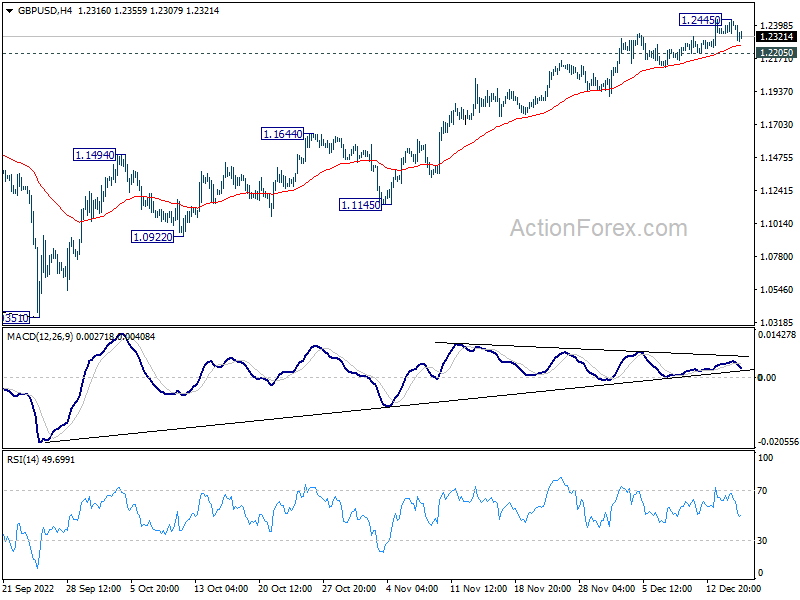
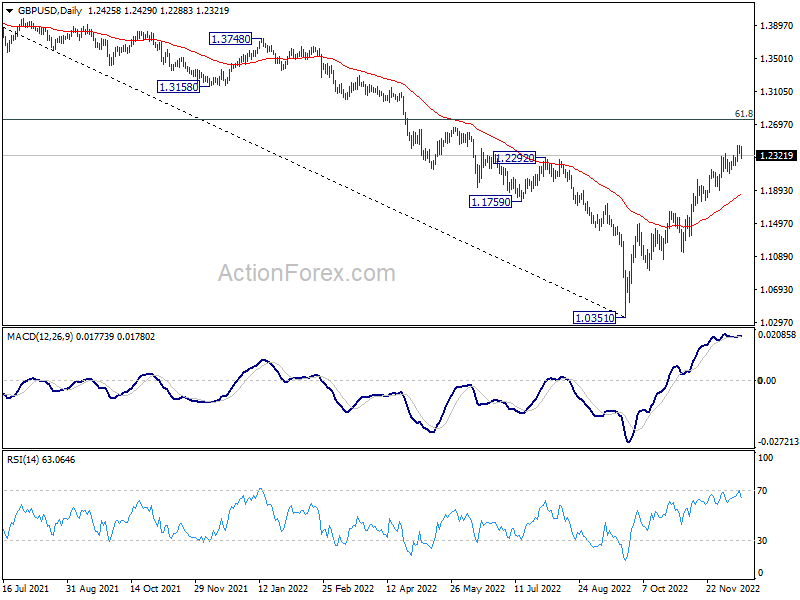
Intraday bias in GBP/USD is turned neutral with current retreat. On the downside, break of 1.2205 minor support will indicate short term topping, bearish divergence condition in 4 hour MACD. Intraday bias will be turned to the downside for deeper pull back to 55 day EMA (now at 1.1860). On the upside, though, break of 1.2445 will resume larger rise to 1.2759 medium term fibonacci level next.
In the bigger picture, rise from 1.0351 medium term bottom is at least correcting whole down trend from 1.4248 (2021 high). Further rise is expected as long as 1.1644 resistance turned support holds. Next target is 61.8% retracement of 1.4248 to 1.0351 at 1.2759. Sustained break there will pave the way back to 1.4248. This will remain the favored case as long as 55 day EMA (now at 1.1860) holds.
USD/CHF Mid-Day Outlook
Daily Pivots: (S1) 0.9207; (P) 0.9253; (R1) 0.9290; More...
USD/CHF continues to lose downside momentum, but there is no sign of bottoming yet. Intraday bias stays mildly on the downside for 61.8% projection of 1.0146 to 0.9355 from 0.9545 at 0.9056. However, break of 0.9378 resistance will indicate short term bottoming and turn bias back to the upside for 0.9545 resistance instead.
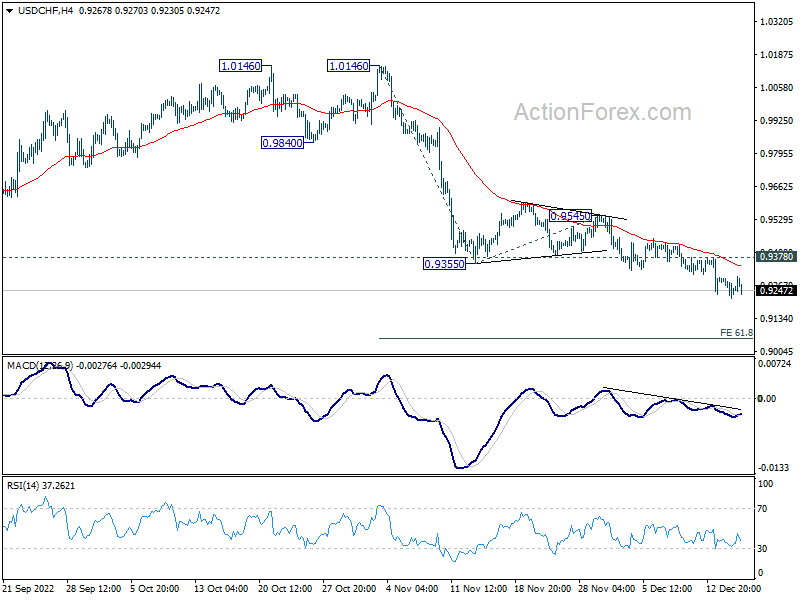
In the bigger picture, rise from 0.8756 (2021 low) has completed at 1.0146, well ahead of 1.0342 long term resistance (2016 high). Based on current downside momentum, fall from 1.0146 might be a medium term down trend itself. Sustained break of 61.8% retracement of 0.8756 to 1.0146 at 0.9287 will pave the way to 0.8756. In any case, risk will stay on the downside as long as 0.9545 resistance holds.