Sample Category Title
SNB Jordan: We will continue to sell foreign currency if appropriate
In the post meeting press conference, SNB Chairman Thomas Jordan said that this year's 4% appreciation in Swiss Franc exchange rate "has helped ensure that less inflation has been imported from abroad, thus curbing the rise in inflation."
He said that the central bank sold "foreign currency in recent months" to ensure appropriate monetary conditions. He added, "We will also sell foreign currency in the future if this is appropriate from the monetary policy perspective. Conversely, we remain willing to buy foreign currency again if necessary, i.e. if there were to be excessive appreciation pressure."
AUDUSD Consolidates as Rebound Falters Near 200-day SMA
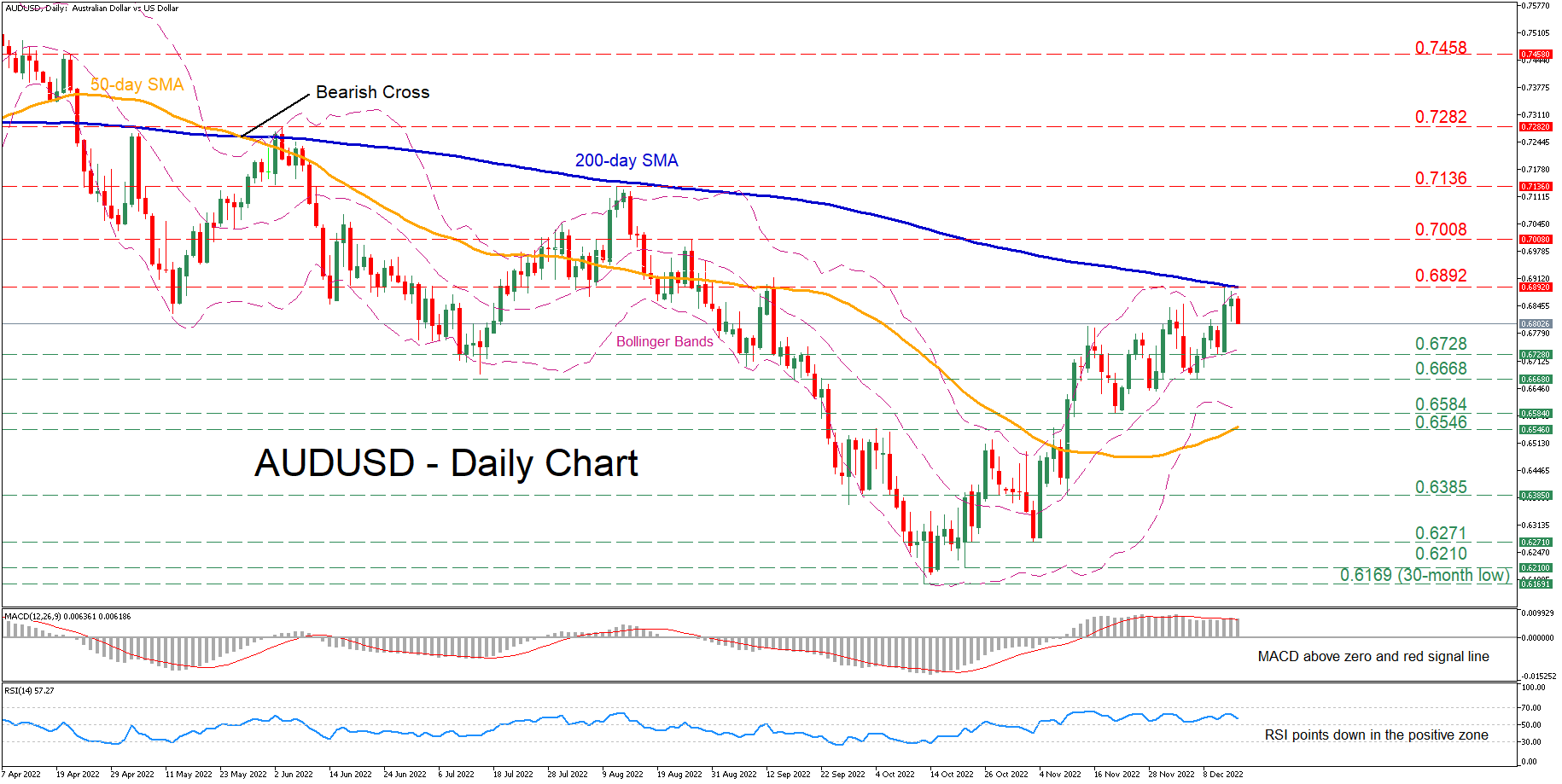
AUDUSD had been stuck in a steep downtrend since early March but managed to recoup some losses after bouncing at the 30-month low of 0.6169. However, the pair has been trading without clear direction in the last couple of daily sessions as its advance came to a halt at the 200-day simple moving average (SMA).
The momentum indicators are reflecting a loss of positive momentum. Specifically, the MACD histogram is softening but remains above both zero and its red signal line, while the RSI is pointing downwards in the positive territory.
Should buying pressures persist, the price could challenge the 200-day SMA, which temporarily rejected the pair’s recent advance. Conquering this barricade, further upside moves may cease at 0.7008 before the August high of 0.7136 comes under examination. Even higher, the June peak of 0.7282 might prove a tough obstacle for the price to overcome.
On the flipside, bearish actions could send the price to test the recent support of 0.6728. Sliding beneath that floor, the bears may aim at 0.6668 before the 0.6584 support appears on the radar. A break below the latter may trigger a retreat towards the 0.6546 resistance region.
Overall, AUDUSD appears ready to retest its recent rejection point as the short-term oscillators suggest that near-term risks remain tilted to the upside. Therefore, a break above the 200-day SMA could signal the resumption of the pair’s recovery.
WTI Futures Head North after One-year Low
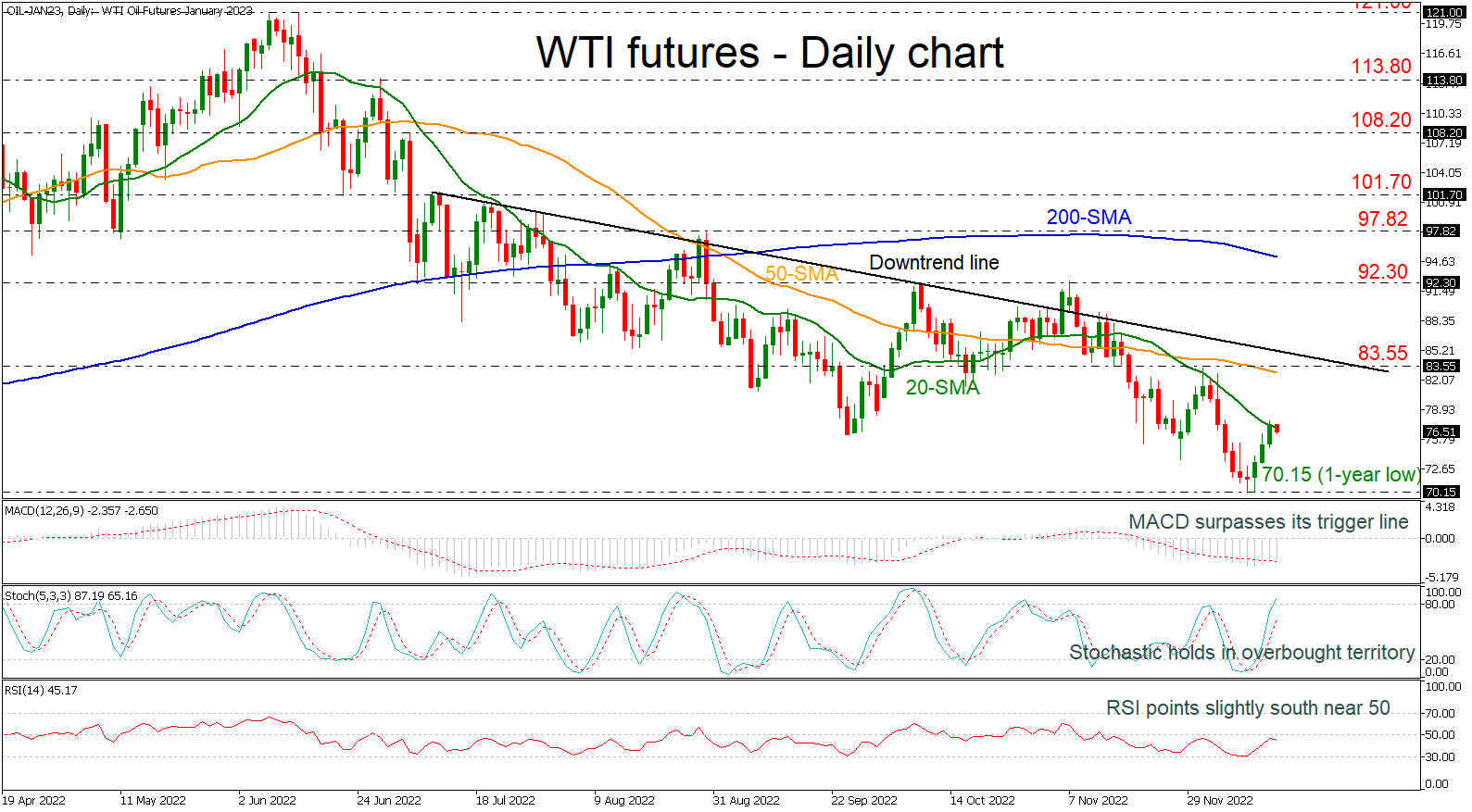
WTI crude oil futures have found a strong support level at the one-year low of 70.15, sending the price higher towards the 20-day simple moving average (SMA).
The price remains well below the medium-term descending trend line with the technical indicators suggesting some contradicting signs. The MACD is standing above its trigger line in the positive region, while the stochastic is advancing in the overbought region. However, the RSI is ticking marginally down near the neutral threshold of 50, confirming today’s bearish start.
In case of more losses, immediate support is being provided by the one-year trough of 70.15 before the price tumbles towards 65.87, registered in December 2021. Should prices dip lower again, the next support would likely come from the 62.30 barrier, achieved in November 2021.
In case of an upward attempt, oil prices would likely meet resistance at the 50-day SMA currently at 82.80 ahead of the 83.55 hurdle and the downtrend line at 84.70. A break above these lines would ease the downside pressure, while a climb above the 92.30 level would help turn the short-term bias to a bullish one, breaking the 200-day SMA at 95.00.
In the medium term, the bearish outlook remains intact, with the moving averages all pointing downwards. However, should prices move above the falling trend line and the 200-day SMA, this would risk shifting the medium-term picture to a more bullish one.
USD/CAD: 1.402 Likely to Complete Global Correction Trend
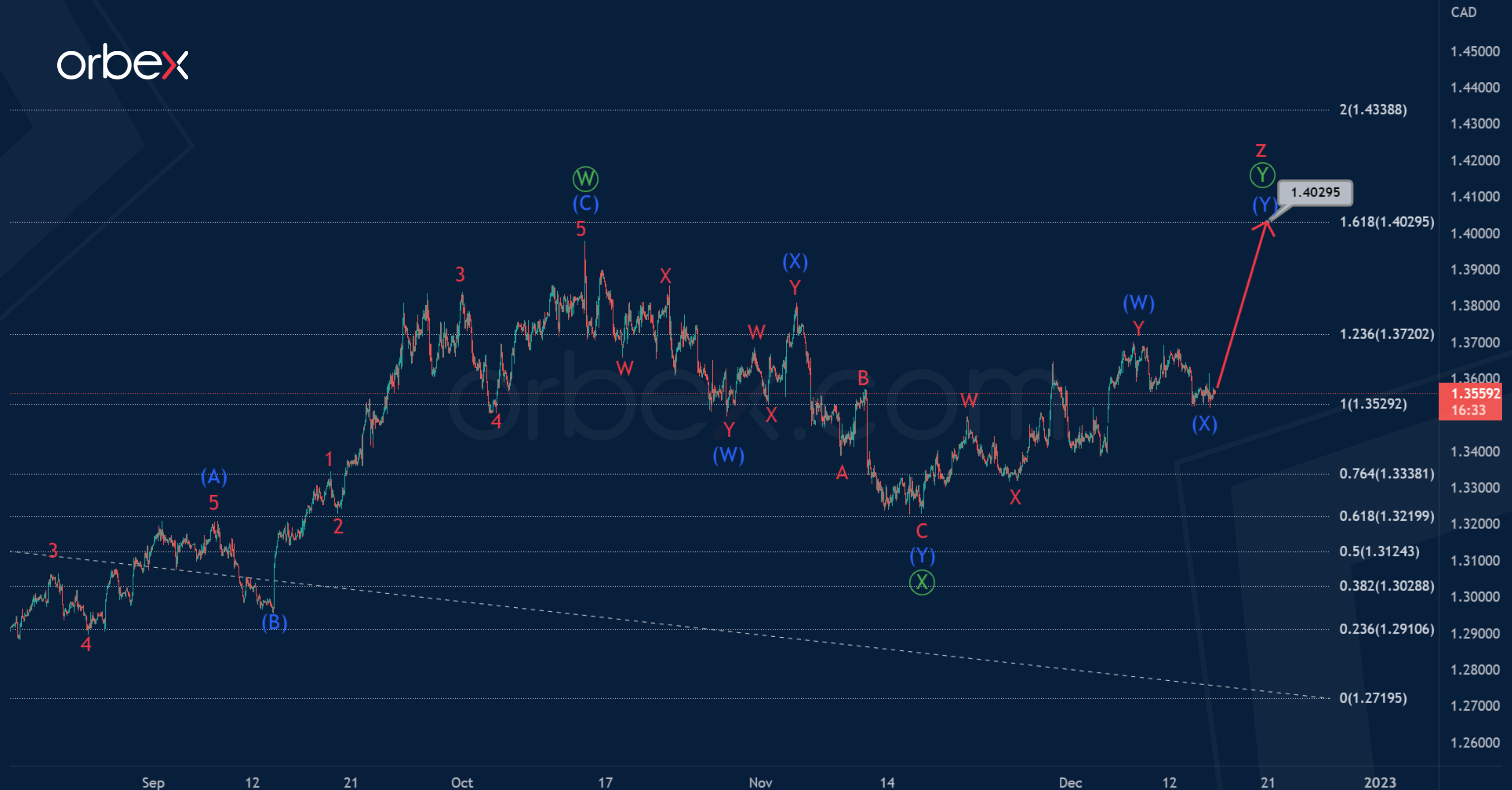
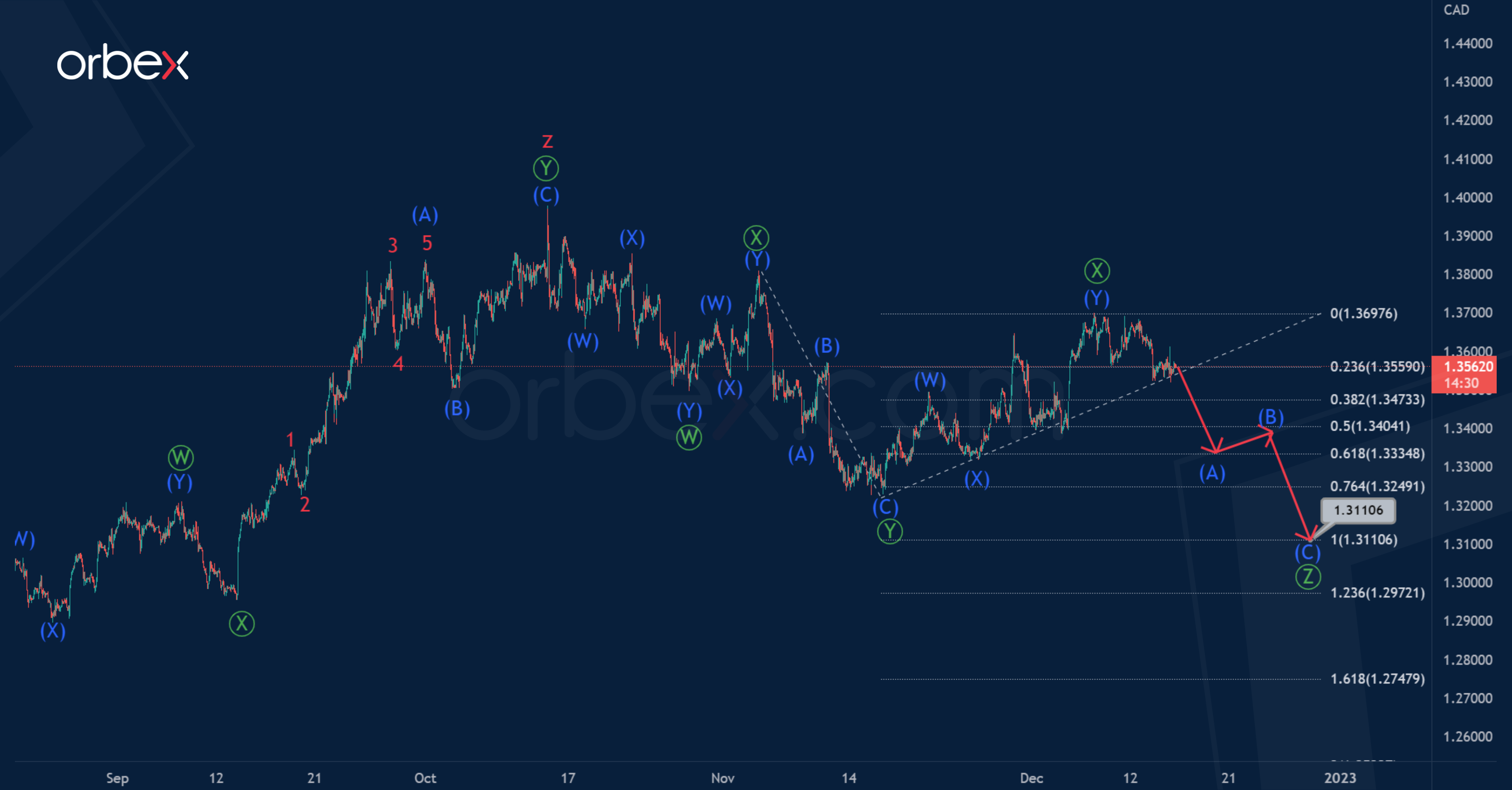
The current USDCAD timeframe shows the internal structure of a large correction pattern, similar to a cycle triple zigzag w-x-y-x-z.
Perhaps the first four parts of this construction are fully completed, and now the final actionary leg is being built the sub-wave z. Apparently, the wave z takes the form of a primary double zigzag, where the sub-waves are formed.
Thus, the last actionary primary wave may be in the process of construction at the moment.
It may end in the form of a double zigzag (W)-(X)-(Y) near 1.402. At that level, cycle wave z will be at 161.8% of cycle wave y.
According to an alternative, the formation of a cycle triple zigzag could be fully completed. Therefore, now we may see the construction of the initial part of a new bearish trend.
The construction of a primary triple zigzag is assumed, which is the beginning in a larger correction pattern.
It is likely that the primary waves have already been built.
In the near future, market participants can expect the formation of a bearish primary wave, which may take the standard zigzag shape (A)-(B)-(C) and end near 1.311. At that level, it will be equal to primary wave.
More Shocks Coming?
Equity markets are back in the red on Thursday as investors reel from the nasty shock delivered by the Fed and look ahead to the plethora of central bank rate decisions on the agenda today.
Safe to say, investors simply didn't see that coming. Two months of better-than-expected inflation data were enough to convince them that the Fed would not only ease off the brake but signal it would do so more in the coming months.
Whether through complacency or a desperate desire to see value in equity markets, investors overlooked the concerns that have plagued policymakers for months. The fear of entrenched inflation has been a much greater concern and it's been better encapsulated in the jobs and wage figures than the headline inflation numbers that have spurred investors on recently.
Of course, that isn't to say the Fed will simply ignore the progress we've seen in the inflation data. But perhaps that investors should give more consideration to the upside risks to it. While I still believe the Fed won't raise rates as far as the dot plot indicates, the next hike may be another 50 basis points unless we see something more sustainable in the labour market and wage numbers.
Of course, markets have been ahead of the Fed a number of times this year and the central bank may simply be pushing back as a means of preventing complacency from appearing in the markets, undermining its own tightening efforts. But the case remains that the path back to 2% will likely be far less smooth than that to 9.1% and potentially just as disappointing at times. We should probably accept that now.
BoE to continue pushing back, ECB projections key
The question now becomes whether other central banks will take a similarly hawkish position against the markets and ruin any hope of a Santa rally this year. Of course, that very much depends on the individual circumstances. Take the BoE for example, it has already been pushing back against market expectations but in a very different way, with the message from the MPC being that it doesn't expect to tighten as aggressively as the economy falters.
The ECB faces other challenges, most notably the fact that inflation is still 10% and it was very late to the party when it comes to raising interest rates. At the same time, the bloc faces a period of huge economic and energy uncertainty and probably recession. The central bank is expected to slow the pace of tightening today following two consecutive 75 basis point hikes but the economic projections are what will likely get the most attention as traders try to determine just how far the central bank plans to push rates.
Oil edges lower
Oil prices are a little lower on Thursday after recording three consecutive days of gains. A stronger post-Fed dollar, fears of slower growth, or a surprisingly large inventory build from EIA may be contributing to today's declines but in reality, we're probably just seeing a little profit-taking following a decent rebound.
The outlook remains highly uncertain given the risks to Chinese demand as it exits zero Covid, the war in Ukraine and the impact of the G7 price cap, and OPEC+, among other factors. The rebound off $70 suggests there may be a psychological element as well after the White House previously indicated it would start refilling the SPR around these levels.
Gold pulls back but traders not buying new projections
Gold is off around 1% today following the disappointment of the Fed projections. While the dollar initially pared gains, it has been on the rise since which is weighing on the yellow metal. The rally had already been losing momentum in the run-up to the meeting which is probably contributing to today's pullback. Whether it can make further progress from here may depend on how good a job the Fed does in convincing traders of its intentions, with the initial reaction suggesting they're not fully buying it.
SNB hikes 50bps to 100%, cannot rule out more
SNB raises the policy rate by 50bps to 1.00% as widely expected, to "countering increased inflation pressure and a further spread of inflation". The central added that additional rate hikes "cannot be ruled out". It also maintained the willingness to be "active in the foreign exchange markets as necessary".
In the new conditional inflation forecast based on 1.0% policy rate, inflation forecasts was lowered from 3.0% to 2.9% in 2022, left unchanged at 2.4% in 2023, and raised from 1.7% to 1.8% in 2024. Inflation forecast was indeed raised from Q3 2023 through Q4 2024.
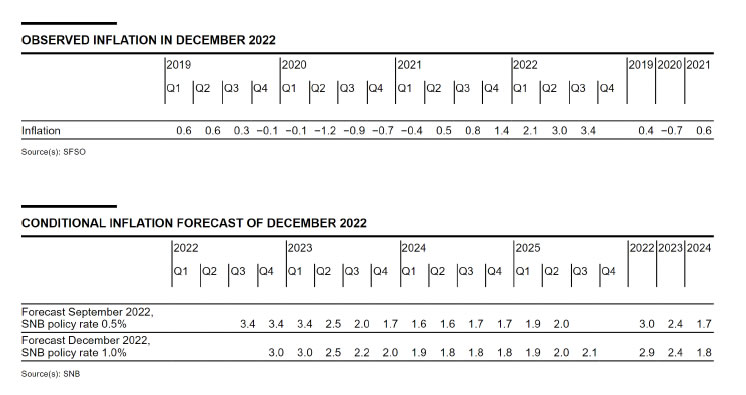
The higher inflation forecasts was "attributable to stronger inflationary pressure from abroad and the fact that price increases are spreading across the various categories of goods and services in the consumer price index."
Regarding GDP growth, SNB expects its to be at around 2.0% this year. But weaker overseas demand and higher energy prices are likely to "curb economic activity marked in the coming year". SNB expects GDP growth to slow to 0.5% in 2023.
(SNB) Swiss National Bank tightens monetary policy further and raises SNB policy rate to 1.0%
The SNB is tightening its monetary policy further and is raising the SNB policy rate by 0.5 percentage points to 1.0%. In doing so, it is countering increased inflationary pressure and a further spread of inflation. It cannot be ruled out that additional rises in the SNB policy rate will be necessary to ensure price stability over the medium term. To provide appropriate monetary conditions, the SNB is also willing to be active in the foreign exchange market as necessary.
The SNB policy rate change applies from tomorrow, 16 December 2022. Banks' sight deposits held at the SNB will be remunerated at the SNB policy rate of 1.0% up to a certain threshold. Sight deposits above this threshold will be remunerated at an interest rate of 0.5%, and thus still at a discount of 0.5 percentage points relative to the SNB policy rate. With this tiered remuneration of sight deposits and open market operations, the SNB is ensuring that the secured short-term Swiss franc money market rates are close to the SNB policy rate.
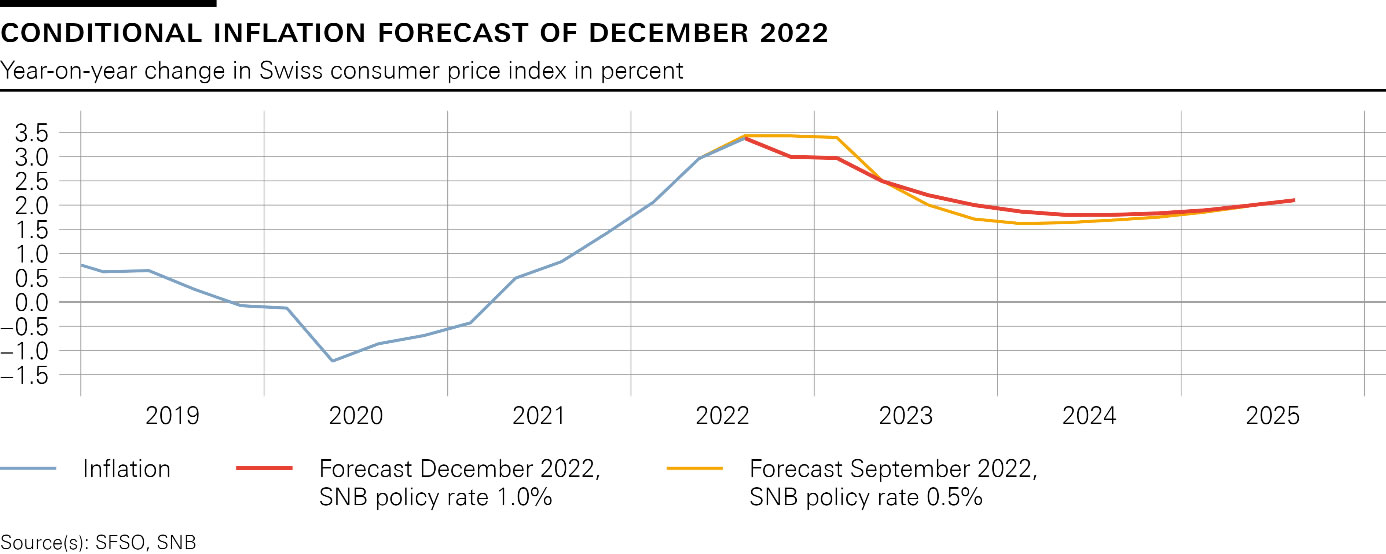
Inflation has declined somewhat in recent months, and stood at 3.0% in November. However, it is still clearly above the range the SNB equates with price stability. Inflation is likely to remain elevated for the time being. The SNB's new conditional inflation forecast is based on the assumption that the SNB policy rate is 1.0% over the entire forecast horizon (cf. chart 1). Up to the beginning of 2023, the forecast is below that of September owing to the somewhat lower oil price. From mid-2023 onwards, the new forecast is higher and stands at 2.1% at the end of the forecast horizon. That the new forecast is higher over the medium term despite the raising of the SNB policy rate is attributable to stronger inflationary pressure from abroad and the fact that price increases are spreading across the various categories of goods and services in the consumer price index. The new forecast puts average annual inflation at 2.9% for 2022, 2.4% for 2023 and 1.8% for 2024 (cf. table 1). Without today's SNB policy rate increase, the inflation forecast would be even higher over the medium term.
Global growth momentum has continued to slow down. At the same time, inflation in many countries is markedly above central banks' targets. Accordingly, numerous central banks have further tightened their monetary policy.
In its baseline scenario for the global economy, the SNB expects this challenging situation to persist for now. Global economic growth is likely to be weak in the coming quarters, and inflation will remain elevated for the time being. Over the medium term, however, inflation abroad should return to more moderate levels, not least due to the increasingly tighter monetary policy in many countries.
This scenario for the global economy is subject to significant risks. The energy situation in Europe could worsen again. At the same time, high inflation could become embedded and require renewed stronger monetary policy responses abroad. Finally, the coronavirus pandemic remains an important source of risk for the global economy.
In Switzerland, GDP grew at an annualised rate of 1.0% in the third quarter. Economic momentum thus remained similarly modest as in the preceding quarters. While many service industries fared well, there was a renewed slight decline in value added in manufacturing.
The situation on the labour market remained positive. Employment continued to rise, and unemployment decreased again slightly. Overall production capacity has been well utilised.
Switzerland's GDP is likely to grow by around 2.0% this year. However, weaker demand from abroad and the high energy prices are likely to curb economic activity markedly in the coming year. Against this backdrop, the SNB expects GDP growth of around 0.5% for 2023.
The forecast for Switzerland, as for the global economy, is subject to high uncertainty. A stronger economic downturn abroad or a pronounced energy shortage in Switzerland would, in particular, have a negative effect.
Growth has remained largely unchanged in recent quarters for both mortgage lending and prices for single-family houses and privately owned apartments. There are, however, signs of a slowdown in prices for apartment buildings. The SNB will continue to monitor developments on the mortgage and real estate markets closely.
More detailed information on the monetary policy decision can be found in Thomas Jordan's introductory remarks. Further information can be found in the introductory remarks of Martin Schlegel and Andréa Maechler.
AUD/USD Tests Major Resistance
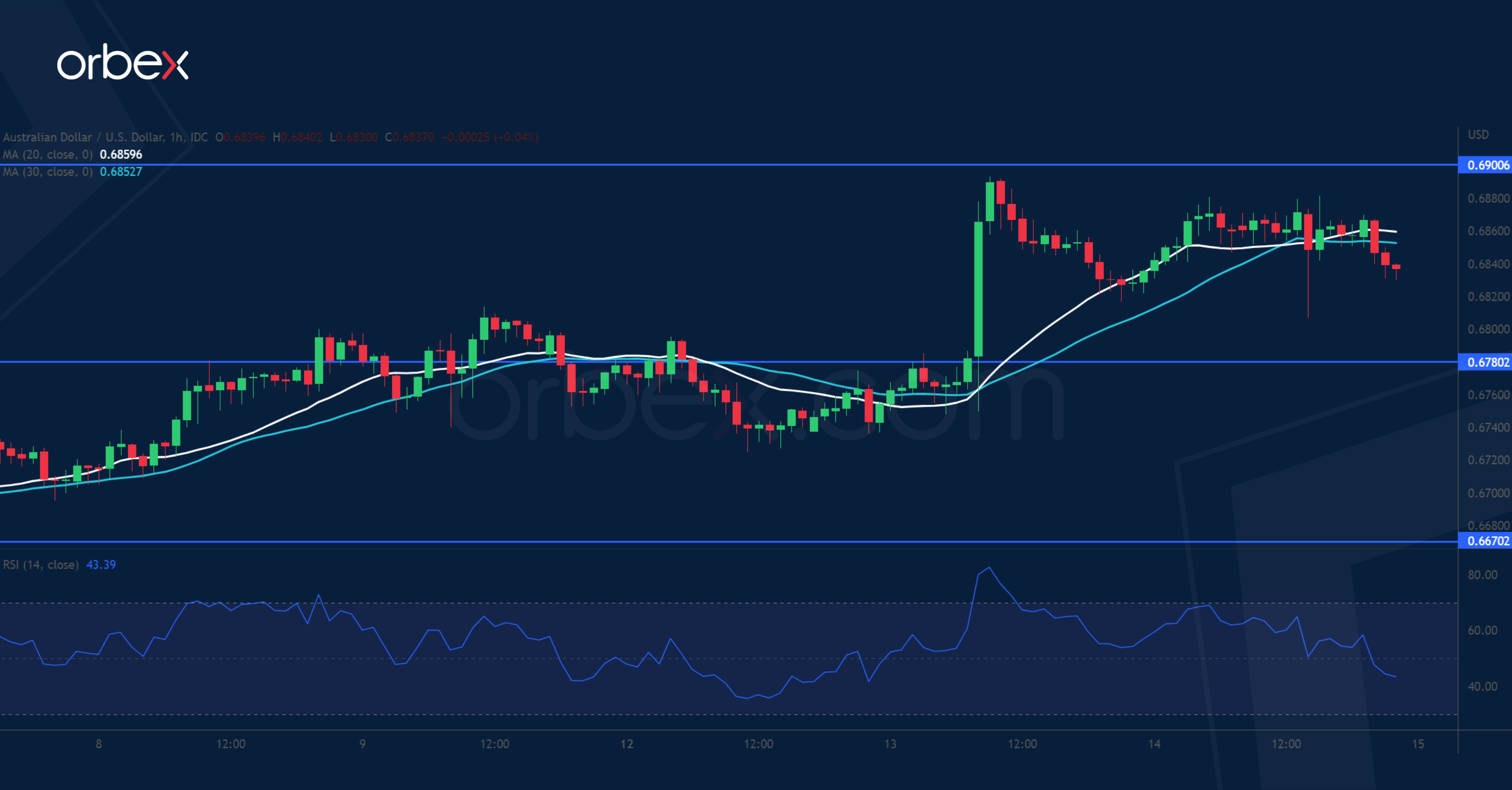
The US dollar softened after the Fed raised interest rates by 50 basis points as expected. The bulls have been probing resistance under September’s high of 0.6900 for a couple of weeks. Profit-taking was not enough to trigger a broader sell-off, which suggests that sentiment has stayed rather upbeat. The latest surge shows strong commitment from the long side and a bullish breakout could extend gains above the psychological level of 0.7000. The demand zone around 0.6780 is key in keeping the momentum in play.
GBP/USD to Test Resistance
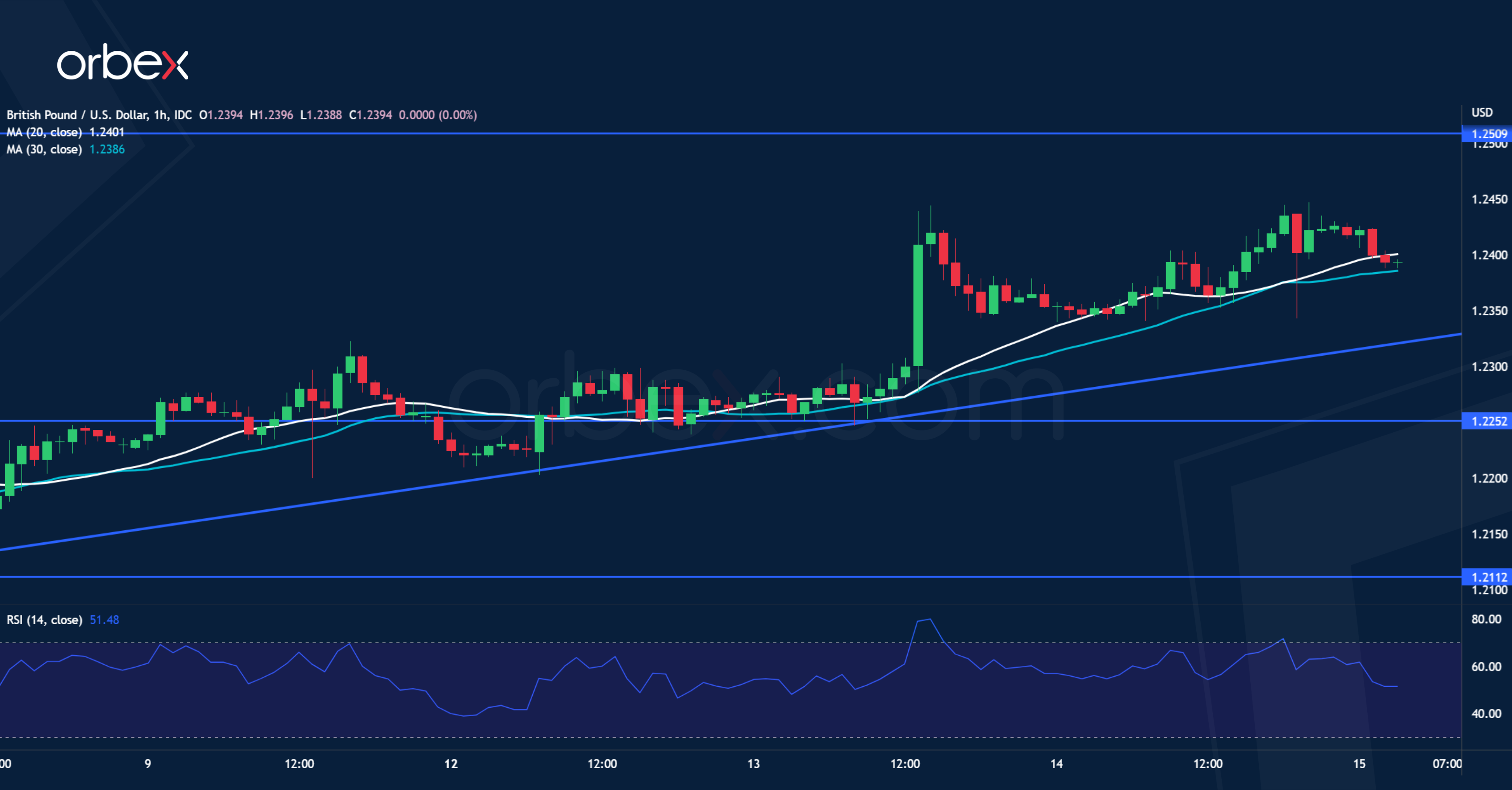
The pound holds firm as the BoE meets amid softer CPI from last month. Sterling is grinding its way up along a rising trend line and past last summer’s high of 1.2250 which has turned into a support. A break above 1.2340 indicates that the bulls are still in control. A pullback could be absorbed by eager trend followers. The psychological level of 1.2500 is the next step and its breach would open the door to last May’s high around 1.2660. On the downside, 1.2110 is the bulls’ second layer of defence in case of a correction.
EUR/USD Rallies Along Trend Line
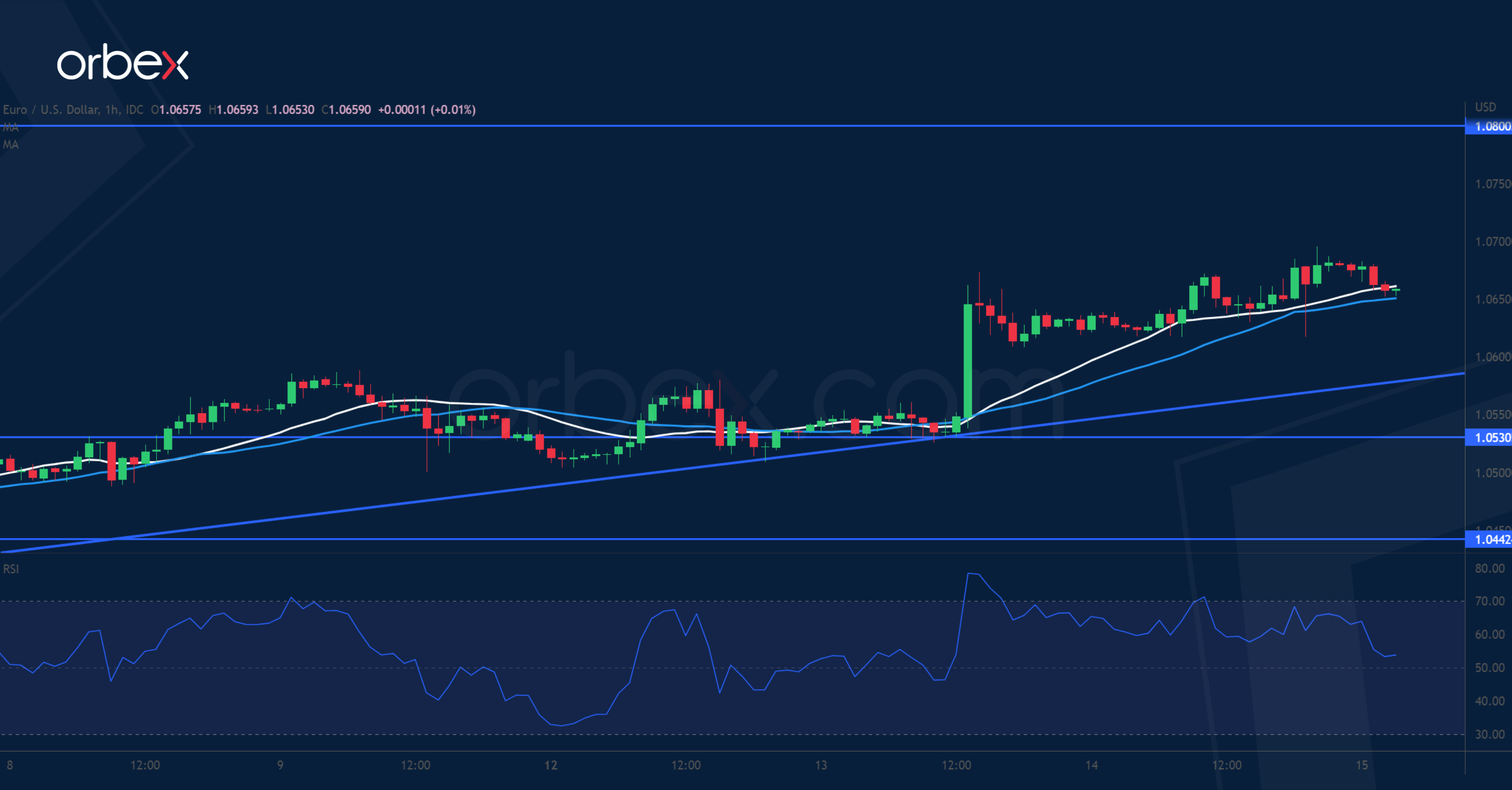
The euro steadies ahead of the ECB interest decision today. On the daily chart, the pair is heading to last May’s high of 1.0800 after bouncing off 1.0300 on the 20-day moving average. Zooming into the hourly time frame, the euro has been climbing along a rising trend line, with a fresh support at the base (1.0530) of the latest momentum. The bullish mood may continue to carry the price action, but selling pressure could grow as the pair approaches the supply zone where short-term buyers might start to take profit.