

Sample Category Title
EUR/USD Daily Outlook
Daily Pivots: (S1) 1.0635; (P) 1.0665; (R1) 1.0711; More...
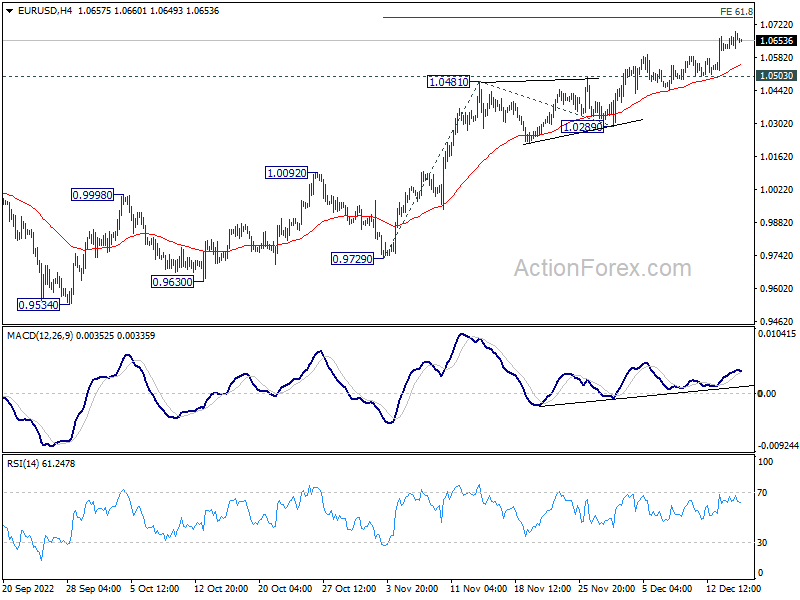
Intraday bias in EUR/USD remains on the upside as current rally from 0.9534 is in progress for 61.8% projection of 0.9729 to 1.0481 from 1.0289 at 1.0754. Firm break there could prompt upside acceleration to 100% projection at 1.1041. On the downside, however, break of 1.0503 support will indicate short term topping, and turn bias to the downside for 1.0289 support instead.
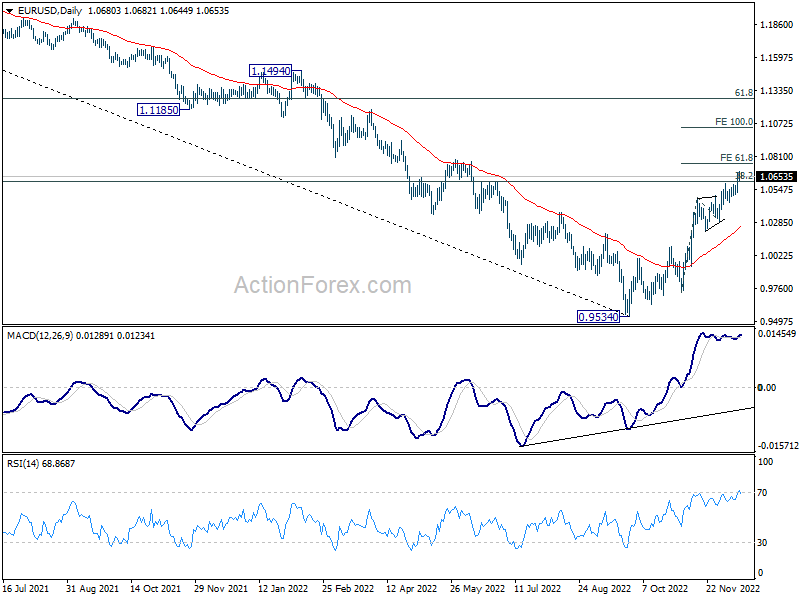
In the bigger picture, focus stays on 38.2% retracement of 1.2348 (2021 high) to 0.9534 at 1.0609. Rejection by 1.0609 will suggest that price actions from 0.9534 medium term bottom are developing into a corrective pattern. Thus, medium bearishness is retained for another fall through 0.9534 at a later stage. However, sustained break of 1.0609 will raise the chance of trend reversal and target 61.8% retracement at 1.1273.
Up Next: The ECB and Bank of England
Markets
The Fed lifted policy rates by 50 bps to 4.25-4.50% at its final policy meeting of the year yesterday. The slowdown from the previous 4x75 bps was telegraphed well in advance. December’s statement was an exact copy of the November one and stated that ongoing increases in the policy rate will be appropriate. The new forecasts contained several hawkish elements, including an upward revision in PCE inflation, both headline and core. The Fed now assumes 3.1% headline price growth (3.5% core) in 2023, 2.5% (2.5%) in 2024 and 2.1% (2.1%) in 2025. Stubborn and above-target inflation requires more rate hikes, with the central bank penciling in a 5-5.25% terminal rate through 2023. That’s 50 bps higher than the September forecasts. The distribution in estimates was widely skewed to the upside with 7 out of 19 policy makers expecting the peak (well) above the median and only 2 below that level. In 2024, and not before – as stressed by chair Powell during the press conference – the Fed sees room for rate cuts. The longer-term (neutral) rate was unchanged at 2.5%. The December dot plot triggered a knee-jerk move higher in US yields across the curve (>10 bps intraday) but the move didn’t make it through the end of the press conference. Powell didn’t push back on the recent sharp easing of financial conditions as hard as he could have and suggested an at least equal possibility of a 25 bps hike instead of 50 at the next meeting. According to money markets it’ll be the former and that will be the end of it. There was a slight outperformance in the belly of the curve (up to 10y). This may reflect recessionary concerns, which was also slightly visible on equity markets (-0.76%, Nasdaq). GDP growth has indeed been lowered to 0.5% in 2023 and 1.6% in 2024. The unemployment rate was revised higher to (an admittedly still relatively low) 4.6% in the next two years. Yields fell between 0 and 3.7 bps on a net daily basis. The dollar quickly returned post-dot plot gains to finish lower. EUR/USD closed at 1.0682. DXY eased to 103.77.
Up next: the ECB and Bank of England. Both will raise rates by 50 bps to 2% and 3.5% respectively. Frankfurt will in addition lay the groundwork for quantitative tightening, which we expect to start soon in 2023. It’ll be a gradual process during which the ECB won’t fully reinvest proceeds from maturing bonds. Doing so extracts excess liquidity from the market, something which the central bank is also achieving through voluntary TLTRO repayments. There will be new forecasts here too. Reuters citing sources yesterday reported that inflation is seen “comfortably above” 2% in 2024 and still just above target in 2025. This would be an important signal to markets. The Bank of England is holding an interim meeting but it’s still worth watching. If there even was a case for a 75 bps move, then UK CPI yesterday (easing slightly more than expected) has dismissed it. Back in November, Sunak’s fiscal plans couldn’t be taken into account yet. In essence, they kick the austerity can down the road with spending cuts mostly kicking in from 2024 on. Today’s meeting (minutes) may shed some light on how this affects BoE policy going forward.
News Headlines
Australian November labour market data beat consensus this morning. Net job growth increased by 64k, almost evenly split between full time and part time occupations. October figures were also upwardly revised from 32.2k to 43.1k. The unemployment rate stabilized at 3.4%, but this occurred against an unexpected increase of the participation rate from 66.6% to 66.8%, the highest level on record. The strong labour data suggest that the Reserve Bank of Australia has more room to extend its tightening cycle, starting with another 25 bps rate hike in February. Australian money markets put the cycle peak at 3.75% compared to the current rate of 3.1%. AUD swap yields add 5 to 7 bps across the curve this morning, but the Aussie dollar fails to capitalize on it. AUD/USD trades near recent highs around 0.6850.
Stellar third quarter New Zealand GDP figures keep the more hawkish RBNZ at course as well. Quarterly growth came in double expectations (even of the RBNZ) at 2% with the Q2 figure upwardly revised from 1.7% Q/Q to 1.9% Q/Q. The annual growth pace stood at 6.4% Y/Y. The Q2 and Q3 growth spurt comes following lockdown-triggered negative growth in Q1. Details showed that net exports drove growth with service exports up 25.7% Q/Q on the recovery of inbound travel. Domestic demand was weak with household consumption falling 0.1% Q/Q and government spending 1.4% Q/Q lower. NZD swap yields added 14 to 18 bps, but the yield support also fails to boost the kiwi dollar around NZD/USD 0.6450. The risk-off setting could be holding back both NZD and AUD.
EURUSD Near The End of 5 Waves Impulsive Elliott Wave Move
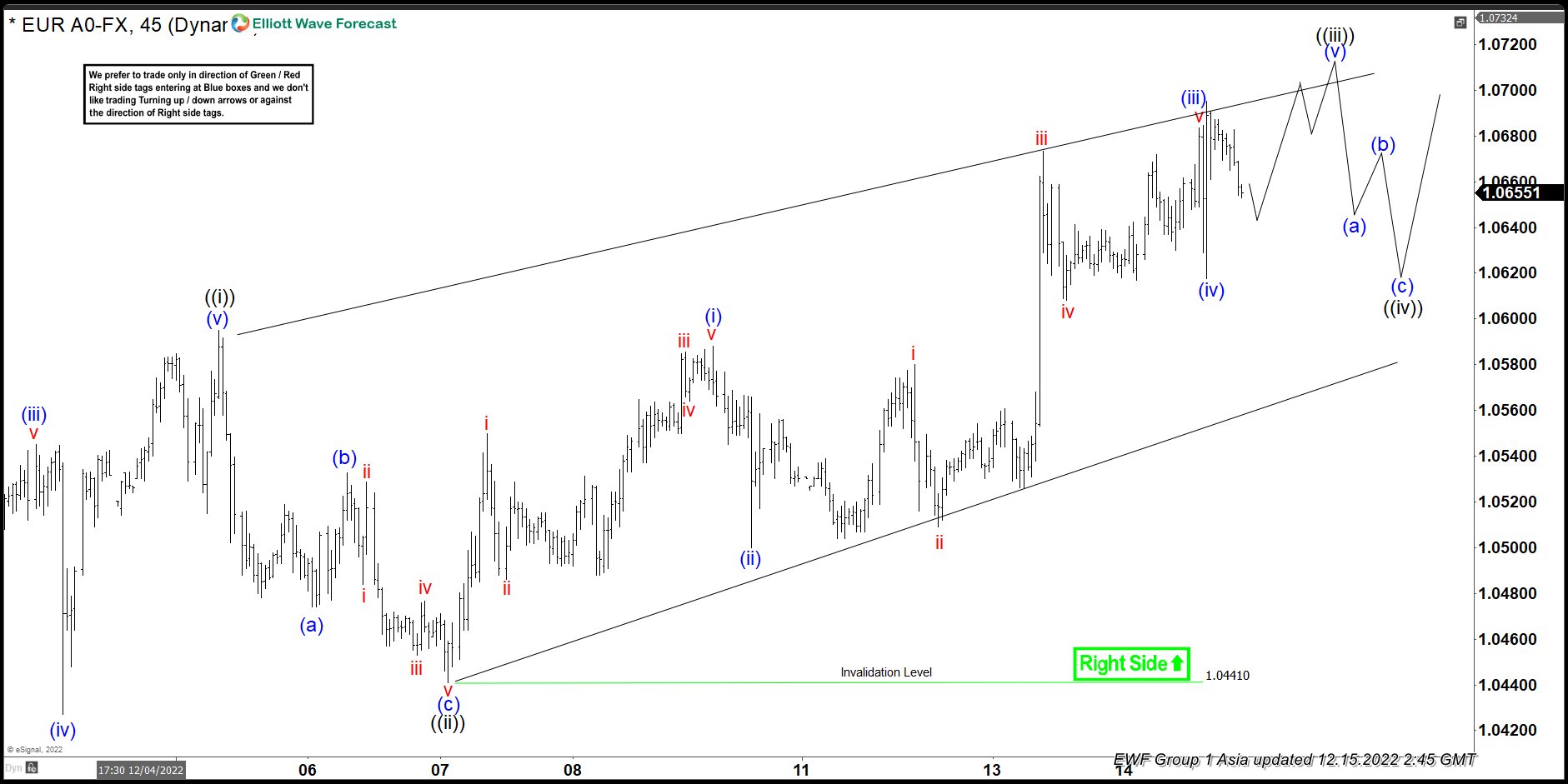
Short term Elliott Wave View in EURUSD suggests the rally from 11.22.2022 low is unfolding as a diagonal. Up from 11.22.2022 low, wave ((i)) ended at 1.0595 and pullback in wave ((ii)) ended at 1.0441. Internal subdivision of wave ((ii)) unfolded as a zigzag structure. Down from wave ((i)), wave (a) ended at 1.0474, wave (b) ended at 1.0539 and third leg wave (c) ended at 1.0441. This completed wave ((ii)) in higher degree. Wave ((iii)) higher is in progress with subdivision as a 5 waves. Up from wave ((ii)), wave (i) ended at 1.0588, and dips in wave (ii) ended at 1.05.
Pair then resumed higher in wave (iii) towards 1.0685 and pullback in wave (iv) ended at 1.0617. Expect pair to rally into a marginal high to end wave (v) of ((iii)). Afterwards, it should pullback in wave ((iv)) to correct cycle from 12.7.2022 low before the rally resumes in wave ((v)). Once wave ((v)) ends, pair should complete at least cycle from 11.22.2022 low and get a larger degree 3 waves pullback. Near term, as far as pivot at 1.0441 low stays intact, expect dips to find support in 3, 7, or 11 swing before the rally resumes.
EURUSD 45 Minutes Elliott Wave Chart
https://www.youtube.com/watch?v=MVQEAPR_rNE
Fed Delivered the Hawkish 50bp Hike, Now it is the ECB’s Turn
Market movers today
Market focus reverts to the ECB meeting today. The stabilization in euro area core inflation in November, paired with the weakening growth outlook probably gives ECB enough arguments to slow the hiking pace to 50bp (broadly in line with market pricing). However, we expect it to continue guiding for further rate hikes ahead, paired with a reduction of the balance sheet (QT), as 'stickily' high core inflation could remain a concern for ECB for some time yet, as the new economic projection will likely also confirm (read more in ECB Preview - A hawkish 50bp, 8 December).
We also expect Bank of England to revert to a more dovish stance, as recession risks are becoming more pronounced (see also Bank of England Preview - Back to 50bp as BoE nears end of hiking cycle, 12 December), while Swiss National Bank (SNB) will likely also join the club of 50bp hikes.
Amid clear signs of peaking inflation and a deteriorating growth outlook, we expect Norges Bank to deliver its last 25bp rate hike, but with the updated policy path showing a roughly 50% chance of a further rate hike in H1 23 (read more in Reading the Markets Norway - "The last hike" and three new trade recommendations, 12 December).
US retail sales for November are also on the agenda this afternoon and will give more clues about the health of consumer spending after confidence rebounded a bit recently.
EU leaders will gather in Brussels to discuss a ninth Russian sanction package, the contentious gas price cap and European competitiveness in light of the US IRA.
The 60 second overview
Fed: Fed delivered the widely anticipated 50bp hike last night. The updated 'dot plot' signalled more hawkish rate path than what market has been pricing in lately, with 17 out of the 19 individual forecasts seeing Fed Funds Rate above 5% in 2023. While Powell did not sound particularly dovish on the outlook, he did still leave the door open for moderating the pace of hiking further in February if warranted by weaker data. EUR/USD reversed the initial downtick during the press conference before edging back lower overnight, while S&P500 ended the day lower. Fed Funds pricing was relatively little affected, the terminal rate is seen 5-6bp higher than before the meeting around 4.87%, while markets still see the February meeting as a coin-toss between 25 and 50bp. While the economy is cooling, and inflation prints will continue to decline in 2023, Powell emphasized that underlying wage-sensitive components of inflation are still at clearly too high levels, which we also flagged yesterday in Global Inflation Watch - Mixed inflation signals in November, 14 December. As such, we keep our Fed call unchanged, and still look for 50bp in February and 25bp in March, with a terminal rate of 5.00-5.25% prevailing through the rest of 2023, in line with Fed's projections. See the full Fed review: FOMC signals Fed Funds above 5% in 2023, 14 December.
China: Overnight, the November retail sales and industrial production data showed even steeper slowdown than consensus had expected, as the rising Covid-cases are weighing on the activity. The situation has become even worse in December, as China is now gradually moving away from the zero-Covid policies, and we expect the surge to continue through winter. In this short paper released this morning (Research China - COVID surge has begun - it should peak in early February, 15 December) we look at how the Covid wave could evolve using the experience from other Asian regions that opened up while Omicron was the dominant variant. It suggests that China could see 10 million cases per day at the peak, which is likely to be at the beginning of February. Cases may be significantly lower by early April if China follows a similar pattern. Hence after 2-3 tough months China should be on the other side and recover gradually starting in Q2.
FI: It was a rather choppy rates session yesterday ahead of the FOMC decision, where focus was on the record-high Germany issuance outlook for 2023. This led to an intraday peak of 10y Bunds 11bp higher just shy of the 2% level. The German Bund asset swap collapsed almost 5bp on the DFA issuance statement. On the day European rates were slightly higher, with peripheral spreads wider leaving the Italian-German yield spread above 190bp again, which is more or less the widest level this month. Rates markets curve flattened on the FOMC meeting as Powell kept the door open for more modest rate hikes. 2y UST rose 3bp, while 10y UST declined 4bp to 3.47%.
FX: The Fed did as widely expected and hiked by 50bp, and the updated 'dots' signal policy rates above 5% in 2023. Despite the relatively hawkish rate projections, EUR/USD remains at pre-meeting levels as Powell left the door open for less hikes if warranted by data. G10 FX in general is relatively unchanged following the meeting, and we probably need another session or two to fully digest the outcome. Today, we see no less than four G10 central banks, with ECB, BoE, SNB and Norges Bank (also Danmarks Nationalbank).
Credit: Credit markets continued the cautious sentiment ahead of FOMC rate decision, leaving iTraxx Main slightly wider by 1.2bp at 83.4bp, while iTraxx Crossover widened 1.7bp, closing at 437.4bp.
Nordic macro
Sweden: Prospera's quarterly "big" survey is released this morning (08.00 CET). Beside inflation expectations market will focus on Social Partners' wage expectations as we are approaching the start of wage negotiations in Q1.
Not the Same 50bp
We knew that the Federal Reserve (Fed) Chair Jerome Powell would not tell investors ‘Ho ho ho, inflation is now 7%, we will stop tightening policy and hiking the rates. So, you can buy stocks, bonds, cryptocurrencies, meme stocks, whatever you find. Merry Xmas!’
No, he was not going to do that, and he did not.
As expected, the Fed raised its interest rates by 50bp to 4.25/4.50% range, the dot plot showed that the Fed officials’ median forecast for the peak Fed rate rose to 5.1%.
Plus, the distribution of rate forecasts skewed higher, with 7 officials out of 19 predicting that the rates could rise above 5.25%
Moreover, the inflation forecast for next year was revised higher DESPITE the latest decline in inflation.
And the median rate forecast for 2024 was revised higher to 4.1%.
In summary, the FOMC message was very clear: the Fed is not ready to stop hiking rates - even though they will be hiking by smaller chunks.
Jerome Powell said yesterday that the last two CPI reports were ‘a welcome reduction in the monthly pace of inflation’, however, ‘it will take substantially more evidence to have confidence’ that the job is done.
Crystal clear. No pause, no cut, no softening in sight.
Waking up from a dovish dream
US equities woke up from a dovish dream with a cold shower yesterday.
What’s interesting is, some investors still wanted to ignore the hawkish Fed comments and buy the dips, because the new Fed trade is no longer about how high the Fed rate will go but ‘how soon the Fed will start cutting the rates again’.
But that reasoning has limits, as it ignores the additional pain that the stock markets should endure due to an eventual recession – the trigger for rate cuts expectations - which could trigger a fresh wave of sharp selloff.
As a result, the S&P500 closed the session 0.60% lower, and there is a stronger case building for a deeper downside correction toward and below the 100-DMA, 3930, than a ytd trend reversal with a third, and successful push above the 4100 resistance. The falling earnings expectations and slowing economic activity is the next challenge for stock investors as the risk of another, and a sharp selloff is still very much alive. Same for Nasdaq. The index closed 0.80% lower after the Fed decision, and will likely re-test the support at 11430/11450, and eventually clear it.
So for those who wanted to see Santa come around this Xmas: he will probably be stuck somewhere in the snow.
USD rebound should remain limited
The US dollar index rebounded from the lowest levels since summer, yet the dollar appetite will likely remain soft, and the rallies will likely be seen as interesting opportunity to sell the top against other majors, given that the Fed’s hawkishness has been wildly priced since mid-2021, and a further downside correction would not be surprising, even though it’s somewhat counterintuitive to rush back to majors like the euro, which deals with a terrible energy crisis and faces a severe recession if it’s not already in one, the pound, which is hammered by economic and political disasters in the UK, amplified by the Brexit’s consequences, and the yen, where the BoJ refuses to take a policy action, letting inflation run hot by keeping rates in the negative territory…
Not the same 50bp
Today, the European Central Bank (ECB), the Bank of England (BoE) and the Swiss National Bank (SNB) are also expected to hike the rates by 50bp to tame inflation in Europe.
But the ECB’s and especially the BoE’s 50bp hike will likely sound more dovish than the Fed’s 50bp hike.
The ECB is expected to revise its inflation forecast higher – which justifies a rate hike, but pull its growth predictions lower – which doesn’t make a rate hike seem ‘that’ right.
If the ECB officials could spit out a date for the start of the QT, that would be a good thing.
The tighter ECB policy – and if all goes well, a softer US dollar - is expected to give further support to the single currency in the coming months, and help the pair extend gains toward the 1.10 mark.
And the euro recovery is one thing that could tame a part of inflationary pressures, making the raw material and energy costs more affordable for European businesses and households.
Across the Channel, the BoE is also expected to hike by 50bp, but try not to boost the BoE hawks. Data released yesterday showed that inflation in Britain slowed to 10.7% in November, which is not a victory, but the economic difficulties in Britain will likely keep the BoE’s hands tied.
And finally in Switzerland, the National Bank is also expected to raise the rates by 50bp to keep up with the others. The strong franc has been the SNB’s best arm in its fight against inflation. And a 50bp in Switzerland - where the inflation is around 3%, which makes it three times lower than inflation in Europe and around two times lower than inflation in the US - is a bigger hike in real terms, and should further support the franc. The dollar-franc is expected to fall to 0.88/0.90 range in the continuation of the actual bearish trend.
GBP/USD Daily Outlook
Daily Pivots: (S1) 1.2365; (P) 1.2405; (R1) 1.2469; More...
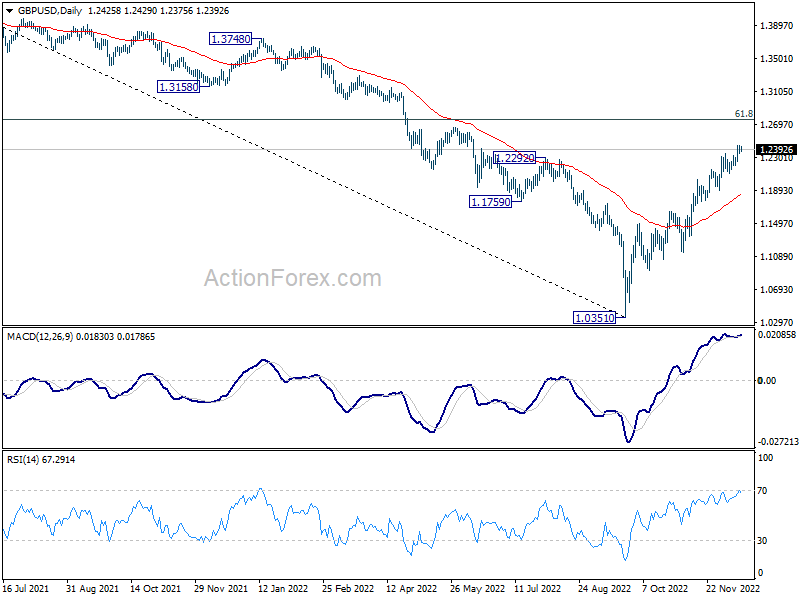
GBP/USD is losing upside momentum as seen in 4 hour MACD. But there is no sign of topping yet. Current rise from 1.0351 is still in progress to 1.2759 medium term fibonacci level next. However, on the downside, break of 1.2205 will indicate short term topping, and turn bias back to the downside for deeper pull back to 55 day EMA (now at 1.1860).
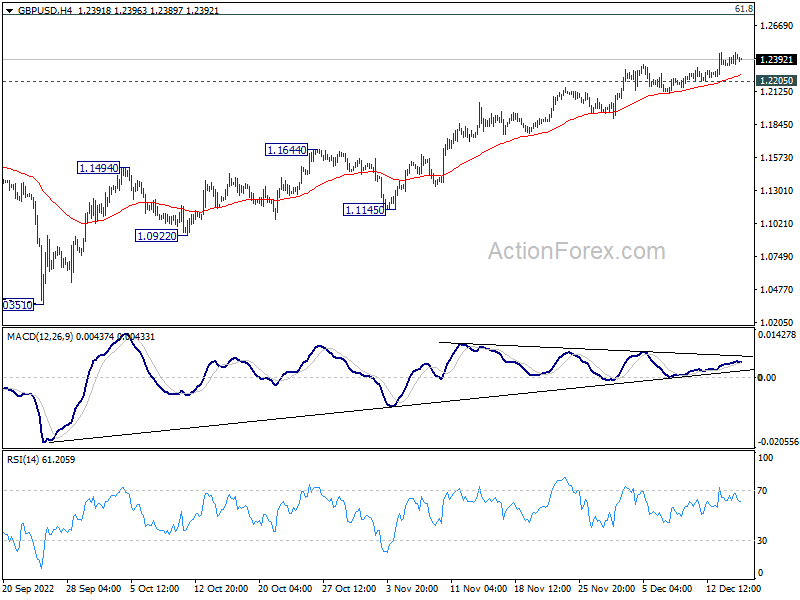
In the bigger picture, rise from 1.0351 medium term bottom is at least correcting whole down trend from 1.4248 (2021 high). Further rise is expected as long as 1.1644 resistance turned support holds. Next target is 61.8% retracement of 1.4248 to 1.0351 at 1.2759. Sustained break there will pave the way back to 1.4248. This will remain the favored case as long as 55 day EMA (now at 1.1860) holds.
Muted Reactions to Hawkish Fed; SNB, BoE and ECB Next
Market reactions to the more hawkish than expected Fed projections were relatively muted. Stocks ended just slightly down while there was no buying momentum for Dollar. The greenback is staying as the worst performer for the week, followed by commodity currencies. Euro is leading Sterling and Swiss Franc as the strongest ones while Yen is mixed. Focuses will now turn to SNB, BoE and ECB rate decisions today.
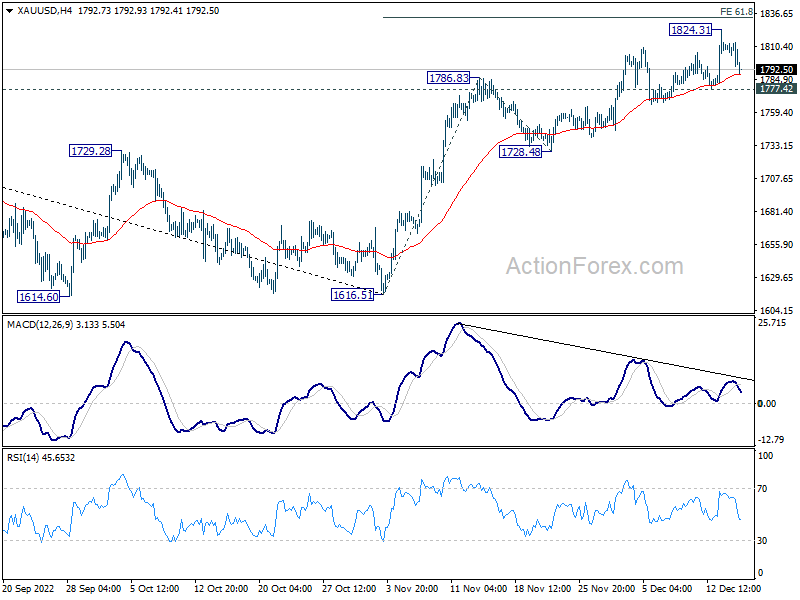
Technically, Gold lost momentum again after spiking higher to 1824.31 earlier in the week. While further rise cannot be ruled out, loss of downside moment, as seen in bearish divergence condition in 4 hour MACD, could cap upside at 61.8% projection of 1616.51 to 1786.83 at 1728.48 at 1898.80. Break of 1777.42 support will confirm short term topping and bring deeper fall to 1728.48 support, and possibly below. If happens, that could be a signal of Dollar's rebound too.
In Asia, at the time of writing, Nikkei is down -0.41%. Hong Kong HSI is down -1.16%. China Shanghai SSE is down -0.23%. Singapore Strait Times is down -0.24%. Japan 10-year JGB yield is down -0.0007 at 0.258. Overnight, DOW dropped -0.42%. S&P 500 dropped -0.61%. NASDAQ dropped -0.76%. 10-year yield rose 0.002 to 3.503.
Fed hikes 50bps, rate to hit 5.1% in 2023
Fed raised interest rate by 50bps to 4.25-4.50% as widely expected. The decision was unanimous.
Tightening bias is maintained as "the Committee anticipates that ongoing increases in the target range will be appropriate in order to attain a stance of monetary policy that is sufficiently restrictive to return inflation to 2 percent over time".
In the new median economic projections:
- Federal funds rate is projected to hit 5.1% in 2023, then falls back to 4.1% in 2024, and then 3.1% in 2015.
- Real GDP growth was revised down from 1.2% to 0.5% in 2023, from 1.7% to 1.6% in 2024, and unchanged at 1.8% in 2025.
- Unemployment rate was revised up from 4.4% to 4.6% in 2023, from 4.4^ to 4.6% in 2024, and from 4.3% to 4.5% in 2025.
- PCE inflation was revised up from 2.8% to 3.1% in 2023, 2.3% to 2.5% in 2024, a and from 2.0% to 2.1% in 2025.
- Core PCE inflation was revised up from 3.1% to 3.5% in 2023, 2.3% to 2.5% in 2024 and unchanged at 2.1% in 2025.
In the "dot plot"
- 17 policy makers expect interest rate to climb to 5.125% and above in 2023, with 7 expects 5.375% and above.
- 12 policy makers expect interest to fall back to 4.125% in 2024 and below.
More on Fed:
- Fed Review: FOMC Signals Fed Funds above 5% in 2023
- What to Make of December's FOMC Meeting?
- FOMC Meeting Recap: Powell Presser Poses More Questions than Answers
- (FED) Federal Reserve Issues FOMC Statement
Australia employment grew 64k in Nov, participation rate back at record high
Australia employment grew 64.0k in November, much better than expectation of 19.4k. Unemployment rate was unchanged at 3.4%, matched expectations. Participation rate rose 0.2% to 66.8%. Monthly hours worked dropped -0.4% mom.
Bjorn Jarvis, head of labour statistics at the ABS, said: "The participation rate increased by 0.2 percentage points to 66.8 per cent in November, returning to the record high we saw in June 2022. It was 1.0 percentage point higher than before the pandemic."
"The record high participation rate continues to show that it is a tight labour market, especially when coupled with very low unemployment."
Japan continues trade deficit streak for the 16th month
Japan export rose 20.0% yoy to JPY 8838B in November, a record high, led by cars autos and mining machinery shipment to the US. Imports rose 30.3% yoy to JPY 10865B, also a record high, as led by imports of crude oil, coal and LNG.
Trade deficit came in at JPY -2.03T. That the 16th straight month of trade deficit, and the fourth month in a row at the JPY 2T level.
In seasonally adjusted term, exports dropped -1.4% mom to JPY 8787B. Imports dropped -5.3%mom to JPY 10520B. Trade deficit narrowed to JPY -1.73T, versus expectation of JPY -1.24T.
China retail sales down -5.9% yoy in Nov, industrial production up 2.2% yoy
China retail sales contracted -5.9% yoy in November, much worse than expectation of -3.9% mom. Industrial production grew 2.2% yoy, below expectation of 3.4% yoy. Fixed asset investment rose 5.3% ytd yoy, below expectation of 5.6%.
"The consumption market was under pressure in November due to the impact of Covid and other factors, and the decline in market sales widened," said NBS statistician Fu Jiaqi.
"However, online consumption grew faster, retail sales of basic living goods increased relatively well, some upgraded consumption was higher than overall, and retail businesses such as supermarkets and convenience shops increased steadily."
Previews on SNB, BoE and ECB
SNB, BoE and ECB rate decisions are the focuses of the day and all are expected to deliver 50bps rate hikes.
There are some talks that given SNB only meets every quarter, it may surprise the market by maintaining the pace of 75bps. But the balance is more towards a 50bps hike to 1.00%. Tightening bias should be maintained while some focuses will be on the rhetoric on Swiss Franc exchange rate.
BoE is expected to raise policy rate by 50bps to 3.50%. Some attention will be on the voting. Last month, only seven MPC members voted for the 75bps hike. Swati Dhingra voted for 50bps, while Silvana Tenreyro voted for 25bps.
ECB should raise the main refinancing rate by 50bps to 2.50%. Additionally, it would announce some key principles regarding quantitative tightening, but the details main only come later, probably at February's meeting. The new economic projections would also be watched closely on the central banks view on the path of slowing inflation and recession.
Here are some previews for SNB, BoE and ECB:
- SNB Meets But Developments Elsewhere Could Carry More Weight for Swissie
- BoE Set for Another Rate Hike, But Divisions May Widen
- Bank of England Preview
- Bank of England Preview – Back to 50bp as BoE Nears End of Hiking Cycle
- ECB Rate Decision, How Sure is 50bps Hike?
- ECB Preview: Will Lagarde Deliver a Hawkish Surprise?
- Will the ECB Signal the Need for More Rate Hikes?
- ECB Preview – A Hawkish 50bp
On the data front
Canada will release housing starts. US will release jobless claims, retail sales, Empire State manufacturing, Philly Fed survey, industrial production and business inventories.
GBP/USD Daily Outlook
Daily Pivots: (S1) 1.2365; (P) 1.2405; (R1) 1.2469; More...
GBP/USD is losing upside momentum as seen in 4 hour MACD. But there is no sign of topping yet. Current rise from 1.0351 is still in progress to 1.2759 medium term fibonacci level next. However, on the downside, break of 1.2205 will indicate short term topping, and turn bias back to the downside for deeper pull back to 55 day EMA (now at 1.1860).
In the bigger picture, rise from 1.0351 medium term bottom is at least correcting whole down trend from 1.4248 (2021 high). Further rise is expected as long as 1.1644 resistance turned support holds. Next target is 61.8% retracement of 1.4248 to 1.0351 at 1.2759. Sustained break there will pave the way back to 1.4248. This will remain the favored case as long as 55 day EMA (now at 1.1860) holds.
Economic Indicators Update
| GMT | Ccy | Events | Actual | Forecast | Previous | Revised |
|---|---|---|---|---|---|---|
| 21:45 | NZD | GDP Q/Q Q3 | 2.00% | 0.80% | 1.70% | 1.90% |
| 23:50 | JPY | Trade Balance (JPY) Nov | -1.73T | -1.24T | -2.30T | -2.21T |
| 00:00 | AUD | Consumer Inflation Expectations Dec | 5.20% | 6.00% | ||
| 00:30 | AUD | Employment Change Nov | 64.0K | 19.4K | 32.2K | 43.1K |
| 00:30 | AUD | Unemployment Rate Nov | 3.40% | 3.40% | 3.40% | |
| 02:00 | CNY | Industrial Production Y/Y Nov | 2.20% | 3.40% | 5.00% | |
| 02:00 | CNY | Retail Sales Y/Y Nov | -5.90% | -3.90% | -0.50% | |
| 02:00 | CNY | Fixed Asset Investment YTD Y/Y Nov | 5.30% | 5.60% | 5.80% | |
| 04:30 | JPY | Tertiary Industry Index M/M Oct | 0.20% | 0.40% | -0.40% | |
| 08:30 | CHF | SNB Interest Rate Decision | 1.00% | 0.50% | ||
| 09:00 | CHF | SNB Press Conference | ||||
| 12:00 | GBP | BoE Interest Rate Decision | 3.50% | 3.00% | ||
| 12:00 | GBP | MPC Official Bank Rate Votes | 9--0--0 | 9--0--0 | ||
| 13:15 | CAD | Housing Starts Nov | 255K | 267K | ||
| 13:15 | EUR | ECB Main Refinancing Rate | 2.50% | 2.00% | ||
| 13:30 | USD | Initial Jobless Claims (Dec 9) | 230K | 230K | ||
| 13:30 | USD | Retail Sales M/M Nov | -0.10% | 1.30% | ||
| 13:30 | USD | Retail Sales ex Autos M/M Nov | 0.20% | 1.30% | ||
| 13:30 | USD | Empire State Manufacturing Index Dec | -0.2 | 4.5 | ||
| 13:30 | USD | Philadelphia Fed Manufacturing Survey Dec | -11.3 | -19.4 | ||
| 13:45 | EUR | ECB Press Conference | ||||
| 14:15 | USD | Industrial Production M/M Nov | 0.10% | -0.10% | ||
| 14:15 | USD | Capacity Utilization Nov | 79.80% | 79.90% | ||
| 15:00 | USD | Business Inventories Oct | 0.40% | 0.40% | ||
| 15:30 | USD | Natural Gas Storage | -21B |
Previews on SNB, BoE and ECB
SNB, BoE and ECB rate decisions are the focuses of the day and all are expected to deliver 50bps rate hikes.
There are some talks that given SNB only meets every quarter, it may surprise the market by maintaining the pace of 75bps. But the balance is more towards a 50bps hike to 1.00%. Tightening bias should be maintained while some focuses will be on the rhetoric on Swiss Franc exchange rate.
BoE is expected to raise policy rate by 50bps to 3.50%. Some attention will be on the voting. Last month, only seven MPC members voted for the 75bps hike. Swati Dhingra voted for 50bps, while Silvana Tenreyro voted for 25bps.
ECB should raise the main refinancing rate by 50bps to 2.50%. Additionally, it would announce some key principles regarding quantitative tightening, but the details main only come later, probably at February's meeting. The new economic projections would also be watched closely on the central banks view on the path of slowing inflation and recession.
Here are some previews for SNB, BoE and ECB:
- SNB Meets But Developments Elsewhere Could Carry More Weight for Swissie
- BoE Set for Another Rate Hike, But Divisions May Widen
- Bank of England Preview
- Bank of England Preview – Back to 50bp as BoE Nears End of Hiking Cycle
- ECB Rate Decision, How Sure is 50bps Hike?
- ECB Preview: Will Lagarde Deliver a Hawkish Surprise?
- Will the ECB Signal the Need for More Rate Hikes?
- ECB Preview – A Hawkish 50bp
China retail sales down -5.9% yoy in Nov, industrial production up 2.2% yoy
China retail sales contracted -5.9% yoy in November, much worse than expectation of -3.9% mom. Industrial production grew 2.2% yoy, below expectation of 3.4% yoy. Fixed asset investment rose 5.3% ytd yoy, below expectation of 5.6%.
"The consumption market was under pressure in November due to the impact of Covid and other factors, and the decline in market sales widened," said NBS statistician Fu Jiaqi.
"However, online consumption grew faster, retail sales of basic living goods increased relatively well, some upgraded consumption was higher than overall, and retail businesses such as supermarkets and convenience shops increased steadily."
Japan continues trade deficit streak for the 16th month
Japan export rose 20.0% yoy to JPY 8838B in November, a record high, led by cars autos and mining machinery shipment to the US. Imports rose 30.3% yoy to JPY 10865B, also a record high, as led by imports of crude oil, coal and LNG.
Trade deficit came in at JPY -2.03T. That the 16th straight month of trade deficit, and the fourth month in a row at the JPY 2T level.
In seasonally adjusted term, exports dropped -1.4% mom to JPY 8787B. Imports dropped -5.3%mom to JPY 10520B. Trade deficit narrowed to JPY -1.73T, versus expectation of JPY -1.24T.