

Sample Category Title
Australia trade surplus little change at AUD 12.22B in Oct
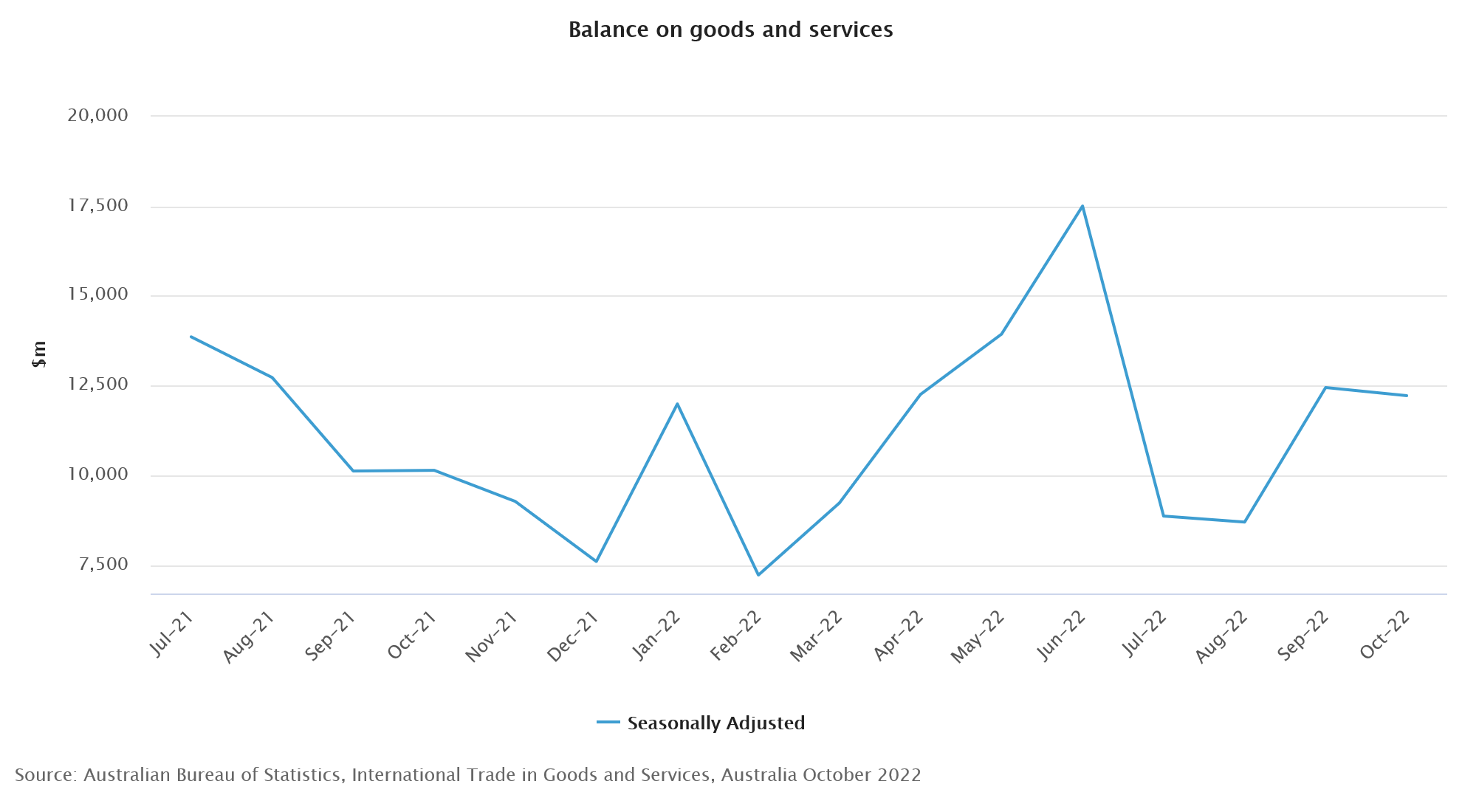
Australia exports of goods and services dropped -0.9% mom to AUD 60.01B in October. Imports dropped -0.7% mom to AUD 47.85B. Trade surplus narrowed slightly from AUD 12.44B to AUD 12.22B, slightly above expectation of AUD 12.10B.
Looking at some details, the decline in exports was driven mainly by AUD -0.6B fall in gold while imports decline was driven by AUD -0.5B fall in energy. Fuel exports, dominated by LNG, rose AUD 0.3B to AUD 11.2B, and hit a new record high. Rural goods exports rose AUD 0.1B to AUD 7.2B, also a record high.
Bitcoin Price At Risk of Fresh Decline, Here’s Why
Key Highlights
- Bitcoin price is struggling to clear the $17,400 resistance zone.
- It traded below a key bullish trend line with support at $16,950 on the 4-hours chart.
- The price could gain bearish momentum if it fails to stay above the $16,200 support.
- Crude oil price spiked below $75 before there was a minor upside correction.
Bitcoin Price Technical Analysis
Bitcoin price attempted a recovery wave above the $16,000 resistance zone. BTC/USD was able to climb above the $17,000 level, but the bears were active near the $17,400 zone.
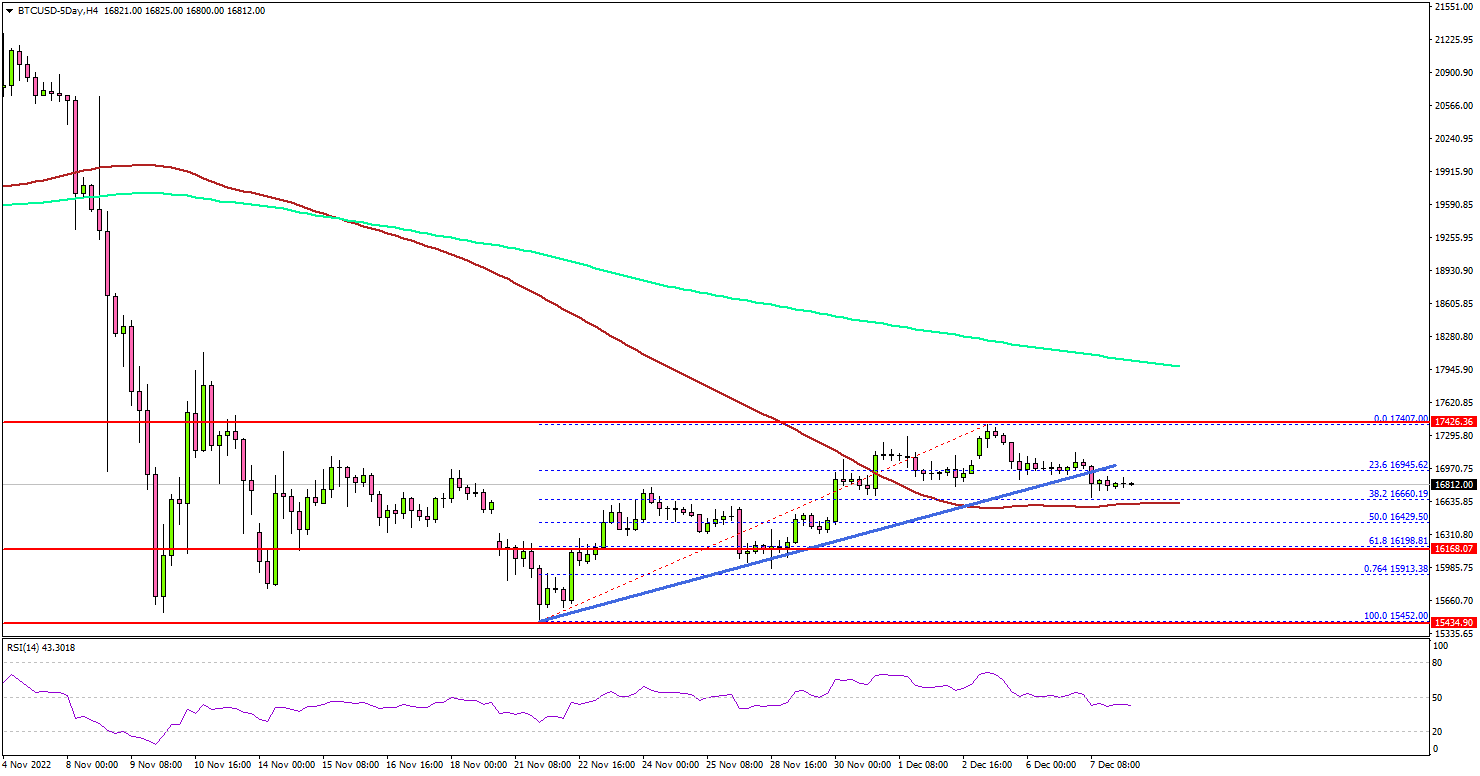
Looking at the 4-hours chart, the price traded as high as $17,407 level and remained below the 200 simple moving average (green, 4-hours). The price started a downside correction below the $17,200 and $17,000 levels.
There was a break below a key bullish trend line with support at $16,950 on the same chart. The price traded below the 23.6% Fib retracement level of the bullish wave from the $15,452 swing low to $17,407 high.
It is now consolidating above the $16,500 level and the 100 simple moving average (red, 4-hours). On the downside, an initial support sits near the $16,420 level.
The main breakdown support sits near the $16,200 zone. If there is a downside break and close below $16,200, bitcoin might start another major decline in the coming days.
An immediate resistance is near the $17,200 level. The next resistance sits near the $17,400 zone. A close above the $17,400 level may perhaps start another steady increase in the coming days.
In the stated case, the price could rise towards the $18,000 level or the 200 simple moving average (green, 4-hours). Any more gains could set the pace for a move towards the $19,000 level.
Economic Releases
- US Initial Jobless Claims - Forecast 230K, versus 225K previous.
Elliott Wave View: EURAUD Has Resumed Higher
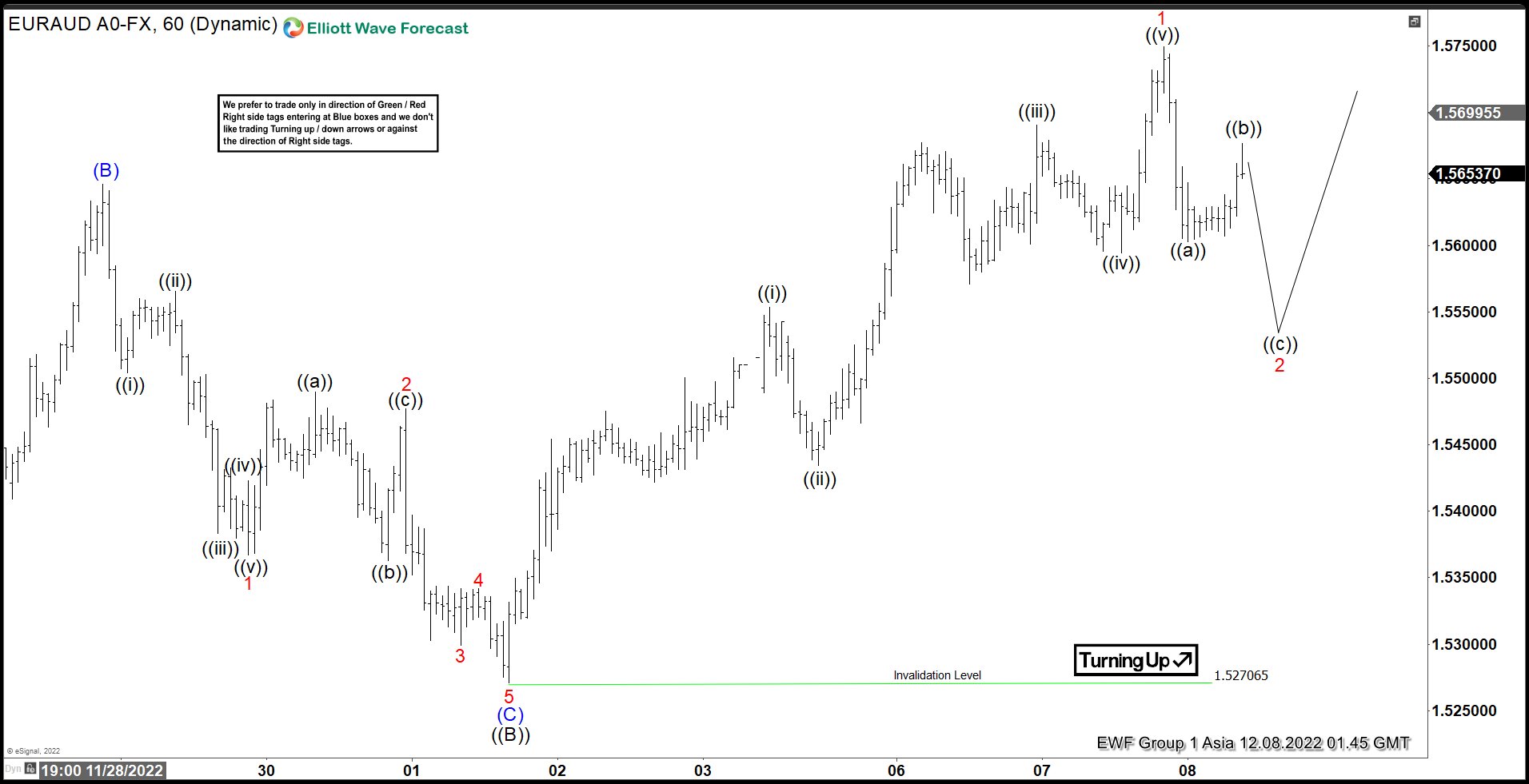
Short term Elliott Wave View in EURAUD suggests the cycle from 8.25.2022 low is unfolding as a zigzag Elliott Wave structure. Up from 8.25.2022 low, wave ((A)) ended at 1.5706 and wave ((B)) pullback ended at 1.5259. Internal subdivision of wave (B) unfolded as a running flat. Wave (A) ended at 1.5254 and wave (B) ended at 1.5645. Wave (C) lower ended at 1.527 with subdivision as a 5 waves impulse. Down from wave (B), wave 1 ended at 1.5367 and rally in wave 2 ended at 1.5476. Pair resumed lower in wave 3 towards 1.5299, wave 4 ended at 1.534, and wave 5 lower ended at 1.527. This completed wave (B) in higher degree.
Wave ((C)) higher is in progress and it has broken above ((A)) at 15706 confirming that the next leg higher has started. Up from 12.1.2022 low, wave ((i)) ended at 1.5553 and pullback in wave ((ii)) ended at 1.5434. Pair resumed higher in wave ((iii)) towards 1.569 and pullback in wave ((iv)) ended at 1.5594. Final leg higher wave ((v)) ended at 1.5749 which completed wave 1. Wave 2 pullback is in progress to correct cycle from 12.1.2022 low before the rally resumes. Near term, as far as pivot at 1.527 low stays intact, expect dips to find support in 3, 7, or 11 swing for further upside.
EURAUD 60 Minutes Elliott Wave Chart
https://www.youtube.com/watch?v=es_2I1X4GIk
BoC’s Hawkish(ish) 50 bp Hike Could Be Its Last
- BoC hikes by 50 bps to 4.25%, bringing cumulative tightening to 400 bps this year
- Slightly hawkish surprise: consensus was split between 25 and 50 bps
- Soft tightening bias opens the door to a January pause
The BoC lifted its overnight rate by 50 bps to 4.25%, a stronger increase than the 25 bps we expected. Consensus was almost evenly split between a 25 and 50 bp hike though market pricing was leaning toward the former, so yields have increased and the Canadian dollar is a touch stronger in the wake of the decision. The policy statement wasn’t as hawkish as the decision itself—in fact the BoC’s updated forward guidance features a softer tightening bias than we expected. Rather than suggesting the “the policy interest rate will need to rise further,” today’s guidance is that “Governing Council will be considering whether the policy interest rate needs to rise further.” That clearly opens the door to a pause as soon as the next meeting in January, and in our view frames that decision as between 0 and 25 bps.
There’s plenty of data in the next seven weeks that will influence that January decision—two CPI reports, another month’s GDP and jobs data, and the bank’s quarterly BOS and CSCE surveys. We think today’s larger-than-expected hike was due in part to strong labour market data since the October meeting. Indeed, the statement noted “Canada’s labour market remains tight, with unemployment near historic lows.” One jobs report isn’t likely to change that story, but a soft December LFS would help build the case for a pause. And since the labour market is generally a lagging indicator, another muted increase in monthly GDP could also help push the BoC to the sidelines. The bank reiterated its view that growth will essentially stall in the coming quarters.
Today’s statement made note of recent slowing in three-month measures of core inflation—a trend we’ve keyed in on, in addition to evidence suggesting inflationary pressure is becoming less broadly based. Two more months of CPI moving in that direction would likely be enough to keep the BoC on hold—we'd say those reports are likely to be the most influential for January's decision. But with ongoing emphasis on inflation expectations, relevant measures in the upcoming BOS and CSCE will also have to cooperate. Interestingly, the BoC made no mention of firming wage growth in recent Labour Force Surveys, perhaps because the separate payrolls survey calls that trend into question.
The BoC is also likely to be watching changes in financial conditions over the next seven weeks. 5-year GoC bond yields were down 75 bps in the month leading to today’s decision—an easing in financial conditions that may have caused some discomfort and motivated today’s 50 bp hike. A further decline in yields could prompt push-back from the BoC, either through another hike in January or emphasis that rates will have to remain high for an extended period. We expect a challenging consumer backdrop and ongoing pullback in housing will see Canada’s economy slip into recession in the first half of 2023. But with inflation remaining elevated, the BoC isn’t likely to react as quickly to that slowdown as it has in recent cycles.
FBS Explains How Servers Affect Speed in Trading
Every trader knows three pillars of productive trading: consistency in a daily routine, patience for a perfect trade, and the ability to learn from mistakes. However, speed is one more thing you should consider. Analysts from FBS, an online trading broker, explain why execution speed is crucial and how servers maintain it in trading.
How does speed affect trading?
Imagine you open the chart and see that your favorite asset is about to break the resistance line. If the breakout has already started, fast hands and constant focus are important, as well as the execution speed.
Execution speed is the time between a broker receiving your order and an order execution itself. For example, the average amount of trades per month is 100. If the speed of order execution is too slow, one trade may open 5-10 points away from your initial entry point, which results in losing 100-500 points of profit monthly. For scalpers with an average of 5-20 trades per day, they could lose 100-200 points daily or 2000-4000 points monthly.
Slow speed means slower order execution and, subsequently, a loss of potential profits. That’s how the execution speed directly affects your trading experience.
How do servers achieve fast execution speed?
Basically, you can trade with a slow execution speed. For instance, you can avoid trading during market volatility, as it can cause significant price changes, or use limit orders to set a specific price at which your order will be executed. However, volatility provides many trading opportunities, so the best way to ensure a faster execution speed is to choose a broker that uses reliable servers.
As an international company, FBS works with Equinix, the Tier-1 Data Center company that provides infrastructure for digital operations, allowing a seamless connection between customers and products. The world’s largest companies like Google, Zoom, Oracle, and Netflix also work with Equinix, ensuring stable and reliable performance of their products and services.
FBS uses Equinix LD4, a server located in one of the major financial centers in London. But how do they maintain fast order execution if the server is far from you?
FBS uses decentralized data centers across the globe to process your transactions instantly. The locations of some of the FBS data centers are the following:
- London
- Singapore
- New York
- Nuremberg
When you place an order, it goes to the closest data center and then to Equinix LD4. Furthermore, FBS liquidity providers also use the LD4 server, meaning there is a minimum delay between the order intake and its execution. An average delay between your click on Buy or Sell and the execution is less than 100 milliseconds, a market-leading speed.
Conclusion
When you choose a broker, don’t forget to research their technical performance. Slower servers may lead to unwanted profit losses, and that’s why FBS guarantees the highest execution speed with the Tier-1 Data Center. Open an account at FBS and explore its advantages.
Robust Eurozone Data Brought EURUSD Back Above 1.05
The single currency edged against most of its peers on Wednesday and managed to return to territory above 1.05, helped in no small part by published economic data.
In the morning, Germany surprised with a less sharp drop in industrial production, which fell by 0.1% in October against an expected 0.6%. France’s trade deficit narrowed to 12.2bn in October from 17.2bn a month earlier.
The final Q3 GDP reading for the Eurozone showed economic growth of 0.3% QoQ and 2.3% YoY (down from 0.2% and 2.1%, respectively).
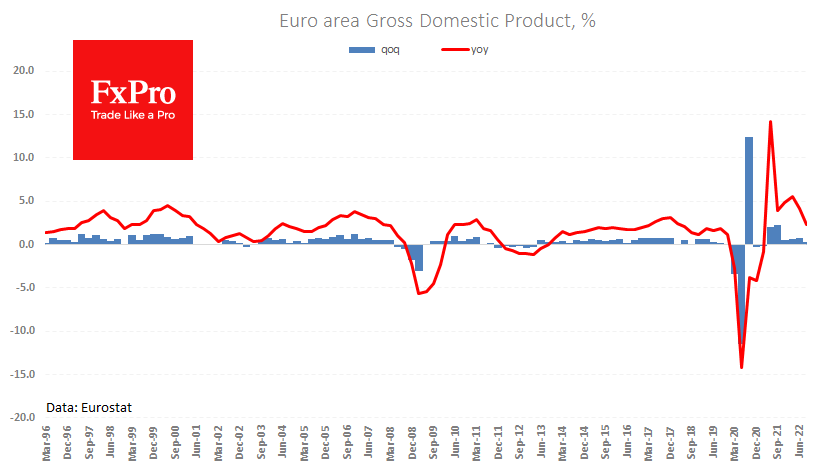
The employment growth estimate was also improved, recording job gains of 0.3% QoQ and 1.8% YoY. Employment is supported by the recovery of the economy from the coronavirus restrictions. But the fragmentation of the global economy is also likely to be a factor, forcing European companies to increase local production, reducing dependence on global supply chains (energy from Russia, goods from China).
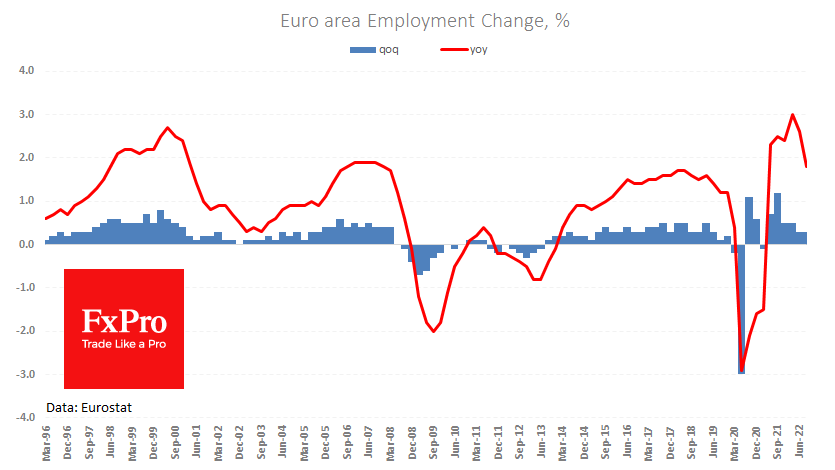
Interestingly, in contrast to the optimistic Q3 employment estimates, Reuters published a selection of large European companies that have announced layoffs or frozen hiring recently. The dynamics in employment may have already turned from growth to decline, but last quarter’s robust data buys some more time for the ECB to actively hike interest rates, which is suitable for the single currency.
Bank of Canada Delivers a 50 Basis Point Hike, But No Guarantees of Future Hikes
The Bank of Canada raised the overnight rate to 4.25%, while stating that it will continue with Quantitative Tightening (QT).
On rising prices, it stated that "inflation is still too high and short-term inflation expectations remain elevated. The longer that consumers and businesses expect inflation to be above the target, the greater the risk that elevated inflation becomes entrenched."
On economic growth, the Bank stated that "GDP growth in the third quarter was stronger than expected, and the economy continued to operate in excess demand. Canada’s labour market remains tight, with unemployment near historic lows. While commodity exports have been strong, there is growing evidence that tighter monetary policy is restraining domestic demand."
On the future path of policy, the Bank noted that it "will be considering whether the policy interest rate needs to rise further to bring supply and demand back into balance and return inflation to target. Governing Council continues to assess how tighter monetary policy is working to slow demand, how supply challenges are resolving, and how inflation and inflation expectations are responding."
Key Implications
The Bank of Canada delivered another 50 basis point hike! With economic growth still running above trend and the labour market remaining tight, the BoC decided that it needed to get rates to an even higher level in order to force the economy back into balance. However, there was a large shift in forward-looking language in the removal of any reference to further rate hikes being required. Prior to today's announcement, the Bank had been signaling the need for more rate hikes, but now it is debating whether it needs to hike rates further at all.
We don't think the BoC is done yet, but it is quickly approaching the end of its hiking cycle. As all Canadians know, the rapid rate hikes over 2022 have caused a dramatic adjustment in the real estate market, and we are starting to see this in consumer spending data. We expect this to continue to weigh on the economy over 2023 as the lagged effects of past hikes filter through. We expect the BoC will deliver its final rate hike in January, bringing the policy rate to 4.5%. At that time, it can move to the sidelines, allowing the economy to recalibrate and let inflation continue its downward trend over 2023.
Sunset Market Commentary
Markets
In a session deprived of important data, technical considerations were the main driver for trading. The German 10-y yield at the open briefly dropped below the 1.77% neckline/early October low. The test is ongoing, but there was no trigger to force a real break. The technical picture of the 10-y EMU swap is slightly different as the spread between swaps and bunds narrowed during the decline in yields since early October. Even so the 10-y tested the psychological barrier of 2.50%. The German yield curve turns slightly less inverse, with the 2-y easing 5 bps and the 30-y rising 0.5 bp. The ECB today published its consumer expectations survey. It probably is only ‘secondary input’ for next week’s policy meeting. Consumers’ inflation assessment at least showed that here is still some work to do for the ECB in convincing citizens that it will be able to bring price growth back to 2.0% in a sustainable way. Inflation expectations for the next 12 months rose further from 5.1% to 5.4%. Expectations for inflation three years ahead remained unchanged at 3.0%, an ‘anchor’ still well above the bank’s target. Intra-EMU spreads of late narrowed substantially in line with the decline in LT core yields. This move continues, even as the pace of narrowing is slowing. The 10-y Italian spread versus Germany currently trades near 185 bpn, to be compared with peak levels near 250 bpn end September. US yields traded little changed as US traders joined, but a downward revision in the (albeit outdated) Q3 unit labour cost (2.4% from 3.5%), again revived the bid for Treasuries. US yields decline 7/8 bps across the curve. The US 10-y yield is setting a new correction low well below 3.50%. Risk sentiment remains fragile after yesterday’s WS sell-off as investors ponder risks for a substantial slowdown/recession. Disappointing Chinese trade data only reinforced doubts. US indices again opened modestly lower (about 0.3%). Oil (Brent $79.75 p/b) struggles to avoid further losses below $80 p/b.
The dollar again delivers an unconvincing performance. The decline in US yields apparently more than counterbalances a fragile risk sentiment. EUR/USD (currently 1.053) in a protracted intra-day uptrend easily recaptured 1.05 barrier. Next resistance stands at 1.0595/1.0611-15. DXY also fails to build on a two-day rebound, trading at 104.88 (open 105.63) with Monday’s correction low at 104.11. Sterling trades in lockstep with the euro with EUR/GBP little changed near 0.8625.
News Headlines
The Czech government approved the joint recommendation of the Ministry of Finance and the Czech National Bank not to set a date for adopting the euro yet. The Government considers the unfinished process of economic convergence of the Czech economy, especially as regards the price and wage levels where the distance from the EMU average remains significant, to be an obstacle. The Czech economy also continues to differ substantially in its structure, a factor which might cause problems in the event of the single monetary policy. Given population ageing, the long-term sustainability of public budgets is also not fully resolved. Close trade ties, a relative stable FX rate, still low long-term unemployment and a resilient banking sector speak in favour of adopting the euro, but don’t weigh strong enough. The CNB today also revealed that it sold €79mn of FX reserves last month to support CZK. It’s the lowest amount since interventions started earlier this year. From May, to October, the CNB spent a total of €25.6bn or 15.9% of total forex reserves in April 2022.
Average UK house prices fell 2.3% in November (-0.4% in October) according to mortgage lender Halifax., the largest monthly drop since October 2008 and the third consecutive fall. The annual growth rate dropped to 4.7% from 8.2%. Over the past quarter, they fell by 1%.. The average UK house price now amounts £285,579, which is the lowest since March. Halifax Mortgages Director Kinnaird commented that the market may now be going through a process of normalisation. Some important factors like limited supply of properties for sale will remain, but the trajectory of mortgage rates, robustness of household finances in the face of the rising cost of living, and how the economy – and more specifically the labour market – performs will be key in determining house prices changes in 2023.
BoC hikes 50bps, will consider whether further increase needed
BoC raises overnight rate by 50bps to 4.25%. The Bank Rate and deposit rate are increased to 4.50% and 4.25% respectively. Quantitative tightening will also continue.
Most importantly BoC said it will now be "considering whether the policy interest rate needs to rise further to bring supply and demand back into balance and return inflation to target". The signals the possibility of a pause after today's action.
Regarding the economy, BoC said growth will "essentially stall through the end of this year and the first half of next year". Three-month rates of chance in core inflation "have come down", as an "early indicator that price pressures may be losing momentum". But inflation is "still too high" and short term inflation expectations remain "elevated".