Sample Category Title
Gold Price Dips But Key Support Intact, Oil Recovers
Key Highlights
- Gold price started a downside correction from the $1,786 level.
- It traded below a short-term rising channel with support at $1,775 on the 4-hours chart.
- Crude oil price tested the $76.50 zone before it recovered.
- The US Manufacturing PMI could drop to 49.8 in Nov 2022 (Preliminary).
Gold Price Technical Analysis
Gold price formed a base above the $1,650 level against the US Dollar. The price started a steady increase above the $1,700 and $1,740 levels.
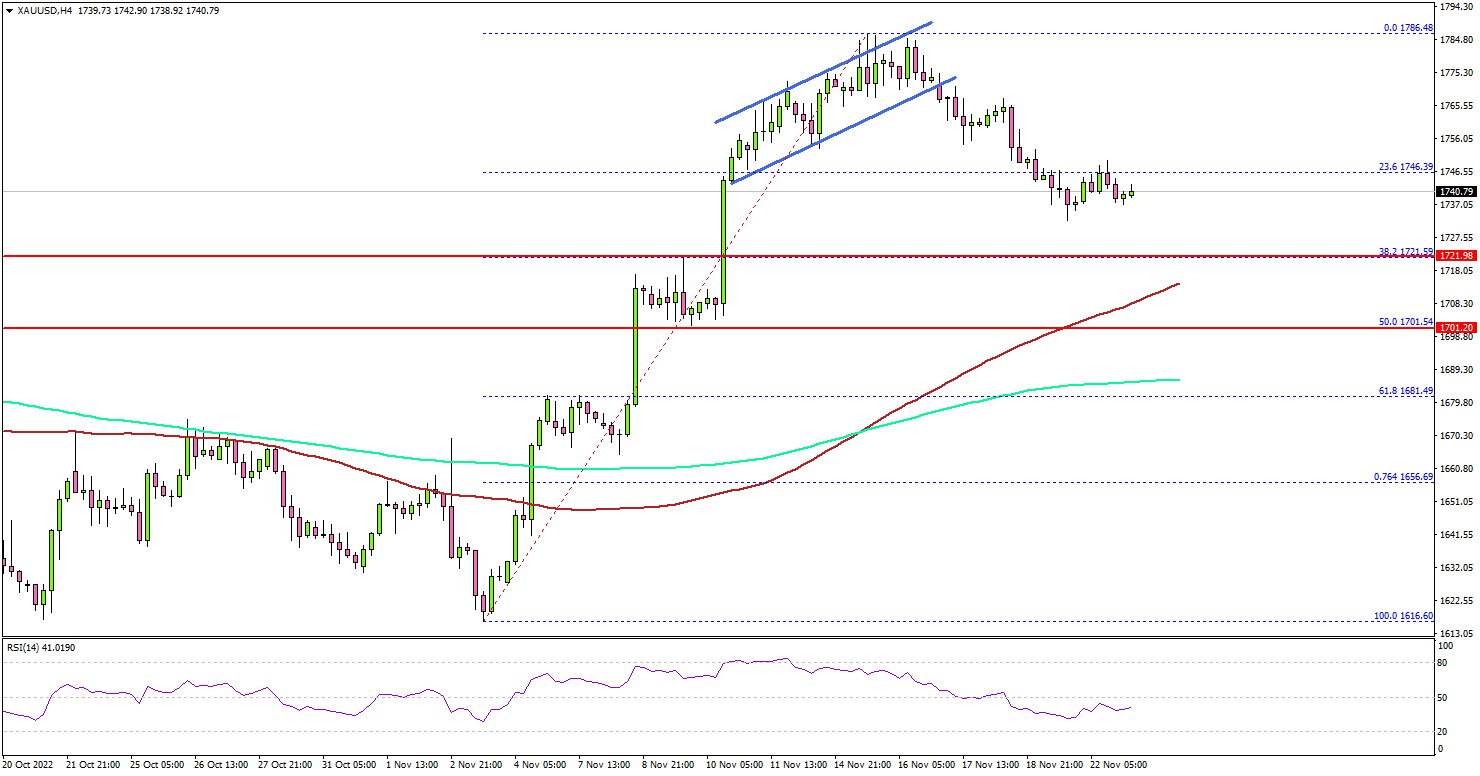
The 4-hours chart of XAU/USD indicates that the price gained pace above the $1,750 resistance zone. The price even moved above the $1,775 level and traded as high as $1,786. Recently, there was a downside correction below the $1,775 level.
The price traded below a short-term rising channel with support at $1,775 on the same chart. It even dropped below the 23.6% Fib retracement level of the upward move from the $1,616 swing low to $1,786 high.
On the downside, an initial support is near the $1,725 level. The next major support is near the $1,710 level or the 100 simple moving average (red, 4-hours).
The main support is near $1,700 or the 50% Fib retracement level of the upward move from the $1,616 swing low to $1,786 high, below which gold price might struggle to stay above the 200 simple moving average (green, 4-hours).
On the upside, the price might face sellers near the $1,765 level. The next major resistance is near the $1,775 level. Any more gains might send the price towards the $1,786 resistance level, above which gold price might revisit the $1,800 resistance.
Looking at crude oil price, there was a sharp decline towards the $76.50 support zone, where the bulls took a strong stand.
Economic Releases to Watch Today
- Germany’s Manufacturing PMI for Nov 2022 (Preliminary) - Forecast 45.0, versus 45.1 previous.
- Germany’s Services PMI for Nov 2022 (Preliminary) - Forecast 46.2, versus 46.5 previous.
- Euro Zone Manufacturing PMI for Nov 2022 (Preliminary) – Forecast 46.0, versus 46.4 previous.
- Euro Zone Services PMI for Nov 2022 (Preliminary) – Forecast 48.0, versus 48.6 previous.
- UK Manufacturing PMI for Nov 2022 (Preliminary) – Forecast 45.8, versus 46.2 previous.
- UK Services PMI for Nov 2022 (Preliminary) – Forecast 48.0, versus 48.8 previous.
- US Manufacturing PMI for Nov 2022 (Preliminary) – Forecast 49.8, versus 50.4 previous.
- US Services PMI for Nov 2022 (Preliminary) – Forecast 47.7, versus 47.8 previous.
- US Initial Jobless Claims - Forecast 224K, versus 222K previous.
- US New Home Sales for Oct 2022 (MoM) – Forecast -3.8%, versus -10.9% previous.
CHFJPY Wave Analysis
- CHFJPY reversed from support level 144.50
- Likely to rise to resistance level 150.00
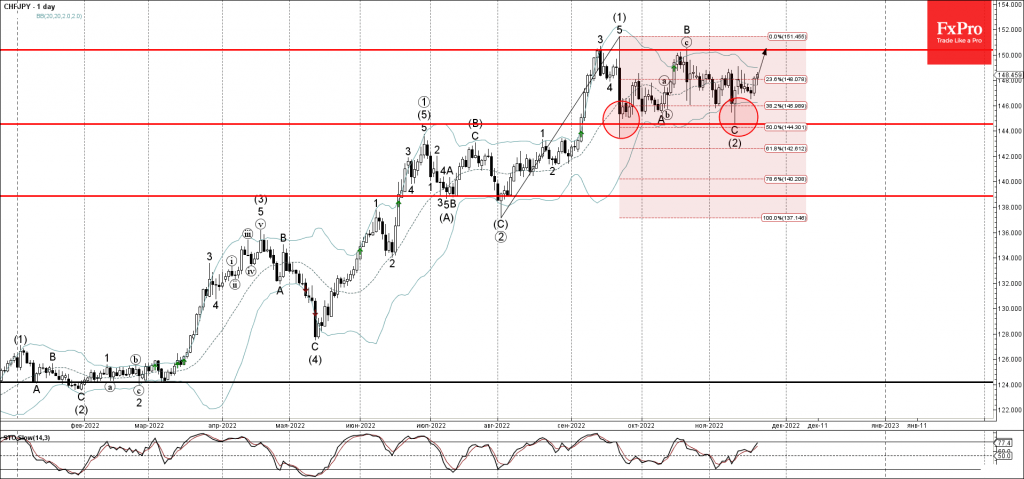
CHFJPY recently reversed up from the key support level 144.50 (which stopped the price in September), standing near the lower daily Bollinger Band and the 50% Fibonacci correction of the upward impulse (1) from August.
The upward reversal from the support level 144.50 started the active medium-term impulse wave (3).
Given the clear daily uptrend, CHFJPY can be expected to rise further toward the next resistance level 150.00 (which has been reversing the price from September).
ECB Simkus: 50bps a must for Dec, 75 also possible
ECB Governing Council member Gediminas Simkus said, "it's clear that 50 basis points is a must" for December meeting. He added, "because we still see very strong inflation pressures and we need to dampen them as soon as possible to prevent a de-anchoring of inflation expectations." Yet, "75 is also possible."
ECB will also discussing shrinking the assets purchased with the stimulus program, also known as quantitative tightening. "The sooner we start quantitative tightening, the better," he said. "But in smaller steps, so that it can run somewhere in the background."
Sunset Market Commentary
Markets
The OECD published its biannual economic outlook today. The recap paints a grim outlook: “The global economy is facing significant challenges. Growth has lost momentum, high inflation has broadened out across countries and products, and is proving persistent. Risks are skewed to the downside. Energy supply shortages could push prices higher. Interest rates increases, necessary to curb inflation, heighten financial vulnerabilities. Russia’s war in Ukraine is increasing the risks of debt distress in low income countries and food insecurity.” World GDP forecasts are downgraded to 3.1% Y/Y this year, 2.2% in 2023 and 2.7% in 2024. The UK is forecast to suffer most amongst G7-nations the next two years with forecasts of respectively -0.4% in 2023 and 0.2% in 2024. Germany is the only other in this group expected to shrink next year (by 0.3%) before rebounding 1.5% in 2024. Inflation will remain high in 2023, but moderate because of tighter monetary policy and decelerating growth. For OECD nations we’re talking about 9.4% average inflation this year, 6.6% in 2023 and 5.1% in 2024. None of the major economies apart from Japan are forecast to have average inflation below 2% in 2024. OECD interim chief economist Santos Pereira stressed after the OECD publication that controlling inflation has to be the top priority otherwise we might end up with a wage-price spiral like we had in the 70s or we end up with a situation that inflation becomes so entrenched that the pain needed to control it will be even greater. Risk of overshooting are certainly less than risks of inaction. Finally he added that fiscal policy should work hand-in-hand with monetary policy to help control inflation.
The OECD outlook didn’t interrupt otherwise dull trading. An empty eco calendar on both sides of the Atlantic can’t provide guidance with volumes again thin in this shortened US trading week. Risk sentiment on European bourses improved from yesterday, with main indices gaining marginally. Core bonds gain some ground with US yields 0.5 bps (30-yr) to 3.5 bps (3-yr) lower. German Bunds underperform with yields 1 to 2 bps higher across the curve. The front end marginally underperforms, perhaps with the hawkish ECB Holzmann comments still at play. He favoured a 75 bps rate hike in December, but that’s the minority view for now. EUR/USD trades with a very small upward bias to currently change hands around 1.0270. Sterling outperforms slightly with EUR/GBP currently seen around 0.8640 in a technical move after losing the recent lows.
News Headlines
Belgian consumer confidence recovered in November. But at -22 (from -27), the indicator remains at levels comparable to those seen in the aftermath of the pandemic. Households were less pessimistic in their expectations regarding the general economic situation in Belgium (from -42 to -32), although they are slightly more concerned about the labour market outlook (from 36 to 38). Belgian consumers are slightly more upbeat with respect to their financial situation as expectations for 12 months ahead improved from -17 to -10. Saving intentions have strengthened but not nearly enough to make up for the steep declines seen in the past two months (from -11 to -7).
The Hungarian central bank (MNB) kept its base rate steady at 13% today. The decision was widely expected as the central bank repeatedly said, today too, that it considers 13% a high enough level to manage fundamental inflation risks. Instead, it has resorted to emergency measures including one-day deposit tenders carrying 18%, to sooth those in the market who disagreed. The MNB said these ad hoc tools have improved financial market stability and tightened conditions. Interbank liquidity will be further reduced, enhancing the current policy stance, via a two-month deposit tender and FX swap tenders providing euro liquidity. New MNB forecasts pencil in 3-4% growth for this year, 0.5-1.5% the next and 3.5-4.5% for 2024. Easing external inflationary pressures, the global growth slowdown and shrinking domestic demand should lead to a turnaround in inflation from 2023. Price growth this year may average between 13.5-14.5% and should return to the tolerance band (3%+1 ppt) in 2024H1. The forint trades virtually unchanged. EUR/HUF slightly eases to 407.86. Hungarian swap yields decline between 15-30 bps but the bulk of the move already occurred before the MNB decision.
Filling the Void
As was to be expected, it's been a choppy week so far in financial markets with Europe a very mixed bag on Tuesday while US futures are marginally higher after making marginal losses on Monday.
On the one hand, we could be seeing investors warily waiting for the FOMC minutes and taking in all of the speeches from various Fed officials in the meantime. On the other, this week may just be a void in an otherwise turbulent year thanks to a lack of major catalysts and the US Thanksgiving bank holiday at the end of the week.
Saudi Arabia has gone some way to filling that void, with so much attention now likely to be on the Gulf over the coming weeks. It goes without saying that it came as quite a shock as everything unfolded as it wasn't what anyone was expecting, quite the opposite in fact. And it could have a major impact on the outcome next month.
But the 2-1 win over one of the tournament favourites, Argentina, was a monumental victory and undoubtedly one of the biggest shocks in World Cup history. It's blown Group C wide open and cast serious doubt over whether Lionel Messi will ever get his hands on the trophy.
In other news, Saudi Arabia also rejected reports that OPEC+ is considering increasing output on 4 December.
OPEC+ speculation drives oil market volatility
Oil prices are bouncing back as OPEC+ members continue to reject reports of an output hike at the next meeting. An announcement from the G7 around the Russian oil price cap is due any day now and could complicate the group's mission to balance supply and demand in the market, especially if the Kremlin responds by slashing exports to participating countries, as they've threatened.
That Russia is a key member of the alliance seriously complicates matters. I do wonder whether members could consider reconfiguring output targets, rather than boosting them, in order to account for lost Russian crude. Of course, that would likely require the backing of Russia which may not be forthcoming.
Oil prices will likely remain highly volatile over the next couple of weeks against this backdrop, with the EU embargo and potential price cap scheduled to start the day after the OPEC+ meeting on 4 December. If the cap agreement goes to the wire, OPEC+ may opt to delay the meeting given the uncertainty it would generate.
Gold rebounds off the prior resistance level
The slight recovery in risk appetite today is coinciding with a pullback in the US dollar and a rebound in gold. The yellow metal has held onto the bulk of November's gains over the last week, seeing support around $1,730 on Monday where it met firm resistance on multiple occasions in September and October.
The key level to the upside remains $1,780 where it peaked around last week and saw substantial support around in the first half of the year.
Another dead cat bounce?
Bitcoin is trading higher on Tuesday, but for how long? The knock-on effects of the FTX collapse are still being uncovered, with more names being added to the exposure list every day. Confidence in the markets has been shattered and it may take time to rebuild.
There remains considerable uncertainty around the full consequences of the FTX collapse and as long as that remains the case, any rallies we see in cryptos may simply become dead cat bounces, as opposed to market bottoms. The latest occurred around $15,500, where it rebounded off a couple of weeks ago, and a break of this could trigger another sharp decline.
Eurozone Business Surveys: Is the Recession Here?
The latest PMI business surveys from the euro area will hit the markets early on Wednesday, starting with the French numbers at 08:00 GMT. They are expected to confirm the economy is headed straight into recession, making the ECB's rate decision next month even harder. As for the euro, despite the recent bounce, it's still too early to envision a sustainable recovery.
In dire straits
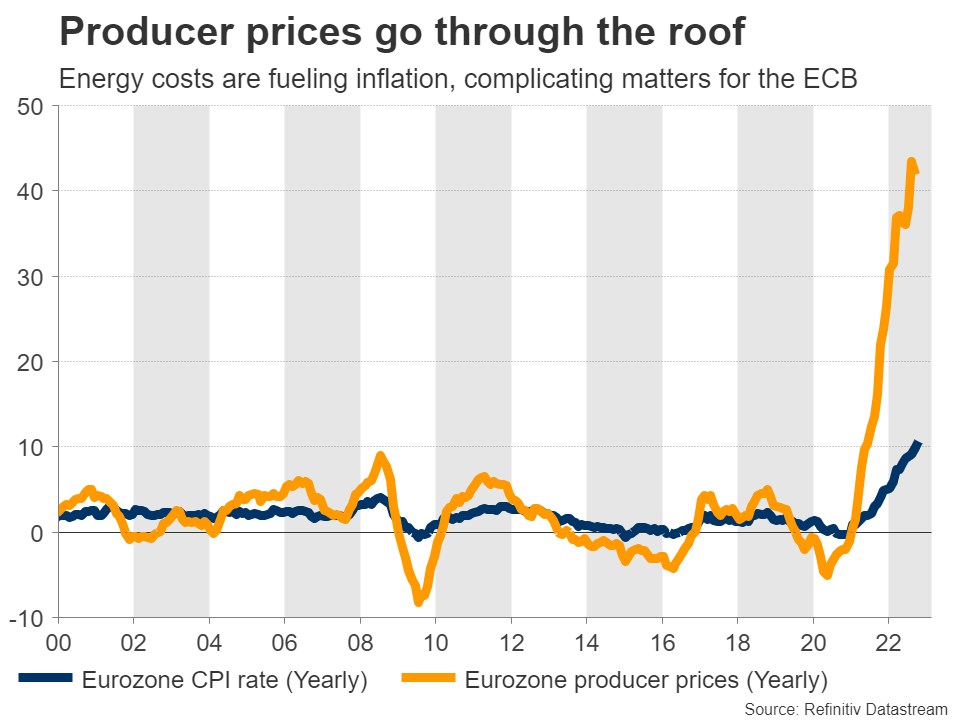
The economic data pulse in the Eurozone has been weakening for several months now, as the energy crisis spiraled out of control. With soaring energy costs serving as rocket fuel for inflationary pressures, consumers have seen their real incomes decline and business confidence has fallen off a cliff.
Worst of all, the European Central Bank cannot ride to the rescue this time. With inflation running in the double digits, policymakers have little choice but to keep raising interest rates at an extraordinarily fast pace. Over time, this will cause lending to dry up and squeeze consumers even more, inflicting more damage on the economy.
The silver lining is the recent decline in energy prices. After European governments announced they'll intervene in the power market, prices fell very substantially. Most nations had already stockpiled energy supplies for the winter, so investors saw the forceful intervention as a sign that the worst had passed, for now.
Make no mistake, there will still be a recession. Too much economic damage has already been done. The good news is the downturn probably won't be as long or as deep as investors feared just a few months ago.
Upcoming data
Investors will get an update on how businesses view the economy with the latest batch of PMI surveys on Wednesday. On the Eurozone level, both the manufacturing and the services indices are expected to have slipped further into contractionary territory in November.
That would reaffirm what the European Commission's latest forecasts suggested, namely that the recession will begin this quarter already. Markets are currently leaning towards another 75bp rate increase when the ECB meets again next month, but a batch of worrisome business surveys could tip the scales back towards a smaller hike of 50bp, dealing a blow to the euro.
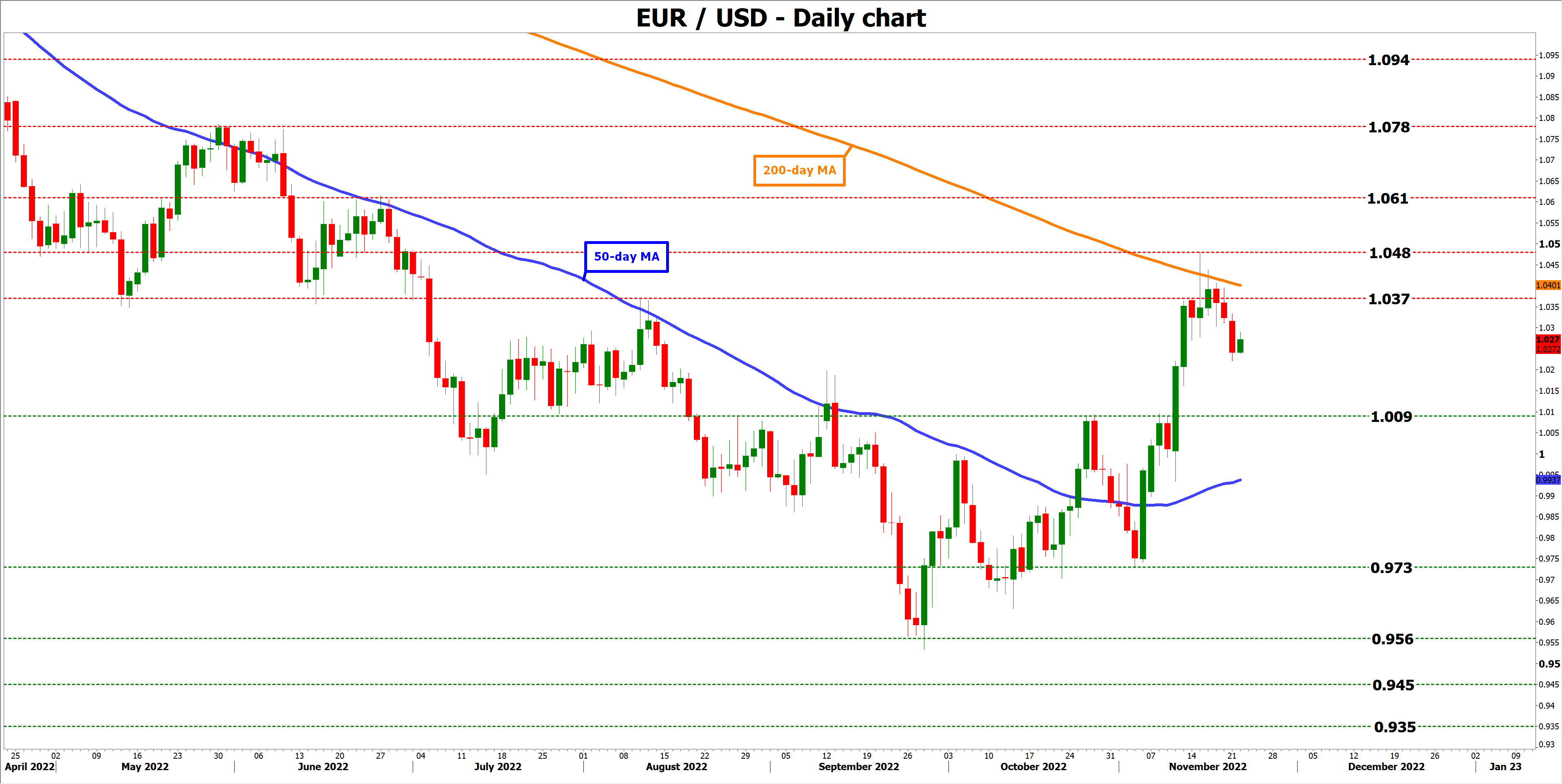
In this case, euro/dollar could edge lower for a test of the 1.0090 region, defined by the peaks of October. On the other hand, a set of surprisingly strong numbers could cement the case for another 75bp hike, propelling the pair higher towards the 1.0370 zone.
Too early for a reversal
In the bigger picture, it's still difficult to be optimistic on the euro, as the next few months will probably be a tough period for the Eurozone economy, especially in case the winter is particularly cold. Even though the US economy is losing steam too, the situation is not as worrisome yet, and it will probably take longer before it falls into a recession.
For a trend reversal to become a realistic scenario, the euro would need a positive catalyst to dispel the current gloom. Peace talks between Ukraine and Russia could do the trick, as the mere possibility would also hammer energy prices lower.
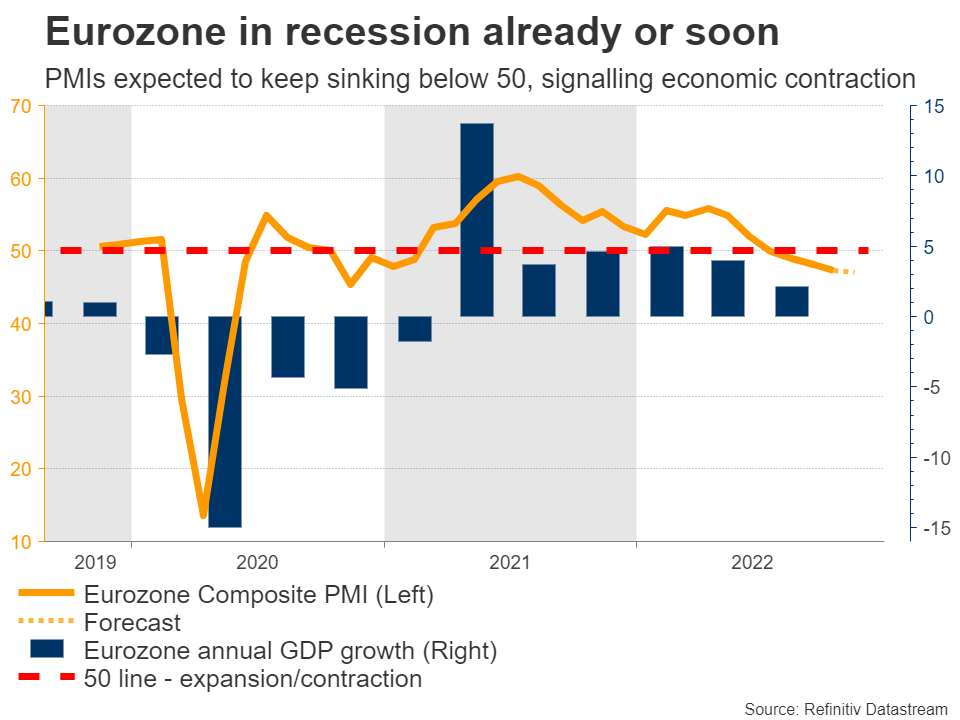
Other upside risks for the euro include a sharp cooldown in US inflation that leads the Fed to pause its tightening cycle, or signs that China will open the stimulus floodoors to support its embattled economy.
Unfortunately, none of these elements are realistic at this stage. Hence, the prospect of a trend reversal remains premature, and probably a story for next year.
AUD/USD: Daily Cloud Top Provides Headwinds to Fresh Recovery
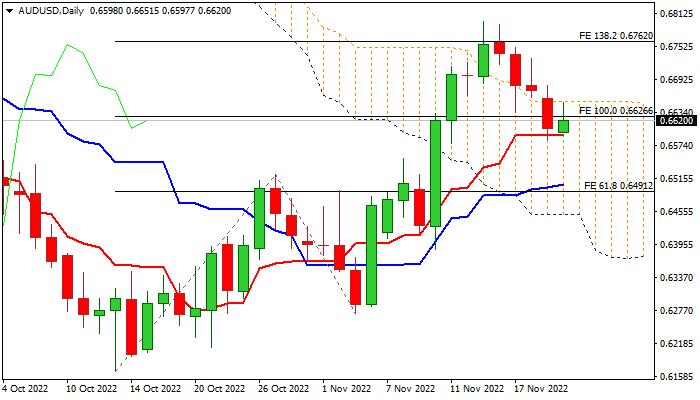
The Australian dollar edges higher vs its US counterpart on Tuesday, after daily Tenkan-sen (0.6591) provided firm ground for a four-day pullback from Nov 15 peak (0.6797).
Aussie regained traction on renewed risk mode, but fresh advance is facings headwinds from daily cloud top, reinforced by 10DMA (0.6653), also near pivotal Fibo barrier at 0.6665 (38.2% of 0.6797/0.6584) though shallow easing suggests that bulls so far hold grip and keep pivotal barrier under pressure.
Daily techs are bullishly aligned and support the action which needs to clearly break above daily cloud to generate initial signal of reversal, which would require further support on extension above 100DMA/50% retracement (0.6691).
Caution on failure at cloud top which would soften near-term structure, but bias is expected to remain positive as long as the action holds above daily Tenkan-sen.
Res: 0.6653; 0.6665; 0.6691; 0.6730.
Sup: 0.6591; 0.6557; 0.6514; 0.6503.
Canada: Retail Sales Edge Lower in September
Retail sales fell 0.5% month-on-month (m/m) in September, in-line with Statistics Canada's advance estimate. Adjusting for the impact of inflation, the volume of sales was down just 0.1% on the month.
Statistics Canada's advance estimate for October points to a 1.5% m/m gain.
Lower receipts at gasoline stations (-2.4%) weighed on the headline in September. The drop was entirely due to lower prices, which fell by 7.4% m/m. In volume terms gasoline sales were actually higher, with lower prices encouraging more driving. Sales of motor vehicle and parts were flat.
Core sales, which exclude autos and gasoline, declined by 0.4%, partially reversing a gain in the month prior. In real terms core sales were down 0.7% m/m.
- Sales at food and beverage stores declined by 1.3%, with an even larger drop in real terms (-2.2%). Sales also edged lower at health and personal care stores (-0.2%), and at stores selling sporting goods, hobby items, and books (-1.5%), following an outsized gain in the prior month.
- Performance was mixed in the housing-related categories. Sales were up 1.4% at furniture & home furnishings stores, increasing for the second consecutive month. However, receipts fell at building materials & garden equipment & supplies stores (-2.0%) and electronic & appliance stores (-0.6%), with the latter declining for the fifth consecutive month.
- Sales at clothing and accessories stores were up 1.7% on the month. General merchandize stores (+0.6%) and miscellaneous retailers (+0.6%) also saw higher sales.
- E-commerce sales were down 5.4% m/m and were just a hair lower (-0.1%) than they were a year ago.
Key Implications
Today's release caps data for the third quarter. Looking at the quarterly numbers, spending at retail stores looks to have eased notably in Q3. In nominal terms sales were down 1.0% on the quarter, after advancing by 3.3% in Q1 and 2.8% in Q2. And, the weakness is not just due to lower gasoline prices, as the volume of sales also fell in Q3. Another culprit for weaker sales could be the shift in spending toward services, and away from goods sold at retail stores. There's limited data to gauge consumer spending trends on services, however, one such category, spending on dining out in bars and restaurants, is showing that spending had plateaued at the end of summer.
Indeed, the most likely reason is that consumers are starting to tighten their purse string, under the weight of financial headwinds: high inflation, rapidly rising interest rates and shrinking wealth. Higher debt servicing costs are expected to hit household finances hard over the remainder of this year, and will remain a challenge next year as well, pointing to significantly weaker consumer spending in 2023.
EUR/USD Mid-Day Outlook
Daily Pivots: (S1) 1.0311; (P) 1.0359; (R1) 1.0412; More...
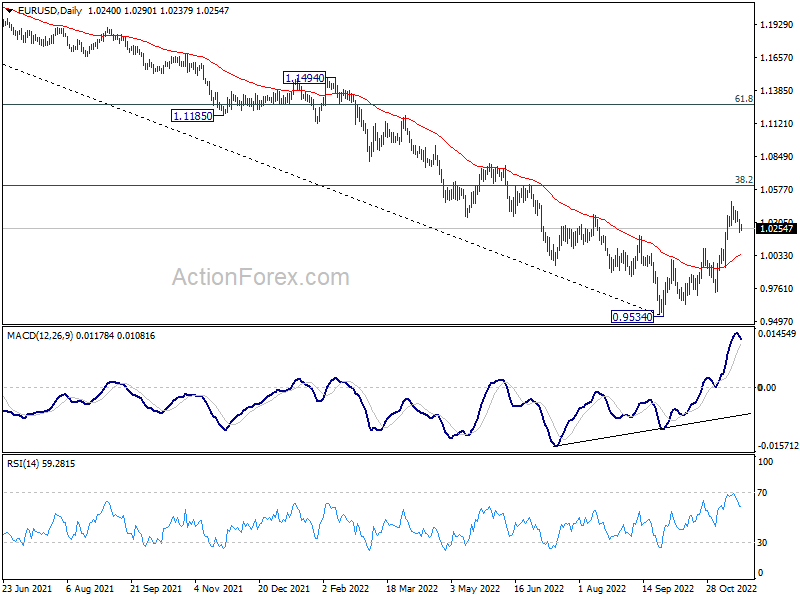
Outlook in EUR/USD remains unchanged and intraday bias stays neutral. Consolidation from 1.0481 could extend further. As long as 1.0092 resistance turned support holds, further rally is still expected. On the upside, break of 1.0481 will resume the rise from 0.9534 and target 1.0609 fibonacci level. However, sustained break of 1.0092 will turn bias to the downside for 55 day EMA (now at 1.0041) and below.
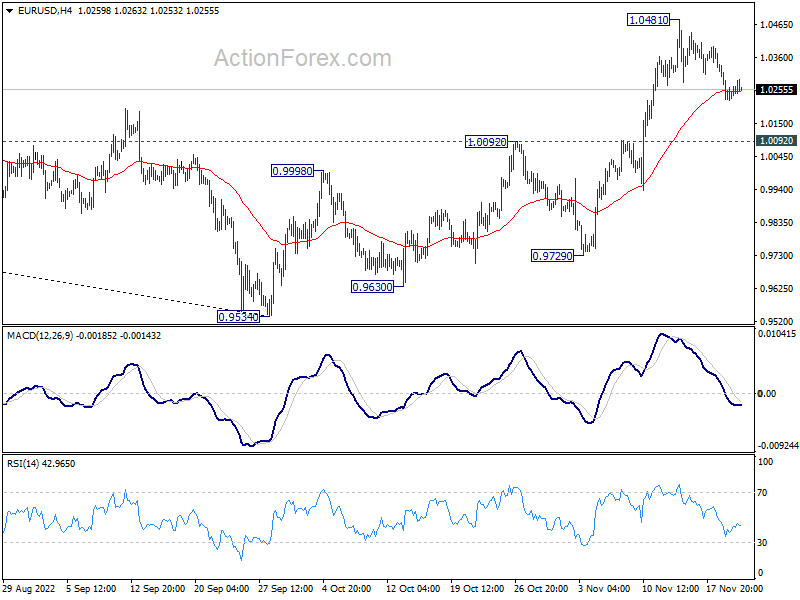
In the bigger picture, a medium term bottom was in place at 0.9534, on bullish convergence condition in daily MACD. Even as a corrective rise, rally from 0.9534 should target 38.2% retracement of 1.2348 (2021 high) to 0.9534 at 1.0609. Sustained trading above 55 week EMA (now at 1.0566) will raise the chance of trend reversal and target 61.8% retracement at 1.1273. This will now remain the favored case as long as 1.0092 resistance turned support holds.