

Sample Category Title
GBP/USD Mid-Day Outlook
Daily Pivots: (S1) 1.1766; (P) 1.1837; (R1) 1.1895; More...
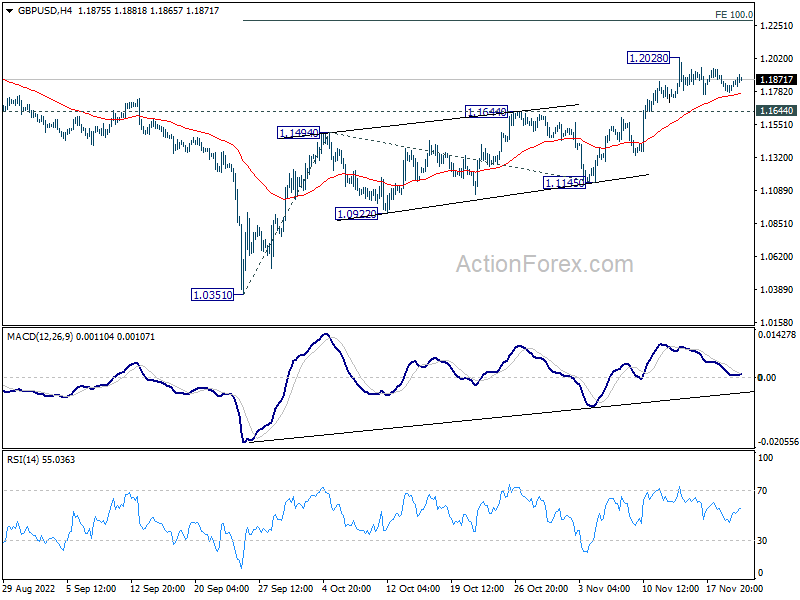
Sideway trading continues in GBP/USD and intraday bias remains neutral for the moment. Further rally is expected as long as 1.1644 resistance turned support holds. On the upside, break of 1.2028 will resume whole rise from 1.0351 to 100% projection of 1.0351 to 1.1494 from 1.1145 at 1.2288. However, sustained break of 1.1644 will bring deeper fall to 1.1145 support instead.
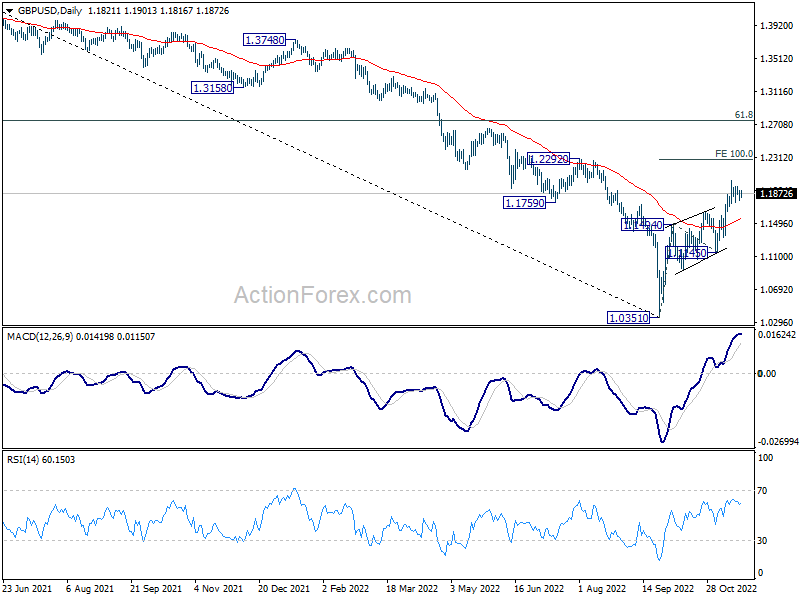
In the bigger picture, rise from 1.0351 medium term bottom is at least correcting whole down trend from 1.4248 (2021 high). Further rise is expected as long as 1.1145 support holds. Next target is 61.8% retracement of 1.4248 to 1.0351 at 1.2759.
USD/CHF Mid-Day Outlook
Daily Pivots: (S1) 0.9549; (P) 0.9574; (R1) 0.9616; More...
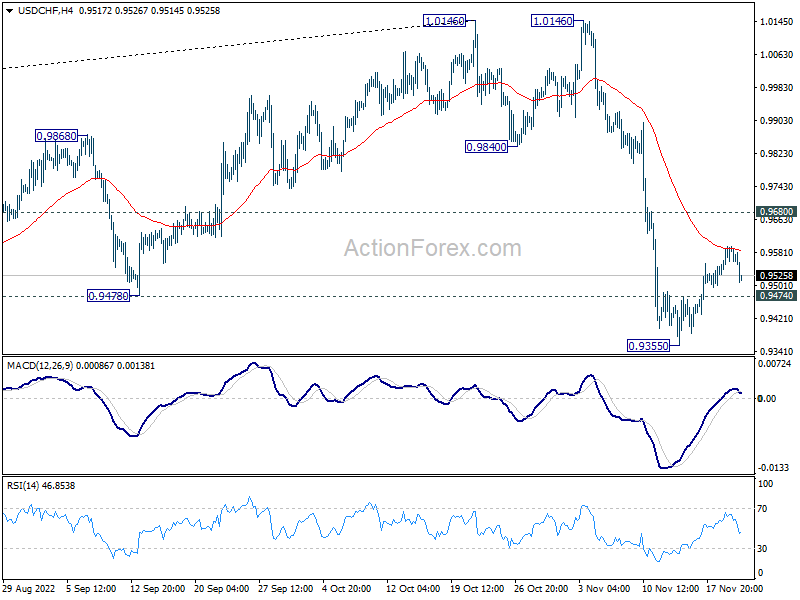
USD/CHF retreats after hitting 4 hour 55 EMA and intraday bias stays neutral for the moment. Further decline is still expected with 0.9680 resistance intact. Below 0.9474 minor support will turn bias back to the downside for 0.9355 low. Break there will resume the fall from 1.0146 to 0.9287 fibonacci level.
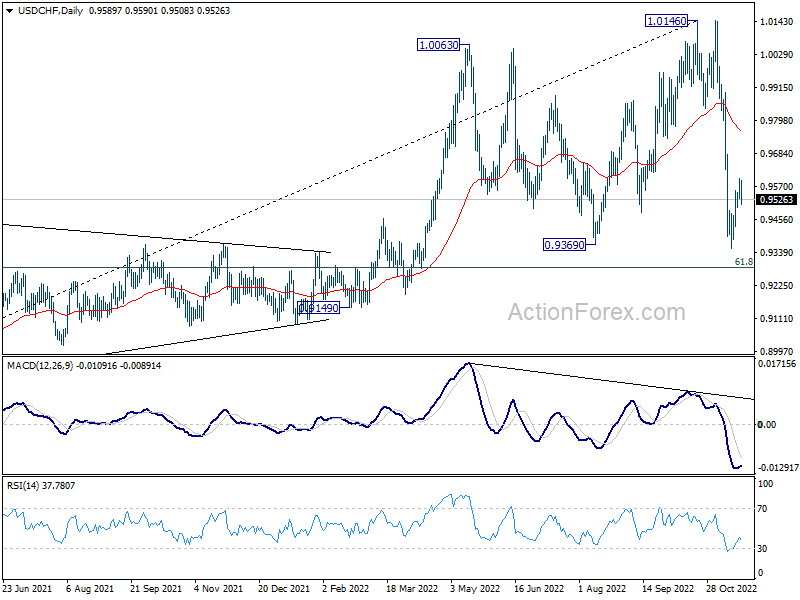
In the bigger picture, rise from 0.8756 (2021 low) has completed at 1.0146, well ahead of 1.0342 long term resistance (2016 high). Based on current downside momentum, fall from 1.0146 might be a medium term down trend itself. Break of 61.8% retracement of 0.8756 to 1.0146 at 0.9287 will pave the way to 0.8756. In any case, risk will stay on the downside as long as 55 day EMA (now at 0.9767) holds.
USD/JPY Mid-Day Outlook
Daily Pivots: (S1) 140.77; (P) 141.51; (R1) 142.86; More...
USD/JPY retreated ahead of 142.45 minor resistance and intraday bias remains neutral first. On the upside, firm break of 142.45 will turn bias back to the upside for stronger rebound to 55 day EMA (now at 143.34) and above. However, break of 139.63 minor support will turn bias back to the downside for 137.66. Break there will resume the decline from 151.93, to 133.07 fibonacci level, as a correction to the larger up trend.
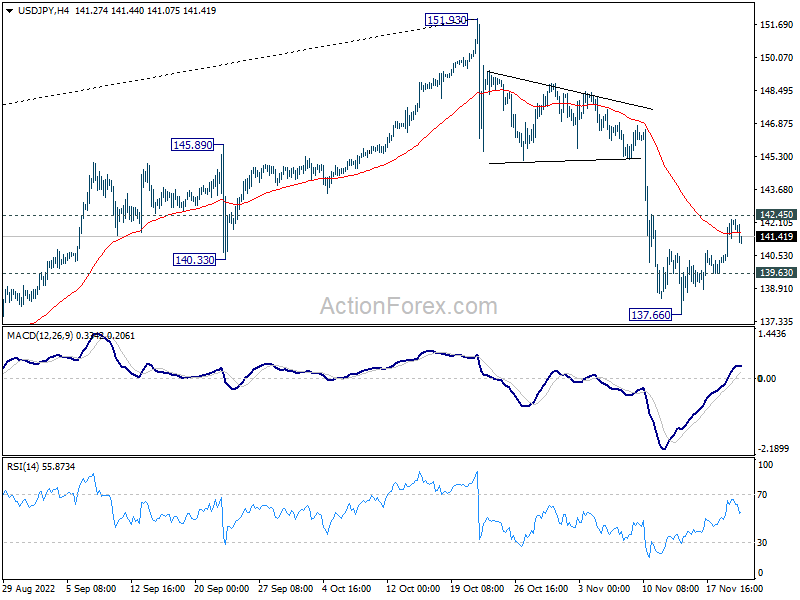
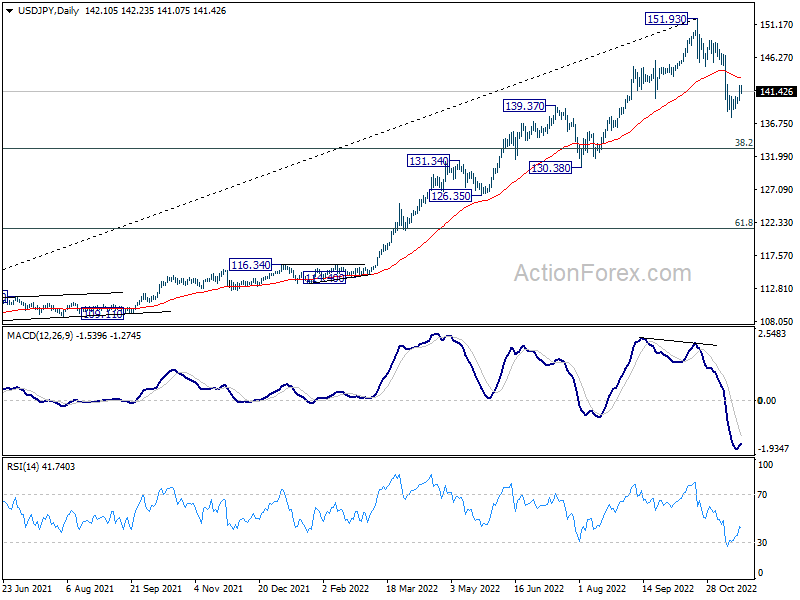
In the bigger picture, a medium term top should be formed at 151.93. Fall from there is correcting larger up trend from 102.58. It's too early to call for bearish trend reversal. But even as a corrective move, such decline should target 38.2% retracement of 102.58 to 151.93 at 133.07, or further to 55 week EMA (now at 130.28).
NZD Recovers ahead of RBNZ Hike, Dollar and Euro Dip
Dollar and Euro are so far the worst performer in quiet trading today. The greenback is clearly weighed down again by stocks' rise and yield's decline. There are news that China's Shanghai is back in tougher restrictions, but investors are not too bothered. Canadian Dollar is also soft after data showed retail sales contraction. Meanwhile, New Zealand Dollar is the strongest one, looking ahead to tomorrow's historical 75bps rate hike by RBNZ. Swiss Franc is also strengthening slightly together with Sterling.
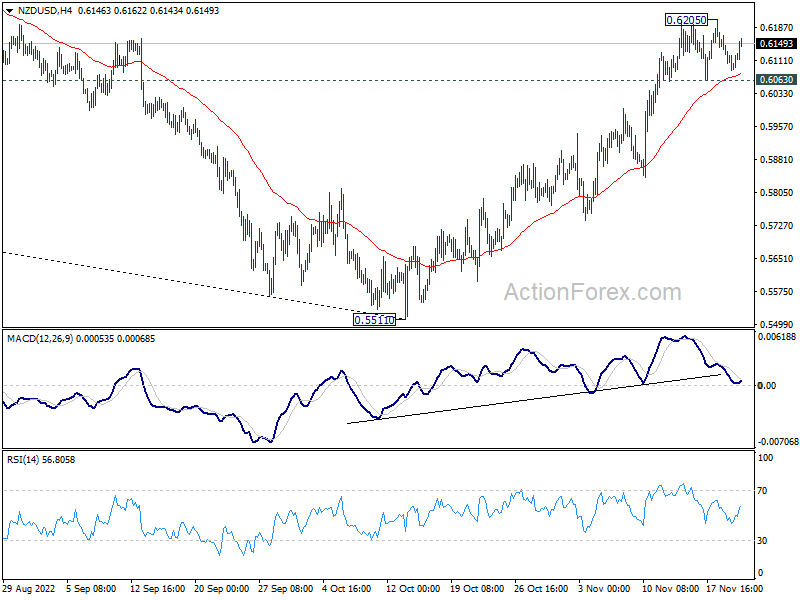
Technically, while NZD/USD recovered today, it's held well inside range of 0.6063 and 0.6205. Further rally is in favor as long as 0.6063 minor support holds. But NZD/USD would then be facing long term fibonacci level of 38.2% retracement of 0.7463 to 0.5511 at 0.6257. Loss of upside momentum could limit upside there, and break of 0.6063 minor support would indicate the start of a near term pull back, at least.
Suggested readings on RBNZ:
- The Consensus Calls for the RBNZ to Hike by 75bp Tomorrow
- RBNZ Might Need to Slam the Brakes in November as Economy Heats Up
In Europe, at the time of writing, FTSE is up 0.70%. DAX is up 0.14%. CAC is up 0.08%. Germany 10-year yield is up 0.018 at 2.011. Earlier in Asia, Nikkei rose 0.61%. Hong Kong HSI dropped -1.31%. China Shanghai SSE rose 0.13%. Singapore Strait Times rose 0.28%. Japan 10-year JGB yield dropped -0.0012 to 0.245.
Canada retail sales dropped -0.5% mom in Sep, down -1.0% qoq in Q3
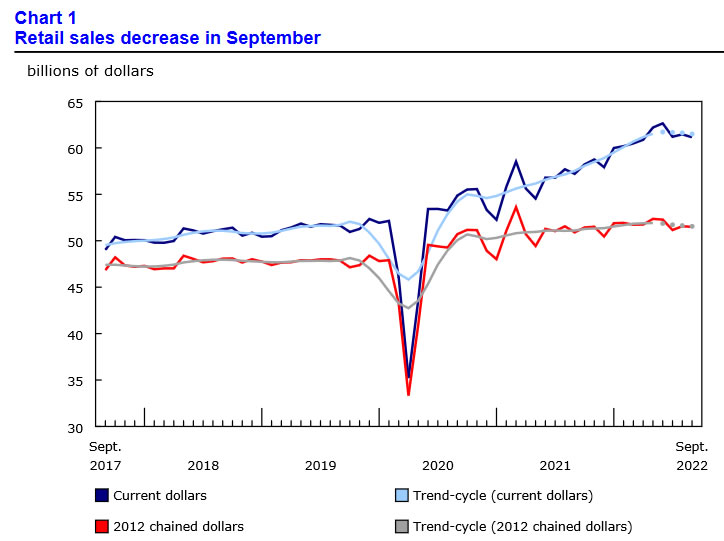
Canada retail sales dropped -0.5% mom to CAD 61.1B in September. Sales declined in 7 of 11 subsectors, led by sales at gasoline stations (-2.4%) and food and beverage stores (-1.3%). Excluding gasoline and auto, sales contracted -0.4%mom. IN volume terms retail sales also declined -0.1% mom.
For Q3, sales were down -1.0% qoq, the first quarterly decline since Q2 of 2020. In volume terms, sales were down -1.4% qoq in Q3.
According to advance estimate, sales rose 1.5% mom in October.
ECB Holzmann backs another 75bps hike to give a strong signal about determination
ECB Governing Council member Robert Holzmann told FT in an interview, that he could "see no signs that core inflation is reducing". He added that another big rate hike "would give a strong signal about our determination," as "it would tell businesses and trade unions we are serious so don't underestimate us, be careful."
He backs another 75bps rate hike in December but he was still "open to changing my mind" based on the ECB's new quarterly economic forecasts. He added that interest rates could need to rise to a level where they "caused pain". Hence, it's important to hike "early" because "afterwards the pain is much, much larger."
RBA Lowe not ruling out return to 50bps hike, nor pausing
RBA Governor Philip Lowe reiterated in a speech that the Board expects to "interest rates further over the period ahead", and interest rate is "not on a pre-set path".
"We have not ruled out returning to 50 basis point increases if that is necessary," he said. "Nor have we ruled out keeping rates unchanged for a time as we assess the state of the economy and the outlook for inflation."
"As we take our decisions over coming meetings, we will be paying close attention to developments in the global economy, the evolution of household spending and wage and price setting behaviour."
"Developments in each of these three areas will affect the pace at which inflation returns to target and whether the economy can remain on an even keel over the next couple of years."
NZ goods exports rose 14% yoy in Oct, imports surged 24% yoy
New Zealand goods exports rose 14% yoy to NZD 6.1B in October. Goods imports rose 24% yoy to NZD 8.3B. Trade deficit widened from NZD -1.7B to NZD -2.1B, much larger than expectation of NZD -1.7B.
Annual goods expects, comparing with the year ended October 2021, rose 14% to NZD 71.1B. Annual goods imports rose 25% to NZD 84.0B. Annual trade deficit swelled to fresh record of NZD -12.9B, comparing to NZD -4.9B a year ago.
USD/JPY Mid-Day Outlook
Daily Pivots: (S1) 140.77; (P) 141.51; (R1) 142.86; More...
USD/JPY retreated ahead of 142.45 minor resistance and intraday bias remains neutral first. On the upside, firm break of 142.45 will turn bias back to the upside for stronger rebound to 55 day EMA (now at 143.34) and above. However, break of 139.63 minor support will turn bias back to the downside for 137.66. Break there will resume the decline from 151.93, to 133.07 fibonacci level, as a correction to the larger up trend.
In the bigger picture, a medium term top should be formed at 151.93. Fall from there is correcting larger up trend from 102.58. It's too early to call for bearish trend reversal. But even as a corrective move, such decline should target 38.2% retracement of 102.58 to 151.93 at 133.07, or further to 55 week EMA (now at 130.28).
Economic Indicators Update
| GMT | Ccy | Events | Actual | Forecast | Previous | Revised |
|---|---|---|---|---|---|---|
| 21:45 | NZD | Trade Balance (NZD) Oct | -2129M | -1715M | -1615M | -1696M |
| 07:00 | GBP | Public Sector Net Borrowing (GBP) Oct | 12.7B | 19.1B | 19.2B | 16.9B |
| 09:00 | EUR | Eurozone Current Account (EUR) Sep | -8.1B | -20.3B | -26.3B | |
| 13:30 | CAD | New Housing Price Index M/M Oct | -0.20% | 0.20% | -0.10% | |
| 13:30 | CAD | Retail Sales M/M Sep | -0.50% | -0.50% | 0.70% | 0.40% |
| 13:30 | CAD | Retail Sales ex Autos M/M Sep | -0.70% | -0.60% | 0.70% | 0.50% |
| 15:00 | EUR | Eurozone Consumer Confidence Nov P | -26 | -28 |
Canada retail sales dropped -0.5% mom in Sep, down -1.0% qoq in Q3
Canada retail sales dropped -0.5% mom to CAD 61.1B in September. Sales declined in 7 of 11 subsectors, led by sales at gasoline stations (-2.4%) and food and beverage stores (-1.3%). Excluding gasoline and auto, sales contracted -0.4%mom. IN volume terms retail sales also declined -0.1% mom.
For Q3, sales were down -1.0% qoq, the first quarterly decline since Q2 of 2020. In volume terms, sales were down -1.4% qoq in Q3.
According to advance estimate, sales rose 1.5% mom in October.
NZD Dollar Bounces Back ahead of RBNZ Meet
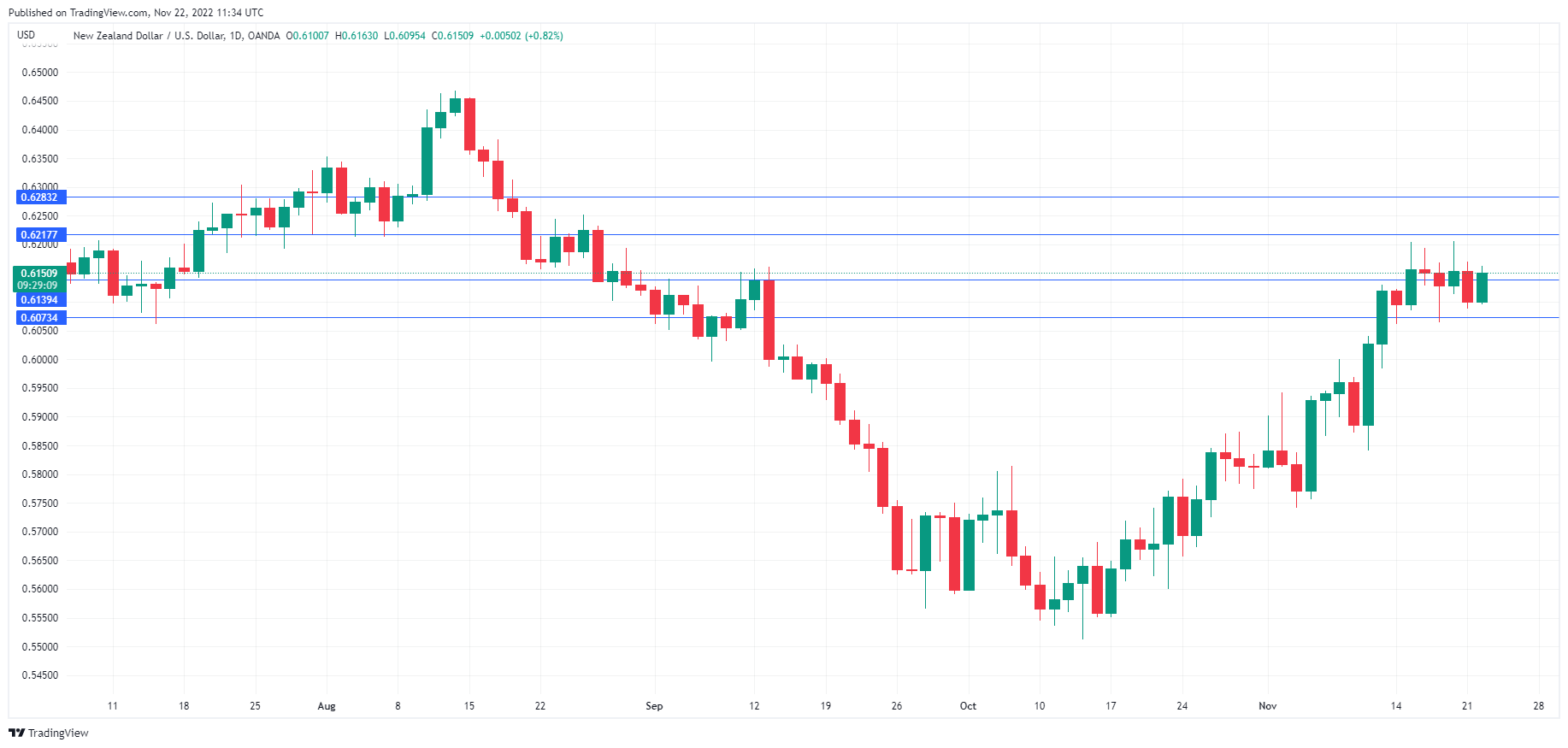
The New Zealand dollar has rebounded on Tuesday with strong gains. In the European session, NZD/USD is trading at 0.6151, up 0.83%.
Will RBNZ go all out?
The Reserve Bank of New Zealand has been tightening aggressively, delivering five straight 50-point hikes. The cash rate is currently at 3.5%, but this hasn’t achieved the goal of taming red-hot inflation. In the third quarter, CPI was almost unchanged, nudging lower to 7.2%, after a 7.3% gain in Q2. This was much higher than the RBNZ’s projection of 6.4%. With inflation expectations at 40-year highs, there is pressure on the bank to press the rate pedal to the floor.
The RBNZ will make its rate decision on Wednesday, with the markets expecting a 75-point hike, which would be the bank’s largest rate increase on record. Policy makers are confident that the economy can withstand a 75-point increase. The labour market remains tight, with unemployment at a near-record low of 3.3%, and the economy has recovered impressively from the Covid pandemic. There is clearly a risk that a jumbo rate hike will cause a harder landing than the RBNZ would like, but inflation remains priority number one. With the next rate decision not until late February, the RBNZ may want to make a loud splash at tomorrow’s meeting.
The recent US inflation report unleashed a wave of exuberance, sending equity markets higher and the US dollar on a nasty slide. Investors became more confident that Fed was close to a pivot in its aggressive policy and risk sentiment soared. The Fed has pushed back with Fed members delivering hawkish statements and projections, which has chilled risk appetite and stabilized the US dollar. Fed member Mary Daly weighed in on Monday, stating that inflation remained unacceptably high and projecting that the fed funds rate will peak at 4.75%-5.00%.
NZD/USD Technical
- There is resistance at 0.6072 and 0.6202
- 0.5955 and 0.5871 are providing support
Crypto Market Cap Halving?
Market picture
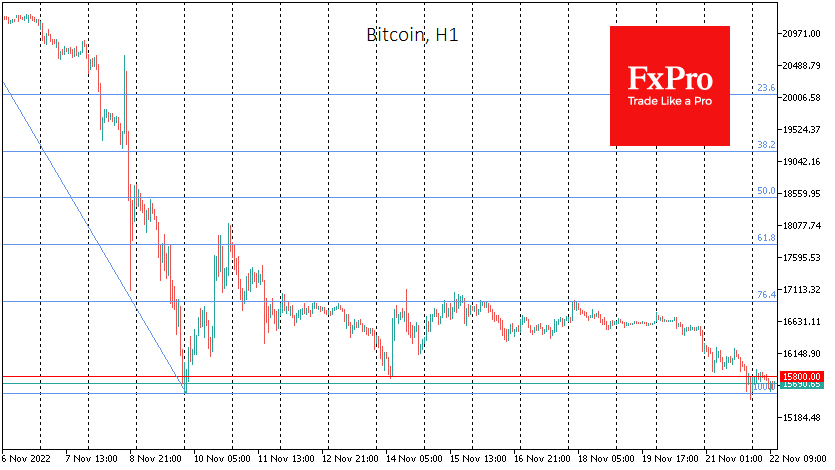
Bitcoin went below 15,500 at the end of the day on Monday, rewriting two-year lows, and slightly retreated from those extremes by the start of trading in Europe, trading around 15,700 (-2% in 24 hours). Ethereum is updating lows from July at the time of writing, falling to $1072 (+3.5% in 24 hours).
The crypto market capitalisation is down 1.75% overnight to $782bn, its lowest since January 2021. Although this indicator is very tentative and synthetic, we have seen a tug-of-war around $1 trillion for a long time. For a while, the market lingered near levels just above 830 – the high at the peak in January 2018. Now another belief that the previous peak of the last cycle would work as insurmountable support has been broken.
The crypto market capitalisation has gone sharply down, failing to develop an offensive above its 200-week average by early November. The 200-week (4-year) period is consistent with the notion of cycles in crypto, and the situation now looks like the exit of leveraged speculators who thought crypto had bottomed out in June-October.
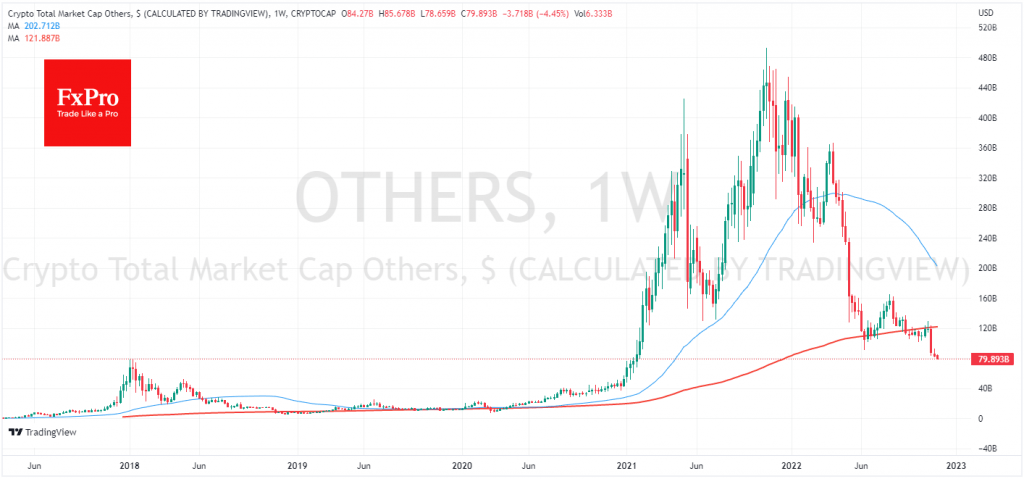
Although we believe that squeezing the weak hands out of the sector is almost complete, we are now seeing nothing more than speculators deleveraging, which is generally healing the market. Technical analysis suggests capitalisation could fall as much as 400-450bn, nullifying the rally, before returning to growth. However, this technical picture looks excessively pessimistic, and the stingiest speculators might not wait for that entry point, as is often the case in the markets.
News background
According to CoinShares, investments in cryptocurrencies rose by $44m last week against inflows of $42m the week before. Bitcoin investments rose by $14m, while Ethereum fell by $1m. Investments in funds that allow shorts on bitcoin increased by $18m, while shorts on ETH increased by a record $14m. Inflows to “short” products were 75% of the total, suggesting a deeply negative sentiment amid the FTX collapse, CoinShares noted.
According to IntoTheBlock, the share of unprofitable bitcoin addresses exceeded 51% (24.56 million addresses out of 47.85 million BTC holders). The last time a similar situation was observed was after the market crash in March 2020.
Rumours have emerged in the cryptocurrency community about possible problems at another major company. The failure of digital asset manager Grayscale Investments to disclose reserves and the suspension of crypto lending operations by OTC platform Genesis Trading have raised concerns about the entire Digital Currency Group (DCG) sustainability. According to experts, the collapse of Grayscale would be more severe than the collapse of Three Arrows Capital.
WTI Quickly Recovered Monday’s Heavy Losses But Downside Remains Vulnerable
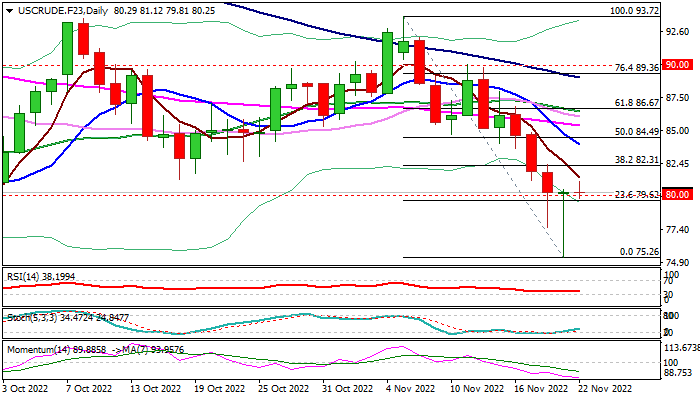
WTI oil was firmer in early Tuesday trading following a roller-coaster ride on Monday, when oil fell over 6% and recovered all losses on subsequent quick bounce.
The news that China is imposing fresh package of restrictions on new and strong wave of Covid infections in the capital Beijing and many provinces, soured the sentiment, though for a short period, as traders saw a good opportunity to enter fresh longs at the levels close to 2022 low, posted in early January.
Oil remains very sensitive to fundamentals, which continue to shake oil market almost on a daily basis and seen as a main driver nowadays.
Technical picture is also very interesting, as overall structure is bearish, defined by strong bearish momentum on daily chart and moving averages in full bearish setup.
On the other side, Monday’s strong rejection at key support at $76.25 (Sep 26 low) and also repeated failure to register daily close below psychological $80 support, generate initial positive signal, along with Monday’s long-tailed Doji candle that signaled a bear-trap and Tuesday’s advance, which hint formation of reversal signal on daily chart.
This points to mixed picture, with more evidence needed to confirm signals in both cases.
Bullish scenario requires stronger bounce and firm bullish close today, to complete Doji Morning Star reversal pattern on daily chart, though extension and close above pivotal Fibo resistance at $82.31 (38.2% of $93.72/$75.26) will be needed to confirm and add to fresh bullish bias.
However, this would still keep risk of limited correction of the bear-leg from $93.72 unless stronger acceleration through an array of moving averages and Fibo level at $86.67 (Fibo 61.8%) registers close above these levels.
More likely scenario in which fresh bulls would run out of steam and increase downside risk, is seen in current overall negative environment, boosted by disappointing news from China, which add to existing fears about further slowdown in a global demand as a number of Western economies are already in recession.
Res: 81.29; 82.31; 83.91; 84.49.
Sup: 80.00; 79.62; 77.57; 76.25.
Yen Steadies as Inflation Rises
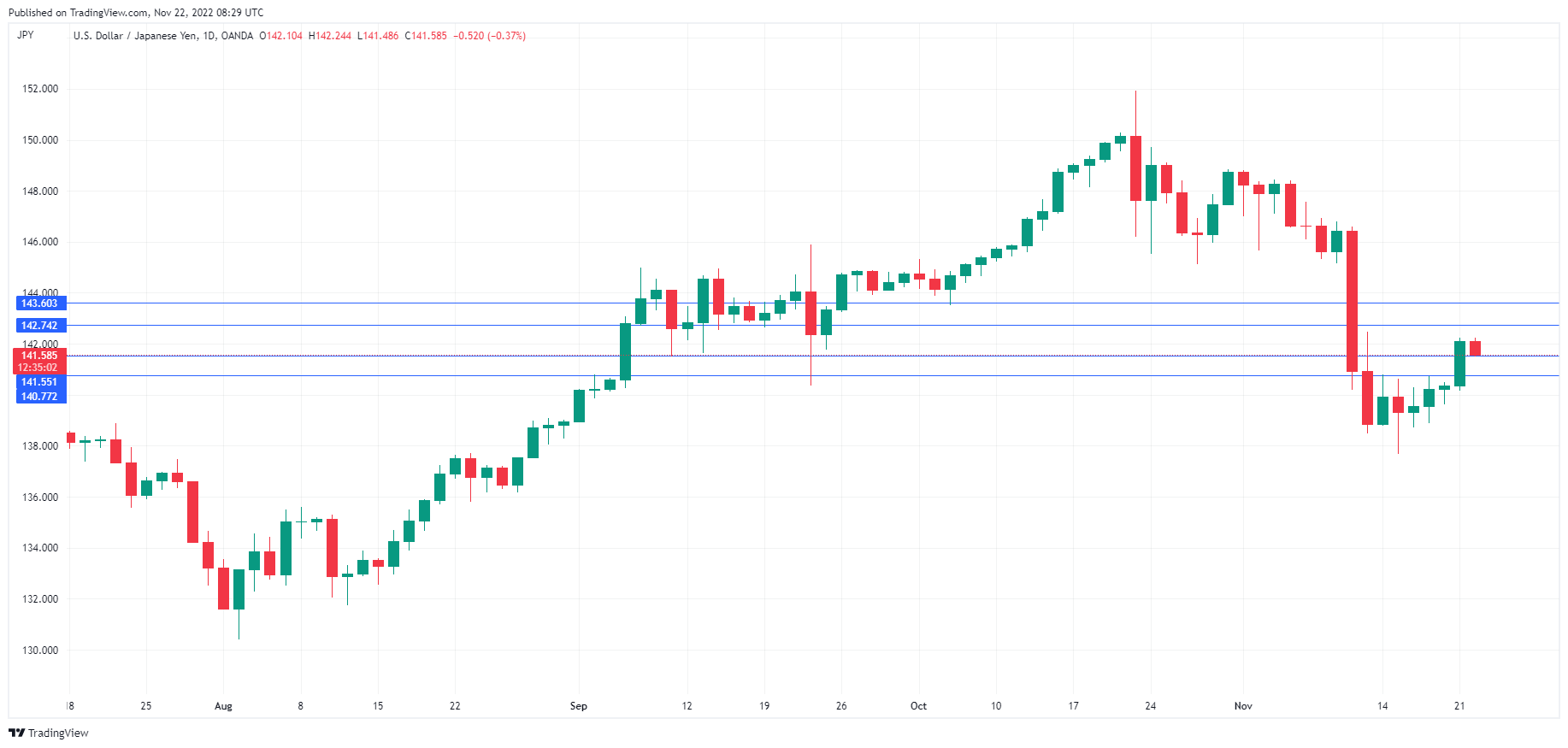
The Japanese yen has stabilized on Tuesday and is trading at 141.58, down 0.37%. USD/JPY rocketed higher on Monday, gaining 1.2%.
BoJ Core CPI jumps to 2.7%
With inflation continuing to gain traction in Japan, there shouldn’t have been much surprise that BoJ Core CPI accelerated in October for a ninth successive month. Still, the 2.7% gain was much stronger than the prior reading of 2.0% and the consensus of 2.2%. The reading comes on the heels of National Core CPI, which rose to 3.6%, up from 3.0%.
The Bank of Japan is unlikely to change its ultra-loose policy, even with inflation rising and a weak yen contributing to higher costs for households and businesses. The yen is well below the highs we saw in late October, when USD/JPY breached the 150 level and triggered a currency intervention. I am doubtful that such unilateral moves can have a lasting effect, but it is a tool that the government likes to resort to in order to dissuade speculators from pushing the yen lower.
What may lead to a change in BoJ policy is the changing of the guard at the central bank. Governor Kuroda is scheduled to step down in April, after a 10-year stint as head of the bank. There have been calls to re-examine the bank’s policy, which has been in place for years. Sayuri Shirai, a former BOJ board member and candidate for a deputy BOJ governor, does not favor sharp rate hikes but has urged the bank to review its stimulus policy, show some flexibility and simplify its communication with the markets. This kind of thinking will be a breath of fresh air at the BoJ, whose policy meetings are usually drab affairs that are ignored by the markets, as the BoJ simply reiterates its policy and expresses concern about the decline in the yen.
The most recent US inflation report was softer than expected, sending equity markets flying and the US dollar sliding lower. The Fed has responded with a steady stream of hawkish statements from Fed members, which has succeeded in dampening risk appetite and stabilizing the dollar. Fed member Mary Daly weighed in on Monday, stating that inflation remained unacceptably high and projecting that the fed funds rate will peak at 4.75%-5.00%
USD/JPY Technical
- USD/JPY is testing support at 141.55. Below, there is support at 140.77
- There is resistance at 142.74 and 143.60
RBA Lowe not ruling out return to 50bps hike, nor pausing
RBA Governor Philip Lowe reiterated in a speech that the Board expects to "interest rates further over the period ahead", and interest rate is "not on a pre-set path".
"We have not ruled out returning to 50 basis point increases if that is necessary," he said. "Nor have we ruled out keeping rates unchanged for a time as we assess the state of the economy and the outlook for inflation."
"As we take our decisions over coming meetings, we will be paying close attention to developments in the global economy, the evolution of household spending and wage and price setting behaviour."
"Developments in each of these three areas will affect the pace at which inflation returns to target and whether the economy can remain on an even keel over the next couple of years."