

Sample Category Title
EUR/GBP Weekly Outlook
EUR/GBP recover to 0.8827 last week but retreated since then. Initial bias stays neutral this week first. On the upside, break of 0.8827 will resume the rise from 0.8570 to 0.8869. Sustained break there will pave the way back to retest 0.9267 high. On the downside, below 0.8689 minor support will turn bias back to the downside for 0.8570 instead.
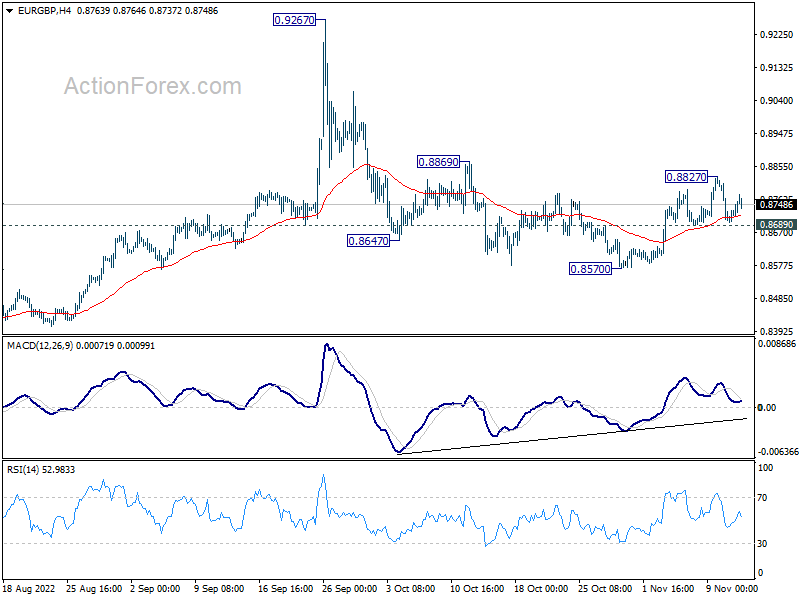
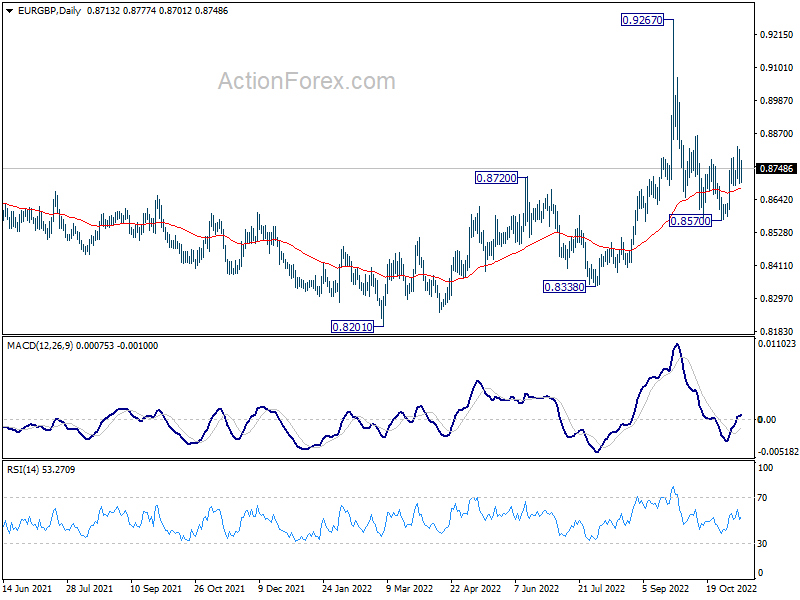
In the bigger picture, current development suggests that fall from 0.9267 is a down leg inside long term range pattern. Deeper fall could be seen towards 0.8201/8338 support zone. But strong support should be seen there to bring reversal. Nevertheless, firm break of 0.8869 resistance will turn favor to the case that such decline is merely a correction in the up trend from 0.8201. That is, further rally would be seen at a later stage through 0.9267.
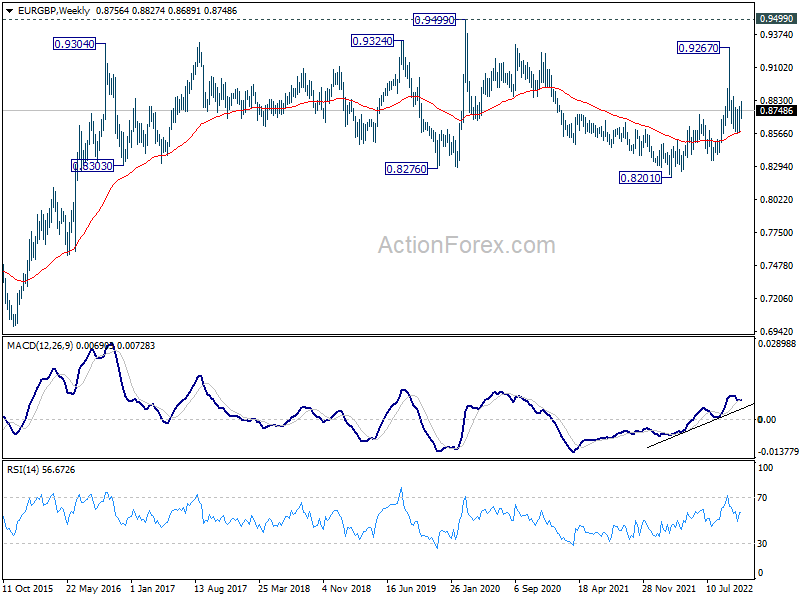
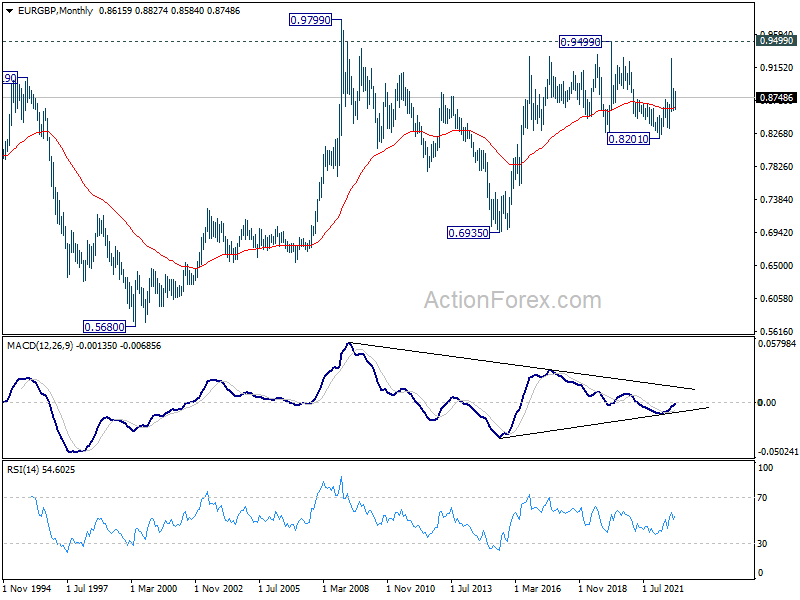
In the long term picture, long term range pattern is extending. But rise from 0.6935 (2015 low) is expected to extend at a later stage, to 0.9799 (2009 high).
EUR/AUD Weekly Outlook
EUR/AUD extended the corrective pattern from 1.5704 and outlook is unchanged. Initial bias remains neutral this week first. In case of deeper retreat, downside should be contained by 55 day EMA (now at 1.5244) to bring rebound. On the upside, break of 1.5704 will resume larger rise from 1.4281. However, sustained trading below 55 day EMA will bring deeper correction towards 1.4965 resistance turned support.
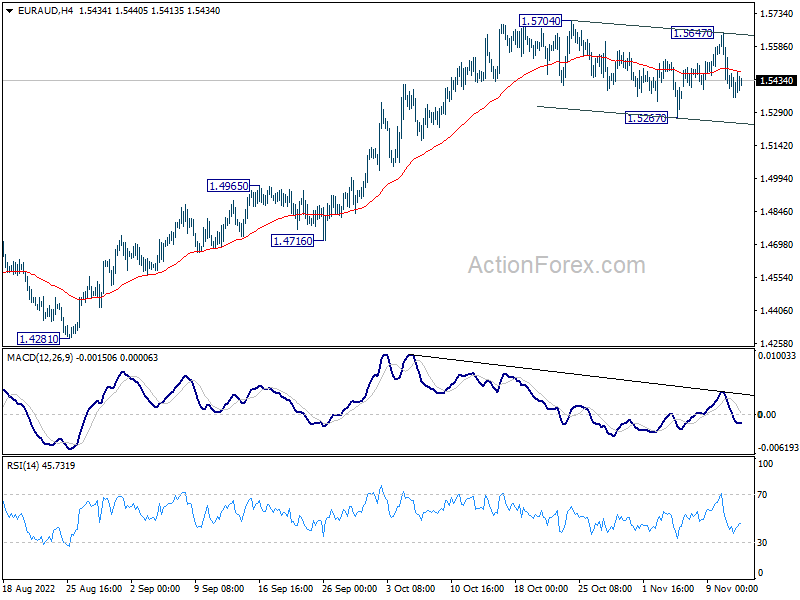
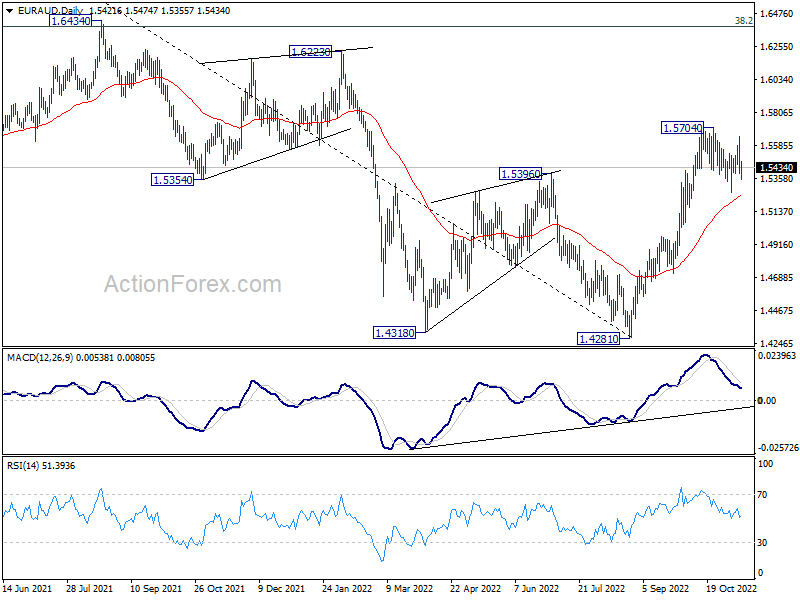
In the bigger picture, a medium term bottom should be in place at 1.4281, on bullish convergence condition in daily MACD. Further rise would be seen back to 1.6434 key resistance next. Break of 1.4965 resistance turned support is needed to indicate reversal. Otherwise, further rally will remain in favor.
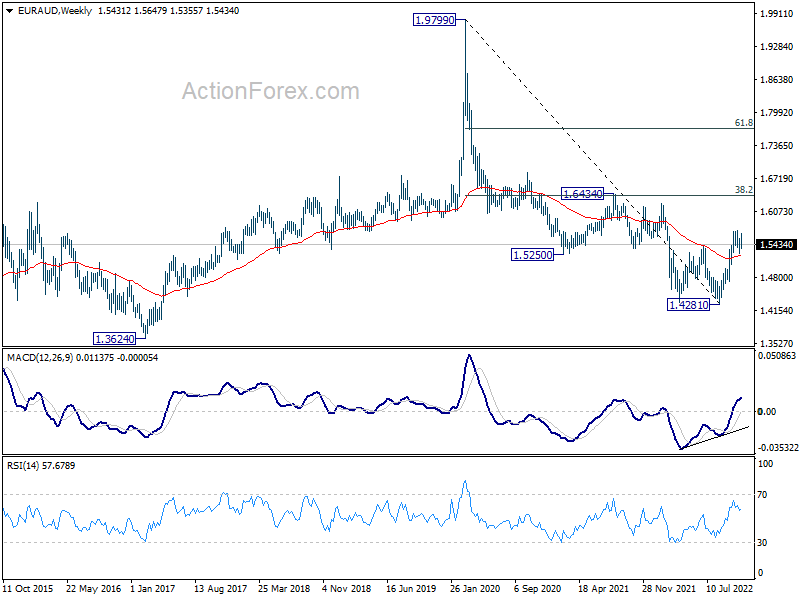
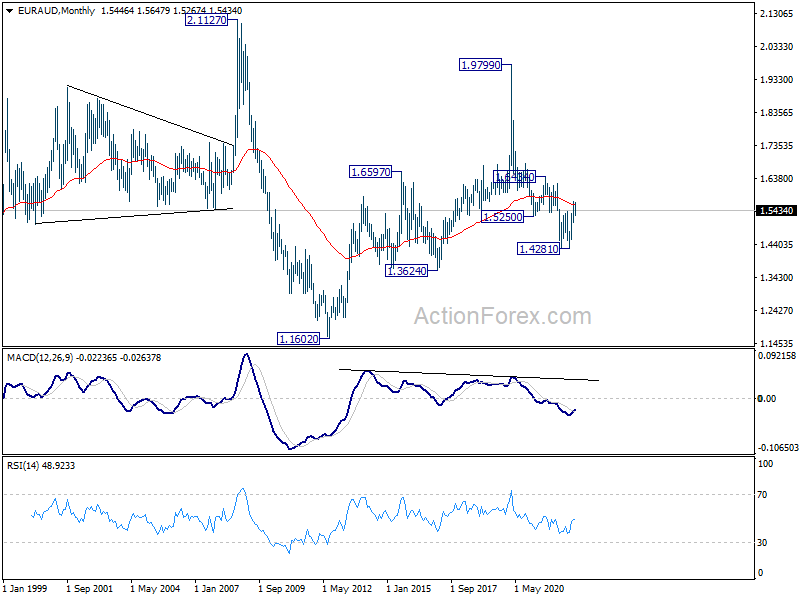
In the longer term picture, breach of 55 month EMA (now at 1.5613) raises the chance of medium term bullish reversal. Focus is back on 1.6434 cluster resistance, 38.2% retracement of 1.9799 (2020 high) to 1.4281 at 1.6389). Sustained break there will confirm and target 61.8% retracement at 1.7691.
EUR/CHF Weekly Outlook
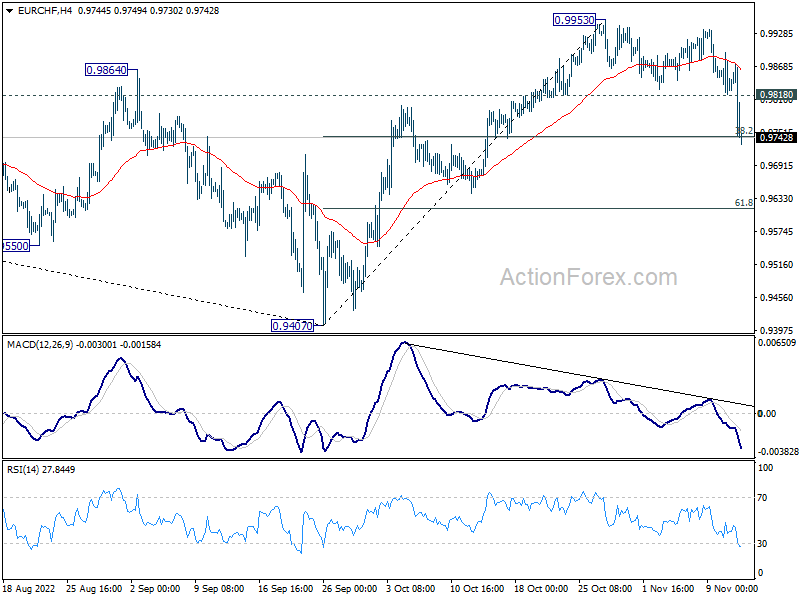
EUR/CHF's steep decline last week indicates that whole rebound from 0.9407 has completed at 0.9953, ahead of 0.9970 support turned resistance. Initial bias is now on the downside this week. Sustained break of 38.2% retracement of 0.8407 to 0.9953 will pave the way to 61.8% retracement a 0.9616, and possibly below. On the upside, though, above 0.9818 support turned resistance will turn intraday bias neutral first.
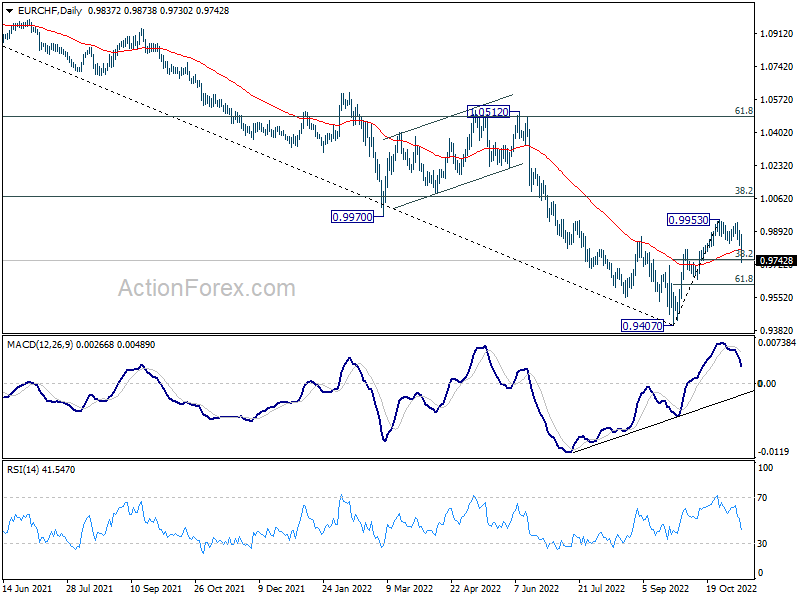
In the bigger picture, rejection by 0.9970 support turned resistance retains medium term bearishness. That is, while 0.9407 is a medium term bottom, price actions from there would develope into a corrective pattern rather than a reversal. That is, down trend resumption through 0.9407 is favored at a later stage. This will remain the favored case now, as long 38.2% retracement of 1.1149 to 0.9407 at 1.0072 holds.
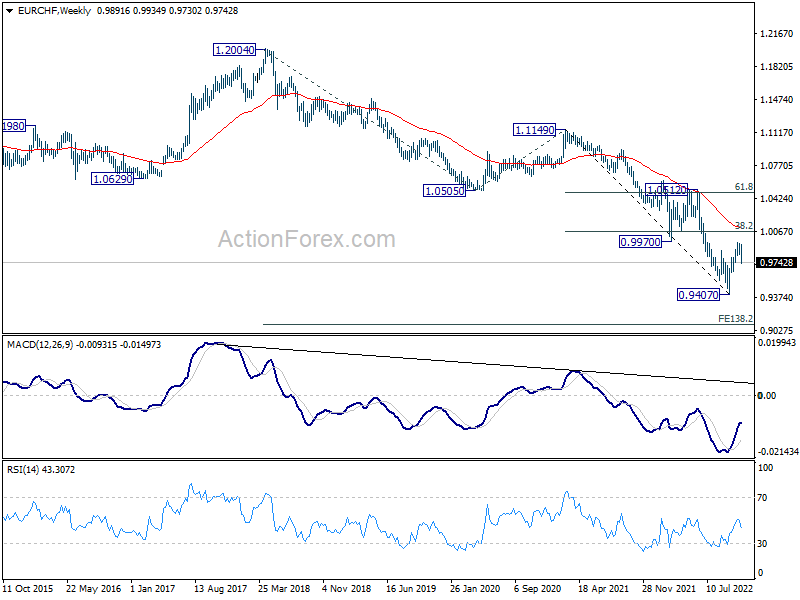
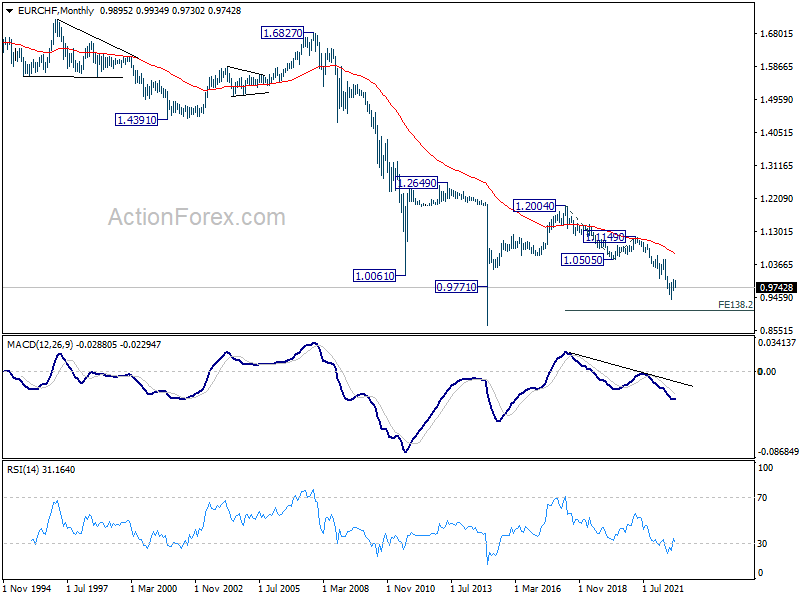
In the long term picture, capped well below 55 month EMA, EUR/CHF is seen as extending the multi-decade down trend. There is no prospect of a bullish reversal until firm break of 1.0505 support turned resistance (2020 low). In case of resumption, next target is 138.2% projection of 1.2004 to 1.0505 to 1.1149 at 0.9033.
Summary 11/14 – 11/18
Monday, Nov 14, 2022
| GMT | Ccy | Events | Consensus | Previous |
|---|---|---|---|---|
| 07:30 | CHF | Producer and Import Prices M/M Oct | 0.20% | 0.20% |
| 10:00 | EUR | Eurozone Industrial Production M/M Sep | 0.10% | 1.50% |
| 23:50 | JPY | GDP Q/Q Q3 P | 0.30% | 0.90% |
| 23:50 | JPY | GDP Deflator Y/Y Q3 P | -0.60% | -0.30% |
| 23:50 | JPY | GDP Annualized Q3 P | 1.10% | 3.50% |
| GMT | Ccy | Events | |
|---|---|---|---|
| 07:30 | CHF | Producer and Import Prices M/M Oct | |
| Forecast: 0.20% | Previous: 0.20% | ||
| 10:00 | EUR | Eurozone Industrial Production M/M Sep | |
| Forecast: 0.10% | Previous: 1.50% | ||
| 23:50 | JPY | GDP Q/Q Q3 P | |
| Forecast: 0.30% | Previous: 0.90% | ||
| 23:50 | JPY | GDP Deflator Y/Y Q3 P | |
| Forecast: -0.60% | Previous: -0.30% | ||
| 23:50 | JPY | GDP Annualized Q3 P | |
| Forecast: 1.10% | Previous: 3.50% | ||
Tuesday, Nov 15, 2022
| GMT | Ccy | Events | Consensus | Previous |
|---|---|---|---|---|
| 00:30 | AUD | RBA Meeting Minutes | ||
| 02:00 | CNY | Industrial Production Y/Y Oct | 5.20% | 6.30% |
| 02:00 | CNY | Retail Sales Y/Y Oct | 1.00% | 2.50% |
| 02:00 | CNY | Fixed Asset Investment YTD Y/Y Oct | 5.90% | 5.90% |
| 04:30 | JPY | Industrial Production M/M Sep F | -1.60% | -1.60% |
| 07:00 | GBP | Claimant Count Change Oct | -12.6K | 25.5K |
| 07:00 | GBP | Unemployment Rate (3M) Sep | 3.50% | 3.50% |
| 07:00 | GBP | Average Earnings Excluding Bonus 3M/Y Sep | 5.60% | 5.40% |
| 07:00 | GBP | Average Earnings Including Bonus 3M/Y Sep | 6.00% | 6.00% |
| 10:00 | EUR | Eurozone Trade Balance (EUR) Sep | -39.4B | -47.3B |
| 10:00 | EUR | Eurozone GDP Q/Q Q3 P | 0.20% | 0.20% |
| 10:00 | EUR | Eurozone Employment Change Q/Q Q3 P | 0.30% | 0.40% |
| 10:00 | EUR | Germany ZEW Economic Sentiment Nov | -54.1 | -59.2 |
| 10:00 | EUR | Germany ZEW Current Situation Nov | -67.5 | -72.2 |
| 10:00 | EUR | Eurozone ZEW Economic Sentiment Nov | -55 | -59.7 |
| 13:30 | CAD | Manufacturing Sales M/M Sep | -0.50% | -2.00% |
| 13:30 | CAD | Wholesale Sales M/M Sep | -0.20% | 1.40% |
| 13:30 | USD | Empire State Manufacturing Index Nov | -7 | -9.1 |
| 13:30 | USD | PPI M/M Oct | 0.50% | 0.40% |
| 13:30 | USD | PPI Y/Y Oct | 8.30% | 8.50% |
| 13:30 | USD | PPI Core M/M Oct | 0.40% | 0.30% |
| 13:30 | USD | PPI Core Y/Y Oct | 7.20% | 7.20% |
| 23:30 | AUD | Westpac Leading Index M/M Oct | 0.00% | |
| 23:50 | JPY | Machinery Orders M/M Sep | 0.70% | -5.80% |
| GMT | Ccy | Events | |
|---|---|---|---|
| 00:30 | AUD | RBA Meeting Minutes | |
| Forecast: | Previous: | ||
| 02:00 | CNY | Industrial Production Y/Y Oct | |
| Forecast: 5.20% | Previous: 6.30% | ||
| 02:00 | CNY | Retail Sales Y/Y Oct | |
| Forecast: 1.00% | Previous: 2.50% | ||
| 02:00 | CNY | Fixed Asset Investment YTD Y/Y Oct | |
| Forecast: 5.90% | Previous: 5.90% | ||
| 04:30 | JPY | Industrial Production M/M Sep F | |
| Forecast: -1.60% | Previous: -1.60% | ||
| 07:00 | GBP | Claimant Count Change Oct | |
| Forecast: -12.6K | Previous: 25.5K | ||
| 07:00 | GBP | Unemployment Rate (3M) Sep | |
| Forecast: 3.50% | Previous: 3.50% | ||
| 07:00 | GBP | Average Earnings Excluding Bonus 3M/Y Sep | |
| Forecast: 5.60% | Previous: 5.40% | ||
| 07:00 | GBP | Average Earnings Including Bonus 3M/Y Sep | |
| Forecast: 6.00% | Previous: 6.00% | ||
| 10:00 | EUR | Eurozone Trade Balance (EUR) Sep | |
| Forecast: -39.4B | Previous: -47.3B | ||
| 10:00 | EUR | Eurozone GDP Q/Q Q3 P | |
| Forecast: 0.20% | Previous: 0.20% | ||
| 10:00 | EUR | Eurozone Employment Change Q/Q Q3 P | |
| Forecast: 0.30% | Previous: 0.40% | ||
| 10:00 | EUR | Germany ZEW Economic Sentiment Nov | |
| Forecast: -54.1 | Previous: -59.2 | ||
| 10:00 | EUR | Germany ZEW Current Situation Nov | |
| Forecast: -67.5 | Previous: -72.2 | ||
| 10:00 | EUR | Eurozone ZEW Economic Sentiment Nov | |
| Forecast: -55 | Previous: -59.7 | ||
| 13:30 | CAD | Manufacturing Sales M/M Sep | |
| Forecast: -0.50% | Previous: -2.00% | ||
| 13:30 | CAD | Wholesale Sales M/M Sep | |
| Forecast: -0.20% | Previous: 1.40% | ||
| 13:30 | USD | Empire State Manufacturing Index Nov | |
| Forecast: -7 | Previous: -9.1 | ||
| 13:30 | USD | PPI M/M Oct | |
| Forecast: 0.50% | Previous: 0.40% | ||
| 13:30 | USD | PPI Y/Y Oct | |
| Forecast: 8.30% | Previous: 8.50% | ||
| 13:30 | USD | PPI Core M/M Oct | |
| Forecast: 0.40% | Previous: 0.30% | ||
| 13:30 | USD | PPI Core Y/Y Oct | |
| Forecast: 7.20% | Previous: 7.20% | ||
| 23:30 | AUD | Westpac Leading Index M/M Oct | |
| Forecast: | Previous: 0.00% | ||
| 23:50 | JPY | Machinery Orders M/M Sep | |
| Forecast: 0.70% | Previous: -5.80% | ||
Wednesday, Nov 16, 2022
| GMT | Ccy | Events | Consensus | Previous |
|---|---|---|---|---|
| 00:30 | AUD | Wage Price Index Q/Q Q3 | 0.90% | 0.70% |
| 04:30 | JPY | Tertiary Industry Index M/M Sep | 0.60% | 0.70% |
| 07:00 | GBP | CPI M/M Oct | 1.70% | 0.50% |
| 07:00 | GBP | CPI Y/Y Oct | 10.60% | 10.10% |
| 07:00 | GBP | Core CPI Y/Y Oct | 6.40% | 6.50% |
| 07:00 | GBP | RPI M/M Oct | 1.80% | 0.70% |
| 07:00 | GBP | RPI Y/Y Oct | 13.40% | 12.60% |
| 07:00 | GBP | PPI Input M/M Oct | 1.00% | 0.40% |
| 07:00 | GBP | PPI Input Y/Y Oct | 17.70% | 20.00% |
| 07:00 | GBP | PPI Output M/M Oct | 0.00% | 0.20% |
| 07:00 | GBP | PPI Output Y/Y Oct | 14.80% | 15.90% |
| 07:00 | GBP | PPI Core Output M/M Oct | 1.30% | 0.70% |
| 07:00 | GBP | PPI Core Output Y/Y Oct | 14.00% | 14.00% |
| 13:15 | CAD | Housing Starts Oct | 275K | 300K |
| 13:30 | CAD | CPI M/M Oct | 0.80% | 0.10% |
| 13:30 | CAD | CPI Y/Y Oct | 7.00% | 6.90% |
| 13:30 | CAD | CPI Median Y/Y Oct | 4.80% | 4.70% |
| 13:30 | CAD | CPI Trimmed Y/Y Oct | 5.30% | 5.20% |
| 13:30 | CAD | CPI Common Y/Y Oct | 5.90% | 6.00% |
| 13:30 | USD | Retail Sales M/M Oct | 0.90% | 0.00% |
| 13:30 | USD | Retail Sales ex Autos M/M Oct | 0.40% | 0.10% |
| 13:30 | USD | Import Price Index M/M Oct | -0.50% | -1.20% |
| 14:15 | USD | Industrial Production M/M Oct | 0.20% | 0.40% |
| 14:15 | USD | Capacity Utilization Oct | 80.40% | 80.30% |
| 15:00 | USD | Business Inventories Sep | 0.50% | 0.80% |
| 15:00 | USD | NAHB Housing Market Index Nov | 36 | 38 |
| 15:30 | USD | Crude Oil Inventories | 3.9M | |
| 21:45 | NZD | PPI Input Q/Q Q3 | 3.10% | |
| 21:45 | NZD | PPI Output Q/Q Q3 | 2.40% | |
| 23:50 | JPY | Trade Balance (JPY) Oct | -2.23T | -2.01T |
| GMT | Ccy | Events | |
|---|---|---|---|
| 00:30 | AUD | Wage Price Index Q/Q Q3 | |
| Forecast: 0.90% | Previous: 0.70% | ||
| 04:30 | JPY | Tertiary Industry Index M/M Sep | |
| Forecast: 0.60% | Previous: 0.70% | ||
| 07:00 | GBP | CPI M/M Oct | |
| Forecast: 1.70% | Previous: 0.50% | ||
| 07:00 | GBP | CPI Y/Y Oct | |
| Forecast: 10.60% | Previous: 10.10% | ||
| 07:00 | GBP | Core CPI Y/Y Oct | |
| Forecast: 6.40% | Previous: 6.50% | ||
| 07:00 | GBP | RPI M/M Oct | |
| Forecast: 1.80% | Previous: 0.70% | ||
| 07:00 | GBP | RPI Y/Y Oct | |
| Forecast: 13.40% | Previous: 12.60% | ||
| 07:00 | GBP | PPI Input M/M Oct | |
| Forecast: 1.00% | Previous: 0.40% | ||
| 07:00 | GBP | PPI Input Y/Y Oct | |
| Forecast: 17.70% | Previous: 20.00% | ||
| 07:00 | GBP | PPI Output M/M Oct | |
| Forecast: 0.00% | Previous: 0.20% | ||
| 07:00 | GBP | PPI Output Y/Y Oct | |
| Forecast: 14.80% | Previous: 15.90% | ||
| 07:00 | GBP | PPI Core Output M/M Oct | |
| Forecast: 1.30% | Previous: 0.70% | ||
| 07:00 | GBP | PPI Core Output Y/Y Oct | |
| Forecast: 14.00% | Previous: 14.00% | ||
| 13:15 | CAD | Housing Starts Oct | |
| Forecast: 275K | Previous: 300K | ||
| 13:30 | CAD | CPI M/M Oct | |
| Forecast: 0.80% | Previous: 0.10% | ||
| 13:30 | CAD | CPI Y/Y Oct | |
| Forecast: 7.00% | Previous: 6.90% | ||
| 13:30 | CAD | CPI Median Y/Y Oct | |
| Forecast: 4.80% | Previous: 4.70% | ||
| 13:30 | CAD | CPI Trimmed Y/Y Oct | |
| Forecast: 5.30% | Previous: 5.20% | ||
| 13:30 | CAD | CPI Common Y/Y Oct | |
| Forecast: 5.90% | Previous: 6.00% | ||
| 13:30 | USD | Retail Sales M/M Oct | |
| Forecast: 0.90% | Previous: 0.00% | ||
| 13:30 | USD | Retail Sales ex Autos M/M Oct | |
| Forecast: 0.40% | Previous: 0.10% | ||
| 13:30 | USD | Import Price Index M/M Oct | |
| Forecast: -0.50% | Previous: -1.20% | ||
| 14:15 | USD | Industrial Production M/M Oct | |
| Forecast: 0.20% | Previous: 0.40% | ||
| 14:15 | USD | Capacity Utilization Oct | |
| Forecast: 80.40% | Previous: 80.30% | ||
| 15:00 | USD | Business Inventories Sep | |
| Forecast: 0.50% | Previous: 0.80% | ||
| 15:00 | USD | NAHB Housing Market Index Nov | |
| Forecast: 36 | Previous: 38 | ||
| 15:30 | USD | Crude Oil Inventories | |
| Forecast: | Previous: 3.9M | ||
| 21:45 | NZD | PPI Input Q/Q Q3 | |
| Forecast: | Previous: 3.10% | ||
| 21:45 | NZD | PPI Output Q/Q Q3 | |
| Forecast: | Previous: 2.40% | ||
| 23:50 | JPY | Trade Balance (JPY) Oct | |
| Forecast: -2.23T | Previous: -2.01T | ||
Thursday, Nov 17, 2022
| GMT | Ccy | Events | Consensus | Previous |
|---|---|---|---|---|
| 00:30 | AUD | Employment Change Oct | 15.0K | 0.9K |
| 00:30 | AUD | Unemployment Rate Oct | 3.50% | 3.50% |
| 07:00 | CHF | Trade Balance (CHF) Oct | 4.0B | |
| 09:00 | EUR | Italy Trade Balance (EUR) Sep | -9.57B | |
| 10:00 | EUR | Eurozone CPI Y/Y Oct F | 10.70% | 10.70% |
| 10:00 | EUR | Eurozone CPI Core Y/Y Oct F | 5.00% | 5.00% |
| 13:30 | USD | Building Permits Oct | 1.52M | 1.56M |
| 13:30 | USD | Housing Starts Oct | 1.42M | 1.44M |
| 13:30 | USD | Initial Jobless Claims (Nov 11) | 220K | 225K |
| 13:30 | USD | Philadelphia Fed Survey Nov | -6 | -8.7 |
| 15:30 | USD | Natural Gas Storage | 79B | |
| 23:30 | JPY | National CPI Core Y/Y Oct | 3.50% | 3.00% |
| GMT | Ccy | Events | |
|---|---|---|---|
| 00:30 | AUD | Employment Change Oct | |
| Forecast: 15.0K | Previous: 0.9K | ||
| 00:30 | AUD | Unemployment Rate Oct | |
| Forecast: 3.50% | Previous: 3.50% | ||
| 07:00 | CHF | Trade Balance (CHF) Oct | |
| Forecast: | Previous: 4.0B | ||
| 09:00 | EUR | Italy Trade Balance (EUR) Sep | |
| Forecast: | Previous: -9.57B | ||
| 10:00 | EUR | Eurozone CPI Y/Y Oct F | |
| Forecast: 10.70% | Previous: 10.70% | ||
| 10:00 | EUR | Eurozone CPI Core Y/Y Oct F | |
| Forecast: 5.00% | Previous: 5.00% | ||
| 13:30 | USD | Building Permits Oct | |
| Forecast: 1.52M | Previous: 1.56M | ||
| 13:30 | USD | Housing Starts Oct | |
| Forecast: 1.42M | Previous: 1.44M | ||
| 13:30 | USD | Initial Jobless Claims (Nov 11) | |
| Forecast: 220K | Previous: 225K | ||
| 13:30 | USD | Philadelphia Fed Survey Nov | |
| Forecast: -6 | Previous: -8.7 | ||
| 15:30 | USD | Natural Gas Storage | |
| Forecast: | Previous: 79B | ||
| 23:30 | JPY | National CPI Core Y/Y Oct | |
| Forecast: 3.50% | Previous: 3.00% | ||
Friday, Nov 18, 2022
| GMT | Ccy | Events | Consensus | Previous |
|---|---|---|---|---|
| 07:00 | GBP | Retail Sales M/M Oct | 0.30% | -1.40% |
| 07:00 | GBP | Retail Sales Y/Y Oct | -6.90% | |
| 07:00 | GBP | Retail Sales ex-Fuel M/M Oct | -1.50% | |
| 07:00 | GBP | Retail Sales ex-Fuel Y/Y Oct | -6.20% | |
| 13:30 | CAD | Industrial Product Price M/M Oct | 0.20% | 0.10% |
| 13:30 | CAD | Raw Material Price Index Oct | -1.00% | -3.20% |
| 15:00 | USD | Existing Home Sales Oct | 4.36M | 4.71M |
| GMT | Ccy | Events | |
|---|---|---|---|
| 07:00 | GBP | Retail Sales M/M Oct | |
| Forecast: 0.30% | Previous: -1.40% | ||
| 07:00 | GBP | Retail Sales Y/Y Oct | |
| Forecast: | Previous: -6.90% | ||
| 07:00 | GBP | Retail Sales ex-Fuel M/M Oct | |
| Forecast: | Previous: -1.50% | ||
| 07:00 | GBP | Retail Sales ex-Fuel Y/Y Oct | |
| Forecast: | Previous: -6.20% | ||
| 13:30 | CAD | Industrial Product Price M/M Oct | |
| Forecast: 0.20% | Previous: 0.10% | ||
| 13:30 | CAD | Raw Material Price Index Oct | |
| Forecast: -1.00% | Previous: -3.20% | ||
| 15:00 | USD | Existing Home Sales Oct | |
| Forecast: 4.36M | Previous: 4.71M | ||
Week Ahead – Moment of Truth
After a round of soft inflation data triggered a buy-everything relief rally, Wall Street will focus on Fed speak and a plethora of data points that might show the economy remains resilient. The key economic readings include manufacturing activity, retail sales, and housing data.
There will be no shortage of appearances by the Fed this week. Brainard and Williams speak on Monday, while Tuesday includes speeches by Harker, Cook, and Barr. Wednesday brings Williams, Barr, and Waller, and on Thursday we will hear from Bullard, Bowman, Mester, Jefferson, and Kashkari.
In addition to a swathe of economic releases, traders will also closely monitor big retail earnings from Walmart, Target, Macy’s, and Kohl’s. We should learn more about the health of the consumer and if we should expect a further easing of prices as we enter the holiday season.
EU
It’s a relatively quiet week for the EU with the two standout economic releases being flash GDP and final HICP. With the economy facing a recession, the GDP data will be an interesting insight into how quickly growth is slowing going into an uncertain winter. The inflation data will naturally be of interest but it may take a significant revision to really grab investors’ attention.
The Autumn statement has been a long time coming, it feels. The markets have calmed down a lot since the ridiculous mini-budget but it will still take time for the government to regain credibility and the confidence of the markets. It starts next week and all eyes will be on Parliament as we learn how the new government plans to balance the books while not piling more misery on the economy.
The BoE monetary policy report hearing next week is another highlight but there’s also a lot of economic data due. The path for interest rates remains uncertain so it’s not just what policymakers have to say that matters, it’s whether the data allows them to slow the pace of tightening going forward as they so clearly want to do. CPI on Thursday is the obvious highlight but there’s plenty more throughout the week.
Russia
A quiet week with no economic data of note.
South Africa
Another quiet week with the only economic release being retail sales on Wednesday.
Turkey
No major economic releases next week, with investors still focused on the central bank and inflation.
Switzerland
Tier three data dominate next week. Focus remains on what the SNB will do in December, with Chair Jordan acknowledging on Friday that monetary policy isn’t restrictive enough to bring inflation back into the range of price stability over the medium term. The risk of a pre-meeting rate hike remains.
Weeks of speculation around China’s commitment to its zero-Covid policy have spurred a recovery in local stocks and we may be about to get more information on what that will entail. A relaxation of quarantine measures has been announced in recent days and a press briefing is now reportedly scheduled for Saturday. At the same time, China is seeing a steady rise in Covid cases resulting in more restrictions and mass testing.
China’s October retail sales, industrial production, and investment data will be released next week. The PBOC is also expected to keep its one-year medium-term lending facility rate at 2.75% in November.
India
A key inflation report could show pricing pressures are easing which might allow the RBI to be less aggressive with its tightening path. Headline inflation is expected to ease from 7.4% to 6.7%.
Australia & New Zealand
The focus for both Australia and New Zealand might stay on China and their weakening outlook due to their struggles with COVID.
Australian employment data is expected to show job growth continues, while unemployment remains at 3.5%. Wage pressures in the third quarter are expected to rise, but some of that is attributed to the increase in the minimum wage.
In New Zealand house sales data and producer prices will be released.
Japan
Japan’s third-quarter GDP reading is expected to show significant weakness as import costs skyrocketed. Japan’s core inflation is also expected to surge from 3.0% to 3.5%, which should clearly weigh on consumer spending. Given the weakness in the US dollar, the BOJ might save its ammunition and hold off intervening anymore in the foreign exchange market.
Singapore
It is expected to be a quiet week with the exception of non-oil domestic export data.
Economic Calendar
Sunday, Nov. 13
Economic Data/Events
- China medium-term lending
- The ASEAN summit concludes in Cambodia.
Monday, Nov. 14
Economic Data/Events
- Eurozone industrial production
- India trade, CPI, wholesale prices
- New Zealand performance services index
- Fed’s Williams moderates a panel at the Economic Club of New York
- ECB’s Fabio Panetta speaks in Florence
- ECB’s de Guindos speaks in Frankfurt.
- BOJ announces the outright purchase amount of Japanese government securities
Tuesday, Nov. 15
Economic Data/Events
- US empire manufacturing, PPI
- France CPI
- Poland CPI
- Eurozone GDP
- Hungary GDP
- Canada existing home sales
- China retail sales, industrial production, surveyed jobless
- France unemployment
- Germany ZEW survey expectations
- Japan industrial production, GDP
- Mexico international reserves
- New Zealand home sales, net migration
- South Korea export/import price index, money supply
- UK jobless claims, unemployment
- G-20 summit in Bali
- IEA monthly oil market report
- ECB’s Elderson speaks
- Fed’s Harker speaks at GIC Annual Monetary & Trade Conference
- Former US President Trump is due to make an announcement in Florida
- RBA releases minutes of its November interest rate meeting
Wednesday, Nov. 16
Economic Data/Events
- US business inventories, cross-border investment, retail sales, industrial production
- Australia leading index
- Canada CPI, housing starts
- China property prices
- Israel GDP
- Italy CPI
- Japan machinery orders, tertiary index, department store sales
- Philippines Bloomberg economic survey
- Russia GDP
- South Africa retail sales
- UK CPI
- EIA crude oil inventory report
- G-20 summit in Bali
- BOE Gov Bailey appears before the Treasury committee
- Fed’s Williams and Brainard, SEC’s Gensler speak at the 2022 Treasury Market conference
- ECB Financial Stability Review
- ECB President Lagarde speaks
- ECB’s Fabio Panetta speaks
Thursday, Nov. 17
Economic Data/Events
- US housing starts, initial jobless claims
- Italy trade
- Singapore trade
- Australia unemployment
- China Swift payments
- Eurozone CPI, new car registrations
- Hong Kong jobless rate
- Japan exports, trade balance
- New Zealand PPI
- Singapore non-oil exports
- UK fiscal statement, economic forecasts
- Fed’s Kashkari and Jefferson speak at the Federal Reserve Bank of Minneapolis Fall Institute Research Conference
- Fed’s Mester speaks at the Federal Reserve Bank of Cleveland and the Office of Financial Research Annual Financial Stability Conference
- Fed’s Evans speaks ahead of his retirement
- BOE’s Silvana Tenreyro speaks
- SNB’s Maechler speaks at Money Market Event in Geneva
- BOE’s Huw Pill speaks at the Bristol Festival of Economics on ‘What Next for Central Banks’
Friday, Nov. 18
Economic Data/Events
- US Conference Board leading index, existing home sales
- Norway GDP
- Japan CPI
- Thailand foreign reserves, forward contracts, car sales
- ECB President Lagarde, Nagel, and Knot speak alongside BOE’s Mann Fed’s Collins speaks at the Federal Reserve Bank of Boston Economic Conference
- BOE’s Jonathan Haskel speaks
Sovereign Rating Updates
- Italy (Fitch)
- Sweden (Fitch)
- Turkey (Fitch)
- Ireland (S&P)
- South Africa (S&P)
- Portugal (Moody’s)
- South Africa (Moody’s)
- Denmark (DBRS)
Research US – Inflation Risks Are Not Over Yet
- While markets have reacted very positively to the October CPI print, we continue to see further risks of more persistent inflation and think it is too early to trade a clear Fed pivot.
- Still elevated underlying price growth, tight labour markets, inflationary market reaction and China reopening risks all favour remaining cautious on inflation.
- The figures challenge our hawkish call for a 75bp hike in December, but Fed's focus remains on terminal rate level and maintaining financial conditions restrictive. Slower hiking pace could extend the cycle further into 2023.
The details of the CPI release were mixed. Admittedly, the recent uptick in oil prices and lagged rise in shelter inflation contributed positively to the CPI, which means that the headline figures partly understate the slowdown in inflation in October. That said, over half of the negative contribution from core goods CPI was explained by a 2.4% drop in used car prices, which have not been a key inflationary driver since late 2021. Similarly, majority of the decline in services CPI ex. shelter was explained by an unexpected drop in health care prices. Dallas Fed estimates that lagged impact from past wage rises should continue to lift health care prices well into 2023, suggesting that the drop might have been a one-off.
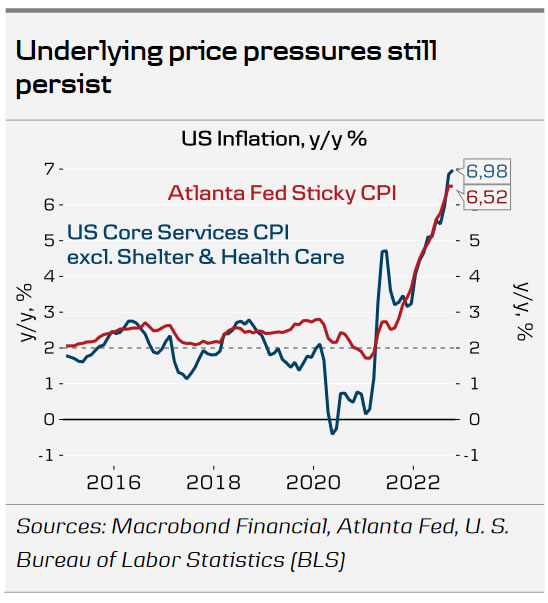
Excluding shelter and healthcare, core services prices rose 0.49% m/m, or around 6% annualized. In line, Atlanta Fed's sticky price inflation remained at 5.5% annualized m/m. Together with the September uptick in job openings and October rise in wage inflation, broad-based price pressures remain way too high for the Fed to feel comfortable yet.
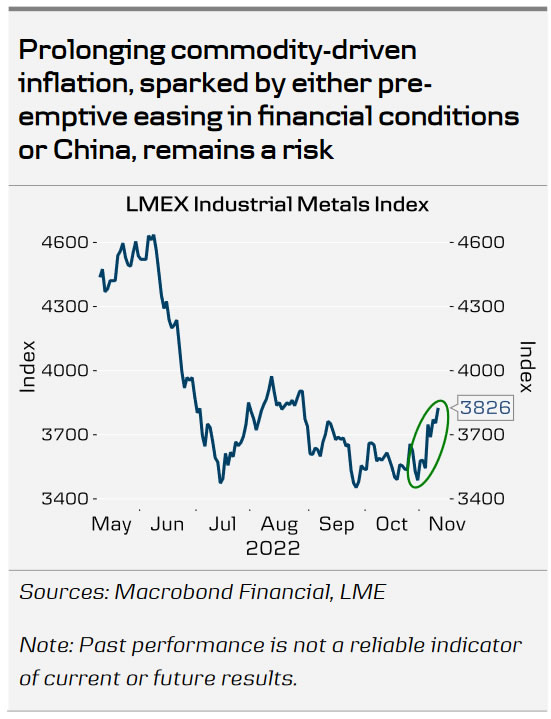
Another challenge for the Fed is the inflationary nature of the market reaction. Lower real yields, weaker USD and higher commodity prices reflect easing financial conditions. If Fed, over the coming days, clearly communicates more dovish rates outlook, they risk fuelling the market rally and prolonging inflation. This is exactly what Powell sought to avoid just last week (see our Fed Review for details, 2 November), and also, why we think the Fed is unlikely to give strong signals for lower terminal rate following just one low CPI print. Back in August, the market reaction only lasted 3 days after a downside CPI surprise.
In addition, the early signs of easing Covid-strategy in China are increasing the inflationary risks for the Western economies. While we remain sceptical that a near-term reversal in the policy stance is imminent, it could gradually progress towards 2023, and the recovering demand from China could provide another boost to global commodity markets. Copper prices have already risen from recent lows and especially the already tight energy markets remain vulnerable to further price upticks.
Even though inflation has likely rolled over its peak, risk of prolonging elevated inflation still persists. Cost of overtightening the economy into a recession is still lower than allowing inflation to become entrenched, and as before, Fed's focus remains on the terminal rate and maintaining financial conditions restrictive towards next year. Our hawkish call for a 75bp hike in December is under clear pressure, but we think that if Fed prefers to moderate the pace of hikes to 50, the hiking cycle could extend well into 2023.
BoE Tenreyro expects rate to be steady at 3% over 2023
BoE MPC member Silvana Tenreyro said, "I would expect that Bank Rate held at 3% over 2023 would reduce output further below potential, given the effects of lower real incomes and the lagged impact of the tightening to date."
"Policy would then have to loosen, perhaps in 2024, to try to prevent inflation falling below target," she added.
"Monetary policy has tightened significantly this year, but most of its effects on demand have yet to occur," she said. "Too high a path for Bank Rate therefore risks over-steering inflation below target in the medium term."
Tenreyro is a known dove, who voted for just a 25bps hike at last meeting, while the majority voted for a 75bps hike.
Is the Japanese Yen Setting Up for a Trend Reversal?
Interest rate differentials have crushed the Japanese yen. The currency is down 18% against the US dollar this year, sinking to its lowest levels in three decades. However, there is light at the end of the tunnel. With the Bank of Japan opening the door for tighter policy and the government rolling out new spending just as the Fed prepares to shift into lower gear with its rate increases, this brutal downtrend seems to be approaching its conclusion.
The story so far
It’s been a stormy year for the yen, and central bank policies lie at the heart of its troubles. Every major central bank has raised interest rates to fight inflation, except for the Bank of Japan. This divergence has caused rate differentials to widen, making the yen less appealing relative to other currencies. In essence, capital is leaving Japan, searching for higher returns abroad.
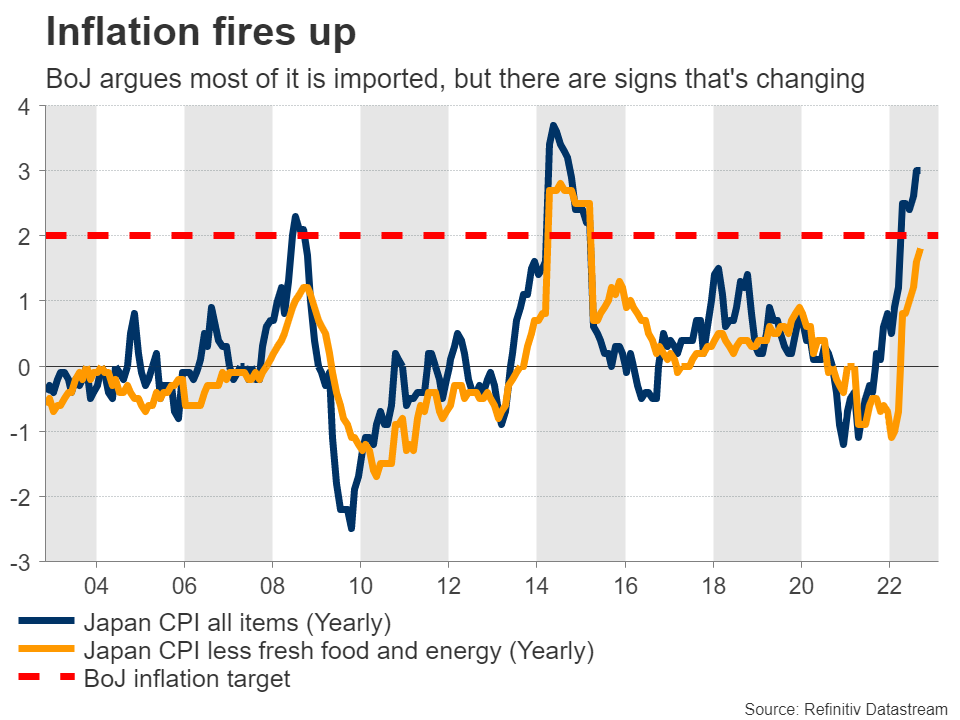
Even though inflation is running at 3%, the BoJ believes this phenomenon is mostly the product of broken supply chains and a severe energy shock, so it will fade away soon. Since wage growth and inflation expectations in Japan remain low, they argue there is little domestically-generated inflation. Therefore, it is unnecessary to raise interest rates in response.
Instead, the government has chosen to defend the currency with direct FX interventions to scare away speculators. The problem with this strategy is that it doesn’t address the source of the problem, it merely slows the bleeding. It is also quite costly as the nation has to burn through its FX reserves, and there are several ways it can backfire.
BoJ capitulates
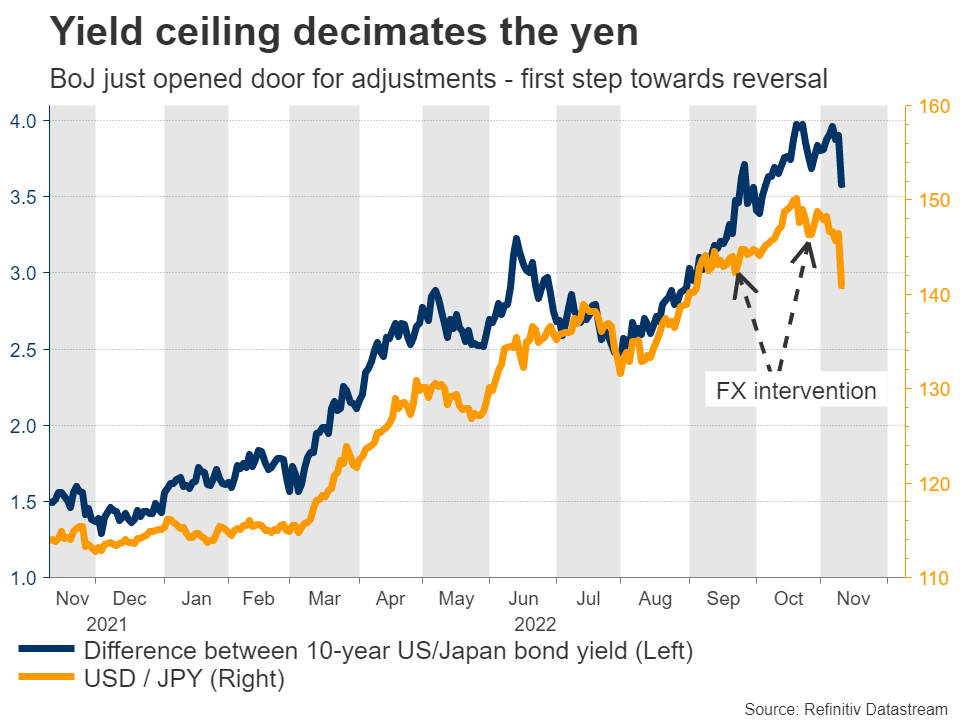
Yet, the wind of change is blowing. Last week, BoJ Governor Kuroda stated that his central bank could make its yield curve control policy “more flexible” in the future. This yield strategy has decimated the yen, so adjusting it would be the first step towards a trend reversal.
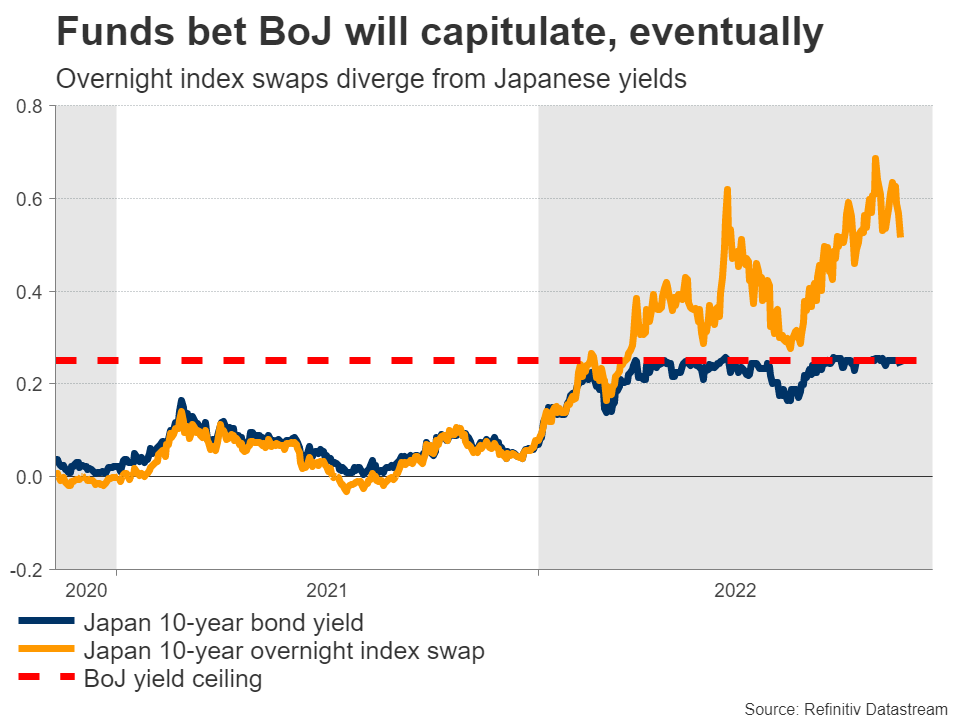
Yield curve control effectively places a ceiling on Japanese bond yields. Every time the 10-year yield attempts to cross above 0.25%, the central bank steps into the market to stop the rally. Since Japanese yields cannot rise beyond this threshold, interest rate differentials mechanically widen against the yen as foreign central banks raise rates.
The possibility of adjusting this strategy was also mentioned in the summary of opinions from the Bank of Japan’s latest meeting. Some policymakers expressed support for an eventual withdrawal of these radical policies, mainly because of signs that inflationary pressures are becoming more entrenched.
Encouraging developments
Behind this change in the BoJ’s thinking lies a shift in economic data. There are clear signs that inflationary pressures are finally broadening out into categories beyond energy, giving policymakers confidence that inflation will be more persistent. Arguing the same point, wage growth has fired up lately, although not dramatically.
Another encouraging development was the $200bn economic stimulus package that the government is about to roll out, to help ease the impact of the cost-of-living crisis on consumers and companies. Importantly, this package also includes measures to encourage companies to raise wages, which will be music to the ears of the Bank of Japan.
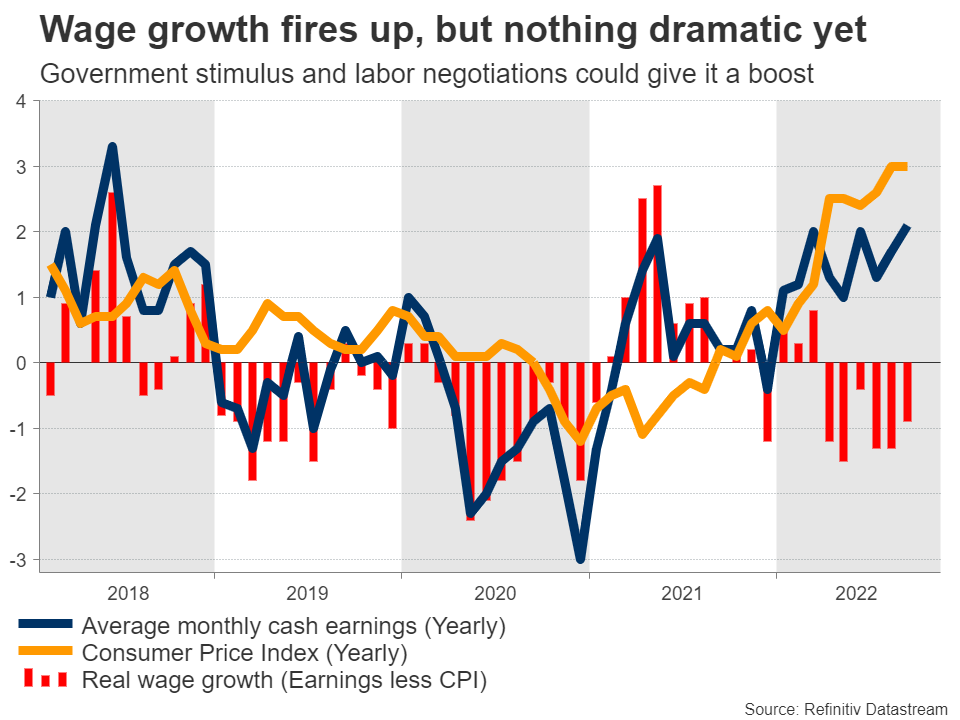
In fact, Japan’s largest labor organization agreed to seek a 5% pay increase in the upcoming spring wage negotiations, which would be the highest in nearly 25 years. Coupled with the upcoming stimulus package, wage growth could finally be on the verge of a serious acceleration. This would be crucial in convincing the BoJ to recalibrate policy.
Big picture
Overall, the outlook for the yen remains dark, but there is light at the end of this tunnel. Slowly but surely, the interest rate divergence that has crippled the currency seems to be coming to an end, with the Fed slowing down as the Bank of Japan moves towards tighter policy.
Hedge funds are betting heavily on the possibility that Japan’s yield curve control will be loosened and yields will be allowed to edge higher, something evident by the widening spread between Japan’s 10-year bond yield and overnight index swaps. However, the timing of any shift is highly uncertain and will ultimately depend on wage dynamics.
In the rest of the world, several central banks have started to slow down the pace of rate increases as they approach the end of their tightening cycles. Most important among them is the Fed, which signaled it might go down to a half-point rate increase at its next meeting in December. Incoming economic data have corroborated this prospect, taking the steam out of the dollar.
All told, picking bottoms in financial markets is notoriously difficult. While the yen could still hit new lows, the scope for further losses seems limited from here, especially with the government prepared to intervene in the FX market. Any real comeback might be a story for next year, but the yen’s fortunes have started to improve.
Week Ahead – Spotlight Turns to Pound and Non-US Data after Dollar Bruising
After another US inflation surprise, CPI data will be dominating the agenda in most other markets in the coming week, shifting the focus away somewhat from the greenback. The pound will likely attract the most attention in what will be a busy week for the United Kingdom, as apart from the economic releases, the budget statement will be watched amid lingering worries about high borrowing. Growth indicators will be important in China and Japan, while in the United States, the main highlight will be the retail sales numbers.
A slew of data and another budget for the pound
It’s been a tumultuous period for sterling these last couple of months and the coming week could again be a bumpy one. Aside from the fact that the week is jam-packed with key economic gauges, the government will unveil its much-anticipated Autumn statement. According to reports, the new chancellor, Jeremy Hunt, is planning to announce a combination of spending cuts and tax increases to fill a fiscal hole that was exacerbated by the mess created by the prior administration.
Hunt and Prime Minister Rishi Sunak will have quite a battle on their hands on Thursday to regain some economic credibility. But as long as the government’s own numbers add up and match the independent forecasts provided by the Office for Budget Responsibility, the event could be positive for the pound.
There is a danger that Hunt and Sunak go too far with their fiscal tightening, which would imply the Bank of England might not have to raise interest rates as aggressively, although this may not necessarily be bad for sterling and could even boost it.
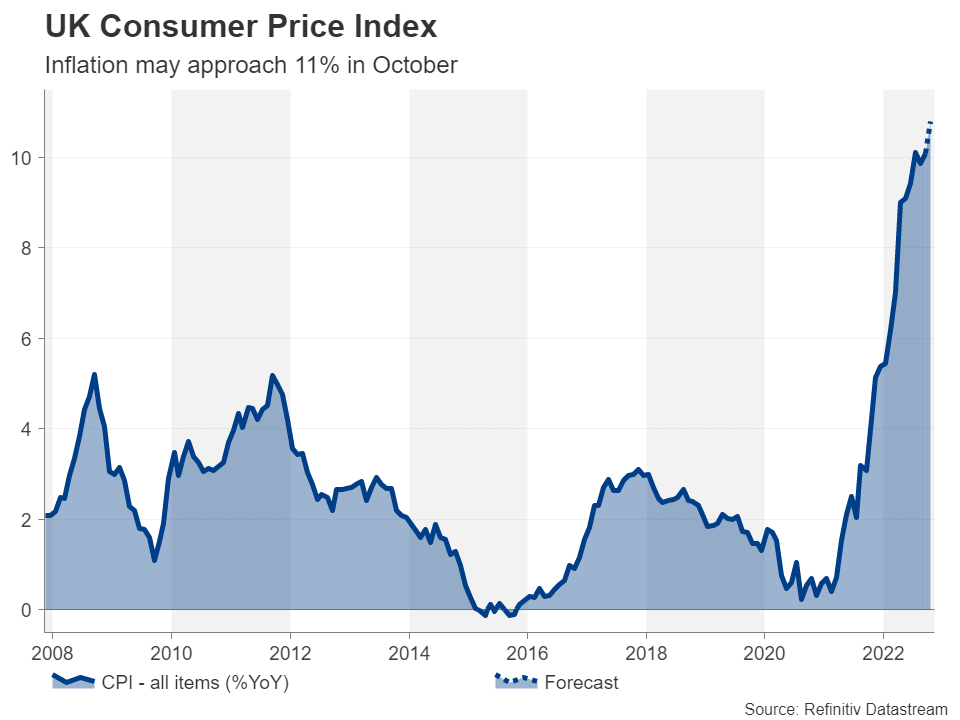
Regardless, it will be hard for the currency to ditch its clouded outlook entirely as the incoming data is expected to confirm a deteriorating economic backdrop with too high inflation. The employment report for September is up first on Tuesday, to be followed by the consumer price index for October on Wednesday. Retail sales figures will round up the week on Friday.
Few drivers for the euro
Across the channel, the euro’s recovery above parity against the US dollar might lose momentum amid mostly second-tier releases on the European calendar. Industrial production for September on Monday, quarterly employment estimates on Tuesday, alongside the second reading of Q3 GDP will all help investors get a better idea of how the Eurozone economy is riding out the energy and inflation storm. However, Thursday’s final estimate of October inflation is the only one that’s likely to spur some reaction in the euro, but only if there is an upward revision.
Otherwise, the euro will take its cues from the dollar and possibly from ECB speakers, who are growing ever more hawkish. Changes in sentiment towards the pound might also spill over to the euro given that lately, investors increasingly see the outlook for the UK and Eurozone economies being intertwined, with their fate tied to how the energy crisis will unfold.
US retail sales eyed after CPI drop
Dollar bulls suffered their biggest setback in more than six years this week after CPI inflation unexpectedly eased to below 8.0% y/y in October. A 50-basis-point rate hike by the Fed in December now seems more likely than a 75-bps one, but there could be some support for the US currency next week from the latest retail sales numbers on Wednesday.
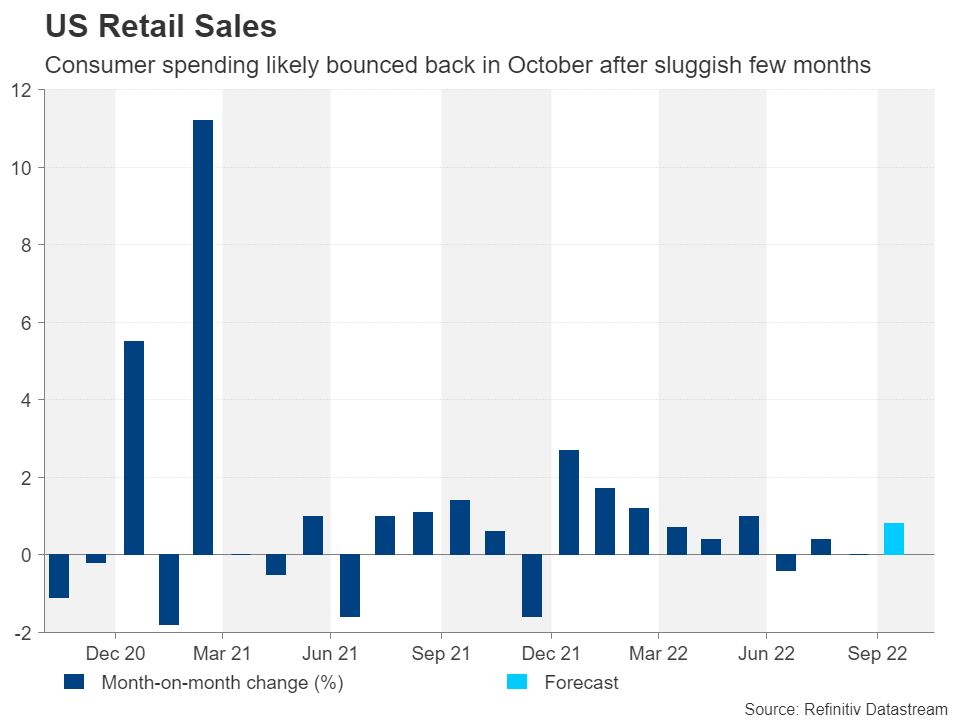
Retail sales are forecast to have bounced back by 0.8% month-on-month in October after being flat in September.
However, upbeat consumer data alone might not be enough to bolster the dollar. It’s unlikely that the other releases, which include producer prices on Tuesday, industrial production on Wednesday, and housing numbers on Thursday and Friday, will significantly brighten the picture.
But as the dollar possibly enters a prolonged phase of being stuck on the backfoot, equity markets stand a good chance of extending their gains over the coming week.
Yen on inflation alert
The battered Japanese yen has gotten off to a positive start in November and its fortunes could further improve next week.
GDP estimates out on Tuesday are expected to show the Japanese economy grew by 0.3% q/q in the third quarter – a comparatively solid clip. There will also be data on machinery orders (Wednesday) and trade (Thursday), but investors will care more about the CPI stats out on Friday.
Whilst still well below other countries, inflation in Japan has been steadily edging higher and the core measure that the Bank of Japan targets is forecast to have maintained the upward trend, climbing further above 3% in October.
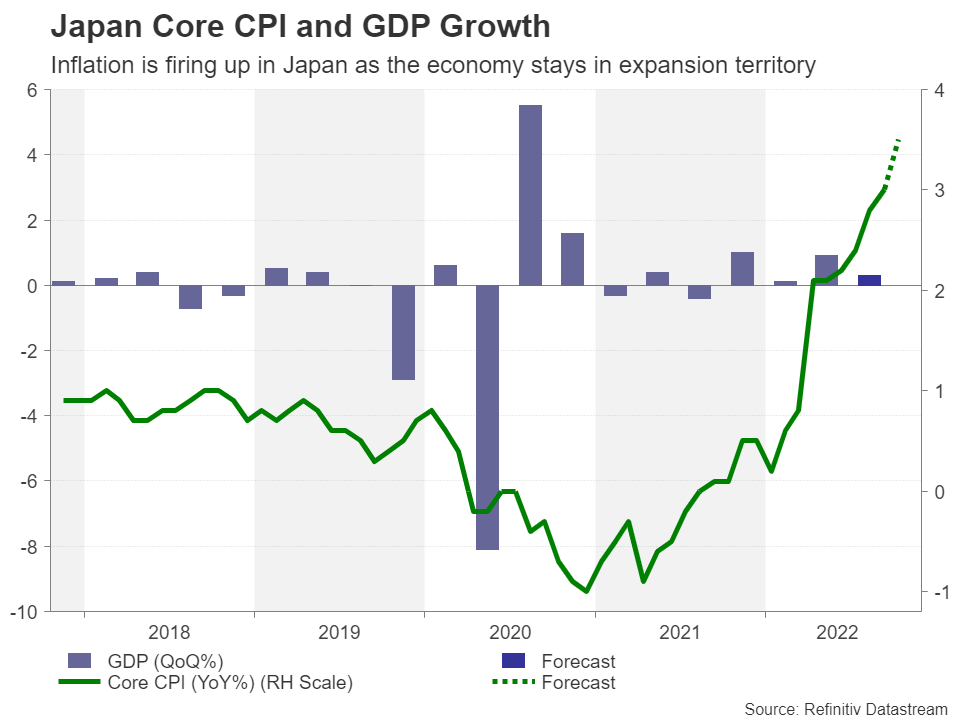
With the BoJ tepidly hinting that the time to start thinking about exiting its ultra-accommodative stance may be nearing, any upside surprises in the inflation readings going forward may fuel speculation about the timing of a policy shift by the Bank, lifting the yen.
Aussie and loonie look to domestic data as China stutters
Whilst the Japanese economy reaps the benefits of still plentiful stimulus by the BoJ, there is concern that China’s economy hasn’t been receiving enough policy support from authorities as it struggles under the weight of lockdowns and a slowly unravelling property crisis.
Industrial output and retail sales figures due Tuesday are not expected to ease slowdown concerns as a softer print is anticipated for both in October.
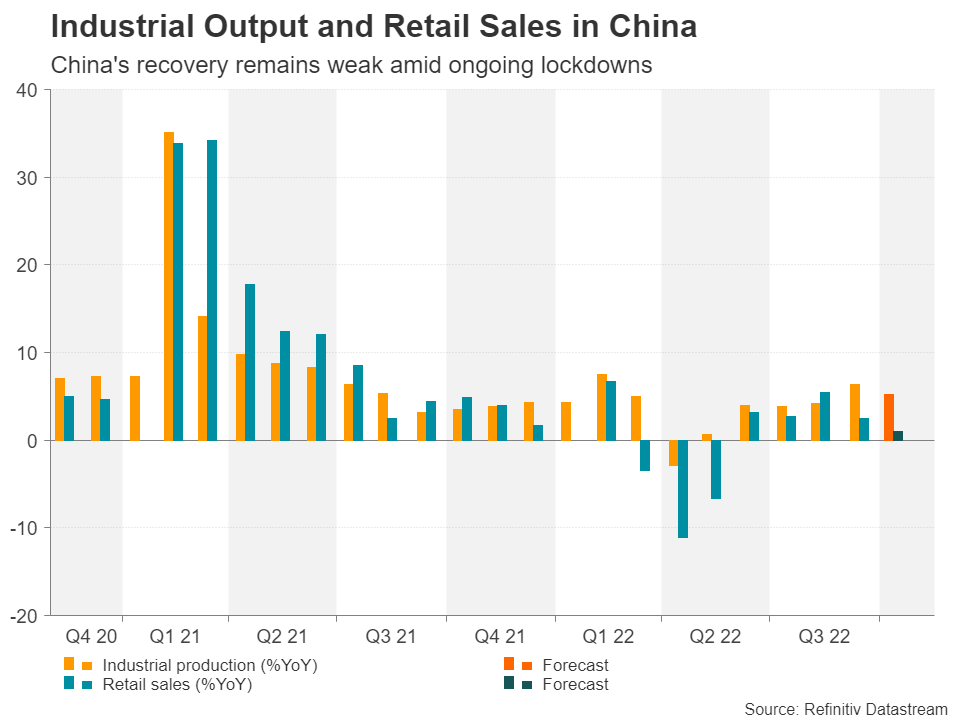
Nevertheless, hopes are high that the Chinese government will soon do away with draconian Covid restrictions so investors might not react too negatively to disappointing data.
Hence, for the China-sensitive Australian dollar, domestic indicators will probably be more crucial as investors have upped their bets lately that the Reserve Bank of Australia will keep rates on hold at its next meeting in December.
The RBA publishes the minutes of its prior meeting on Tuesday, and on Wednesday and Thursday, quarterly wage and employment numbers will be watched, respectively.
A stronger-than-expected rise in employment in October would lessen the odds of no change in rates in December, potentially boosting the aussie as it rebounds from the October lows against the greenback.
Another central bank that has recently shifted into lower gear is the Bank of Canada, although the local dollar remains one of the top performers this year.
Wednesday’s CPI report could determine if the BoC opts for a 25- or 50-bps hike at its December gathering.
Weekly Focus – Geopolitics Takes Centre Stage
The central bank 'pivot' narrative got a boost from US CPI inflation surprising on the downside, falling back to 7.7% in October amid easing core inflation pressures. Terminal rate expectations declined and markets are now pricing only a 50bp Fed hike in December, challenging our call of a 75bp increase. Equity markets rallied on the prospect of less Fed tightening and the roller-coaster moves in yields continued, with spread tightening also seen in European rates. Geopolitical headlines of Russia withdrawing from the city of Kherson added to the volatility, as did comments from a range of ECB members suggesting that the recession view is gaining ground, although in contrast to the Fed, with no slackening of the hiking pace yet in sight. The rally in Chinese equities got a boost from an easing of quarantine rules for travellers, but new infections have climbed higher especially in the manufacturing hub of Guangzhou. Commodity prices, including oil, rose more than 1% on the back of broad USD weakening. We remain sceptical that a turnaround in the strict zero-Covid stance is coming anytime soon, and continue to think EUR/USD will decline back below parity despite the most recent uptick.
As votes in the US midterm elections continue to be counted, the Republicans look likely to narrowly win the House of Representatives, but the anticipated 'Red Wave' did not materialise. Control of the Senate might not be known for weeks, as the race in Georgia goes to a December run-off. Overall, the market reaction was muted as little changes to fiscal policies are expected to result from the political gridlock, although we keep an eye on potential changes to US support for Ukraine and the upcoming debt ceiling discussions.
The EU Commission published a first proposal for overhauling the EU's fiscal rules, which would allow countries to agree more realistic debt-reduction paths with Brussels, while creating extra space for public investment. Enforcement would be tightened, with a stricter regime for countries that face 'substantial' public debt challenges, but an agreement before mid-2023 seems unlikely.
A busy week awaits on the geopolitical front, creating the backdrop for volatile markets. On Tuesday Indonesia will host the first G20 leaders' meeting after Russia's invasion of Ukraine. It has been confirmed that Russian President Putin will not attend in person, though he is planning a virtual participation in one of the meetings, in an encouraging sign that some level of dialogue between Western and Russian leaders continues. President Xi and Biden are also set to meet for their first face-to face meeting. Securing 'guardrails' on the Taiwan issue could be the most important topic, while we also look out for comments from Xi about his opposition to using nuclear weapons. In China we have a policy rate decision and a cut cannot be ruled out, as a range of 'hard data' will probably confirm that Covid uncertainty continues to dampen demand. In the UK, we look forward to the Chancellor's Autumn Statement on Thursday, where PM Sunak's government will spell out its fiscal plans. It is widely expected to include tax increases across the board to fill up the hole of approximately GBP 50bn in the UK's public finances, while October inflation numbers could take another big jump up. In the US, retail sales for October will reveal how well consumer spending is holding up amid high inflation.