

Sample Category Title
Fed George urges steady and deliberate approach to raising policy rate
Kansas City Fed President Esther George said yesterday, "I continue to see several advantages for a steady and deliberate approach to raising the policy rate."
"Without question, monetary policy must respond decisively to high inflation to avoid embedding expectations of future inflation," she said. "A more measured approached to rate increases may be particularly useful as policymakers judge the economy's response to higher rates".
"As the tightening cycle continues, now is a particularly important time to avoid unduly contributing to financial market volatility, especially as volatility stresses market liquidity with the potential to complicate balance sheet run-off plans," George said.
"The degree of tightening necessary will only be determined by observing the dynamics of the economy and inflation and cannot be predetermined by theory or pre-pandemic benchmarks," George said.
Fed Mester: There continue to be some upside risks to inflation forecast
Cleveland Fed President Loretta Mester yesterday's October CPI report "suggests some easing in overall and core inflation." However, "there continue to be some upside risks to the inflation forecast." She expects to see a "meaningful" decrease in inflationary pressures next year and after, with CPI back to 2% target by 2025.
"Given the current level of inflation, its broad-based nature, and its persistence, I believe monetary policy will need to become more restrictive and remain restrictive for a while in order to put inflation on a sustainable downward path to 2%," she said.
"Despite the moves we have made so far, given that inflation has consistently proven to be more persistent than expected and there are significant costs of continued high inflation, I currently view the larger risks as coming from tightening too little."
Fed Daly: One month does not a victory make
San Francisco Fed President Mary Daly said yesterday that the slowdown in inflation was "goods news". Yet, "one month does not a victory make."
"We have to be resolute to bring inflation down; we're united in that commitment," she said. "It's raising the rate and then holding it for a length of time that is sufficient to bring inflation reliably back to 2%."
"I would rather move a little bit higher and have to come back then to move a little bit less high and to then tell people we're going to go higher, because at some point it does seep into inflation expectations," Daly said.
At the same time, she said, "I don't want to be over tightening to the point where we throw the economy into a sharp recession, but if we are talking about a rate hike on either side, I want to fully get inflation sustainably down to 2% on average."
Cliff Notes: Conflicting Forces for Sentiment
Key insights from the week that was.
This week delivered a very weak update for Australian consumer sentiment, highlighting the impact of declining real income and high interest rates. In stark contrast however, market confidence surged in the US today following a better-than-expected CPI print and a broadly neutral outcome in Tuesday’s mid-term elections.
Beginning in Australia, the Westpac-MI Consumer Sentiment survey reported a sharp decline in confidence, the headline index down 6.9% in November. It’s clear that inflation, having reached 7.3%yr at September 2022, and interest rates remain the key issues weighing on the minds of consumers. At 78.0, the headline index has sunk below GFC-era pessimism, suggesting that the cost-of-living pressures facing households will have a material impact on real spending capacity into year-end.
Indeed, on Christmas spending intentions, almost 40% of consumers expect to reduce spending on gifts this year – the highest proportion in the history of the series back to 2009. Consumers expect this pressure to be long-lasting too, with the ‘family finances, next 12 months’ sub-index posting a steep 11.2% fall in the month to its lowest level since 2014. Pessimism is also beginning to spread into consumer’s views on the labour market which, albeit still constructive versus the long-run average, have deteriorated markedly, unemployment expectations rising 17.8% in two months.
The labour market has been one of the few areas of support to consumers since the RBA begun hiking rates in May, but the recent shift in confidence is consistent with signs the labour market is nearing a turning point. Chief Economist Bill Evans provided a full discussion of these results and other salient themes from the survey in a video update mid-week. The outlook for inflation is also a key area of discussion in Westpac Economics’ latest Market Outlook in Conversation podcast.
NAB’s latest business survey meanwhile suggests that business conditions for Australian firms are beginning to crest as the economy slows under the weight of high inflation and rising interest rates. Down 1pt to +22, conditions are still supportive, but the strength of output growth into year-end remains an open question. Business confidence has weakened significantly, down 5pts in October to a below-average reading of 0, reflecting a deteriorating global backdrop and some signs of slowing in parts of the domestic economy.
Following these releases, RBA Deputy Governor Bullock again emphasised the need to quell inflation pressures and risks, but also growing uncertainty around the activity outlook and a desire to maintain the strength of Australia’s economy and labour market for the medium-term. Both sets of risks will be monitored closely by the RBA into 2023 as they continue to raise the cash rate further into contractionary territory – Westpac believes to a peak of 3.85% in May 2023.
Over in the US, expectations of a red wave across Congress were not met, with the Senate likely to remain divided and the new Republican majority in the House of Representatives slim. If history is a guide, Congress will therefore have limited reform capacity this term; the risks around the next debt ceiling debate, due early-2023, have also increased.
The key event for the US this week however was the release of the October CPI. After a string of upside surprises, October finally delivered a weaker-than-expected result with constructive underlying detail. Despite a rebound in energy prices and further strength in food in the month, headline prices rose ‘just’ 0.4% against a 0.6% expectation. Ex food and energy, prices rose 0.3%, half the pace of September.
Notably, the core outcome was despite another robust print for shelter which gained 0.8%, goods ex energy and food offsetting as it declined 0.4% following a flat outcome in September. Medical care service costs also declined in October, -0.6%, further reducing the significance of shelter’s gain.
Looking ahead, the mix of inflation pressures in both September and October point to a marked deceleration in end demand and consequently reduced pricing power amongst firms. As policy’s full effect is yet to be felt and the FOMC are intent on continuing to tighten into 2023, there is reason to be confident that inflation will trend lower from here. Eventually, this price trend and underlying weakness in economic activity will beget a need to ease monetary policy back to near-neutral levels. Having peaked at 4.625% in February, we anticipate 200bps of easing from early-2024 through mid-2025 to 2.625%.
Turning finally to China. This week’s data again emphasised that inflation is not a concern, with annual inflation decelerating to 2.1%yr in October, a fraction of the US’ 7.7%yr and Europe’s 10.7%yr. Price controls and the slack created by COVID-zero are factors here, but so too is the nation’s productivity and efficiency – underlying strengths which will allow authorities to keep policy accommodative as the domestic economy recovers fully from COVID-zero. Of concern though is that export demand continues to weaken, the October trade balance coming in well below expectations, albeit in line with the previous month, as exports fell 0.3%yr.
With developed-world demand to be held back by policy for an extended period, if it is to experience continued growth in trade income, increasingly China will have to depend on the geographic expansion of its export markets through Asia as well as increasing the output of disruptive industries such as electric vehicles. China’s dual circulation strategy is constructive here, reducing the need for imports and also aiding in the development of new products which can also be exported. For aggregate demand, it is not only the income received from trade that matters, but also the investment it incentivises. We suspect this wave of capacity expansion will be large in scale and long in duration.
USD/JPY Nosedives As US CPI Dips Below 8%
Key Highlights
- USD/JPY declined heavily and traded below the 145.50 support.
- A major bearish trend line is forming with resistance near 147.80 on the 4-hours chart.
- Gold price extended gains above the $1,715 and $1,720 resistance levels.
- The US CPI increased 7.7% in Oct 2022 (YoY), down from 8.2%.
USD/JPY Technical Analysis
The US Dollar started a fresh decline from the 148.50 resistance against the Japanese Yen. USD/JPY traded below the 146.50 support to start a short-term downtrend.
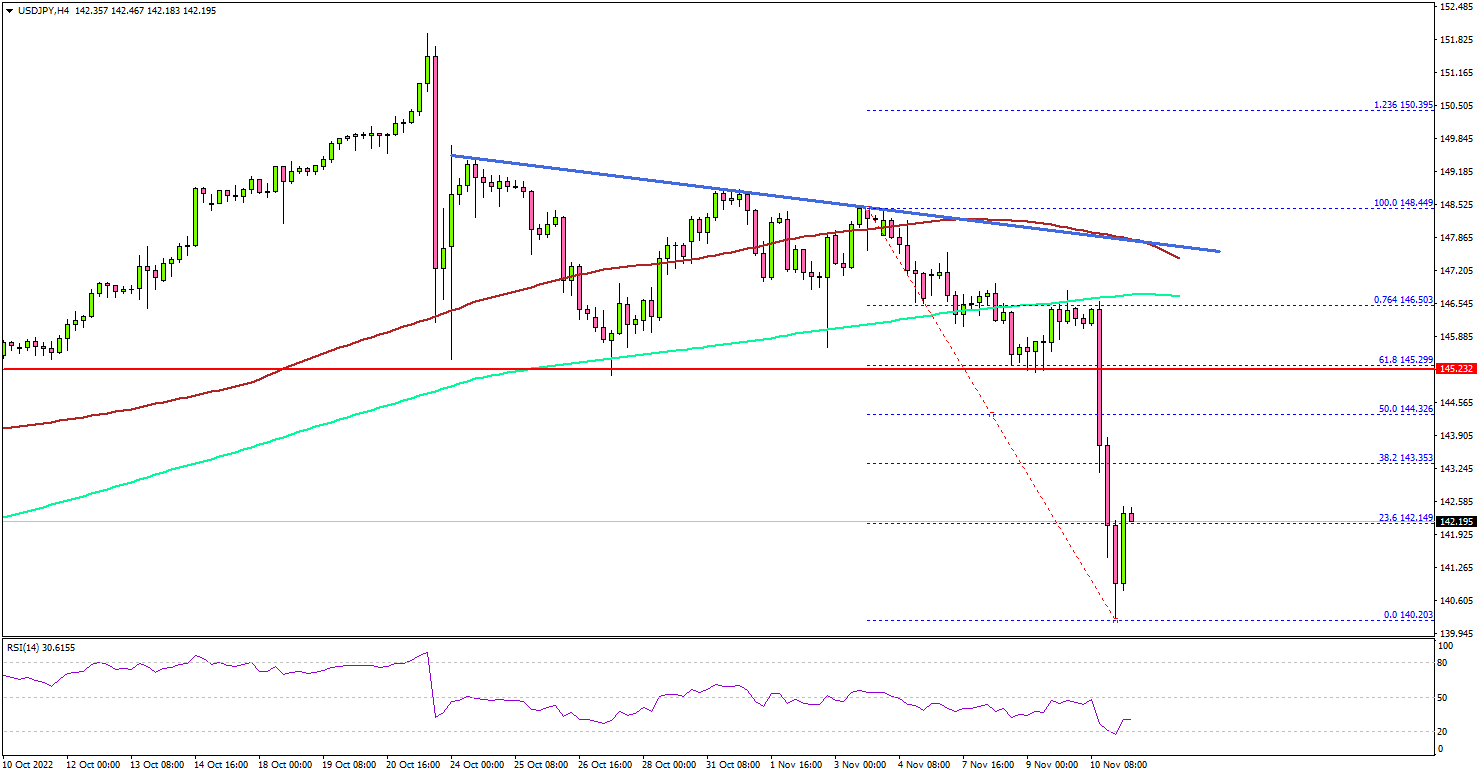
Looking at the 4-hours chart, the pair gained bearish momentum after the US CPI numbers were released. The US CPI increased 7.7% in Oct 2022 (YoY), down from 8.2%.
It triggered a sharp decline in USD/JPY below the 145.50 support zone. The pair settled well below the 145.50 support, the 100 simple moving average (red, 4-hours) plus the 200 simple moving average (green, 4-hours).
The bears were able to push the pair below the 143.20 support. The pair spiked below the 142.00 level before the bulls took a stand. On the upside, the pair could face hurdles near 142.80 level.
The next major resistance may perhaps be near 143.20. Any more gains could set the pace for a move towards the 144.50 level, above which it could even test 145.50.
An initial support is near the 141.50 level. The next major support is near the 140.40 zone. The main support sits at 140.00. A close below the 140.00 level might start another strong decline. In the stated case, USD/JPY could decline towards the 138.00 support.
Looking at gold price, there was a strong upward move above the $1,720 level and it seems like the price might even climb above the $1,750 level.
Economic Releases
- UK GDP for Q3 2022 (QoQ) (Prelim) - Forecast -0.5%, versus +0.2% previous.
- German Consumer Price Index for Oct 2022 (YoY) – Forecast +10.4%, versus +10.4% previous.
- German Consumer Price Index for Oct 2022 (MoM) – Forecast +0.9%, versus +0.9% previous.
EUR/USD: Euro Accelerated Higher After Weaker than Expected US Inflation Data
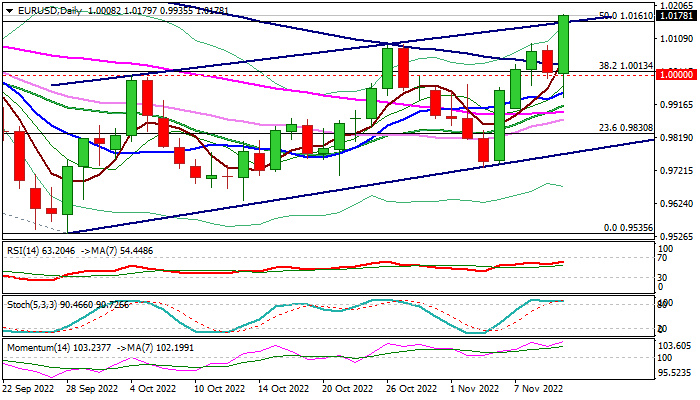
The euro rose strongly in the US session on Thursday, after lower than expected inflation in October signaled that US consumer prices may have peaked that would allow Fed to start reducing the pace of rate hiking.
Fresh bulls pushed the price to two month high, following break through former double top at 1.0088/93 (Oct 26,27) and cracked pivotal Fibo barrier at 1.0161 (50% retracement of 1.0786/0.9535), pressuring September’s peak at 1.0197, violation of which would unmask targets at 1.0308 (Fibo 61.8%) and 1.0368 (August peak.
Bullish daily studies were reinforced by the latest advance, though overbought stochastic warns that bulls may slow in coming sessions.
Improved sentiment adds to bullish near-term outlook, with shallow dips to ideally stay above broken 100DMA (1.0033) and keep intact key supports at 1.0000/0.9954 (parity / daily cloud top).
Res: 1.0197; 1.0308; 1.0368; 1.0444
Sup: 1.0100; 1.0033; 1.0000; 0.9954
Gold completes double bottom, 1788 next
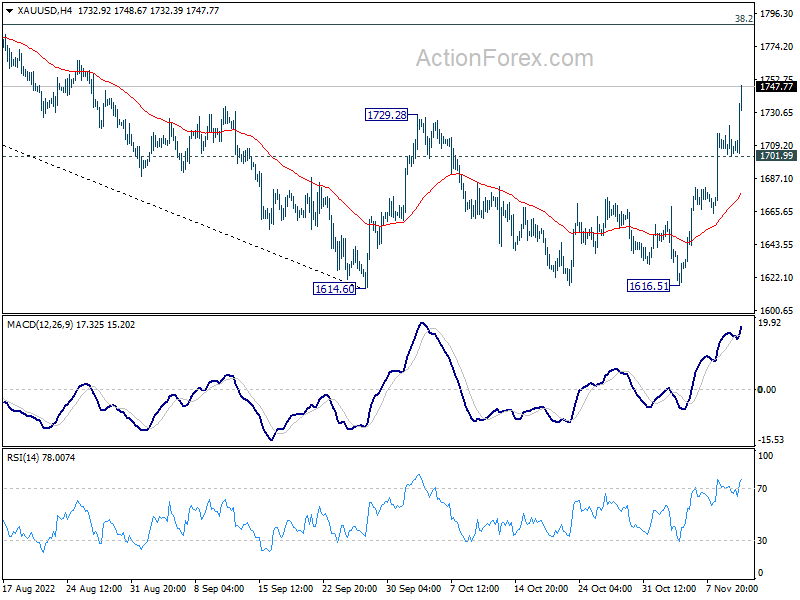
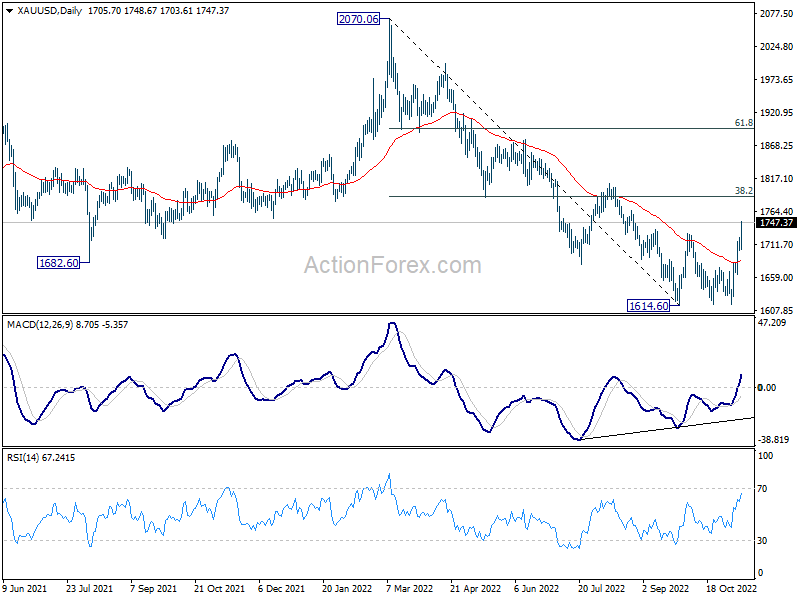
Gold's rally accelerates higher today, as reaction to Dollar's post-CPI sell-off. Break of 179.28 resistance confirmed completion of a double bottom pattern (1614.60; 1616.51), which raises the chance of trend reversal.
Further rise is now expected as long as 1701.99 support holds. Next target is 38.2% retracement of 2070.06 to 1614.60 at 1788.58. Sustained break of 1788.58 will pave the wave to 61.8% retracement at 1896.07.
Fed Logan: CPI data were a welcome relief
Dallas Fed President Lorie Logan said "This morning's CPI data were a welcome relief, but there is still a long way to go."
"I believe it may soon be appropriate to slow the pace of rate increases so we can better assess how financial and economic conditions are evolving," she added.
Fed Harker: In the upcoming months, we will slow the pace of our rate hikes
Philadelphia Fed President Patrick Harker said, "In the upcoming months, in light of the cumulative tightening we have achieved, I expect we will slow the pace of our rate hikes as we approach a sufficiently restrictive stance."
He added, "at some point next year, I expect we will hold at a restrictive rate for a while to let monetary policy do its work". What happened after there will be driven by data. "If we have to, we can always tighten further, based on the data."
"What we really need to see is a sustained decline in a number of inflation indicators before we let up on tightening monetary policy," he said, adding "we need to make sure inflation expectations don't become unanchored."